







Abstract
This study examined patterns of peer affiliations and their associations with child maltreatment, substance use, and future expectations. This study focused on 844 adolescents from the Longitudinal Studies of Child Abuse and Neglect. We identified four distinct peer-affiliation patterns: (1) no affiliation with peers who engage in either prosocial or deviant behaviors; (2) affiliation with peers using substances; (3) affiliation with peers who engage in severe deviant behaviors; and (4) affiliation with peers who engage in prosocial behaviors. Youth with sexual abuse experiences were more likely to be affiliated with peers who engage in severe deviant or prosocial behaviors. We also found different substance use and future expectations depending on peer affiliations. This study highlights the importance of examining both prosocial and deviant peer affiliations.
Keywords
Introduction
Adolescence marks a critical period of human development where peer relationships assume paramount significance. These formative years are characterized by a search for identity, independence, and autonomy, making it a period where individuals often turn to their peers for guidance and support (La Greca & Harrison, 2005). While affiliating with peer groups offers numerous benefits by providing a sense of belonging (Newman et al., 2007; Walker et al., 2014), it also exerts profound challenges by influencing one’s attitudes, behaviors, and decision-making processes (Laursen & Veenstra, 2021). These seemingly contradictory roles of peer affiliation can be explained by with whom the adolescent affiliates, such as prosocial or deviant peer groups. Differential association theory (Akers, 2009) addresses the way people engage in specific behaviors with the desire for social rewards within the group they belong to and its association with consequent behaviors. To solidify relationship within peer groups, adolescents model the behaviors that the group defines favorable.
The role of peer affiliations is particularly impactful for youth who are at risk of maltreatment. Given that adolescents with a history of maltreatment are at a higher risk for insecure attachment (Struck et al., 2020), they may be especially prone to the effects of peer relationships, whether positive or negative (Powers et al., 2009; Tung et al., 2019). However, little research has examined the effects of both prosocial and deviant peer affiliations simultaneously on adolescent development within the context of child maltreatment. The developmental psychopathology perspective (Cicchetti & Toth, 2009) underscores the enduring consequences of early risky experiences (e.g., child maltreatment) and the influence of risk and protective factors over the lifespan. According to this perspective, although child maltreatment experiences can have negative influences on adolescent development, adolescents’ developmental trajectories, and ultimate outcomes may differ based on the risk and protective factors they encounter. Peer relationships, for instance—depending on the nature of the relationships and peer characteristics (e.g., peers engaging in prosocial behavior, peers engaging in deviant behavior)—may serve as a risk or a protective factor and shape youth outcomes following child maltreatment. Thus, it is imperative to understand the complexity of peer affiliations in the context of child maltreatment.
Patterns of Peer Affiliations
Given the significant role of peer affiliations with both prosocial and deviant peers in adolescent development, a growing body of research has examined the patterns of peer affiliations (Vitaro et al., 2005; Yoon et al., 2019). Using a sample of youth aging out of the child welfare system, Shook et al. (2009) identified three distinct peer-affiliation patterns based on the severity of affiliations with their deviant peers: low, moderate, and high. Similarly, Price et al. (2019) examined heterogeneity patterns of deviant peer affiliations at three time-points of adolescence in a sample of youth at risk for substance use. In early adolescence, they identified only three different patterns including “low deviant peers,” “conduct problem focused deviant peers,” and “both conduct problems and substance use peers.” In middle adolescence, they found similar patterns of deviant peer affiliation from early adolescence, but one more pattern was added: “severe levels of conduct problems and substance use peers.” In late adolescence, they found similar patterns from middle adolescence, but “substance focused deviant peers” emerged newly as a particular group in which using substances is common. The “conduct problems focused deviant peers” also disappeared in late adolescence, likely because this is a period during which aggressive behavior is reduced.
Although these two studies have identified distinct patterns of peer affiliations, they focused only on deviant peer affiliation. Yoon (2020) investigated the underlying patterns of peer affiliation using diverse concepts of peer relationships—such as peer dynamics, peer popularity, and deviant peer affiliation—in a sample of adolescents at risk of maltreatment. Yoon (2020) found four noticeable patterns. However, Yoon’s study also neglected prosocial peer affiliation (assuming that low levels of deviant peer affiliation indicated prosocial peer affiliation), which hinders understanding of the intricacies in peer affiliation during adolescence. Adolescents’ peer affiliation is complex; they may be affiliated with both deviant peers and prosocial peers at the same time (Carson 2013; Farrell et al., 2017), both of which can contribute to adolescent substance use and future expectations differently. Thus, there is a need for studies to incorporate youths’ relationships with both deviant and prosocial peers, and to examine the heterogeneity patterns of peer affiliation.
Child Maltreatment and Peer Affiliations
In tandem with the developmental psychopathology perspective, a high volume of research has supported the association between child maltreatment and peer affiliations, mostly focusing on deviant peer affiliations (Kubik et al., 2019; Li et al., 2023; Trinidad, 2021). Although all types of maltreatment have been linked with deviant peer affiliation, the strongest risk factors are emotional abuse (Li et al., 2022; Yoon, 2020; Yoon, Snyder, & Yoon, 2020), physical abuse (Hong et al., 2017; Yoon, Snyder, Yoon, & Coxe, 2020; Zhu et al., 2017), and neglect (Haslam & Taylor, 2022; Kubik et al., 2019; Yang et al., 2021). In contrast to the other types of maltreatment, only a handful of studies have shown an association between sexual abuse and deviant peer affiliation (Fergusson & Horwood, 1999; Mason et al., 2017).
To date, few studies have examined the association between child maltreatment and prosocial affiliation, yielding mixed findings. Allen et al. (2021) examined the relationships among child maltreatment, externalizing symptoms, and prosocial peer affiliation. At the bivariate level, they found higher levels of prosocial peer affiliation among youth with a history of maltreatment, compared to those without maltreatment. Yet the pathways from maltreatment to prosocial peer affiliation were not significant at the multivariate level. Unlike this 2021 study, Han and Margolin (2016) found no relationship between child maltreatment and prosocial peer affiliation even at the bivariate level.
Peer Affiliations and Consequences
Social learning theory (Bandura, 1977) asserts that people mimic the behaviors of others by observing their interactions. In other words, individuals learn and develop positive or negative behaviors depending on their interactions with prosocial or deviant peers by internalizing the values they observe. Along with the theory, much research has focused on examining the consequences of peer affiliation, given the nature of peer affiliations that play a crucial role in youth development tin late adolescence (B. B. Brown & Larson, 2009; Trucco, 2020).
Previous research generally suggested that deviant peer affiliation is a robust predictor of negative outcomes, whereas prosocial peer affiliation is a strong predictor of positive outcomes. Among the diverse negative and positive consequences, adolescent substance use (Ayers et al., 2021; García et al., 2021; Hoeben et al., 2021; Yoon et al., 2023) and future expectations (Marotta & Voisin, 2020; Verdugo & Sánchez-Sandoval, 2022) have been consistently identified to be associated with peer relationship. For example, Hoeben et al. (2021) investigated the role of different peer-group characteristics (e.g., peers engaging in violence, vandalism, and substance use) and their impact on adolescent behaviors. Their findings demonstrated opportunity-driven behaviors. Using an at-risk sample, García et al. (2021) also found that youth who were less affiliated with prosocial peers (e.g., getting good grades) at age 14 were more likely to exhibit illicit substance use at age 16. However, no significant relationships were found for later tobacco, alcohol, or marijuana use. Ayers et al. (2021) mirrored this finding: prosocial peer affiliation was not associated with any substance use, including alcohol, cigarettes, and marijuana. By contrast, Prinstein et al. (2001) found that affiliating with prosocial peers was associated with lower cigarette use but not with lower rates of heavy episodic drinking or marijuana use.
As for the association between peer relationship and future expectations, Marotta and Voisin (2020) found no significant relationships between deviant peer affiliation and future expectations. In contrast, Dubow et al. (2001) found negative associations between deviant peer affiliation and future expectations. Thus, further empirical research is needed to explore the both positive and negative consequences of multidimensional—taking into account both prosocial and deviant—peer affiliations.
The Current Study
Previous studies have identified the crucial role of peer affiliation in later consequences, particularly focusing on adolescent substance use and future expectations, among youth at risk of maltreatment. Most of these studies, however, have focused heavily on deviant peer affiliation; little research has considered prosocial peer affiliation. Given the multidimensional nature of peer affiliation (Carson 2013; Farrell et al., 2017), it is important to examine both prosocial and deviant peer affiliations simultaneously. Additionally, the extant literature has suggested the different impacts of specific child-maltreatment types on peer affiliation, along with the strong association between peer affiliation and adolescent substance use and future expectations. To this end, this study addressed the following research questions: (1) Among youth at risk of maltreatment, is there heterogeneity in patterns of affiliation with peers who engage in prosocial or deviant behaviors?; (2) Do patterns of peer affiliation differ by maltreatment type?; and (3) How are patterns of peer affiliation associated with later adolescent development (i.e., substance use and future expectations)?
Method
Sample
To examine the underlying patterns of peer affiliation among youth at risk of maltreatment, this study used Longitudinal Studies of Child Abuse and Neglect (LONGSCAN), which investigated the antecedents and consequences of child abuse and neglect. LONGSCAN (Larrabee & Lewis, 2014) collected samples from five study sites in the US (N = 1,354). All study sites used the same study variables, measures, and data-management strategies.
This study included 844 adolescents who had all peer affiliation variables at age 14 and child maltreatment at age 12 (Table 1). Approximately half of the participants were female (51.5%) and Black (54.6%). More than a quarter of the participants (27.7%) were low-income, with annual household incomes of less than $15,000. Compared to the baseline sample, adolescents in this study were more likely to be Black, χ2 (1) = 7.75, p = .005. There were no other significant differences between the baseline sample and the final sample.
Descriptive Statistics of Study Variables (N = 844).

CPS records.
Measures
Peer Affiliations
To measure both prosocial and deviant peer affiliation, the modified version of the Youth Risk Behavior and Monitoring the Future Survey (Knight et al., 2008) was used. Adolescents reported their perception of their peer groups’ prosocial or risk behaviors at age 14. Prosocial peer affiliation was assessed using five positive peer social activities, such as participating in school clubs or sports, and getting good grades in schools. It was originally scaled from 0 (none of my friends) to 2 (most of my friends), but all response options were dichotomized as follows: 0 = none or some of my friends, 1 = most of my friends. For deviant peer affiliation, 13 items on peer groups’ antisocial behaviors were used (e.g., substance use and fighting). Similar to prosocial peer affiliation, the original response options were recoded into a dichotomous variable: 0 = none of my friends, 1 = some or most of my friends. Among the 13 items, three items on hard drugs were combined into one item (friends who use drugs) due to the low prevalence of friends using cocaine, heroin, and other drugs (2.8%, 1.5%, and 3.9% respectively).
Child Maltreatment
Child Protective Services (CPS) records were reviewed by LONGSCAN coders who were trained to use the modified maltreatment classification system (MMCS; English et al., 2005), which is a highly validated system to evaluate child maltreatment cases. For this study sample, the inter-rater reliability of the MMCS was acceptable (Kappas > .70; Larrabee & Lewis, 2014). For each maltreatment type (birth to age 12), four dichotomous variables (i.e., physical, sexual, and emotional abuse, as well as neglect) were created.
Adolescent Substance Use
Adolescents’ self-reported alcohol, tobacco, and marijuana use in the past year (1 = yes and 0 = no) was used to measure substance use, following the methodology of previous studies (Benedini & Fagan, 2020; Duprey et al., 2017; Yoon et al., 2023).
Adolescent Future Expectations
Adolescents self-reported at age 16 their future expectations in the areas of education/career and financial instability, using a modified version of the Add Health study and Michigan Study of Adolescent and Life Transitions (Knight et al., 2008). Education- and career-related expectations were assessed using four items (e.g., go to college, get the job you want), while financial instability expectations were assessed using four items (e.g., you will go on welfare sometime, be unemployed sometime). For both scales, 5-point Likert scale (1 = very unlikely to 5 = very likely) response options were used. In this sample, internal consistency reliability (α) for education/career expectation and financial instability expectation were .72 and .65, respectively.
Covariates
Adolescent gender (1 = female, 0 = male), race/ethnicity (White, Black, Hispanic, and Other), and household income (12 categories with $5,000 increments per year, ranging from “less than $5,000” to “more than $55,000”) were used as covariates.
Statistical Analyses
Before conducting a series of main analyses, we checked frequencies, descriptive statistics, and bivariate correlations between all study variables using SPSS v. 28. Latent Class Analysis (LCA) was performed to identify patterns of prosocial and/or deviant peer affiliations (Research question 1). LCA is a beneficial method to empirically examine distinct subgroups based on categorical indicators (Collins & Lanza, 2010). Using Mplus 8.3, two- to six-class models were estimated iteratively to determine the optimal number of classes, which was decided with several model fit indices: Akaike Information Criteria (AIC), Bayesian Information Criteria (BIC), the sample-size-adjusted BIC (ABIC), the Vuong Lo-Mendell-Rubin test (VLMR), and entropy. For AIC, BIC, and ABIC, the smaller values indicate better model fits (Nylund et al., 2007). For VLMR, the p-value determines whether model fit significantly improves after adding an additional class model to the previous model, compared to previous model (Nylund et al., 2007). For entropy (ranges from 0 to 1), higher levels of entropy generally yield a better model fit (Celeux & Soromenho, 1996). The percentage of smallest class and interpretability were also checked. After determining the final number of classes, the most likely classes were used for multinomial logistic regression (Research question 2), multiple logistic regressions, and OLS regression (Research question 3). The Full Information Maximum Likelihood (FIML) method—an effective way to handle parameter estimates and standard errors when data are missing at random (MAR) or missing completely at random (MCAR)—was used to handle missing data (Cham et al., 2017).
Results
Patterns of Peer Affiliations
The model fit indices showed conflicting results. For example, AIC, BIC, and ABIC suggested that the six-class model fit better than the 5-class model. However, the VLMR p-values indicated the four-class model to be the best fitting. After reviewing model fit indices with interpretability, we determined that the four-class solution had the best fit for the data. Figure 1 shows a plot with item probabilities for the four-class solution. Class 1 was labeled as no affiliation with peers who engage in either prosocial or deviant behaviors (37.2%) because this class has generally reported low peer affiliation across most items. Class 2, estimated as representing 26.7% of the sample, was labeled affiliation with peers using substances. Youth in this class reported that their peer groups had relatively high rates of using substances including alcohol, tobacco, and marijuana. Class 3 (8.6%) was labeled as affiliation with peers who engage in severe deviant behaviors. This class consistently reported that their peer groups were involved in high rates of deviant behaviors (e.g., substance use, selling drugs, and shoplifting) and low rates of prosocial behaviors (e.g., good behavior in school and getting good grades). Class 4 was labeled affiliation with peers who engage in prosocial behaviors (27.3%). Youth in this class reported that their peer groups had high involvement in prosocial behaviors.
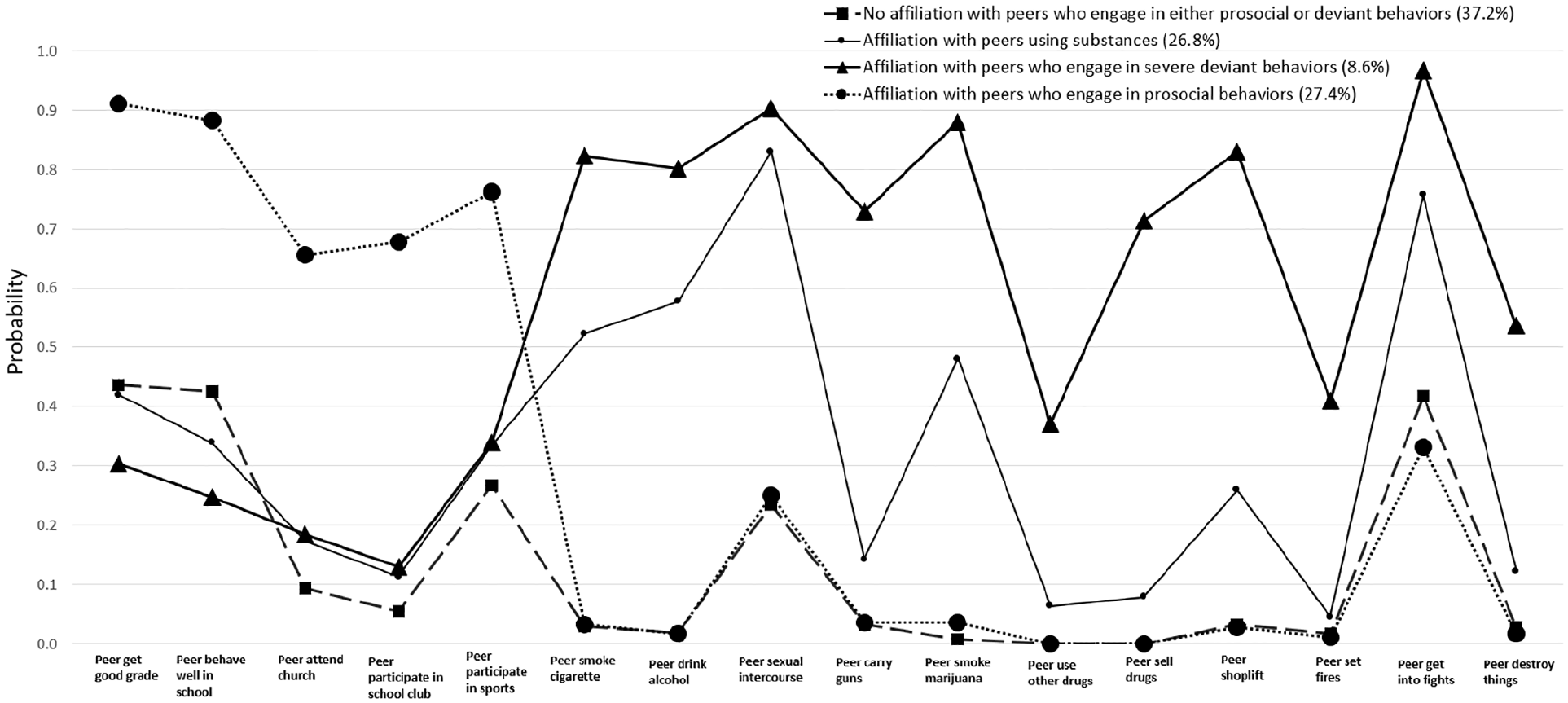
Plot with item-probabilities for the four-class solution.
Child Maltreatment and Patterns of Peer Affiliations
Table 2 shows the effects of child maltreatment types on peer-affiliation classes, after controlling for demographic information. Adolescents who had had sexual abuse experiences in their life were 2.74 times more likely to be in the Class 3 (95% CI [1.09, 6.92]) and the Class 4 (95% CI [1.18, 4.19) than to be in the Class 1. Compared to youth who identified as Black, those who self-identified their race as “other” had lower odds of being in the Class 3 (OR = 0.35, 95% CI [0.17, 0.71]). Female adolescents were less likely to be in the Class 3 than in the Class 2 (OR = 0.52, 95% CI [0.27, 0.99]). Finally, youth who identified as “other race” had lower odds of being in the Class 4 than were those who identified as Black (OR = 0.34, 95% CI [0.17, 0.71]).
Effects of Child Maltreatment Types on Peer Affiliation Classes, OR (95% CI).

Note. The significant association is indicated as bold.
Patterns of Peer Affiliations and Adolescent Development
Figure 2 presents the association between identified peer relationship classes and adolescent substance use and future expectations, after controlling for demographic information. Youth in the Class 3 (61.9%) drank more than those in the Class 2 (39.3%), Class 1 (24.1%), and Class 4 (16.2%). Additionally, more youth in the Class 2 drank alcohol than those in the Class 1 and 4. White youth were more likely to drink alcohol than Black youth (OR = 1.61, 95% CI [1.01, 2.55], p = .046). As for tobacco use, youth in the Class 4 (10.2%) smoked less tobacco than those in the Class 3(42.2%), Class 2 (38.1%), and Class 1 (18.5%) classes. In addition, youth in the Class 1 reported less tobacco use than those in the Class 2 and 3. Compared to Black youth, White (OR = 2.80, 95% CI [1.70, 4.61], p < .001) and “other race” (OR = 2.19, 95% CI [1.26, 3.80], p = .005) youth had higher odds of smoking tobacco. Regarding marijuana use, youth in the Class 3 (49.4%) reported more marijuana use than those in Class 2 (31.5%), Class 1 (17.7%), and Class 4 (6.5%). Additionally, more youth in the class 2 reported marijuana use than those in the Class 1 and 4. Youth in the Class 1 also reported more marijuana use than youth in the Class 4.
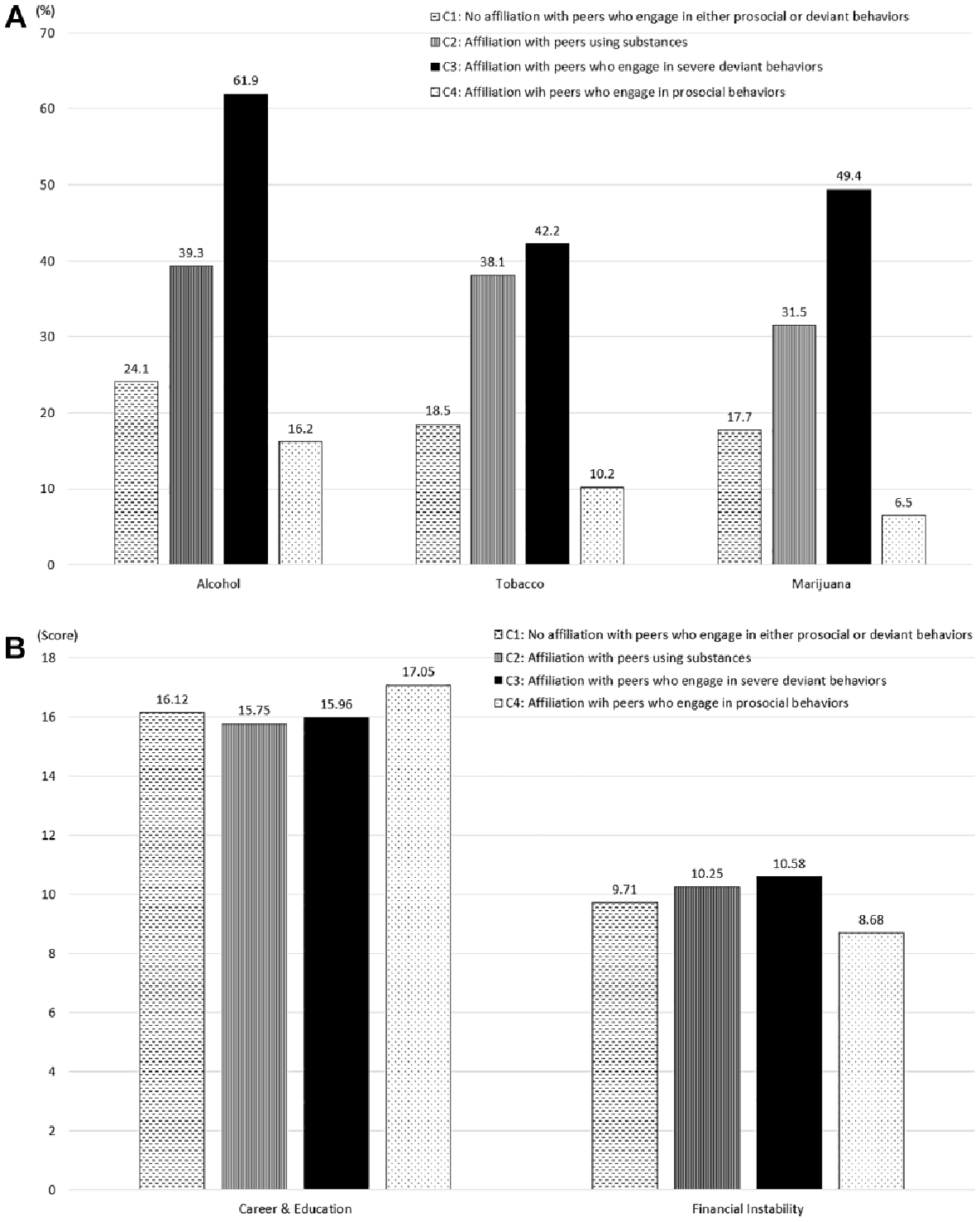
Adolescent substance use and future expectations at age 16 by latent classes.
In regard to career and education expectations, youth in the Class 4 (M = 17.05, SE = .23) reported better career and education expectations than those in the Class 1 (M = 16.12, SE = .19), Class 2 (M = 15.75, SE = .22), and Class 3 (M = 15.96, SE = .41). Similarly, youth in the Class 4 (M = 8.68, SE = .23) reported lower scores on financial-instability expectations than those in the Class 1 (M = 9.71, SE = .19), class 2 (M = 10.25, SE = .22), and class 3 (M = 10.58, SE = .41), indicating that youth with peers who engage in prosocial behaviors have better financial-instability expectations than the others.
Discussion
By examining both prosocial and deviant peer affiliations simultaneously using an at-risk sample, this study goes beyond most existing research, which has relied solely on either deviant or prosocial peer affiliations. The identified classes were roughly similar to previous studies: that is, peers using substances, peers who engage in severe deviant behaviors, and peers who engage in prosocial behaviors (Price et al., 2019; Shook et al., 2009). Our findings, however, did not discover a class of affiliations with peers who engage in both prosocial and deviant behaviors, as suggested by Carson (2013) and Farrell et al. (2017). Instead of having affiliation with both peer groups, we found a “no affiliation with peers who engage in either prosocial or deviant behaviors” class. These are important new findings. Previous studies used either one of the affiliations (deviant or prosocial peers), which made it difficult to detect one of the most predictable peer statuses: that is, no affiliation with peers who engage in either prosocial or deviant behaviors. Past studies had falsely assumed that adolescents would be affiliated with prosocial peers if they were not affiliated with deviant peers (Yoon, 2020). However, our results indicate that low levels of deviant peer affiliation do not necessarily mean high affiliation with prosocial peers. It is also important to note that the largest group in this study consisted of individuals with “no affiliation with peers who engage in either prosocial or deviant behaviors.” This may reflect the challenges faced by at-risk youth in building relationships within a maltreatment-affected population. Future research is needed to explore the pathways to relationship-building in this group.
Youth who had been sexually abused were more likely to affiliate with peers who engage in severe deviant behaviors. This finding is consistent with the findings of Fergusson and Horwood (1999) and Yoon et al. (2019), which demonstrated that sexual-abuse experiences are associated with affiliation with peers who engage in deviant behaviors in early adolescence. It is plausible that youth with sexual-abuse experiences have low self-esteem (Gauthier-Duchesne et al., 2022; Okunlola et al., 2021), and that they tend to affiliate with peers who engage in severely deviant behaviors (Lin et al., 2022) because peers who do so are possibly viewed as cool or having power among peer groups (Rodkin et al., 2006). Surprisingly, youth with sexual abuse experiences also reported more affiliation with peers who engaged in prosocial behaviors. It is possible that they may try to recover from their traumatic experiences and achieve healthy relationship functioning (Newsom & Myers-Bowman, 2017). Suffering from sexual-abuse experiences may make these adolescents seek out relationships that give them a strong sense of identity among their peers (Fergusson et al., 2013)—which may entail affiliating with peers who engage in prosocial or severely deviant behaviors. Further research is needed to examine why some adolescents, following sexual abuse, affiliate with peers who engage in deviant behaviors whereas others affiliate with peers who engage in prosocial behaviors.
It was surprising that physical and emotional abuse, as well as neglect, were not significantly associated with peer affiliations, despite past research demonstrating the detrimental effects of other types of maltreatment on deviant peer affiliation (Haslam & Taylor, 2022; Li et al., 2022; Yoon, Snyder, & Yoon, 2020; Zhu et al., 2017). These contradictory results could be explained in two parts. First, the current study includes a diverse range of peer affiliation, encompassing peers engaged in both prosocial and deviant behaviors. Previous research did not take into account for peers engaging in prosocial behaviors, which may have led to inconsistent findings. Second, this study examines various types of maltreatment (i.e., physical, sexual, and emotional abuse, as well as neglect), whereas prior research has solely focused on only one type, such as physical abuse (Zhu et al., 2017) or neglect (Haslam & Taylor, 2022). However, future research is needed to explore why and how only experiences of sexual abuse are associated with peer affiliation.
The results of the current study have broad ramifications for our comprehension of how adolescents establish peer relationships and the ways in which these connections influence several facets of their development, including substance use and expectations for the future. Consistent with the differential association theory (Akers, 2009), our study generally indicates that the characteristics of peers with whom adolescents are affiliated influence adolescent substance use. For example, youth affiliating with peers who engage in prosocial behaviors are less likely to use substances than are those who affiliate with peers engaged in substance use or severe deviant behaviors. These results are consistent with most previous studies (Ayers et al., 2021; García et al., 2021; Marotta & Voisin, 2020; Verdugo & Sánchez-Sandoval, 2022), suggesting the monitoring of peer affiliations and encouraging prosocial peer affiliations. There are, however, a few differences depending on the substances.
For alcohol use, there were no significant differences between “no affiliating with peers who engage in either prosocial or deviant behaviors” and “affiliating with peers who engage in prosocial behaviors.” The absence of significant differences explains the tendency of alcohol use during adolescence, which is often a rite of passage rather than a direct marker of deviance (S. A. Brown et al., 2008). We found, though, that when they were affiliated with peers who engage in substances or severe deviant behaviors, they were more frequently drinking alcohol, which is consistent with previous studies (Pesola et al., 2015; Wilhoit & Goodnight, 2022). Conversely, the similarities in tobacco use between adolescents affiliated with peers who engage in substances and affiliation with peers who engage in severely deviant behaviors could be attributed to the addictive nature of nicotine, transcending the specific type of deviant affiliation (Chassin et al., 2010). Lastly, the distinct levels of marijuana use among the four groups underscore the importance of peer influence in the initiation and maintenance of marijuana use. This is in line with the findings by Fergusson et al. (2002), who suggested that peer affiliations could have a differential impact on the type and frequency of substance use.
The results of the association between peer affiliation and future expectations reinforce the notion that affiliations with peers who engage in prosocial behaviors are linked with having a more optimistic outlook on one’s future career and financial stability (Beal & Crockett, 2010). This is a critical insight, given the protective role of positive future orientation in adolescent development (Seginer, 2009). Yet youth in the “no affiliation with peers who engage in either prosocial or deviant behaviors” class did not have significant differences in future expectations compared to those in the “peers who engage in severe deviant behaviors” and “peers using substances” classes. This suggests that youth whose peers are not engaged in prosocial or deviant behaviors may serve as a risk factor for future expectations. It is possible that parents or teachers pay less attention to youth who are not affiliated with peers who engage in either deviant behaviors or prosocial behaviors because they appear to do fine at home or school. However, our results suggest that this group may also be at risk for negative future expectations, which may be a serious warning sign for later outcomes during young adulthood.
Strengths and Limitations
The use of sophisticated analytic techniques represents the strengths and methodological rigor of this study. In addition, it makes an important contribution to the literature in its nuanced examination of the intricacies of peer relationships, and of their association with maltreatment and adolescent development outcomes. Furthermore, this study contributes a unique perspective by considering simultaneously the influence of affiliations with peers who engage in prosocial and deviant behaviors. The use of both prosocial and deviant peer-affiliation measures helped to identify a new peer-affiliation pattern: that is, no affiliation with peers who engage in either prosocial or deviant behaviors. This pattern is particularly important for practitioners to consider as it highlights the complexity of peer relationships. That is, the absence of deviant peer affiliation does not automatically indicate an affiliation with prosocial peers. Finally, this study applies a strength-based approach by acknowledging peers who engage in prosocial behaviors and examining positive outcomes.
Despite its strengths, the study’s generalizability is limited due to the specific characteristics of the sample, which consists predominantly of Black, low-income adolescents at risk for maltreatment. Future research may consider including a more diverse population. Additionally, this study had limitations related to measurement of key construct. Specifically, we relied on youth self-reports of peer relationships and adolescent development, which may be prone to social desirability bias. Social network analysis could help identify more nuanced information about peer affiliations and relationships. Lastly, this study used official records of child-maltreatment experiences, which do not account for unreported cases. Future research might consider including self-reported maltreatment experiences to capture underreported cases.
Implications
The findings of this study have significant implications for developing targeted interventions that promote healthy adolescent development, especially for those at risk for maltreatment. By identifying distinct patterns of peer affiliations that include both deviant and prosocial influences, our research fills a critical gap in the existing literature. For instance, mentoring programs and extracurricular activities can provide structured environments for prosocial peer interactions (Karcher, 2005). Schools and communities must also consider the importance of fostering opportunities for adolescents to develop healthy peer relationships across cultural, racial, and socioeconomic lines.
Additionally, our findings suggest that interventions must account for the unique needs of adolescents who have a history of sexual abuse and provide them with opportunities to form secure and supportive peer relationships, via interventions such as trauma-informed care and therapeutic groups (Cohen et al., 2006). Previous studies have largely focused on the impact of deviant peer affiliations on adolescent behavior, often neglecting the simultaneous role of prosocial peer affiliations. This study’s comprehensive approach provides a more nuanced understanding of how these affiliations collectively shape substance use behaviors and future expectations in adolescents. Such insights are crucial for practitioners who aim to support at-risk youth by addressing both the risks and benefits associated with different types of peer affiliations.
Our findings challenge the traditional assumption that low levels of deviant peer affiliation automatically indicate high levels of prosocial peer affiliation. By identifying a subgroup of adolescents who are not affiliated with either prosocial or deviant peers, the study introduces a new dimension to the discussion of peer influences. This “no affiliation” pattern, which has been largely overlooked in prior research, suggests that youth who lack engagement with both types of peers may be at risk, particularly concerning their future expectations and overall development. This discovery has important implications for intervention strategies, as it indicates the need for targeted efforts to engage socially isolated adolescents in positive social activities that can foster their development and improve their outlook on the future.
Finally, this study not only reinforces the importance of peer relationships in adolescent development but also broadens the scope of current research by integrating prosocial peer affiliations into the analysis. The inclusion of both prosocial and deviant peer affiliations provides a more comprehensive framework for understanding the complex dynamics of peer influences on adolescent behavior. These findings are essential for practitioners developing interventions aimed at promoting healthy peer relationships and mitigating the risks associated with both deviant affiliations and social isolation among at-risk youth. By addressing the full spectrum of peer affiliations, practitioners can better support adolescents in navigating their social environments and achieving positive developmental outcomes.
Footnotes
Acknowledgements
Dr. Dalhee Yoon conceptualized the paper, conducted the statistical analyses, and drafted the manuscript. Mr. Juan Benavides and Frank Okyere Osei, Drs. Jiho Park, Keisha Wint, and Susan Yoon interpreted the data and helped to draft the manuscript.
Data Availability Statement

Declaration of Conflicting Interests
The author(s) declared no potential conflicts of interest with respect to the research, authorship, and/or publication of this article.
Funding
The author(s) disclosed receipt of the following financial support for the research, authorship, and/or publication of this article: This research was funded by the Institute for Justice and Well-Being with support from Binghamton University Division of Research.