







Abstract
Existing research on future orientation inventory among serious juvenile offenders has predominantly focused on individual predictors, necessitating a broader understanding of their developmental trajectories and influencing factors. Utilizing data from the Pathways to Desistance study (n = 1,354, 80.8% male), this study employed latent growth curve modeling to examine future orientation trajectories across four waves. Findings reveal a general positive growth in future orientation, with notable individual differences in both initial levels and growth rates. Baseline Parental warmth, friendship quality, and self-reliance positively influence initial future orientation, while Hispanic identity shows negative associations. These results highlight the importance of targeted interventions aimed at fostering resilience, enhancing peer support, and promoting long-term planning among juvenile offenders.
Keywords
Introduction
The future orientation trajectories of serious juvenile offenders represent a critical area of inquiry, as it sheds light on the cognitive and social development of this at-risk population (Mulvey et al., 2004). These trajectories are influenced by a variety of factors, including the quality of baseline friendships, parental warmth, and individual levels of self-reliance (Eccles et al., 2004; Greenberger et al., 1975; Pierce et al., 1992). Understanding the role of baseline independent variables in predicting future orientation trajectories is essential, as these initial conditions provide a foundation upon which developmental changes occur (e.g., Felt et al., 2017). By focusing on baseline predictors, this study aims to distinguish the long-term effects of these early influences from short−term fluctuations, thereby providing a clearer understanding of the underlying mechanisms driving changes in future orientation trajectories. Examining the developmental course of future orientation trajectories can provide valuable insights for interventions aimed at promoting positive life outcomes for these youths (Conger et al., 1994; Strathman et al., 1994). The importance of future orientation is especially evident in the context of diverse social, racial, and gender, as these factors significantly interact with an individual’s growth trajectory (Greenberger et al., 1975; Mulvey et al., 2004; Pierce et al., 1992). By identifying these influences, educators and policymakers can design more effective support systems to foster resilience and positive future planning among juvenile offenders.
Future Orientation Inventory Trajectories
Future orientation inventory trajectories offer a crucial framework for examining how serious juvenile offenders envision and plan for their future over time (Abram et al., 2009). These trajectories reflect the developmental shifts in an individual’s capacity to anticipate future outcomes, make long-term decisions, and set goals (Nurmi, 1991). Future orientation is particularly significant in this population, as it is closely tied to their ability to navigate complex personal and legal challenges during the transition to adulthood (Steinberg et al., 2009). By assessing these trajectories, researchers can gain valuable insights into the cognitive and motivational processes that underlie decision-making in high-risk environments (Stouthamer−Loeber et al., 2002). While research in this area remains limited, understanding the patterns of future orientation development provides a foundation for designing interventions aimed at supporting better life outcomes (Kazemian & Farrington, 2006). Notably, these trajectories are shaped by key factors such as parental warmth, peer support, and motivation to succeed (Harder et al., 2012; Kerpelman & Mosher, 2004). This study aims to explore how these Influencing factors affect future orientation trajectories, thus offering crucial insights for interventions that foster positive developmental outcomes in this vulnerable group.
Relations Between Friendship Quality and Future Orientation Inventory Trajectories
The quality of friendships plays a vital role in shaping the future orientation trajectories of serious juvenile offenders (Blieszner & Roberto, 2003). Positive peer relationships provide emotional support and foster an environment where individuals feel encouraged to set and pursue long−term goals (Wentzel, 1998). Adolescents with high−quality friendships are more likely to develop a stronger sense of future orientation, as peer support often contributes to motivation and persistence in the face of challenges (Hartup & Stevens, 1997). Moreover, the presence of close, supportive friendships has been shown to enhance decision-making abilities, which are critical for long-term planning and future orientation (Wentzel et al., 2004). In contrast, lower-quality friendships or associations with delinquent peers can negatively impact future planning, as these relationships may encourage risky behaviors and short-term thinking (Dishion & Tipsord, 2011). Overall, research indicates that the quality of adolescent friendships is a significant predictor of future orientation trajectories, making it a key factor in understanding developmental outcomes in high-risk youth populations (Zimmer-Gembeck et al., 2005). However, existing research has primarily focused on general adolescent populations, leaving a gap in understanding how friendship quality specifically influences the future orientation trajectories of serious juvenile offenders. Our study seeks to address this gap by examining the unique ways in which high-quality and low-quality peer relationships affect the future orientation trajectories of this high-risk group, providing new insights that can inform targeted interventions.
Relations between Motivation to Succeed and Future Orientation Inventory Trajectories
Motivation to succeed is a particularly important factor in shaping the future orientation trajectories of juvenile offenders (Alarid et al., 2000). For this population, a strong desire to succeed can act as a protective factor, helping them to overcome the adverse circumstances often associated with delinquency, such as unstable family environments and negative peer influences (Zigler & Hall, 1987). Juvenile offenders with higher levels of motivation are more likely to envision a positive future, engage in long-term planning, and make decisions that align with their goals for personal improvement (Snyder et al., 2000). This motivation has been linked to lower recidivism rates, as it encourages individuals to focus on education, employment, and personal growth, which are essential for reintegration into society (Ryan & Deci, 2000). In contrast, a lack of motivation to succeed can lead to disengagement from future-oriented thinking, increasing the likelihood of reoffending and hindering the development of a positive future outlook (Burnett & Maruna, 2004). Therefore, motivation to succeed plays a critical role in determining the future orientation trajectories of juvenile offenders, directly impacting their long-term rehabilitation outcomes (Carroll et al., 2008). However, much of the existing research has primarily focused on general populations of offenders, without specifically examining the unique motivational factors that drive future orientation among serious juvenile offenders. Our study seeks to address this gap by exploring how motivation to succeed uniquely influences future orientation trajectories in this high-risk group, providing critical insights for designing targeted interventions aimed at reducing recidivism and promoting successful reintegration.
Relations Between Parental warmth and Future Orientation Inventory Trajectories
Parental warmth is a critical factor influencing the future orientation trajectories of juvenile offenders (Laible et al., 2000). Warm and supportive relationships with parents foster a sense of security and self-efficacy, which are essential for developing long-term goals and future planning (Conger et al., 1994). Adolescents who experience high levels of parental warmth are more likely to develop positive future orientations, as such relationships provide emotional support and guidance that help them navigate challenges and setbacks (Steinberg, 2001). This supportive dynamic encourages the development of resilience, allowing juvenile offenders to focus on rehabilitation and future success rather than on short-term gratification or risky behaviors (Hoeve et al., 2009). Parental warmth has also been linked to lower rates of recidivism, as it promotes stronger family bonds, which are often protective factors against reoffending (Farrington & Loeber, 2000). In contrast, a lack of parental warmth or the presence of parental neglect has been shown to contribute to negative future orientation trajectories, increasing the likelihood of engagement in delinquent behaviors and reoffending (Patterson et al., 2017). Although existing literature has explored the relationship between parental warmth and the future outcomes of juvenile offenders, few studies have specifically examined how parental warmth influences the trajectories of future orientation over time. Our study aims to address this gap by focusing on the longitudinal development of future orientation trajectories in juvenile offenders, highlighting the critical role of parental warmth in shaping these trajectories and contributing to more effective interventions for rehabilitation.
Relations Between Self−reliance and Future Orientation Inventory Trajectories
Self-reliance is a key factor that shapes the future orientation trajectories of juvenile offenders (Schwartz et al., 2005). Adolescents who demonstrate a higher degree of self-reliance are better equipped to plan for the future and make decisions that align with their long-term goals (Greenberger & Sorensen, 1974). Self-reliant individuals tend to exhibit greater personal agency, which allows them to take responsibility for their actions and persist in the face of challenges, critical components for successful future planning (Bandura, 1999). Research has shown that self-reliance is associated with stronger problem-solving skills and the ability to avoid risky behaviors, both of which are crucial for maintaining positive future orientation trajectories (Steinberg, 2005). For juvenile offenders, developing self-reliance can act as a protective factor, helping them to resist negative peer influences and remain focused on long-term rehabilitation goals (Moffitt, 2017). Although prior research has highlighted the importance of self-reliance in adolescent development, there is limited exploration of how self-reliance specifically influences the trajectories of future orientation among juvenile offenders over time. Our study aims to address this gap by investigating the longitudinal impact of self-reliance on future orientation trajectories, providing new insights into the developmental processes that contribute to successful rehabilitation.
Relations Between Demographic Factors and Future Orientation Inventory Trajectories
Demographic factors, such as race and gender, have often been considered in studies examining future orientation trajectories among adolescents, including juvenile offenders. Previous research has suggested that these factors may play a role in shaping individuals’ future planning and long−term goal setting (e.g., Nurmi, 1991; Mulvey et al., 2004). However, there has been limited research specifically exploring the influence of demographic factors on the future orientation trajectories of serious juvenile offenders. Most existing studies tend to focus on other psychological or social factors, overlooking the potential subtle effects that demographic variables might have. Therefore, this study aims to fill this gap by examining how race and gender may influence the future orientation trajectories of juvenile offenders, providing a more nuanced understanding of the role these demographic factors play in shaping developmental outcomes.
The Present Study
Previous research on future orientation trajectories among serious juvenile offenders has predominantly focused on singular aspects or single time point, leaving gaps in understanding the holistic development of these trajectories. Addressing these limitations, the present study aims to explore the developmental course of future orientation in serious juvenile offenders, focusing on a diverse range of influencing factors including early friendship quality, parental warmth, self-reliance, motivation to succeed, race, and gender. Specifically, we use latent growth curve modeling (LGCM) to examine the developmental trajectories of future orientation over four waves, with covariates representing various psychosocial and demographic factors. Our study tracked serious juvenile offenders from adolescence into young adulthood, allowing us to understand the dynamic changes in their future planning capabilities. We hypothesize that:
Hypothesis 1: Participants with higher levels of friendship quality at Wave 1 will demonstrate a higher initial level of future orientation and an increasing trajectory compared to those with lower friendship quality.
Hypothesis 2: Participants with higher levels of motivation to succeed at Wave 1 will have a higher initial level of future orientation and a steeper growth trajectory over time.
Hypothesis 3a: Higher levels of maternal warmth at Wave 1 will be positively associated with both the initial level and the growth trajectory of future orientation.
Hypothesis 3b: Higher levels of paternal warmth at Wave 1 will be positively associated with the initial level of future orientation but negatively associated with the growth trajectory over time.
Hypothesis 4: Participants with higher levels of self-reliance at Wave 1 will have a higher initial level of future orientation and a steeper growth trajectory over time.
Research Question: How do race and gender influence the initial level and growth rate of future orientation among serious juvenile offenders? This question is exploratory, as there is insufficient literature to support a specific hypothesis regarding the influence of these demographic factors.
Method
Participants
The present study drew on data from the Pathways to Desistance study (Pathways; Mulvey et al., 2014), which is a multi-site longitudinal research project that tracked 1,354 serious juvenile offenders from adolescence into young adulthood across two locations: Maricopa County (Phoenix), Arizona, and Philadelphia County, Pennsylvania. Baseline data collection took place between November 2000 and January 2003. To focus on participants in young adulthood, the current study utilized data from the 6 month (Wave 1), 12 month (Wave 2), 18 month (Wave 3), and 24 month (Wave 4) follow-up assessments, resulting in a final sample of 1,354 individuals. At the start of the study, participants were aged between 14 and 20 years. The majority of the sample was male (n = 1,094, 80.8%). In terms of racial and ethnic background, 274 participants (20.2%) identified as White, 561 (41.4%) identified as Black, 454 (33.5%) identified as Hispanic, and 65 (4.8%) were from other racial/ethnic groups. Table 1 presents bivariate associations and Table 2 presents descriptive statistics for the study samples.
Bivariate Associations for the Study Variables.
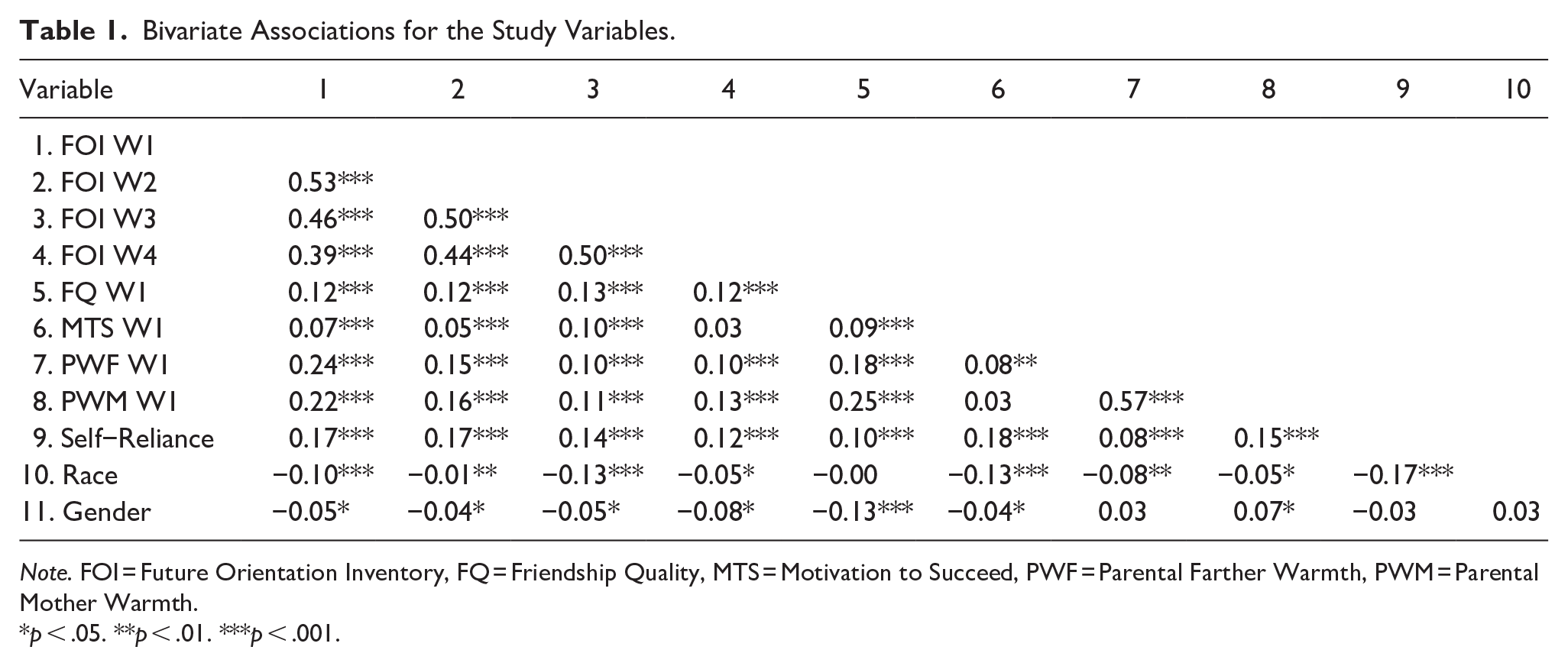
Note. FOI = Future Orientation Inventory, FQ = Friendship Quality, MTS = Motivation to Succeed, PWF = Parental Farther Warmth, PWM = Parental Mother Warmth.
p < .05. **p < .01. ***p < .001.
Descriptive Statistics for the Study Variables.
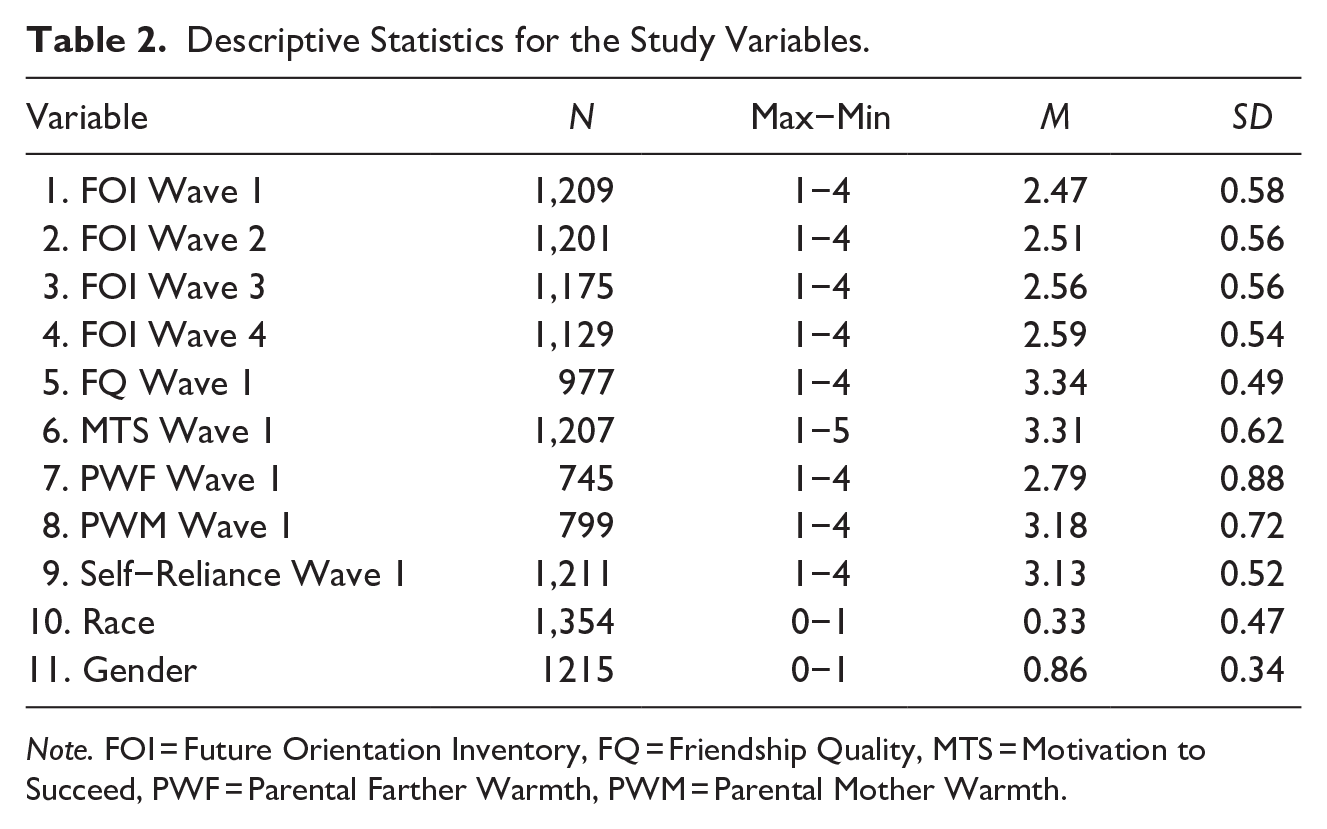
Note. FOI = Future Orientation Inventory, FQ = Friendship Quality, MTS = Motivation to Succeed, PWF = Parental Farther Warmth, PWM = Parental Mother Warmth.
Measures
Future Orientation Inventory
The Future Outlook Inventory (FOI) was a 15-item measure designed to assess the extent to which individuals consider and plan for their future. The scale draws on items from the Life Orientation Test (Scheier & Carver, 1985), the Zimbardo Time Perspective Scale (Zimbardo, 2017), and the Consideration of Future Consequences Scale (Strathman et al., 1994). Participants rate each statement on a 4-point Likert scale ranging from 1 (Never True) to 4 (Always True) to indicate how well the statements represent their usual behavior (e.g., “I will keep working at difficult, boring tasks if I know they will help me get ahead late”’). Higher scores reflect a stronger orientation towards future planning and a greater tendency to consider future outcomes when making decisions. Although the scale contains 15 items, only 8 of these items are included in the total score computation, while the remaining 7 items are excluded. Cronbach’s alpha for the scale was .78.
Friendship Quality
The Friendship Quality scale was adapted from items included in the Quality of Relationships Inventory (Pierce et al., 1991). The original scale was designed to assess interpersonal support from a single romantic partner, but this adaptation shifted the focus to a global assessment of the youth’s five closest friends. Participants were asked to provide an average rating across these friends. The scale consisted of 10 items that assessed various aspects of support and closeness (e.g., “How much could you count on these people for help with a problem?,” “How close did you think you would be to these people in ten years?”, “How much did you depend on these friends?”). Responses were recorded on a 4-point Likert scale ranging from 1 (Not at all) to 4 (Very much), reflecting the level of support and the quality of the relationship with close friends. To calculate the mean score, at least 7 items had to contain valid data. Higher scores indicated a higher perceived quality of friendship.
Motivation to Succeed
The Motivation to Succeed scale was based on items developed by Eccles et al. (1998). It consisted of six items that assess an individual’s perception of the opportunities available in their neighborhood concerning education and work. This measure was administered at each follow-up interview, reflecting the perceived opportunities in the neighborhood where the individual resided the longest during the recall period. Participants responded to each item on a 5-point Likert scale ranging from 1 (Strongly disagree) to 5 (Strongly agree). An overall “Motivation to Succeed” score was computed by taking the mean of these six items, with higher scores indicating a more optimistic view of future success.
Parental Warmth
The Parental Warmth measure was adapted from the Quality of Parental Relationships Inventory (Ge et al., 1994) to assess the emotional tone of the parental-adolescent relationship. Items in the measure assessed maternal warmth (e.g., “How often did your mother/father let you know she really cared about you?”) and paternal warmth (e.g., “How often did your father tell you he loved you?”). The scale contained 42 items in total, with 21 items dedicated to the maternal relationship and 21 items dedicated to the paternal relationship. Participants responded on a 4-point Likert scale ranging from 1 (Always) to 4 (Never), where higher scores indicated a more supportive and nurturing parental relationship. For both parental warmth—mother and parental warmth—father, 9 items were used to calculate the mean score, with at least seven items needing to contain valid data for the score to be computed.
Self-Reliance
The Self-Reliance subscale of the Psychosocial Maturity Inventory (PSMI Form D) (Greenberger et al., 1975) was used to assess the participants’ sense of internal control and their ability to make decisions without heavy reliance on others. This subscale included 10 items, such as “Luck decides most things that happen to me” (reverse coded). Participants responded on a 4-point Likert scale ranging from 1 (Strongly Agree) to 4 (Strongly Disagree), with higher scores reflecting greater self−reliance. The mean score of the 10 items was used for analysis.
Race
Race was coded as 0 (Non-Hispanic) and 1 (Hispanic) .
Gender
Gender was coded as 0 (female) and 1 (male).
Analytic Plan
We employed latent growth curve modeling (LGCM) to examine our proposed hypotheses. Initially, an unconditional LGCM was estimated, without including covariates, to describe the starting point and growth trajectory of participants’ future orientation inventory. Subsequently, a conditional LGCM was estimated, incorporating covariates of interest as predictors of the intercept and slope factors. Significant associations between covariates and intercept or slope terms indicated relationships with the initial level or the growth rate of participants’ future orientation over time. All analyses were conducted using Mplus and Stata, utilizing full−information maximum likelihood estimation to address missing data. Model fit was evaluated using the comparative fit index (CFI > .95), the standardized root mean square residual (SRMR < .08), and the root mean square error of approximation (RMSEA < .08) as criteria (Hu & Bentler, 1999).
Results
We estimated an unconditional latent growth curve model (LGCM) for future orientation across four waves, χ² (5) = 10.55, p < .001; CFI = .994; SRMR = .031; RMSEA = .029, 90% CI = [.000, .053]. Model fit indices were all satisfactory, and thus, this model was chosen for subsequent analyses. Both the means of the intercept and slope factors were significant, with a baseline mean of future orientation at 2.54 (SE = .02, p < .001) and a positive linear growth rate of 0.04 (SE = .01, p < .001). These results indicate a significant increase in future orientation over time. The variances for the intercept (Di = .22, SE = .02) and slope (Ds = .01, SE = .003) were significant (p < .001), indicating notable individual differences in the initial level and growth trajectory of future orientation. Additionally, the intercept and slope were negatively correlated (r = –.50, p < .001), suggesting that individuals with higher initial levels of future orientation tended to have slower growth rates over time.
The conditional LGCM, which included several covariates, demonstrated a satisfactory model fit: χ² (19) = 30.93, p < .001; CFI = .989; SRMR = .023; RMSEA = .022, 90% CI = [.005, .036]. Friendship quality, parental warmth (both mother and father), self-reliance, and Hispanic identity were significantly associated with participants’ initial levels of future orientation. Specifically, higher friendship quality (β = .063, p < .01), higher parental warmth from the mother (β = .085, p < .01), higher parental warmth from the father (β = .085, p < .001), and greater self−reliance (β = .079, p < .01) were linked to higher baseline levels of future orientation. In contrast, identifying as Hispanic (β = −.09, p < .01) was negatively associated with initial levels of future orientation. Parental warmth from the father was significantly and negatively associated with the linear slope factor (β = −.024, p < .01), indicating that greater warmth from the father was related to a slower rate of increase in future orientation over time. Additionally, the intercept and slope were negatively correlated (r = −0.028, p < .001), suggesting that individuals with higher initial levels of future orientation tended to exhibit slower growth over time. Details were shown in Figure 1.
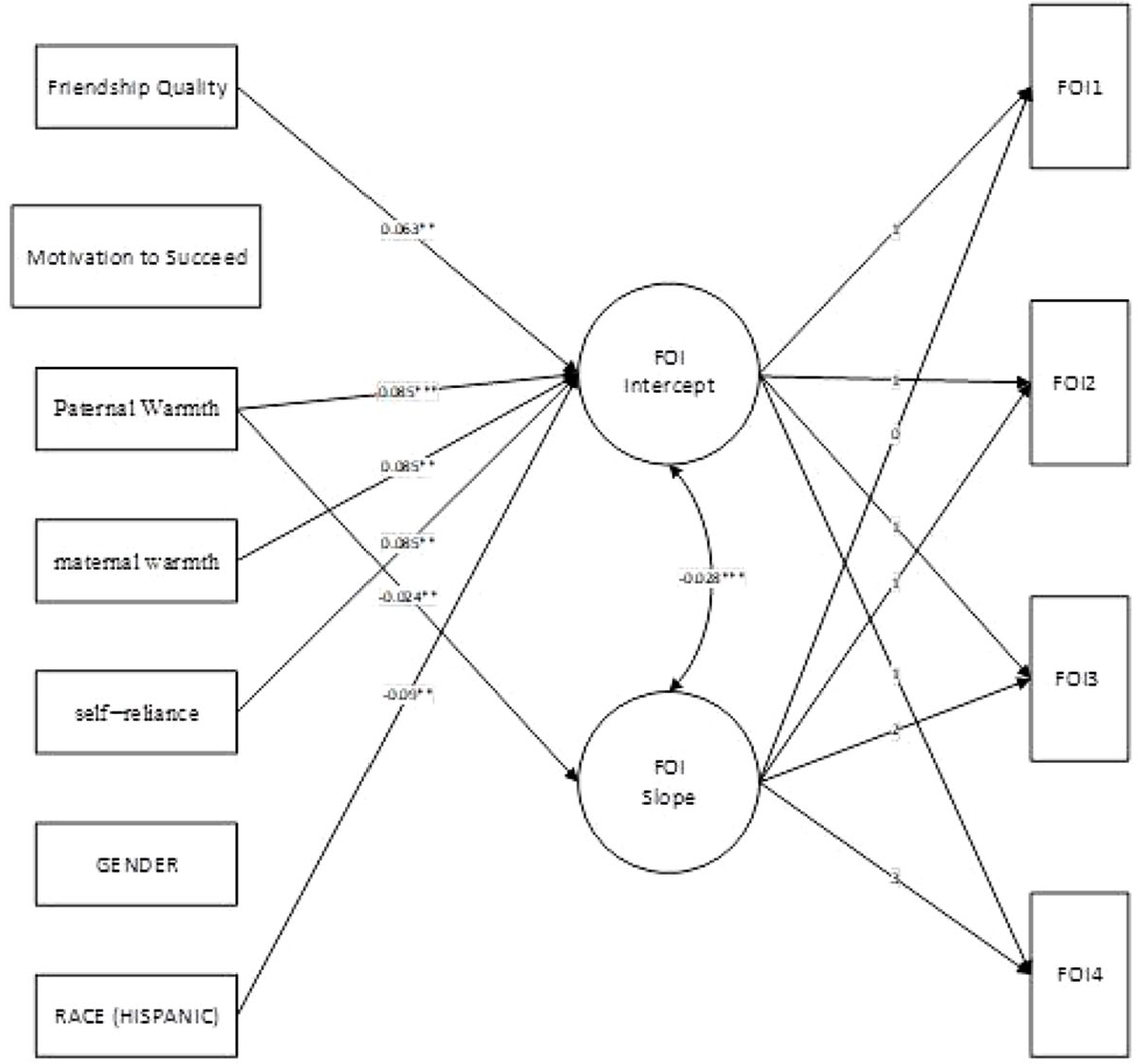
Conditional latent growth curve model for future orientation inventory.
Discussion
While prior research has extensively explored the future orientation of adolescents in the general population, the present study uniquely examines future orientation trajectories among serious juvenile offenders, focusing on the role of key psychosocial factors such as friendship quality, parental warmth, motivation to succeed, and self-reliance. Using latent growth curve modeling (LGCM), this study tracks the developmental course of future orientation over four waves, offering a nuanced understanding of how these factors influence the initial levels and growth trajectories of future orientation. The findings provide critical insights that could inform targeted interventions to foster resilience and positive developmental outcomes in this high-risk group.
Future orientation inventory trajectories provide a vital framework for examining how serious juvenile offenders develop their ability to plan for their future across adolescence and into young adulthood (Abram et al., 2009). In the present study, latent growth curve modeling revealed significant individual differences in both the initial levels and growth rates of future orientation (Kazemian & Farrington, 2006). Specifically, the findings showed an overall positive growth in future orientation over the four waves, aligning with previous research that suggests that, despite being a high-risk group, juvenile offenders are capable of developmental improvement over time (Steinberg et al., 2009; Stouthamer-Loeber et al., 2002). However, the negative correlation between the intercept and slope suggests that individuals with higher initial levels of future orientation tend to have slower growth rates over time, indicating that those who start off with stronger future—oriented thinking may experience a stabilization rather than continued rapid growth (Steinberg, 2005). Understanding these developmental shifts in future orientation provides a foundation for designing tailored interventions that aim to foster resilience and sustained positive planning among juvenile offenders, emphasizing the role of psychosocial influences such as parental warmth, friendship quality, and self-reliance (Harder et al., 2012; Kerpelman & Mosher, 2004; Mulvey et al., 2004).
Confirming the first hypothesis, the results indicate that participants with higher levels of friendship quality at baseline demonstrated both a higher initial level of future orientation and a more positive growth trajectory over time compared to those with lower friendship quality. This finding aligns with existing literature that highlights the pivotal role of peer relationships in shaping future-oriented thinking and goal-setting behavior (Hartup & Stevens, 1997; Wentzel, 1998). Adolescents who receive emotional support and encouragement from their close friendships are more likely to engage in long-term planning and demonstrate persistence when facing challenges (Wentzel et al., 2004). This underscores the importance of fostering high-quality friendships as a protective factor for serious juvenile offenders, supporting them in developing a stronger orientation toward their future. Interestingly, the positive influence of friendship quality on future orientation growth suggests that supportive peer relationships may help mitigate some of the cognitive and emotional challenges typically faced by this population (Zimmer-Gembeck et al., 2005). These findings have important implications for intervention programs, indicating that efforts to enhance friendship quality could play a critical role in promoting better long-term outcomes for at-risk youth.
Confirming the second hypothesis, the findings show that participants with higher levels of motivation to succeed at baseline had a higher initial level of future orientation and demonstrated a steeper growth trajectory over time compared to those with lower motivation. This result aligns with existing literature, which underscores the importance of motivation as a protective factor in future-oriented thinking, particularly among high-risk populations such as juvenile offenders (Burnett & Maruna, 2004; Ryan & Deci, 2000). Individuals who are more motivated to succeed are better equipped to engage in long-term planning and make decisions that align with their goals, leading to improved outcomes over time (Burnett & Maruna, 2004). The positive impact of motivation on future orientation development suggests that enhancing motivation in intervention programs could play a critical role in promoting the long-term rehabilitation and reintegration of juvenile offenders (Snyder et al., 2000).
Confirming the third hypothesis 3a, the results indicate that higher levels of maternal warmth at baseline were associated with both a higher initial level of future orientation and a more positive growth trajectory over time. This finding is consistent with previous research, which emphasizes the role of supportive maternal relationships in fostering emotional security and resilience, key factors in future-oriented thinking (Steinberg, 2001; Hoeve et al., 2009). Adolescents who experience greater maternal warmth are more likely to develop a positive outlook on their future, as the emotional support provided by their mothers helps them navigate challenges and engage in long-term planning (Laible et al., 2000).
Partially confirming to the third hypothesis (3b), the results revealed that higher levels of paternal warmth at baseline were associated with a higher initial level of future orientation but with a slower growth trajectory over time. This unexpected finding suggests that while paternal warmth provides immediate emotional support and fosters positive future-oriented thinking early on, it may not contribute to continued rapid growth in future orientation as adolescents progress through time. One possible explanation is that paternal warmth, while initially encouraging, might lead to a stabilization of future-oriented thinking, with less need for further growth as the individual becomes more secure in their long-term outlook (Backman et al., 2021; Williams & Steinberg, 2011).
Confirming the fourth hypothesis, the results indicate that participants with higher levels of self-reliance at baseline demonstrated both a higher initial level of future orientation and a steeper growth trajectory over time compared to those with lower self-reliance. This finding aligns with previous research, which highlights the role of self-reliance in fostering personal agency and long-term planning (Bandura, 1999; Steinberg, 2005). Juvenile offenders with greater self-reliance are more capable of making independent decisions and overcoming challenges, which likely contributes to their ability to engage in future-oriented thinking (Schwartz et al., 2005).
In exploring the research question regarding how race and gender influence the initial level and growth rate of future orientation, the results revealed some nuanced findings. Contrary to expectations, gender was not a significant predictor of either the initial level or the growth rate of future orientation, suggesting that the developmental trajectory of future orientation may be similar across genders among juvenile offenders. Factors such as violence exposure or correctional confinement environments may overshadow gender-specific developmental differences (Schaefer et al., 2019). However, Hispanic identity was significantly associated with the initial level of future orientation, with Hispanic participants displaying lower baseline levels of future orientation compared to their non-Hispanic peers. Hispanic youth frequently face socioeconomic obstacles, including limited access to quality education and resources, which can hinder their ability to plan and aspire for the future. These challenges can impact their overall development and outlook (Gonzalez et al., 2012).
Practical Implications
The findings of this study provide valuable insights for enhancing interventions targeting serious juvenile offenders. First, high-quality friendships play a critical role in fostering future-oriented thinking, indicating that peer support programs could be vital in rehabilitation efforts. Mentoring initiatives can help these youths set and achieve long-term goals (Wentzel et al., 2004). Second, motivation to succeed is a key factor. Interventions that inspire educational and career aspirations are essential, and programs that enhance intrinsic motivation can empower juvenile offenders to envision a positive future (Ryan & Deci, 2000). Third, parental warmth, especially from mothers, is crucial in shaping future orientation. Family-centered programs that foster strong parental bonds can enhance resilience and reduce recidivism rates (Steinberg, 2001). Lastly, promoting self-reliance is essential. Life skills training that empowers individuals to make independent decisions will help them navigate challenges and focus on long-term success (Bandura, 1999). In summary, targeted interventions focusing on peer relationships, motivation, family support, and self-reliance can significantly enhance rehabilitation outcomes for juvenile offenders.
Limitations and Future Directions
This study has several limitations that should be addressed in future research. First, the use of self-report scales introduces the potential for response bias, as participants may have provided socially desirable answers rather than accurate reflections of their behaviors and attitudes. Future studies could consider incorporating a multi-method approach, including observational data or reports from parents, peers, or teachers, to improve the reliability of the findings. Second, the gender distribution in this study was highly uneven, with the majority of participants being male. This imbalance limits the generalizability of the results, particularly regarding the influence of gender on future orientation trajectories. Future research should aim for a more balanced sample to better understand the potential differences in future orientation and its predictors across genders. This would provide a more nuanced perspective on how interventions could be tailored to meet the unique needs of both male and female juvenile offenders.
Conclusion
In conclusion, this study provides important insights into the future orientation trajectories of serious juvenile offenders and the psychosocial factors influencing these trajectories. By employing latent growth curve modeling, we were able to examine the developmental changes in future orientation over time, highlighting the significant roles of friendship quality, motivation to succeed, parental warmth, and self-reliance. The findings underscore the importance of targeted interventions focusing on fostering high-quality peer relationships, enhancing motivation, strengthening family support, and promoting self-reliance. Such interventions could contribute to better rehabilitation outcomes and facilitate the positive reintegration of juvenile offenders into society. Future research should address the limitations noted, including the reliance on self-report measures and the gender imbalance, to further refine and expand upon these findings. Ultimately, a deeper understanding of these developmental processes can inform more effective support systems aimed at reducing recidivism and promoting successful outcomes for high-risk youth.
Footnotes
Acknowledgements
None
Author Contribution Statement
Conceptualization, methodology, software, formal analysis, original draft writing, and review and editing of the manuscript.
Data Availability Statement
The data that support the findings of this study are available from the corresponding author upon reasonable request.
Declaration of Conflicting Interests
The author(s) declared no potential conflicts of interest with respect to the research, authorship, and/or publication of this article.
Funding
The author(s) received no financial support for the research, authorship, and/or publication of this article.
Ethical Approval
Ethics approval statement is not applicable
Patient Consent Statement
Patient Consent Statement is not applicable
