







Abstract
In recent years, the Chinese Ministry of Education has implemented policies to reduce the academic burden on students by regulating extracurricular training in compulsory education. While academic tutoring has been restricted, non-academic extracurricular training has surged, prompting research into its impact on adolescents’ non-cognitive skills. This study used descriptive statistics and OLS multiple linear regression to examine the effect of non-academic after-school training on non-cognitive abilities. The results were further tested for robustness through quantile regression and sub-sample analysis to explore heterogeneity in the impact of training across different groups. The results of the study showed that non-discipline-based out-of-school training had a significant positive impact on adolescents’ non-cognitive development, with a significant inverted “U” curve effect, and further calculations revealed that holding non-discipline-based out-of-school training programs more than twice a week reduced its marginal benefit. In addition, the impact of non-discipline-based out-of-school training on adolescents’ non-cognitive abilities varied significantly by household registration, gender and household cultural capital, with males and rural adolescents benefited more, and high cultural capital household groups exhibited a slight positive impact.
Introduction
Globally, students in East and Southeast Asian countries, including China, South Korea, and Japan, have long engaged in large-scale after-school private tutoring programs (Dang & Rogers, 2008). As early as the mid-1990s, researchers conducted a study across 41 countries and found that, on average, 4 out of 10 eighth-grade students participated in various forms of supplementary education weekly (Baker et al., 2001). Currently, such private tutoring is expanding on a global scale (Aurini & Davies, 2004; Bray, 2017).In China, some parents, either proactively or passively, are drawn to private tutoring as they perceive it as an effective intervention to enhance their children’s academic performance and overall competencies (Bray, 2023; Zhang & Xie, 2016). However, numerous studies have highlighted the negative impacts of excessive academic workloads on adolescents’ physical and mental health (FHKPS, 2013; Hesketh et al., 2010).To address this growing concern, the Chinese government issued the Opinions on “Further Reducing the Burden of Homework and Off-campus Training for Students in Compulsory Education” (The abbreviation: China’s Double Reduction Policy) in 2021. This policy aims to alleviate the academic pressures faced by students both in and out of school during the compulsory education stage (Will “double Reduction” Policy Lead to Fairer Education? - Opinion - Chinadaily.Com.Cn, n.d.).
With the decline of discipline-based tutoring, non-academic extracurricular training has quietly emerged as a “new trend” in institutional training (Tadesse et al., 2022). This type of training, distinct from academic tutoring, specifically refers to extracurricular activities in areas such as sports, arts, and comprehensive practical skills (Aibin et al., 2023; Bailey, 2006; Fredricks & Eccles, 2006). Since the introduction of China’s Double Reduction Policy, more than 33,000 companies related to sports and arts training have been established nationwide (Students Have More Sporting Time from “double Reduction” Policy - Chinadaily.Com.Cn, n.d.). Numerous scholars and even national policies advocate for encouraging adolescents to better utilize their leisure time by participating in high-quality extracurricular programs. Such participation has been shown to have positive effects, including preventing various harmful outcomes (Durlak & Weissberg, 2007; Gootman & Eccles, 2002). For instance, research has demonstrated that non-academic extracurricular training positively influences academic performance, interpersonal skills, academic persistence, and future labor market outcomes (Elder & Conger, 2014; Marsh & Kleitman, 2002). However, a critical examination reveals that participation in non-academic extracurricular training can also present potential risks. For example, engagement in these activities may increase adolescents’ stress and anxiety, negatively impacting their mental health and academic focus (Shulruf, 2010). Adolescents who participate in sports but not in arts may exhibit higher correlations with behaviors such as alcohol abuse and other risky activities (Eccles & Barber, 1999; Fredricks & Eccles, 2008). Furthermore, when weekly participation exceeds 14 hours, extracurricular activities can lead to a decline in academic performance (Mahoney & Vest, 2012).
Non-academic extracurricular training is also closely related to personal capacity development. The theory of new human capital emphasizes that the key components of individual capability development include “cognitive abilities” and “non-cognitive skills” (J. J. Heckman & Rubinstein, 2001) .Non-cognitive skills typically encompass personality traits, motivation, interests, self-concept, and beliefs (Khine & Areepattamannil, 2016; OECD, 2015).Heckman et al. argue that in addition to cognitive skills such as intelligence, non-cognitive skills (e.g., perseverance, self-discipline, and social skills) also play a crucial role in education and employment (J. Heckman et al., 2006; J. J. Heckman & Kautz, 2012).Although there is no unified standard for measuring non-cognitive skills, researchers often construct proxies for these skills based on specific questionnaire items and well-established measurement dimensions and frameworks. These include the Big Five Personality Model, the OECD Social and Emotional Skills Framework, and Duckworth’s Grit Model, among others. In these measurement frames, the Big Five Model is the most widely adopted by scholars. Its strength lies in identifying the five core and stable traits of personality structure: extraversion, agreeableness, conscientiousness, emotional stability, and openness to experience (Goldberg, 2013; John et al., 2008).
Relevant studies show that non-academic extracurricular training provides adolescents with an interactive platform outside the school context, fostering opportunities for socialization. This environment can enhance social awareness and emotional regulation skills, thereby contributing to the development of their non-cognitive skills (Gilman et al., 2004; Huebner & Mancini, 2003; Zaff et al., 2003). Some empirical studies have already provided evidence supporting, adolescents often learn by observing the behaviors of others and the subsequent consequences. Non-academic extracurricular training provides opportunities for authentic social interactions and practical situations, which help them develop abilities such as emotional regulation, self-expression, and teamwork (Cortellazzo et al., 2021; Mahoney et al., 2004). Further studies have revealed that adolescents’ participation in non-academic extracurricular training can impact their personality development, including traits like responsibility and openness (Hansen et al., 2003; Vollrath & Torgersen, 2000). In addition, coping with adversity and setbacks is an important aspect of adolescent development. The frustrations and challenges experienced in non-academic extracurricular training can help adolescents develop psychological resilience and coping strategies in a safe environment, which pertains to the development of grit in adolescents. (Hansen et al., 2003; Masten & Barnes, 2018).In the meanwhile, achievement motivation is the intrinsic drive that compels individuals to attain their goals. Through participation in non-academic extracurricular training, adolescents can enhance their self-discipline, perseverance, and self-efficacy (Atkinson, 1957). In summary, numerous studies have confirmed that non-academic extracurricular training has a substantial impact on the development of adolescents’ non-cognitive skills.
While it is important to acknowledge that non-discipline-based out-of-school training does not always have a positive effect on adolescents’ non-cognitive abilities. Research indicates that adolescence is a particularly effective period for the development of non-cognitive skills (Suárez Pandiello et al., 2016). As previously discussed, irrational participation in extracurricular training can negatively impact adolescents’ non-cognitive abilities, resulting in setbacks in emotional regulation, self-esteem, and interpersonal relationships (Mahoney & Vest, 2012; Portela-Pino et al., 2021). Excessive and unreasonable participation in non-academic extracurricular training has adverse effects on adolescents’ academic performance, social well-being, and overall health. Studies have shown that unreasonable participation in extracurricular training may negatively affect adolescents’ emotional regulation, self-esteem, and interpersonal relationships, leading to increased stress and emotional instability (Luthar & Barkin, 2012). As Knifsend have noted, students with extremely high levels of extracurricular participation do not demonstrate better adaptability compared to their moderately involved peers (Knifsend & Graham, 2012). At very high levels of extracurricular activity engagement, the positive effects on adolescents’ academic achievement, adjustment, and adaptability tend to diminish (Fredricks & Eccles, 2008; Marsh & Kleitman, 2002). An excessive schedule of extracurricular activities can hinder children’s development of creativity, problem-solving skills, and social abilities (Deb, 2018). Overall, numerous studies have indicated that while adolescent participation in after-school activities is generally associated with better academic outcomes, there may be a threshold beyond which higher levels of participation no longer predict more positive results. As “Overlearning Theory” posits that learners should engage in repetitive practice to consolidate learned material. However, it also emphasizes the need to avoid “diminishing returns.” When learning exceeds an optimal limit, negative effects such as reduced interest, attention, and increased fatigue can emerge, leading to a decrease in learning effectiveness and retention (Rohrer et al., 2005).
Based on the above, exploring the extent and factors influencing the impact of non-academic extracurricular training on adolescents’ non-cognitive skills holds significant value, particularly in the context of China’s “Double Reduction” policy. This research seeks to contribute to the construction of a positive and sustainable ecosystem for adolescents’ participation in non-academic extracurricular training. It also aims to provide critical insights to inform the implementation of the “Double Reduction” policy, helping to prevent the emergence of further social tensions and educational risks. The study specifically focuses on examining the relationship between adolescents’ participation in non-academic extracurricular training and their non-cognitive skills.
Thus, this study aims to test the following hypotheses:
H1: Non-academic extracurricular training has a significant positive impact on the development of adolescents’ non-cognitive skills.
H2: The impact of non-academic extracurricular training on the development of adolescents’ non-cognitive skills may exhibit a nonlinear relationship.
H3: The impact of non-academic extracurricular training on the development of adolescents’ non-cognitive skills is heterogeneous.
Methods
Data and Sample
The data used in this study come from the China Education Panel Survey (CEPS) 2014 to 2015 follow-up data, which was officially released in 2018. The survey, designed and executed by the Survey and Data Center at People University of China, aims to reveal the impacts of family, school, community, and macro-social structures on individual educational outcomes, and further explore how educational outcomes influence individuals’ life trajectories. In the 2014 to 2015 follow-up survey, the research team tracked 10,279 seventh-grade students from the 2013 to 2014 baseline sample, achieving a follow-up success rate of 91.9%. Among these, 830 students were lost to follow-up, while 471 new students were added to the sample. The survey data includes aspects such as students’ personal development, family background, teacher characteristics, and school environment, which align with the empirical analysis requirements of this study. After excluding inapplicable samples and those with missing key variables, the final sample size is 6,156. For more detailed information and data on CEPS, please refer to the CEPS website, http://ceps.ruc.edu.cn.
Variables
Non-Cognitive Skills
The dependent variable in this study is non-cognitive skills. The measurement frameworks for non-cognitive skills internationally primarily focus on multiple dimensions such as social, emotional, behavioral, and personality traits. Established and mature non-cognitive skill measurement frameworks that can be referenced include the Big Five Personality Model (extraversion, agreeableness, conscientiousness, emotional stability, openness to experience; John et al., 2008), the OECD Framework for Social and Emotional Skills (self-control, cooperation, empathy, resilience, responsibility; OECD, 2015), and Duckworth’s model of grit and passion (grit, passion; Duckworth et al., 2007). Based on the key elements of the Big Five personality modeling framework, and considering that the CEPS survey does not include items directly measuring respondent’s non-cognitive skill levels, this study adopts a similar approach and classification criteria from related research. It constructs proxy variables to reflect the respondents’ non-cognitive skill levels, measuring them across four dimensions: learning grit, openness, emotional stability, and school adaptation. The dimension of learning grit is measured using three items from the CEPS student questionnaire: “Even if I feel a little unwell or have other reasons to stay home, I still try my best to go to school,” “Even if I don’t like a discipline, I will still try my best to do it”, and “Even if it takes a long time to finish my homework, I will keep trying my best to complete it.” These items are scored on a four-point scale (Strongly Disagree = 1, Disagree = 2, Agree = 3, Strongly Agree = 4), and the average score is calculated by summing the responses. After testing, the internal consistency coefficient of the above three question items is 0.809, which is high reliability. The dimension of openness is measured using four items from the CEPS parent questionnaire: “Able to clearly express one’s opinions,” “Quick to respond,” “Able to quickly learn new knowledge and curious about new things.” These items are scored on a four-point scale (Strongly Disagree = 1, Disagree = 2, Agree = 3, Strongly Agree = 4), and the average score is calculated by summing the responses. After testing, the internal consistency coefficient of the above four question items is 0.857, which is high reliability. The dimension of emotional stability is measured using six items from the CEPS student questionnaire: “Frustrated,” “So depressed that I can’t focus on things,” “Unhappy,” “Life feels meaningless,” “Lack the energy to do things,” and “Sad, down.” These items are scored on a five-point scale, with reverse scoring (Never = 5, Rarely = 4, Sometimes = 3, Often = 2, Always = 1), and the average score is calculated by summing the responses. After testing, the internal consistency coefficient of the above 6 question items is 0.918, which is high reliability. The dimension of school adaptation is measured using four items from the CEPS student questionnaire: “Most of my classmates are friendly to me,” “The class atmosphere in my class is good,” “I often participate in activities organized by the school or class,” and “I feel close to the people at this school.” These items are scored on a four-point scale (Strongly Disagree = 1, Disagree = 2, Agree = 3, Strongly Agree = 4), and the average score is calculated by summing the responses. After testing, the internal consistency coefficient of the above 4 question items is 0.778, which is a high level of reliability. In all the above dimensions, higher student scores in learning grit, openness, emotional stability, and school adaptation indicate stronger skills of non-cognitive.
Non-Academic Extracurricular Training
The independent variable in this study is non-academic extracurricular training. It is measured based on the item from the CEPS student questionnaire: “In the past year, which extracurricular or interest classes have you attended?” This item measures the number of non-academic extracurricular training programs in which the adolescent has participated. The question is multiple-choice, with each class attended assigned a score of one point. The higher the score, the greater the variety of non-academic extracurricular training programs attended by the adolescent.
Characteristics of Personal, Family and School Background
This study selects variables at the individual, family, and school levels as control variables. At the individual level, the selected variables include gender, household registration, whether the student is an only child, and academic performance. At the family level, the variables include family economic status, parents’ educational attainment, and family book collection. At the school level, the variable selected is the school’s quality ranking.
Empirical Strategy
This study uses statistical software such as SPSS 26.0 and Stata 16.0 for data analysis. First, descriptive statistics are presented to show the mean and standard deviation of the variables in this study. Then, an OLS multiple linear regression analysis is employed to examine the impact of non-academic extracurricular training on adolescents’ non-cognitive skills. In terms of model specification, this study first establishes a linear function model to test the effect of non-academic extracurricular training on adolescents’ non-cognitive skills. The model is specified as follows:

The explained variable

Secondly, robustness checks were conducted by replacing the dependent variable and excluding specific subsamples to validate the baseline regression results. Finally, this study employed quantile regression and subsample regression methods to examine the heterogeneity of the impact of non-academic extracurricular training on adolescents’ non-cognitive abilities across different levels of individual ability and group distributions.
Results
Descriptive Analyses
Descriptive statistics, including the means and standard deviations of the independent, dependent, and control variables, were calculated. The results are reported as follows: the independent variable, frequency of out-of-school training in non-disciplinary disciplines, has a mean of 0.32 and a standard deviation of 0.65. The dependent variable, non-cognitive ability, was categorized into academic perseverance, openness, school adaptation, and emotional stability. Among these, emotional stability had the highest score (M = 3.85, SD = 0.88), followed by openness (M = 3.34, SD = 0.72), academic perseverance (M = 3.12, SD = 0.86), and school adaptation (M = 2.95, SD = 0.90). Additionally, the following control variables: gender (M = 1.50, SD = 0.50), household registration (M = 1.35, SD = 0.48), being an only child (M = 1.58, SD = 0.49), academic performance (M = 3.13, SD = 1.05), family economic status (M = 2.91, SD = 0.60), parental education level (M = 9.97, SD = 2.98), family book collection (M = 3.03, SD = 1.15), and school quality ranking (M = 3.98, SD = 0.84).
Regression Analyses
Based on descriptive statistical analysis, this study employed OLS regression to examine the impact of non-academic extracurricular training on adolescents’ non-cognitive skills. The results are presented in the table. Model A displays the linear fit without incorporating the quadratic term of non-academic extracurricular training. The findings reveal that non-academic extracurricular training has a significant positive effect on adolescents’ school adaptation, academic perseverance, and overall non-cognitive skills. In terms of standardized coefficients, the effect of non-academic extracurricular training on adolescents’ school adaptation is greater than its effect on academic perseverance. This suggests that while non-academic extracurricular training fosters positive learning qualities, it has a more significant impact on enhancing adolescents’ adaptive abilities. To further explore whether a nonlinear relationship exists between the two variables, Model B introduces the quadratic term of non-academic extracurricular training based on Model A. The results of Model B indicate that in the regression analysis of the effects of non-academic extracurricular training on adolescents’ school adaptation, openness, and overall non-cognitive skills, the coefficient of the linear term is positive, while the coefficient of the quadratic term is negative.
Regression Results of Non-Academic Extracurricular Training on Adolescents’ Non-Cognitive Abilities.
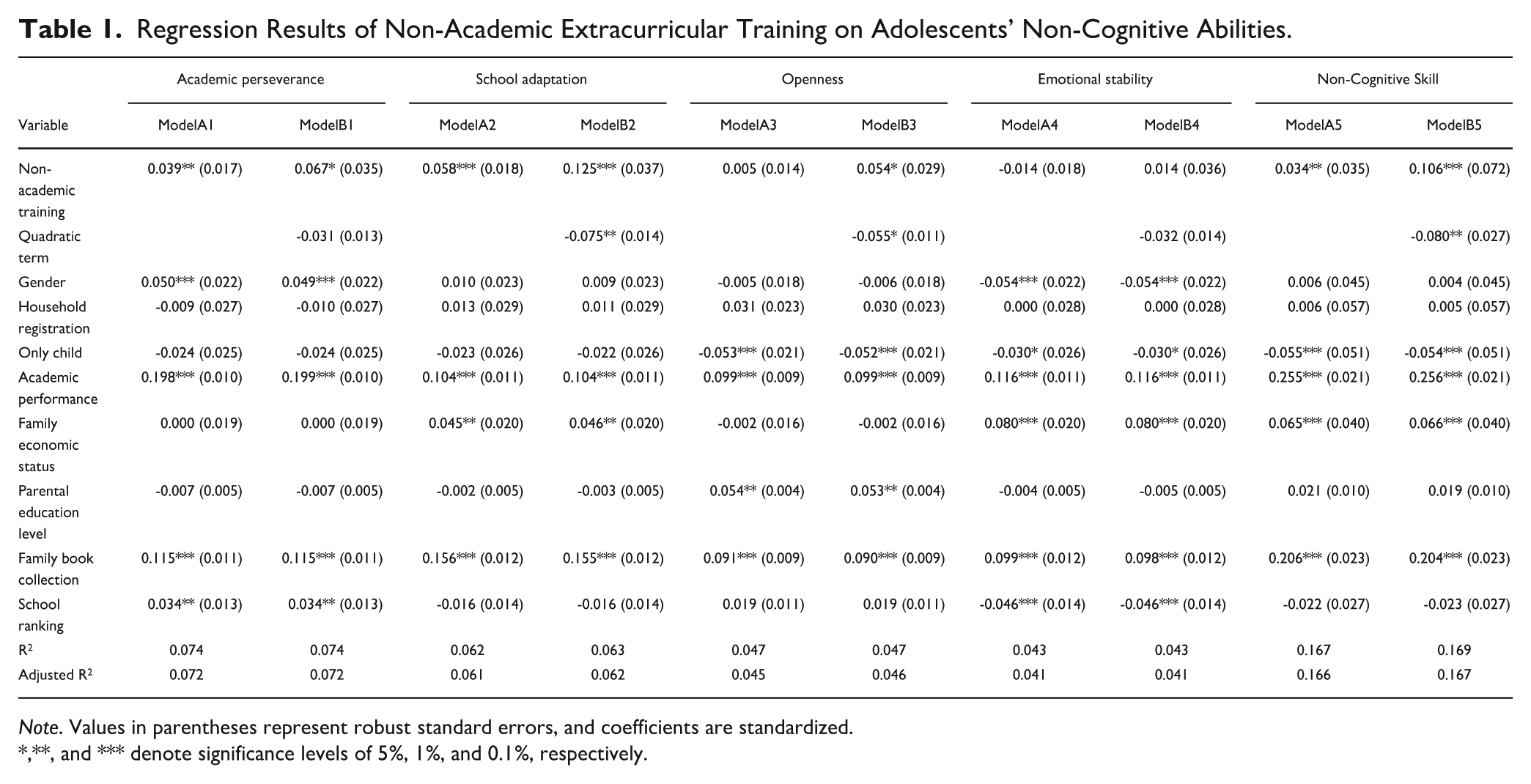
Note. Values in parentheses represent robust standard errors, and coefficients are standardized.
,**, and *** denote significance levels of 5%, 1%, and 0.1%, respectively.
Robustness Test
Replace the Interpreted Variable
In the baseline regression, non-cognitive skills were divided into four dimensions: academic perseverance, openness, school adaptation, and emotional stability. Referring to existing research, interpersonal skills were also incorporated into the measurement framework of non-cognitive skills, followed by regression analysis. The regression results are presented in Table 2. The findings indicate that the impact of non-academic extracurricular training on adolescents’ non-cognitive skills remains significant and continues to exhibit a reversed U-shaped pattern, suggesting that the baseline regression results are relatively robust.
Robustness Check: Regression Results with Alternative Dependent Variables.
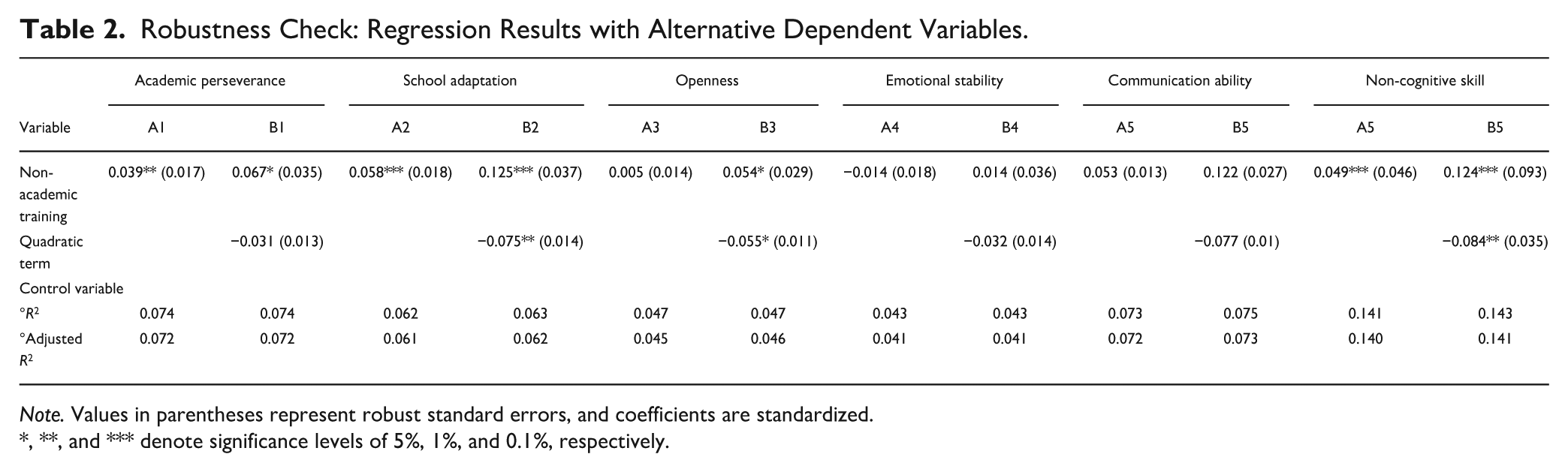
Note. Values in parentheses represent robust standard errors, and coefficients are standardized.
, **, and *** denote significance levels of 5%, 1%, and 0.1%, respectively.
Eliminate Special Sub-samples
With the acceleration of urbanization, a significant number of surplus rural laborers have migrated to cities in search of better job opportunities and higher incomes (Lyu et al., 2024). In China’s educational context, the urban-rural dichotomy and the persistence of external problems such as the household registration system and educational opportunities have given rise to the special group of rural left-behind children. (Hong et al., 2019).These children, who experience prolonged absence of parental care and attention, are often at a disadvantage in terms of family capital and access to educational resources (Dong et al., 2019). As a result, the educational attainment and skill development of left-behind children are significantly affected by their limited family capital and educational resources (Shen et al., 2021). This group may affect the results of the baseline regression, so it is necessary to propose the exclusion of the left-behind children sample to test the robustness of the results. As shown in Table 3, the effect of non-academic extracurricular training on adolescent’s non-cognitive skills remains significant after excluding the sample of left-behind children, and after introducing the quadratic term, the reversed U-shaped pattern persists. These findings suggest that the baseline regression results are relatively robust.
Robustness Check: Regression Results Excluding Left-Behind Children.
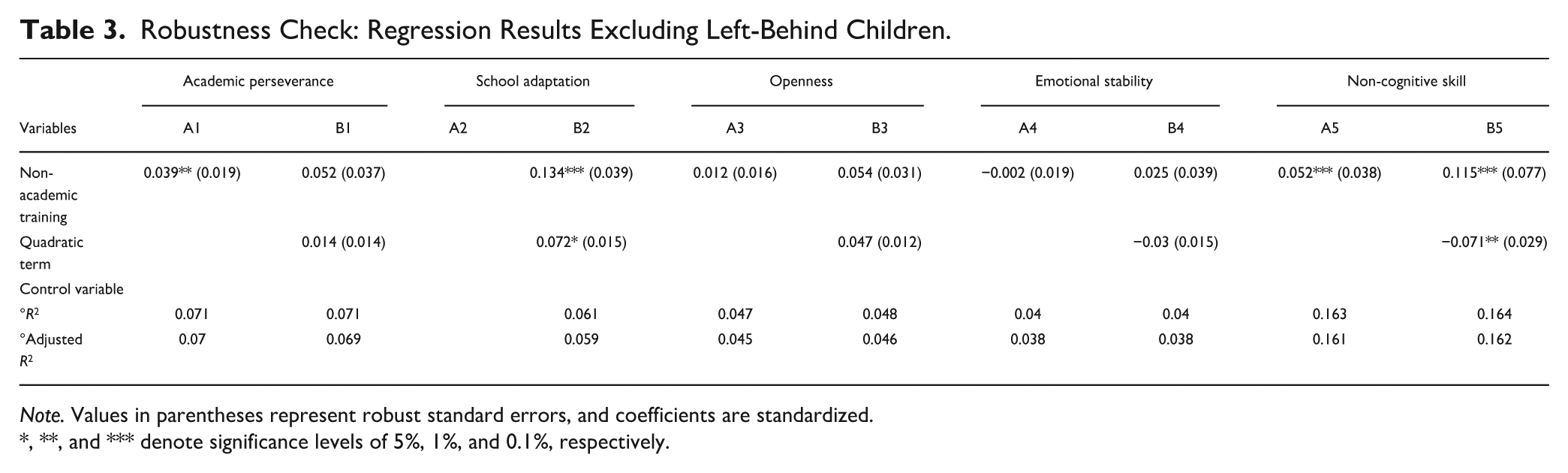
Note. Values in parentheses represent robust standard errors, and coefficients are standardized.
, **, and *** denote significance levels of 5%, 1%, and 0.1%, respectively.
Heterogeneity Analysis
The study further examines the impact of non-academic extracurricular training on adolescents’ non-cognitive skills at the group level, conducting subsample heterogeneity analyses from the perspectives of gender, household registration, and family cultural capital. The results are presented in Table 4.
Regression Results of Non-Academic Extracurricular Training on Adolescents’ Non-Cognitive Skills at the Group Level.
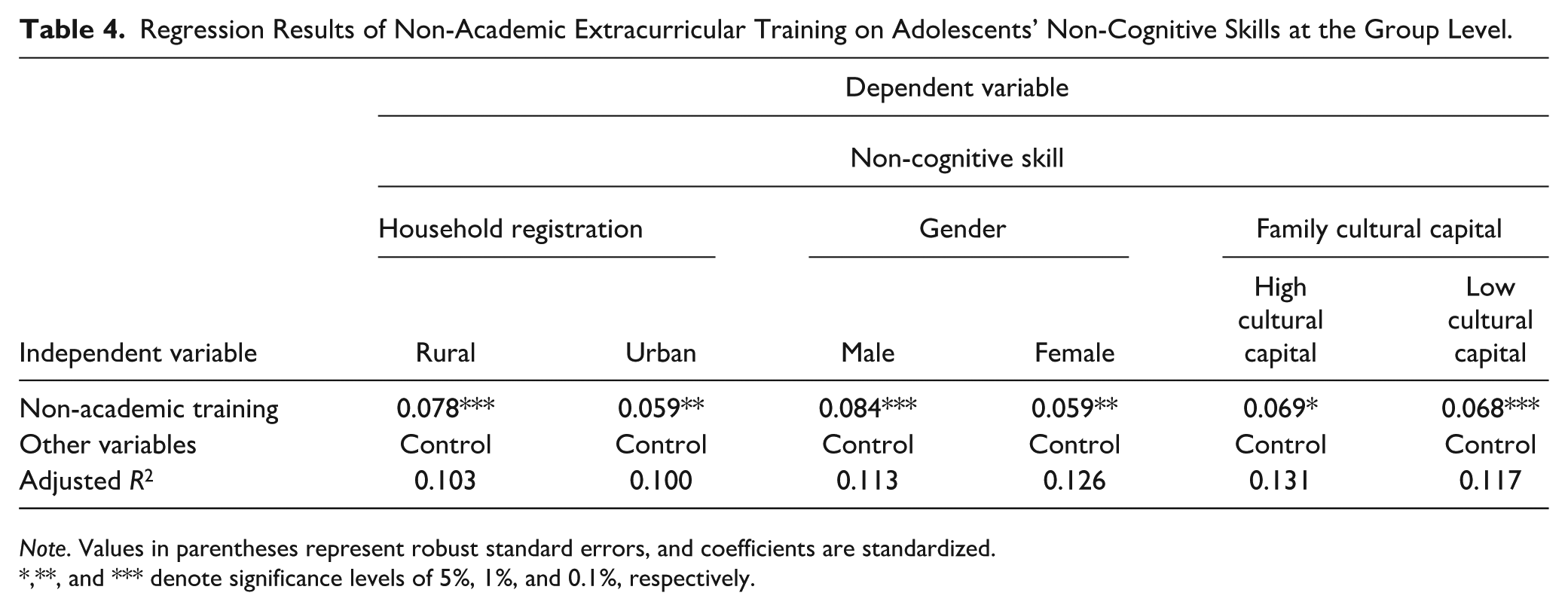
Note. Values in parentheses represent robust standard errors, and coefficients are standardized.
,**, and *** denote significance levels of 5%, 1%, and 0.1%, respectively.
From the perspective of urban and rural differences, the impact of non-academic extracurricular training on adolescent’s non-cognitive skills exhibits significant disparities. Non-academic extracurricular training has a greater effect on improving the non-cognitive skills of rural adolescents. From the perspective of gender, the training shows a stronger effect on enhancing the non-cognitive skills of male students. Regarding family cultural capital, non-academic extracurricular training has a more pronounced impact on improving the non-cognitive skills of adolescents with lower family cultural capital. Based on these findings, Hypothesis H3 is confirmed.
Discussion
This study utilizes CEPS data provided by the Survey and Data Center of Renmin University of China and employs multiple linear regression, quadratic function modeling, and unconditional quantile regression to examine the impact of non-academic extracurricular training on the development of adolescent’s non-cognitive skills. The findings reveal that an increase in the frequency of non-academic extracurricular training has a significant positive effect on adolescents’ academic perseverance and school adaptation, but no significant effect on emotional stability. Furthermore, a nonlinear relationship exists between non-academic extracurricular training and adolescents’ non-cognitive skills, characterized by a reversed U-shaped curve. That is, while non-academic extracurricular training positively influences adolescents’ non-cognitive skills, excessive training can lead to negative effects. The calculated threshold between non-academic extracurricular training and adolescents’ non-cognitive skills is 1.71. This indicates that within the frequency range of 0 to 1.71, the positive effects of non-academic extracurricular training gradually increase, while exceeding this threshold leads to a declining trend. Based on the questionnaire content, this threshold suggests that when the number of non-academic extracurricular training programs does not exceed two, the training has a sustained and positive impact on the development of adolescents’ non-cognitive skills. However, when participation involves two or more programs, the positive effects begin to diminish. As both the Overlearning Theory and the Yerkes-Dodson Law suggest, participation driven by irrational or excessive beliefs will only lead to increased physical and mental burdens, as well as unforeseen risks. In addition, significant differences are observed in the impact of non-academic extracurricular training on non-cognitive skills across urban and rural areas, gender, and family cultural capital. The effect is significantly higher for rural adolescents compared to their urban counterparts. Male adolescents show greater improvement in non-cognitive skills from participating in non-academic extracurricular training than females. Similarly, adolescents from families with higher cultural capital also exhibit noticeably better non-cognitive skills after participating in such training.
The Implications of This Study
Firstly, government agencies should optimize the allocation of non-academic extracurricular training resources and enhance their public welfare and inclusivity. Specifically, efforts should focus on improving resource distribution by directing resources toward disadvantaged groups and regions while strengthening and refining the overall capacity of non-academic extracurricular training providers. Initiatives such as promoting government- or non-profit-led extracurricular training programs should be prioritized, positioning these programs as a lever for promoting equitable access to educational opportunities. At the same time, relevant departments should further promote the classification and collaborative governance of non-academic extracurricular training. This includes refining and standardizing categories and disciplines of extracurricular training nationwide to prevent potential irregularities. For instance, implementing a coding system for training categories could standardize and regulate the industry, ensuring orderly market entry while providing a framework for clear responsibilities and effective oversight by relevant authorities. Secondly, after detailing specific regulations regarding curriculum, teacher qualifications, management, safety, and exit mechanisms, educators and administrators should emphasize the integration of non-academic extracurricular training with school-based after-school programs. This would improve the content and quality of after-school services, alleviate teachers’ workloads, and better align these services with students’ educational needs. Finally, parents should adopt a balanced perspective regarding the educational outcomes of non-academic extracurricular training. When adolescents participate in a certain number or variety of extracurricular programs, the positive effects begin to diminish, indicating that “more is not always better.” Excessive participation may lead to diminishing returns, emphasizing the need for moderation and appropriate planning.
Limitations
This study has several limitations: First, the sample size distribution is not fully balanced, which may affect precision and representativeness; however, the use of a large, national dataset and standard controls reduces (though does not eliminate) this concerns. Second, we did not differentiate extracurricular training by type (e.g., sports, arts, academic-enrichment alternatives) or by intensity/quality (hours, coaching, team vs. individual), so estimates may average over meaningful heterogeneity; future work should classify activity categories, incorporate dosage/quality measures, and test interactions to compare effects across types and intensities. Third, despite multiple covariates, residual confounding—especially along socioeconomic and family-process dimensions (e.g., parental involvement, neighborhood resources)—could bias associations; richer SES and family measures and designs that better address selection (propensity scores, fixed effects, instrumental variables, or quasi-experiments) are recommended. Fourth, key constructs rely on proxy indices and self/parent reports, introducing potential measurement and social-desirability bias; triangulation with validated scales, teacher reports, administrative participation records, time-use diaries, or activity logs would strengthen inferences. Fifth, the observational, largely cross-sectional nature of the analysis precludes causal claims; longitudinal designs and policy-timing analyses can better identify mechanisms. Finally, external validity may be bounded by policy and market changes over time; replication with post-policy cohorts and in other settings will clarify generalizability.
Conclusions
The study analyzed the impact of non-academic extracurricular training on adolescents’ non-cognitive skills and its differential effects. The results indicate that non-academic extracurricular training has a significant positive impact on adolescents’ non-cognitive skills, with a U-shaped curve effect between the two. Further heterogeneity analysis reveals significant differences in the impact of non-academic extracurricular training on non-cognitive skills across urban and rural areas, gender, and family cultural capital. These findings enrich the current body of research on non-academic extracurricular training for adolescents and provide valuable insights for policy development in areas such as training market regulation and the promotion of adolescent skill development, particularly in the context of post “Double Reduction” policy implementation.
Footnotes
Acknowledgements
We would like to express our gratitude for the support provided by Zhejiang Normal University
Data Availability Statement
Data will be made available on request.
Declaration of Conflicting Interests
The authors declared no potential conflicts of interest with respect to the research, authorship, and/or publication of this article.
Funding
The authors received no financial support for the research, authorship, and/or publication of this article.
Ethics Statement
Not applicable.
