







Abstract
This qualitative study explores how high school students develop diplomatic competencies through extracurricular participation, personal experiences with global issues, and individual learning goals. Utilizing thematic analysis, we collected data from students’ reflective assignments to identify key themes. Our findings suggest that young people’s engagement in clubs and leadership roles supports diplomatic skill development, as their encounters with challenges, such as discrimination and poverty, deepen their global awareness and motivation. Further, students demonstrate passions for diverse global topics and issues, underscoring the need for experiential and inclusive learning that aligns with their aspirations. This study contributes to the literature by foregrounding student perspectives and examining the interplay between structured activities and authentic students’ engagement in shaping diplomacy-related competencies. Based on the findings, our recommendations include integrating skill-based learning into curricula, expanding simulation-based training, and fostering cross-cultural exchanges.
Keywords
Introduction
In today’s globalized world, diplomatic skills among youth and young people are crucial for preparing future leaders to navigate international challenges. These skills, including effective communication, negotiation, and conflict resolution, enable young individuals to actively participate in global dialogs and multicultural exchanges (Aderibigbe et al., 2023; Boix Mansilla & Jackson, 2022; Samorodova et al., 2023). As documented, educational initiatives, including the Model United Nations (MUN), youth diplomacy workshops, and cultural exchange programs, have focused on equipping youth with these competencies, enhancing their readiness for global engagement (National Geographic, 2021a, 2021b).
However, there remains a gap in evaluating the actual impact of these programs on youth leadership and global engagement. Recent studies emphasize innovative educational strategies and soft power’s role in youth diplomacy (Acosta et al., 2020; Tran et al., 2023). Even so, more comprehensive assessments within different cultural contexts are needed. Specifically, understanding how youths’ knowledge, personal experiences, and interests inform their development of diplomatic skills is critical (National Geographic, 2021a). This knowledge is fundamental as adolescence significantly shapes career interests and future decisions (Xiao et al., 2018).
This study addresses these gaps by examining extracurricular engagement and personal experiences with global issues among high school students in the United Arab Emirates (UAE). Understanding how prior knowledge influences learning and reflection can help tailor more impactful educational interventions (Aderibigbe, 2024), requiring proper guidance and support to reduce learning impediments for psychological stability (Alakashee et al., 2022). Additionally, insights into youth interests and goals related to global issues can guide the design of targeted diplomatic training, aligning with their professional aspirations and equipping them for global citizenship (Boix Mansilla & Jackson, 2022; Samorodova et al., 2023). Amidst global challenges and issues, such as diversity, discrimination, and migration (Aderibigbe et al., 2023; Hamdi et al., 2024), this study holds significant implications for educators, policymakers, and community organizations seeking effective ways to nurture diplomatic skills among youth.
Literature Review
Diplomacy is essential for international cooperation, conflict resolution, and global understanding in an increasingly interconnected global environment. Diplomacy encompasses skills such as negotiation, effective communication, conflict resolution, and cultural sensitivity, essential for international cooperation and mutual understanding. These skills support and improve organized international engagement, allowing individuals to navigate and communicate effectively across various political and cultural contexts (Aderibigbe et al., 2023; Hamdi et al., 2024; Ton, 2024). Diplomatic skills stand apart from the broader concept of youth involvement described in Article 12 of the UN Convention on the Rights of the Child (UNCRC), which emphasizes children’s right to voice their opinions and take part in decisions that impact their lives (United Nations, 1989). Instead, diplomacy explicitly emphasizes structured strategic engagement in global affairs, highlighting competencies crucial for proactive international relations and intercultural exchange (Ton, 2024). This endeavor is essential in today’s society, where increased international migration is fueled by disparities in economic, social, and educational opportunities. These results in inequalities and persecution (Hamdi et al., 2024) and require an appreciation for diversity and inclusion (Aderibigbe et al., 2023).
Collaboration and Group Membership
Diplomacy is fundamentally a collaborative process that brings stakeholders from different backgrounds together to manage intricate negotiations and build relationships. Initiatives like Model United Nations (MUN) highlight this approach by encouraging young people to work in teams, engage in cross-cultural dialog, and tackle issues through shared problem-solving (Samorodova et al., 2023). Similarly, initiatives like the UAE-China Virtual Culture Week demonstrate how structured cultural interactions enhance diplomatic relationships through mutual respect and understanding (Ministry of Foreign Affairs and International Cooperation, 2020). Tran et al. (2023) further highlight youth agency in public diplomacy, showcasing how collaborative participation significantly enhances diplomatic outcomes by fostering deeper intercultural connections.
Global Awareness and Diplomatic Education
Effective diplomatic education integrates global awareness, preparing and equipping youth with the knowledge to address international challenges such as climate change, migration, and geopolitical tensions. Initiatives like the Global Scholars Program and digital platforms like iCivics provide interactive educational experiences that cultivate global citizenship, critical thinking, and informed diplomatic practices (Global Cities, 2021; iCivics, n.d.). Exchange programs, including Fulbright and Erasmus+, and virtual platforms such as Soliya, significantly enhance students’ global perspectives by facilitating direct intercultural exchanges and dialog (European Commission, 2021; Fulbright, 2023; Soliya, 2022). These programs assist youth in developing essential skills for navigating international complexities, underscoring the importance of informed, culturally sensitive diplomacy.
Needs and Strategies for Developing Diplomatic Skills
The evolving international landscape requires diplomatic skills beyond traditional civic engagement. For instance, cultural sensitivity, strategic communication, and negotiation are increasingly crucial for youth involvement in global policy-making and activism (Cuellar-Ramirez, 2021; Ton, 2024). The UAE’s use of soft power through cultural diplomacy exemplifies this strategic approach to addressing global issues (UAE Government Portal, 2022). That said, effective diplomatic education integrates theory with practical experience. Programs like MUN simulate diplomatic scenarios, allowing students to develop negotiation, public speaking, and strategic thinking skills (Samorodova et al., 2023). Digital platforms such as iCivics provide interactive, scalable diplomacy training, though careful deployment is essential to ensure meaningful engagement (iCivics, n.d; Sjolie et al., 2024). Additionally, targeted cultural exchanges, including the UAE’s youth diplomatic initiatives, enhance interpersonal skills and global understanding, preparing youth for active international leadership (Emirates News Agency, 2023).
Methodology
Research Context
As global challenges grow more complex, equipping youth with diplomatic skills becomes increasingly essential. Education systems play a central role in the UAE’s Ministry of Education ESTEDAD program, which includes a dedicated diplomacy track (https://e.moe.gov.ae/ords/f?p=111:1). This initiative prepares students to engage meaningfully in international contexts through five key modules: the UN Sustainable Development Goals, international cooperation, applied research, leadership and governance, and negotiation and debate.
To explore how students engage with this track, we examined participants’ experiences in the program in Summer 2022. The following research questions guided the study:
How do students describe the groups they belong to or have membership in?
How do students report their experiences with global issues?
How do students articulate their particular areas of interest in global issues?
How do students express their personal learning goals for the course or program?
As shown in Table 1, a higher number of participants were in Grade 12, followed by Grade 11, with first-year college students being the least represented. The majority were female and Emirati. Nearly half attended public high schools, with a smaller number from vocational institutions. This demographic data underpines the study’s regional relevance and diversity.
Participants’ Demographic Information (N = 22).
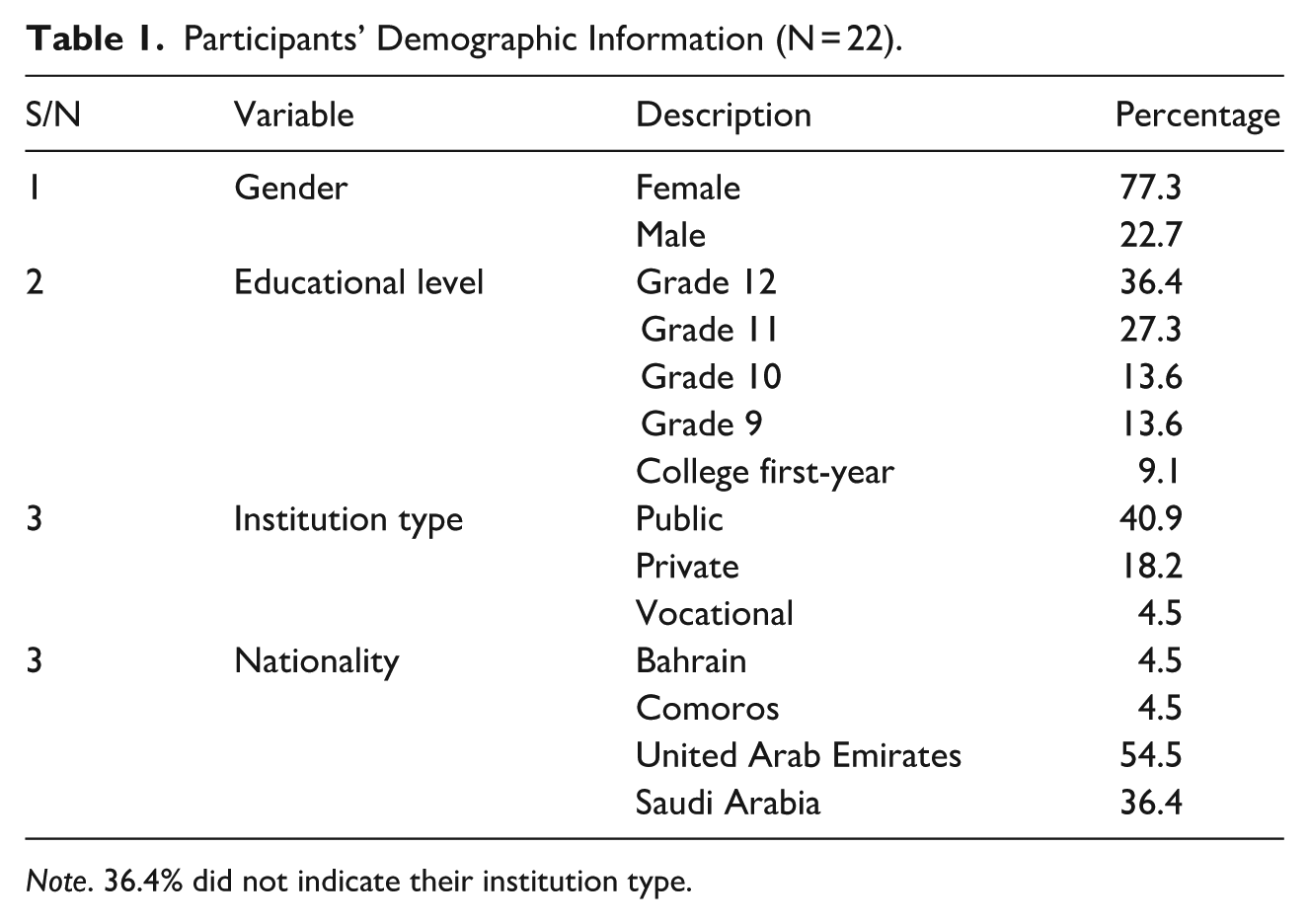
Note. 36.4% did not indicate their institution type.
Method
We adopted a qualitative design to explore students’ reflections on their learning within the ESTEDAD diplomacy program. This approach allowed for rich, contextually grounded insights into how students understood and applied diplomatic skills (Creswell & Poth, 2018; Denzin & Lincoln, 2011).
Data Collection and Analysis
We collected data from reflective assignments submitted by all 22 students. These reflections addressed the research questions and gave a window into students’ evolving understanding of diplomacy. Reflective writing is widely recognized for encouraging self-awareness and critical thinking (Moon, 2006).
We employed thematic analysis to identify and interpret patterns across the data (Braun & Clarke, 2006). Following established procedures, we immersed ourselves in the texts, coded relevant content, and developed themes through iterative refinement (Nowell et al., 2017). Each theme was defined to ensure the research questions’ clarity, coherence, and relevance.
Rigor and Trustworthiness
We employed multiple strategies to ensure research quality. First, we sought credibility through extended engagement with the data, triangulation of ideas and collaborative coding (Guba & Lincoln, 1985). Second, thick descriptions supported transferability, while an audit trail ensured dependability (Guba & Lincoln, 1985). Third, we addressed confirmability through researcher reflexivity, acknowledging potential bias and grounding interpretations in the data (Moustakas, 1994).
Ethical Considerations
We sought approval to retrieve and ethically analyze the students’ reflective data from our university and the Ministry of Education before data collection. We assured the participants of their confidentiality and the anonymity of their responses. Additionally, we assured them of their right to withdraw from the study without any consequences. We also got the consent to publish the work from the Ministry of Education’s representative and program coordinator. Sensitive information was handled with utmost care to protect participants’ privacy, adhering to ethical standards in research (Polit & Beck, 2017).
Results
The findings of this study are organized around the four primary research questions, each addressing distinct aspects of high school students’ experiences within the ESTEDAD diplomacy program. For each research question, themes emerged that encapsulate the students’ perspectives, supported by illustrative comments from their reflective assignments.
Research Question 1: How Do Students Describe the Groups They Belong to or Have Membership?
Exploring the various groups and memberships that students identify with, shedding light on the role these affiliations play in their personal and academic development, assists in achieving the objectives of this study. Through the data collected and analyzed, the themes that emerged are as follows:
Academic and Extracurricular Clubs
Students frequently mentioned their involvement in academic and extracurricular clubs, highlighting the diversity of their engagements. These clubs serve as platforms for developing essential skills and fostering a sense of community.
All throughout the 9th grade I was in a literacy club that helped me learn how to write and debate (Text 1). I belong to many groups or ’societies,’ starting from the chess group to my Model United Nations group (Text 4). I belong to reading and recycling clubs (Text 9).
From the revelation above, getting involved in academic and extracurricular clubs is key to building critical thinking, communication, and leadership skills. Indeed, being part of these groups supports students’ academic success and helps them grow as well-rounded individuals, preparing them for future roles in leadership and active participation in their communities.
Leadership Roles and School Councils
Leadership roles within school councils and student organizations are prominent among participants, indicating a drive toward governance and community involvement.
I’m currently a member in the student president council (Text 3). I’ve been in several groups over the years, like the student council where I was president, and the vice president in the student parliament (Text 8). I’ve been part of leadership groups within my school (Text 4).
As revealed, engagement in leadership roles within school councils and student organizations is crucial in developing governance and management skills. These experiences prepare students for future leadership positions by providing practical opportunities to apply theoretical knowledge in real-world settings.
Cultural and Religious Backgrounds
Students’ cultural and religious backgrounds significantly influence their group memberships and interactions within the program, highlighting the importance of diversity and inclusion.
My older sister studies abroad, and she’s been told many times to go back to her country and remove her hijab (Text 9). My father is Emirati, and my mother is an African immigrant; she was a Christian (Text 4). I am Emirati and have recently joined programs to connect with others from diverse backgrounds (Text 7).
The findings show that schools that acknowledge and appreciate cultural and religious differences among students create a more welcoming and respectful atmosphere. This inclusive and multicultural approach helps students better understand one another and enhances their education by equipping them with the cultural awareness needed to face global issues thoughtfully and respectfully.
Research Question 2: How Do Students Report Their Experiences With Global Issues?
Assessing how students perceive and articulate their encounters with various global concerns provides insight into their motivations and areas of concern. The themes that emerged from the data analyzed are as follows:
Religious Discrimination and Cultural Misunderstandings
Students expressed having experiences related to social issues and problems, such as religious discrimination and cultural misunderstanding, indicating the prevalence of these issues.
One of my experiences of global issues was the discrimination of religion and the violence acted towards it out of hate (Text 1). Whenever I travel abroad wearing a headscarf, I get mean comments or terrified stares (Text 3). A man came to me and started saying bad things about me covering my hair (Text 10).
Findings reveal that pervasive religious discrimination and cultural misunderstandings among students underscore the critical need for educational programs that address bias, promote cultural sensitivity, and encourage respectful interactions. Addressing these issues is essential for creating a more inclusive and harmonious society.
Observations of Poverty and Educational Disparities
Students also reported witnessing global issues, such as poverty and educational disparities, which reflect their concerns about socioeconomic inequalities and the challenges many face in accessing quality education.
Currently, I am in India, and one issue I see everywhere would be poverty—mothers taking care of children on the streets (Text 7). I have seen families who let their kids work instead of completing their education (Text 6). Since I was young, I’ve seen tons of people suffer from poverty, and it hurts me to see that (Text 8).
This finding shows that addressing poverty and educational disparities is crucial for fostering equitable societies. Essentially, academic programs that raise awareness and encourage students to engage in poverty alleviation and education advocacy can contribute to meaningful social change and reduce systemic inequalities.
Environmental and Social Issues
Environmental concerns and broader social issues were also prominent in students’ reflections, indicating a holistic understanding of global challenges.
I tried to find an answer to global warming and its effects (Text 5). I hope for peace to be achieved globally, as wars cause so much destruction (Text 7). In Kuwait, I witnessed climate change when the sky turned red—it was quite intriguing (Text 4).
Drawing on the findings, environmental sustainability and social justice are interconnected realms that require comprehensive strategies. Thus, educational initiatives addressing social and ecological issues equip students with the knowledge to engage in global problem-solving endeavors, fostering resilient and adaptive leaders.
Research Question 3: How Do Students Articulate Their Particular Areas of Interest in Global Issues?
Identifying students’ areas of interest in global issues provides insight into their motivations and potential contributions to addressing these challenges. From the data analyzed, the themes that emerged are as follows:
Social Justice and Human Rights
Many students expressed a strong interest in social justice and human rights, emphasizing the importance of equitable treatment and protecting fundamental freedoms.
My area is to reduce global issues, especially quality education for children because it’s the main cause of improving quality of life (Text 6). Peace and security are my focus—I hope for peace to be achieved globally (Text 7). I want to focus on poverty because it’s painful to see people suffering (Text 8).
As revealed. interest in social justice and human rights indicates a readiness among students to engage in advocacy and policy-making to create equitable and just societies. So, educational programs that nurture these interests can empower students to become effective change agents in addressing systemic injustices.
Environmental Concerns
Environmental issues emerged as a significant area of interest, reflecting students’ awareness of the critical role of environmental sustainability in global well-being.
Anything related to social, political, economic, and environmental issues interests me. The effects of climate change intrigue me, especially how they impact people differently (Text 4). My particular area of interest in global issues includes global political and environmental concerns (Text 5). My favorite was trying to understand climate and where they came from. I think that is something that we all should be doing to develop an understanding world and healthy relationships (Text 10).
From the data, environmental concerns are critical for sustainable development, and students’ interests in this area highlight the importance of integrating environmental education into diplomatic training. Programs that address these environmental issues equip future leaders with the knowledge and motivation to implement sustainable policies and practices.
Education and Development
The theme of education and its role in societal development was prevalent, emphasizing the transformative power of education in improving lives and communities.
Quality education is vital—it’s the main cause of improving quality of life (Text 6). My goal is to gain knowledge to make informed decisions and share my perspectives (Text 3). Education is a tool to benefit mankind and help them develop in all fields (Text 5).
This finding reveals that emphasizing education and development within students’ areas of interest aligns with global priorities for human capital development. Therefore, educational programs prioritizing these areas can significantly contribute to youth empowerment, enabling them to drive sustainable development and innovation.
Research Question 4: How Do Students Express Their Personal Learning Goals for the Course or Program?
Examining students’ personal learning goals provides insight into their aspirations and the skills they seek to develop through participation in the program. Based on the analysis of their responses to this question, the following themes emerged:
Soft Skills Development
A fundamental focus among students was the development of various skills, particularly leadership, communication, and diplomatic competencies.
I want to develop my communication and leadership abilities through this program (Text 8). My goal for this program is to develop my skills and share my opinion with others (Text 3). My goal is to build up my leadership skills and know how to use them in practical life (Text 6).
According to the findings, emphasizing skill development gives young people the tools to handle complex social and political issues effectively. When education programs focus on building these skills, they help shape confident, capable individuals prepared to take on leadership roles across different fields.
Gaining Knowledge for Future Impact
Students expressed a strong desire to acquire knowledge that would enable them to make meaningful contributions in the future, particularly in diplomacy and global affairs.
I want to come out with as much information as I can to make me fit to represent my country abroad (Text 4). I aim to enhance my knowledge of diplomacy and learn how to make an impact globally (Text 7). At the end of this course, I want to benefit mankind and help them develop (Text 5).
Based on the findings, acquiring knowledge with a future-oriented mindset equips students to face global challenges and contribute constructively to international communities effectively. Educational programs that focus on purposeful learning help shape well-informed, skilled individuals who are ready to lead and inspire positive change on a global level.
Broadening Perspectives
Students aimed to broaden their perspectives by engaging with diverse viewpoints and experiences, enhancing their understanding of global issues and diplomatic practices.
I aim to observe and see where I stand between my teammates and I—it’s a learning experience (Text 1). I joined the program to improve my skills and gain more information about diplomacy (Text 9). I hope to benefit from the professors’ experiences and share my own (Text 11).
From the revelation above, broadening perspectives through exposure to diverse viewpoints and experiences enhances cognitive flexibility and empathy. Educational programs encouraging perspective-taking prepare students to engage effectively in multicultural and interdisciplinary contexts, which are essential for successful diplomacy and global leadership.
Discussion
This study examined how students’ memberships, lived encounters with global issues, stated interests, and learning goals converge to shape early diplomatic competencies. While these dimensions are often considered separately in youth development and high school research, this study highlights clear pathways through clubs and councils, identity, and lived experience that translate reflection into motivation and skill for future diplomatic engagement.
Students’ Description of the Groups’ Membership
Students described memberships as multi-stranded, spanning academic and extracurricular clubs, formal leadership bodies, and culturally or religiously anchored communities. These affiliations functioned as spaces for competence building, civic socialization, and identity work. From participants’ views, clubs such as literacy, chess, Model United Nations, reading, and recycling groups (Texts 1, 4, 9) were consistently framed as platforms for learning and belonging. They offered practice in writing, debate, problem solving, and coordination, while also nurturing peer networks and confidence linked to stronger academic engagement, a finding consistent with Tran et al. (2023) and Sustarsic and Cheng (2022). Participants also pointed out that leadership roles in student councils and parliaments (Texts 3, 8, 4) introduced responsibilities akin to governance, including agenda setting, representation, and coordination. However, as Persaud and Murphy (2019) caution, when such structures are adult-led or unevenly accessible, they can reproduce inequities in social capital and mute agency. Students’ accounts showed both opportunities and limits in their leadership experiences. They pointed to the need for open selection processes, strong mentoring, and real decision-making power to turn leadership titles into genuine learning. Besides, cultural and religious identity also shaped how they participated, with some describing mixed heritage, faith practices, and moments of bias (Texts 4, 7, 9). These findings echo the Ministry of Foreign Affairs and International Cooperation (2020) in underscoring that inclusion requires psychologically safe spaces and explicit intercultural learning aims. Designing co-curricular programs that broaden access, embed equity safeguards, and make inclusion a deliberate learning outcome would increase the developmental yield of group membership.
Students’ Experiences With Global Issues
Students’ accounts of global challenges clustered in three interconnected domains: religious discrimination and cultural misunderstanding, poverty and educational inequity, and environmental and broader social instability. These experiences were lived rather than theoretical or abstract, shaping empathy, civic concern, and readiness to act in ways consistent with experiential learning and advocacy development models (Ntuli & Nyarambi, 2015; Sustarsic & Cheng, 2022). As participants explained, encounters with religious bias (Texts 1, 3, 10) revealed how faith-based identity in public spaces could invite hostility and fear, making global human rights debates sharply local. These accounts underline the need for anti-bias and diversity-oriented education combined with clear reporting pathways, restorative dialog, and identity-safe classrooms to reduce emotional risk and foster intercultural competence (Aderibigbe et al., 2023). From the analysis, observations of poverty and disrupted schooling (Texts 6, 7, 8) moved students beyond awareness toward moral urgency, prompting questions about structural causes rather than charitable fixes. Without careful scaffolding, such engagement risks oversimplification or deficit framings; with it, schools can channel concern into policy analysis, advocacy, and community partnerships to enhance young students’ civic values and psychological stability (Alakashee et al., 2022). Environmental concerns expressed by participants (Texts 4, 5, 7) also reflected a systems-level awareness, linking climate anomalies to human security and aspirations for peace. Thus, integrating scholarly inquiry with civic learning through local-to-global impact mapping, solution design, and scenario planning can cultivate sustainability literacy and collaborative problem solving skills among adolescents.
Students’ Explanations About Their Particular Areas of Interest in Global Issues
Students’ interests in global issues coalesced around three domains: social justice and human rights, environmental sustainability, and education as a driver of development. As participants pointed out social justice priorities (Texts 6, 7, 8) included expanding access to quality education, alleviating poverty, and advancing peace and security. These interests indicate readiness for policy engagement and advocacy that can be nurtured through rights-based coursework, policy labs, and supervised partnerships with civic or multilateral organizations (Cuellar-Ramirez, 2021; Graziani, 2019). Environmental concerns (Texts 4, 5, 10) were expressed by participants with a systems lens, highlighting climate variability, uneven social impacts, and a desire to understand causal mechanisms. So, linking climate literacy with diplomatic practice through data inquiry, negotiation simulations, and adaptation scenario planning would build analytical rigor alongside coalition-building skills (Graziani, 2019) for adolescents and young people. Education as development (Texts 3, 5, 6) was seen as by participants as both a personal priority and a societal push for improved life chances and informed decision-making. In this sense, adopting programs that foreground inquiry-to-action capstones, peer teaching, and partnerships with NGOs focused on learning equity can align intellectual growth with community impact (Cuellar-Ramirez, 2021).
Students’ Account of Their Personal Learning Goals for the Program
Students identified three interlocking learning goals: developing soft skills, acquiring knowledge for future impact, and broadening perspectives. These goals combined personal growth with public purpose and align with competency frameworks for contemporary diplomacy and global leadership (Ntuli & Nyarambi, 2015; Samorodova et al., 2023). From participants’ views, soft skill development (Texts 3, 6, 8) centered on leadership, communication, and diplomatic competencies, with an emphasis on applied contexts as a salient learning for the program. Structured simulations, negotiation exercises, rotating team roles, coached feedback, and reflective journals can therefore support this aim (Persaud & Murphy, 2019). Participants also identified knowledge acquisition for impact (Texts 4, 5, 7) focused on aspirations to represent their country, contribute to diplomacy, and serve the public good. This endeavor requires sequencing domain knowledge with applied analysis, including, policy labs, evidence appraisal, and ethics of representation, culminating in capstone projects that generate credible outputs (Ntuli & Nyarambi, 2015; Samorodova et al., 2023). Besides, participants noted that broadening perspectives (Texts 1, 9, 11) was tied to learning with diverse peers and mentors, which they described as essential for understanding global issues and diplomatic practice. Facilitated dialog, comparative case discussions, peer teaching, and intercultural competence modules can cultivate empathy and cognitive flexibility (Aderibigbe et al., 2023; Persaud & Murphy, 2019) in youth and adolescent growth.
Limitations and Future Research
This study has some limitations. The small, single program sample limits variation and transferability. Reliance on self-reported reflections may not be at variance with actual behavior (Suetani, 2019), and the cross-sectional design cannot capture developmental change or causality. The absence of triangulation with observations, artifacts, or performance measures, and the likelihood that highly motivated students self-selected, may overstate engagement and readiness.
In addressing these limitations, future research should involve larger, more diverse samples across the Middle East and North Africa, employ longitudinal and comparative designs, and include perspectives from educators and caregivers. Examining links between specific extracurricular activities and skill acquisition would support targeted program design. Mixed method approaches that combine observation, products of practice, and performance assessment would strengthen credibility, developmental insight, and transferability.
Conclusion and Implications
Our findings reveal a clear pathway from participation to competence among adolescents and young adults. Students described active club membership, direct encounters with discrimination, poverty, and environmental disruption, firm commitments to social justice, sustainability, and education, and learning goals that combined skills, future impact, and broader perspectives. Structured practice built communication and leadership; real-world exposure deepened empathy and civic purpose; intentional goal setting strengthened agency and identity. Together, these elements indicate that well-designed co-curricular and curricular experiences can transform values and lived experience into durable diplomatic competencies.
Besides, the study points to clear and practical steps for applications by key stakeholders in youth and adolescent development. First, schools can bring diplomatic training into clubs, councils, and elective classes through simulations, collaborative projects, and modules on social justice, environmental issues, and international relations. This approach builds on what students already know and do, while giving them real opportunities to apply their skills in meaningful contexts. Second, curriculum designers and policymakers can help by fostering experiential and globally focused learning that reflects students’ ambitions to represent their country, engage in diplomacy, and serve the public good. Strategic investment in simulations, international partnerships, and exchange programs can turn this motivation into concrete action, while strengthening judgment, collaboration, and problem-solving abilities. Third, NGOs and community organizations can develop and facilitate hands-on training in areas such as conflict resolution, cultural awareness, and advocacy. Doing this enables students to turn personal experiences into meaningful civic participation. Fourth, parents and caregivers also have an important role to play by encouraging involvement in debates, leadership opportunities, and intercultural exchanges that expand perspectives, enhance critical thinking, and nurture global awareness both at home and in the broader community.
Footnotes
Acknowledgements
We thank the high school students who participated in this study. We also thank the University of Sharjah for the enabling environment and two colleagues for their support. Lastly, we are indebted to MoE staff, including teachers and coordinators, who worked with us in the ESTEDAD program.

Funding
The authors received no financial support for the research, authorship, and/or publication of this article.
Declaration of Conflicting Interests
The authors declared no potential conflicts of interest with respect to the research, authorship, and/or publication of this article.
Data Availability Statement
The data that support the findings of this study are available from the corresponding author upon reasonable request.