







Abstract
Adolescence is a critical period for developing responses to political symbols. Based on the perspective of indirect political socialization, this study explored the effect of paternal emotional warmth (PEW) on attitudes toward political symbols and the underlying mechanism of teacher-student relationships (TSR) and political interest. Altogether, 819 Chinese public middle school students (mean age = 15.48) were asked to participate in a cross-sectional survey. Structural equation modeling and mediation analysis confirmed that PEW positively predicted attitudes toward political symbols, TSR and political interests played serial mediators between PEW and attitudes toward political symbols. These findings highlight the importance of relational factors (relations with fathers, teachers, and political objects) in fostering positive attitudes toward political symbols during adolescence.
Keywords
Introduction
Political symbols represent the general concept of the nation and politics and even condense the knowledge, values, history, memories, and solid emotional attachments associated with parties and the nation (Butz, 2009). Exposure to political symbols assures a positive notion of national identity by arousing an individual’s collective memory or intense emotions (Ariely, 2019; Muldoon et al., 2020), activating egalitarian concepts and decreasing out-group prejudice (Becker et al., 2012; Butz, 2009). The evidence raises the importance of studying political symbols.
In the psychological theory of symbolic politics, an individual’s responses to political symbols are learned, and this occurs at a relatively early age during adolescence and persists throughout life (Sears, 1993). Parents are first and foremost among the agents of political socialization, and teachers in school are the secondary agents of political socialization. These two agents interact in the mesosystem of ecological systems theory (Bronfenbrenner, 1979). Additionally, combining interpersonal transfer model (Hess & Torney, 1967), with attachment theory (Bowlby, 1988) and self-determination theory (Deci & Ryan, 2012), this study mainly explores why adolescents exhibit differences in attitudes toward political symbols and the potential mechanism among relational factors, specifically, we will develop a potential serial mediation model, father’s emotional warmth → teacher-student relationship → political interest → attitudes toward political symbols.
Paternal Emotional Warmth (PEW) and Interpersonal Transfer Model
Parents are first and foremost among the agents of political socialization. Parents transmit their political attitudes directly or indirectly through subtle processes, such as parenting (Baumrind, 1991). Fathers play an irreplaceable role between children and political attitudes (Hess et al., 2017). Interview data shows that today’s Chinese fathers are willing to display parental warmth toward their children (Li, 2021). Furthermore, warmth is the essential parenting component associated with adolescents’ attitudes, mental health, and even political behaviors (Lavi & Slone, 2012). Therefore, this study concentrates on the effect of paternal emotional warmth on attitudes toward political symbols and its potential mechanism.
Emotional warmth refers to expressions of love and affection toward the child (Baumrind, 1991). The interpersonal transfer model (Hess & Torney, 1967) indicates that expectations formed from experience in family relationships (especially with authority in the family) are later generalized to political objects. According to this theory, if the child perceives warmth, care, and respect from fathers, the child develops a more positive attitude toward political objects, politicians, or other political symbols. In empirical studies, paternal warmth promoted positive political attitudes and enhanced political participation. For example, PEW promoted civic engagement (Mahatmya & Lohman, 2012). Adolescents who reported closeness, warmth, and positive care from fathers tended to trust their federal, state, and local governments (Wray-Lake & Flanagan, 2012). Adolescents’ perceived PEW at ages 11 or 13 predicted their trust in politicians and institutions at age 17 (Šerek & Macek, 2014; Umemura & Šerek, 2016). In Chinese undergraduate students, PEW positively predicted political confidence, tolerance, and participation (Zheng & He, 2012). Based on the interpersonal transfer model and the above evidence, this study hypothesizes that PEW predicts positive attitudes toward political symbols (
Teacher-Student Relationships (TSRs)
School is the only formal socialization agent for students and helps strengthen parts of the political system, including symbols (Bronfenbrenner, 1979; Haziri, 2019). Teachers in the school play an essential role in fostering adolescents’ political attitudes and behaviors in different ways, including their relationships with students (Bayram Özdemir et al., 2016). Researchers typically operationalize TSRs as specific or positive facets of the relationship (e.g., teachers’ support, fairness, and so forth; Brinkworth et al., 2018; Roorda et al., 2011). This study focuses on the positive aspects of TSRs in the political domain; for example, teachers encourage students to express different political opinions.
A central prediction from attachment theory is that the quality of attachment to parents is associated with the quality of relationships with other people (Bowlby, 1988). The father is a principal attachment figure, and paternal acceptance affects the psychological adjustment of children and adult offspring across cultures, ethnicities, or geographical locations (Khaleque & Ali, 2017). Additionally, in empirical studies, PEW is positively associated with TSRs during adolescence (Lu, 2023; Y. Luo et al., 2020). Middle school students who perceive PEW, care, and respect from fathers report more satisfied TSRs, closeness with teachers, perceived support from teachers, and less teacher-student conflict (Guo et al., 2017). Therefore, adolescents with more paternal warmth develop close and safe TSRs.
An expanding understanding of the interpersonal transfer model is that students’ relationships with the teacher—the perceived authority in school—(close, respectful, supportive, distant, or unfair) will transfer to their perception of political authorities, such as politicians, political leaders, or political institutions. Empirical studies show that by being fairly treated by teachers, high school students develop greater trust in political institutions over time (Abdelzadeh et al., 2015). When adolescents perceive their teachers as fair and respectful, they are more likely to believe in the importance of civic goals and be more patriotic (Flanagan et al., 2007). Adolescents perceive more fairness from their teachers; then, they develop more civic responsibility and are more likely to consider that contributing to the common good of society is essential (Lenzi et al., 2014). These findings indicate that forming care or respectful or fair relationships with teachers promotes positive political attitudes and predicts a positive attitude toward the representation of politics and political symbols. Furthermore, paternal warmth—the primary indirect political socialization—increases the possibility of adolescents establishing positive TSRs, which is the secondary indirect political socialization. Then, positive attitudes toward political symbols are developed. Following this rationale, we assume that PEW affects attitudes toward political symbols through the potential mediating effect of TSRs (
Political Interest
Political Interest and Attitudes Toward Political Symbols
As the most potent predictor of political behavior, political interest is mainly developed during adolescence and early adulthood and is difficult to change later (Prior, 2010). Political interest is typically the most critical determinant of political knowledge (Luskin, 1990). Politically interested citizens are attentive to political information or issues (Strömbäck & Shehata, 2010). It contributes to raising awareness of the political system, such as political symbols, and this increases symbol familiarity, which is positively correlated with symbol comprehension (Hancock et al., 2004). Political interest promotes participation in various activities, including political discussions, particularly in childhood and adolescence, which helps to acquire the meaning of political symbols (Haziri, 2019). Although East Asian millennials are behaviorally and psychologically less engaged in political issues than the older age cohort, almost half indicate interest in politics and regularly follow political news (Chu & Welsh, 2015). Political knowledge, information, and the meaning of political symbols contribute to the development of political cognition.
Political interest also positively predicts trust in political parties across different age groups (Kestilä-Kekkonen, 2009). With Chinese data from the World Values Survey (WVS), Xu et al. (2022) demonstrated that political interest positively predicted public trust in police. However, political interest shows no significant effect on supporting citizens’ initiatives among millennials (Huttunen & Christensen, 2020). The evidence seems inconsistent, but interest-based actions or attitudes are mainly associated with positive emotional experiences (Krapp, 1999). Therefore, political interest enhances positive emotions in the political world and the representation of politics. In short, political interest promotes political knowledge and emotion, the two main components of political attitudes. Thus, political interest positively predicts attitudes toward political symbols.
Interest emerges from individuals’ interaction with their environment and represents a specific relationship between people and some topic or content (Krapp, 1999). According to self-determination theory, political interest as intrinsic motivation depends on how social contexts (PEW in the family or TSRs in the school) fulfill psychological needs for competence, relatedness, and autonomy (Deci & Ryan, 2012). Thus, the following statement will consider how PEW and TSRs are associated with political interest.
Paternal Emotional Warmth and Political Interest
According to self-determination theory (Deci & Ryan, 2012), if adolescents feel close to significant others and their fathers value or respect their opinions, they are more likely to fulfill psychological needs for competence, relatedness, and autonomy and then become intrinsically motivated. This socializing process also extends to politics (Koestner et al., 1996), which means that respect from fathers can promote political interests. Empirical evidence shows that warm and supportive fathers may encourage their offspring’s interest (Pavlova et al., 2016). A longitudinal study also showed that supportive parenting from fathers significantly positively associated with political interest in adulthood (Bougher, 2018). However, punishment, obedience, and rejection positively predict negative adolescent political development, such as political alienation (Gniewosz et al., 2009). Therefore, PEW promotes adolescents’ political interests. Additionally, based on the statement in part 1.3.1, political interest enhances positive attitudes toward political symbols. Following this rationale, we assume that PEW affects attitudes toward political symbols through the potential mediating effect of political interest (
Teacher-Student Relationships and Political Interest
Teachers are regularly regarded as agents who influence the development of political interest in adolescents and are more significant in developing societal interest among adolescents (Wanders et al., 2020). Positive TSRs support adolescents’ need satisfaction over time (Bakadorova & Raufelder, 2018), encourage students to join political discussions and express their opinions (Bayram Özdemir et al., 2016), increase interest in political matters, and promote Chinese high school students’ academic motivation for ideological and political subjects (Wang et al., 2024). Positive TSRs create open classroom climates, which enhance civic knowledge and political interest in lower and higher parental education groups (Campbell, 2008; García-Albacete, 2013; Godfrey & Grayman, 2014; Wanders et al., 2020). These findings indicate that supportive, fair, or close TSRs fulfill psychological needs for competence, relatedness, and autonomy (three essential components in self-determination theory, Deci & Ryan, 2012), enhancing students’ political interest.
According to the above evidence, TSRs and political interest are two potential mediators between PEW and attitudes toward political symbols. Additionally, positive TSRs satisfy the psychological needs of developing political interest. Following this rationale, we assume PEW affects attitudes toward political symbols through the potential serial mediating effects of TSRs and political interest (
The Present Study
Symbols are essential to national identity and egalitarian concepts; however, little is known about why individuals’ attitudes differ. This study would construct a theoretical model, that was, a serial mediation model. In the model, PEW (the primary indirect political socialization) affects attitudes toward political symbols, first through positive TSRs (the secondary indirect political socialization) and then through the mediating effect of political interest. Hypotheses were as follows:
Method
Participants
This study primarily sampled public middle schools (five schools) in a city within a northern Chinese province. The city was selected for its economic development level and urban-rural structure, which align closely with the provincial and broader northern regional averages, granting it regional representativeness. Due to resource and feasibility constraints, we randomly selected 10 schools from the list for contact, with 5 ultimately agreeing to participate. Given that urban secondary schools account for a higher proportion than rural ones, therefore three schools were recruited from the city, two from the small town. A paper-based questionnaire was group-administered during regular school hours.
The administrators were psychology teachers and undergraduate students majoring in psychology. To ensure quality, each administrator on the team underwent a training program before administering the survey. At the beginning of the investigation, the purpose and the nature of voluntary and confidential participation were emphasized to the participants. Eight hundred forty-five questionnaires were returned (a response rate of 844/900 or 93.78%). We applied “listwise deletion” to the cases where large-scale missing data existed throughout the entire questionnaire (such as entire pages left blank) or where key variables were missing. In those 844 questionnaires, 25 participants did not complete the survey or left necessary variables, which were excluded. Thus, 819 middle school students completed the survey. We applied “mean value imputation” to questionnaires where items 1 to 2 of the scale remain unfilled. The description of the sample (gender, school type, grade, and school location) was shown in the Supplemental materials, S.1. The Chinese education system comprises: Junior high school, covering grades 7 through 9, typically for students aged 12 to 15; Senior high school, covering grades 10 through 12, typically for students aged 15 to 18.
All procedures in this study were performed under the ethical standards of the institutional research committee and with the 1,964 Helsinki Declaration and its later amendments or comparable ethical standards. All procedures performed in this study were approved by the Ethics Committee of North China University of Science and Technology (Approval No. 2,020,194). The investigation was conducted with the consent of the school, parents, and adolescents. All the adolescents signed an informed consent form to use their data. All adolescents were given consent forms to take home to their parents, which explained the nature of the study.
Measures
Attitudes Toward Political Symbols
Attitudes toward political symbols were assessed by the Political Symbol Attitude Scale, a self-reported scale which showed satisfying reliability; Cronbach’s α coefficient was 0.87 in Chinese adolescents. It contained 10 items, with five-point Likert scale (from 1 = totally disagree to 5 = totally agree); the higher the total score, the more positive the attitude toward political symbols was. In this study, Cronbach’s α coefficient for the whole scale was 0.88.
Paternal Emotional Warmth (PEW)
PEW was assessed by
Teacher-Student Relationships (TSRs)
This self-reported scale evaluated TSRs in the political or social domain. It contained four items, and each item was measured on a six-point Likert scale (from 1 = totally disagree to 6 = totally agree); the higher the total score was, the more respectful and positive the TSRs were. In this study, Cronbach’s α coefficient was .78.
Political Interest
The Political Interest Scale measured political interest developed by J. S. Luo (2007), which was designed to assess the degree of adolescents’ interest in public or political issues. It was a six-point Likert scale (from 1 = never to 6 = very frequently). The higher the score was, the higher the degree of interest in public issues. In this study, the α coefficient for the scale was .90.
Other Variables
The final part of the questionnaire contained items relating to demographic variables, including age, gender (girl/boy), grade (grade 7–12), school type (junior/senior high school), school location (city/town), and paternal and maternal education.
Data Analysis
Demographic data were calculated as frequencies (percent), means, and standard deviations. Confirmatory factor analysis (CFA) was used to test common method bias.. Univariate analysis of variance was used to examine the differences in the total score of political symbols between gender and school type.
Pearson correlation analysis was conducted to test the correlation between key variables. Structural equation modeling (SEM) was employed to examine the relationship between PEW and attitudes toward political symbols, the serial mediating effects of TSRs, and political interest in this relationship. The model fit was estimated with four primary fit indices. In general, the CFI and TLI were above 0.90, the RMSEA and SRMR were below 0.08, and x2/df was below five, indicating that the model fit the data well.
All tests of hypotheses were two-tailed, and the level of significance was set at p < .05. All the above data analysis methods were performed using SPSS software 23.0 and Mplus software 8.0.
Results
Test of Common Method Bias
In this study, all variables were quantified using self-reporting questionnaires, so common method bias should be tested (Podsakoff et al., 2003). As there were four key variables (attitudes toward political symbols, PEW, TSRs, and political interest) in the present study, CFA was conducted by setting only one common factor, two, three, or four factors (Detailed results are available in the Supplemental materials, S.3.). The results showed that the four-factor model indicated a satisfying model. Common method bias was acceptable in this study.
Preliminary Analyses
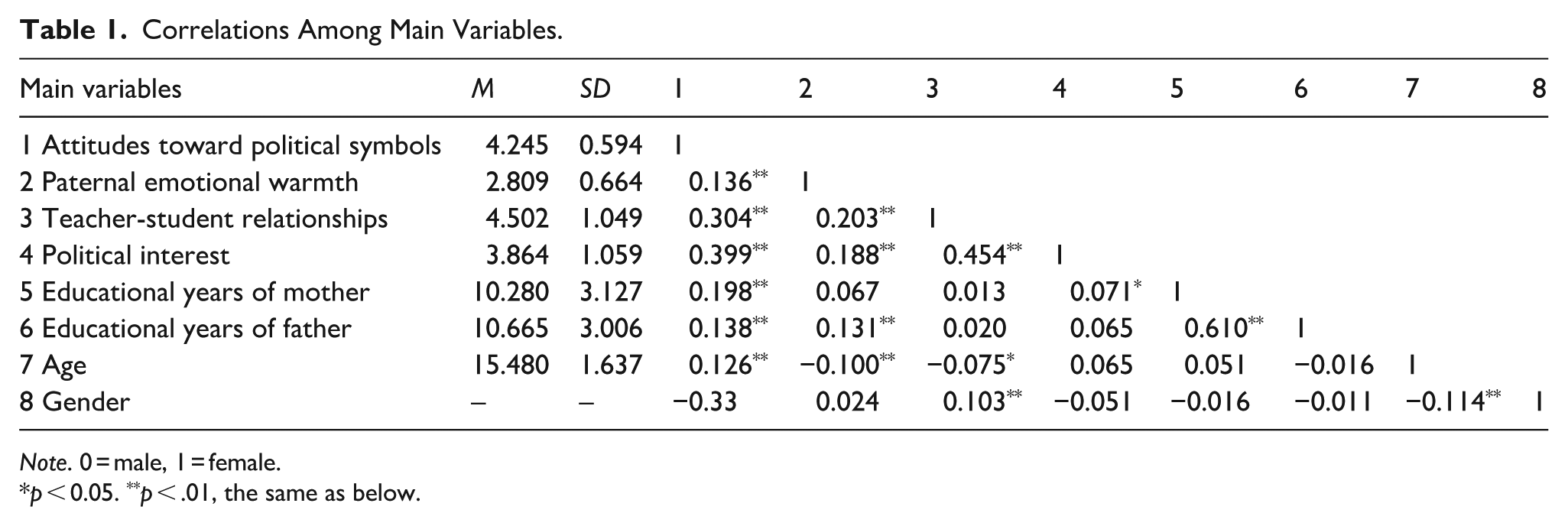
Pearson correlations were conducted between key variables (Table 1), and showed that the pairwise correlations among PEW, TSRs, political interest and attitudes toward political symbols all reached a significant level. Educational years of mother and father and age were positively associated with attitudes toward political symbols. Therefore, age and the educational years of the mother and father were all controlled in the structural equation model. School type was also controlled, while gender was not considered in the follow-up analysis due to an insignificant main effect (See Supplemental S.4. Univariate Analysis of Variance).
Correlations Among Main Variables.
Note. 0 = male, 1 = female.
p < 0.05. **p < .01, the same as below.
The Serial Multiple Mediation Model of TSRs and Political Interest
The result of direct effect model of PEW was showed in S.5. A structural equation model examined the mediating effect of TSRs and political interest between PEW and attitudes toward political symbols and the serial multiple mediating effects. The goodness-of-fit indices showed that the multiple mediation model fit the data well (x2/df = 2.491, p < .001, RMSEA = 0.043, SRMR = 0.044, TLI = 0.905, CFI = 0.911).
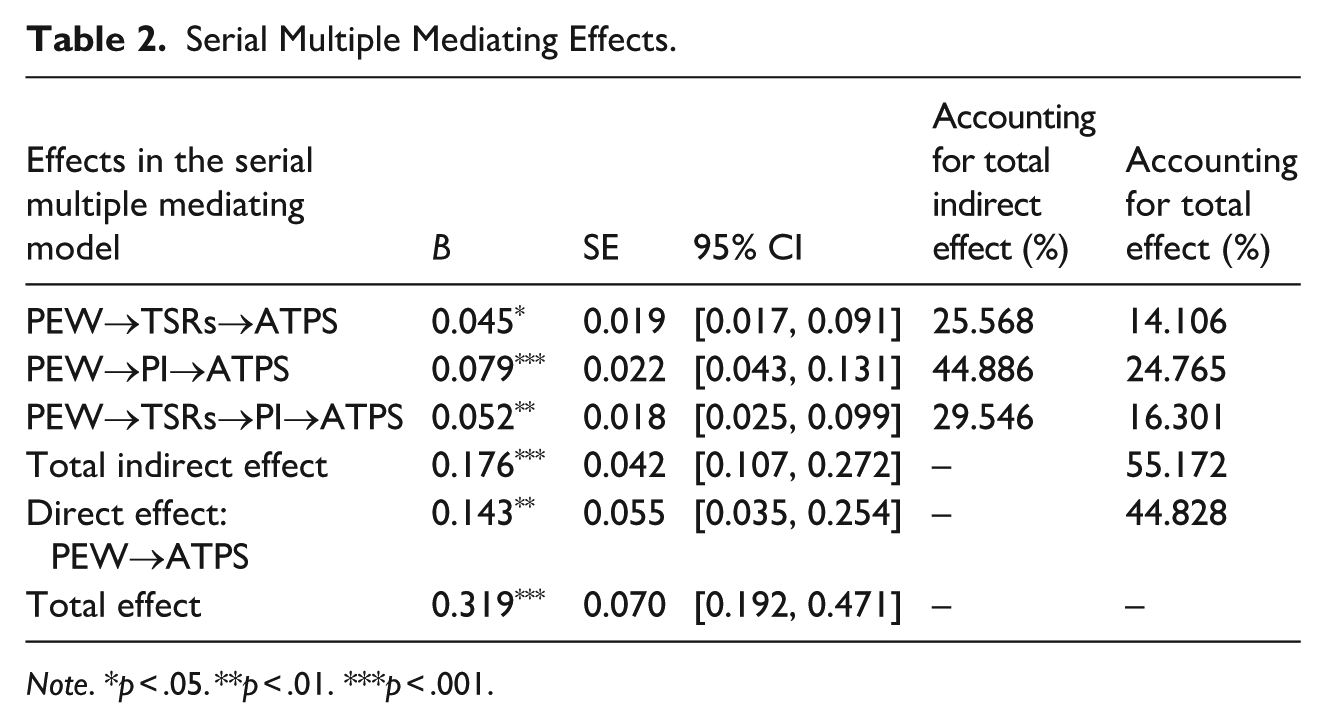
The standardized path coefficients in the multiple mediation model were shown in Figure 1. The direct and indirect effects of PEW on attitudes toward political symbols were shown in Table 2. In the serial mediation model, after paternal and maternal educational years, age, and school type were controlled, PEW was positively associated with attitude toward political symbols, β = .143, 95% CI (0.035, 0.254). The mediating effects of TSRs, political interest and serial mediating model were 0.045, 0.079 and 0.052, respectively, Therefore, a serial mediating model was supported and partially mediated between PEW and attitude toward political symbols.
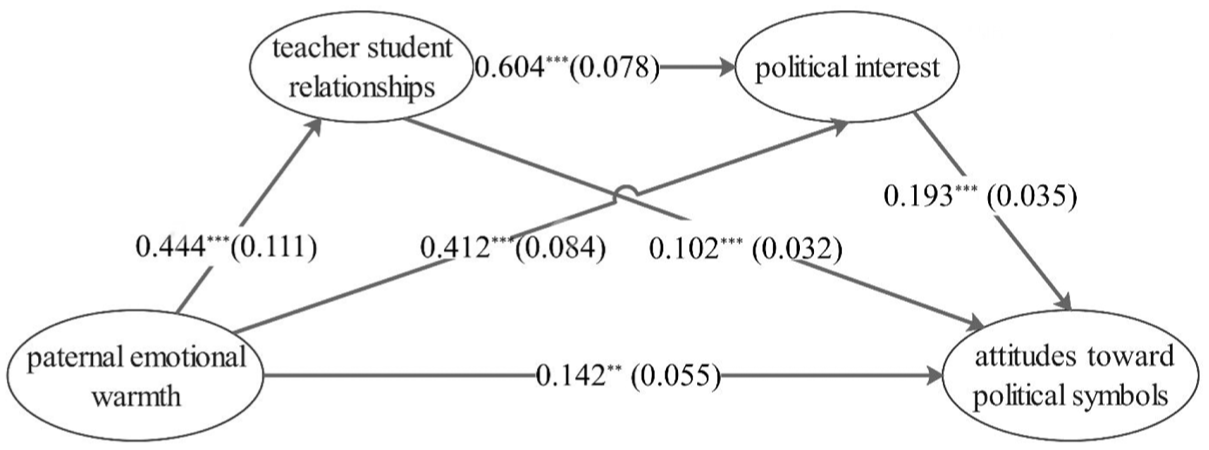
Structural model examining serial mediating effects of TSRs and political interest.
Serial Multiple Mediating Effects.
Note.*p < .05. **p < .01. ***p < .001.
Discussion
Direct Effect of PEW
In this study, PEW is positively associated with adolescents’ attitudes toward political symbols, and this supports
The relationship between family and nation has been discussed in Chinese political philosophies. Confucius and Mencius, who are representatives of Confucianism, believed in Family-Nation Isomorphism (家国同构). The structure of family and nation shows continuous isomorphism, and the nation is the big family for an individual. Children’s filial piety to their fathers in the family can predict their future loyalty to the monarch or nation. Political symbols represent the nation and government. Therefore, this study’s result fits not only the interpersonal transfer model (Hess & Torney, 1967) but also the political thought of Confucius and Mencius.
It is worth pointing out that gender does not enter the structural equation modeling because there is no significant gender difference in attitudes toward political symbols in the present study. This result is similar to Zheng and He (2012), which indicates no gender difference in political confidence between genders. Furthermore, Liu et al. (2023) also demonstrate that there is no gender difference in governmental satisfaction and political trust in officials, which are all associated with political emotions. Therefore, attitudes toward political symbols show no gender difference as do other political emotional factors.
Mediating Effect of TSRs
The present study shows that TSRs mediate the effect of PEW on attitudes toward political symbols, which supports
Serial Mediating Effect of TSRs and Political Interest
This study shows the serial mediating effect of TSRs and political interest between PEW and attitudes toward political symbols, which supports
Limitations and Implications
Future research could be conducted in the following ways. First, the present study utilizes a cross-sectional design to build the correlation model. While, a longitudinal design or experiment could be considered to expand into a causal model. Second, the data is mainly from Chinese adolescents. Although Chinese political culture emphasizes on collectivism and centralization, distinct from Western individualism and power decentralization (Yan, 2021), the theoretical framework and empirical evidence are not culturally bounded. Additional Western data can enhance the cultural applicability of the findings. Third, more family or school variables, such as parents’ political interests, attitudes toward political symbols, or school climate, being excluded due to questionnaire length and accessibility constraints, can be considered in the future.
This study offers strong theoretical and practical implications. First, this is the first study to explore how relational factors affect attitudes toward political symbols. The serial multiple mediating model fills the gap in how PEW influences attitudes toward political symbols. Second, most studies have indicated a respective and independent effect of PEW and TSRs on political attitudes, and this study combines the two main political socialization agents in the same theoretical model. The mediating effect of TSRs expands the understanding of TSRs in political socialization and confirms an extension of the interpersonal transfer model. Third, practically, this study implicates the unique functions of interpersonal factors in fostering positive reactions to political world, for example, support, caring, or respect from fathers or teachers.
Supplemental Material
sj-docx-1-yas-10.1177_0044118X251414418 – Supplemental material for Effect of Paternal Emotional Warmth on Attitudes Toward Political Symbols: A Serial Mediating Model
Supplemental material, sj-docx-1-yas-10.1177_0044118X251414418 for Effect of Paternal Emotional Warmth on Attitudes Toward Political Symbols: A Serial Mediating Model by Suran Guo, Shaobo LV, Hongmin Chen and Yang Zhang in Youth & Society
Footnotes

Funding
The authors disclosed receipt of the following financial support for the research, authorship, and/or publication of this article: It was supported by National Key R&D Program of China (2024YFC2707800), and Research Funds for NSD Construction, University of International Relations 2019GA39.
Declaration of Conflicting Interests
The authors declared no potential conflicts of interest with respect to the research, authorship, and/or publication of this article.
Data Availability Statement
Supplemental Material
Supplemental material for this article is available online.
Author Biographies
References
Supplementary Material
Please find the following supplemental material available below.
For Open Access articles published under a Creative Commons License, all supplemental material carries the same license as the article it is associated with.
For non-Open Access articles published, all supplemental material carries a non-exclusive license, and permission requests for re-use of supplemental material or any part of supplemental material shall be sent directly to the copyright owner as specified in the copyright notice associated with the article.
