







Abstract
The Student Human Rights Ordinance (SHRO) constitutes a major normative reform in South Korean education, aiming to institutionalize students’ dignity and autonomy, yet its practical effects remain contested. Exploiting staggered adoption across six metropolitan and provincial jurisdictions, this study estimates the causal impact of the SHRO using a difference-in-differences design that accounts for treatment heterogeneity. Analyzing administrative panel data and nationwide surveys, we find no evidence that the ordinance improved student outcomes. Instead, SHRO adoption is associated with deteriorations in student well-being, including increased physical and mental health problems, and suggestive declines in academic proficiency among lower-performing high school students. Moreover, reported violations of teachers’ rights increased significantly, indicating reduced institutional efficiency. These unintended effects appear driven by administrative overload, ambiguous implementation, and weakened teacher discretion, highlighting the need for complementary structural reforms to align student rights protection with effective educational practice.
Keywords
Introduction
Student rights encompass the entitlements and freedoms students hold within educational settings. This concept positions students as autonomous individuals deserving of dignity and fairness, rather than passive recipients of education. A landmark precedent is the 1969 U.S. Supreme Court case Tinker v. Des Moines Independent Community School District, which affirmed that “students do not shed their constitutional rights at the schoolhouse gate.” International norms, enshrined in the UN Convention on the Rights of the Child (UNCRC, 1989), specify these rights, including protection from violence, equitable access to education, freedom of expression, non-discrimination, and participation in school governance.
Student rights are situated at the intersection of school structure and student-teacher relations. Analyses emphasizing structure, agency, and power sharpen an understanding of these dynamics (Devine, 2002; Gallagher, 2008). Power operates through what Giddens (1984) and Sewell (1992) term the “dialectic of control,” where structures both constrain and enable action. Thus, student rights reflect the mutual shaping of individual agency and institutional constraint.
Authoritarian regimes historically leveraged school hierarchies to justify corporal punishment and strict discipline, viewing children as controllable subjects rather than rights-bearing agents. Central to this is an asymmetric power dynamic that legitimizes overriding student rights (Foucault, 1979; Rose et al., 2006). The hidden curriculum reinforces these dynamics (Bernstein, 1975; Jackson, 1968). Developmental frameworks proposed by Piaget (1932), Erikson (1950), and Kohlberg (1963) did not prescribe subordination, but educators often used them to justify limiting students’ rights by labeling them “immature.” This decontextualization of theory sustains hierarchical power under the guise of pedagogical neutrality (Giroux, 1983; Popkewitz, 1988).
Recent research critiques these asymmetries. Authoritarian leadership harms student well-being and increases emotional strain, while corporal punishment has lasting negative effects (Gershoff & Grogan-Kaylor, 2016; Peng & Huang, 2024). In contrast, prosocial teachers and positive classroom climates foster better outcomes (Jennings & Greenberg, 2009). Alternative scholarship advances a participatory model of student rights, particularly in democratic contexts, emphasizing students’ right to voice and governance (Lundy, 2007). These rights serve not only as safeguards but as means to promote dignity, participation, and growth. This transformative approach reshapes curriculum and school culture (Fielding, 2004), while fostering agency, belonging, and competence (Mitra, 2004). It also strengthens self-efficacy (Bandura, 2001), reduces behavioral issues via belonging (Osterman, 2000), and supports intrinsic motivation through autonomy (Ryan & Deci, 2000).
Korea’s Student Human Rights Ordinance (SHRO) operationalizes internationally recognized student rights principles within local legal frameworks, shaping public education policy and facilitating judicial oversight. By embedding student rights into everyday school administration, the SHRO aims to ensure their legal enforceability and institutional legitimacy. However, despite its normative aspirations, the ordinance has sparked deeply polarized political debates. Often cast within ideological divisions, student rights are rendered as symbolic rhetoric rather than substantive policy imperatives. A key obstacle is the lack of empirical evidence. Even studies on related pedagogical styles, such as indulgent versus authoritative approaches, yield inconclusive results (Babcock, 2009; Kahne et al., 2022). Quantitative research assessing the actual effects of student rights on school environments remains scarce, and methodological challenges, particularly issues related to endogeneity, continue to complicate causal inference.
This study evaluates the causal impact of SHRO on (1) student well-being, (2) school failure, and (3) institutional efficiency in South Korea, exploiting staggered adoption across six jurisdictions within a decentralized education system. Using a staggered difference-in-differences design, it identifies policy effects based on temporal and regional variation in SHRO implementation (Roth et al., 2023). The findings show no improvements in student well-being or academic outcomes, while violations of teacher rights increased following SHRO adoption, indicating weakened institutional efficiency. These results highlight structural and administrative challenges in SHRO implementation and underscore the need for reduced bureaucratic burden, clearer guidelines, and stronger institutional support for teachers to enhance policy effectiveness.
This study contributes to the literature by providing an empirical framework for evaluating normative educational reforms and offers implications for the design of future rights-based policies. The remainder of the paper is organized as follows. Section 2 describes the institutional background of SHRO. Section 3 reviews the relevant theoretical literature. Section 4 examines the limited existing empirical literature on SHRO and develops a set of core, policy-relevant, and empirically testable hypotheses that extend prior research. Section 5 outlines the data sources and empirical strategy. Section 6 presents the main findings and situates them within their broader policy and educational-sociological contexts. Section 7 concludes.
Korean Backgrounds
Following its accession to the United Nations in the early 1990s, South Korea ratified the 1989 Convention on the Rights of the Child (UNCRC), committing to international human rights standards in education. From the mid-1990s, public discourse on student rights expanded to include freedom of expression, privacy, religious freedom, and protection from violence. This expansion was driven by several policy controversies, including mandatory evening self-study in 1995, enforcement of hairstyle regulations in 2000, introduction of the National Education Information System in 2003, and government-mandated student placement in mission schools in 2004. These cases increased public expectations for formal recognition of student rights.
Academic and policy debates focused on whether student rights should remain normative or be legally binding. As support for codification grew, attention shifted to the appropriate legal level, including constitutional, statutory, administrative, or internal school regulation. This debate was reflected in the December 2007 amendment to the Elementary and Secondary Education Act, which required school founders and principals to respect students’ constitutional and internationally guaranteed rights.
Institutional change accompanied these developments through the introduction of direct elections for superintendents of education in all metropolitan and provincial jurisdictions. Previously appointed or selected through non-competitive procedures, superintendents operated within a centralized governance structure. Direct elections transferred selection authority to local electorates and increased legitimacy and accountability. Superintendents are elected to four-year terms, renewable up to three consecutive terms, and serve as independent executive authorities. Under the Local Autonomy Act and the Act on Local Education Autonomy, they propose ordinances and budgets, regulate education administration, manage school establishment and closure, oversee curriculum implementation, and make personnel decisions. The central government retains authority over the national curriculum and general standards, while provincial superintendents are responsible for implementation and daily administration.
The SHRO emerged from this shift toward educational self-governance and developed unevenly across regions. Gyeonggi Province enacted the first ordinance in 2011, followed by Seoul and Gwangju in 2012, and Jeollabuk-do in 2013. Chungcheongnam-do adopted the ordinance in 2020, and Jeju-do in 2021. Six metropolitan and provincial governments have enacted SHROs to date. Regional variation reflects differences in political orientation and local governance conditions. Early adopters were generally progressive jurisdictions with active civic participation, while later adopters proceeded more cautiously.
As shown in Table 1, the SHRO defines a framework of student rights applicable in school settings. The ordinances are structured around six domains: inclusive rights, political and administrative rights, protection from violence, privacy rights, education-related rights, and health and safety. Inclusive rights include freedom of conscience, religion, and expression, and prohibit discrimination against minority groups. Political and administrative rights guarantee student participation in school governance, due process in disciplinary procedures, and the establishment of advocacy bodies and human rights education. The SHRO prohibits corporal punishment and addresses student safety. Privacy provisions regulate school authority over appearance and personal belongings. Education-related rights ensure access to instruction and extracurricular activities. Health and safety provisions address school meals, rest, environmental conditions, and physical and mental well-being.
Detailed Rights of the Student Human Rights Ordinance.
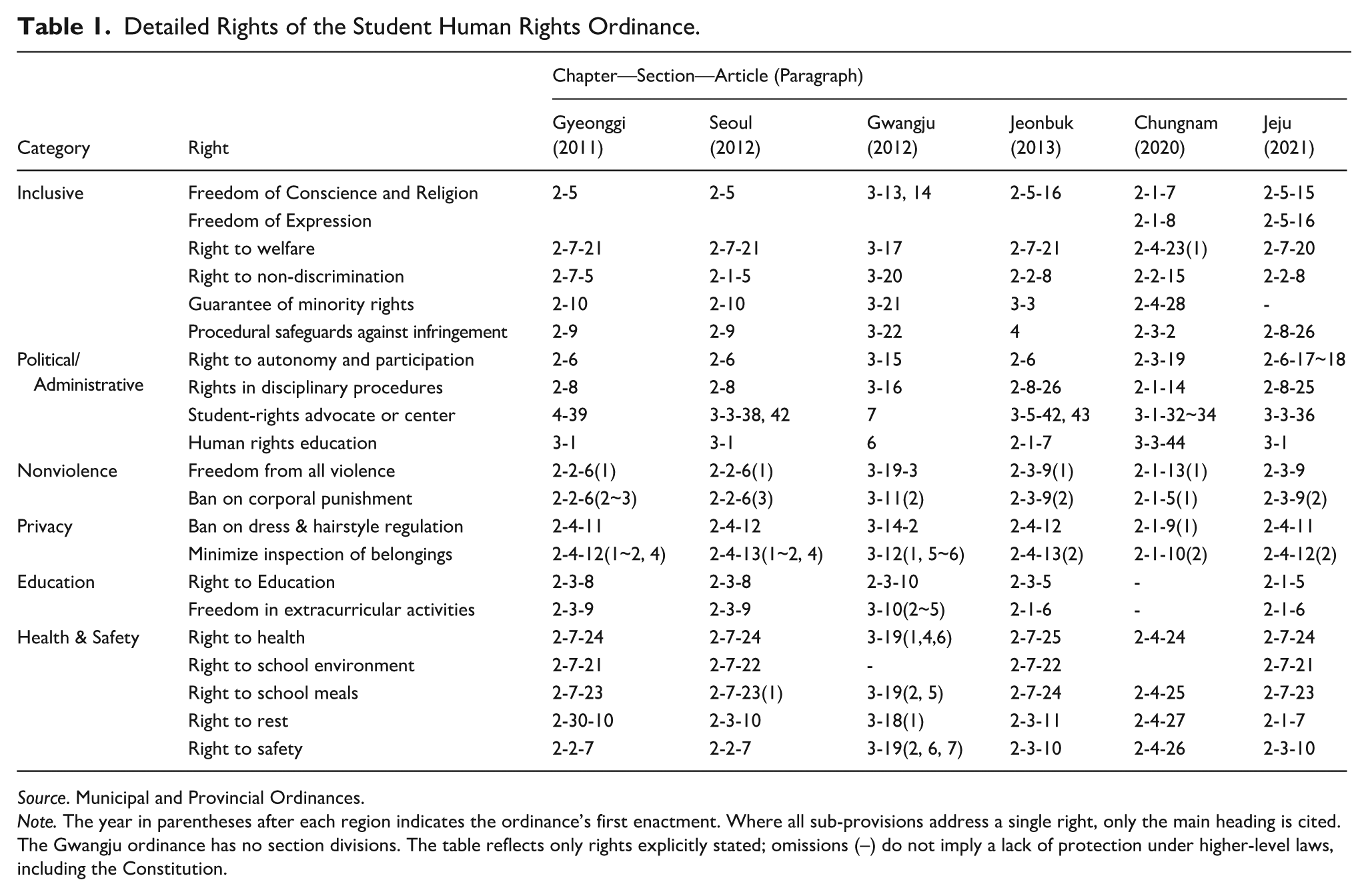
Source. Municipal and Provincial Ordinances.
Note. The year in parentheses after each region indicates the ordinance’s first enactment. Where all sub-provisions address a single right, only the main heading is cited. The Gwangju ordinance has no section divisions. The table reflects only rights explicitly stated; omissions (–) do not imply a lack of protection under higher-level laws, including the Constitution.
Public debate has focused on corporal punishment, hairstyle regulations, and inspections of personal belongings, but the SHRO encompasses broader concerns, including emotional well-being, autonomy, equal participation, and inclusion. Despite regional differences in terminology, the ordinances establish functionally equivalent rights and responsibilities. They include administrative provisions for implementation, monitoring, and institutionalization at school and district levels, providing a legal basis for rights-based school governance.
Since its adoption, the SHRO has generated sustained controversy (Park et al., 2017). Supporters argue that recognizing students as constitutional rights holders is necessary for democratizing education and protecting human dignity, particularly through prohibitions on corporal punishment and protections for freedom of expression. Critics argue that the ordinance weakens teacher authority, undermines discipline, and has limited relevance to students’ experiences. Others contend that its effects are symbolic and that the ordinance was adopted without sufficient deliberation, especially involving teachers and parents.
These debates remain unresolved. Following publicized cases involving violations of teachers’ rights, some teacher unions and conservative groups have called for repeal of the SHRO. Ongoing conflict reflects institutional and political divisions and points to the need for systematic evaluation and evidence-based policy responses.
Theoretical Contexts
Student rights are best understood as children’s rights rearticulated within the institutional context of schooling (Fairhall & Woods, 2021; Urinboyev et al., 2016). Their normative justification rests on two foundational values: the universality of human rights and the maintenance of educational order (Dixon & Nussbaum, 2012; Giesinger, 2019). The SHRO provides a paradigmatic example of how such a normative ideal is legally institutionalized within schools. As schools operate as administrative organs of the state, they embody pronounced features of public governance. Accordingly, the ordinance calls for analysis from two interrelated theoretical perspectives: first, the legitimacy and normative distinctiveness of student rights; and second, the functional and institutional dynamics through which these norms are translated into and interact with law in practice.
The contemporary discourse on student rights emerged in the twentieth century alongside the broader expansion of legal protections to previously marginalized groups (Dixon & Nussbaum, 2012). The adoption of the 1989 United Nations Convention on the Rights of the Child (UNCRC) consolidated previously fragmented standards of child rights (Hammarberg, 1990) and catalyzed scholarly inquiry into how student rights are perceived, interpreted, and enacted within educational settings (Quennerstedt & Moody, 2020). Prior studies indicate that children’s understandings of their rights vary significantly across social domains, including school, family, community, and political systems (Ben-Arieh & Attar-Schwartz, 2013). Moreover, these understandings are continually reshaped in response to transformations in educational institutions and broader societal values (Coppock & Gillett-Swan, 2016). Student rights should therefore be conceptualized not as static legal entitlements, but as dynamic constructs embedded within shifting temporal and spatial contexts (Quennerstedt & Quennerstedt, 2014).
From a solidaristic perspective, students are rights-bearing individuals whose entitlements are not contingent upon their institutional status as students (Lundy, 2007). Central to this perspective is the notion of rights consciousness, defined as the capacity to recognize and interpret lived experiences as potential rights violations (Perry-Hazan, 2021). Such consciousness enables students to translate grievances into rights-based claims and to pursue appropriate responses (Felstiner et al., 1980), thereby constituting a precondition for legal mobilization (Zemans, 1983). School environments that safeguard freedom of expression and protect students from discrimination play a critical role in cultivating this awareness, facilitating a developmental shift from egocentric to solidaristic understandings of rights (Covell & Howe, 2001). At the same time, conflating rights with adjacent concepts such as welfare risks diluting their normative specificity. Clarifying student rights as substantive entitlements, rather than discretionary benefits, reinforces their legal enforceability (Reynaert et al., 2009). Beyond their instrumental significance, rights-conscious students are also more likely to internalize democratic norms, which in turn reduces the likelihood of rights violations and contributes to the formation of democratic citizenship more broadly (Osler & Starkey, 2006).
Law plays a constitutive role in shaping how individuals interpret their experiences and operates in a coevolutionary relationship with social norms (Ostrom, 2009; Sunstein, 1996). Legal rules may directly influence behavior through formal enforcement mechanisms (Becker, 1968), or indirectly by signaling socially valued norms and expectations (Benabou & Tirole, 2026; Lane et al., 2023; McAdams, 1997). Conversely, social norms can precipitate legal change by shaping legislative agendas, judicial interpretations, or the everyday application of statutory provisions (Mezey, 2001; Pound, 1910). These interactions are inherently context-dependent: while excessive legal coercion may provoke resistance, legal enforcement tends to be more effective when it aligns with local norms or is reinforced by community-based processes of rule generation and enforcement (Acemoglu & Jackson, 2017; Ostrom et al., 1992).
In contemporary societies, the interaction between law and social norms has promoted the juridification of rights—that is, the expansion of legal norms into routine organizational practices (Friedman, 1994; McAdams, 2015). While juridification can strengthen normative protection, it also entails implementation costs. These costs are analytically distinct from the legitimacy of rights themselves and include compliance, learning, psychological, dispute, and opportunity costs. In public administration scholarship, such costs are conceptualized as administrative burden (Herd & Moynihan, 2018). Moreover, legal institutionalization may lead to symbolic compliance, whereby organizations adopt formal structures to signal conformity with legal expectations while decoupling them from everyday practices (Meyer & Rowan, 1977). Schools are enforcement organizations in which such administrative and policy burdens are particularly concentrated. Teachers and administrators operate as street-level bureaucrats who interpret and apply often ambiguous legal rules under conditions of limited resources, thereby enacting policy as it is practiced rather than as it is formally prescribed (Lipsky, 1980). When legal norms are contested or procedurally indeterminate, implementation becomes fragmented, compliance costs and conflict increase, and potentially leading to behavioral chilling effects (Matland, 1995). From this perspective, the central challenge posed by SHRO lies not merely in the legitimacy of student rights, but in how those rights are institutionalized and operationalized within the school context.
Literature Review and Hypotheses Development
Existing empirical work on the SHRO yields limited and inconclusive evidence regarding its effects. Using data from the early phase of SHRO implementation (2010–2013), Jung and Kang (2015) find no statistically meaningful effects on school life and behavioral outcomes. Bae and Chin (2017) show that changes in students’ nighttime study time largely reflect nationwide trends rather than SHRO adoption. Jeong and Jeong (2020) report declines in school bullying in some SHRO regions, while Park (2021) finds modest improvements in overall human rights conditions without corresponding changes in rights-supportive school climates. Taken together, existing estimates do not converge on a stable pattern of effects, leaving the net impact of the SHRO empirically ambiguous. Building on this evidence, this study formulates hypotheses around three outcome domains directly linked to rights explicitly stated in the SHRO and operationalized as observable outcome variables.
First, student well-being corresponds to rights related to students’ health, safety, and basic living conditions stated in the SHRO (see Table 1). Student well-being is operationalized using self-reported measures of physical and mental health and nutrition, including self-rated health, perceived stress, depressive symptoms, and indicators related to dietary conditions. This domain examines whether awareness and enforcement of these rights are associated with changes in these outcomes within the school environment.
Second, school failure is defined from the perspective of minimum educational guarantees. Rather than focusing on gains in overall academic performance, this domain examines whether the SHRO mitigates outcomes, such as failure to meet basic academic standards or disengagement from formal schooling (Faubert, 2012). These outcomes provide a direct way to assess whether education- and learning-related rights are reflected in reductions in clearly adverse educational states, allowing for an evaluation that incorporates equality-related considerations.
Third, institutional efficiency at the school level captures how the legal institutionalization of student rights interacts with schools’ capacity to carry out educational and student-protection functions under administrative and professional constraints. Efficiency is understood as the maintenance of instructional authority and organizational functioning following SHRO implementation. Incidents of teacher authority infringement and private tutoring participation are used as observable indicators of potential frictions in school operations and shifts in reliance on external educational inputs.
Based on these considerations, this study advances the following hypotheses:
Method
This study uses South Korea’s 17 metropolitan and provincial governments as units of analysis, constructing a panel dataset from administrative records. As noted in Section 2, decisions regarding the enactment, implementation, and repeal of SHRO, as well as broader education policy, are made at this level. Given regional variation in SHRO adoption, province-level analysis is essential for statistical validity.
Dependent variables are grouped into three domains: well-being, educational outcomes, and institutional efficiency. The well-being domain, closely related to core human rights concerns, draws on the Korea Youth Risk Behavior Web-based Survey, a nationwide annual survey conducted since 2005 that covers approximately 60,000 students and provides key indicators of adolescent health behaviors (Kim et al., 2016). Four indicators are constructed: (1) Self-rated health, based on a 5-point item (“How would you describe your overall health?”); (2) Perceived stress, also on a 5-point scale (“How often do you feel stressed?”), where higher scores indicate greater stress; (3) Depressive symptoms, a binary measure of experiencing sadness or hopelessness for two consecutive weeks in the past year; and (4) Suicidal ideation, a binary measure of having seriously considered suicide in the past year.
School failure is assessed using two indicators relevant to children’s rights to education. The first is the proportion of students scoring below the basic proficiency level in Korean, English, and mathematics. Academic achievement is analyzed separately for middle school (ages 13–15) and high school (ages 16–18) students from 2008 to 2016, using data from the Ministry of Education’s National Assessment of Educational Achievement, which classifies performance into proficient, basic, and below-basic levels. The analysis focuses on the below-basic category as an indicator of minimum educational standards. Because achievement data outside this period rely on a 3% sample rather than a full census, provincial-level estimates for those years are excluded from the analysis. The second indicator is the dropout rate, calculated from complete administrative records in provincial education yearbooks and expressed per 1,000 enrolled students.
Institutional efficiency is assessed using two measures. The first measure is incidents of teacher authority infringement, drawn from data compiled by the Korean Federation of Teachers’ Associations covering the period from 2009 to 2021. To standardize variation arising from changes in the student-age population and teacher supply over time, these incidents are normalized per 1,000 teachers and per 1,000 students. The second measure is private tutoring participation, measured annually for middle and high school students using data from the KOSIS Survey on Private Education Expenditure for the period from 2009 to 2023.
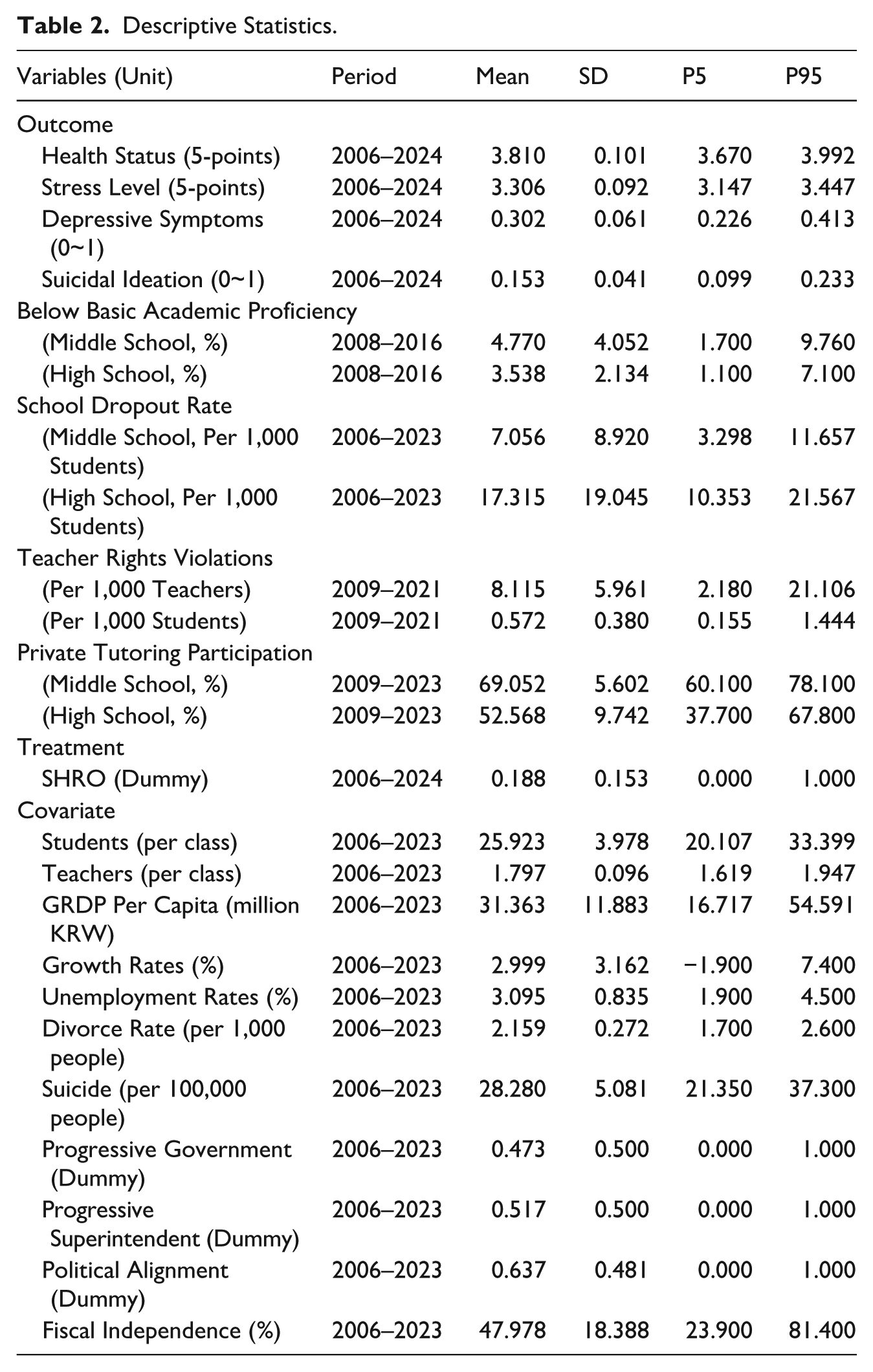
Control variables include widely used indicators of educational conditions, socioeconomic context, and population health. Students per class and teachers per class proxy for instructional demand and supply. Regional economic conditions are captured by per capita gross regional domestic product (GRDP) and its growth rate, and the unemployment rate is included to account for household- and community-level channels affecting students’ well-being and academic performance (Jensen, 2023; Picchio & Ubaldi, 2024). Divorce and suicide rates per 100,000 population reflect family and societal stressors relevant to student welfare. Given that all SHROs were enacted under progressive superintendents, the political orientation of both regional superintendents and the central government is controlled for. An additional dummy variable indicates whether the Minister of Education and the superintendent share the same political orientation, capturing Korea’s divided education governance structure. Finally, the fiscal self-reliance ratio measures regional budgetary autonomy in SHRO implementation. All models additionally include region and year fixed effects. Descriptive statistics are reported in Table 2.
Descriptive Statistics.
To estimate the causal effect of SHRO, we employ the difference-in-differences design leveraging the staggered timing of ordinance adoption across regions. This approach compares outcome changes in treated jurisdictions before and after implementation with contemporaneous changes in untreated regions, isolating the policy’s effect from general trends.
Our baseline model is a two-way fixed effects (TWFE) regression:

where
A crucial assumption for the validity of this identification strategy is that, in the absence of the SHRO, treated and control regions would have followed similar outcome trajectories. To test the parallel trends assumption, we estimate an event-study model:

where
In light of recent concerns regarding potential bias in staggered DiD estimators due to treatment effect heterogeneity (Goodman-Bacon, 2021), we supplement our TWFE estimates with alternative methods proposed by Callaway and Sant’Anna (2021), Sun and Abraham (2021), and Borusyak et al. (2024). These approaches address the issue of negative weighting and enhance robustness in contexts with heterogeneous treatment timing. Following these methodologies, the event study analysis defines the observation window as the four years preceding the policy adoption (
Results and Discussions
The results section reports estimates obtained from four empirical approaches implemented within designs that allow for causal inference. When the estimates are consistent in both direction and magnitude across methods and are statistically significant, they provide coherent and relatively robust evidence of an effect associated with the introduction of the SHRO. Based on this criterion, the following discussion examines SHRO’s estimated impacts across outcome variables within the three hypothesis-driven domains, and then situates these findings within a broader analytical lens to explore the mechanisms and contextual factors underlying the observed patterns.
Based on the results presented in Table 3, the SHRO appears to have exerted a generally adverse yet modest influence on student well-being. For self-reported health status (Panel A), the TWFE estimator and those proposed by Callaway and Sant’Anna (2021) as well as Borusyak et al. (2024) yielded statistically significant negative effects, whereas the estimator by Sun and Abraham (2021) did not. Among the statistically significant estimates, the magnitudes were broadly consistent, with the decline in health status amounting to approximately 30 percent of the sample standard deviation, indicating a non-negligible deterioration. Regarding stress levels, statistically significant increases were observed under the TWFE model and the estimator of Borusyak et al. (2024), while the remaining two models produced insignificant estimates. This pattern provides only partial evidence of an adverse impact in this domain. In contrast, robust findings emerged for depressive symptoms (Panel C) and suicidal ideation (Panel D), both of which are key indicators of compromised mental health. Almost all estimators yielded statistically significant effects of comparable magnitude, suggesting a modest but consistent elevation in mental health risks following the implementation of the SHRO.
Effects on Student Well-Being, School Failure, Institutional Efficiency.
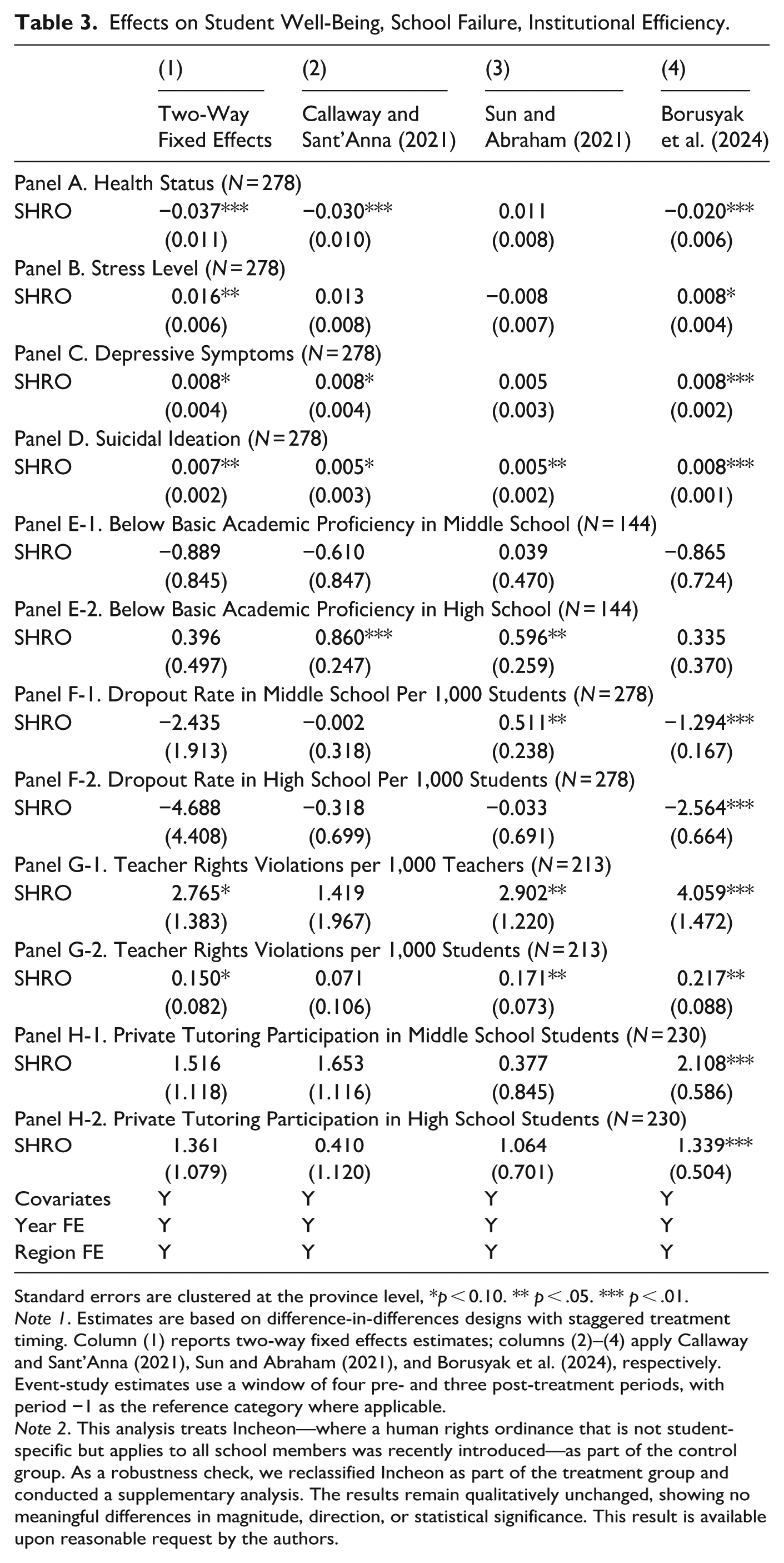
Standard errors are clustered at the province level, *p < 0.10. ** p < .05. *** p < .01.
Note 1. Estimates are based on difference-in-differences designs with staggered treatment timing. Column (1) reports two-way fixed effects estimates; columns (2)–(4) apply Callaway and Sant’Anna (2021), Sun and Abraham (2021), and Borusyak et al. (2024), respectively. Event-study estimates use a window of four pre- and three post-treatment periods, with period −1 as the reference category where applicable.
Note 2. This analysis treats Incheon—where a human rights ordinance that is not student-specific but applies to all school members was recently introduced—as part of the control group. As a robustness check, we reclassified Incheon as part of the treatment group and conducted a supplementary analysis. The results remain qualitatively unchanged, showing no meaningful differences in magnitude, direction, or statistical significance. This result is available upon reasonable request by the authors.
These results do not substantiate a definitive causal link between the SHRO and the observed deterioration in student well-being. However, they clearly indicate that the policy was not successful in yielding substantive improvements in this domain. A plausible interpretation is that school practices did not sufficiently adjust after the ordinance’s adoption. In the absence of clear implementation guidelines or reliable information, instructional and student-support services may have functioned under increased caution or without adequate assurance of professional discretion (Warren et al., 2024). Consequently, physical- and health-education classes and counseling services may have been delivered in a more limited way, and heightened sensitivity to student privacy, including concerns about confidentiality, disclosure or labeling, may have constrained the early identification of risk-factors emerging from home or peer environments. Moreover, although confidential support channels may have existed, students’ limited awareness of these options, together with stigma or access-barriers, may have reduced their likelihood of utilizing such channels (McPhail et al., 2024; O’Farrell et al., 2023).
It was also difficult to identify any significant improvements in school failure following the introduction of the SHRO. Although most estimates are either statistically insignificant or inconsistent in direction, the outcome variable Below Basic Academic Proficiency in High School (Panel E-2) produced relatively robust results when bias-adjusted estimators were used, particularly those of Callaway and Sant’Anna (2021) and Sun and Abraham (2021). These findings tentatively indicate that the SHRO may have contributed to a decline in learning outcomes among lower-performing students. A plausible educational interpretation is that the ordinance may have unintentionally altered teachers’ professional duties, increasing the emphasis on administrative and procedural work, thereby reducing opportunities for remedial support (Ballet & Kelchtermans, 2009; Kim, 2019). Such changes in instructional priorities could have influenced the level of support available to students who require additional or more optimized academic assistance. Some educators may also have adopted a more cautious approach to level-based differentiated teaching practices, reflecting heightened sensitivity to issues of fairness and equity (Jerrim et al., 2025; Park & Datnow, 2017). Furthermore, by requiring student consent rather than allowing teacher discretion, and amid unclear guidelines that raised concerns about potential rights violations, the SHRO may have allowed selection bias to persist and reduced the conducive learning time available to less motivated or at-risk students (Durlak et al., 2010; Hodges et al., 2001).
The analysis of school-level institutional efficiency provided empirical evidence of a key linkage that helps explain previously identified limitations and unintended consequences of the SHRO. For the outcome variable Teacher Rights Violations (Panels G-1 and G-2), the estimated coefficients are positive and statistically significant in most specifications. The evidence suggests that, at least at the outcome level, the implementation of the SHRO has led to a measurable increase in teacher rights violations, regardless of teacher or student numbers. The findings indicate that the SHRO has restricted teachers’ core professional responsibilities across both instructional and administrative domains, thereby intensifying the risk of professional inhibition and institutional disempowerment (Astor et al., 2024; Choi et al., 2024). Given that teachers serve as central agents in both educational practice and school administration (Datnow, 2020), such conflicts constitute a critical educational hindrance and administrative bottleneck that have collectively driven the unintended deterioration that has emerged since the SHRO’s implementation. These findings provide an institutional explanation for the ordinance’s principal limitations, suggesting that its structural design and implementation processes may inadvertently generate systemic inefficiencies and undermine the fundamental functions of educational institutions. With respect to private tutoring participation (Panel H-1 and H-2), some model specifications yield statistically significant estimates. However, the overall evidence following the introduction of the SHRO is neither consistent nor robust. As such, there is limited support for interpretations that the SHRO led to active substitution toward private tutoring or deliberate shifts away from formal schooling (Kim & Lee, 2010). Any such effects, if present, appear modest and should be interpreted with caution.
Overall, the empirical evidence indicates that the SHRO has not produced statistically meaningful benefits for students or teachers and has instead generated unintended adverse effects in several domains. As shown in Figure 1, the estimated effects exhibit no statistically detectable differences prior to the introduction of SHRO, whereas most post-introduction confidence intervals do not cross the null line, zero. This pattern provides substantial empirical support for the credibility of the causal identification strategy. Taken together, the results imply that the observed changes within education field are shaped by a complex configuration of political, administrative, and institutional dynamics. Interpreting these findings requires placing them in their broader context, clarifying their underlying causes, and articulating a more comprehensive account of their implications.
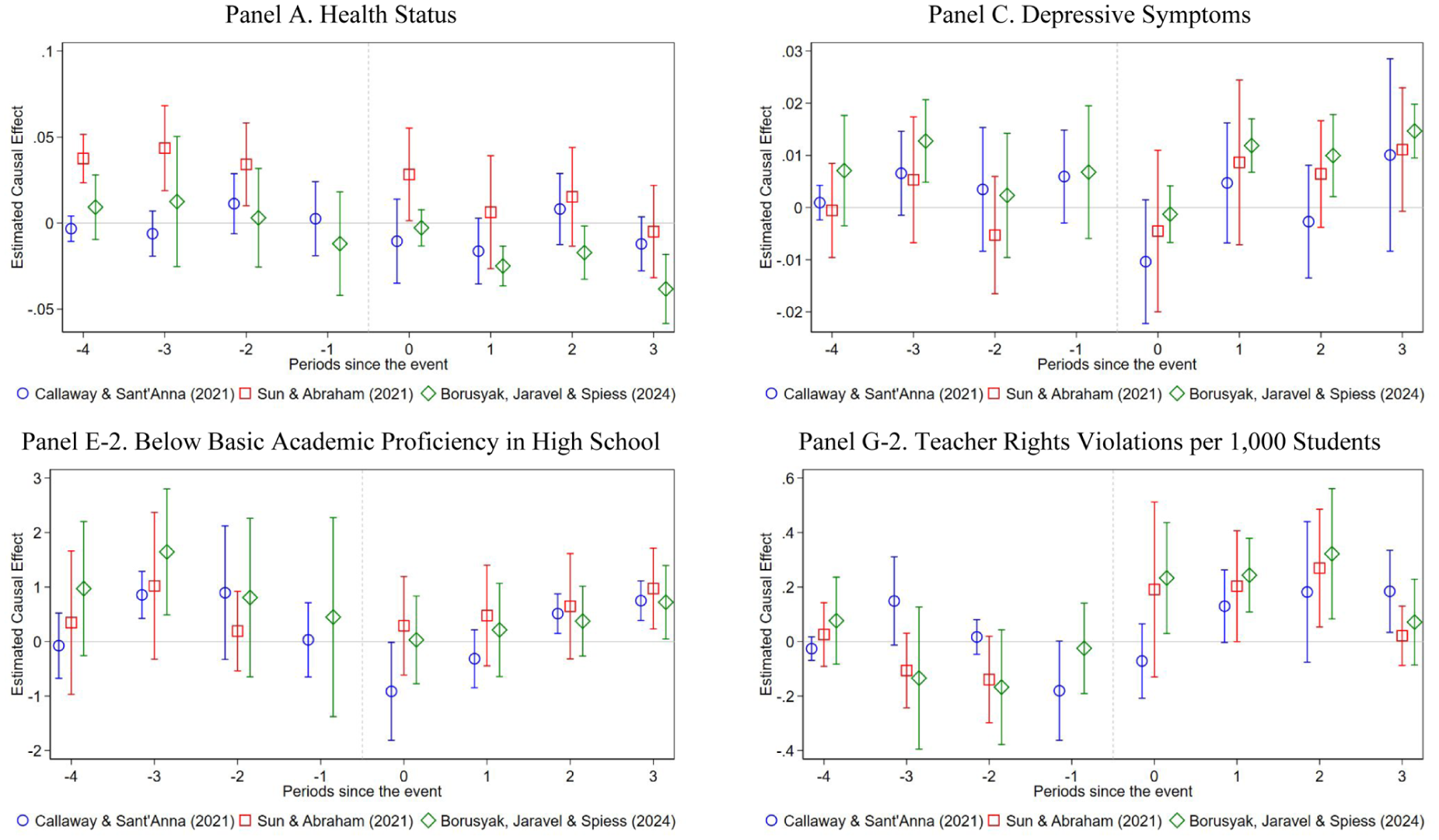
Dynamic treatment effects on key outcome variables.
Within the political dimension, the SHRO reconfigures power relations among students, teachers, and parents while serving as a symbolic assertion of local educational autonomy by progressive superintendents. When policies serve more as political statements than as instruments for change, stakeholders may be sidelined, and implementation reduced to rhetoric (Schneider & Ingram, 1993). Highly conflictual policies risk producing stalemates, reinforcing symbolic posturing while displacing accountability (Matland, 1995). The public discourse surrounding the SHRO fixated on the corporal punishment ban, thereby crowding out attention to deeper educational goals such as student well-being, academic achievement, and instructional quality.
At the administrative dimension, implementation may have been hampered by burdens placed on frontline educators (Moynihan et al., 2015). Learning costs, including the time and effort required to understand new regulations, combined with procedural demands for participatory governance, added to teacher workload. However, psychological costs likely had the most detrimental impact. Teachers may have experienced diminished autonomy and status, especially when their authority was challenged or when they faced stigmatization within the school community. This erosion of professional standing may have inhibited their capacity to adapt or advocate effectively. As “street-level bureaucrats” (Perry, 1996; Tummers et al., 2015), teachers typically demonstrate strong public service motivation and a student-centered orientation. Yet, the ambiguity and conflict surrounding SHRO implementation may have constrained their discretionary judgment and reduced the efficacy of their coping mechanisms.
In the legal-institutional dimension, the SHRO faces inherent limits in legal force and enforceability due to its status as an ordinance rather than national law. Even where provincial offices issued guidelines, implementation could be blocked or diluted by statutory constraints or central budget controls (Shipan & Volden, 2008). The ordinance was enacted only in regions governed by progressive superintendents, while central institutions, often led by conservative parties, retained influence throughout much of the study period. Although this political tension may have affected implementation, it is unlikely to be the primary driver of the observed outcomes, as the analysis controls for both political alignment and fiscal self-reliance.
Conclusion
This study empirically confirms that the introduction of SHRO has not realized the policy’s expected outcomes, as it has failed to generate clearly positive effects across major domains. However, these findings should not be construed as evidence of overall policy failure, nor do they suggest that student rights are unnecessary. Rather, recognizing that student rights as a form of children’s rights implemented within the administrative context of schools, our findings underscore the need to examine several policy implications to enhance the ordinance’s practical effectiveness.
First, the administrative burden on frontline teachers should be substantially reduced. As teachers adapt to the institutional environment created by the SHRO, they are likely to face heightened demands for legal literacy and concerns about professional security (Holben et al., 2009; Schimmel & Militello, 2007). In response, the institutionalization of sustained professional development and accessible legal support is essential. Core implementation guidelines should also preserve teachers’ professional autonomy and discretion while remaining consistent with student-centered accountability. Most importantly, implementation responsibilities should not be concentrated on a small subset of teachers. Instead, an integrated response framework involving politically accountable provincial education authorities and administratively responsible school principals is required.
Second, securing transparency and institutional trust requires a formal, professional governance structure. Student perspectives, as those of the primary beneficiaries, must be systematically collected. Parental input should be institutionally incorporated through procedurally fair and standardized mechanisms. The SHRO generates system-wide interactions and entails substantial conflicting interests among stakeholders. Participation alone is therefore insufficient to restore public trust in the education system. Visible and verifiable outcomes are essential (Campbell, 2023). In this context, third, to narrow the gap among political leaders such as elected superintendents, classroom practitioners, and beneficiaries including students and parents, evaluation frameworks should incorporate performance indicators that directly measure SHRO implementation. Such indicators would strengthen mutual accountability. They would also align policy objectives with on-the-ground conditions and enhance the ordinance’s overall effectiveness.
This study evaluates the SHRO using an approach feasible within the Korean data structure. However, several limitations should be noted. First, analysis at the metropolitan and provincial levels—the primary units of SHRO adoption—may not capture within-region heterogeneity; future studies should use district- or school-level panel data. Second, student well-being measures rely on self-reported data and may not reflect clinically precise health conditions; future research should incorporate indicators of physical development and major medical conditions. Third, the multidimensional variables used in this study do not fully capture policy-process frictions. Future research should develop integrative measures incorporating stakeholders’ values and judgments, including qualitative approaches, which would also improve policy responsiveness.
This paper makes three core academic contributions. First, it provides a comprehensive analysis of changes associated with SHRO by applying a multidisciplinary framework, thereby offering an integrated perspective on a body of SHRO research that has remained largely fragmented. Second, the study strengthens causal identification and improves the credibility of its estimates by exploiting the staggered regional adoption of SHRO and employing staggered difference-in-differences estimators that address bias arising from heterogeneous treatment timing. Third, based on reliable estimates and their interpretation, the study presents a mechanism-oriented analysis grounded in institutional context. By identifying pathways involving increased administrative burden, constraints on professional discretion, and misalignment between legal norms and organizational capacity, it derives policy implications for implementing student rights at the intersection of education and administration within schools.
Footnotes

Funding
The authors received no financial support for the research, authorship, and/or publication of this article.
Declaration of Conflicting Interests
The authors declared no potential conflicts of interest with respect to the research, authorship, and/or publication of this article.
Data Availability Statement
Data are available upon request by the authors.