







Abstract
Research on mobile media use and adolescent mental health has yielded inconsistent findings, often emphasizing usage frequency while neglecting motivational differences. Grounded in Uses and Gratifications Theory and Social Cognitive Theory, this study examined how academic self-concept and prosocial behavior mediate the associations between different motivations for mobile media use (MMMU) and depression among Chinese adolescents. A large-scale offline survey using cluster sampling was conducted with 46,862 participants (Mage = 13.33 ± 2.20), who completed validated measures of MMMU, academic self-concept, prosocial behavior, and depression. Parallel mediation analyses showed that interpersonal communication and information acquisition were negatively associated with depression, whereas reality avoidance and stimulus seeking were positively associated. Both academic self-concept and prosocial behavior significantly mediated the associations between each type of MMMU and depression. Consistent with the proposed theoretical framework, adaptive motivations enhanced academic self-concept and prosocial behavior, reducing depressive symptoms, while maladaptive motivations weakened these protective factors.
Keywords
Introduction
In recent years, the rapid proliferation of short-video platforms and social media applications has reinforced the dominance of mobile devices in adolescents’ daily lives. In China, internet access among minors has reached near saturation, with more than 190 million underage users and smartphones serving as the primary gateway for online engagement (iResearch, 2023). As both the scope and intensity of mobile media use continue to expand, increasing attention has been directed toward its potential implications for adolescents’ mental health.
Despite extensive attention, empirical findings regarding mobile media use and adolescent mental health remain inconsistent. While some studies and meta-analyses have linked higher levels of mobile media use to increased depressive symptoms (e.g., Girela-Serrano et al., 2024), others have reported null or even opposite effects (e.g., Shahzad et al., 2024). These mixed results suggest that the relationship between mobile media use and mental health is more complex than previously assumed. One important limitation of prior research is its predominant focus on usage frequency or duration, which may obscure meaningful psychological differences in how adolescents engage with mobile media. Recent studies have suggested that different usage patterns and motivations may be associated with distinct psychological outcomes (Hao et al., 2019). In addition, relatively little research has examined the psychosocial mechanisms through which specific motivations for mobile media use relate to depression, leaving key explanatory pathways insufficiently understood.
To address these gaps, the present study adopts a motivation-oriented perspective to examine the associations between different motivations for mobile media use (MMMU) and depression among adolescents. Drawing on prior conceptualizations of MMMU (Zhou, 2014), this study focuses on five dimensions: self-presentation, interpersonal communication, reality avoidance, information acquisition, and stimulus seeking. Importantly, this study examines whether and how academic self-concept and prosocial behavior mediate the associations between different motivations for mobile media use and depressive symptoms. By integrating multiple MMMU dimensions with two key psychosocial mediators, this study aims to clarify motivation-specific pathways linking mobile media use to adolescent depression, thereby moving beyond simplistic exposure-based models that focus solely on screen time.
MMMU and Depression
A substantial body of research has suggested a link between mobile media use and depression (Barthorpe et al., 2020; Girela-Serrano et al., 2024). For instance, a meta-analysis of 25 studies reported that greater use of mobile phones and other wireless devices may be associated with depression among adolescents (Girela-Serrano et al., 2024). However, findings in recent years have been inconsistent. Some studies report no significant association between mobile media use and adverse psychological outcomes (Vuorre & Przybylski, 2023, 2024), whereas others suggest a positive relationship between mobile media use and well-being (Shahzad et al., 2024).
One explanation for these inconsistencies is that much prior research has relied on overly simplistic measures of mobile media use, such as frequency (e.g., Shimoga et al., 2019) or duration (e.g., Sharifian & Zahodne, 2021). Such measures are narrow in scope and fail to capture the complexity of users’ experiences or the differentiated psychological effects of mobile media use (Saleem et al., 2024). Drawing on Uses and Gratifications Theory (Katz et al., 1973), individuals use media intentionally to meet specific psychological needs (Ruggiero, 2000; Wei et al., 2024). This perspective suggests that different needs give rise to distinct motivations for mobile media use, which in turn may have divergent implications for mental health (Girela-Serrano et al., 2024). Thus, examining MMMU provides a more nuanced and theoretically grounded framework for understanding the complex dynamics linking mobile media use and mental health (Jarman et al., 2021).
In addition, some scholars argue that the relationship between mobile media use and depression may be indirect. For example, research indicates that this relationship may be shaped by adolescents’ self-concept (Xiao et al., 2024) and prosocial competencies (Fitzpatrick & Boers, 2022). Therefore, it is crucial not only to clarify the direct association between MMMU and depression but also to investigate the mechanisms and conditions under which MMMU contributes to adolescents’ depressive symptoms.
The Mediating Role of Academic Self-Concept
Academic self-concept refers to students’ self-perceptions of their abilities in the academic domain (Wunberg et al., 2024). Two central dimensions are the perception of academic ability and the experience of academic emotions (Guo et al., 2011). The perception of academic ability reflects students’ overall evaluation of their learning capacities (e.g., whether they consider themselves competent learners), whereas the experience of academic emotions reflects their affective responses to academic activities (e.g., whether they perceive learning as enjoyable).
According to Uses and Gratifications Theory (Katz et al., 1973; Nguyen & Nguyen, 2024; Ruggiero, 2000), individuals selectively engage with media to satisfy specific psychological needs, and different types of media content fulfill different needs. Strengthening one’s academic self-concept represents a typical developmental need during adolescence and exerts a substantial influence on mental health. Thus, academic self-concept may serve as a mediator between MMMU and depression.
Empirical research lends preliminary support to this proposition. On the one hand, motivations for stimulus-seeking via smartphones (e.g., online gaming) have been found to negatively predict students’ academic self-efficacy, undermining behavioral, emotional, and cognitive engagement, as well as academic achievement motivation (Sun et al., 2023). However, smartphone use for academic learning is positively associated with students’ academic self-efficacy (Zhang et al., 2022). These findings suggest that distinct MMMU dimensions may either impair or strengthen academic self-concept. On the other hand, academic self-concept has been negatively associated with depressive symptoms. For instance, Morales et al. (2023) demonstrated that academic self-concept significantly predicted lower depression levels 1 year later among Spanish children and adolescents, whereas other self-concept domains (e.g., social, emotional, and physical) no longer showed longitudinal predictive effects. This evidence underscores the unique role of academic self-concept in protecting against depression. Taken together, these findings suggest that academic self-concept may mediate the association between different MMMU dimensions and adolescents’ depressive symptoms.
The Mediating Role of Prosocial Behavior
Prosocial behavior is generally defined as voluntary actions intended to benefit others or promote harmonious interpersonal relationships (Bergin et al., 2003). Such behaviors not only benefit recipients and enhance individuals’ subjective well-being and life satisfaction (Chen, 2024), but also foster stronger relationships between helpers and recipients and contribute to broader social harmony.
According to Social Cognitive Theory (SCT), individuals learn behaviors by observing others’ actions and their subsequent outcomes, with most people’s attitudes, values, and behavioral patterns shaped by what they observe in media environments (Bandura, 2001; W. Li et al., 2022). Observational learning is largely driven by vicarious reinforcement: when role models are rewarded for their actions, observers are more likely to engage in similar behaviors (Bandura, 2001). In mobile media contexts, prosocial content is frequently presented and often accompanied by positive reinforcement, which may encourage adolescents’ prosocial tendencies. Importantly, once enacted, prosocial behaviors can generate positive emotions and strengthen social bonds (e.g., Shi et al., 2025), which are protective factors against depression. Thus, exposure to prosocial models in mobile media may reduce adolescents’ risk of depression by fostering prosocial orientations and behaviors.
Empirical research has provided preliminary evidence linking different MMMU dimensions to prosocial behavior and depression. For example, an experimental study revealed that viewing prosocial short videos significantly increased adolescents’ prosocial behavior (Q. Li & Li, 2024). Similarly, mobile media use motivated by instant messaging and the use of emoticons has been shown to facilitate the expression of prosocial behavior (Pastor et al., 2025). Moreover, prosocial behavior itself is a well-documented protective factor against depression. For instance, using a daily diary design, Schacter and Margolin (2019) demonstrated the unique benefits of prosociality in adolescents’ daily lives, showing that everyday helping behaviors can fulfill the social and emotional needs of depressed youth. In addition, a recent longitudinal study found that adolescents’ prosocial behavior significantly predicted lower levels of depression 4 years later (Padilla-Walker et al., 2025). Taken together, this body of evidence suggests that the relationship between different types of MMMU and adolescents’ depression is likely mediated by prosocial behavior.
The Current Study
Despite a growing body of research, several limitations remain in the literature that constrain a comprehensive understanding of the complex relationship between MMMU and depression. First, although some studies have examined associations between MMMU and depressive symptoms, the increasing diversification of mobile media use suggests that individuals rarely engage with mobile media for a single purpose. To date, few studies have adopted an integrative approach that simultaneously considers multiple MMMU dimensions and their associations with depression. Following Zhou’s (2014) framework, this study focuses on five dimensions of MMMU: self-presentation, reality avoidance, interpersonal communication, information acquisition, and stimulus seeking. Specifically, self-presentation refers to the motivation to share personal experiences, express emotions, and seek attention through online media. Interpersonal communication captures the motivation to stay connected with family and friends and to share life updates. Reality avoidance reflects the tendency to use mobile media as a means of escaping daily troubles and misfortunes. Information acquisition refers to the use of mobile media to conveniently search for information. Finally, stimulus seeking reflects the pursuit of entertainment, such as listening to music, playing games, or watching videos.
Second, no prior research has simultaneously incorporated MMMU, depression, academic self-concept, and prosocial behavior into a single integrative model. From a sociocultural perspective, however, academic self-concept and prosocial behavior hold particular developmental significance among Chinese adolescents. On the one hand, Chinese society has long been characterized by a highly achievement-oriented educational system, in which academic performance serves not only as a primary indicator of adolescents’ competence but also as a core component of their self-worth and social recognition (Ng et al., 2014; Yang, 2025). Within this context, academic self-concept reflects more than subjective evaluations of learning ability and is closely intertwined with adolescents’ psychological well-being (Wu et al., 2024). On the other hand, Chinese culture emphasizes collectivist values, interpersonal harmony, and social responsibility (Hu & Fatima Wang, 2009). In this cultural context, prosocial behavior plays a role beyond moral development, functioning as a key mechanism for maintaining social relationships and gaining group acceptance (Shi et al., 2025). These relational resources have been consistently identified as important protective factors against depression (Ju et al., 2025). Against the backdrop of the pervasive integration of mobile media into adolescents’ daily lives, different MMMU may shape academic self-concept and prosocial tendencies in distinct ways, thereby exerting differential influences on mental health outcomes. Accordingly, examining multiple dimensions of MMMU while incorporating academic self-concept and prosocial behavior as mediating mechanisms is particularly valuable for advancing a nuanced understanding of the complex relationship between mobile media use and depression within the sociocultural context of Chinese adolescents.
This study tested the following hypotheses (see Figure 1): (1) Different MMMU dimensions are directly associated with depression. (2) Academic self-concept mediates the relationships between MMMU dimensions and depression. (3) Prosocial behavior mediates the relationships between MMMU dimensions and depression.
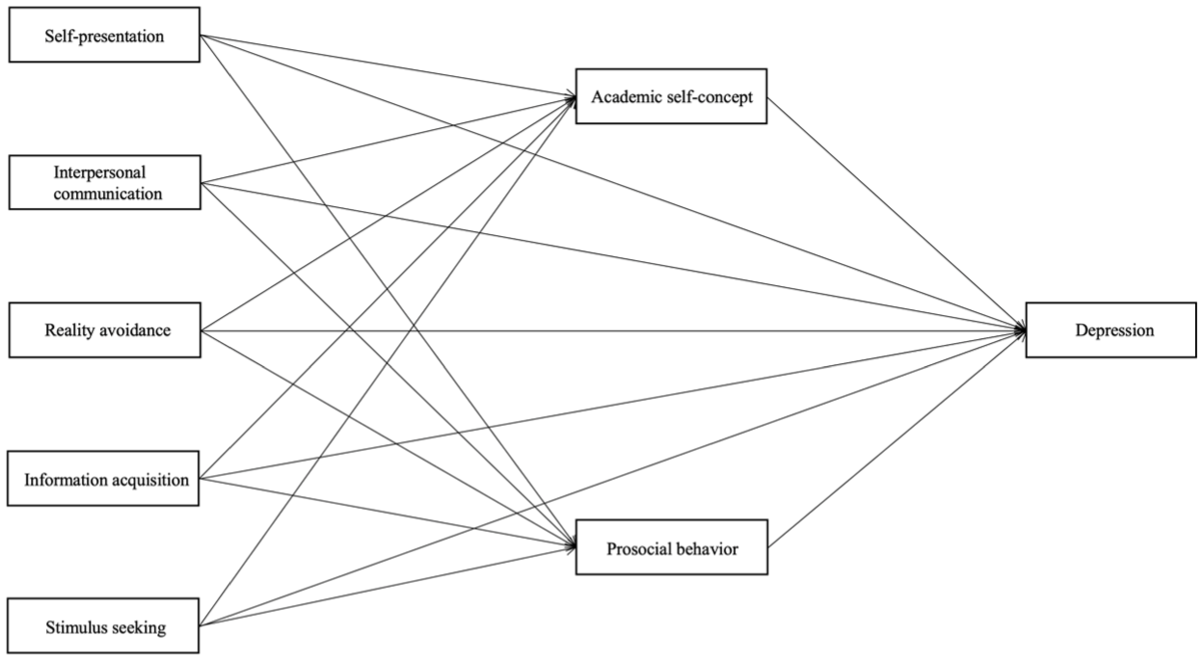
The Hypothesized Model of MMMU, academic self-concept, prosocial behavior, and depression.
Method
Participants and Procedure
A large-scale survey was conducted using an offline cluster sampling method among students in grades 4 to 12 from North China, South China, Central China, Northeast China, Northwest China, and Southwest China. Data were collected between March and April 2024 in collaboration with participating schools. The final sample comprised 46,862 valid responses (Mage = 13.33, SD = 2.20), with participants’ ages ranging from 10 to 18 years.
Questionnaires were administered in classroom settings during regular school hours. Trained graduate students in psychology, who received standardized training prior to data collection, administered the surveys and provided uniform instructions. Participation was voluntary and anonymous, and questionnaires were completed independently and collected immediately after completion, yielding a response rate of 97.50%. Written informed consent was obtained from all participants and their parents, and the study protocol was approved by the institutional ethics review boards of the researchers’ affiliated institutions.
Measures
Shortened Mobile Media Use Motivation Scale
The Shortened Mobile Media Use Motivation Scale (Lei et al., 2024; Zhou, 2014) was administered to assess MMMU. The scale comprises five dimensions: self-presentation, interpersonal communication, reality avoidance, information acquisition, and stimulus seeking. Each dimension was measured with two items. The scale uses a 4-point Likert scale (1 = Strongly disagree, 4 = Strongly agree), with higher scores indicating stronger motivations for using mobile media in each specific area. In this study, Cronbach’s α for the subscales ranged from .62 to .77, with the overall scale α at 0.83.
Adolescent Students General Academic Self-Concept Questionnaire
The Adolescent Students General Academic Self-Concept Questionnaire, developed by Guo et al. (2011), measures adolescents’ academic self-concept. Based on prior research (Lei et al., 2024), this study focused on perception of academic ability (5 items) and experience of academic emotion (5 items) to assess adolescents’ academic self-concept. The scale uses a 5-point Likert scale (1 = Strongly disagree, 5 = Strongly agree), with higher scores indicating stronger academic self-efficacy. In this study, the scale demonstrated good reliability, with Cronbach’s α values of .95.
Prosocial Behavior Subscale of Strengths and Difficulties Questionnaire
The Prosocial Behavior subscale of the Strengths and Difficulties Questionnaire (SDQ), developed by Goodman (2001), measures the likelihood of prosocial behavior among Chinese adolescents (Zhao et al., 2023). This subscale consists of 5 items, and it is rated on a 3-point Likert scale (1 = Not True, 3 = Certainly True), with higher scores indicating stronger prosocial tendencies. In this study, the scale demonstrated good reliability, with Cronbach’s α values of 0.87.
Patient Health Questionnaire
The Patient Health Questionnaire (Kroenke & Spitzer, 2002) was developed to assess an individual’s level of depression. This unidimensional scale consists of 10 items, and it is rated on a 4-point Likert scale (0 = not at all, 3 = nearly every day), with higher scores indicating greater depression severity. In this study, the scale demonstrated good reliability, with Cronbach’s α values of 0.92.
Covariates
Previous evidence has demonstrated that age and gender are significantly associated with academic self-concept, prosocial behavior, and depression (e.g., Pastor et al., 2024; Zhang et al., 2022). Accordingly, these two variables were included as in the present analyses.
Data Analysis
In the current study, IBM SPSS Statistics 26 version and Mplus 8.0 was used to test the hypothesized model. First, descriptive analyses and Pearson correlation analyses were conducted by SPSS 26.0. Then, Mplus 8.0 was used to evaluate the mediating roles of academic self-concept and prosocial behavior in the relations between the five dimensions of MMMU and depression after controlling for age and gender. Bootstrapping of regression estimates with 5,000 samples and a 95% confidence interval was conducted. The effect is viewed as significant if zero is not included in the 95% confidence interval.
Results
Preliminary and Correlation Analyses
Harman’s single factor test was used to examine common method bias. The results of the unrotated factor analysis showed that there were 5 factors with characteristics roots more than 1, and the first principal factor explained only 27.52% (<40%) of the variance. Thus, common method bias was not a serious problem in this study. Table 1 displays the means, standard deviations, skewness, kurtosis, and Pearson correlations for all variables. Bivariate correlation analyses revealed divergent patterns of associations between the different dimensions of MMMU and academic self-concept, prosocial behavior, and depression. Additionally, academic self-concept was positively associated with prosocial behavior, whereas academic self-concept and prosocial behavior was negatively correlated with depression.
Descriptive Statistics and Correlation of All Variables.
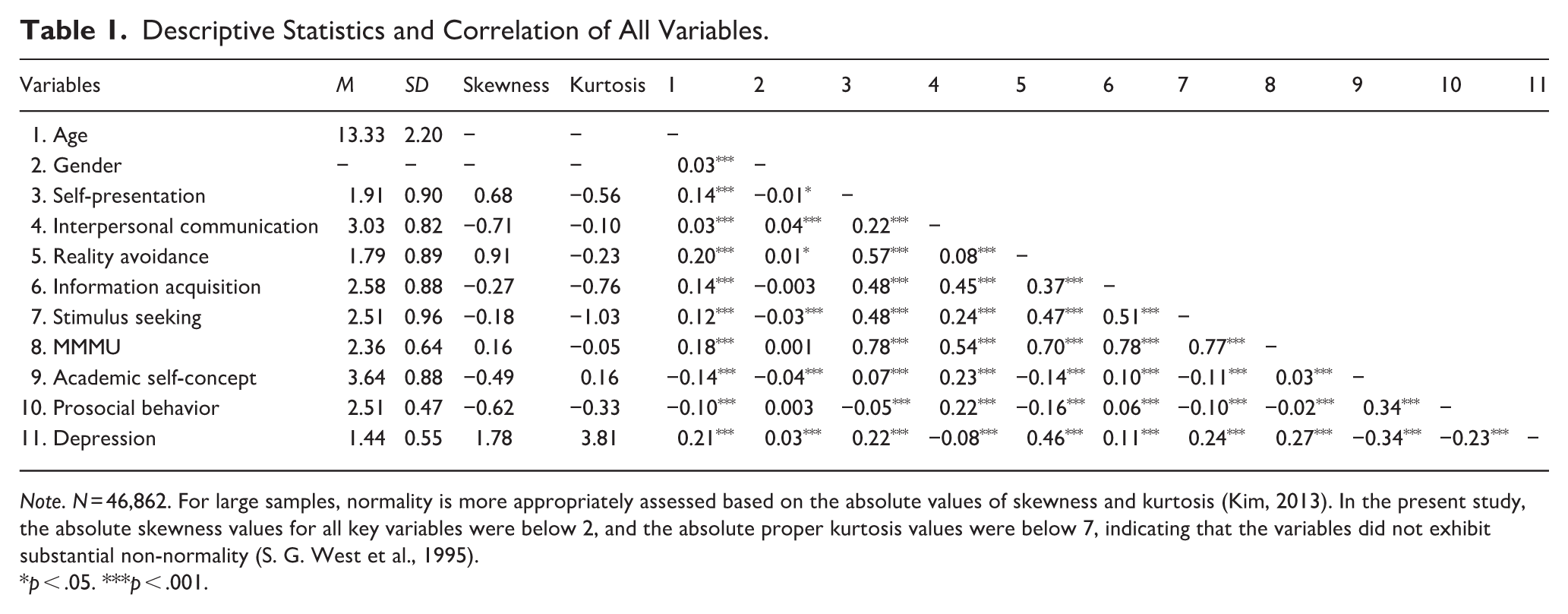
Note. N = 46,862. For large samples, normality is more appropriately assessed based on the absolute values of skewness and kurtosis (Kim, 2013). In the present study, the absolute skewness values for all key variables were below 2, and the absolute proper kurtosis values were below 7, indicating that the variables did not exhibit substantial non-normality (S. G. West et al., 1995).
p < .05. ***p < .001.
Mediation Analysis
The results of the mediation analyses examining the effects of academic self-concept and prosocial behavior on the associations between the different dimensions of MMMU and depression are presented in Figure 2 and Table 2. Of the indirect effects, the path from self-presentation (effect = −0.04, 95% CI [−0.05, −0.04]), interpersonal communication (effect = −0.05), reality avoidance (effect = 0.04), information acquisition (effect = −0.02, 95% CI [−0.03, −0.02]), stimulus seeking (effect = 0.05) to depression through academic self-concept was significant. The path from self-presentation (effect = −0.002, 95% CI [−0.002, −0.001]), interpersonal communication (effect = −0.01, 95% CI [−0.02, −0.01]), reality avoidance (effect = 0.01), information acquisition (effect = −0.01, 95% CI [−0.01, −0.004]), stimulus seeking (effect = 0.01) to depression through prosocial behavior was significant too. Thus, both academic self-concept and prosocial behavior mediated the relationship between MMMU and depression. These mediation models explained a significant amount of variance in depression (R2 = .29).
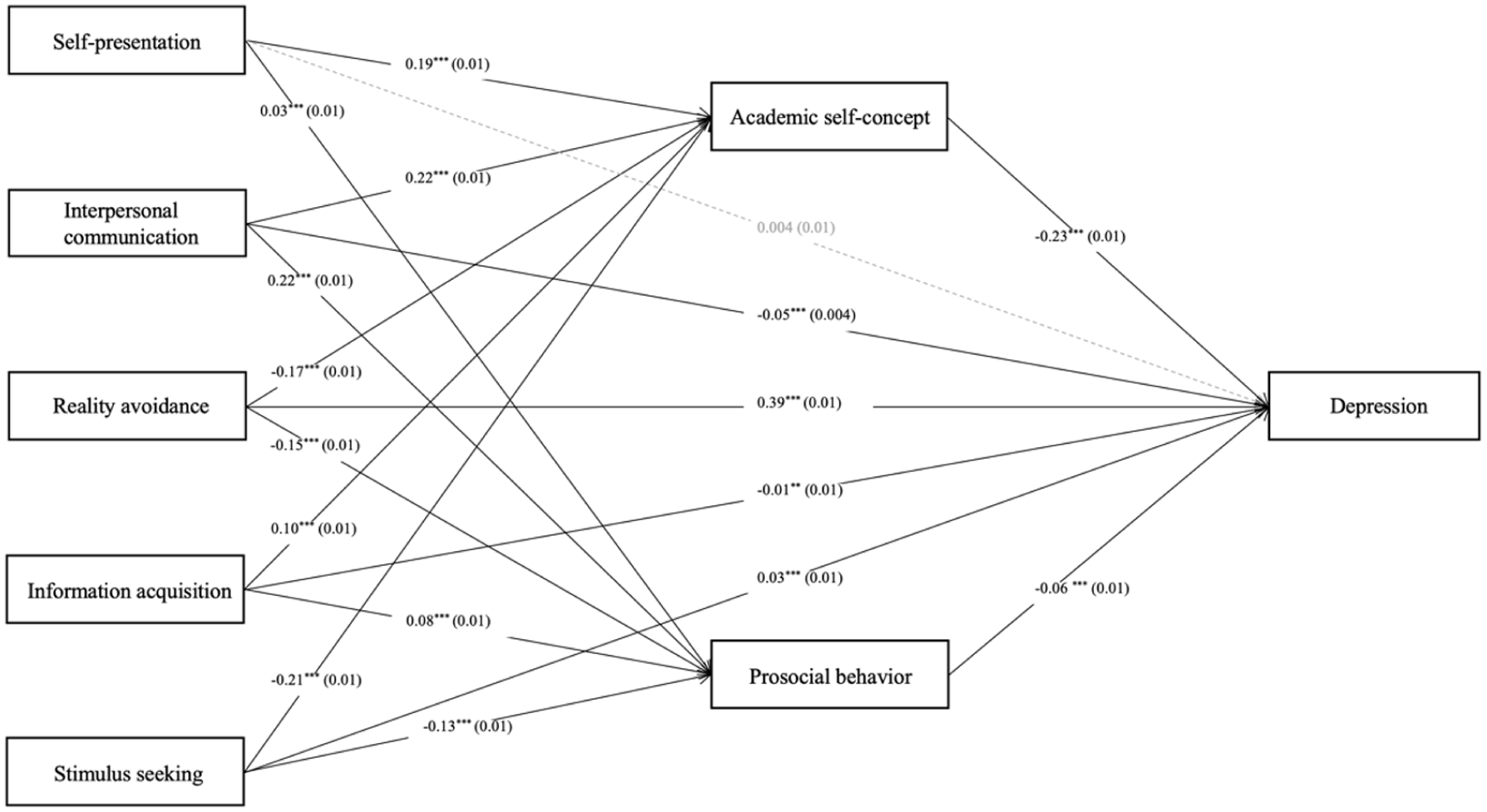
Results of mediation model.
Mediation Effects of Academic Self-concept and Prosocial Behavior.
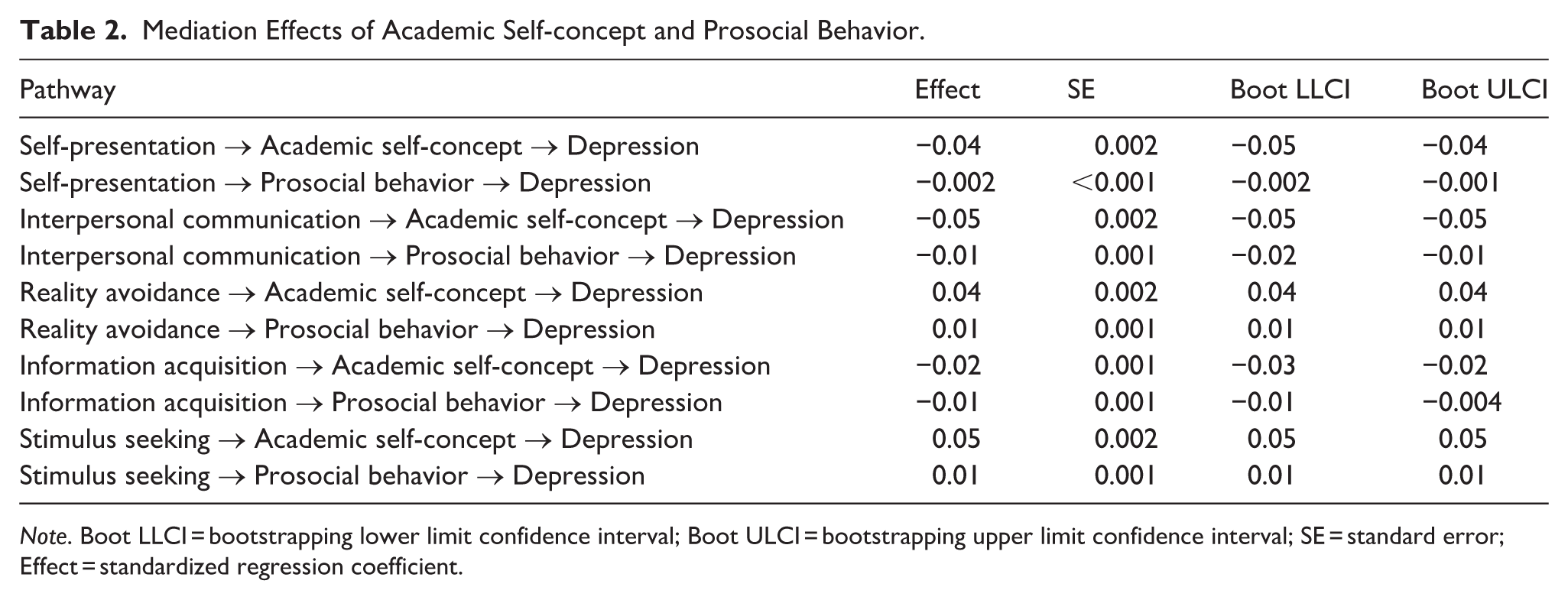
Note. Boot LLCI = bootstrapping lower limit confidence interval; Boot ULCI = bootstrapping upper limit confidence interval; SE = standard error; Effect = standardized regression coefficient.
Discussion
There has been growing scholarly attention on the relationship between mobile media use and depression among adolescents. The present study aimed to examine whether, and how, academic self-concept and prosocial behavior mediate the associations between different dimensions of MMMU and depression. The findings first revealed that interpersonal communication and information acquisition were directly and negatively associated with depression, whereas reality avoidance and stimulus seeking were directly and positively associated with depression. Second, both academic self-concept and prosocial behavior significantly mediated the links between different dimensions of MMMU and depression. Thus, these results provide empirical support for the hypotheses proposed in this study.
The Direct Relationship Between MMMU and Depression
The present study found that interpersonal communication and information acquisition were directly and negatively associated with depression, whereas reality avoidance and stimulus seeking were directly and positively associated with depression. These findings highlight that different MMMU dimensions are differentially related to adolescents’ mental health. This perspective helps explain the inconsistent results reported in previous studies, which often relied on crude indicators such as the duration or frequency of mobile media use while neglecting the underlying motivations driving such engagement (Liu et al., 2024).
The specific patterns observed in this study can be further understood through the lens of Self-Determination Theory (SDT). According to SDT, individuals engage in media use to satisfy intrinsic psychological needs, and when these needs for autonomy, relatedness, and competence are met, they promote adaptive psychological and social functioning (Ryan & Deci, 2020). When adolescents use mobile media with interpersonal communication as their primary motivation, such as chatting with friends, maintaining social ties, or sharing daily experiences, these activities fulfill their basic psychological need for relatedness. By strengthening social bonds and reinforcing a sense of belonging, this form of media use may protect against depressive symptoms. Similarly, when adolescents engage in mobile media for information acquisition, such as searching for knowledge, accessing learning resources, or following news of personal relevance, these activities enhance their sense of autonomy. Having the capacity to independently seek, choose, and evaluate information supports self-directed growth, thereby reducing the likelihood of depression.
In contrast, using mobile media for reality avoidance, for example by immersing oneself in entertainment platforms, binge-watching videos, or scrolling aimlessly to distract from daily stressors, reflects a maladaptive coping strategy (Jarman et al., 2021). Such avoidance fails to meet basic psychological needs and instead reinforces disengagement from real-life challenges. Over time, this coping pattern can exacerbate depressive symptoms by offering distraction rather than genuine problem resolution (Fluharty et al., 2021). Likewise, stimulus seeking, such as playing games or consuming short entertaining clips, may bring temporary pleasure, but this superficial gratification does not satisfy deeper psychological needs for autonomy, relatedness, or competence. Consequently, the protective effect on depression is absent, and in some cases, overreliance on such shallow rewards may even contribute to worsening psychological outcomes.
The Mediating Role of Academic Self-Concept and Prosocial Behavior
The results of this study demonstrated that both academic self-concept and prosocial behavior significantly mediated the associations between different dimensions of MMMU and depression. Specifically, self-presentation, interpersonal communication, and information acquisition positively predicted adolescents’ academic self-concept and prosocial behavior, whereas reality avoidance and stimulus seeking negatively predicted these two factors. In turn, both academic self-concept and prosocial behavior were significantly and negatively associated with depression.
When adolescents use mobile media for self-presentation, their expressions of personal life and emotions allow others to recognize their needs for social support. The interactive feedback mechanisms embedded in mobile platforms further reinforce the perception of being noticed and valued (Lu & Hampton, 2017). Such reciprocal exchanges enhance perceived social support, which is closely linked to self-worth—including the academic domain (Cohen & Wills, 1985). These processes also foster prosocial reciprocity, creating a positive cycle that contributes to a greater sense of predictability and stability in life, thereby reducing the risk of depression.
When mobile media is used for interpersonal communication, its ability to transcend geographical barriers enables adolescents to sustain meaningful connections with peers and family members (M. West et al., 2025). These relationships foster empathy and encourage prosocial behavior (Armstrong-Carter & Telzer, 2021). At the same time, maintaining supportive peer relationships reinforces academic self-concept by enhancing motivation, engagement, and confidence in learning, as adolescents are more likely to internalize positive academic feedback and social comparisons. Consequently, both stronger prosocial orientations and more positive academic self-concept function as protective factors against depression.
When adolescents engage in information acquisition, their active search for knowledge, whether related to academics, hobbies, or personal interests, constitutes a form of self-directed learning. This process strengthens their academic self-concept by fostering a sense of competence and mastery over new knowledge. In addition, the information environment of mobile media often exposes individuals to prosocial content, even passively through algorithmic recommendations, which has been shown to positively shape prosocial attitudes and behaviors (Martínez-Cano et al., 2023; Silva Santos & Pimentel, 2025). Thus, information acquisition not only builds confidence in academic abilities but also enhances adolescents’ likelihood of engaging in prosocial behavior, both of which contribute to lower depressive symptoms.
In contrast, when mobile media is used for reality avoidance or stimulus seeking, adolescents may attempt to enrich their inner world and seek vivid experiences through online distractions. However, such coping strategies often undermine their sense of meaning in real life (Wang et al., 2023) and lead to feelings of deeper emptiness (Xiao et al., 2024). This, in turn, weakens experiences that are closely tied to real-world functioning, such as academic self-concept and prosocial behavior, which are essential for psychological resilience. As a result, maladaptive use motivations not only fail to buffer against stress but also exacerbate depressive symptoms (Candussi et al., 2023).
Practical Implications
The findings of this study have important implications for educational and intervention practices concerning adolescents’ mobile media use. On the one hand, the results indicate that not all forms of mobile media use are detrimental to adolescents’ mental health. Mobile media use motivated by interpersonal communication, information acquisition, and self-presentation is associated with higher levels of academic self-concept and prosocial behavior, which in turn relate to lower levels of depression. These findings suggest that parents, teachers, and schools should avoid adopting a one-size-fits-all approach that focuses solely on reducing screen time. Instead, greater attention should be paid to adolescents’ underlying use motivations and content engagement, with encouragement to use mobile media for maintaining positive social interactions, accessing valuable information, and engaging in constructive self-expression. This perspective is consistent with recent calls for more nuanced approaches to youth media engagement (Archer, 2025).
On the other hand, the present study also highlights the potential risks associated with mobile media use motivated by reality avoidance and stimulus seeking. Such use patterns tend to be associated with lower academic self-concept and prosocial behavior and may increase adolescents’ vulnerability to depressive symptoms. Accordingly, mental health professionals and educational practitioners should identify adolescents with high-risk use motivations and implement targeted interventions, such as media literacy education, emotion regulation training, and the promotion of alternative offline activities (e.g., Nagata et al., 2025). These strategies may help adolescents meet their psychological needs in more adaptive and developmentally supportive ways.
It is worth noting that the practical implications discussed above may be particularly salient within the sociocultural context of Chinese adolescents. As noted earlier, China’s education system has long emphasized academic achievement as a central evaluative criterion, positioning academic performance as a key foundation for adolescents’ self-worth and social recognition (Ng et al., 2014; Yang, 2025). At the same time, cultural norms that prioritize collectivism, interpersonal harmony, and social responsibility (Hu & Fatima Wang, 2009) confer additional social significance on prosocial behavior, as it facilitates relationship maintenance and group acceptance (Shi et al., 2025). Within this context, the association of mobile media use motivations with academic self-concept and prosocial behavior may be amplified, thereby showing stronger downstream links to adolescents’ mental health. From an applied perspective, these findings suggest that fostering more adaptive motivations for mobile media use may not only support adolescents’ emotional adjustment but also promote their academic engagement and social functioning in ways that are culturally congruent with the developmental demands faced by Chinese youth.
Limitations and Future Directions
Although this research is the first to investigate the mediating roles of academic self-concept and prosocial behavior in the associations between different types of MMMU and depression among Chinese adolescents, several limitations should be noted.
First, the findings were derived from a cross-sectional design that examined the relationships among MMMU, academic self-concept, prosocial behavior, and depression. As a result, the conclusions cannot support causal claims. A longitudinal or experimental design would allow for more rigorous testing of temporal order and causality in future research. Second, this study did not distinguish between different types of prosocial behavior. Prior research suggests that prosocial behavior toward strangers is linked to intrinsic strengths and motivations, which serve as protective factors against depression (Padilla-Walker et al., 2020). By contrast, a recent cross-national study including 14 countries found that only prosocial behavior directed toward family members was consistently negatively associated with depression (Padilla-Walker et al., 2022). Thus, future research should investigate whether prosocial behaviors directed toward different targets (e.g., strangers, friends, and family members; Padilla-Walker et al., 2025) have distinct effects on the pathways identified in the present study. Third, the current sample consisted of adolescents aged 10 to 18 years. Given developmental differences across age groups, the associations between mobile media use and depression may vary between adolescents and older youth. For example, emerging adults, who are still developing self-regulation capacities and often lack parental and teacher supervision, may be more vulnerable to problematic media use and feelings of emptiness (Xiao et al., 2024). Therefore, future studies are needed to test whether the parallel mediation model established here can be generalized to emerging adulthood.
Conclusion
The present study examined how different MMMU are associated with depression among Chinese adolescents and investigated the mediating roles of academic self-concept and prosocial behavior. The findings revealed that interpersonal communication and information acquisition were negatively associated with depression, whereas reality avoidance and stimulus seeking were positively associated with depression. Moreover, both academic self-concept and prosocial behavior served as significant mediators, helping to explain how different MMMU dimensions contribute to adolescents’ mental health. Overall, this study contributes to a more nuanced understanding of the complex relationship between mobile media use and depression, offering valuable insights for educators, parents, and policymakers seeking to promote healthy media engagement and psychological well-being among adolescents.
Footnotes

Ethical Considerations
The Ethics Committee of the Renmin University of China approved this study. And this study was also carried out in accordance with ethical guidelines of Renmin University of China.
Consent to Participate
All participants were given informed consent before completing the measures.
Author Contributions
Jingyuan Yang contributed to the conception and design, interpretation of data, drafting, and editing manuscript; Li Lei contributed to the conception and design and interpretation of data; Xin Fang contributed to the acquisition of data; Xiaofei Qiao & Zilin Wang contributed to the conception and design.
Funding
The authors disclosed receipt of the following financial support for the research, authorship, and/or publication of this article: This study supported by the Outstanding Innovative Talents Cultivation Funded Programs 2025 of Renmin University of China.
Declaration of Conflicting Interests
The authors declared no potential conflicts of interest with respect to the research, authorship, and/or publication of this article.
Data Availability Statement
The datasets used and analyzed during the current study are available from the corresponding author on reasonable request.*