






Abstract
Smartphones’ role in schools has been widely debated in recent years, and this study foregrounds students’ voices on their role in social processes at school. Data were collected from 58 students in two Finnish lower secondary schools through open-ended questionnaires and focus group interviews and analyzed inductively using qualitative content analysis. The findings emphasize that, according to students, smartphone use plays a central role in forming and maintaining relationships in school. Their influence in face-to-face interaction is ambivalent: while smartphone use can facilitate interaction, their pervasive presence may reduce conversations and expose students to social tensions and loneliness. Students describe smartphones as sources of social support and safety, but also as exposing them to inappropriate content and uncertainty. Overall, peer relationships are strongly mediated through smartphones, reflecting a transformed media ecology and underscoring the need for schools to support face-to-face peer socialization and students’ interpersonal and digital citizenship skills.
Introduction
Today’s adolescents are the first generation to grow up with smartphones shaping their media ecology from an early age (e.g., Navarro & Tudge, 2022). Smartphone use has become central to practices of communication, social coordination, and self-expression, and it is habitual, and often constant among teenagers (Anderson et al., 2024; Smahel et al., 2020; Valkenburg & Peter, 2011). Smartphones are deeply embedded in adolescents’ peer relationships and everyday social interaction, including within school settings, where schools play a central role in supporting social development and participation in peer groups (Wentzel, 2017). At the same time, smartphone use in schools has become increasingly contested, with approximately 40% of countries recently implementing restrictions or bans on smartphone use in educational settings (UNESCO, 2023). While such policies are often justified by concerns about distraction, learning, and wellbeing (Böttger & Zierer, 2024; UNESCO, 2023), students themselves have emphasized the importance of smartphones for peer connection, support, and everyday safety (Gath et al., 2024; Rose et al., 2022).
Existing research suggests that smartphone use in classrooms can contribute to distraction and reduced learning, while evidence regarding restrictions and bans shows mixed effects on academic, social, and wellbeing outcomes (Campbell et al., 2024). Some studies have reported improvements in social wellbeing following bans, including increased collaboration and reduced bullying (Böttger & Zierer, 2024). However, findings also suggest that stricter restrictions do not necessarily produce more positive outcomes, as they may reduce students’ sense of school belonging and social connectedness with teachers (Vanluydt et al., 2026). Overall, current evidence highlights the complex role of smartphones in adolescents’ social experiences at school rather than indicating uniformly positive or negative effects.
Adolescence is a developmental period characterized by heightened sensitivity to peer relationships, social status, and identity construction through interaction with others (Ragelienė, 2016). Understanding how students themselves perceive smartphones’ role in peer relationships and social interaction is therefore particularly important. However, students’ perspectives remain underrepresented in both research and educational decision-making. Against this background, we investigate Finnish students’ perspectives on smartphones’ role in peer relationships and social interactions at school.
Transforming Media Ecologies of Youth Sociality
We draw on a theoretical framing that treats mobile media as part of a transforming ecology rather than as a single device with uniform “effects.” Media ecology scholarship emphasizes that dominant communication technologies function as environments that reorganize attention, interaction, institutional routines, and cultural values. In the classic tradition (e.g., McLuhan, 1964; Postman, 1985), the crucial point is not merely what media communicate but how they reshape everyday conduct and the norms that guide it. This lens is useful for studying phones in school because it focuses on how communication environments reorganize participation and social order.
However, contemporary youth media environments differ substantially from the broadcast and print ecologies that shaped early media ecology arguments (Logan, 2010). Today’s mobile media are interactive, networked, and continuously accessible (Boyd, 2014; Navarro & Tudge, 2022). Social interaction is increasingly mediated by platform infrastructures (Nieborg & Poell, 2018; Van Dijk et al., 2018), with a specific interface logic, including messaging systems, visibility metrics, and algorithmic curation. The relevant “environment” is therefore not simply the smartphone as a medium, but a shifting configuration of devices, platforms, data practices, and social norms—an ecology that changes rapidly and is co-shaped by students’ practices and school-level governance. These developments have reshaped the ways in which young people interact and maintain social ties. By reducing the significance of physical distance, mobile devices enable students to extend networks beyond schools and neighborhoods, sustain constant contact, and be present in multiple spaces simultaneously (Boyd, 2014; Navarro & Tudge, 2022). Furthermore, online spaces afford greater control over self-presentation, which allows individuals to shape how they express themselves, negotiate peer belonging, and manage social comparisons (Navarro & Tudge, 2022; Valkenburg & Peter, 2011).
Building on these changes in social interaction, recent scholarship on youth and digital media extends the media ecology by emphasizing practice, participation, and learning across different contexts (Barron, 2006; Ito et al., 2010; Jenkins et al., 2009). Work on learning ecologies and connected learning conceptualizes young people’s engagement as pathways linking personal interests, peer culture, and institutional settings. This perspective highlights how participation becomes educationally meaningful when it is supported by relationships, opportunities to create and share, and recognition across various contexts. Participatory culture perspectives foreground young people’s roles as contributors and coordinators in networked publics (Boyd, 2014; Jenkins et al., 2009), while also drawing attention to tensions between youth participation and institutional control. Taken together, these perspectives shift the focus from general claims about media effects to lived participation in socio-technical environments.
To integrate these perspectives into a coherent framework for school-based phone use, Bronfenbrenner’s (1976, 1994) ecological systems theory, which has been extended to incorporate the digital world by Navarro and Tudge (2022), provides a useful organizing structure. Students’ mobile practices unfold within the microsystem of classroom interaction and peer relations: how students coordinate their presence, respond to one another, manage inclusion and exclusion, and signal their availability. Yet these practices are shaped by mesosystem connections among school, home, and peer networks that span online and offline settings—for example, how expectations by parents and peer groups intersect with school norms, or how group chat dynamics spill over into face-to-face interactions during breaks and lessons. Exosystem forces include platform governance, content moderation, school-level policies, and municipal or national regulations that shape what is possible and what is sanctioned. Finally, the macrosystem includes broader cultural narratives about childhood, risk, learning, rights, and responsibility that influence whether phone use is interpreted as harmful, empowering, or morally suspect. The chronosystem is particularly salient in mobile media research: rapid transformations in platform ecologies and adolescent developmental transitions mean that the “media environment” is historically situated and continuously changing (Hakkarainen et al., 2015). Policy initiatives restricting phone use in schools (UNESCO, 2023) can be understood, within this framework, as part of the ecology itself—new constraints that reshape everyday practices, meanings, and conflicts rather than neutral external “conditions.”
Linking transforming media ecology to ecological psychology (Damşa et al., 2019; Gibson, 1979; Rietveld & Kiverstein, 2014) clarifies how these environments matter in the moment-to-moment life of schools. From an affordance perspective, action possibilities are relational: what a phone affords in a classroom depends on students’ skills and intentions, peer norms, and institutional constraints. In school settings, phones can afford social coordination, emotional regulation, identity work, and creative production while also enabling students to avoid uncomfortable interactions, withdraw from classroom participation, or engage in intensified social comparison (Damşa et al., 2019; Gath et al., 2024). Importantly, constraints are not merely obstacles; they shape the affordance landscape (Rietveld & Kiverstein, 2014) by moving practices into hidden micro-moments, redefining what counts as “acceptable” use, and changing the social meaning of being reachable.
Understanding Phones in Peer Relations and Interactions at School
Empirical research suggests that smartphone use can strengthen interpersonal relationships by facilitating relationship formation, expanding access to social networks, and enabling support, thereby potentially increasing social capital and reducing isolation (e.g., Cho, 2015). Research on students’ experiences supports these findings: students purposely use specific applications and social media to maintain and improve their connections (Boyd, 2014; Varadi, 2025), and they report that these platforms can facilitate more open communication (Sjolie et al., 2023). Smartphones may provide students with a sense of support and safety, particularly in emergencies (Gath et al., 2024; Rose et al., 2022).
At the same time, research highlights tensions between the convenience of online communication and the richness of in-person engagement. The mere presence of phones can reduce the perceived quality of interactions and feelings of connectedness (Capilla Garrido et al., 2021; Rotondi et al., 2017). Adolescents may also experience constant connectivity as an ongoing responsibility to remain available to peers (Wikström et al., 2022), while exposure to social media can intensify social comparison and status anxiety, particularly among girls (Scully et al., 2020). In school contexts, students have reported that phone use reduces face-to-face interaction, facilitates cyberbullying and enables the recording and sharing of inappropriate content (Gath et al., 2024). In addition, higher levels of smartphone use have been associated with poorer social skills and weaker peer relationships (Zhou et al., 2017). These dynamics are also visible in the Finnish context, where teachers have reported that the use of digital tools can limit face-to-face communication (OECD, 2025).
Within schools, smartphone use is further shaped by institutional cultures, norms, and regulatory practices that structure both learning opportunities and students’ social connections. Although smartphones can support learning through access to information, self-regulated learning, and interactive engagement, they also introduce interruptions, lead to multitasking, and increase cognitive load, which may undermine sustained attention and deeper learning (e.g., Kuş, 2025). In line with these tensions, according to an OECD TALIS survey (2025), more than two-thirds of Finnish teachers perceive digital tools as negatively influencing teaching and students’ well-being, while also recognizing their potential to enhance students’ interest in learning.
The Current Study
Research examining smartphone use in schools has largely relied on adult interpretations (teachers, parents, policymakers), often overlooking how students themselves experience peer dynamics and interactional consequences in school. While smartphones’ role in student learning has been more extensively studied (e.g., Campbell et al., 2024; Kuş, 2025), there is limited research examining how students feel smartphones shape the interactional climate in schools. Student voice research (e.g., Cook-Sather, 2006) argues that it is essential to listen to young people’s accounts when schools redesign practices that affect everyday participation, inclusion, and safety, particularly in areas where adult concerns and students’ lived realities may diverge. Therefore, the present study foregrounds students’ perspectives and meaning-making by asking:
Methods
Study Context
The present study was conducted in Finland in two lower secondary schools in the Helsinki capital region during spring 2025. With its strong educational reputation and widespread use of youth technology, Finland provides a relevant context for studying smartphone impacts on school social climates, as children often obtain their first device at 6–7 years of age and nearly all 13–16-year-olds own one (DNA, 2025; Smahel et al., 2020). Finnish basic education consists of 6 years of primary school (grades 1–6, starting at age seven), followed by 3 years of lower secondary school (grades 7–9, starting at age 13; EDUFI, 2022). Finland’s comprehensive school system is highly equal, with publicly funded schools sharing similar resources and curricula, which minimizes school-level variation, and provides a stable research context. In the capital area, 10.2% of students have a foreign nationality (compared to 6.5% nationwide), and the participating multicultural schools reflect this diversity, enabling insights from a broad range of student experiences (EDUFI, 2022; Vipunen, 2023).
Finnish schools have the authority to establish school rules, guided by laws and local authorities (EDUFI, 2022). In response to concerns about the effects of widespread smartphone use on learning and social skills, many Finnish schools, including those participating in this study, have implemented regulations on smartphone use during school days. In both participating schools, phone use was prohibited during lessons and lunch breaks without teachers’ permission. School A permitted phone use only during one recess a day. During the data collection period, the school introduced a policy requiring students to store their phones in designated areas at the start of lessons, motivated by frequent disruptions. Apart from this change, regulations regarding smartphone use had been similar throughout students’ time in lower secondary school in both participating schools. In contrast, school B permitted phone use during all recesses and had designated storage areas during tests, but not during regular lessons. Continuous noncompliance with the rules led to disciplinary educational discussions and, if teaching was disrupted, to phone confiscation.
Participants and Data Collection
A total of 58 students participated in the study. The students’ ages ranged from 14 to 17 years (M = 15.2, SD = 0.7), and they were in the last 2 years of lower secondary school. In school A, participants were in grade 8, and in school B they were in grade 9. Of the participants, 29 were female, 27 were male, and 2 preferred not to say. Information about the study was provided orally and in writing before data collection. Following the guidelines of the Finnish National Board on Research Integrity (TENK), permission was first obtained from the education division of the city where the school was located. Second, written informed consent was obtained from all participants, with parental consent obtained for those under 15 years of age. The legal guardians were informed about the study, and participants were briefed on confidentiality to prevent the sharing of sensitive information outside interviews. Following TENK guidelines, study participants were compensated with a movie ticket and candy.
The research material consisted of focus group interviews (FGIs) and open-ended questionnaires. This combination of methods was chosen to capture both shared and individual dimensions of smartphone use. FGIs were used to elicit peer-level norms, contested meanings, and moral orders (Krueger, 2015), particularly in relation to research questions two and three. Open-ended questionnaires, in turn, captured individual experiences, everyday practices, and perspectives that may be less readily expressed in group settings, focusing on research questions one and three. Both the questionnaires and FGIs were developed iteratively in collaboration with multiple experts and piloted with students of the same age in another school. Based on the pilot responses, several questions were revised, the thematic structure was clarified and more systematically organized, and some items were rephrased to improve clarity and comprehensibility. The questionnaire and interview questions are available in Supplemental Material S1.
First, 57 students completed the written open-ended questionnaires during a 45-min lesson. The questions focused on students’ smartphone use during school days and their influence on interaction, for example, “Describe how and which applications you use with friends at school” and “Describe how smartphones affect your interaction and communication with others during school hours.” According to the questionnaire responses, all participants owned smartphones, and with the exception of one, they all reported using them at school. The participants reported using their phones in school in various ways: most used them for messaging (96%), entertainment (91%), studying (87%), and coordinating the school day (89%). For the second phase of data collection, FGIs were conducted to further explore and contextualize the patterns identified in the questionnaire responses. Thirty-three of the questionnaire participants were also willing to take part in the FGIs. One additional student joined only the FGI due to being absent when others had completed the questionnaire. In total, eight FGIs were conducted, with an average of four students per group (range: 3–6). The interviews were conducted on school premises during school hours, they lasted approximately 40 min, and they were audio-recorded. The first author moderated all interviews.
Following Krueger (2015), the FGIs were designed as moderated group discussions to elicit spontaneous elaboration and interaction. Participants were encouraged to respond openly since there were no right or wrong answers. The interview protocol consisted of questions and attitude statements, divided into three themes, and it focused on exploring shared practices and support dynamics around smartphone use. Attitude statements were used as prompts to elicit rich argumentation on the issue and to encourage students to take a stand on current smartphone-related issues, as recommended in the methodological literature (Vesala & Rantanen, 2007). The statements consisted of arguments from news headlines, for example “Social media has made teen friendships more stressful” and “Teens with smartphones have stronger friendships, study claims,” as stated in Supplemental Material S1.
Data Analysis
The FGIs were transcribed using aTrain and then manually checked for accuracy. Data analysis involved examining students’ questionnaire responses and transcribed FGIs through qualitative content analysis, in which the data were systematically coded and grouped into meaningful categories (Saldaña, 2015). The analysis followed a data-driven, inductive approach to identify recurrent themes (Elo & Kyngäs, 2008). First, the data were read multiple times to gain an overall understanding of participants’ perceptions and to identify patterns. Second, the data were coded in Excel for the questionnaires and in ATLAS.Ti for the FGIs. In the third step, codes generated from the interviews and questionnaire responses were examined together to identify the main categories and subcategories. The data were analyzed iteratively, coded, and re-coded until no new categories emerged. During each stage of the data analysis, the first author conducted a preliminary review, which was further discussed, and refined in regular meetings with all authors. Analytical categories were refined multiple times and tested against data excerpts.
Data handling and storage were conducted in accordance with the General Data Protection Regulation (GDPR), and participants’ anonymity was protected through pseudonymization. For reporting the findings, respondent identifiers were structured to include school A or B, participant number, and gender, for example A2F. The FGIs were conducted in Finnish, and in the translations filler words have been omitted from the quotations to improve readability while preserving the original meaning.
Findings
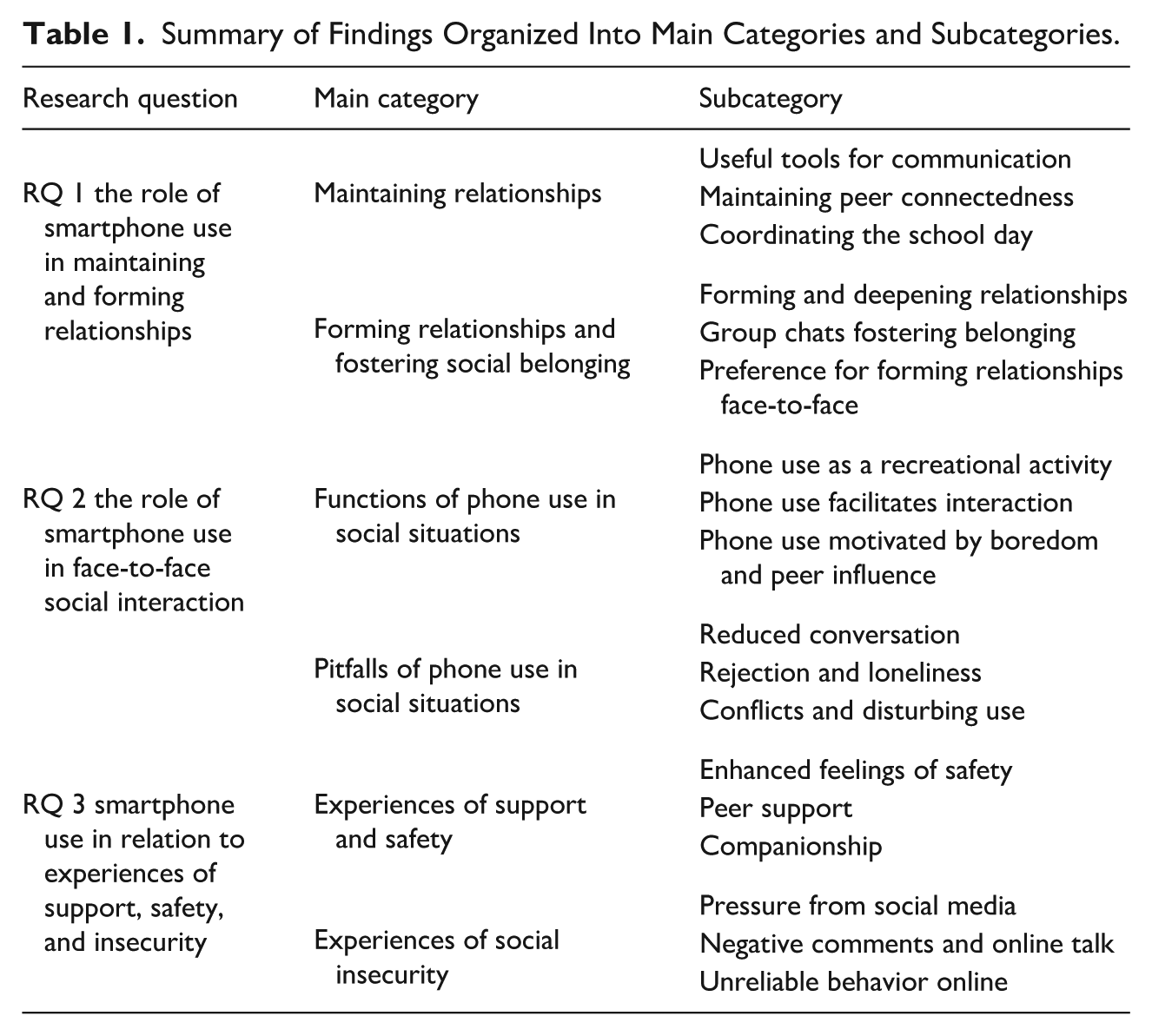
The findings are presented in accordance with the three research questions. First, we describe how students perceived smartphone use to influence maintaining and forming relationships. Second, we describe the perceived role of smartphones in face-to-face social interaction. Third, we present how phone use shaped students’ experiences of social support, safety, and insecurity. The categories derived from the content analysis are presented in Table 1. Supplemental Material S2 provides frequencies, descriptions, and illustrative examples of the codes. The findings extended to students’ everyday media ecologies, both during and beyond the school day.
Summary of Findings Organized Into Main Categories and Subcategories.
The role of smartphone use in Maintaining and Forming Relationships
The findings on the first research question showed that smartphone use, through its communicative affordances, played a key role in students’ media ecologies. Texting and chatting afforded them continuous connection with their peers, enabling students to sustain friendships across distance and coordinate every-day and school-related matters throughout the day. Smartphone use supported both the formation of new relationships and the strengthening of existing ones, though some students preferred meeting people through face-to-face interactions.
Maintaining Relationships
The study identified three subcategories related to the role of smartphones in maintaining peer relationships: useful tools for communication, maintaining peer connectedness, and coordinating the school day. Students appreciated smartphones for affording quick, effortless communication, which was closely associated with maintaining friendships, as illustrated in this quote: “As long as you have your smartphone, you’re connected with friends” (A37F). Smartphones allowed students to stay updated with friends who lived elsewhere, studied in different classes, or were not present at school, as illustrated in the following comment:
My best friend is not at this school. I think it’s nice to be able to text her during the school day since it would be weird if we didn’t text at all between 8 a.m. and 3 p.m. It’s a long time. (A16F)
Smartphones also allowed students to interact with multiple people on a tight schedule and remain friends if someone moved out of the neighborhood. Students perceived messaging as important to social inclusion: when peers did not check their messages, they sometimes missed after-school activities and social updates, leaving those who contacted others less frequently at a disadvantage:
B2M: These days, everyone uses their phones a lot to stay in touch. If you don’t engage with others through the phone, you’re at a disadvantage compared to others. Everything is harder for you, staying in touch and coming up with plans. I feel like people start thinking you’re weird if you don’t use your phone. B10M: You probably don’t have friends unless you do.
The third identified subcategory described coordinating the school day through messaging. Texting was a fast way to find peers at recess and to receive updates on daily schedules. Students’ habits of staying up to date also helped the teachers, as described here: “If my friends are not in class and the teacher does not know where they are, I text them” (A27F). The students used their phones to inform their parents and teachers about essential matters and to ask their peers for help: “we ask each other to open the school doors, or what’s been assigned for homework” (A23F), illustrating that smartphone use facilitated the flow of the school day.
Forming Relationships and Fostering Social Belonging
The data analysis revealed three subcategories related to relationship formation and social belonging: forming and deepening relationships, group chats fostering a sense of belonging, and a preference for forming relationships face-to-face. Phone use allowed students to both establish new relationships and strengthen existing ones. Shared interests that students identified through their phones could lay the groundwork for new friendships: “Some people get to know each other through it. They notice they like the same things and start talking about that, then” (A2F). Engaging in shared activities, such as playing the same mobile games, facilitated getting to know others.
Snapchat and Instagram were commonly mentioned as platforms where students found new contacts. Some students messaged people they did not previously know, formed close friendships on social networking sites, and even engaged in romantic relationships that existed solely online. The possibility to contact others online was especially helpful for students who did not feel as comfortable starting a face-to-face conversation: “Sometimes you feel brave when you don’t see the other person’s face. You’re writing or sending voicemail, and you feel brave. But then if you’re face to face, sometimes you lack the courage to speak” (A41F). Some students shared their social media details with new acquaintances as a way to get to know them, as described below:
Your friend group becomes a lot bigger [when you use your phone]. . . . You meet new people who join the group, you can get their contact information and keep talking to them. You become friends, and it just continues like that. (A26F)
An important factor in joining groups of friends was joining a group chat, where “meetings are planned and funny things are shared” (A42F). Students described that being included in Snapchat groups “makes you feel like you’re part of the group and keeps you up to date on your friends’ business” (A7M). This type of inclusion fostered a sense of group belonging by helping students identify shared interests with their friends.
While most students saw smartphones as useful for getting to know people, about one-fourth reported that they were not important for meeting others. Some students noted that they met new friends through face-to-face interaction rather than online and viewed the role of smartphones in meeting people negatively: “If I get to know new people, I avoid being on my phone, it’s rude” (A25F). One participant reported not using the phone at school: “You can communicate with people by going to talk to them. The smartphone does not affect my interactions with people or my friendships” (B1M).
Findings related to the first research question indicate that smartphones played an important role in promoting peer connections within students’ everyday media ecologies, supporting relationship maintenance, fostering social belonging, and facilitating coordination of the school day. While many students used smartphones to get to know their peers, others preferred face-to-face interactions.
The Role of Smartphone Use in Face-to-Face Social Interaction
The second research question was examined by analyzing students’ responses regarding phone use practices and their impact on face-to-face social interaction. The findings show that phone use was a common peer activity, often driven by boredom and social influence. Its role in face-to-face interaction was ambivalent: while smartphone use could support social situations and connections, its pervasive use also reduced conversation and contributed to loneliness and conflicts.
Functions of Phone Use in Social Situations
The data analysis revealed three main categories related to the functions of phone use in social situations: recreational activity, facilitating social interaction, and use motivated by boredom and peer influence. Typical ways of using phones at school included watching and sharing content on social media as well as messaging others, which was most common in Snapchat, followed by WhatsApp, TikTok, and Instagram. Playing mobile games was mostly reported by boys. Students commonly used their phones to study and check for school-related updates, such as comparing grades. All these activities occurred both individually and together with peers.
For students, using smartphones together was a natural way to hang out, and for some students even a norm: “If you’re on your phone, you are playing the same game as your friends” (B10M). Students’ conversations often revolved around the games they played and the videos they shared, which supported interaction and facilitated connection among peers: sharing fun content and using the same applications provided topics of discussion, made peers laugh, and could “bring friends together” (A15F).
According to the students, their phone use was often influenced by peers’ behavior. Some students said they ended up using their phones simply because others had theirs out or because they felt bored or lacked engaging activities during the school day. Interestingly, students noted that in certain situations, there was an expectation to use their phones, portraying it as a central activity that signaled belonging to the group:
B10M: If all your friends are viewing their phones, you take it out too. If someone tells others to come and play [mobile games], then everyone — B6M: Everyone must join. B5ND: You can’t leave your friends alone.
Pitfalls of Phone Use in Social Situations
The data analysis revealed three subcategories capturing the pitfalls of phone use among peers: reduced conversation, feelings of rejection and loneliness, as well as conflicts, and disturbing use. Most students reported that smartphone use resulted in a reduced number of and quality of conversations: “People spend much time with phones in their hands, so it’s perhaps harder to start a real conversation, like a deep conversation” (A15F). Students described that phone use made others less present in social situations and illustrated that phones could “interest you more than talking with friends” (A34M). As a result, students sometimes chose their phones over shared social activities, such as playing pool during recess. Some students experienced this type of behavior as socially excluding, with several reporting feelings of rejection when others preferred their phones, as expressed by the comments “you feel abandoned” (A41F) and “is there something on the phone that I can’t offer you?” (A26F). In some cases, phone use was described as a means of self-isolation and social withdrawal; for instance, new students would “just sit in the corner on their phones” (B2M) rather than engage with peers. Reflecting on these dynamics, some students reported disappointment with their own phone use, acknowledging that it reduced the time spent with friends: “I try to spend time during the school day without my phone, but I don’t always succeed. I could use that time to talk to my friends” (B12F).
Students perceived others’ phone use during the school day as disturbing: they associated it with high noise levels in the school hallways and classes, and students even sometimes gathered around someone’s phone while “blocking certain areas at school” (A2F). In addition, phone use that violated school rules generated tension with teachers. One student presented an opposing viewpoint on this topic: “When people spend more time on their phones, they focus on their own business. But if they don’t have their phones, they get bored, start fighting, and it creates more problems” (A36F).
Students had different motivations for using their phones, and some were less inclined to use them frequently. A few students perceived videos that their friends showed them as annoying, boring, or scary: “You don’t always want to look at those videos and pictures of the same topics. I’d rather enjoy the outdoors and the school day in peace” (A20F). Interpreting messages differently or not staying up to date with friends’ posts could lead to arguments: “It can create unimportant drama if somebody makes a new Instagram post and you don’t immediately like it” (A7M).
The findings highlight the contradictory nature of phone use in face-to-face social situations. On the one hand, smartphone use could be a shared and enjoyable activity among peers, facilitating interaction. On the other, students felt that phone use reduced the quality and number of face-to-face conversations and caused disturbance, conflicts, and feelings of rejection.
Smartphone Use in Relation to Experiences of Support, Safety, and Insecurity
The third research question was examined through an analysis of students’ responses concerning smartphone use, socio-emotional experiences, and support practices. The findings highlighted the contradictory nature of phones within students’ everyday media ecologies. The ability to contact others made students feel supported, safe, and less alone. However, students were exposed to negative content and comments on social media, which created pressure, and insecurities in their lives.
Experiences of Support and Safety
We identified three subcategories related to experiences of support and safety: enhanced feelings of safety, peer support, and companionship. The students described that the possibility of being in touch with others “provided feelings of safety” (A7M) and helped them in “difficult, anxious, and lonely situations” (A41F). One participant explicitly reported having the phone at school for safety reasons. In addition, students reported that access to smartphones ensured they could be reached in urgent situations, such as “when a friend has gotten her period, and they need a pad” (A37F).
Students used texting to exchange emotional, informational, and practical support. They sought support when facing difficult school assignments, practical problems, or emotional distress: “If I’m anxious about an exam, I might text my friends about it, and they have helped me. . . . They support me and might share some advice, such as to calm down” (A1F). Students reported that they helped each other with their schoolwork, studied together on calls or in group chats, and sent each other materials for learning, as illustrated by the following comment: “If you’re not present at school, and you’re missing out on studying since you’re sick, your friends can take photos of the topics of the day. This way you can learn at home” (A26F).
For some students, smartphone use alleviated feelings of loneliness, for instance through texting in lonely situations. Students described that texting with friends provided them with companionship, and it was particularly noteworthy that some achieved this aim through conversations with AI: “I feel like AI is really my friend. Sometimes when I feel lonely, I ask AI how they are doing. . . . For example, if my friends don’t reply to me, I just go talk to Chat-GPT” (A37F). For one student, chatting on Discord and role-playing with Character AI was especially meaningful, as she reported having no friends at school. Some students felt uncomfortable being alone and turned to smartphones to hide or mask their loneliness. In this way, smartphones functioned as a key tool in helping students cope with insecurities typical of adolescence, as illustrated in the following comment:
You can’t just stare at walls. You must look at something [on your phone]. I would say you have to act like you have company and you’re not alone. If you’re alone, you don’t fit in, you’re somehow different. (A41F)
Experiences of Social Insecurity
While smartphone use could enhance students’ feelings of support and safety as well as alleviate feelings of loneliness, it also generated insecurities in their lives. This was illustrated by three subcategories, predominantly described by girls: pressure from social media, negative comments and online talk, and unreliable behavior online. Several students recognized that the content they saw on social media created insecurities about fitting in, physical appearance, and the quality of their friendships: “I see perfect friendships on social media, where you do lots of fun things that might be expensive. Then you start feeling like we don’t do any of those things, are we really good friends?” (A2F). Social media comparison created stress for some students, particularly increasing the pressure on girls to fit in:
A42F: If there’s some trendy stuff, such as these shoes, which are new, and expensive, then everyone starts buying them. If someone doesn’t buy them, it’s embarrassing. You can’t hang out with them. A26F: It creates a lot of insecurities. Everybody’s got these shoes, why can’t I have them? It makes a person very insecure. A42F: Basically, you must fit in, or you’re nothing.
Students acknowledged the harmful effects of social comparison and, in some cases, suggested ways to address them: “it is important to find balance so that the phone doesn’t take too much attention from real life” (A7M). Encountering mean talk and comments on social media affected students’ self-confidence: “On TikTok, some people make videos of their own face, and people comment all kinds of, like, horrible things” (A22F). One student said that coming across those kinds of comments “puts you on the ground” and “takes away motivation from studying” (A26F). Students also spread gossip about their peers online, stating that online people “talk about the person that has been left out” (A33F) or “say things you wouldn’t dare say out loud” (A36F).
The students encountered unreliable behavior online from friends and strangers. One student reported receiving violent videos from her friends, “probably not meant for even adults’ eyes” (A26F), and some found it hard to trust people online due to fake profiles:
You can never know if someone [you talk with] is close to you or a random person. On Snapchat, there was a person I didn’t know. They just started calling me names and writing inappropriate things. Suddenly, I learned that I knew this person! And they had been pretty close to me. (A42F)
Unreliable behavior also manifested through taking and sharing pictures and videos of others without their consent. This point was noted in both participating schools. For example, an anonymous TikTok account had been created at school A, where “students were matched with each other on videos” (A26F). Similarly, a group of boys described how funny-looking pictures of others were shared on Snapchat groups as stickers among friends, while “the worst pictures spread to a bigger audience” (B2M). The findings on the third research question reflected the ambivalent role of smartphones within students’ media ecologies: smartphone use could both enhance students’ feelings of safety and support while also exposing them to negative content, comments, and untrustworthy people, creating insecurities, and pressure to fit in.
Discussion
Smartphones’ role in schools has been widely debated in recent years, and this study highlighted students’ voices on how smartphones shape social processes at school. Open-ended questionnaires and FGIs were employed to capture both students’ individual accounts and shared meaning-making and analyzed inductively through qualitative content analysis. First, we examined students’ perceptions of how smartphone use influences relationship maintenance and formation. Smartphones emerged as key social tools within students’ media ecologies, as their communicative and coordinative affordances supported those processes. Second, we focused on the role of smartphones in face-to-face interaction, where students expressed more ambivalence: while smartphones could facilitate interaction, their pervasive presence also reduced conversation and contributed to social tensions and loneliness. Finally, we addressed students’ experiences of support, safety, and insecurity. Smartphones afforded students social support and a sense of safety, yet they simultaneously exposed them to inappropriate content and uncertainty. Overall, students’ peer relationships were strongly mediated by smartphones, highlighting the need for schools to support face-to-face socialization, interpersonal skills, and digital citizenship, which is understood as responsible, safe, and ethical participation in online environments (Jones & Mitchell, 2016). Students’ voices showed active agencies in smartphone use, particularly in school-day coordination and collaboration, underscoring the importance of including student perspectives in educational planning.
Rather than framing smartphone use as an individual or parallel activity, this study positions smartphones within the school’s broader media ecology, where digital devices function as a core part of students’ everyday social infrastructure. Building on this perspective, Boyd (2014) highlights how online platforms serve as hybrid social spaces that are deeply intertwined with teenagers’ offline lives. The platforms do not only offer virtual connection but also function as an extension of school hallways. In line with this perspective, our results show that smartphones provide students with digital spaces for “hanging out” (Ito et al., 2010), supporting socialization and coordination across physical distance and often beyond teachers’ direct observation. These findings suggest that smartphones reshape students’ media ecology by blurring physical and digital boundaries and reshaping the visibility of interactions.
Previous research suggests that smartphone use can reduce both the quality and quantity of face-to-face interaction (Rotondi et al., 2017; Verduyn et al., 2021). In line with this, students reflected on how peers’ phone use sometimes made conversations less frequent and more superficial, creating feelings of rejection and loneliness, consistent with phubbing (Capilla Garrido et al., 2021). At the same time, students described smartphones as an easier, lower-pressure mode of communication, aligning with Turkle’s (2011) suggestion that digital interaction allows conversations to remain lighter and less demanding. Students’ experiences of loneliness were consequently complex: while others’ phone use could intensify exclusion, students themselves turned to messaging and AI chatbots to fill social gaps when interaction was unavailable. Our findings align with prior research suggesting that AI chatbots are becoming increasingly popular sources of companionship in young people’s lives, having the potential to alleviate loneliness while also raising important psychological and ethical considerations (Andoh, 2026). Taken together, our findings illustrate how smartphone use can both deepen and alleviate loneliness through alternative forms of connection, including AI-based companionship.
Students’ accounts reflected the complexities and insecurities characteristic of adolescence. Smartphones were important for fitting in, as students emphasized the need to be included in group chats and keep up with social media trends. They also afforded possibilities to signal social connectedness, for instance by messaging others to appear surrounded by friends. However, these affordances were intertwined with pressures and insecurities: social media content exposed students, especially girls, to social comparison, and heightened their insecurities, in line with previous research (Scully et al., 2020). Moreover, smartphones’ affordances of constant social visibility and connectivity created pressure to remain in contact with peers, also echoing earlier findings (Varadi, 2025; Wikström et al., 2022). These findings illustrate that smartphones are not merely communication tools but integral instruments in students’ media ecologies, through which they navigate social inclusion, manage impressions, and cope with the pressures and insecurities of adolescence.
The findings should be interpreted in light of several limitations. Collecting more detailed background information on students’ prior device ownership and usage patterns outside of school would have helped contextualize their in-school behaviors and attitudes. Smartphone policies varied across the participating schools, yet students’ accounts suggested that the rules were not always followed, which limits their explanatory value regarding student experiences. During data collection, School A had designated phone storage areas for lessons, which may have sparked stronger opinions about smartphone use. Furthermore, the first author had previously worked as a teacher at School A, and this familiarity could have influenced the responses or data interpretation. The study’s strengths lie in combining written narratives and FGIs, producing rich insights into both individual and shared experiences. Although FGIs are susceptible to peer influence, this dynamic can also illuminate how meanings around smartphone use are socially negotiated. Overall, the findings offer nuanced, contextually grounded insights into students’ experiences in school settings.
Implications for Research and Practice
In Finland, a new law banning mobile device use in basic education during lessons was introduced shortly after the data collection for this study (EDUFI, 2025). Previously, schools determined their own policies regarding mobile phone use, and the new law standardizes and tightens these regulations at the national level. While the effects of the bans for student well-being, learning, and social outcomes remain mixed (Campbell et al., 2024), some studies have reported increases in socialization and reduced social problems, such as bullying (Böttger & Zierer, 2024; Campbell et al., 2024). Existing research further indicates that partial restrictions, rather than total bans, may better support student–teacher connectedness and positive relational dynamics (Vanluydt et al., 2026). During school breaks, combining partial restrictions with meaningful shared activities may help preserve opportunities for peer connection while also encouraging face-to-face interaction.
Our findings highlight the importance of involving students in school planning and decision-making to ensure that smartphone regulations reflect their lived experiences and balance both the benefits and drawbacks of smartphone use. Schools could co-develop clear norms and practices with students that acknowledge both the social affordances and potential drawbacks of smartphones in school life. In our study, students’ accounts suggested that smartphone rules were not always consistently followed, underscoring the importance of considering how policies are enacted in everyday school contexts. This implies that the effectiveness of smartphone regulations may depend not only on the rules themselves, but also on whether students perceive them as meaningful and workable in practice.
As students’ peer relations are increasingly mediated by smartphones, integrating digital citizenship education (Jones & Mitchell, 2016) into everyday classroom practices is necessary to support respectful engagement, critical media awareness, and online risk management. Furthermore, the findings illustrated students’ diverse relationships with smartphone use, as some students perceived smartphones as distracting or unimportant in school and relationships. Future research should examine whether students who do not rely on smartphones may experience exclusion in certain social situations, as well as how usage differs across socioeconomic and minoritized groups, for whom smartphones may be especially significant (Tsetsi & Rains, 2017). Furthermore, future research could compare how school-level smartphone policies influence peer relations and incorporate teachers’ perspectives to better understand classroom dynamics and policy implementation.
Supplemental Material
sj-docx-1-yas-10.1177_0044118X261465033 – Supplemental material for “As Long as You Have Your Smartphone, You’re Connected with Friends”: Lower Secondary Students’ Perceptions of Smartphones’ Role in Social Relationships at School
Supplemental material, sj-docx-1-yas-10.1177_0044118X261465033 for “As Long as You Have Your Smartphone, You’re Connected with Friends”: Lower Secondary Students’ Perceptions of Smartphones’ Role in Social Relationships at School by Sonja Hartio, Kai Hakkarainen, Kalle Juuti and Kati Sormunen in Youth & Society
Footnotes
Acknowledgements
The authors would like to express deep gratitude to the teachers and students that participated in this study and Sini Davies for her valuable insights.

Ethical Considerations
According to the guidelines of Finnish National Board on Research Integrity (TENK) and the University of Helsinki Ethical Board, this kind of study does not require prior ethical review.
Consent to Participate
All participants provided written informed consent prior to data collection. In addition, parental consent was obtained for participants under the age of 15.
Consent for Publication
Consent covered both participation and publication of the study.
Funding
The authors disclosed receipt of the following financial support for the research, authorship, and/or publication of this article: This study is funded by the Research Council of Finland (EDUCA Flagship #358924, #358945) and the Ministry of Education and Culture (Doctoral school pilot #VN/3137/2024-OKM-4) and the Strategic Research Council (SRC) established within the Research Council of Finland, grants #352859, #372306. Open-access funding was provided by the University of Helsinki.
Declaration of Conflicting Interests
The authors declared no potential conflicts of interest with respect to the research, authorship, and/or publication of this article.
Data Availability Statement
The datasets generated and/or analyzed during the current study are not publicly available due to the limitations of the research agreement, but they are available from the corresponding author upon reasonable request.
Supplemental Material
Supplemental material for this article is available online.
Author Biographies
References
Supplementary Material
Please find the following supplemental material available below.
For Open Access articles published under a Creative Commons License, all supplemental material carries the same license as the article it is associated with.
For non-Open Access articles published, all supplemental material carries a non-exclusive license, and permission requests for re-use of supplemental material or any part of supplemental material shall be sent directly to the copyright owner as specified in the copyright notice associated with the article.
