







Abstract
The theoretical concept John Herz called a ‘security dilemma’ has rarely been applied to sub-state social figurations, although security dilemmas do shape political behaviour in post-conflict peacebuilding. Comparable to state formation, sub-state groups develop institutional capacities. Often led by ‘warlords’ or ‘strongmen’, these entities resemble states within, while lacking recognition and legitimacy from without. Between these entities arises a sub-sovereign form of security dilemma. It is a result of uncertainty about the other’s motives regarding expansion, control of sources of funding, or domination within the legal order of the ‘state’. When statebuilding is pursued by external actors, aiming to fill the legal void, the ‘state’ can become a source of existential risks for sub-state entities. Risks – from extinction to the transformation of a group’s socio-political identity – can stem from another sub-state group taking over the state, appropriating superior means of coercion and hence enabling itself to subjugate others; relative deprivation concerning external funding or revenue from trade or smuggling; or loss of investment in networks of patronage, favourable terms of trade, or monopolies for certain goods. External support adds considerable uncertainty about interventionists’ capabilities, willingness and ability to steer and control statebuilding efforts. This article explores how risks and their perception shape interaction between social actors and at the same time how awareness and consideration of these risks may influence external actors’ behaviour. It argues that understanding risk constellations within an intervention and their processual transformation is vital for external statebuilding support.
Keywords
Introduction
John H. Herz’s notion of a ‘security dilemma’ and how it was understood for nearly half a century relies on thinking about politics in modern categories. He took the state to be a unit in a system; intra-state dynamics supposedly played a minor role. The state was seen as a template, structuring societal interaction, thus negating the fact that the state was a specific European development that only later spread across the world. 1 The security dilemma was thus primarily seen as a matter of inter-state relations. Herz did not, however, rule out the adaptation of his basic dilemma to other socio-political constellations. Doing precisely that, I will outline the security dilemma as it works for sub-state groups in a statebuilding environment, then turn to the risks they are facing, and, finally, reconnect these local constellations with the broader development of global politics under a paradigm of risk.
Sub-state groups often assume tasks resembling those of states proper. In the first part, I distinguish between the characteristics of states and non-state groups to show how the structure of the international system helps or restrains the latter and shapes how these sub-state arrangements interact with the state. The legal norm of statehood dictates that even weak states claim supreme control, which feeds back to sub-state groups’ politics, and often provides for a peculiar interplay between quasi-states (not recognised internationally), de facto non-states (with UN membership) and the ‘international community’. 2 These interrelations, I argue, are characterised by questions of legitimacy.
The next part outlines the dimensions of sub-state groups’ competition with a state-to-be-built: first, if groups are armed and uphold a spatially limited monopoly of force, they risk losing political leverage by abandoning violence. Even if not in a security dilemma situation with other groupings within the state, they will have considerably less influence relinquishing the potential use of weapons 3 and, second, lose a source of revenue. Quasi-sovereignty on a given territory usually allows for extracting customs, violent buying into economies or selling violence for protection rackets or as ‘security services’. 4 Third, symbolic capital decreases when groups lose the primacy to construe reality according to their own norms. Thus, they are deprived of the sovereignty of interpretation of political matters. Fourth, legitimacy is reproduced within sub-state security arrangements through goods and services – however basic – but also by the ability to construct outside threats. Inclusion into a broader state framework may significantly lower the legitimacy of sub-state arrangements. Finally, time plays a critical role in the conception of risks and the subsequent perception of insecurity. Expectations based on distinct groups’ view of other actors significantly shape the security dilemma’s dynamics. They influence whether there are in-built escalation or retarding factors which allow information to feed back, in turn influencing perceptions or transforming prejudices: expectations may be self-enforcing or open for reconsideration.
The final section looks at the framing of international risk politics. The construction of a zone of closely cooperating Western liberal states that tend to view the ‘outside world’ as a risk means politics is increasingly understood as risk management (see Hameiri in this issue). This suggests that pro-active involvement in local conflicts, which are now seen to spread terrorism and other contagious developments, has become the leading idea of security policy. 5 The emergence of global risk awareness may be traced back to processes of modernisation, industrialisation and individualisation in Western countries. 6 Western risk perceptions often lead to policies penetrating deeply into non-Western societies, in turn posing a risk to those subject to interventions. Hence, evaluating all relevant risk perceptions is vital for political action in ways that limit unintended consequences. Only addressing the uncertainty experienced by different groups regarding their security may prevent the violent escalation of insurgencies. Thus I conclude, hinting at Clausewitz, that it is important to know your enemy’s risks. This means that we need to understand how Western epistemic communities construct potential risks and how risk management interacts with local political constellations.
The security dilemma revisited
In ‘Idealist Internationalism and the Security Dilemma’, John H. Herz described a social constellation and potential dynamics of escalation as a security dilemma. Virtually at the same time, Herbert Butterfield grasped the same phenomenon, coining the term ‘Hobbesian fear’. 7 Both highlighted the tragic reality that under conditions of anarchy one actor cannot be entirely sure about the other’s intentions. This impedes politics, requiring constant awareness of one’s irresolvable vulnerability stemming from this uncertainty. Butterfield elaborates:
you yourself may vividly feel the terrible fear that you have of the other party, but you cannot enter into the other man’s fear, or even understand why he should be particularly nervous. For you know that you yourself mean him no harm, and that you want nothing from him save guarantees for your own safety; and it is never possible for you to realise or remember properly that since he cannot see the inside of your mind, he can never have the same assurance of your intentions that you have … neither party sees the nature of the predicament he is in, for each only imagines that the other party is being hostile and unreasonable.8
While this constellation usually exists between states, neither Butterfield nor Herz rules out the possible use of the concept in sub-state situations. Herz makes explicit, however, how his concept derives from a homo homini lupus situation. It does not rule out cooperation as a social given, but often forces cooperation to serve as an asset to strengthen one group against another:
The struggle for security, then, is merely raised from the individual or lower-group level to a higher-group level. Thus, families and tribes may overcome the power game in their internal relations in order to face other families or tribes … But ultimately, somewhere, conflicts caused by the security dilemma are bound to emerge among political units of power.9
This means security concerns exist on an individual level and between political units. These, however, need not necessarily be states. As a minimum requirement they have to have achieved a level of institutionalised (but not necessarily formalised) political capacity to organise collective defence. Hence, collaboration is a requirement to form states in the first place and cannot be ruled out as characteristic for state behaviour – a logical flaw in realist theorising that is widely overlooked.
Butterfield, facing a tendency to judge politics according to virtue (or the lack of it) in the dawning Cold War, used security dilemma theorising to distance himself from moralist arguments. Rather, he describes it as a general predicament devoid of moralist ‘self-righteousness’ 10 to reclaim analytical credibility. While often seen as realist, the concept goes beyond realism’s anthropological limits (Morgenthau’s animus dominandi), instead locating the problem in the social constellation. 11 It also exceeds systemic neorealism, adumbrating psychological aspects to explain how the dilemma works on top of its structural base. Picking up on the idea, mainly in an inter-state context, were Robert Jervis and Charles Glaser, 12 while Jack Snyder and Robert Jervis, and Erik Melander added sub-state to the state as the focus of analysis. 13 Using the concept in a rationalist way, however, they neglected the ideational resources upon which sub-state groups often base political mobilisation. Not surprisingly, in contrast, the security dilemma has resonated with constructivists in international relations and critical security studies, 14 some embracing the idea of a sub-state security dilemma. 15 Ken Booth and Nicholas Wheeler’s comprehensive theoretical treatment of the dilemma’s ideational aspects allows us top skip theoretical detail here. Instead, I will highlight the importance of the state in sub-state security dilemmas, especially when boosted by external sources.
The security dilemma’s basic feature is a lack of constant and reliable information about others. The assumption of the hostile intentions of other groups may be fictitious, but will usually have some basis in a former confrontation or some sketchy information about weaponry and military potential. Even if one group knew another’s intentions, they could not be sure about altered mindsets when leadership changes or social dynamics initiate a reorientation of security policy. 16 Not seeing the inside of another’s mind is what makes the problem one of perception (see Figure 1). No direct or even ‘reality-based’ evaluation of risks in a particular constellation need necessarily guide security considerations: if sympathy reigns, a party can happily be oblivious to great danger, while if hostility dominates assuming the worst will be normal even without evil intent.
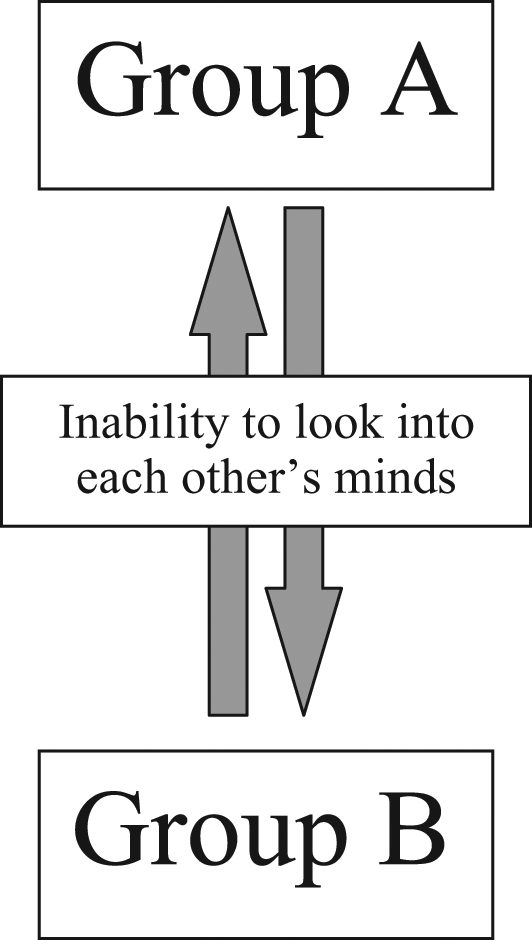
Ideal-type security dilemma between two groups
In sub-state constellations, recent experience with violence will generally frame the perception of political actors in post-conflict situations. To stabilise societies after violence, often coupled with mass atrocities and displacement, establishing political mechanisms to overcome uncertainty is vital. Military force may strengthen political arrangements and provide the potential to punish acts that oppose these arrangements. Thus, the military remains a supporting factor, but not a necessary one. Security, in that sense, is not the absence of manifest violence but politically calculable options and expectations that allow politics to come back into play and marginalise security-dilemma-induced considerations. It is this stable set of expectations that a new state, bolstered by external support, is almost inevitably lacking. 17
This is one of the insoluble gaps between security dilemma theorising and its practical implications. In theory, a group that finds itself in a security dilemma situation has no history and hence no record of former interaction with adversaries; its internal composition is disregarded in this rather ahistorical view. Resolving this deficit, these groups can be described using sociologist Norbert Elias’s concept of ‘figuration’. Elias develops the idea of a figuration as a far-reaching web of persons who are interdependent and form institutions entangling them in multiple layers of relations. These dynamic configurations provide an analytical framework that permits abandoning ‘the fruitless individualism versus society or structure versus agency debates’ 18 and the rather static reading of a security dilemma situation in which groups remain unchanged over time. Elias’s example of a game of cards illustrates this: four players play a game with existing rules (structure), but the characteristics of each game depend on the player’s agency. They form a figuration; were one person to leave the table and be substituted by someone else, the figuration would change. Including the individual in a structural analysis illustrates the interwoven interdependencies while resisting the use of ‘de-humanising substantives’ such as structure, functions or organisation. 19
Therefore, we must look at how the figuration of sub-state groups forms and develops over time – groups may lose cohesion, win support, have lucky draws or suffer strategic setbacks. Why do some groups manage to develop a military capacity to fight while others fail to organise durable institutionalised capacities? Klaus Schlichte compares several cases based on in-depth analyses of violent campaigns. He develops three useful ideal-type mechanisms which generate violent actor groups outside states’ control. 20 One is what he terms repression – groups addressing political grievances may attract repression by the state. Especially when state agencies act in unfamiliar settings, repression is often indiscriminate. A sub-state group may then gain legitimacy to resist what is seen as an oppressive force and develop capacities to provide protection against state agencies. This radicalisation of a formerly non-violent political movement, often in the face of rapid social change, sometimes escalates into a full-scale rebellion. Second, in the ad hoc mechanism, violence develops from neo-patrimonial, mostly clientelist structures of rule under strain. Formerly favoured individuals find themselves excluded, and may become leaders of violent opposition groups, which may subsequently gain strength by gathering military experts around them who themselves have lost the support of the system. A third type of armed group exists when paramilitary groups develop a life of their own. These militias may initially serve state purposes the regular military might be unable or unwilling to fulfil. Over time, as happened in the former Yugoslavia, these groups spin off into informalised state structures, eliminating control structures. However, because they are usually less able to generate public support than the first two groups, their lifespan is considerably shorter.
Thus, sub-state armed groups do not simply appear but have a history. In a state formation process, what Elias calls the ‘monopolisation mechanism’ works to subdue these groups under central rule. In his model, free competition of social figurations for the means of subsistence will leave some ‘victorious and others vanquished, and... gradually... fewer and fewer will control more and more opportunities, and more and more units will be eliminated from the competition’. 21 To keep the monopolised function, its proprietors need to ‘become the central functionaries of an apparatus composed of differentiated functions’ 22 – simply put, the monopoly demands functional diversification, which in turn allows responsibility to spread out to different persons: historically, the ‘privately owned monopoly in the hands of a single individual or family comes under the control of broader social strata, and transforms itself as the central organ of a state into a public monopoly’. 23
Elias’s process approach has been criticised as teleological and implicitly legitimising colonialism. 24 It is also questionable whether, as Elias assumes, growing chains of mutual interdependence are indeed the drivers of effective controls and social differentiation. Nevertheless, it is undoubtedly evolving institutional specialisation which shapes the politics of the modern state. It is quite obvious that contemporary state formation processes and, more specifically, attempts at statebuilding, take abstract norms of established Western statehood as a construction template or ideational backdrop. What Elias reminds us is that state formation, even more so in its externally enforced version of statebuilding, bears the risk to sub-state figurations of being eliminated from the competition. He describes this as a rather violent process (which may be a reason for a statebuilding intervention in the first place). Also, he declines to declare a unidirectional evolution of one group; the process is reversible and may change its direction many times. He alludes to state formation by a monopolisation mechanism as a self-enforcing development due to social, economic, military and administrative differentiation. On the surface, and certainly in Western perception, this differentiation ought to give the state-to-be-built a comparative advantage against sub-state figurations. It is, however, unclear which mutually enforcing or stymieing interdependencies of legitimacy, economic reproduction and violence exist and work – or fail to work – in favour of the state at which moment. 25 If a group has a distinct identity as a social figuration, and if integration into a dominating state would cause the loss of this identity, the formation of a state poses an existential risk for sub-state figurations.
States are often a source of insecurity. The absence of organised security agencies, often causal for Western ascription of ‘failed state’ status, could pose a risk, and comes close to a kind of domestic anarchy that resembles the international structure. But also, in a ‘strong’ state, regime considerations may pose a risk to some groups. Force directed against agents of change is common in ‘strong’ states, where state elites use overwhelming force to keep political opposition at bay and remain in power. Statistically, this makes the state one of the prime risks for individuals, 26 pointing to the tricky distinction between weak and strong states. 27 To buttress states considered weak by comparison to Western states, in recent years statebuilding has become a foreign policy tool. The hybrid forms of traditional and modern rule brought about by statebuilding practices often lack societal checks and balances, while providing those that successfully capture the state with resources. This may fundamentally change the security relationship between groups, shedding a different light on the state for local populations than the weak–strong dichotomy suggests: the state may ultimately appear more risky than the non-state.
External interventions tend to overlook power shifts they themselves facilitate. Rather, external actors view themselves as some deus ex machina, miraculously solving conflicts local actors have perpetuated, sometimes for years and even generations. The tendency to de-politicise non-Western societies and to politicise development efforts in effect justifies putting local populations under trusteeship, as they cannot be trusted to behave according to their own good. 28 In such settings, state capture becomes a viable strategy for one group to weaken and politically diminish other groups. It is easier to attract Western support when groups learn to speak the language of intervention and are consequently able to portray other actors as spoilers. Time is often crucial for violent groups, as they can accelerate or slow down political processes. However, this does not always work to their advantage. 29
While it is important to engage groups in the process of statebuilding, some may remain outside it. Between them, the security dilemma changes as they strive for a dominant position in state institutions. It becomes a trilemma, as the relation between two sub-state groups is amended by the state as a resource, a threat, or both (see Figure 2). In this way a new state is an important factor recalibrating power resources as well as the ‘environment’ for the application of organised violence. In spatial terms, where a state’s outreach is advanced, violence and the ordering power of sub-state groups may at first decline. Due to the (real or anticipated) potential of a state that enjoys technological support, information and enhanced logistical capacities, it makes little sense for a sub-state group to confront it when there is uncertainty about its capabilities. Temporally, violence often drops during the first stages of an intervention – sub-state actors first need to figure out the potential and resolve of an emboldened state and its influence on their own legitimacy. After all, sub-state security arrangements derive their social validity from the fact that they develop when state institutions are absent or incapable of delivering public goods. Given the normative power of stateness, 30 a population likely expects a state to start fulfilling its demands, however diverse these are. Only later might violence resume, as criminal networks start to make use of weaknesses in state control or corruption begins to subvert state action. Then, mobilising against the state may become part of security dilemma considerations.
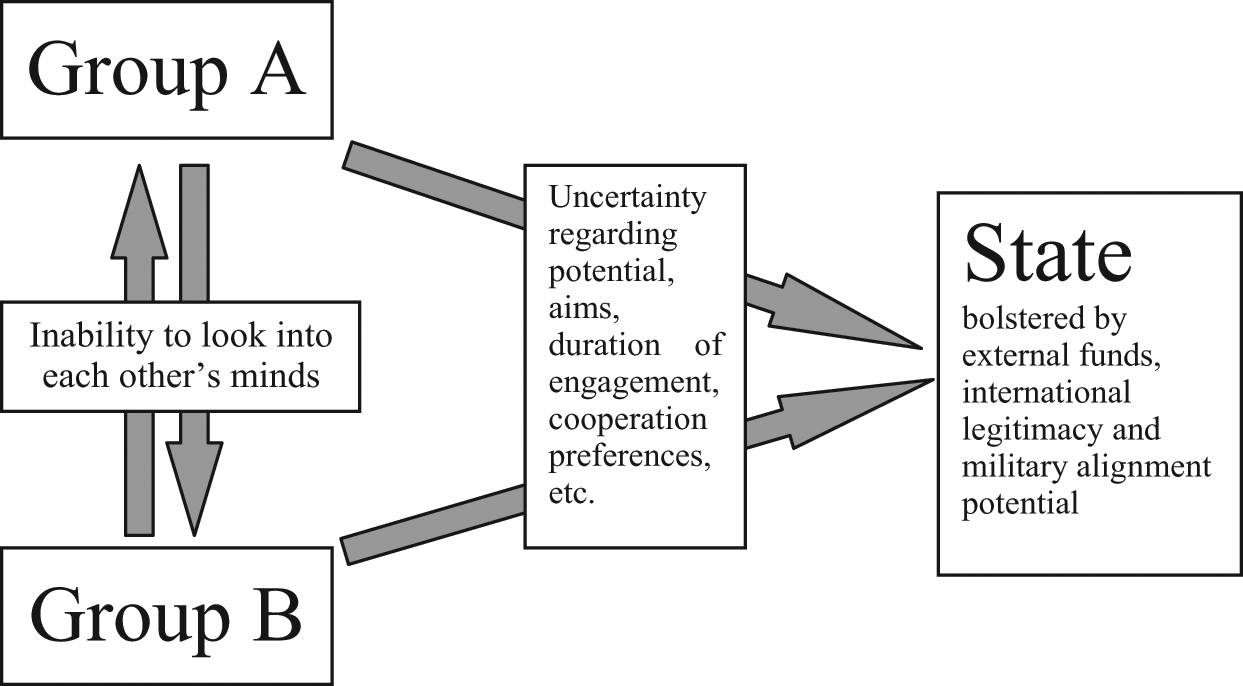
Security trilemma constellation under international intervention
Interventions have so far failed to take the internal security constellation into account. This is particularly striking as interventions have mostly taken place to end conflict which disrupted basic features of trust and predictability. 31 Post-conflict planning tacitly assumed that a state-to-be-built would solve each groups’ perceived security problems. In spite of calls for ‘broad-based’ or ‘ethnically balanced’ institutions, state agencies, and most importantly the security apparatus, often become tools of suppression, retaliation and human rights abuses. Unable to prevent this, the international intervention then has to either change course or tacitly accept the situation. Since the global ‘war on terror’ sided firmly with state institutions while often viewing other groups as posing a risk (such as by being close to ‘terrorists’), Western politics acquiesced to suppression of opposition groups and even torture.
In statebuilding processes, sending trustworthy companions to ‘serve’ in these institutions may be a strategic attempt to subvert these institutions and are part of resistance against the monopolising mechanism. Even though gaining access to ministries, intelligence agencies or other security assets may depend on chance, using opportunities as they present themselves is an ability all conflicting parties will be proficient in. However, the security dilemma situation between groups close to the intervention and those far away from it can become out of balance (see Figure 3). For international interventions, this may raise ethical questions: supporting ‘the wrong guys’ may be politically contaminated, especially when an intervention was justified on grounds of human rights.
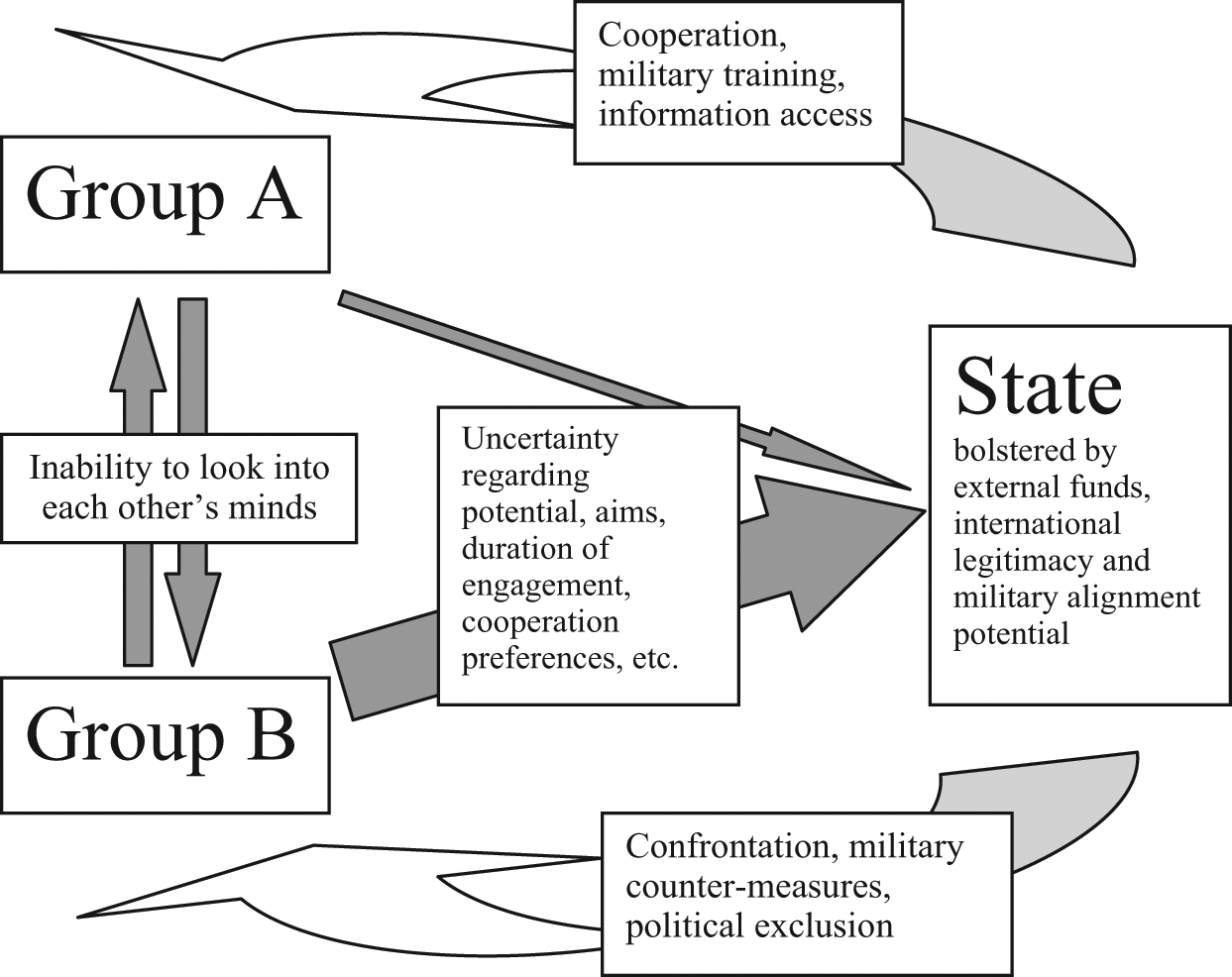
Extended security trilemma under external intervention
The relation between sub-state groups is significantly altered by access to the state, to external funds channelled through it, and the legitimacy it provides. The illustration freezes what in reality is a dynamic process – Group A and the state may be closely or loosely related; the favour of state co-operation may alter between groups; none of the groups may have its security dilemma vis-à-vis the state ameliorated. However, if external actors decide to side with one group, 32 the other has few options besides submission under a new regime – with uncertain security prospects – or fighting the power conglomerate. Although intervening countries, often in conjunction with the UN, usually try to induce the inferior side into a peace agreement and demand cooperation between former foes, what is of interest here is a group’s perception, for whom it may seem reasonable to ‘assume the worst because the worst is possible’. Uncertainty seems to bring politics close to gambling, as ‘uneven progress in the formation of state structures … create[s] windows of opportunity and vulnerability’. 33
A security dilemma approach, then, needs to be paired with a process analysis: groups are hardly distinguishable to outside actors. Not only can strategic postures be incomprehensible, group affiliations may be shifting and practically a lot less distinct than the ready ascriptions of ‘ethnicity’ or ‘religion’ suggest. Also, outside actors cannot look into a group’s mind and comprehend their attitudes – even for members of a group it is nearly impossible to figure out the balance between defensive and predatory motives. Additionally, each group may find itself in a perceived situation of multi-security predicaments, since usually there will be more than one contending group. A new regime, installed with external support, may rely on either certain social classes or ethnic, religious or other groups able to mobilise their constituency for political purposes. However, few regimes brought about by peace agreements are fully supported by all strata of a population. Enjoying limited legitimacy, put into place by force or at least with vocal political support from external states and organisations, they have to deal with external demands as well as with expectations ‘to deliver’ a ‘peace dividend’. This places the regime at the margins between internationalised and local political space: 34 the security dilemma existing between two groups on the local level enters into an odd interplay with actions based on political considerations elsewhere, thus becoming internationalised. 35
Often, a foreign-backed regime is unable to generate broad legitimacy through external mandates, peace conferences or external backing alone. As such, it fails to provide security – particularly by monopolising the legitimate use of violence – or a platform for political balancing and justice. 36 The internationalised regime is even more risky as the foreign intervention’s goals, timescale and means are harder to conceive than those of local – and often well-known – actors. Armed groups’ considerations regarding the use of violence, finances and symbolic capital, as well as their overall legitimacy in relation to statebuilding efforts, are examined in the next section before I connect the dynamics of the security dilemma with the perception of sub-state conflicts as international risks.
Sub-state groups and the state-to-be-built
The discussion about failing and failed states illustrates the increasingly hierarchical nature of the once pluralistic international system – i.e. the legal equality of states regardless of differences in their domestic constitution. 37 It has also brought to the fore a number of categorisations of violent sub-state actors. Ulrich Schneckener lists a ‘universe’ of groups active in uncontrolled ‘areas of limited statehood’ and argues that recent trends make it ‘increasingly difficult to distinguish’ 38 between them. Civilians and combatants both use ‘safe havens’ across borders while being entangled in transnational networks that allow them to collect revenues from smuggling and shadow markets. Often, they share ‘globalised’ ideological views while tending to be less hierarchical, lacking traditional channels of command-and-control and instead consisting of loosely cooperating sub-groups. While this structure renders globalised activities hard to disrupt by law enforcement, ‘actors become more fragmented and the leadership and command levels become less able to achieve coherence in strategic and ideological terms’. 39 However, especially when struggling for influence in a state or for territorial control while interacting with an external intervention, they face the following risks.
(i) Loss of violence as a political resource
In statebuilding, monopolisation of the legitimate use of violence is one of the main aims of political, aid and military actors. For a sub-state group, however, giving up the means of violence and demobilising militias or disarmament means not only creating vulnerabilities. Other groups may seize the opportunity to attack while the state may prove unable to protect vulnerable groups. Hence, disarming is unattractive when uncertainty reigns about the intervention force’s ability, resolve and level of information regarding potential attacks – and it can also actually raise the probability of an attack precisely because of the opportunity. For a sub-state group, the distinction between predatory and defensive politics is blurred when integration into a new state security sector is part of the statebuilding endeavour: while this may give the group enough leverage to protect itself, it may also open up opportunities to exploit other groups once influence is secured. Integrating into a state’s security apparatus, however, means that one group’s military force may come under the control of another. As no group wants to run the risk of losing its military assets, integration is hardly feasible, and creating a national military might not work in the first place. Even if integration of fragmented forces is not on the agenda, sub-state groups have few incentives to disarm and demobilise. In a fragile political process, military potential increases political manoeuvrability. The disruptive potential of militias gives a group a boost in international and domestic considerations. While it would be desirable to see interventions strictly adhering to the principle that (potential) violence does not pay, in reality, politically engaging with sub-state armed groups often means rewarding their military potential.
(ii) Loss of revenues
When state control in failed or failing states (but not limited to them) is restricted and particular regions are ‘ungoverned’, sub-state figurations may step in. The above-mentioned cross-border relations and illicit trade patterns are often their main source of revenue. A group needs to control an area in order to pursue trade and trafficking necessary for its reproduction. Controlling streets and collecting customs duties, tolls and taxes provides income for sub-state groups: they can offer protection to farmers, traders and other parts of the population. This protection is Janus-faced, as Charles Tilly has shown regarding European statebuilding processes. 40 In his model, state agencies developed by offering protection against racketeering that they themselves engaged in. Sub-state groups in a competitive monopolisation mechanism may show characteristics of nascent states. Their activities may resemble that of a state, and statebuilding means handing these functions over to state agencies.
In a security dilemma situation, loss of revenues can be vital. As money buys weapons and trading relations help organise their delivery, handing over these assets to state agencies simultaneously limits a sub-state group’s power and capacity for self-defence. Trading relations or controlling routes and borders may be necessary for a new state, and hence this control becomes subject to competition. The leverage of groups in controlling these assets translates into political capital. Maintaining sources of revenue well into a statebuilding process allows buying into posts, appropriating public agencies or state companies, and thus securing influence. Acquiring fame as businessmen, the leaders of sub-state groups may strengthen their stance as politicians. As a result, the distinction between war and peace economies becomes impossible to draw. As Antonio Giustozzi shows for post-Taliban Afghanistan, business is often funded and controlled by warlords and strongmen. They may send ‘dummy businessmen’ to act on their behalf or ‘allow’ entrepreneurs into business for protection rackets, 41 or loyal militiamen to serve in national army units. While this smacks of ‘military capture’, as sub-state groups may tap into state funds, military assets and equipment for their own good, it can be a strategy to secure future income by improving a group’s knowledge and ‘fundraising’ skills.
(iii) Loss of symbolic capital
Also impeding sub-state groups’ integration into state structures is a potential loss of symbolic capital. In post-conflict situations (and even more so if conflict drags on during intervention), narratives of conflict may reward war heroes with political influence beyond their constituency. From a security dilemma perspective, the symbolic capital of influential leaders may serve as a deterrent to others. They face the choice of becoming involved in national politics or staying on their home turf. Often, the strategy will be a mixture of both: if regional strongmen cave in to the ideology of statehood and become state officials, they need to appeal to their own group at the same time. For them, the dilemma of engaging in politics is one of personal security: being a strongman with leverage over life and death in a segment of population or a politician having to strike deals and compromise is an obvious difference. Unless the habitus of the state makes up for the aura of the militia, ethnic or religious leader, giving up that status and the associated symbolic capital is risky. Becoming involved and potentially being perceived as giving up too much autonomy might strengthen internal contenders who strive to take over leadership. Such internal creep may decrease internal legitimacy, in turn weakening a group’s political standing and creating ‘windows of opportunity’ for others.
(iv) Loss of legitimacy
The reasons for the success of sub-state groups vary. The weak-state/strong-state dichotomy tends to overlook the fact that legitimacy can hardly be achieved by economic or procedural means. The output dimension is also insufficient to explain legitimacy, as ideas and identities also play a role. Hence, acceptance of a sub-state identity as a group’s prime affiliation will decline once its leaders agree to amalgamate politically into a new state. Legitimacy relates to a broader notion of security: if security is understood as a preservation of a group’s identity, a perceived transformation of the self can be problematic. 42 To maintain legitimacy, all of the above are important: command over the means of violence will – not only for those actually exercising it – shape identity and provide for economic reproduction. The glory of a group’s leader will shine on the group, and the group’s appearance will affect its leader.
Legitimacy, in short, is crucial for mobilising political support. Inversely, it can be a source of threat. If a group is able to produce cohesion and focus political efforts on independence, its chances of success in security competition with others increase:
A group identity helps the individual members cooperate to achieve their purposes. When humans can readily cooperate, the whole exceeds the sum of the parts, creating a unit stronger relative to those groups with a weaker identity. Thus, the ‘groupness’ of the ethnic, religious, cultural and linguistic collectives … gives each of them an inherent offensive military power.43
Political figuration with a sense of identity is a vital condition for the emergence of a risk constellation. In the following, I look at states and sub-state groups in a security dilemma situation and their interrelations with the globalised politics of risk.
States and non-states
Generally, politics is beset by uncertainty. This is both basic and unfortunate, as certainty about the future would allow for better planning but diminish political options and transform politics into the execution of predetermined outcomes. However, starting from a sub-state security dilemma, it has been established that, depending of the characteristics of political organisations, options available to groups and their leaders differ significantly. For states, according to Herz, the main task is to secure their survival in a ‘struggle for security’. 44 To maintain their identity and independence, they find themselves pressured by the other’s mere existence: the potential of a threat to one state by another is what Butterfield calls ‘the tragic element in human conflict’. 45 This picture of mature anarchy as the setting for a state security dilemma is one of equal, stable and independent units. If one questions this basic assumption of the state’s equality, of course, then the picture changes significantly.
During colonial times, the question of equal states did not exist. People under colonial rule were not seen as living in a state (leaving only the mainly European states as ‘real’ state equals), or they were seen as living in inferior states. Nominally, this situation changed with the end of colonialism. However, ‘developed’ states with a certain ‘standard of civilisation’ cooperated more closely in political, economic, military and cultural matters. 46 This shaped a dichotomous worldview of a ‘zone of peace’ and a ‘zone of turmoil’:
There is universalism in the general acceptance of sovereign equality and the framework of international law and diplomacy based on that. And there is Western imperialism both in the projection of some contested values (human rights, democracy), and in the fact that the Western core and its immediate circle of Westernistic associates have developed a much thicker version of international society among themselves than they share with the rest.47
This can also be framed as a distinction between Lockean (liberal) states and Hobbesian states, the latter characterised by a strong security impetus seeking territorial integrity and domestic prevalence. 48 This undercurrent in the perception of world politics has led to an increasing hierarchy of states, as William Clapton notes. Facilitated by a growing construction of vertical risk (or orchestration of risk, according to Beck 49 ) within this hierarchy, power relations are reflected in two paradoxical ways. First, it is the population of the world outside the Western security community 50 which bears the brunt of anthropogenic risks following industrialisation and modernisation, while at the same time becoming increasingly ‘risky’ to Western energy-dependent standards of living. 51 Second, Western states have managed to eliminate war as a means of politics from their mutual relations, but attempt to govern the world outside this ‘zone of peace’ to act preventively against potentially emerging threats. This is a result of advanced modernisation in Western societies, ‘which, as they have grown more aware of such risks, have become increasingly anxious and insecure. One of the main features of these new forms of security risks is their temporal and spatial de-bounding.’ 52 Clapton argues that Western states have developed a risk perception closely linked to liberal values, which:
[became] the key to managing security risks, which provides the impetus for forceful interventions aimed at promoting liberalism. Therefore, it is not simply liberal values per se that provide the rationale for Western interventionism, but the more utilitarian and self-interested notion that liberal democratic governance provides a way of minimising and managing the new risks of the post-Cold War era.53
Western interventions ‘out of area’ conform to this liberal logic: only in a world of democracies can security eventually materialise. Since one cannot trust illiberal regimes to remain peaceful tomorrow, the strategy would have to be to extend the zone of peace – peacefully or by intervention. Although war against non-democracies may be the dark side of liberal peace, it is an intrinsic component of internal peace: ‘Democratic peace, one might say with only small exaggeration, proves itself in democratic war.’ 54 The security community’s politics of peacebuilding ‘represents the mutual inclusiveness of the idea of peace and the practice of war’. 55
Managing risks projects their significance into the indefinite, an ‘estimation of the dangerousness of the future’. 56 In contrast, though the manifest threat of, say, nuclear confrontation was by no means innocuous, it could be localised and temporally influenced – that is, the superpowers could politically hold off on nuclear war. The new risks cannot be framed according to actors, capabilities and intentions. 57 In spatially de-bounding risks, conflicts that were once local have now become globalised – and, as such, an imminent problem for the Western security community. Local violence cannot be ignored any longer without, ever again, risking spillover into the zone of peace. Statebuilding is paradoxical in this context: the West proclaims states to be the solution to sub-state (and hence incontrollable) violence. In aiming to control the risks of modernisation (which, by extension, includes the transformation of pre-modern states), new risks are generated for social relations in non-Western societies.
Thus interventions shape security dilemmas between sub-state groups, adding risks formerly unknown while they stem from increased risk perceptions themselves. Terrorism is the prototype of these risks, which accelerated a paradigm change towards a pro-active rather than a reactive posture in Western security policy. 58 Involvement in local affairs including military forces snowballed, which boosted the perception of Western, especially American, interference in genuinely sovereign (particularly cultural and religious) affairs.
The ‘orchestration’ of the terrorist risk made use of media globalisation in a likewise prototypical manner, 59 leading to growing risk transfer in the global ‘war on terror’. 60 Becoming more and more aware of the orchestration of risks, the West returns the risk to the world outside the zone of peace.
Conclusion: ‘Know your enemy’s risks’
Western global politics increases the risks to those living outside the pacified zone of liberal states without policy makers even being aware of this deflection of risk onto others. Western states have developed away from what they perceive as the rest of the world, which paradoxically seems so close through the lens of globalisation. Thus risks seem to become all-encompassing, ever-present and ubiquitous. The downsides of modernisation, such as ecological problems caused by industrialisation, economic collapse caused by late capitalism, or violence caused by terrorists, call for deflective risk management. The inflection of risk awareness and associated politics by Western states and subsequent risk transformation for local actors outside the West caused by interventions is a paradox of world politics. For local communities, threats, often manifest over time and territorially bounded in a security dilemma, collide with Western risk perception projected onto them and into the future of states-to-be-built. Thus Western politics puts the responsibility for Western security onto the states subject to intervention, creating another modernisation risk through these competing logics of conflict.
For analytical clarity, Booth and Wheeler split the security dilemma into a dilemma of interpretation – caused by uncertainty – and one of response. Thus they can isolate the dilemma itself from what it can cause. They disentangle the conflated perception problem and resulting political reactions: when there is a ‘response … that creates a spiral of mutual hostility, when neither wanted it, a situation has developed which we call the security paradox’. 61 This security paradox is one particular result, not the situation per se (the basic predicament, according to Butterfield), which is, like modernisation and industrialisation, man-made. However, it is not inevitable, as security dilemma situations can be mitigated. Awareness of the situation actors find themselves in is a good start. Even if actors are aware, they may not be able to act against what may seem inescapable. In a security dilemma constellation of combined levels – a local level of sub-state groups facing insecurity under the condition of external intervention, and an international level, shaped by risk constructions mirroring Western deflection of unintended modernisation dynamics – acting politically in a mitigating manner may appear virtually impossible.
One idea worth exploring is empathy. ‘Know your enemy’, says Clausewitz; that is, empathising with the enemy will advance your position in a war. As Butterfield observes, this is precisely what is impossible to do and creates a security dilemma, or Hobbesian fear, in his words. This is, of course, no news to Clausewitz: he stresses that it is just as important to know yourself. Thus, the gradual shift of risks and security constellations caused by global politics resulting in Western risk perceptions ought to be taken into account. A new culture of transitive risk reflection is needed – mirroring the apparent ‘clash of risk cultures’. 62 The worldview of Western scientific calculation needs to include estimations of its own framing of the world. That includes remembering Butterfield’s bold move away from moral arguments and ‘self-righteousness’. Rather, we ought to consider the mutual influence of states’ and sub-state groups’ politics. It is now time to soberly evaluate the predicaments caused by Western policy and de-demonise those who are so easily labelled ‘terrorists’ or ‘warlords’ to ensure Western moral superiority.
Footnotes
Acknowledgements
I would like to thank all at the Queen’s Centre for International Relations (QCIR) at Queen’s University, Kingston/Ontario, where I enjoyed the privilege of spending a research fellowship in 2010, for their generosity and friendship. An earlier version of this article was discussed at the Security and Defence Seminar there, and I profited from the insights of Charles Pentland, Kim Richard Nossal, Andrea Charron, Houchang Hassan-Yari, John Schram, Louis Delvoie, Andrew Grant, Sven Hilgefort and Douglas Bentley Jr. A big thank you, also, goes to Anna Leander, Christopher Daase, Berit Bliesemann de Guevara, the editors of International Relations, three anonymous reviewers, and the panelists at the 2010 International Studies Association annual convention in New Orleans’ panel series ‘Risk, the State and Contemporary Governance I+II’ for all the helpful hints and comments. And to Shahar Hameiri, for the perfect cooperation. Any remaining mistakes are, however, solely my own.