







Abstract
This article aims to highlight the impact of strategic culture on Italian attitude to war and peace. The first section shows how both structural interpretations based on the influence of international variables and domestic models that neglect the cultural dimension offer no adequate explanations of Italy’s military behaviour. The second section reviews the literature on strategic culture and its usefulness to explain the Italian case. The third section examines the characteristics of Italy’s strategic culture through the period of the Republic, and the fourth examines the influence of ideational factors on its military behaviour abroad. In this section, a series of hypotheses derived from structural and cultural models are tested using data from the Correlates of War dataset. The conclusion provides a summary of the research findings that emerged from the empirical analysis.
This article has two goals. First, it aims to identify the reasons for the low profile of Italy’s military behaviour and, in particular, its negative attitude towards the use of force. Second, it intends to contribute to the debate on the role of material and ideational factors in explaining the preference for offensive or defensive strategies. A first glance at the Italian Republic’s record of international behaviour after 1945 highlights the difficulties in applying realist explanations to the case of Italy. Foreign policy seems to be remarkably consistent over time despite changes in the nation’s international ranking. Italy passed from the status of a defeated and economically backward country to the rank of a major economic power, member of G8 since its foundation. In the 1980s, Italy was the fifth largest economy in the world. This development was not followed by a greater dynamism in security policy. International behaviour was strongly limited by a reluctance to build up and use the military. This reluctance, which was developed after Italy’s defeat in World War II (WWII), endured throughout the Cold War and post-Cold War eras. The persistence of the Italian elite’s ideas regarding ‘appropriate behaviour’ in the field of security must therefore be explained.
Although it considers itself to be a national actor as important as France, the United Kingdom and Germany, Italy has been incapable of playing a political role comparable to theirs. This cannot be attributed entirely to material constraints; 1 rather, it is the result of the country’s strategic culture, which is a mixture of realpolitik and pacifist tendencies. As will be demonstrated in more detail in the following pages, the concept of strategic culture is here understood to be a set of institutionalised beliefs within a society (more precisely within its political elite), transmitted through socialisation mechanisms, regarding the roles of war, international relations and the use of force in foreign policy. In other words, the concept of strategic culture represents the framework through which the political elite interpret the main threats and opportunities that may emerge from the international system and the correct strategies of action (social practices) for addressing them. As cultural factors, these strategies of action have a high degree of persistence in time.
Notwithstanding national and international changes in military technology and political structures, Italy’s attitude to the use of force has always been that military power should be used very circumspectly, that is, only defensively and within a multilateral framework. Military spending has remained low, both in absolute terms and in comparison with other middle-sized powers, and interventions abroad are still hotly debated politically and looked upon with suspicion.
In the following pages, I conduct an exploratory case study to determine whether hypotheses generated by the strategic culture approach can shed some light on Italy’s puzzling behaviour in the international arena (puzzling because Italy shows a less assertive foreign policy vis-à-vis other middle-ranking powers). In the first section, I consider the leading interpretations of Italian foreign policy and their limitations. In the second section, I review the literature on strategic culture and stress its utility for the Italian case. In the third section, I describe the country’s strategic culture through the period of the Republic, and in the fourth section, I test the relative weights of the influence of structural and ideational factors on Italy’s military behaviour. I conclude by summarising the various findings that have emerged from this study.
Competing interpretations of Italian foreign policy
Even though a vast amount of literature exists on the transformations of strategic cultures and foreign policies of Germany and Japan after WWII, 2 an analogous interest for Italy is almost completely absent, even though Italy was an ally of these two countries and shared an analogous destiny after its defeat, that is, the transformation of a fascist regime into a liberal democracy, the adoption of a constitution with strongly pacifist characteristics and a low-profile foreign policy in which the military played a secondary role.
The leading interpretations of Italian foreign policy during the Cold War underestimate the influence of strategic culture and follow realist/neorealist models centred on the constraining effect of international structure on Italian behaviour or models that explain Italy’s foreign policy using domestic political variables. 3 Many writers, such as Gianfranco Pasquino, Ennio Di Nolfo and Carlo Maria Santoro, have noted the restrictions on Italy that are implied by its membership in the Western Bloc and by the dynamics of the bipolar system. 4 The confrontation between the two superpowers forced Italy into a marginal international role in which it delegated its security to North Atlantic Treaty Organization (NATO). Within the North Atlantic alliance, Rome played the role of a loyal but passive partner; governments rarely questioned the United States’ decisions.
Contrary to neorealist expectations, many traits of this attitude, especially a reluctance to employ the military abroad, persisted in the post-Cold War period. The problem with interpretations based on external factors is that international material structures do not have unambiguous effects on a country’s foreign policy; they can push it to behave in contradictory ways. In fact, one must look at ideational factors to predict the direction in which a country will move. The ‘distribution of material capabilities and their systemic effects are indeterminate; their effects are determined by inter-subjective interpretation. Normative structures are the “shared expectations about appropriate behaviour held by a community actors”’.
5
Ludovico Incisa di Camerana’s comments are revealing in this context:
In comparison with the foreign policies of other countries (France, West Germany itself) Italian foreign policy during this period was extraordinarily steady and coherent … The steadiness and coherence of Italian foreign policy can only be explained by a substantial basic unity in Italian political culture regarding foreign affairs, that is, by a lack of any real alternatives.
6
Moving on to interpretations based on internal factors, analysts have noted the influence exerted by social systems. The works of both Norman Kogan and Angelo Panebianco address this topic and demonstrate how Italy’s sociopolitical characteristics have led to a low-profile foreign policy. 7 According to Kogan, Italian society is strongly oriented towards particularistic interests and pays little attention to international affairs, doing so only when they appear to present opportunities for, or threats to, internal positions of power. 8 According to Panebianco, the pursuit of a passive foreign policy was an attempt to prevent disagreements regarding international issues from becoming yet another source of division in domestic politics that could fan the flames of an already overheated public discourse. 9 This policy entailed the renouncement of military interventions abroad.
Notwithstanding changes in the domestic political system in the early 1990s, an accommodationist foreign policy has endured. The theoretical ambiguity found in external interpretations also exists in those internal interpretations that do not give sufficient weight to the normative-ideational dimension of society in which the appropriate responses to specific stimuli are determined. As Elizabeth Kier demonstrates in her study of military culture in the French army between the World Wars, organisational cultures affect how the bureaucracies that are responsible for the management of security policy react to changes in domestic policy. 10
The persistence of similar risk-averse patterns of behaviour over the Cold War and post-Cold War periods suggests that the way in which Italy faces its external problems is strongly stable and represents a ‘repertoire of strategies’ that has remained valid over a prolonged duration (notwithstanding deep changes in international and domestic arenas). In other words, it is a culturally determined behaviour, in the sense that Ann Swidler uses this concept. 11
Studies of strategic culture
Studies on strategic culture show how a country’s responses to threats (through realpolitik practices or conciliatory strategies) are learnt culturally through processes of socialisation and institutionalisation and do not automatically follow the logic of international anarchy or of internal political compromises that can lead to a wide variety of possible outcomes. Countries with the same international positions but different cultural traditions will not react to the same external events in similar ways.
Johnston differentiates three generations of studies on strategic cultures. 12 The first generation includes studies conducted in the late 1970s and early 1980s on the behaviour of the United States and Union of Soviet Socialist Republics (USSR) in the field of nuclear strategy. The research by Jack Snyder on Soviet strategic culture, Ken Booth on ethnocentrism and strategy and Colin Gray on national style and strategy belongs to this generation. 13 Even though Johnston recognises the important pioneering function of these works in opening strategic studies, which is a field that until then was dominated by formal models derived from economics, to a cultural approach, he underlines several methodological problems that plagued this generation of scholarship. First, the definition of the concept of strategic culture is so vague that it can prevent an understanding of the specific role of ideational factors. Second, it does not discriminate the ideational dimension of culture from observed behaviour: ‘… cultural explanations are rendered tautological through the derivation of inferences about culture from behaviour’. 14
The second generation of studies on strategic culture, in the late 1980s, was characterised by an instrumental vision of ideational factors. This generation considers culture to be a simple expedient used to cover the real motivations of actions. 15 Johnston responds to this position by emphasising that even when strategic culture is being used symbolically, it still can have some effect on the behaviour of policymakers. Cases of ‘rhetorical entrapment’ can occur: people are influenced by the same arguments that they have elaborated to legitimise their actions: ‘… elites, too, are socialised in the strategic culture they produce, and thus can be constrained by the symbolic myths which their predecessors created’. 16
The third generation of studies on strategic cultures appeared in the 1990s and is characterised by greater methodological rigour and more careful specification of the independent and dependent variables. The classic study edited by Peter Katzenstein 17 and the studies by Johnston are some of the most important examples of third-generation research.
This generation has three main characteristics. First, it tries to avoid making too many determinist affirmations, as the first generation did. It is interested in comparing several approaches and empirically testing hypotheses that are derived from different models. The study edited by Glenn, Howlett and Poore is representative of this school of thought: it tries to verify the explanatory power of the cultural variables used by constructivism and the structural variables used by neorealism through a cross-national analysis. 18 Third, studies belonging to the third generation share a similar conception of culture: ‘culture either presents decision makers with limited range of options or it acts as a lens that alters the appearance and efficacy of different choices’. 19
To solve the problem of theoretical ambiguity of the traditional interpretations of Italian foreign policy and avoid inferring a cultural model from observable behaviours, I will use, in the following pages, Johnston’s definition of strategic culture, which can be understood as a system of symbols that expresses the ideas prevalent in a society regarding:
The role of war in international relations (war can be seen as a normal characteristic of international relations or as a momentary aberration), the nature of a country’s rivals (peaceable or implacable enemies) and the utility of force (which can be seen as an effective means of achieving a country’s goals or as pointless violence);
Preferences for different strategic options (offensive action, defensive action or non-military action). 20
This definition has the merit of being clear and of distinguishing factors that are more symbolic (i.e. the first part of the definition of belief systems) from those that are more operational (i.e. the second part of the definition of policymakers’ strategic preferences) and have more direct influences on behaviour.
An empirical study of Italian strategic culture is important because, in spite of changes in the international and domestic systems in the post-Cold War era, Italy’s military behaviour presents a strong continuity in its basic characteristics. The analysis involves a two-stage procedure:
Specifying the images of war and rivals, the role of force and the strategic preferences of the political and military elite of the Republic as they developed in the aftermath of WWII and consolidated during the Cold War (section ‘Characteristics of the Italian Republic’s strategic culture’). 21
Analysing the actual behaviour of the country in the security field to verify the consistency between belief systems, strategic preferences and political choices (section ‘Italy’s strategic culture in action’).
Several sources operationalise the central tenets of the strategic culture of the Italian political elite:
Political platforms of political parties;
Speeches of individual leaders;
Theoretical documents that illustrate the ideological bases of the main political cultures of the country, that is, Catholic and socialist/communist;
To this set of sources is added a symbolic analysis to evidence the self-perception of the Italian elites regarding national identity and war. In particular, the emergence of the so-called mito autoassolutorio (self-absolution myth) for war crimes committed during WWII and the associated theme of the ‘compassionate Italian soldier’ are considered.
As for the identification of strategic preferences, the operational doctrines issued by the general staff of the Armed Forces during the Cold War, which was the period in which the Italian accommodationist strategic culture formed and consolidated, will be considered.
This part of the analysis is conducted using documentary material and based on secondary literature. The empirical test is principally centred on quantitative data (Correlates of War – COW) to sketch an approximate picture of the behaviour displayed by the country in the period considered vis-a-vis the decision to use force.
Characteristics of the Italian Republic’s strategic culture
The strategic culture of liberal (1861–1921) and fascist (1922–45) Italy possessed many of the characteristics of the model referred to by Johnston as hard realpolitik: 22 a belief in the centrality/inevitability of war in international relations, negative images of rivals, a positive perception of the military means and a cult of offensive. 23 The strategic culture of the Italian Republic, in contrast, appears to be an accommodationist strategic culture. 24 In cognitive terms, an accommodationist strategic culture considers the state of war to be an exception rather than a normal condition of international relations. It considers interstate relations to be primarily cooperative in nature and refuses to regard military force as a legitimate instrument of foreign policy. In behavioural terms, an accommodationist strategic culture manifests a strong preference for negotiation, compromise and the use of international institutions to resolve conflict; accommodationist elites avoid dangerous actions and do not run unnecessary risks. These preferences imply a reluctance to be dragged into the dynamics of power politics. 25
Italy’s defeat in 1945 favoured the establishment of an elite that opposed war and the use of force as a means to solve international disputes. Many factors led to this culture taking root: the institutionalisation of a pacifist tendency in Article 11 of the Constitution, which bans war and requires the country to support international organisations; the disrepute of the Armed Forces; the downsizing of the defence industry; the process of ‘defascistisation’ (which often actually meant denationalisation); the creation of the myth of the Italian ‘compassionate soldier’, which contributed to the spread of the narrative of a country reluctant to use military force; the polarisation of internal politics, which encouraged low-profile choices in the fields of security and defence. External factors also played an important role in this process, but their effects proved to be ambivalent. On one hand, the military clauses of the 1947 peace treaty limited Italy’s room for manoeuvre and the possibility of a quick recovery and modernisation of the Armed Forces. On the other hand, the inclusion of the country in the Western bloc and the outbreak of the Cold War slowed down the ‘cleaning up’ of the bureaucracy by the remnants of the previous regime, as shown by the emergence of the mito autoassolutorio, which will be discussed later. 26
To describe the characteristics of the strategic culture established after WWII, we need to take a broader view of the attitudes of its principal proponents: Catholic groups and the political forces of the left. 27 The literature shows that after WWII, there were two dominant political cultures in Italy: a ‘red’ culture of the left, and a ‘white’ culture of conservatism/Catholicism. 28 These two political cultures found expression in political parties that were strongly rooted in the territory. In the following, I describe the various components of the Italian strategic culture, including prevalent ideas regarding war and the use of the military force, the perceptions of rivals and operational preferences.
War and the use of military force
Conservative parties were in part influenced by the doctrine of the Roman Catholic Church, whose attitude to war was not unequivocal. In some respects, war was considered a natural component of relations among states given the presence of evil in the world. In other respects, the existence of war was attributed to the fact that contemporary societies did not correspond to the ideal of an international Christian order. 29 In the early years of the Cold War, the Church rejected absolute pacifism because of the perceived Communist threat, but the Church’s attitude towards war became more decisively condemnatory after the Second Vatican Council. In the encyclical, Pacem in terris, Pope John XXIII strongly condemned nuclear weapons and called for their destruction; furthermore, he declared that it had been a mistake to consider that war could be used as a means to resolve disputes. A few years later, in his address to the United Nations in October 1965, Pope Paul VI called for an outright ban on war. 30
The influence of Church doctrine on the main post-war party in Italy, the Christian Democrats, is complex because there were different factions within the party, some more pragmatic and others more ideologically driven. 31 Guido Formigoni distinguishes three factions: the first, that is, the ‘Orthodox Atlanticist’ position, which was espoused by politicians such as Antonio Segni, Paolo Emilio Taviani and (at least initially) Giulio Andreotti, perceived the choice of belonging to the Western Bloc as not just a security calculation but also a wider question of identity. The Soviet threat made it necessary to join NATO, but the values and cultural traditions that Italy shared with other NATO members also made it necessary to join NATO. 32
The so-called Neo-Atlantic wing, which comprised men such as Giovanni Gronchi, Amintore Fanfani and Enrico Mattei, stood in contrast to the Orthodox Atlanticists (although it shared many basic tenets with them). This faction did not question the country’s international position but laid claim to greater autonomy in the promotion of the national interest, above all in relation to its dealings with developing countries on which Italy depended for its energy supply. This wing shared some of the positions of Giorgio La Pira (a leading representative of Catholic pacifism), which centred on the need to transcend the logic of the Cold War and to increase international détente, with Italy acting as a conciliator. 33
Finally, there was the ‘Morotea’ faction of Aldo Moro. Initially, Moro was not particularly interested in world politics, and he mainly acted in support of Fanfani’s initiatives. However, from the end of the 1960s on, his position became more clarified, and he developed a more markedly defined foreign policy. He aimed to move beyond the logic of blocs by recognising the growing interdependence of nations and the need of more collegiality in dealing with international issues, thereby removing them from the tight grip of the superpowers. There was a partial convergence between the positions of this faction and the more radical positions held by the left of the party reunited in the ‘Base’. According to Moro, changes at the international level would be linked to the possibility of triggering deep changes in the internal politics of the country.
Communist thinking on war and peace is in some ways similar to that of Christians. Both accept the concept of just war: in Christian doctrine, the war of self-defence is just, whereas for Marxists, the struggle of exploited classes against their exploiters (and of oppressed nations against their oppressors) is just. However, war is not inevitable in Marxist doctrine because it is seen as neither the result of an immutable international system (as it is in the realist theory of anarchy) nor the result of man’s innate wickedness. War is the product of a particular socio-economic system and as such can be prevented through the abolition of the exploitation of man by other men and of poor countries by rich nations. 34
The attitude of Italy’s left-wing parties towards war reflected both an ideological approach and a great deal of pragmatism and opportunism linked to a responsiveness to Soviet politics. In the cases of the Partito Comunista Italiano (PCI, that is, the Italian Communist Party) and the Partito Socialista Italiano (PSI; that is, the Italian Socialist Party), which after the war was largely dominated by the international positions of the former, 35 ideological factors were a very important aspect of foreign policy. The two parties shared Marxist–Leninist roots. Throughout its history, Italian socialism has been strongly anti-militarist.
The relationship with Moscow played a large part in the development of both parties’ political positions. The growth of a pacifist movement, led by the Communists, was closely linked to the campaign launched by Stalin to sow opposition to US military policy in the West. For Moscow, there was a distinction to be drawn between indiscriminate pacifism, which abhorred all war equally, and true pacifism, which condemned the warmongering of the capitalist countries. From this point of view, disarmament campaigns actually were campaigns against the Atlantic Alliance.
The shift from unilateral to universal pacifism coincided with the changes introduced in 1968 after the Czechoslovakian crisis and was a by-product of a more general cooling in relations between the PCI and the USSR. An ‘absolute pacifism and the prejudicial rejection of the use of force’ thus emerged. 36
The so-called mito autoassolutorio of crimes committed by the Armed Forces during the WWII, which was a strong symbol of an Italy that was little inclined to fight, is an important part of this process of rejection of war. 37 At the end of WWII, as military operations were drawing down, it was clear that Italians had committed war crimes, especially during the campaigns in Greece and Yugoslavia. Non-conventional instruments and tactics had been used even during colonial enterprises; the use of poison gas contradicted the narrative of an Italian colonialism that was less brutal than that of other major European powers.
In January 1944, Benedetto Croce condemned the acts of violence perpetrated by Italians against the populations of the countries invaded. At the same time, however, he emphasised how these behaviours were the result of an imitation of the attitudes of German troops and were ‘contrary to all Italian habits and temperament’. 38 The philosopher’s arguments would become those used most often by both leaders and the general public (i.e. that Italian soldiers, in the vast majority of cases, had acted in a humane manner vis-à-vis their enemies and avoided the brutality of other armies).
In the years immediately following the end of the war, for various internal and international reasons, the crimes committed by Italian troops were kept secret, and proceedings against those who were accused of such crimes did not result in convictions or punishment. Rather, a narrative of the war that tended to downplay the responsibility of Italian soldiers began to emerge; this narrative was accepted by government circles, civil society and parties on both the Right and the Left. This myth of the ‘compassionate soldier’ was strongly associated with the image of Italians as a people little inclined to pursue warlike behaviour. The worst episodes of violence were reduced to isolated incidents or attributed to the actions of fanatics and bloody fascist squadrons:
To the image of the ‘bad German’, a fanatic warrior capable of every vileness, was contrasted the ‘bravo italiano’: badly equipped, catapulted against his will in a wretched war, the Italian soldier sympathised with the populations of the countries invaded, helped them against hunger and poverty by sharing with them his poor foods, and above all, he protected them from the abuse and the violence of German comrades.
39
The image of the enemy
The image of the rival, which during the Cold War was the USSR, is a complex web of negative and positive views. Although it can be more or less taken for granted that the PCI, and for some time the PSI, did not see the USSR as an enemy, it is also true that Christian Democrat governments also began to demonstrate a more constructive image of the USSR after the period of détente initiated by Khrushchev in the second half of the 1960s, as they saw the USSR as not only an adversary but also a possible source of opportunity.
40
This positive view grew stronger during the Gorbachev years. The importance of Gorbachev’s coming to power in terms of Italy’s attitude towards the USSR is well expressed by Roberto Gaja:
The case of Italy, however, deserves to be considered separately. Above all, we must recognise that Gorbachev was most likely more popular in Italy than in any other country. It is easy to understand this being the case for Italian communists … but it was so particularly for the government and the Christian Democrats … besides, our big industry, which has always had an inclination for the Soviet Bloc, was agreeable to a rapprochement with the Soviet Union.
41
Ambassador Sergio Romano also argues that Italy was most likely the country that had the most faith in Gorbachev’s political turnabout. 42
Operational preferences
Ideas regarding war, the enemy and the use of military force translate into preferences for different strategic options. Post-war Italian strategic culture prioritised diplomacy as a means to solve conflict. When choosing between offence and defence, defensive strategies were preferred to offensive strategies, in contrast to the liberal and fascist periods.
The various circulars that have been published by the Army High Command reflect these basic concepts. In the first 30 years of the Republic, four series of documents dealing with the role of the army were published: series 3000, 600, 700 and 800 of the ‘Force Employment Doctrine’. 43 The first series (3000) still reflected a WWII concept of war and was based on predictions of a typical conventional conflict in which the Italian army played a limited defensive role. The next two series (600 and 700) were adapted to account for the United States’ development of its nuclear policy in the 1950s (the strategy of ‘massive retaliation’). Series 800 was formulated to account for the reshaping of nuclear policy (determined by NATO’s shift from ‘massive retaliation’ to ‘flexible response’). When referring to the use of tactical nuclear weapons, these documents emphasised the advantages of a defensive posture, only aimed to halt an attacking enemy.
This preference for defensive action is confirmed by the Navy and Air Force’s operational doctrines. The Italian Navy was severely limited by the peace treaty after WWII: it was forced to cede part of its fleet to the victorious countries and was prevented from building up any combat units for offensive purposes. 44 In the various phases that have marked the rebuilding of the national fleet and that witnessed the gradual substitution of units equipped with the most up-to-date technology for old pre-war ships, military planning was always focused on defence. At first, when the only ships in the Mediterranean were those of allies, the naval operational doctrine only allowed for the defence of the Italian coast on the border with Yugoslavia and the escort of convoys in the case of conflict with the USSR. Although this strategic framework subsequently became more complex with the threatening appearance of the Soviet fleet in the Mediterranean, the Italian Navy’s main role continued to be fundamentally defensive.
After Italy joined NATO in 1949, the Air Force tried to overcome the constraints imposed upon it by the peace treaty and to initiate a programme of modernisation. Whereas the Air Forces of other nations were assigned strategic tasks, Italy’s Air Force was entrusted with the tactical support of ground troops and air defence. 45 Over the next two decades, little changed, and despite international developments and improvements in weapons systems technology, defence and tactical missions continued to be at the centre of the Air Force’s operational planning. Such priorities were more in line with the thinking of General Amedeo Mecozzi, who was strongly against the offensive use of the Air Force, than that of General Giulio Douhet, who was a theorist for the offensive role of air power between the World Wars. 46
The most striking features of Italian strategic culture, which emerge from the interweaving of different factions (primarily Catholic and left-wing) with the pragmatic calculations of politicians, can be summed up in the words of three historians who have studied these issues in detail:
The Republican age appears … to be largely characterised by a culture of peace and, indeed, by heated public debate (the case of the socialist/communist campaigns and the Christian Democratic polemic in response is typical) about it. Merely a remnant of a past to be quickly forgotten, war was expressly rejected in the Constitution, while the entire issue of the military and defence endured a long process of delegitimisation which led to even research on the subject being regarded with suspicion. After WWII, public opinion, politicians and Italian political culture (whose role in influencing foreign policy became especially important, as in the case of the beginning of détente, or of the bitter debate around nuclear weapons within NATO) were increasingly drawn towards rejection of the war. They insisted on the primary importance of international cooperation and opted, if not for pacifism, for a systematic policy of mediation and of peace (not without, however, a degree of instrumentalism).
47
The end of the Cold War triggered a re-examination of Italian security policy involving an increased willingness to use military force. Some authors, such as James Walston, stress the change of Italy from the role of security consumer to the role of security producer.
48
Others, such as Antonio Missiroli, emphasise continuity more than change. Missiroli writes that:
in the specific domain of foreign and security policy, such characterisation of the ‘Second Republic’ leaves much to be desired. The verbal confrontation and adversarial rhetoric of the two camps notwithstanding, actual government policy has shown much more continuity than normally assumed or acknowledged.
49
Maurizio Carbone’s analysis shows the ambivalent role played by domestic reforms after the end of the Cold War. On the one hand, they produced a more assertive European and Atlantic foreign policy; on the other hand, they led to a low-profile policy for international development, which had traditionally been a field of great Italian activity. 50 Elisabetta Brighi assessed the foreign policy of centre-right and centre-left governments in post-Cold War Italy and saw more evidence of stability than evidence of discontinuity. 51
From these studies emerges a contrasted picture of continuity, notwithstanding greater assertiveness. The change primarily relates to Italy’s willingness to play a more independent international role; the continuity relates to the way that Italy endeavoured to perform this role (the field of cultural practice). Italian policy remained primarily defensive, and the increased projection of military power occurred in peacekeeping and peace-building missions, which became a junction in which the anti-militarist tendency, on the one hand, and the growing use of the military, on the other hand, could find some common ground. International and domestic transformations have not led to any substantial modification of the strategic culture. 52 The political elite have tried to respond to the new threats and opportunities that have emerged since the fall of the Berlin Wall in 1989 while remaining within the limits (although occasionally stretching them considerably) defined by the post-war strategic culture. 53 In times of change, culture influences behaviour both by prescribing the repertoire of feasible actions and by competing with other cultural models, thereby providing guidelines for the invention of new strategies. 54
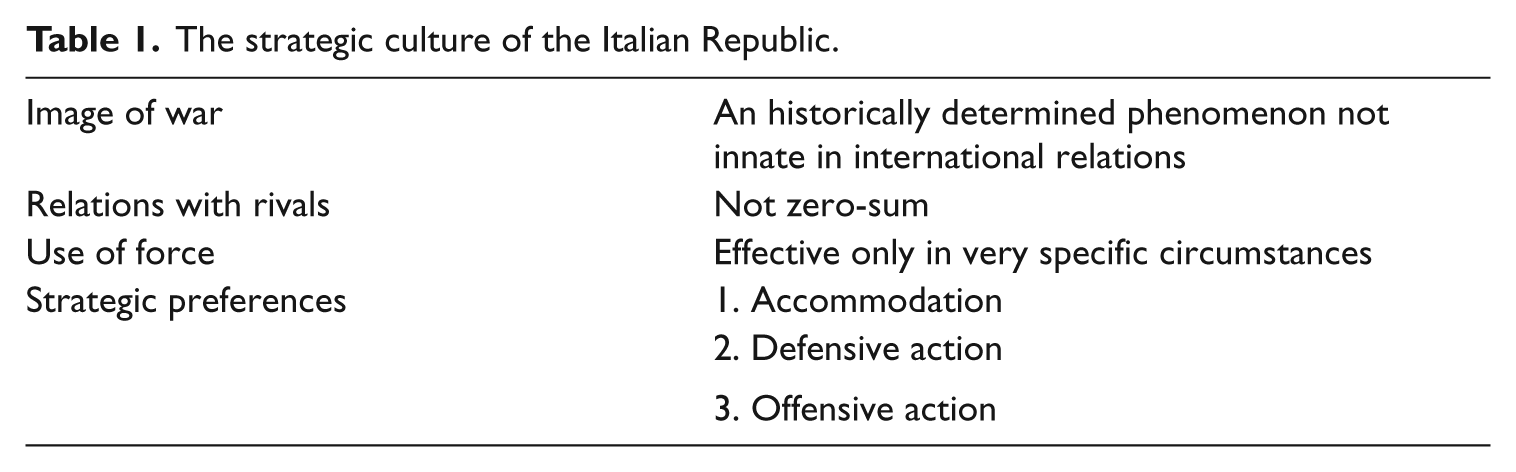
The model of the accommodationist strategic culture outlined above is schematised in Table 1. The next section shows the extent to which the Italian Republic’s international behaviour is consistent with this model.
The strategic culture of the Italian Republic.
Italy’s strategic culture in action
From a neorealist perspective, the events of 1989 that led to the collapse of the bipolar system and to the demise of the main threat justifying the North Atlantic alliance should have brought about profound changes in Italian military behaviour such as:
Greater assertiveness and a higher international profile;
An increase in defence spending;
A weakening of support for international security organisations;
The emergence of a more marked inclination towards unilateral actions, including military action.
However, one of the assumptions of a cultural approach is that the repertoire of practices that comprises a security culture (and from which actors choose strategies with which to tackle particular issues) is persistent and does not fade away easily. Thus, even when national and international conditions change, policymakers continue to react to security issues according to procedures that derive from their security culture. If we can assume that the post-war strategic culture, which was consolidated over many years, is still influential, then we should find that even in changed international circumstances, 55 Italy continues to be a country that:
Uses military force reluctantly;
Does not invest heavily on weapons;
Supports multilateral organisations;
Tends to frame its interventions as peace missions rather than acts of war.
In the following pages, I will test these hypotheses by analysing a series of themes, including involvement in militarised disputes, patterns of defence spending and attitudes to multinational security organisations. The comparison is made between neorealism and the cultural model, and not with the domestic politics model, for two main reason: First, this comparison enables us to draw a parallel between this study and other similar works that analyse the strengths and weaknesses of neorealist and cultural explanations. 56 Second, and most important, the cultural explanation should not be understood as an alternative to the domestic political explanation but rather as a complement. The domestic structure encompasses not only the strength of political institutions and societal actors and the way that they relate to each other but also the normative dimension consisting of ideas and social norms. 57
Behaviour in militarised interstate disputes
A quantitative analysis of Italy’s military behaviour allows one to take an initial look at the country’s attitude towards the use of force. To do this, I have used data from the COW project on militarised interstate disputes (MID), which includes the years up to 2001. 58 A militarised interstate dispute is defined as a single historical event in which the threat, deployment or use of force by one state is unequivocally directed at the government, property or territory of another state. The level of violence in a dispute can range from simply threatening the use of force to the declaration of war.
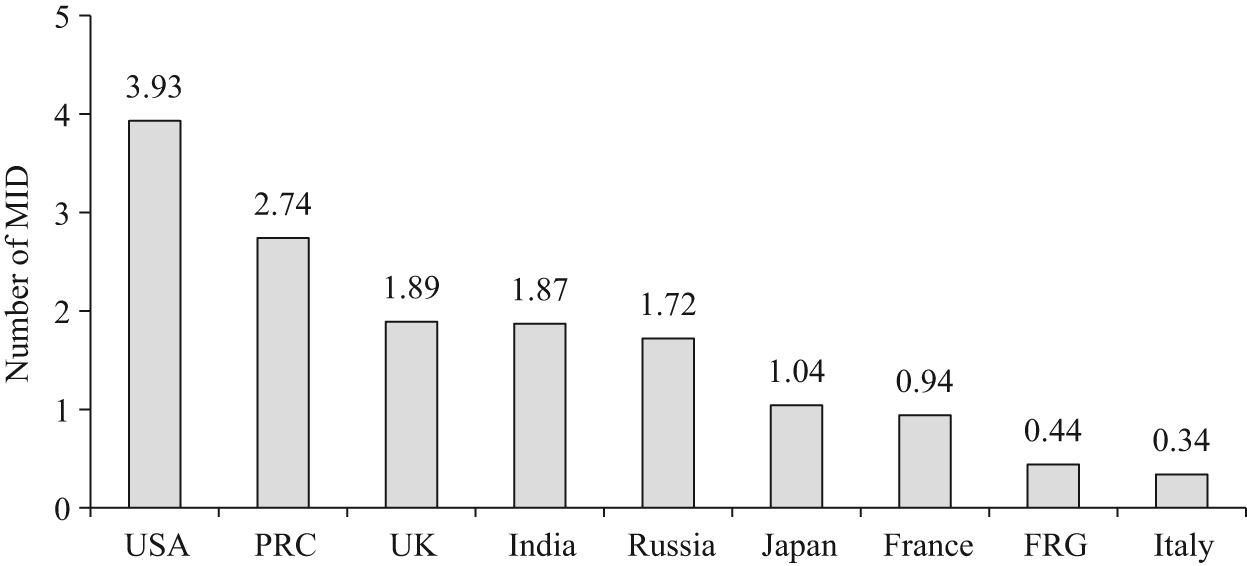
From an initial comparison with other countries, we can see that Italy is not a war-prone state (Figure 1). Since the post-war period, the United States has been party to almost four disputes per year; China to almost three; the United Kingdom, Russia and India to almost two and Japan and France to approximately one per year. Germany and Italy only became involved in one dispute every 3 years. These data are consistent with an accommodationist security culture.
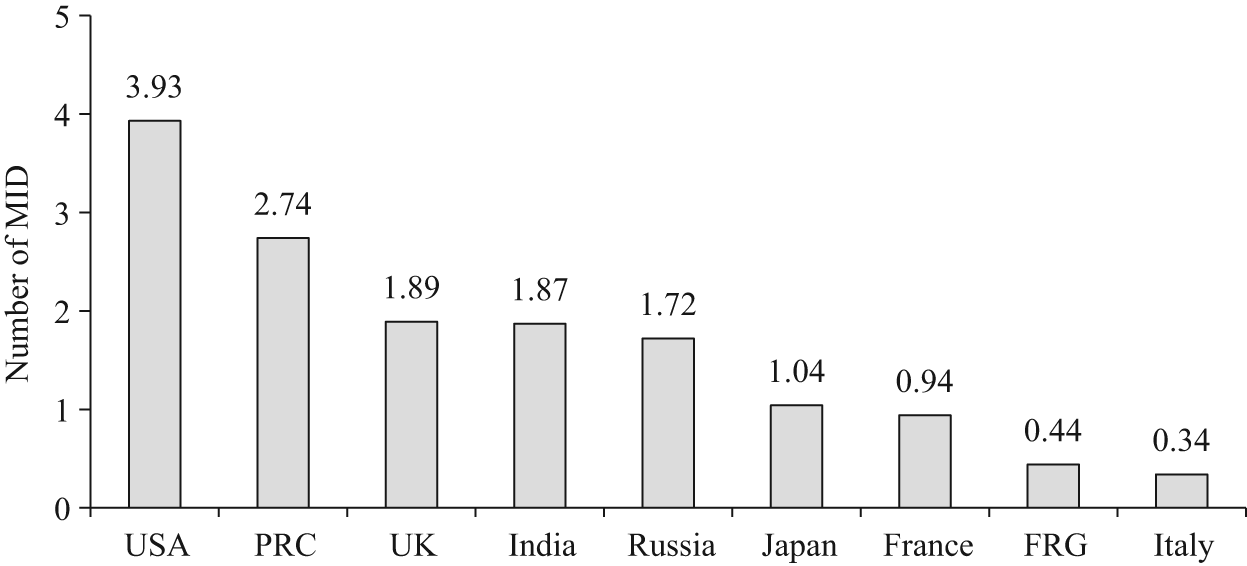
Nations’ involvement in MID (MID per year, 1946–92).
The differences are even more significant if countries that because of their size, international responsibilities and traditions, occupy a particular position in the world (e.g. the United States, Russia and China), are excluded from the comparison. A comparison among middle-sized powers such as France, the United Kingdom, Germany, Japan and Italy shows that Italy was the country least likely to be involved in military disputes during the Cold War (Figure 2). Although the watershed year of 1989 led to a general increase in the use of force that was most likely caused by the instability generated by the collapse of the blocs and the increased freedom to manoeuvre gained by medium-sized powers, as predicted by the neorealist thesis, the fact that Italy and Germany, that is, countries with an accommodationist strategic culture, always have the lowest score on the scale (Japan is slightly exceptional) confirms the idea that, even within a more permissive international climate, an acquired repertoire of cultural practices continued to influence the behaviour of these countries abroad.
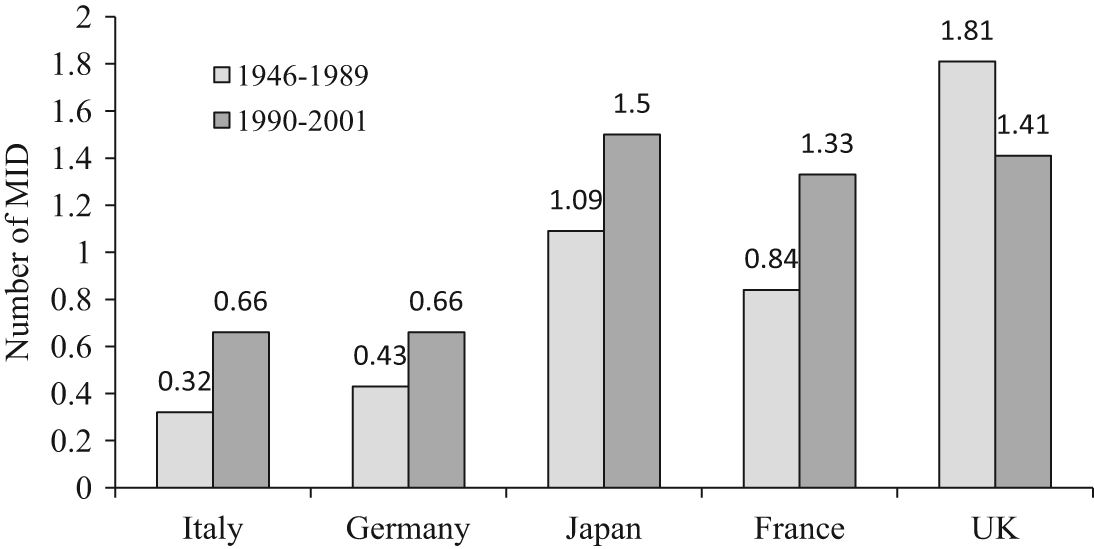
Middle powers’ involvement in MID (MID per year, comparison of five nations).
We see little change when we move from a cross-national comparison to a longitudinal comparison. I have evaluated four sub-periods in Italian history: the liberal period, from the foundation of the unified state to the advent of fascism (1861–1921), the two decades of fascism (1922–45), the Italian Republic during the Cold War (1946–89) and the Italian Republic during the post-Cold War era (1990–2001) (Figure 3). The period that saw the most conflict was the fascist period (60 MID, or 2.5 conflicts per year), followed by the liberal period (41 MID, or 0.69 per year), the post-Cold War period (8 MID, or 0.66 per year) and finally, the Cold War period (14 MID, or 0.32 disputes per year). These statistics are compatible both with a neorealist interpretation, which indicates international anarchy and Italy’s security interests as independent variables, and with a cultural interpretation. The bellicosity in the liberal period can be linked to the demands involved in the construction of the new state, which was intended to complete the project of the Risorgimento and confirm Italy as a genuine great power, and which ultimately led to Italy’s involvement in World War I (WWI). 59 The bellicosity of the fascist period can conversely be seen more as a result of the strongly militarist tendencies of the strategic culture than of any modification of international position, which in fact remained substantially unchanged. 60 Similarly, the constraints on any increase in Italian military activity in the post-Cold War period seem to be more linked to cultural factors, that is, a resistance to adopting the tactics of realpolitik, than to structural deficiencies or internal politics.
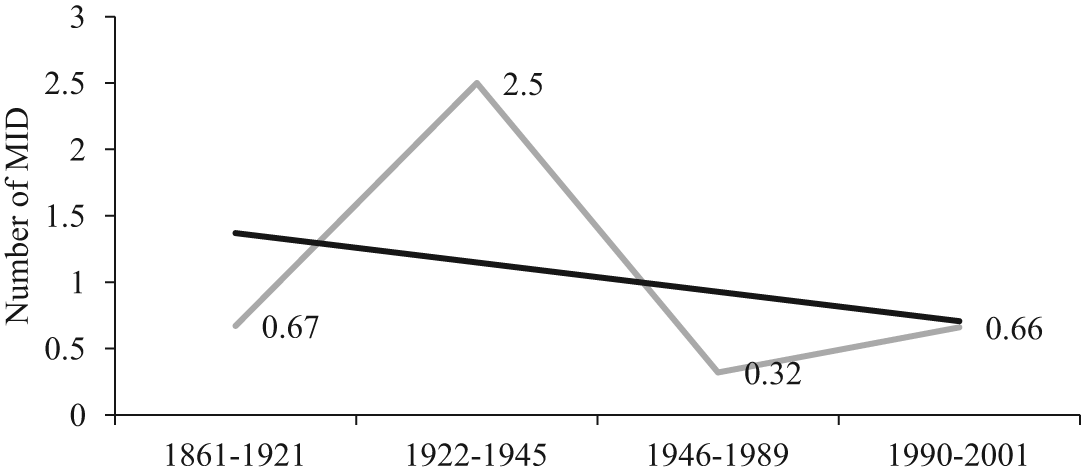
Italy’s involvement in MID (MID per year, sub-periods).
If we combine the four sub-periods, then the contrast between the Italy characterised by a strategic culture moulded by realpolitik and the cult of the offensive (1861–1945) and the Italy characterised by an accommodationist strategic culture (1946–2001) becomes even more striking. The number of MID in which Italy was involved in the former period is three times higher than that in the Republican period (Figure 4).
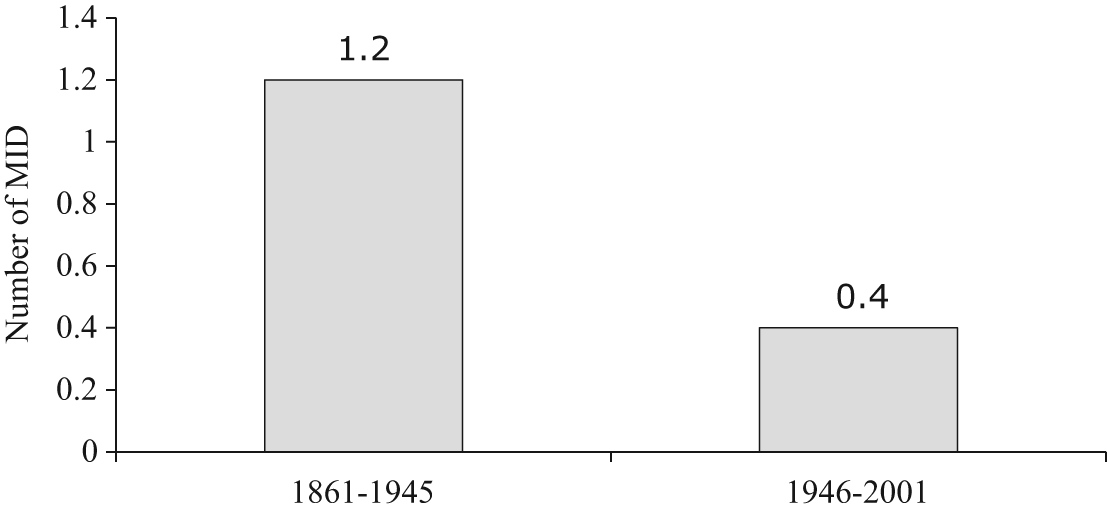
Italy’s involvement in MID (MID per year, aggregated sub-periods).
These data fit neatly into the strategic cultural model but do not necessarily exclude other interpretations. We must consider other aspects of Italy’s behaviour regarding war to better understand the effects of cultural factors. As mentioned earlier, an important component of a strategic culture is its preference for certain operational options, that is, does it favour more or less violence, and does it favour more or less offensive tactics? The MID dataset distinguishes five possible levels of violence on a scale from 1 (minimum) to 5 (maximum). By calculating the average level of violence used by Italy (Figure 5), we see that it declines from the liberal to the fascist period. This tendency becomes even more marked during the Cold War. The post-Cold War period appears to buck the trend, but the data are in fact distorted by the limited number of MIDs: a small number of interventions, with a high level of violence, weigh disproportionately in the calculations of the average level of violence. Out of the eight MID in which Italy was involved in this period, one was an interstate war (the 1991 Gulf War) and two involved the massive use of military force (former Yugoslavia and Kosovo). A gross comparison of the pre- and post-WWII periods confirms that Italy was less inclined to use violence in the second period (Figure 6).
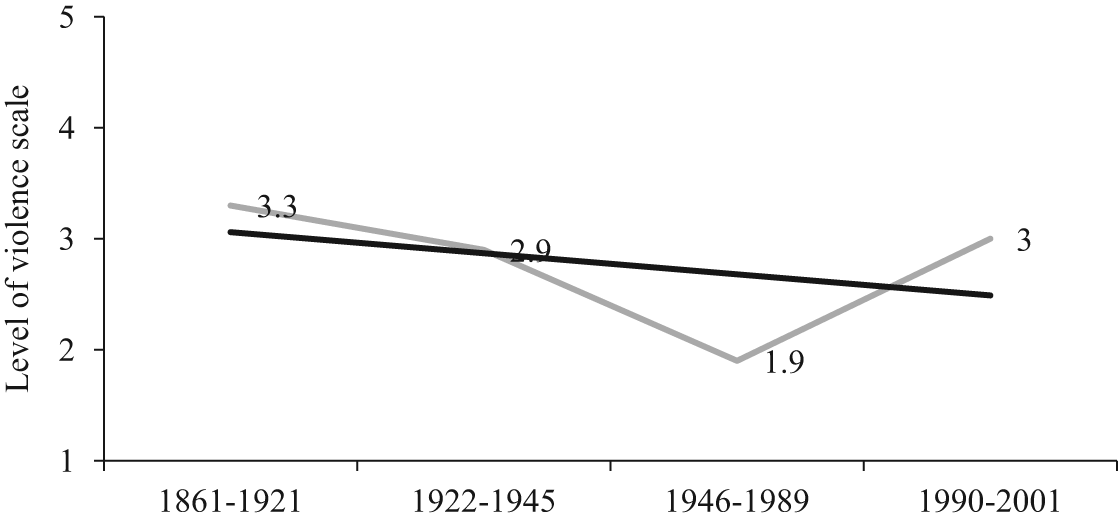
Level of violence used by Italy (sub-periods, average value).
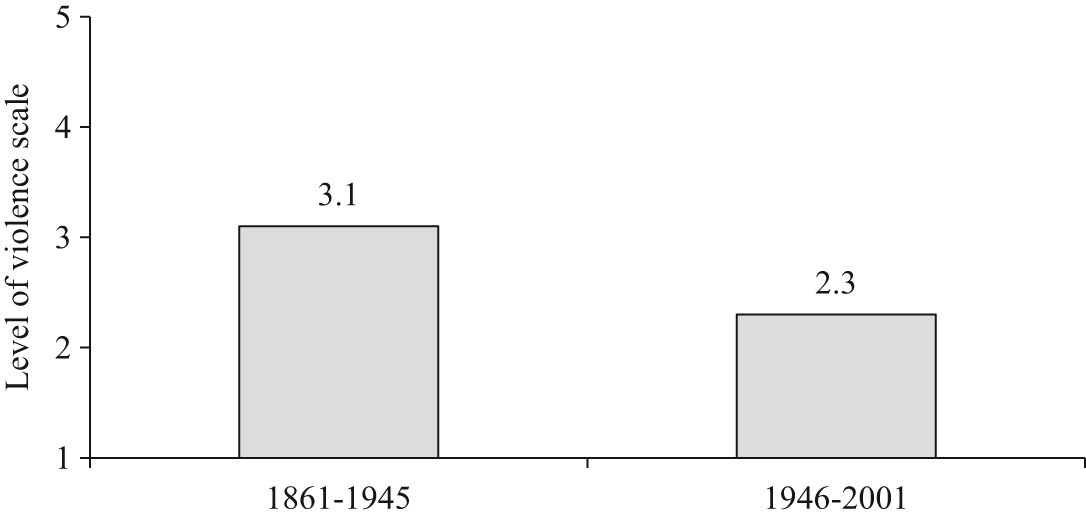
Level of violence used by Italy (aggregated sub-periods, average value).
A cross-national comparison of the medium-sized powers also shows that countries with an accommodationist strategic culture (Italy, Germany and Japan) tend to resort less frequently to high levels of violence than countries with a ‘warlike’ tradition, such as the United Kingdom and France (Figure 7). 61 This tendency holds in the Cold War period and afterwards, which demonstrates that changes in the international system cannot alone explain the differences in these countries’ security policies.
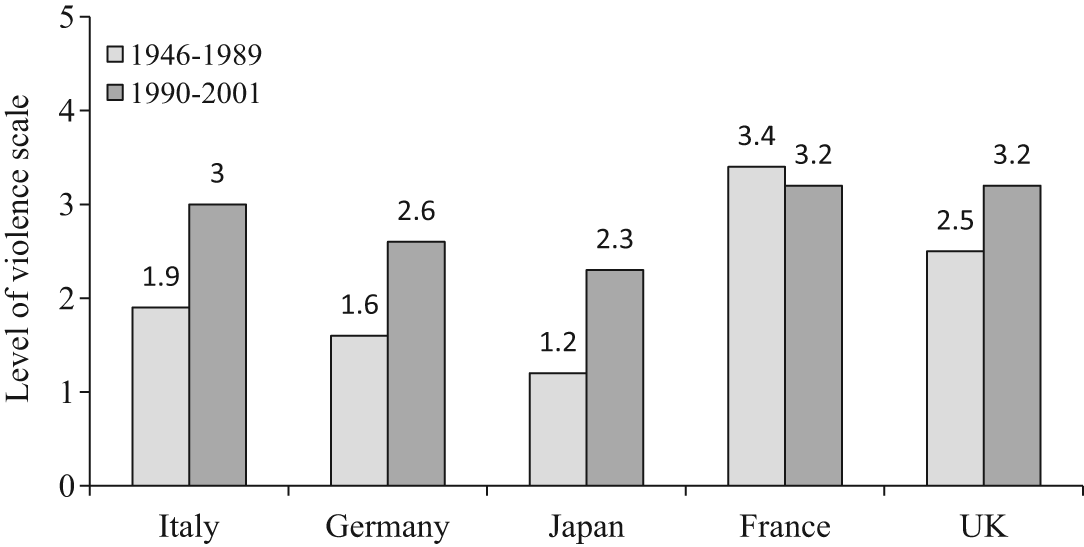
Level of violence (comparison of five nations, average value).
We obtain a fuller picture of Italy’s military conduct by examining the reasons for its involvement in military disputes. The COW project distinguishes countries that pursue revisionist objectives from those whose policies are intended to maintain a status quo. Although there is no direct link between offensive strategies and revisionism, or between defensive strategies and maintenance of the status quo, it is clear that whereas the status quo can be maintained by both offensive and defensive means, revisionist objectives necessarily imply more offensive actions. The data for Italy show a very marked decline in its revisionist objectives after WWII (Figure 8). Revisionist objectives were implicated in 19 out of 44 instances (43.1%) in the liberal period and 26 out of 60 instances (43.3%) during the fascist period. During the Cold War, there were no disputes involving revisionist objectives. In the post-Cold War period, two out of eight disputes involved revisionist objectives. When arranging the four periods into two groups, the difference is remarkable (Figure 9). In the period characterised by a hard realpolitik strategic culture, 45 out of 104 events involved revisionist policies. During the years of the Italian Republic, 2 out of 22 events involved revisionist policies.
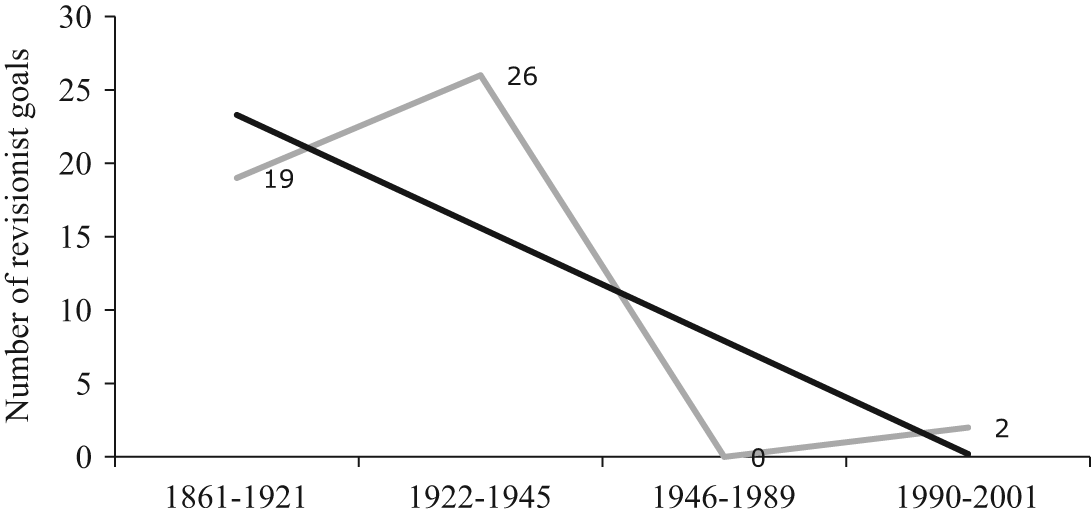
Revisionist goals in Italian foreign policy (sub-periods).
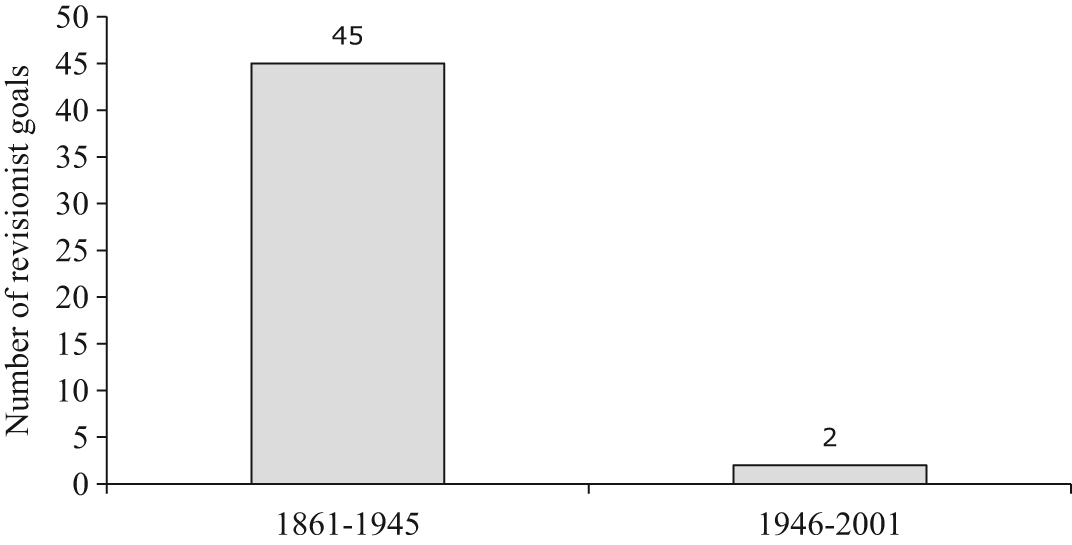
Revisionist goals in Italian foreign policy (aggregated sub-periods).
One last detail in this reconstruction of Italy’s conduct in militarised disputes is provided by an analysis of the types of action used in the pursuit of its objectives. The MID database distinguishes among 22 different possible types of conflictive action, which enables us to gain a more detailed picture than that provided by the five-item scale of violence described earlier.
The data for Italy are given in Figure 10. They show the strategic preferences of the different historical periods, even if a clearly defined model of Italy’s conduct does not emerge. In the liberal period, which was strongly influenced by the need to complete the project of national unity, the governments’ preferred options were as follows: show of force (13 instances), occupation of enemy territory (8 instances) and war (4 instances, including participation in conflicts started by others and those initiated by Italy itself). In the fascist period, the preference was for non-military actions (20), followed by military attack (14), shows of force (7) and participation in war (7, considering war initiated by Italy or by others). In the Cold War period, the preference was for non-military action (8) and shows of force (4). No discernible model has emerged since the end of the Cold War, given that there have been few incidents and that these incidents have been more or less equally distributed across the possible options. When we consider only the larger conflicts, we see that Italy fought in 11 wars between 1861 and 1945 (approximately one conflict every 7 years). The Italian Republic was involved in only one war over a 50-year period.
Type of conflictual action used by Italy.
The facts so far suggest that, in general, the Italian Republic was less inclined than the other medium-sized powers to become involved in military disputes. It also tended to resort less frequently to high levels of violence in comparison with other countries and previous historical periods. In the liberal and fascist periods, Italy was much more willing to engage in conflict than it was in the first 50 years of the Republic. The fact that Italy rarely resorted to the use of military force even after the Cold War is a strong argument in support of the approach of strategic culture.
To dispel the uncertainties present in the MID data, I will move on to an analysis of Italy’s military spending and its attitude towards multilateral organisations.
Strategic culture, military spending and multilateral organisations
Italy’s low-profile defence policy has meant that military spending has been restrained. During the 1980s, Italy’s defence expenditure was roughly half that of the United Kingdom or France and also considerably less than that of West Germany (Table 2). The situation did not particularly change after the Cold War; the relative difference decreased not because Italy began to spend more but because other countries were spending less.
Military expenditure as a percentage of GDP in major European nations.
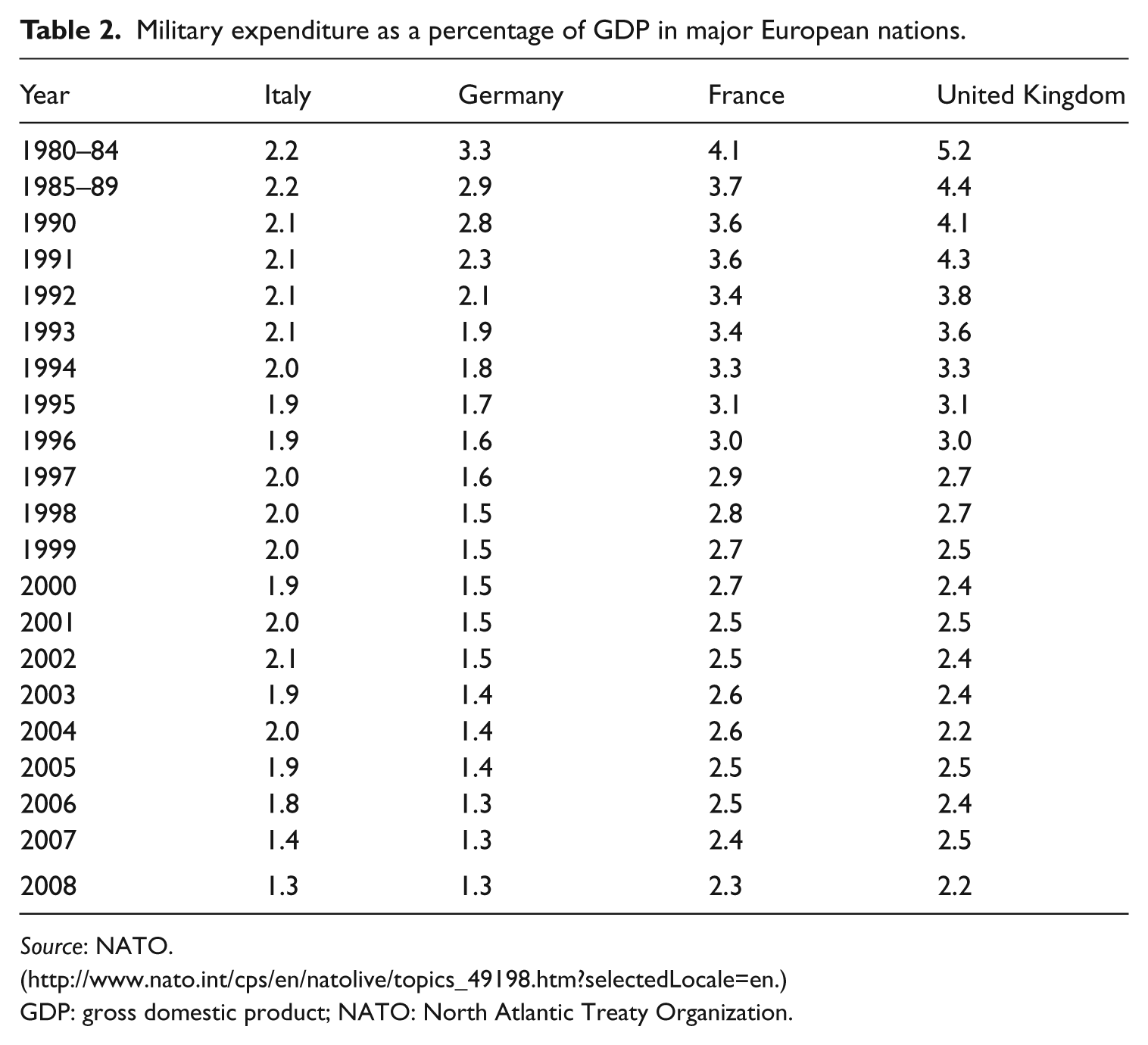
GDP: gross domestic product; NATO: North Atlantic Treaty Organization.
In terms of organisation, the sudden end of the Cold War gave the Italian Armed Forces an unexpected window of opportunity. They were transformed from being a conscript army that spent most of its time in barracks and was trained to operate in traditional conflicts to a professional army capable of rapidly intervening in crisis areas and operating in peacekeeping and peace-enforcing missions. An attempt to increase the investment quota of defence spending accompanied these developments. Since the 9/11 attacks, spending on the modernisation of weapons systems has been increasing, although it slowed in 2005–6 for economic reasons. In 2007–8, the modernisation programme took off again, with more new money being invested in hardware than in personnel, although the latter still comprised the largest item in the defence budget. These efforts, although limited, are aimed at creating a more modern army whose focus is on technology rather than manpower, as is also the case in other countries. The structure of military spending (e.g. aircraft carriers, tactical transport helicopters and new-generation fighter jets) and the move from a conscript to a professional army reveal a certain tendency to give Italy a greater capacity for force projection.
The decrease in military spending in the post-Cold War period (Figure 11) does not imply an isolationist attitude; rather, it has occurred concomitantly with increased involvement in international crises (Figure 12). As a result, what we are witnessing is not a retreat but rather an increase in activism, with tools other than the military being employed.
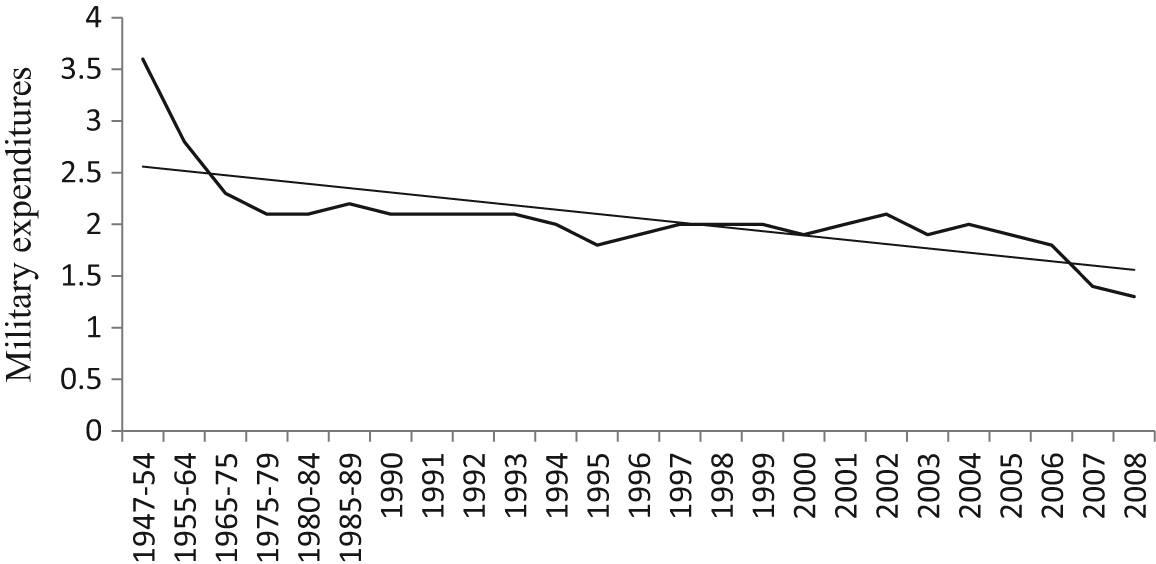
Italy’s military expenditure as a percentage of GDP.
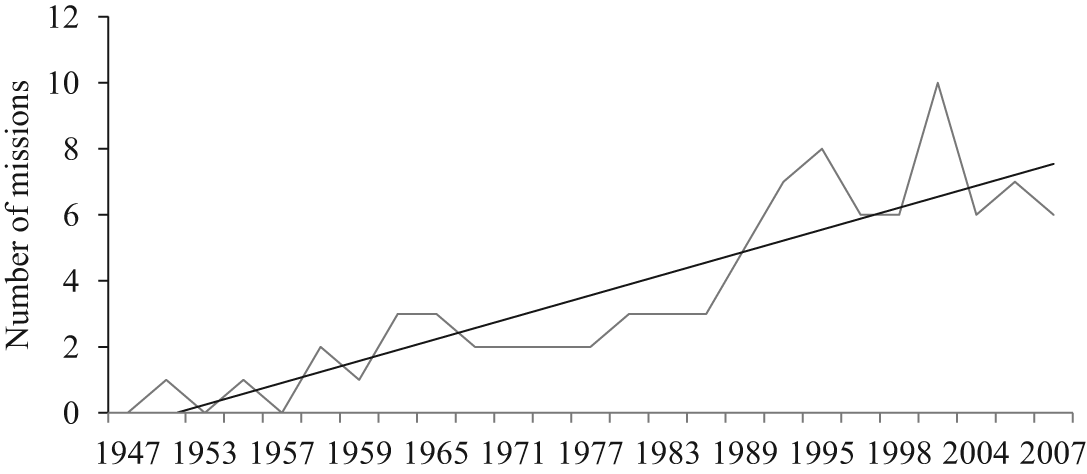
Italy’s participation to United Nation’s missions.
This negative trend in military expenditures, even as international exposure was increasing, belies neorealist hypotheses, which would have predicted increased spending, either for defensive purposes (to compensate for the weakening of alliances) or for offensive motives (to take advantage of the opportunities for assertion that opened up with the end of the bipolar world).
Policymakers who espouse an accommodationist strategic culture are very likely to entrust the resolution of conflict to multilateral institutions, whereas hardliners prefer unilateral solutions because they are unwilling to limit their ability to choose whatever strategy they may consider to be most suited to the pursuit of the national interest. 62 Italy has been a strong supporter of multilateral security organisations. A document from the Ministry of Foreign Affairs regarding Italy’s participation in international organisations stated that ‘multilateralism, centred on the role of the U.N. (the most legitimate source of authority in the world today), has always been a foreign policy priority for Italy’. 63
As Fulvio Attinà writes:
there are factors which favour Italy’s perseverance in its multilateralist role, like the fact that this role has been internalised in the country’s prevalent political culture, and the experience it has gained through its frequent involvement in multilateral organisations, especially in the European organisations.
64
Throughout the Cold War, Italy strongly supported large international organisations such as the United Nations, NATO, the Organisation for Security and Co-operation in Europe (OSCE) and the European Union (EU). Its principal interventions in crisis areas have always been under the auspices of these organisations. This stance has been strengthened, not weakened, since the Berlin Wall came down.
Changes in military policy have occurred within the parameters determined by the strategic culture, sometimes pushing these parameters to their limits, but never breaking them. The most radical innovations were ‘domesticated’ by the national strategic culture. Policymakers, the elite and public opinion all continue to favour a multidimensional and integrated approach, which uses soft power when possible. 65 Italy’s increased capacity to project force has thus far been used solely for peacekeeping or peace-enforcing missions under multilateral cover. The characteristics of the country’s major military interventions abroad since 1990 reveal the influence of the accommodationist strategic culture: 66
A preference for diplomacy over coercion;
A quest for the international legitimisation of interventions from the United Nations, NATO or other security organisations;
A framing of interventions as humanitarian operations, peace missions or international policing activities;
A rejection of offensive action;
Strict political and operational constraints on the use of force in theatres of operation.
The hot political debates triggered by every intervention and the various political and military ‘strings’ attached to their implementation testify to the dilemmas that a country with an accommodationist strategic culture has to face when it is confronted with the need to go to war.
Conclusion
The above quantitative analysis is not sufficient to establish a causal relationship and at best can only establish a statistical correlation. To identify a direct link between cultural models and political choices, an in-depth study using the technique of process tracing would be necessary, particularly to reconstruct the decision-making process and discover the motivations behind major military interventions. This is not possible in this study. In any case, what emerges is a remarkable consistency between the strategic culture and international behaviour of Italy.
In Italy, Japan and Germany, the end of WWII marked a total break with previous strategic cultures. 67 As John Vasquez notes, 68 the fact that these countries had experienced catastrophic defeat, combined with a widespread perception that the war had not been worth the tremendous political, economic, human and material costs that it incurred, favoured the rise to power of policymakers who advocated an accommodationist strategic culture.
Italy’s post-war strategic culture is shared by the main political forces, from those on the left to the Catholics, and is diametrically opposed to that of the liberal and fascist periods: war is no longer seen as an inevitable factor in international relations, interstate relations are not considered zero-sum and there is much scepticism about the utility of force, all of which result in a diffuse anti-militarist attitude. This translates into a preference for diplomatic strategy and the rejection of offensive military action. Within this culture, the influence of the old doctrine of realpolitik can still sometimes be felt, particularly among political forces that inherited liberal and fascist traditions.
In section ‘Italy’s strategic culture in action’, I tested hypotheses derived from the neorealist and strategic culture models. A mixed picture emerged, in which the influence of an accommodationist strategic culture on Italy’s international behaviour was fairly evident. Both a quantitative analysis of Italian participation in militarised interstate disputes and a more detailed tracking of military spending and support for multilateralism support the hypotheses of the strategic culture model.
This is not to deny that the structural changes brought about by the collapse of the bipolar world order did not affect Italian foreign policy making. It is clear that they did, as we have seen on a number of occasions. Cultural interpretations do not deny the influence of the structural factors emphasised by the neorealists (the opposite is not true). They note that to affect decisions, structural factors have to be ‘filtered’ through the lenses of a culture, which define the repertoire of actions considered to be appropriate by a country’s policymakers. In contrast, neorealists believe that cultural factors play no more than a residual role, serving to explain deviations from rational behaviour. 69
On the one hand, therefore, the analysis shows that Italy has been more active abroad since the end of the Cold War: the transformation of the Armed Forces from a conscript army languishing in its barracks to a professional force capable of rapid intervention abroad is the most obvious symbol of this fact, as is the shift from the role of security consumer to that of security producer. On the other hand, the manner in which this increased activism has actually played out demonstrates the strong influence of an accommodationist strategic culture even in the post-Cold War period, when the country has had greater room for manoeuvre.
Footnotes
Funding
This article is the result of research, partially financed by the ‘Programma di Interesse Nazionale (PRIN) of the Italian Ministry of Education (Title: “La politica estera italiana di fronte alle nuove minacce del sistema internazionale: attori, istituzioni e politiche”), Grant Agreement n. 201032T8ZE_004’.