







Abstract
This article relates the effectiveness of the European Union’s (EU) effectiveness to its international actorness in negotiations on international food standards taking place in the Codex Alimentarius Commission (CAC). Actorness is taken to result from EU competence, preference homogeneity and processes of socialisation among EU Member State representatives. In the 2009 negotiations on growth promoters for livestock, whose use the EU opposes, the Commission took the lead. It was trusted and supported by the EU Member States, but its dominant role resulted in them being rather passive. As a result, the EU’s potential to negotiate effectively in the CAC was not used in its full potential.
Keywords
Introduction
International food standards decided upon in the Codex Alimentarius Commission (hereafter CAC) have a considerable influence on the way our food is produced, processed and traded across the globe. The Codex Alimentarius has almost worldwide coverage with 181 Member States and one Member Organisation, the European Union (EU). The CAC meets every year at the premises of one of its parent organisations, the Food and Agricultural Organization (FAO) and the World Health Organization (WHO).
Adoption of Codex standards usually is the result of long-standing deliberations that concentrate on scientific evidence regarding food and consumer safety. The outcome matters, since Codex standards are an important reference point for World Trade Organization (WTO) dispute settlement on food safety issues. They, thus, indirectly influence the borderline between, on the one hand, justified food safety protection measures and, on the other hand, unjustified barriers to trade. Codex standards are specifically important to the EU because it is the largest trading power in the world and its citizens are keen on eating safe food. The CAC is moreover the latest international organisation of which the EU obtained Membership in 2003.
As a result of food policy being almost entirely harmonised by EU legislation, the EU operates through a rather centralised model of external policy-making on most issues discussed at the CAC, whereby the European Commission (EC) is in the driving seat regarding the development and external representation of EU positions. In the light of this special issue, the case could therefore be considered a most likely case for a high degree of EU actorness and effectiveness when assuming that more centralisation is positively contributing to these factors.
This article will question this premise and analyses the EU’s international actorness and effectiveness in Codex negotiations by making a detailed analysis of the negotiations on a specific standard on the growth promoter ractopamine in the 2009 CAC. It is salient, since the EU does not allow the use of growth promoters to increase livestock production but has difficulties to justify its stance on the basis of scientific evidence. It lost the Beef Hormones case inter alia because of the WTO dispute settlement body referring to hormone standards agreed upon within the Codex Alimentarius, and as a result of this, the EU was confronted with trade retaliation measures from the United States and Canada.
This article proceeds as follows. First, it briefly discusses how we could analyse the relationship between EU actorness and its effectiveness in international negotiations. It elaborates on the choice to focus at competence, preference homogeneity, and EU socialisation in order to analyse EU actorness, which is subsequently analysed for the 2009 Codex negotiations on growth promoters. This analysis is based on document study, interviews with experts involved in the negotiations and participatory observation of the author during the 2009 CAC. 1 The concluding section will discuss how EU actorness has influenced its effectiveness and to what extent the negotiating environment influenced this relationship.
EU actorness and effectiveness in international negotiations
EU actorness is generally understood as the ‘EU’s ability to function actively and deliberately in relation to other actors in the international system’. 2 Actorness is often analysed largely on the basis of EU internal criteria, 3 which will also be the focus here, even though the external context is assumed to influence these internal criteria. For analytical purposes, actorness is separated from EU effectiveness, since these two are not automatically two sides of the same coin as is often implied. 4 Actorness may influence the EU’s capacity to negotiate and thereby its bargaining power. 5 In that way, it may contribute to the EU’s effectiveness in the negotiations. Actorness would be enhanced by more supranationalism, or to put it differently, by a higher degree of EU centralisation. 6
Although it seems reasonable to think that more EU actorness increases the EU’s effectiveness in multilateral negotiations, only a small number of case studies have systematically analysed this relationship. 7 This is not surprising, given the difficulty of measuring effectiveness. Analysing it is almost unavoidably subject to perceptions of those who were involved in the negotiations, or observed them (e.g. media). This article investigates to what extent the EU could achieve its initial position on the growth promoter ractopamine during the 2009 CAC. Effectiveness is thus primarily seen as ‘goal attainment’ within the given negotiating context. On the basis of this analysis and perceptions on the EU’s effectiveness gathered through interviews, the concept is analysed in relation to EU actorness.
EU actorness is analysed by looking at three variables: competence, preference homogeneity and EU socialisation. The three are chosen because they are all expected to somehow affect not only EU actorness but also EU effectiveness and to incorporate other possible aspects, such as interests of EU Member States (which is incorporated in preference homogeneity) and autonomy of the lead negotiator (which is established if trust exists over competence division and preferences). The negotiating environment is taken into account as it is likely to influence the variables, for instance, with regard to the extent the EU is able and allowed to translate its internal competences externally and taken into account in the analysis of effectiveness. It is accepted that the judgement on effectiveness depends to a large extent on what is perceived as possible for the EU within the negotiation context.
EU competence
The legal competence of the EU on a policy issue is likely to influence the extent of EU actorness as it obliges EU Member States to operate through a single voice, and to grant speaking rights to the EC. According to Jupille and Caporaso, competence establishes authority for the EU to engage in an external policy issue, and is also likely to grant autonomy to the Commission to carry out the negotiations on behalf of the EU. 8
The need for a common EU position, when EU legislation is in place, is understandable since international agreements often contain provisions affecting this legislation. When the Commission would not be involved, this could offer EU Member States an opportunity to bypass the Commission’s right of initiative by agreeing rules differently in the international arena. Subsequently, it could be disputed whether EU or international law applies for the EU Member States.
Nevertheless, Member States may find it difficult to accept EC involvement in external representation. Having a single representative to speak on behalf of the EU could be viewed as a sign of statehood. 9 In international organisations, nation states traditionally control decision-making, and membership is a reflection of the sovereign equality of these states. The EU is no federal state, and it cannot completely replace its Member States. They tend to cherish their rights in international organisations and also fear the process of ceding competences is irreversible.
As international agendas often offer room for interpretation with regard to EU competence and EU rules for external representation are not always accepted, a plethora of models is used for EU representation in international organisations. 10 It can be observed that the more centralised model, as is for instance used for trade, is no guarantee for EU unity. For instance, in WTO negotiations, tensions between the Commission and the EU Member States have occurred at regular intervals. 11 This is why, in addition to EU competence, it is relevant to analyse whether preferences of EU Member States are in line and if their representatives are willing to operate through the EU.
Preference homogeneity
It is usually perceived that operating with a joint position and a single voice adds to the powers of the individual EU Member States, also the bigger ones, which at global scale are only middle-range powers. It would prevent other states, such as Russia and the United States, from exploiting their negotiating power vis-à-vis individual Member States. Operating as a ‘European bloc’ could prevent deals that may incur benefits for an individual Member State, but not for the EU as such. Particularly for small states, operating through the EU is therefore considered not only a legal obligation but also of vital importance to maximize influence in world affairs. In this respect, the EU could be compared to other coalitions operating in the international system.
For the EU, the degree of preference homogeneity can be expected to be higher than the one existing in a ‘normal’ coalition, as a result of the European integration process (internal market with common regulatory framework), a shared normative and cultural orientation, and relatively similar geographical interests. 12 Nevertheless, on specific issues, EU Member States may have different interests and viewpoints. Their representatives operate on the basis of nationally defined instructions and may find it difficult to depart from them in order to find agreement. Preference heterogeneity, even in cases where EU Member States may be closer to each other than to non-EU states, may still jeopardise EU actorness and its effectiveness in the negotiations.
If an EU position is agreed upon, it is still not always clear whether this indicates issue-specific preferences (and underlying interests) became more similar, or whether a general preference or obligation to operate as a European bloc convinced Member States to give in on issue-specific preferences. 13 Member States may have deliberately chosen to bundle their positions in international affairs, or merely have considered it appropriate to do so. 14 Indeed, processes of EU socialisation may contribute positively to Member State representatives’ willingness to align their preferences, a point we will now discuss.
EU socialisation
Research indicates that representatives of EU Member States can be expected to become socialised in EU practices when they are established. 15 It also found that EU socialisation has occurred during the process of EU coordination in international organisations, particularly at the level of civil servants. 16 The reason for going to EU coordination meetings may just be to find out what the negotiations will be about and which positions other EU Member States take. But, over time, increased exposure to EU coordination is likely to stimulate a sense of ‘we-ness’ among Member State representatives, leading them to identify with the common position. 17 They are clearly ‘Europeanised’ when they consider explaining and defending the EU position in their capitals among their main tasks.
It can be questioned how EU socialisation is related to preference homogeneity. Increased exposure can be expected to lead to mutual understanding, resulting in national instructions being based on similar considerations. But, perhaps EU socialisation can only emerge when at least a basic agreement on overarching objectives is in place? Preference homogeneity and EU socialisation are likely to reinforce each other, but it is less clear which of the two is more important for EU actorness to emerge, and by extension to the EU being an effective negotiator. Although this article is unlikely to answer this rather fundamental question on the origin of national preferences, it will try to carefully analyse and distinguish between Member States’ interests in relation to their preferences, as well as informal norms influencing them.
Towards a model for analysing EU actorness and effectiveness in international negotiations
EU competence, preference homogeneity and EU socialisation can be expected to substantially affect the EU’s actorness and the EU’s effectiveness in the negotiations, but on the basis of existing insights in the literature, the direction of the relationships are not crystal clear, neither has it been specified how the negotiating context influences the relationship. In this article, less attention is devoted to other, more contextual, or incidental factors, such as commercial interests, 18 and the influence of key individuals involved in the negotiations. These are considered less structural or subordinate to the factors outlined above. For instance, commercial interests will be discussed when relevant to the preference formation. Figure 1 summarises the model used.
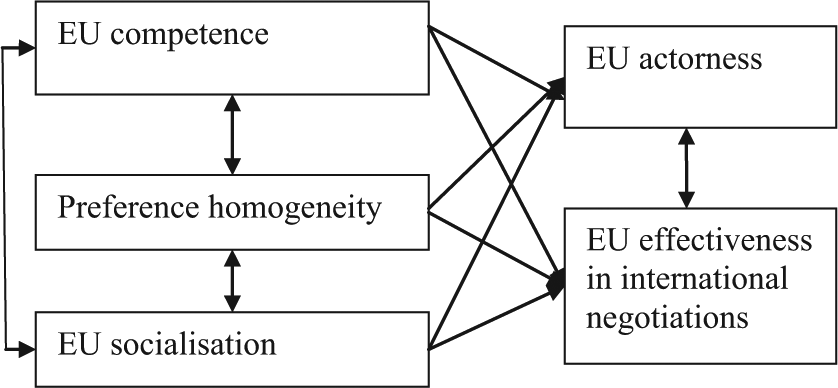
A model for analysing the European Union (EU) actorness and its relationship to EU effectiveness (within the given negotiating context).
The European Union in the Codex Alimentarius
Most of today’s EU Member States were involved immediately when the CAC was established in 1963. In fact, the term Codex Alimentarius, Latin for ‘food law’, was already used before in the Austrian–Hungarian empire. Codex standards are voluntary. In legal terms, Codex Members are therefore not obliged to adjust their own legislation to standards adopted. However, Codex standards do take a special role in WTO law where they are considered an important benchmark for international food standards. 19 Reference to Codex standards, for instance, to clarify the meaning of certain expressions used in EU food legislation, can also be found in case law established by the European Court of Justice. 20
The risk of Codex standards being used as a basis to start a trade dispute was an implicit effect of the establishment of the WTO with its Dispute Settlement Body in 1995 and is related to specific provisions in its agreement on Sanitary and Phytosanitary Standards (SPS). Since 1995, the EU suffered defeats in WTO cases on hormones and sardines due to its own rules being incompatible with Codex standards. 21 In these cases, EU law was more restrictive than Codex standards and was therefore considered an unjustifiable trade barrier.
Codex standards are developed in various committees, adhering to an eight-step process from proposal to adoption in the CAC. On all issues being discussed, Codex Members are invited to send comments or information by means of Circular Letters. Within the EU, the Commission usually takes the initiative to formulate a reaction, in close consultation with the Member States. The Commission takes the lead in developing positions, also for those issues of shared and Member States’ competence, on which EU Member States are still allowed to take their own position. It also represents these positions within the Codex, which was facilitated by the EU becoming a Member of the Codex in 2003.
EU positions, accompanied by fallback positions and negotiating tactics, are discussed and decided upon in the Codex Working Party that is chaired by the country holding the half-annually rotating Presidency of the EU. The European Parliament is not involved since it only has advisory power with regard to positions for international negotiations, and Codex standards do not need to be ratified, since they are voluntary. EU countries most active in the Working Party are France, Germany, the United Kingdom, the Netherlands and Belgium. The Member States that joined in 2004 and 2007 are somewhat less involved.
If no agreement can be reached in the Working Party, or if issues are considered very political, resort to the body of permanent ambassadors of EU Member States in Brussels, Coreper, is possible. However, the food safety experts, who are usually sent from the capitals, try to avoid this as much as possible. They do not want to bother Coreper and do not fully trust it has sufficient expertise to take a considerate decision. In theory, Coreper can resort Codex matters to the Ministerial level (i.e. the Agricultural and Fisheries Council), but this has never occurred.
An advantage of the Coreper level is that it can take decisions by means of qualified majority voting. For international positions, this is only possible if an exclusive EU competence exists. In 2008, Spain opposed a proposed EU position on gluten-free foods. It argued consensus was required since the issue would not be subject to exclusive competence as the Commission claimed. The United Kingdom supported Spain, although it disagreed with the Spanish position on gluten-free foods. This illustrates the United Kingdom’s general stance not to cede competences to the EU when they are disputed. Eventually, it was decided that exclusive competence did apply and a vote took place in Coreper to adopt the position. This example illustrates that the division of competence can be contested when Member States have diverging views.
The EU negotiating growth promoters
At the 2009 session of the CAC, the EU was most anxious about a standard concerning the growth of livestock. Ractopamine is a beta-agonist that promotes leanness in pigs and cattle. The standard for allowing its use was developed in the Codex Committee on Residues of Veterinary Drugs in Foods chaired by the United States.
The EU opposes the use of growth promoters in healthy animals, just for increased production. China also opposes the use of growth promoters and in particular the use of ractopamine. However, using this growth promoter is common practice in the United States, Brazil, New Zealand, Australia, Canada and other meat and dairy producing countries. As a result of the earlier loss by the EU of the Beef Hormones case in the WTO, the EU was faced with countervailing measures worth US$116 million per year. 22 Realising the possible costs of adopting new Codex standards on growth promoters, the EU was keen on blocking the adoption of the ractopamine standard.
Hormone standards are moreover sensitive to the EU ever since it lost a vote on allowing the use of six hormones in the CAC in 1995. After this vote, the EC commented ‘that it was regrettable that this important and far-reaching decision was made […]’. It would ‘cast doubts on the validity and value of Codex work and standards’ and ‘consequences would be grave including the EC’s rethinking of participation in Codex work’. 23 The delegations of the Netherlands, Sweden, Spain, Finland and the United Kingdom stressed that the statement was made on behalf of the EC, but not on behalf of the EU or its member countries. They dissociated themselves from the statement. It illustrates the tensions between the EU Member States and the Commission and how upset the Commission was with losing the vote, possibly because it realised the probable WTO consequences.
The vote was followed by a vote to suspend another hormone standard (BST). This vote past and since then the standard is held at step 8 and has featured on the agenda of various CAC meetings (in which it was always decided to postpone the decision). Remarkably, the United Kingdom voted against this decision in 1995, whereas the other EU Member States voted in favour. This illustrates that EU voting coherence within Codex negotiations was not automatic in 1995. After the EU joined the CAC as a Member in 2003, this no longer is allowed, neither can Member States dissociate themselves from EU statements.
Another remarkable issue surrounding the 1995 votes is that they marked the start of a debate on taking into consideration factors other than scientifically proven harm to public health, such as animal welfare, consumer confidence, technological developments and sustainable development. 24 Within the EU, these were relevant factors when discussing food standards, such as those on hormones. The United States, however, took a very restrictive view, not willing to take such factors into account. 25 A small step was made, although only factors with worldwide relevance, and those not affecting the scientific basis of risk assessment, were eventually allowed. 26
Exclusive EU competence
The first EU directive banning the use of certain hormone growth promoters stems from 1981, preceding the establishment of a committee dealing with this issue in the Codex. 27 A general ban on the production and importation of meat derived from animals treated with growth hormones was decided upon in 1985. 28 The current legal basis for the ban is Council Directive 96/22/EC, which prohibits the use of hormones and beta-agonists in food-producing animals for growth promotion. It covers domestic production and imports of meat from third countries.
Because of the fully harmonised EU legislation on the use of growth promoters in livestock, the existence of exclusive EU competence is undisputed, meaning that the Commission speaks and casts the vote if needed. When the EU obtained Membership of the Codex, it was agreed that it would not obtain an extra vote, but that either the EU Member States would vote or that the EU vote would equal the number of states present. 29 At the 2009 CAC, 22 votes could be cast, that is, the number of Member States present.
A high degree of preference homogeneity, but not wholeheartedly
The EU is the world’s largest food importer as well as exporter. It is also a major importer of beef and pig meat for which the use of growth promoters, such as ractopamine is particularly suited.
Codex hormone and beta-agonist standards affect the economic interests of the EU Member States directly and indirectly. In a direct way, they legitimise their use in the United States, Brazil and other countries and imply that EU consumers pay a relatively high price for livestock produced without growth promoters. In an indirect way, similar standards have confronted the EU with trade retaliation measures imposed by the United States.
To outsiders, it may seem as if the EU is rather firm on its policy not to allow the use of hormones and beta-agonists in healthy animals. However, also within the EU, dissenting voices exist. For instance, the United Kingdom and Ireland voted against the EU ban in 1985. 30 The United Kingdom also voted against the adjournment of the BST standard in the 1995 CAC. The outbreak of the mad cow disease may have increased the United Kingdom’s sensitivity to consumer concerns, but its position is still ambiguous. Other states are more convinced, including France, Germany and Italy.
The current EU policy is underpinned by consumer fears that emerged after food-related scandals and crises. 31 An example is a scandal in Italy in the 1980s regarding the use of diethylstilbestrol (DES) in meat. This supposedly caused abnormal sexual development in children who consumed this hormone-treated meat. 32 Another example is the mad cow disease and its possible link with the disease of Creutzfeldt-Jakob. 33 The ban on hormone-treatment also helped to end veal and beef surpluses and accompanying EU agricultural subsidies for these products. 34 Studies did not find the use of hormones dangerous to public health but could also not exclude remaining scientific uncertainties on possible harm.
In addition to doubting the scientific justification for the ban on growth promoters, there is another reason why EU states may be less inclined to actively support the EU position. In the WTO retaliation measures that were imposed by the United States and Canada, the heaviest share of sanctions fell on Germany and France (24% on each). They were seen as the main supporters of the ban, while the United Kingdom was exempted. 35 Member States may thus want to avoid being considered the staunchest supporters of the EU ban in order to avoid retaliation.
More in general, it is difficult for the EU to change its position, since this would mean having to acknowledge openly that using growth promoters is less dangerous than originally propagated. Changing the EU legislation on this point would moreover require a proposal to that regard from the Commission, a qualified majority in the Council and a simple majority in the European Parliament. No small hurdle for such a sensitive issue. As a result, all EU actors could be said to have an interest in avoiding new standards being adopted in the CAC. On paper, the degree of preference homogeneity is thus high, even though the EU’s position on hormone growth promoters is not as warm-heartedly supported by all EU Member States.
High degree of EU socialisation
In the immediate aftermath of the 2003 decision on EU Membership of the CAC, the relationship between the Member States and the Commission was tense, as the membership application had provoked opposition from EU Member States. It proved difficult to decide upon the division of competences for Codex agenda items and the content of EU positions. Once they were decided upon, it was close to impossible to depart from them during the Codex meetings.
But, after a year or two, EU coordination and external representation practices smoothened. This made it possible to consider the preparation of fallback positions and more detailed negotiating strategies for sensitive agenda items. Member State representatives in interviews indicated that a high level of trust in EU Commission officials working on Codex matters exists in 2009. They appreciate them developing EU positions and setting out the negotiating tactics. EU delegates, in turn, consider it advantageous when Member States intervene in plenary to support and develop the common EU position. Psychologically, it would look better to have several EU voices advocating a certain stance, rather than the same position being represented by a single EU voice.
There is still some suspicion about creeping competence. Some argue too much emphasis is placed on the need to speak with one voice, and the Commission would be understaffed with only three to four officials taking care of the majority of the Codex work. This would particularly be problematic for some of the Codex committee meetings, where it would not always be sufficiently prepared.
EU states do appreciate the Commission being in the driving seat on the issue of growth promoters since it also takes care of this issue within the WTO/SPS. Representatives of Member States rely on information about the state of play in ongoing WTO negotiations on hormones provided by the Commission. Still, this does not mean they give a carte blanche. Just because the issue is so sensitive, the Commission is watched closely. When ractopamine was discussed, delegates were keen to hear what the Commission intended to say in plenary.
Member State representatives participating in the 2009 CAC in interviews indicated that they consider themselves primarily EU and less so national representatives, although to varying degrees. During the interruptions of CAC meetings, EU delegates often get together to go for lunch or dinners. The task of the EU Presidency according to them is first to ‘create an atmosphere of cooperation’. 36 Nevertheless, most EU Member States still operate on the basis of national instructions. Third countries, such as the United States and China, consider the Commission and, to a lesser extent, the EU Presidency their primary contact point.
Since the EU obtained Membership of the CAC, delegates of EU Member States have by and large supported the agreed common positions in Codex meetings. Individuals at times still disagreed with the Commission’s strategy, but the vast majority has accepted that consensus should prevail. Fears that EU Membership of the CAC would lead to a fall-off in the attendance of Member States seem over-exaggerated. But, Member State representatives are said to have become more passive since the EU joined the CAC. Delegates would be ‘sleeping in the plenary’ and just be there because EU coordination starts at 8.30. 37 They would have fewer incentives to be active during the meeting.
Representatives indicate the existence of a high degree of mutual trust and respect. According to one of them, they have ‘a common goal’, 38 and they generally believe that the single voice is essential to being influential in the negotiations. The 2004 enlargement of the EU did not undermine the group feeling among the EU delegates. Delegates consider themselves part of a Codex community, where presents are exchanged when colleagues with a long-standing track record retire or change position. The Codex group would be so close given that most representatives involved are real experts on food safety. The discussion on accession of the EU to the Codex caused some stir, but soon afterwards, the working atmosphere and mutual understanding improved among the food safety experts from the capitals and the Commission.
The EU’s objectives for the negotiations and its outcome
The ractopamine standard was the most contested item of the 2009 CAC agenda. Its adoption was strongly opposed by both the EU and China. They contested scientific evidence provided by a scientific expert committee of the Codex, the so-called JECFA (the Joint FAO/WHO Expert Committee on Food Additives). Ractopamine had already been brought for adoption to the CAC in 2008, where after intense discussions it was decided to keep it on hold at step 8. The discussion centred on a re-evaluation made by the European Food Safety Authority on the JECFA assessment and new data provided by China, which were not yet evaluated by JECFA.
In internal EU deliberations, it was debated how strong the EU should oppose to the adoption of ractopamine. Several delegates indicated a preference not to call for a vote or to provoke other Codex member to do so, since such a vote could be lost or cause irritation with other states. The official position was to send the standard back to step 6, but a satisfactory outcome would be the standard to be held at step 8. Several Member States strongly preferred the scientific assessment to be redone. It was estimated that Australia, Canada, New Zealand and the United States would strongly favour adoption, but not ask for a vote. This information was based on a telephone conference the Commission, Presidency and Council Secretariat held with the United States preceding the CAC. Member States were explicitly invited by the Commission to raise their flags in plenary and to support the EU intervention. This was also asked to Switzerland, Norway, Turkey and the Balkan states.
During the 2009 CAC, a heated debate took place in which 44 interventions were made, 22 in favour and 22 against adoption of the standard. According to the US chair of the committee in which the standard was discussed, new Chinese data would not affect the scientific basis, which was contested by China, the EU and others. The Commission, on behalf of the EU, argued the standard should go back to step 6. It was supported by interventions of several EU Member States. Subsequently, the chair of the CAC suggested to hold ractopamine at step 8, which was accepted by some, but not by others. Canada suggested to distinguish between the use of ractopamine for beef and pig meat, and to adopt the former since only the latter seemed contested. This was not acceptable to others, including the EU and China, upon which point the chair decided to break up the meeting.
During the break, US delegates were going round to gather support, whereas delegates of EU Member States did not actively promote their position. This illustrates Member States not willing to be too much involved on this issue and to consider the lobby-work a task of the Commission. Meanwhile, the Commission talked to the opponents and the chair of the CAC. Eventually, the chair decided to suspend the discussion on ractopamine to the next day.
In the evening, the issue was discussed between the Commission, the United States, Canada, Australia and the CAC chair. As a compromise, it was agreed to request the JECFA, to undertake a new review of the Chinese data as a matter of priority. In the meantime, the standard would be held at step 8. In addition, there was a proposal by the chair to further discuss why standards are held at step 8. This would address the tricky question to what extent this is due to scientific controversy or to other factors.
The following day, EU Member States backed the compromise. The Netherlands offered to lead the work on why standards are held at step 8. In the plenary meeting, the compromise was adopted too, but only after an intense discussion. Latin American states expressed dissatisfaction with the compromise being developed outside the plenary and with involvement of a limited number of states only. They asked for further elaborations on what would be discussed in relation to the work on reasons for holding Codex standards at step 8. Apparently, a replication of the debate on ‘other legitimate factors’ than scientific considerations on food safety as a basis for Codex decision-making was considered undesirable. Developing countries consider this debate a way for the EU to impose additional non-tariff barriers on the basis of criteria such as consumer confidence or animal well-being, which to them are not considered justifiable reasons for closing borders to the world’s biggest market. At the final day of the Codex meeting, where normally only the content of the report of the meeting is discussed, this still proved a difficult nut to crack. The discussion on why standards are held at step 8 was put on hold, making it more difficult for the EU to argue at the next CAC that ractopamine should not be adopted.
A pound of flesh?
The EU thus eventually succeeded in preventing the adoption of ractopamine at the 2009 CAC, but its effectiveness in the longer term can be questioned. At the CAC meetings of 2010, 2011 and 2012, the debate on ractopamine resurfaced. In 2012, this resulted in a 68–67 vote in favour of adoption of the standard. 39 The fact that decisions in the Codex can be taken by a simple majority, if resort to voting is used, is remarkable. It is not in line with the decision-making procedure in other international organisations, where consensus or a larger majority is usually required for decision-making. 40 In other international contexts, opposition by China and the EU would be sufficient to stick to the status quo, but in the Codex, this is not the case. In the 2012 vote on ractopamine, also Russia voted against, meaning that about two-thirds of the world population lives in countries who opposed the adoption of the standard.
The Codex voting rule is also rather remote from the official objective to take decisions by consensus, and thereby undermines the legitimacy of Codex decisions taken by a vote. 41 It takes away the option of playing a hands-tied strategy in which the EU’s lead negotiator argues it cannot concede since its masters, that is, the EU Member States, cannot agree to this, something that would be a feasible strategy if consensus applies. 42 The possibility of a vote moreover illustrates the importance of having the support of large numbers of countries. In this respect, the EU’s numbers are considered an asset by the EU, but annoying by others as it essentially operates as one actor, but can cast 27 votes if all EU Member States are present.
Given the possible WTO consequences of adoption of Codex standards, it is vital for the EU to build coalitions. Some delegates argue in this respect that more could be done to improve bilateral relations with the Latin American countries that display rather vocal opposition to the EU on a number of issues. Their influence on other developing countries results in anti-EU sentiments being felt during Codex meetings. They are afraid of the EU using the Codex as an instrument to justify additional barriers to food exports to the European market. In combination with the EU’s alleged over-representation, and the EU not prohibiting its food multinationals to set their own norms (that far exceed Codex standards), this is the source of considerable frustration towards the EU.
The EU hardly seems to listen to these concerns and in displaying more actorness seems to invite anti-EU sentiments, rather than reduce them. In this respect, the Commission is left on its own. EU Member States could certainly put more efforts in sharing information obtained out of bilateral contacts, and offer help to the Commission in conducting outreach. On growth promoters, not all of them seem to have been willing to do so actively. This is understandable given the risk of becoming a future target of trade retaliation measures, as happened before. However, since the EU ban is likely to stay in place, it would be in the EU’s overall interest to strengthen its outreach.
In the end of the day, it remains problematic that Codex food safety standards are primarily based on scientific effects for health only. On the one hand, this is beneficial, since it ensures that states cannot easily close their borders for foodstuffs, without being able to justify this on the basis of scientifically proven health risks. It also ensures that consumption of imported food products can be expected to be safe. On the other hand, it makes it difficult for the EU to decide upon food regulation on the basis of factors, such as consumer confidence and environmental and animal welfare concerns. It also leaves little room for informal negotiations, which the EU could use to increase understanding for its position. This is quite a significant feature that hardly receives attention outside the Codex discussions.
Conclusion
On the ractopamine standard, exclusive EU competence and high degrees of preference homogeneity and EU socialisation resulted in a high degree of EU actorness. It is the question whether the EU’s effectiveness in the 2009 CAC meeting would have been better if a less compelling model for external representation would have been used. Some Member States may still have defended the EU ban on growth promoters, but others may have been less enthusiastic. Just because being vocal implies a risk for trade retaliation, they would probably not have defended the EU position as strongly as the Commission did at the 2009 CAC, neither would the rotating presidency have done so. From that perspective, it could be considered a blessing that EU actorness to a large extent was imposed as a result of the exclusive competence being translated externally, and EU Membership of the CAC facilitating the EU to exercise it.
However, the EU’s participation in the Codex did come along with considerable growing pains and it still seems to punch below its weight. The EU’s numbers are considerable, but with a small Commission delegation and relatively passive Member States, capacity is not used to the full. This is not resolved by encouraging Member State delegates to intervene after the EU has spoken. Indeed, in other international institutions, where this possibility is not allowed, one would not consider the EU to be a weak player (e.g. in the trade negotiations). Member State representatives consider themselves members of the EU Codex family, but still operate on the basis of national preferences, even for these areas where internal legislation is fully harmonised at EU level.
The development towards more EU actorness in the Codex is in line with developments in other international organisations. The EU is increasingly acting as a unified actor, and the Commission consequently aims at translating internal EU competences into external competences. 43 Its activism on this issue has increased after the entry into force of the Lisbon Treaty. This case demonstrated that more EU actorness is indeed contributing positively to the EU’s effectiveness, but the degree to which this occurs depends on the EU being able to promote its position and representatives of EU Member States considering it appropriate to support it actively throughout the negotiations.
Moreover, it matters if the negotiating environment allows the EU to conduct a single external representation. In the Codex, the EU was allowed Membership, but it now annoys other states that it dominates in plenary by using its numbers to put forward essentially the same message. This irritation about the EU’s over-representation can also be witnessed in other international fora, such as the International Monetary Fund (IMF) and World Bank. It appears to provide at least a partial explanation for why it has now become more difficult for the EU to obtain an upgraded status in other international organisations. This was most clearly illustrated by the difficult process of obtaining speaking rights for EU actors within the United Nations (UN) General Assembly in 2010–2011.
Although the EU may have acquired state-like characteristics, it still can only function well if its ‘constituting parts’ are firmly behind it. The challenge is to diminish its ‘growing pains’ by keeping these parts together, and to make them work towards the common EU objectives. On the issue of growth promoters, the EU only partially succeeded in doing so during the 2009 CAC. On such a sensitive issue, more consideration could be given to making the EU a more strategic negotiator and to strengthen its capacity. More Commission delegates and EU diplomats from the European External Action Service could be sent to the CAC meetings and Member State delegates could engage more. For instance, individual experts of Member States could be asked to help in designing positions and addressing non-EU states for a certain time period and for specific issues. Their expertise, contacts and influence could be used in a more structural way, making the EU a more full-grown negotiator in the CAC.
Footnotes
Funding
This research received no specific grant from any funding agency in the public, commercial, or not-for-profit sectors.