







Abstract
Regional cooperation in Asia takes place in formal Regional Organizations (ROs) as well as in less formal Regional Fora (RF). In addition, unlike in other parts of the world, Asian regionalism mainly developed in one instead of two waves. Especially after the end of the Cold War, Asian countries created numerous ROs and RF. Over time, Asian states became members of several ROs and RF at the same time, thereby contributing to Asian regime complexity. Given that multiple memberships in regional cooperation agreements can place high demands on diplomatic and financial resources of member states, the fact that Asian states became members in between one and 17 ROs and RF is puzzling. This article investigates why Asian countries join regional cooperation agreements. Based on a theory-guided empirical analysis that combines quantitative and qualitative methods, it argues that hedging and economic interests are the main driving forces behind Asian regionalism and that these motivations are often interlinked.
Keywords
Introduction
After a first wave of regionalism in the 1950s and 1960s, which mainly originated in Europe and to a lesser extent in Latin America, 1 the 1990s saw the emergence of a second wave of regionalism. 2 Since then regional cooperation agreements proliferated exponentially. Many of these new regional groupings emerged in the Global South, virtually leaving no world region without regionalism.3,4 Yet already a casual glance at these newly formed regional organizations (ROs) and regional fora (RF) shows that their membership, functions, and mandates strongly overlap. In other words, many states are members of several regional bodies, which perform the same or largely similar functions. While the trend to multi-membership in regional bodies is worldwide, 5 Asia is a region in which this trend is also pronounced.
Existing research on Asian regionalism has focused on the history, institutional design, norms, and effectiveness of regional cooperation, 6 but the phenomenon of overlapping regionalism has only recently attracted scholarly attention. 7 The few existing studies on Asia often rely on single case studies, cover seldom more than one sub-region, 8 and are based on qualitative methodology. None of these studies treated Asia as a whole and adopted an encompassing long durée comparative perspective.
This article seeks to address this lacuna. Inspired by Lieberman’s ‘nested analysis’, 9 we combine quantitative and qualitative methods, examine overlapping regionalism for the whole of Asia from 1945 to 2015 and adopt a unit-level approach by focusing on member states’ interests. We follow the UN definition of Asia, which covers 50 countries located in the Near and Middle East, Central Asia, South, Southeast and East Asia including Australia, New Zealand, and Oceania. This paper is the most comprehensive study of Asian regionalism to date, encompassing the time period between 1945 and 2015 and covering all Asian ROs and RFs and combines a quantitative analysis with in-depth case studies.
The paper examines why Asian states join ROs and RFs and why they differ in this respect as state membership varies between zero and 17 organizations. Membership in regional cooperation arenas is important as these are the locations in which the distribution of material goods is negotiated and regional rules and norms are discussed and passed in summit declarations as soft or hard law. Yet the more ROs and RF a state has joined, the more governance resources it needs in order to participate in these schemes. In order words, multiple membership can be problematic for the operation and effectiveness of regional governance arrangements when the respective states lack the capacities to engage actively in all of them. Linked to multiple memberships despite resource constraints, Asian regionalism is often regarded as being institutionally minimalist in nature. 10
Accordingly, the key question we pose in this article is the following: Why do some countries join more regional cooperation schemes than others? We approach this puzzle by firstly presenting an empirical overview concerning the evolution of regionalism in Asia including the concomitant membership patterns. Thereafter, we derive six hypotheses, which are influenced by the three major strands of international relations theory: realism, liberalism, and constructivism. We examine the plausibility of these hypotheses in the subsequent sections of the article; first by employing statistical regressions, followed by a qualitative analysis. The case studies use fine-grained indicators and contextual insights in order to shed additional light on the hypotheses that the quantitative part identified as important and thus to enhance ‘overall confidence in the central findings of the study’. 11 The main findings are that the motives for joining ROs and RF do not systematically differ from each other, that hedging and economic interests are the driving forces behind Asian regionalism and that these motivations are often connected. Also, the case studies show that economic incentives are often linked to internal legitimacy and external recognition.
The development of regional cooperation arrangements in Asia
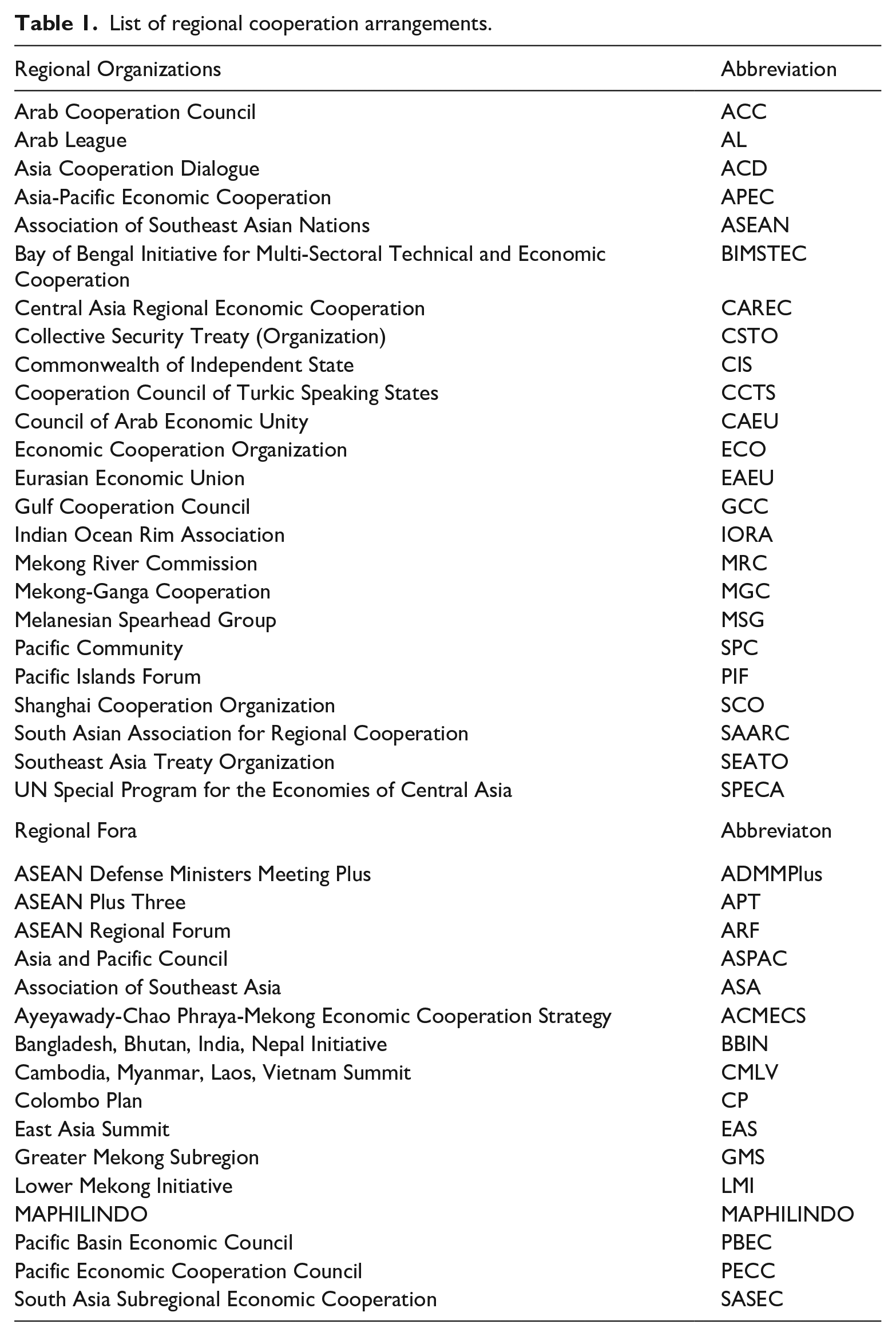
This section sheds light on which regional cooperation arrangements have been established in Asia and shows how their numbers have increased over time and which states have joined how many of them. The paper analytically distinguishes between two forms of regional cooperation: regional organizations (ROs) and regional fora (RF). ROs are defined as institutionalized forms of cooperation between at least three states and characterized by a headquarter office or secretariat and a set of primary rules. 12 Unlike the membership in international organizations, the terms of membership in ROs are based on geographical criteria, economic interdependence or shared values. 13 Applying these criteria to Asia in the period 1945–2015, there are 24 ROs (see Table 1). Asian regionalism places great emphasis on informality. Thus, there are, in addition to the rather formal ROs, several Asian regional fora (RF), which are also forms of regional cooperation. Yet, unlike ROs, RF tend to be less formalized: they neither have a secretariat nor a repository of primary rules. Based on this definition, we include 16 Asian RF (see Table 1).
List of regional cooperation arrangements.
As in other parts of the world, ROs and RF differ in the number of member states in Asia, ranging between three (ASA and MAPHILINDO during their entire existence, as well as ACC 1989/90, ECO 1985/91, MGC 2000/1) and 31 (ACD since 2008). Yet, unlike regional integration in Europe, Africa, or Latin America, 14 there are not two waves of regionalism in Asia, but only one. Figure 1 illustrates that Asian regional cooperation especially took off in the 1990s. In 1950, only two ROs existed (the SPC and the AL), 10 years later there were three ROs (including SEATO), the number of which increased to five in 1970 (ASEAN and CAEU) and remained to stay the same until 1980. After the end of the Cold War, the number of ROs increased steeply. While in 1990 nine ROs were recorded (ACC, ECO, PIF, and GCC), by 2000 the number had increased to 17 (APEC, BIMSTEC, CIS, CISTO, EAEU, IORA, MRC, SPECA) and in 2010 there were 22 Asian ROs. Similarly, only two RF existed in the 1960s (e.g. PBEC, ASPAC), one in the 1980s (PECC), four in the 1990s (GMS, BBIN, ARF, APT), while most RF were created in the 2000s (SASEC, ACMECS, CMLV, LMI, EAS, ADMM Plus).
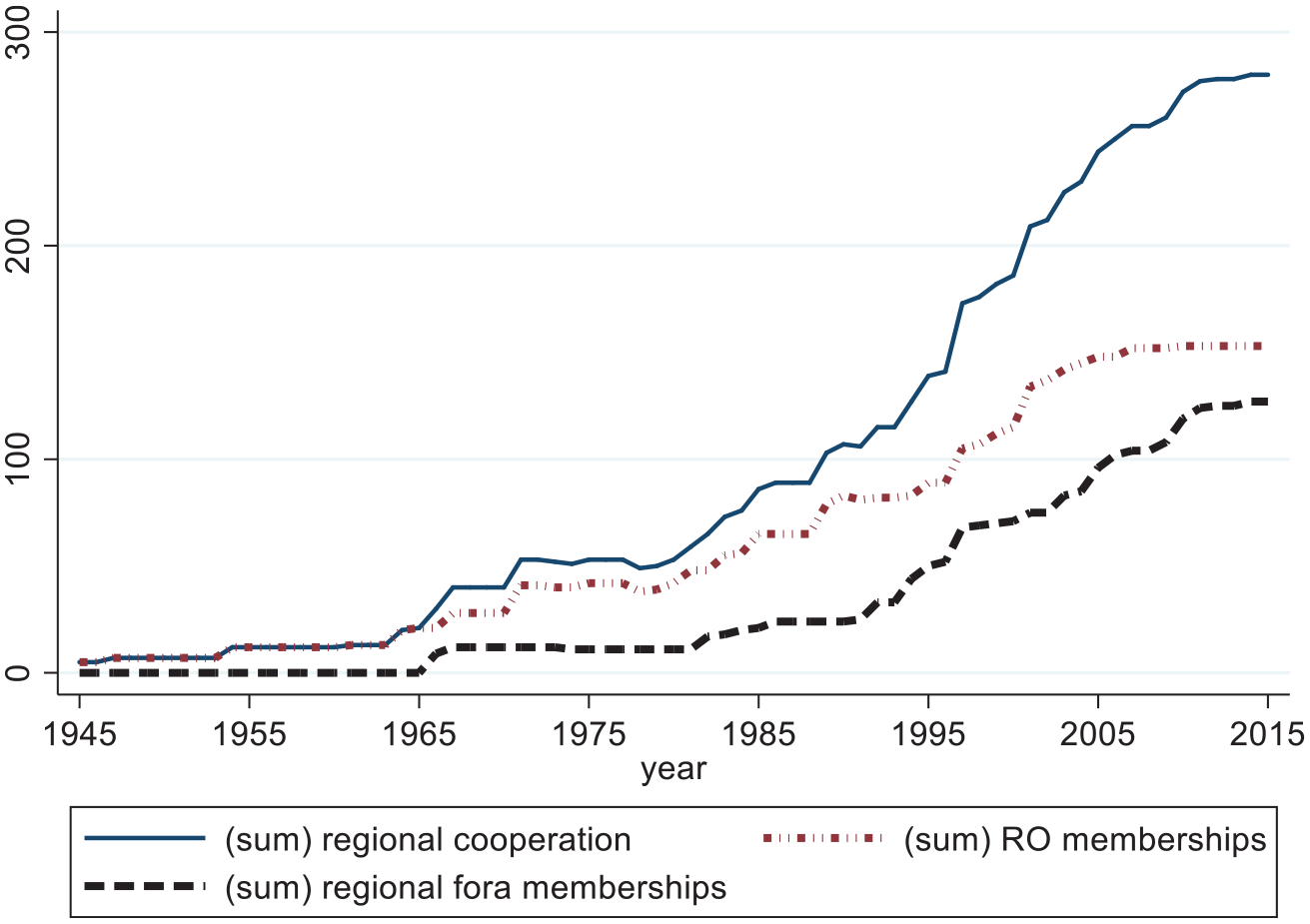
Aggregated memberships in regional cooperation arrangements, 1945–2015.
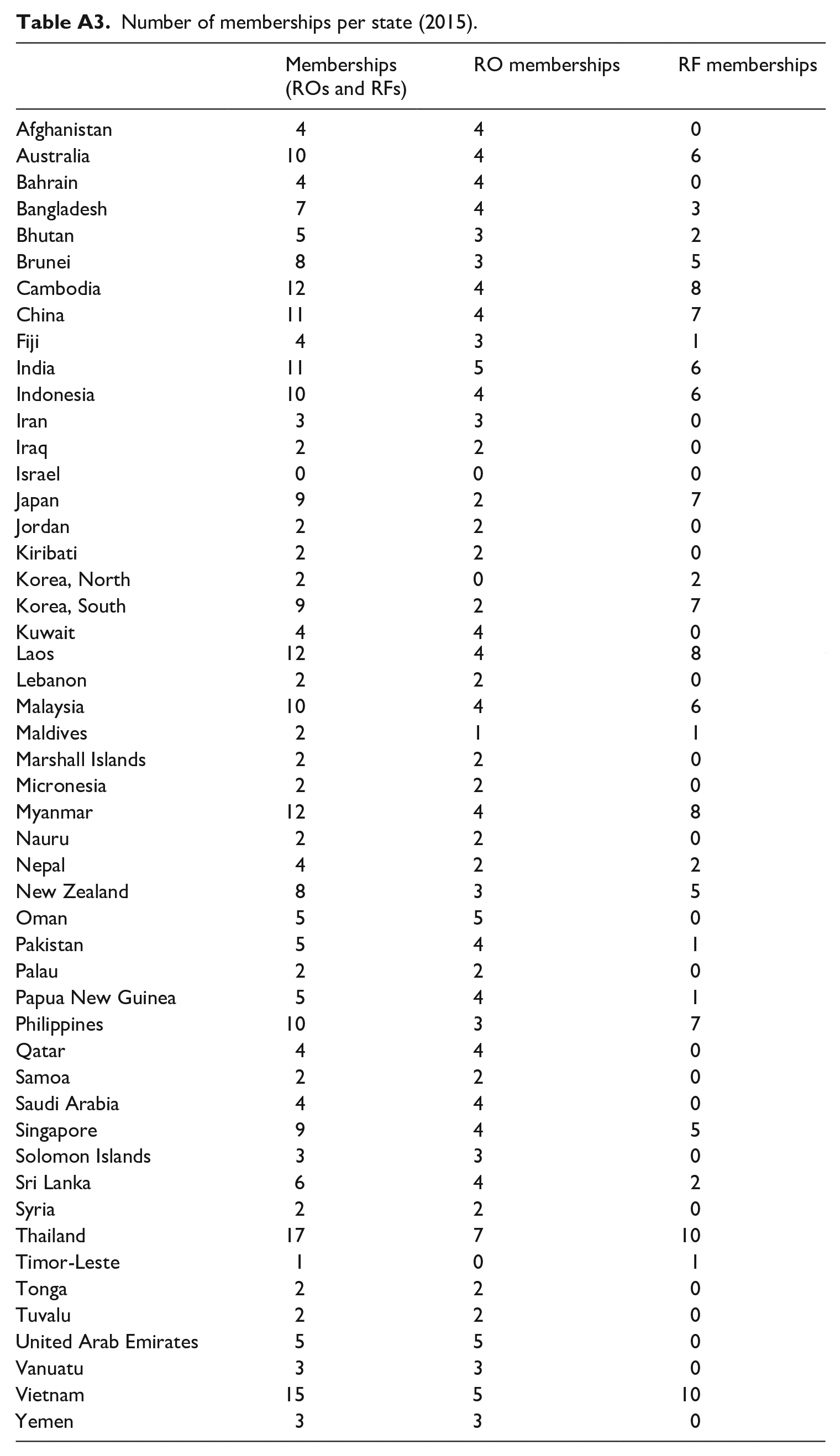
Figure 2 shows that in the first decades of observation, states did not create many ROs and RF and did not join them in high numbers. In 1945, only five states (Iraq, Jordan, Lebanon, Saudi Arabia, and Syria) were in an RO at all and no state was member in a less formalized arena for regional cooperation, a regional forum. In 1955, Australia and New Zealand had two RO memberships each, while the Philippines, and Thailand were members in one RO in addition to Iraq, Jordan, Lebanon, Saudi Arabia, and Syria which also had joined one RO. Ten years later, five of the 50 states were in one RO and eight states held two memberships. The total number of memberships in regional cooperation schemes was 53 in 1975 and increased to 85 ten years later. In 1985, only few states were not member of at least one RO or RF, among them Afghanistan, Myanmar, Cambodia, Laos, Israel, as well as China. At the same time, Australia and New Zealand were at the forefront of regional cooperation with a total of five memberships (two in ROs, three in RF). Six countries, namely Bahrain, Kuwait, Oman, Qatar, Saudi Arabia, and the United Arab Emirates, held three memberships in ROs each, while Japan and South Korea had three memberships in RF, respectively. Between 1985 and 1995, regional cooperation proliferated and membership in regional agreements increased by one-third from 85 to 135. In 1995, Australia and Thailand had seven memberships each, followed by New Zealand, the Philippines, and Vietnam which had joined six ROs and RF each, and China and Japan with five affiliations, respectively. At the other end of the spectrum was Israel, which did not engage in regional cooperation in ROs or RF. Ten years later, the number of RO and RF memberships strongly increased to a total of 237. By 2005, Thailand had joined seven ROs and eight RF, Vietnam held eight RF and five RO memberships. Compared to the increase in memberships between 1995 and 2005, the change is less dramatic for the 2005–2015 period. In the last year of observation, in 2015, the number of memberships increased to 272. By 2015 China had caught up with regionalism (seven memberships in RF and four in ROs), but was exceeded by Thailand which had joined 17 regional cooperation schemes (seven ROs and ten RF).
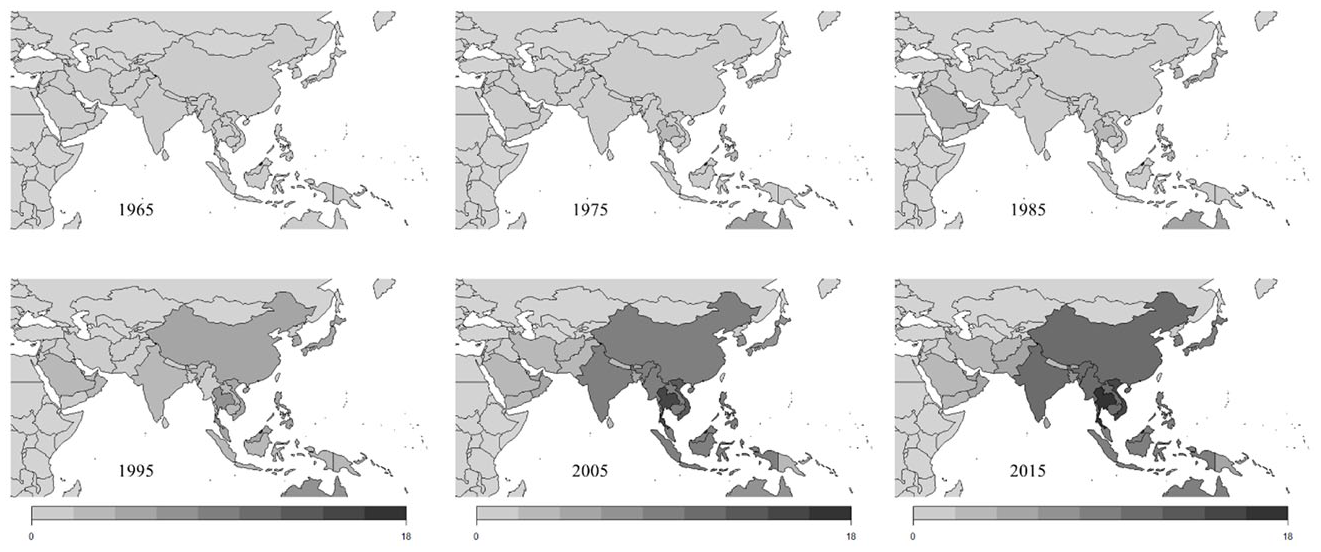
State membership in regional cooperation arrangements, 1965–2015.
In sum, there is a clear trend toward an increase in regional cooperation in Asia which took off only after the end of the Cold War and especially at the end of the 1990s. In addition, memberships in ROs outnumber memberships in RF. While most states tend to engage in both arenas, some states prefer formal ROs over informal RF (e.g. Oman, United Arab Emirates, Afghanistan, Bahrain, Kuwait, Qatar, or Saudi Arabia), while others favor informal cooperation in RF over formal RO membership (e.g. North Korea, China, and Japan).
State of the art and theoretical expectations for regional integration in Asia
Research on regionalism has produced a rich literature explaining why states engage in regional cooperation. This literature is strongly influenced by the three main strands of International Relations theory: realism, liberalism, and constructivism. In this section, we briefly review this literature and derive six competing hypotheses from it.
The regionalism literature inspired by realist arguments takes into consideration that regional cooperation can be a result of insecurity. 15 According to this reasoning, a history of frequent interstate wars and persistently high levels of political tension in a region may motivate governments to reconsider the predominant security dilemma logic. Especially critical junctures such as severe crises or external shocks 16 may facilitate a shift in their foreign policy outlook from an emphasis on strong military defenses to one of cooperation. The European integration after the Second World War as a design to contain the Soviet Union and a potentially resurging Germany is one of the most obvious examples for such a policy shift, but also ASEAN was primarily formed to mitigate tensions between its founding members. 17 In order to examine whether such a response to insecurity can also be generalized for Asia, we hypothesize that
H1a: The more states are exposed to insecurity, the greater is their incentive to become members of regional cooperation arrangements.
The rapid rise of China and the concomitant intensification of rivalries for pre-eminence in much of Asia with the United States has stimulated research on the foreign policy strategies especially regarding Asia’s smaller countries. One of the findings is that these states increasingly tend to engage in ‘hedging’ activities whereby states seek to be on good terms with competing hegemons and interact with them without taking sides.18,19 Hedging is identical neither with bandwagoning, nor with ‘hard’ (or military) balancing as both concepts imply cooperation with only one hegemon. It denotes ‘behavior in which a country seeks to offset risks by pursuing multiple policy options that are intended to produce mutually counteracting effects, under the situations of uncertainty and high-stakes’. 20 It combines ‘return maximization’ through economic cooperation with (regional) hegemons, and ‘risk-reducing’ actions through military modernization as well as military and institutional cooperation with other great powers. 21 Hedging is an essentially realist concept, but it also accommodates a modicum of cooperative state behavior. 22 Creating or joining regional cooperation schemes can be part of hedging behavior, leading us to our second hypothesis:
H1b: The greater the opportunity to join a regional cooperation arrangement which includes a regional hegemon, the greater the number of ROs and RF a state joins.
Approaches of regionalism inspired by liberal International Relations theory focus on domestic properties of states and expected increases of welfare in order to explain regional cooperation. They create a link between the system of government and the economic system that generates the highest material benefits. Rosecrance’s concept of the ‘trading state’, 23 derived from Kant’s treatise of ‘Perpetual Peace’ epitomizes this view. A trading state is a democratic polity with an open, that is, liberal economic system. Liberal political values and a liberal economy thus coincide. As liberal intergovernmentalism has pointed out, democratic states with a liberal economic system are thus expected to augment welfare through economic cooperation. 24 Joining regional bodies is seen as a strategy to pursue this objective, especially since there are no regional cooperation arrangements which are not directly or indirectly geared toward increasing the well-being of its member states. 25 Therefore, we hypothesize that
H2a: The more democratic countries are, the higher the number of regional cooperation arrangements they join.
A related theoretical argument focuses on the economic benefits that states expect from joining regional cooperation arrangements. The more promising regional cooperation is in terms of fostering trade and promoting economic growth, the more likely it is that it attracts member states. 26 Such an argument has not only been made with respect to the European Union, 27 but also for ASEAN. 28 Hence, our second liberal hypothesis posits:
H2b: The more economic benefits a state can expect from joining regional cooperation arrangements, the greater is its membership in regional cooperation schemes.
Constructivist scholarship treats preference building of states as an essentially endogenous process. 29 Decisions are thus greatly influenced by representations of the past. Historical experiences shape collective memories and strategic cultures. Most Asian governments perceive their country’s history as highly turbulent. This perception arises because their countries have been victimized by colonialism, imperialism, and great power politics. Therefore, smaller countries and even emerging great powers such as China and India regard international politics as a highly volatile process, exposing them to infringements on their sovereignty. Consequently, creating or joining regional bodies is not only an act of hedging via-a-vis hegemons (see H1b), but also a deliberate attempt to multilateralize international politics and an opportunity to socialize neighboring states in cooperative norms. We thus hypothesize that
H3a: The stronger its perception of vulnerability, the more regional cooperation arrangements a state joins.
Constructivism also sheds light on the image nation states project of themselves and their image as perceived by others. They regard membership in regional bodies as a chance to gain respectability and recognition. Joining regional cooperation arrangements conveys to the world that they matter in regional politics and that they are regarded by others as actors that have to offer important human, material, or ideational resources to tackle cross-border regional problems. Especially countries that have only recently gained independence and countries that have suffered from a pariah reputation, such as Myanmar after its crackdown on the country’s democracy movement in 1988 until its political opening in 2010 or Cambodia during its genocidal Khmer Rouge regime (1975–1978) and after the Vietnamese occupation between 1978 and 1991, can be assumed to be keen on upgrading their international stature. This reasoning leads us to formulate a last hypothesis:
H3b: The stronger the demand of a country to obtain external recognition, the greater is the likelihood to hold a high number of memberships in regional cooperation arrangements.
The subsequent sections provide an empirical analysis of these theoretical expectations. In a first step, a quantitative analysis adopts a comprehensive approach, covering all ROs and RF between 1945 and 2015, and examines the plausibility of the six hypotheses. This, however, requires the usage of empirical proxies for each of the six independent variables that are available for all Asian states and ROs/RF over this long period of time. In order to further substantiate and contextualize the quantitative findings, the paper subsequently provides in-depth qualitative studies selected in line with a mixed-methods approach. 30 Thus, these studies place particular emphasis on those two hypotheses that the quantitative part regarded as plausible. The qualitative studies use fine-grained indicators and shed more detailed light on the mechanisms at play in the hypotheses on hedging and economic stature. To this end, we selected three countries: India, Thailand, and Cambodia. They differ in their inclination to engage in hedging as well as with respect to their economic stature, which are the core findings of the quantitative part and therefore at the center of the qualitative analysis. Cambodia is the most likely case to join ROs and RFs in order to engage in hedging, while India pursues stronger economic than hedging interests. Thailand assumes a middle-ground: both motives are prevalent, but not as pronounced as in India and Cambodia.
Quantitative analysis
This section first introduces the measurement of core variables. In a second step, it examines the data structure and selects a suitable method of data analysis. On this basis, the hypotheses are examined quantitatively and the findings are discussed in a third step.
Operationalization of independent variables
The independent variable of hypothesis 1a is exposure to insecurity as the hypothesis expects that states exposed to interstate wars and violent conflicts have greater incentives to join ROs and RF. The data on the number of interstate wars counts the number of incidents per country and year and stems from the Quality of Government Dataset. Hedging is the key concept of hypothesis 1b and operationalized by a proxy that focuses on whether the membership of regional hegemons (India, China) in Asian ROs and RF has a pull-effect on other states. The independent variable hedging incentives per state is captured by how many of its regional cooperation arrangements entail a regional hegemon.
Hypothesis 2a treats the regime type as independent variable. The extent to which a country is democratic ranges from zero (least democratic) to ten (most democratic) and the data has also been taken from the Quality of Government Dataset. Hypothesis 2b expects that states pursue economic objectives when deciding whether to join a regional cooperation arrangement or not. This is captured by the economic policy scope of the ROs a state is member of in a given year. The data stems from the Regional Organizations Competencies (ROCO) database, which includes information on policy competencies of ROs. It was coded, based on the body of RO primary law. 31 Next to founding treaties, this includes treaty changes, protocols, and annexes that are part of RO treaties. These documents were coded in order to obtain information on RO policy competencies for the creation of secondary law and the making of soft law, as well as competencies allowing for collective action of RO members, or for other RO activities. The ROCO database distinguishes between 11 different policy fields. 32 In the economic policy field, we distinguish between 17 specific policy competencies. 33 In order to examine whether economic policy competencies of ROs pose an incentive to Asian states to join them, this paper uses cumulative scope of economic policy competencies per year of the ROs a state is member of as independent variable. These data are not available for RF (see discussion below).
Hypothesis 3a focuses on state size as independent variable. This is captured by the population of a country in billion citizens. The annual data stem from the World Bank’s Development Indicators (WDI database). The independent variable of hypothesis 3b is the demand for external recognition. As this demand should be more prevalent in younger states, we operationalize this variable with the age of states, measured by the years since independence. These data have been collected on the basis of the CIA Factbook 34 and the homepages of states. The descriptive statistics of all variables are available in the appendix (Table A1).
Model selection
This paper sheds light on two variants of the dependent variable, namely the number of ROs and RF a state is member of in a given year (DV1a) as well as the number or RO memberships per state and year (DV1b). Both variants of the dependent variable are of count nature. Since the variance is higher than the mean for DV1a and DV1b, over-dispersion in the data calls for negative binomial models rather than Poisson estimations. The structure of the data requires a time-series cross-sectional analysis and we use standard errors clustered on the country level in order to avoid problems of autocorrelation due to repeated observations. This can be combined by adopting generalized linear models with a negative binomial family function. In all models, the independent variables are lagged by three years (all findings remain robust for five-year time lags as well).
Empirical analysis and discussion
Table 2 reports the findings from the regression analysis. Models 1 and 2 focus on state membership in regional cooperation agreements (ROs and RF) (DV1a). Models 3 and 4 provide a robustness check. These models only focus on the number of RO memberships of states as data on economic competencies are only available for ROs (DV1b). This reveals that there are no systematic differences in the underlying driving forces of regional cooperation.
Regression analysis.
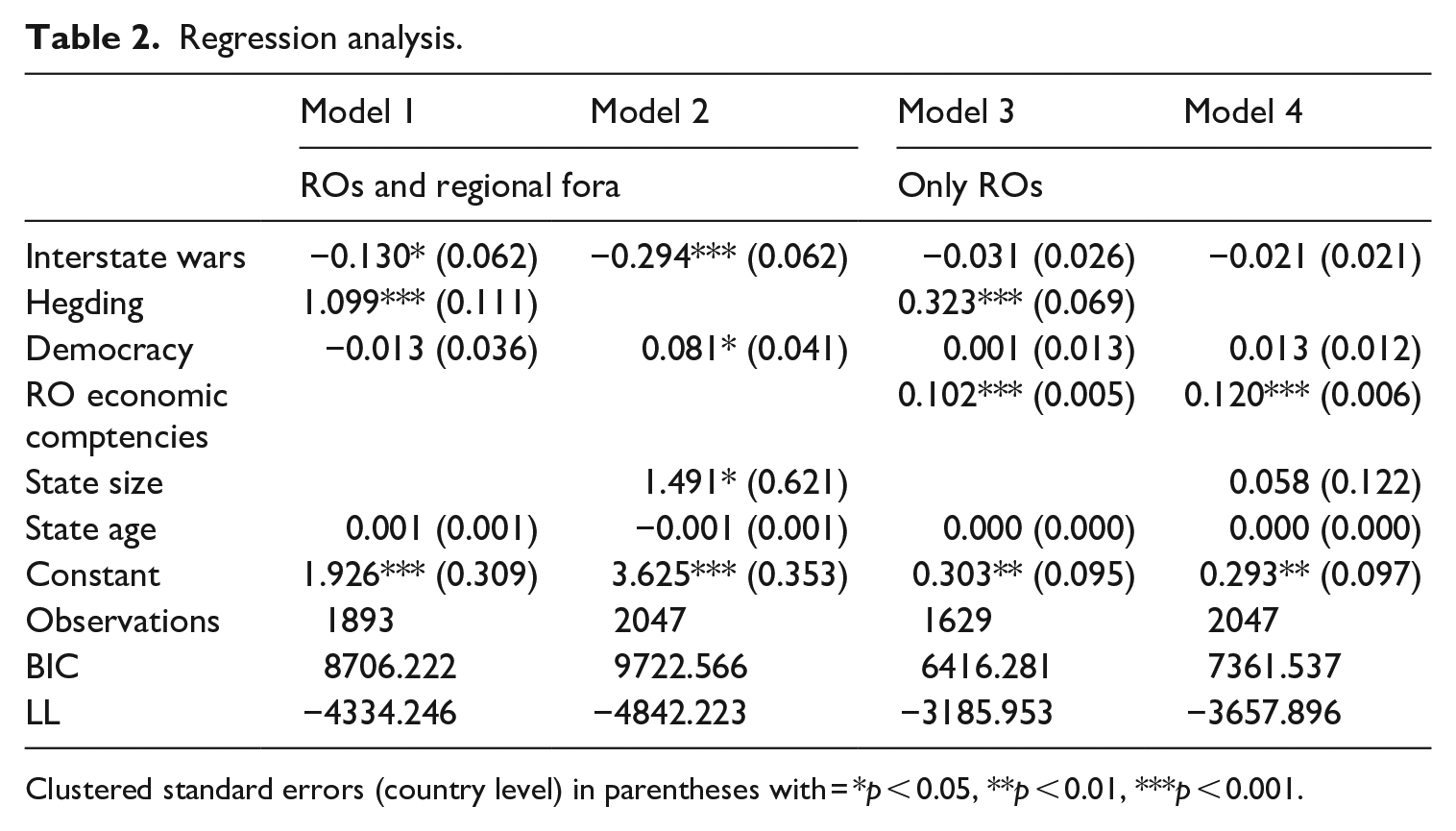
Clustered standard errors (country level) in parentheses with = *p < 0.05, **p < 0.01, ***p < 0.001.
The quantitative analysis lends empirical support to some, but not all hypotheses. First we examine the assumptions derived from realist inspired regional cooperation approaches, followed by the two liberal and the two constructivist hypotheses.
The analysis illustrates that, in general, security concerns are not a very strong impetus for RO and RF membership decisions in Asia. Hypothesis 1a is not supported by empirical evidence: As Table 1 shows, states that were increasingly exposed to interstate wars, are not – as expected – systematically more likely to acquire memberships in regional cooperation arrangements. In fact, countries subject to interstate violence are less likely to join ROs. This resonates with the observation that Asian states are more likely to formally equip their respective ROs with economic, technology, and finance competencies than security ones (c.f. Figure 3). Thus, although security issues are important for several ROs and RF, 35 economic incentives seem to be more prevalent when states face the decision whether to join an RO or not (see also below). This also fits to the observation that Asian regionalism has taken off mainly after the end of the Cold War, when security concerns were less prevelent.
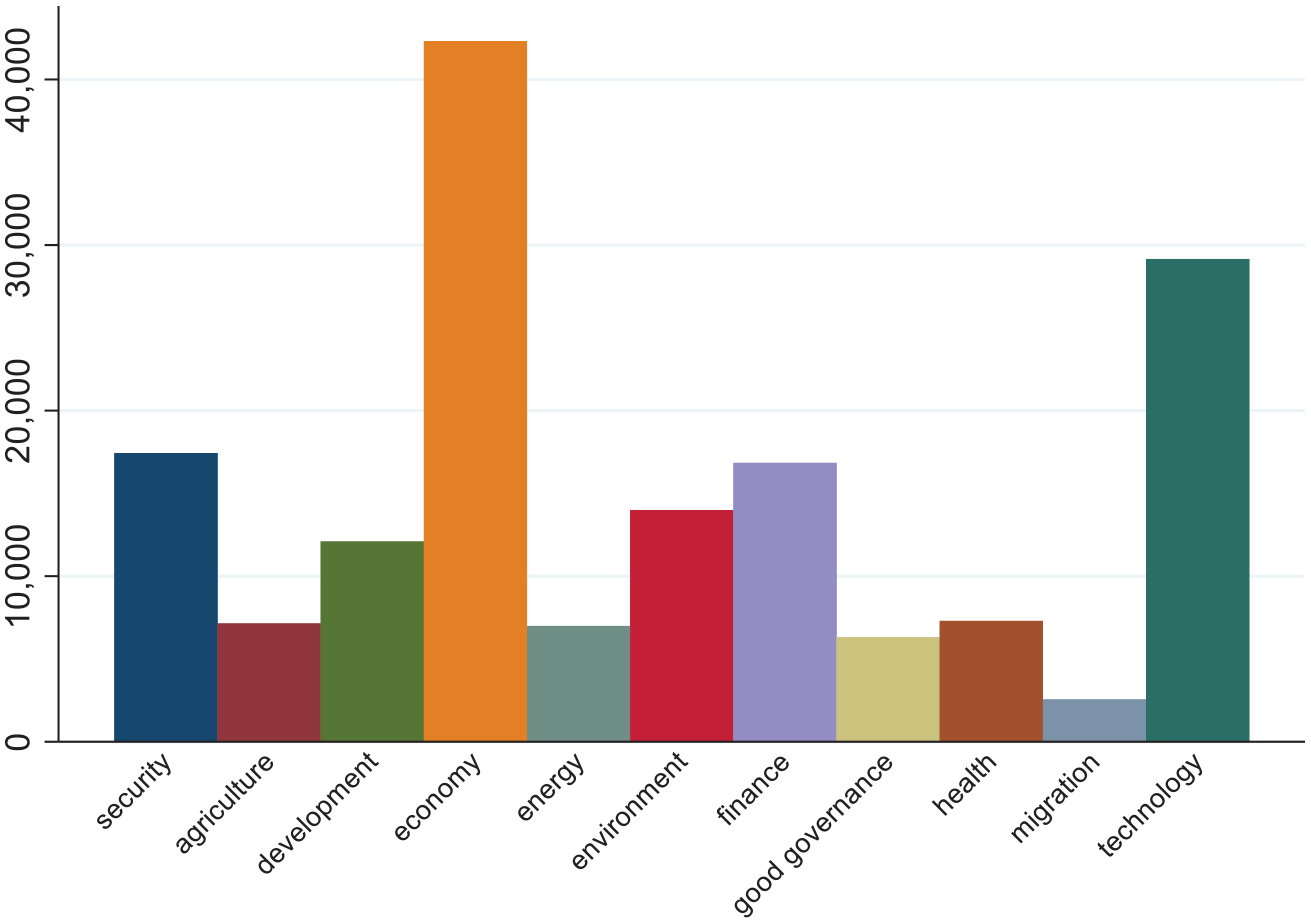
Total number of delegated policy competencies to ROs per policy area, Asian states 1945–2015.
By contrast, the robustly positive and significant covariates in models 1 and 3 indicate that hedging is likely to be an important motive for states to join ROs and RF. Asian states are significantly more likely to become members in ROs and RF in which India or China are also members. In line with hypothesis 1b, India or China as regional hegemons are likely to bring about a pull into their ROs and RF (see also case study evidence below). This finding resonates well with case study literature that attributes hedging behavior to smaller Asian nations, 36 though thereby neglecting ROs and RF as hedging resources.37,38
The strong emphasis placed on economics and trade as well as on technology and infrastructure in Asian regionalism suggests that governments that are open to sub-state actors (e.g. business interests, consumer groups) should be conducive to the willingness of states to join ROs and RF in order to pursue their economic interests on this level as well. Yet the regression analysis does not lend strong support for this expectation and the corresponding hypothesis 2a. Only in one out of four models regime type has a significantly positive effect on the willingness of states to enter regional cooperation arrangements (Model 2 in Table 2). In the other three models, it is not the case that states have higher probabilities of becoming members in many ROs, the more democratic they are. Instead, Models 1 and 3 of Table 2 suggest the opposite (albeit non-significant) effect. States that are more autocratic display higher propensities to be member in larger numbers of ROs and RF.
This finding does most likely not indicate that economic interests do not matter, but rather that autocratic governments also highly value opportunities for regional economic cooperation. In line with this, models 3 and 4 in Table 2 show that states which have already equipped the ROs they are members in with economic competencies, have a positive stance toward further regional cooperation and are therefore more likely to join additional ROs. Thus, hypothesis 2b is empirically plausible. Secondary literature lends support to this finding. For instance, Bowles, 39 Dent, 40 and Dosch 41 show that especially after the end of the Cold War, economic interests were major drivers of Asian regionalism.
Table 2 suggests that small size of states does not translate into more prevalent perceptions of vulnerability leading to a higher number of membership in ROs and RF. Models 2 and 4 point out that, in tendency, the larger the size of a country, the greater the likelihood that it has joined several regional cooperation arrangements, which is not in line with hypothesis 3a. Thus, while in individual cases, such as Cambodia, perceptions of smallness, and vulnerability do matter for the decision to join ROs and RF (see qualitative part below), this does not apply to all smaller Asian states per se.
The final constructivist expectation (H3b) only finds tentative support. The signs point into the expected direction in three out of four models, but the findings lack significance (see Table 2). In tendency, younger states seem to be more likely to join higher numbers of ROs and RF than older states. This may suggest that striving for external recognition is an important motive of many but not all younger states to join regional cooperation arrangements. This might be explained by the fact that not all younger states are equally well equipped with resources, which are needed to effectively work in multiple ROs and RFs at the same time.
In sum, this analysis illustrates that there are no systematic differences in the underlying driving forces of regional cooperation. It is not the case that the rationales of states for regional cooperation differ fundamentally depending on the cooperation format (RO vs informal RF). While this finding might be surprising on first glance as ROs are more strongly institutionalized than the rather informal RF, it can be explained by the fact that many of the Asian ROs are in practice characterized by summitry. 42 Unlike many of the ROs in Europe which place emphasis on the day-to-day development of binding policies and non-binding new modes of governance (e.g. benchmarking, best practice exchanges, horizontal learning), Asian ROs place a strong emphasis on Heads of States’ meetings (summits), which showcases commitment to cooperation, rather than policy-making. Thus, in effect Asian ROs and Asian RF are more similar than ROs and RF in Europe.
The analysis further shows that major factors fostering regional cooperation in Asia are hedging and expected economic benefits. In addition, we find that insecurity in form of interstate wars hampers regional cooperation as states do not use ROs and RF as shelters. These findings remain robust, if we control for sub-regions, such as Southeast Asia (see Table A2 in the Appendix). In other words, countries located in Southeast Asia (Brunei, Indonesia, Cambodia, Laos, Malaysia, Myanmar, the Philippines, Singapore, Thailand, Vietnam, and Timor-Leste) do not behave differently from the rest of the countries in the broader Asian region.
Moreover, our study indicates that smaller states are per se not more motivated to join high numbers of ROs and RF than larger states. In fact, in tendency larger states make more use of regional cooperation in Asia. Again, this finding also holds, when we insert Southeast Asia as a control group in the model (see Table A2 in the Appendix).
Qualitative analysis
This section complements the statistical analysis by detailed qualitative studies that zoom more closely into specific cases in order to further contextualize and substantiate the core quantitative findings based on fine-grained indicators and in-depth analysis (c.f. end of section 3 for case selection).
The qualitative evaluation of the six hypotheses supports the statistical finding that hedging (H1b) and economic (H2b) motivations matter. However, the cases also reveal that both motivations are difficult to disentangle. While Asian states unquestionably have strong incentives to pursue regional cooperation for the sake of economic growth and the promotion of national prosperity, economic cooperation is also inextricably linked to the ‘return maximization’ dimension of hedging. 43 Yet as in the statistical regressions ‘hedging’ came out as the most compelling ground for Asian states to join regional cooperation arrangements, we first examine whether and in how far the behavior of the three sample states corroborates this finding (H1b). We then turn to hypothesis H2b highlighting economic motivations, the other assumption supported by statistical evidence. The section ends with discussing the plausibility of the remaining hypotheses for the three countries under scrutiny.
Hedging
Although our statistical analysis suggests that security issues play only a subordinate role in the motivation of Asian states to join regional cooperation arrangements, this is only part of the truth. Regional cooperation agreements rarely mention security functions, yet they matter. This becomes most evident in the hedging strategies states apply. When they simultaneously cooperate with different hegemons in different ROs or RF or interact with all of them in the same RO or RF, states engaged in hedging combine security objectives (risk contingency) with economic objectives (return maximization). It is chiefly China’s meteoric rise as an economic power house, its increasingly assertive foreign policy and its exponential increase of military strength, that have induced all three countries to engage in hedging strategies. Of the three states examined, Cambodia engages the most in hedging, followed by Thailand, whereas India resorts to this strategy the least – as it is a regional hegemon itself. Yet all three countries have embarked on ‘return maximization’ in their interactions with China and markedly increased two-way economic transactions. In 2016, the middle kingdom has been the largest trading partner of all three countries and the largest investor in Cambodia. Chinese investment in Thailand has been rapidly increasing in recent years, making it the sixth largest investor in the country, and also in India China is entering the club of the 10 largest foreign investors. Thailand and, in particular, Cambodia have also joined the Chinese Belt and Road Initiative (BRI), an infrastructure development scheme worth more than 1 trillion US dollar. The ROs and RF they joined have helped them to tap abundant Chinese resources.
At the same time, Cambodia, Thailand and to a lesser extent even India protect themselves from too much dependency on China by activating the ‘risk contingency’ component of hedging. The latter is driven by a skeptical worldview which foreign policy elites in most Asian countries share. Their outlook on international relations is shaped by highly adverse historical experiences such as the waxing and waning of empires in the pre-colonial period, colonialism, frequent inter-state and intra-state warfare, and a post-colonial international order perceived as highly inequitable and unjust. These adverse experiences translate into foreign policy practices which are strongly guided by the tenets of realpolitik. Asian foreign policy elites are greatly aware of their nation’s vulnerability, which explains their almost seismic sensitivity to perceived or real global and regional power shifts and the widespread belief that survival is best secured through self-help and national resilience. 44 National resilience can be strengthened through joining regional groupings for the sake of ‘soft’ or institutional balancing, a major dimension of the ‘risk contingency’ element of hedging.
Former Indian Minister of State for External Affairs Shashi Tharoor once argued that ‘economics can always open the door to politics’. 45 This statement as well as the fact that India, Thailand, and Cambodia also created or joined regional groupings in which China is conspicuously absent, suggest that there is a hidden objective behind the founding declarations of many regional cooperation arrangements, which all highlight pure economic rationales: ‘Soft’ balancing China through exclusivist regional organizations and regional fora as a ‘risk contingency’ policy.
Indian hedging motivations were shaped by the fact that the country is increasingly challenged by China in its South Asian home turf and neighboring mainland Southeast Asia. From the 1980s onward, New Delhi warily watched intensifying Chinese political and economic presence in Pakistan, Sri Lanka, the Maldives, Bangladesh, Nepal, and Myanmar and increased maritime activism in its Indian Ocean defense perimeter. 46 Yet Indian military and economic capacities are clearly inferior to those of China, disallowing New Delhi to rely on ‘hard’ or military balancing in order to contain what is viewed as a menacingly assertive China. Although the Indian government avoids publicly admitting that the ROs and RF, which India helped to establish – including the Indian Ocean Rim Association for Regional Cooperation (IOR-ARC, 1995), 47 the Bay of Bengal Initiative for Multisectoral Technical and Economic Cooperation (BIMSTEC, 1997), the Bangladesh, Bhutan, India, Nepal Initiative (BBIN, 1997), and the Mekong-Ganga Cooperation (MGC, 2000) – are devices of ‘soft’ balancing China, the Indian security community is unanimous in this respect. 48 Hedging motivations are also behind India’s accession to the China-dominated Shanghai Cooperation Organization (SCO) in 2017 49 as well as the simultaneous presence in the US-led Quadrilateral Security Dialogue (Quad, with Japan and Australia) 50 and the participation in triangular cooperation with Russia and China in an ‘Eurasia Caucus’ rivalling the Quad. 51
Evidence for the ‘risk contingency’ dimension of hedging is even more persuasive for Thai regionalism. Driven by concerns about the rapidly increasing influence of China and India in mainland Southeast Asia, Thailand began practicing a dual hedging strategy: Hedging China and India. Regional institutions which Thailand subsequently joined and in which India but not China is a member included BIMSTEC, the MGC, and the IOR-ARC. China but not India is a member in the Greater Mekong Sub-region (GMS), the ASEAN Plus Three (APT), and the Asia-Pacific Economic Cooperation (APEC). Thailand also became a member of the ASEAN Regional Forum (ARF), the East Asia Summit (EAS), the ASEAN Defense Ministers Meeting Plus (ADMM Plus), and it created the Asian Cooperation Dialogue (ACD), in which both, China and India, are members. Hedging Chinese and – to a lesser extent – Indian influence in mainland Southeast Asia also involves military cooperation with the United States (albeit reduced after the military coup in 2014) and close economic ties with Japan. The latter are – like Thailand – members in the ARF, the EAS, APEC, and ADMM Plus, Japan also participates in the ACD. Thailand’s membership in these regional cooperation arrangements thus tallies perfectly with the country’s foreign policy tradition of carefully calibrating relationships with large powers.
Also the Cambodian case strongly supports the ‘hedging’ hypothesis. Cambodia is a member of all Mekong region-centered organizations in which China also participates including the Lower Mekong Initiative (GMS) and, since 2016, the Lancang Mekong Cooperation (LMC). The latter is a Beijing-sponsored forum, which in an attempt to compensate Lower Mekong riparians for the cascade of environmentally damaging dams China built on the upper Mekong, channels lavish infrastructure funding into the Mekong Basin region. 52 These dams massively impact the water flow and river sedimentation, with highly adverse consequences for agriculture, fisheries, and biodiversity at the Lower Mekong. 53 With its focus on infrastructure development, the LMC is also a conduit for China’s BRI activities. While Chinese projects in Cambodia proliferate, anti-Chinese sentiments in the population are likewise on the rise. The government of Prime Minister Hun Sen and its cronies, which are widely seen as the main beneficiaries of the heavy influx of Chinese goods, tourists, and investments, must assuage these grievances fueling opposition. Realizing what the government describes as ‘economic pragmatism’, 54 Cambodia thus seeks to maintain a modicum of foreign policy autonomy by hedging Chinese influence through economic cooperation with Japan and the Japan-dominated Asian Development Bank (ADB). Unsurprisingly, Prime Minister Hun Sen is a regular attendant of the annual Mekong-Japan Summits. 55 Hedging China is also the motivation for joining regional cooperation arrangements in which India but not China is a member such as in the MGC. 56 The hedging effect even increases as India is closely aligned with Japan in Mekong region infrastructure development. The building of east-west corridors counters the essentially north-south bound Chinese infrastructure development. 57 Finally, Cambodia also hedges against ambitious regional powers like Thailand. It is on the one hand member of the Ayeyawaddy Chao Phraya Mekong Economic Cooperation Strategy (ACMECS) initiated by Thailand, but at the same time together with Myanmar, Laos, and Vietnam, member of the CLVM Summit which excludes Thailand. 58
Economic motivation
As the ‘return maximization’ component of Kuik’s hedging concept is a strategy to promote economic growth, it overlaps with the economic motivations posited in hypothesis H2b. It reflects the fact that in many parts of Asia economic prosperity has been the most significant provider of governmental legitimacy since precolonial times. This explains why even autocratic regimes such as Indonesia under Suharto only collapsed when they failed to generate economic growth. By contrast, the communist regimes in China and Vietnam are stable because they are reasonably successful on this count. Moreover, economic cooperation is attractive for many states, as they hope that prosperity enhances their ‘resilience’ which political elites especially in Southeast Asia believe would strengthen national sovereignty. 59
India’s ‘Look East’ policy (in 2014 re-named ‘Act East’) 60 was initially a response to the economic stagnation caused by the collapse of its most important economic partner, the Soviet Union, and the massive mismanagement of the byzantine ‘License Raj’ characterizing the country’s ‘mixed economy’ prior to 1991. 61 While this policy focused on deepening bilateral ties with its high-growth Southeast Asian neighbors at first, it took a multilateral turn by the mid-1990s as India became a driver in the formation of new regional schemes including the IOR-ARC, BIMSTEC, BBIN, MGC, and a member in others such as the ACD and various fora launched by ASEAN including the ARF, ADMM Plus, and EAS. 62 All of these regional bodies – except the ARF and ADMM Plus – emphasized variants of economic cooperation including a so far non-implemented free trade area under BIMSTEC 63 and advancements in connectivity in order to boost economic growth. At the same time, economic development through regional cooperation was – as Indian Foreign Secretary Shyam Saran explained – a strategy to establish ‘a peaceful and tranquil periphery’ considered as crucial for India’s economic advancement. 64 Indian foreign policy pundits also highlight the functionalist logic that economic cooperation as an essentially non-political, technical affair which implies less delicate issues than security cooperation, is an additional explanation for launching regional cooperation schemes. 65
Thailand also sought to pursue economic objectives when it created or joined regional institutions. Thai governments had been drivers of deepening economic cooperation in ASEAN where they were at the forefront of the ASEAN Free Trade Area (AFTA) (1991) and – together with Singapore – the formation of the ASEAN Economic Community (AEC) (2003). The country was also a founding member of the Pacific Economic Cooperation Council (PECC), APEC, ASEAN Plus Three, the EAS, and the ACD. 66 In the 1990s, inspired by the ambition to become the economic power house on mainland Southeast Asia as embodied in the historical Suvannaphume (Golden Peninsula) myth, Thailand stepped up trade, investment, and resource diplomacy with neighbors Myanmar, Laos, and Cambodia. 67 By building pipelines from Myanmar’s offshore oil and gas fields in the Andaman Sea, dams for generating hydro-power in Myanmar and Laos, and the acquisition of timber concessions in Myanmar, Thailand sought to secure the supply of important raw materials for its fast growing economy without causing severe environmental damages at home which a critical civil society vociferously decried. Thailand’s crucial role in the formation of BIMSTEC, the MGC, ACMECS, and the IOR-ARC can be well explained by the objective to advance trade with partners which so far have not been integrated into the regional economy, to upgrade energy supplies and to outsource its environmentally non-sustainable (extractive) industries.
War-ravaged Cambodia had the status of a least developed country (LDC) when it joined regional cooperation arrangements in the 1990s and 2000s. At the time, it was desperately in need of capital and infrastructure development. Membership in ASEAN and the regional cooperation schemes initiated by India (MGC), the Japan and Western-dominated ADB (GMS), the Thai-sponsored ACMECS and ACD and, in particular, the LMC launched by China in 2016, were important sources for attracting urgently needed foreign investment and development aid. 68 More recently, multi-membership in regional associations has become a precaution against China’s ‘new normal’, an economic slowdown which is expected to continue. 69 The massive influx of capital from abroad helped Cambodia to jump-start an economic growth which averaged at 7.7% over the last two decades and brought the kingdom onto the threshold of a lower middle-income country. 70
Other hypotheses
While ample qualitative evidence exists for hypotheses H1b and H2b, the case studies provide less support for the other hypotheses. To some extent, the regional cooperation of Cambodia and Thailand can also be explained by hypothesis H3b, which posits that countries join ROs and RF for the purpose of increasing their international recognition. This is particularly true for Cambodia, although this is not due to the young age of the Cambodian state but rather its long international isolation in the genocidal Khmer Rouge period (1975–1978) and during the Vietnamese occupation (1978–1991). Its accession to the regional cooperation arrangements cited above and – like Thailand – to the ARF, APT, EAS, and ADMM Plus, signals to the international and domestic audience that today Cambodia is a respected member of the international society that contributes constructively and responsively to the solution of sub-regional and regional problems. 71
Hypothesis H3b also has some plausibility for Thailand during the administration of Prime Minister Thaksin Shinnawatra. While enhanced international recognition is undoubtedly a motivation, there is also a strong domestic dimension of this hypothesis. For Thaksin, who despite landslide electoral victories in 2001 and 2005 has always been a controversial figure in Thai politics, regional cooperation opened the chance to project the image of an internationally active politician with leadership qualities whose ideas are embraced by other governments in the region. Part of this offensive for recognition was the (eventually unsuccessful) candidacy of his former foreign minister Surakiart Sathirathai for the post of the UN Secretary General in 2006 72 and at the regional level the formation of the ACD and ACMECS. 73
Hypothesis H1a, which highlights security motivations as a major purpose to join ROs and RF, only applies to early Thai decisions to become member in the Colombo Plan (1950), SEATO (1954), and ASEAN (1967). While membership in the Colombo Plan was certainly motivated by economic incentives, in Southeast Asia prosperity was also seen as a bulwark against communist insurgencies and the putative dynamics of the then highly influential domino theory: If one country in the region succumbs to communism, others will follow. Also in ASEAN’s founding document, the Bangkok Declaration, 74 ‘security’ is not explicitly mentioned as a major cause to cooperate. Yet it is conventional wisdom that in light of previous political turbulences and hostilities among Southeast Asian neighbors 75 security definitively mattered for the decision of ASEAN’s founding fathers to enter regional cooperation. Repeated references in the declaration to ‘peaceful’ national development supports this interpretation. With the US Guam Doctrine (1969), announcing America’s withdrawal of ground forces from Southeast Asia, and North Vietnam’s looming victory in the Indochina War, security concerns became even more decisive, although ASEAN painstakingly avoided the impression of evolving into a security pact. Instead, by their Kuala Lumpur Declaration of 1971, ASEAN member countries promulgated the idea of transforming Southeast Asia into a Zone of Peace, Freedom and Neutrality (ZOPFAN) 76 and their aspiration to build a region without military alliances and foreign bases.
The three countries scrutinized here differ markedly in their system of government; yet all three joined ROs and RF in sizeable number. This corroborates our statistical findings, which did not confirm H2a. Government systems thus play no role for joining ROs and RF.
Also hypothesis H3a, which contends that especially small states, fearing vulnerability, join regional cooperation arrangements is not tenable. In Asia, fears of vulnerability are not limited to the region’s smaller states such as Laos, Singapore, Bhutan, or Cambodia, they are also present in larger states, such as Indonesia and India 77 and the latter’s propensity to join regional cooperation arrangements does not differ significantly.
Conclusions
Regional cooperation agreements encompass formal ROs and more informal RF and are prevalent in Asia, Europe, Africa, and the Americas. Compared to the other three world regions, regional cooperation took off with a delay in Asia as a high number of regional cooperation agreements were created after the end of the Cold War. As of 2015, there are a total of 24 ROs and 16 RF in which Asian countries are engaged.
Despite the delay in institutionalized regional cooperation, many Asian countries turned into proponents of regional cooperation, becoming members in several regional cooperation agreements at the same time. For instance, by 2015 Thailand has joined no less than 17 regional cooperation agreements, followed by Vietnam (15) and Cambodia, Laos and Myanmar (12 memberships each). On the other end of the spectrum are countries with few memberships in regional cooperation agreements such as Iraq, Jordan, South Korea, North Korea or Lebanon (two each), or Iran and Yemen (three each). Research on regional cooperation and integration would juxtapose that the turn toward regional cooperation in Asia and the other regions could reflect the widespread promises and hopes of the constituent countries to address common regional and transnational problems as well as challenges relating to globalization more effectively on a regional level rather than on the local or the global level. 78 Yet in this perspective it is puzzling why not all states are equally interested in becoming members of regional cooperation agreements, but differ considerably in the number of ROs and RF they have joined. To shed light on this puzzle, this paper examined why Asian states markedly differ in the number of the regional cooperation agreement memberships they hold.
The major findings are, first, that hedging is an important driving force of regional cooperation in Asia. When a regional hegemon is member of a RO or RF, other states have incentives to join as well in order to engage in hedging. Thus, hegemonic membership exerts a pull-effect on other states, making the respective regional cooperation agreement attractive for them, for instance by allowing for ‘return maximization’. At the same time, non-hegemonic states pursue a strategy of multiple memberships by also joining regional cooperation agreements in which the aforementioned hegemon is not present, as this allows for risk and dependency reduction. In the Asian context, there are two hegemonic states, China and India. Accordingly, hedging behavior often leads states into joining regional cooperation agreements in which China is member of, as well as joining regional cooperation agreements in which India is represented.
Second, economic incentives matter for states to become members in regional cooperation agreements. If ROs are equipped with economic and trade related competencies, they become more attractive to states and in this sense exert a ‘pulling force’. The analysis also shows that in Asian countries, economic performance is often linked to internal legitimacy and external recognition. This makes economic performance even more important. Thus, economic motivations are often prevalent for states when joining regional cooperation agreements.
Third, there is no systematic difference in the cooperation format. Asian states participate in both ROs and RF in order to engage in hedging and pursue economic objectives. At the same time, while individual motivations may vary, there is no systematic evidence that they join higher numbers of regional cooperation agreements the more they are exposed to insecurity in their environment, the more democratic they are, the more strongly they perceive themselves as vulnerable and the younger they are.
Given that there are two strong driving forces behind the proliferation of regional cooperation in Asia after 1990, hedging and economic interests, which are coping mechanisms for potential challenges associated with globalization and hegemons, we can expect Asian regionalism to grow further if the international and regional geopolitical context remains stable in this respect. However, whether, under what conditions, and to which extent regional cooperation agreements are able to deliver upon states’ interests and motivations for joining them is yet to be seen. Although we know a lot about individual ROs and RF, there is scant research adopting a comprehensive diachronic comparative perspective and studying their performance. This major task is up to future research.
Footnotes
Appendix
Number of memberships per state (2015).
| Memberships (ROs and RFs) | RO memberships | RF memberships | |
|---|---|---|---|
| Afghanistan | 4 | 4 | 0 |
| Australia | 10 | 4 | 6 |
| Bahrain | 4 | 4 | 0 |
| Bangladesh | 7 | 4 | 3 |
| Bhutan | 5 | 3 | 2 |
| Brunei | 8 | 3 | 5 |
| Cambodia | 12 | 4 | 8 |
| China | 11 | 4 | 7 |
| Fiji | 4 | 3 | 1 |
| India | 11 | 5 | 6 |
| Indonesia | 10 | 4 | 6 |
| Iran | 3 | 3 | 0 |
| Iraq | 2 | 2 | 0 |
| Israel | 0 | 0 | 0 |
| Japan | 9 | 2 | 7 |
| Jordan | 2 | 2 | 0 |
| Kiribati | 2 | 2 | 0 |
| Korea, North | 2 | 0 | 2 |
| Korea, South | 9 | 2 | 7 |
| Kuwait | 4 | 4 | 0 |
| Laos | 12 | 4 | 8 |
| Lebanon | 2 | 2 | 0 |
| Malaysia | 10 | 4 | 6 |
| Maldives | 2 | 1 | 1 |
| Marshall Islands | 2 | 2 | 0 |
| Micronesia | 2 | 2 | 0 |
| Myanmar | 12 | 4 | 8 |
| Nauru | 2 | 2 | 0 |
| Nepal | 4 | 2 | 2 |
| New Zealand | 8 | 3 | 5 |
| Oman | 5 | 5 | 0 |
| Pakistan | 5 | 4 | 1 |
| Palau | 2 | 2 | 0 |
| Papua New Guinea | 5 | 4 | 1 |
| Philippines | 10 | 3 | 7 |
| Qatar | 4 | 4 | 0 |
| Samoa | 2 | 2 | 0 |
| Saudi Arabia | 4 | 4 | 0 |
| Singapore | 9 | 4 | 5 |
| Solomon Islands | 3 | 3 | 0 |
| Sri Lanka | 6 | 4 | 2 |
| Syria | 2 | 2 | 0 |
| Thailand | 17 | 7 | 10 |
| Timor-Leste | 1 | 0 | 1 |
| Tonga | 2 | 2 | 0 |
| Tuvalu | 2 | 2 | 0 |
| United Arab Emirates | 5 | 5 | 0 |
| Vanuatu | 3 | 3 | 0 |
| Vietnam | 15 | 5 | 10 |
| Yemen | 3 | 3 | 0 |
Acknowledgements
Parts of this paper draw on data from the research project “Towards an Increasing Regionalization of International Politics? Comparing the Development of External and Internal Competencies of Regional Organizations over Time” funded by the Fritz-Thyssen-Foundation (Az.10.16.1.012IB). Thus, we would also like to thank Anna Starkmann as well as Chiara Fury, Clara Hirschmann, Paul Meiners, Leonardo Rey, Benjamin Schäfer, Philipp Wagenhals, and Ivan Zolotarevskii for valuable assistance in researching sources, coding documents, and databank management. Anna-Lena Zunftmeister, Simon Straub, Kai Vorberg, Malte Seebens and Raphael Steinhilber helped completing the data for regional fora. For providing additional information on Central Asian regional organizations, we would like to thank Alexander Libman (Free University of Berlin). Last but not least we would like to thank several colleagues for constructive comments on earlier versions of this paper, especially Fredrik Söderbaum, Kilian Spandler, and Janne Mende.
Funding
The author(s) received no financial support for the research, authorship, and/or publication of this article.
