







Abstract
Within Global IR a constructivist-postcolonial literature is emerging which inquires into how postcolonial states intervene into the normative structure of world politics. This research programme has less covered the question how postcolonial states relate to the international norm of democracy, how and in which ways do they contest this norm, and to which effects? This question is important both to study how the ‘postcolonial condition’ can be overcome, as well as to understand which contours and shapes the norm of democracy might be taking in a multiplex world. To study this multifaceted question from a perspective which acknowledges the shadow of the past, as well as the agency of postcolonial states, Wiener’s concept of norm contestation is applied and further developed in three respects: firstly, by staking out various forms of contestation, that is rejection, strategic contestation and the construction of alternative meaning; secondly, by bringing in identity as a mediating device which impacts the forms of contestation; and thirdly, by studying various sites of contestation where actors beyond the state are also taken into account. This framework is then applied to heuristically study the case of Iran which is of particular interest as it intervenes in the global contestation of the norm of democracy on a dual level of external resistance and internal dissent. Studying Iranian contestation at the UN, within Iran and in Iranian-EU engagement, it becomes evident that during times of geopolitical confrontation with the US, the spectre of the past is produced as present and the form of contestation features dialectics of hypocrisy which harm the norm of democracy. At the same time, we also see a strengthening of the norm of democracy through hybridity both in Iranian encounters with the EU, as well as in the contestation of meanings of democracy within Iran itself.
Introduction
As the world is becoming more multiplex, international order-building is no longer seen in IR as a ‘fundamentally Western enterprise’ 1 ; rather, a more global IR has begun to take account of the various agency from and in different world regions in this respect. 2 Whilst research in IR in the area of international order-building in this moment focuses much on the interventions of China and Russia, 3 more variance in research is needed to also focus on the agency of a variety of postcolonial states in this respect. The latter is a growing research programme. Research on ‘postcolonial negotiations of norms have historically focused on racism, self-determination, global economic equalities and rights of access’. 4 Amitav Acharya has shown how postcolonial states strongly reproduce fundamental norms such as sovereignty, territorial integrity and the right of self-determination. 5 But how do these states relate to the international norm of democracy, how and in which ways do they contest this norm, and to which effects?
This question is crucial, from both a postcolonial, as well as a constructivist perspective. From a postcolonial perspective, scholars such as Achille Mbembe 6 and Mahmood Mamdani 7 have pointed out how the particular form of democracy in Europe and the US has developed in relationship to (settler)colonialism across the world and/or slavery at home. Thus, it is precisely democracy which colonial and imperial powers had granted themselves while imposing anti-democratic, oppressive and extractivist regimes upon others which affects how post-colonial states view (Western) democracy today. This becomes particularly pertinent when democracy is used to justify military interventions as in Iraq or Libya or when global democratic deficits continue to reside ‘in the structures and processes of international organizations as well as the institutions and traditions of self-interested entities bent on preserving their own power’. 8 At the same time, political regimes emerging out of the anti-colonial and anti-imperial struggles have often perpetuated oppressive authoritarian practices vis-à-vis their own populations, frequently supported by former colonial powers. Speaking about postcolonial ideological formations, Hamid Dabashi has pointed out that the ‘postcolonial did not overcome the colonial; it exacerbated it by negation’. 9 To understand this ‘postcolonial condition’ and how to exit it, it is important to understand how postcolonial states contest the norm of democracy and how they so intervene into the normative structure of world politics.
Turning instead to a constructivist perspective, the norm of democracy is particular as it represents a truly global norm with historical origins across the entire globe. 10 As opposed to the norms of sovereignty, political independence and territorial integrity, it has not evolved with the nation-state and the Westphalian system. It is also not a reaction to colonialism as, for example, the global affirmation of the right to self-determination (Getachew 2019). 11 Nonetheless, these developments have deeply influenced the evolution of the norm of democracy and the global contestation of the norm of democracy remains a very present reality. As Viatcheslav Morozov has pointed out, we ‘live in a world where democracy is almost universally accepted as the only legitimate form of government’, and ‘the debate about the substantial criteria of a democratic society is one of the defining conflicts of our time’. 12 Morozov sees democracy ‘as an empty signifier that is hegemonically controlled by the West’, 13 but this article takes a different perspective: it sees the Western framing of democracy as contested and inquiring into this contestation is important to understand which contours and shapes the norm of democracy might be taking in a multiplex world.
With its inquiry into how postcolonial states relate to the norm of democracy this article is situated in the norms literature, and particularly the constructivist-postcolonial engagement of it. 14 The constructivist literature on norms – which had typically focused on Western norm diffusion and compliance with such norms – has taken a more global and critical turn in the past decade. Acharya’s concepts of norm localization (on how foreign norms are imported) and norm subsidiarity (on how locally constructed norms are exported or ‘universalized’) have provided concepts to inquire into normative agency from and in various world regions. 15 This approach has been critiqued for neglecting the ‘power relations running through these normative matrices, and the specific exclusions they enact and enable’. 16 Such exclusions have been more concretely tackled through the literature on stigmatization which has shown how postcolonial states were joining an already rather thickly institutionalized world. 17 However, when applying ‘stigma’ as a frame of analysis, the West still appears as the prime mover who sets the normal to which the postcolonial reacts.
To propose an approach which makes exclusions visible, whilst acknowledging the independent agency of postcolonial states, this article proposes to study norm contestation. 18 Contestation, as Dunne and Reus-Smit have pointed out, is a ‘crucial and long-term driver of international societal development. Studying contestation . . . can reveal as much, if not more, about the nature of international society than focusing solely on settled norms and practices’. 19 Contestation of a norm, it should be pointed out, is not to be equated with the rejection of a norm. This article argues that it can take different forms: rejection, strategic contestation or the construction of alternative meaning. Furthermore, this article also highlights that such contestation does not emerge from a vacuum but is mediated by identity. The strong reproduction of the norm of sovereignty of postcolonial states, for example, is rooted in their identity which has taken shape in their anticolonial and anti-imperial struggle, and thus aims at assuring ‘autonomy from dominance, neglect, violation, or abuse by more powerful central actors’. 20 This ‘shadow of history’ is often rarely understood in IR and is brought into the conceptual framework through identity as a mediating ‘device’. As Lila Abu Lughod has reminded us, every view, is a view from somewhere. Identity helps us to capture that view from somewhere. 21
This particular theoretical framework to inquire into the global contestation of the norm of democracy from a postcolonial perspective is tested through a heuristic case study of Iran to set the ground for more research into this area. Iran is a growing regional power in Western Asia whose revolution has profoundly challenged the system of states. 22 Heir of the Persian Empire, Iran has never been subject to settler colonialism. However, during the colonial period, it had to confront Russian, British and US colonial interventions and violence in various forms which influence its identity to this day. Iran shows what Jabri has termed ‘postcolonial subjectivity’ in its identity in which the Iranian revolution both appears as a break with the past of US imperialism whilst that past at the same time cannot become a ‘legacy’ as it remains a constant ‘present’. 23 Iran also strongly intervenes in the global contestation of the norm of democracy on a dual level. On the state level, rather than rejecting the norm, it enacts its presence in the international by framing the Islamic Republic as a particular model in this respect. As in the case of other postcolonial states such as Turkey, 24 this comes with a paradox whereby its postcolonial subjectivity serves both to resist imperialism, but also to squash democratic movements in both Iran and Iran’s near abroad (Syria in particular). On the societal level, as evidenced by the Green Movement in 2009 and the waves of protests since 2017, a contestation on the norm of democracy (that is on how democracy should be defined domestically) is also happening within Iran itself. Thus, Iran intervenes in the global contestation of the norm of democracy on a dual level of external resistance and internal dissent which makes it a particular crucial case to study the research problematique outlined here. Iran, it needs to be stressed, is of course not the only case that should be studied in this respect. As mentioned before, there are many other postcolonial states with diverse histories and positionalities in the international system which intervene in the contestation of the norm of democracy. The conclusions will, therefore, address what we can learn from this heuristic case study and how this research programme needs to be further developed to account for the plurality of the ‘postcolonial world’.
This article proceeds as follows. The first section outlines the conceptual framework of the article, followed by a section which defines its methodology. I will then provide a literature review on Iran’s evolving identity which highlights the postcolonial subjectivity of Iran and defines the context for the subsequent empirical analysis of Iran’s intervention in the global contestation of the norm of democracy in three sites of international encounters: the United Nations General Assembly, the Arab uprisings/Iranian protest movements and in EU-Iranian engagement. The final section concludes with findings and outlines paths for future research.
Contestation under the shadow of the past
This article is interested in understanding how Iran, in light of its own identity, relates to the norm of democracy, or how and in which ways it contests this norm, and how it so intervenes into the structure of meaning in the international. The focus of the analysis is on contestation of the norm of democracy and the identity this is situated in.
Contestation has been paradigmatically defined by Antje Wiener as a practice that can either indicate objection to something, for example the implementation of a norm as ‘contested compliance’ or breaches of a norm as ‘contested norm violation’. In these cases, we speak of reactive contestation. In turn and less frequently, contestation may also include critical engagement with a norm (a rule, a principle, or an order) in order to clarify distinct meanings or agree on the means (instruments, mechanism, policies) that are required to implement the norm. In this case, we speak of proactive contestation.
25
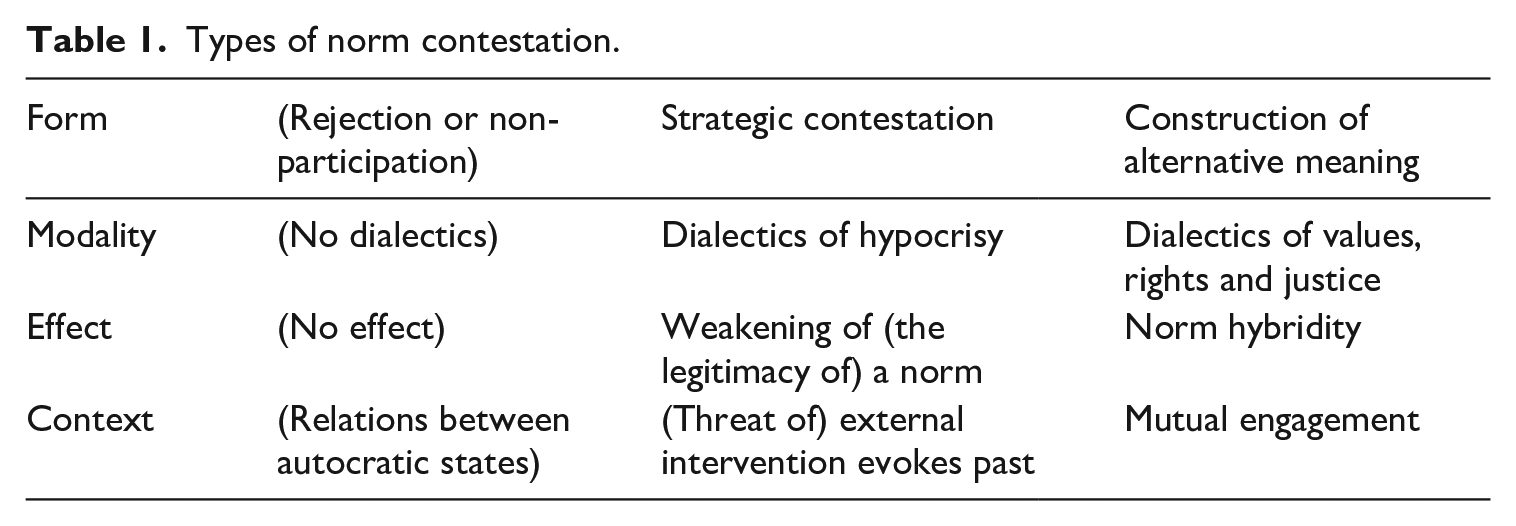
This definition usefully describes contestation as a practice whereby Wiener distinguishes between two forms of contestation: objection to a norm, a reactive form of contestation, and critical engagement with a norm, a proactive form of contestation. However, this definition focuses on the practice itself and so does not directly speak to the politics of contestation. It brackets out the modalities and effects of contestation, as well as the context in which it emerges. This article sets up a typology of three forms of contestation, identifying their respective modalities and effects, before delving into identity as a context for contestation.
The first form of contestation is mere rejection of a particular norm, for example the rejection of the norm of democracy. Such a rejection means that the norm is not universally accepted, but it also does not set up an alternative and so leaves the dominant meaning of a norm essentially uncontested. Thus, there is no real effect on the norm of democracy. It might be difficult to find such a case in the current international scenario since, as mentioned in the introduction, most states define themselves as democracies or republics with various adjectives. No state calls itself the ‘Autocracy of X’. It should be mentioned here that there is also the possibility of non-participation in the global contestation of democracy of any type of state, democratic or not, postcolonial or not. Similar to rejection, this has no effect on the norm of democracy. It might be an indication of both, the norm of democracy doing extremely well or doing extremely bad. Non-participation would particularly appear in an overall non-democratic world, or between autocratic states.
The second form of contestation is strategic. A strategic contestation does not contest the meaning of a norm but rather takes it as a given while either hiding own behavioural defections from the norm or discursively naming and shaming defections of others from a given norm. This contestation functions as an instrument to stigmatize the other for purposes that might not always be directly related to democracy, but might rather serve to harm the ‘normative power’ of the other in a geopolitical confrontation. This modality foregrounds what could be termed ‘dialectics of hypocrisy’ in which two sides stigmatize the other by pointing to respective double standards, as for example the US and Soviet Union did during the Cold War. The norm of democracy mainly serves as a means here, the contestation is about hypocritical behaviour of either self or other in relation to the existing meaning of a norm. As the norm is strategically employed and hypocrisies exposed, the legitimacy of a norm might be damaged and the norm weakened.
The third form of contestation is the construction of alternative meaning. This is the strongest form of contestation of a norm, as it constructs new meaning within the normative structure of the international. This modality foregrounds ethical-political or moral dialectics, evoking local/global values or ‘the language of rights, law and the universal concept of justice’. 26 It creates hybridity in a norm and so arguably strengthens a norm. Hybridity emerges not in the sense that states superficially add various ‘adjectives’ to democracy, but rather as an outcome of an intensive engagement and process of staking out meanings, by localizing global norms, 27 or by inserting new dimensions (e.g. social justice as the Arab uprisings proposed) in the global meaning of a norm. It can also mean that historical justice or anticolonial dimensions of democracy become gradually more integrated. As a result, democracy becomes a norm which is more responsive to local and regional, historical and cultural contexts, more legitimate, widely shared and practiced, and, therefore, more resilient.
These forms of contestation do not take place in a vacuum. In her ground-breaking book on ‘The Invisible Constitution of Politics: Contested Norms and International Encounters’, Antje Wiener has suggested that ‘cultural differences often either remain unnoticed or turn into the invisible yet influential elephant in the room’. 28 Charmine Chua has argued in this respect that with its focus on ‘cultural background information’, the contestation turn has neglected ‘the violent tension that characterizes the relation between the abstract standards and norms of global civil society, and the multiplicities of difference that trouble its narrative’. 29 Indeed, another elephant in the room – the spectre of the past – has remained often invisible in the contestation literature, maybe rooted in the assumption that there has been a rupture with that past. Gurminder Bhambra has recently highlighted an important gap in this respect, Europe (or the West) ‘regarding colonial history as “the past” and of little consequence to its understandings in the present and, on the other hand, formerly colonized countries living with the ongoing legacies of that past as a present reality’. 30 Jabri has also pointed out that the colonial legacy has not disappeared, ‘but re-emerges in memory traces, narratives, and the hermeneutic positioning of the postcolonial self’. 31 Similarly, Epstein has reminded us that postcolonial perspectives are ‘characterized by a different temporal sensibility . . ., one that is marked . . . by the persisting presence of the (colonial) past’. 32 How does this persistent present of the past impact contestation though?
Identity is crucial here as it sets both a context for normative interventions in the international and is also impacted by it. Identity is typically seen in constructivist IR as ‘the images of individuality and distinctiveness (“selfhood”) held and projected by an actor and formed [. . .] through relations with significant “others.”’ 33 Identity is thus centred in selfhood, but also co-constituted by self-other relationships. However, when conceptualizing identity, we should also take historical experiences seriously and how they are made sense of through collective memory, 34 but are also enacted in international encounters with significant others (such as the US in the case of Iran). Felix Berenkoetter has argued that the nation-state is an ‘entity constituted through a narrative designating an experienced space (giving meaning to the past) intertwined with an envisioned space (giving meaning to the future)’. 35 As ‘memories serve as temporal orientation devices that make the past meaningful by providing a sense of where “we” come from and what “we” have been through’. 36 From the perspective of a postcolonial state, identity and collective memory of the past might play a role in modality of contestation. In particular, it is likely that the more there is external intervention or a (perceived) threat thereof, the more the memory of the traumatic past is evoked in identity, and the more the form of contestation might be strategic and focused on dialectics of hypocrisy. Conversely, the less present is the spectre of the past, the more likely becomes an engagement beyond postcoloniality in a dialectical engagement on values, rights and justice (Table 1).
Types of norm contestation.
Sites of encounter
Contestation takes place at many sites of encounter, may they be situated at the multilateral, bilateral or domestic level. Choosing sites of encounter at these various levels in particular time periods implies a decision on whom we are listening to or not. Who is, as Charmine Chua has termed it, the “‘postcolonial subject’, the subject borne of resistance against colonial rule and claiming a right of access to the political terrain that is the international?” 37 As already highlighted in the introduction, Iran intervenes in the global contestation of the norm of democracy on a dual level of external resistance and internal dissent. Iranian state representatives and opposition or protest movements might hold different interpretations or knowledges of what democracy means. Both are crucial to understand how Iran intervenes into the normative structure of the international; waves of protests represent an intervention into both the domestic and the international. Indeed, Global IR might have possibly neglected to focus on ‘forms of local agency and difference that lie beyond the institution’ of the state and are so ‘made unthinkable’. 38
This article looks at three such sites, that is, the UN General Assembly (UNGA), the Arab uprisings/Iranian protest movements and EU-Iranian engagement (Table 2).
Sites of encounter.

The UN General Assembly is an obvious choice as it is the only site where states can directly deliberate on norms in the international society of states. In contestations at UNGA, representatives of states present discursive positions and this section of the article is based on a discourse analysis of all speeches of the Iranian Presidents or Foreign Ministers at the opening session of the United Nations General Assembly from 1997 to 2022, focused on the question how they are framing democracy in these speeches, and how they relate these concepts to other norms and Iran’s identity. 1997 is chosen as the starting date as it has been the Khatami Presidency which sought to transform the ‘Iranian state from one founded on traditional principles of authority reliant on opaque personal networks, to one founded on accountable institutions, dependent on transparent due process and the rule of law. This was to be a project which would fulfil the democratic promise of the Islamic Revolution’ 39 – a promise which was blocked when, in 2005, Mahmoud Ahmadinejad won on a populist, neoconservative agenda. In 2009, he was re-elected under allegations of substantial vote rigging which triggered the Green Movement’s protests in 2009. Between 2013 and 2021, the more moderate Hassan Rouhani was President of Iran, followed by the conservative Ebrahim Raisi. While these presidents have not represented the whole spectrum of political forces in Iran, the variance in their political agendas do show how the Islamic revolution ‘continues to be constructed and reinvented’. 40
The second site of contestation is the internal discussion in Iran how to react to the Arab uprisings since their onset in 2011. This is of particular interest as the Iranian Green Movement in 2009 preceded the uprisings and has represented a proactive contestation of the norm of democracy within Iran, as have the recurring protest waves since 2017. Whilst the inquiry at the UNGA as a site of contestation focuses on the official state representation only, this site of contestation opens up to contestation within Iran. Thus, this incorporates both secondary literature and discourse analysis of speeches of Iranian state representatives, opposition and protest movements.
This third site of discursive and behavioural contestation focuses on the Iranian engagement with the European Union. This encounter or site of contestation is of particular interest as it did include discussions specifically devoted to democracy and human rights. This analysis starts with the onset of the engagement in 1992. Since it is impossible to have access to the proceedings of these engagements it relies on the analysis of sources which either recall (memoirs, communiques), describe (newspaper articles) or analyse (academic literature) it.
Before proceeding with this analysis, however, Iran’s identity as an overall context for its normative interventions in world politics is shortly addressed.
Iran’s identity and the question of democracy
As Anoush Ehteshami has pointed out, ‘one cannot underestimate the role that history has continued to play in the country’s self-perception and also in determining its role in the Westphalian system of states’. 41 In its modern history, Iran has been subject to foreign colonial/imperial interventions, may that be from Russia, Britain or the US in collaboration with repressive puppet regimes. The resistance which grew against this – arguably from the Tobacco Revolt of 1891–1892 onwards – ‘gave a far more precise definition to the emergence of Shi’ism as an insurrectionary movement against colonialism’. 42 Rooted in this tradition, the revolution which culminated in 1979 ‘reverted to Shi’i-Islamic anti-imperialist imageries as the dominant narrative of the Iranian self’. 43
Vis-à-vis the weight of this past, independence and democracy became central pillars in the Islamic Republic of Iran’s identity. Shabnam Holliday has suggested that the ‘use of democracy as an integral part of Iranian national identity stems from the Constitutional Revolution and the National Front. In both these cases, democracy was a means of expressing anti-imperialism and asserting Iran’s independence as a nation’.
44
Furthermore, Arshin Adib-Moghaddam has pointed out, the two grand ambitions of Iran’s modern history, democracy and independence, were central to the Islamic revolution as well. The mainstream of the Iranian revolutionaries imagined an authentic Iranian-Islamic order that would be accountable to the people and independent of the dictates of external powers. It was the culmination of the protest of Iranians against both their political masters and the international system enveloping their country, as expressed in their revolutionary slogans, na sharghi na gharbi jomhuri-ye islami [neither east nor west, only the Islamic republic] and esteghlal, azadi, jomhuri-ye islami([independence, freedom, Islamic republic]. Iran, even today, is in many ways trying to bridge the tensions between these slogans.
45
Homeira Moshirzadeh has identified three meta discourses in Iran’s externally-oriented identity, that is the discourses of independence, justice and resistance which are all connected to democracy and freedom, from colonial/imperial interferences and towards self-determination to the Iranian people. The discourse of independence was already evolving and used in Iran’s role conception before 1979, dominated by the idea of being an ‘independent country’. 46 After the revolution, this discourse became institutionalized in the constitution which rejects oppression, colonialization and foreign control. The second meta discourse is related to the central role justice plays in Islam and Shiism in particular. It has translated into support for liberation movements, so giving it a transnational dimension, as well. It also relates to democracy in the international system, that is in its institutions such as the UN or the practices and double-standards of major powers in it. Finally, the discourse of resistance stems directly from the revolution and, as Moshirzadeh has pointed out, some ‘of the elements of the discourse of resistance were absorbed into the official discourse of the Islamic Republic’, even though over the course of time, ‘most of these elements of the movement discourse were substituted by elements of a state discourse in which the legitimacy of international institutions such as international law, international organizations, diplomacy, etc. was recognized’, 47 specifically during the Rafsanjani and Khatami presidencies which sought to normalize Iran’s international relations. Indeed, while in the early 1980s, Iran’s identity has been described as ‘messianic’, 48 after the Iran-Iraq war and towards the end of the Cold War, Iran went through a ‘transition to pragmatism and the establishment of the pragmatist line in Iran’s foreign policy’, 49 even though – as Arshin Adib-Moghaddam has argued – ‘the Islamic Republic has not discarded certain core principles formulated during the revolutionary period’. 50
Within Iran, the revolution’s promise of democracy has only partially realized. As Anoush Ehteshami has pointed out, the ‘reality is that the Islamic republic has held dozens of popular, and meaningful, elections since its birth in 1979’, but there is also a ‘parallel universe of power’ against which waves of protests have turned. Nonetheless, the ‘political system has proved itself to be remarkably flexible and also resilient. This is, paradoxically, partly a result of the multi-centred structure of the political order and partly because no credible alternative (opposition) movement has emerged from within to challenge the Islamic regime in its entirety’. 51 Nonetheless, continuing waves of protest in Iran ‘reveal the salience and obduracy of radical political subjectivity in Iran’. 52 Indeed, as Hamid Dabashi has argued, resistance against external imperialism on one hand, and internal dissent, on the other, are what makes Iran today ‘both weak and powerful’ 53 at the same time and a crucial case to observe for the research question of this article. This is not to say that the Iranian case is anomalous; rather, it is an example of a broader historical phenomenon which this article proposes to study in an heuristic endeavour which is situated in an emerging literature and seeks to develop a framework which can then also be applied to study other cases.
Contestation at the UN General Assembly
The ‘shadow of the past’ remains always present throughout all observed Iranian UN speeches and is framed as directly related to Iran’s quest for independence and democracy. It also fixes its relationship to what is produced as the most relevant other in this story, the United States. In the period at the UN General Assembly observed here, Iranian presidents do not reject the norm of democracy (Iran does reject several related human rights norms, see Table 3 below), but rather engage in two principal forms of contestation. They strategically use the norm to highlight hypocrisies of the US in relation to the norm of democracy in a dialectic which hides Iran’s own hypocrisies; and they proactively construct alternative meaning on the norm of democracy in two ways: they set up a close link between democracy, political independence, non-interference and territorial sovereignty; and they link democracy to inalienable rights within the framework of the UN itself.
Iran’s ratification status of key UN Human Rights Conventions.
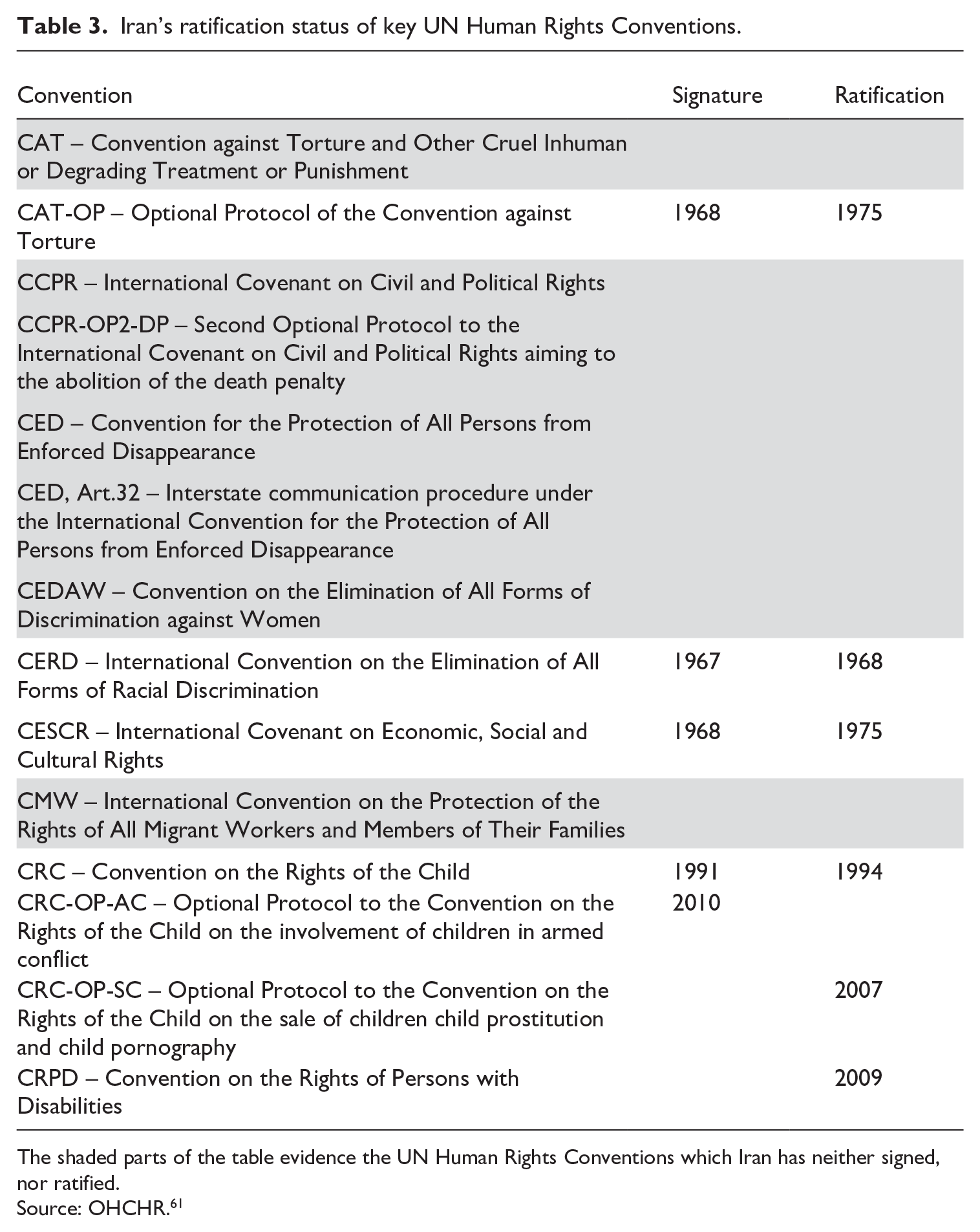
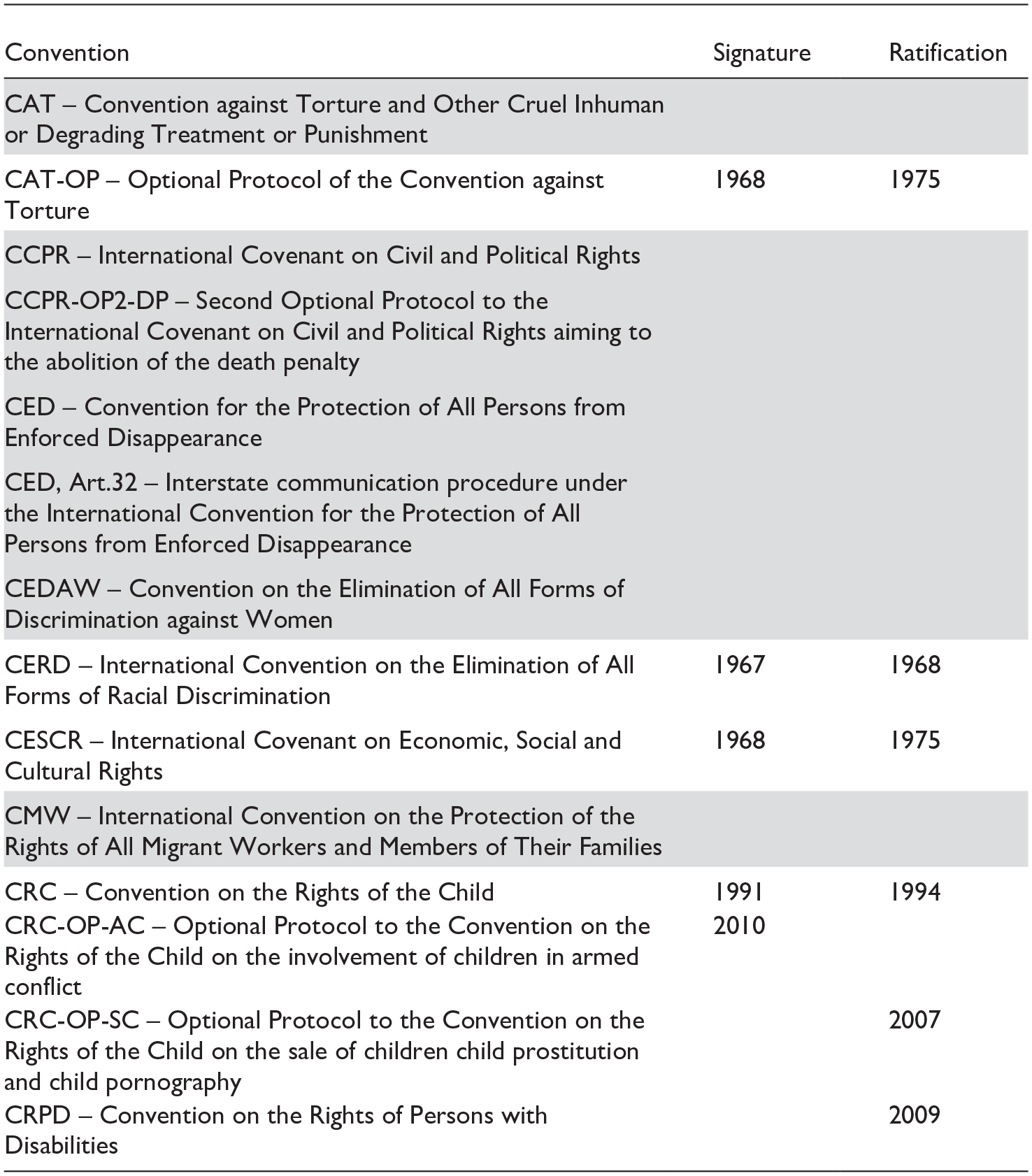
The shaded parts of the table evidence the UN Human Rights Conventions which Iran has neither signed, nor ratified.
Source: OHCHR. 61
Strategic contestation
To start with strategic contestation, throughout all presidencies, the US is represented as the most significant other to Iran, portrayed as a hypocritic actor which continues colonial-imperial policies under a democratic disguise. This is particularly pertinent during periods of intense crisis in the Iranian-US relationship. Mahmoud Ahmadinejad’s speeches principally engage in this strategic form of norm contestation. In 2009, he argued that ‘the time has passed for a group of people who believe that they alone can define concepts such as democracy and freedom . . . while simultaneously violating the very principles to which they claim to aspire’.
54
Western democracy and human rights promotion is mainly framed as a pretext to occupy sovereign states. The ‘occupation of other countries under the pretext of freedom and democracy is an unforgivable crime’,
55
a new type of colonialism ‘disguised under slogans for change’.
56
Hassan Rouhani, in 2020, connects the murder of George Floyd in the US with what oppressive policies vis-à-vis Iran: We instantly recognize the feet kneeling on the neck as the feet of arrogance on the neck of independent nations. For decades, the valiant Iranian nation has paid a similar high price for its quest for freedom and liberation from domination and despotism.
57
Also Ebrahim Raisi represents US policies as a continuation of colonialism, imperialism and ‘maximum oppression’, 58 paraphrasing the US ‘maximum pressure’ campaign against Iran. The dialectic of criticizing US hypocrisies while hiding Iran’s became maybe most evident during the women-led protests in Iran in 2022, when Raisi pointed to ‘the double standards of some governments in the field of human rights’ whereby Iran is criticized on ‘an incident under investigation in the Islamic Republic of Iran’ – thus referring only implicitly to the brutal murder of Zhina (Mahsa) Amini through the Iranian morality police and ignoring the ongoing state violence against internal women-led protests – while there is ‘deathly silence’ when it comes to the violation of rights of indigenous communities or refugees in Western states. 59 This strategic employment of human rights norms seeks to make visible/hearable human rights violations of the other whilst making invisible/silent human rights violations of the self.
Construction of alternative meaning
Regarding the construction of alternative meaning, the content of contestation varies depending on which faction is in power. In his speeches at the UN, President Mahmoud Ahmadinejad stressed the spiritual or religious elements of Iran’s normative framework of governance. Regarding rights, Ahmadinejad mainly focused on exposing Western human rights violations, but at times also spoke about his conception of rights. Regarding women rights, for example, he framed women mainly as ‘mothers’ and ‘wives’. 60 It should be added here that Iran has so far rejected to sign the Convention on the Elimination of All Forms of Discrimination Against Women (see Table 3 on the Ratification Status of Key UN Human Rights Conventions for Iran).
In contrast to this, Presidents Mohammad Khatami and Hassan Rouhani, while also placing Iranian democracy in an Islamic framework, put more emphasis on citizenship rights. In 1998, Khatami highlights that Iran ‘is a nation which pioneered in the East the establishment of civil society and constitutional government in the course of its contemporary history’. 62 Khatami’s foreign minister Kharrazi highlighted Iran’s ‘democratic Islamic principles’, including constitutional liberties, the rule of law, democratic norms and institutions, culture of participation, the role of people in government, full accountability of public officials, transparency, civil society, tolerance and a pluralistic society. 63 In Rouhani’s speeches at the UN Iranian democracy is a constantly recurring theme. He does not only evoke citizens’ rights, but also the ‘ballot box’, and links elections to stability, arguing that the ‘realization of democracy consistent with religion and the peaceful transfer of executive power showed that Iran is an anchor of stability in an ocean of regional instabilities’. 64 Similarly, Rouhani argues that ‘(h)uman and civil rights, along with a quest for justice and Islamic values, have been at the heart of the principal demands of the Iranian people for their more than 150 years of struggle, particularly during the Islamic revolution of 1979’. 65 Raisi instead links democracy with social welfare infrastructures in Iran. 66
Whilst the concrete content of democracy thus varies across factions, what does appear in the speeches of all representatives across factions, is that democracy is directly linked to political independence, non-interference and territorial sovereignty. Iran is presented as a pioneer in the struggle for political independence. Khatami pointed out in 1998, that Iran is a nation which ‘has been at the forefront of the struggle for independence and against colonialism’.
67
In this quest, Iran is continuously portrayed as non-surrendering, steadfast, resilient or the ‘land of perseverance and independence’.
68
Democracy is framed as an essential part of the Iranian struggle against colonialism, foreign oppression and interference. This is evident in the following quote from President Rouhani’s 2020 speech at the UNGA which is quoted at length as it highlights how the issues of democracy, freedom and political independence, sovereignty and non-interference are linked, including from a historical perspective that still reverberates in how the presence (and in this case US sanctions) is interpreted: Life is hard under sanctions. However, harder, is life without independence. Political freedom at home is important. We—as the oldest democracy in the Middle East—are proud of our people determining their destiny and will not trade domestic freedom with foreign interference. Democracy is the sovereign right of a nation, and not the right of interference by an outsider—let alone a terrorist and interventionist outsider that remains captive to the illusions of 19 August 1953, when its predecessors overthrew the only democracy in the Middle East though a coup d’etat.
69
Furthermore, democracy is also directly linked to territorial integrity. Rouhani argues that a return to ‘dismemberment’ would lead again to colonialism and dependence. 70 Thus, what is shared by all factions is a proactive intervention regarding the global contestation of the norm of democracy which stresses the anti-colonial and self-determining aspects of democracy. This dimension, it should be noted, is always present, independent of the overall (geo)political context, and thus a persistent intervention of Iran in the meaning of democracy.
Finally, when it comes to the international community as constituted by the United Nations, the issue of democracy at the UN level is mentioned, but with less frequency, principally in the Khatami and Ahmadinejad periods, less in the Rouhani and Raisi periods. In 2000, for example, Khatami argues that the ‘structure of power in our contemporary world must be reformed, and this requires submission to democratic rule at the international level’. 71 Ahmadinejad specifically highlights what he sees as a colonial dimension in this. He argues that ‘not one of the more than 50 Islamic countries, encompassing more than 1.2 billion people, has a permanent seat in the Security Council; nor does Africa’. 72 The issue does not return in the Rouhani or (so far) Reisi period. What does dominate the Rouhani and Reisi periods, however, is the nuclear issue which is presented as a question of Iran’s right to develop nuclear technology, framed as an ‘inalienable right’. 73
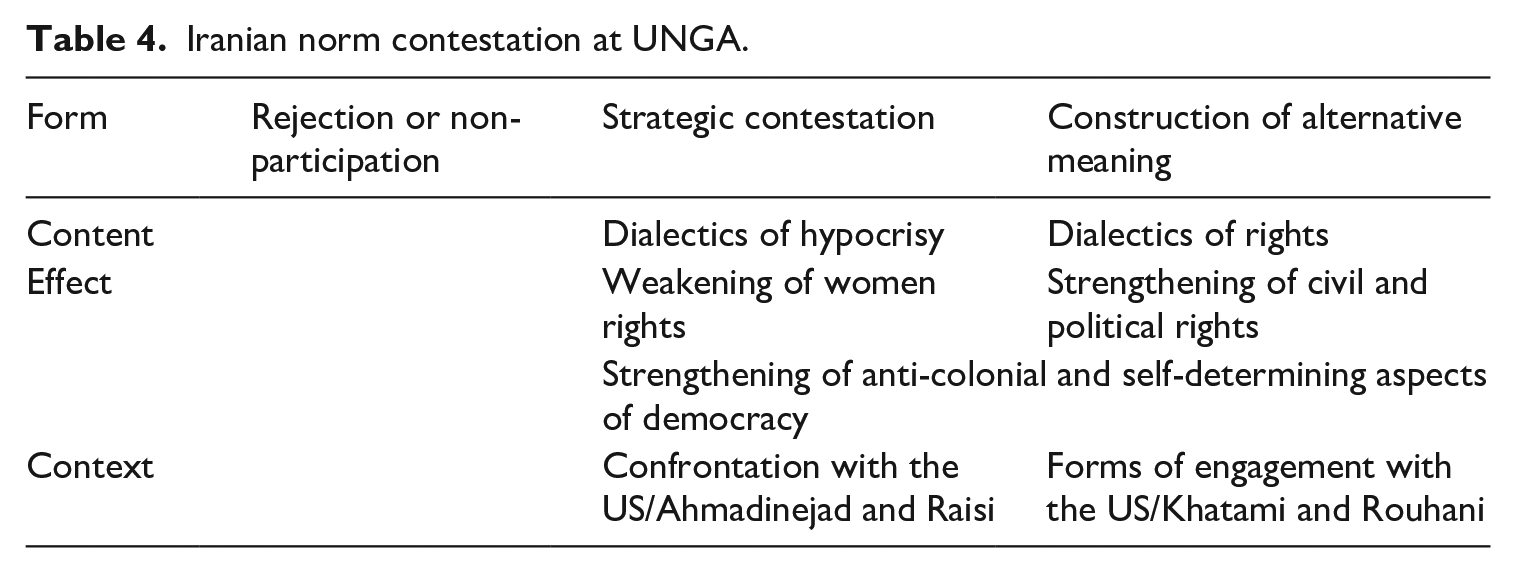
In conclusion, the overall pattern that is visible in this arena of contestation is that the Ahmadinejad and Raisi presidencies give more space to strategic contestation, whilst the Khatami and Rouhani presidencies engage mainly (but not only) in the construction of alternative meaning. This pattern in terms of the form of contestation correlates with respective geopolitical contexts dominated by confrontation with the US in the Ahmadinejad and Raisi periods and by some form of engagement in the Khatami and Rouhani periods. At the same time, what remains a constant for all presidencies is that – under the shadow of the past which is frequently evoked by all presidents – the norm of democracy is closely linked to the norm of political independence, non-interference, territorial integrity and sovereignty. Thus, whilst the concrete content of democracy and the form of contestation varies by president, they all stress the anti-colonial and self-determining aspects of democracy (Table 4).
Iranian norm contestation at UNGA.
Iran and the Arab uprisings/protests in Iran
Turning to the encounter of Iran with the Arab uprisings and protests in Iran itself, one can look into various levels of interventions in the contestation of the norm of democracy, that is the official state/government contestation and the contestation of various political forces within Iran, including the opposition and internal protest movements.
Strategic contestation
With the Arab uprisings, representatives of the Islamic Republic of Iran sought to establish a dominant reading of these events which would associate them with the Islamic Revolution of 1979, while disassociating them from the 2009 Green Movement. While one of the key figures of the Green Movement, Mir Hossein Mousavi, called for solidarity demonstrations in Iran framing the Green Movement as one of the first instances of the Arab uprisings, 74 Supreme Leader Khamenei framed them an ‘Islamic Awakening’, 75 relating them to Iran’s Islamic Revolution, as they initially brought Political Islam to power (the Muslim Brotherhood in Egypt and Ennahda in Tunisia) and potentially strengthened the anti-imperialist drive in the region. As Payam Mohseni has pointed out, the term ‘Islamic Awakening’ is ‘not new within Iranian discourse, and has been commonly used to describe the contemporary resurgence of Islamic identity and ideology within the Islamic world’. 76
But whilst Iran could be framed as supportive of various uprisings in the Arab world, the case of Syria has been different, as Damascus has been one of Iran’s most important allies in the region since the Iraq-Iran war in the 1980s. Syria has thus been the hard test of the Iranian contestation of the norm of democracy and will, therefore, be more deeply inquired here. Unlike the other Arab uprisings, the Syrian uprisings were not framed as an ‘Islamic Awakening’, but rather construed as an attempt of ‘foreign interference’ to break one of the pillars in the ‘axis of resistance’ (mehvar-i moghavemat), a framing which has denied the Syrian revolution any independent agency. Khamenei argued that ‘the reality about the Syrian issue is that the arrogant front is intent on destroying the chain of resistance in the region, which exists in the neighbourhood of the usurping Zionist regime’. 77 Thus, while Iran initially mainly provided funds to Damascus, as the conflict intensified and as ISIS began to emerge as a major force with the fall of Mosul, Iran sent the Quds Forces of the Iranian Revolutionary Guard Corps (IRGC) to support the Syrian military, alongside Hezbollah. Bajoghli and Keshavarzian have argued that the ‘prospect of sectarian chaos and an armed and organized extremist Sunni entity on its western border was unacceptable to Teheran’. 78 Syria was framed as an example of what foreign intervention could lead to also in Iran: state disintegration and civil war. The uprising in Syria became securitized and independence, territorial integrity and sovereignty were prioritized. Thus, contestation has been strategic in that independence (and with it territorial sovereignty and non-interference) has taken absolute precedence; a move which has served to justify Iran’s support for the violent suppression of a local movement for democracy in Syria.
Construction of alternative meaning
This framing, whilst supported and adopted also by parts of the opposition, has, however, been contested, for example by Iranian academics. Furthermore, waves of protests re-emerged in Iran since 2017 onwards and were also met by regime violence. These protests did not only represent a forceful intervention in how democracy is defined in Iran, but also in the global meaning of democracy given the large global attention to them.
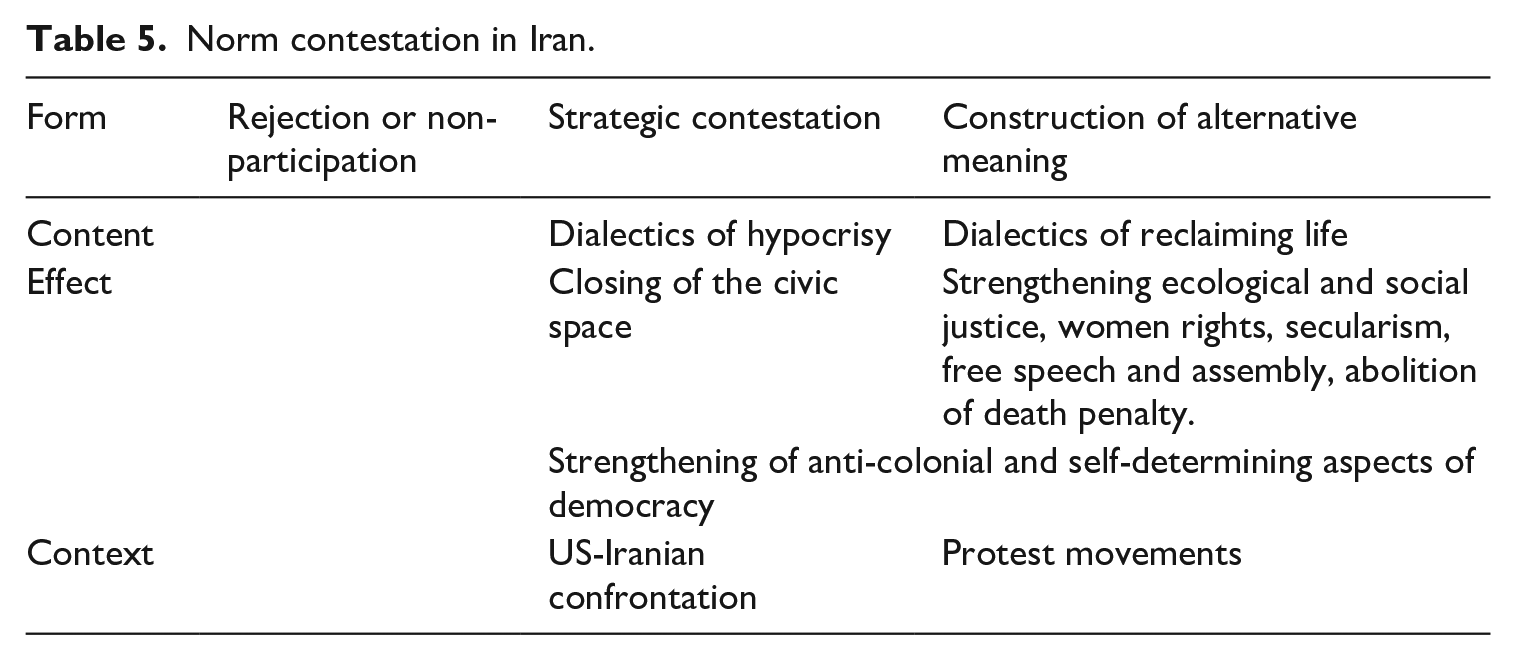
In terms of content, the protests have been anti-regime, for social and ecological justice, women rights and secularism, as well as rights such as free speech and assembly, the abolition of the death penalty and the release of political prisoners. As Asef Bayat has pointed out, the slogan Jin, jiyan, azadi/Zan, zendegi, Azadi (women, life, freedom) has created a collective claim not only for women, but also ‘young people, students and teachers, middle-class families and workers, residents of some rural and poor communities, and those religious and ethnic minorities (Kurds, Arabs, Azeris and Baluchis) who, like women, feel like second-class citizens’. It is a dialectic of reclaiming life and recognizes ‘women as transformative actors and the “woman question” as a strategic focus of struggle’ vis-a-vis a regime which is seen as a ‘colonial entity’. 79
Strategic contestation
Whilst these protests are a construction of alternative meaning, they took place in an overall context of a US-Iranian ‘dialectic of hypocrisy’ in which both the US and Iran strategically employed the norms of political independence (Iran) and democracy (US) against each other in geopolitical showdowns, occluding the path towards the construction of various alternatives as proposed by moderates or protest movements. An example of this is the outbreak of protests in 2020, after US President Donald Trump had ordered the extrajudicial killing of Iranian General Qassem Soleimani in Iraq which led to the subsequent shooting down of a Ukrainian passenger plane by Iran and the outbreak of protests, notably at Amirkabir University in Teheran. Trump issued a statement in which he supported ‘the brave, long-suffering people of Iran: I’ve stood with you since the beginning of my Presidency, and my Administration will continue to stand with you’.
80
This played into the dialectics of Teheran which – as Anoush Ehteshami has pointed out – has turned the spectre of foreign-supported regime change into ‘a powerful political tool for control, and when necessary the silencing of dissent. At the first signs of protest the regime sees hands of “biganehgan” (those external to us, or simply put foreigners) agitating what they depict as the simple people’.
81
The result of stated US support for protests and the dialectics it triggers has been the closing of spaces to produce alternative meanings of democracy. Indeed, protesters have sought to move against this dialectics of hypocrisy which undermines their own agency and demands. Students of Amirkabir University in Tehran published a statement in 2020 which moved against both US ‘imperialism’ and Iranian ‘despotism’: Dear Iranian people! The only way to escape the current crisis is to return to a policy based on people’s democratic rights, a policy that will not rush into the arms of imperialism due to its fear of despotism, and one that in the name of resistance and fighting against imperialism will not legitimize despotism. Yes, the only way to reject and escape the current situation is to equally reject both despotism and imperialism.
82
Thus, what we can see in conclusion in this arena of contestation is that there are two dialectics at play: an Iranian-US dialectics of hypocrisy which closes spaces for producing alternatives, and an internal Iranian dissent which rejects this dialectic, opposing both imperialism and despotism, and strengthening social and ecological justice, women rights, secularism, free speech and assembly and the abolition of the death penalty. Instead, the support to the self-determining aspects of democracy against foreign interference is strong within Iran at all levels (Table 5).
Norm contestation in Iran.
Iran and the EU: engaging on norms
The European Union and Iran have held three rounds of dialogues: the ‘critical dialogue’ from 1992 to 1997, the ‘comprehensive dialogue’ from 2000 to 2004 and the ‘high level dialogue’ from 2016 to 2020.
Strategic contestation
In 1992, after Hashemi Rafsanjani had become President of Iran, the EU lifted economic sanctions and began a process of normalizing relations with Iran, initially in the framework of what it termed a ‘critical dialogue’, so giving it a different label than the usual ‘political dialogue’ with third countries. The main aim was to determine if confidence between both sides could be established. The dialogue, held twice per year, focused on human rights, the fatwa issued against Rushdie, terrorism, Iran’s position on the Middle East Peace Process (MEPP) and weapons of mass destruction. The dialogue was largely still dominated by strategic contestation which is evident in the exchange on the fatwa to which Iran responded by outlining European hypocrisy. Mousavian, then Iranian Ambassador to Germany, argued that Rushdie’s book was seen as a ‘blatant violation of the rights of hundreds of millions of world Muslims’, further stating that Europe deprives Muslim women ‘of the freedom to wear her religious attire of choice’, and that in Europe homes of Muslims are set on fire, while ‘in the heart of Europe, tens of thousands of Muslims in Bosnia-Herzegovina are massacred and dragged through blood and dirt’. 83 At the same time, first seeds of constructive engagement were also sown. While Iran still refused to let the United Nations Special Representative (UNSR) for Human Rights enter Iran despite massive criticism from the EU, it ‘began slowly to set up institutions reflecting at least awareness that the unremitting international criticism needed to be addressed’, such as the Islamic Human Rights Commission in 1995, the Committee on Human Rights in the Iranian Parliament and the Department of Human Rights in the Foreign Ministry. In 1996, Iran allowed the UNSR to visit the country once, while denying a second visit arguing that his report had been abused by ‘certain countries’ in order to ‘reinforce their prejudgment and pre-drawn conclusions’ against Iran. 84
The shared construction of alternative meaning
With the election of Mohammad Khatami as President (in office 1997–2005), relations between the EU and Iran improved markedly. Khatami did not only launch the idea of a Dialogue between Civilizations, but also sought to improve rule of law and human rights in Iran throughout his terms. The comprehensive dialogue with the EU was a constructive means for Khatami to back that agenda through an international link. The labelling of the new dialogue as ‘comprehensive’ clearly marked a change to the previous ‘critical dialogue’ and already incorporates the idea of the mutual construction of alternative meaning. It focused on human rights, non-proliferation, terrorism and the MEPP, but also fight against drug trafficking, refugees, trade, transport and energy. The human rights dialogue, organized in four roundtables, initially constituted the gravitational point of this dialogue. This time, the EU set clear benchmarks, including the ratification of international human rights instruments and cooperation with international human rights mechanisms. Four round tables took place between 2002 and 2004, with participants coming from the government, judiciary, parliament, civil society (also international NGOs), the Iranian Islamic Human Rights Commission, as well as academics and experts.
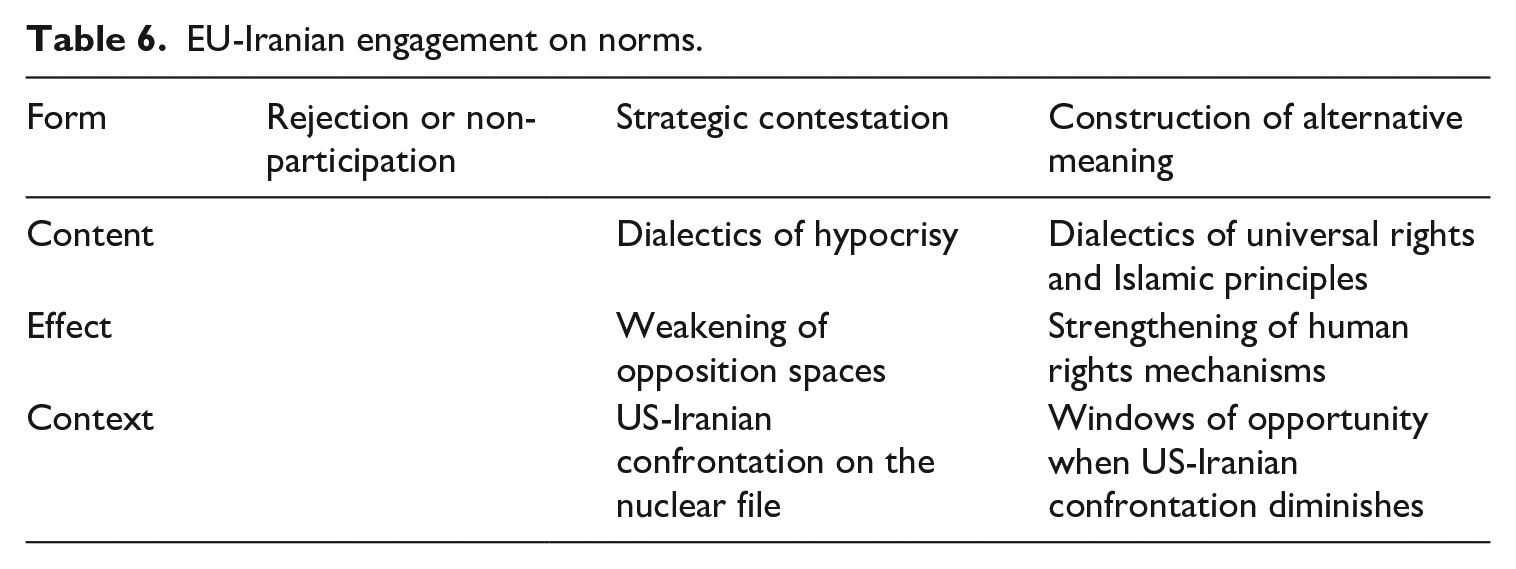
The first roundtable focused on discrimination (of women and religious minorities) and torture, with the EU exerting pressure on Iran to ratify the UN Convention on the Elimination of All Forms of Discrimination against Women (CEDAW) and the UN Convention against Torture and its Optional Protocol. The Iranian Parliament passed a bill banning torture which was, however, rejected by the Guardian Council. As Kaussler has pointed out, only in 2004, after renewed pressure from the EU, the head of the judiciary announced the ban on the use of torture in obtaining confession, with the bill being passed again by the Parliament and approved by the Guardian Council. 85 The Parliament also decided to accede to CEDAW which, again, was rejected by the Guardian Council. In the first round table, the EU also voiced its strong opposition to the death penalty and particularly cruel forms of its execution such as stoning which was then banned by the judiciary. The second round table focused on the rule of law, whereby ‘Iranian Human Rights experts and activists used Islamic principles and argument to advocate the advancement of the notion of the rule of law’, focusing on ‘republican Islam: an Islam that takes democracy and rights seriously’. 86 The third round table dealt with the right to freedom of expression in the context of which the EU demanded Iran to let the Special Rapporteur back in and let the Majlis introduce an amendment to the Press Law. 87 The third roundtable also discussed the right to development. What is remarkable in these rounds is that they highlighted how this dialogue amounts to a constructive bilateral contestation – in the sense of shared construction of meaning – which encouraged various actors in Iran to produce an alternative in very concrete terms which could bring Islamic principles, universal human rights, as well as particular needs from/rights of developing countries together. This constructive contestation in a shared ‘moral language’ which melts universal rights with local conceptions of justice was, however, interrupted with US-Iranian geopolitics having a come-back which led the EU to shift its priority from human rights to the nuclear file.
Strategic contestation
In 2006, the Iranian nuclear file was referred to UN Security Council, while EU High Representative Javier Solana continued to engage with Iran. With UN Resolution 1929 in June 2010, the EU imposed tougher sanctions on Iran. Only after the JCPOA was concluded in 2015 and the EU lifted the nuclear-related sanctions on Iran, did a window open again to engage with Iran on human rights issues. First exploratory meetings were held in 2016 and 2017, whereby the ‘first discussion focused on both sides’ human rights policies and concerns and touched, inter alia, on the following issues: the death penalty, women’s rights, cooperation with UN mechanisms and adherence to international conventions’. 88 As Adebahr and Mittelhammer have pointed out, in 2016 ‘a brief window of opportunity opened’, 89 as the nuclear programme was off the table. This window, however, closed again almost immediately when US President Donald Trump exited the nuclear deal in 2018 and entered a policy of ‘maximum pressure’ on Iran, including secondary sanctions on the EU. The space for discussing human rights shrank, and the US-Iranian dialectics of hypocrisy evidenced in the previous section set the tone in which Iran suspended all talks on human rights with the EU and began to engage in strategic contestation again. It presented a letter to the EU in which it pointed out that the EU itself has been violating the human rights of Iranians in Iran and in Europe. It argued that the sanctions on Iran cause ‘intentional damage on the health and wellbeing of the Iranian people, particularly children, women, the elderly, and persons with disability’, detailing that in cases the lack of access to vital medicine has caused death, including of children. In Europe, it points out how Iranian migrants are discriminated against on the basis of their nationality. 90 Thus, Iran reverted back again from the proactive form of constructive contestation through the production of shared meaning to the strategic contestation of European hypocrisies.
In conclusion, in this arena of contestation, there has been a rather profound engagement on the norm of democracy between both sides in which a shared construction of alternative meaning occurred through melting universal rights with the needs of developing countries and local Islamic conceptions of justice which had the potential to operate its way out of the shadow of the past. Indeed, in this arena, the anti-colonial or self-determining aspects of democracy which appear so dominant in the other arenas, has been less present as there was no threat of foreign intervention from the side of the EU. At the same time, power remains evident in this engagement, as Europeans are not respectively engaging on improving migrant rights for example in the framework of this dialogue (Table 6).
EU-Iranian engagement on norms.
Conclusions
Examining Iran’s intervention in the global contestation of the norm of democracy in three sites of international encounters, this article has found that Iran engages in various forms of norm contestation. An evident pattern is that during times of geopolitical confrontation between the US and Iran, the form of contestation is mainly strategic, focused on a dialectics of hypocrisy. This harms the global norm of democracy in the international community, where it appears as a geopolitical device, and within Iran, where spaces of the opposition and protest movements shrink. At the same time and throughout the overall period observed, we also see a strengthening of the global norm of democracy through hybridity: in the merging of universal rights with Islamic principles and rights of developing countries; the strengthening of advocacy for ecological and social justice, women rights, secularism, free speech and assembly and the abolition of death penalty; and for the anticolonial and self-determining aspects of democracy. Thus, from a constructivist perspective, we can see a clear evolution of the norm of democracy in this case study. Whilst such an evolution of the norm from its mainly liberal form towards global hybridity implies a decline of the liberal order, it also shows that the latter does not necessarily come with a decline of the norm of democracy as such. More hybridity in its substance will increase the legitimacy and resilience of the norm. Whilst it is true that authoritarianism in Iran remains resilient, the opposite drive for democracy remains extremely pertinent, as well, as continuous waves of protests have shown.
Beyond its constructivist findings, this article also speaks to the larger question important for postcolonial studies of ‘what failure of form, what failure of the postcolonial lies here?’ 91 Iran intervenes at the intersection of the norm of democracy on one hand, and the norms of sovereignty, territorial integrity and political independence on the other. The intersection appears as dilemmatic because it can either perpetuate or exit what could be termed the postcolonial condition in the normative structure of world politics. What appeared at the invisible elephant at this intersection is the shadow of the past. Reproduced and employed by both by government officials and the opposition, it has been hanging over all three sites of encounter. The article has found that geopolitics make the spectre of the past always present, reproduce the past as present, and fix Iran’s relationship with the US, while also securitizing the space for protest movements in Iran in a dialectics of hypocrisy in which the governments of both the US and Iran strategically employ the norms of political independence (Iran) and democracy (US) against each other in geopolitical showdowns. This dialectic contributes to perpetuating this postcolonial condition and is – indeed – resisted as such by the protest movement. At the same time, this article has also pointed to ways out of the postcolonial condition. In EU-Iranian engagement there have been windows of opportunity which have temporarily put the past to rest, and increased the space of moderate and/or reformist voices in Iran.
Besides its overall contribution to the constructivist-postcolonial literature on norms in IR, this article is also situated in the area studies literature on Iran. Whilst the understanding in IR often is that Iran rejects the notion of democracy, the area studies literature shows a more complex picture and this article contributes to it by highlighting that democracy as a signifier is important for Iran. It does not reject democracy, but it sees democracy as valuable insofar as Iranians, and not someone else, is able to define it. Iran and Iranians contest the notion of democracy on various levels, advancing their own interpretation of it, in the context of Iran’s history. In doing so, Iran constitutes itself ‘in relation to international society, and more specifically in relation to other members of that society’. 92
Iran is, as pointed out before, a case which is most likely to fit the theory presented here. It would indeed be important to further develop this research programme and situate it in the identities rooted in diverse histories, experiences of colonialism, as well as positionality of states in the current world order. There are states which had been empires and experienced various forms of colonial violence, such as Iran, China or Turkey, but not settler colonialism and genocide, as for example Namibia or Libya. There are medium powers, such as Brazil or South Africa, which have experienced colonialism, but today do not fear external intervention, as opposed to Iran or Libya. There are democratic postcolonial states such as Namibia and South-Africa, as well as autocratic ones such as Egypt. It is, therefore, likely that we will find diverse dialectics in these cases, but also similarities, for example regarding social justice or the anticolonial and self-determining aspects of democracy.
Footnotes
Acknowledgements
The author would like to thank Riccardo Alcaro for including me in the Italian-Iranian track II engagement he has organized in Rome and Teheran in 2019, and for his generous feedback on an earlier version of this article. She would also like to thank the discussants in the panel on Revisionisms in IR at the Annual Convention of the Società Italiana di Scienza Politica at the University of Genova, Barbara Pisciotta and Gabriele Natalizia, for their thoughtful discussion of this article. Views are of the author only
Funding
The author received no financial support for the research, authorship, and/or publication of this article.
