







Abstract
Italy became the only G7 member to join the Belt and Road Initiative (BRI) in 2019. Yet, 5 years later, Rome announced its withdrawal, a rare reversal among BRI participants. This article examines Italy’s abrupt policy shift. We argue that Italy’s decision to join and subsequently exit the BRI reflects a strategy of institutional hedging, in which states calibrate their institutional engagements based on evolving assessments of institutions’ relative capacities, relevance and risks. Initially, Italy perceived the BRI as an unparalleled opportunity in the absence of viable Western alternatives, with anticipated risks deemed limited. As rival institutions emerged, Italy’s relevance in them increased, and the risks of participation in the BRI grew, Rome recalibrated its stance at different stages from institutional hedging to balancing. By examining this case, we demonstrate how small and middle powers navigate institutional rivalry between great powers. Theoretically, this article contributes to the literature by developing an analytical framework of institutional hedging, an existing yet insufficiently elaborated concept, to account for small and middle powers’ behavior regarding international institutions.
Introduction
Italy shocked the world by joining the China-initiated Belt and Road Initiative (BRI) in 2019 as the only G7 country to do so despite US objections. 1 Its endorsement of the BRI was perceived as a triumph for Beijing, casting a shadow over its relations with Europe. 2 Five years later, however, the country left the BRI when its Memorandum of Understanding (MoU) expired in March 2024. Moreover, Italian defense minister Guido Crosetto commented on Rome’s decision to join the BRI in 2019 as ‘an improvised and atrocious act’. 3 As Italy planned to exit the BRI, it signed the MoU of the new US-led India-Middle East Europe Economic Corridor (IMEC) at the 2023 G20 summit, together with other participants including India, the United Arab Emirates (UAE), Saudi Arabia, France, and Germany. 4 The IMEC ‘is seen as a counter to the BRI’, and Italy’s being part of the MoU is ‘seen as a move confirming its imminent exit from the BRI’. 5
Italy’s abrupt reversal in its approach to BRI poses an empirical puzzle. According to liberal institutionalism, once embedded in an international institution, states are inclined to stay due to the benefits of cooperation and the costs of exit. 6 However, the US is the most frequent withdrawer from international organizations. 7 Research shows that the US exits from international organizations to minimize financial burdens. 8 Also, exit threats are employed by powerful states as a means for institutional reform. 9 Yet, these logics can hardly apply to middle and small powers, raising the question of what drives a middle or small power, such as Italy, to suddenly alter its stance toward an institution like the BRI?
To answer this novel question, we make use of Mie Oba’s newly invented and hardly tested concept of institutional hedging, which refers to ‘a state’s hedging behavior that manifests through multilateral institutions and a type of hedging effort performed by states that use multilateral institutions, instead of traditional military measures, to compete for power and influence in international politics’. 10 We argue that apart from institutional balancing, 11 which usually adopts the perspective of great powers and focuses on states’ competition for influence, institutional hedging is more often used by small and middle powers as they tend to pursue short-term benefits rather than long-term influence. By delving into their choices, we add to the scope of the institutional balancing literature.
This article also contributes to the study of great-power competition. Literature on great-power rivalry traditionally focuses on the interaction between the dominant and the rising powers. As middle powers’ alignment can tilt the balance of great-power rivalry, they have become a key arena where big powers compete for influence. Their reaction to the US-China rivalry has received growing attention. 12 It is argued that secondary and tertiary states use ambiguous signaling to hedge in US-China strategic competition. 13 However, their choices in US-led and China-led institutions are not explored. In the institutional environment, the existing literature mostly discusses strategies of great powers, such as cooptation. 14 This article contributes to the big-power rivalry literature by recognizing and analyzing the agency and institutional behavior of middle and small powers in shaping the balance of big-power rivalry in an institutional environment.
Empirically, Italy’s participation in and withdrawal from the BRI offer a compelling within-case study for analyzing institutional hedging, as it captures the strategic shifts of a middle power over a condensed timeframe. In only 5 years, Italy joined and left the BRI, illustrating policy shifts from bandwagoning to hedging and eventually balancing.
The remainder of this article is structured as follows. The first section situates Rome’s behavior within the broader literature on states’ decisions to join or exit international institutions and puts forward our analytical framework based on Oba’s institutional hedging. The second and third sections apply the framework of institutional hedging to the case of Italy’s decision concerning the BRI, which is followed by a concluding section.
Hedging in contested international institutions
Hedging is a middle ground between balancing and bandwagoning. Among them, balancing refers to states’ actions to counteract the influence of a more powerful state or alliance to preserve a balance of power in the international system 15 ; bandwagoning refers to ‘joining the stronger coalition’, 16 driven ‘by the opportunity for gain’. 17 Therefore, ‘bandwagoning is a form of positive feedback’ driven by the prospect of rewards, while ‘balancing is a form of negative feedback’. 18 Balancing and bandwagoning, achieved through making alliances, incur the tension between entrapment and abandonment. 19 Hedging addresses the dilemma by adopting a middle ground between balancing and bandwagoning, allowing a state to manage rewards and risks in uncertain situations. Hedging is defined as ‘a state behavior that attempts to maintain strategic ambiguity to reduce or avoid the risks and uncertainties of negative consequences produced by balancing or bandwagoning alone’, 20 an alternative to balancing and bandwagoning in describing small and middle powers’ response to great powers. 21 Abundant research identifies middle powers and small states’ hedging behavior in international policies and uses hedging to analyze their policy choice. 22 Apart from the realistic perspective, hedging is also perceived through the lens of the English School and applied to the analysis of the Association of Southeast Asian Nations’ (ASEAN) hedging between the US and China. Wicaksana and Karim identify ‘elite diplomatic culture and great power management’ as ASEAN’s primary institutions that help preserve the organization’s relevance in great-power competition. 23
However, it is insufficiently nuanced to account for states’ behavior of opting in and out of international institutions, as in Rome’s changed attitude toward the BRI. A new theoretical framework is needed to identify the conditions and reveal the mechanisms that trigger policy change in middle powers and small states.
The framework of ‘institutional balancing’ situates the balance of power in an institutional context. Kai He defines institutional balancing as ‘countering pressures or threats through initiating, utilizing, and dominating multilateral institutions’, including inclusive and exclusive balancing. 24 Institutional balancing, as a state’s behavior in international institutions, is a function of polarity and economic interdependence. 25 In a bipolar international system, states adopt exclusive balancing between two blocs and inclusive balancing within the blocs. The motive of institutional balancing is to counter the institutional influence of a powerful state. For instance, it is contended that China adopts institutional balancing ‘to challenge the US-led international order’. 26
In this model, middle and small powers face an either-or choice between blocs as in the Cold War era. However, in most cases, these states may join institutions of both blocs and retain strategic ambiguity to maximize interests and reduce risks under uncertainty. For instance, Saudi Arabia, also a middle power, 27 is both a beneficiary of the BRI and a participant in the IMEC. It benefits from the institutions without endangering its autonomy, as may occur in bandwagoning. 28 Meanwhile, it does not need to forsake membership in either institution, as is the case in balancing. In this case, the strategy Saudi Arabia adopted is institutional hedging.
Built on He’s model of institutional balancing, hedging behavior in international institutions is conceptualized as ‘institutional hedging’, a clear definition of institutional hedging can hardly be found except in Oba’s contribution, where it is defined as ‘a type of hedging effort performed by states that use multilateral institutions, instead of traditional military measures, to compete for power and influence in international politics’. 29 Oba, though putting forward the concept of institutional hedging, does not identify the conditions that trigger middle and small powers’ institutional hedging behavior or reveal the mechanisms under which institutional hedging works.
In a very recent study, Liu and Jia explore the concept of institutional hedging and offer a rather different definition. They define institutional hedging as a strategy adopted by regional organizations to mitigate tensions generated by big-power rivalry. 30 In this definition, the actors of institutional hedging are regional organizations rather than middle and small powers in Oba’s conceptualization.
This article treats middle and small powers as the actors of institutional hedging following Oba’s definition. Using Oba’s definition, we study the hedging behavior of a state in an institutional context. Middle and small powers usually face institutions led by two big powers in a bipolar system or in the context of strategic competition, where they have, in theory, three options: to participate exclusively in institutions led by either one of the big powers (bandwagoning/balancing); to engage in the two sets of institutions to increase their benefits and reduce risks (hedging). The latter constitutes institutional hedging, the participation of more than one institution of similar functions to maximize interests in a middle ground between balancing and bandwagoning. This article seeks to identify the independent variables that propel a state to change its behavior within institutions and the mechanisms through which the variables work.
We argue that: (1) a state’s institutional choice depends on its perceived rewards and risks associated with institutional participation, as the literature suggests that balancing, hedging, and bandwagoning are adopted to pursue rewards and manage risks; (2) the rewards motivate a state to participate in an institution and adopt institutional bandwagoning, while the risks dissuade a state to participate in an institution and seek institutional alternatives and by doing so, adopt the strategy of balancing; (3) the state’s expectations of rewards from an institution is the function of the institution’s capacity and the state’s relevance in it.
Institutional capacity is ‘defined as the capability of an institution to set and achieve social and economic goals through knowledge, skills, and systems’. 31 In international development, institutions’ primary goal is to channel financial resources into development projects. For instance, the International Development Association’s (IDA) goal is ‘providing development financing and cross-sector support that responds to complex global challenges and helps countries improve their development outcome’. 32 While stating its mandate, the IDA also emphasizes in the same paragraph that ‘It provides a substantial and stable source of funding that IDA countries can rely on to fund their development priorities’. 33 Thus, in international development, capacity is mostly determined by the financial resources an institution can pool. Stronger institutional capacity brings higher rewards for the participating states. Admittedly, institutional capacities are shaped by strategic competition as great powers compete for influence within institutional frameworks and extend their influence via international institutions. For theoretical simplicity, we do not further explore the mechanisms driving their actions but accept institutional capacities as given at a certain stage. In this article, institutional capacities are assessed relatively, comparing the BRI with its institutional alternatives. Institutional alternatives, derived from the concept of outside options in the literature on institutional change, are external venues to which a member reallocates resources other than the examined institution. 34 They may weaken a participant’s bond with an institution 35 and redirect resources elsewhere. In this article, institutional alternatives are the Western counterparts of the BRI.
If institutional capacity decides the size of the cake, the relevance of a member state determines its share. For infrastructure initiatives, especially those focusing on connectivity, a country’s relevance is determined by its geographic location and strategic position, which vary by initiative, as well as other factors such as the country’s economic strength, political stability, and existing infrastructure, which remain constant across initiatives. Thus, we examine Italy’s geographic and strategic relevance in infrastructure initiatives.
Following the above propositions, a middle or small power would: bandwagon with an institution given that the institution promises high relative rewards and poses low relative risks compared with its institutional rivalry, as this better aligns with the state’s interests; balance against the institution if it promises low relative rewards and poses high relative risks, since membership in the institutional rivalry is a better choice; hedge in high-reward, high-risk or low-reward, low-risk scenarios, as it remains uncertain which institutional option can maximize the state’s interests (see Figure 1). In cases of high rewards and risks, a state is attracted by the benefits of participating in the institution, though dissuaded from full commitment by the associated risks, and thus adopts a hedging strategy to control risks. In the second scenario, the state tends to stay in the institution, as the associated risks are low, while seeking opportunities elsewhere to compensate for the low rewards.
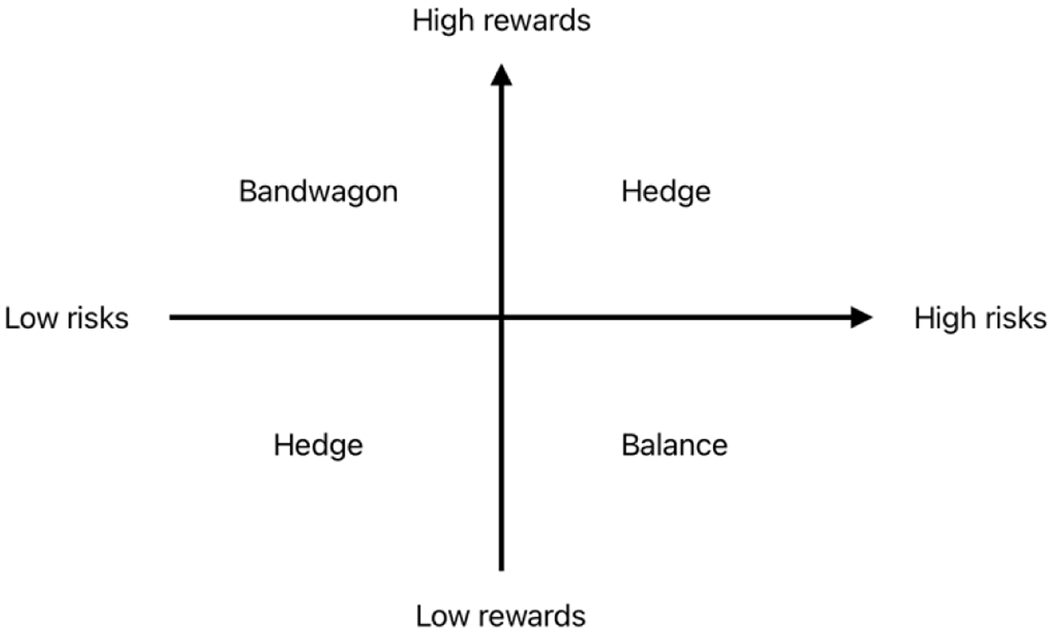
Middle and small powers’ behavior vis-à-vis an institution.
Since high rewards are expected only if a state participates in an institution with high capacities and is highly relevant in it, in operation, we first evaluate the institutional capacities. If low institutional capacities are identified, the institution’s expected rewards are low regardless of the state’s relevance in the institution. If high institutional capacities are observed, we evaluate the state’s relevance. If the state’s relevance in an institution is high, the expected rewards from participating are high; otherwise, the expected rewards are low (see Figure 2). Individual cases are differentiated by comparison and thus measured in relative terms.
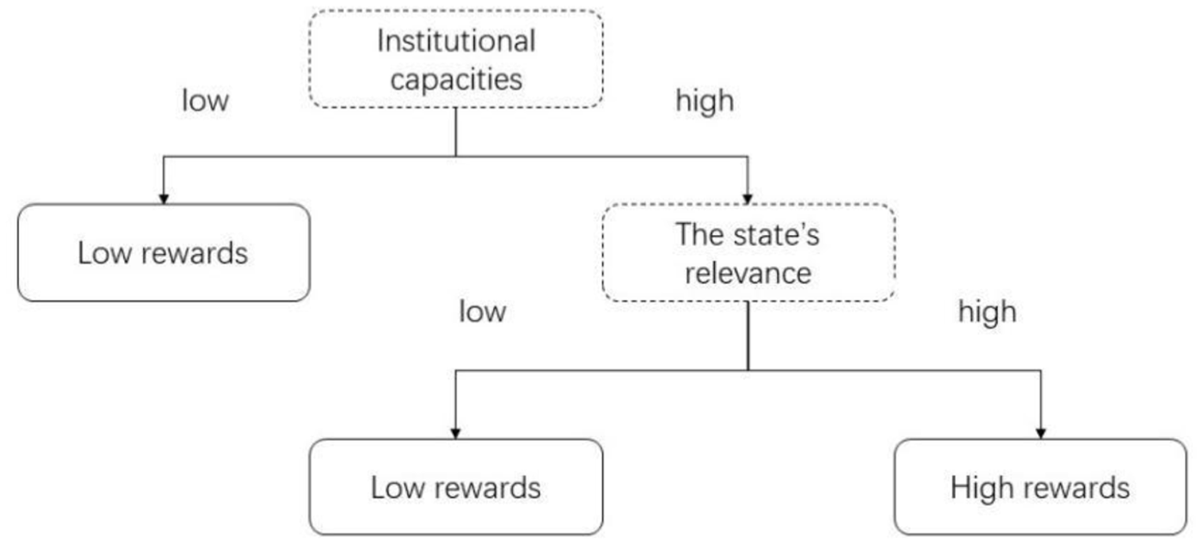
Institutional capacities and the state’s relevance.
In this article, we test our proposition through the case of Italy’s participation in the BRI in 2019 and its exit in 2024. International institutions are ‘sets of rules that stipulate the ways in which states should cooperate and compete with each other’. 36 Therefore, the BRI and its Western counterparts, stipulating ways of cooperation between participating states with dialogue mechanisms, are qualified as international institutions, and our analytical framework of institutional hedging applies to the case of Italy’s behavior toward the BRI. We employ process tracing to observe the mechanisms that drive Rome’s strategic change within a single case. Following the guidelines outlined by Bennett and Checkel, 37 we begin by developing our hypotheses specified above and observing the temporal unfolding of key events to assess if they align with our expectations. We examine the period from Italy’s signing of the MoU in 2019 to the notification of its exit from the BRI in 2023, as they are critical junctures ‘at which an institution or practice was contingent or open to alternative paths’. 38 To circumvent biases in evidentiary sources, we gather evidence from a diverse array of sources, including primary sources such as documents released by the Italian government, the US government, and EU agencies, as well as secondary sources like academic literature and media reports. We also evaluate the evidence against alternative explanations.
Joining the BRI
In this section, we compare the capacities of the BRI and its Western counterparts, evaluate Italy’s relevance in the BRI, analyze Rome’s expected rewards and risks of signing the MoU, and apply them to our analytical framework of institutional hedging.
Capacities of the BRI vis-à-vis its Western counterparts
At the juncture when Italy signed the MoU, Western alternatives to the BRI remained mostly fragmented 39 and ‘dwarfed in scope and scale’. 40 The EU-Asia Connectivity Strategy was announced in 2018 as a response to China’s BRI. 41 However, it relies on the existing tool of the Neighbourhood, Development and International Cooperation Instrument (NDICI), which targets non-EU countries, except for additional funding from the private sector. 42
The Blue Dot Network (BDN), seen as a move to rival the BRI, was launched in November 2019 by the US, Japan, and Australia after Italy’s BRI accession, 43 though its conception may have occurred earlier. The BRI had been in operation for 6 years before Rome decided to join the initiative. By March 2019, Beijing had signed 173 documents with 125 countries and 29 international organizations under the BRI on cooperation in the Digital Silk Road, standard harmonization, tax, intellectual property, judiciary, and energy. 44 The BDN was newly launched in 2019, and by the writing of this article, has only limited members, which include seven governing members and three network members. 45 The BRI also outperforms the BDN in lending capacity. The BDN is a certification system and thus has ‘no lending function of its own’ 46 ; the BRI, however, released RMB117 billion investment to participating countries from 2013 to 2019. 47 Therefore, the initiative falls short of a viable alternative to the BRI. Similarly, the EU also faced the problem of fragmentation in infrastructure development, with its ‘countless initiatives’ implemented ‘at both EU and national levels’ 48 before the Global Gateway was launched in 2021.
Given the BRI’s large relative capacity compared with its Western counterpart of the BDN, it had the potential to provide greater rewards.
Italy’s relevance in the BRI
Since the BRI demonstrates higher institutional capacities than its Western counterparts, we examine Italy’s relevance in the BRI through our analytical framework. Around the time of joining the BRI, Italy was perceived as having strong geographic and strategic relevance within the BRI. Geographically, Italy’s location was expected to lend the country significant relevance in the BRI. Michele Geraci, then Undersecretary of State at the Italian Ministry of Economic Development and ‘the architect of Italy’s Belt and Road participation’, said in an interview that ‘the geography hasn’t changed’ compared to the time ‘when Marco Polo went to China’. 49 In the same interview, Geraci also said, ‘Italy is still as it was 100 years ago, at the center of the Mediterranean. Italy is still the country that has the longest coastline, so it’s open to trade, port, so it’s a natural terminal of the Belt and Road now as it was during Marco Polo time’. 50 In May 2019, the Chinese Embassy in Italy hosted an event on the BRI and Sino-Italian cooperation, attended by Italian representatives from the government, the parliament, political parties, and think tanks, who claimed that Italy had a geographic advantage in the BRI. 51 Beijing and Rome agreed to invest in Italian ports of Trieste, Genoa, and Palermo as transportation hubs for Chinese goods heading to Europe. 52
Strategically, Italy’s BRI participation facilitated Chinese investment in Europe and advanced the associated narrative. It was deemed ‘small but important steps to extend China’s new position of systemic power into the EU’, and helped Chinese media construct the notion that BRI projects were welcome by the West, demonstrating normative, discursive, and commercial significance. 53 Also, ‘Italy’s traditional role as terminal of the maritime Silk Road’ 54 rendered its accession to the BRI more relevant in the narratives of the initiative.
Expected relative rewards
With the BRI’s strong institutional capacities and Italy’s relevance in it, substantial benefits are expected from the BRI; meanwhile, the BRI’s Western counterparts have yet to reach substantial scale. Thus, high relative rewards were expected from participating in BRI according to our analytical framework, which we support with evidence in this section.
After the Euro debt crisis, Italy looked to China for investment and trade opportunities to facilitate its economic recovery. 55 From 2016 to 2018 (the year before Rome signed the MoU), Italy’s bilateral trade of goods with the Chinese mainland, especially its exports, registered unimpressive growth (see Table 1). During the same time, Italy’s exports to China were also less than those of major European countries such as Germany, France, and the UK. 56
Italy’s bilateral trade with China 2016–2018.
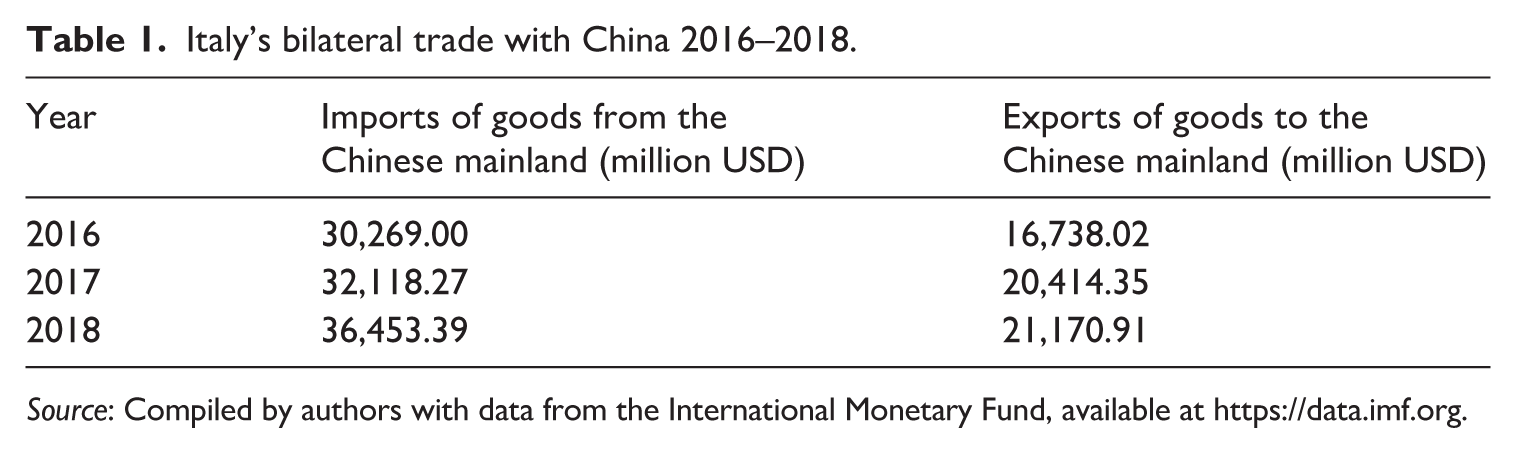
Source: Compiled by authors with data from the International Monetary Fund, available at https://data.imf.org.
Meanwhile, the international trade environment was not in Italy’s favor. Italy’s exports still focused on traditional sectors that overlapped with China’s strong manufacturing, which undercut its exports to China. 57 Moreover, ‘Brexit and hostile trade policies’ adopted by the Trump Administration toward the EU further cast a shadow over Italy’s export industries. 58 These propelled Rome to seek opportunities externally. Before joining the BRI, ‘the Italian government anticipated significant opportunities to export its goods to China and had high expectations to realize them’. 59 Giuseppe Conte, then-Italian prime minister, acknowledging the unfavorable conditions, said that Rome wanted to take the opportunity of the BRI to rebalance trade, gain competitive advantages over other European countries, and grow Italy’s economy. 60
The BRI provided an opportunity for Italy to access China’s huge market, 61 and the country was further encouraged as it witnessed the success of Greece’s Port of Piraeus after the Chinese company COSCO held a controlling stake in the port in 2016. 62 Matteo Renzi, Italy’s then-prime minister, deemed the BRI an opportunity for Italian ports. 63 Zeno D’Agostino, the president of the Trieste port authority, was confident that Chinese investment would return the port of Trieste ‘to the logistical role for Europe that it had for the old Austro-Hungarian empire’. 64 Eventually, both the Port of Genoa and the Port of Trieste signed an MoU with China Communications Construction Company (CCCC) under the broader BRI MoU. 65 However, Italy received less Chinese FDI than Germany, France, and the UK. 66 Signing the MoU was envisioned to give the country more advantage over other major European countries in attracting Chinese investment at a difficult time when the European Central Bank was to cease its bond-buying program and Rome was looking to Chinese investors. 67 By taking the lead among Western countries to join the BRI, Rome expected to replicate the UK’s first-mover advantage in the Asian Infrastructure Investment Bank. 68 Also, the unexpected collapse of the Polcevera Viaduct propelled Rome’s decision to join the BRI. In August 2018, the bridge collapsed during a rainstorm, killing 43 people. This transportation disruption at the Port of Genoa placed significant pressure on local and national authorities to respond, creating an ideal moment for announcing the BRI, which pledges investment in the port’s infrastructure. 69
Rome set high expectations of rewards from joining the BRI, which agrees with the BRI’s institutional capacities and Italy’s relevance in it. During domestic economic stagnation, the prospect of accessing the vast Chinese market and Chinese investment through participation in the BRI prompted Rome to sign the MoU.
Expected risks
The economic opportunities expected from joining the BRI come with risks of dependence on China and spoiling the relationship with the US and the EU.
With the rise of Chinese development finance, controversies have been growing over recipient countries’ economic stability. Chinese loans have been accused of being ‘rogue aid’ 70 much earlier than Rome’s accession to the BRI, and recently the discourse on ‘debt-trap diplomacy’ 71 has become popular among policy analysts and scholars. US officials also routinely accused Chinese infrastructure projects of being predatory and creating debt traps. 72 The risk of debt distress is especially alarming for Italy as the country’s government debt amounted to 134% of its GDP in 2018, the year before its BRI accession. 73 Therefore, from a Western perspective, receiving Chinese investment may undermine Italy’s debt sustainability. However, debt sustainability risks were much less conspicuous before Italy acceded to the BRI. The Chinese loans renegotiated or written off between 2017 and the end of 2019 amounted to USD 17 billion, much less than the USD 78.5 billion recorded between 2020 and March 2023. 74 Also, 6 sovereign defaults occurred between 2017 and 2019, significantly less than the 14 defaults from 2020 to 2023. 75
Another risk of joining the BRI for Italy was its potential influence on the country’s relationships with the EU and the US. ‘Both the EU and the US expressed concern when Italy decided to join the scheme’. 76 Before Italy signed the MoU, the US National Security Council tweeted that ‘Endorsing BRI lends legitimacy to China’s predatory approach to investment and will bring no benefits to the Italian people’, 77 overtly showing its opposition. After Italy’s BRI accession, the White House immediately voiced its criticism, 78 fearing that ‘Italy could become a Chinese Trojan horse in Europe’. 79
Likewise, the EU also expressed concerns over Rome’s move. Before Italy formally endorsed the BRI, an EU spokesperson required all member states to ‘ensure consistency with EU law rules and policies and to respect EU unity in implementing EU policies’. 80 Under these circumstances, Italy’s move was believed to ‘undermine Brussels’ efforts to overcome divisions within the EU over the best approach to deal with Chinese investments’, 81 and damage its credibility among European allies. 82 However, the criticism was targeted more at Rome’s disregard for a European position than its BRI accession per se, as German Economy Minister Peter Altmaier showed major EU member states’ intentions to sign the MoU on the BRI as a group after Italy’s move. 83
Rome expected the influence of its BRI accession on its relationship with the EU and the US to be limited, as it ‘failed to perceive the shifting ground both in Washington and Brussels by the time the MoU was signed’. 84 Italian Deputy Prime Minister Luigi Di Maio reassured that there was ‘nothing to worry about’ regarding Italy’s BRI participation, and that he would emphasize that Italy remains a steadfast ally during the upcoming US visit. Similarly, the finance minister Giovanni Tria said that the country did not receive backlashes from the US and described its action as signing ‘just a memorandum of understanding’. 85 Italian officials also dismissed the criticism. For instance, Manlio Di Stefano, undersecretary at the foreign ministry, claimed that as other EU countries had signed commercial agreements with China, the criticism of Italy seemed ‘a little hypocritical’. 86 Giuseppe Conte, the Italian prime minister, stressed the economic benefits of the BRI and assured the parliament that BRI accession would not undermine Italy’s Euro-Atlantic alliance. 87
At this stage, Rome envisioned great relative rewards and limited risks from the BRI. This predicts the behavior of institutional bandwagoning by our analytical framework. Rome’s joining the BRI agrees with the theoretical expectation.
From staying to leaving the BRI
Rome’s decision on the BRI continued to be challenged after its accession. Changes took place both in Italy’s domestic politics and international environment that incrementally led to its final withdrawal from the BRI. By the end of 2023, Rome notified Beijing of its intention to withdraw from the BRI when the MoU expires in March 2024. 88 However, speculation about Italy’s decision emerged earlier. The first sign of Italy’s exit was believed to be the meeting between Italian Prime Minister Meloni and US President Biden in July 2023. 89 The meeting produced a joint statement in which the two countries agreed to increase their ‘collective assessment, preparedness, deterrence and response to economic coercion’, 90 which implicitly refers to China. In this section, we compare the relative capacities of the BRI and its Western alternatives, identify Italy’s relevance in the institutions, and analyze Italy’s rewards and risks from the BRI.
Capacities of the BRI vis-à-vis its Western counterparts
The US and the EU took various actions in response to the BRI. In November 2019, the US launched the Blue Dot Network (BDN) with Japan and Australia, 91 to ‘differentiate BRI projects with higher standards in areas such as marketization, sustainable debt, and environmental protection’. 92 The BDN, considered a counter initiative to the BRI, 93 is a certification system that ensures infrastructure projects meet high environmental and social standards and, by that means, attracts investments. 94 However, it lacks funding 95 and fails to gain the expected influence.
Built on the BDN, the G7 launched an initiative of Build Back a Better World (B3W) in 2021, 2 years into Italy’s BRI membership. The US government alluded to strategic competition with China at the beginning of the official news release on the B3W, 96 affirming that the new initiative was a counter to the BRI. However, the initiative encountered challenges in mobilizing private-sector investment and achieving members’ consensus on the prioritized investment location. 97
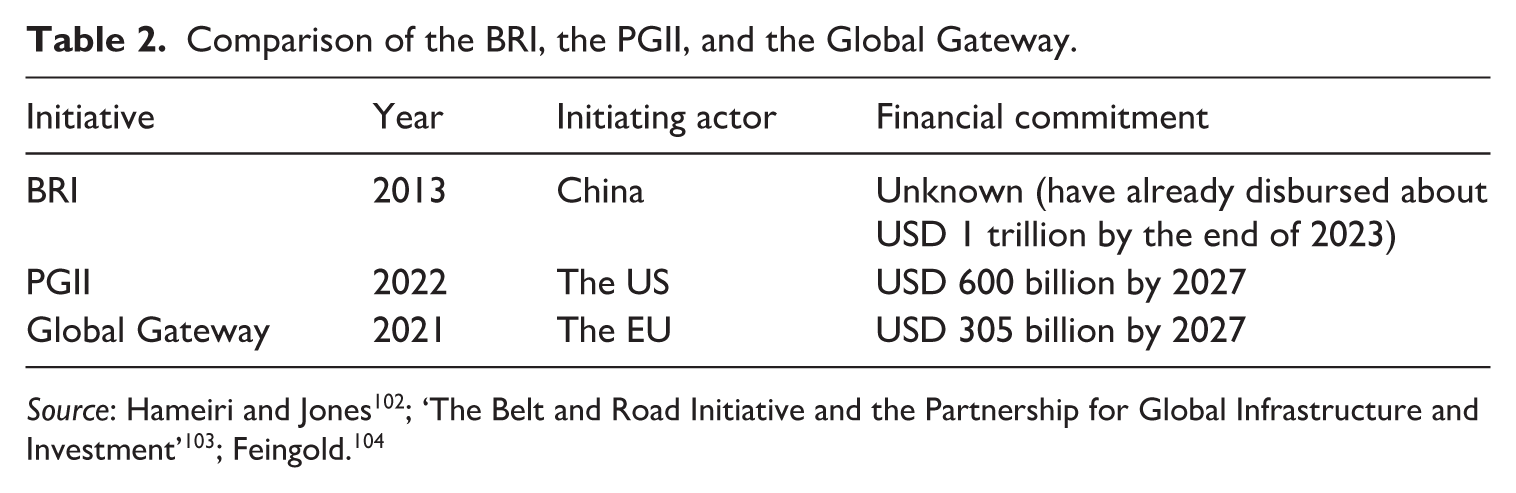
The B3W was repackaged into the Partnership for Global Infrastructure and Investment (PGII) in June 2022 at the G7 summit with more detailed objectives and plans than its predecessor. 98 The PGII pledged USD 600 billion in infrastructure investment by 2027. 99 It also incorporates the EU’s Global Gateway, 100 announced in 2021, with a financial commitment of up to USD 305 billion. 101
Table 2 compares the scales of the BRI, PGII, and Global Gateway. The committed capital of the PGII and Global Gateway adds to about USD 900 billion, which is comparable to the disbursed investment of the BRI. Still, it remains uncertain how the financial commitment will materialize.
Comparison of the BRI, the PGII, and the Global Gateway.
Since Italy joined the BRI, several alternatives to the BRI have emerged, such as the PGII, the Global Gateway, and the UK’s Clean Green Initiative. These initiatives are considered Western alternatives to the BRI. Italy is a participant in the PGII and the Global Gateway, which pledged large-scale financial resources, though still less than the BRI’s investment.
Italy’s relevance in the Western-led institutions
As the Western equivalents of the BRI emerged to demonstrate strong institutional capacities, we examine Italy’s relevance in them, as is dictated by our analytical framework. Geographically, Italy’s position in the Mediterranean, and thus the proximity to North Africa and the Middle East, granted it great potential relevance in the PGII and the Global Gateway. This potential, however, was complicated by Italy’s BRI membership. Strategically, the G7-led PGII was viewed as a counter to China’s BRI, 105 and thus Italy’s participation in the BRI raised questions about its commitment to the PGII, especially as a G7 member and 2024 G7 president. Furthermore, Italy’s involvement in the BRI undermined the EU’s policy coherence, 106 conflicting with the objectives of the EU’s Global Gateway. In the PGII factsheet released at the G7 Hiroshima Summit in May 2023, Italy was mentioned as a participant in the PGII only three times among the 40 highlighted projects. 107 At this stage, Italy’s relevance in the Western-led counterparts of the BRI was low, predicting low relative rewards. This changed with the launch of the IMEC.
The US, Saudi Arabia, the EU, India, the UAE, France, Germany, and Italy signed the MoU on the IMEC in September 2023, 108 about the time when signs of Italy’s BRI withdrawal emerged. The IMEC is part of the PGII, 109 and is also regarded as a complement to the Global Gateway and a move to achieve the EU’s ‘de-risking’. 110 It is envisioned to serve Italy’s existing Indo-Pacific Strategy. In this initiative, Italy and India are ‘the two pillars’ connecting ‘the two seas’. 111 This renders Italy a more important role than in the BRI. Italian ports such as Trieste also have the potential to become the IMEC’s European terminal, 112 accentuating Italy’s strategic location along the corridor. The strong institutional capacities of the Western alternatives to the BRI, joined by Rome’s high relevance in the IMEC, predict high rewards.
Expected rewards
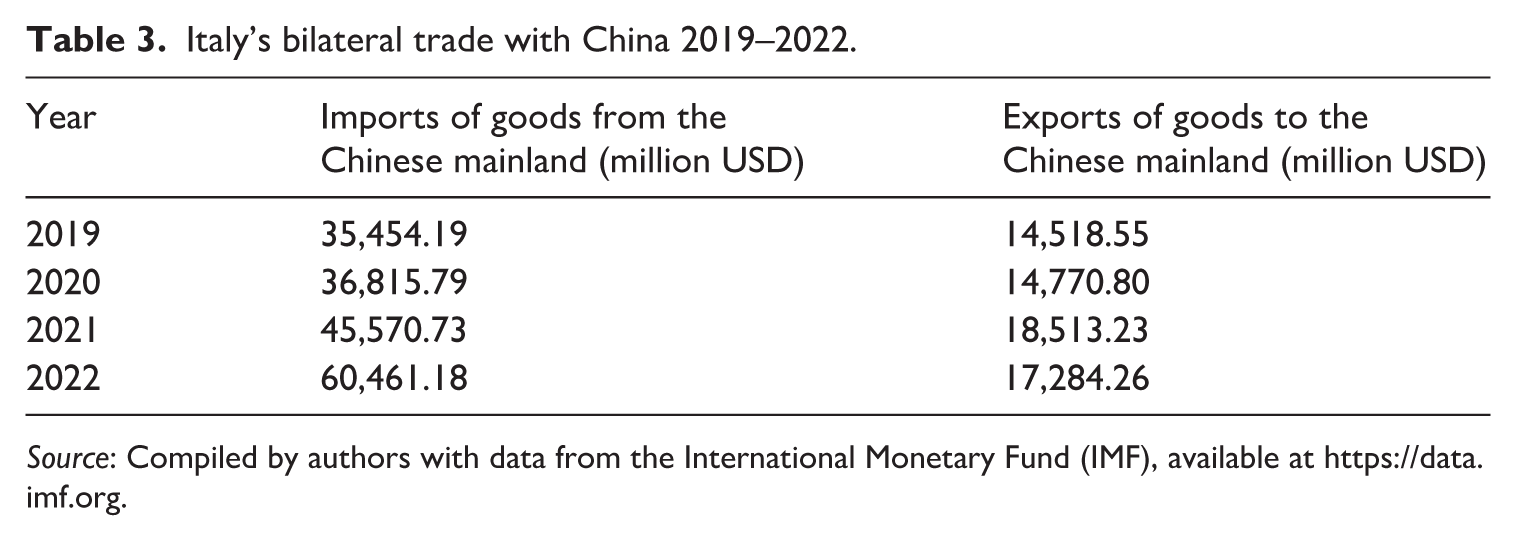
Rome joins the BRI for the potential rewards we discussed earlier. The prospect of substantive export growth was one of the reasons that enticed Rome into participating in the BRI despite the opposition from its allies. However, the trade balance between Italy and China was not tilted in Italy’s favor. From 2019 to 2022, its exports to China increased slightly from 14.5 billion to 17.28 billion dollars, while its imports from China nearly doubled from 35.34 billion to 60.46 billion dollars (see Table 3). Therefore, Italy did not achieve the trade growth it expected from the BRI.
Italy’s bilateral trade with China 2019–2022.
Source: Compiled by authors with data from the International Monetary Fund (IMF), available at https://data.imf.org.
Rome also expected to secure more Chinese investment by joining the BRI. As shown in Figure 3, Italy’s inward FDI from China declined in 2019 and 2020 and did not recover to the 2018 level in 2022. While Covid-19 partially contributed to this decline, FDI from Germany and the US rose above pre-crisis levels. Thus, we infer that FDI from China fell below Rome’s expectations, even when adjusted for the pandemic’s impact. For instance, the foreign minister Antonio Tajani pointed out in an interview that ‘we have not had many benefits from the (new) Silk Road, this is technically proven’. 113
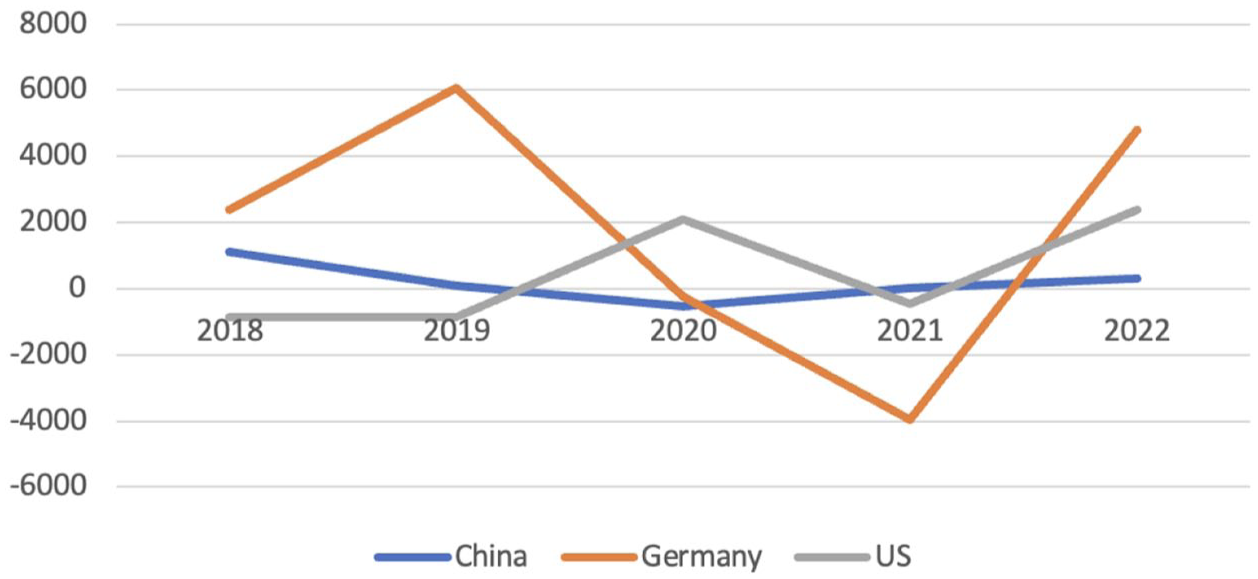
Italy’s inward FDI flow.
Increased exports and FDI were the potential rewards that tempted Rome to sign the MoU, but they have not materialized. Meloni pointed out that benefits had not been accrued to Italy after joining the BRI, claiming that ‘Italy is the only G7 member that signed up to the accession memorandum to the Silk Road, but it is not the European or Western country with the strongest economic relations and trade flows with China’. 114
Disillusioned by the BRI, Italy found hope in the newly launched Western initiatives. The IMEC is especially attractive to Italy. Meloni described it as Italy’s ‘crucial initiative’. 115 It is envisioned to facilitate Italy’s Indo-Pacific strategy that ‘aims to connect the Mediterranean to the Indian and Pacific Oceans through the Middle East’. 116 Also, unlike the BRI, the IMEC is supported by the US and the EU. Therefore, it is seen as a potential ‘countermeasure’ for Italy if it decides to leave the BRI. 117 Edoardo Rixi, Italian Deputy Minister of Transport and Infrastructure, said that the new initiative ‘responds to new challenges and tangible opportunities’ while the BRI has not delivered ‘tangible results’. 118 As the PGII competes with the BRI in scale, the IMEC, which is part of the PGII, accentuates the relevance of Italy. They offer a viable alternative to the BRI from Rome’s stance.
The risks
Debt distress and an undermined relationship with the US and the EU were the potential risks of joining the BRI. After Italy participated in the initiative, new developments altered Rome’s estimation of risks associated with staying in the BRI.
The Covid crisis, breaking out at the end of 2019, gave the weak Italian economy another blow, increasing the risks of overwhelming Chinese influence. 119 As the pandemic originated in China, conspiracy theories were put forward about the disease, harming China’s international image. The Covid crisis and the Hong Kong security legislation cooled the relationship between Italy and China. 120 The Russia-Ukraine War and Beijing’s friendly relationship with Russia also complicated European countries’ perceptions of the BRI. 121
Before Italy joined the BRI, there were concerns over the potential risks of Chinese investment. As Sino-Italian relations cooled down following a series of events, those concerns increased. The Italian government tightened the regulation of FDI in sectors of security concerns and ‘blocked Chinese investments in critical infrastructure such as the ports in Trieste and Genoa, 5G telecommunication technology, and space technology’. 122
As China was increasingly seen as a rival to the Western bloc, Italy faced greater pressures to stay in the BRI as a G7 and NATO member. 123 Its perception of China shifted from ‘a significant trade partner and a potential trade multiplier in East and Southeast Asia’ to the very recent ‘challenger of the international system’. 124 Before Rome informed Beijing of its decision to leave the BRI, Meloni was said to have promised Biden that Italy would withdraw from the initiative, 125 and her move was attributed to pressure from Washington. 126
Similar pressure also came from the EU. Ursula von der Leyen, President of the European Commission, put forward the policy of ‘de-risking’ from China in a speech on March 30, 2023, amidst his comments on Beijing’s stance on the Russia-Ukraine War, the tensions over the Taiwan Strait, the alleged human rights abuse, the concerns over China’s technological advancement, possession of critical raw materials, etc.. 127 In June 2023, the EU adopted a European Economic Security Strategy to reduce economic risks arising from ‘certain economic dependencies’, 128 which refers to reliance on China, though not explicitly stated. 129 The Strategy intends to reassess economic security risks and propose measures to mitigate them. 130 The EU’s series of moves to reduce dependence on China are certain to have impacts on Italy, the EU’s founding member. Some observers even attribute Rome’s decision to leave the BRI to the EU’s de-risking policy. 131
Risks of dependence on China and undermined relations with the US and the EU existed at the time of Italy’s BRI entry. These risks increased after Italy joined the BRI, as a series of events unfolded and the US and EU increasingly viewed China as a competitor, influencing Italy’s China policy. Stefano Stefanini, Italy’s former ambassador to NATO, said that it was untenable for Italy to stay in the BRI, given that Beijing’s relations with Washington and Brussels deteriorated and the West endeavored to reduce dependence on China. 132 Analysts also discerned the ‘growing necessity within the EU and its members to attempt to reach a common stance toward China that somewhat aligns with Washington’, 133 and attributed Italy’s decision to ‘sustained US pressure’. 134 Italy’s reduced policy space amid intensified institutional rivalry between the West and China propelled the country to leave the initiative as it expired in 2024, the year when Italy assumed the G7 presidency.
Discussion
After Italy’s BRI entry, new Western alternatives to the BRI emerged. They were built piecemeal, and Italy was not given priority until the IMEC. Therefore, despite the BRI’s failure to meet Rome’s expectations in trade and investment, the Western alternatives are not expected to offer greater rewards. In the meantime, Italy faced high risks of staying in the BRI amid a changed international landscape. At this stage, Italy adopted the strategy of institutional hedging as it remained in the Chinese-led initiative while joining more Western ones.
The situation changed as the IMEC was launched, showing the prospect of Italy being at the center of an economic initiative. The high relevance of Italy in the Western alternatives, on top of their increased institutional capacities, promises Italy high rewards. The IMEC was a game-changer for Italy’s choice regarding the BRI, after which Italy adopted the strategy of institutional balancing and left the BRI as the MOU expired.
There may be an alternative explanation that Rome’s policy change is attributable to the change of administration, based on the argument that the coalition of the Five Star Movement and the Lega was more pro-China than the Meloni administration. In general, governments’ foreign policy-making is based on national interests rather than political leaders’ personal stances, and thus features continuity. Observation pointed out that ‘Meloni’s primary goal is to defend Italy’s national interests’. 135 When asked about the future of Italy’s BRI membership, Meloni said, ‘The issue is how to guarantee a partnership that is beneficial for both sides, leaving aside the decision that we will take on the BRI’, 136 stressing the role of national interests in the bilateral relations. She also explained Italy’s possible withdrawal from the BRI by claiming that ‘The tool of the (BRI) . . . has not produced the results that were expected’. 137 Moreover, joining the BRI was not a novel decision of the coalition government, but a ‘close coordination with the country’s bureaucratic apparatus’ and agreed with the policies of earlier Italian governments. 138
Conclusion
This article offers an integrated framework that accounts for middle and small powers’ institutional strategies of balancing, hedging, and bandwagoning through a unified logic of perceived rewards and risks. It also identifies institutional capacities and the state’s relevance in the institution as the determinants of expected rewards, and develops a two-step assessment: high expected rewards arise only when both are strong. They jointly explain why middle and small powers are prone to hedging in strategic ambiguity characterized by high-reward, high-risk or low-reward, low-risk scenarios.
We empirically illustrated our framework using Italy’s entry and exit from the BRI. We compared Italy’s anticipated rewards and risks between two critical junctures: its signing of the MoU in 2019 and the notification of its exit from the BRI in 2023. We found that the relative rewards that tempted Rome into bandwagoning by signing the MoU had not materialized over four years into its BRI accession, and the risks of staying in the BRI increased as China was increasingly viewed as a challenger to the international order and other new developments took place in the international landscape. Therefore, Rome adopted hedging by remaining ambiguous until the IMEC. Before the IMEC was conceived, Italy was not an essential member of the growing Western alternatives, expecting low rewards from the new institutions, thus not determined to leave the BRI as the MoU matured. The balance was tilted as the IMEC situated Italy in a strategic position and made the country highly relevant, promising high rewards for joining the Western alternatives. This encourages Rome to shift its strategy from institutional hedging to balancing.
Theoretically, we examined the concept of institutional hedging and developed an analytical framework based on this concept, which is not sufficiently elaborated and remains mostly ambiguous in the existing research. This offers a new account of small and middle powers’ behavior in international institutions apart from the established explanation of institutional balancing. This article also supplements the existent framework of institutional balancing by adopting the perspective of small and middle powers navigating institutional competition between great powers, seeking rewards and avoiding risks instead of pursuing influence. It also extends the balance of power theory to the institutional context by synthesizing insights from neorealism and neoliberal institutionalism. Empirically, we apply the newly created framework to investigate Italy’s U-turn on its decision regarding BRI membership, which remains under-probed despite receiving wide media coverage.
Footnotes
Funding
The authors disclosed receipt of the following financial support for the research, authorship, and/or publication of this article: This research was funded by the Shanghai Philosophy and Social Sciences Planning Project (Grant Number: 2025EGB014).
