






Abstract
How can we characterise the foreign policy of populist leaders? This paper argues for the introduction of the concept of ‘populist foreign politics’. Populist foreign politics is when politics trumps policy. In other words, we define the concept as the substitution of political criteria for interest-based considerations in the selection, retention and promotion of foreign policy allies, in countries led by populist leaderships. Based on four case studies from two countries led by populist leaders, the paper shows that populist foreign politics takes the form of supporting fellow populists even if they harm officially stated interests – and punishing non-populist actors because they are politically not in the camp of populists, even if interests align. Overall, the paper makes the claim that, under certain conditions, populist foreign politics, based on belief similarity is indeed a noticeable trait in the foreign policy of populists and that populism (and not their far right ideology) has a direct impact on the substantive foreign policy preferences of populist leaders.
Introduction
How can we characterise the foreign policy of populist leaders? Scholars have been debating this question for quite some time. This paper argues for the introduction of the concept of ‘populist foreign politics’ (PFP) to describe an occasionally odd and counter-intuitive behaviour typical of (but not necessarily exclusive to) populist leaders. Populist foreign politics is when politics trumps policy. In other words, we witness this phenomenon when, in countries led by populist leaderships, ‘foreign politics’ occasionally override actual interests in foreign policy. By ‘foreign politics’ we mean a certain kind of politicisation of foreign policy: the perceived need to support like-minded fellow populist politicians abroad, even if they are effectively harming the achievement of the foreign policy goals of our country. Or, the flip-side to this: signalling disdain towards un-likeminded leaders, even if their foreign policy goals are in line with our own interests.
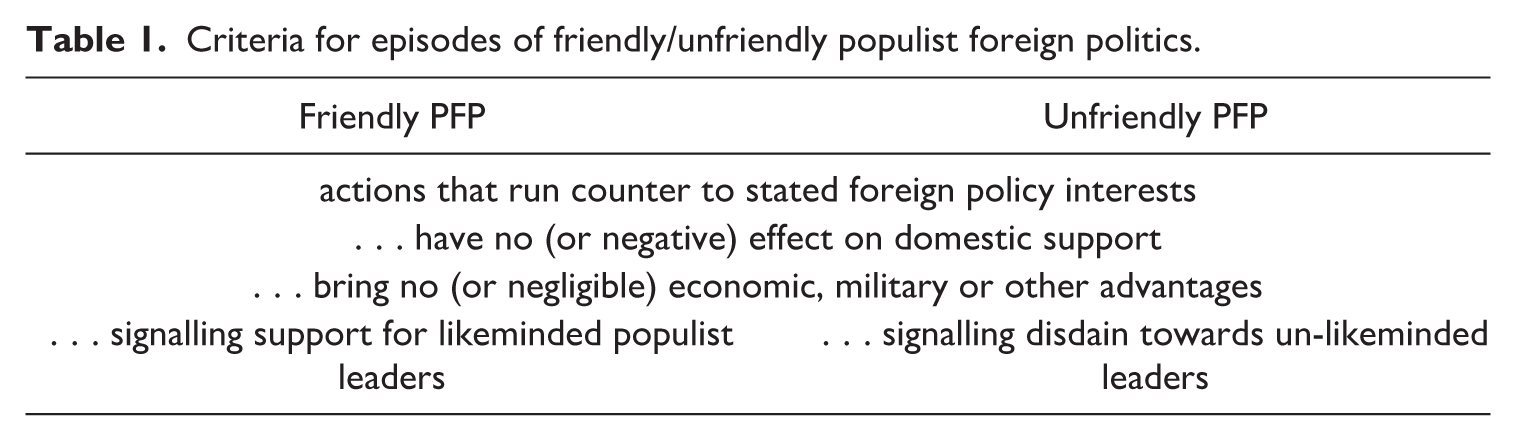
Populist foreign politics thus takes the form of letting fellow populists off the hook even if they harm our officially stated interests – and punishing non-populist actors because they are politically not in our camp, even if our interests align. We call these two variants friendly and unfriendly PFP. To be considered cases of (friendly or unfriendly) populist foreign politics, foreign policy actions have to fulfil four criteria, three of which remain the same in either case: (1) they run counter to the foreign policy interests of the given country, as laid down in strategic documents, and/or statements of their populist political leaders; (2) they have no, or potentially even negative effect on the populists’ domestic electoral support and (3) they bring negligible to no economic, military or other advantages to their country. As far as friendly populist foreign politics is concerned, the fourth criteria is that foreign policy actions signal support for likeminded populist governments with the aim to strengthen their common, counter-hegemonic agenda and cooperation. As far as unfriendly populist foreign politics, the fourth criteria is the implementation of foreign policy actions which is rhetorically accompanied by severe criticism, even disdain, towards un-likeminded, non-populist governments (Table 1).
Criteria for episodes of friendly/unfriendly populist foreign politics.
The article makes the following two contributions to the literature. First, it shines a light on how and why populists cooperate internationally. As Wojczewski pointed out, ‘despite their chauvinistic our-country-first nationalism, we can observe intensified cross-border networking and cooperation between [populist] political actors’. 1 But we claim that staunch nationalists can, under certain conditions, cooperate to such an extent that they support their populist friends even if these friends effectively harm the achievement of their very own foreign policy goals. Based on the extant literature, but also building on it, we introduce the notion of ‘populist foreign politics’, which emerges through a three-step process (see later).
Secondly, we make the claim that populism (and not their far right ideology) has a direct impact on the substantive foreign policy preferences of populist leaders under certain circumstances. Building on the literature, we postulate that populist leaders see each other as fellow builders of a common populist international counter-hegemonic project. Importantly, we aim to prove with the following case studies that friendly PFP-behaviour is extended to fellow populists who share the belief in the necessity of the counter-hegemonic project, regardless of whether they are far right or not. The paper aims to back up these assertions with four short foreign policy-case studies from two countries led by populist leaders (at the time): three from Hungary (two friendly and one unfriendly PFP examples) and one from the United States (friendly PFP). The paper proceeds as follows. The first section presents the three-step casual link leading to the emergence of populist foreign politics. The second part engages with the extant literature on the foreign policy of populist leaders, highlighting the contributions the paper makes, and its limitations. After presenting the methodology, the fourth part contains the four case studies (on Hungary-Israel, Hungary-Slovakia, the expulsion of the CEU from Budapest and Hungary’s procrastination over Sweden’s NATO accession). The final section discusses the results and concludes with the main takeaways.
Populist foreign politics
Our causal link for the emergence of PFP starts with (1) populism, which causes (2) personalisation and politicisation of foreign policy, which is then complemented by (3) perceived belief similarity to produce episodes of populist foreign politics. We now turn to each one of these elements.
Populism
The first necessary condition is, obviously, the presence of populism, therefore this paper will focus on the behaviour and interaction of well-known populist leaders such as Hungarian prime minister Orbán Viktor, Slovak Prime Minister Robert Fico, Israeli Prime Minister Benjamin Netanyahu and American President Donald Trump. Populism is a ‘thin’ ideology which sees society to be ‘ultimately separated into two homogeneous and antagonistic groups, “the pure people” versus “the corrupt elite,”’ 2 and argues that ‘politics should be an expression of the volonté générale (general will) of the people’. 3 The other essential trait of populism is anti-pluralism, which entails the claim that only the populist leader can speak in the name of the ‘true’ people. 4 This thin ideology is then combined with ‘thicker’ ideological elements such as nationalism, socialism, radical right or religious fundamentalism. 5
Politicisation, personalisation and the international context
In a second step, we build upon the literature that has shown that populism often leads to personalisation and politicisation of populist foreign policy. 6 Politicisation, in the most general terms, ‘means the demand for, or the act of, transporting an issue or an institution into the sphere of politics – making previously unpolitical matters political’. 7 While politicisation is not confined to them, 8 populist parties and leaders seem to be especially prone to it. 9 According to another definition, politicisation in the civil service is ‘the substitution of political criteria for merit-based criteria in the selection, retention, promotion, rewards, and disciplining of members of the public service’. 10 We can paraphrase this definition for our purposes: politicisation in populist foreign politics is the substitution of political criteria for interest-based considerations in the selection, retention and promotion of foreign policy allies: ‘We need to support leader X not because of shared interests, but because he/she shares our beliefs and supports our counter-hegemonic quest, and is thus a political ally’.
Since the late 1980s, ‘as means of mass communication have become more widespread and diversified, and as ideologies and political parties have declined in importance’, 11 non-populist and populist political leaders have come to overshadow their parties and the institutions of their governments. 12 Personalisation, as this phenomenon is called, refers to a situation where the foreign policy-bureaucracy ‘is brought under the control of the populist leader(s) in a manner that fully reflects their interests and narratives’. 13 Again, studies have established that personalisation is especially evident in populist-led regimes.14,15 According to the literature, both personalisation and politicisation can be observed in populist-led countries like Hungary 16 ; Israel 17 and the United States. 18
Importantly, the personalisation of foreign policy in the hands of heads of states or governments is not unique to populist governments but constitutes a broader trend. 19 Nor is politicisation a phenomenon exclusive to populists. 20 But Destradi and Plagemann also claim that the populist leader will be much more involved in foreign policy than non-populist predecessors, a trend clearly seen in both Hungary and the US. 21 Personalisation is also seen as an important trait of populism. Building on these claims, this contribution argues that populist leaders will, under certain conditions (see later), be ready to put their personal ties with fellow populist leaders based on their belief similarity above the purported interests of their countries.
Especially relevant for our line of thought have been insights of Cadier, who argues that populism translates into ‘a greater proclivity to use foreign policy as the continuation of domestic politics by other means’. 22 More specifically, he writes that ‘the logics of differentiation, mobilization, and salience inherent to populism feed populist actors’ tendency’ 23 to invest foreign policy as an instrument and as a ground to battle political opponents (‘battle-ground foreign policy’). While Cadier mostly focuses on domestic opponents, we wish to extend this notion to the international arena and international opponents: populist foreign politics as a battle against our foreign enemies (unfriendly populist foreign politics) and/or as a vehicle of support for our friends abroad (friendly populist foreign politics). This especially makes sense if the populist leader connects its foreign opponents (e.g. US billionaire György Soros or Ukraine) with domestic enemies (hostile Hungarian media outlets allegedly financed by Soros and doing the bidding of Kyiv). 24 Domestic opponents thus become the continuation of the ‘international negative Other’ – and vice versa. 25
This ‘weaponized internationalization’ of the domestic struggle between populists and their opponents is, of course, nothing new. Destradi and Plagemann have pointed out that ‘populists typically rally support by pitting the “people” against domestic “elites” and other groups outside the true people and that, depending on the precise context, these elites and out-groups may also be associated with foreign countries or governments’.26,27 According to Wajner, ‘contemporary populist leaders show a growing willingness to transfer the discursive construction of a struggle between “the people” and “the elites” to the regional and global levels as a way of obtaining internal and external legitimation’. 28
Belief similarity
But we believe that populism, the resulting politicisation and personalisation in combination with the ‘internationalization’ of the domestic struggle are not in themselves enough to explain why typically nationalist, isolationist, ‘my nation-first’ – politicians not only collaborate, but, as we postulate, occasionally put their own stated interests aside to defer to their fellow populist colleagues. 29 In the third step in our causal link, we consider this belief similarity as a necessary condition for populist foreign politics to emerge. We propose that belief similarity is the glue that holds populist friendships together and motivates populist foreign politics. Because the focus here is on interpersonal relations between populist leaders, we borrow this concept from social psychology. 30 Belief similarity is the perception that my beliefs about the world and my attachment are shared (or at least very close) to the beliefs and attachments of another person. 31 Belief similarity has been shown to be a major factor in interpersonal judgment 32 and political attitudes such as voting. 33 Observers judge individuals perceived to have the same beliefs more positively (both on morality and competence). 34 Similarly, people display less prejudice towards groups that are perceived as having similar values. 35 In one study, perceived belief similarity (in combination with other factors) led to more support for Putin and his war in Ukraine among non-Russians. 36
We hypothesise that belief similarity among populist politicians makes friendships between them possible, even likely. Many authors hint at the important role of friendship among populists. Wajner and Giurlando aptly talk about ‘euphoric encounters’ between populist leaders, who ‘embody the affective solidarity between their peoples and their political associations’. 37 Kopper et al. point out that it was reasonable for Orbán to make friends with Putin, a likeminded leader of a self-styled illiberal state. 38 Even more to our point, Giurlando and Wajner conclude that populists are partly motivated by ‘sentiments of sympathy for, and friendship with, Vladimir Putin rather than cold calculations of power’. 39 In our case, populist leaders such as Orbán and Trump believe that the other populist leaders also share their belief in their international counter-hegemonic project. Thus, belief similarity seems to be the reason why populist leaders occasionally represent the interests of their fellow friends more than the interests of the countries they are leading.
But what is the actual belief that all of these populists hold and how is this belief connected to populism (and not far right)? We build on Wojczewski’s claim, and postulate that Orbán, Trump, Fico and Netanyahu see each other as fellow builders of their common international counter-hegemonic project, aimed at rebuilding international politics around the notions of ethnoculturally homogenous nations, anti-globalism and anti-multiculturalism. 40 As a nice side-effect, in the process of shattering the existing hegemony of the elites in conjunction with their fellows, populist leaders also gain legitimacy, both home and abroad. 41
Contribution to the literature
Overall, this contribution strongly sides with those in the literature, who claim that there are indeed noticeably typical (but not necessarily exclusive) traits in the foreign policy of populists 42 and takes issue with those who claim that populism has no direct impact on the substantive foreign policy preferences of the discussed parties and that ‘thick’ ideologies shape the foreign policy outlook of populists.43,44 What about the counterargument that Orbán, Trump, Fico and Netanyahu supported each other not because they are populists, but because they were all far right politicians, as follows from Verbeek and Wojczewski’s suggestion and is in line with most of the extant literature? Admittedly, Fidesz is both far right and populists, as per the authoritative PopuList 3.0 database. But, first of all, it is not clear whether Fico’s Smer party can be called far right. While Smer is certainly populist, the PopuList 3.0 database does not list it as far right. In fact, many in the literature label the party left-populist, so the idea of a ‘far right international’ – solidarity does not work in the Hungarian-Slovak case. 45 Secondly, Likud is not labelled far right in the literature, either, weakening the case further.46,47 (Unfortunately, PopuList only tallies European parties, so we remain agnostic as to whether Trump and the Republicans are far right or not). Thus, the episodes of ‘populist foreign politics’ analysed in this paper clearly include non-far right leaders.
Because we also look at actual foreign policy decisions and not merely discourse, we overall aim to show that in contradiction to Wojczewski, populism (and not far right or other ideologies), does occasionally have a substantial impact on foreign policy. 48 We aim to prove with the following four case studies that friendly PFP-behaviour is extended to fellow populists who share the belief in the necessity of the counter-hegemonic project, regardless of whether they are far right or not.
The key question is, under which conditions will PFP come to the fore? Our limited case studies can only provide a tentative first cut to this question, yet with the help of Wajner and Giurlando’s useful list of variables which make populist foreign policy more impactful in general, we can deduce some consequences. First, the authors emphasise that ‘the material distribution of military power, geopolitical pressures, and economic capabilities’ all affect the way populist leaderships formulate, plan, and implement their foreign policies. 49 Hungary, being safely in EU and NATO, can therefore arguably allow itself to prioritise its populist friends and alienate its traditional allies without immediate and painful costs. Meanwhile, thanks to its military capabilities and economic power, the USA has ample room to display the occasional PFP episode. Thus, it seems that a secure power position in the international system facilitates the occurrence of PFP. The second important variable is the domestic power position of the populist leader. 50 Thanks to various causes, such as voting systems benefitting winners, favourable media landscapes and control over their parties, both Trump and Orbán sat securely at the apex of power, allowing them to pursue foreign policy goals which were both unpopular (or, at any rate, not popular) and sometimes inimical to the interest of their countries.51,52
Thirdly, it seems possible that the propensity of populist leaders to engage in populist foreign politics increases over time. Here, we draw on the more general understanding that the longer authoritarian populists stay in power, the more one can expect their effect on foreign policy. 53 The time factor has certainly played a part in Hungary: all our case studies of populist foreign politics come from the later period of Orbán’s (so far) 15-year rule. Yet, Donald Trump was willing to deploy populist foreign politics already in his first term, weakening this argument.
A word of caution in on order. This paper claims not that PFP can describe all the foreign policy decisions of all populist leaders. Consider, for example, that Trump’s crushing tariffs policy applied to populist and non-populist countries alike. Populist leaders are also very well capable of pursuing a pragmatic and interest-driven foreign policy and are not necessarily worse international citizens than non-populists. 54 Also, the prioritisation of some kind of ideological alignment over material or strategic interests can observed in a range of foreign policy contexts that are not associated with populism. 55 In short, this contribution presents the idea of ‘populist foreign politics’ as a potentially promising research agenda rather than a definitive explanatory model, acknowledging the fact that further investigation is needed – for example on which conditions enable PFP-episodes.
More broadly, it is of course extremely simplifying to reduce the drivers of foreign policy to the three causes this paper considers (pursuit of national interests, maximisation of domestic support, achievement of economic or military benefits). Obviously, identity considerations do also play a role, just to name one additional cause. However, we believe that the behaviour of the populist leaders in all of our four case studies also go against the very foreign policy identity of their country, to pick up this alternative explanation strand. In Hungary’s case, there is an overarching consensus on supporting the Hungarian minorities abroad, or for strengthening the country’s security lifeline that is NATO, yet the case studies will show that the populist leadership disregarded these identity considerations. One would be also hard-pressed to reconcile Trump’s behaviour in the CEU case with America’s traditional self-professed leadership role, sense of exceptionalism and the proudness of being soft power Number 1 in the world. However, length requirements do not permit to further branch out in this direction.
Methodology
To establish what counts as the stated interests of the given country, we firstly draw on recent strategic documents the populist leaderships themselves adopted, such as the Hungarian constitution, the National Security Strategies of Hungary and the United States of America and other official written statements and positions. Secondly, we also draw on relevant statements of political leaders with authority (such as prime ministers or foreign ministers). To establish the ‘official position’, we will give precedence to the official, written documents, supplying further evidence from secondary, oral statements which are in line with the official position. As we will see, in reality, the actual steps taken by the populist governments (and the rhetoric accompanying it) oftentimes give lie to the official positions they themselves have staked out. Having established the country’s ‘official position’ on the given issue, we then contrast it with actual foreign policy behaviour, such as relevant topic-related decisions, voting records and policy outcomes. One might argue that the foreign policy episodes under consideration in this paper could instead be seen as part of an ongoing process of constituting the national interest in a new way by the populist leaders, rather than as deviations from it. But then one should expect the leaders to bring their words and deeds in line by translating their worldviews into new official strategic documents. Interestingly, this has not happened: our four case study actions still deviate from the then-operational National Security Strategies (and from many oral statements), even though it was the Orbán and Trump administrations themselves that have written and adopted them. If these leaders had really wanted to reformulate what constitutes the national interest, they easily could have drafted new strategies.
Next, we look at recent opinion polls to underlie our claim that the analysed cases have no (or even negative) effect on the domestic support of populist leaders. Then we look at economic data (primarily trade and FDI statistics), military cooperation and other pertinent issue areas to prove that these PFP actions did not bring economic, military or other advantages to the populist leaders’ country. Fourthly, we aim to highlight very briefly the belief similarity of the given leaders, especially their cooperation in the populist counter-hegemonic project – or, in the case of Sweden and Hungary, the lack thereof. Because we wanted to showcase recent developments, the case studies are from the last 8 years.
We do not negate a certain arbitrariness in the case selection: in order to present the concept of ‘populist foreign politics’, we had to look for decisions from populist governments which were counterintuitive and surprising in the first place. The focus on these four particular cases is due to the fact that (1) the Central and Eastern European region is the author’s field of expertise; (2) Hungary has been led by a populist government for a rather significant amount of time (almost 16 years at the time of writing), making it an insightful case study on the effects of populism over time and (3) the inclusion of the USA aims to highlight that PFP is not limited to Orbán, because apparently other populist leaders also occasionally resort to it.
A common thread in all the case studies is that in all four cases the policies followed by the fellow-populist governments are harming both the purported foreign policy goals of Hungary (three cases), and the United States (one), as laid out by the Orbán and Trump administrations themselves. In short, the particular policies carried the following drawbacks and disadvantages: firstly, Netanyahu’s policy towards the Palestinians seriously undermined the possibility of a two-state solution, the avowed goal of Hungary for the last decades; secondly, Fico’s planned State Language Law and the application of the Benes Decrees is threatening the rights of the Hungarian minority in Slovakia, whose support has been a persistent foreign policy priority of Hungary. Thirdly, the expulsion of the CEU clearly dented the soft power of the country and set a dangerous precedent for other states to get rid of the American universities on their soil. Fourthly, Hungary’s dithering over Sweden’s NATO accession made the very alliance which underwrites the country’s security look weak and indecisive.
Case study 1: Hungary’s pro-Netanyahu foreign policy under Orbán Viktor (friendly PFP)
Officially, the Orbán governments since 2010 have had a fairly balanced, middle-of-the-road position on the Israeli-Palestinian conflict. According to the National Security Strategy adopted by the Fidesz government in 2020, Hungary is placing great value on the respect of international law and is working towards the stabilisation of the Middle East. 56 Budapest has been an unequivocal proponent of the two-state solution, upholding this position both bilaterally and in the EU Common Foreign and Security Policy-context. Official documents, such as the 2012 Strategy of the Ministry of Foreign Affairs, 57 a written statement to the International Court of Justice from 2023 on Hungary’s Near East policy 58 as well as common EU positions supported by Budapest 59 (all under the Fidesz governments’ watch) are testaments to that. The two Ministers of Foreign Affairs since 2010, Martonyi János 60 and Szijjártó Péter 61 also publicly subscribed to negotiations and the two-state solution. In fact, one could argue that Budapest is among the most steadfast supporters of Palestinian statehood, as it is among the only handful EU member states which recognise Palestine as a state.
Yet, giving lie to its professed position, Hungary is one of Israel’s (or, rather, Prime Minister Netanyahu’s) closest ally, showing little signs of a balanced approach. Already in 2019, scholars have concluded that Hungary was the EU member state most energetic in blocking joint EU statements critical of Israel. 62 Since then, this one-sidedness has kept manifesting itself in multiple ways: Budapest (often unilaterally) vetoed EU statements and declarations, such as an EU declaration on a ceasefire between Israel and the Palestinians in May 2021 63 ; in 2024, it refused to endorse the EU’s call for an eventual ceasefire in Gaza 64 as well as refusing to deplore with the other 26 member states a Knesset resolution rejecting Palestinian statehood. 65 In the United Nations General Assembly, Hungary has been among the 14 states in the world that voted against a resolution that demanded that Israel pull out of Palestinian areas within a year 66 ; in the same year, Hungary has been among the nine states voting against upgrading Palestine’s rights as an observer state. 67 What is more, Orbán welcomed Netanyahu on an official visit to Hungary in April 2025, announcing that Hungary will withdraw from the International Criminal Court (ICC) for good measure. 68 Crucially, none of these votes, vetoes and decisions fell into the 18-month period, when Naftali Bennett, and then Yair Lapid, took over the premiership from Netanyahu in 2021–2022.
Could economic considerations explain the behaviour of the Orbán-governments? Not really. In 2022, Israel was only Hungary’s 32nd biggest export partner and 36th biggest import partner. 69 Growth in bilateral trade since 2015 was not higher than the overall growth of Hungarian trade in the same period. 70 Despite its firms having sizeable investments in some sectors such as property development, Israel was only in one year among the three biggest investors in Hungary by value between 2010 and 2022. 71 In all, Israeli investments account for only 3% of the total foreign investment stock in Hungary. 72 Nor has Hungary been a major buyer of Israeli weapons: the SIPRI lists only two transfers in the years since 2010, one for air-search radar and another for loitering munitions. 73 Hungarian FDI in Israel is negligible.
Hungarian public opinion is not exactly a fan of Benjamin Netanyahu, either. On a list of 23 world leaders, he stood at No. 15 with only 25% of Hungarians having a ‘fairly positive’ or ‘fully positive’ view of him. 74 (For Putin, the same share was 15%). Only 1% of Hungarians said that Israel should be among the three countries with which it would be most important to have close ties. 75 Hungarians were also critical with the steps Netanyahu’s government took in the wake of Hamas’s attack on October 7, 2023: only 30% of respondents considered its response ‘legitimate and proportionate’ while 41% thought that they were ‘legitimate, but not proportionate’ and 9% ‘neither legitimate nor proportionate’. 76 Overall, the very visible pro-Netanyahu position does not seem to be a net positive for the government in terms of public opinion.
If economic considerations, arms transfers or public opinion cannot explain Hungary’s stance, we propose belief similarity as explanation, manifesting itself through Orbán’s and Netanyahu’s joint efforts in their common counter-hegemonic agenda. The strong personal relationship between Orbán and Netanyahu, which multiple sources called ‘friendship’, is well-documented.77,78 Their belief similarity, especially on migration, anti-terrorism, US billionaire George Soros, the ICC and the weakening of the rule of law are all evident. 79 During his 2025 visit, Netanyahu praised the relationship between their countries as a ‘fantastic alliance’, while Orbán castigated the EU for importing antisemitism through illegal migration, something which would never happen in Hungary. 80 In short, we propose that it is their belief similarity, leading to what many call a friendship, that explains and motivates Hungary’s strongly pro-Netanyahu stance.
Case study 2: Slovak-Hungarian relations under the Fico government (friendly PFP)
Our second case study entails Slovakia, a country with a sizeable Hungarian minority, making up around 8% of the population. Safeguarding the rights and interests of the approximately 2,5 million ethnic Hungarians in the neighbouring countries has been a major focus of Hungary’s foreign policy since 1990. Article D of the current Hungarian constitution (adopted by the the Fidesz-majority of the Hungarian parliament in 2011) states that ‘Hungary shall bear responsibility for the fate of Hungarians living beyond its borders . . . it shall support their efforts to preserve their Hungarian identity [and] the assertion of their individual and collective rights’. The minority issue is also identified as one of the main goals of Hungary’s foreign policy in the Fidesz government’s most recent National Security Strategy. 81
One might conclude from all this that a country which does not respect the rights of the Hungarian minority to the fullest might not enjoy a good relationship with Budapest. But one would be wrong. To illustrate the improvement of Slovak-Hungarian relations despite problematic minority rights-issues, we turn to one of the most important official documents in this domain area, namely the closing statements of the annual Hungarian Standing Conference (MÁÉRT). MÁÉRT is an annual meeting between the Hungarian government, parliamentary parties and minority Hungarian political organisations. The closing statements typically take stock of the minority right-developments of the previous year in Hungary’s neighbouring countries through the lens of the Hungarian government. A close analysis of these documents before 2024 (i.e. pre-Fico) reveals a consistent pattern. The overall tone towards Slovakia is one of criticism and anger, highlighting supposedly discriminatory citizenship, education and language laws, among other things. 82 Of the seven paragraphs in the 2022 statement that evaluate the actions taken by the non-populist Slovak government of the day, five point out various shortcomings, one expresses approval and one contains both criticism and praise. 83 However, in a striking improvement, two of the four sentences in the 2024 statement on Slovakia suddenly contain praise, one is neutral and only one contains the slightest of criticisms: the members of MÁÉRT ‘are confident . . . that the planned amendment to the State Language Law will not restrict the acquired rights of the Hungarian community’. 84
This staggering improvement in perception might be down to the fact, that the shortcomings perceived by Budapest have been addressed by Bratislava between 2022 and 2024. Alas, this is not the case. Granted, there have been some improvements, such as upgrading the status of the government agency working on minority rights, 85 but Slovakia has not moved an inch on many issues problematised in the 2022 closing statement, such as Slovakia’s nationality law seen as discriminating against Hungarians, or the abolition of the Benes Decrees. Quite to the contrary, the aforementioned planned State Language Law has been called by Magyar Szövetség, the biggest Hungarian party in Slovakia a ‘bunch of wild ideas’, seriously limiting the use of the Hungarian language in schools, public transport and television, and imposing fines of up to €15,000 for unlawfully using it. 86 To be fair, after the first Slovak plans surfaced, Foreign Minister Szijjártó immediately rushed to Bratislava to discuss the issue, but has been (uncharacteristically quickly) assuaged by assurances from the Slovak side. 87 Also, when Orbán visited Fico in January 2025, his lengthy exposé at the press conference after their meeting did not include a single sentence on the issue. 88 Ultimately, the Slovak government decided to shelve the controversial law until the end of 2025, but has not given up on the idea of limiting the role of Hungarian (and other minority languages) in public. 89 In parallel, a planned efficiency reform by the Slovakian Education Ministry endangered the existence of smaller, Hungarian-speaking elementary schools. 90 While Magyar Szövetség protested against the idea, condemnation from the usually minority-sensitive Hungarian government was notably absent. 91 And in early 2026 Slovakia also started to re-apply the controversial Benes Decrees 92 and even criminalised the criticism of it. 93 The usually combative Hungarian prime minister subsequently announced meekly that his government was in talks with Bratislava ‘aiming to clarify’ what the law is about, while the overall Slovakian-Hungarian cooperation – for example on blocking an EU loan to Ukraine – continued undeterred. 94
Can perhaps economic considerations explain this improvement in Slovak-Hungarian relations? It is obviously hard to track the potential impact of very recent economic developments on political decisions (or the other way around) – let us not forget, that the Fico government was formed in November 2023, barely 2 years before the writing of this paper. But based on existing data, one might tentatively conclude that Slovakia has not suddenly become paramount for the well-being of Hungary’s economy. In 2022, Slovakia was the 4th biggest export partner and also the 4th biggest import partner for Hungary – a position it more or less held constantly over the past decade. Growth in bilateral trade since 2015 was not higher than the overall growth of Hungarian trade in the same period. 95 After a 26% contraction in 2023, Slovakia slipped to the 6th rank in the list of Hungary’s most important import partners but it retained its 4th rank in the export list. 96 Thus, if anything, Slovakia became less important for Hungary trade-wise since Fico came to power. On the investment side, as of 2023, 5% of total outward Hungarian FDI went to its northern neighbour and Slovakia was the 8th biggest investment location for Hungarian firms. 97 The stock of Hungarian investment between 2010 and 2023 grew by 25%, a year-on-year increase of barely 2%. 98 (Slovak FDI in Hungary was negligible). Overall, it does not seem that a suddenly increased economic significance of Slovakia warranted Hungary’s ultra-accommodating foreign policy.
It would also be a stretch to bring in public opinion-considerations to explain the new-found closeness between Budapest and Bratislava. For a right-wing party like Fidesz, the minority issue has always been particularly important because domestically it can present a picture of being demanding and insistent towards its neighbours in this regard. Moreover, the whole minority rights-issue has always been a great opportunity for Fidesz to out-bid its radical right rivals and maximise its domestic support. 99 Polls have repeatedly shown that among the Hungarian public, it is Fidesz voters who are those most in favour of supporting the Hungarian minorities abroad through various measures. 100 Still, as we have seen, Fidesz was curiously willing to give the benefit of the doubt to Bratislava on the State Language Law, while ceasing to harp on the Benes Decrees, a perennial bug-bear of the Hungarian right. Nor is Slovakia seen as a particularly important country for Hungary. Only 9% said in 2024 that Slovakia should be among the three countries with which it would be most important to have close ties. 101 On a more political level, 77% favoured strong ties between Hungary and Slovakia, in the range of the numbers with the other V4 countries, but behind Austria, Germany, Croatia and the United Kingdom. 102 All in all, it does not seem that unconditional support for Slovakia would be inherently popular with voters, especially at a time when the Fico government seems to be taking steps which go against the grain of one of Hungary’s core state interests.
Instead, we again propose that it is the belief similarity between Orbán and Fico, and their common counter-hegemonic agenda, that explains Hungary’s foreign policy. During his January 2025 visit to Bratislava, Orbán demonstrated his belief similarity with Fico, criticising ‘pro-war Brussels’ and Ukraine, and highlighting that ‘I am a long-standing admirer of the Prime Minister, and this personal friendship enables the two governments to coordinate and act quickly and jointly when necessary’. 103 Their well-documented friendship harks back to the 2015 migration crisis, after which the two countries jointly (and unsuccessfully) challenged the EU’s relocation policy for asylum seekers before the European Court of Justice. 104 The belief similarity of the two leaders on domestic rule of law-issues, their common fight against Article 7 proceedings, 105 on the need to maintain close ties with China 106 or on Ukraine are evident – even if differences in the actual implementation of these positions do exist between Bratislava and Budapest. 107
Case Study 3: the expulsion of the Central European University from Budapest (friendly PFP)
In 2019, the Central European University (CEU), a private university founded in 1991 by George Soros in Budapest had to leave the Hungarian capital because of the persistent political pressure of the fourth Orbán government. How did this affect American interests? The 2017 National Security Strategy adopted by the first Trump administration prioritised the advancement of American influence ‘as a positive force that can help set the conditions for peace and prosperity and for developing successful societies’. 108 Although CEU is private, American universities are clearly an important tool in America’s soft power and influence-promotion arsenal.109,110 According to a 2023 Pew poll, American universities were held in high regard around the world and were thus an important component of American soft power. 111 Even in the Trump years, various soft power indices showed America among the leading countries in education and science.112,113 Although we don’t have surveys specifically on how the American public viewed the expulsion of CEU from Budapest, it is hard to imagine a scenario where the expulsion of such an important soft power-tool was a net positive for the president.
Therefore, one can argue that it was in Washington’s interest to have the CEU continue working in Hungary – not to mention the negative precedent an expulsion of an American university such as the CEU could set world-wide. (As of 2020, there were 80 such universities in 55 different countries). Consequently, in several official statements, the Trump administration signalled its commitment to avoid this outcome. The U.S. Embassy in Hungary expressed its ‘disappointment’ over a bill introduced in the Hungarian Parliament aimed at forcing out CEU from Budapest 114 ; the State Department ‘urged’ the government of Hungary to ‘avoid taking any legislative action that would compromise CEU’s operations or independence’. 115 The university had also enjoyed strong bipartisan support on Capitol Hill, with representatives of both parties warning that ejecting the school will undercut academic freedom and harm U.S.-Hungarian relations. 116 All to no avail – the CEU had to go. Once the fate of the CEU was sealed, the State Department emphasised that ‘the departure of these U.S.-accredited programs from Hungary will be a loss for the CEU community, for the United States, and for Hungary’. 117
Apart from these statements the Trump administration did not go to great length to discourage the Orbán government from expelling CEU from Hungary. The approach taken by Washington was one of ‘engagement’ with the Hungarian government, with Ambassador David B. Cornstein only putting the mildest of pressures on the Hungarian decision-makers government. After some ‘initial posturing on behalf of CEU, the U.S. ambassador of the Trump administration in Hungary ultimately sided with the illiberal Orbán regime by shifting blame onto the university’s founder, George Soros’. 118 The CEU duly had to leave Hungary in 2019 for Vienna.
Importantly, there did not seem to be any costs for Orbán in the remaining years of the Trump administration, quite to the contrary. In May 2019 Trump received Orbán in Washington, the first official visit of a Hungarian Prime Minister to the U.S. in 14 years. Before their meeting, Trump said of Orbán, whose government just expelled the CEU from Budapest, that he ‘has done a tremendous job in so many different ways. Highly respected’. 119 Their personal connection endured even after Trump lost the 2020 election. Memorably, Trump told a crowd of supporters in 2024 that ‘there’s nobody that’s better, smarter or a better leader than Viktor Orbán. He’s fantastic’. 120
Again, the question arises: why would America let Hungary get away with expelling the CEU – but also with various other Hungarian foreign policy moves that went clearly against the interests of the Trump administration (such as maintaining and deepening cordial relations with Russia and China)? 121 Again, could economic considerations explain this behaviour? Barely. In 2014, Hungary was only the 45th biggest trade partner of the US. 122 In 2023, it was No. 36. 123 Growth in bilateral trade since 2015 was not higher than the overall growth of Hungarian trade in the same period. 124 American investments in Hungary represented only 0,24% of total American outward investment positions in 2023. 125 Hungary has not been a major buyer of American weapons. Since 2010, only two relatively minor Hungarian acquisitions have been made, the first involving two air search radars from Raytheon and the other the purchase of 180 AMRAAM missiles, also from Raytheon. 126 The volume of the latter contract was reportedly $500 million, a paltry sum for the American weapons industry which exported $238 billion in 2023. 127
Again, we propose it was belief similarity between Orbán and Trump and their common counter-hegemonic project which overruled American misgivings of Hungary’s controversial and unfriendly move. Ties between Orbán and Trump and also between Fidesz and parts of the Republican establishment and media are well-known.128,129 Orbán already supported Trump’s presidential bid in 2016 and was more than happy when he was re-elected in 2024. 130 Similarities in their rhetoric, 131 but also in their actual relationship towards notions such as rule of law, judicial independence or the role NGOs are evident. 132 An American journalist who was present at the meeting of Orbán and Trump in Mar-a-Lago in 2024 summed up their relationship: ‘What I saw is what we call in English a bromance’. 133
Case study 4: Sweden’s NATO accession and the Hungarian ratification process (unfriendly PFP)
Ever since becoming a member of NATO, Hungary has been a staunch proponent of the alliance and its further enlargement. The 2011 Foreign Policy Strategy of the Foreign Ministry highlighted Hungary’s interest in strengthening transatlantic cooperation and extending NATO into the Western Balkans. 134 Similarly, the 2012 National Security Strategy set the goal of potentially integrating all neighbouring countries into NATO. 135 The most recent Security Strategy of the Fidesz government states that ‘Hungary regards the maintenance of the cohesion of NATO . . . to be one of its priorities’. 136 After a 2015 meeting with Montenegro’s Prime Minister, Orbán said that Hungary was a committed supporter of Montenegro’s NATO membership. 137 In short, ‘Hungary has always been a pro-enlargement member state of NATO’, Foreign Minister Szijjártó pointed out during the June 2019 parliamentary debate on North Macedonia’s accession to the Alliance. 138
From this would then follow the expectation that Budapest should have been a strong supporter of Finland and Sweden’s NATO accession, especially as the most recent National Security Strategy states that ‘We have an interest in a strong, unified Alliance that is capable of reacting to security challenges in a timely manner, utilizing a 360-degree approach’. 139 Who would be more useful to contribute to this goal in times of war in Hungary’s neighbourhood than two countries with powerful armies, sophisticated defence technologies and strategic locations?
It is not necessary to re-tell the long-winding saga of the Hungarian Parliament’s procrastination over its vote to ratify Sweden’s accession. Suffice to say that Stockholm applied for membership in May 2022. By October 2022, all NATO members except for Hungary and Turkey had completed the processes of ratifying Sweden’s accession. However, it took an additional 16 months for the Fidesz-dominated legislature to vote for Sweden’s application. (While the decision to procrastinate might be seen as taken by independent parliamentarians, given Orbán’s wide-ranging sway over the Fidesz MPs and the notorious discipline of the party, it was quite clear that the decision to drag out the ratification was taken by the prime minister and then dutifully followed by the Fidesz caucus.)140,141
It slowly emerged, that, in true unfriendly populist foreign politics-fashion, animosities caused by ’belief un-similarity’ between Budapest and the centre-right Swedish government guided Hungarian behaviour. Government spokesman Kovács Zoltán revealed in March 2023 that it was Sweden’s criticism (or ‘bashing’, as he put it) over the erosion of rule of law by Orban’s government which led to Budapest’s procrastination. 142 Minister of Prime Minister’s Office Gulyás Gergely clearly spelled out the conditions for a ‘yes’-vote: ‘We expect respect and appreciation from those who want to join a club of which we are a member’. 143 The self-professed interest of the country, as laid out in Fidesz-approved strategic documents, was thus easily overruled by the wish to signal disdain towards an un-likeminded country and its leaders.
How can we otherwise explain Hungary’s procrastination? Domestically, dragging out Sweden’s accession was not popular. In a February 2024 survey, 58% supported Sweden’s NATO-bid, with only 15% opposed. Even among Fidesz voters, the ratio was 38%–29%. 144 In another survey by the think-tank Policy Solutions, 65% were for and 18% against the idea, but this time, fully 65% of Fidesz voters were supporting Sweden’s admission into the Alliance. 145 Dragging out the ratification process also meant further criticism for Fidesz from its allies and brought Budapest under tremendous pressure. 146 Were there maybe military technology-benefits to be extracted from Stockholm in exchange for Hungary’s ‘yes?’ Bizarrely, this is how the pro-government media framed an agreement between Hungary and Sweden, which was signed just as the Parliament ratified the accession. 147 In the agreement, Hungary managed to ‘extort’ from Stockholm its readiness to sell a batch of four additional Gripen airplanes to Hungary for an undisclosed amount. Perhaps it is fair to assume that the humiliating and nerve-racking Hungarian ratification process was not a necessary pre-condition for the Swedish manufacturer of the Gripen to sell his products to the Hungarian army.
Conclusion
This paper aimed to extend our knowledge on populism and foreign policy in two ways. First, based on four case studies, three from Hungary under Orbán and one from the USA under Trump, the paper introduced the notion of ‘populist foreign politics’ as a potentially promising research agenda (rather than a definitive explanatory model.) PFP episodes occur, when, in countries led by populist leaderships, politics occasionally override actual interests in foreign policy. We defined politicisation in populist foreign politics as the substitution of political criteria for interest-based considerations in the selection, retention and promotion of foreign policy allies. We showed that populist foreign politics comes in two variants: friendly and unfriendly. In both variants, considerations about politics (who shares our beliefs and who does not?) overrode foreign policy interests. We also aimed to show under which conditions populist foreign politics is effectuated, because it is clear that most of the time populist leaders do give preference to their actual foreign policy goals over the politics of belief similarity. We have cautiously put forward the variables ‘international position’, ‘domestic power position’ and ‘time’ and as potentially important variables, but further research is needed to substantiate these claims over a wider range of countries and timeframes.
Secondly, by introducing populist foreign politics as a concept, we made the implicit claim that there is a noticeable trait in the foreign policy of populists and that populism (and not their far right ideology) had a direct impact on the substantive foreign policy preferences of populist leaders under certain circumstances. We base this claim on the fact that neither Fico nor Netanyahu (or their respective parties) are far right. As we have seen in the second case study, even though the left-populist Fico-government violated central tenets of Hungarian foreign policy, this caused no dent in the cooperation between Budapest and Bratislava. Instead, the necessary condition for their admission into this international ‘Populist Inc.’ seemed to be a zeal to take part in the counter-hegemonic agenda of the populists, regardless of being left or right. If you’re in, you are entitled to the populist foreign politics-treatment and we will let you get away with occasionally damaging our interests. If not, we might punish you even if our interests align.
It follows from our observations that we sometimes need a different analytical angle and toolkit when talking about the relationship between populist leaders. For example, we cannot really say that Hungary was pro-Israel. Rather, we should say that Orbán was pro-Netanyahu. Concurrently, in the months when Bibi was out of office, the Israeli-Hungarian relationship cooled off significantly. Slovak-Hungarian relations since 1993 were never too warm to begin with, yet improved dramatically since Fico came to power, but will probably revert back to ‘normal’ once he (or Orbán) leaves office. In short, the politicisation of bilateral ties carries with it the risk of heightened volatility. Supposedly stable bonds between nations suddenly become fickle relationships between temporary leaders, subject to the whims of the next election, which is never far away. If the recent populist wave in Europe and elsewhere keeps on growing, we should expect ever more episodes of populist foreign politics, carrying the risk of a weakening of interest-based ties between nations at the expense of politics-driven, and thus necessarily temporary, friendships between populist leaders.
Footnotes
Funding
The author disclosed receipt of the following financial support for the research, authorship, and/or publication of this article: This research was supported by the Swiss Contribution with the national co-financing of the Hungarian Government.
Ethical considerations
No ethical approval was required for this article.
