







Abstract
Tobacco use is of high prevalence among Spanish adolescents. Programming to counteract tobacco use has been needed. There is a lack of knowledge on the efficacy of teen tobacco use cessation programming. The current study provides an immediate outcome evaluation of the Project EX tobacco use prevention and cessation program among Spanish adolescents. An eight-session, classroom-based curriculum was translated from English to Spanish and adapted to the Spanish culture. Next, it was tested using a randomized controlled trial with 1,546 Spanish students, involving three program and three control high schools. Participants at the program group provided moderately favorable process ratings of the program. Compared to the standard care control condition, the program condition revealed a greater reduction in smoking intentions and CO ppm levels.
Smoking is a chronic addictive disorder (Bello, 2011; Lekuona, Salcedo, Morillas, & Umaran, 2009). Tobacco use has become a pediatric epidemic in Spain, because, as elsewhere around the world, most new smokers begin at school age (Rodríguez, López, López, & García, 2013). The latest survey from the European School Survey Project on Alcohol and Other Drugs (ESPAD, Hibell et al., 2012) found that 54% of young Europeans aged 15 years had smoked cigarettes at least once in their lifetime, and more than half of the lifetime smokers had smoked cigarettes in the last 30 days (approximately 30% of all youth). These data may be contrasted with that of the United States, where only approximately 7% of high school students indicated some form of tobacco use at least once in the previous month (Centers for Disease Control and Prevention, 2013). In Spain, tobacco and alcohol are the most consumed drugs in adolescence, and prevention and control of tobacco use is one of Spain’s most pressing public health needs (Meneses et al., 2013; Spanish Drugs Observatory, 2013). Tobacco education may be most fruitful when provided before adulthood, in order to avoid cumulative physical consequences and financial and societal costs (Sussman, Miyano, Rorhbach, Dent, & Sun, 2007). A study delivered in the United States involving a cost-effective analysis of a school-based teen smoking cessation program suggested that the program was more cost effective than adult tobacco use cessation programs (Dino, Horn, Abdulkadri, Kalsekar, & Branstetter, 2008). Relativly few studies of teen smoking cessation have been conducted worldwide compared to adult cessation programs and only 25% of these studies have been conducted outside the United States (Sussman, 2012). Also, while some tobacco use-related prevention programming has been evaluated in Spain (e.g., Espada, Orgilés, Méndez, García-Fernández, & Inglés, 2008), there are no well-evaluated cessation intervention programs for adolescent tobacco cessation in Spain.
Project EX is an empirically validated teen tobacco use cessation program and provides motivation-coping skills-commitment material (Milton et al., 2004). In its clinic version, Project EX has shown positive 3–6-month outcome effects over three experimental trials and one multiple baseline single group trial (Idrisov et al., 2013; Sussman, 2013; Sussman et al., 2004). While the school-based clinic version of Project EX has been found to be effective in the United States, China, and Russia, international translation research on Project EX thus far has been limited to those smokers who attend the clinic. Reach is no longer a problem if the cessation program is delivered in a classroom setting. Both tobacco users and nonusers are found in the classroom setting. A prevention or cessation classroom-based version of EX was delivered in southern California and revealed effects across the full range of smoking, and most strongly on cessation (Sussman et al., 2007; Sussman, Miyano, Rohrbach, Dent, & Sun, 2010). The current study focused on adapting the previous Project EX prevention or cessation program to Spanish adolescents. It may be relatively effective to have a single program aimed at the entire adolescent population (i.e., prevention among nonsmokers; cessation among smokers). In addition, nonsmokers could serve as a means of social support for those trying to quit smoking.
This paper focuses on reporting immediate outcomes of the Project EX prevention or cessation program with Spanish adolescents. We examined receptivity to the program. In addition, we hypothesized that the classroom-based curriculum would elicit changes on knowledge, smoking intention, nicotine dependence, and posttest assessment-day cigarette smoking, comparing a Project EX program condition to a standard care control condition in a two-group randomized design.
Method
School Selection and Experimental Design
Before proceeding with the recruitment of the sample, the study was approved by the IRB at Miguel Hernandez University, ensuring that the study does not involve risks to participants, respects human rights, maximizes confidentiality of the participants’ responses, and involves the implementation of informed consent. We contacted a convenience sample of 45 schools from 17 towns in the province of Alicante. After the first in-person meeting with the school board of each school to present the objectives of the intervention, a total of six high schools from three cities (Elche [n = 4], Crevillente [n = 1], and San Vicente [n = 1]) were recruited (recruitment rate = 13%). The reasons for nonrecruitment were no response (62%), responded back to us after a first meeting with a statement of no interest (16%), and inability to be able to implement the study during the school day (9%). The schools recruited were randomly assigned to one of two experimental conditions: treatment or standard care (control); that is, there were three schools per condition.
Project Ex Curriculum
The original version of the EX prevention or cessation curriculum was translated into Spanish by two translators. Two bilingual researchers working at the University Miguel Hernandez checked the translation by reading both the English and Spanish versions. The feasibility of the Spanish version was assessed in one focus group, composed of 10 students at a high school, before program implementation, which verified that the curriculum was clearly understood and culturally appropriate.
The Project EX classroom curriculum is closely adapted from the clinic program (Sun, Miyano, Rohrbach, Dent, & Sussman, 2007; Sussman, Dent, & Lichtman, 2001). The learning activities included strategies to quit smoking and learning skills for maintenance without smoking, with an interactive methodology based on motivation. The program comprises (a) role playing (talk shows), where volunteers fill the role of each guest and the public should direct questions to the guests; (b) alternative medicine strategies including healthy breathing, characterized by slow and deep breaths, and yoga and meditation activities, which involves focusing attention on the present moment; and (c) a game, “Is Smoking in the Menu,” which divides the participants into teams to answer questions about tobacco. It involves eight sessions delivered in classrooms over a 6-week period. The first four sessions are held in a 2-week period. The second four sessions are held once per week during the following month. Session 1 imparts the ground rules for the class and discusses reasons for using, not using, quitting tobacco, or remaining tobacco free. Also, the talk show “Family and Friends Confront Smokers About Their Habit” is completed. The smoker role talks about being nagged, whereas family members express their worries about how the smoker has become more irritable since becoming a smoker. An experiment is requested in which the smoker attempts not to smoke in a situation within which he or she usually smokes, and discusses in the next session how that felt. Nonsmokers choose one situation in which they are around people smoking tobacco and notice how they feel (e.g., whether the secondhand smoke bothered them). Nonsmokers who are never around smokers notice where there is any evidence of tobacco (e.g., corner store, advertisements, cigarette butts on the street, etc.) and discuss how they feel about it.
Session 2 discusses how tobacco use can cause, rather than relieve, stress. The talk show “Your Cigarettes May Be Stressing You Out” is completed. Guests include an ex-smoker, psychologist, and physician. Guests discuss how tobacco use actually increases, rather than decreases, stress. Youth learn healthy ways (skills) to cope with stress. Also, students practice a “healthy breathing” novel-type activity. They are instructed how smoking hurts one’s breathing and are provided with exercises on healthy breathing. Information also is provided on tobacco industry marketing tactics and how they target youth.
Session 3 discusses the harmful substances in tobacco and how it can injure one’s body. Youth also play the game “Is Smoking on the Menu.” Students create a menu of possible categories and order questions regarding the dangers of passive smoke as a group competition.
Session 4 discusses addiction to tobacco. The first step of breaking an addiction by making a commitment to quit and methods of quitting are discussed. Physical and psychological aspects of withdrawal are discussed. Participants also play the talk show “Quitting Smoking: I’ve Been There and It Does Get Better.” This talk show describes guests who are smokers at different stages of the quitting process. Smokers can make personal commitments to quit. Nonsmokers can make personal commitments to remain tobacco free and serve as a “listening ear” to assist those who may be trying to quit.
Session 5 discusses more about nicotine, addiction, and strategies of avoiding addiction or managing withdrawal symptoms. Psychological coping includes self-forgiveness and avoiding false expectations regarding how not using tobacco or quitting will and will not affect one’s life. Session 6 involves learning lifestyle balance strategies, including weight control and practicing a yoga activity. This is a novel activity in which students learn several easy postures that they can use to feel more relaxed.
Session 7 involves learning more coping strategies, including assertiveness training and anger management. Participants also learn the “Letting Feelings Pass” meditation activity. This is a novel activity, in which participants learn that sometimes just letting feelings pass can be more effective than reacting to them. They learn relaxation and breathing meditations. Finally, Session 8 involves learning means to avoid using tobacco again, or staying tobacco free, and mentions how topics covered in the tobacco education program could be applicable to other substances. Youth also participate in the talk show “Warning: Waiting to Quit Smoking May Be Hazardous to Your Peace of Mind.” They learn that it's better to not use tobacco in the future or quit and stay stopped when you are young, due to an accumulation of consequences with age.
Adaptations
In addition to language adaptations, five changes were made in the curriculum to adapt it to Spanish culture. First, the original curriculum targets tobacco use including smokeless tobacco, pipes, cigars, and chewing tobacco. Spanish adolescents very rarely use other forms of tobacco other than cigarettes (Meneses et al., 2013; Spanish Drugs Observatory, 2013), so that information was removed and the program focused on prevention or cessation of cigarette smoking only. Second, when Project EX was implemented as a research project in the United States, extrinsic motivators were provided as incentives. Participants were told that they would obtain credits for participating in the program. In Spain, as in other international settings within which Project EX is being translated (Idrisov et al., 2013; Sussman, 2012), there were no incentives for attending at the program sessions. Third, all names of characters in the talk shows (see Sussman et al., 2001) were changed from American to Spanish names. Fourth, the monetary amounts were changed from dollars to euros. For instance, in Session 1, “Orientation,” the original curriculum provides as a suggestion for the question “What are some reasons for quitting?” that one may “Save money. Over US$1,725 per year is spent on smoking one pack per day.” The amount was changed to 1,249 €, which indicates what the cost is in Spain. Finally, in Session 3, “Health Dangers of Tobacco Use,” there is a question list for a game in the original curriculum, pertaining to secondhand smoke and policies. Questions and forced-choice responses were changed to reflect policies in Spain. For example, one question asks, “In which of the following places is it legal to smoke in the United States? (‘Airline flight,’ ‘Interstate bus,’ ‘New York City taxi cab,’ and ‘None of the above’).” This item was replaced with “In which of the following places is it legal to smoke in Spain? (‘Airport,’ ‘Bus station,’ ‘Taxis,’ and ‘None of the above’ [correct answer]).”
Participants
An average of 12 classes was selected per school, with a range of 8 to 19 classes, across the six high schools. A total of 1,546 students were selected for participation in the study (716 in the control condition and 830 in the program condition), 54.58% of the total enrollment across these classes (n = 2,691). Among the 1,546 subjects that participated in the pretest survey, 1,203 (586 in the control condition and 617 in the program condition) also completed immediate postprogram questionnaires (77.8% retention rate).
Participants varied from 14 to 21 years of age (M = 15.26; SD = 1.20) at pretest. The sample was 53.8% male; 90.9% Spanish, and 9.1% other nationality. Further, 79% of the students lived with both parents, and 68.8% of youths’ fathers and 68.6% of youths’ mothers completed high school. Approximately 32% of the participants had smoked a cigarette sometime in their lives and in the last 30 days, and 7.1% on the day of the pretest assessment.
Training in Project EX
Between October and November of 2012, psychology graduate students were given the opportunity to become a program facilitator. All volunteers received an introductory lecture about Project EX, which included a brief summary of the Project EX curriculum, its history, advantages of using the program, and the role of program facilitators. Seventeen Spanish graduate students (16 female), an average of 23 years of age (SD = 0.8), interested in implementing the program, spent eight hours studying and practicing the eight sessions of Project EX, including learning details of program delivery and how to deliver the material with fidelity. The training was provided by a researcher who had previously been trained by the program developer. All persons trained delivered the program to an average of two classes each.
Data Collection and Measures
Pretest and posttest measures, the latter delivered four weeks later, were collected from students using a self-report, closed-ended, and fill-in-the-blank response questionnaire. Demographic items included age (in years), gender, nationality (born in Spain, or immigrated to Spain from another country), current living situation (with parents, live alone, other situation), and parents' education (mean response across father's [or stepfather's] and mother's [or stepmother's] educational levels) based on categories derived from Hollingshead and Redlich (1958).
Assessment-day smoking behavior was assessed with the item asking “Did you smoke tobacco today?” The level of nicotine dependence was assessed with the 8-item modified Fagerstrom Tolerance Questionnaire (mFTQ) (Idrisov et al., 2013; Prokhorov, Pallonen, Fava, Ding, & Niaura, 1996; Prokhorov et al., 2000). To assess smoking intention (e.g., Fagan et al., 2007), students were assessed with the question, “Do you think you will ever quit smoking cigarettes?,” with response categories being 0: I never smoke cigarettes, 1: Yes, I already have, 2: Yes, I will sometime in the future, 3: Yes, I will in the next few weeks, 4: Maybe, and 5: No. Furthermore, to validate assessment-day smoking responses, assessment of expired CO was completed at pretest and posttest assessment by use of a breath CO monitor (Micro+ Smokerlyzer; Belfont Technical Instruments, Kent, UK; http://www.bedfont.com/ch/smokerlyzer/micro, accessed April 19, 2014). All participants that completed the questionnaire also completed the CO readings.
In the process evaluation portion of the immediate posttest questionnaire, measures of student responsiveness to the program were obtained. The first measure was composed of eight items and assessed student’s ratings of the program quality. These items asked the subject to rate how much they “liked” and “learned” from the sessions, how “interesting,” “informative,” and “well organized” the sessions were, how “enthusiastic” and “knowledgeable” the facilitator was, and how “helpful” the sessions were to not smoke in the future. Responses were on 10-point scales (not at all to extremely). As in previous work (e.g., Sussman et al., 2001), these adjectives were highly intercorrelated (Cronbach’s α = .80 for the current study); thus ratings across the items were averaged to comprise a perceived program quality index.
Likeability Ratings of Eight Key Activities in Project EX-Spain.
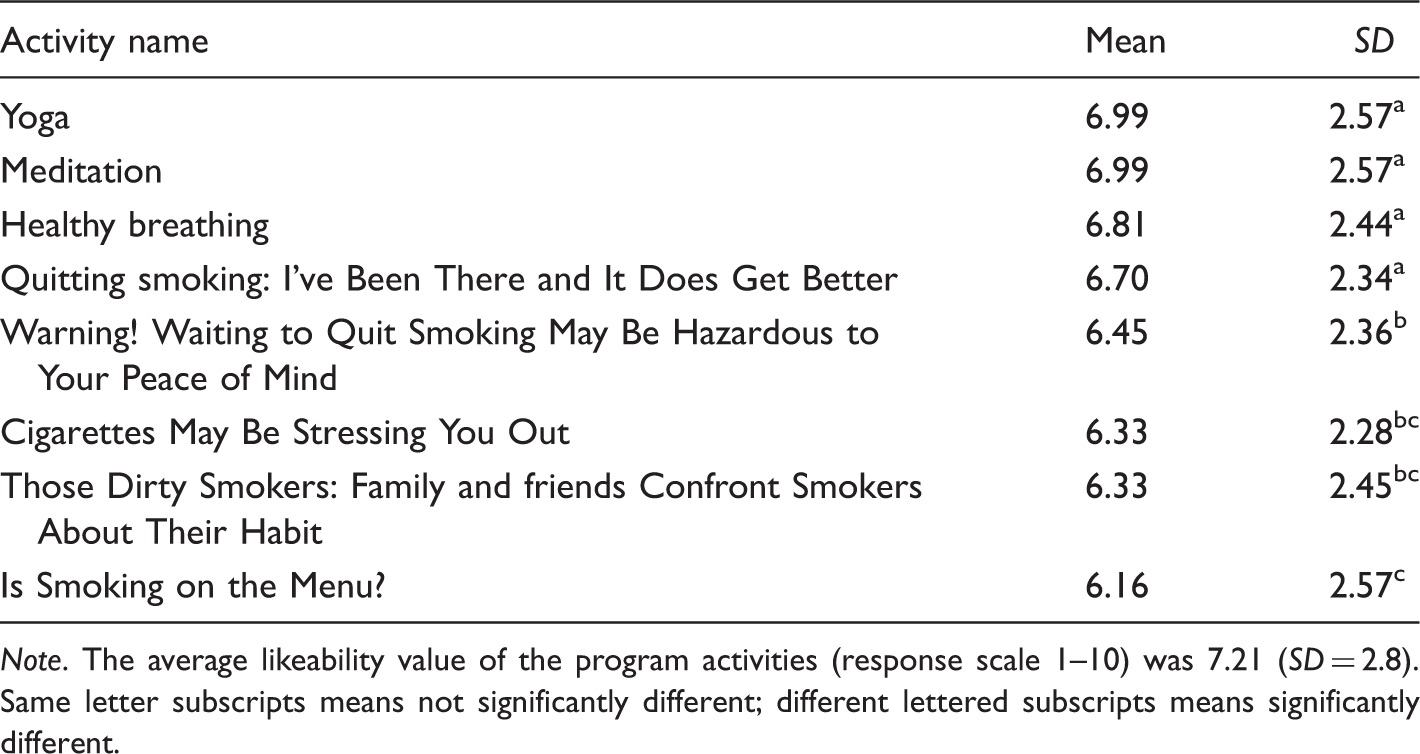
Note. The average likeability value of the program activities (response scale 1–10) was 7.21 (SD = 2.8). Same letter subscripts means not significantly different; different lettered subscripts means significantly different.
One other immediate forced-choice posttest item, asked only of participants in the program group, was “Did taking the Project EX class help you to do any of the following?” The eight forced-choice response categories included “quit tobacco use completely,” “reduce the amount of tobacco you use, and you plan to quit completely,” “reduce the amount of tobacco you use, but you do not plan to quit completely,” “decide to quit smoking in the next two weeks,” “decide to quit smoking sometime in the future,” “strengthen your commitment to stay tobacco free (if you had already quit smoking),” “strengthen your commitment to stay tobacco free (if you have never smoked),” and “other (please specify).”
Program-specific knowledge was assessed with 16 items derived from the curriculum content (approximately two items tapped material from each session). All knowledge items were in a multiple-choice format and provided two to three wrong answers along with one correct answer. All knowledge items were scored as correct or incorrect and averaged into a percent correct score for analysis. For example, one item asked “What is the third leading cause of preventable death? ([a] accidents, [b] secondhand smoke [correct answer], [c] alcohol use, [d] heroin use).”
Data Analysis
To assess the potential sampling bias due to attrition at the posttest across conditions (external invalidity), we calculated a new variable called “attrition group” in which we included 1,203 participants that were surveyed at both time points and compared them with the 343 participants that were only surveyed at pretest. We used logistic regression analysis with the attrition group as the dependent variable. Predictors included age, gender, nationality (born in Spain, or not), current living situation, parents’ education, assessment-day smoking, level of nicotine dependence, and smoking intention. To assess the potential sampling bias due to attrition at the posttest as a function of condition (internal invalidity), comparisons were made between the sample that was lost at posttest and the rest of the sample that remained in the study at posttest, as a function of condition. The comparisons utilized were chi-square or t test models to indicate statistically significant differences (two-tailed p value at the .05 level). Again, all relevant demographic and outcome variables were examined.
Program receptivity was examined at immediate posttest in the program condition through a simple look at mean ratings on the two receptivity measures and the behavior commitment item. Also, all possible within-subjects mean comparison t tests were conducted to provide a comparison on likeability among the eight activities.
Program Effects Adjusted for Imbalance in Attrition.a
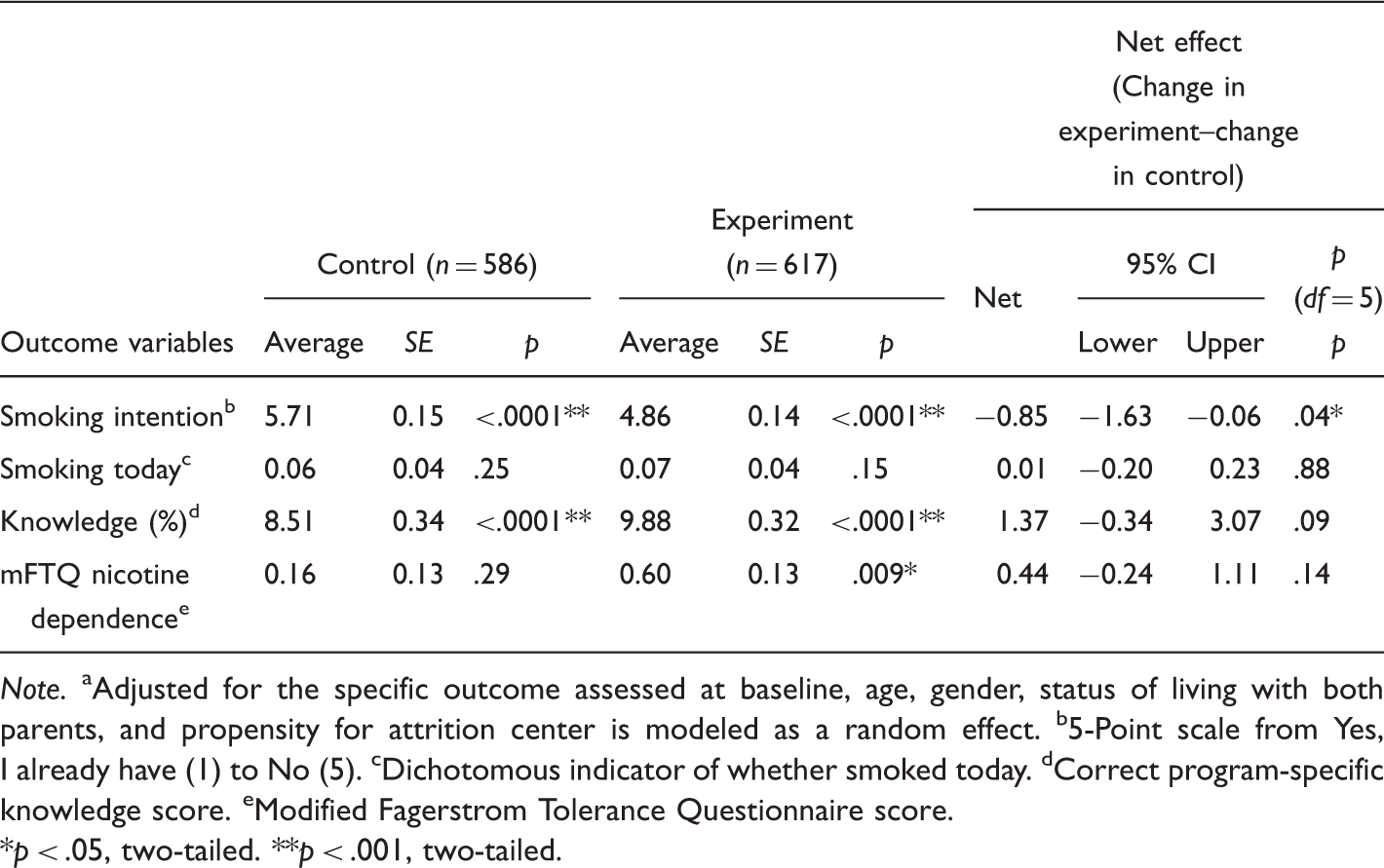
Note. aAdjusted for the specific outcome assessed at baseline, age, gender, status of living with both parents, and propensity for attrition center is modeled as a random effect. b5-Point scale from Yes, I already have (1) to No (5). cDichotomous indicator of whether smoked today. dCorrect program-specific knowledge score. eModified Fagerstrom Tolerance Questionnaire score.
p < .05, two-tailed. **p < .001, two-tailed.
Results
Assessment of Attrition Bias
First, regarding the analysis of external invalidity, differences were only found on age (mean age of group lost to attrition = 15.61 years; mean age of group surveyed at both time points = 15.26; p < .01). The retention rate differed between the EX program group and control group (χ2(1) = 12.55; p < .001). In the EX program group, the retention rate was 74.3% (n = 617), and in the control group the retention rate was 81.8% (n = 586). The attrition analysis comparing conditions (internal invalidity) revealed statistically significant differences in age and living situation between those who were retained at follow up. The participants that were followed up at posttest were slightly younger in age in the program condition compared to the control condition (mean age was 15.19 vs. 15.61, respectively; (t(1,539) = −5.82; p < .001). In addition, those followed up in the program condition were relatively more likely to live with both parents than in the control condition (80.1% vs. 73.9%; χ2(1) = 6.08; p < .014). We failed to find differences in attrition as a function of gender and nationality or on any of the outcome variables. Differences in age and living situation have been controlled for in the analysis.
Process Ratings and Knowledge Change
The average satisfaction of adolescents with the program (perceived program quality; eight items on a scale of 1–10) was 6.67 (SD = 1.72). The average likeability rating of the program activities (response scale from 1–10) was 7.21 (SD = 2.8). The average likeability of the program activities ranged between 6.16 (SD = 2.57) for the game Is Smoking on the Menu? and 6.99 (SD = 2.57) for yoga and meditation. The three alternative medicine activities and one talk show (Quitting Smoking: I’ve Been There and It Does Get Better) were better liked than all other activities, which is shown in Table 1. In addition, 80.4% of adolescents in the program condition reported that Project EX helped to strengthen their commitment to stay tobacco free (if they had already quit smoking) or stay tobacco free (if they had never smoked).
The knowledge index percentage correct at baseline was 93.75% for students in program condition and 87.5% for control condition. The net knowledge index program effect (change in percentage correct in the program condition minus change in percentage correct in the control condition) was 1.37 (p < .09), indicating a marginally positive effect of the program on the designated knowledge items.
Effects on Smoking Intention and Tobacco Use
As shown in Table 2, the program was found to be statistically significant in reducing smoking intention. The net effect was −0.85 (p < .04), contrasting the program condition with the control condition. However, immediate posttest effects on assessment-day cigarette smoking did not show a significant difference between the program and control condition (p < .88). Subjects in the control condition reported a higher level of nicotine dependence at the immediate posttest; however, the net effect failed to reach significance (net effect = 0.44; p < .14). While the intent-to-treat comparison was in the right direction (i.e., intent-to-treat quit rates were 9.5% and 6.7%, respectively, for the program and control conditions), this comparison failed to approach significance (p < .29). Curiously, at immediate posttest there were differences between the program and control group assessed on CO. That is, the CO monitor repeated assessments revealed a significant decrease of ppm levels in the program group (−0.09; p < .03), while the control group showed a significant increase of ppm levels (0.14; p < .008).
Discussion
The high rates of teenage smoking in Spain suggest the need to develop effective programs for tobacco prevention and cessation. In Spain, policy and educational decisions are primarily directed at prevention programs (Gómez, Barrueco, Aparicio, Maderuelo, & Torrecilla, 2009), but it is equally necessary to develop cessation programs for the affected population. Furthermore, prevention programs that have been implemented are geared mostly to drugs in general (Espada et al., 2008).
The Project EX tobacco use cessation program in Russia (Idrisov et al., 2013) significantly reduced future smoking expectation, decreased intention to no quit smoking, and increased motivation to quit smoking at immediate posttest. The program also resulted in higher quit rates at the 6-month follow-up. With the same program in China, 4-month follow-up data indicated a 10.5% 30-day quit rate and a 14.3% 7-day quit rate (Zheng et al., 2004). In the classroom context, Project EX in southern California (Sun et al., 2007) produced a greater reduction in weekly smoking and intention for smoking in the next 12 months. At 6-and-12 month follow-ups, students in the treatment condition experienced a greater reduction in weekly smoking and monthly smoking (Sussman et al., 2007). In addition, an incremental 8% higher cessation rate was observed at the program schools (Sussman et al., 2010). In the present study, the Project EX prevention or cessation program was translated to Spanish and adapted slightly for the Spanish culture. Participants who received the program reported being less likely to smoke in the next 12 months and provided moderately favorable ratings of the program quality, consistent with Sun et al. (2007). Among smokers, commitment in Project EX curriculum pertains to making a personal commitment to quit and subsequently reviewing the commitment. Nonsmokers can make personal commitments to remain tobacco free and serve as a “listening ear” to assist those who may be trying to quit (Sun et al., 2007). Over 80% reported that Project EX helped to strengthen their commitment to stay quit or never smoke. Although at immediate posttest only intention to smoke was found to be significant with a differential of −.85 between treatment and control group, all other variables show a favorable net effect for treatment group. Possibly, longer term effects of the program on smoking prevalence and cessation will be found—we are collecting one-year follow-up data now.
Still, the relative knowledge index effect was marginal. As the baseline knowledge percentage correct was very high in both conditions, perhaps it is not surprising that students at program group improved only marginally their knowledge relative to the control condition, as usually occurs after the implementation of programs that use an interactive methodology pertaining to an arena in which information is well disseminated (Hernández, Espada, Piqueras, Orgilés, & García, 2013). Apparently, while most programming is not directed toward tobacco cessation, public information has disseminated program information (e.g., effects of secondhand smoke; withdrawal symptoms) widely.
Although immediate posttest effects on assessment-day cigarette smoking did not show significant differences between the program and control condition, we did find a significant decrease of ppm levels in the program group along with an increase in ppm levels in the control group. That is, although participants reported to still smoking, objective measures show lower consumption levels. One may speculate that these results suggest that youth in Spain did not honestly report quitting behavior in the classroom. We speculate that youth may make a show of smoking in front of their classmates (as smoking is relatively tolerated in Spain), while privately trying to quit smoking.
As it has been shown in this study, Project EX as a prevention-cessation program can effect immediate changes. Still, there are several notable limitations. First, recruitment was not easy in Spanish high schools because of low motivation among staff to add extra-curricular activities in the schedule. The recruitment rate of schools was 13%. Possibly, we could have been more aggressive in our recruitment strategies. We were not able to offer the school any incentives for participation (e.g., monetary donation to the school). It is also possible that readiness to quit smoking is relatively low in Spain and that changes in the larger social climate may be needed prior to disseminating school-based prevention or cessation programming (Sussman et al., 2010).
Second, the dropout rate at immediate postprogram questionnaires was 22.2%. However, we did make at least three attempts per school to collect posttest data, suggesting to us that higher rates would be difficult. Student absentees accounted for most of the noncompletion, although subject withdrawal from the study accounted for 25% of the noncompletion of questionnaires at posttest.
Third, the study only pertains to immediate effects. It will be important to know what program effects are obtained in a longer time period, because variations in sustained use or cessation usually are observed at the follow-up (Dijk, Reubsaet, de Nooijer, & de Vries, 2007; Griffin, Botvin, Scheier, & Nichols, 2002). Currently, one-year outcomes data are being collected. Fourth, the fidelity of implementation was not assessed, although we know that all sessions were implemented in some form in all classes that received the program. The only data collected on the facilitators was from the ratings of the participants. In these ratings, the facilitators were moderately favorably rated (this information was included in the perceived program quality receptivity measure). An assessment of the fidelity implementation would be appropriate, considering that it largely determines the success of interventions (Sánchez-Martínez et al., 2010). Finally, Project EX generalization to other Spanish locations has not yet been tested. It would be interesting to replicate this classroom modality in other Spanish cities.
Despite the limitations of this study, the use of a randomized design and the large sample size, along with changes observed particularly on behavioral intention and CO levels, suggests promise of Project EX as a cessation or prevention program for Spanish adolescents. Furthermore, there are no well-evaluated cessation intervention programs for adolescent tobacco in Spain, and so the results of this study provide evidence. To have a single program covering the entire Spanish adolescent population (both smokers and nonsmokers) will be more practical for the classroom and potentially more effective for society, in terms of public health.
Footnotes
Declaration of Conflicting Interests
The author(s) declared no potential conflicts of interest with respect to the research, authorship, and/or publication of this article.
Funding
The author(s) disclosed receipt of the following financial support for the research, authorship, and/or publication of this article: This research was supported by the Spanish Department of Economy and Competitiveness (PSI2011-26819), by the Program Vali+d for Research Staff training of the Council of Culture, Education and Science of the Valencian Autonomous Government (Ref. ACIF/2014/047). and a grant from the National Institute on Drug Abuse (DA020138).