







Abstract
The present study tested whether playing football or lacrosse in high school is associated with more problematic alcohol use during college compared with playing other sports in high school. A sample of undergraduate males (n = 2,940) in their freshmen year who had played sports in high school completed a web-based questionnaire. Results showed that males who played lacrosse or both football and lacrosse in high school engaged in heavier alcohol use in college than males who played football or other sports in high school. In addition, males who played football in high school engaged in heavier alcohol use in college than males who played other high school sports. Thus, not all high school sports place males at equal risk for heavy alcohol use in college.
High school athletes drink at significantly higher rates and experience more negative alcohol outcomes than do nonathletes (Denham, 2011; Garry & Morrissey, 2000; Hoffman, 2006; Mays, DePadilla, Thompson, Kushner, & Windle, 2010; Mays & Thompson, 2009). Furthermore, a recent systematic review concluded that those who participated in sports during high school reported drinking more during early adulthood than those who did not participate in sports during high school (Kwan, Bobko, Faulkner, Donnelly, & Cairney, 2014). While there is considerable evidence showing that high school athletes are at increased risk for greater alcohol use and more alcohol-related problems than nonathletes (Hoffman, 2006; Kwan et al., 2014; Lisha & Sussman, 2010), little published research has compared drinking rates across specific sports.
Sport Categories and Alcohol Use
A majority of the research that compares drinking rates across sports fails to compare specific sports with respective alcohol use. Instead, the published literature that focuses on sports participation and alcohol use utilizes the categorization approach. In this approach, investigators differentiate sports along some dimension hypothesized to explain differences in alcohol use and then compare the sport categories on alcohol consumption (Denham, 2011; Veliz, Boyd, & McCabe, 2015). This approach is illustrated by Veliz et al. (2015) where sports were categorized based on level of physical contact. Categories included high contact, semicontact, or noncontact. High-contact sports included sports like wrestling, football, and lacrosse and semicontact sports included sports like soccer, baseball, and field hockey. Noncontact sports included sports like cross-country, gymnastics, and swimming. Results showed that adolescent athletes who played at least one high-contact sport within the past year had higher odds of 30-day prevalence of getting drunk when compared with athletes who did not play a high-contact sport.
The Present Study
An assumption of the category-based approach is that sports within each category drink at similar rates, but this remains an untested assumption. Therefore, the objective of the present study was to test the assumption that sports within the same category drink at similar rates. Specifically, we test whether drinking rates of males who played football and lacrosse in high school, two high-contact sports, reported drinking at similar or different rates when they arrive at college.
Football and lacrosse were selected as the focus of the present study because they are two popular high-contact sports played by high school boys. Over one million high school boys report playing football each year, which is nearly double the number of males that play the next most popular boys sport, track, and field (National Federation of State High School Associations, 2015). While fewer males play high school lacrosse than high school football, it is one of the fastest growing high school sports in the United States (US Lacrosse, 2015). Between 2010 and 2015, the number of high schools offering lacrosse for boys grew by nearly 30%, which greatly outpaced the next fastest growing sport, indoor track, which grew by about 13% (US Lacrosse, 2015). Therefore, football and lacrosse were selected as the focus of the present study because they are among the most popular high-contact sports in high school in terms of sheer participation numbers or growing trends in participation rates. This led to the following set of research questions (RQs):
Will undergraduate males who report having participated in football, lacrosse, both football and lacrosse, or other sports during high school report statistically similar or different (a) rates of social weekend drinking, (b) times drunk in the past 30 days, and (c) number of alcoholic drinks consumed on an occasion that they drank the most in the past 6 weeks?
Methods
Procedures
Males (n = 3,565) in their freshman year in college were recruited from two public universities (one in the Mid-Atlantic and one in the Northeastern United States) to complete a web-based questionnaire as part of a larger study examining substance use behaviors among freshman males. Analyses were restricted to participants who reported having played a sport during high school (n = 2,940). A majority of the sample was White (81.8%), followed by 4% Black, 8% Asian, and 5.9% Other. Approximately 6% of the sample reported being Hispanic. The mean age of the sample was 18.48 years (standard deviation [SD] = 0.88).
Measures
Alcohol use
Three assessments of alcohol use were administered. These were selected because each reflects a slightly different aspect of alcohol use, and each are commonly used in the literature on college student drinking (e.g., MacKillop, 2006; Murphy et al., 2004; Turrisi et al., 2013). Participants were provided with the definition of a standard drink (i.e., one drink equals: 12 oz. beer, 10 oz. wine cooler, 4 oz. wine, 1 cocktail with 1 oz. of 100 proof liquor, or 1.25 oz. of 80 proof liquor) prior to items assessing alcohol use.
Social weekend drinking
A modified version of the Daily Drinking Questionnaire (Collins, Parks, & Marlatt, 1985) was administered, and participants were asked to report the average amount of drinks consumed on a typical Monday, Tuesday, and so on, over the past month. Problematic alcohol consumption is often greatest during the social weekend (Thursday through Saturday), so a measure of social weekend drinking was calculated by taking the mean number of drinks consumed Thursday through Saturday (Cleveland, Lanza, Ray, Turrisi, & Mallett, 2012; Finlay, Ram, Maggs, & Caldwell, 2012). The internal consistency for the social weekend drinking measure of alcohol was acceptable (standardized α = .88).
Times drunk
Participants reported how many times during the past 30 days (about 1 month) they had gotten drunk or very high from alcohol. This item is commonly used in research with similar samples (e.g., Cleveland, Reavy, Mallett, Turrisi, & White, 2014; Mallett, Marzell, Scaglione, Hultgren, & Turrisi, 2014; Turrisi et al., 2013).
Peak amount consumed
Participants indicated the maximum number of alcoholic drinks consumed on an occasion in the past 6 weeks using a modified item from the Quantity/Frequency/Peak Questionnaire (Dimeff, John, Kivlahan, & Marlatt, 1999; Marlatt et al., 1998).
High school sport participation
Participants listed the sport(s), if any, they played in high school (they could to list up to four). Dummy variables were created to reflect four orthogonal groups based on the sports participants listed: played a sport other than lacrosse or football (OTHER), played lacrosse in high school (LAX; i.e., lacrosse but not football), played football in high school (F; i.e., football but not lacrosse), or played both lacrosse and football in high school (LAXF). Thus, for example, if a participant reported having played lacrosse and soccer, then the participant would be categorized as LAX. The number of sports played in high school was calculated by summing the number of high school sports listed by each participant.
Injunctive norms
Injunctive norms were included as a covariate and were assessed with two items similar to those used in the previous research (Baer, 1994; Neighbors et al., 2008; Turrisi, Mastroleo, Mallett, Larimer, & Kilmer, 2007). Responses ranged from −3 (strong disapproval) to 3 (strong approval). The two items were averaged such that higher scores reflected more normative support (r = .65, p < .01).
Demographic information
Participants reported their race (White served as the reference group when dummy coding), ethnicity (1 = Hispanic, 2 = non-Hispanic), age, and highest level of education reached by the participant’s mother and father (an indicator of socioeconomic status). Participants who had consumed alcohol before also reported the age at which they first drank alcohol (i.e., more than a few sips). Participants were asked if they had played a National Collegiate Athletic Association (NCAA) sport at their university. They self-reported weight and height, and body mass index (BMI) of participants was calculated by using the formula suggested by the Centers for Disease Control and Prevention (2015).
Statistical Analyses
The RQs were tested using analysis of covariance (ANCOVA). The alcohol measure of interest was entered as the dependent variable, and the sport dummy variables were entered as predictor variables. LAXF served as the reference group. A modified Bonferroni correction procedure outlined by Jaccard (1998) was used to control for multiple comparisons. The adjusted p values for group comparisons were as follows: p < .0083, .01, .0125, .0167, .025, and .05. A post hoc power analysis yielded the power of 0.99 given the sample size (n = 2,940), with a p value of .05, and a small effect size (d = 0.1).
Covariates included race, data collection site, age, BMI, number of sports played in high school, participation in NCAA sports, and injunctive norms. These were selected as covariates to help rule out the possibility that any relationship between sport type and alcohol use is spurious. For example, males with greater BMIs may gravitate toward sports like football and lacrosse due to their size. Likewise, those with higher BMIs may drink more than those with lower BMIs to feel the effects of alcohol. Although previous research has suggested that ethnicity and parental education may be predictors of alcohol use (e.g., Chartier & Caetano, 2010; Kendler et al., 2014), they were unrelated to any of the outcome variables in bivariate analyses so they were not included as covariates.
Outlier analyses were conducted. Responses more than three SDs above the mean for alcohol consumption for any social weekend day, times drunk in past 30 days, and peak drinking were considered outliers and were assigned the score that corresponded to three SDs above the mean for each variable (e.g., for times drunk in past 30 days, this was 20 times; Tabachnick & Fidell, 2001). Responses three SDs below the mean for age of first drink (10 years of age) were assigned the score of 10. Responses three SDs above the mean for BMI (34.66) were assigned the score 34.66. There were no responses three SDs below the mean for BMI. Outliers reflected less than 1% of the responses on all variables. Sample sizes varied slightly across analyses due to missing data.
Results
Descriptive Statistics
The sports most commonly played by participants when they were in high school were track (n = 945; 32.1%), basketball (n = 801; 27.4%), soccer (n = 769; 26.1%), football (n = 750; 25.6%), baseball (n = 600; 20.4%), tennis (n = 347; 11.9%), cross-country (n = 342; 11.6%), and lacrosse (n = 321; 10.9%). When these open-ended responses were used to create the orthogonal groups, nearly 7% reported playing LAX (reflecting males who played LAX but not F; n = 204), 22% reported playing F (reflecting males who played F but not LAX; n = 633), about 4% played LAXF (reflecting males who played F and LAX; n = 117), and nearly 68% reported playing OTHER sport (n = 1,986). Table 1 shows the correlations, means, and SDs of study variables.
Correlations of Major Study Variables.
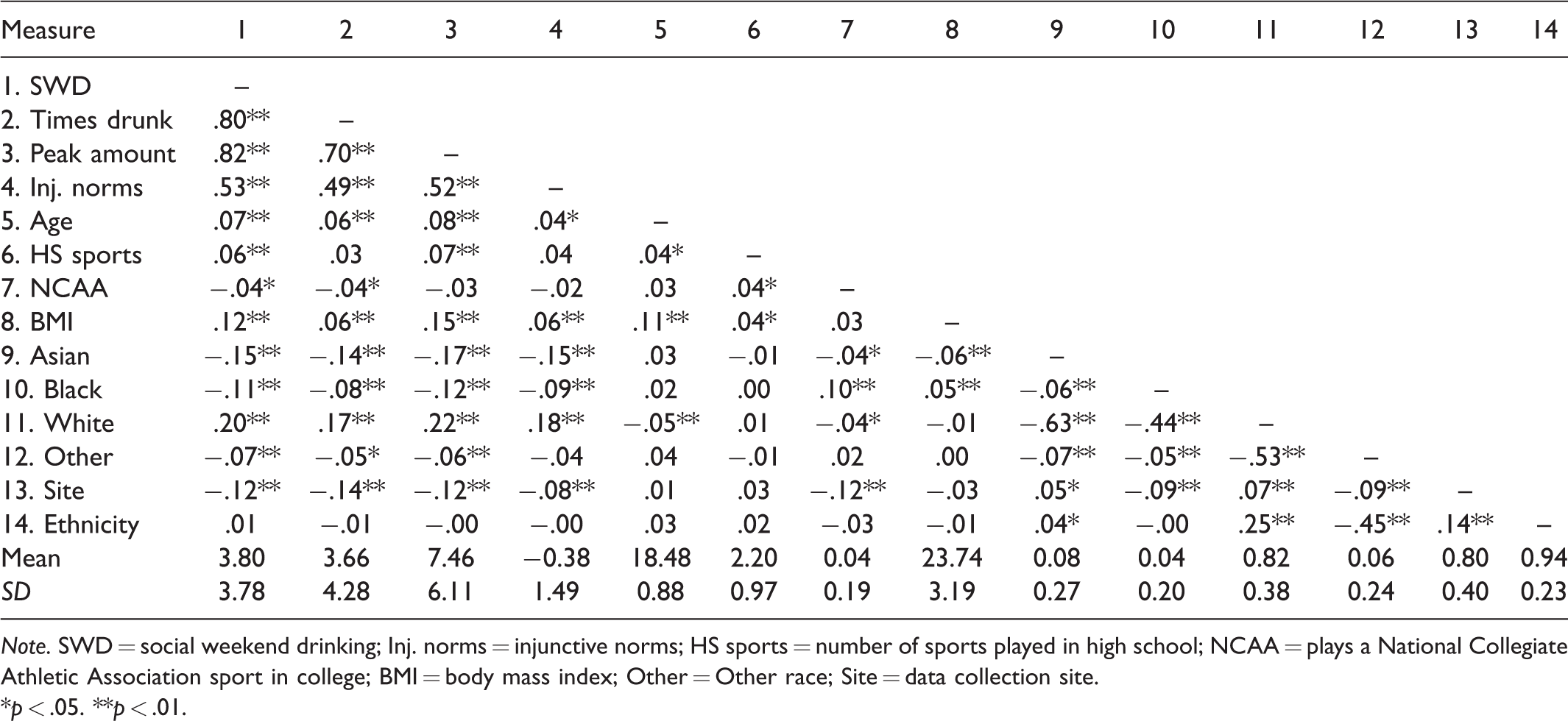
Note. SWD = social weekend drinking; Inj. norms = injunctive norms; HS sports = number of sports played in high school; NCAA = plays a National Collegiate Athletic Association sport in college; BMI = body mass index; Other = Other race; Site = data collection site.
*p < .05. **p < .01.
Research Questions
Means and SDs from analyses that test RQs 1a to 1c are shown in Table 2. Parameter estimates are shown in Table 3.
Alcohol Use During College as a Function of High School Sport Participation.
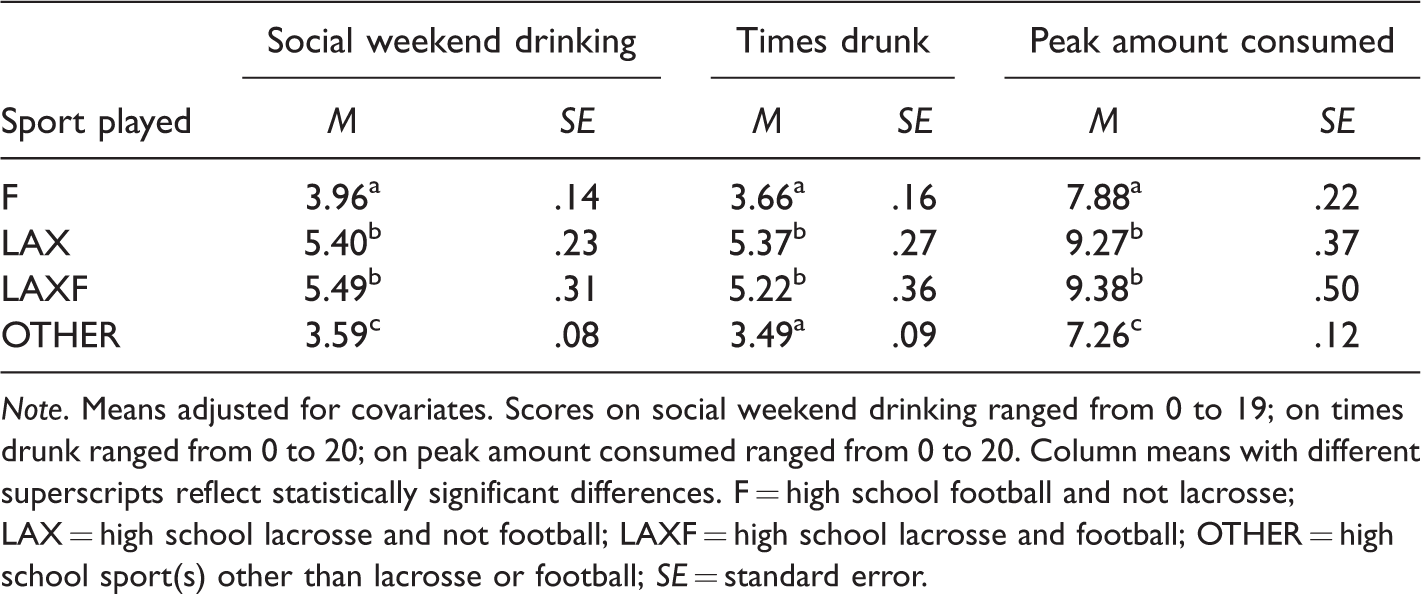
Note. Means adjusted for covariates. Scores on social weekend drinking ranged from 0 to 19; on times drunk ranged from 0 to 20; on peak amount consumed ranged from 0 to 20. Column means with different superscripts reflect statistically significant differences. F = high school football and not lacrosse; LAX = high school lacrosse and not football; LAXF = high school lacrosse and football; OTHER = high school sport(s) other than lacrosse or football; SE = standard error.
Covariate Parameter Estimates.
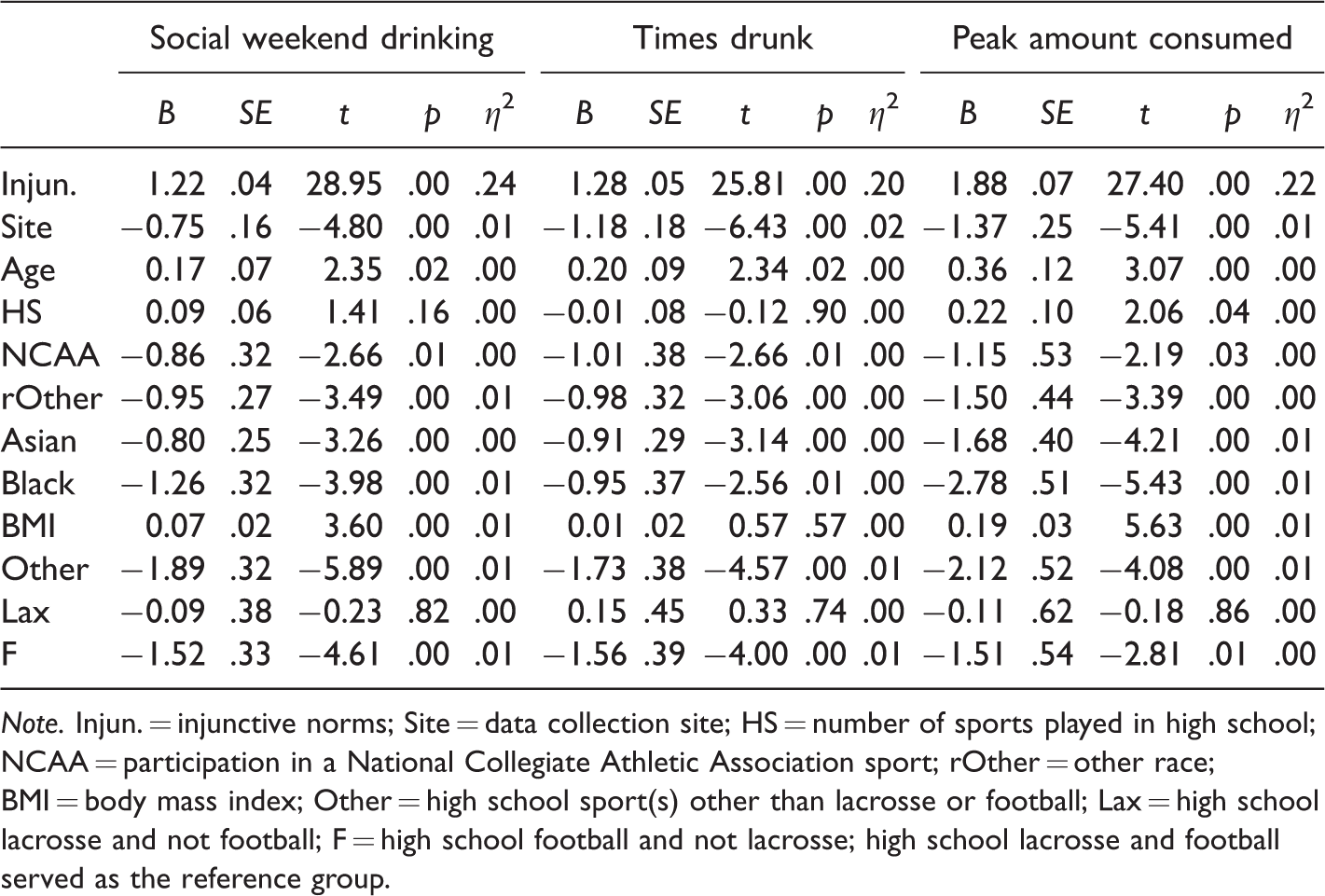
Note. Injun. = injunctive norms; Site = data collection site; HS = number of sports played in high school; NCAA = participation in a National Collegiate Athletic Association sport; rOther = other race; BMI = body mass index; Other = high school sport(s) other than lacrosse or football; Lax = high school lacrosse and not football; F = high school football and not lacrosse; high school lacrosse and football served as the reference group.
RQ 1a: Social weekend drinking
Results of the ANCOVA indicated that social weekend drinking in college differed significantly based on type of sport played in high school controlling for covariates, F(3, 2636) = 27.45, p < .01,
RQ 1b: Times drunk
Results of the ANCOVA showed that times drunk in the past 30 days differed significantly based on type of sport played in high school controlling for covariates, F(3, 2634) = 19.94, p < .01,
RQ 1c: Peak amount consumed
Results of the ANCOVA indicated that peak amount consumed differed significantly based on type of sport played in high school controlling for covariates, F(3, 2633) = 13.29, p < .01,
Discussion
This is the first published study to test the assumption made by the category-based approach that drinking rates among different high-contact sports are equivalent. Specifically, we tested whether males in their freshman year of college who reported playing lacrosse, football, both lacrosse and football, or other sports during high school engaged in equivalent or different rates of alcohol use. Those who played lacrosse or who played both lacrosse and football reported significantly more social weekend drinking, being drunk more times in the past 30 days, and greater peak drinking than those who played football only or who played other sports. These results fail to support the assumption made by the category-based approach that sports within each category drink at similar rates. Results further suggest there is something unique about lacrosse players or the culture of lacrosse that leads to more drinking compared with other sports.
Two possibilities emerge for why those who played lacrosse in high school may engage in more high-risk drinking in college than those involved in other sports. One possibility is that the personality characteristics that draw one to the sport of lacrosse may also lead him to consume more alcohol. For example, sensation seeking is a personality trait characterized by the propensity to seek new and diverse sensations and experiences (Hittner & Swickert, 2006), and research has found sensation seeking is positively related to alcohol use (Hittner & Swickert, 2006; Meil et al., 2016). Therefore, those high in sensation seeking may drink more than those low in sensation seeking and may also be attracted to lacrosse because it is fast-paced, exciting, and carries an element of physical risk. This would imply that the positive relationship between lacrosse and alcohol use is due primarily to one’s personality and not to the sport of lacrosse.
Another possibility for why lacrosse would lead to more high-risk drinking than other sports, including football, is that there is something unique about the lacrosse culture that fosters high-risk drinking. One feature of lacrosse that distinguishes it from the high-contact sport of football is team size. For example, high school football teams can be almost twice as large as high school lacrosse teams. Because the lacrosse teams are smaller than football teams, they may be more tight-knit, homogenous, and cohesive (Widmeyer, Brawley, & Carron, 1990; Widmeyer & Williams, 1991). Athletes perceive more normative support for alcohol use than nonathletes (Ford, 2007; Turrisi et al., 2007), so it may be that those who played on lacrosse teams in high school internalized drinking norms to a greater degree than those who played on a football team. As a result, their drinking behaviors in college are reflecting the values internalized during high school.
Although the data indicated that those who played football in high school differed from those who played other sports with respect to social weekend drinking and peak drinking in college, this pattern did not hold for times drunk. Instead males who played football during high school reported equivalent rates of times drunk in the past 30 days as males who played other sports during high school. One possibility for this divergence is that times drunk measures frequency, whereas social weekend drinking and peak drinking measure quantity. It may take males who played other sports in high school fewer drinks to get drunk than males who played football in high school, which is possible considering that those who played football in high school drink more than those who played other sports in high school, which could, as a result, impact their alcohol tolerance.
Contributions to the Literature
The present study makes both theoretical and practical contributions to the literature. In terms of theory, results fail to support the assumption made by the category-based approach that all sports within the same category drink at similar rates. Relying exclusively on category-based approaches when studying the relationship between sports participation and alcohol use prevents us from developing a more nuanced understanding of the relationship between the two that is necessary for prevention and intervention programs. Identifying variability in drinking across specific sports would allow practitioners, coaches, and others to consider which teams would benefit the most from interventions. Rather than creating more or different sport categories, future research should identify specific sports that place males at high risk for alcohol use.
Results of the present study provide insight for education and prevention efforts. When developing such programs decisions about dosage (i.e., duration, frequency, and amount) are challenging. Two factors that can help inform a priori decisions about dosage are behaviors of the target audience and key stakeholders (Voils et al., 2014). The data herein suggest that the dosage of an intervention to reduce high-risk drinking may be greater among lacrosse and football players than among those who play other sports. Furthermore, the coaches of teams that are found to be at greatest risk for heavy alcohol use should be included as stakeholders to help inform discussions about dosage.
Future Research
Results of this study offer several avenues for future research. One avenue is to examine other combinations of sports participation. Selecting sports that are similar to lacrosse and football could help to illuminate which features or characteristics are responsible for heavier drinking. Several features worthy of consideration are level of contact, size of sport, weight restrictions, prestige, and hyper/masculinity (Veliz et al., 2015; Wells et al., 2014). For example, ice hockey and wrestling are also high-contact sports (that are high in masculinity, vary in size, differ with respect to weight restrictions, and have unique cultures) that may place high school students at risk for high levels of alcohol consumption in college compared with other sports. Furthermore, athletes who play sports with weight restrictions (e.g., wrestling) may be deterred by heavy drinking because of concerns about caloric intake. In contrast, athletes who play sports that encourage a high caloric intake (e.g., football) may be more inclined to engage in heavy drinking. In addition, some high-contact sports (e.g., lacrosse) may confer greater prestige or popularity than other high-contact sports (e.g., wrestling), and this greater prestige or popularity may pressure athletes to drink more in an attempt to continue to fit in. Alternatively, these sports may also have unique cultures that embrace alcohol use. Future research should attempt to identify which sports are at elevated risk of heavy drinking and attempt to isolate features that are responsible for differences in alcohol use.
Another avenue for future research is to study mechanisms responsible for the link between participation in lacrosse and football and heavy alcohol use. It is of interest to understand whether the differences in use are due to internalized norms, perceptions of invulnerability, or some other factor(s) that males are perceiving from their sporting environment. Such information is critical for developing the prevention and intervention programs.
Strengths and Limitations
Results of the present study must be viewed in light of the strengths and limitations of the study design. One limitation is that the study relied on male participants from two universities, so the extent to which these findings generalize to females and students at other universities is unknown. The National Federation of State High School Associations (NFSHSA) reports that football is the most commonly played sport by high school males. However, in our data, we found track and field to be the most commonly played sport (NFSHSA, 2015). The NFSHSA assessment focused only sports that were part of a high school program, whereas our assessment of high school sports programs did not focus exclusively on school-sponsored teams. Responses to our item would have also included club or travel teams as well. The study relied on self-reports of alcohol use, and participants may have over or underreported their alcohol use behaviors. Such misreporting would bias means, parameter estimates, and SEs. However, we used three well-established measures that have been widely used with populations similar to the one studied here (e.g., Cleveland et al., 2012, 2014; Marlatt et al., 1998). The study was cross-sectional and correlational and such a design precludes us from testing for temporal precedence or causal ordering. There is a temporal lag between sport participation and reports of drinking in college. The lack of contemporaneous data constitutes a weakness as well.
Finally, this study was a first step in discovering differences among sports, and not all comparisons were possible (e.g., comparing lacrosse with wrestling). However, results reported herein study should give researchers confidence that moving forward with a more targeted recruitment effort to distinguish which sports are at greatest risk is worthwhile.
Despite these limitations, the present study has several strengths. The study included a large sample of male college students, a population that is at particularly high risk for heavy alcohol use. Another strength is that injunctive norms were included as a covariate, which provided a very stringent test of the RQs. Finally, three measures of alcohol use were used to assess the different aspects of alcohol use to provide some convergence about the relationship between the type of sport played in high school and alcohol use in college.
Conclusion
Results imply that not all high school sports are associated with equal risk for heavy alcohol use among males in college. Males who play lacrosse in high school may be at greater risk for heavy alcohol use in college than males who play other sports even after controlling for current sports participation and drinking norms, two strong predictors of alcohol use among college students. Prevention programs might consider including males who play lacrosse and football in programs aimed to reduce drinking prior to the transition to college. Finally, the field should move beyond category-based approach studies to develop a more nuanced understanding of the relationship between specific sports and alcohol use. Targeting specific sports likely requires significant resources in terms of data collection efforts and recruitment efforts, but results of the present study should provide confidence that such efforts have the potential to significantly advance the literature on sports participation and alcohol use.
Footnotes
Declaration of Conflicting Interests
The authors declared no potential conflicts of interest with respect to the research, authorship, and/or publication of this article.
Funding
The authors disclosed receipt of the following financial support for the research, authorship, and/or publication of this article: This project was partially supported by Award Number R21DA023147 from the National Institute on Drug Abuse issued to Tonya Dodge.