







Abstract
In this longitudinal study (N = 98), we examined whether drinking for suppression reasons moderated the relation between depressive symptoms and hooking up for self-affirmation reasons and negative hookup consequences. No moderation was found for hooking up for self-affirmation reasons, but the effect for negative hookup consequences approached significance. When drinking for suppression reasons is low, participants with fewer depressive symptoms reported more negative consequences, and participants with more depressive symptoms reported fewer negative consequences 2 months later. Results are discussed within the context of sex education and mental health programming for young adults.
Hooking up 1 and alcohol consumption are prevalent on college campuses (Garcia et al., 2012). A significant proportion of students report negative consequences of hookup affect their academic, social, and personal well-being (Fielder & Carey, 2010). Two common predictors of hooking up—depressive symptoms and alcohol consumption (LaBrie et al., 2014; Manthos et al., 2014)—could be associated with young adults’ motives for, and negative consequences of, hooking up.
Studies examining the link between depressive symptoms and likelihood of hooking up yield mixed findings (e.g., Fielder & Carey, 2010; Owen et al., 2010). Manthos et al. (2014) found two distinct subgroups of young adults concerning hookup behavior: In one group, ratings of depressive symptoms were significantly associated with hooking up, and members endorsed more sexually permissive attitudes. Students in the second group were more conventional in their sexual attitudes, and their ratings of depressive symptoms were not associated with the likelihood of hooking up over the course of a semester. Despite mixed findings on depressive symptoms and hooking up, literature does indicate that depressive symptoms are associated with higher feelings of regret and negative affect after a hookup (Grello et al., 2006) and are also linked to reasons for hooking up. Owen et al. (2014) found that young adults who reported more depressive symptoms also endorsed hooking up to affirm their self-concept, which reflects a desire to avoid negative outcomes or abandonment. Understanding whether there are moderators in the relationship between depressive symptoms and hooking up for self-affirmation reasons would clarify the conceptualization of students with depressive symptoms’ hookup behaviors.
Young adults with more depressive symptoms experience more negative consequences after drinking alcohol compared with students with fewer depressive symptoms, even after controlling for alcohol consumed (Gonzalez et al., 2011). Alcohol serves as a social facilitator to increase the likelihood of hooking up as well as a mechanism to avoid the negative consequences of a hookup (Peralta, 2008). Nevertheless, hooking up while intoxicated increased college students’ likelihood of experiencing regret after the hookup (Fielder et al., 2013). Drinking motives may explain these findings. One reason for drinking is suppression: Individuals with suppression reasons for drinking are motivated to distract themselves from troubling negative thoughts, typically associated with depressive symptoms.
Although drinking for suppression reasons has been associated with depressive symptoms in adult populations, the findings with college samples have been mixed. Ralston and Palfai (2012) found that drinking to cope, like drinking for suppression reasons, 2 moderated the relation between depressive symptoms and students’ implicit evaluations of alcohol, where high coping motives and more depressive symptoms led to more positive evaluations of alcohol.
Drinking for suppression reasons may predict more hookups for self-affirmation reasons, as individuals drinking to suppress are experiencing distress, and this distress could be further resolved by hooking up to increase their positive sense of self (Owen et al., 2011). Moeller and Crocker (2009) found a cross-sectional association between drinking for suppression reasons and a focus on self-image (i.e., fixated on appearing in a positive manner) among college students. Thus, it is likely that drinking for suppression reasons relates to hooking up for self-affirmation reasons.
Suppression motives may moderate the relation between depressive symptoms and hookup consequences and motives. Others have conceptualized drinking motives as moderators (Ralston & Palfai, 2012, discussed earlier). Individuals who drink to suppress tend experience more alcohol consequences after drinking when upset (Simons et al., 2005). While we expect both depressive symptoms and drinking to suppress predict hooking up for self-affirmation reasons and negative hookup consequences, we anticipate that individuals with high levels of depressive symptoms who drink to suppress will experience more alcohol consequences and will hook up with the intent to bolster their sense of self—another means of regulating mood in addition to drinking to suppress.
This, longitudinal study builds upon prior work to understand the role of depressive symptoms and drinking for suppression motives in hookup motives and perceived hookup consequences over time. We hypothesized:
Participants who endorse more depressive symptoms would endorse higher levels of hooking up for self-affirmation reasons 2 months later. Participants who more strongly endorse drinking for suppression reasons would endorse higher levels of hooking up for self-affirmation reasons 2 months later. Drinking for suppression reasons would moderate the relation between depressive symptoms and hooking up for self-affirmation reasons 2 months later, where higher levels of drinking for suppression reasons would magnify the positive relationship between depressive symptoms and hooking up for self-affirmation reasons 2 months later. Participants with more depressive symptoms would experience more negative consequences of hooking up 2 months later. Participants who more strongly endorse suppression reasons for drinking would experience more negative consequences of hooking up 2 months later. Drinking for suppression reasons would moderate the relation between depressive symptoms and negative consequences of hooking up, where higher levels of drinking for suppression reasons would magnify the positive relationship between depressive symptoms and negative consequences of hooking up 2 months late.
No sex differences were hypothesized. Recent studies focusing on negative reactions to hookups and motives for hooking up found no sex differences (e.g., Vrangalova, 2015). Hyde (2005) has suggested that sex differences, when they do exist, are often very small but may contribute to false narratives about the sexual behaviors expected of men and women.
Method
Participants
Participants reported consuming alcohol and engaging in at least one hookup in the past year (N = 98) at Time 1. The majority of the sample was females (79.6%; median age = 19.57 years, standard deviation [SD] = 1.93 years) and White (78.6%; followed by 8.1% multiracial/ethnic, 7.1% Black, 2% Asian American, 1% Native American; 3.1% did not answer). The educational levels of participants were 39.8% freshmen, 32.7% sophomores, 19.4% juniors, and 8.2% seniors.
Measures
Hooking Up
Participants were asked at both time points: “Some people say that a hookup is when two people get together for a physical encounter and don’t necessarily expect anything further. Based on this definition, how many people have you hooked up with in the past 12 months?”
Alcohol C=Consumption
Participants reported at both time points how many occasions had they consumed alcohol over the past month, how many alcoholic beverages they consumed per sitting on average, and how many times they had consumed five or more standard drinks in one sitting (Daily Drinking Questionnaire; Collins et al., 1985).
Depressive Symptoms
The Center for Epidemiologic Studies-Depression Scale (CES-D; Radloff, 1977) assessed depressive symptoms. The CES-D has 10 items rated on a 4-point scale (e.g., “I felt depressed”), with higher scores indicating more depressive symptoms. This measure was administered at Time 1, and Cronbach’s α was .72.
Drinking to Suppress
The Reasons for Drinking Questionnaire—Suppression subscale (RDQ-Suppress; Labouvie & Bates, 2002) measured the extent to which participants drink to cope. The 13-item, 3-point scale asked how important participants find various suppression-related reasons for using alcohol (e.g., “to help me feel better emotionally”). Labouvie and Bates’ (2002) suppression motive is conceptually the same as the drinking to cope motive from Cooper’s (1994) Drinking Motives Questionnaire—Coping subscale (for a review, see Kuntsche et al., 2005). The measure was administered at Time 1, and Cronbach’s α was .90.
Negative Consequences of Hooking Up
The 7-item Negative Consequences subscale of the Social, Academic, Romantic, and Sexual Hooking Up Reasons Scale (SARS-Neg; Owen et al., 2014) assessed negative consequences of hooking up (e.g., “This hookup has negatively impacted my relationship with my friends;” 5-point scale). This measure was administered at Time 2, Cronbach’s α was .79.
Motives for Hooking Up
The 5-item self-affirmation subscale of the Sex Motives Scale (SMS-Affirm; Cooper et al., 1998) measures the extent to which participants hooked up for self-affirmation reasons (e.g., “To what extent did you engage in this experience to make you feel more self-confident?;” 5-point scale). This measure was administered at Time 2, Cronbach’s α was .88.
Procedure
Participants were recruited through an introductory course on families across the lifespan that fulfilled a social sciences requirement. Participants completed the measures at two time points: within the first week of class and then 2 months later. The university institutional review board approved all procedures.
Data Analysis
Participants who did not report hooking up or consuming alcohol over the course of the study, and participants who did not complete both Time 1 and Time 2 were removed, resulting in a final sample size of 98. Neither age nor year in school was associated with any of the study variables; therefore, no control variables were added to any of the main analyses. Alcohol consumption did not correlate with either outcome variable (self-affirmation reasons and negative consequences of hooking up) and, therefore, was also not included as a control variable. We conducted two separate moderation regression analyses in SPSS 24.0 with PROCESS (Hayes, 2012). In the first regression, hooking up for self-affirmation reasons at Time 2 (SMS-Affirm) was the outcome variable; in the second, negative consequences of hooking up (SARS-Neg) was the outcome variable. Drinking for suppression reasons (RDQ-Suppress) and depressive symptoms (CES-D) at Time 1 were entered in the first step of each regression to test whether the variable predicted either hooking up for self-affirmation reasons (Hypotheses 1 and 2) or negative consequences of hooking up (Hypotheses 4 and 5). PROCESS automatically tests interaction effects of the specified predictor (depressive symptoms) and moderator variables (drinking for suppression reasons), thus addressing Hypotheses 3 and 6.
To probe interaction effects approaching or with statistical significance, we used the Johnson-Neyman technique (Hayes & Matthes, 2009) to analyze the effect of depressive symptoms on each outcome variable at different levels of drinking for suppression reasons, the moderating variable.
Results
At Time 1, on average participants drank on 4.56 occasions (SD = 1.13; M = 4.42 occasions, SD = 1.18 at Time 2), consuming 3.46 standard drinks (SD = 0.95 drinks) per sitting (M = 3.38 drinks, SD = 0.90 at Time 2), and binge drinking 3.59 instances (SD = 2.09; average of 3.59 instances, SD = 2.0 at Time 2) over the past month. Males consumed more alcohol per sitting, Time 1: t(95) = 2.101, p < .05; males: M = 3.95 beverages, SD = 1.23; females: M = 3.34 beverages, SD = 0.821. There were no sex differences on number of occasions or frequency of binge drinking at Time 1 or Time 2, t(95) = 1.085, p = .281; t(95) = 1.304, p = .204; t(96) = 0.142, p = .161; t(96) = 1.41, p = .161, respectively, and no sex differences on number of beverages consumed per sitting at Time 2, t(95) = 0.107, p = .92. At Time 1, participants reported an average of 4.28 hookups in the past year (SD = 2.55; average of 3.32 hookups, SD = 1.30 at Time 2); there were no sex differences in the number of hookups reported at either time point, t(96) = −0.539, p = .591; t(96) = 0.322, p = .748. Nearly half of the sample reported that their hookup included vaginal or anal intercourse at Time 1 and Time 2 (49.4%; 51.1%, respectively) with no sex differences at either time point (χ2 = 0.830, p = .362; χ2 = 0.169, p = .681). As expected, no sex differences were found on CES-D, t(96) = −0.330, p = .742, SARS-Neg, t(96) = 0.721, p = .473, SMS-Affirm, t(96) = 1.893, p = .061, or RDQ-Suppress scores, t(96) = −0.830, p = .408. The bivariate correlations, means, and SDs of the variables are presented in Table 1.
Bivariate Correlations and Descriptive Statistics Among the Variables.
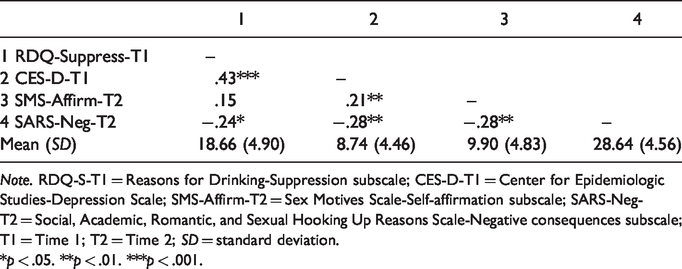
Note. RDQ-S-T1 = Reasons for Drinking-Suppression subscale; CES-D-T1 = Center for Epidemiologic Studies-Depression Scale; SMS-Affirm-T2 = Sex Motives Scale-Self-affirmation subscale; SARS-Neg-T2 = Social, Academic, Romantic, and Sexual Hooking Up Reasons Scale-Negative consequences subscale; T1 = Time 1; T2 = Time 2; SD = standard deviation.
*p < .05. **p < .01. ***p < .001.
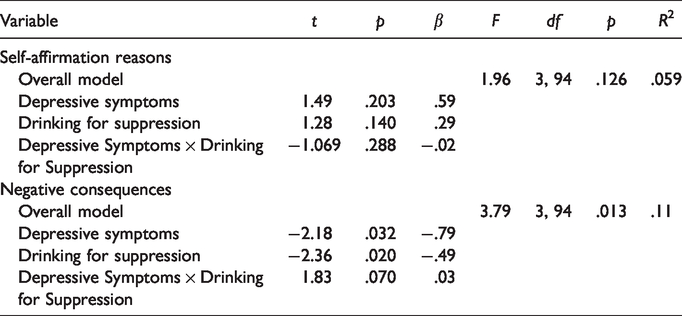
The first regression model (Hypotheses 1–3) did not significantly explain variance of self-affirmation motives to hookup. The second model (Hypotheses 4–6) explained a significant amount of variance of negative consequences of hooking up (see Table 2 for regression results). Results of the regression analysis indicated the main effects of both depressive symptoms and drinking for suppression reasons predicted fewer negative consequences of hooking up as main effects and the interaction effect approached significance.
Multiple Regression Analysis Predicting Hooking Up for Self-Affirmation Reasons and Negative Consequences of Hooking Up.
Given the relationship between interaction effects of depressive symptoms and drinking for suppression reasons at Time 1 and negative consequences of hooking up at Time 2 was a statistical trend (i.e., p < .10), we used the Johnson-Neyman technique to explore the interaction effect (Figure 1). The Johnson-Neyman statistics indicated that when participants scored 17 or below on drinking for suppression reasons (50% of the sample), depressive symptoms predicted fewer negative consequences at Time 2.
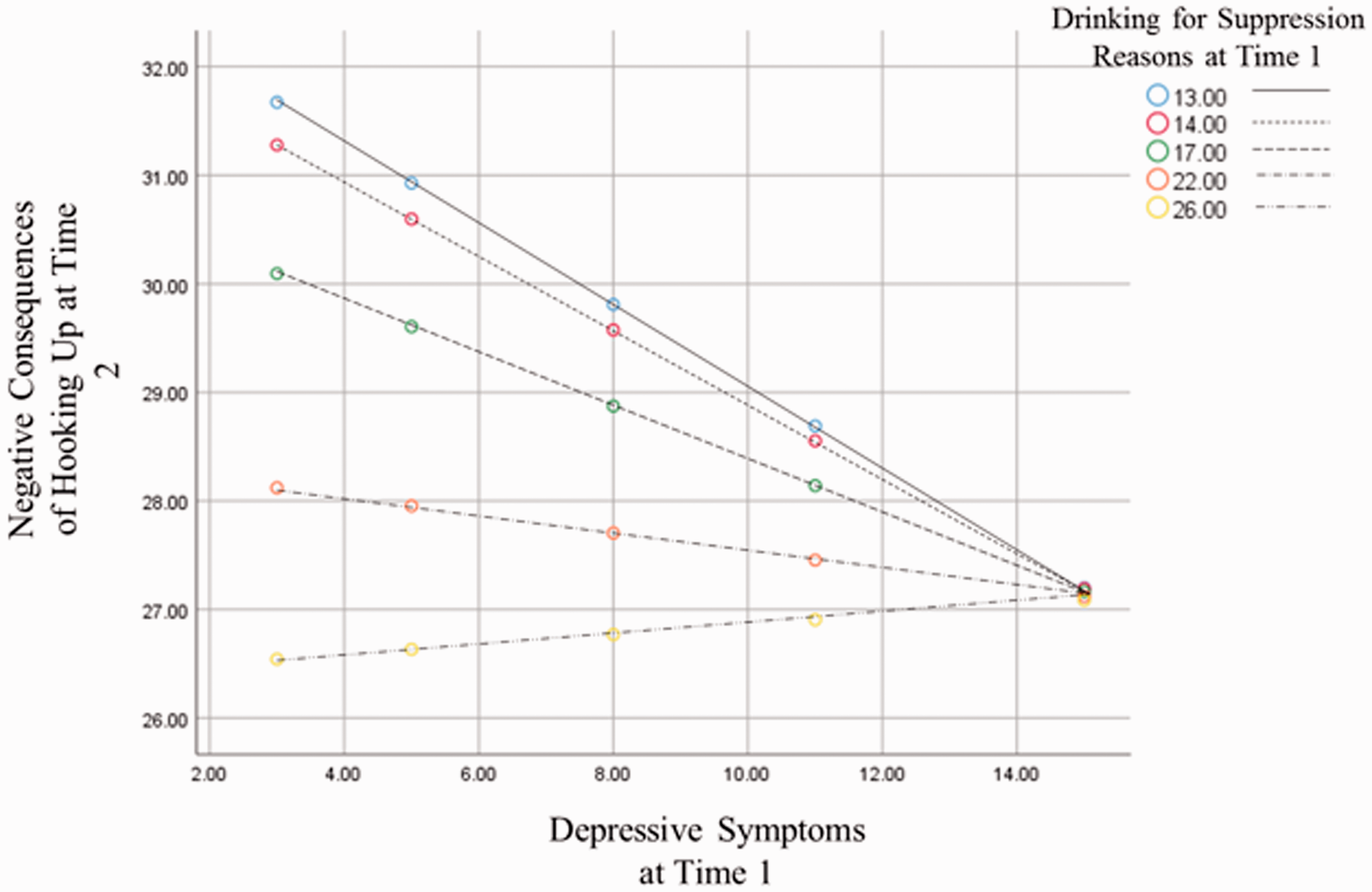
Drinking for Suppression Reasons as a Moderator of the Relationship Between Depressive Symptoms at Time 1 and Negative Hookup Consequences at Time 2.
Discussion
This study analyzed whether depressive symptoms and drinking for suppression reasons predict (a) hooking up for self-affirmation reasons and (b) negative consequences of hooking up in a sample of college students and whether drinking for suppression reasons moderated the relation between depressive symptoms and the outcome variables. We found that depressive symptoms and drinking for suppression reasons did not predict hooking up for self-affirmation reasons independently or as an interaction effect. This was unexpected given prior findings of a relation between depressive symptoms and self-affirmation hookup reasons (Fielder et al., 2013; Owen et al., 2014) and self-image and drinking for suppression reasons (Moeller & Crocker, 2009). The relationship between depressive symptoms and hookup motives may not be linear; severe depressive symptoms are associated with decreased libido. Individuals with moderate or mild depressive symptoms could hook up for self-affirmation reasons, and individuals without depressive symptoms could hook up for other reasons. The null effects could also be due to study limitations, discussed in detail later.
The results suggested that suppression reasons moderated the relation between depressive symptoms and negative consequences of hooking up. Specifically, drinking for suppression reasons moderated the relation when people endorsed fewer suppression reasons. Participants who endorsed lower levels of drinking for suppression reasons and endorsed lower levels of depressive symptoms reported higher levels of negative hookup consequences. Participants who endorsed lower levels of drinking for suppression reasons but endorsed higher levels of depressive symptoms reported lower levels of negative hookup consequences. This result appears at odds with prior findings that more drinking to cope strengthens the link between depressive symptoms and positive, implicit evaluations of alcohol (Ralston & Palfai, 2012), although Ralston and Palfai’s (2012) study did not account for hookup behaviors. This moderation effect does expand upon the work of Owen et al. (2011), who found that students with depressive symptoms felt less depressed after hooking up, while students with fewer depressive symptoms felt worse after hooking up. Hooking up can make young adults feel more autonomous and in control (Manthos et al., 2014), if alcohol is introduced as a means of reducing negative affect, the hookup may be less intentional and thereby undermine feelings of autonomy and control. It is possible that students with depressive symptoms regain a sense of control and choice when they hook up while sober but lose that sense of control or choice when hooking up while drinking to suppress negative emotions.
The results of this study should also be understood in the context of their methodological limitations. First, most participants were White and from a single university; it is unknown whether the results will generalize to other groups. Second, we excluded participants who reported not drinking, as the primary variables in the study would not be applicable to these individuals; our estimates concerning hookup behaviors should be limited to young adults who drink. Third, all measures were self-reports and subject to social desirability biases. Fourth, the current sample size was small; analyses in this study were underpowered for testing the moderation hypotheses. Nonetheless, evidence of significant relationships with an underpowered sample is compelling. Future analyses testing moderation effects should rely on a larger sample to unpack additional between-group effects (e.g., college and noncollege populations). Finally, variables were measured at 2-month intervals; it is possible that 2 months is too long between predictors and outcomes in this case: Participants’ perceptions of negative hookup consequences, for example, may be highest in the days following depressive symptoms and drinking motives (predictors), rather than several weeks later. Ecological momentary assessment (see Shiffman, 2009) methods retain greater external validity as participants complete surveys at multiple time points daily while in their usual environments; allowing researchers to track participants’ motives for drinking and hooking up, as well as fluctuations in depressive symptoms, throughout a day or weekend.
During young adulthood, individuals often explore and develop a sexual sense of self (Manthos et al., 2014). Engaging individuals in conversations about why they drink may help illuminate their hookup decision-making process. Owen et al. (2014) found that those who hooked up with the hope for intimacy reported more negative reactions. Therapists and sex educators working with young adults should acknowledge sex as a viable, adaptive coping technique while emphasizing that combining sex with drinking for suppression reasons can lead to negative emotional outcomes. By doing so, discussions around hookups become strengths-based interventions, rather than simplistic, harm-avoidant discussions.
Footnotes
Declaration of Conflicting Interests
The authors declared no potential conflicts of interest with respect to the research, authorship, and/or publication of this article.
Funding
The authors received no financial support for the research, authorship, and/or publication of this article.
