






Abstract
Pupils in Sweden are socialized in commercial off-the-shelf games, and, therefore, game-oriented formal education can constitute a foundation for further socialization of pupils excluded in school. However, digital illiteracy and traditional views among school staff forced a regression from the game-oriented formal trial education in this study back to the traditional education form. Research questions were as follows: How did the pupils act upon the consequences of the regression? How can these acts inform the design of education in digital culture? These questions were addressed using ethnography over 3 years. The pupils' acts differed depending on their socialization in school and in games. While the game-oriented formal education included all in the socialization process, the regression caused half of the pupils to drop out. The pupils' acts are discussed with a conceptual framework. Conclusions show the need for digital literacy and understanding pupils' perspectives on education among school staff.
Introduction
Play is a voluntary activity, and Huizinga (1955) views play as the foundation of culture. Further, from a philosophical view, Suits (2005) argues that playing games can be seen as the only meaningful activity when material needs are satisfied. Play also has a central role in learning and education. Taking a psychological and cultural–historical perspective, Vygotskij (1995) viewed play as an expression for creativity, which in turn relies on the sociocultural context, that is, where invention depends upon previous work of others, or artifacts. Thus, social interaction is central in education, where artifacts (e.g., computer games) are part of reality. However, Leontjev viewed play as problematic in capitalism, where the children do not play with adults; they only play adult in their imagination (Jerlang et al., 1988). These perspectives stress the needs for play in education and for teachers to play games together with pupils to enable dialogue.
Game-based learning (GBL) research can be described from at least three views: goal-tool, game-value, and socialization. In the goal-tool view, games are tools to achieve goals of formal education (see, e.g., Egenfeldt-Nielsen, 2007). In other words, the focus is on edutainment or serious games, that is, simulations designed for formal education. Another view, here called game-value, focuses on the value of games in their own right, taking game play, game design, and game development into account (see, for example, Buckingham & Burn, 2007). A brief review of these first two views is available in Westin and Lange (2012). A critique of GBL is that some games are designed to make you spend time rather than learn new skills in the game, thus creating an “illusion of learning” (Linderoth, 2009, p. 17).
However, Linderoth (2009) does not discuss an important point: The dialogue about the content in games (and not the game content itself) can be of most value for education (Gee, 2007). This means that the content is dialectic; it is created in dialogue between the teacher and the pupil (Rescher, 2007). In fact, both can be teachers; the pupil often knows more than the teacher about games, and the teacher often knows more about the school subjects. Further, the dialectic approach means that games can be commercial off-the-shelf (COTS) entertainment products, unmodified for educational purposes, as the educational content is created in dialogue. By taking Gee's perspective (which includes both goal and value rationales), it is possible to view games as a foundation for education, that is, a socialization process to achieve inclusion in society. The dialectic enables the goal rationality of formal education; the COTS games enable the value-rationality of building education on the pupils' interest in these games. This third socialization view is not as well researched as the goal-tool or game-value views.
Social inclusion is “to participate fully in economic, social and cultural life” (Council of the European Union, 2004, p. 8). In contrast, “[e]xclusion consists of dynamic, multi-dimensional processes driven by unequal power relationships” (Popay et al., 2008, p. 36). Further, social exclusion is a process whereby certain individuals are pushed to the edge of society and prevented from participating fully by virtue of their poverty, or lack of basic competencies and lifelong learning opportunities, or as a result of discriminatin. (Council of the European Union, 2004, p. 8)
In this study, pupils are more specifically gamers who have been excluded in school. A gamer is here seen as someone who is socialized in computer games culture, which to some extent represents most pupils in Sweden. A report from the Swedish Media Council shows that 92% of the boys and 60% of the girls aged 9 to 16 in Sweden play computer games, and the younger (aged 9–12) play more than the older (aged 12–16). However, regarding level of activity, 10% of the younger and 18% of the older played computer games at least 3 hours per day (Ahlinder & Agebäck, 2010). While playing games is more common among the younger, there are almost twice as many hard-core gamers among the older, including the age of 16 at which the pupils in this study started upper secondary education. There may also be an overlap within activities, for example, between the most common activity (looking at video clips on YouTube) and playing games, as many video clips are about games and game play.
As more boys than girls fail in school (Klefbom et al., 2012) and all pupils but one in this study was male, it should be noted that the three most preferred games among boys at the time of the study were first-person shooter games such as Counter-Strike (16%) and Call of Duty—Modern Warfare (10%) as well as online role-playing games such as World of Warcraft (12%) (Ahlinder & Agebäck, 2010). These games are all COTS games. The overlap of the age groups (9–12 and 12–16) was due to the time of year the person had his/her birthday, which is before or after the survey as explained in a follow-up study (Thorslund, 2013). These two studies by the Swedish Media Council imply that playing computer games is a normal activity, especially among boys. For 10% to 18% of the boys, COTS games are a major part of their leisure activities, and this group could generally be called hard-core gamers (as opposed to casual gamers). For convenience, the term gamer is used in this article to represent hard-core gamers. COTS games provide a fertile ground for a game-oriented formal education, that is, where games constitute the foundation for socialization for a large portion of the pupils (the gamers).
As COTS games (from here on, games) are unmodified for formal education purposes, this approach requires a pedagogical design of the education, as tried in the Digital Room (DR) project in this study. Göran Lange, pedagogue at Stockholm University, created the first DR in Project 1, P1 (Wiklund & Ekenberg, 2009). He was also the project manager for the second DR in Project 2, P2, which is the education studied in this article. In short, the DR design (in both P1 and P2) can be described with seven principles: (a) Common interest: that is, interest in games among pupils and teachers; (b) Dialogue: about the content of games (Gee, 2007) and gaming activity related to the curricula; (c) Play: a lusory attitude (Suits, 2005) or willingness to accept the lusory means (what is allowed to play the game) which is required of teachers; that is, to play games with the pupils, which is the prelusory goal (Suits, 2005); (d) Full workdays: that is, without a traditional schedule to enable gaming; (e) Access: full administrative rights to computers, managed by the pupils to enable gaming, learning about technology and minimize costs; (f) Location: no regular classroom, but a common physical space to also socialize outside of the game worlds; and (g) Material: based on COTS games, not educational games (in coherence with the first principle).
The DR design can be related to six barriers for gaming in school, identified in a literature study (Rice, 2007) and further elaborated in Westin and Lange (2012). Two of the barriers were (a) negative perceptions toward video games as educational components and (b) a lack of alignment to state standards. Adding to these, lack of digital literacy among school staff made the dialogue about DR with school staff hard to achieve. These barriers forced a regression of DR back to the traditional education form, triggered by an anonymous notice to the Swedish Schools Inspectorate.
Problem and Research Questions
The problem was that all but three of the pupils had more or less given up on traditional school before attending the DR, which all pupils strongly appreciated. As pupils' dropout and failure rates are high in Sweden (Klefbom et al., 2012), this problem is central in designing formal education related to the digital culture where many pupils live today. Two questions are investigated here: How did the pupils act upon the consequences of the regression, transforming game-oriented formal education into traditional school? How can these acts inform design of education in digital culture?
Conceptual Framework
To interpret the results, a conceptual framework as illustrated in Figure 1 is needed, with a narrative description (Miles & Huberman, 1994) of seven steps as follows:
Conceptual framework.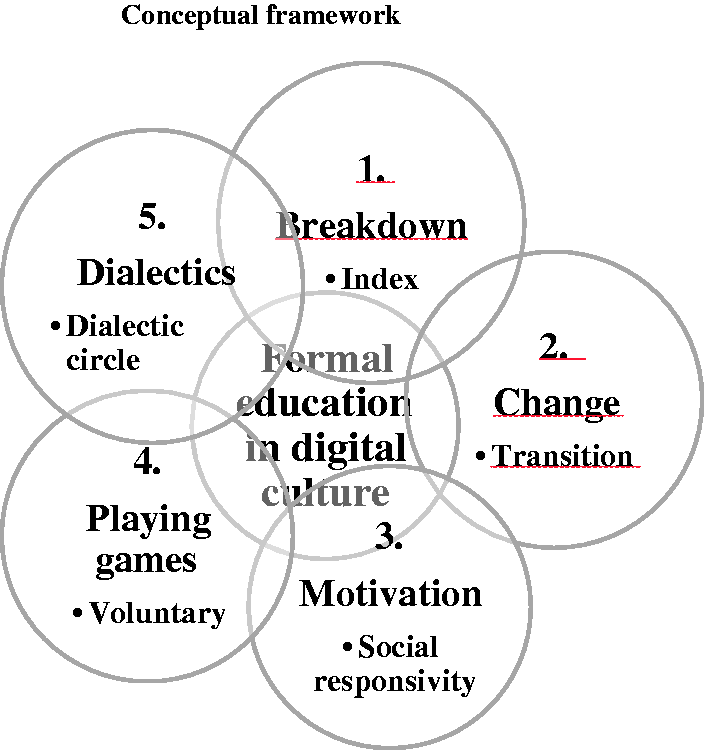
The index was introduced with the advent of typography and mass production of the written word; further, computers are dependent on the written word for their existence (Ong). Consequently, the index is also a concept in computer science (e.g., indexing of databases) and thus part of computer games, such as keeping track of each avatar's inventory. Further, the index is also used in a technocratic way to keep track of (or to control) the pupils in school; the schedule is an index, which dictates the breakdown of time, space, and content of each day. Attendance lists represent another index to follow-up the control of time and space. Grades (a third index) are used to keep track of each pupil's performance related to the content (curriculum). These indexes constitute a multidimensional matrix, devoid of meaning outside school: “The temporal intervals of school and the order of the subjects are not readily consistent with individual student interests, rhythm and ability” (Balldin, 2006, p. 26, translation by the authors).
The schedule is typically nondialectic and does not fit the time of events in games. Thus, to use concepts by Freire (1974), the traditional school “oppresses” pupils who are gamers, as their voices and interest are “silenced,” by not being able to build on their “interests, rhythm and ability” (Balldin, 2006, p. 26). Change can occur on different levels. For instance, adding more grades or demand on attendance in traditional school are changes, which just preserve the status quo. To genuinely change the situation for gamers in school, and especially those who have been excluded, there is a need for a transitional change (TC). As Freire (1974) points out: “While all transition involves change, not all change results in transition” (p. 6). Pupils can achieve TC by dropping out, but otherwise are at the mercy of the school administration to have a dialogue.
Breakdown, a concept originally conceived by Heidegger, occurs when a preunderstanding of something does not make sense. In system science, breakdown is often explained by going from ready-to-hand (Winograd & Flores, 1986; e.g., attending school to learn something meaningful) to present-at-hand (Winograd & Flores, 1986). That is, when the pupils have realized the lack of meaning of indexing, a breakdown occurs where they start to question school (it becomes present-at-hand) and eventually drop out. Another possibility for pupils to achieve TC is to find another form of education, as the DR in this study. In the DR, pupils who had not been “domesticated” (Freire, 1974, p. 31) in school were the focus; or more succinctly, excluded gamers. Most of them had lost their intrinsic motivation of learning by attending school, and some had also lost the extrinsic motivation to grade. By changing formal education from traditional school into a pedagogical design based on the pupils' interest in games (the DR), it was possible to regain their motivation (intrinsic and to some extent extrinsic). It was also possible to achieve inclusion of all pupils by avoiding stigmatization that may occur in remedial education, as was previously shown in a study of P1 (Wiklund, Mozelius, Norberg, & Westin, 2014).
With a dialectic cycle involving initiation, response, revision, and readjustment, the “processes involved react sequentially to or against their own prior products” (Rescher, 2007, p. 1). Events in a game can initiate such dialectic cycles, and formal education can be performed, by playing COTS games together (both teachers and pupils). Social responsivity is “human sociality and her willingness to ‘respond’ when ‘questions’ are asked of her” (Asplund, 1987, p. 29, translation by the authors). This willingness implies an interest and motivation to participate. Asplund further explains that sociality is being social; responsivity is being responsive in dialogue, and the response may also anticipate the other person's response. Social responsivity relates to the elementary forms of social life, such as play and games. However, in this study, the school administration regressed to an increased index (from Step 5 to 1, clockwise in Figure 1), resulting in oppression of the pupils’ culture as gamers.
Research Method
To answer the research questions, the study was conducted during 3 years with an ethnographic approach. Focus was on the pupils' acts, and the researchers' interpretations of those acts are discussed. Ethnography is in short a process initiated by breakdowns, and resolution of those breakdowns to reach coherence (Agar, 1986). All actors can be said to have at least one goal. Each goal is “an interest at hand” (Agar, 1986, p. 23), which may result in change. Further, goals are the “source of breakdowns and resolutions” (Agar, 1986, p. 23), and a plan expresses how to achieve the goal. Frames are “generalized knowledge structures” (Agar, 1986, p. 24) between actors. Here, actors are mainly the pupils and the researcher, but may also be the project manager or the school staff. Formal education is focused toward goals and often has detailed plans to reach those goals. When the goals of school are not an interest (or goal) of the pupil, or the frames are not shared between pupils and school staff, problems are bound to arise, resulting in a breakdown.
Breakdowns occurred when a schema (goal, frame, and plan) was unable to make sense of (resolve) a strip of data. Strips of data were primarily Level 1 (Agar, 1986), that is, acts by the pupils noted in a logbook along other events, and media files produced by the pupils, but also Level 2 from interviews with pupils and meetings with school staff. Acts are either “reflectively contemplated action” (Agar, 1986, p. 24) of what just happened, or projected as an action of an imagined future (Agar, 1986). In this study, both forms of acts were present in the transformation of the education over time. The transformation was a dialectic circle, a process of thesis, antithesis, and synthesis (Rescher, 2007). On one level, it was a divergent dialectic (Rescher, 2007) where the DR project manager and the school administration did not get a convergent result. At another level, the dialectic was convergent between the pupils and the DR project manager. The dialectic circle ended when we had “exhausted the requisite resources” (Rescher, 2007, p. 8), for example, energy and access to the field.
At the beginning of the study, the interest at hand by the pupils of playing games in school lead to a derivative and occasioned breakdown based on an anonymous notice to the school inspectorate. This turned into the core breakdown investigated in this article: the transformation (regression) of the game-oriented formal education to traditional school. The strips provided the ground for a thick description in the results, which is discussed in relation to the conceptual framework, thereby enabling a more generic understanding of the strips.
Ethical aspects of the study can be described by relating to four key principles of research ethics (Denscombe, 2010). First, to protect the interest of the pupils, the study was done with permission from the school, as some pupils were minors (below 18 years). Further, the pupils were informed that the data would be presented in such a way as to not reveal the identity of a specific person. Second, the pupils were informed about the purpose of the study (to evaluate the DR) and that it was voluntary to participate. The third principle of openness and honesty in the study was implemented by making transcriptions as best possible and double-checking interpretations with peer researchers regarding the findings. The fourth principle (abide by the laws of the country) considered copyright and keeping the data as safe as possible (e.g., passwords on computer storage).
Results
Three dimensions of the pupils' backgrounds are illustrated in Figure 2, identifying three groups (A–C) among the pupils.
Three groups (A, B, C) within the group of pupils', approximately positioned by their socioeconomic situation (solid line: __), level of socialization in games (dotted line: …), and socialization in school (dashed line: - - -).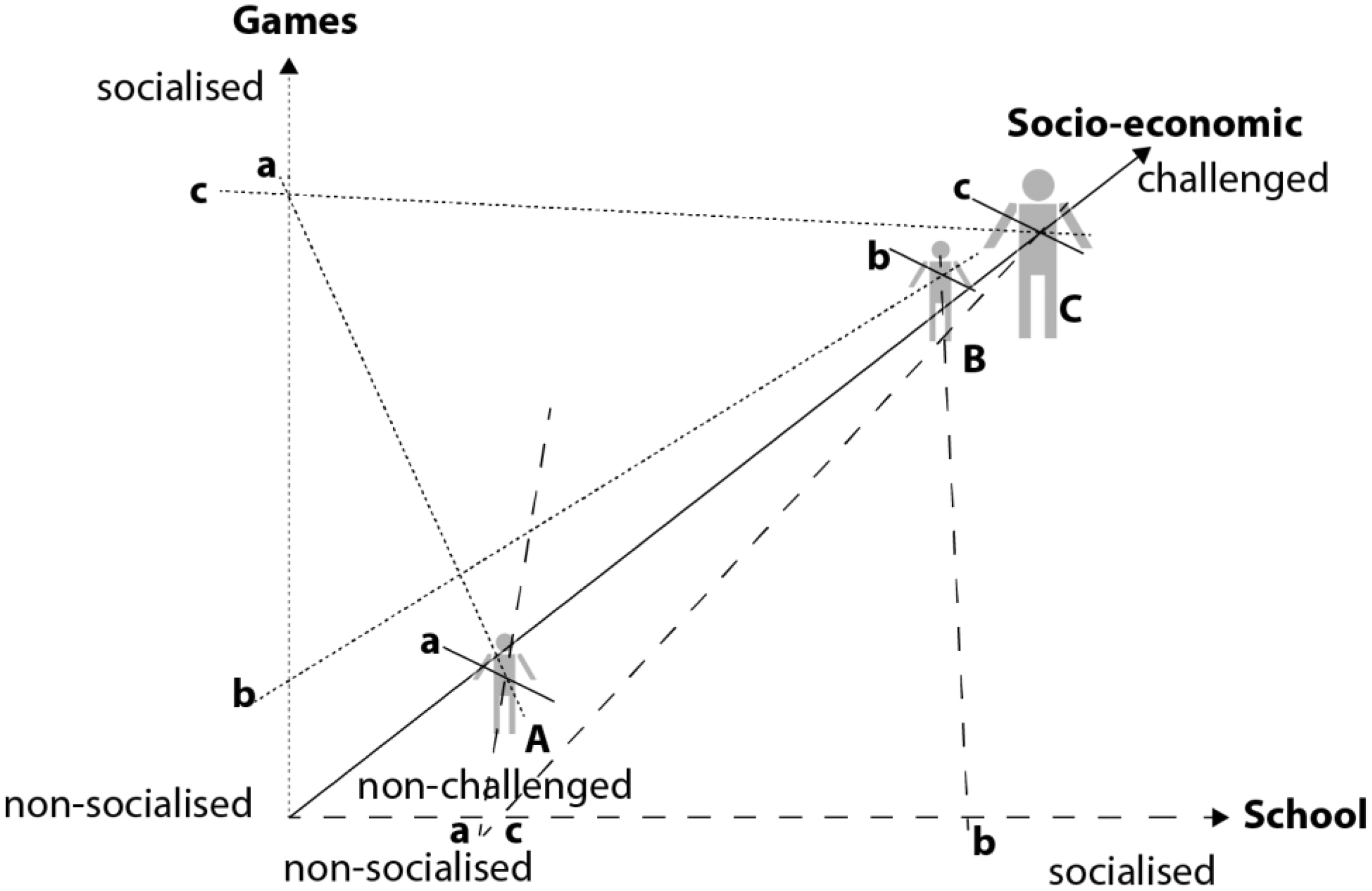
Using the illustration in Figure 2, an understanding of the diversity of the pupils can be achieved. For instance, a major part of the pupils were living in a socioeconomically challenged situation (b_, c_). Further, a major part of the pupils were highly socialized in games but not in school (a- - -, c- - -; a…, c…). These similarities in the degree of socialization in games and school were not directly related to their socioeconomic situation, as the minor group who was socialized in school lived in a socially and economically challenged suburb (b- - -, b_). Group C was the largest group. The project design (described in the Introduction) had to be able to unite pupils with this diverse background:
Group A: Gamers; not socioeconomically challenged Group B: Not gamers; socioeconomically challenged Group C: Gamers; socioeconomically challenged
Timeline of Formal Events
To get a clearer view of the transformation process over the 2 years of the DR project and the following post-project year, the timeline in Figure 3 provides an overview of the most important formal events and the times at which they occurred.
Formal events of importance for the pupils during the Digital Room project (P2) timeline.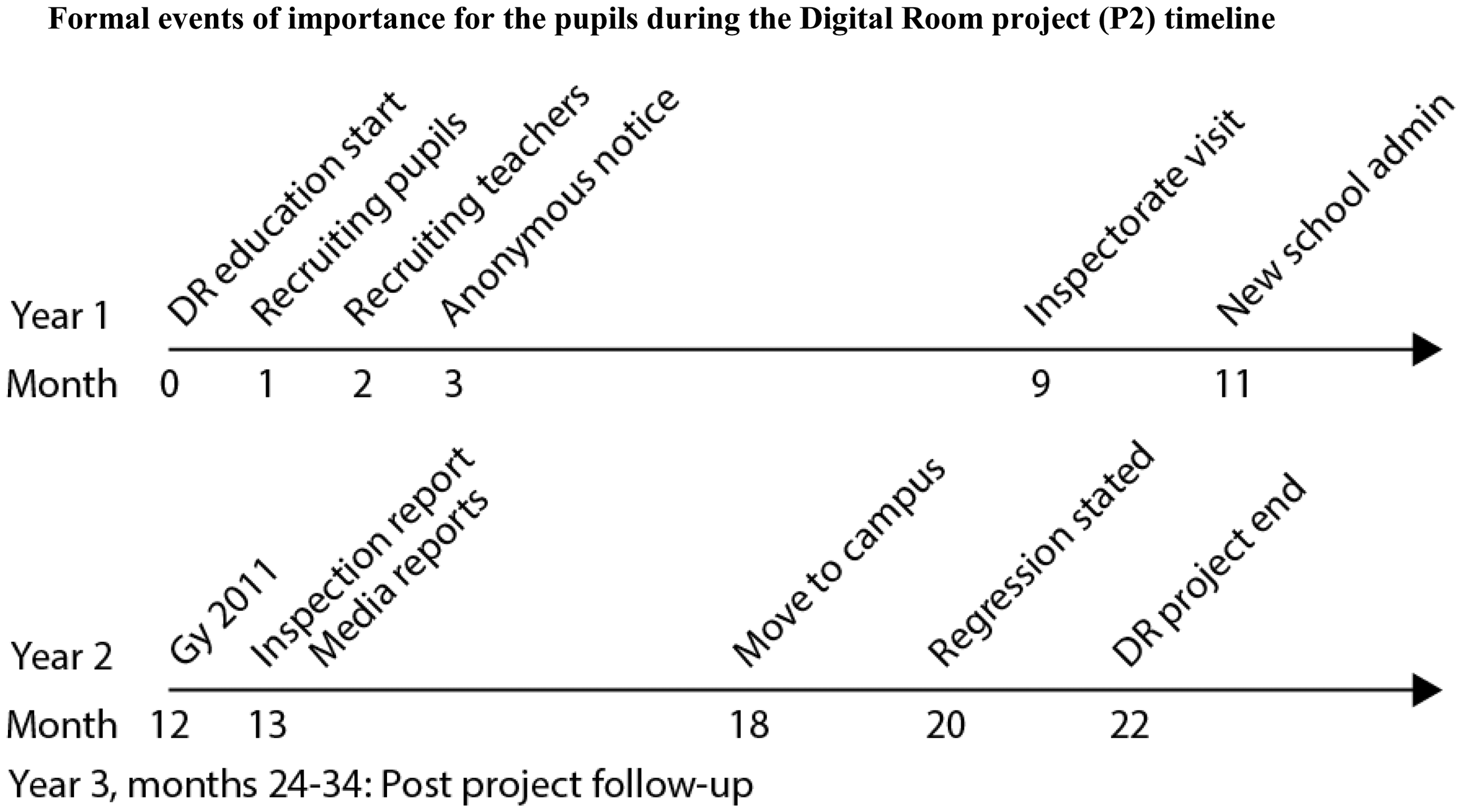
The following brief summary of the timeline is elaborated later in the Results section. The DR education started in August 2010 (Month 0), in a building off the school campus in a suburb. The Swedish School Inspectorate received an anonymous notice in Month 3, while the project manager was still recruiting teachers. During Months 4 to 8, numerous documents were produced to the inspectorate. The notice was followed up in Month 9 with a visit by the inspectorate, who had a meeting with school staff and the project manager and a group interview with pupils. During the summer in Month 11, a new school administration based in the city center took over, while the DR continued to be placed in the suburb. In Month 12, a new curricula called Gy-2011 (Skolverket, 2013) replaced the old Lp4-94 (Skolverket, 2006), requiring nine extra grades for attending upper secondary school. The visit by the school inspection was reported in Month 13, and several media published a more or less erroneous interpretation, which the pupils acted upon. A half-year later (Month 18), the DR was moved into the city campus building, which realized the regression and transformation to traditional school in Month 20. The project supporting the DR (P2) ended in Month 22, but the pupils who had not dropped out after the move continued for a third school year (Months 24–34).
DR off Campus
This section focuses on events during the process leading up to the regression, which are important as a contrast to answer the research question. First, there was a group process that can be described as creating a guild, a group of people playing together, in this case based on the 20 pupils who attended the DR and had experienced various but significant issues with the traditional school. Thus, the project manager stressed the importance of a common interest in computer games. Seventeen of the pupils were hard-core gamers when they began their education at the DR, playing preferred game genres such as first-person shooters, real-time strategy, and massively multiplayer online role-playing games, which made them typical gamers compared with Ahlinder and Agebäck (2010). Two pupils preferred simulation games (flight or historical). However, the school staff included three pupils who were not gamers (Group B), which disrupted the early group process when it was still fragile. The nongamers were at a beginner level in the games while the others (Groups A and C) were advanced (hard-core) gamers; the latter had to wait and teach the beginners for a long time before they could play together. In the end, it worked out for two of them; they were included in the group, as they gradually became gamers. The third nongamer did not participate in the gaming but was very active in social media.
Second, as playing a game is a voluntary accepted activity, it means that the quest to voluntary participate in upper secondary education must also be accepted. One pupil said: “You are free somehow. They way you learn [at DR], you study in two very different ways” (Pupil 14). This expression of freedom clearly relates to a voluntary activity, which also explains why most of the pupils recruited each other to the DR. The freedom could also be explained by enabling an individual path to learning, which was motivating: “In my old school you got books and you had to read them. Here, if I don't want to have the French revolution, I may get the Russian or something else” (Pupil 10). Another pupil talked more generally about the path of attending the DR: “It is mostly computers here and not books and papers” (Pupil 17). Yet, another pupil expressed how the path could lead to something in the future: “I may work with what I like and study what I want to be” (Pupil 16). A fourth example points to the difference of learning and performance: “Here you get grades for your knowledge and not for how you perform and I think this is damn good” (Pupil 1). A fifth example is a pupil who related the individual path to lifelong learning: Here I may choose who I should write about and that enables me to have that knowledge for the rest of my life. If I write about something I am not interested in, that knowledge may last perhaps a year before I forget it. Then I do it only for the grades, not for the knowledge. (Pupil 8) The system here is so much simpler yet more advanced than the old school. You don't need the old books; if you get a task the teachers help you directly; you get pages to read, do your tasks. (Pupil 6)
The third process in leading up to the regression was how the pupils defended their education, that is, their stronghold to use medieval terminology common in many games. In Month 3 of the project, an anonymous notice was sent to the Swedish Schools Inspectorate, which followed up on this issue at the end of the first year (Month 9). The inspectorate found the following formalities for rectifying: (a) grading for every course; (b) having an individual plan for pupils; and (c) following curricula in the subjects of sports, math, and English. All pupils who were interviewed by the inspectorate expressed a positive view of the DR, and one of the pupils said the DR was “the best thing that had happened to him.” After the visit, media erroneously reported that the pupils just played games without breaks or teachers, missing that it was the notifier and not the inspectorate who claimed this. Without a schedule, the pupils were free to take a break whenever they wanted, and the fact that the teacher sat in an adjacent room has less relevance where both teachers and pupils are logged in to the same shared virtual learning space (i.e., online game). Another error reported in media was the lack of certified teachers (at the notice in Month 3) but had in part been rectified at the time of the media articles. Finding teachers who were both gamers and certified was a challenge, but a young female teacher fit the profile. She was easily accepted among the pupils as she could play together with them. On their own initiative, two pupils were interviewed in one of the newspapers and expressed their perspective, opposing the notifier's view.
Transition to Traditional School on Campus
This section focuses on events during the process of transition to traditional school. Some of the events described here started to occur before the move to campus, as the change was gradual.
Moving to the school building located on campus
During the autumn semester (before the move), the pupils had created clay sculptures of game characters, and 3D-scanned them into digital 3D-models. One planned activity was to show this at an exhibition in conjunction with an event arranged by the city. While the school administration was informed about this, they decided to move the day before the exhibition, and the pupils were not allowed to attend. The moving from the external building in the suburb and into the school building in the city took place in Month 18. This change was motivated by the school to rectify some of the formal issues noted by the schools inspectorate. The project manager was hesitant but had no power in this decision. During the first 2 months in the school building, the pupils were allowed to continue playing games. However, at a meeting in Month 20, the pupils were informed by the school that major changes were going to happen. In practice, this meant that a traditional school format was forced upon the pupils, despite discussions in which the project manager argued for the importance of the pupils' views about the DR. As a result, attendance dropped from 75% before the move to 55% after the move. Furthermore, the school broke the class down into smaller groups, separated from each other in different classrooms. Eight months after the move, that is, in Month 26, one pupil reported that they thought “the school sucks, but half of us have decided to finish the education anyway.”
Immediately after the move into the school building in the city, the group became anxious. On February 20, 2012, for the first time during 18 months, a pupil stole something (a gaming-mouse) from another pupil. The project manager resolved this by paying for a new mouse himself. In addition, there were basic practical problems with the move to the campus. Significantly increased travel time from the suburb and bad food were comments from some of the pupils. Those who could afford it resolved the latter issue by going to a fast-food restaurant downtown instead. In contrast, while the education was located off campus in the suburb, 16/20 lived in the neighborhoods, and a local restaurant served much appreciated lunches.
Regression to traditional school
On campus after the move, one of the teachers confirmed that there was a regression to traditional school. In March 2012, the class was now split by the school authority and made to join four existing classes on the campus. A traditional schedule was introduced, causing a breakdown of both time and space; attendance got lower and truancy was a fact. Groups A and C deprecated the regression, expressed by one pupil: “We were a family there, now we have been split up,” “We have stopped playing the games, which kept us together,” and “The move has made us split up and rendered a negative feeling” (Pupil 3). Another pupil put it succinctly: “It was our school, this is their school” (Pupil 5). Group B (nongamers, socialized in school, socioeconomic challenged) did not view this as a big problem; they actually appreciated the traditional school.
Surprisingly, the principal informed that the minimum requirement for attendance was 1 hour per week; all requirements above that should only be justified from each pupil's needs. This puts the concept of truancy in secondary school in a different perspective. Upon further investigation, the Swedish National Agency for Education (Skolverket) uses the recommending phrase should in conjunction with encourage attendance (Skolverket, 2012). The secondary school regulation says absence due to illness or other circumstances, where the pupil cannot participate in school work must be reported; if not and the absence is more than 1 month, the pupil may be considered to have quit (see Chapter 12, paragraphs 1 and 4 in Utbildningsdepartementet, 2010). However, the minimum requirement of attendance is not mentioned.
The 10 remaining pupils after Month 26 were determined to finish their studies and thus accepted the regression to a traditional school format. However, most of the pupils did so primarily for the extrinsic motivation of getting their exam, not for the intrinsic motivation of learning. Further, some pupils remained in the education, either because they had no other choice (by family pressure) or to be able to show the family they could finish school (which, in one case, none in his family had done). The exam or grades had no other value for them than that. This was clearly stated by one of the pupils, as “I'll get through this shit!” [sic] and similar expressions of hate toward the school. In Month 28, the pupils explained that all that remained of the DR was the name of the education. The pupils said in a group interview that the most important thing they brought from the time before the move was “the friendship and the freedom it gave.” The friendship was primarily between pupils but also between pupils and teachers and pupils and the project manager. This makes the need for digital literacy clear, as it was enabled through gaming and dialogue.
Digital illiteracy among teachers
During the autumn of 2011 (before the move), the new administration took a more active role in the education, compared with the original administration. At one of the visits, the pupils were playing Heroes of Newerth. One of the visiting teachers then revealed her digital illiteracy by saying “that is a nice game, I too play World of Warcraft.” The pupils did not correct her but joked about it later when the teacher was not present. The visiting teacher's comment created a breakdown of authority, which was resolved by the pupils with a polite silence. Shortly after the move, when playing games in school was still allowed, a school administrator clearly expressed her digital illiteracy by asking the pupils: “Why can't you take a break at the same time as the rest of the pupils?” A more digitally literate person would have realized that games don't follow the school schedule. At a meeting with school staff on March 12, 2012, a question was raised regarding educating the teachers in digital literacy, so they could communicate better with the pupils. They spontaneously responded by explaining what they aimed to do:
The young math teacher said he would start playing games. Another young social science teacher said he would start working “more digitally,” without specifying how. A senior teacher said he would use the newspaper Metro in education. Another senior teacher planned to attend a course to learn the administrative system Fronter.
The two younger teachers mentioned games and working more digitally, while the two older teachers focused on a newspaper (which may or may not be digital) and an administrative system. Another observation made by an external teacher, who worked temporarily on campus, was that the school staff barely knew how to handle Outlook for e-mail and calendars. In all four examples listed earlier, the teachers said that they would start doing things, to become digitally literate. While the positive attitude was a step in the right direction, the trivial examples revealed a misconception of digital literacy. For instance, none of the teachers mentioned creating or modifying games, or even creating digital media in general; they all focused on consuming existing digital solutions or media. This reveals a more profound issue on how knowledge is viewed, as consumed and administered, rather than created or produced by the pupils in dialogue with the teachers.
At an informal meeting with the pupils (Month 26), dismay was expressed about the situation with the computers on campus, where an external company administered the computers centrally. The administrative policy did not allow the pupils to install software or even customize the desktop background image in Windows. In other words, the pupils did not have administrator rights, as they had previously had during the first 17 months before the move to campus. Further, some Internet addresses were blocked, as well as the command prompt and some applications. With these restrictions, the endless affordances of computers for learning were severely diminished; the computers were transformed into appliances. While you can be creative with a hammer (appliance), it makes everything look like nails.
There was also a lack of trust in the pupils; they had to wait for weeks to get their computers until these were extensively marked and fitted with antitheft mechanisms. When the pupils finally got the computers, the school had not created passwords, necessary due to restrictions, rendering the computers useless. The centralized service also failed to install even basic software like a word processor in time. Another breakdown of trust was triggered by one of the teachers who threatened one of the pupils to tell his mother that he had been gaming instead of attending a lesson in geography. It should be noted that this happened when the pupils' gaming computers had been exchanged with low-end laptops, not useful for gaming and media-related activities. The gaming computers that the pupils used during the first 22 months had by then been given to another group of pupils, who did not play games.
Invalidation of learning
The pupils were in general digitally literate, but one pupil in particular was exceptionally competent. Still, he reported to have truanted 98% of his time in previous schools and had almost no grades in any subject. Instead, he had been very active with computers and created a fictional state online, with, for example, propaganda videos, 3D-models, and texts, thus creating an ambitious argumentation about its constitution and government. This way, he had among other things learnt social science, language, and history, as well as web technology, 3D-graphics modeling, and audio/video editing. At the first test, he participated in by request from one of teachers at the DR; he was assessed to have Grade A in English and Swedish. In summary, he was an autodidact with no grades on the grounds that he had not attended class enough or learnt enough from schoolbooks.
To try and resolve this breakdown, the curricula regulations provided useful information. In the old curriculum called Lpf 94 (Skolverket, 2006) as well as the new Gy 2011 (Skolverket, 2013), it is stated (in Section 2.5) that the pupils shall take responsibility for their studies. Further, it is stated that the teacher must when grading “use all the information available about the student's knowledge in relation to the national knowledge requirements for each course” and “take into account the knowledge that a student has acquired outside actual teaching” (Skolverket, 2013, p. 13). In other words, autodidact pupils must be included in the validation of knowledge and be graded. The Swedish National Agency for Education (Skolverket) confirmed this conclusion during Month 17 and suggested two options. The first option was for the school to simply comply with the regulation, that is, to evaluate and grade the pupil. The second option was to let the pupil be evaluated at another school, if there was a lack of competence among the original school staff to do this.
Discussion
The pupils' acts upon the consequences of regression can be explained by relating results before and after the move with the conceptual framework. The regression occurred as TCs (Freire, 1974), from one state to another, visualized in Figure 4. Events that lead to a new state are TCs, while events that keep the status quo is a non-TC. Events in capital letters are acts by the pupils.
States (rounded rectangles) and two types of events (arrows) illustrating the regression process: (a) pupil's acts (capitalized) and (b) transitional changes (TCs). Notes 1 to 3 refer to theories in the conceptual framework.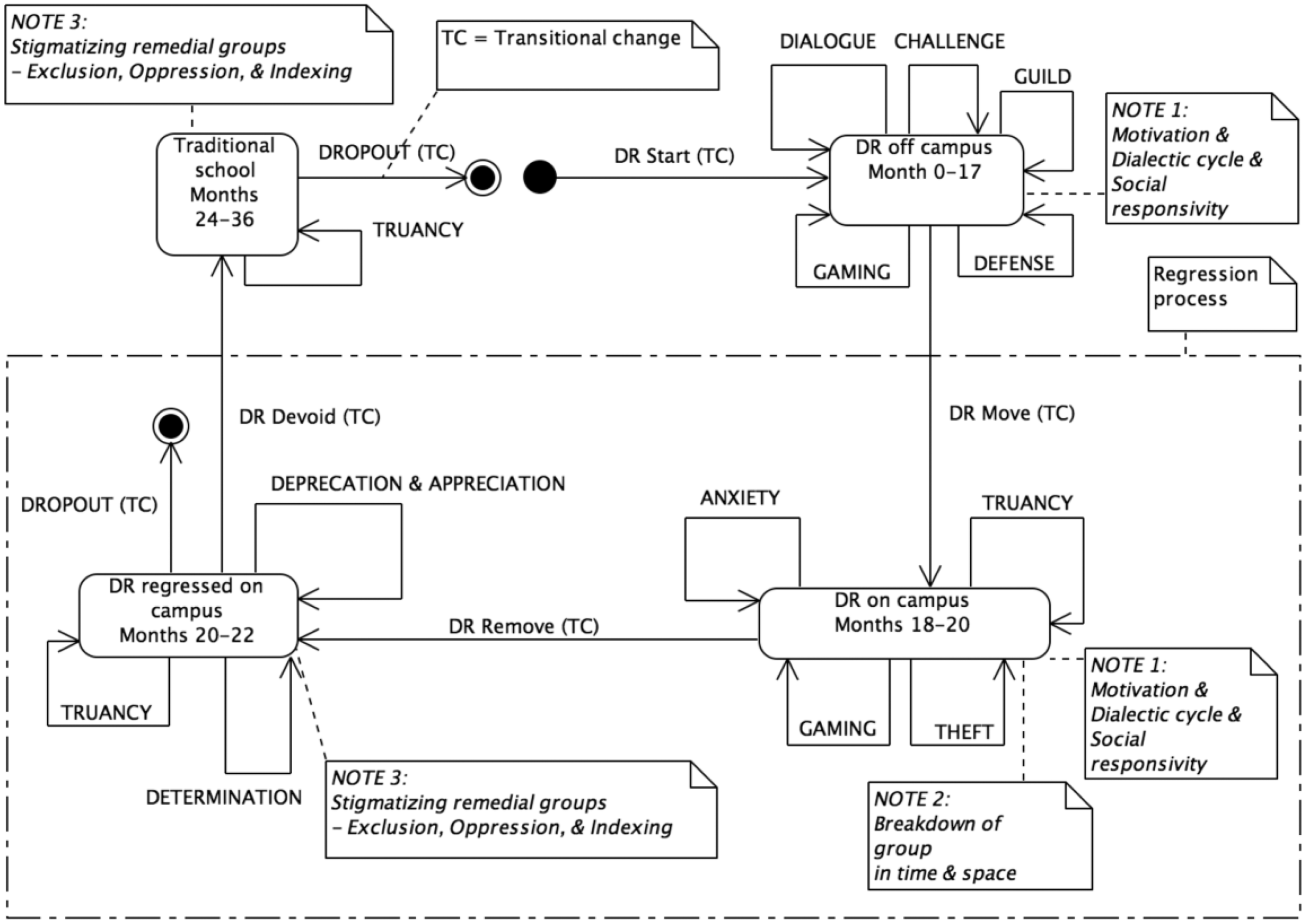
Pupil's Acts and TCs
All TCs in Figure 4 were initiated by either the project manager (DR Start) or by the school staff, except the DROPOUT event, which was initiated by the pupils. The reason for this is that pupils didn't have other means to make TCs; in a context with no dialogue possibility, dropping out is the only alternative. Figure 4 contains a description of all events and the resulting states, related to Notes 1, 2, and 3 in italics, and related to Groups A, B, and C in Figure 2. Notes 1, 2, and 3 relate in turn to the conceptual framework in Figure 1.
DR off Campus
The situation at DR off campus can be better understood by relating the design principles of the DR (see Introduction section) with acts (capitalized) in Figure 4, theoretical concepts in Note 1 and Groups A, B, and C. The common interest (DR principle 1) was important to create a strong group, a GUILD. Playing together means you have to know each other, which in turn created calmness, enabling a focus on learning. DIALOGUE (DR principle 2) was confirmed in several quotes, where the relationship to the teacher was important and pupils actively asked for more CHALLENGE in a dialectic cycle. These acts can be understood as social responsivity.
Play (DR principle 3), that is, the lusory attitude of participating in game play (GAMING) was important; both regarding teachers and the project manager, and also regarding peers who were not gamers when they started their education at the DR. Playing games was enabled by the full workdays (DR principle 4), uninterrupted by a schedule. Concepts expressed by the pupils were, for example, freedom: “you are free”; ownership: “it was our school”; and responsibility: “I don't have any absence here.” These can be related to the full workdays without schedules and indexing. Access to the environment (DR principle 5) was relevant in the widest sense of the word, for example, by having full administrative rights on the computers, or access to teachers, on demand. The DR off campus (DR principle 6) was explicitly defended, when the school inspectorate and media criticized it. The professional yet free-to-use game development tools (DR principle 7) was highly motivating, expressed as social responsivity.
DR on Campus
The introduction of traditional phenomena in formal education, such as a schedule and schoolbooks, caused a breakdown of the DR after the move. To manage the breakdown, the pupils developed strategies related to the indexed rational of controlled time and space in school. Spaces used as retreats were the pupils' café, the smoking space outside, or simply by staying home. TRUANCY took place in all these spaces. As playing games (gaming) gradually was replaced with scheduled lessons, evenings were an affordance in time where they could continue playing together, which some but not all did (e.g., some could not afford gaming hardware at home).
Theories of games and play may aid the understanding of why the pupils rejected the traditional school format, causing the breakdown. The acceptance of rules, necessary for what Suits calls a “lusory attitude,” is hard to achieve if the subject of study is of no interest to the learner. Further, as the rules of a game are absolutely binding (Huizinga, 1955), changing the rules during a game is forbidden. Yet, this is what happened with the nine extra grades in Gy 2011, which excluded pupils at the DR who became unqualified with the new conditions. Further, the transition to traditional school changed the rules of the education they had appreciated. The changes of rules created anxiousness among the pupils, most clearly expressed by the first (and only) occasion of theft.
DR Regressed on Campus Into Traditional School
When DR was regressed on campus, pupils who were gamers before joining the DR (Groups A and C) deprecated the change, regardless of their sociocultural status. Pupils who were not gamers but socialized in school (Group B) was appreciating the change, as they were neither gamers nor excluded to begin with, that is, they were domesticated as pupils. Groups A and C became silenced (another result of oppression) as gamers but not domesticated as pupils. The pupils were divided into stigmatizing remedial education groups, based on test results in different subjects. Access to teachers was according to schedule (instead of on demand); there were individual learning plans (instead of paths) and the gaming hardware was removed. In Month 22, the dropout rate had increased significantly, expressing an act of the pupils to achieve a TC from the indexing. Those who remained were determined to finish their education.
The general requirement for all pupils to attend equally can strictly speaking be seen as a bureaucratic justification, which is no justification at all: Attendance for the sake of attendance is meaningless. Furthermore, the breakdown of time (schedule) made it impossible to play games together, which seems irrational as it was the gaming that had renewed their interest in attending formal education.
Conclusions
From the pupils' acts upon the consequences of regression to traditional school, a number of conclusions can be drawn regarding the design of education in a digital culture. First, while all pupils appreciated the dialogue-based approach of DR off campus, there was a breakdown caused by the anonymous notifier, media, schools inspectorate, and the new school administration; it can be explained by incompatibility among the involved parties' definitions of what constitutes school. The erroneous anonymous notice initiated the regression to traditional school.
The notice (despite being erroneous) and the resulting processes consumed significant amounts from the pupils' time with the teachers. To avoid this issue in the future for all schools, the inspectorate could instead take the role of a broker, whereby the identity of the notifier is revealed to the inspectorate (to protect the school from erroneous notices) but not to the school (to protect the notifier). Regarding the formal issues found by the inspectorate, these could have been avoided with better education of the school administration about regulations.
The regression caused half of the pupils to drop out, and most others to truant and deprecate school again; thus the regression was counterproductive for the pupils who were excluded gamers. Three pupils, who were neither excluded in school nor gamers, appreciated the regression to traditional school. This appreciation can be understood from the perspective of being socialized in traditional school. In other words, education design should be grounded in the perspectives of pupils who are not socialized in school, as these are at greater risk of exclusion. The design should build on—not oppress or silence—the interests of the pupils. This requires change of the traditional school format: removing schedules and schoolbooks to have a real dialogue. This requires teachers who are confident in their subjects, willing to play games with the pupils and gain digital literacy.
The high dropout rate in the regression process can also be contrasted with DR off campus where only one pupil dropped out; they also defended the education against external critique. This means that the design of the DR is relevant when discussing future designs of education in digital culture. The occasioned breakdown of the group into several remedial groups (at DR regressed on campus) made gaming impossible. Dropping out was the only way for the pupils to achieve TC from the regression. Thus, indexes are a problem for pupils if used for nondialectic purposes of control (but not when used in gaming, e.g., for game scores).
Footnotes
Acknowledgments
First and foremost, the authors thank both the pupils and Göran Lange, the visionary pedagogue behind the DR. Further, the authors thank the school administrations involved for granting access to the field and to their colleagues at the university for feedback and support.
Declaration of Conflicting Interests
The authors declared no potential conflicts of interest with respect to the research, authorship, and/or publication of this article.
Funding
The authors received no financial support for the research, authorship, and/or publication of this article.