






Abstract
This research sought to determine what impact a social network messaging app could have on student’s team project performance. The app allowed students to self-select teams based on user profiles within the app. The study investigated three hypotheses that measured the apps impact on the quality of completed team projects, the team’s sense of shared goals, and team cohesiveness. The findings suggested that social network messaging apps that provide a sense of common ground between team members may better engage students in project teamwork which could lead to improved learning and better team cohesiveness.
Keywords
Introduction
Murray and Waller (2007) define social networking sites (SNSs) as, “virtual communities which allow people to connect and interact with each other on a particular subject or to just hang out together online” (p. 1337). The decision to connect, interact, and hang out online rather than via face-to-face options such as at coffee shops, malls, or other physical locations has a growing body of research. For example, Lin and Lu (2011) investigated network externalities and motivation theory in an attempt to explain why people continue to use SNS and found that enjoyment is the most influential factor in people’s use of SNS. In another study, Park, Kee, and Valenzuela (2009) investigated college students (n = 1715) to determine “the relationship between users’ SNS usage gratification and their political and civic participation offline” (p. 729). Their study revealed that socializing, entertainment, self-status seeking, and information were the primary reasons to use Facebook Groups for social networking.
Cheung, Chiu, and Lee (2011) also investigated students’ use of Facebook based on several theories: (a) “we-intention,” which they defined as “a commitment of an individual to engage in joint action and involves an implicit or explicit agreement between the participants to engage in that joint action.” (b) Social influence theory, which “determines the changes in attitudes and actions produced by social influence which may occur at different levels.” (c) Uses and gratification paradigm, which attempts to explain why people choose a specific social networking medium over alternatives and to reveal the “psychological needs” that influence people to use a particular social networking medium. (d) Social presence theory that measures the “degree of salience of the other person in the interaction and the consequent salience of interpersonal relationships” (p. 1338).
They also found that we-intention was influenced most by social presence and that of the factors found in the uses and gratification paradigm (purposive value, self-discovery, maintaining interpersonal interconnectivity with other people, social enhancement, and entertainment value), social-related factors demonstrated the most significant impact on intention to use. The previously mentioned findings by Park et al. (2009) and the findings by Cheung et al. (2011) have shown why students are using SNS.
In an interesting study conducted by Karpinski, Kirschner, Ozer, Mellott, and Ochwo (2013) which investigated the relationship between SNS usage and academic performance of two populations, the U.S. students (n = 451) and European students (n = 406), they found a negative relationship between SNS use and U.S. students’ academic performance only. They suggested that European students “may be less prone” to disruptive multitasking using SNS and cautioned that the use of SNS could be detrimental to university students academic performance.
Smith and Anderson (2018) found that many social media platforms have shown a significant increase in usage, ranging from about 10% to 30% between 2012 and 2018. Furthermore, the use of mobile messaging apps continues to increase on a global basis as shown in Figure 1 (Birds-Beep Blog, 2018).

Number of mobile phone messaging app users worldwide from 2016 to 2021.

Figure 2. Structural model used to measure the Nearpeer’s impact on virtual team’s sense of shared goals and objectives, virtual team cohesiveness, and quality of completed team project.
This research study sought to determine whether the use of an SNS messaging app could improve the student’s team project performance. We specifically examined (a) the link between the frequency of use of a social networking messaging app by student project teams and the quality of the completed team project, (b) the link between the frequency of use of a social networking messaging app by student project teams and an increased sense of shared goals and objectives, and (c) the link between the frequency of use of a social networking messaging app by student project teams and project team cohesiveness. We used a developmental social media networking mobile app called “neerpeer” (NP) to test these hypotheses.
Background—Literature Review
Team Formation and Social Networks
According to Aldrich and Kim (2007), there are basically two ways for teams to form. The first one they call a “pragmatic approach” where someone in management or a team leader selects the team members based on logical criteria such as skills, expertise, or work experiences. They call the second approach “a social psychological model” (p. 49) where the emphasis is on a good interpersonal fit between team members so that they get along well. In their review of the social science literature, they conclude that most networks tend to be “homophilous” where “birds of a feather flock together.” It makes sense intuitively that people feel more comfortable and understand others who are similar to themselves in some way. However, according to the theory of weak ties (Granovetter, 1973), some people also recognize the value of diversity (heterophilous teams) in bridging different networks to bring in different perspectives and expertise. While heterophilous teams bring new perspectives to a team, in theory, team formation should be quicker and easier in homophilous teams.
McPherson, Smith-Lovin, and Cook (2001) reinforce the benefits of homophilous teams, suggesting that they create “powerful implications for the information they receive, the attitudes they form, and the interactions they experience” (p. 415). Thus, these teams would theoretically be more cohesive. On the other hand, it could be argued that these teams would need to link to heterophilous teams to get the needed expertise and knowledge to produce a quality deliverable as homophilous teams might be limited in this regard.
Team Cohesiveness and Social Networks/Social Media
Carron and Brawley (2000) defined team cohesiveness as “a dynamic process that is reflected in the tendency for a group to stick together and remain united in the pursuit of its instrumental objectives and/or for the satisfaction of member affective needs” (p. 213). In a classic study by Yukelson, Weinberg, and Jackson (1984), they found that team cohesiveness was influenced by four factors: “(a) quality of teamwork, (b) attraction to the group, (c) unity of purpose, and (d) valued roles” (p. 52).
How does social media influence team cohesiveness? In an interesting study by McKenna, Green, Glenson, and Marci (2002), they found that people using Facebook may develop stronger relationships than with face-to-face contact. While this may seem counterintuitive, they found that people will disclose more personal information on Facebook and thus develop deeper, more meaningful relationships.
According to a global Gallup poll (Adams, 2013), “only 13% of workers feel engaged by their jobs” and “A full 24% are what Gallup calls ‘actively disengaged,’ meaning they pretty much hate their jobs. They act out and undermine what their coworkers accomplish.” Therefore, the vast majority of workers in this poll “are emotionally disconnected from their workplaces and less likely to be productive.”
However, according to Wolf (2015), organizations that create a culture that facilitates friendships create happier, more productive employees. To support this, he quotes a study from Globoforce where “89% of workers say work relationships matter to quality of life. ‘Informal’ communication on social media leads to better understanding of your team members’ work preferences, capabilities and needs.” This study (Globoforce, 2014) also showed that the majority of people surveyed said that friendships made them more engaged and more productive.
Wolf also found that social media could be used to publicly recognize employee accomplishments, leading to higher productivity. He referenced a study at the University of Kent, which found that “Engaged employees want to see the benefits of their work, they want to know they are making a difference” and suggests that social media improves innovation where “communication on social media allows team members to connect and share ideas freely.” Finally, he suggests that social media improved team communication because it provides additional opportunities for people to communicate in a personal way at any time.
In another study at the Warck School of Business (2013), they researched the impact of social media on teams and found that “the ubiquitous digital connectivity altered workers’ sense of ‘presence’ and helped rather than hindered the effective completion of collective tasks.” Social media also improved the productivity because workers had greater control over the time and location of their work, leading to greater flexibility.
Uptmor (2017) further supports the benefits of social media to team productivity for a variety of reasons. First, he suggests that with a changing workforce, younger workers, especially Millennials, communicate more effectively with social media systems that allow group and real-time communication. He also suggests that with project teams that may be distributed across the globe in different time zones, social media allows these people to form friendships, more personal connections that improve their communication throughout the project. Finally, he proposes that where public input is helpful in projects, social media allows the team to spread the word about the project to increase the engagement both within the team and with the community.
Thus, we can infer that these same qualities can increase the productivity and innovation in teams and projects for the same reasons.
Study Methodology
This study asked the question: Does the use of a social networking mobile app increase the quality of the team project, the team’s sense of shared goals and objectives, and increased team cohesiveness? Specifically, the study had three hypotheses listed later. As discussed in the “study population and Methodology” section, students completed a profile using the NP system that linked students with common interests. Thus, we can assume that the teams were homophilous to some degree.
In this experiment, a new academic social media platform called NP was tested to see whether it would help students feel more engaged in the team project, feel more connected to the goals, and ultimately, whether it might result in better performance with the project. There were three management information systems (MIS) classes that participated in the experiment; 46 teams with three students per team. In terms of student demographics, there was a mix of freshman, sophomores, juniors, and seniors. While almost half of the students were MIS majors, the rest had majors in the other business disciplines including accounting, finance, management, and marketing with a few nonbusiness majors from different disciplines in the university.
Each team was tasked with creating a database system using Microsoft Access. The purpose was to theoretically help a small business manage data better using a database system. For example, a team might create an inventory management database or a customer database. While this was a semester-long project, the deadline was at the end of the semester.
The students received training in NP at the beginning of the semester in class and were asked to use it throughout the semester on the project. However, it should be noted that the use of this app was self-reported.
Hypotheses
Study Population and Methodology
The study population for this study were undergraduate students enrolled in an introductory MIS class who were tasked with a team project to design and develop a database management system (DBMS) using MS Access 2016. When the team project was assigned, students viewed a demonstration of NP, the social networking mobile application. When the students registered for this app, they were required to create profiles which included demographic data such as age, gender, year in college, veteran status, and so on. It also included fields and drop-down menus that let students add personal interests to their profile. Some of these personal interests included: I like to kayak, I like to fish, I enjoy camping, and I enjoy running to name a few of them. The NP mobile application included a feature that allowed individual students to search for teammates based on what interests they shared. Once a student found other students with a similar interest or commonality, they were instructed to connect with those students and form teams of no larger than three persons.
The teams then received the criteria for designing and developing an MS Access DBMS. The criteria for the team project included
a list of at least three business requirements that stated what the DBMS would do; an entity–relationship diagram that graphically represented the DBMS entities (tables) and relationships between tables; and the completed DBMS itself. This DBMS would include tables, forms, queries, and relationships between tables. The DBMS also required some data inputted into the tables so that information could be presented in query results and reports.
Finally, teams were instructed to use the NP mobile application’s instant messaging (IM) capability to communicate. Teams were instructed to communicate with one another exclusively through NPs IM capability regarding all aspects of the team project.
The quality of the completed team project was assessed using a grading rubric (Online Appendix A) developed by the study’s principal investigator. Increased sense of shared goals and increased team cohesiveness were measured using a virtual team survey (VTS; Online Appendix B) completed through Qualtrics, a web-based survey tool after the team project was submitted for grading. While the VTS measures many attributes of virtual team effectiveness, such as level of involvement in team formation, job characteristics, technical proficiency, relationships between team members, team processes, and team leader attributes, only a few select survey responses were retrieved and included for the purpose of this article. These responsess were:
The use of software increased the virtual team experience of a sense of shared goals and objectives. The use of software increased virtual team cohesiveness.
The quality of the final project was assessed by the professor.
Data Analysis
The data were analyzed using two types of statistical analysis. To determine the quality of completed team projects, team projects were first graded on the degree to which they met all of the team projects criteria and this team grade was then compared with the number of times per week each team used the NP IM functionality. Specifically, for H1, the study measured two groups: Those who used the IM tool greater than 1× per week and those team that used the IM tool less than 1× per week using a two-sample t test with unequal variances. For H2 and H3, χ2 tests were run to compare the observed data with the data we would expect to obtain according to the studied hypotheses.
Study Findings
A total of 46 teams with three people per team or 136 students in total completed the VTS. H1: Students who use NP greater than 1× per week will perform better on the team project than students who use NP less than 1× per week. H2: The use of NP will increase virtual team experience of a sense of shared goals and objectives. H3: The use of NP will increase virtual team cohesiveness.
Discussion
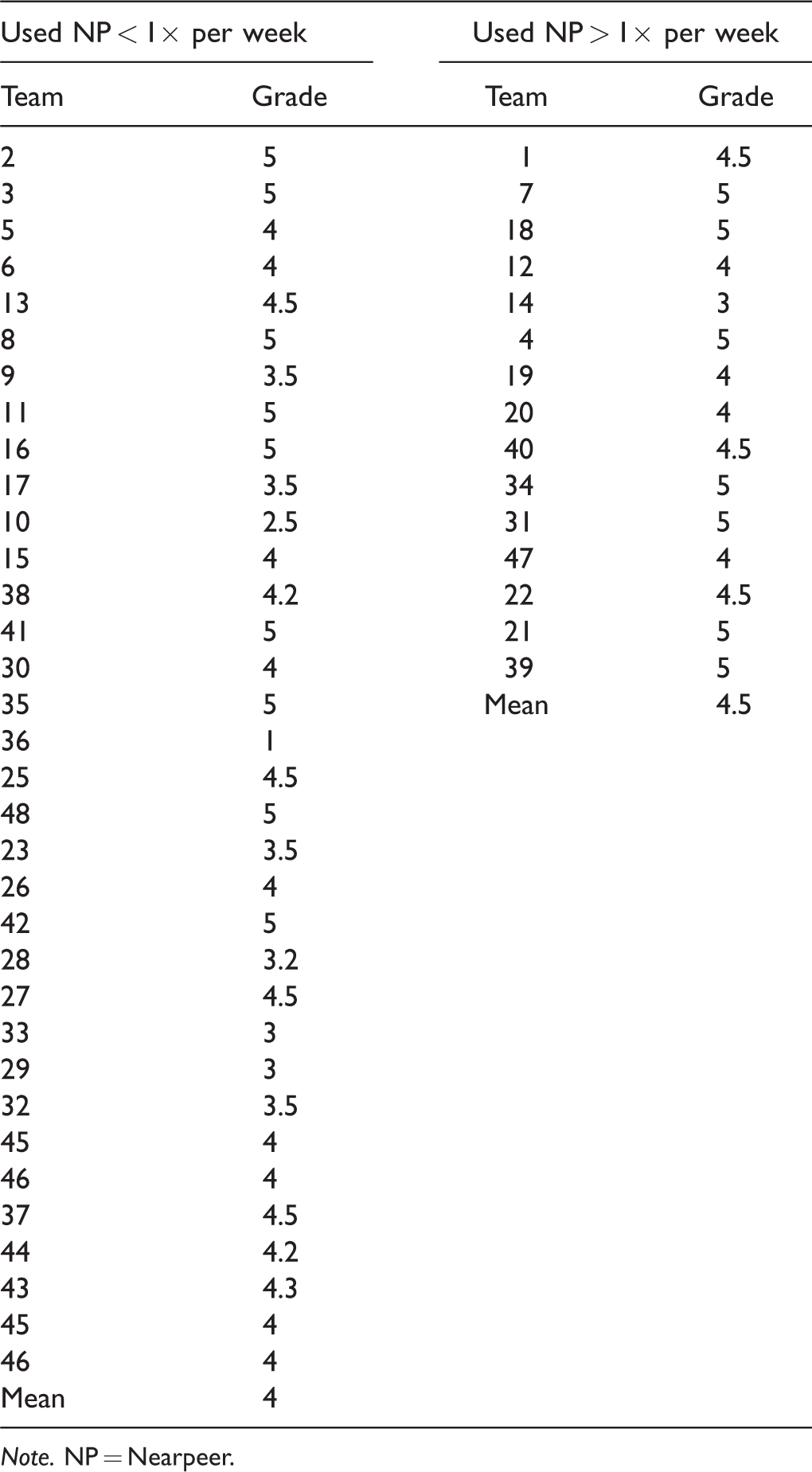
Table 1 shows that the teams that used the messaging app more frequently performed slightly better than the teams that did not. Table 2 shows that there was no significant difference in the sense of shared goals and objectives based on usage rates of the message app. Finally, Table 3 shows a small significant difference in a higher sense of cohesiveness among the teams that used the message app more frequently than the teams that did not.
Team Grades.
Note. NP = Nearpeer.
Statistical Analysis of NP Frequency of Use.

Note. NP = Nearpeer.
aThe t value is −1.73717. The p value is .088907. The result was not significant at .05 but was significant at p ≤ .10.
Statistical Analysis of Nearpeer Impact on Sense of Shared Goals and Objectives.

aThe χ2 statistic is 0.0303. The p value is .861868. The result was not significant at .05 and was not significant at p ≤ .10.
Statistical Analysis of Nearpeer Impact on Team Cohesiveness.
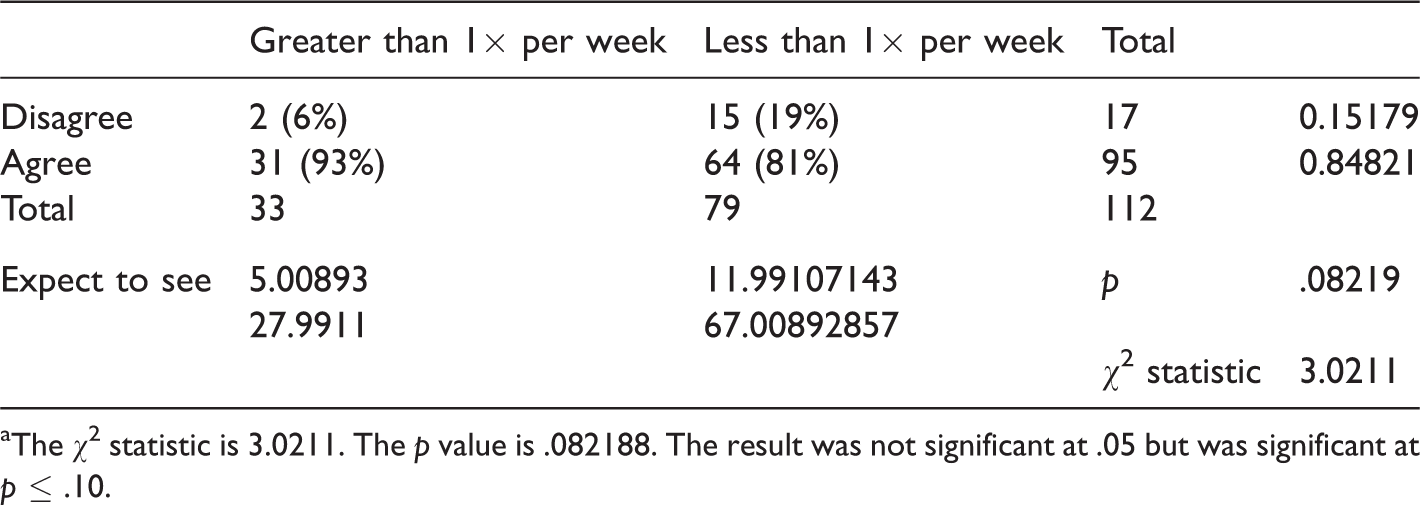
aThe χ2 statistic is 3.0211. The p value is .082188. The result was not significant at .05 but was significant at p ≤ .10.
What does this tell us? A recent study by Deloitte (2017) found that organizations with strong online social networks are 7% more productive than those without, organizations that installed social media tools internally found a median 20% increase in employee satisfaction, and when employee engagement increases, there is a corresponding increase in employee retention by up to 87%. (p. 6)
Similarly, Heun (2017) found that “more than one in four companies has created a business case for team chat apps—mostly to improve internal collaboration.” Therefore, there is support for the idea that a social media message app can improve team productivity and cohesiveness, with the inference that it could also create better shared goals and objectives.
We speculate that this study did not show higher significance in the three hypotheses for several reasons. A significant observation by the professor was that students who were more engaged in the educational experience and took the class and content more seriously, tended to use the NP social media platform more frequently than the other students. Therefore, this moderating variable could explain the increase in performance on the project as well as the increase in team cohesiveness over the teams that did not use the system as often.
Another moderating factor that may have influenced the results was that many of the students who reported using the NP system less frequently waited until the “last minute” to work on the project. Therefore, they would not have had the opportunity to use it frequently enough to feel comfortable using it or to develop any real sense of trust or cohesiveness with their group members, thus possibly explaining those results.
Finally, while we would assume that the students would self-select more homophilous teams, there was so much variability in the composition of the classes, that the degree of homophily may not have been sufficient to facilitate the development of strong relationships that could have resulted in increased team cohesiveness, shared goals, or improved project performance.
Future Research
While this experiment did show some significance in improved project performance and team cohesiveness in the student teams that used the social media message app more frequently, we suggest some modifications for future research.
First, it would be helpful to design a study that controlled the moderating variables a little more strictly. For example, the use of a team formation tool like catme.org allows the researcher to survey students based on major, year in college, interests, self-perceived commitment to the class and program, schedule, and others. This might create the formation of more truly homophilous teams and provide the information on the moderating variables to help explain differences among usage and resulting performance. In addition, the survey could include more demographic questions as well as motivational questions to examine these factors into the results.
Second, a future experiment could also be controlled more tightly by structuring the project within the class with more defined timelines and parameters. For example, the experiment could require shorter deadlines throughout the semester to force all teams to use the app more frequently so that they could not “wait until the last minute” to communicate using the app and work on the project.
While this experiment focused on the new academic social media app program “NP,” it was not clear whether the students viewed it as an engaging platform that they enjoyed using or whether they viewed it as a burden that was forced on them. A future experiment could evaluate the social media platforms that are heavily used by the target population and use that platform to focus more on the variables of interest; performance and team cohesiveness.
Finally, future research could also examine the issue of student engagement in the educational experience as a whole. As the culture of students evolve from Millennials to Generation Z who have different expectations about technology usage and the educational experience, how do we respond academically? Based on some data including, the following, what do academics need to do to reach students more effectively? Below is a list of facts about our millennials and following generation Z students: They’ve never known a world without the internet or cell phones; younger Z’s have never known a world without smartphones. They spend between six and nine hours a day absorbing media, according to a survey from Common Sense Media. Among teens, 92 percent go online daily, Pew Research reports. Their preferred mode of communication is digital, primarily through social media and texting. (Facts & Trends, 2017).
Conclusion
These data tell us as academics, we need to find ways to communicate and connect with students in the same ways they communicate with each other. Social networking usage certainly appears to be the most logical next communication transition. For example, McCarroll and Curran (2013) reported that SNS could be used to create a learnscape that they defined as an “environment for formal and informal learning that adheres to educational guidelines but also harnesses the social support system of these online communities” (p. 1) which might resonate with Generation Z students more. Roblyer, McDaniel, Webb, Herman, and Witty (2010) compared college faculty and students uses and perceptions of sSNSs and found that students were much more likely than faculty to use Facebook. In addition, Roblyer et al. (2010) reported that students are much more open to using Facebook and similar technologies to support classroom work, while faculty continued to prefer more traditional technologies such as e-mail. Hamid, Waycott, Kurnia, and Chang (2015) investigated the benefits of online social networking (OSN) use for teaching and learning. Their findings show that students identified a number of positive outcomes from using online social networks to interact with each other and with their instructors. These included:
Improved mastery of course content when they had greater interaction with other students and their instructors using the OSN. Improved knowledge sharing that supported both formal learning activities, for example, prepping for examinations, and informal learning, for example, just being online talking with friends sharing notes. Students reported that the OSN promoted increased critical thinking and analytical skills by being required to comment on peers work.
These research findings provide evidence that mobile apps such as NP can be a preferred method for students to communicate with each other when engaged in academic homework, group work, and other activities such as studying for quizzes and tests. In addition, this study and previous research identified in this article also suggest that mobile app communication may lead to better relationships between students, students and faculty, and even students and the academic institutions they attend. Although this exploratory research on mobile app usage only shows evidence that leans toward significance, it does provide encouraging insights on how mobile apps could be used in academic institutions to better communicate and engage students.
Supplemental Material
Supplemental Material1 - Supplemental material for Impact of a Social Network Messaging App on Team Cohesiveness and Quality of Completed Team Projects in an Undergraduate Team Project
Supplemental material, Supplemental Material1 for Impact of a Social Network Messaging App on Team Cohesiveness and Quality of Completed Team Projects in an Undergraduate Team Project by C. Matt Graham and Nory Jones in Journal of Educational Technology Systems
Supplemental Material
Supplemental Material2 - Supplemental material for Impact of a Social Network Messaging App on Team Cohesiveness and Quality of Completed Team Projects in an Undergraduate Team Project
Supplemental material, Supplemental Material2 for Impact of a Social Network Messaging App on Team Cohesiveness and Quality of Completed Team Projects in an Undergraduate Team Project by C. Matt Graham and Nory Jones in Journal of Educational Technology Systems
Footnotes
Declaration of Conflicting Interests
The authors declared no potential conflicts of interest with respect to the research, authorship, and/or publication of this article.
Funding
The authors received no financial support for the research, authorship, and/or publication of this article.
Supplemental Material
Supplemental material is available online.
Author Biographies
References
Supplementary Material
Please find the following supplemental material available below.
For Open Access articles published under a Creative Commons License, all supplemental material carries the same license as the article it is associated with.
For non-Open Access articles published, all supplemental material carries a non-exclusive license, and permission requests for re-use of supplemental material or any part of supplemental material shall be sent directly to the copyright owner as specified in the copyright notice associated with the article.
