







Abstract
The coronavirus disease 2019 epidemic has prompted all universities to completely change their teaching in a very rapid way around the world. In France, most of the university courses for the year 2020 had to be delivered at distance. This can be an opportunity for some to rethink the place and the form of distance learning (DL). We present here the feedback of students about DL, who answered a questionnaire about classes they followed between October and December 2020. In addition, we evaluated the use and utility of an audience response system promoting interaction. Our results showed that overall the organization and internet connections allowed DL to run smoothly. Interestingly, all students were in favor of the development of a mixed solution, with distant lectures and face-to-face practical lessons. Finally, the use of interactive software such as Wooclap® has proven to be easy to use and to develop for all lessons.
Introduction
To face the outbreak of coronavirus disease 2019 (COVID-19), the worldwide education system had to rapidly adapt (UNESCO 2020). The ongoing development of digital teaching solutions was greatly accelerated by this abrupt transition from face-to-face sessions to online sessions (Gewin, 2020). Indeed, by April 1, 2020, 173 countries closed their schools and universities and more than 1 billion students were impacted by these decisions (UNESCO 2020). In France, since the first lockdown in March 2020, distance learning (DL) largely prevailed over face-to-face teaching in universities.
The development of DL courses requires specific pedagogical approaches including course design and communication methods (Perreault et al., 2002). Depending on the institution, the support and encouragement for teachers to develop DL greatly vary (Daily, 2000). Given the urgency of the sanitary crisis, institutions did not have time to train properly the teachers to DL and to provide adequate equipment and online tools. As a consequence, educational continuity was challenged by this abrupt transition (Dietrich et al., 2020). Students were also challenged over this period and had to face several difficulties, such as connection issues, absence or inappropriate equipment, and limited access to a suitable learning environment (Dietrich et al., 2020). Overall, teachers and students needed to increase networking, favor human relationships in their communications, in a context of multiple changes and restrictions accompanying the COVID-19 crisis and the resulting psychosocial disorders (Marshall & Wolanskyj-Spinner, 2020) (Carlson, 2020).
Despite all these difficulties, DL has spread widely in teaching practices and many teachers and students have experienced this new form of learning. The urgency of the sanitary crisis which took place in March 2020 is now behind us, and since then most of the classes were given remotely. In the perspective of a second lockdown, between March and October 2020, teachers had more time to train for digital teaching solutions and to specifically rethink their classes for DL. Moreover, with a significant personal commitment, teachers acknowledge that they have learned more about DL during this crisis than in the past 10 years (Dietrich et al., 2020). Now, the time is right for questioning our DL practices and several studies from different countries and for different levels of education already exist (Rad et al., 2021; Bergdahl & Nouri, 2020; Wotto). Reflexivity is an important dimension of a teacher's advancement (Ryan & Webster, 2019) and an effective way to improve teaching (Stîngu, 2012). It is clear that many negative effects have been observed such as social isolation of students causing many different psychological disorders (Elmer et al., 2020). However, the development of videoconferences can also have a positive impact with a reduction in our trips allowing better productivity and positive consequences on the environment (Le Quéré et al., 2020). Therefore, this commitment could be the first step toward a broader reflection and the possibility to develop new pedagogies.
Among the many digital teaching solutions available, audience response systems (ARSs) have emerged to improve the interaction of the teacher with his audience, especially with a large number of students (Abdel Meguid & Collins, 2017). Positive evaluations were observed in different studies in medicine or pharmacy schools when ARS was used in a face-to-face mode (Chung et al., 2018; Grzych & Schraen-Maschke, 2019). ARS can also be used in distanced sessions to improve interactivity and student interest. Indeed, integration of this interactive device within lessons is part of active learning practices, which improve critical thinking through stimulating student interest, and is an essential component of health education (Freeman et al., 2014; Ramnanan & Pound, 2017).
Here, we take advantage of the digital transition, which followed the outbreak of COVID-19, to evaluate DL practices in general and the particular use of an ARS. We analyzed the feedback of students, who followed microbiology lessons between October and December 2020. The questionnaire, to which they responded, focused (1) on their experience of DL and (2) on the use of Wooclap®, an online ARS allowing students to participate in various activities.
Materials and Methods
Students
The number of students registered in the different sections varied according to the fields. Most of the students came from the UFR de Santé, Médecine et Biologie Humaine (SMBH) from the Université Sorbonne Paris Nord. They were 190 students in the fourth year of MS, 176 in the sixth year of MS, 91 in the third year of Biology License (BL3), and 21 in the first year of Biology Master (BM1). We also have taught to residents in medical microbiology corresponding to medical or pharmacy students after minimum 7 years of study (n = 37 registered).
Format of Lectures in Microbiology
Between the end of October and the middle of December 2020, we gave lessons in microbiology to medical school (MS) and biology students of different levels. For each level, we gave one session of DL of microbiology (except for fourth year of MS students for whom we gave three sessions). These lessons were carried out using videoconferencing either by the teams platform from Microsoft (https://www.microsoft.com/fr-fr/microsoft-teams/group-chat-software) or by the zoom platform (https://zoom.us). These lessons were all lectures. Some of the lectures were performed using also the Wooclap® ARS, which introduced multiple choice questions type activities, open questions, image recognition within the lecture (Grzych & Schraen-Maschke, 2019). Wooclap® (Wooclap SA) is a participative tool directly usable on a web interface. With this tool, teachers can add an activity directly into their traditional presentation slides (PowerPoint, Google slides, or PDF). Then, during the lecture, students can answer activities using their laptop or smartphone. All the students received both types of distance learning: lectures assisted by Wooclap® and traditional lectures.
Methods of Evaluations
We sent a Google form link (https://www.google.fr/intl/fr/forms/about/) to the students so that they can complete the survey questionnaire. Subsequently, we sent to all students up to three reminder messages to complete the questionnaire. All students were informed of the study and agreed to participate in the study. They answered questions anonymously. The questionnaire consisted of nine questions presented in Supplemental Appendix. These questions concerned their gender (Question 1), their level of study (Q2), the course of the lectures in terms of organization of the videoconferencing and internet connection (Q3 and Q4), and their wishes in terms of transforming their teaching in the future (Q5 and Q6). Concerning the use of Wooclap®, the questions concerned, among other things, the ease of use and the educational contribution of the ARS (Q7–Q9). The questions 3–9 were Likert scales scored between 1 and 5, the low score (1) corresponding to a total disagreement of the question and 5 to a total agreement to the question. Boxplots and the following analyses were realized with the program R (R Core Team, 2020). When variability was observed on the boxplots, scores were compared between the different sections with an analysis of variance (ANOVA) followed by a Tukey test (multiple comparison of means) when the difference among sections was significant. A significance level of .05 was used for all statistical tests.
Results
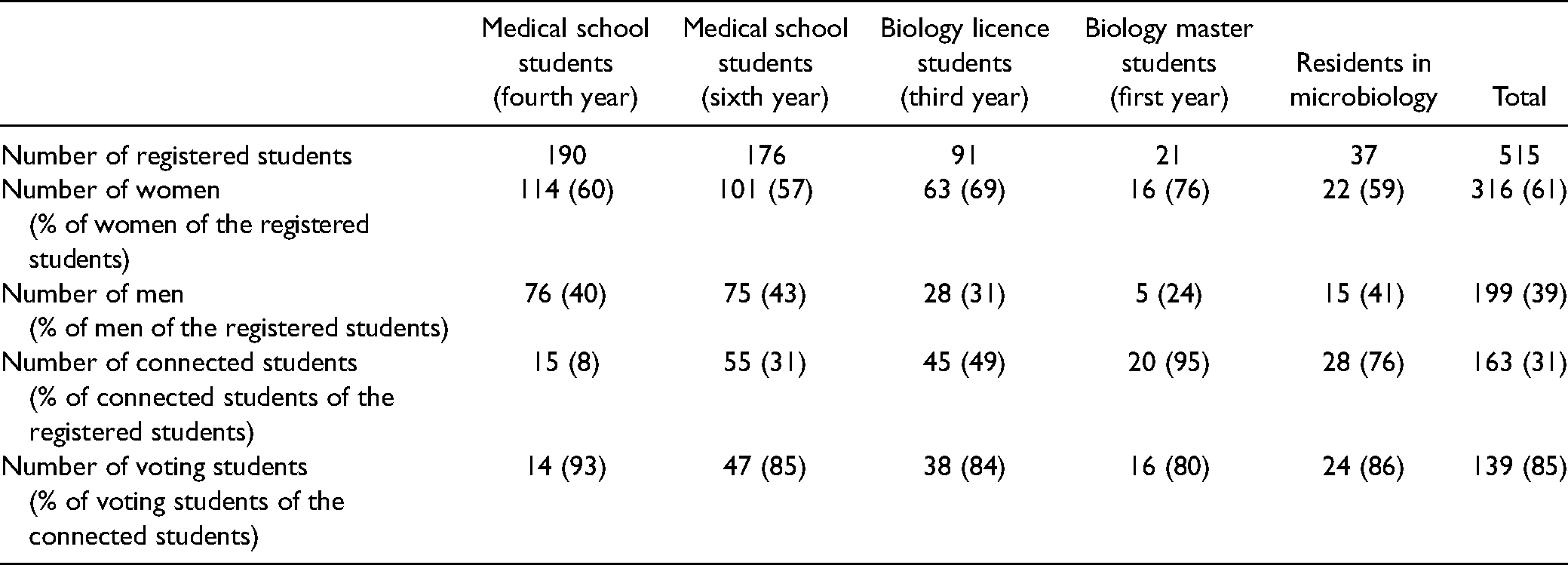
During the lectures, there were 5% (n = 14), 27% (n = 55), 49% (n = 45), 95% (n = 20), and 75% (n = 28) of the students respectively in the fourth and sixth years in MS, BL3, BM1, and residency in microbiology, connected during the lectures (Table 1). Overall, 85% of the students connected during the lectures responded to the online survey (n = 139), allowing us to consider that the responses were representative of the students who were effectively connected during the DL program. Among the 139 participating students, 74% were women and 26% were men whereas among the 515 registered students, 61% were women and 39% were men (Table 1).
Characteristics of the Different Sections of the Students in Terms Registration, Gender, and Participation of the Distanced Teachings and Evaluation of the Distanced Teachings.
Because there were nonsignificant differences between the responses (Q3–Q9) of students in fourth and sixth year of MS (Tukey test, p > .05, data not shown), we grouped their responses under MS student responses to simplify the remaining analyses.
For all questions, except Q6 and Q7, we found significant differences for at least one section (ANOVA). For those questions, at least one section was answered differently than the others. We then performed pairwise comparisons (Tukey test) for each question (SOM1). Specifically, for general organizational questions (Q3 and Q4), the students considered that the DL had been well organized with scores mainly >4/5 except for the BL3 students whose organization scores were significantly lower compared to other sections (Tukey test, all p < .05) (Figure 1 and SOM1). Likewise, the students had good internet connection, except BL3 students who encountered more problems as expressed by their lower scores, however only significantly different from residents in microbiology (p = .004) (Figure 1 and SOM1). Regarding questions on changes in learnings in the future (Q5 and Q6), the answers varied greatly depending on the sections. To Q5 “Would you like your current learning to be all distanced?” the MS students answered positively with scores significantly higher than other sections ( ≥ 4/5) (all p < .000001) (SOM1). Other students had more varied answers with scores ranging mainly between 1 and 3 (Figure 1). To Q6 “Would you like a hybrid format (distant lectures/traditional practical learnings) to be developed?” The students of the different sections have responded positively with scores greater than 3 except for BM1 students, but without significant difference between the different sections (Figure 1 and SOM1). Favorable evaluation of Wooclap® was observed for most of the students who considered the use as easy (Q7) (all scores > or equal to 4/5 for all sections without significant differences between the sections) (SOM1). They also considered that this tool should be developed in all learnings (Q8) and particularly helps distanced learnings (Q9) (the majority of scores ≥ 4/5, except for BL3 students whose scores were significantly lower but only when compared with residents in microbiology (p = .014 and .001 for questions 8 and 9, respectively) (Figure 2 and SOM1).
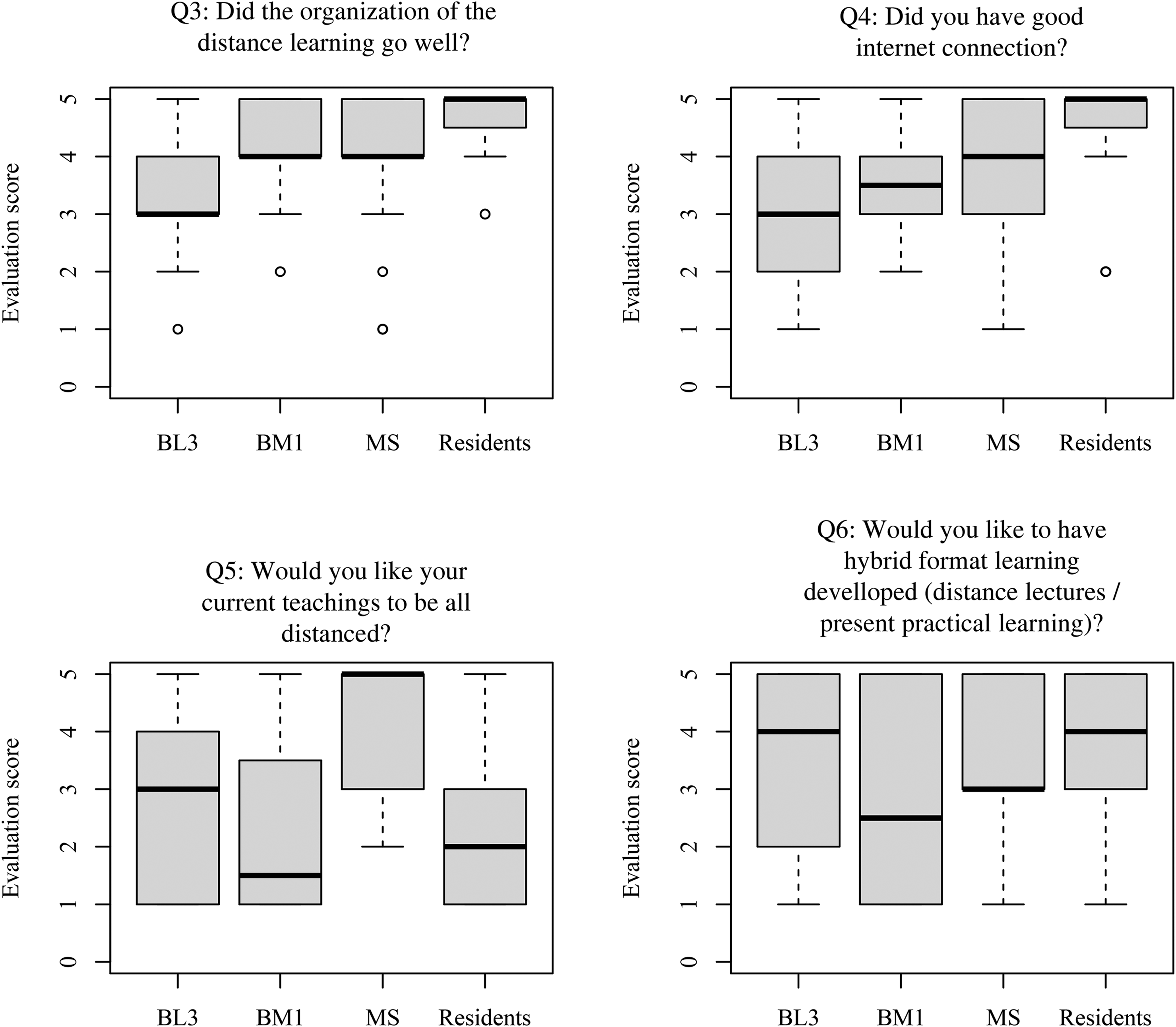
Feedback distribution of the different sections of students about general organization and changes in their future microbiology learnings.
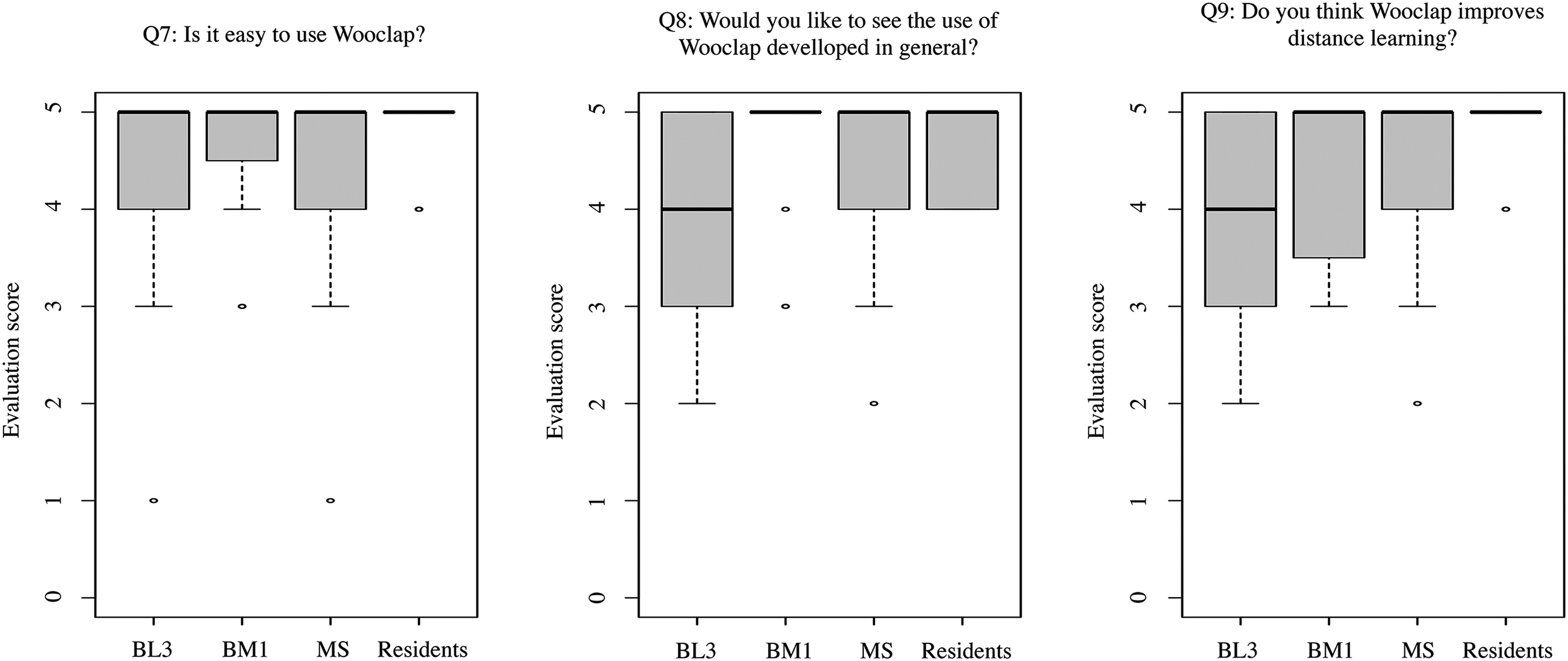
Feedback distribution of the different sections of students about Wooclap® utilization in our microbiology learnings.
Discussion and Conclusion
Following the health situation due to COVID-19 in March 2020, all university teachers across the world have experienced a drastic change through the imposition of DL. Despite difficulties, such as lack of training and equipment, teachers and students quickly adapted to DL (Rad et al., 2021; Kang, 2021). One year later, we discuss the way to incorporate DL in our traditional teaching practices. More generally, we question how remote solutions, without being exclusive, can be implemented to facilitate our daily work.
We analyzed the feedback from our students on DL, for a microbiology class that they followed between October and December 2020. The questionnaire focused on three main aspects, the general opinion of students on their DL experience, the way they wish to see DL integrated in future classes, and the relevance of ARS in class.
Overall, 85% of the students connected during the lectures responded to the online survey (n = 139) allowing us to consider that the responses were representative of the students who were effectively connected during the DL. This large proportion is probably due to the repeated sending of emails to the students just after the lectures.
A larger proportion of women (74%) participated in the questionnaire compared to the proportion of registered women (61%). We have no clear explanation for this difference and hypothesized that this difference was representative of the higher proportion of women that usually follow the lectures when it is not mandatory.
The evaluation of DL revealed that students from different levels in MS and biology observed a relatively good organization of the faculty as observed elsewhere by Rad et al. (2021) in dental school, and good internet connections, except for BL3 (Figure 1). Explanations regarding these discrepancies could be due to different precarity levels of the students that should be further explored. Indeed, the department of Seine-Saint-Denis, where the university is located, is a department with a high level of precariousness (Castro et al., 2020). Digital access among students can be affected with problems of access to computers or internet connection. Assistance in the department has then been deployed as announced in November 2020 to allow the most disadvantaged to have better conditions to follow DL in this sanitary crisis period (Bougenaux, 2020).
In our study, regarding questions on the place of DL in future lectures, all students were in favor of a hybrid solution, with distanced lectures and face-to-face practical lessons (Figure 1). Indeed, lectures, usually given to a large number of students and with limited interactions between the teacher and the students, are better suited to DL. If recorded, DL can be watched several times and at any time by students (Rad et al., 2021). Moreover, DL allows students who cannot go to the university to attend the class anyway (Rad et al., 2021). On the contrary, practical lessons, usually given to small groups of students, imply more difficulties for DL as they often require specific equipment to make experiences. Some devices have been specifically designed for distant practical lessons, as home-laboratory kits (Kennepohl, 2007) or virtual laboratories (Daineko et al., 2017) to teach general chemistry and physics, respectively. However, some laboratory experiments require specific equipment and security conditions that cannot be fulfilled by these devices. Moreover, practical lessons are also the place of more interactions between the teacher and his students, helping to strengthen the link between them. This consensus for the development of hybrid version of teachings underlines the importance of interaction in small groups for students. Indeed, the lack of face-to-face interactions is a common disappointment reported by DL students (Perreault et al., 2002). Moreover, the importance of social contacts has recently been shown in students’ mental health in order to counterbalance the negative psychological effects due to social isolation during the COVID-19 crisis (Elmer et al., 2020). In this study, we observed that MS students were also in favor of a complete distant solution. Different hypotheses can be put forward: (1) they belong to large classes with low interactive activities in their lectures compared to Resident and BM1 sections or (2) they belong to classes similar in size compared to BL3 but unlike BL3 find other learning strategies and face-to-face interaction in hospital practice. Importantly, if a complete distant solution is considered, special attention is needed to build an effective communication framework at the start of a DL course (Berger, 1999).
Similarly to previous studies on health students (Chung et al., 2018; Grzych & Schraen-Maschke, 2019), most of the students were very positive about the ease of use and the interest of Wooclap® in traditional learnings as well as in DL. Only the BL3 students were significantly less adherent but this may be due to the greater digital access difficulties they encountered. Studies on the precariousness of students would help evaluating whether BL3 students suffer from higher precarity than resident and BM1 students. Nevertheless, active learning is an efficient way to stimulate students, increasing their motivation, and by consequence their results (Bédard & Viau, 2001).
There are some limitations to this study. First, we observed for some sections a very low proportion of connected students (31% of the registered students) that could engender a bias in the results of the evaluation since the major part of connected student answered the questionnaire (85%). Those who did not answer the questionnaire may have been unable to follow DL for practical reasons (e.g., limited access to internet, lack of material). The other explanation, that we considered to be more likely, is the usual absenteeism. Indeed, according to our observation, the number of connections corresponded to the number of students usually present in class (data not shown) because attending classes for students is not mandatory. Second, this survey is monocentric, and should be seen as a preliminary study allowing proposing several hypotheses that should be further tested in a large-scale study. A similar, but multicenter study that would evaluate the place of DL in teaching practice and the use of ARS for different sections would help to further explore our results. It would also allow the evaluation of different online platforms and ARS (such as MOODLE, Socrative, Poll Everywhere, etc.) to compare it with Wooclap®. Moreover, the present study did not address specifically the DL experiences of teachers. In order to do so, we have adapted our questionnaire and delivered it via the French Society of Microbiology to teachers of microbiology in France and their students to conduct a large national survey.
In conclusion, the abrupt transition from face-to-face sessions to online sessions that followed the COVID-19 outbreak was a difficult time for both teachers and students, but this particular period can also be seen as the opportunity to question our DL experience and to evolve our teaching practices. Besides smooth organization and the usefulness of ARS, this study showed that all students were in favor of the development of a mixed teaching solution, with distant lectures and face-to-face practical lessons. More broadly, this crisis, which has been very difficult on many aspects, also gave us the opportunity to test distant solutions in our daily work, during meetings and conferences, for instance. From these experiences we can rethink our habits, and find the place of distant solutions to facilitate our work without being exclusive. Indeed, this reflexivity on the courses we have conducted can be used to completely redefine the syllabus of our teachings (Berthiaume and Rege Colet, 2013). A reform of medical studies is currently being carried out in France with a redefinition of the educational objectives of all courses that will be deposed on a national numeric platform (https://www.uness.fr/). We consider that this kind of study can help in the transformation of the forms of teaching, which would follow the redefinition of these objectives. We suggest setting up distance learning courses helped with ARS to address the essential concepts associated with face-to-face courses with small number of students to deepen this essential knowledge and consolidate their learning through interactive activities.
Supplemental Material
sj-docx-1-ets-10.1177_00472395211023383 - Supplemental material for Feedback From Medical and Biology Students on Distance Learning: Focus on a Useful Interactive Software, Wooclap®
Supplemental material, sj-docx-1-ets-10.1177_00472395211023383 for Feedback From Medical and Biology Students on Distance Learning: Focus on a Useful Interactive Software, Wooclap® by Julie Marin, Ségolène Brichler, Hervé Lecuyer, Etienne Carbonnelle and Mathilde Lescat in Journal of Educational Technology Systems
Supplemental Material
sj-xlsx-2-ets-10.1177_00472395211023383 - Supplemental material for Feedback From Medical and Biology Students on Distance Learning: Focus on a Useful Interactive Software, Wooclap®
Supplemental material, sj-xlsx-2-ets-10.1177_00472395211023383 for Feedback From Medical and Biology Students on Distance Learning: Focus on a Useful Interactive Software, Wooclap® by Julie Marin, Ségolène Brichler, Hervé Lecuyer, Etienne Carbonnelle and Mathilde Lescat in Journal of Educational Technology Systems
Footnotes
Author Contributions
JM wrote the paper and participated in the design of the study. SB participated in the production of results. HL participated in the production of results. EC participated in the writing of the paper and in the design of the study. ML wrote the paper, designed the study, conducted the survey and analyzed the results.
Declaration of Conflicting Interests
The authors declared no potential conflicts of interest with respect to the research, authorship, and/or publication of this article.
Funding
The authors received no financial support for the research, authorship, and/or publication of this article.

Supplemental Material
Supplemental material for this article is available online.
Author Biographies
References
Supplementary Material
Please find the following supplemental material available below.
For Open Access articles published under a Creative Commons License, all supplemental material carries the same license as the article it is associated with.
For non-Open Access articles published, all supplemental material carries a non-exclusive license, and permission requests for re-use of supplemental material or any part of supplemental material shall be sent directly to the copyright owner as specified in the copyright notice associated with the article.
