







Abstract
This exploratory study builds upon the expertise of a panel of faculty, administrators, students, and instructional designers (IDs) who lived through the pandemic and dealt with the associated challenges firsthand. These participants provided insight on how to establish systems that would create successful online teaching and learning opportunities in the post-vaccine and post-pandemic world. Four major themes emerged: (a) integrating technology to facilitate and enhance education; (b) structural support and resources needed to build sound processes for effective online education; (c) establishing faculty presence to facilitate learning; and (d) joint ownership and responsibility of learning—everyone must play a part. These themes have been described in light of theoretical frameworks, such as the Technological Pedagogical and Content Knowledge (TPACK) model, Community of Inquiry (COI), and Continuous Quality Improvement (CQI). Finally, evidence-based tips will allow academic institutions to successfully emerge out of the pandemic while still making plans to adjust and adapt in the post-vaccine world.
Keywords
Introduction
The COVID-19 pandemic has caused many problems in the higher education system across the world. When countries began shutting down in March 2020, even scientists did not know how harmful contracting COVID-19 would be to the members of the community. To curtail the rapid spread of the virus, governments of nearly every country began to mandate shutdowns of various businesses, including institutions of higher education (Singh et al., 2021). Due to the unpredictability of COVID-19, education systems had to find a way to continue learning, as it was unknown if face-to-face instruction would be able to continue. Since on-campus learning was shutting down indefinitely, online learning was able to provide an emergency solution at the time. An emergency shift in learning occurred, where instructors were forced to move face-to-face instruction completely online, regardless of knowledge to implement/use technology (Rapanta et al., 2020). Faculty, administrators, students, and instructional designers (IDs) had only a few weeks for this move to occur (Nworie, 2020). When the transition to online learning was implemented, the difficulty of the switch varied from faculty to faculty, which also made the transition more difficult for IDs and technology experts (Nworie, 2020). This, in turn, resulted in an adverse impact on students’ performances, especially on standardized test scores, exams, and other assignments (Kemp & Grieve, 2014; Singh et al., 2021). With entry into the post-vaccine world, it is important to acknowledge roles of faculty, IDs, administrators, and students. This will allow reflection on how the emergency transition to online learning occurred, and what could be done to improve teaching and learning practices as online learning continues to be a major solution in the post-vaccine world.
Literature Review
In March 2020, when an emergency was declared across many countries, including the United States, academic institutions scrambled to ramp up efforts and create online learning opportunities for students. This was particularly important to control spread of the virus, as the global death toll was surpassing 200,000 (Neilson & Woodward, 2020; Sacco & Kelly, 2021). There was a sudden halt in in-person teaching. Faculty members were required to explore uncharted territory and unfamiliar methods of instruction with the transition to virtual learning. Furthermore, the additional changes involved with a rapidly evolving crisis further aggravated the already complicated situation. These included: (a) an absence of policies regarding online teaching and the use of learning management systems (LMS), (b) an uncertainty surrounding internships and practicum experiences (clinical or nonclinical), and (c) a lack of support from academic administration (Richardson et al., 2015). These issues were compounded by the fear of retrenchment, hiring chills, as well as other challenges faculty were facing during the pandemic (Sacco & Kelly, 2021).
The transition to online learning made it essential for most instructors to learn, design, and conduct their classes for an online medium of instruction. Many instructors reported minimal or no training in the required technology, which left them faced with a major change in their practice. When the transition to online learning was beginning, the different levels of technology usage and knowledge became one of the biggest obstacles for many faculty. There was lack of proper information technology support during the initial transition, as face-to-face instruction did not require as much support compared to online learning (Singh & Matthees, 2021). Additionally, online learning requires those impacted in higher education to have access to all required resources to continue instruction from home. Students had to obtain required materials for online learning, including a computer with video and audio capabilities and reliable high-speed Internet. Instruction from home may have been a benefit to some, but others found it difficult to separate home life from work life without having separate spaces with minimal distractions. Social interaction and communication also became difficult during the emergency transition, as face-to-face interaction was being replaced with applications like Zoom, Microsoft Teams, and email. This was compounded by the lack of knowledge on how to correctly utilize these applications (Singh et al., 2021).
The shift to online learning during the COVID-19 pandemic was able to offer both an emergency solution and a long-term solution that will offer major benefits to the future of higher education. Anderson (2011, as cited in Rapanta et al., 2020) referred to online learning as a type of teaching and learning situation in which (a) “the learner is at a distance from the tutor/instructor, (b) the learner uses some form of technology to access the learning materials, (c) the learner uses technology to interact with the tutor/instructor and with other learners, and (d) some kind of support is provided to learners” (p. 925).
Students, faculty, administration, and IDs each had a vital role in both the emergency transition to online learning and in assisting in improvements as online learning continued. IDs helped make online learning interactive, engaging for students, and easy to navigate for faculty. Administration and information technology constructed and provided education for faculty and students to help navigate through online LMS and required applications, such as Zoom, for meetings and synchronous classes (Nworie, 2020).
Online learning has shown to have many positive benefits, such as an increase in retention of information and taking less time to complete the same amount of work. Research shows 25%–60% more material retention from online learning and 40%–60% less time to complete work due to online learning being individually paced (Li & Lalani, 2020). Additionally, online learning has provided flexibility to those in higher education and decreased stress when it comes to unexpected events requiring time off. Therefore, online learning could be a major advantage for higher education in the long run.
It is important to recognize that well-planned education programs with online instruction are different from “eclectic methods cobbled together” in haste to meet the pressing demands of the pandemic (Nworie, 2020). While transitioning to virtual learning was a necessity in 2020, academic institutions have to reflect and ensure that appropriate mechanisms are in place to support faculty and students in virtual learning. It is important to emphasize that education and academic programs in the post-vaccine and post-pandemic era will be delivered differently. It is important to work collectively to prepare for a changing world of higher education. Moving forward, faculty, administrators, students, and IDs should take lessons learned from the pandemic and use them in the future. Building on gains and lessons from 2020, it is possible to work toward building structure and processes to enhance the quality of online teaching and learning. There are a plethora of studies that have examined faculty and/or students’ struggle during the pandemic; however, there is minimal or no evidence that brings together perspective of all the stakeholders who had a major role when transition to an online or hybrid medium of instruction actually occurred. There is a scarcity of literature/research that brings together perspectives of all the key stakeholders who were involved in the process of planning, design, delivery (and usage) of classes/content when transition occurred in early 2020. With the focus on the post-vaccine and post-pandemic world, this exploratory study builds upon the expertise of a panel of faculty, administrators, students, and ID who have lived through the pandemic and dealt with challenges firsthand. These participants answered a series of questions and provided insight on how to work on establishing systems that would create successful online teaching and learning opportunities in the post-vaccine and post-pandemic world.
Methods
This exploratory research utilized interviews from faculty/instructors, students, IDs, and administrators as data sources for the project. Bogner et al. (2009, as cited in Rapanta et al., 2020) indicated that researchers can rely on practical insider knowledge, especially when insights about new emerging topics are under consideration and information about such topics is not readily available or easily obtained. As the COVID-19 crisis continued to evolve, the sudden transition and swift move to a completely online medium of instruction presented such a topic. The current research project was conducted after a large portion of the population was vaccinated against COVID-19; however, the Delta variant has continued to create problems as new cases have increased across the globe. Many changes that occurred during early 2020 still hold true in the post-vaccine environment. While one cannot question or challenge the systematic research approach (hypothesis testing, etc.), it is important to note that researchers in this team engaged in heuristic methods that are scientific and rely on participants’ thoughts and perspectives. Being able to work with participants who had undergone challenges as faculty, students, IDs, and administrators during the surging pandemic helped in achieving a certain degree of validity and reliability in the study (Rapanta et al., 2020).
Research participants were selected because of their experiences in the field of online learning in a variety of roles. Participant selection criteria included: (a) faculty/instructors with a minimum of 10 years of online, hybrid, and/or face-to-face teaching experience; (b) ID team lead and administrator who had a direct role in planning as transition to a completely online medium of instruction occurred in early 2020; and (c) students who were taking face-to-face classes and had to switch to an online medium during the onset of COVID-19. All the participants are also listed as co-authors of the manuscript, and their responses to the interview guide are presented in the results section. By including participants as co-researchers, this project met a two-fold requirement of heuristic research: (a) participants’ experiences during COVID-19 and in the post-vaccine era were reported accurately and (b) including these participants in every part of the manuscript allowed equal access to review, comment, and revise different sections. This co-researcher and authorship approach left original participants’ thoughts intact and has been utilized by several researchers in their projects (Matusov et al., 2019; Rapanta et al., 2020; Shor & Freire, 1987). It must also be noted that all participants, including students, had extensive training in research, as well as qualitative and quantitative research methods.
In-person or Zoom meetings were organized to explain the purpose of the research, and the interview guide was sent to participants once questions were finalized. These questions are outlined below:
In retrospect, what could have made the emergency transition to online, hybrid, and blended learning more successful for faculty and students? Please describe your thoughts about the future of traditional face-to-face learning post-vaccine and post-pandemic. Please describe your thoughts about how universities can utilize lessons learned during the pandemic to move forward and transition into the next phase, especially in a post-vaccine and post-pandemic world. What can faculty, administrators, students, and IDs do to make online, hybrid, and blended learning successful in the event of future disruptions that call for emergency remote teaching and learning (emphasis on the post-vaccine and post-pandemic world)? What would you say to colleagues and students as we try to return to universities/academic settings with the continued uncertainty of the current pandemic?
After initial meetings, three teams were formed, and each team was required to answer the questions included in the guide. Team one consisted of faculty members (JS, AR, EE), team two included an administrator and ID lead (LK, KQ), and team three was comprised of students (LS, HW). One of the members from the faculty team (JS) coordinated the entire team effort and was the point of contact for each team. This author also compiled all the responses, and the faculty team worked together to draft the first version of the manuscript and sent it to the other teams for their review and comments. In the sections that follow, authors present participant responses, identify major themes, and discuss these findings in light of pedagogical underpinnings, such as Technological Pedagogical and Content Knowledge (TPACK) model and Community of Inquiry (COI) framework. Furthermore, the authors have also examined these findings through the lens of a Continuous Quality Improvement (CQI) framework. It is important to note that examination of participant response and themes with COI and CQI lenses constitutes the majority of the discussion section. The discussion section has been drafted by the faculty authors/team and feedback and confirmation was sought and received from the rest of the team members.
Results
In Retrospect, What Could Have Made the Emergency Transition to Online, Hybrid, and Blended Learning More Successful for Faculty and Students?
Faculty Team Response
In retrospect, there were several ways in which the transition could have been more successful; specifically, preemptive education regarding online learning for faculty and students, contingency plans for transitioning to online learning, communication of flexibility, and adequate consideration of the mental health of faculty and students. With the increased popularity of, and demand for, online education, adequate education for both faculty and students related to online learning is a necessity. For faculty specifically, policy development outlining professional development and minimum qualifications for teaching online should be implemented. Professional development opportunities and resources were thrown at faculty amid a pandemic, which certainly was not an ideal time to hone such skills. In addition, standardized approaches to the development and presentation of online courses university wide would aid in student familiarity of where to find information in any given course and would also alleviate faculty from having to step into the arena of ID. Instead, faculty can focus on learning how to increase social teaching and cognitive presence, as well as integrating online resources into their courses. On the student side, an orientation upon admission to the university to understand the basics of learning in an online format would be helpful in increasing online awareness for students.
Contingency plans on how to shift rapidly to an online, hybrid, and/or blended learning environment will be a necessity going forward. There are a number of different issues that arise with the shift in learning, and plans to address each of these issues will be important if a rapid shift is required again. For example, if students are no longer allowed to live on campus, there needs to be a plan for where they will go. International students may pose an even greater challenge if they are unable to return home. Field experiences may need to be replaced or supplemented with online opportunities. Students who do not have access to computers and/or the Internet will need to know their options for the procurement of required technology.
Communication during an emergency shift to online learning is important, but more specifically, communication regarding flexibility is essential. When an event requires a shift away from normalcy and predictability, students need to be made aware of changes and flexibility in expectations. For example, immediate awareness of due date extensions can result in decreased stress and anxiety for students who are trying to manage all that goes along with a shift in the delivery of education.
Mental health care for both faculty and students during stressful transitions is imperative. Though there was a great focus by many universities on the mental health of students during the transition, not much attention was given to the mental health of faculty. Both students and faculty were struggling during the transition in a multitude of ways, such as learning how to learn or teach online, sharing space with others who were learning and/or working from home, and dealing with personal illness and/or the illness of a loved one. Being cognizant of how change and transition, and the cause of the transition, affects the mental health of all involved is vital in coming out successful on the other end.
Student Team Response
Online learning is a powerful teaching and learning approach that can facilitate effective engagement with course content and mastery of the concepts taught to students. In this rapidly changing world, instructors are expected to be experts in course content, technology tools, and how to organize and deliver content in a completely online medium of instruction. From a student's standpoint, transition to an online medium requires one to take charge/ownership of his or her own learning and be more independent. While instructors can create engaging content, use advanced tools to promote learning, and include opportunities for students to interact with each other, a fair share of responsibility falls on students’ shoulders as well. Both students and faculty have to prepare for the post-vaccine and post-pandemic world. Effective course design, more opportunities to participate in discussions, team-based exercises, easy to navigate course platform, instructor presence (even in online classes), prompt feedback, multiple ways to measure student learning, and ability to quickly change and adapt to a new reality would have made transition less complex for students.
Furthermore, opportunities to interact with faculty (virtually) and being present in the online platform demonstrates that instructors are genuinely interested in students’ progress. It is important to note that when COVID-19 hit and in-person classes were suspended, a large number of students were not prepared to learn remotely. Many students, including international students, relied on academic institutions and on-campus facilities (library, computer labs) to complete their work. Lack of access to computer, software, Internet, and bandwidth created extra hurdles for students. One should also consider the impact of mental health challenges that students faced due to loss of loved ones, separation from families, and lack of connections if in-person classes was their only opportunity to interact with friends. Thus, it is extremely important to invest in structures and processes to build robust online support programs for both faculty and students to handle future problems.
Administration and Instructional Design Team Response
Steady and sustained quality assurance for instruction that assumes student access to digital content and learning activities benefits not only students in flexible modalities like online, hybrid, and HyFlex, but also face-to-face instruction. Flexible opportunities to learn with access to digital course materials also benefit students requiring accommodations, students with jobs/careers, and students with families. If we build a culture from this student-centered perspective, preparing to transition to online in times of emergency should be more of a logistical tactic than one of professional growth related to instructional technologies and online pedagogy. The latter does not happen quickly and takes time to implement, practice, iterate, and refine.
Every summer, the Crisis Management Team at the university meets to update the roster of the team and discuss each other's roles and responsibilities around Continuity of Instruction with what-if scenarios. It would be helpful to include faculty and student representation on this committee and send communication out to the whole campus to be familiar with where to find information on what to do if they need to pivot fully online for any reason that may prevent in-person instruction or campus presence (natural disasters, pandemic, fire, etc.).
Please Describe Your Thoughts About the Future of Traditional Face-to-Face Learning Post-Vaccine and Post-Pandemic
Faculty Team Response
In regard to the future of learning in general, there needs to be a focus on change management. Faculty need to be prepared for another event like this in the future. The COVID-19 pandemic was an impetus for momentum toward distance learning. Even if COVID-19 no longer poses a threat in the future, this enhanced interest and use of distance learning is likely not going to diminish. It is essential for more faculties to shift components of coursework online and to try new teaching practices. COVID-19 has certainly been a test case for offering more innovative ways of delivering education. The early adopters of online learning, likely those who were well versed in the practice even before the pandemic, need to lead the late adopters to promote this change. It will be essential for the early adopters to use their own experiences and methods for promoting change, acting as mentors for the late adopters.
There will surely be increased use of technology in higher education learning. What we have seen and used in traditional face-to-face education may no longer be viable. Faculty must understand that blended and hybrid learning can be as effective as on-campus learning, and they must prepare for more effective use of online resources. There will always be a need for certain in-person learning requirements, such as labs and clinical experiences in certain programs, however, it is necessary to also be creative in the means of delivering these experiences. For example, simulation and virtual reality will be integral in providing realistic experiences in education as both means of primary instruction and also as tools in the event that in-person learning is again halted.
It will also be important to consider how students are prepared for college while still in high school. It will be essential that high schools are preparing students for a new way of learning. The college experience may no longer be what students are expecting it to be. Students will likely be expected to learn in hybrid and blended learning formats, and must realize that it can be just as effective as in-person learning. There needs to be a shift away from the thought that some students cannot learn in any format other than in-person.
On a sidenote, many campuses are noticing a decline in enrollment. It is imperative to embrace innovative learning methods to engage nontraditional students outside of the residential classroom. Higher education needs to think outside of the box on how to capitalize on what we have learned about the delivery of education during the pandemic. The increased use of innovative teaching strategies will likely be very attractive to nontraditional students.
Student Team Response
It is important to understand that online learning is here to stay, even in the post-vaccine and post-pandemic world. Institutions of higher education should re-envision academic processes, including teaching and learning, as students may choose online learning because of its flexibility. This is especially true for nontraditional adult learners who have to find balance between family life, work life, and school life. While online education requires more self-discipline, the ability to manage time/complete responsibilities, and knowledge to work with technology, students do appreciate more flexibility that online learning brings to the teaching and learning process. It is important to note that traditional face-to-face learning will return as we achieve some level of normalcy, however, there is increased need of contingency plans in case there are future disruptions. It is challenging (not impossible) to find substitute for in-person lab work, music classes, and specialized learning environments. Efforts should be made to find engaging technology tools such as video games, virtual reality, and innovative course delivery methods for students. A combination of pedagogical methods, such as hybrid or a blended learning approach, can be utilized in the future. This will meet needs for on-campus meetings while providing much needed flexibility to both traditional and nontraditional students.
Academic institutions should work toward providing online options for students. These opportunities include, but are not limited to, regular courses, virtual simulations, and experiential learning opportunities for students. These options should be available to international students as well, and additional efforts should be made to work with immigration authorities so students can continue to maintain valid legal status while taking online classes.
In addition, universities should work toward online orientation programs for students and add nonacademic services to support students. Streamlined nonacademic services such as technology support, counseling services, academic success centers, and other resources must be made available to both on-campus and online students.
Administration and Instructional Design Team Response
The face-to-face learning time needs to be valuable for students, promoting high student engagement. Students want to have meaningful interactions with their classmates and instructor. If the faculty member is going to lecture, it can be recorded and shared through the LMS. We encourage the use of a flipped classroom model, promoting more technology integration for all classes.
The reason for being on-campus and in face-to-face classes should outweigh the perceived convenience of participating remotely. Most learning activities can be accomplished online, but it does not mean they should. Students must feel compelled to participate in-person because the learning is incredibly dynamic, interactive, or uses equipment and immersive experiences that cannot be accessed remotely. This is not to say that lectures cannot be dynamic or interactive, but that we should consider asking students what they feel is the biggest value of being in-person. It is possible they might want to spend their time asking questions, collaborating on assignments, requesting content/lectures on-demand, building relationships with peers, or refining a performance-based activity with meaningful feedback from their instructor. We hope we continue to rethink the value of being together once we can comfortably do so again.
Please Describe Your Thoughts about How Universities can Utilize Lessons Learned During the Pandemic to Move Forward and Transition into the Next Phase, Especially in the Post-Vaccine and Post-Pandemic World
Faculty Team Response
A partnership between faculty, admissions, and industry is helpful in recruiting and retaining students. With declining enrollment, this partnership will be integral in developing innovative programs. Many students may already be working in the field for which they are seeking a degree. The creation of this partnership will foster the identification and development of programs required for students to improve their work performance. Programs with flexible and/or minimal attendance requirements should be a priority to accommodate for various student work schedules. The identification of preceptor and mentors within a student's place of work will foster the application of learning into practice. Consideration should be given for credit based on experience. Many students may have skills and experiences in their field, being able to demonstrate competence without having to take additional coursework. This supports the idea for competency-based education for nontraditional learners.
Faculty should embrace the role of facilitator, rather than teacher. There should be an increased focus on flexibility in learning, with a shift toward competency-based education, and with a decreased emphasis on time-oriented learning. This will require faculty to spend more time on the development of activities that require in-depth learning. Faculty must utilize the features of technology for assistance with activities, such as grading quizzes and exams, and reserve faculty time for the assessment of assignments that require critical thinking and summative feedback. Faculty should explore options for activities to occur outside of the classroom, such as the use of remote proctoring services. On that note, faculty should consider the most appropriate way to assess learning. It is essential to consider multiple modes of assessment, shifting away from exams as the primary method of assessing learning. In general, this shift toward competency-based education needs to be a focus of the university at large, and not just program specific. Creating adequate and appropriate infrastructure for the support of online learning will be key in shifting toward competency-based education. Hiring administrators who are specifically focused on making online learning a priority and a success is important in fostering innovation in this area. Investment in this area will support streamlined processes, contingency planning, and student satisfaction.
Partnerships between public schools and universities can be leveraged to excite students early on about majors they may be interested in. It is also important to introduce students to the unique ways in which various majors are delivered. Faculty can serve as guest speakers to provide information about prospective career opportunities and the innovative ways in which these programs are being taught and delivered. Students will be better prepared when they enter the college or university setting when they have already been exposed to the new and unique ways in which courses are delivered.
Faculty development in the area of student-centeredness is essential in promoting student engagement in online learning. Education in student-centeredness encourages faculty to focus on inclusivity related to barrier reduction in their courses. Faculty shift their teaching to focus on student strengths rather than weaknesses. In addition, faculty focus their attention to the diversification of the curriculum. It is important to motivate and incentivize faculty for a shift to online instruction. Faculty need to be supported in their implementation of online practices.
It is important for the student population to mirror the workforce and customer demographics. This supports empathetic and culturally competent employees. The effective consideration of diversity, equity, and inclusion in promoting diverse learning is essential in supporting learners from various backgrounds.
Student Team Response
Well-designed online courses can have the same outcomes as traditional face-to-face classes. In partnership with faculty, administrators, and students, online courses that were created during the pandemic should be examined, and efforts should be made to further refine those courses to create meaningful learning experience for students. Administrators and faculty should also carefully think about increasing investment in online resources and developing policies and procedures to achieve some level of standardization in online course delivery methods. Creating course templates, effective methods to measure/assess student performance in online courses, and additional training opportunities will help in developing long-term support for both students and faculty. Administrators should also collect data to identify whether students have access to technology and appropriate resources to succeed in online classes. This will allow administrators to make evidence-based decisions regarding instructional materials, such as availability of printed notes, e-text books, or jump drives.
As COVID-19 cases continue to rise, there is an increased need for innovative online programs that could help us in dealing with the healthcare work force shortage. Academia and community-based organizations need to forge strong partnerships to create programs that would help in preparing a work force that is ready to deal with challenges posed by this evolving health crisis.
Administration and Instructional Design Team Response
Students want information readily available to them at any time. They want the opportunity to go back to reread and rewatch information from a class. If, for whatever reason, they need to miss a class, they do not want to fall behind. Having the information in a LMS course shell helps students keep up with class information and assignments, and allows them to keep on track and stay organized.
In a student survey conducted by student services at the university in October 2020, students found their courses would benefit from the following:
Clear deadlines for assignments. Increased communication with faculty (i.e., through LMS). Opportunities to engage synchronously with students and faculty (i.e., break-out rooms, Zoom meetings). Increased consistency from faculty across online courses (using LMS, course layout).
This points back to the importance of quality assurance for online instruction and learning. Universities should continue to incentivize and increase the use of professional learning resources to ensure all faculties are able to implement course design essentials across all modalities.
What can Faculty, Administrators, Students, and Instructional Designers do to Make Online, Hybrid, and Blended Learning Successful in the Event of Future Disruptions That Call for Emergency Remote Teaching and Learning (Emphasis on Post-Vaccine and Post-Pandemic World)?
Faculty Team Response
With the continued uncertainty of the pandemic, the need for faculty to embrace technology is essential. Policies for minimal faculty competence in online education should be promoted. Faculty would benefit from participation in professional development opportunities related to online education to learn and utilize best practices. When setting up course LMS, online platforms should be easy to navigate so there is minimal time searching for content and assignments are clearly presented. Since ID is not a specialty of faculty, collaboration with the online learning team is necessary to create a quality product with minimal waste (i.e., overproduction of instructions). Faculty should establish feedback loops and make changes to courses based on student feedback.
While online learning tools are helpful, one must also consider the ramifications of frequent meetings via Zoom or Microsoft Teams, for example. Zoom fatigue has presented as a negative experience associated with prolonged videoconferences. To provide an opportunity to take a break, faculty should not schedule online meetings back to back, if possible. With the increased use of technology, accessibility of equipment (i.e., computer, Internet access) and IT support can also pose challenges. Nontraditional learners typically complete schoolwork during the evenings and/or on weekends. Interprofessional teamwork between faculty, online advisors, and IT would be beneficial to create flexible schedules and coverage during nontraditional schoolwork hours. Support from administration would be necessary in the creation of flexible schedules and faculty would need to set expectations for student contact, as well as promote role clarity.
To promote student success with online education, a mandatory zero credit student orientation course to instruct them on how to learn online would assist students to shift from face-to-face to online learning. Students should take ownership of their learning to prevent feeling lost if a transition to online learning happens again. For example, students should be encouraged to register and participate in an online course, even if this is not their preferred method of learning. Regular attendance and timely completion of assignments need to be priorities of learners. This is especially true for students participating in experiential learning; some experiences may not be perfectly replicated in an online education format if the shift from face-to-face to online learning is necessary again. In addition, regular teleconference meetings and check-ins with students in face-to-face courses and programs that need to move online provide opportunities to maintain personal connections and keep students engaged.
Student Team Response
To make online, hybrid, and blended learning successful in future unexpected emergency events, especially in the post-vaccine and post pandemic world, faculty, administrators, students, and IDs need to be prepared at all times. On top of learning and teaching course material, students and faculty are required to know how to use all the applications and basic troubleshooting. Therefore, the frustration and stress is increased without proper IT support and preparation of emergency remote teaching and learning tactics. Faculty, administrators, students, and IDs should universally use required applications to make online learning most successful. To do this, introductory classes should be used for all required applications such as Office 365, Zoom, online LMS. This will help lessen confusion, stress, and frustration among everyone, even in events of emergency where remote teaching and learning are the only solution. Knowledge is power, especially when it comes to technology in higher education, so it would be useful for all of us to be on the same page at the same time. Even if the skills are not immediately utilized, it would be useful to have them on the back burner for emergency situations and be prepared for unpredictable future disruptions.
Additionally, preparation for students requires the access to required materials. When the emergency transition happened, many students did not have access to a computer or high-speed, reliable Internet, and a proper workplace excluded from distractions to be able to attend lectures, complete assignments, or take proctored exams. To be prepared for future disruptions, students should have a plan as to how they will get access to the required resources when the need arises, whether that is purchasing materials, exploring the computer labs on campus or the nearest library, or setting up alternate plans with the instructor of the course.
Administration and Instructional Design Team Response
Be prepared! Do not wait for something to happen to disrupt learning, but instead be prepared through annual trainings with key stakeholders across campus for when disruption happens. With preparation, everyone knows what their roles and responsibilities are and where to find information and resources. Being prepared to pivot at any given time is extremely important for both faculty and students.
Resources and trainings should be readily available for student-focused transitional needs, as opposed to using the limited amount of pivot time to teach the initial use of relevant technologies. Learning how to use web conferencing tools, cloud-based productivity suites, online video capturing/editing, and an LMS all at once is overwhelming. Time should be spent preparing consistent course communication, clear expectations for students, and revamping course navigation for student ease of use in the entirely remote environment.
What Would you say to Colleagues and Students as we try to Return to Universities/Academic Settings With the Continued Uncertainty of the Current Pandemic?
Faculty Team Response
First, be open to changes in the event that face-to-face courses move to an online format again. Familiarize yourselves with online education through regular use of technology and online resources. Establishing online etiquette policies when working with products such as Zoom may be necessary to prevent issues with no camera use and attendance in online class sessions. In addition, increased use of interprofessional teams assist in creating improved processes across disciplines. For example, the standardization of teaching and learning approaches and course delivery methods university-wide help minimize waste, facilitate problem solving, and maintain familiarity of online learning platforms for students. These methods can then be assessed and evaluated with approaches such as Plan-Do-Study-Act (PDSA) cycles to improve online teaching and learning by utilizing student feedback. CQI provides an opportunity to analyze problems experienced by students, bring forth solutions, and implement changes to achieve program, department, and university missions and visions.
Communication is always important, but especially so during an emergency shift to an unfamiliar learning format. Faculty may not always know when a student is struggling. Students need to feel comfortable asking for extensions on their assignments when necessary. At the same time, faculty need to respect the human side of students and be flexible with due dates. Many students are frontline workers during this pandemic and are being pulled in multiple directions between work, home, and school, leading to conflicts with time management. To help combat these challenges, it is helpful for students to determine a system of keeping track of obligations and remaining organized—whether learning in a face-to-face or online learning format.
Student Team Response
My advice to colleagues and students would be to hope for the best but prepare for the worst. Online learning will continue to be a benefit for future teaching and learning, whether in-person, hybrid, blended, or completely remote. Furthermore, online learning has shown to have many positive benefits for students since the pandemic began. Benefits include an increase in retention of information and taking less time to complete the same amount of work. More specifically, research shows 25%–60% more material retention from online learning and 40%–60% less time to complete assignments due to online learning being individually paced (Li & Lalani, 2020). Additionally, online learning has provided flexibility to those in higher education, meaning less stress when it comes to unexpected events requiring time off, especially for asynchronous classes. Although the initial emergency transition was unexpected and rushed, online learning will be a major advantage for higher education in the long run, especially with the uncertainty the pandemic holds. Therefore, faculty should continue to offer hybrid and blended options to best fit the student's learning style and be prepared for future disruptions. It would be beneficial from a student perspective to have faculty continue to record lectures, whether in-person or online, and upload them for student access, along with online homework assignments, online exam options, etc. Therefore, in case of emergency situations due to the pandemic, faculty and students will already be familiar with remote teaching and learning and the transition will be much easier for all.
Administration and Instructional Design Team Response
We need to learn to let go of control and embrace flexibility, inclusiveness, and adaptability. We need to be agile in the ever-changing world around us. We will never go back to what we thought was normal. It was normal because that was all we knew at the time. We are now in the new normal world. We need to be prepared for whatever may happen. Because of the pandemic, we know we can be flexible, inclusive, and adaptable, and we now have new tools in our toolbox and lessons learned based on what we did well and what we need to continue to work on for improvement. We need to learn to live with the pandemic in a safe environment. During this time, we all learned new efficiencies and ways to flexibly meet our students’ needs. Undoubtedly, we all experienced times of productive struggle while learning new tools and strategies in an entirely online environment. We hope we will not return to what felt most comfortable in our pre-pandemic processes and, instead, push each other to continuously rethink the student benefit of anytime, anywhere access to coursework and university resources.
Discussion
Panel responses are provided as they were written, with only grammatical edits, which were reviewed and approved by the original authors. Through the review and analysis of the panel responses, we identified four themes. However, while reading panel responses, readers may find additional or differing themes, correlations, or commonalities among the responses. The discussion of themes was originally authored by the first three authors, with edits made by the panel at large.
Themes and Theoretical Framework
Integrating Technology to Facilitate and Enhance Education
Students would likely benefit from a multitude of online learning options, including didactic coursework, virtual simulations, as well as experiential learning that effectively integrate technology to enhance learning. International students may require additional creativity in course delivery to maintain valid student status if there is a lack of campus-based learning. According to Parker and Wassef (2010), students appreciate flexibility in course delivery to accommodate their individual schedules and needs.
Students at large would likely appreciate online LMS that are easy to navigate and consistent in appearance and use. Findick-Coskuncay et al. (2018) report that LMS that promote student “enjoyment, satisfaction and interactivity and control factors” are more likely to be accepted by students (p. 25). Students can be supported with the development of online learning orientations for various platforms and softwares. This may assist them in mastering navigation and use by decreasing confusion, stress, and frustration with the technology.
It is also important to note that the effective integration of TPACK is essential in designing information and communications technology integrated learning (Koh et al., 2014). It will be important for faculty and IDs to collaborate in the creation of online courses. According to Lawson and Dorst (2009), effective designers engage in formulation, representation, movement, evaluation, and management. These steps are essential in the integration of TPACK. Faculty, as well as students, would benefit from this partnership with IDs who have expertise in online course development. IDs can support faculty in the creation of course templates and effective methods of measurement and assessment of student performance in the online learning environment.
Furthermore, both faculty and IDs should participate in continuous process improvement (PI), utilizing a methods, such as PDSA cycles, to test changes made in the online learning environment. Connelly (2021) stresses the necessity to not oversimplify the PDSA model as adequate time and energy are required to make informed decisions based on PDSA data. Faculty and IDs can use the data gathered from PI models, such as the PDSA, to ensure momentum toward optimal online learning design.
Structural Support and Resources are Needed to Build Sound Processes for Effective Online Education
During the onset of the COVID-19 pandemic, the lack of access to computers, software programs, and the Internet (with sufficient bandwidth) created several hurdles for student success in the transition to online learning. According to Koh et al. (2014, 2015), it is essential for instructors to consider the availability of technological resources with the implementation of TPACK in their instruction. Administrators and faculty must think critically about increased investments in resources and the further development of policies and procedures aimed at achieving standardization of, and access to, online learning.
The development of policies aimed at minimal faculty competence in online education is important to consider with the likelihood of a continued requirement and demand for online education. According to Janse van Rensburg (2018), “support for students and educators is needed in the online teaching and learning context to address challenges and ensure positive online teaching and learning practices” (p. 79). Furthermore, the positive outcomes associated with effective online teaching practices has been associated with the retention and satisfaction of students (Janse van Rensburg, 2018).
Investing in experts in the field of ID will prove invaluable in the further development and enhancement of online learning platforms. Sentz and Stefaniak (2018) discuss the difficulties and intricacies IDs encounter, and the need for pedagogical strategies that foster effective problem-solving and decision-making. The collaboration between faculty and IDs will ensure the successful fusion of content and pedagogy in the online learning environment.
The availability of student support services, both academic and nonacademic, will be helpful in promoting student success in online learning. For example, technology support, counseling and mental health services, academic success centers, and other resources should be made available both on-campus and online to support students no matter their mode of education. In relation to the evaluation of available support services, Nsamba and Makoe (2017) argue for the need to evaluate the quality of support services through the lens of the user. Historically, these services have been evaluated through the institutional lens, which does not lend itself feedback from students (Nsamba & Makoe, 2017). Effective evaluation of these services will be imperative in ensuring their usefulness for the student population.
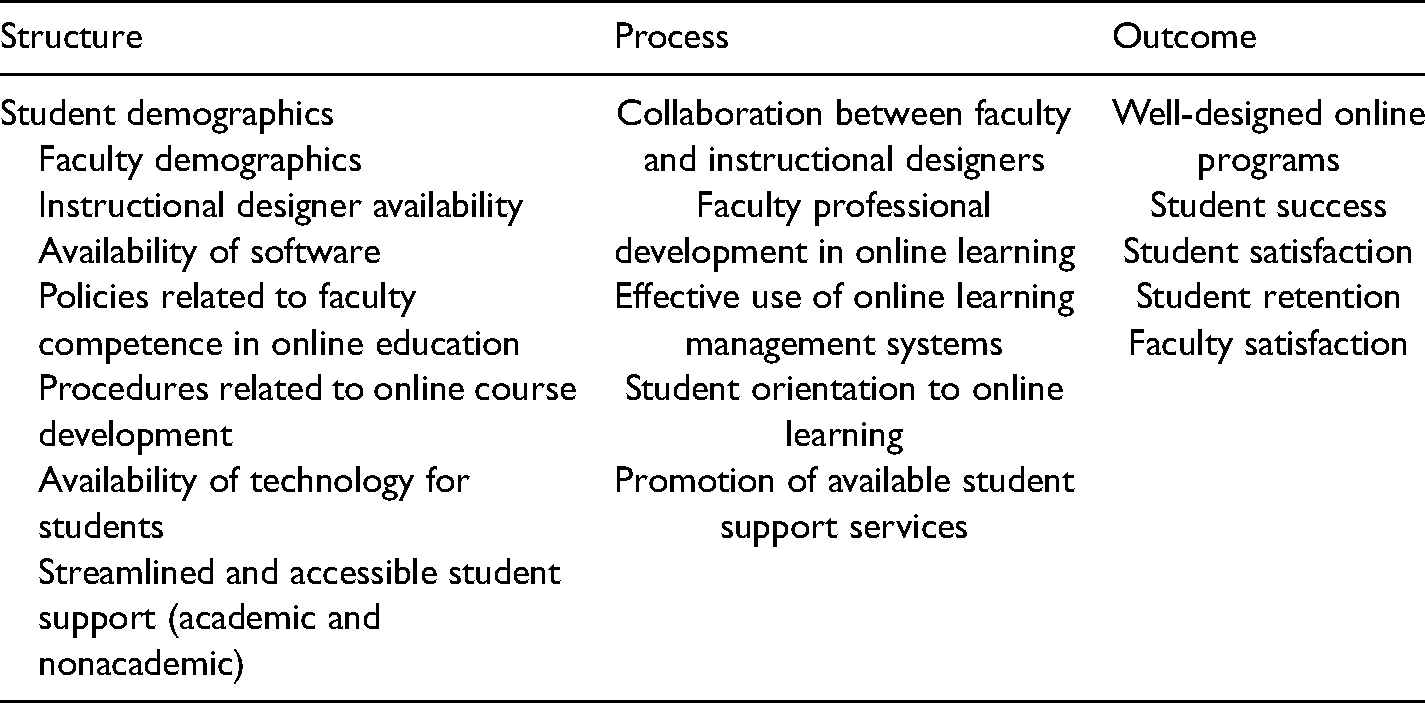
As highlighted by the participants in this research, evaluation and continuous quality measurement is extremely important especially as we prepare for future and plan to deliver education/programs in online medium of instruction. Though the Donabedian model is attributed to quality measurement in healthcare (Berwick & Fox, 2016), the move toward online education can also be examined through the structure–process–outcome framework that is credited to the Donabedian model. Initially proposed by Avedis Donabedian, structure–process–outcome model aims to examine quality of healthcare services provided to patients. More recently, researchers have utilized this framework in planning and delivery of interprofessional education programs at academic health settings (Botma & Labuschagne, 2017). Structure, as highlighted in Donabedian model includes facilities/infrastructure and organizational capacity to provide services. Process denotes how well services are delivered and outcome denotes how does the system (structure and process variables) impact overall well-being of customers (patients in healthcare). Table 1 demonstrates that adequate and appropriate structures and processes related to online education culminate in positive outcomes for both students and faculty. It is important to consider the rationale for, and construction of, structures and processes to ensure measurable outcomes that will benefit students and faculty alike.
The Donabedian Model in the Context of Online Education.
Establishing Faculty Presence to Facilitate Learning
A third theme identified is establishing faculty presence to facilitate learning. From a student's perspective, it is important for faculty to be present and provide opportunities to interact with students in an online learning platform. This demonstrates faculty's genuine interest in student progress. Results presented above clearly indicate that faculty need to embrace being present in the online classroom by integrating online resources and facilitating regular teleconference meetings and check-ins to maintain personal connections with students and keep them engaged. The opportunity to connect with others is essential to promote dialogue and sustain educational experiences over time so that students can progress to higher levels of critical thinking. Connection with others promotes commitment and ensures students have meaningful educational experiences to construct knowledge, whether in-person or in an online platform (Garrison & Kanuka, 2004).
During the COVID-19 pandemic, when in-person learning is not possible, creativity was necessary to deliver alternate experiences (i.e., virtual reality, simulation, recorded lectures) via the LMS and through online teleconference meetings, such as Zoom. Online learning environments can, and should, be flexible, inclusive, and adaptable. Traditional lectures can be recorded and posted in the LMS to make more effective use of classroom time through active, meaningful learning activities. Faculty can enhance course quality and the teaching and learning experience by implementing innovative teaching strategies in their classes (Garrison & Kanuka, 2004). Improved student learning outcomes are possible when faculty/instructors take time to design activities to address needs of learners.
Establishing faculty presence to facilitate learning can be explained by a COI framework. A COI consists of three overarching elements, including social, cognitive, and teaching presence (Garrison & Kanuka, 2004). COI also provides opportunities for open dialogue between students and faculty, as well as time to debate, negotiate, and agree, which are hallmarks of higher education. Faculty should focus on increasing social, cognitive, and teaching presence to promote an environment conducive to learning. Effective social presence in online education enables students to express themselves freely, build effective connections, and function as a team. This could create meaningful and engaging learning experience for online learners (Garrison et al., 2000; Purdue University, 2020). Cognitive presence focuses on the students’ ability to construct meaning through continuous dialog and reflection. It is important to note that the COI framework aims to use a strong foundation built by teaching and social presence to encourage cognitive presence in classes (Garrison et al., 2000; Purdue University, 2020). Teaching presence includes both planning and facilitation of the class to achieve optimal learning outcomes. By establishing strong teaching presence in classes (online, on-campus, or hybrid), instructors can work toward enhancing social and cognitive presence, which may lead to meaningful learning experiences (Garrison et al., 2000; Purdue University, 2020). In the post-vaccine and post-pandemic era, where teaching and learning has changed, faculty need to adopt a growth mindset and be open to the use of technology tools and innovative pedagogical methods in current times.
Joint Ownership and Responsibility of Learning—Everyone Must Play a Part
The fourth identified theme is joint ownership and responsibility of learning. Everyone must play a part to ensure a positive learning experience. When transitioning to an online medium, students must take ownership of their own learning. While faculty create engaging content, implement advanced learning tools, and include opportunities for connecting students to peers and faculty, students hold a fair share of responsibility in their learning. Online learning requires self-regulation; engaging in efforts to manage one's own learning to achieve established goals (Rapanta et al., 2020). Self-regulation tools include, for example, self-reflection, portfolios, and self-paced asynchronous learning activities. These activities “shift the focus onto students as responsible for their own learning” (Rapanta et al., 2020, p. 939).
A partnership between faculty, admissions, and industry can enhance student recruitment and retention. This partnership will be integral in developing innovative ways to help combat declining enrollment in higher education. There are many higher education institutions at risk for closure. With the continued rise in tuition, students desire the best value for their investment and a quality learning experience with convenience. “There is growing evidence and a sentiment that sitting in a large lecture hall three times a week is not intellectually stimulating or perhaps worth the commute to campus” (Garrison & Kanuka, 2004, p. 104). With many students working in their degree fields, these partnerships can foster the identification and development of programs specific to improving student performance. Instruction that embraces student access to digital content and innovative learning activities benefits students in flexible learning modalities. The ability for students to learn through online platforms and engage in student-centered learning activities help to prepare students for online education and the workforce. Many students may have skills and experiences in their field and the ability to demonstrate competence without additional coursework, which supports competency-based education for nontraditional learners. Creating an infrastructure that is conducive for online learning will be key in the shift toward competency-based education. Universities embracing competency-based education can provide a more affordable and flexible way to obtain a degree, supporting students with responsibilities outside of the classroom (Nodine, 2016). When hiring administrators, it will be important to assess their intent to make online learning a priority to foster innovation. Investment in this area can support streamlined processes, contingency planning, and student satisfaction.
Collaboration with the ID team is necessary since ID is not a specialty of faculty. Faculty and administrators often do not play a role in restructuring online courses, so a partnership with IT is imperative (Garrison & Kanuka, 2004). With increased use of technology and online teaching modalities, support from IT and administration will also be necessary for student success. Nontraditional learners may have commitments and responsibilities outside the classroom, therefore, may be completing schoolwork during nontraditional schoolwork hours. It is important to have a “dedicated student service support center” available to assist students with technology needs (Garrison & Kanuka, 2004, p. 102). Interprofessional teamwork between faculty, administration, online advisors, and IT could support and create flexible schedules and coverage during nontraditional schoolwork hours.
Increased use of interprofessional teams in higher education can assist in improved processes across disciplines. The standardization of teaching and learning approaches and course delivery methods university wide can help minimize waste, facilitate problem-solving, and maintain consistency of online courses. Evaluation and assessment methods can improve online teaching and learning by utilizing student feedback, and a continuous assessment model should be adopted (Rapanta et al., 2020). CQI provides an opportunity to analyze problems, create solutions, and implement changes to achieve program, department, and university missions and vision
Conclusion and Suggestions
This research study builds upon the expertise of faculty, administrators, ID team lead, and students, and allows these key stakeholders to express their thoughts on creating successful processes and systems with a focus on the post-vaccine and post-pandemic world. The authors have presented four key themes (a) integrating technology to facilitate and enhance education; (b) structural support and resources needed to build sound processes for effective online education; (c) establishing faculty presence to facilitate learning; (d) joint ownership and responsibility of learning—everyone must play a part and described these themes in light of well-established theoretical frameworks in education and quality improvement.
It is important to note that COVID-19 and other public health issues will continue to create issues in the environment. It is important to utilize lessons learned during the pandemic and prepare to adapt and make changes to meet the demands posed by future disruptions. As pointed out by one of the participants, “we need to let go of control and embrace flexibility, inclusiveness, and adaptability. We need to be agile in the ever-changing world around us.” Contingency plans for how to shift quickly to an online, hybrid, and/or blended learning environment will be a necessity in the future. One must always remember the daunting task universities across the globe undertook when a sudden pivot to an online medium of instruction was needed to curtail the spread of COVID-19. Educators, administrators, and IDs should consider COVID-19 as an opportunity which has allowed critical examination of current practices and a re-envision of existing academic processes. There is a clear need to invest in faculty development and innovative teaching and learning practices, as well as the scholarship of teaching and learning, to face the inevitable global challenges of the future.
Findings clearly indicate that there needs to be an increased focus on building structure and processes to support online learning. There is a clear need to create training programs and professional development opportunities focused on the use of web-based learning, cloud-based productivity suites, online video capture, and effective use of LMS. This could be overwhelming if faculty are required to learn and master the details in a short period of time. Additionally, there is a need for quality assurance for online education and overall learning. Educational institutions should incentivize faculty to implement and utilize course design essentials across all modalities. While few instructors integrated e-tools wholeheartedly, other instructors were not able to implement these tools as effectively. The need for policy intervention is also integral as the use of LMS and e-learning tools have not been consistent among various online and on-campus courses. If used correctly and consistently, e-learning tools can enhance teaching and learning across programs in the United States and globally.
This study provides important insight regarding challenges faced by international students, the future of traditional land-based education, and issues related to accessibility and digital equity. It is critically important that university administrators pay attention to issues surrounding immigration problems when international students take online/remote classes. This pandemic has demonstrated that with appropriate structural support, students (domestic and international) can take remote classes and still achieve educational outcomes similar to when they attend on-campus classes. It is important to note, however, that low Internet bandwidth, lack of appropriate technology or tools (computer/laptop), and costly data packages may impact learning, especially for students who come from lower socioeconomic backgrounds, who previously relied on university resources to complete their work.
Faculty participants indicated that interest in online learning is not going to diminish in the post-vaccine and post-pandemic world. Faculty should re-evaluate their courses and pedagogical methods and incorporate innovative teaching practices. Furthermore, the use of mentor–mentee models with early adopters who could lead the way and share their own experiences with novice educators (or instructors who are new to online teaching) for promoting change was also highlighted. Participants indicated that instructors need to assume the role of facilitator in a completely online or hybrid/blended environment. Technology tools, principles of course design, effective instructional approaches, and relationships between students and faculty can be used to create a deep and meaningful learning experience for students. Such methods can be used to build a strong social and teaching presence in online classes, which, in turn, can result in meaningful learning opportunities and outcomes for students.
Educational institutions should offer learning opportunities for faculty so they can effectively run an online curriculum with the same ease as on-campus classes. One of the key highlights of this research is the need to embrace innovative learning methods to engage nontraditional students outside of residential education. These methods are an opportunity to boost enrollment, especially in smaller academic institutions that are facing enrollment crises due to the pandemic. Furthermore, it will be important to pay attention to the needs of high school students and their expectations of higher education. Additionally, partnerships between industry and academia will foster the building of innovative programs, such as micro-credentialing, and the recruitment of students, which are factors worth considering in preparation for the future.
Finally, findings of this study suggest that students, faculty, and administrators realize the pandemic has changed the way education will be delivered in the future. There was an increased recognition of the lack of support, as well as the lack of sound technology infrastructure. There is a continued need for CQI, which involves the assessment of online education, and the requirement to redesign existing processes and methods to streamline online education to meet the needs of students. There was an appreciation for how faculty and professionals quickly transitioned to online instructional methods, even if they were personally struggling with COVID-related problems. There is a clear need for studies across different academic settings (including schools/K-12 education, community and technical colleges, and for-profit and not-for profit systems) so researchers can explore attitudes of students, instructors, and administrators toward lessons learned during the pandemic and how they wish to utilize these lessons in future planning. The inclusion of different educational settings not currently represented in the research will allow for a better understanding of how academia is preparing to successfully emerge out of the pandemic, while still making plans to adjust and adapt in the post-vaccine world.
Footnotes
Declaration of Conflicting Interests
The author(s) declared no potential conflicts of interest with respect to the research, authorship, and/or publication of this article.
Funding
The author(s) received no financial support for the research, authorship, and/or publication of this article.
