







Abstract
This exploratory study describes the distribution of pre-service teacher (PST) technology use for formal or informal professional learning. Additionally, it describes PSTs’ self-efficacy for technology use and associated factors. Laptops and smartphones were among the most commonly used devices. Technology use for professional learning was common in general but less so for informal learning. Modest levels of PST self-efficacy varied by activity, with lower levels of self-efficacy for informal learning. PSTs were particularly stressed due to examinations, workload, and lack of time to relax. Also, PSTs’ academic stress pertaining to performance pressures and time restraints was associated with greater technology use while academic stress pertaining to workload was associated with less technology use. Limitations and future directions are discussed.
Technology has played an increasing role in the design and delivery of pre-service teacher (PST) education over the past few decades. Nearly all PST courses, experiences, or programs rely on some form of technology, such as course management systems, document preparation, or tools for clinical experience management. While some PST education programs are entirely online, other place-based programs include individual courses that are online (Brzycki & Dudt, 2005; Dede, 2006; Dede et al., 2009; Thomas et al., 1996).
In contrast to such online programs or courses, the use of technology—emergency remote teaching—for PST education became more acute during the COVID-19 pandemic as higher education institutions and K-12 schools pivoted to remote learning (Jones et al., 2021). During the 2020–21 academic year, many teacher preparation programs—including coursework, clinical experiences, and other activities—were entirely online. Because the support and time that faculty typically receive when designing and implementing online instruction was limited during the crisis circumstances of COVID-19, the rapid switch from face-to-face instruction to online instruction likely diminished instructional quality (Hodges et al., 2020). Also, the need to pivot to online instruction due to COVID-19 most likely imposed stresses on PSTs (Jones et al., 2021), challenging both their resilience and skills using technology for these purposes. The special conditions of this time period thus raised questions about the role of important psycho-social factors and how PSTs use technology for professional learning.
Regardless of the emergency online circumstances of the COVID-19 pandemic, PSTs should be knowledgeable of and confident in using educational technology in the classroom with their own students (Giles, 2019). However, without instruction on educational technology, many PSTs experience anxiety or fear of implementing new technologies in their classrooms that they do not fully understand themselves (Colognesi & Hanin, 2024). Although much has been written about PSTs in relation to their integration of technology within their pedagogy (e.g., Admiraal et al., 2017; Farjon et al., 2019; Koh & Divaharan, 2011), much less is known about PSTs’ use of technology for formal and informal professional learning. Therefore, the present study examined research questions related to PSTs’ use of technology for professional learning. Using technology for professional learning was defined as using computers or other devices (e.g., desktops, laptops, tablets, smartphones), as well as software programs, apps, or websites to learn to teach and to learn about the practice of teaching. Formal professional learning was defined as learning associated with a teacher education program or course, and informal professional learning was defined as other learning about how to teach or the practice of teaching (e.g., from peers, on social media). The research questions examined in the present study were as follows:
Which technological devices do PSTs use for formal and informal professional learning? How do PSTs use technology for formal and informal professional learning? How self-efficacious, stressed, or resilient are PSTs with respect to their use of technology for formal and informal professional learning? What PST characteristics are associated with using technology for formal and informal professional learning?
With the increasing availability, functionality, and versatility that technology offers and its rapid growth and expansion from an optional to an integral device in the world of education, this study offers a timely examination of PSTs’ technology use for formal and informal professional learning. The study helps to better understand the complexity, contemporary usage, predictors, and PST characteristics associated with using technology during the special conditions of the COVID-19 pandemic. Using a quantitative approach, the study contributes to an emerging literature base on PST technology use by providing a nuanced understanding of how PSTs use technology for formal and informal professional learning. The study concludes with implications for practice in teacher education.
Literature Review
There is a voluminous literature globally about PSTs and technology. For example, much has been written about the technology skills that PSTs need to acquire (see Bakir, 2016), the prominent Technological Pedagogical Content Knowledge (TPACK) framework (Koehler & Mishra, 2009), and how to develop technology skills in PST education (Tondeur et al., 2018). Other work has focused on PSTs’ intention to use mobile devices in their practice (e.g., Sánchez-Prieto et al., 2017; Wong, 2015) or their acceptance of technology for teaching (e.g., Ranellucci et al., 2020). This work relied on relevant theoretical frameworks such as the Technology Acceptance Model (TAM; Davis, 1989) and the Unified Theory of Acceptance and Use of Technology Model (UTAUTM; Venkatesh et al., 2003). Additionally, there is literature on PSTs’ experiences with learning to use various technologies such as graphing calculators in mathematics (Meagher et al., 2011) or augmented reality in science (Delello, 2014).
There is also a body of literature on uses of technologies to promote PSTs’ learning and development in teacher education. This includes instructor use of classroom simulations (Sasaki et al., 2020), web-based audio and video for assessment purposes (Newman-Thomas et al., 2012), as well as video use for self-reflection in clinical experiences (Cavanagh, 2021; Colognesi & Hanin, 2024) and the modeling of practices and analysis of teaching (Smith & Greene, 2013). Other literature describes the use of technology such as e-mail, text messaging, video, and bug-in-ear for the provision of PSTs during clinical experiences (McCorkle & Coogle, 2020) and the use of video to provide feedback (Cavanagh, 2021).
Much has been written about what PSTs should know for integration of technology for teaching (e.g., Admiraal et al., 2017; Farjon et al., 2019; Koh & Divaharan, 2011), their acceptance or intention to use technology (e.g., Han et al., 2017; Sanchez-Prieto et al., 2017; Teo & Noyes, 2014), and instructor uses of technology (e.g., Bai & Ertmer, 2008; Brinkley-Etzkorn, 2020; Santos Espino et al., 2020). Numerous studies have also examined a variety of ways (e.g., student partnerships, flipped classrooms, training programs) to increase PSTs’ comfort with, positive perception of, and use of educational technology in their own classrooms (Barahona et al., 2022; Colognesi & Hanin, 2024; Giles, 2019). Although these studies demonstrated ways that PSTs may be better prepared to incorporate educational technology within their pedagogy, many PSTs still expressed a need for greater professional development in this domain (e.g., Barahona et al., 2022).
However, curiously, less is known about PSTs’ use of technology within formal course structures or informally. While PSTs’ use of technology for learning purposes likely varies by institution and program due to differences in program modality or other factors (Duncan & Barnett, 2009), there is a surprisingly small body of literature on this topic. For example, Newhouse and colleagues (2006) provided evidence that PSTs used provided laptops daily or almost daily for learning purposes in their teacher preparation program. Similarly, Chen and colleagues (2012) found that PSTs had multiple mobile and non-mobile devices and that different devices tended to be used for different purposes (e.g., communication and content creation). However, Chen and colleagues’ (2012) study was not focused on learning to teach per se. Also, these studies are now somewhat dated, not taking into consideration the special conditions and challenges that PSTs faced during the COVID-19 pandemic. Thus, we examine such issues in a more targeted and comprehensive fashion, in addition to considering a set of possible explanatory antecedent psycho-social factors in relation to the distribution of technology use for formal and informal professional learning during the COVID-19 pandemic.
Technology Use During the COVID-19 Pandemic
The COVID-19 pandemic impacted the education system at all levels, from students and teachers in K-12 classrooms to PST preparation programs. The use of technology during this time became essential. Some teachers felt confident in their ability to incorporate online tools within their instruction (e.g., Jimoyiannis & Koukis, 2023). However, across the globe (including the United States, where the present study was conducted), many teachers’ ability to incorporate technology into their teaching was mediocre, having had little prior contact with technology and needing guidance to incorporate technology within their pedagogy (e.g., Garcia et al., 2024; Merrick & Joseph, 2024; Teichert & Piazza, 2023). Despite many teachers only having rudimentary skill in using technology to access resources or professional development, many had to use technology to participate in professional learning opportunities during this time to improve their proficiency in teaching online and noted a need for continued professional development in this domain after the pandemic (Jimoyiannis & Koukis, 2023; Merrick & Joseph, 2024; Teichert & Piazza, 2023).
Moreover, with the COVID-19 pandemic having changed the landscape of the U.S. education system, PSTs faced changes within their teacher preparation programs and faced entering a changed and uncertain profession (Hebert & Hickey, 2022). Consequently, PSTs also need resources for professional development. For example, in Jones and colleagues’ (2021) study, PSTs made presentations that discussed various educational technology tools and contributed information to a Google Document that everyone could access for resources and professional development. Nevertheless, continued practice with the technology was found to be essential for the PSTs’ online pedagogy given that PSTs are new to delivering instruction face-to-face or remotely, and educational technology is constantly evolving (Jones et al., 2021). Such need for continued practice is associated with PSTs’ professional development. Much professional development is offered online (e.g., massive open online courses (MOOCs), e-mentoring, and/or professional learning networks; Jimoyiannis & Koukis, 2023), making it essential to examine the next generation of teachers’ engagement with such resources.
Antecedent Psycho-Social Factors
Given that technology adoption is a complex social process (Batane & Ngwako, 2017), there is literature on the relationship between antecedent psycho-social factors and PSTs’ technology use, specifically technology use intention. For example, attitudinal factors are reflected in relevant theoretical frameworks for technology use such as the theory of planned behavior (Ajzen, 1991) and the Technology Acceptance Model (Davis, 1989). Bergum Johanson and colleagues (2022) found that attitudes, emotions, prior experience, and mastery orientation were related to PSTs’ software-use competence. Similarly, Teo and van Schaik (2012) associated attitude and self-efficacy with the intention to use technology for teaching purposes among PSTs. We limit our review and analysis of antecedent psycho-social factors to that of self-efficacy, stress, and resilience.
Self-Efficacy
Teachers’ self-efficacy for using technology varied greatly during the COVID-19 pandemic (e.g., Garcia et al., 2024; Jimoyiannis & Koukis, 2023; Merrick & Joseph, 2024; Teichert & Piazza, 2023). However, much of the prior literature on self-efficacy and technology use was conducted prior to the pandemic. In general, self-efficacy refers to “beliefs in one's capabilities to organize and execute the courses of action required to produce given attainments” (Bandura, 1997, p. 3). Self-efficacy among teachers in particular pertains to teachers’ beliefs in their ability and skill to educate (Joo et al., 2018).
Studies have investigated links between self-efficacy and in-service or pre-service teachers’ intention to integrate technology (Sánchez-Prieto et al., 2017). After receiving formal professional development pertaining to pedagogical technology uses within their pre-service training, beginning teachers experienced greater confidence in their ability to use technology as a learning tool (and were more likely to use technology for such purposes) compared to those who did not receive such instruction (Tondeur et al., 2017). Similarly, Joo and colleagues (2018) found that PSTs should obtain an integrated knowledge of technology, teaching, and content (i.e., Koehler and Mishra's (2009) TPACK) because it is positively associated with teacher self-efficacy. Also, they found that PSTs’ self-efficacy, in conjunction with their perceived ease of use and usefulness of technology, was positively associated with PSTs’ intention to use technology (Joo et al., 2018). Likewise, Teo and van Schaik (2012) found that self-efficacy had a positive relationship with the perceived ease of use of technology which, in turn, indirectly predicted PSTs’ intention to use technology. However, this was likely due to PSTs having some technological knowledge and skills prior to beginning their teacher preparation program (Teo & van Schaik, 2012).
It has also been suggested that teachers’ self-efficacy beliefs about their ability to use technology should be associated with their actual technology use (Kent & Giles, 2017). For instance, Kent and Giles (2017) found that PSTs were self-efficacious in their abilities to use technology in their teaching after they took a course on integrating technology in their teaching and, subsequently, were placed in classrooms with a moderate amount of technology for their field experiences. However, about a third of these PSTs felt less confident in their ability to evaluate and select high-quality technological tools for their teaching use (Kent & Giles, 2017).
Furthermore, variation has been found in PSTs’ self-efficacy pertaining to their uses of technology, with self-efficacy higher for skills such as accessing the Internet and course management system, as well as downloading files, whereas self-efficacy was lower for skills such as creating or editing videos (Lemon & Garvis, 2016; Newhouse et al., 2006). Additionally, technology may be used by PSTs as a professional development tool to discuss the various aspects of their teacher education, including pedagogical technology uses. For instance, mobile portfolio applications afford PSTs with such experiences, and were positively correlated with their self-efficacy in their ability to engage students (Michos & Petko, 2024). We examine self-efficacy in the form of a task-specific self-efficacy belief, that is, in relation to PSTs’ actual use of technology to learn how to teach. Nevertheless, PSTs’ lower self-efficacy for some forms or uses of technology (e.g., Lemon & Garvis, 2016; Newhouse et al., 2006) may also be a source of stress for PSTs.
Stress
Stress is common among both in-service and pre-service teachers. Indeed, multiple scholars have found evidence that PSTs are stressed across a variety of countries: U.S. (DeMauro & Jennings, 2016), Canada (Klassen & Chiu, 2011), Australia (Geng et al., 2015; Geng et al., 2016), Spain (García-Martínez, Gavín-Chocano et al., 2021a; García-Martínez, Pérez-Navío et al., 2021b), Turkey (Bayrakdaroglu & Hekim, 2020), and Malaysia (Balakrishnan et al., 2017). Balakrishnan and colleagues (2017) identified a variety of academic stressors that PSTs face, including exams, workload, low motivation, and high family expectations. Recent studies showed especially high in-service teacher stress levels during the COVID-19 pandemic as well as high levels of anxiety (Kush et al., 2022; Steiner & Woo, 2022).
Geng and colleagues (2016) found that graduate PSTs exhibited more stress than undergraduate PSTs. For undergraduates, understanding educational theory as well as a lack of knowledge about the support provided to them contributed to their stress (Geng et al., 2016). For graduate students, major stressors included their future employment opportunities, lack of classroom time, and lack of reflective thinking and teaching-strategy development (Geng et al., 2016). Moreover, elementary and secondary PSTs were more stressed than early childhood PSTs (Geng et al., 2015) with PSTs in computer and technology studies being especially stressed (Bayrakdaroglu & Hekim, 2020). PSTs even commented that the work they must complete constituted an “overwhelming workload and has caused me a tremendous amount of stress and anxiety” (Geng et al., 2015, p. 42).
These stresses previously identified among PSTs may have been exacerbated by the COVID-19 pandemic. In light of these prior findings, with this study we seek to understand how several categories of academic-related stresses related to PSTs’ technology use for professional learning during the COVID-19 era. Nevertheless, the stress that PSTs face may be remedied, at least in part, by building resilience among PSTs so that they feel confident in the classroom (Le Cornu, 2009).
Resilience
Resilience may be crucial for both in-service and pre-service teachers. The present stresses, as well as the current social, political, and economic climates surrounding teachers, can create uncertain and complex worlds for teachers to navigate (Le Cornu, 2013; Mansfield et al., 2018). In such climates, resilience may prove beneficial. Resilience is the capacity to bounce back and be successful despite challenges and setbacks (Brunetti, 2006; Sammons et al., 2007). Masten and colleagues (1990) suggested that teachers can demonstrate resilience by successfully adapting to and overcoming the challenges set before them.
A recent study by Steiner and Woo (2022) found mixed levels of resilience among in-service teachers, but less is known about PSTs. Mansfield and colleagues (2018) found that teacher educators thought that PSTs were resilient in terms of their optimistic willingness to learn and try new ideas while being prepared to fail. Similarly, both He (2009) and Le Cornu (2009) argued that mentors are important to PSTs’ resilience. Although Scherer and colleagues (2018) noted the potential relevance of PSTs’ adaptability to novelty (i.e., resilience) to their perceived use and ease of use of technology, we examine the relationship between resilience and technology use in terms of PSTs’ technology use for professional learning.
Method
To answer the research questions, we relied primarily on a descriptive and explanatory correlational research design. This study (protocol approval # HS21-0154) received Institutional Review Board (IRB) approval from the Office of Research Compliance, Integrity, and Safety at Northern Illinois University.
Participants
Participants were 258 PSTs 1 enrolled in at least 31 different teacher-education programs across at least five institutions and were sampled using a non-probabilistic approach. 2 Recruitment involved contacting individuals on an existing sampling frame of U.S. PSTs who indicated that they would be interested in participating in future research, as well as new recruitment of PSTs enrolled at select teacher education programs to which the researchers had access. Data were collected during the Fall 2020 (12%), Spring 2021 (47%), Fall 2021 (30%), and Spring 2022 (11%) academic semesters. All participants provided informed consent for study participation.
Approximately 96% of the sample was enrolled in an undergraduate program, whereas others were enrolled in postbaccalaureate or graduate programs, and 95% in traditional higher-education-based (college- or university-based) teacher education programs. Among undergraduate participants, academic standing was distributed as follows: 5% freshman, 3% sophomore, 43% junior, and 50% senior. Eighty-seven percent of participants were completing a clinical or field experience (e.g., student teaching) at the time of data collection. The average number of years enrolled in their current teacher preparation program was 2.60 (SD = 1.25).
The sample included individuals who intended to primarily teach in a variety of school levels: pre-kindergarten (1%), elementary school (grades K-5; 54%), middle school (grades 6–8; 12%), high school (grades 9–12; 22%), multiple levels (9%), and other (1%). The majority of the sample (55%) reported intending to teach all core subject areas whereas others reported intending to teach other specific subject areas or multiple subjects. Eighty-one percent of the sample was female. The racial distribution was as follows: 82% white; 3% Black or African American; 6% Asian; 2% American Indian or Alaska Native; 1% Native Hawaiian or Other Pacific Islander; and 6% two or more races. The average age of participants was 23.11 (SD = 4.19) years.
Instrumentation
Data were collected via a researcher-developed online survey. In addition to items used to operationalize the variables of interest, including PST technology use, self-efficacy, academic stress, and resilience, data were collected to help describe the PST sample's characteristics and teacher education programs.
Technology use
To assess technology use for professional learning, we relied on a researcher-developed instrument. Some of the items pertained to technology use activities for formal professional learning (e.g., “Use technology to access course materials (e.g., readings, multi-media, library databases)”), and some of the items pertained to technology use activities for informal professional learning (e.g., “Use technology to explore a topic related to teaching (e.g., watching YouTube videos, reading blogs, Googling a topic)”). The response format was a six-point frequency scale: 1 = Never, 2 = Once a month or less, 3 = Once a week or less, 4 = A few times per week, 5 = Every day or almost every day, and 6 = Multiple times per day.
A preliminary exploratory factor analysis indicated a two-factor structure with seven items loading on the first factor labeled technology use for formal learning and three items loading on the second factor labeled technology use for informal learning; the two factors were moderately correlated. Reliability estimates were acceptable for both the formal [McDonald's (1999)
Self-Efficacy
To assess self-efficacy for technology use for professional learning, we relied on a researcher-developed instrument. The 10 items asked about confidence in the ability to use technology for formal and informal professional learning (e.g., “I am confident in my ability to use technology to access course materials (e.g., readings, multi-media, library databases);” “I am confident in my ability to use technology to explore a topic related to teaching (e.g., watching YouTube videos, reading blogs, Googling a topic)”). These items were parallel with those for technology use. For instance, the latter example above asked about a confidence judgment for the technology use item, “Use technology to explore a topic related to teaching (e.g., watching YouTube videos, reading blogs, Googling a topic).” The response format was 1 = Strongly disagree, 2 = Disagree, 3 = Somewhat disagree, 4 = Neither agree nor disagree, 5 = Somewhat agree, 6 = Agree, and 7 = Strongly agree. A preliminary exploratory factor analysis indicated a plausible single-factor structure for the item scores; the reliability estimate for the scores was very high [McDonald's (1999)'s
Academic Stress
To operationalize academic stress, we used the Perception of Academic Stress Scale (PASS) (Bedewy & Gabriel, 2015). This 18-item measure is intended to measure four dimensions of academic stress: pressures to perform (five items; e.g., “The competition with my peers for grades is quite intense”); perceptions of workload (four items; e.g., “I believe that the amount of work assignment is too much”); academic self-perceptions (four items; “I fear failing courses this year”); and time restraints (five items; “I have enough time to relax after work”). The response format for the items was a five-point agreement scale: 1 = Strongly disagree, 2 = Disagree, 3 = Neither agree nor disagree, 4 = Agree, and 5 = Strongly agree. Five of the items were negatively worded and reverse-scored prior to analysis.
As validity evidence, the PASS's authors (Bedewy & Gabriel, 2015) provided item content relevance ratings and conducted an exploratory factor analysis. With respect to reliability, the PASS’ authors reported a Cronbach's alpha estimate of .70 for the overall set of all 18 items. In our study, reliability estimates were minimally acceptable for the pressures to perform [McDonald's (1999)
Resilience
To assess resilience, we relied on a researcher-developed instrument. This 10-item measure featured items written to reflect key resilience construct domains such as emotional recovery and positive thinking (e.g., “I can learn and grow from experiences that set me back at work,” “Even if I suffer great challenges at school, I don’t give up easily”). The response format for the items was a six-point scale: 1 = Very untrue of me, 2 = Untrue of me, 3 = Somewhat untrue of me, 4 = Somewhat true of me, 5 = True of me, and 6 = Very true of me. A preliminary exploratory factor analysis indicated a plausible single-factor structure for the item scores; the reliability estimate for the scores was very high [McDonald's (1999)'s
Analytic Approach
All analyses were conducted in R with the ‘lavaan’ package (Rosseel, 2012), using full-information maximum likelihood estimation. We relied on descriptive statistical analyses to address our first three research questions. For our fourth research question, we used structural equation modeling.
In our initial structural equation model, which employed the published four-factor specification for the PASS measure, we observed an implausibly large (>1) correlation between the stress related to time restraints and stress related to pressures to perform latent variables. To shed light on this, we examined modification indices, looking especially toward possible cross-loadings or correlated errors for those items comprising these two scales. While we were able to resolve the issue by allowing a correlated error between two items across the two scales, the latent-variable correlation remained extremely high (.995) suggesting that the two scales were co-linear. Therefore, we decided to collapse these two factors into a factor we labeled stress related to pressures to perform and time restraints. We interpreted this factor as the level of stress associated with academic rigor and expectations for students, which results in students experiencing pressure pertaining to their performance along with restraints on their time to perform well. We suspect that the problem had to do with the quality of the stress measure. For context, in our final model seven of 18 PASS items loaded less than .5 on their respective factors and were negligibly explained by the factor structure. We present our findings with the caveat that additional reliability and validity research vis-à-vis the PASS measure is clearly needed.
Given the timing of data collection during a dynamic, global pandemic, we conducted preliminary analyses to understand differences in the dependent variable by semester. These analyses revealed some semester differences that did not necessarily correspond to the 2020–21 and 2021–22 academic years which generally featured distinct instructional modes. Thus, we controlled for semester with a set of indicator variables.
Results
Devices
For the distribution of device use among the PSTs sampled, respondents more commonly indicated using a laptop computer (97%) and smartphone (69%) than a desktop computer (21%) or tablet (28%) for professional learning.
Technology Uses
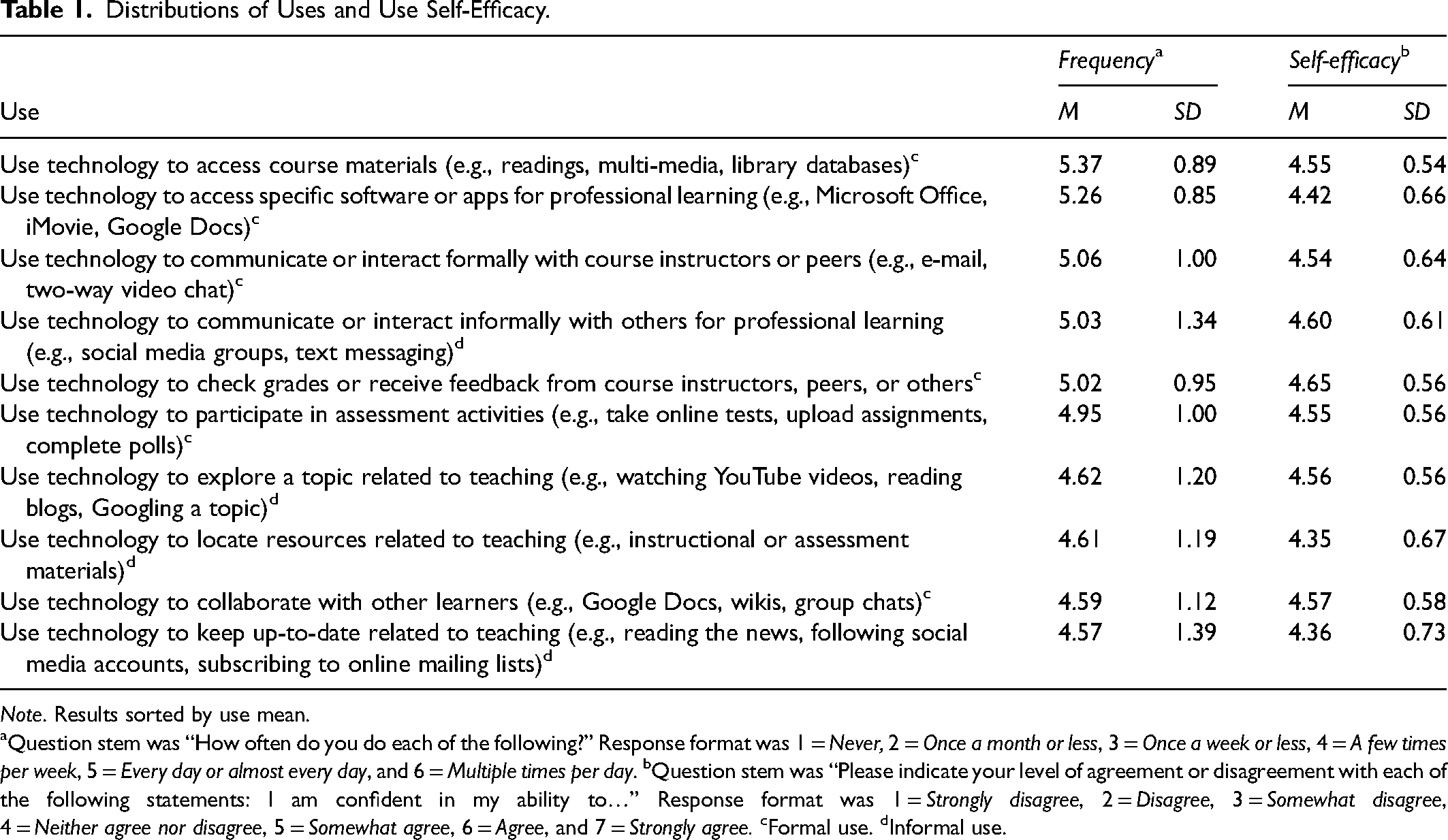
As shown in Table 1, means for the various technology uses ranged from 5.37 (between Every day or almost every day and Multiple times per day) to 4.57 (between A few times per week and Every day or almost every day). Relatively more common uses of technology for professional learning were: using technology to access course materials (e.g., readings, multi-media, library databases) (M = 5.37, SD = 0.89) and using technology to access specific software or apps for professional learning (e.g., Microsoft Office, iMovie, Google Docs) (M = 5.26, SD = 0.85).
Distributions of Uses and Use Self-Efficacy.
Note. Results sorted by use mean.
Question stem was “How often do you do each of the following?” Response format was 1 = Never, 2 = Once a month or less, 3 = Once a week or less, 4 = A few times per week, 5 = Every day or almost every day, and 6 = Multiple times per day. bQuestion stem was “Please indicate your level of agreement or disagreement with each of the following statements: I am confident in my ability to…” Response format was 1 = Strongly disagree, 2 = Disagree, 3 = Somewhat disagree, 4 = Neither agree nor disagree, 5 = Somewhat agree, 6 = Agree, and 7 = Strongly agree. cFormal use. dInformal use.
Relatively less common uses of technology for professional learning were: using technology to explore a topic related to teaching (e.g., watching YouTube videos, reading blogs, Googling a topic) (M = 4.62, SD = 1.20), using technology to locate resources related to teaching (e.g., instructional or assessment materials) (M = 4.61, SD = 1.19), using technology to collaborate with other learners (e.g., Google Docs, wikis, group chats) (M = 4.59, SD = 1.12), and using technology to keep up-to-date related to teaching (e.g., reading the news, following social media accounts, subscribing to online mailing lists) (M = 4.57, SD = 1.39). Some of these less common uses were forms of informal learning.
The most common uses were the least variable among respondents, and the least common uses were the most variable. However, there was also notably large variation with respect to using technology to communicate or interact informally with others for professional learning (e.g., social media groups, text messaging).
Self-Efficacy
Self-efficacy means for the various technology uses ranged from 4.65 to 4.35 (between Neither agree nor disagree and Somewhat agree), which implies slight levels of self-efficacy for using technology for professional learning. Respondents reported being relatively more self-efficacious as it relates to: using technology to check grades or receive feedback from course instructors, peers, or others (M = 4.65, SD = 0.56), and using technology to communicate or interact informally with others for professional learning (e.g., social media groups, text messaging) (M = 4.60, SD = 0.61).
Respondents reported being relatively less self-efficacious as it relates to: using technology to access specific software or apps for professional learning (e.g., Microsoft Office, iMovie, Google Docs) (M = 4.42, SD = 0.66); using technology to keep up-to-date related to teaching (e.g., reading the news, following social media accounts, subscribing to online mailing lists) (M = 4.36, SD = 0.73); and using technology to locate resources related to teaching (e.g., instructional or assessment materials) (M = 4.35, SD = 0.67). There was comparatively more variation in self-efficacy for these uses as well.
Curiously, the uses for which respondents indicated being most self-efficacious—using technology to check grades or receive feedback from course instructors, peers, or others and using technology to communicate or interact informally with others for professional learning (e.g., social media groups, text messaging)—were not those in which they most frequently engaged. However, there was more overlap between those uses which respondents indicated being least self-efficacious for and those uses for which respondents indicated less frequently engaging.
Academic Stress
Table 2 contains descriptive statistics for the academic stress items, organized by sub-dimension. Academic stress items means ranged from 1.76 (between Strongly disagree and Disagree) to 3.70 (between Neither agree nor disagree and Agree), and the standard deviations ranged from 0.70 to 1.48. The four sub-dimensions under academic stress items are pressures to perform, perceptions of workload, academic self-perceptions, and time restraints. The means for pressures to perform ranged from 2.55 (between Disagree and Neither agree nor disagree) to 3.70 (between Neither agree nor disagree and Agree). The means for perceptions of workload ranged from 3.11 to 3.65 (between Neither agree nor disagree and Agree). The means for academic self-perceptions ranged from 1.76 (between Strongly disagree and Disagree) to 2.65 (between Disagree and Neither agree nor disagree). The means for time restraints ranged from 2.62 (between Disagree and Neither agree nor disagree) to 3.61 (between Neither agree nor disagree and Agree).
Descriptive Statistics for Academic Stress Items.
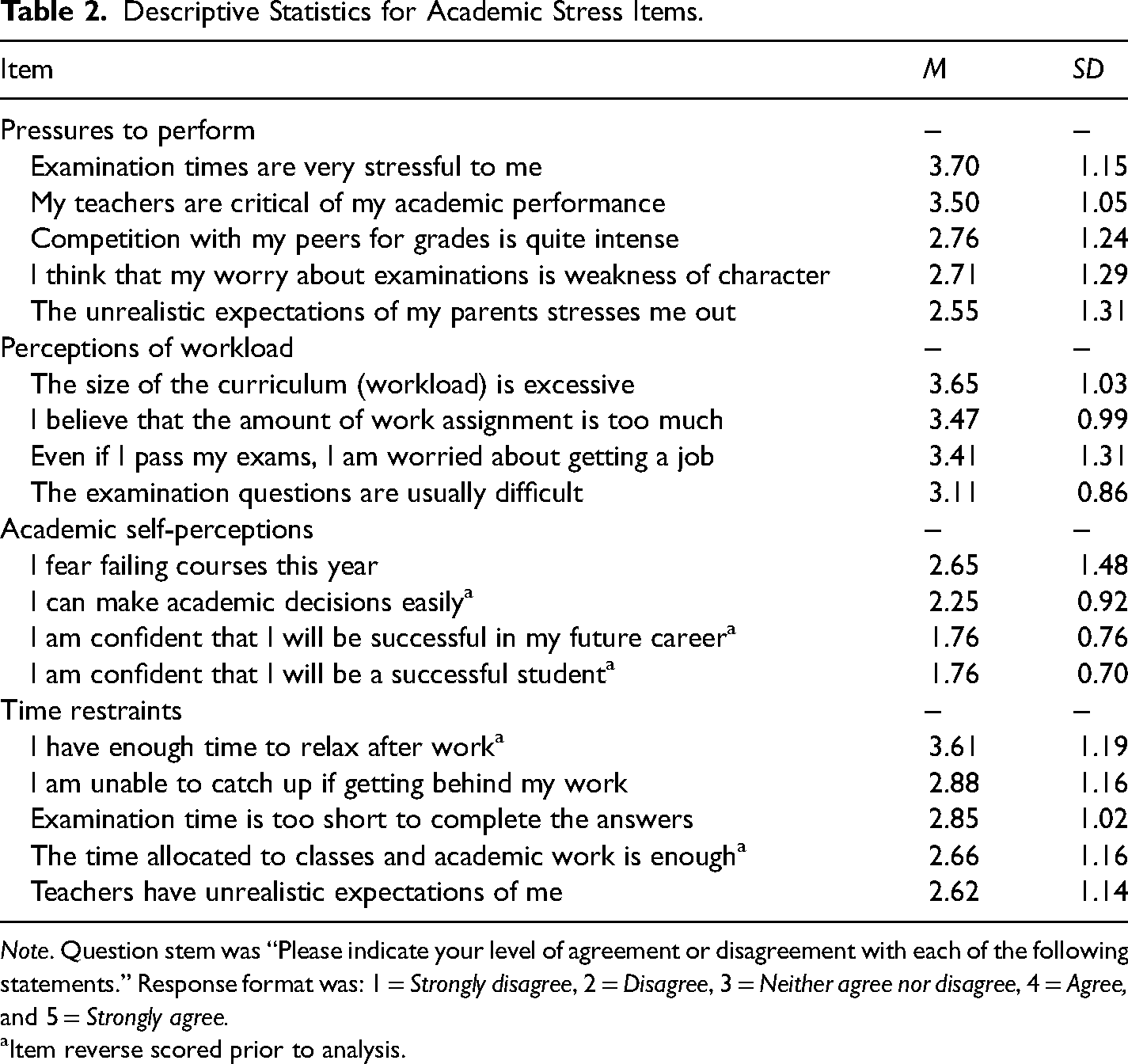
Note. Question stem was “Please indicate your level of agreement or disagreement with each of the following statements.” Response format was: 1 = Strongly disagree, 2 = Disagree, 3 = Neither agree nor disagree, 4 = Agree, and 5 = Strongly agree.
Item reverse scored prior to analysis.
Respondents reported being in the greatest agreement (indicating the greatest stress) with the following items: “examination times are very stressful to me” (M = 3.70, SD = 1.15), “the size of the curriculum (workload) is excessive” (M = 3.65, SD = 1.03), “I have enough time to relax after work” (M = 3.61, SD = 1.19), and “my teachers are critical of my academic performance” (M = 3.50, SD = 1.05). Respondents reported being in the least agreement (indicating the least stress) with the following items: “I am confident that I will be successful in my future career” (M = 1.76, SD = 0.76), “I am confident that I will be a successful student” (M = 1.76, SD = 0.70), “I can make academic decisions easily” (M = 2.25, SD = 0.92), and “The unrealistic expectations of my parents stresses me out” (M = 2.55, SD = 1.31). Overall, the PSTs’ agreement was the greatest (most stress) for the sub-dimension of perceptions of workload with the average mean being 3.41. The agreement was the least (least stress) for the sub-dimension of academic self-perceptions with the average mean being 2.11.
Resilience
Table 3 contains the means and standard deviations of teachers’ responses to the resilience items. The mean values ranged from 3.83 (between Somewhat untrue of me and Somewhat true of me) to 5.31 (between True of me and Very true of me) while the standard deviation values ranged from 0.75 to 1.38. The largest means were for the items “I can learn and grow from experiences that set me back at work” (M = 5.31, SD = 0.75), “I have a strong sense of mission for the cultivation of students” (M = 5.09, SD = 0.89), and “Even if I suffer great challenges at school, I don’t give up easily” (M = 5.08, SD = 0.89). These items naturally tended to also have less variable responses.
Descriptive Statistics for Resilience Items.
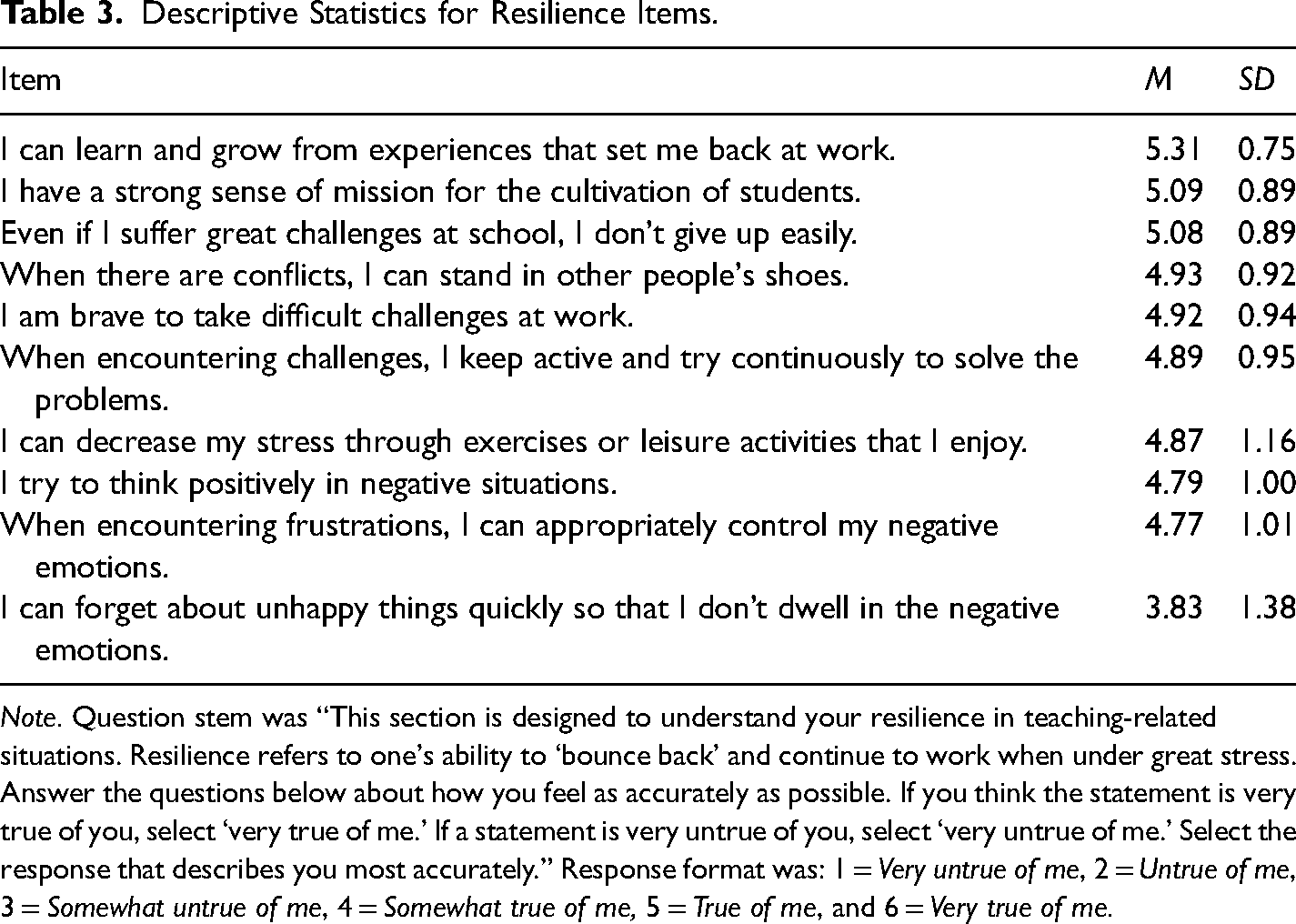
Note. Question stem was “This section is designed to understand your resilience in teaching-related situations. Resilience refers to one's ability to ‘bounce back’ and continue to work when under great stress. Answer the questions below about how you feel as accurately as possible. If you think the statement is very true of you, select ‘very true of me.’ If a statement is very untrue of you, select ‘very untrue of me.’ Select the response that describes you most accurately.” Response format was: 1 = Very untrue of me, 2 = Untrue of me, 3 = Somewhat untrue of me, 4 = Somewhat true of me, 5 = True of me, and 6 = Very true of me.
The smallest means were for the items, “I can forget about unhappy things quickly so that I don’t dwell in the negative emotions” (M = 3.83, SD = 1.38), “When encountering frustrations, I can appropriately control my negative emotions” (M = 4.77, SD = 1.01), and “I try to think positively in negative situations” (M = 4.79, SD = 1.00). Responses to these items also tended to be the most variable, especially for the latter-most item.
Structural Equation Modeling
The chi-square test of model fit was statistically significant, χ2(1148) = 2140.915, p < .001; however, the sample size was large, so we used other fit measures to assess model fit. The robust Comparative Fit Index (CFI) value of .790 and robust Tucker-Lewis Index (TLI) value of .777 indicated poor model fit (Bentler & Bonett, 1980; Hu & Bentler, 1999; Schumacker & Lomax, 1996). Similarly, the Standardized Root Mean Square Residual (SRMR) value of .083 indicated poor model fit, exceeding .08 (Hu & Bentler, 1999). However, the robust Root Mean Square Error of Approximation (RMSEA) value of .060 (90% CI .056 - .063), p < .001 indicated reasonable model fit (Hu & Bentler, 1999; Marsh et al., 2004). The variances explained for formal technology use (R2=.21) and informal technology use (R2=.21) were acceptable.
Measurement Model
Table 4 contains measurement model results. Although most factor loadings exceeded the item salience threshold of .5 (Kline, 2014) and were acceptable, loadings were slightly lower than .5 for two resilience items, four stress-related-to-performance-pressures-and-time-restraints items, two stress-related-to-workload items, and one stress-related-to-academic-self-perceptions item. All factor loadings were statistically significant (p < .05), except for one item on the stress-related-to-performance-pressures-and-time-restraints variable and one item on the stress-related-to-workload variable.
Standardized Factor Loadings for Measurement Model.
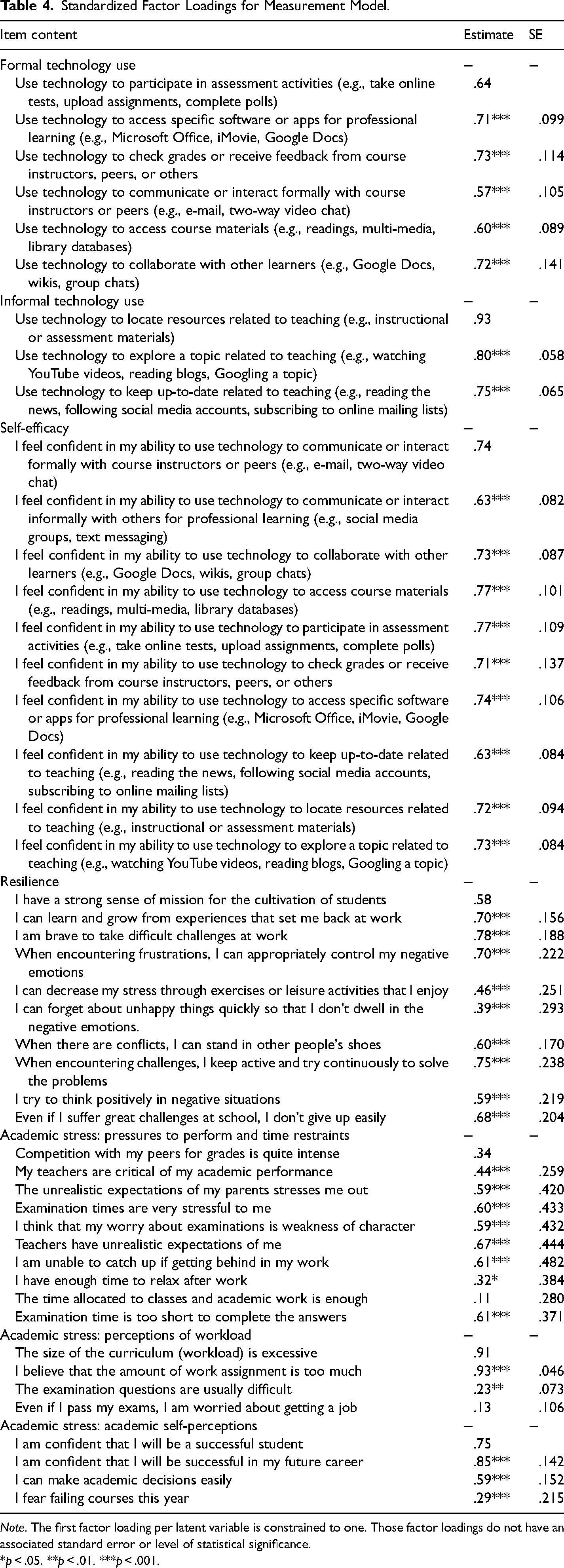
Note. The first factor loading per latent variable is constrained to one. Those factor loadings do not have an associated standard error or level of statistical significance.
*p < .05. **p < .01. ***p < .001.
Structural Model
Stress related to performance pressures and time restraints was a statistically-significant, positive predictor of both formal technology use (r = .46, p = .011) and informal technology use (r = .53, p = .006). That is, PSTs who experienced greater levels of academic stress pertaining to pressures to perform and time restraints were more likely to use technology for formal and informal professional learning tasks. Stress related to PSTs’ perceptions of workload was a statistically-significant, negative predictor of both formal technology use (r = −.29, p = .037) and informal technology use (r = −.31, p = .033). In other words, PSTs who experienced greater levels of academic stress pertaining to their perceptions of workload were less likely to use technology for formal and informal professional learning tasks. Additionally, the Fall 2021 semester was a statistically significant, negative predictor of both formal technology use (r = −.23, p = .016) and informal technology use (r = −.22, p = .024). PSTs who were surveyed during the Fall 2021 semester demonstrated lower formal and informal technology use compared to PSTs surveyed during the Fall 2020 semester. However, PSTs who were surveyed during the Spring 2021 or Spring 2022 semesters did not differ from PSTs surveyed during the Fall 2020 semester in either their formal or informal technology use. Also, self-efficacy, resilience, and stress pertaining to academic self-perceptions did not significantly predict formal or informal technology use. Table 5 contains the standardized regression coefficients for the structural model.
Standardized Regression Coefficients for Structural Model.
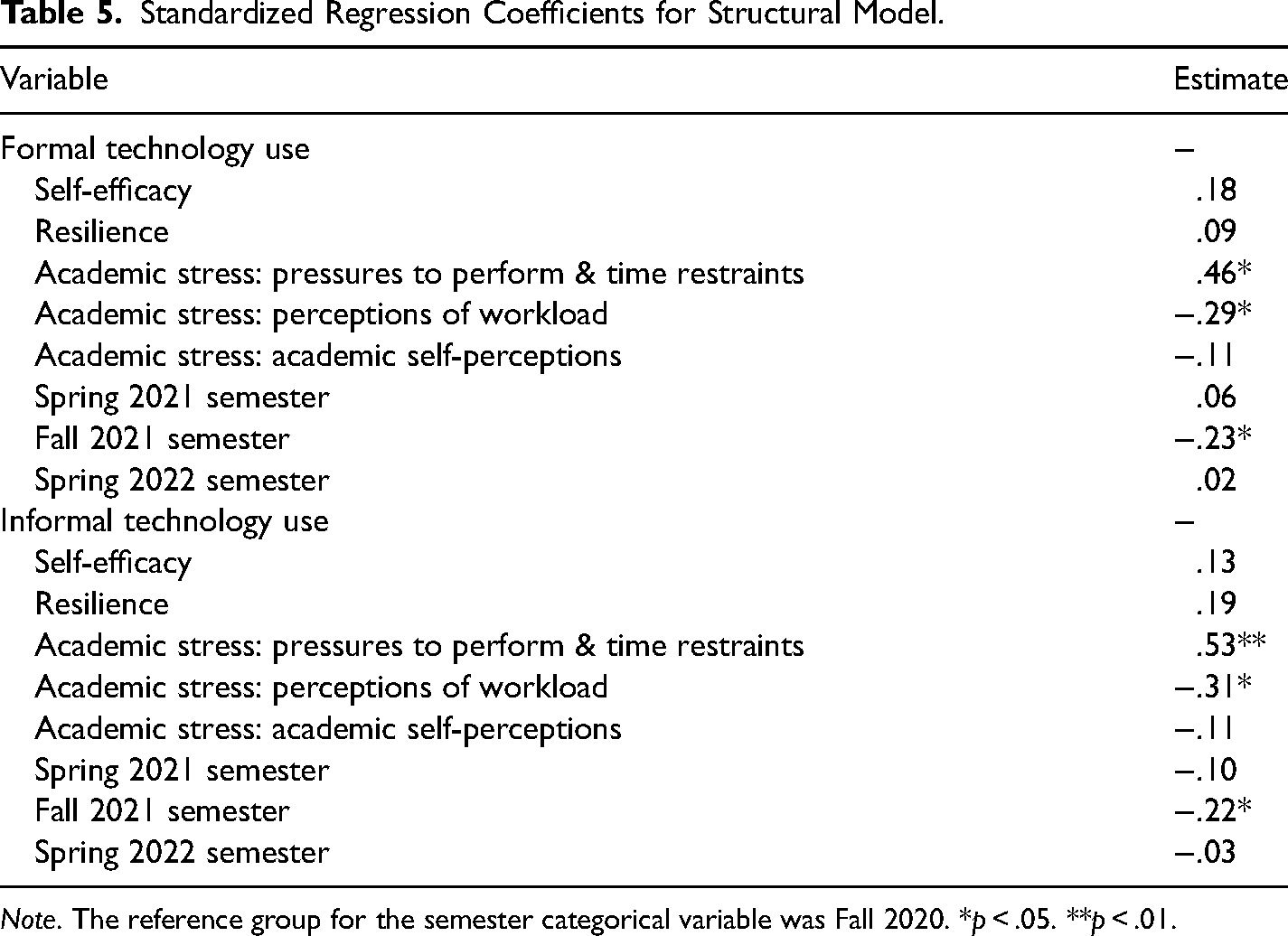
Note. The reference group for the semester categorical variable was Fall 2020. *p < .05. **p < .01.
Correlations among Factors
As might be expected, formal and informal technology use were positively correlated (r = .69, p < .001). Self-efficacy was positively correlated with resilience (r = .47, p = .002). It was negatively correlated with stress related to performance pressures and time restraints (r = −.27, p = .007) and stress related to academic self-perceptions (r = −.48, p < .001). Self-efficacy was not correlated with stress related to workload (r = −.14, p = .068). There was a negative relationship between resilience and stress related to academic self-perceptions (r = -63, p < .001) but not stress related to performance pressures and time restraints (r = −.06, p = .479) or stress related to workload (r = .07, p = .428). Unsurprisingly, stress related to performance pressures and time restraints was positively associated with stress related to workload (r = .75, p < .001) and stress related to academic self-perceptions (r = .30, p = .007). However, stress related to workload was not correlated with stress related to academic self-perceptions (r = .15, p = .105).
Inspection of modification indices indicated that model fit could be improved by a variety of changes to the measurement portion of the model. For example, allowing error covariances among items within the self-efficacy, academic stress, and resilience measures; allowing cross-loadings for some academic stress items; and allowing an error covariance among a corresponding pair of technology use self-efficacy items would have appreciably improved overall model fit. However, as our main interest was in structural relationships and due to the possibility of capitalization on chance, we did not opt to make such modifications. We present our findings with these caveats in mind, though we note that the academic stress measure might need further psychometric scrutiny.
Discussion
We found that PSTs used laptops and smartphones far more commonly than desktop and tablet devices for professional learning. With many PSTs reporting that they use smartphones, this may have implications for course design, such as selecting software programs that are responsively designed. Conversely, many PSTs may not use tablet devices for much the same reason as they do not commonly use desktop computers: tablets can perform much of the same tasks as smartphones, while desktops can perform much of the same tasks as laptops. Moreover, due to many PSTs likely not having much discretionary money, PSTs may try to rely on the technology that has become more or less essential in higher education and the workplace (e.g., laptops, smartphones).
Overall, the levels of PSTs’ use of technology were high, though technology uses for some purposes were more common than others. Technology use was common for formal professional learning tasks such as accessing course materials (e.g., readings, multi-media, library databases) and accessing specific software or apps for professional learning (e.g., Microsoft Office, iMovie, Google Docs). Technology use was also common for informal professional learning tasks such as exploring a topic related to teaching (e.g., watching YouTube videos, reading blogs, Googling a topic), locating resources related to teaching (e.g., instructional or assessment materials), and keeping up-to-date related to teaching (e.g., reading the news, following social media accounts, subscribing to online mailing lists). The evidence of relatively frequent technology use may imply that PSTs are up to the task of using technology as part of their teacher education program, including for assessments such as edTPA which do require technology skills (e.g., video editing).
Despite their overall high technology use across tasks, PSTs’ self-efficacy levels for such tasks were comparatively modest. This implies that PSTs were not especially confident in their use of technology, despite engagement in such behavior, and begs a question about how successful their uses of technology to learn might be. This was the case even for more routine uses of technology such as checking grades, receiving feedback, and communicating with instructors or peers, but especially for more informal technology uses for professional learning. In light of PSTs’ relatively lower uses and self-efficacy for informal technology use and the likelihood of a need for such once they become in-service teachers to fulfill ongoing professional learning requirements, some attention may be deserved in relation to PSTs’ informal learning practices. In particular, equipping PSTs with knowledge concerning available resources and strategies by which to evaluate their credibility may be of value.
Additionally, examining the item means on the academic stress subscales, our study found that PSTs perceived the most stress due to examination times, their teachers being critical of their academic performance, and not having enough time to relax after work. PSTs also found all items relating to their perceptions of workload to be particularly stressful: the excessive size of the curriculum and workload, the large amount of work assignments, worrying about not finding a job even if they passed the exams, and the difficulty of the examination questions. Similarly, prior research shows that PSTs suffer from a variety of academic stressors such as passing exams, meeting course requirements, completing excessive workloads, being responsible for their own learning, meeting high or unrealistic expectations, and managing their time effectively (e.g., Balakrishnan et al., 2017; Francisco et al., 2022; Geng et al., 2015; Mansfield et al., 2018; Weatherby-Fell et al., 2019). These academic stresses were particularly pertinent during the COVID-19 pandemic (Francisco et al., 2022) when our study was conducted. These variables may impede PSTs’ successful completion of their teacher preparation program and ability to start a career as a teacher after graduation. Therefore, it is intuitive that these variables would be the largest sources of PSTs’ academic stress.
Relationships among the Antecedent Psycho-Social Factors of PST Technology Use
This study also provides some evidence for the potential antecedents of PST technology use for professional learning. Although self-efficacy, resilience, and academic stress pertaining to academic self-perceptions were not associated with technology use for either formal or informal professional learning, there is evidence to suggest that other dimensions of academic stress are antecedents of PST technology use. Specifically, academic stress pertaining to PSTs’ pressures to perform and time restraints was positively associated with formal and informal technology use, while academic stress pertaining to PSTs’ perceptions of workload was negatively associated with formal and informal technology use.
Regarding the positive effect of stress pertaining to performance pressures and time restraints, elementary and secondary education are challenging majors, and it is intuitive that students will use technology more, either by choice or necessity, to learn in challenging academic environments. Moreover, similar to our finding that benefits associated with academic stress were due to performance pressures, prior research suggests that performance pressures in the form of high expectations may have positive effects. For instance, students’ math scores improved when they had teachers who held high expectations (Rubie-Davies et al., 2015). Also, when college faculty held high expectations for their students and provided feedback that encouraged more effort to meet those expectations, there were gains in students’ learning (Lundberg et al., 2018). Among PSTs, Bayrakdaroglu and Hekim (2020) found that as stress levels pertaining to parent/teacher expectations or their own expectations of themselves increased, the PSTs’ goal commitments increased. Bayrakdaroglu and Hekim (2020) speculated that higher stress levels among PSTs may be due to their desire to do and be the “best.” If PSTs’ desire to do and be their “best” may be realized, at least in part, by their use of technology for professional learning tasks, then higher stress levels would be predictive of technology use. Similarly, DeMauro and Jennings (2016) argue that PSTs’ experiences of stress may be motivational, encouraging PSTs to focus on and prepare for the upcoming obstacles they face. PSTs can prepare for some upcoming obstacles by using technology for professional learning tasks, either formally or informally.
In addition to facing stress from high expectations, PSTs also face a variety of other academic stressors, including that of excessive and overwhelming workloads (Balakrishnan et al., 2017; Francisco et al., 2022; Geng et al., 2015). This dimension of academic stress may hinder PSTs’ academic performance in their teacher preparation program and, later, their professional performance as in-service teachers (Francisco et al., 2022). It is also important to consider how workload might include non-course expectations such as clinical experiences that do not involve technology use or that excessive workload is overwhelming to PSTs and thus undermines engagement in other learning processes. Thus, it is reasonable that PSTs’ workload stress will impede their formal and informal technology use for professional learning tasks.
Furthermore, our findings offer some theoretical insights as to the relations among other key constructs as they pertain to PSTs. Self-efficacy was negatively related to two of the three dimensions of academic stress, that is, stress related to performance pressures and time restraints and stress related to academic self-perceptions. Similarly, PSTs in computer and technology studies who were more stressed (Bayrakdaroglu & Hekim, 2020) demonstrated less self-efficacy in classroom management (Klassen & Chiu, 2011). Indeed, according to Bandura (1997), those with low self-efficacy typically manage their stress poorly.
We also found that self-efficacy was positively related to resilience. Similarly, Yada and colleagues (2021) found that PSTs’ self-efficacy and resilience were positively associated, at least in terms of implementing inclusive practices in their instruction. In addition, we found a negative relationship between resilience and stress related to academic self-perceptions. Likewise, previous literature has reported that resilience was negatively related to teachers’ stress (Evers et al., 2002; Howard & Johnson, 2004; Kyriacou, 2011; Skaalvik & Skaalvik, 2010; Yu et al., 2015). Teachers who developed higher levels of resilience were less emotionally exhausted and had a higher level of work satisfaction and positive interactions with others which were associated with lower stress levels (Richards et al., 2013, 2016). Richards and colleagues (2016) further suggested that teachers’ resilience can predict their resistance to stress, help elementary and secondary teachers avoid negative consequences associated with workplace stress, and assist them in better coping with stressors that they experience. In turn, Olivier and Venter (2003) emphasized that promoting resilience during teacher preparation programs may help novice teachers to better manage their stressors.
Teacher preparation programs might consider incorporating online modules into their programs that are intended to promote PSTs’ resilience and self-efficacy while diminishing their stress. For instance, programs might employ Mansfield and colleagues’ (2020) BRiTE modules. Throughout these online modules, PSTs learn about their existing resilience strengths via quizzes and reflection questions, demonstrate how resilience can be applied to various teaching situations via reflection questions and interactive activities, and develop a personalized toolkit of resilience resources that they can use throughout the remainder of their teacher preparation program as well as in their future classrooms (Mansfield et al., 2020). Additionally, by ensuring that this is a successful online learning experience for PSTs, PSTs’ self-efficacy for using technology for both formal and informal professional learning might be enhanced. Finally, with improved self-efficacy and strategies for being resilient, PSTs might also gain coping mechanisms that help reduce stress (Mansfield et al., 2020).
Limitations
Our findings must be interpreted in light of the limitations of the study itself. Having statistically accounted for the semester in the model, we can rule out the possibility that these observations are due to differential representation of this population across semesters which might have varied with respect to instructional mode. However, these findings may be due to confounding with other variables, especially those associated with the COVID-19 pandemic. Given that the data were collected during COVID-19, our estimates of technology use may be higher than is typical (i.e., history threat). On the other hand, it is unclear whether the relative magnitudes of the relationship estimates would differ if data were collected at another time. Due to data limitations we were, however, unable to account for institution or program-level differences in technology use for professional learning.
Similarly, because academic stress may have been especially high when we conducted our study during the COVID-19 pandemic, our findings might be different now, years after the nearly worldwide shift to emergency remote teaching at the onset of the pandemic. For instance, PSTs’ academic stress might be lower. Also, after the implementation of emergency remote teaching, where everyone was suddenly forced to use technology for nearly every aspect of their lives, PSTs’ resilience and self-efficacy for formal and informal technology use may be higher. However, these benefits might now be juxtaposed against potentially increased negative attitudes toward the use of technology for learning purposes because of the low quality online instruction that occurred during the emergency remote teaching.
Another limitation may be related to statistical power; indeed, our model was underpowered for small effects. However, we are confident that both academic stress pertaining to performance pressures and time restraints as well as academic stress pertaining to perceptions of workload matter for both formal and informal technology use in a practically meaningful way. During the COVID-19 pandemic, excessive workload stress may have been a particular barrier to PSTs’ engagement in both formal and informal learning opportunities. A third limitation may be related to the instrument that we used for the academic stress variable. Although our sample size was not particularly large for complex statistical models, we found evidence of correlated errors and cross-loadings on the PASS measure from the modification indices suggested for our structural equation model. Also, an exploratory factor analysis revealed some concerns with the factor structure of the PASS. As such, due to our sample size constraints, future research should further examine the psychometric properties of the PASS for use among PSTs. Finally, while our study's sampling design was non-probabilistic, it is notable that the sample distributions of gender and race were broadly similar to those of the U.S. teacher population (Taie & Lewis, 2022).
Future Directions
Knowing the nature of PSTs’ formal and informal technology use for professional learning tasks, future research should explore interventions designed to increase PSTs’ use of technology for these purposes. Additionally, due to our finding that PSTs were not even highly self-efficacious for the technology uses that they engaged in frequently, much less for the technology uses that they engaged in less frequently, interventions should be designed to increase either PSTs’ resilience or self-efficacy for both their formal and informal technology use for professional learning. This is increasingly important as teacher preparation programs and the teaching profession continue to increase their reliance on technology. If interventions can effectively increase PSTs’ resilience, then PSTs’ perceptions of academic stress may decrease while their self-efficacy for formal and informal technology use may increase. Alternatively, if interventions can effectively increase PSTs’ self-efficacy, then PSTs’ perceptions of academic stress may similarly decrease while their resilience improves. In turn, this may facilitate PSTs’ success not only in their teacher preparation programs and clinical experiences but also as they transition into the role of in-service teachers. For instance, according to Koehler & Mishra's (2009) TPACK framework, PSTs who receive an integrated knowledge of technology, teaching, and content tend to demonstrate greater self-efficacy which is associated with their intentions to use technology (Joo et al., 2018). Therefore, PSTs’ experiences with technology is likely connected to whether or not they employ technology-informed pedagogies once they become in-service teachers, making it imperative to increase PSTs’ use of technology throughout their teacher preparation programs.
Footnotes
Consent to Participate
All participants provided informed consent via Qualtrics for study participation.
Consent for Publication
Not applicable.
Data Availability
Data are available upon request.
Declaration of Conflicting Interests
The authors declared no potential conflicts of interest with respect to the research, authorship, and/or publication of this article.
Ethical Considerations
This study (protocol approval # HS21-0154) received Institutional Review Board (IRB) approval from the Office of Research Compliance, Integrity, and Safety at Northern Illinois University.
Funding
The authors received no financial support for the research, authorship, and/or publication of this article.

Notes
Author Biographies
Dr.
Dr.
Dr.