







Abstract
This article follows the experience of Polish writers in the first decade of communism. Although the Red Army had pushed the Nazis out of Poland, for almost all Poles communist rule brought pain and confusion. For several years the Resistance waged a war against the incoming communists. Poles connected to the London Government in Exile and the AK (Home Army) faced arrest and imprisonment; those who had spent the war abroad had to decide whether or not to return; those who had spent the war in the USSR had an intimate knowledge of what Soviet communism was capable but little choice other than to accept the ‘new reality’. For Polish writers, who were by tradition social and political leaders, the Party was something of a rival, but one with which they shared certain aims. Their decision eventually resolved itself into one question: how far should they compromise in order to write and survive?
In 1944–5 the incoming communist ‘Lublin Poles’ wanted to win over cultural and creative circles and through them to neutralize hostility to communism. However, while culture, literature and the arts appeared in the National Liberation Manifesto, these topics had not figured much in any actual planning, and given the degree of destruction and the massive displacement of population Poland had experienced, there were more pressing issues. The communists were also seriously distracted by the civil war that followed the defeat of Nazism, and which did not finish until 1947 (1955 in some parts of Poland). Consequently, while reconstruction and the restructuring of Polish society in general began at once, it was to be 1949 before the communists turned their attention to reconfiguring the Polish artistic and literary worlds. So for the most part the period 1944–9 was a ‘honeymoon’ in which creative intellectuals of all kinds continued their pre-war modes of operation.
In 1945 under the guidance of Jerzy Borejsza (nominally president of the Czytelnik publishing cooperative, but in fact a much more powerful figure), the Party set the agenda for the Kraków conference of the ZZLP (the as yet unreformed pre-war Union of Professional Polish Writers), where the major topic for discussion was the question: ‘Was the Second World War an ideological watershed?’ The choice of topic was not likely to offend anyone and, if anything, actually encouraged debate. Union chairman Julian Przyboś, a fanatical avant-gardist who, while reluctant to support official cultural policies, was desperate to modernize Poland, advised writers not to look back to established Polish literary forms, but to look to the USSR, which, he said, had the most progressive literary avant-garde in the world. Przyboś chose to overlook the fact that Stalin had killed off the Soviet literary avant-garde a decade earlier to replace it with a more conformist generation that now largely followed the precepts of socialist realism. In 1945 the Party also created the literary magazine Kuźnica (The Forge) in an attempt to create a clear link for the inteligencja between the ideas of the Polish Enlightenment and the socialist ‘camp of reform’. The magazine was to be the communist-Positivist flagship, devoted to fighting reactionary clericism, misplaced szlachta idealism and outdated Sarmatian-style patriotism. The appearance of the liberal, left-leaning weekly literary magazine Odrodzenie (Rebirth, published first in Lublin, then in Kraków, and from March 1947 in Warsaw) was also seen as auguring well for artistic circles.
Catholic writers and the older writers were certain to resist any form of coercion, so while the Party tried to bully the Church, it did not push writers too hard. In any case the Party wished to enlist influential Catholics to its side without necessarily enrolling them in the Party. In 1945, in an effort to subvert the authority of the Church, Jakub Berman (who, together with Bolesław Bierut and Hilary Minc, formed the triumvirate of Stalinist leaders in post-war Poland) set up Pax, under the ex-fascist Bolesław Piasecki. Piasecki had made a deal with the NKVD to get out of jail and Pax was a Party-led ‘Catholic’ front organization, designed to split Catholic opposition to communism: it ran a substantial publishing operation, making use of younger writers and Catholics who were prepared to ‘cooperate’ with the new order. While on the face of it Pax seemed to enable ‘open discussion’, as a ‘front’ organization led and run by the regime, it was quite capable of declaring its loyalty by condemning oppositional Catholics like Cardinal Hłond and Bishop Kaczmarek. The empire Piasecki built up over the next few years included several newspapers like Dzis i Jutro (Today and Tomorrow), Kierunki (Directions), Więz (Link) and Słowo Powszechne (Universal Word) and had a monopoly on the manufacture and import of Catholic items, including wine for the celebration of mass. Pax was one of the few publishing operations to have access to ‘hard’ currency with which to pay the foreign writers it decided to publish. Pax operated virtually without taxation and employed several of Piasecki’s cronies from his pre-war days as a fascist leader: it made him one of the richest men in the Eastern bloc (Blit, 1965; Torańska, 1987: 270).
The government of 1947 allocated, along with the Ministries of Forests, Post and Telegraph, Agriculture and Agricultural Reform, the post of Minister of Culture to the PSL (Peasant Party), and while the appearance of liberal opinion was maintained by these allocations, in fact this Ministry was much less important than the Party-approved post of Deputy Minister or Secretary of State. As far as writers, intellectuals and artists were concerned, the Party was still anxious to appear as a benevolent dictatorship engaged in a łagodna rewolucja (gentle revolution), though in every other sphere of activity it was busy criminalizing, brutalizing and repressing all opposition: the Party slandered the AK (Armia Krajowa, the London-backed National Army) and emphasized the role of the tiny wartime AL (Armia Ludowa, People’s Army, communist resistance). Occasionally these two policies collided. For example, the SB (Security Service) arrested historian Adam Borkiewicz and his wife, and seized all his documents in an attempt to prevent him writing an account of the Warsaw Uprising that did not disparage the AK (Kochanski, 2013: 584).
In spite of the civil war, the ‘battle for trade’ (class war) and the beginnings of agricultural reform (collectivization), in the years 1944–8 there was a great deal of give and take within the literary–political fraternity. Meetings and discussions between opposing political factions within the writing community seem to have passed off without rancour or violence, and the Party attempted to swing this generosity of spirit and interest in resolving the social issues interrupted by the war around to its own ends by focusing writers’ attention on the experience of war rather than the ideological difficulties it left behind. In general writers had a great deal of experience to ‘process’ both culturally and individually and there are signs that this ‘softly-softly’ policy worked for a while: among several other publications, Czesław Milsoz’s Ocalenia (Salvation, 1946), Jerzy Putrament’s Rzeczywistość (Reality, 1947), Jerzy Andrejewski’s Popiól i diament (Ashes and Diamonds, 1947), Jerzy Pzyboś’s Poezje Wybrane (Selected Poetry, 1948), Tadeusz Breza’s Mury Jerycha (Walls of Jericho, 1949), and a little later Zofia Nalkowska’s Medaliony (Medallions, 1958), the normal practice of writers like Paweł Hertz and Mieczysław Jastrun, and the critical essays of Jan Kott, Adam Ważyk and Stefan Żółkiewski, while they clearly clung to a pluralistic worldview, showed a willingness to accommodate the regime on some level and perhaps even to work with it. The office of the censor, which was still in its infancy, at this point only intervened on clearly defined issues and on specifically forbidden topics. Even so, the younger writers beginning their writing careers just after the war – Tadeusz Borowski, Roman Bratny, Andrzej Braun, Bohdan Czeszko, Tadeusz Konwicki, Grzegorz Lasota, Andrzej Mandalian, Witold Wirpsza and Wiktor Woroszylski (dubbed pryszczaci, ‘the pimplies’, by Tadeusz Borowski), who were at first more easily influenced in favour of the Party, along with pre-war writers and the more traditional ‘Catholic writers’, soon became isolated from the bulk of the ZZLP membership, who were not Party members, not particularly interested in the Party’s idea of literary fashion, nor very active Catholics.
At first the Party engaged in gently wooing and reassuring Polish intellectuals, but the Party’s long-term plan in cultural matters was crystallizing. Paczkowski, for example, quotes a Ministry of Education text for internal circulation dating from the end of 1945 which, although it refers specifically to university professors, might well be taken as the cynical blueprint for the regime’s treatment of the intellectual strata as a whole: Tired and hungry, the mass of university professors can be rallied to our side if we show concern for their material well-being; individually, each professor can be bought if we show concern for the material needs of his workplace, because they all have a fixation where their work is concerned. (Paczkowski, 2003: 255)
At the Party Plenum in April 1947, Władysław Bieńkowski, referring mainly to education and the universities, summed up the general problem and the Party strategy: Although there is undoubtedly a large percentage of people linked to reaction, the overwhelming majority of that intellectual elite is utilizable. That however demands great effort from our side. We must begin to organize culture and science. These people must feel that we need them and this will bind them to us even more strongly, even though until now they have not felt this way. The issue of the forms through which we will exert influence organizationally while maintaining for ourselves alone the managing and controlling positions, is one of the leading problems. (Kersten, 1991: 381)
While the Party never did manage to gain control of the Polish universities in quite the way it wanted, nevertheless, the general strategy for dealing with intellectuals is clear (Connelly, 2000).
However gently it treated the writers at first, the Party was intent on change. In late 1946 the Party replaced its slogans of reconstruction with a new slogan: ‘Transformation in a democratic spirit.’ At a meeting of representatives of the various Eastern bloc communist parties at Szklarska Poręba in September 1947 Andrei Zhdanov said that in future a pluralistic worldview was to be eliminated and that the People’s Democracies must now separate themselves from the influence of the West. This signalled a shift from tolerance to hostility; and for Poles it signalled a shift from the problems of survival to the business of reshaping Polish society and mentality. In the summer of 1947 the first signs of a hardening of attitudes began to appear. The Polish Central Committee drew up a list of ‘themes to be addressed in creative activity’, which were to be given priority by all publishing concerns and cultural institutions. In October 1947, as part of the build-up to the next writers’ conference, and possibly responding to accounts of the meeting in Szklarska Poręba, the writer Jerzy Putrament declared at a ZLP meeting that the Party planned to undertake ‘a systematic campaign to inoculate our work against the rotten influences of European capitalist backwardness’, and that this would ‘counteract the penetration of capitalist mentality’. He was in favour of limiting imports of British and American films, books and newspapers, and he wanted to limit the activities of the British Council and English-language study in schools and universities. He also wanted to eliminate private publishing and to develop a stricter system of censorship.
First Secretary Bolesław Bierut gave the first public indication of this new line when opening a Wrocław radio station on 16 November 1947, during the Wrocław ZZLP (Professional Union of Polish Writers) Congress. He complained that artists of all kinds were lagging behind the ‘mighty current’ of political and economic change. He said he looked to artists to ‘popularize and socialize cultural production in all its fields and manifestations’ and said he expected writers ‘to shape the culture of the entire nation for a new period in its history’: Artistic and cultural creativity should be a reflection of the great turning point the nation is experiencing – it should be, although it is not yet. It is not because it clearly lags behind the rapid mighty current of life today … What are scholars writing about, what are theatres and cinemas showing, what are national poets writing, what tone, what mood do writers’ works awaken? Do we often find in them the joy of liberation, enthusiasm for work, belief in the productivity of action? Such requirements, after all, are demanded of authors today by the highest social and national need … In the field of cultural creativity the same interdependence should exist between the individual and society as in the field of creativity of material goods. Not only does the author shape the culture of the nation but the nation must shape the authors of its culture by recognizing or by rejecting their works, by criticism or by distinction. (Kersten, 1991: 416)
He made it clear this was a ‘cultural revolution’ and that ‘work to a plan’ was necessary along the ‘entire cultural front’. He called for an ‘artistic offensive’ to create the ‘culture of a people’s democracy’. In effect, as if Jerzy Putrament’s comments had not been warning enough, this signalled that a direct attempt to control writers through their agencies, organizations, income and outlets was on the way.
Shortly after this the Party held its first Congress in 1947 and Jakub Berman was appointed a member of the Politburo, the Secretariat of the Central Committee and the Central Committee’s Organizational Bureau. Jerzy Borejsza, working under Berman, was now director of several major state publishing concerns and secretary-general of the 1948 Wrocław Congress of Intellectuals, which invited 500 foreign intellectuals from 45 countries to see the changes being wrought. Although the Party still did not interfere directly with the ZZLP, nevertheless the Party believed, probably because Stalin said so, that writers were the ‘engineers of human souls’ (Westerman, 2011: 32–4). As such, writers would be of enormous use in ideological legitimation, rather than in purely literary tasks. The Party desperately needed writers and intellectuals. It had no capacity to ‘buy’ the nation, but there was a possibility that if it showed them some respect, the Party could buy some writers and, through manipulation of professional issues, persuade others to acquiesce.
The Party and the writing community had a shared interest in culture and enlightenment. The Polish inteligencja and the Party both felt that their concerns were made more urgent by the post-war growth of industry and cities, the movement from the countryside into the cities and the poor standards of education. In spite of the economic problems, from the very first the communists put money into public libraries and stepped up publishing. Libraries, festivals, cinemas and theatres all increased in number, and in a country where 1.5 million (18 per cent of the population) were unable to read, the government initiated a school reform and then in 1951 a mass literacy campaign (Pasiebiński, 1960). In addition education at a primary, secondary and tertiary level began to expand at a rate previously unseen in Poland. All of the changes brought about by the interim government benefited writers – indeed for those writers who had started their careers before the war, the improvement to their material conditions in terms of publishing deals, the growing number of readers, the number of books printed and revenues derived was substantial. It was hard for a writer to question these developments without appearing mealy-mouthed. In these years several writers – Tuwim, Broniewski, Nałkowska, Dąbrawska – suspended their disbelief, set aside their experience of the USSR and cooperated with the Party in the hope that a new Poland could be built from the wreckage of the war. Others were prepared to go further: Julian Przybuś, Jerzy Andrzejewski, Mieczysław Jastrun, Tadeusz Konwicki and Kazimierz Brandys either joined the Party or became fellow travellers. Czesław Miłosz, who had been connected to the London-backed AK wartime resistance, and Stanislaw Jerzy Lec, who had been associated with the communist AL resistance movement, both joined the Polish Diplomatic Corps and took up posts abroad. Many of the younger generation of writers joined the Party with considerable initial enthusiasm.
Joining the Party in 1949 or 1950 was not unusual and did not necessarily indicate some deficiency of character: it could be construed as a legitimate desire to join in rebuilding the devastated country and in reshaping Polish society. For Konwicki, for example, joining the Party had initially been an attempt to restore balance and direction to his life, but he soon came to understand that he was in fact merely aiding the destruction of morality and a sense of an inner life. He was later to stress repeatedly that neither fighting with the AK nor joining the Party fulfilled his dreams and aspirations: he had first witnessed the destruction of his material world in the war, then the steady demolition of his moral world by the Party. As Stanisław Balbus, criticizing Kazimierz Brandys for his naivety was later to say of writers at that time: Almost everybody was a member of the Party. There were even a few who weren’t in the Party, but submissively carried out its recommendations. There were not many who refused to cooperate. But there were a few. And at that time it was very obvious who they were … However, the borderline between the ‘disgraced’ and those who saved face does not follow the same course as the border between a Party member and a non-member, and in general was more obscure. (Michajłów and Pacławski, 1991: 40)
However, given that even in the early days the Party’s wooing of writers and intellectuals took place against a background of mendacity and great brutality, we have to ask: How much did these writers know and understand about the ‘new reality’ and how much were they prepared to compromise their principles? It has been estimated that in addition to those arrested by the NKVD or by the Polish authorities for armed resistance, by the end of 1948 around 100,000–150,000 people had been imprisoned for legal oppositional activities sanctioned by the Yalta Agreement. In Glos Ludu (Voice of the People) the names of those sentenced to death were announced at the rate of about 100 per month (Torańska, 1987: 272). In this context, and perhaps predictably, Stefan Staszewski (a leading Party propagandist and head of the Party press section) claimed that the writer Jerzy Andrzejewski, for example, knew exactly what he was doing: Here was, to put it bluntly, this intellectual, this humanist, this Catholic, and you mean to tell me he didn’t know what he was doing? He came to us of his own free will; no one forced him, no one pressured him and he joined the Party not because someone was urging him to but because he accepted the Party’s programme and principles. And not only did he join it: he wanted to play an active role in it. He wanted to justify the Party’s principles and persuade others that the Party was right. I don’t know how you interpret his Ashes and Diamonds after all these years, but it’s a novel whose function, if you’ll forgive me, was among other things to bring the nation round to this regime and show that there was shooting on both sides, and that Maciek was a victim of accident and misunderstanding. Whom does Andrzejewski justify, who does he think was right, historically right, in this novel? Maciek? No, Szczuka: a communist. No one asked Andrzejewski to do that. (Torańska, 1987: 131)
Culture, literature and the arts avoided the worst of the developing conflict until the summer of 1948 when Moscow determined the nature of change and forced a faster rate on the Polish communists. In the summer of 1948, as Stalin grew tired of his satellites’ slow progress towards the Soviet model, and Yugoslavia broke away from his control, the Soviet Communist Party increased its demands for sovietization and called for increased ‘proletarian discipline’ and loyalty to Stalin from its satellites. At its meeting in June 1948, the Cominform developed the broad outline of a four-point policy for the People’s Democracies: ‘The working class Party in power must alone decide the destinies of the countries’; ‘total suppression of the vestiges of capitalism … collectivization of agriculture … mass investment in heavy industry’; ‘no human activities are to be isolated from the political process and no person can be considered politically neutral’; ‘the Soviet Union … constitutes the valid model for all the People’s Democracies, including all that concerns the elaboration of the doctrine and its practical application’ (Karol, 1959: 118). The Polish delegates Berman and Zawadzki objected to collectivization, but in the end had no choice but to agree to the new line. Party propagandist Stefan Staszewski was later to say that the imposition of socrealizm was not chosen by anyone in the Polish leadership, but was ‘an element in the politics of the entire bloc, and that was something you couldn’t question’ (Torańska, 1987: 141). Up to this point many Polish communists doubted that it was possible or even wise to copy all aspects of the Soviet system and felt sympathy with the Yugoslavs. However, with the post-war western Polish borders still unrecognized, the Party felt it had little choice but to bend to the Moscow line. Moscow, after all, was the only guarantor of the new Poland. The Party went over to the attack in cultural matters.
The policies of the Party up to this point had been directed, with some success, at obtaining intellectual support for their programme, but now began to develop into a contradictory combination of mistrust of the writers’ individualism and independence, disgust at writers’ ingratitude, rewards to those who went along with the Party line, and coercion, censorship and isolation for those who proved unreliable or less tractable. This was made very clear to delegates at the Wrocław Congress of Intellectuals in August 1948, when Alexander Fadeyev, the hostile chair of the Soviet delegation, filling in for Andrei Zhdanov, described Jean-Paul Sartre, who was in the audience, as a ‘hyena armed with a fountain pen’, and went on to declare: ‘If hyenas knew how to use a fountain pen and jackals could type, they would write like T. S. Eliot’ (Paczkowski, 2003: 195, 257–8). Foreign intellectuals could and did walk out at this, but Polish delegates felt obliged to sit and listen.
In the autumn of 1945 the writers at their first post-war conference in Kraków had agreed to address the issue: ‘Did the war represent an ideological watershed?’ By the time the ZZLP assembled for their fourth congress in Szczecin in January 1949, this question was no longer relevant: political pressure on the Writer’s Union was obvious and unavoidable. There the Party members characterized contemporary Polish literature as bourgeois reactionary art, ‘the philosophy of catastrophism, helplessness, mysticism and irrationalism’ (Trybuna Ludu, 20 January 1949). Writers did not formally adopt socrealizm in the 1949 Congress resolutions, but that hardly mattered. Berman, writing in Odrodzenie and in Kuźnica announced that socrealizm was ‘a genuinely revolutionary leap … a revelatory creative methodology’ and he announced that the Party would defend it – come what may. Socrealizm figured largely in the programmatic writings of Minister for the Arts, Włodzimierz Sokorski, and also in the writings of critic Stefan Żołkiewswki. Through these people the Party made it clear that it now planned to create ‘a new cultural tradition’ that would broadly follow developments already taking place in the USSR, where since 1946 avant-gardism had been abandoned and production-line ‘socialist realism’ was the artistic norm.
The project of controlling writers fell largely to Jakub Berman. Berman had spent the war in the USSR and was the main force behind the Party’s ideological programme. Although Berman was a member of the Polish Politburo, nominally his most powerful office was only that of under-secretary in the Council of Ministers. However, by this time he was charged with a staggering range of responsibilities and oversaw ideology, education, foreign affairs, security, culture, propaganda, security and foreign affairs. In March 1949 the Soviet Foreign Ministry’s European Department, paranoid about the power of a reactionary bourgeoisie, drew up a list of helpful suggestions to improve Soviet influence on the cultural life of East Central European states (Applebaum, 2013: 76, 358). In response, in May 1949 Berman signalled his understanding of the situation when he addressed a Party conference on cultural affairs and said: We must inspire disgust for art which is laden with formalist cynicism and lack of ideals. For decadent capitalist art, for American cosmopolitanism; we must be passionate and ruthless in combating fascist trends; we must above all combat reactionary Catholic trends. (Torańska, 1987: 291)
He made it clear that he had decided to ‘use every conceivable means’ to influence Polish writers because it was ‘especially important to us to enlist the cultural circles on our side’. Under Berman’s guidance it became Party policy to foster, support and publish socrealizm in a Polish variant in all the arts. As if to confirm the new line, the final Kraków issue of Twórczość in December 1949 carried an 18-page poem in praise of Stalin. That same week the collected works of Joseph Stalin were published in Polish, and the journal Nowa Kultura began a series of articles on Marxist theory and the arts. As part of this strategy Berman supervised the restructuring of the Writers’ Union and instructed Leon Kruczkowski, the union chairman, to prepare a ‘production plan’ by which the union would do its part to fulfil the state’s cultural policies and literature would become part of the new Six-Year Plan.
In July 1949 Berman summarized proceedings at the Party Plenum, saying that the Party was now ready to begin the ‘ideological and cultural offensive’ which up to now it had been unable to deliver. Now it was ready to combat the ‘rotten liberalism’ that had ‘held sway among Poles for so long and done so much damage’. He went on to say that the Party had already achieved considerable success in the area of culture and that the ‘new reality’ was ‘penetrating the consciousness of the inteligencja, the writers’. While he looked forward to liberating new creative forces, this could only be done through the Party’s leadership in the offensive (Kersten, 1991: 447–8). Later that same month the Central Publishing Commission was established and the print and press industries were ‘rationalized’: the number of newspapers was reduced from 107 to 34 and the number of periodicals from 745 to 592. At the same time publishing was also ‘rationalized’. By the early 1950s about 40–50 per cent of all belles lettres was published by the Czytelnik and Książka i Wiedza publishing houses, and all books were distributed by the monopoly DKS (Dom Książki Spółdzielnia, Home of Books Cooperative). As a result the increase in the number of new books suddenly slowed, though there was an increase in the size of print runs as publishers struggled to meet targets. While in 1949 privately printed books still counted for about 25 per cent of the market (a reduction from about 40 per cent in 1947), the virtual abolition of privately owned publishing firms reduced this to 8 per cent within a year. Between 1944 and 1955 the number of translations from Russian suddenly rose by about 300 per cent to 6524 titles in 108,090 copies, of which 2257 titles were belles lettres in 49,701 copies; at the same time translations from English and American authors tailed off rapidly to give a decade total of 680 titles in 17,145 copies (Ruch wydawniczy, 1989: table 47; Paczkowski, 2003: 259–60).
In 1950 Berman closed down the rather liberal journals and magazines that had come to life at the end of the war. He moved the monthly magazine Twórczość (Creativity), which had been edited by Kazimierz Wyka who was not particularly sympathetic to socrealizm, from Kraków to Warsaw, where under the leadership of Adam Ważyk it was handed over to the ZLP. The literary journal Kuźnica had pushed the Party line on socrealizm, but it had not done so exclusively or dogmatically. This clearly did not go far enough: Berman ‘amalgamated’ Kuźnica with Odrodzenie (Rebirth) to form the new weekly Nowa Kultura (New Culture): ‘one journal, with a line better adapted to the times’, edited by Paweł Hoffman, head of the Culture Department of the Central Committee (Torańska, 1987: 269–70). Berman’s desire to better control and direct these magazines is clear.
Berman’s idea was that Polish writers should adopt Soviet literary models, creating a literature of socialism not as it was in reality but as it should have been. Broadly speaking his aims were that writing should now express solidarity with the USSR, display a pleasing sense of class-awareness or teach an unchallenging, folksy sense of national identity. The Party looked to see strong, inspirational heroes in an educational role, who were, preferably, Party members, working though plots that accepted ‘the new situation’ and looked to build a socialist future. There were variations to this basic plot, but the hero was always an idealist with strong communist convictions. Though a kind, quiet thoughtful man, shown reading Krótki kurs historii WKP(b) (Short Course on the History of the Communist Party of the Soviet Union – Bolsheviks) and Stalin’s Zagadnienia leninizmu (Questions of Leninism), he dreamed of playing his own small part in the eventual victory of communism and he was not afraid to make speeches at significant moments. At the end of a socrealizm novel his efforts were rewarded, he found recognition and, if he was a bachelor, he often found a true (socialist) love. His opponent, however, was not only a political and possibly romantic rival, but usually a member of a hostile social class like the bourgeoisie, if not then a fully-fledged enemy of the people, a pre-war police officer, a factory owner or a functionary of the pre-war Sanacja regime, possibly even a spy for the USA, UK, West Germany or France. He detested communism, hated the workers and was generally an all-round nasty piece of work, prepared to sabotage the economy – possibly by spreading Colorado beetle – and by conspiring against the hero. Usually at the end of the novel the villain is unmasked, shamed and then either reformed or imprisoned. The Czech writer Josef Skvorecky, who experienced a very similar situation, was to outline the typical socrealizm novel thus: It invariably features a factory (or collective farm) Manager, and the beautiful local School teacher (or Doctor). A gang of hard drinking Workers, infiltrated by CIA Agents, is stealing material from the factory or farm. The incompetent local Chairman of the town council is helpless. A Secretary appears, first at the Railway Station, then in the Party Secretariat. He turns out to have been sent from Prague (or Moscow, or Warsaw, or Sofia). He sees the School teacher (or Doctor), and offers help. He uncovers the Agents, reforms the Working-class alcoholics, and thus ensures the fulfilment of the Production Quotas. However, the School teacher (or Doctor) then reveals to the Secretary that she is engaged to the Young Shock-worker in the factory (or on the Farm). The Secretary leaves first the Secretariat, then the county. He is last seen at the railway station. (Skvorecky, 1984: 161–2)
The resemblance to the US cowboy novels of the 1930s 40s and 50s is unavoidable. However, in Poland the national form these things were to take was deeply problematic. Partyność (Party-mindedness) was not so difficult to demonstrate or even to fake, but narodność (national awareness), an uncomfortable importation of the Russian narodnost’ and highly ambiguous in Polish, was to prove a real sticking point for many writers – particularly those with inteligencja backgrounds – since the Romantic literary tradition underlying Polish identity and nationality, formed during the years of Partition, were often vehemently and intractably opposed to any form of Russian power or influence over Poland (Kołakowski, 1971: 176–7).
Some writers, like Gałczyński, had no problem accepting the idea of writing to ‘social command’ and among the many works of socrealizm to appear were, most notably perhaps: Kazimierz Brandys’ Troja, miasta otwarte (Troy, Open City, 1949) and Obywatele (Citizens, 1954), Igor Newerly’s Pamiątka z celulozy (Memoirs of Cellulose, 1952), W. Mach’s Jaworowy dom (Plane-Tree House, 1954), A. Scibor-Rylski’s Węgiel (Coal, 1954), M. Kowalewski’s Kampania znaczy walka (Campaign Means Struggle, 1950) and Marian Brandys’ Początek opowieści (The Beginning of a Story). After 1949, as portrait painters, concert pianists, poets and novelists began to appear in factories, coalmines and shipyards, literary magazines began to publish a steady stream of translations from Soviet socrealizm alongside Polish socrealizm: poems about the victorious Red Army, Polish–Soviet friendship, the Polish People’s Army, hymns to the security services, to the joys of the new People’s Constitution, to the sons of labour, to individual war heroes, Stakhanovite workers in the new industrial centres, hymns in praise of the new communist industrial city of Nowa Huta, poems urging the realization of the latest economic plan, strategy or initiative, odes praising Stalin. And of course there were poems denouncing Truman, Churchill, Tito and Western generals like Ridgeway and MacArthur.
The ‘new reality’ proved to be an invitation to professional writers to make fools of themselves. In 1949, for example, Władysław Broniewski, who had been a loyal fellow traveller before the war, but had been arrested and imprisoned by the NKVD, set aside the memory of his suffering to write the ode, ‘A Word About Stalin’: ‘Glory to the name of Stalin, bringer of peace to the world, peace’. In that poem he also said Stalin was the engine driver of ‘history’s train’. Adam Ważyk wrote a poem called ‘The River’ in which he claimed that Stalin’s wisdom was like a great river circling the Earth, uniting all people and bringing peace and joy. Marian Brandys, older brother of Kazimierz Brandys, had made his debut with a novel called Początek opowieści (The Beginning of the Story, 1949), about the origins of the new industrial city of Nowa Huta. Janina Dziarnowska also produced a novel about Nowa Huta entitled Jesteśmy z Nowej Huty (We Are From Nowa Huta, 1951). These were very quickly dubbed ‘factory literature’. The newspapers and literary journals were filled with examples of the new style to celebrate Stalin’s seventieth birthday, and it was grasped with enthusiasm by the younger generation of Polish writers who had grown up during and after the war. In 1950, for example, the young Sławomir Mrożek, then working as part of a construction brigade in Nowa Huta, penned a poem in praise of Piotr Ożanski, the Stakhanovite bricklayer who had just laid 34,728 bricks in an eight-hour shift, ‘storming the norm’ by 525.6 per cent (Lebow, 2013: 74). In general, though, socrealizm was not a particular literary form, a specific set of rhetorical devices or even a distinct literary style: more than anything it was a mind-set that was simply ‘realistic’ in accepting ‘socialism’. In future the Party’s cultural line would be dictated by Moscow but driven by the central plan, production targets and ideology of the developing Cold War.
In practice Berman simply strangled the writers by forcing publishing houses and editors to refuse almost everything that did not conform to the precepts of socrealizm by identifying openly with the aims of the Party. Some tried the style and found it to be simplistic and unsatisfying. Many simply declined any ‘social commission’. Some writers, like Przyboś and Mieczysław Jastrun, found they could not easily bend their work to the new system. And a few just refused to have anything to do with it right from the start. Zbigniew Herbert, who was working steadily towards his first poetry collection by publishing in the Catholic Tygodnik Powszechny, wrote about his reasons for leaving the ZZLP in 1948: Because of a lie. Socialist realism had sounded. I had no chance to publish what I was writing then, and by my withdrawal I think I anticipated a dismissal from the union. It was like this: I was taken to observe an action to destroy kulaks. Armed bands of ‘workers’, who were not workers at all, would come and loot the property of the foes of the proletariat. They took away everything. Grain was loaded on horse carts; and the carts would stand outdoors in the rain and snow, the grain going to waste. It was the economic price of an historical experiment. I was a writer and could join a band to see for myself, in practice, not in the papers. I wanted to find out who was right, the spirit of the day or common sense. And conscience. They took grain away from a woman, Malcowa, who worked for a kulak. She went wild with despair. What could one do? Give the woman a hundredweight of grain lest she and her son should die of starvation in the coming winter. I went to see the organizer of the action so that I could write a report and get them to give her a sack of grain. They explained that I did not understand the dialectic of history. Sometime later I learned that Malcowa had hanged herself. I unstuck my photo. I sent my membership card back to the union. I went down to the bottom. (Wiessbort, 1991: 328)
Looking back, Herbert’s view was that the Party was simply nauseating and, unlike Miłosz, his rejection grew not out of a tortured intellectual debate with himself about joining the new social movement, about being progressive, opposing the forces of reaction, or even feeling ‘left out’, but was ‘fundamentally a question of taste’: It didn’t require great character at all our refusal disagreement and resistance we had a shred of necessary courage but fundamentally it was a matter of taste Yes taste in which there are fibers of soul the cartilage of conscience (Herbert, 1985: 69)
Later he was to accuse all the writers who continued to publish through the 1950s of ‘base material motives’, ‘fear and bad faith’ (Trznadel, 1990: 184).
In 1949, under Berman’s direction, the Party also rewrote the statutes of the ZZLP to make it conform to those of the Soviet writers’ unions, and assist it in mobilizing the membership to support the new authorities. Backed by Party members of the union, the union changed its name: instead of ZZLP (Union of Professional Polish Writers) it became ZLP (Union of Polish Writers). The change of name was to signify a ‘democratization’ of the membership, but in practice it enabled literary dabblers and scribblers of all kinds – particularly in the Party and the bureaucracy grafomani (graphomaniacs) – to secure membership. In 1950 the union adopted a resolution describing it as an ‘ideological-educational association’: in future the ZLP was to be ‘the body for the organization of awareness and social involvement of writers and for the fulfilment of the tasks of the state’s cultural policy’ (Kierczyńska, 1950). The Party clearly hoped to see an influx of new members which would ‘rejuvenate’ the union and move it away from its pre-war, liberal, inteligencja roots. However, the surviving pre-war membership saw these changes as a demoralizing levelling-down, a dilution of its professionalism threatening the social standing and prestige of what had been a ‘respectable professional organization’. Many also suspected that, in spite of its liberal appearance, the new union would not be able to maintain independence from the Party, and this in itself would affect professional competence and literary standards.
Almost at once the changes in the ZLP’s structure and function became apparent. The union was now subject to the Culture Department of the Central Committee of the PZPR and to the Ministry of Arts and Culture, which often set its agenda; it now had an annual budget set by the state which allowed for several special funds and permits: membership allowed access to vacation homes, stipends, cash prizes, food supplements and medical clinics; it meant jumping the waiting list for a car; for the inner circle and those in favour it meant the possibility of foreign travel. Writing, literature, publication and the life of the new ZLP were all part of a production line of social organization, the downward transmission of ideas and directives from the Party and tied into the Six-Year Plan. Overseen by Minister Włodzimierz Sokorski the Party cadre within the ZLP began to suggest ‘suitable topics’ and to arrange educational and organizational meetings, conferences, congresses and factory visits for writers. Also a hierarchy of political preference for publication, stipends and prizes began to emerge. The main administrative divisions within the ZLP were the Executive Committee (20 members elected at the annual congress, plus the chairs of the regional branches), the Qualifications Commission (controlling membership admissions), the Court of Colleagues (arbitrating within the union) and the Accounts and Auditing Commission. There were also numerous committees, clubs and working parties. The ZLP were also instructed to develop sekcje twórcze (creative genre sections), which met regularly to discuss the ideological content of work in progress and to consider the implications of the latest directives from the Party. The creation of these sections was an attempt to fragment and control decision-making processes within the union, but also to control the creativity of individual writers through party-led critical / ideological debate. These creative sections were the first hurdle in the censorship apparatus designed to help shape a collective literary view.
In 1950 there was a series of meetings between the union and the Ministry of Arts and Culture about the fulfilment of literary instructions concerning socrealizm and the problems created when the Party decided to place the production of certain books and publications in the hands of inexperienced military and youth organizations whose literary aims were quite different from those of professional writers. For example, the Pax organization ran a substantial publishing operation which often attracted young writers, and Stanisław Lem’s early novels Śledztwo (The Investigation 1959), Solaris (Solaris 1961) and Niezwyciężony (The Invincible 1964) were published by the Ministry of National Defence (Szczepański, 1989: 5–7). These organizations, though they were Party-led, had very little understanding of writers or literature, but while they had clear deficiencies in commissioning and editing, they made use of the state-run book storage and distribution service and state-run bookshops. Within a few months of these changes the writers’ union found itself in danger of becoming irrelevant to the professional life of the writers it was supposed to represent, of being by-passed as a creative forum and having its ideas and opinions bureaucratized into bland, dull conformity.
For several years after the 1949 Szczecin conference it became very difficult for a writer to get challenging new work past the rapidly expanding and increasingly effective net of censorship: first the writer had to get past comment and criticism from the sekcje twórcze (creative genre sections), then past the editorial boards of the various reviews and journals dealing with creative literature, then past the editorial board of the state publishing houses, and finally past the censor. A writer who refused to follow the Party line or who offended the Party in some way, if they ever got published at all, could be entirely ignored by the critics so that a book did not sell: the writer could also be threatened with expulsion from the union, denied reprints of books already issued or denied awards and prizes. The powers of the censor were particularly useful. The GUKPPiW (Main Office for the Control of Press, Theatre and Exhibitions, the censor) was initiated in July 1946 and its functions expanded rapidly after 1949, particularly in the provinces. The censor could recommend that a book should be withdrawn from circulation, or that its author could be blacklisted or confined to working on translations of foreign literature; it could even suggest that a writer should not be mentioned in the press or media. A ban of this sort was not announced publicly, but a writer might suddenly find contracts and reprints were no longer on offer, that state subsidy, readings, prizes, awards and reprinting were simply denied. The idea behind these changes was to create a system of monitoring that would filter out anything the Party did not consider appropriate before publication, so that the Office of the Censor need intervene only infrequently and the various ministers should have no problems with issues raised by writers and their literature. These things all signalled that writers should rethink what they were doing and saying (Curry, 1984).
In crude terms, in line with the production-line attitude of socrealizm, the Party increased the number of books published. From 1945 there was a steady rise in book production, with a peak in 1950 which was not to be matched again until 1971. The Ministry of Arts and Culture made one further radical change in publishing practice: from the late 1940s onwards payment to the author was dependent on the size of the print run rather than on actual sales. Thus a book deemed favourable by the censor might prove unpopular, even unsaleable, but the author would nevertheless receive payment. By the mid-1950s social and economic improvement was substantial and impressive. The improvement in book publication and in library provision, for example, was enormous (see Table 1). But this progress came at a price. Among the hard-pressed workers who for all their labours saw little improvement in their material conditions, and among writers and intellectuals, there was growing discontent. However, these two social groups were barely in contact and did not trust each other.
Libraries, 1956–78.
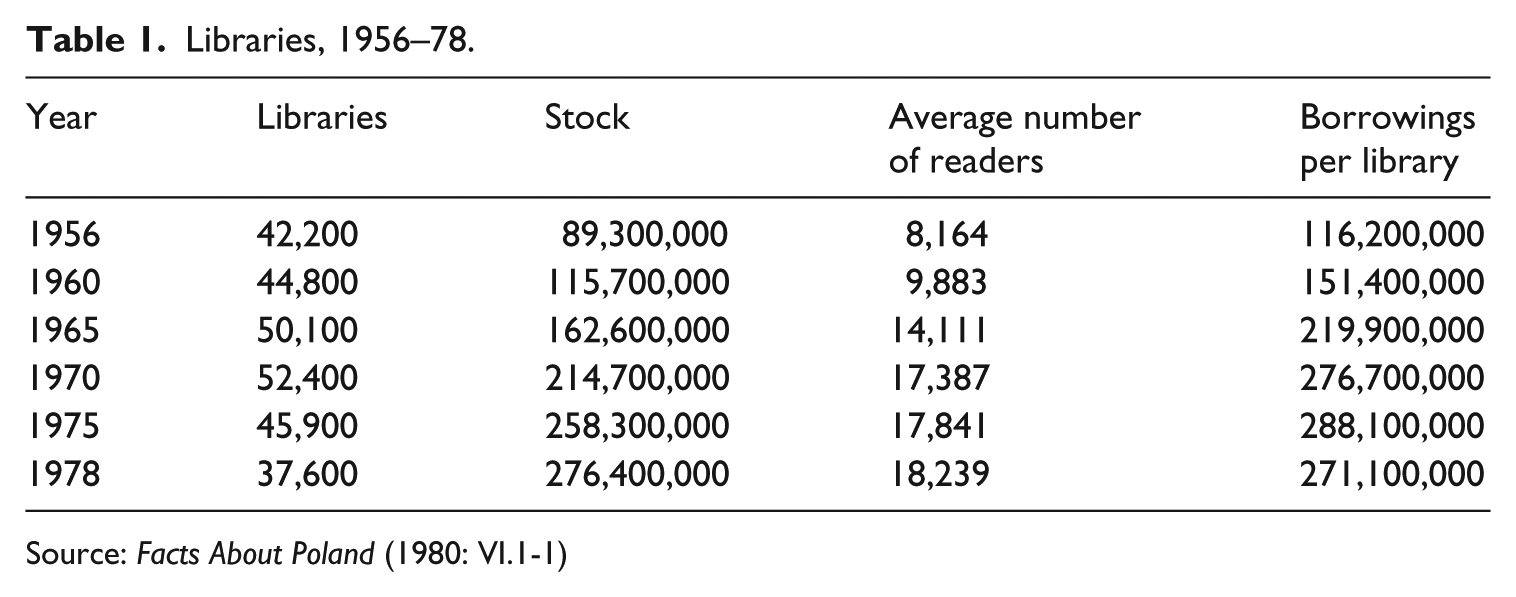
Source: Facts About Poland (1980: VI.1-1)
Although many writers had felt helpless at the extraordinary spectacle of a communist takeover in Poland, a significant number had been prepared to go along with the new regime – particularly the ardent Stalinists like Putrament and enthusiastic young Polish intellectuals with no experience of the USSR, but also writers who had taken refuge in the USSR in 1939 and had seen at first hand just how ruthless the Soviet system was with its opponents. However, for many writers the year 1949 was their professional and ideological crisis-point. At this moment the writers’ choices were either to embrace the new regime (like Broniewski, Putrament, Kisielewski, Kruczkowski and Ważyk), to collaborate reluctantly and imperfectly (like the bulk of the writers who submerged themselves in ‘the new reality’ without ever quite accepting it), or to pull back completely from conflict with the censor, preserve an individual stance, eschew the mainstream and remain aloof in increasing danger of poverty, obscurity and possibly harassment (like Miron Białoszewski, Zbigniew Herbert and Stanisław Lem). Some, the lucky few like Julian Tuwim, managed to preserve their independence simply because the Party made no effort to win them over and did not find it worthwhile to suppress them. It would seem that only the writers grouped around the Catholic newspaper Tygodnik Powszechny (Weekly Universal) avoided disgrace completely: Jerzy Turowicz, Zbigniew Herbert, Hanna Malewska, Antoni Gołubiew, J. J. Szcepański, Leopold Tyrmond, Stefan Kisielewski, Kornel Filipowicz. However, the independence of this newspaper was not to last long: as part of the new line taken by the government, Tygodnik Powszechny was taken over by Pax in 1953.
In 1950, on the back of the successful Three-Year Plan, the Party announced the implementation of the new and long-awaited ‘Six-Year Plan of Economic Development and Construction of the Foundation of Socialism’. This plan envisaged the liquidation of the capitalist sector in towns, the transformation of a large number of small farms into collectives, and saw industrial output targeted to rise by 136 per cent. It called for massive sacrifices from an already exhausted populace, and was to prove totally unrealistic: the dogmatic approach to ‘sharpening the class struggle’ and the frequent resort to violations of the law to achieve the plan alienated the peasants, slowed down agricultural production, brutalized factory workers and actually hampered economic development. In May 1951 a socrealizm-styled poster appeared for the celebration of ‘Days of Books, Culture and the Press’. It showed two peasants in national costume clutching books: the female carried volumes by Adam Mickiewicz, Hugo Kołłątaj, Władysław Broniewski and Stalin. The motto read: ‘
Before long, the new cultural policy produced casualties within the Party. In 1950, as part of the ‘sharpening of the class struggle’, Minc and Zambrowski renewed their criticism of Jerzy Borejsza for the petit-bourgeois taste of his Czytelnik cooperative publishing house, which published about 25 per cent of serious ‘non-Party’ poetry, short stories and novels. Borejsza, who was responsible for coining the phrase rewolucja łagodna (gentle revolution) to describe the Party’s approach to culture in the years 1945–9, had been criticized as early as 1947 for ‘lack of direction’, ‘pseudo-objectivity’ and ‘susceptibility to the forces of reaction’. The charges may have had a grain of truth to them, but it seems likely that at this moment, as the various elements and factions within the Party jostled for dominance in what was now the only legitimate conduit of expression, the Party needed to show Moscow it was ever-vigilant and still doing as it was told. Borejsza was the nominated victim. After a motoring accident and a stroke he was an easy target. In 1951 he was dismissed from Czytelnik and retired (Torańska 1987: 265). In the eyes of many Borejsza was permanently tarnished not only because he was Jewish (his real name was Jerzy Goldberg) but because he was the brother of Jacek Różański, head of the Internal Security Department, famous for kicking prisoners from behind during interrogation. However, Jan Kott was to write of Borejsza with considerable affection: I still think about Borejsza with undiminished admiration. And even a certain tenderness. He was a true visionary, one suited to those first years after the war when our hopes, all our different hopes had not yet been lost … If it hadn’t been for that car accident, Borejsza would probably have succeeded in bringing back to Poland half the émigrés from London, and who knows, perhaps even the remains of Stanisław August Poniatowski – Poland’s last king – would have been placed in Wawel Castle. (Kott, 1990: 177)
Only the poet Czesław Miłosz, who was working for the Polish diplomatic corps in Paris, was in a position to openly express a lack of confidence in the Party, refuse partyność, refuse to abandon his own unique view of the world and refuse to accept the worldview dictated by the Party, and to do so publicly and with impunity. In 1951 he asked for political asylum in France and went on the publish The Captive Mind, a devastating and detailed critique of the impact of the Party on the Polish literary community, based on direct observation of writers he knew (Miłosz, 1953). While his defection caused shock-waves throughout the literary–political community, it only served to emphasize that this option was not available to most Polish writers.
The year 1951 was to bring one further significant literary scandal. Tadeusz Borowski, was born in 1921 in the Ukrainian town of Zhitomir, USSR. Borowski’s parents had been imprisoned in Stalin’s camps in 1926. His father, a bookkeeper, was transported to Karelia to dig the White Sea Canal as punishment for his service in Polish military organization during the First World War. Borowski lived with his aunt for several years and the family was reunited in 1932, when the Red Cross arranged an exchange of Soviet communists for Polish prisoners. Borowski was educated by Franciscan monks and graduated from an underground high school in 1940. He worked as a night-watchman and dabbled in the black market. A cycle of his poems was published by the underground in 1942. He had an active role in the wartime resistance but was arrested in 1943 and sent to Auschwitz where he worked as a hospital orderly. He was later evacuated to Dachau and was liberated by the Americans on 1 May 1945. He lived in Munich and Murnau for a while, working for the Red Cross, then returned to Poland in 1946 or 1947. His second volume of stories, World of Stone (1948) was a stunning, close observation of his experiences in the Nazi concentration camps. Although on the surface his writing was a graphic and detailed depiction of the camps, and not so very far from the kind of realism the Party wanted to promote, the amorality and nihilism of his observation was at odds with what the Party wanted. Criticism led to a mental crisis. Borowski joined the PPS in 1948 just as it was gobbled up into the Polish United Workers’ Party, but he became an enthusiastic and highly active supporter of the new regime, and a frantically active journalist and cultural worker. He received a state literary prize. However, if the strain of trying to speak the unspeakable had begun the process of driving him to desperation, the strain of trying to live the ‘new life’ of communist culture did not provide a solution. He had embraced communism as a rigid moral code in an effort to give shape to what he saw as an immoral and pointless world, but the Party failed to provide any deep-seated response to his probing of the darkest side of human nature. In 1949 Borowski was sent back to Germany as press officer to the Polish military mission. The effort of continued political activism at the height of the Cold War, the arrest of one of his best friends by the SB (Security Service), and Borowski’s own involvement in an espionage mission of some sort all proved too much and he gassed himself in Warsaw on 1 July 1951.
In 1953 Stalin and his henchman Beria died. For a while nothing happened. The Second Party Congress in March 1954 passed off as if Stalin was still alive. However, in actuality the whole of the Eastern bloc – Poland and Hungary in particular – was seething with discontent.
In 1954 socrealizm posters began to appear showing a young man in overalls pointing a finger at the viewer and demanding: ‘Coś TY zrobił dla realizacji planu?’ (What have
By 1955 it was clear the Six-Year Plan had failed, mainly because of exports to the USSR and the added cost of the weaponry for the rapidly developing Cold War. As the government struggled to extract 40 per cent capital formation from current production for reinvestment, living standards fell by about 10 per cent. Coal output, car production and agricultural output had all fallen by 12–20 per cent. Workers and peasants were leaving the Party, while white-collar membership was increasing as the bureaucracy grew and Party membership became the only route for advancement (Harman, 1974: 96). Against this background literary and artistic developments seemed to indicate the possibility, perhaps even the necessity, of a general ‘thaw’ in attitudes (Gömöri, 1966: 231–4).
Although many writers had given a ritual nod in the direction of socrealizm, only a few had any interest in it and fewer still seriously engaged with it. In general Polish writers were much more interested in the theories of Hungarian critic György Lukács and in their own home-grown ideas and arguments about the direction Poland should take. That many writers found socrealizm irrelevant, infantile and patronizing was signalled very clearly in Jerzy Andrzejewski’s story ‘The Lament of a Great Paperhead’ (1954), and again in his story ‘Złoty Lis’ (Golden Fox, 1955), and in the work of Kazimierz Brandys, who indicated that his attitudes and style were changing with the short story, ‘Defending Granada’ (1955). These works, along with Hlasko’s First Step in the Clouds (1956) and Eighth Day of the Week (1956) inverted the dramatic narrative structure the theorists of socrealizm had posited, made the morality of the tale and the eventual outcome unclear and showed human dilemmas against a background of megaphone political culture and mendacious official slogans in a way in which the reality of daily life quietly contradicted official propaganda without confronting it.
Meanwhile, in poetry a declining interest in any form of ‘schematism of the workers’ paradise’ and political engagement was signalled by the work of Tadeusz Różewicz as, after a period of rather sterile conformity, he moved again in his 1956 collection Poemat Otwarty (Open Poem) to a consideration of personal themes and human problems. In film too, discontent and dissatisfaction were beginning to surface among audiences and critics. In 1950 the director Aleksander Ford had produced his socrealist film biography of Frederyk Chopin, Młodość Chopina (The Youth of Chopin) according to Party directions, showing the young composer to be above all a ‘friend to the working class’. Edward Ochab supported the film, claiming that it was a ‘serious achievement praising socialism’. This film reinstated Ford as a ‘good communist’; after a period in the doldrums it restored his reputation with the Party and earned him promotion to a nomenklatura (Party-nominated) post on the Commission Evaluating Script and Films. However, the film was not popular with the paying public and it was scorned by Chopin experts. 1 And disenchantment was there too from about mid-1955 in the literary criticism of Jan Kott, Artur Sandauer and Jan Błoński. In 1956 in the journal Nowa Kultura Andrzej Kijówski dared to pose the question ‘Kto bohaterem?’ (Who is the Hero?) Quietly, without any great fuss, it had become apparent that the ‘literary organs’, magazines and cultural institutions in which theoretical debates and policy discussions were conducted in a kind of shadow fight, had all begun to assume that they were somehow more important than the actual creative writings of poets, novelists and dramatists.
In literature, matters first came out into the open with the August 1955 issue of the magazine Nowa Kultura (New Culture) where Adam Ważyk’s protest, ‘Poemat dla Dorosłych’ (Poem for Grown-ups), appeared. Ważyk, widely regarded as the Party’s poet laureate, had been a convinced communist before the war, a member of the KPP, and had spent the war in the USSR editing a magazine. He had returned wearing an enormous pistol to become a prize-winning author who toed the Party-line enthusiastically, penning ‘odes to construction’ among other things the Party liked. However, he had been ill and absent from the literary scene for some time and on his return to Warsaw had been asked undertake a research trip to cover the development of the ‘socialist city’ and steel works at Nowa Huta, 10 kilometres from Kraków. It was a newly built, impossibly bleak, improbably gigantic, industrial town, a hymn of praise to Leninism but in fact an example of all the problems, failings and indifference of central planning. The Party had seen the new town simply as an adjunct to the gigantic steel works and had done little to provide adequate accommodation and made little effort to attend to the education and cultural life of the workers: it had built cinemas and bars but as this was to be a ‘socialist paradise’ it had not planned for a single church.
The Six-Year Plan had increased the number of factory workers in Poland from 1,300,000 to 2,500,000, mainly by attracting very poorly educated farm labourers and peasants from the villages. By the end of the Six-Year Plan the general educational standards of the Polish workforce had become a serious barrier to development of the Polish economy: more than half of the two million non-manual workers employed in state enterprises had only an elementary or incomplete secondary education (Wiatr, 1967: 52). These people had been sucked into the cities and into various new Polish industrial centres, but between 1949 and 1955 something like 300,000 of them (mostly young males) had been ‘recruited’ to Nowa Huta, which then consisted of a massive factory surrounded by a sea of mud dotted with industrial barracks, shared rooms, communal canteens and streets that for many years had no names, just block numbers. For most the new life in Nowa Huta may have been a social improvement on the ‘rural idiocy’ of village life and an economic opportunity for advancement, but for the most part in its early years it offered hard, often dangerous, work and endless fatigue, relieved mainly by vodka, hooliganism and fornication (Lebow, 2013).
The foundations of the gigantic steelworks and city had been started during the 1949 writers’ conference and the Party had repeatedly directed writers to the project as a suitable subject for their work. Ryszard Kapuściński, Tadeusz Konwicki, Sławomir Mrożek, Wisława Szymborska and many more young writers all made a ‘literary pilgrimage’ there. Some – perhaps most – embraced the massive project simply because it was clearly a revolutionary attempt to modernize Poland, relieve the housing crisis and provide work. Tadeusz Konwicki, for example, had joined a volunteer youth brigade as he researched in Nowa Huta in 1949–50, gathering material for his socrealizm novel Przy Budowie (Building Site, 1950). In that novel Konwicki, as many other writers were to do, warped the conventions of Polish Romanticism into those of socrealizm by showing a work crew attempting to meet a deadline derailed by unenlightened ‘class enemies’: through dint of hard work and the ‘correct line’ supplied by the Party, the hero ‘finds the joy of life in collective work’, the crew fulfil their quota and the project meets its deadline. The novelist Kazimierz Brandys, a leading writer in the Party’s programme of renewal and very much in favour with the Party in the early 1950s, had visited the place and been asked by the ZMP (Union of Polish Youth) activist Józef Tejchma to tone down his embarrassing optimism about the romantic nature of work and the workplace when addressing actual workers (Applebaum 2013: 402). Tejchma later went on to become Minister of Culture and played an active role in bringing Wajda’s film Man of Marble (in part about the building of Nowa Huta) to the public (Lebow, 2013: 128–9).
The experience of Ważyk’s visit to Nowa Huta, coupled with his renewed acquaintance with the Party and his encounters with its propagandists and bureaucrats, shattered his confidence in the wisdom of the Party. Speaking to a Western journalist sometime after the event he is reported as saying he doubted the wisdom of the Party and was convinced ‘we now have government by imbeciles’. In his famous poem, in which he railed against the drunkenness, hooliganism and sexual laxity of the new town and wondered what kind of Poland the Party was creating, he wrote: We make demands on this earth for which we did not throw dice for which a million died in battle: for a clear truth, for the bread of freedom, for burning reason, for burning reason. We demand these every day. We demand through the Party.
There is little doubt that in his heart Ważyk remained a communist, but had seen through the notion that the Party was infallible.
The Party sacked Paweł Hoffman, the editor of Nowa Kultura, for daring to publish the poem, but it could not have been entirely surprised by the poem itself. In 1953, three years before Ważyk’s poem appeared, Ryszard Kapuściński, then a student writing for Sztandar Młodych (Youth Banner, journal of the Union of Rural Youth), had toured Nowa Huta in company with Wiktor Woroszylski and written articles generally praising the development but hinting that all was not as it should be. However, when Kapuściński was sent back there on Party instructions to produce a rebuttal to Ważyk’s poem, he produced instead an uncompromising article called ‘This Too is the Truth of Nowa Huta’. He now said openly that although the gigantic steelworks was a showpiece for the regime it was riddled with drunken supervisors, poor management, massively inefficient planning and appalling working conditions. He concluded his article by saying that the people of Nowa Huta awaited justice for the skulduggery, insensitivity and hypocrisy that had been visited upon them, and waited for the Party and the government to explain themselves, but knew there was no explanation beyond ignorance and indifference. The editors of Sztandar Młodych lost their jobs and Kapuściński went into hiding, protected by the workers at the plant. Eventually a special commission of inquiry was appointed and, after an investigation, the management of the steelworks was dismissed and the government offered money to build additional municipal facilities. Kapuściński was rehabilitated: at the age of 23 he was awarded the state’s Golden Cross of Merit for investigative journalism. However, in retrospect it became clear that the Party had not in fact been listening: its reaction had been cosmetic rather than systemic (Michajłów and Pacławski, 1991: 59–64; Ludwikowski, 1979; Adamczewski, 1986; Lebow, 2013: 146–9).
In 1954 Lieutenant-Colonel Józef Światło, a security service chief from Department 10 of the Służba Bezpieczęstwa (SB) (Security Service, secret police), which specialized in spying on Party members, defected to the West and began a series of devastating radio broadcasts about the activities of the security services in Poland – lurid tales of torture, blackmail and Soviet interference. Perhaps in response to this in late 1954, the SB was disbanded, reformed with a new ethos and renamed the Urząd Bezpieczęstwa (Department of Security). In January 1955 Bierut, responding to Światło’s broadcasts, spoke about the shortcomings of ‘the bureaucratic method’, the absence of democracy within the Party and the failures of collective leadership. A short while later Khrushchev’s secret speech on ‘The Cult of Personality and its Consequences’, revealing many of Stalin’s crimes and machinations, delivered in February 1956 at the Twentieth Congress of the Communist Party of the Soviet Union not only dropped a bombshell within the Soviet Party, but opened up the possibility of action within the rifts of the Polish Party. Later that month, close on Khrushchev’s secret speech, a communiqué from Moscow announced the rehabilitation of the pre-war Polish Communist Party leaders and membership, who had, it said, fallen victims to ‘provocations and slanders’ during the period of the ‘cult of personality’. This had the effect not only of confirming Polish suspicions of Russian intent, but of widening the rifts between the various factions in the post-war Party.
In these years the differences between the revisionist ambitions of the Party as a whole, the liberal tendencies of the socialists and liberal-leftists who had been corralled into the Party through amalgamation, the demands of intellectuals, the increasingly discontented and disappointed youth of Poland, the poor performance of the economy, the mounting problem of a poorly educated peasantry transplanted to the city and factory, and the complacent ‘bubble’ of the inner Party, could only be disguised with great difficulty. Change in the USSR coincided with the sudden death of Polish First Secretary Boleslaw Bierut – some said he died of shock on hearing the details of Stalin’s crimes. In Poland and Hungary at a local level, Party members began to sense that change was possible with or without the approval of Moscow and they began to go their own way. In Hungary the pressure for reform could not be contained, and while the Soviets were distracted by events there, the Poles pressed ahead with ‘the Polish road to socialism’. The number of political prisoners had risen rapidly from 26,400 in 1946 to 35,000 in 1950 and 84,200 by 1954 (Applebaum, 2013: 76, 294). In April 1956 a general amnesty was declared and some 28,000 prisoners – many of them political – were released (Karol, 1959: 133). In May 1956 Jakub Berman stepped down from the government and from the Politburo and retired to private life.
However, it has to be said that Bierut, Minc, Berman and several other leading members of the Polish Party – many of them survivors of the pre-war Polish PPR which had been almost annihilated by Stalin – though often deeply unpopular with the general public, played a very cunning game throughout these years (Dziewanowski, 2010: 2582). As Moscow’s pressure for sovietization increased they had been compelled to conform. With all the appearance of loyalty to Moscow they had sniffed out ‘nationalist deviationism’, ‘right-deviationism’, ‘Titoism’ and ‘Polish Marxism’ of all kinds and when necessary had even deposed and arrested a number of leading figures – including Gomułka. However, by design, while Gomulka and the other opponents of the new line from Moscow were interrogated endlessly, there were no show trials and no executions.
However, there were show trials for the clergy. In 1952–3, as the UB arrested Cardinal Wyszyński and confined him to a monastery, the Party attempted to take over the appointment of clergy to key posts within the Church hierarchy. It closed down Tygodnik Powszwchny for refusing to print a eulogy to Stalin, and the Krakow Curia was arraigned and charged with sabotage in a trial that fabricated evidence, forged documents and claimed the Curia used invisible ink. Bishop Kaczmarek is said to have been tortured. By the end of 1954 nine bishops and a thousand priests had been imprisoned. Long jail sentences and several death sentences were handed down, but the death sentences were never carried out. The Kraków branch of the Writers’ Union penned a letter condemning the Church hierarchy for ‘anti-Polish acts’ and it was signed by 53 members including Jan Błoński, Sławomir Mrożek, Wisława Szymborska, Andrzej Kijówski, Julian Przyboś and Anna Świrczińska (Błoński, et al., 1953). Commenting on Sławomir Mrożek’s behaviour at this time, one writer said, he was ‘a young squirt’ of ‘respectable plebeian descent’ for whom working on the newspaper Dziennik Polski was a kind of ‘authentic promotion’. He allowed himself to be ‘lured by the Communists without giving it much thought’ (Michajłów and Pacławski, 1991: 44).
While the Party arrested priests and harassed the Church, they made little progress in dismantling it or curtailing its activities. Likewise, while they made a show of attacking the ‘kulaks’ and took many private farms into state ownership or turned them into cooperatives, they understood that Polish peasants were not capitalists and so made little or no progress in collectivizing agriculture. The Party, on Moscow’s instruction, had imposed socrealizm in literature without much enthusiasm or hope of its success, and while writers and intellectuals who disliked burying their personality in ‘production-line’ literature fell silent in increasing numbers, few if any of those who chose not to praise Stalin or to write for their ‘bottom drawer’ were arrested or punished. History was to show that for all their failings, the leadership consisted of Polish communists rather than just Soviet stooges.
In June 1956 there were riots and demonstrations on the streets of Poznań. Crowds of protesters, estimated at 100,000, demanding bread and singing the ‘Internationale’ encountered 400 tanks and 10,000 Polish soldiers. Police stations and a jail were stormed and the authorities replied with force. Officially there were over 50 dead, including two security service officials (one of whom was lynched) and a 13-year-old child, several hundred were injured and 154 arrested, accused of working with ‘foreign powers’. Whatever generosity the waverers and opponents of socialism had managed to evince up to this point evaporated rapidly and it soon became apparent that no amount of improvising at the top could relieve the pressure of the discontented masses below. The confidence of ‘the system’ and the apparatus of state control which had developed over the previous decade was thrown into confusion by the events in Poznań. This was to prove a watershed in public relations between the Party and the Polish populace, and caused a severe wobble in the Polish political system. In effect the Party had been put on notice that the Polish public wanted de-Stalinization: if the Party would not undertake it, then it would face increasing pressure and de-Stalinization might then be undertaken by anti-communists.
To its credit the Party did not use the Poznań protest as an excuse to clamp down. However, as the shock of the protest worked its way through the system, among many other changes, the practice of giving precise direction to artists of all kinds was quietly abandoned. Sokorski was later to claim that grafting socrealizm onto Polish society ‘didn’t seem to be effective’: that’s why we were able to reject and get rid of socialist realism with such relative ease; because first of all it was not rooted in our cultural tradition, and secondly we weren’t excessively enthusiastic in implementing it. Wherever it was possible to wriggle out of some act of servility, we wriggled out of it. Above all we managed to wriggle out of a large part of the junk of Soviet socialist-realist literature. We published relatively little of it and we didn’t propagate it much. (Torańska, 1987: 141)
This is his view from the inner Party bubble and may be just his way of trying to put a good face on failure; but this was certainly not how it felt for writers and readers. The fact was that socrealizm was not popular with readers, it soon exhausted its possibilities with older writers and it was already in the process of being abandoned by ‘the pimplies’. By 1956 even the Party was beginning to think it might be counterproductive.
The Party’s indecision following Stalin’s death, coupled with its poor claim to legitimacy, allowed a movement pressing for ‘democratization’ to give voice to its thoughts. The change in direction and control, and the easing of censorship were soon labelled rewizjonizm (revisionism). Émigré writer Z. A. Pełczyński was later to summarize this movement as: a reaction against Stalinism and the limited official measures of de-Stalinization taken in the Soviet bloc. Its aim was to redefine, in theory and in practice, the role of the Communist Party vis-à-vis culture, society, economy and the state. Instead of its leaders continuing to impose a dogmatic conception of socialism in those spheres, the Party was to reassess Marxian theories in the light of changed conditions. It had to arrive at correct socialist policies through a free internal-democratic debate, and execute those policies through the aktiv rather than the professional Party apparat. (Pełczyński, 1988: 361)
The satirical magazine Szpilki (Pins), the literary journal Nowa Kultura and the student newspaper Po Prostu (Straight Talk), edited by young communists, produced articles openly criticizing Bolesław Piasecki and his Pax organization, and articles exposing the system of ‘Yellow Curtains’ – secret shops full of scarce food stuffs and luxury goods available only to Party members. Circulation of Po Prostu quickly rose to 90,000. In one edition Jerzy Urban wrote about what the Party had not allowed him to say publicly during the Six-Year Plan: During the recruiting campaign for industry and mining there existed near Warsaw a centre in which young girls who worked in the nearby factory were billeted. Terrible things happened there: dirt, hunger, misery, disease, prostitution, lack of care, mass attacks of hysteria, attempts at suicide. They did not let me write about these things in the name of ‘higher goals’ … I later visited the State farms near Zielona Góra. The youngsters lived there not like people but like cattle. Somewhere on a wooden bed a young girl was dying of disease and hunger. She was fired because she developed tuberculosis. They did not let me write about that, again because of ‘higher goals’. (Harman, 1974: 100)
2
Artists of all kinds took this opportunity to shake off caution and express themselves clearly: loyal Party writers like Jan Kott, Leszek Kołakowski, Adam Ważyk, Paweł Hertz, Mieczysław Jastrun and Wiktor Woroszylski spoke out against the Party line. In an unguarded moment Jerzy Putrament went so far as to say openly that the ‘economic system had failed’, and to blame the Six-Year Plan which, he said, had been based on the Soviet model: for this Pravda labelled him an ‘ignorant scribe’ (Bethell, 1972: 210).
Many writers and translators took this opportunity to pull manuscripts from their bottom drawer and publish things that would previously have been unacceptable. Timid editors suddenly became bold: the magazine Zycie Literacki (Literary Life) which had been diligent in publishing its share of poems praising Stalin, suddenly produced new work by the emerging young poets Drozdowski, Białoszewski, Herbert, Harasymowicz and Czycz, introduced and defended by established poets. Within a short while new books – all implicitly challenging the idea of ‘the literature of social command’ – also began to appear in print: Zbigniew Herbert’s Struna swiatła (Chord of Light), Tadeusz Konwicki’s Rojsty (Marshes) which had been awaiting publication for over ten years, J. J. Szczepański’s Buty (Boots), Marek Hłasko’s Pierwszy krok w chmurach (First Step in the Clouds), Jerzy Andrzejewski’s Ciemność kryją ziemię (Darkness Covers the Earth, published in English as The Inquisitors), Kazimierz Brandy’s Matka królów (Mother of Kings, published in English as Sons and Comrades), and Sławomir Mrożek’s play Policja (Police) and his first collection of short satirical stories Słoń (Elephant), along with selected works by Gombrowicz, Witkiewicz and Różewicz. Translations from Kafka, Mailer, Faulkner, Sartre, T. S. Eliot, Simenon, Agatha Christie, Erskine Caldwell, John Steinbeck and Ernest Hemingway all appeared at this time. Aleksander Wat, who in the early 1950s had been silenced as ‘a hostile element’, ostracized and then suffered a stroke, began to write again and his Wiersze (Verses) appeared in 1957. Stanisław Jerzy Lec, who had been refused publication until the late 1950s, produced a whole volume of gem-like aphorisms – each a product of the times – including the slogan ‘Illiterates must dictate’, which for many in years to come summed up communist rule (Lec, 1957). Even émigré writers began to see publication in Poland – an essay by Miłosz and several titles by Maria Kuncewicz appeared.
To a certain extent the dilemmas the Party faced now were not entirely of its own making. The Comintern had dissolved the pre-war Polish Communist Party, claiming it was ‘corroded by Trotskyite and Piłsudskist influences’ and had become ‘an agency of fascism and political police influence’. In the early 1930s Stalin executed as many as 5000 members, virtually the entire Party, without even troubling to give them a show trial (Deutscher, 1982: 125–62). The post-war Party, created from forced amalgamations, was a factious, divided and ambiguous entity and was to pay the price for being the only permitted conduit of expression. Deutscher, writing of Poland in the years 1960–70, effectively summed up the whole communist period when he said: It should not be imagined that the line of division ran only between members and non-members of the Communist Party. It cut across the Party itself, which in the last twelve years had absorbed the most diverse elements, some who would normally, given their freedom of choice, have followed a Social Democratic lead, and others who would have joined right-wing clericist and nationalist parties. As long as the Communist Party was the Stalinist monolith, these differences mattered little; they had no opportunity of expression. But now the Party was no longer the old monolith and so a tug of war between communism and anti-communism – conscious or only instinctive – began to develop in its own midst. Outside the Party, anti-communism had behind it a numerous and influential Catholic clergy, the sentiments of vast sections of the peasantry and of the intelligentsia, and the new anti-Stalinism appealed to non-Party men as well, to workers, intellectuals, and members of the bureaucracy. (Deutscher, 1970: 84)
In 1956 Poles were willing to suspend their anti-communist suspicions and to enjoy the feeling that for the first time they had their own man, a socialist and a Pole, as a candidate for power. In what was Poland’s first, last and only socialist upsurge, in October 1956 Władysław Gomułka was wafted to power as the new First Secretary of the PZPR while the Soviets were distracted by the Hungarian uprising. Initially Gomułka had great popular support. He had in fact been the Polish communist leader in the immediate post-war years, but had lost his position in the Stalinist takeover. Now and as a consequence, he was seen by former members of the Polish Socialist Party, like Cyrankiewicz, Rapacki and Lange, as an anti-Stalinist. The Polish experiment in liberalization went well at first, but once in office, Gomułka’s efforts went ‘to restore order, the party’s authority, and its monopolistic position … to gaining the support of the politico-military organization and reassuring the Russians’ (Fejtő, 1974: 101). His line was that Stalin may have made serious errors and the cult of Stalin was a fault, but communism was still Gomułka’s aim and he insisted that the Party, not writers and artists – and definitely not the priests and bishops – was the real conscience of the Polish people. Early in 1957 he tried to regain control of Trybuna Ludu (Tribune of the People), and when this failed he simply sacked the editorial board. In May of that year he began an attack on the student paper Po Prostu. Eligiusz Lasota, the editor who had supported Gomułka’s campaign a year earlier, was dismissed. It took his liberalizing supporters and the general public until the autumn of 1957 to realize that Gomułka, while a nationalist and a traditionalist, was still a dull, conformist communist. In October Gomułka ordered Po Prostu to be closed down completely, a decision that resulted in student riots in Warsaw. When he suppressed the magazine Europa Adam Ważyk resigned from the Party in protest.
In February 1958 Minister for Arts and Culture Włodimierz Sokorski declared that the state had the ‘right to defend its citizens from trash and art which was hostile or openly destructive’ and consequently had ‘no wish to relinquish influence over what is presented in theaters, what kind of paintings are bought and from whom, what is transmitted by radio and television’ (Paczkowski, 2003: 293–4). Within a short while a campaign commenced against the Paris-based émigré magazine Kultura (Culture) and against Marek Hłasko, who while abroad had offered his novels Cmentarz (Cemetery) and Następnego do raju (Next Stop Paradise) to Kultura. In Poland both these works had been blocked by the censor. In December 1959 Antoni Słonimski, the respected president of the ZLP, was replaced by the more tractable Jarosław Iwaszkiewicz: a short while later Putrament and Kruczkowski were manoeuvred into supporting roles within the ZLP. Putrament had been a deputy to the Sejm (Polish Parliament) from 1952 to 1961, and was a member of the Party Central Committee 1964–81. However, by the early 1960s these three union officers were the subject of harsh criticism from the membership for their close connection to the Party, ‘collaborationist attitudes’, for encouraging spying on the membership and for their luxurious lifestyle. 3
Clearly not all writers in Poland were actively opposed to the government. Some were members of the Party, some were bureaucrats and officials who ‘dabbled’ in the arts or who ‘became writers’ because they had managed to get a poem, a story or an article published in an obscure departmental magazine or an internal Party journal. Many of these enjoyed protection from the Party and when necessary would turn out en masse to block union decision-making. In spite of the tension that existed between the ZLP and the PZPR there was very little hostility to the Party cadre within the union. In 1964 sociologist Andrzej Siciński asked ZLP members how they regarded Party members in the union. The replies were as follows: as a separate group within the ZLP, forming its own circle, 5 per cent; not as a separate group within the ZLP, 39 per cent; as a non-artistic group, sharing ideology, worldview and politics, 6 per cent; as a non-artistic group, formed on another basis, e.g. comradeship, 11 per cent; as a group founded on other principles or another basis, 10 per cent; don’t know or did not reply, 29 per cent (Siciński, 1971: table 62). Considering the antics of people like Broniewski, Putrament and Ważyk, this shows remarkable restraint, a very forgiving nature or just substantial indifference to the issue in question.
By the end of 1958 it was clear that Gomułka was not the revisionist rebel the public had supposed. Within a year of coming to office he had lost the support of the intellectuals, many of them up to now loyal communists or fellow travellers, who had helped usher him into power. The plan he had for Poland was much less flexible than the ideas of people like Jan Kott, Jerzy Andrzejewski, Kazimierz Brandys, Tadeusz Konwicki, Leszek Kołakowski, Wiktor Woroszylski and dozens of other creative intellectuals on the left, most of whom were to abandon the Party between 1956 and 1970. Marian Brandys, for example, after his debut novel quietly abandoned socrealizm, took to writing children’s literature and left the Party in 1966. Many writers came to understand that joining the Party was one thing, but staying in it was something very different. Increasingly from the mid-1950s membership of the Party indicated a knowingly opportunistic and shameful affiliation with a disgraced entity. Many, like Brandys and Konwicki, were later to talk openly about their break with the Party: others were more embarrassed at the connection. Wisława Szymborska, for example, while working as an editor for Zycie Literackie prepared her first collection of poetry for publication in 1948, but before it could appear the collection was ‘found wanting’ in ideological terms and after a vicious campaign against her, even involving schoolchildren, publication was cancelled. She revised the collection and in 1952 a new collection mainly on political themes entitled Dlatego Żyjemey (Why We Live) appeared. One of her poems from this period was ‘Ten Dzień’ (That Day), about the death of Stalin, which first appeared in Zycie Literackie (15 March 1953). However, she did not consider her new collection to be satisfactory and Szymborska quietly stopped writing praise poems for Stalin and left the Party later in 1953; her next collection Pytanie Zadawane Sobie (Questions Asked of the Self) appeared in 1954. This time the poems had a much less public, more personal, inward slant. Eventually she became a supporter of Solidarność and a close associate of Lech Wałęsa, and her poetry about the right to doubt in a utopia earned her a Nobel Prize for Literature in 1996. Her early Stalinism may explain why Czesław Miłosz included only one of her poems in his influential collection Post-War Polish Poetry (Miłosz, 1965). She seems to have rejected her own early poetry completely and none of her Stalinist poems figured in her 1970 collected works. Later Miłosz praised her ‘mature verse’ (Miłosz, 1983a) and included seven more of her poems in the revised and expanded third edition of Postwar Polish Poetry (Miłosz, 1983b).
Whatever Polish literary culture of the past may have taught about the power of the inteligencja, writers were far from central to the Party’s programme or its estimate of its own success, and the Party took little real interest in literature. After the period of ‘high Stalinism’, the Party continued to control, censor and block writers it did not favour by starving them of the oxygen of publication, reprints, fees and publicity; it may have wasted their time and energy and may even have blocked or spoiled them as writers, but it did not attack, imprison or torture them. They could satirize and criticize as much as they liked provided they looked only at individual examples and instances of ‘problems’ – shortages, potholes, the quality of sausage – and did not attack the system itself. They could even publish abroad, in Polish or in translation, so long as they did not mind becoming non-persons at home. If anything the Party respected and slightly feared writers of all kinds and still vaguely tried to enlist them. Although it failed to fully control writers and university intellectuals, the Party clearly hoped that one day writers and professors would somehow help them create a new red inteligencja. Juliusz Żuławski (1911–99), president of Polish PEN, put it like this: At least here in Poland you could always offer your book to the publishing house without risking your life. They could simply say no, the censor will not allow it, and that was the end of the matter … You could always translate the classics or steer clear of political questions. The situation in Poland was always much more relaxed than in Czechoslovakia or Hungary or the Soviet Union … The worst period for us was the period 1950–4. In this period, rather than risk new creative work of my own, I decided to translate English and American poetry. In 1951 for example, I ran to Byron – for political reasons – he was very much against British imperialism and against the Congress of Vienna. And so for many years I was a translator and this was the case with a number of my friends. The classics were always considered safe: they were not dangerous; the authors were dead; they didn’t write about Poland, about our situation. And it was possible to make a living out of the classics. But in Czechoslovakia and in the Soviet Union friends of mine were forbidden to write at all and they had to take another job altogether. In Poland it was always possible to preserve your independence, to keep your own way of working, right through even the worst years. It was always better in Poland. Why? The communists were always afraid of this very strong tradition of writers. (Tighe, 1999)
For Polish writers the period of ‘high Stalinism’ was one of passing socrealizm, but increasing socialist-surrealism. Although the riots and protests in Poznań in 1956 may have provided the illusion of a coincidence of interests, the problems of the intellectuals were not, as yet, those of the workers (or vice versa) and it would be several years before these groups could begin to trust each other. While the disaffection of writers and intellectuals may not have informed an indifferent Party apparatus, it was to prove influential in fostering an attitude of cynicism, ironic aloofness and withheld consent that fed into a growing stream of intellectual opinion, information, criticism, argument and advice that supported industrial workers and others in their battles with the Party. Looking back over the period of ‘high Stalinism’ Andrzej Szczypiorski, his cynicism well founded in close observation, wrote: Having, not without reason, lost faith in democratic principles and in humanist civilization that had effectively failed to oppose Hitler’s tyranny, the intellectuals began feverishly to search for a new faith. They found it in the Hegelian spirit of history that comes from the East … Intellectual circles in Poland became the aristocracy of the system, and, as a matter of fact were not forced to produce paeans of praise for the authorities. They were asked only for one thing: for their participation in the ritual of power. Scholars, writers, artists and great actors became in that period the first citizens of the country … Acceptance of the patronage of the state in learning and culture meant tacit agreement that society and the creators themselves would refrain from taking decisions on what was important and what was not important in intellectual life. It was the state which decided, and that mean a group of state, party or police functionaries … State patronage can sometimes be convenient. It eliminates competition, frees one from the whims of the market, allows one to exist and create in complete detachment from the verdicts of the public … no one made unpleasant political demands and authors could, for instance, publish poems about such morally uncontroversial matters as the growing of sunflowers. The point is that these poems were not read, and yet the authors acquired a national reputation … Although state patronage does not fight talent, on the whole it prefers mediocrity. Without state patronage only talented people would survive, and mediocrity would have to disappear from intellectual life. (Szczypiorski, 1982: 55–7)
The Stalinist programme of enlightenment was a cultural and political failure, particularly since at first the communists and the inteligencja had both seemed to share an ambition towards leadership, education and cultural development. This failure had enormous repercussions after Stalin’s death, as writers and intellectuals who had at first chosen to work with the Party – or at least not to oppose it – began to see the Party as incapable of any kind of genuine leadership or serious cultural engagement, and began to see the Party itself as in desperate need of enlightenment. Increasingly Polish writers saw the Party as lying, corrupt and inefficient, and in cultural matters as wilfully boorish, philistine and semi-literate. An official summary of the period 1945–56 reads as follows: young writers and artists from the pre-war left-wing started to ponder the formal problems of the new literature. Realism was accepted as the main aim. It was in accordance with Marxist and Leninist ideology, as well as with the political situation and the need for a hard-headed attitude towards post-war conditions. Realism gained ground gradually in the post-war years, which led at the end of the 1940s and the beginning of the 1950s to the emergence of socialist realism … The first, lively post-war period, full of discussions, finished in August 1948, when the tasks of socialist realism in literature and artistic norms were defined. The reign of socialist realism, common in the countries of the people’s democracy, ended in 1956. (Klimaszewski, 1984: 309)
What this bland and inaccurate summary hides is that by 1956 the Party’s cultural policy was in tatters and its relationship with the creative intellectuals had turned sour. The Catholic writers around Tygodnik Powszechny remained indifferent if not hostile to the Party; Julian Przybuś, Jan Kott, Jerzy Andrzejewski, Kazimierz Brandys, Marian Brandys, Tadeusz Konwicki, Leszek Kołakowski, Wiktor Woroszylski, along with several others, were on the point of breaking with the Party; most of the younger writers including Rózewicz and Szymborska had tried and then abandoned socrealizm; Tadeusz Borowski was dead; Miłosz and Lec had both used diplomatic positions abroad to sever connections to the regime and they, along with Hłasko and Wat – some of Polish literature’s brightest hopes – were highly critical of the Party and now lived abroad. Socrealizm as a cultural policy did not ‘end’ officially, but like a damp firework simply fizzled out.
The year 1956 was to prove something of a watershed in post-war Polish communism, but it took another decade for the exact nature of the change to clarify itself. After 1956 the threat of police terror, political trials and socrealizm faded away, like the Six-Year Plan, but as the dissident communists Jacek Kuroń and Karol Modzelewski pointed out, by the early 1960s it was clear that the Party was a ruling class and the workers were exploited. But by then Poland’s reserves – moral, political, ideological and financial – were gone. For daring to say this in a short pamphlet both authors were arrested, labelled ‘Trotskyite fascists’ and expelled from the Party. Their original document was confiscated, but to defend themselves they produced an open letter to the members of the Warsaw University Campus branch of the Polish United Workers’ Party and Union of Socialist Youth – their Party comrades (Kuroń and Modzelewski, 1966). For this second document Modzelewski was sentenced to three years and Kuroń to three and a half years in prison.
For the Party the issues revealed in their first decade of power remained unresolved throughout the post-war period and were evident in the crises of 1968, 1970, 1976, 1980–81, Martial Law and afterwards. The lack of legitimacy and the relationship with Moscow skewed everything the Party did. The lingering tradition of Polish socialism from the old PPS membership acted as a rather ineffective but nevertheless awkward brake on the Stalinists. However, with little or no internal democracy and few opportunities for rising stars, the Party was often paralysed by faction-fights which all too frequently grounded themselves in appeals to populist anti-Semitism (Gross, 2006). With few intellectuals in its senior ranks, massive corruption and a burgeoning black market, the Party could make little headway in developing an efficient economy. The system of nomenklatura (party-approved appointments) dominated not only top government and economics posts, but also top university management and administrative posts, ‘judges, head-teachers at big schools, managers of football clubs, the fire service bosses, senior army and police officers, newspaper editors, hospital administrators, college lecturers, theatre and concert hall directors’ – in total something like 10 per cent of all jobs (Sebestyen, 2009: 15). However, this system produced not well-educated, well-informed argumentative and inventive intellectuals striving to improve the situation, but an enormous layer of dead-weight ‘yes-men’, managers anxious to keep their place by telling their boss what they thought the boss wanted to hear. At the same time the Party was the only available route for advancement: membership became a cynical careerist ploy for advancement, rather than an expression of support and ideological commitment. To compound this problem, the Party, particularly the inner circle, operated increasingly in a bubble where it believed its own propaganda. And all the while its fundamental problems remained unresolved in the face of a largely surly, cynical and sometimes openly hostile population – how to achieve authority, how to legitimize the political system, how to retain power and, most important of all, how to do these things without offending the Soviets.
At the start of the 1970s under Gierek’s leadership the Party was to seek external finance from the West to support its gigantic industrial schemes, but it made no serious effort to develop, extend or even follow communist ideology or to respond to the gathering internal criticism and crisis. While Poland lacked the economic infrastructure and skills to absorb or make good use of Western finance, the manufactured goods it produced could barely compete in world markets, so it became increasingly difficult to service the debt. At the same time the Party abandoned its efforts to reshape Polish society through ‘class war’, to progress collectivization or to fully control the Catholic Church. Lacking legitimacy the Party did little more than try to hold on to power – which it defined as its ‘Leading Role’ – long after its claim to leadership and authority had been exposed. Yet the unrealizable aims, unwieldy structures, unworkable economy, wasteful and inefficient management, and impractical systems that the Stalinists developed – like central planning, censorship, control of publishing, the nomenklatura – nevertheless remained in place, blocking, spoiling and distorting even while they decayed. The increasingly widespread czarny rynek (black market) siphoned off much of what the economy produced and resold it at market rates, relieving pressure on the state system but at the same time making it look as if the system functioned inefficiently when in fact it did not function at all.