







Abstract
This article considers best practices for writing articles in science, technology, and policy, focusing on writing for international scholarly journals in nuclear security. Its two main audiences are technical communication educators/researchers and internationals wishing to publish their work in English-medium scholarly journals. I discuss publishing scenarios and challenges facing such authors and offer guidelines for producing clear, effective, publishable articles, in English, for international discourse. My approach is based on traditional rhetorical principles, plain language studies, research pursued at nuclear security conferences, feedback from internationals at writing workshops, and my experience as editor of the International Journal of Nuclear Security.
Keywords
Global Communication for Nuclear Security
During the Trump era, the Doomsday Clock of the Bulletin of the Atomic Scientists has twice ticked forward. The atomic scientists take into account climate change and disruptive technologies in addition to threat from weapons of mass destruction, but the threat of nuclear war has always been the clock’s major indicator. It now stands at 2 minutes until the midnight of annihilation. In other words, the sober judgement of leading scientific and security experts from around the world declares that our planet now stands in as much danger of destruction as it did in 1953, when the Soviets tested their first thermonuclear device. The clock has never been nearer to midnight than it is now. 1
You’re aware of today’s high level of danger if you keep up with any reputable news source reporting, for example, on activities of eastern terrorist groups shopping for nuclear materials on Moldova’s black market, or news reporting on nuclear developments connected with North Korea, Russia, Pakistan, India, Iran—and of course the United States. One way or another, you’re not surprised I’m concerned about global nuclear security. You’re worried too, and no doubt you take what actions you can in contributing to world peace and safety.
My own contribution, in addition to voting for sane and moral political candidates, has been to lend my communication expertise to professionals directly involved in nuclear security: scientists and engineers, policy, agency, and military experts, as well as trainers and educators. I offer writing workshops to internationals in nuclear security, I queue up my students to serve as communication consultants to these experts, I edit an open-source scholarly journal in nuclear security, and I try to supply, as in this article, advice about effective communication—geared to internationals working in nuclear security.
The bulk of this article expands upon a list of guidelines for producing excellent academic articles, something I put together after becoming editor of the International Journal of Nuclear Security (IJNS) in 2015. I found myself reviewing manuscripts written, in English, by highly intelligent members of an international community working to guard the world from nuclear terror and proliferation, and from all manner of nuclear crimes and accidents. Most of these dedicated professionals are what we call L2 or (my preference) E2 2 : users of English as a second language, and not from western contexts. Many of the manuscripts I receive need a lot of work. And I know that many valuable manuscripts are missing from my inbox because it is challenging for E2s in scientific and technical fields to produce effective writing, in English, for peer-reviewed, international, scholarly journals. The issues go beyond sentence-level control and correctness. They have to do as well with the larger issues of rhetorical sensibility, tone, argumentative structure, proportion, cohesion, and engagement with international academic conversations in their field—which happen primarily in English.
For readers of JTWC, the writing guidelines I discuss don’t afford new information about principles of composition and rhetoric, or about discourse communities, 3 plain language, 4 scholarship as a conversation, 5 and so on. Nor am I the first to explore best practices for guiding internationals in mastering English and genres of writing for purposes of professional and academic discourse. English for Specific Purposes focusing on scientific, technical, and medical English, and English for Academic Purposes have been around for a long time; scholars such as John Swales and Christine Feak have devoted decades to this area. 6
So, you’ll recognize what you see here as time-honored instruction in our western, Anglophone-centric educational contexts. But you might be interested in this instance of its application and reception, in the international context of writing for nuclear security and safety in which I’ve been operating.
On a personal note: I got hooked on working to shape our traditional rhetorical materials to this international context during a writing workshop my students and I conducted on campus of the Ghana Atomic Energy Commission in 2016. We called the workshop From Technical Evidence to Public Action: Persuasive Writing in the Field of Nuclear Security, and we covered writing for proposals, op-ed pieces, and academic articles. 7 Participants were enthusiastic and grateful for the instruction, and as we were leaving, they warmly shook our hands and took selfies with us, a few people dabbing wet eyes. We had never experienced this kind of response in other instructional contexts. Hubert Foy, director of AFRICSIS, 8 who had invited us to deliver the workshop, urged us: “Please continue doing this throughout sub-Saharan Africa.” We, who are among the gatekeepers of scholarly scientific discourse in English, had not anticipated how much it might mean to dedicated nuclear scientists and engineers in Africa to receive this kind of boost to their professional trajectories, and to connect with us in this way. For our part, we felt honored to become associated with them (Figure 1).
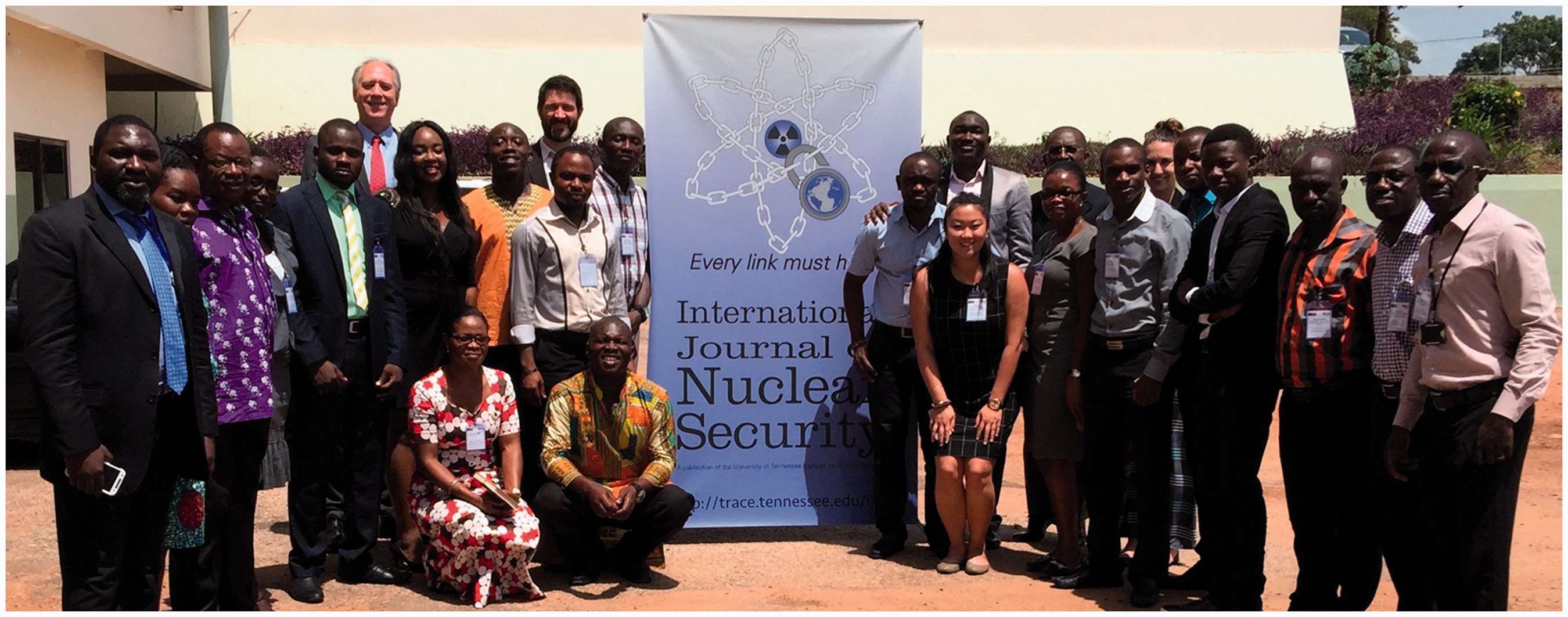
Foy (left), Hirst (tallest), students, and participants of writing workshop in Accra on campus of Ghana Atomic Energy Commission, 2016.
Scope and Audiences
In this article, I do not examine political or cultural reactions to the spread of English. My orientation matches that of international professionals I’ve met over the years: It’s vital clearly to communicate with one another, so there’s a huge gain in having a common language. That language, for now, is English—so it benefits us all to get good at it. I don’t assert English is superior, as a linguistic system or vehicle of thought or moral medium, to other developed languages. I don’t survey the spread of English over the face of the globe with any sense of its divine right to do so. But I recognize the reality that, due mainly to the economic and military power of the United States during the past century, and also of Britain reaching back further, English has been, is now, and looks likely to be in future what we can call a common world language—in widespread professional contexts.
Also, despite my references to English as a global language, I do not provide historicolinguistic accounting of global English, or Englishes. For that sort of treatment, I recommend the popular British linguist, David Crystal, especially his book English as a Global Language (2003). Many regions of the world and many cultures have appropriated and adapted English, shaping it for their contexts, cultures, and times. This is a normal process for languages in general; it’s how they change and evolve, as Crystal shows. But for my purposes, I refer to English in the sense of a standard language for global communication about science, technology, commerce, and diplomacy. Even though there is no single English language, I reference English used internationally, for the purposes just stated, as a global or standard English—the English designated as official by the United Nations, the International Atomic Energy Agency, and so on.
I realize that by referencing and endorsing a standard English, I’m neglecting to examine the vast terrain of linguistic, cultural, and political complexity associated with this idea. For example, if one looks at the differences among English as a lingua franca, English as a foreign language, English as a second language, English as an additional language, English for speakers of other languages—and any number of associated acronyms—one begins to reference these complexities and varying philosophies and agendas. And clearly, the phenomenon of International Auxiliary Languages—constructed languages (“conlangs”) such as Interlingua, Esperanto, and Ido—are reactions or proposed solutions to the problems not only of “foreign language learning difficulty,” but of political/cultural power and favoritism associated with using natural languages such as English, French, or Arabic as common languages. Although all these topics are important, I am here focusing on my topic of “Writing, in English, for Publication in Science and Technology,” shared as pedagogical practice with fellow educators in scientific and technical communication, and addressed primarily to international professionals.
It is actually my acquaintance with such international professionals that emboldens me to take the stance toward global/standard English that I’ve just described. These professionals are scientists, engineers, diplomats, agency leaders, and educators working in nuclear security, safety, anti-terrorism, and nuclear nonproliferation. The strong sense I get from them is that of a shared mission, an extremely important one: the survival and prosperity of the human race. In terms then of their attitudes toward using English as a common language in their collaboration to save and prosper humanity: Whatever reluctance or resistance they might feel is overcome by the importance of their shared mission. They remind me of Renaissance natural philosophers (scientists), from multiple countries and language contexts, using New Latin as a common language in order to share their knowledge with each other while pursuing their goal of expanding scientific knowledge, for the benefit of all humanity.
A final item of scope: Although in this article I do reference vocabulary while explaining and endorsing principles of plain language for use in scientific discourse, I don’t unpack the large topic of specialized English vocabulary for use in writing about nuclear science, security, and safety. The International Atomic Energy Agency (IAEA) and the International Nuclear Security Education Network (INSEN) continue to develop glossaries/guides for such terms, 9 and we see emerging in them some of the linguistic and professional complexities of the sort I’ve mentioned—but again, expanding upon this specific topic is beyond the scope of my article. What I’m delivering here is a more general explanation and guide in a particular genre of writing, in English, for international discourse in science, technology, and policy.
So, in writing my article, I’ve had in mind the two audiences I’ve now referenced: academics (and their students) reading English-medium journals about professional communication, like JTWC—and also internationals working in nuclear security and safety. At this point, having introduced my topic to the former audience and suggested why it might interest them, I transition to addressing the latter audience while inviting the former to listen in on my application of rhetorical principles and academic best practices for international scholarly discourse in science and technology, with special application to the fields of nuclear science and security.
The challenge of linguistic complexity
E2s, you use English extensively in your professional lives, but it is not your native language in the same sense it is for those of us from the United States, England, Canada (most of it), Australia, and so forth. This poses challenges to many of you as you reach toward the acme of high-status publication in science: international, English-medium, peer-reviewed, scholarly journals—especially those emanating from Anglophone-center zones and receiving high scores for impact factor or journal impact factor, as defined and generated by another English-oriented entity: the Institute for Scientific Information. You are aware, no doubt, that most academic journals (over two thirds) referenced in major periodical directories, and nearly all science journals, use all or some English. 10
You face publication challenges for a range of reasons. First is the hurdle of linguistic sophistication: As if it weren’t challenging enough to contribute new material to global conversations about science, technology, and policy, you must do it in a language that has not, in your intellectual history, received your full linguistic attention. The mental energies of your language development have necessarily been divided. Although this division of intellectual energies helps you in important respects—such as your ability to access information in multiple languages, your expanded international networks, and your deepened cultural understanding—it likely disadvantages you when it comes to the specific task of writing and publishing in English for global communication in your field. And this specific task, it turns out, is central to your professional success.
For a moment of compressed historical reflection, let us again ponder those Renaissance (and later) scientists to whom I’ve compared you. Your situation is more challenging, in many respects, than the scientific intelligencia of Europe in centuries past! Although they, like you, used a lingua franca, a common/bridge/trade/vehicular language, for exchange of scientific knowledge, their common tounge for such exchanges—Latin 11 —was a “dead language.” In other words, the common language for scientific exchange was not (as English is today) the live, native language of a fortunate, language-advantaged subset of the global scientific community. After the fall of the Roman empire in the west in AD 476, few people were growing up with Latin as their native, primary language. 12 For capturing Latin as an additional, scholarly language, advantage may have gone to those growing up with Romance descendant vernaculars, especially Italian(s)—but this advantage faded.
Are you perhaps thinking a genius like Nicolaus Copernicus had no trouble thinking and communicating in Latin as he shared with fellow scientific wizards his De Revolutionibus? Or Francis Bacon his Novum Organon, or Issac Newton his Principia Mathematica? 13 It does help if one begins learning a lingua franca early in life and increases its use as professional life expands. But for expressing thought that is sophisticated, consequential, and new? The intellectual energies of such geniuses were so vast as to offer a faulty touchstone to the rest of us as we ponder the phenomenon of scientific thinking and conversation transmuted—at a high cost of time and energy—into the gold of a common language for global discourse.
The challenge of publishing internationally, in English
Beyond this linguistic and intellectual challenge for E2s looms the complex terrain of global academic publishing, with all its networks, interests, and boundaries, and its western, Anglophone-based methods of evaluation and status, its makeup of literacy/language facilitators and academic facilitators. This scenario is well described in the book Academic Writing in a Global Context: The politics and practices of publishing in English (2010) by Theresa Lillis and Mary Jane Curry. Lillis and Curry describe how the vast majority of E2s, when seeking to move their writing into publication for global exposure, use native Anglophone (E1) facilitators of some kind—“brokers,” they call them. Such brokers/helpers/gatekeepers/facilitators can be visualized along a spectrum (my summary diagram, Figure 2), with the language helpers at one end and the academic helpers at the other. If we also regard this spectrum as suggesting time to publication and author satisfaction with text published, it’s clear you want to enter the line as far as possible from the language brokers, and as nearly as you can to the academic brokers: From people at the language end, E2 writers seek language-level help: grammar, mechanics, style, word choice, correctness, transitions, tone, and so on. There is no shame in seeking any of this; seek as much of it as you need! But if you follow the guidelines I’m about to describe, you won’t need to be so near the language facilitators. You’ll enter the scenario at a point much nearer the academic facilitators.

Text facilitation for internationals looking to publish in English.
At the other end of the spectrum, E2s seek help from E1 academic brokers, the most important being those in the writer’s specific scientific/technical fields, especially those connected with publication gatekeeping and status networking: journal editors, reviewers, educators, grantors, and prominent authors already published in their fields. At this end of the spectrum, E2 scholars are seeking guidance about larger issues: the methodologies and content of their work, acceptability of their conclusions and claims, understanding of disciplinary terrain, introductions and doorways to publication opportunity, and even financial help. Here’s the bottom line: If you show up with well-written, well-structured, well-integrated English text, your interaction with academic brokers is greatly enhanced, and your text speeds toward publication and recognition on the global stage.
Wherever along the spectrum you are entering for needed help toward publication, you naturally want to maintain as much control as possible over your work. You want its meaning to be the meaning you have conceived and intend the reader to understand and appreciate. So, transmutation to English is an issue for you. You, like most scholars and professionals, keenly desire your words to be golden, not leaden. For this reason, more than because of cost, don’t you tend to resist translation services, at least for initial presentation of your work in the global conversation? To a large degree, translation means trusting others to express your ideas and contributions—and usually, those others are not fellow wizards in your field, and rarely are they intimates to your culture, your national and institutional orientations and commitments, etc. 14
There’s much more to be said about this complex scenario for academic publishing in English. For expanding one’s sense of it, I recommend authors like Lillis and Curry, and also Swales and Feak, and others with expertise in equipping internationals to communicate well in English. But the fundamental questions regarding publication success are already clear. You must ask yourself: Am I going to maintain the strongest possible grip for communicating my own work, the ideas defining my contributions in my field? How can I break in to the English publication brokering spectrum as closely as possible to the publication end?
As an E1 academic broker, editing an international, peer-reviewed, open-source journal in nuclear security, I offer the article you’re now reading as a guide to placing your manuscript as nearly as possible to the publication end of the spectrum. Follow the principles discussed herein, and you’ll maintain maximum control over your communication and also speed its delivery into the global conversation taking place via the world’s current lingua franca: English.
Writing Well for Nuclear Security
In this section, I present and illustrate seven guidelines for producing clear, effective writing about science and technology, focusing on nuclear security. Also, I argue that such writing is important in the global effort toward cooperation and security. Global nuclear security must remain a top priority and requires a great deal of international cooperation: sharing of ideas and resources, diplomatic negotiations, common missions. The enterprise is complicated, both technically and politically. We must not encumber ourselves with unnecessarily difficult communication.
My focus is production of excellent academic articles in nuclear security and policy, but the principles of effective writing serve all professionals working in science, technology, industry, business, and government. And although I’m now primarily addressing my E2 colleagues, the writing guidelines I’m now discussing serve E1s as well.
Expertise in communication, especially in writing, generally is developed through extensive study and practice, like most any other skill. But this is difficult to do when one’s curriculum and professional life requires extensive skill in mathematics, scientific method, and the enormous body of scientific and technical knowledge required in such fields. Add to this, as I’ve mentioned, the fact that internationals are doing most of this work and study in what is to them a second or third language, or at least a linguistically complex academic and cultural environment, and we begin to see the challenges such professionals might face in producing writing that competes successfully for publication in the international arena.
In my experience, E2s working in a field such as nuclear security benefit from communication guidance given by professional communicators and educators. Their need is at least twofold: They hope to improve their ability with professional use of English generally, and they want to understand more about the conventions of writing and of publishing their work in English—in scholarly venues, particularly. This is true whether or not they are academicians. They all recognize this sort of publication as conducive to being fully involved, contributing, and appreciated members of the international community working in nuclear security and policy.
My position as editor of the IJNS, published in English, allows me to look closely at drafts of materials being produced by internationals working in this field. This is what alerted me to the communication needs of this community of scholars, and the Ghana writing workshop was an early instance of an effort to help address it. A year later, having reshaped and expanded that workshop material while focusing on academic writing, I spoke 15 at headquarters of the IAEA, at the annual conference of the INSEN. My topic was “Writing about nuclear security for academic journals.” At the INSEN conference, I found my audience of scientists, engineers, policy makers, and educators very receptive to the topic. Some of them approached me after the presentation with requests to visit at their universities and other organizations to continue teaching about clear writing. Since full-time duties at my own university will not accommodate most of the travels requested, I offer here the core material from my presentation, adjusted and expanded into a journal article.
The guidelines given here lead to good academic articles and will place one’s manuscript near the publication end of the spectrum I described earlier. I’m confident this is true no matter what field of science, technology, or policy you are in, but the examples I use to explain and illustrate these guidelines are geared to my original audience: educators and professionals of all kinds in nuclear security and policy.
Guidelines for Producing Excellent Academic Articles
Chances are greatly enhanced for having your work published in nearly any academic journal in science, technology, or policy when you follow these seven guidelines:
As you write, think of yourself as engaged with peers in a widespread and important professional conversation. Contribute something new to the conversation in your field. Argue for the validity and value of your ideas, using strong evidence and good reasoning. Use all the standard parts of an academic article, in a connected narrative. Use a clear, readable style. Show how your ideas relate to those of others in your field. Submit your article to a good journal in your field, then revise based on feedback from reviewers and editor/staff.
Let’s unpack these guidelines.
As You Write, Think of Yourself as Engaged With Peers in a Widespread and Important Professional Conversation
A journal article is a kind of extended professional conversation. The “conversation” idea is both literal and metaphorical, and communication scholars have been making good use of it for a long time, as I’ve noted. Let’s apply it now to what we’re doing as we write an academic article for international publication.
In institutions of higher learning, we mean something specific when we refer to an academic article. The most useful, rigorous category in this form of communication is the scholarly, peer-reviewed academic article. Authors of such articles have worked hard, using best practices in their discipline, to generate, structure, and express the knowledge they want to share. They have researched thoroughly, using good methodology, and they have synthesized and interpreted their data accurately and intelligently. They have then formulated their conclusions into compelling arguments and discussed the significance and implications of their arguments. They have mapped out a Big Picture of their field of study, and they understand where their contribution fits in to that picture. Their articles thus become integrated, important parts of the conversations going on within the community of professionals who are working with them as everyone explores the terrain.
A scholarly, peer-reviewed article gets published only after recognized experts have reviewed the work, interacted with the authors to further refine it, and rendered professional judgment as to its worthiness to be disseminated into the general professional conversation in the form of a scholarly article published in a particular journal. The article then becomes a permanent part of the worldwide discussion in its field. And it continues to generate knowledge in an extensive network of scholars and professionals.
To have one’s contributions to the scholarly conversation disseminated in this way is not only extremely useful to the network of readers—it is also a significant endorsement thereafter carried by the author or authors of the scholarly article. It indicates their status as generators of important knowledge and as skilled presenters of that knowledge to the community of practice.
Although a good academic article is addressed primarily to a particular community of practice, it is also accessible to a broader audience. And it is timely, presenting current and significant information. That presentation is highly structured; it announces its shape, orienting and guiding the reader. It is well crafted, accessible, efficient, and interesting. A good academic article is also carefully researched—but of course it doesn’t unload everything the researcher knows! It provides just the right amount of detail to accommodate the needs and interests of fellow professionals—and to deliver its arguments well supported by evidence and reason. It is just the right size and treatment for its rhetorical mission. It is one of the most welcome and useful contributions you can bring to the professional conversation.
Contribute Something New to the Conversation in Your Field
We stay current with research and innovations in nuclear security by talking with professionals in the field, by being active at conferences, and by reading relevant publications. Talking about your research opens new ways of thinking. You may discover research that was unknown to you. Attending conferences puts you in touch with the right people with whom to discuss your research. But nothing beats reading a variety of publications, especially journals—which usually contain more current information than books do—to gain a deeper understanding of what is going on in the nuclear security world, and of how your work fits in to the broader professional discussion. Reading widely in nuclear security is one of the most important things you can do while deciding what you can add to the professional conversation. It’s hard to know what’s new if you don’t know what’s already there, and (anticipating Guideline 3 as well) it’s hard to know how best to present your research unless you learn how others in your field are arguing for their ideas.
At academic conferences, for example, we have a great variety of conversations with each other. Some conversations are one-on-one over coffee or dinner. Many more include larger numbers, perhaps among regional groups or members of working groups. We have planned conversations, scheduled as meetings, and spontaneous ones, out in the hallways and so on. Conversations happen via spoken words, in near proximity or at a distance, or written words in e-mails, phone texts, or other forms. All these modes of conversation have their value, but a journal article is a particularly high-quality form of our extended conversations.
Conversations important to the field of nuclear security are going on in a variety of journals. You are familiar with any number of journals containing in their titles such words as Nuclear security, Non-proliferation, Nuclear materials, Strategy, Science, Policy, and so on. But our conversation extends into many other areas—education, for example. An excellent example of an important nuclear security-related conversation going on in such an area was written by Matthew Moran and Christopher Hobbs of King’s College London; it appeared in 2017 in the British Journal of Educational Studies. Its title is “From Communities of Interest to Communities of Practice: The Role and Impact of Professional Development in Nuclear Security Education” (Moran & Hobbs, 2017). In this article, Moran and Hobbs show how the professional development courses they and colleagues have conducted in various international settings have impacted the field of education and training in nuclear security, helping extensively to advance the field from a Community of Interest to a robust Community of Practice. That community has become an active interdisciplinary network of educators, trainers, scholars, scientists, consultants, engineers, government representatives, agency personnel, and others engaging each other in pursuit of their shared enterprise in nuclear security education and training, and spreading nuclear security culture.
The three hallmarks of a Community of Practice, as Moran and Hobbs describe, are mutual engagement, shared mission, and shared “repertoire” (90–91), meaning “routines, words, tools, ways of doing things, stories, gestures, symbols, genres, actions, or concepts that the community has produced or adopted in the course of its existence” (E. Wenger, Communities of Practice: Learning, Meaning, and Identity, 1998; cited in Moran and Hobbs 91). Our practice of engaging with each other by writing journal articles, wherein we present our research and perspectives and further develop our shared repertoire, is one of the most important ways we strengthen and spread the nuclear security community of practice. It is a key element for accelerating what Moran and Hobbs call the “irreversible momentum” (p. 92) of our community.
So again, we ask ourselves: For a journal article in nuclear security and policy—a document serving as a vehicle for high-quality conversation within this community of practice—what constitutes something new? It is important to realize that everyone working in this field has new and valuable things to contribute to the conversation. The field is itself so new, with so many developments and new actors, that there’s a great deal of newness available. New can mean new theories and discoveries in the sciences, such as nuclear forensics, or new descriptions of problems, dangers, and possible solutions—along with their implications for nuclear security policy. IJNS, for example, asks authors always to discuss policy implications for their contributions, no matter what the subject.
New can also mean innovations in training, be it new collaborations and programs or new training technologies. It can mean being first to describe scenarios relevant to nuclear security in particular countries, professions, or organizations, and it can also mean challenges to opinions or claims being made in all these contexts. Here, for example, are some of the contributions we have published in IJNS
A new pathway to enhance the global nuclear security regime: lessons learned from Southeast Asia Ukraine at the fulcrum: a nuclear house of cards Nuclear power: black sky liability or black sky asset? Addressing the tunnel threat at nuclear facilities Improving nuclear safety, security, and nonproliferation in Northeast Asia Modern advancements in postdetonation nuclear forensic analysis
All these articles contributed something new to the international discussion about nuclear security, and they did so in the form of good, well-structured arguments. The nature of good arguments is the topic of the next guideline:
Argue for the Validity and Value of Your Ideas, Using Strong Evidence and Good Reasoning
A scholarly argument does not simply present information, as in, for example, a catalog description of a college curriculum or of a standard decontamination procedure. To argue, in a scholarly sense, means to present a claim about something of interest to an audience and then to support that claim with evidence, analysis, reasons, examples, details, demonstrations, and so on. A good argument does these things in a structured, well-illustrated way that makes the author’s claim or claims “clear and bright”—hence, convincing—within the minds of the people it addresses. This is the literal meaning of the English word “argument.”
In the earlier referenced Moran-Hobbs article, note how often the authors make clear, important assertions, such as “Empirical evidence gathered as part of an effort to gauge the impact of train-the-trainer PDCs reveals that this approach has been highly effective,” and “[this] approach has made a substantial contribution to the development of a sustainable, international nuclear security education community, committed to infusing the next generation of nuclear experts with an understanding of nuclear security and its complexities” (p. 104). These lines appear in their conclusion, but they came also, in similar wording, at the beginning and at other junctures of their article, often signaled by such phrases as “this demonstrates,” “empirical evidence reveals,” and “we will argue.”
Hobbs provides another good example of a clear, well-developed argument is the article he wrote along with Elizabeth Young, and published in IJNS: “Calling all actors: A holistic framework for tackling supply-side proliferation” (Hobbs & Young, 2015). This is the sort of helpful two-part argument wherein the authors claim: Problem X exists, and Y is the solution.
Here is their abstract, which not only posits problem and solution but also reveals the structure used to support their claim: This article proposes a new holistic framework for tackling supply-side proliferation, based on a mix of punishments, incentives, and new normative standards (PIN) that could be taken by industry. After outlining a brief history of illicit nuclear trade, highlighting the increasingly sophisticated strategies adopted by proliferators, we explore in detail the PIN framework. We argue that to meet this challenge, industry must adopt behavior that goes beyond compliance with current regulations, particularly in the area of due diligence and information sharing. (p. 17)
After presenting this clear description of the problem, the authors can now effectively present the major part of their contribution, their solution to this problem: “A holistic PIN framework [a system of
This is a good example of the kind of contribution and treatment sought by journals in science, technology, and policy. The Hobbs-Young article makes a clear assertion about something that can improve global nuclear security—and it puts that assertion into the context of a worldwide discussion about a problem: the inadequate participation of industry in the mission of nuclear security. The article then proposes a solution, arguing for it in a structured, well-illustrated way.
Is the proposed solution 100% “new”? Maybe not if we say, “It’s long been known that we need industry to participate more conscientiously and voluntarily in nuclear security.” But what made the Hobbs-Young article new, and a valuable contribution, was their particular explanation of the problem, the quality of their voices and engagement with it, and their clearly structured argument for the solution they propose, complete with a memorable acronym for encapsulating the solution: PIN—punishments, incentives, norms. Hobbs, Young, and Moran are excellent conversationalists in the international discussion about nuclear security. They contribute new things to the professional conversation, and argue for them—in a clear, structured ways.
What I am doing in this article is simply following the pattern of communication topics as outlined in any number of ancient manuals on speech making. I have discussed the rhetorical purpose, audience, and context for the kind of communication we’re interested in creating: academic articles about nuclear security. Then I discussed Argumentation. Next, I will address the topic of Arrangement (organization) and then move on to Style. A great deal has changed for humanity during the past three millennia, especially in terms of our astonishing technological developments—but the principles of effective human communication have remained much the same.
Use All the Standard Parts of an Academic Article, in a Connected Narrative
Speaking of classical wisdom: in his Poetics, 16 Aristotle asserted that every drama must, to form a whole, have a beginning, a middle, and an end. In Rhetoric, he applies this to speech-making as well. Aristotle, like the communication theorists who preceded and succeeded him, was talking about the fact that a speech should first prepare listeners to receive knowledge, then deliver it to them, then conclude by reinforcing the significance of the information and (often) urging people to take action. Does the shape of a modern-day academic article appear anything like a classical drama or speech? Yes, indeed.
Here are the principal components of an academic article:
Title page Abstract Introduction Body (headings, subheadings) Conclusion Works cited Author’s bio and contact information
Some journals may require additional parts, such as a keywords section after the abstract, and some may allow additional sections, such as an expanded list of resources following works cited, or an acknowledgements section near the end of the article. But the parts listed earlier are the main ones.
Applying Aristotle’s three-part scheme to the elements of an article generates the following groups:
Title page
Abstract
Introduction
Body (headings, subheadings)
Conclusion
Works cited
Author’s bio and contact information
This seems obvious, but many article writers struggle with this outline—especially when it comes to making a good beginning and a good ending. Yet in academic articles, as in orations, it is important to use all the proper parts and to get the most out of their function. Let’s consider the functions of all parts of an article.
• Provides the title of the article, revealing the topic and the author’s treatment/question/contribution related to the topic, while engaging the reader’s interest.
So: you must create a readable, informative title with a “hook.” As example, which of the following two titles is most readable and interesting? A New Technological Platform to Detect Environmental and Health Related Substances with Endocrine Disruptor Activity on an Industrial Scale: Using Supercomputing in an Integrated Experimental and Virtual Approach
or Using High-Performance Supercomputing to Find Endocrine Disruptors: A Fast Track to Discovering New Medicines and Protecting the Environment
The title page also provides:
• Author(s’) name(s) and affiliation(s).
For these lines, list the authors in order of contribution to the article, along with their institutional/organizational affiliations. This creates the hierarchy that allows us to reference an article’s “first author, second author,” and so on. Note that order of contribution normally means listing the authors in the order of who did the most work on the article or put the most significant material into it. However, the relative seniority and prestige of authors may also influence the order in which they are listed, especially in some particular fields of science, technology, and policy. All this is entirely up to the authors themselves; journal editors will respect the order of authorship presented to them. Certainly, we are all aware of cases where it appears a senior person is in some degree taking credit for a junior person’s work, and this itself is a valid topic in the professional conversation—but it is beyond the scope of this article.
The abstract of an academic article allows you to orient your audience in a number of ways:
Provides the scope of what the article intends to communicate Gives background information pertaining to the generalized area of study States key objectives of the performed research and research purposes Announces the author’s thesis and main supporting arguments
For example, here’s the abstract from the Duchene-Hall article “Addressing Imbalances in US Nuclear Economic and Nonproliferation Policies,” which appeared in IJNS. It manifests all the functions of a good abstract: Foreign civilian nuclear start-ups have an increasing number of international partners capable of supplying fuel cycle technologies. The desire to prevent the spread of dual-use enrichment and reprocessing technology by asking partner states to rely on international fuel markets is a major obstacle for US negotiating civilian nuclear trade agreements, leading to delays. US participation in emerging nuclear markets is being undercut by foreign competition, leading to decreasing economic competition and influence in international nonproliferation issues. It is therefore necessary for the US to reinvest and complete its domestic nuclear fuel cycle and modify its process for implementing civilian nuclear cooperation agreements with other states. By reducing delays in negotiations, having a larger stake in the uranium fuel supply provided to international markets, and outlining a clear waste policy, Washington will advance both its economic and nonproliferation goals. (Duchene & Hall, 2015, p. 97)
Introduction
The word “introduction” literally means “lead/draw in.” Your article’s introduction is your opportunity to provide history and context, to reveal the scope and methods of your research, to reference dissenting voices, even to tell stories, if that seems effective. All this serves to lead the reader, smoothly and helpfully, into the main body of your discussion. This is its function. Another of our ancient friends, Cicero, said that the introduction to an oration is like the porch or entryway at a mansion; the porch serves to prepare guests, coming to an event at the mansion, for the activity inside. Yes, the abstract also begins to prepare the reader in this way—but it is a quick snapshot and distillation of the entire contents of the social event in the mansion. The introduction, the porch, is bigger and more discursive. It goes much further toward preparing readers to understand and appreciate what they are about to experience. The introduction:
Primes readers to relate a specific research area to the greater scope of the generalized area of study Introduces research to the reader in greater detail, communicating how the performed research relates directly to the subject/hypothesis/problem Explains author’s methods of evaluating the subject/hypothesis/problem More fully states the author’s main arguments
And by the way, although you may use the heading “Introduction” to label your introduction—and some journals may even ask you to do it that way—an introduction need not really be labeled “Introduction.” The reader knows that the lead-in to an article follows the abstract. Personally, I prefer a more interesting heading than “introduction.” For example, the heading that Hall and Duchene use to introduce their “Addressing Imbalances” article is
Body
Examples of introductions and of body text are too lengthy to examine here—excellent examples are available in published issues of all the journals I reference—but by way of continuing our discussion of “parts,” functions, and connectivity:
The body of the article is the main discussion of the research performed by the author. It is the longest part of the article, and the most demanding upon the reader’s attention. But that demand upon the reader’s mental energy is greatly reduced when the author:
shapes the body material according to helpful patterns and combinations of patterns—such as Least to Most (as in least to most effective shielding against some kind of hazard), Familiar to Unfamiliar, Old to New, Dangerous to Safe, and so on and
What might such abundance look like? Here are the headings—just the major headings—in the lead article appearing in IJNS volume 2(3). The article is “Nuclear Power: Black Sky Liability or Black Sky Asset?” by Dr. Sherrell Green of Advanced Technology Insights (Greene, 2016).
Just glancing at this heading scheme, we get an excellent sense of this article’s information architecture. And we like this; we like to locate things and to know where we’re going. Green’s headings locate our subject (nuclear power as an element of the U.S. electrical power grid), then signal an upcoming story to help us imagine a black sky event, then continue our meditation about how nuclear power might figure in dealing with such an event—and so on. The headings are signposts for our mental journey as we consider how nuclear power might best become the desired Asset, rather than Liability, in black sky scenarios. –The U.S. Grid is a System of Systems –Imagining a Black Sky Event –The U.S. Grid and Nuclear Power’s Place In It –U.S. Grid Recovery During Black Sky Events –The NPP’s Initial Response to a Black Sky Event –The NPP’s Long-term Black Sky Response –Today’s NPPs Are Black Sky Liabilities –The Potential Value of NPPs Under Black Skies –Current Nuclear Industry and NRC Posture With Respect to Black Sky Events –Formulating “The Question” –A Framework For Addressing NPP—Black Sky Issues –A Word About Risk
Conclusion
As Green demonstrated, you don’t have to name your final section Conclusion any more than you have to name your beginning section Introduction. We know where the beginning and end are because of the way you have assembled your article. All the parts of academic articles must be there and must effectively serve their purposes, but for the most part you may label them in the ways you think will be most useful and interesting for your audiences.
In the conclusion of your article, the main things you must do are:
Restate your research, hypothesis, methodology, and subsequent results, reminding readers of the overall context of the conversation. Reinforce in the minds of readers the importance of your research and your findings, and the rightness of your subsequent assertions—your arguments! Call for further research and any other needed action.
The conclusion is your article’s final punch. You have done a great deal of work, preparing your reader to accept the validity and importance of your ideas. Now, don’t waste this opportunity: drive home your arguments, leave your reader in a state of strong agreement and enthusiasm for your ideas!
Here is an example of such an exciting, effective conclusion, again from Green’s “Black Sky” article. I present his conclusion in chunks, each prefaced with a line of commentary from me:
gestures to the broad picture and places his topic in its context
Reliable access to electricity is a key enabler of modern life and the foundation of all other Critical Infrastructures. The Grid is the “machine” which generates, stores, and delivers this electricity.
asserts, with emotional force, the importance of his topic
The U.S. Grid is vulnerable to a number of natural hazards and man-made threats that have the potential to cause Black Sky Events—blackouts of extraordinary geographical scale lasting for weeks, months, or even longer.
recaps the major areas his article has addressed and calls for further research
Embedded within the U.S. Grid are almost 100 commercial nuclear power reactors. This paper has addressed two levels of relevant NPP Black Sky issues: (1) The behavior of the interconnected “system of systems” that is the coupled physical infrastructure–human infrastructure world in which Black Sky Events would evolve and (2) the role of nuclear power plants in Black Sky Events. The role of NPPs in Black Sky scenarios is largely unexplored territory . . .
summarizes the specific insight/solution/contribution he is making to the professional conversation
Internal to the NPP lies an asset that would be of extraordinary value during Black Sky Events if the NPP and the Grid could be modified to access it. An NPP might have as much as 24 (full power) months of fuel in the reactor at the start of a Black Sky Event. When compared with the onsite fuel inventory at a coal-fired electrical generating plant (typically 30–60 days), or gas-turbine plants (hours to perhaps a few days), the NPP’s nuclear fuel inventory could enable the NPP to become the foundation of a robust U.S. Grid restoration strategy.
recaps the challenges surrounding his insight/solution/contribution and again states the significance of his idea
This benefit can only be realized if the plant could endure the Black Sky Event without damage, run through the event or restart in the midst of Black Sky conditions, synchronize with the Grid, reconnect to the Grid, and run as required to match voltage, frequency, and (real and reactive) power demands. This could be an enormous societal benefit during a time when all Critical Infrastructures are compromised and virtually all resources are over-subscribed. NPPs could become nearly ideal Black Start Resources (“Units”) and an enabler of Grid resiliency—if these functionalities could be achieved . . . —next, the author briefly outlines practical recommendations for implementing his ideas, then: finishes strong, with an interesting, inspiring statement: Every day, as we go about our lives, the nation’s nuclear power fleet quietly provides enormous benefits to society. A Black Sky Event has the potential to disrupt life as we know it. Can nuclear power be the key to protecting society from the ravages of Black Sky Events? We can and should move promptly to address this question. (pp. 20–23)
Connecting the Parts
So, if you create all these sections for your article, and they all serve their functions well, and you have provided helpful headings for sections and subsections—then you have a well-mapped article on your hands. Your readers will love this clear signaling and coherence. Headings, as I said, are like guideposts for us as we travel in intellectual terrain. We want such signs, and we want them presented to us in the form of a route, a connected series of signs showing us a path to travel. Probably all of us like to go to new places with knowledgeable guides, who connect and explain things, like a guide taking us through an art museum and explaining about, say, 19th and then 20th-century impressionist art. They say as we walk with them from one big room to another, Now that we’ve seen how 19th-century impressionists gave birth to a new form of visual art, we’ll look at how 20th-century artists further developed this form, especially as they applied it to impressions of human development in science, technology, and politics.
Writers of good academic articles use abundant transitional words and phrases to show the reader how all the parts and ideas in the article are related to each other. This creates what we call “cohesion” in the text, literally a “sticking together.” If the writer does not provide the glue, the reader has to try and do it—and this is exhausting. Which of the following versions of this paragraph best shows logical connectivity? The contractor is still operating in two shifts. Cleared debris is now being piled. No burning at all is being permitted. The continued dry weather has produced extreme fire hazard conditions. No power equipment is permitted to operate when the relative humidity is below 20%. The contractor is still operating in two shifts, and cleared debris is now being piled. Even so, no burning at all is being permitted, since the continued dry weather has produced extreme fire hazard conditions. Not only is burning prohibited, but no power equipment is permitted to operate when the relative humidity is below 20%.
Since logical connectivity is so important, just about every handbook of writing provides categories and lists of transitions such as the following. Good academic articles are rich with such terms:
Use a Clear, Readable Style
The science, technology, and policy related to nuclear security can be complex, but this does not mean that articles about nuclear security must be dense or difficult to read. Rarely, if ever, do journal editors or reviewers or other readers wish to read dense, difficult prose. Everyone prefers clear, interesting writing that does not needlessly exhaust mental energy. Here are a few techniques that promote clear, unburdensome writing:
Not:
The new radiation detectors were used.
But rather:
IAEA inspectors used the new radiation detectors.
Not:
But rather:
Nearby residents
Not:
Use of the previously employed program has ceased due to the fact that at this point in time the new program had been prepared and a decision has been reached to initiate that program.
But rather:
We stopped using the old program because we were ready to launch the new one.
Not:
Unless influx from contaminant sources is remediated at upstream points of entry in expedited fashion, all Ranidae and Bufonidae in the aqueous and riparian habitat will be eliminated.
But rather:
Unless we quickly stop contaminants from entering upstream, all frogs in the river and toads living near it will die.
Not:
Decision makers for the government agencies involved in studies of the area engaged in a process for determining the impact of environmental conditions on the health of the flora and fauna in the wetlands outside the boundaries of the ORR. (11 prepositional phrases)
But rather:
Government officials studied how environmental conditions are affecting wetland plants and animals
My free, online style tutorials, at http://www.russelhirst.com/home/lesson-one/, explore additional techniques for clear writing and provide more explanation and examples. These techniques apply to all kinds of professional writing, including the entire field of nuclear security.
To see the kinds of improvements such techniques can bring to writing in nuclear security, let’s apply them to something we’re familiar with and consider to be a particularly important document: the Treaty on the Non-Proliferation of Nuclear Weapons (NPT). 18
The NPT is extraordinarily important, and many professionals in nuclear security and policy work with it all the time. For example, many attend the NPT preparatory conferences and the recurring 5-year conferences, engaging in all manner of discussions, plans, debates, reports, collaborations, and studies in connection with it. It is a high-use, high-value document, seminal to ongoing global efforts in nonproliferation. Should it not, then, be as readable, accessible, and stylistically helpful as possible? Clearly, it should be; unfortunately it isn’t.
The NPT’s first sentence is 490 words long, so let us examine instead a more manageable chunk of the treaty. Here is Article 3.1: Each non-nuclear-weapon State Party to the Treaty undertakes to accept safeguards, as set forth in an agreement to be negotiated and concluded with the International Atomic Energy Agency in accordance with the Statute of the International Atomic Energy Agency and the Agency’s safeguards system, for the exclusive purpose of verification of the fulfillment of its obligations assumed under this Treaty with a view to preventing diversion of nuclear energy from peaceful uses to nuclear weapons or other nuclear explosive devices. Procedures for the safeguards required by this Article shall be followed with respect to source or special fissionable material whether it is being produced, processed or used in any principal nuclear facility or is outside any such facility. The safeguards required by this Article shall be applied on all source or special fissionable material in all peaceful nuclear activities within the territory of such State, under its jurisdiction, or carried out under its control anywhere.
NPT Article 3.1, Stylistically Revised
Every non-nuclear state signing this treaty may use nuclear energy for peaceful applications, but it agrees not to divert nuclear energy to nuclear weapons or other nuclear explosive devices. In order to verify compliance, each state agrees to subject itself to a safeguards procedure conducted by the International Atomic Energy Agency. The procedure will focus exclusively upon compliance with the promise, by all states signing the treaty, not to divert nuclear energy to weapons or explosives of any kind. The exact procedure will be negotiated and officially established, according to IAEA statues and its safeguards system. The system will track and account for source or special fissionable material being used for peaceful purposes within the territory of each state—or under its jurisdiction, or carried out under its control anywhere. This includes all such material whether it is being produced, processed, or used in any principal nuclear facility, or whether it exists outside any such facility. 20
Wasn’t that easier to read? And did I miss anything? If I did, international lawyers will let me know. We are all aware that legal language, especially treaty language, results from long, expensive, deliberate negotiations by top-level government leaders and experts. Very often, long periods of heated debate and negotiation go into particular choices of words and phrasing. But the kind of style I am promoting is based on universal goals of good communication for the world of work and scholarship. If we are going to use a common language to think and share and negotiate and work together—then we should value clarity, readability, and accessibility 21 above traditions of stately or ceremonial language.
As scholars working together in nuclear security or other fields of science, technology, and policy, we judge writing to be good if:
Sentences are unburdensome to read Terms are used consistently Meaning is clear Ideas are connected and explained Content and significance are interesting and memorable
And, in our international context, we add:
Text is as unproblematic as possible to translate.
[This last point is distinct from my advice to “Avoid dependence upon translators to render your scholarly work into English; be your own master of English.”]
These are worthy goals for all writing in the field of nuclear security, whether for treaties, academic journals, books, procedures, specifications, letters, or anything we may write. I think I may speak for a wide range of journal editors and reviewers when I say we smile upon these stylistic graces appearing in any article submitted to us.
The next guideline is related closely to guidelines 1 and 2, which urge authors to think of themselves as engaged in a widespread scholarly conversation and to focus on contributing something new. The following guideline reminds us to use, in scholarly writing, a grace that might come naturally to us in face-to-face discussions—the art of directly engaging with what others are saying:
Show How Your Ideas Relate to Those of Others in the Conversation
You may have noticed that I did not deal with the Works Cited section of articles in the context of my Guideline No. 4, “parts of an article.” Surprise! I saved it until now, because I want to give it a particular kind of treatment, and it deserves a section of its own.
At this point, let’s not worry about specific citation requirements of different style guides. Every journal will let you know what citation scheme and footnote/endnote scheme it requires. Let us simply consider the general philosophy of engaging, in writing, others whose publications you have found relevant and important in your own work.
Remember, a good manuscript submitted to an academic journal is something that has been written as a contribution to a worldwide scholarly conversation about nuclear security. So the author or authors of a good, engaged article must show they are familiar with the contributions being made by the international community of scholars and professionals working in their field. One important dimension of doing so is citing and referring to these scholars and their works to show how your own ideas are related to the ideas and contributions of others in the field. Again, this is a form of connectivity, of coherence, which we crave and need for intellectual health.
A good conversationalist in any scholarly field will often use phrases such as those below when referring to the published words of others—whether directly quoting or paraphrasing those words: –According to Wilson of IAEA, –As Wilson puts it, –In Wilson’s view, –Wilson maintains, –Wilson is absolutely correct when she says, –Wilson seems to agree with me when she writes—ETC. –In other words, Wilson believes __________. –In making this comment, Wilson argues that __________. –Wilson is insisting that __________. –Wilson’s point is that __________. –Wilson acknowledges that __________. –Wilson is alarmed at the tendency to ______. –Wilson celebrates the fact that ________. –Wilson complains that __________. –Wilson concedes that __________. –The essence of Wilson’s argument is that __________.
As Harris describes them, moves are such things as “forwarding” and “countering,” each being doable in multiple ways. I borrow the following words from Chapters 2 and 3 of Harris’s book—and then use his ideas to illustrate the effectiveness of a passage of writing in nuclear security:
Illustrating: when you look to other texts (or other forms of media) for examples of a point you want to make. Authorizing: when you use the expertise of another writer to support your argument. Borrowing: like authorizing, but not just a brief quote. You will summarize and explain an idea from the original author in more detail to not only support your argument, but also advance it. You don’t have to agree with the other author’s whole argument, just the pieces you need to help you with yours. Extending: This is like borrowing, but going one step further: taking an idea you agree with and tweaking it to make it your own as well. Think of extending as acknowledging the merit of the original author’s idea and then substituting your own terms or ideas to broaden the range of meaning (pp. 39–40).
Arguing the Other Side: showing the usefulness of a term or idea that a writer has criticized or noting problems with one that she or he has argued for. Uncovering Values: bringing up a word or concept for analysis that a text has left undefined or unexplained. Dissenting: identifying a shared line of thought on an issue in order to note its limits. In order to do this, you must first establish that consensus exists (pp. 58–68).
Let’s consider what writing in the field of nuclear security education might look like when employing such techniques, and I again hold up the Moran-Hobbs article as exemplar. The following passage is 272 words in two sequential paragraphs; I have broken up the sentences for purposes of illustration: A recent study by Gambetta and Hertog . . . gave robust empirical grounding to the link between aspects of vocational education, particularly engineering, and Islamist terrorism (Gambetta & Hertog, 2009). The work of Gambetta and Hertog builds on a broader body of scholarship that has ‘found evidence of a positive correlation between level of education and militancy both among Islamic and left-wing radicals’ (202). [ Yet, this focus on the role of education in the causal equation of extremism, whether violent or non-violent, represents only one aspect of the academic debate. In this broad area of terrorism, there is another strand of literature that explores the role of education in preventing or countering extremism and otherwise strengthening security, as well as trends that have emerged around this theme. [ Gearon, for example, offers a useful insight into the ‘counter terrorist classroom’ with a critique of the ‘use of religion in education for political and [ . . . ] security purpose’ (Gearon, 2013, p. 129). At a more practical level, Cozine’ s study of the extent to which game-based learning can enhance comprehension and support the development of critical thinking on terrorism and homeland security courses provides a good example of the diverse ways in which the academic community is trying to understand and engage with this fluid and rapidly evolving relationship between education and security (Cozine, 2015, p. 367). [ Broadly speaking, it is to this preventative dimension of the education–security nexus that our research seeks to contribute, by adapting the concept of CoP to the nuclear security context and using this as a means of exploring recent, innovative efforts to promote nuclear security education. (4)
When you are satisfied with the engagement of your article, and with its arguments and evidence, and with the way you have shaped it, connected it, and styled it:
Submit your article to a good journal in your field, then revise based on feedback from reviewers and editor/staff
Here are some of the journals sustaining our professional discussions about nuclear security, safety, and policy: – The Non-Proliferation Review—Strategic Analysis – European Journal of International Security—Contemporary Security Policy – Journal of Nuclear Materials—Journal of Nuclear Materials Management – Journal of Science & Global Security—International Journal of Nuclear Security – International Journal of Nuclear Energy Science and Technology
Given the flexibility of digital publication, some online journals, like IJNS, have gone to a Continuous Publication Model. This means that when your article has passed completely through the process of review, author revision, and editorial revision/checks, it will be published right away on the journal’s website. 22 It will then be compiled into the upcoming issue of the journal, when all the other submissions for that issue have also finished the process and have been published individually on the journal website.
It is good to find out as much as you can about the spirit and mission of a journal, and the nature of the conversation they are hosting, before submitting your work to it. Don’t stop at looking up “journal impact factors.” At the very least, read the “About this journal” or “Mission of this journal” links on the journal’s website. Ideally, you should seek beyond this by perusing articles in various journals for at least 5 years back, and look for what’s on display in the conference rooms and hallways at conferences you attend. If there are any conference sessions featuring presentations by journal editors: attend, ask questions, meet the editors. Also talk with colleagues about the journals hosting those threads of professional conversation most relevant to you.
Now an analogy: When you attend a professional conference, you have paid (travel, room, meals) for the privilege of being physically present to listen to your peers and to engage in focused conversations with them at a high level of relevance—and usually, you have made a monetary contribution to support the operation of the conference. By the same tokens, there is usually a fee associated with journal conversation as well, at least in science and technology. Most journals in these areas do charge a page fee for publication, as a way of generating funds to support the journal. As you would for conference attendance, look to your institution, and to grant opportunities, to cover this fee.
Finally, never submit the same manuscript to more than one journal at a time. If you become dissatisfied with the length of time a journal is holding on to your submission, you can always communicate with the editor about it and then withdraw your manuscript if you feel things are not moving fast enough. You are then free to send your manuscript to a different journal. But simultaneous submission is a disservice to the editor, staff, and volunteers connected to any journal—people working hard to provide a platform for your high-level professional exchange of ideas.
Conclusion: Scholarly Articles, in Well-Written English, Are Vital to International Conversations in Science, Technology, and Policy
Publishing clear, readable scholarly work in any field of science, technology, or public policy is a highly important contribution to the international community working in such fields. My article has focused on the relatively new field we broadly call Nuclear Security. The global conversations taking place about nuclear security and safety, nonproliferation, and antiterrorism are vital to our world’s survival.
The international community working in these areas uses dozens of different languages, but most journals in nuclear security and policy publish in English. Although users of Chinese outnumber users of English, 23 the premier language for international exchanges and cooperation in science, technology, commerce, and diplomacy remains English. In addition to English and Chinese, the other official languages of many large international organizations, such as the United Nations and the World Health Organization, are French, Russian, Arabic, and Spanish—but even in such organizations, English serves as the most commonly used language. English is the official or at least de facto language of about 60 countries—two dozen on the African continent alone—and of thousands of international agencies and organizations, such as the International Atomic Energy Agency. However, official language does not necessarily mean native language, or highly skilled control over a language—and frankly, in all countries, including the United States, Britain, Canada, Australia, and the other core English-speaking countries and territories, advanced skill in English eludes many scientists, engineers, and technologists. Certainly, such professionals are highly educated, and they do tremendously important work; They are the practical intelligentsia of our planet. But their impressive knowledge and ability does not always include great skill as communicators.
For this reason, I have compiled, organized, connected, and conversed with you in this little treatise about writing English-language articles that are clear, unburdensome, and effective. I am not a linguist, and I am fluent in only one language besides English, and that is Spanish. So I cannot say with authority that all the advice I have offered here, about writing articles in the “common language” of English, applies entirely to written work on scientific/technical subjects in other languages. However, I can say this much: Writing is thinking on paper or computer screen—and although human beings using different languages and proceeding from different cultures may differ in some aspects of thinking, they also have much in common. For example, we all like patterns rather than chaos. We do better with well-mapped architectures of information than with “data dumps.” We realize, at least later in life, that we can learn important things from other humans by communicating with them. If we are civilized, we like to know what other people believe, and why they believe it—especially if those beliefs are about things we ourselves are also trying to understand.
Finally, humans don’t like to do unnecessary work. Mental work is hard enough already. We want to apply as much of our minds as possible to the solutions, inventions, collaborations, inspirations, and opportunities of our lives; the words we read and hear and speak are means, not ends. 24 If you follow the guidelines I have discussed in this article, your ideas will enter the professional conversation in the least burdensome, most impressive ways. This will make your voice welcome, important, memorable—everything good you want it to be.
The forum for professional conversation that I have helped create expresses its mission this way: The International Journal of Nuclear Security was launched in 2015 to fill the need for an open, international, scholarly discussion about nuclear security issues and insights among scholars, students, practitioners, and experts from academia, government, industry, and the private sector—as well as from the intelligence, military, and law enforcement communities. This journal supports international and interdisciplinary collaboration. We invite and value contributions from every kind of discipline, professional, student, and scholar of every country interested in promoting and maintaining a world secured from nuclear aggression and illicit use of nuclear materials, while supporting a world enriched by the proper use of nuclear technologies.
25
International colleagues working in nuclear security: I know you share the mission of IAEA and of IJNS. I share with you this article because I’m confident that the well-crafted, scholarly conversations in which you are involved will be all the more effective when you follow the guidelines herein discussed. Wherever I hear your scholarly voices, in any number of venues, I very much look forward to our continuing discussions and work dedicated to keeping the world safe from nuclear accident and nuclear aggression—and prospering it through peaceful uses of nuclear science and technology.
Footnotes
Declaration of Conflicting Interests
The author(s) declared no potential conflicts of interest with respect to the research, authorship, and/or publication of this article.
Funding
The author(s) received no financial support for the research, authorship, and/or publication of this article.