







Abstract
Many collections of keyword essays include the term technology, but less attention has been paid to the genealogy of the word technical. Because it is often used to describe specialized knowledge, the term can also imply a separation between knowledges. This essay reviews the Oxford English Dictionary alongside several keyword collections to show how the word technical is a marker of division between binary knowledge formations, in particular, specialized/general, theory/practice, and mind/body. This distinction, I argue, makes possible political renderings of the term that can hide violence within what is often considered to be neutral language.
Introduction: Violent Findings in the Oxford English Dictionary
During the fall 2024 semester, I asked introductory technical writing students to investigate the term technical by reviewing its entry in the Oxford English Dictionary (OED). After teaching the course for several years, I started to wonder if I could actually explain what the word meant and how technical writing might be different from other forms of writing. When questions like this come up for me, I often rely on Freirian, student-centered notions of meaning-making, and so I tasked students with treating the term as a keyword and its definitions in the OED as a set of data (after all, the OED is listed as a “database” on our library website).
For context, most of the students in this course are majors in engineering, and I often ask them to look at language as a form of data because “data” is a familiar, ethos-carrying term for them. The reverse is also true in that I encourage students to view data as a kind of language that is always in the process of being interpreted through its conditions of possibility. The OED itself can likewise be considered an example of technical writing. It includes codes, abbreviations, and specialized discourse alongside stylistic features like lists, numbers, and dates. It organizes information with negative space and does not rely on paragraph formatting. At least, these are some of the surface-level elements that I first think of when I think of the word technical.
Inspired by the keyword approach in the work of Raymond Williams as well as in the series of keywords anthologies published by New York University Press, I asked students to cite evidence from the OED's entry for technical with two goals in mind: to find the most familiar definition, one that might match the learning outcomes for our course, as well as the “weirdest” or most unfamiliar, one that might add to our understanding. For context, I explained to students how Williams (1983) examined the biological definition of the word culture and its implications for how cultural practices might grow or spread (p. 87). Similarly, archaic, rare, and obsolete uses of a word can reveal other dimensions, or perhaps genealogies, to more common and contemporary uses. It follows, then, that our class discussion that day led me to the central questions and thesis for this essay: How is the word technical defined in the OED, and how is it represented in keyword collections? In examining those sources, I found that technical can have two overarching uses not explicitly stated in its listed definitions: (1) a pejorative use that describes a form of practical knowledge, or sometimes jargon, that is separate from generalizable knowledge like concepts and theories; and (2) a euphemistic use that claims neutrality while hiding, erasing, or obscuring truth, accuracy, and the value of human life.
Students generally agreed that definition 2.a. fit the course outcomes: “the specialized use or meaning of language in a particular field” (Oxford University Press, n.d.). This notion of “specialized use” in the OED is also an example of what Michel Foucault (2010) has defined as a discourse, or the idea of “discourse itself as a practice” (p. 46). Students in this class are typically familiar with the idea of a discourse community and that communication in one field of study might be different from that of another, at least at the level of STEM and the humanities. This definition, I think, is a useful starting point for considering how the word technical can be used to describe a knowledge separate from other forms of knowledge.
The first “weird” or unexpected definition students identified was a 1939 entry that shows the word technical being used to describe “a textile or fabric” (3.d.). Pointing students to how the OED cites evidence for its claims, we looked at how this meaning contrasted “specially designed technical textile fibers” with those considered “fashionable.” This distinction seems to represent a value judgement as well between “technical” and “fashionable.” Students were a little surprised but not very interested in this particular use. Although we were not familiar with this meaning, it is not obsolete or archaic (3.d.).
The entry that students found most surprising was the fourth and final definition of the term, and it stood out initially for two reasons: technical is used as a noun, and its oldest reference was only 1992: 4. Usually in plural. Originally and chiefly in the context of the conflict in Somalia in the early 1990s. 4.a. 1992: A jeep, pick-up truck, or similar vehicle with a machine gun or other armament mounted on the back; spec. a converted nonmilitary vehicle of this type.
The class consensus was that this use of technical as a noun was surprising, weird, and even alarming. I told the students how it reminded me of George Orwell's (1946/n.d.) essay, “Politics and the English Language” and the problem of neutral or euphemistic discourse. On the subject of euphemism and politics, Orwell writes, “political speech and writing are largely the defense of the indefensible … Thus political language has to consist largely of euphemism, question-begging, and sheer cloudy vagueness” (p. 9). On its surface, I don’t think my students or I would have assumed the word technical could represent a form of “political language” or that it could be used as a euphemism. It does not immediately standout as a figure of speech, and definitions of technical generally do not imply a “cloudy vagueness.”
If definition 4.a was surprising to us, we were particularly troubled by definition 4.b., also from 1992: “A combatant who rides in a vehicle of this kind.” What stood out to me in particular was how with just the one word, this instance of military discourse collapses the machine and the human in a way that erases life from the equation. If a technical is targeted, then the implication is that any presence of life is secondary or without consideration.
The term technical, which denotes exactness and precision, is used in this case to remove specificity. In its effort to disguise reality, it shows itself as a term of political discourse. Because it conveys neutrality, but is here used to erase life, it also enables, to use Orwell's phrase, “the defense of the indefensible.” A kind of discursive dialectic also arises from this use of technical: it not only collapses the notions of a human being and a military vehicle into one, vague object, but because of the term's other uses, it simultaneously declares that object to be precise and specialized, to represent expert knowledge in factual terms. Technical communication scholars McKenna and Graham (2000) cite Horkheimer and Adorno to note a similar collapse, or an “abridging and compressing” of meaning that can be enabled by technical or scientific knowledge (p. 247). In this way, a term like technical becomes a kind of “neutral sign for itself” (Horkheimer and Adorno, 2002, p. 17). To put it another way, the military use case of technical proclaims not to be a euphemism while being a euphemism.
I examine the word technical in support of two corresponding claims. One claim is that contrastive and pejorative uses of technical represent a division of knowledge, such as that between specialized knowledge (or jargon) and general knowledge. The other claim is that the implied neutrality of the term technical can obscure its political dimensions and therefore hide violent outcomes, such as in its military application. These arguments are developed through close-reading and discourse analysis to show how certain applications of a discourse make possible other iterations of that discourse (Foucault, 1994), or for instance, how the term's appearance of neutrality enables its military application. I extend that idea to what bell hooks (1994) describes as the “mind/body split” (p. 135) to show how the division between technical language and generalizable knowledge also makes possible uses of technical that can separate and combine knowledge in ways that mask violent ends and erase the presence of human life.
The idea of one discourse making another possible can be found in Foucault's (1994) observations on language: “The truth of discourse is caught in the trap of philology. Hence the need to work one's way back from opinions, philosophies, and perhaps even from sciences, to the words that made them possible” (p. 297). For the word technical, its uses as an adjective to denote a separation between different types of knowledge predates its use as a noun in the military sense. How one might lead to the other can be seen within the division itself. As hooks (1994) argues, a central problem for knowledge and meaning-making is the “mind/body split” (p. 135). That is, the “erasure of the body encourages us to think that we are listening to neutral, objective facts, facts that are not particular to who is sharing the information,” which has the effect of “denying subjectivity to some groups and according it to others” (p. 139). The reverse can also be true. An appeal to neutrality can obscure or make possible the “erasure of the body.” The noun use of technical as a military vehicle and its human occupant exemplifies such erasure. The body remains in the vehicle, but the two are collapsed into one neutral concept: a technical, turning the body into a part of the machine or a piece of information. It is this more general split denoted by the word that makes this violent “truth of discourse” possible. The division produces the collapse.
The following sections examine technical as a discursive technique for concealing political discourse, first in a review of keyword anthologies, then in how scholars have traced the term to the rhetorical concept techne, then in a feminist analysis of connections between technical and the mind/body split, and finally in an example of human rights discourse. This essay concludes with suggested implications for teaching and further study.
The Absence of Technical in Keywords Collections
When it comes to the analysis of keywords, much of the attention in technical communication, composition and rhetoric, and cultural studies more broadly has been on the term technology and its historical relationship to political discourse with little attention paid specifically to the adjective technical. In their introduction to Keywords in Technical and Professional Communication, Yu and Buehl (2023) explain some of the difficulties in identifying keywords that might be repeated too often or are “too broad for useful description” (p. 15).
Yet as an adjective, technical carries a lot of intellectual weight as a descriptor of things both technological and beyond. For instance, Langdon Winner's (1989) landmark text, The Whale and the Reactor, argues that “technical things have political qualities” and “can embody specific forms of power and authority” (p. 19). While technology has always had a political dimension, this claim has remained a controversial subject in public discourse because technical knowledge is presented as detached from other kinds of knowledge. Winner extends politics to “the design or arrangement of a technical system” and “how seemingly innocuous design features” can “mask social choices” (p. 28). From a Black feminist perspective, hooks also analyzes systems but more specifically how bodies are embedded within them. Some bodies are forced to be in opposition to those systems while others benefit (p. 135). Although Winner's text provides useful arguments on how technology is entangled with political systems of power and oppression, it is important to include hooks’ insights into how those systems are simultaneously racialized, gendered, and classed.
In addition to close-reading the OED entry for technical, I surveyed 15 keyword collections:
the foundational text, Keywords: A Vocabulary of Culture and Society by Raymond Williams (1983); the University of Pittsburgh's Keywords Project (2016); the lineup of keyword anthologies from NYU Press (2014–2021); Keywords in Writing Studies edited by Paul Heilker and Peter Vandenberg (2015); Keywords in Technical and Professional Communication edited by Han Yu and Jonathan Buehl (2023).
In all, technical was never explicitly identified as a key term on its own. This is not necessarily a problem of oversight. Adjectives are not common subjects in keyword collections because they are almost always attached other words and so can be difficult to research. Technical occasionally garnered some attention on its own within essays about technology, but usually within a group of other words with the “tech” prefix. Therefore, I primarily examined keyword essays on technology, how the word technical might appear in those essays, and how those essays made the case that technology is often thought of as neutral but closer examination reveals its political dimensions.
Table 1 provides a summary of the examined collections, including one instance of technical as in technical communication. Because of the term's practical connotations, I also looked at keyword essays on the words skill and information.
Keyword Collections and Reviewed Essays.
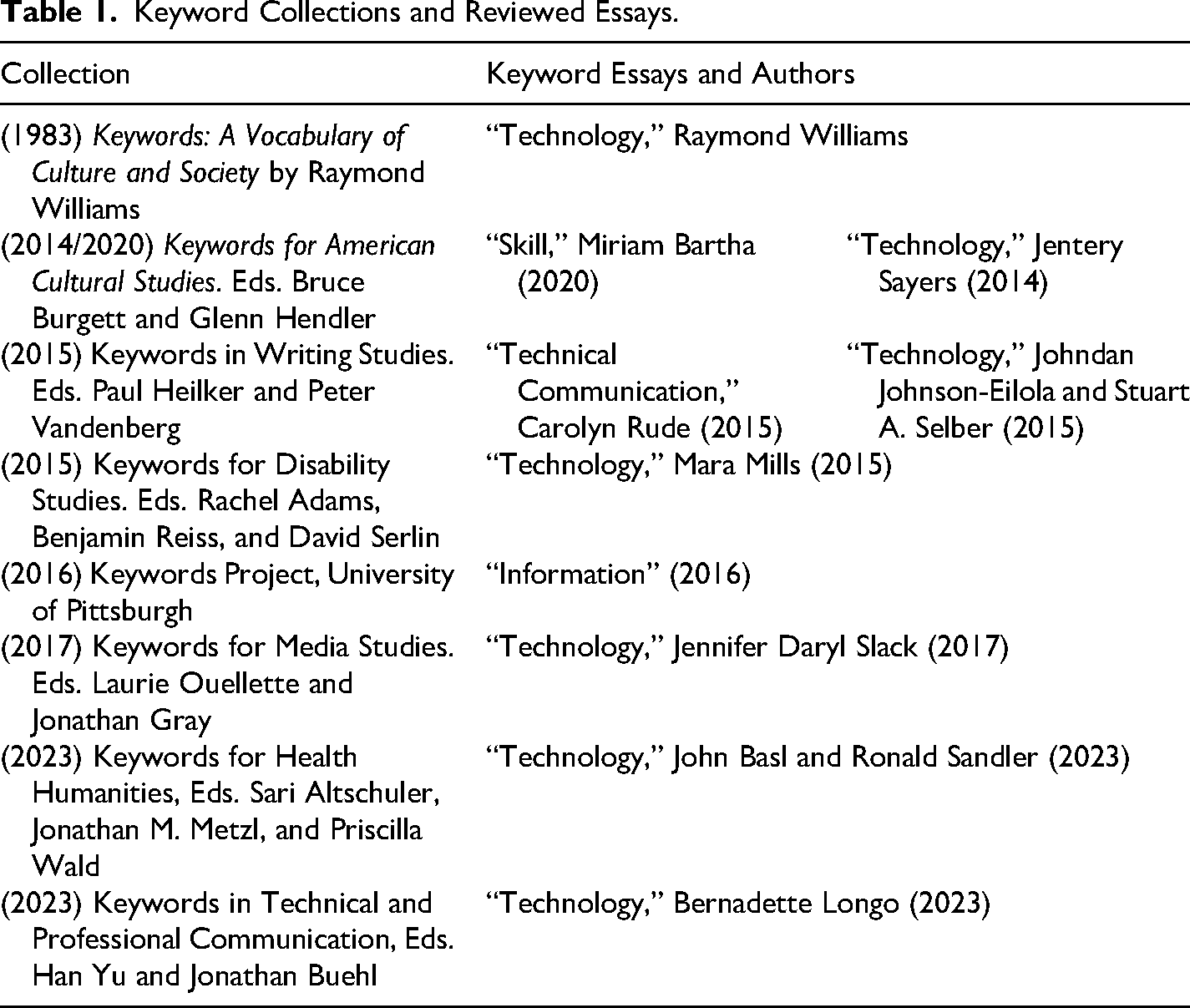
The only direct reference to technical as the subject of an essay is Carolyn Rude's (2015) keyword analysis of “Technical communication.” In this case, Rude focuses on technical communication as a discipline within writing studies and how it functions as a genre with some of its genealogical “roots” in engineering (p. 165). Rude points out a tension important to my own arguments: when the word is used to describe writing as instrumental, or a means of problem-solving, its “pragmatic nature” sometimes “raises questions about its intellectual substance” (p. 167). That the term invokes practicality and application often puts it in opposition to intellectual sophistication or broadly generalizable forms of knowledge, theory, and philosophy.
As Table 1 shows, technology gets a much more thorough treatment as a keyword across several disciplines and does not seem relegated only to the realm of practicality. Raymond Williams (1983), for instance, notes an “awkwardness” when it comes to adjectives, with technical used for “matters of practical construction” and technological representing more “systematic” applications (p. 315). Perhaps it is this connection to systematic knowledge that imbues technology with intellectual value whereas technical in its adjective form feels separated from or diminished by the noun it is used to describe.
Keyword essays also seem to describe an agency-technology dialectic wherein the relationship between user, technology, and culture can be muddled. Bernadette Longo (2023), for instance, identifies a “metaphorical need to place a device in the subject position of an active verb” (p. 298). That is, technology is grammatically framed as the actor with a passive or absent user. This points to a limitation in “defining a technology as both the human know-how and the object created by that know-how” (p. 298). The contradiction is that the human is active and passive at the same time. Similarly, a device signifies an object and an action. This pattern of confusing the thing and the person is one of the ways euphemistic constructions like the noun form of technical can stand in for both a military vehicle and its human operators or passengers.
In addition to this user–device contradiction, many of the reviewed keyword authors place their study within broader contexts of power relations. For instance, Johnson-Eilola and Stuart A. Selber (2015) examine writing as a form of technology. Referencing Foucault, they observe how structures of power “are the product of a sustained process of applying a multitude of tiny forces, writing in particular” (p. 169). This idea of “tiny forces” helps show how the subject and the object, the user and the device, operate within broader contexts of power relations, not just within or subsumed by systems and structures. Everyday technological use constitutes those power relations as well. It could be argued that the confusion between agency and technology is the very contradiction that reveals how those power relations are made possible and even maintained.
In addition to the term technology being contextualized within systems and structures, Jentery Sayers (2014) observes how technology also has “recursive and embodied relationships” with its users (p. 236). The military application of technical, wherein the vehicle and its operator are collapsed into one noun, erases this embodied relationship. Both are transfused into the same material. Citing Walter Benjamin's work, Sayers traces this problem back to how “totalitarian regimes … aestheticized their politics through references to technological innovation” (p. 237). The noun form of technical in this case, seems to fulfill a similar function, to erase the politics of the body from the aesthetic of the military target; the image of the truck subsumes the image of the body.
Rhetorical implications for technology and political discourse include Jennifer Daryl Slack's (2017) observation that the term itself often “closes off the possibility of argument” (p. 191). Its rhetorical ethos is such that it can be used “in mutually exclusive and even contradictory ways,” and “knowledge about technology … tend[s] to oversimplify and reinforce dominant conceptions of reality and relations of power (p. 192). Users, teachers, students, and researchers—that is, potential audiences for and users of the term technology—are confronted with an idea that seems in many ways unmovable, that its meaning is self-evident. As Slack argues, going beyond the surface of its many use cases can be difficult because of how the word technology oversimplifies its relationship to power. Like my initial examination of technical, this idea that technology can shut down deliberation shows how it rhetorically distorts its political dimensions.
Turning back to the word technical and its appearance in keyword collections, Table 2 provides examples of prominent noun phrases that include the word technical in the reviewed keyword essays on “technical communication,” “technology,” “skill,” and “information.”
Uses of Technical as an Adjective in Keyword Essays.
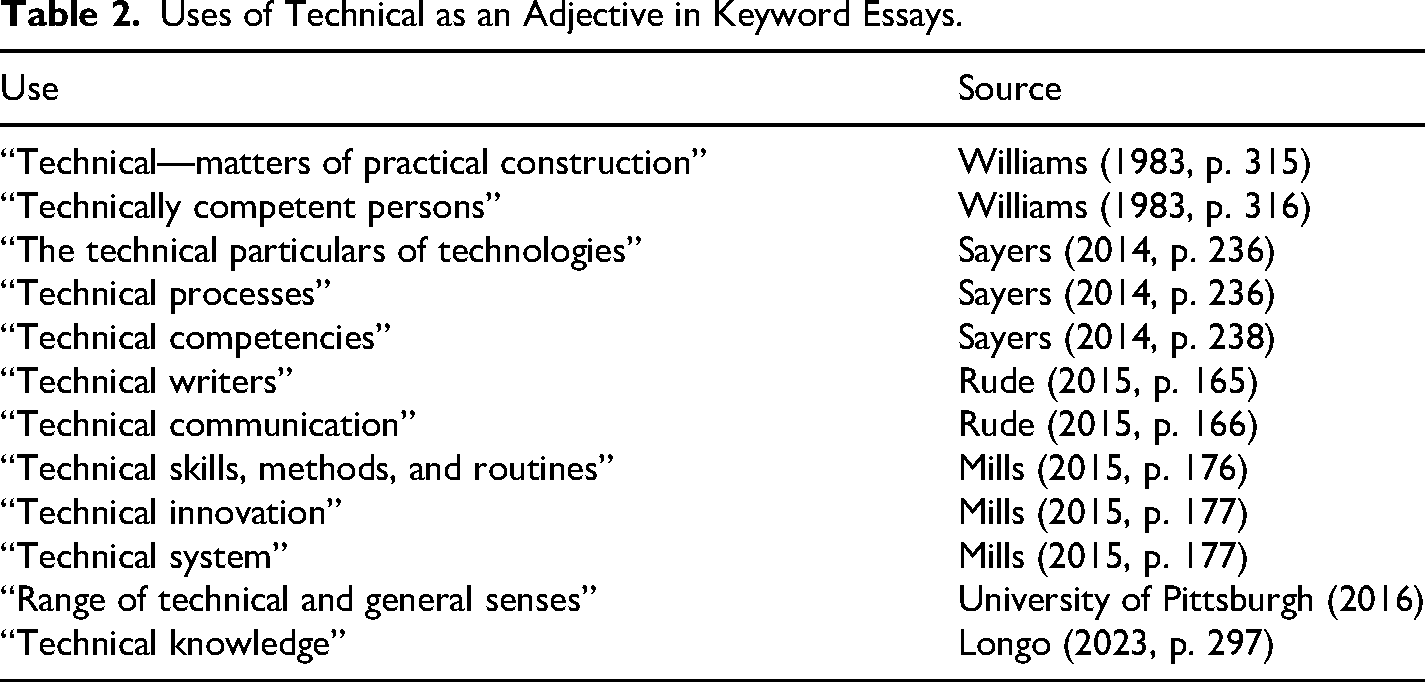
These instances of technical show a somewhat narrow range of uses, including familiar assumptions about practical application (“matters of practical construction”), specialized knowledge (“technical competencies” and “technical skills, methods, and routines”), and a form of knowledge distinct from generalizable knowledge (“range of technical and general senses”).
In this sense, technical knowledge reflects what Foucault (2010) refers to as connaissance, or “the sovereign unity of a subject, a spirit, or a period,” that is, disciplinary knowledge and specialized discourse (p. 191). Foucault contrasts connaissance with savoir, or knowledge which is “situated and dependent” (p. 183). An additional note in the Archaeology of Knowledge shows that savoir also describes the “conditions that are necessary in a particular period” that make connaissance, or disciplinary knowledge possible (p. 15, note 2).
Extending this scheme to the ways hooks (1994) describes the mind/body split illustrates the division between knowledge that presents itself as scientific, disciplinary, or rational and knowledge which is situated, conditional, or subjectively tied to experience and emotion. Technical knowledge certainly makes claims to pragmatic logic. But as writers of keyword essays on technology argue, the political dimensions of technology point toward the problematics of the mind/body split, that technology, its uses, and its effects should be thought of more in terms of an “embodied” knowledge, wherein the body of the user and the material of the technology are understood in relation to one another (Sayers, 2014, p. 235). Embodied knowledge reflects a unification of the mind and body that hooks argues is necessary for dismantling systems of oppression.
The Technical Virtue of Techne
The reviewed essays on technology often trace the term's relevance to the more subtle qualities of the classical notion of techne 1 . The Stanford Encyclopedia of Philosophy (Parry, 2024) introduces techne as a “craft or art” but also notes that this translation can oversimplify “some of our contemporary assumptions” about the distinctions between theoretical knowledge and practical experience. For instance, one contemporary view is that “pure theory is removed from ethical investigation” while lived experience and “the practice of living requires it.” This division, however, is not necessarily evident in the historical understandings of techne (Parry, 2024).
Keyword authors sometimes use the idea of techne to complicate assumptions about theory/practice or knowledge/experience binaries. For instance, in Keywords for Health Humanities, Johnl and Sandler (2023) observe how techne can indicate both an “object” and “practices” (p. 199). As a noun, techne can afford the adjective technical a more dynamic range of meaning than its contemporary uses. In his sprawling survey of classical rhetoric, Roland Barthes (1988) links techne to the politics of public knowledge and how, for Aristotle, techne could signal “what the public believes others ‘have in mind’” (p. 73). Barthes emphasizes techne as a kind of vulgar form of knowledge, or a discourse of practicality meant for a non-expert public that is unable to grasp sophistication and nuance. This is an interesting nuance since technical represents expert or specialized knowledge, but techne here puts more emphasis on pragmatic, everyday forms of knowledge.
Longo (2023) summarizes Aristotle's treatment of techne differently, as a “virtue” of “a good life” (p. 297). If a “person who had technical knowledge was virtuous, the product of that tekhne would result in civic good” (p. 297). These two interpretations of Aristotle's techne are not exactly opposite, but they do appear to reveal multiple dimensions to the concept, including multiple ways of thinking about techne, or technical knowledge, as a form of political discourse. From these reviews, techne complicates the division between theory and practice, even if it still implies some binary discord. That is, when techne is thought of as public-facing, it might also be considered a civic “good,” though perhaps and at the same time, without sophistication.
Of relevance to my own observations about how the word technical can hide violence within neutral language, Barthes’ review returns several times to the idea of euphemism and “enthymeme,” or those statements in which much is assumed or left unsaid. The Classical rhetoric category of “Explanation,” for instance, included “the necessity to euphemize, to evade the taboos” (p. 89), statements that might result, according to Barthes, in “a violent, disturbing force” (p. 55). This survey of Classical rhetorical traditions reveals a genealogical rationale for how a term like technical can shift in contradictory ways, from precision to euphemism. The ways the word can signify a practical, public discourse about belief might be one way it affords these other uses: a euphemism in which knowledge is omitted, like the human operator of a weaponized vehicle. In this complicated fashion, both virtue and violence germinate in the term's history.
Pejorative Implications of Technical for the Mind/Body Split
Returning to the OED, despite the neutrality suggested by the word technical, the references in support of its definitions show instances of contrastive, judgmental, and pejorative language. My review of the OED recognized a trend in which technical was indirectly used in a pejorative sense to critique either unskilled pragmatism, jargon, or surface-level knowledge. Like Barthes’ notion that techne could represent a type of unsophisticated civic discourse (1988, p. 73), the OED references imply a hierarchy between knowledge forms. In some instances, I was reminded of how Foucault (1991) described his work, The Order of Things, as “a very technical book that was especially directed at specialists” (p. 99). For scholars of technical communication, Foucault's statement about his own philosophical writing shows that what might be categorized as a technical audience can be as much a matter of opinion and judgement as a strict genre or discursive boundary. This might be why the OED textual citations are more qualitative than indicated by the dictionary definitions themselves.
I identified at least 17 references in the OED that considered technical to be jargon, surface-level, or even a clever trick of language. For instance, an 1896 example refers to writing that is “somewhat too technical for any one who is not a botanist,” and a 1927 example describes “unintelligible technical works” (2.b.). The 1896 reference compares technical knowledge with general knowledge, but this also appears to include a judgmental qualification with the use of the word “too,” as in “too technical” for general audiences. The second instance uses more sensational language, with technical equating “unintelligible,” a criticism that is often leveled at academic discourse as well.
Another pejorative use of technical that implies a value hierarchy relates to an “official” title or rule (OED 2.c. 1779–). Again, the definition appears neutral, but the references are more qualifying. In this case, they point to surface-level meaning, like in an excerpt about law and possession that refers to a “technical, artificial title.” A more contemporary reference related to social norms from 2008 contrasts a couple's “technical first date first” with “their first real date.” These two references point to technical as describing something as either artificial or nominal. It appears that in this case, a “technical first date” might not have been worth remembering as such.
These hierarchical judgements about language make space for a broader division of labor between what are perceived as valuable forms of knowledge and those deemed to be jargon or artificial. When used as a noun to describe a “person having technical knowledge or expertise” (n., 1.) the term ascribes value to different types of workers, revealing a problematic skilled/unskilled binary. The OED cites a 2002 excerpt from Software for your Head that shows how workers can be categorized according to the theory/practice divide: “Nontechnicals don’t feel qualified to discuss vision of any type with the technicals, and technicals feel constrained to imagine only things in the short term and the technical domain.” Not only are the spheres of knowledge for these workers articulated as distinct, but the workers imagined in this example also seem incapable or unwilling to communicate with one another about the knowledge they produce. They work within rigid disciplinary boundaries.
Such discursive boundaries and divisions are amplified by race, class, and gender. As hooks (1994) observes, a mind/body split is one of the ways class stratification can be identified, noting that those with the most power have “the privilege of denying their body” (p. 137). The kind of privilege the mind/body split makes possible is both systemic and institutional. For example, a gendered and raced division of labor can be propagated through the institutions and practices of higher education. In that regard, Donna Strickland (2001) illustrates how such divisions influenced the landscape of teaching, writing, and rhetoric to favor vocational training. Starting with the story of the Edison dictation machine, which enabled white-collar men in early 20th century, offices to speak their thoughts into the ears of women for quick and easy transcription (p. 457). Through technology, thinking continued to be fixated as a higher order form of knowledge than writing, which was thought of as a technical skill. In addition to revealing the value hierarchies of knowledge production more broadly, Strickland shows how the specific divisions illustrated by the dictation machine—between men and women, thinking and writing, the mind and the body—preceded other divisions, like those between high school and college, technical schools and 4-year colleges, and even between the subjects of introductory composition and literature (p. 464).
Divisions of labor that insist on regarding mind and body as two separate, stratified entities help reinforce the binary between so-called skilled and unskilled labor. Miriam Bartha's (2020) keyword essay “Skill,” for instance, examines the historical implications for how “managerial regimes sought to divide mental and manual labor.” That is, skill, like techne and technical, points to a range of knowledges that appear to differentiate between theory and practice. The idea of skill also shows how this division has been a technique for maintaining control over labor and production. Although it denotes a similar practicality as technical, another hierarchy is implied between the paradigm of skilled and unskilled labor, the former often associated with advanced education in theory, thinking, managing, or technology, and the latter often used in equivalence to waged or manual labor.
To address the mind/body split in this way is to revisit the idea of embodiment. In Keywords for Disability Studies, Mara Mills (2015) observes a problematic dialectic that complicates knowledge about bodies that is, in fact, disembodied. Mills writes, “the incorporation of ‘human factors’ into design gave rise to standardization technologies for statistically average users, excluding those with disabilities” (p. 177). Similar to how hooks (1994) argues that the “erasure of the body connects to the erasure of class differences” (p. 140), standardization, normalization, and exclusion of the body from knowledge production results in not just hierarchies of knowledge, but also hierarchies of life. Some humans can easily see themselves as privileged or ideal users of technology, while other humans can be erased or subsumed by it. In that regard, the pejorative use of the word technical seems to, at least in part, make possible its military use, where the vehicle and its operator or passengers are collapsed into one, neutralized and nonhuman, bodiless, military object.
Technically Violent Ends
In his landmark essay on the ethics of technical communication, Steven B. Katz (1992) examines a Nazi memo detailing military vehicle modifications. Katz observes how the memo was “technically accurate and logically argued” and how it employed “technical criteria as a means to an end” (p. 257). The Nazi memo, in other words, was an example of effective technical communication. At the same time, it documented and archived the ordinariness of the violence and horror of Nazi ideology. Like the final entry for technical in the OED that describes the word's use in American military discourse, human suffering is neutralized through the rhetorical appeal of technical knowledge. In the OED example, this occurs through a euphemistic collapse of the human and the mechanical. In the Nazi memo, Katz observes how the writer displayed “no concern that the purpose of his memo” was “not only to improve efficiency, but also to exterminate people” (p. 257). This pragmatic, means-oriented aspect of the word technical supports its appeal to neutrality, which allows descriptions like efficient, expedient, and effective to mask its violent ends.
Katz also points to a pejorative use of technical that implies a boundary crossed by the memo writer: “given the subject matter, we might wish to claim that this memo is too technical, too logical” (p. 257). In this case, technical suggests a focus so narrow and specific that it is removed from purpose and context. Katz proposes a counter-argument, that “most technical communication is deliberative,” and in turn, “much deliberative discourse is technical” (p. 261). So, although Katz illustrates how the narrowness indicated by the use of the word can erase a message's violent contexts, there is also an ignored tradition of complexity inherent in technical communication that might open possibilities for recognizing or exposing such violent intentions.
Katz's (1992) article was important for rethinking the terms of technical communication, informing scholars who have linked technical communication with social justice and anti-oppression. To separate the idea of the technical from notions of deliberation and dialogue reinforces the separation between form and content, the mind and the body, the practical, and the theoretical. It is the separation that makes possible forms of rhetoric that can appear practical, neutral, or “expedient,” but in fact carry the message and means of violence. To put it another way, narrow boundaries around divisions of knowledge make possible all kinds of violent ends out of seemingly technical means.
In an effort to provide my own example of technical use cases, I turn to rhetorics of human rights. I have recently examined reports published by the United Nations Global Compact (UNGC) that invite corporate actors to interpret and implement human rights discourse (see MacDonald, 2025). The UNGC is an international agreement on human rights and sustainable development boasting over 25,000 members; most are corporations, but some state and nongovernmental organizations have also joined over the compact's 25-year existence (see https://unglobalcompact.org).
The UN Global Compact strategy 2021–2023 report frames its appeal to corporate members as an imperative, using phrases like, “Now is the time” (2021, p. 3) and “There is clear demand” (p. 4). Uses of technical focus on the need to work with experts, like in these phrases: “technical expertise” (pp. 17, 28) and “technical partners” (p. 17). Most of these instances are broad and abstract, like in this example of how the compact guides members in adopting UNGC principles: “the Global Compact has built targeted technical capabilities and is helping business understand and integrate the Ten Principles into their business practices” (p. 15). From my understanding, “technical capabilities” could mean the assessment tools the UNGC uses to review member participation, which is actually member self-reporting. Annual memos are required that reaffirm a member's rhetorical commitment to the UNGC mission. Beyond that, many members mention the UNGC principles in their corporate responsibility reports.
A broad search for the word technical using the UNGC website search bar yielded the following results (as of December 10, 2025):
Communication on Progress reports, that is, the annual reports required of members, 12684; news items, 59; members with technical in the title of their business or organization, 49; instances of general web page hits, 36; event announcements, 6.
One way to look at these results more closely would be to examine the rhetorical strategies in the reports of one of the UNGC's largest, longest standing participants: BP (formerly British Petroleum).
One strategy BP appears to use in its appeals to human rights discourse is to depict the Global South as a special problem. That is, there seems to be a correlation between how the UNGC describes the importance of unique regional contexts and how members like BP develop specialized knowledge about countries and regions in order to defer the company's human rights responsibilities. Not surprisingly, this knowledge reflects a colonial logic of power. The UN Global Compact Strategy 2021–2023 report (2021), for instance, states that small businesses are essential for furthering its principles in “emerging economies, especially in Africa” (p. 5). Described as “Local Networks,” the UNGC explains why the “Global South” is an important area of the growth for the compact (p. 25). Colonizing logics shape not only how the UNGC implies that human rights is a unique concern for the Global South but also in how human rights can be universalized and expanded from a central authority.
For BP (2022), this kind of specialized knowledge can be seen in statements like this: “We operate in parts of the world where bribery and corruption present a high risk” (p. 5). Rather than talk about its own efforts to correct corruption internally (which is a specific goal of the compact, from what I can tell), the company takes a passive stance, that it is BP that is “exposed” to corruption, especially in certain “parts of the world” (p. 5). A contradiction between universalized human rights principles and the idea that some countries require specialized knowledge shows how a corporate UNGC member like BP can avail itself from confronting its own internal corruption or the impacts of its energy extraction practices. The stories BP tells about the places in which it conducts its operations are also examples of the role of narrative in technical communication, how sometimes narrative—important for resisting oppression—can also be used for oppression (Jones and Sackey 2025, p. 7).
Implications for Teaching and Further Study
In Teaching to Transgress bell hooks (1994) coincidentally uses the figure of Michel Foucault to illustrate the mind/body split. She notes how he wrote about sexuality and techniques of disciplining the body while his own subjectivity was largely absent from his writing (p. 136). Though it's a brief observation, the implications are important for knowledge and meaning-making because of Foucault's position as a white man who held prestigious and influential academic posts. The modes of writing and research privileged by that world were not things he necessarily challenged even while defying other institutional norms. And so when Foucault (1991) claimed his work to be “very technical,” he risked reproducing the problematic hooks outlines around the divisions between the mind and the body and between theory and practice. Examinations of these divisions of knowledge are, of course, extensive in the areas of feminist theory, critical race theory, and postcolonial studies, much of which has also informed contemporary scholarship in technical communication (notably, work coming out of the social justice turn, such as Walton et al. 2019). Adding the word technical to the equation can help show some of the forms those divisions can take.
Returning to my technical writing course, we made a Google Ngram for the word technical, and I asked students to brainstorm possible reasons for why it seemed more or less prevalent at certain times in recent history. Google Ngram is an interesting, if limited, tool for teaching. It shows clear, quantitative, visual data, but at the same time, any interpretation of that data would be loose correlation or speculation (Figure 1).
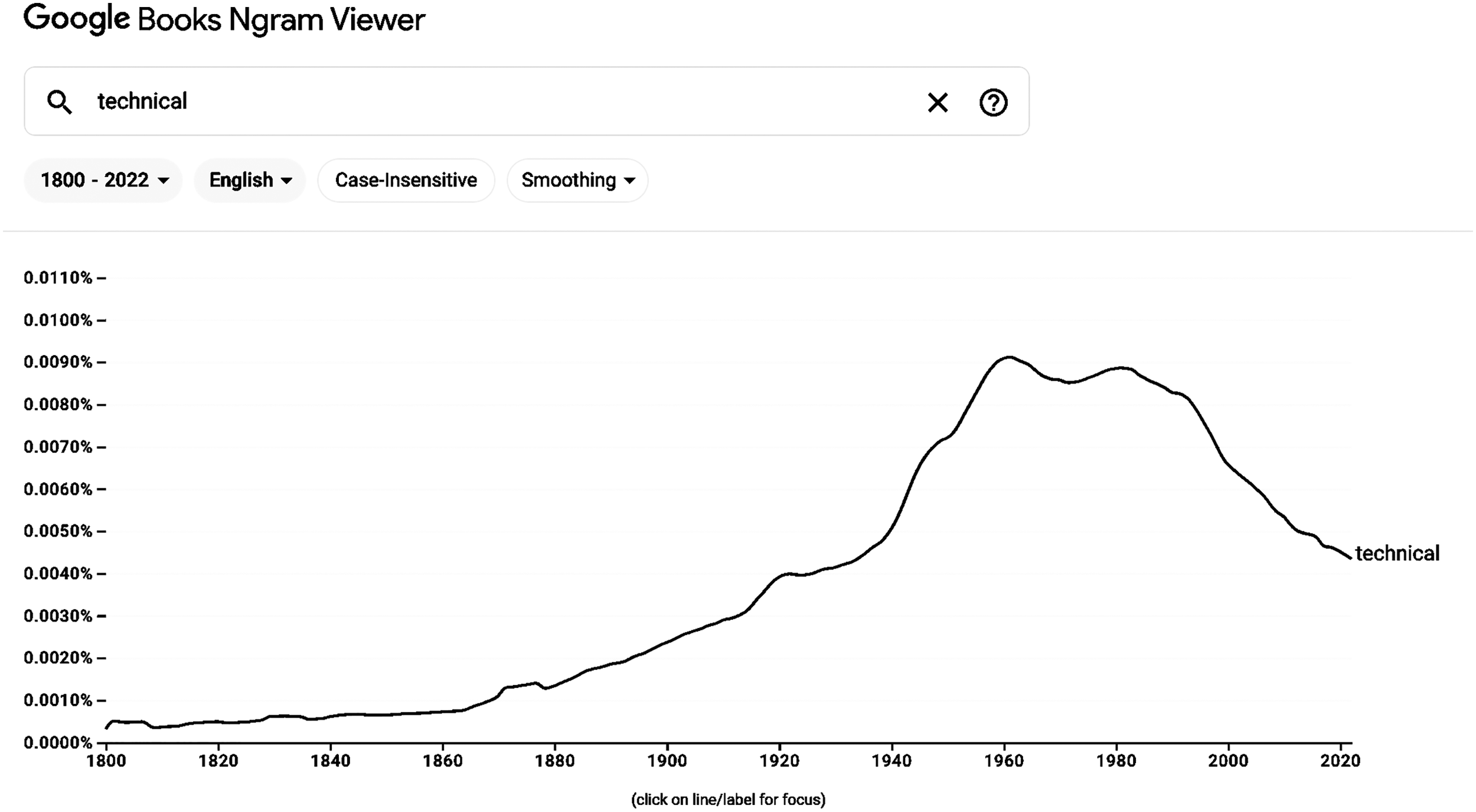
Google Ngram—technical.
The students discussed possible correlations for the term's appearance rising in 1940 and falling in 1990. Perhaps a rapid increase in technology post-WWII led to a surge in published manuals (a familiar genre to the engineering students in the class), and then around 1990, those manuals were likely put online for easy access and updating.
Other forms of the term technical can point to productive subjects for investigation. Technocrat, for instance, has gone through a shift in usage between the 20th and 21st centuries that can help teacher-scholars think about the relationship between politics and technology. In Williams’ (1983) keyword analysis, technocrat had previously been used to describe a ‘specific doctrine of government by technically competent persons’ that ‘was often anti-capitalist’ (p. 316). While also associated with the more pejorative idea of bureaucracy (p. 316), this anticapitalist dimension might be surprising to students, given that today technocrat is often used to describe the invitation to billionaires and technology companies to influence governmental processes.
Technical communication scholars McKenna and Graham (2000) have examined the implication of technocratic discourse for late 20th century claims about globalization. They argue that because technocratic discourse expresses an “apparent objectivity” (p. 224). It appears to “present itself ‘above the fray’ … free of all interests” (p. 225). As a result, technocratic discourse can produce a form of “governance-by obfuscation” (p. 226). Such critiques provide a guide for how to think critically about a range of problems, from defining the idea of the “international community” (p. 227) to the specific instance of the 2025 US administration efforts to implement a so-called “Department of Government Efficiency.” My own example of BP's membership in the United Nations Global Compact might also be a relevant example of this kind of technocratic hegemony.
Examinations of other iterations of “tech” or “techno” that have important implications for further complicating the genealogy of technical include what Jones and Sackey (2025) call the “sociotechnical,” which they frame within a detailed theorization of “security logics” in technical communication (p. 2). If the purpose of my own analysis in this essay has been primarily one of critique, Jones and Sackey outline strategies for intervention, including the idea of “advocacy via narrative” (p. 3). Narrative, however, can be a techne, or a tool, that can be used by both the oppressors and those who resist oppression, and so Jones and Sackey caution readers about the sociotechnical applications of narrative (p. 7). They draw attention to the impacts of sociotechnical systems on “lived experience” (p. 3), showing how narrative and experience can also be methods for working toward the idea of rhetorical embodiment discussed in keyword essays on technology.
In this essay, I do not argue that the word technical needs to be reclaimed in some fashion, though examining it in relation to techne can produce important nuance. Instead, I see the word as a marker of the problematic disentanglement of practice from theory, of rhetoric from action, of agency from structure, and of the mind from the body. What the scholars and teachers reviewed in this essay do argue for, though, is a reunification of those divisions, primarily through the notion of embodiment (see also Knoblauch and Moeller, 2022). The division that paradoxically allows for a collapse between a military vehicle and its human occupant might be reconstituted to allow the value of life to move to the forefront of discourses of power.
Footnotes

Funding
The author received no financial support for the research, authorship, and/or publication of this article.
Declaration of Conflicting Interests
The author declared no potential conflicts of interest with respect to the research, authorship, and/or publication of this article.