







Abstract
More than a decade has passed since the Travel Industry Association investigated adventure travel as a promising market. Despite growth in the adventure industry, studies of adventure travelers remain scarce, particularly in the identification of the psychological underpinnings of consumer adventurers. Mowen’s (2000) 3M Model of Motivation and Personality provided an organizing framework to explain the psychological roots of adventure tourism behavior. Self-administered questionnaires were mailed to a random sample (N = 1000) of National Geographic Adventure magazine subscribers with a response rate (n = 339) of 34%. Guttman Scaling Procedure was employed to categorize respondents in hard and soft adventure traveler categories as a context for understanding the demographic and travel behavior characteristics. The personality trait interest in cultural experiences was a consistent predictor of adventure travel propensity for hard and soft adventure traveler groups. The traits need for arousal and need for material resources were significant predictors for the hard adventure traveler group, while competitiveness was the other trait found to be a significant predictor for the soft adventure traveler group. Findings of this study enhance knowledge and understanding of the relationship between personality and tourism behavior.
Introduction
More than a decade has passed since the Travel Industry Association of America (TIA) investigated the topic of adventure travel. Results of TIA’s Adventure Travel Report (1998) indicated one-half of all U.S. adults (50% or 98.0 million) took an adventure vacation trip that included either soft adventure outdoor activities (e.g., camping, canoeing, wildlife viewing) and/or hard adventure outdoor activities (e.g., mountain biking, whitewater rafting, hanggliding). Among the nearly 100 million adults who had not taken an adventure trip in the past five years, one-fourth (28%) indicated they would be very or somewhat likely to do so in the next five years, suggesting potential growth of the adventure market. Although adventure travel has continued to be a growth market, research on the topic has remained stagnant.
Research on adventure travel has typically explored what tourists buy, as well as when and how they buy. The psychological forces directing these behaviors have not been adequately addressed (Sung 2000, 2004; Sung, Morrison, and O’Leary 1997). Existing research is descriptive, rather than predictive, and fails to identify the psychological underpinnings of consumer behavior related to adventure tourism (Swarbrooke et al. 2003). One of the recommendations for future research suggested by the Canadian Tourism Commission (CTC 2003) was the need for “in-depth psychographic analysis of geographically dispersed Americans by means of larger-scale American studies” (p. 9). A number of researchers have noted the importance of examining adventure tourism behavior from a psychological perspective (Brooker 1983; Cheron and Ritchie 1982), expressing the need to establish how factors such as personality characteristics affect behavior. Personality, as expressed in behavior and communication, affects travel and tourism (Fridgen 1991). Today, consumers are driving demand; therefore, understanding the underlying psychological and social dimensions that motivate consumers may offer the tourism industry insight into how to meet their changing needs.
Drawing on the personality literature found in consumer behavior (Kassarjian and Sheffet 1991; McCrae and Costa 1999) and the leisure and tourism literature (Crompton 1979; Madrigal 1995; Mayo and Jarvis 1981; Pomfret 2006), this study sought to explain the psychological roots of one niche tourism behavior—adventure travel behavior. Mowen’s (2000) Meta-Theoretic Model of Motivation and Personality (3M Model) provided the theoretical framework for understanding how personality traits affect behavior.
Adventure Travel Literature
For more than four decades, academics have attempted to explain tourist behavior by developing typologies of tourists and their behaviors (Cohen 1972; Plog 1991). Adventure tourism is a broad concept and involves a range of products and people; thus, a number of typologies of adventure tourism have been developed. These include classifications such as the adventure and independence typology (Addison 1999), destination-driven versus activity-driven typology (Millington, Locke, and Locke 2001), and “hard” and “soft” typologies (Lipscombe 1995).
The terms hard adventure and soft adventure were developed by researchers who devised a continuum to explain the diversity of behavior, beginning with mild adventure (termed soft adventure) at one end of the scale and progressing to hard adventure at the other extreme (Swarbrooke et al. 2003). This continuum involves differing degrees of challenge, uncertainty, setting, familiarity, personal abilities, intensity, duration, and perceptions of control (Lipscombe 1995). This typology has been shown to be useful to both academics and practitioners alike. Thus, in this study, an effort was made to group respondents into soft/hard adventure travel groups using a Guttman scaling approach (Guttman 1950; McIver and Carmines 1981). Most classifications fail to speak to the psychological forces that motivate and influence various travel-related decisions. Hence, the current study expands the utility of the hard and soft tourist classifications in two ways: first, by examining potential psychological antecedents to soft and hard adventure classifications, and second, by determining if these typologies are predictive of an enduring desire for adventure travel.
Theoretical Framework
A link between psychology and consumer research are investigations of personality and consumer behavior theories. Despite the fundamental importance of the study of motivation and personality in adventure travel, finding a holistic view of the topic in consumer behavior or psychology is difficult. The current study utilized the 3M Model, an integrated model of motivation and personality, to provide an organizational structure to address the research problem.
The 3M Model “integrates diverse psychological theories and consumer behavior constructs into a coherent general theory of motivation and personality that more parsimoniously explains a broad set of phenomena” (Mowen 2000, p. 6). Four theoretical approaches were combined to develop the 3M Model: control theory, hierarchical models of personality, evolutionary psychology, and trait theories of personality. The work in evolutionary psychology and trait theory provides a set of personality traits. Hierarchical models of personality supply the basis for the idea that traits diverge in terms of abstractness, while control theory provides a framework that describes how the hierarchical arrangement of traits results in goals, emotions, and ultimately, behavior. The 3M Model proposes a set of traits that underlie consumer behavior: elemental, compound, situational, and category-specific surface traits. Control theory not only provides the structure within which the traits are arranged but also identifies how these personality traits influence behavior.
Personality Traits
At the first level of the 3M Model hierarchy is elemental traits. These traits are defined as “unidimensional underlying predispositions of individuals that arise from genetics and early learning history and represent the broadest reference for performing programs of behavior” (Mowen 2000, p. 21). Based on many studies, the 3M Model proposes eight elemental traits: introversion, conscientiousness, openness to experience, agreeableness, emotional instability, need for arousal, need for body resources, and need for material resources.
Considered building blocks for more concrete-level traits, Mowen (2000) suggested that all elemental traits be included as control variables when analyzing the full hierarchical model. Accordingly, each of the eight elemental traits were investigated in the present research either as a control variable or as an antecedent of the surface trait adventure travel propensity (ATP). Based on the findings of previous research, two of the elemental traits—need for arousal and agreeableness—were proposed to be associated with ATP (Scott and Mowen, 2007).
The elemental trait need for arousal is defined as “the desire for stimulation and excitement” (Mowen 2000, p. 29). One motivation for taking an adventure travel vacation may be to gain sensory stimulation. Based on Zuckerman (1979), Mowen (2000) developed a sensation seeking scale, which he labeled need for arousal (i.e., desire for stimulation and excitement). This research suggests individuals who have a greater desire for excitement will show a stronger propensity for adventure travel.
Research supports participation in recreation and tourism to fulfill the need for arousal. The sensation seeking scale has been used to understand the influence of need for arousal in recreation and tourism behavior (Iso-Ahola,1989). Arousal has been positively related to a number of adventure recreation activities, including parachuting (Rowland, Franken, and Harrison 1986), mountain climbing (Robinson 1985), tourism (Eachus 2004), and adventure tourism (Gilchrist 1994).
Gilchrist (1994) found adventure travelers have a greater desire to engage in risky and adventurous sports and activities involving speed and danger. Results of his study suggested adventure travelers “seek more experiences through mind and senses, travel and non-conforming lifestyles” (p. 35). A follow-up study found that propensity for adventure vacations and sensation seeking were related (Gilchrist et al. 1995).
The second elemental trait proposed to be associated with ATP is agreeableness. The trait is defined as “the need to experience kindness and sympathy towards others” (Mowen 2000, p. 29). Costa and McCrae (1992) found that individuals who are agreeable are perceived as being trusting, cooperative, and compliant. Agreeableness has been associated with play and adventure recreation and has been seen as a form of adult play (Carpenter and Priest 1989). One can hypothesize elemental traits with positive emotional tones, such as agreeability and extroversion, would be associated with play.
At the second level of the hierarchy are the compound traits. Compound traits are defined as “the unidimensional predispositions that result from the effects of multiple elemental traits, a person’s learning history, and culture” (Mowen 2000, p. 21). Compound traits differ from the elemental traits in that elemental traits provide general guidelines for selecting and acting out behaviors. Like elemental traits, they provide reference points for evaluating and interpreting outcomes, but they are narrower in application than elemental traits and function specifically to guide programs of the control model behavior. The compound traits investigated in the current research are competitiveness, altruism, and the need for learning. While other compound traits have been developed (e.g., task orientation, need for activity), these three were selected as a result of the implications drawn from previous research.
Spence and Helmreich (1983) defined the competitiveness trait as “the enjoyment of interpersonal competition and the desire to win and be better than others” (p. 41). Deci and Ryan (2000) found that the sense of competence gained through competition can be intrinsically motivating. People will seek out activities that are likely to provide them with intrinsic rewards and a sense of autonomy and competence.
The competitiveness trait has been explored extensively in the sport and physical education literature (Duda 1993; Frederick-Recascino and Schuster-Smith 2003). Frederick-Recascino and Schuster-Smith (2003) suggested competitiveness exists in other life domains and not only in sporting environments.
Tran and Ralston (2006) observed individuals with high needs for achievement tended to prefer challenging vacations. These results are consistent with McClelland’s (1965) theory, in which achievement motivation was linked to overcoming challenges. The results suggest people possessing a high need for achievement will be more competitive and most likely prefer adventure travel.
The second compound trait is altruism (Brown and Lehto 2005; Unger 1991; Wearing 2001). Altruism is defined as “general predisposition to selflessly seek to help others” (Mowen and Sujan 2005, p. 173). Empirical research conducted by Unger (1991) found support for altruistic motives in volunteerism. She identified the construct as the primary motivator for volunteering to help others. A growing trend in the tourism industry is the concept of “volunteer tourism” (Wearing 2001). Brown and Lehto (2005) suggested volunteer vacationers are driven by the sense of adventure and desires for exploration and novelty that are not as prominent with the more serious volunteer travelers. Using Plog’s typology, they proposed volunteer vacationers were allocentrics. Many adventure travel tour operators offer opportunities to give back to the communities they visit.
The third compound trait proposed to influence ATP is the need for learning. Mowen (2000) defined need for learning as “an enduring disposition to seek information resources” (p. 72). He developed a measure of the need for learning and identified it as a compound trait. The construct was designed to measure the cross-situational predisposition to obtain information resources. Swarbrooke et al. (2003) suggested exploration and discovery are core components of the adventure process. Addison (1999) argued that education and the hunger to learn from new situations are key motivations for both travel and adventure. Walle (1997) offered an expansion and redefinition of adventure tourism as a quest for insight and knowledge (rather than risk). Sung, Morrison, and O’Leary (1997) suggested that a reason for engaging in adventure travel is the educational opportunities. Weber (2001) identified learning and insight as motives for engaging in adventure travel. Scott and Mowen (2007) explored the need for learning trait and several types of travelers including luxury travel and camping. These studies suggest that a motive for engaging in adventure travel is to learn about other people, places, and cultures.
At the third level of the hierarchy are situational traits. Situational traits are defined as “the unidimensional predispositions to behave within a general situational context” (Mowen 2000, p. 21). They are influenced by the pressures of the situational environment and affects of elemental and compound traits. A number of situational traits exist, including value consciousness, sports interest, and health motivation. Situational traits result from the interaction of the situational context with more basic personality characteristics and are predictive of the more concrete surface traits. Mowen and Sujan (2005) proposed situational traits act as motives for engaging in behavior. A starting point for identifying the contexts within which situational traits emerge can be found in Belk’s (1974) research. Dispositions to behave may emerge with regard to circumstances involving the social context, time, and task definition.
In the present research, two situational traits are investigated: interest in cultural experiences and need for uniqueness. These traits were selected as a result of the implications drawn from previous research. Interest in cultural experiences is proposed to be a reason people participate in adventure travel. Similar to the measure of arts and humanities (Mowen and Carlson 2003), interest in cultural experiences trait was proposed as a situational trait. Interest in cultural experience comprises the activities that take place on the mosaic of places, traditions, art forms, celebrations, and experiences portraying the beauty of a country and its people, reflecting the diversity and character of the country (Tran and Ralson 2006). Individuals interested in cultural experiences seek opportunities to broaden their participation in the arts and involvement with local artisans. An individual may be motivated to travel to gain cultural experiences from exposure to indigenous people, local foods, and customs.
The diverse nature of adventure tourism means participants have a wide range of motives. Adventure research has traditionally focused on gaining skills and competences in a natural setting involving some risk. Recently, the role of cultural experiences has been identified as an important motive for adventure travelers. Sung, Morrison, and O’Leary (1997) found interpretation of the environment and culture was noted as one of the benefits adventure travelers seek from experiences. Weber’s research (2001) reported that motivations beyond those traditionally identified by adventure researchers include the desire to travel through peripheral destinations, often rich in cultural traditions. Consumer research conducted on behalf of the Adventure Travel Trade Association supports the importance of culture and ecotourism in adventure experiences (Schneider and Vogt 2005). These studies illustrate the importance adventure travelers place on the cultural aspect of their adventure travel experience.
The second situational trait proposed is need for uniqueness. Consumers’ need for uniqueness is defined as an individual’s pursuit of differentness relative to others that is achieved through the acquisition, utilization, and disposition of consumer goods for the purpose of developing and enhancing one’s personal and social identity (Tian, Bearden, and Hunter 2001). One way individuals differentiate themselves is through product purchases, of which travel may serve as a recognizable symbol of uniqueness (Tian, Bearden, and Hunter 2001). Status has been related to the purchase of adventure tourism products. The meaning of status includes exclusivity on the basis of rarity, uniqueness of the experience, or a high price. In travel, status may be gained from being away from other tourists, by visiting exotic destinations, or by traveling cheaply like the student backpacker (Swarbrooke et al. 2003). Travel experiences with distinct characteristics may allow a person to stand out among others, providing status and uniqueness.
At the final level are surface traits. Surface traits “delineate the programs of behavior that individuals run in order to complete tasks” (Mowen 2000, p. 21). These traits are a result of person, situation, product and category interactions. Surface traits result from the influences of elemental, compound, and situational traits and the pressure of the context-specific environment. In contrast to the more general situational traits, surface traits occur in narrower contexts and can be expected to lead to a category-specific disposition. Mowen (2000) proposed a combination of traits from the different levels of the hierarchy directly and/or indirectly influence outcomes. Surface traits are expected to be strong predictors of outcomes. A new scale was developed for this study to measure ATP, as a function of adventure travel experiences. ATP is conceptualized as a surface-level trait because of its specificity. Furthermore, ATP represents an enduring disposition, not a specific act or behavior. The 3M Model proposes that partial mediation exists between traits at each level in the hierarchy, and the combination of traits will be predictive of the surface trait.
Problem Statement
This study examines the underlying psychological traits that contribute to ATP. Psychological traits that are antecedent to “hard” adventure travel and “soft” adventure travel are differentiated. Results are described using the 3M Model to highlight how personality traits impact behavior (Mowen 2000).
Research Questions
Building on existing tourist personality research and utilizing an integrated approach to motivation and personality (the 3M Model) the following research questions were formulated: What are the trait antecedents of hard ATP? What are the trait antecedents of soft ATP? and Does a motivation-personality system of traits that predict ATP exist?
The study was designed to determine the motivation-personality systems of adventure travelers. On the basis of on an extensive review of the literature, seven personality traits were proposed to be associated with ATP: need for arousal, agreeableness, competitiveness, altruism, need for learning, interest in cultural experiences, and need for uniqueness.
Methods
Study Population and Sampling
With a theoretical population of adventure travelers, the accessible population for the current study was subscribers to National Geographic Adventure magazine. The sample was derived from the complete 2007 list of subscribers. The subscriber group can be considered as activity involved or at least interested in taking adventure travel trips, therefore representing not necessarily the entire population in the United States but adventure travelers.
The stratified random sampling method was based on National Geographic Adventure’s subscriber distribution in four census regions: East, Midwest, South, and West (N = 150,164). The original sample size was 1,000 based on available resources for a mail survey. Random selection from the population list enabled the sample to potentially be representative of the population with the lowest error of misrepresenting population statistics.
Data Collection and Survey Instrument
A modified version of Dillman’s (2000) Total Design Method was employed for data collection between October 2007 and January 2008. A total of 1,000 eight-page questionnaires with a cover letter and postage-paid return envelope were mailed. To increase the likelihood of responding (Dillman 2000), a chance to win two international airline tickets or National Geographic branded prizes were offered. All of these elements are designed to maximize response rates (e.g., regular first-class postage stamps, hand signing the cover letter, incentive). Seven days after the initial mailing, each sampled subscriber was sent a reminder postcard. After three weeks, a second full package with cover letter, questionnaire, and return envelope was sent to nonrespondents.
Once the data collection period ended, two methods were used to test for response bias. First, survey respondents and nonrespondents were compared using available respondent attribute data from the U.S. Census. Second, a nonresponse survey was conducted. A total of 100 nonrespondents were sent an abbreviated self-administered questionnaire, cover letter, and postage-paid return envelope. Tests indicated no statistically significant differences between the respondent and the nonrespondent test group on key variables (i.e., personality traits, travel behavior).
From 1,000 surveys, 17 were undeliverable and 339 were returned and completed, for an overall response rate of 35%. Response rates ranged from 31% in the Western U.S. census region to 40% in the Midwest. Few bad addresses were returned (suggesting a quality list), and a few surveys were declined by sample members (suggesting a willingness to participate), which lent to the strong response rate.
Measurement
Guttman scaling
The hard/soft adventure typology has been shown to be useful to academics and practitioners alike. An effort was made to group the respondents into traveler groups using a novel, but appropriate, application of the approach known as Guttman scaling. Used in psychological and sociological research, a Guttman scale is a measurement instrument to assess unidimensionality and construct validity (Ekinci and Riley 1999; Guttman 1950; Hattie 1985). The scale works best for constructs that are hierarchical and structured (Maslow 1954). Previous recreation and tourism literature suggests that recreation and travel behavior follows a hierarchy (Addison 1999; Lipscombe 1995; Pearce and Lee 2005); however, tourism researchers have applied Guttman scaling infrequently (Ekinci and Riley 1999, 2001; Um and Crompton 1987). The items must be clearly ordered in a way that they are, ordinally speaking, progressively more difficult to meet. Given the proposed nature of travel progressing from mass tourism to hard adventure tourism, this study may indeed prove a meaningful application of the Guttman scale. Respondents were categorized on their past vacations using activities. Three tourist types were identified: mass, soft adventure, and hard adventure.
Trochim (2000) provided a succinct list of the steps required in constructing a Guttman scale. First, an initial list of recreation and travel activities items was developed based on a review of the recreation, tourism, and adventure literature (CTC 2003; Jang, Morrison, and O’Leary 2004; OIA 2006; Sung, Morrison, and O’Leary 1997; TIA 1998, 2006). The second step was inviting a panel of tourism experts to rate the list of items in terms of which reflected the concepts of mass and soft and hard adventure travel. Items were then categorized according to mass travel or soft or hard adventure travel type based on the highest percentage level of agreement among judges. Only items with greater than 50% agreement were included in the final list. A total of 20 activity items were categorized as mass, 13 items as soft, and 4 items as hard (Table 1). Once the legitimacy of the variables was established, they were used to construct a Guttman scale for measuring traveler type.
Expert Judged Recreation and Travel Activity Categories

Percentage agreeing that the item represented the travel type.
The third step involves ordering the items to create a cumulative scale. In the present study, the lowest level of the scale should refer to mass tourism, the next level soft adventure, and the third hard adventure. Items were recoded into a new variable to test the scalability. Each respondent was assigned a scale score ranging from 1 to 3 based on a positive response in each tourism type category of recreation and travel activities. If a response pattern does not match with this profile, then errors are present (Table 2).
Results of Cumulative Scale for Recreation and Tourism Activity Categories

For each pattern, the first digit refers to Mass Travel, the second to Soft Adventure Travel, and the third to Hard Adventure Travel—1 representing passing on that item and 0 representing not passing. Thus, the pattern of 100 refers to those that passed on the Mass Travel items but did not pass on the Soft or Hard Adventure items. Total errors = 4; CR = 1.0 – (4)/337; CRge = .989.
The Guttman scaling procedure requires an ordinal (hierarchical) and cumulative structure in a scale, with the unidimensionality of the scale determined by checking the response patterns in the data. Perfect scales rarely occur; thus, using the perfect scale matrix, the cumulative property of the scales is checked and errors are counted. Guttman suggested the coefficient of reproducibility (CR) should be used to assess the number of errors and the degree of scalability in such cases. The CR score must be .90 or higher to claim that the dimension is scalable (or that the scale is unidimensional). The .90 criterion indicates the scale contains a maximum of 10% error. The formula for measuring CR is as follows: CR = 1 – Total Error/Total Responses and CR = 1 – Total Error/(Items × Respondents) (McIver and Carmines 1981).
The current study employed the Goodenough-Edwards technique (Edwards 1954) to compute the CR and will be referred to as CRge. In this technique, error is assigned to every observed response that does not correspond to the ideal scale pattern predicted by the total score with CRge. Retaining Guttman’s original specification that a scale is interpretable if it reflects 10% or less error, the scalability criterion was CRge ≥ .90. Results of the scalogram analysis for the recreation and travel activities met the scalability criterion (CRge = .99) and thus convergent categorization was achieved with the expert panel.
The final step in the Guttman scaling procedure is to administer the scale. Each scale item has a scale value (obtained from the scalogram analysis in step 3). Each respondent was assigned a scale score ranging from 1 to 3 based on their positive response pattern to recreation and travel activities. Error patterns were categorized into the highest level of activity experienced. For instance, if a respondent indicated not having experienced a mass activity but he or she indicated a hard activity, the respondent was categorized as a hard adventure traveler. Nontravelers (n = 7) were not examined in the current study.
3M model personality trait measures
Measures of the eight elemental traits were taken from Licata et al. (2003). The structure, predictive validity, and construct validity of the eight elemental traits were supported in a series of studies (Mowen 2000) and discriminant validity was supported (Licata et al. 2003). The compound traits competitiveness, altruism, and need for learning were taken from Mowen (2000). The items were assessed by asking respondents to indicate “How often does the characteristic describe how you see yourself in everyday life?” As recommended by Mowen (2000), the elemental and compound traits were measured on 9-point scales anchored by 1 = never and 9 = always to give variability in the positive end of the scale to identify differences and, to some extent, to avoid restriction of range issues. Coefficient alphas for all of the compound traits were .70 or higher.
The situational trait interest in cultural experiences was adapted from Mowen and Carlson (2003). The items were assessed in the same fashion as the elemental and compound traits. The situational trait need for uniqueness was adapted from Tian, Bearden, and Hunter (2001) and was measured on a 5-point Likert-type scale where 1 = strongest disagreement and 5 = strongest agreement. Coefficient alphas for the situational traits were .70 or higher.
A new scale was developed to measure propensity for adventure travel experiences. Initial content for the scale came from university tourism students who were asked to provide their dream travel experiences (no consideration given to internal or external constraints). A list of items was generated and a panel of industry experts and tourism professionals were asked to review this list and provided feedback. Edits were incorporated resulting in a 24-item scale. The final scale was subjected to a reliability analysis and good internal reliability (Cronbach alpha = .70 or higher) was exhibited. Descriptive statistics of the scale are summarized in Table 3. A composite score was calculated for the 24-item scale for use in the data analysis.
Mean Scores Adventure Travel Propensity Items
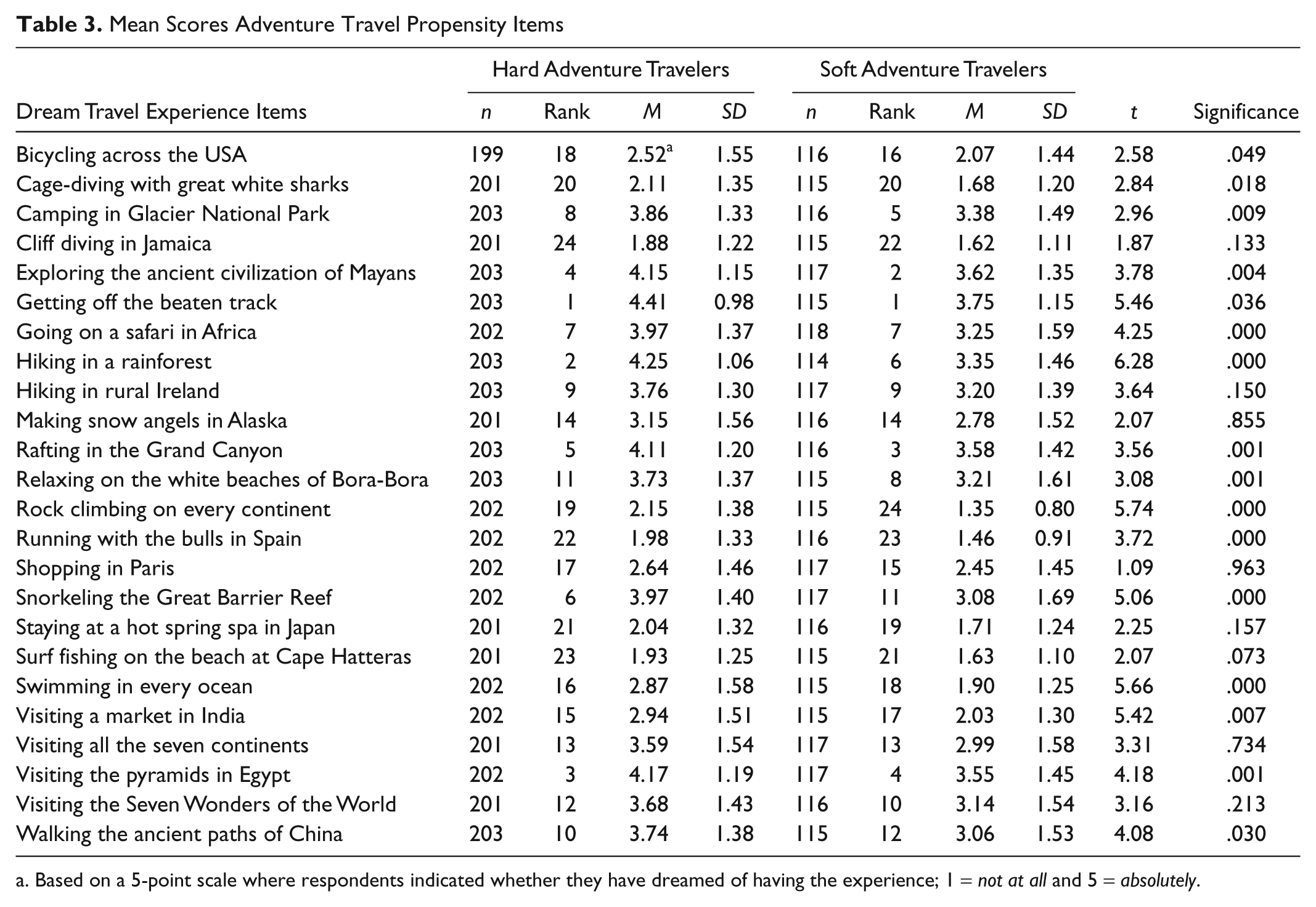
Based on a 5-point scale where respondents indicated whether they have dreamed of having the experience; 1 = not at all and 5 = absolutely.
Data Analysis
Several statistical methods were used in data analyses. First, descriptive statistics were used to analyze respondents’ demographic characteristics. Next, the Guttman scaling procedure was used to categorize respondents into soft and hard categories. Then, a series of paired t-tests were performed to identify any differences in trait antecedents of hard adventure traveler (HAT) and soft adventure traveler (SAT) groups. Hierarchical regressions were performed to explore the relationships between personality traits and ATP for HATs and SATs. The alpha level .05 was used for all statistical tests.
Results
Demographic profile
Respondents’ demographic characteristics are summarized for the two subgroups, HATs and SATs. The majority of respondents were male. In the HAT group, males outnumbered females by 25%. Overall, respondents were between the ages of 55 and 64 (28%), followed closely by the 45 to 54 age group (26%). Respondents in the SAT group were older, with most in the 55 to 64 (32%) or the 65 years and older group (26%). In contrast, most of the HAT group respondents were in the 45 to 54 age group (30%) followed by the 55 to 64 age group (26%). Consequently, the mean age of the HATs was six years less than the SAT group.
The majority of respondents were married (65%) and roughly 8 of 10 respondents in both groups reported living in households consisting of no more than two people (84% SATs and 79% HATs), with a similar number indicating that they currently had no children less than 18 years of age living at home (83% SATs and 72% HATs). Almost all respondents reported their ethnicity as white (95% SATs and 93% HATs).
The majority of respondents hold an advanced (37%) or four-year college degree (35%). More than three-quarters (78%) of the HAT group had an advanced or four-year college degree. For the SAT group, more than half (61%) had a four-year college or an advanced degree such as MBA, MS, or PhD. With regard to 2005 gross household income, most respondents reported earning between $100,000 and $149,999 annually. In the case of traveler type groups, 5 of 10 in each group reported earning $100,000 or more (46% SAT and 56% HAT); however, the proportion reporting the lowest income level of under $35,000 was higher in the SAT group (12%) compared with the HAT group (4%); the proportion earning the highest income level of $250,000 or more was higher in the HAT group (12%) compared with the SAT group (6%). Most reported working full-time; the proportion of full-time workers was slightly lower in the SAT group (56%) compared to the HAT group (67%); the proportion of retirees was higher in the SAT group (29%) when compared to the HAT group (13%).
Personality Traits Associated with HAT and SAT
HAT and SAT subgroups were formed using Guttman scaling procedure and the 3M Model provided a structure for understanding the personality variables examined in this research. Based on hierarchical approaches to personality, traits were arranged a priori in a four-level hierarchy consisting of elemental, compound, situational, and surface traits. Descriptive statistics and paired t-tests were used to describe the differential personality traits associated with the subgroups.
Descriptive statistics for elemental traits are provided in Table 4. The highest mean scores for HATs were for agreeableness (M = 6.96, SD = 1.19), openness to experience (M = 6.92, SD = 1.38), and conscientiousness (M = 6.75, SD = 1.37). For SATs the traits with the highest mean scores were agreeableness (M = 6.99, SD = 1.17), conscientiousness (M = 6.51, SD = 1.42), and openness to experience (M = 6.38, SD = 1.41). An independent samples t-test was conducted to compare mean scores for elemental traits between HATs and SATs. Mean scores for HATs were significantly higher than those of SATs for the traits openness to experience, t(315) = 3.27, p < .01, and need for arousal t(315) = 5.38, p < .001.
Descriptive Statistics for Elemental Traits
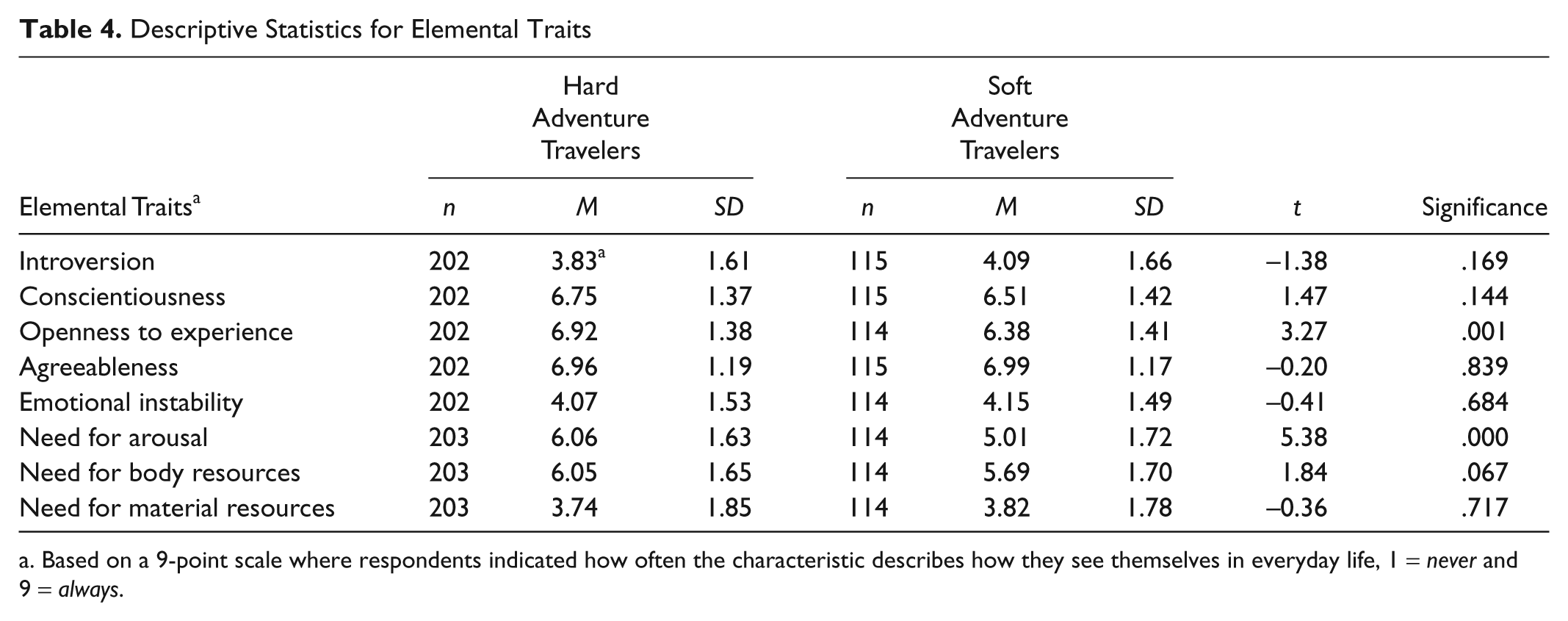
Based on a 9-point scale where respondents indicated how often the characteristic describes how they see themselves in everyday life, 1 = never and 9 = always.
Descriptive statistics for compound traits are provided in Table 5. The compound trait need for learning was scored highest by both HATs (M = 7.07, SD = 1.17) and SATs (M = 6.68, SD = 1.68). An independent samples t-test was conducted to compare the groups and a significant difference between HATs and SATs was found for the compound trait need for learning: t(315) = 2.18, p < .05.
Descriptive Statistics for Compound Traits
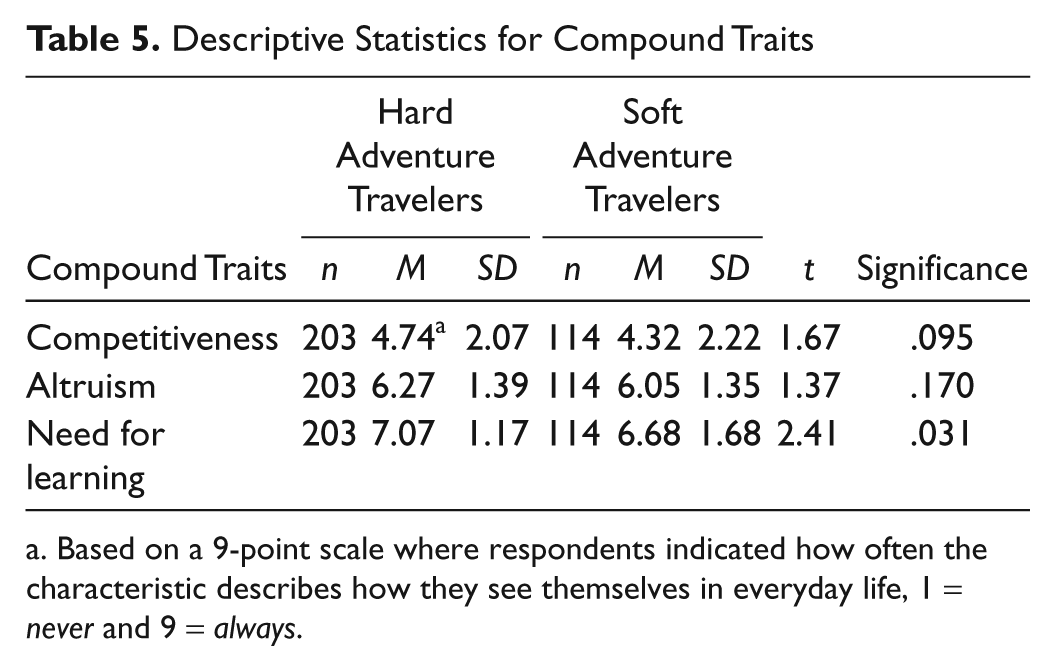
Based on a 9-point scale where respondents indicated how often the characteristic describes how they see themselves in everyday life, 1 = never and 9 = always.
Descriptive statistics for situational traits is provided in Table 6. The trait interest in cultural experiences held the highest mean for HATs (M = 7.05, SD = 1.32) and SATs (M = 6.31, SD = 1.54). An independent samples t-test examined differences between groups and a significant difference was found for interest in cultural experiences, t(315) = 2.18, p < .05, suggesting HATs have a higher interest in cultural experiences.
Descriptive Statistics for Situational Traits
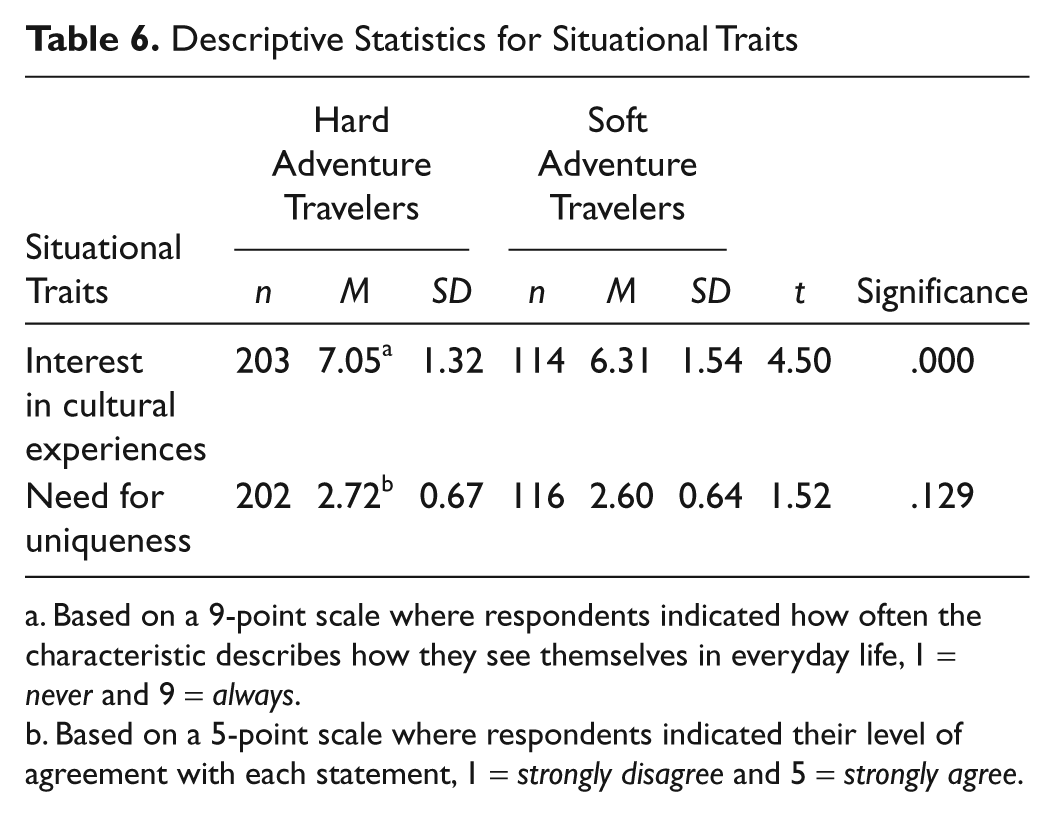
Based on a 9-point scale where respondents indicated how often the characteristic describes how they see themselves in everyday life, 1 = never and 9 = always.
Based on a 5-point scale where respondents indicated their level of agreement with each statement, 1 = strongly disagree and 5 = strongly agree.
Descriptive statistics for surface traits as measured with the new ATP scale found that getting off the beaten path item produced the highest mean score reported by HATs (M = 4.41, SD = 0.98) and SATs (M = 3.75, SD = 1.15). Significant differences were found in 16 of the 24 dream travel experiences with independent samples t-tests. In all 16 cases, HATs scored the highest mean values, suggesting they have greater dream travel experience aspirations.
Investigating adventure travel propensity
With an understanding of which personality traits are most closely associated with HAT and SAT groups, regression analyses allowed further testing of the 3M Model in a hierarchical process. The first model included only elemental traits, the second model added compound traits, and the third and final hierarchical model added situational traits (Table 7). In all cases, variance inflation factor (VIF) (≤1.95) and condition index (17.34) values were acceptable as they were below the recommended levels of 10 and 30, respectively (Hair et al. 1998). This indicates multicollinearity was not an issue.
Results of Hierarchical Regression for Personality Traits Predicative of Adventure Travel Propensity by Traveler Type
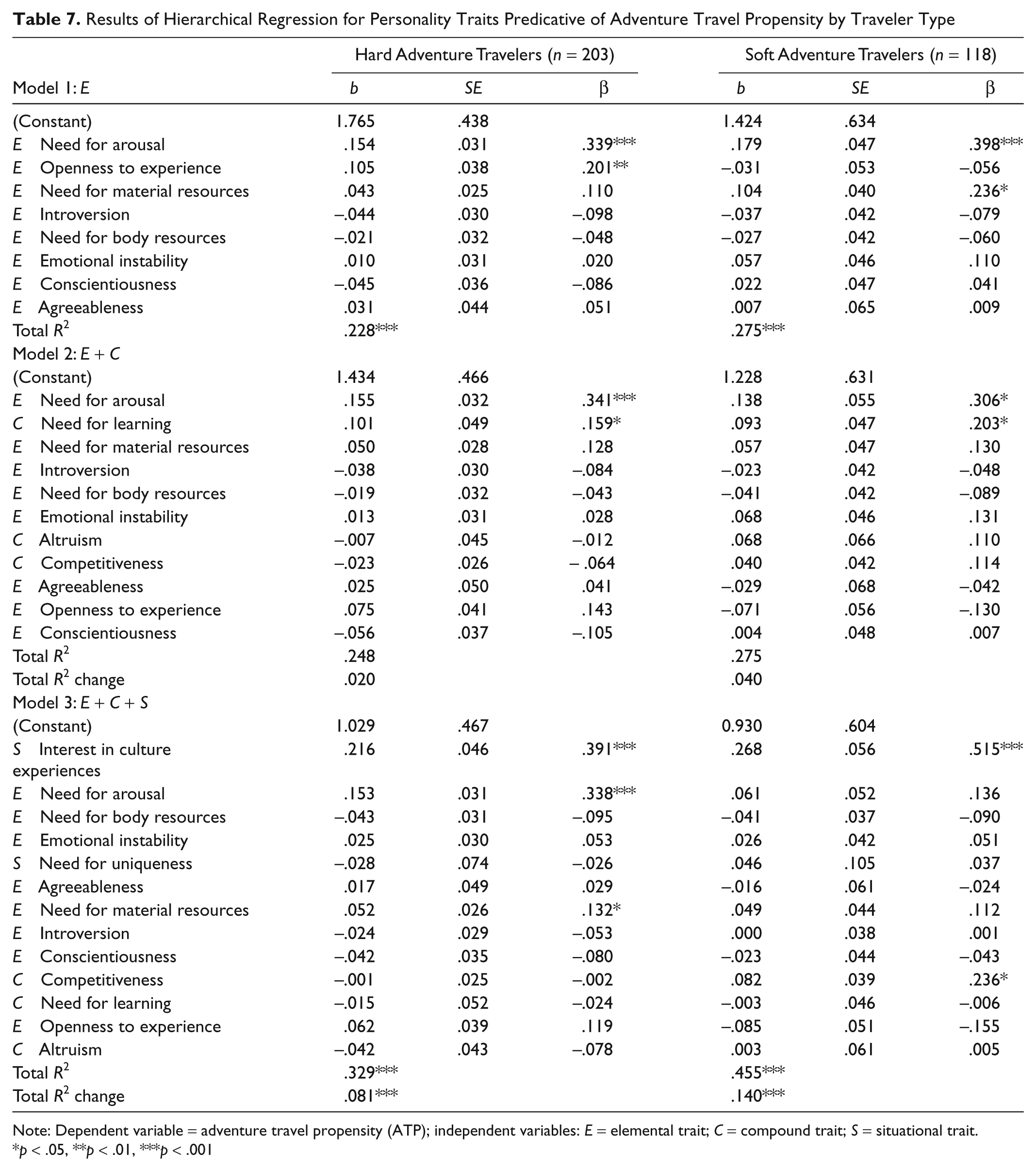
Note: Dependent variable = adventure travel propensity (ATP); independent variables: E = elemental trait; C = compound trait; S = situational trait.
p < .05, **p < .01, ***p < .001
First, HATs were examined. Model 1, with only elemental traits, was significant (R2 = .23, p < .001). The elemental trait need for arousal (β = .339, p < .001) and openness to experience (β = .201, p < .01) were statistically significant predictors of ATP for HATs. When compound traits were added in model 2, no significant increase in variance explained was obtained. In model 3, addition of situational traits increased the variance explained (ΔR2 = .08, p < .001). In this final model, significant predictors of ATP were the elemental traits need for arousal (β = .338, p < .001) and need for material resources (β = .132, p < .05) and situational trait interest in cultural experiences (β = .391, p < .001).
Next, SATs were examined in a similar hierarchy of trait variables. Model 1 was significant (R2 = .275, p < .001) and the elemental traits need for arousal (β = .398, p < .001) and need for material resources (β = .236, p < .001) were statistically significant predictors of ATP. In model 2, there was no significant increase in the variance explained. Finally, in model 3, situational traits significantly increased the variance explained (ΔR2 = .14, p < .001). In the final model, significant predictors of ATP were the elemental trait competitiveness (β = .236, p < .05) and situational trait interest in cultural experiences (β = .515, p < .001).
Discussion
Personality, as expressed in behavior and communication, affects travel and tourism. The focus of this study was to explore adventure travel behavior from a psychological perspective to determine how personality characteristics affect behavior. Understanding the underlying psychological dimensions that motivate consumers may offer the tourism industry insight into how to better meet their needs particularly for the adventure and nature-based tourist segments. This research employed the 3M Model as the organizational structure to understand how personality traits impact behavior (Mowen 2000). By integrating control theory, evolutionary psychology principles, and elements of hierarchical trait theories, the 3M Model provides a holistic view of how personality interacts with situations to influence behavior. The study extended Mowen’s (2000) model, which has been utilized to examine healthy diet lifestyles, compulsive buying, sports participation, and here adventure travel.
Studies of nature-based tourism (e.g., adventure, ecotourism) have suggested that adventure travelers are likely to be males, middle aged, well educated, and affluent (Loverseed 1997; TIA 1998; Wight 1996). This general profile appears to describe adventure travelers in this study. According to a TIA (2006) publication, affluent leisure travelers accounted for 34.8 million leisure household trips, with vacation spending averaging more than $2,100 per trip, and average household incomes were $163,100. Almost a quarter (24%) of study respondents had a household income higher than $150,000, making them part of the affluent segment. Affluent travelers represent a lucrative segment for adventure travel businesses to target.
Compared with the more than a decade old TIA Adventure Travel Report (1998), the study respondents were younger and had fewer children living in the household. Overall, adventure travelers were distinctive in some demographic and socioeconomic characteristics and, therefore, have specific needs and demands for travel and tourism products and services. The profile of adventure travelers identified in this study can provide valuable information for adventure industry managers and marketers in addressing the most salient managerial issue: Who are adventure travelers?
Based on an extensive review of the literature, seven personality traits were proposed to be associated with ATP: need for arousal, agreeableness, competitiveness, altruism, need for learning, interest in cultural experiences, and need for uniqueness. Results indicate that indeed a motivation–personality system of traits predictive of ATP exists. The trait that showed to be a consistent predictor of ATP was interest in cultural experiences.
The majority of adventure literature has focused on risk as the primary motivation for participation in adventure travel. A dearth of literature has focused on cultural experiences as the main reason people seek adventure travel (Sung, Morrison, and O’Leary 1997; Weber 2001). Cultural experiences comprise a variety of activities and events that represent a country and its people. Additionally, consumer research conducted on behalf of the Adventure Travel Trade Association supports the importance of culture and ecotourism in adventure experiences (Schneider and Vogt 2005). In sum, these studies and the results of our research illustrate the importance placed on cultural aspects of adventure travel experiences. Researchers and practitioners should look beyond risk and explore culture as a key part of adventure travel and a predictor of ATP.
The soft/hard adventure typology has been shown to be useful to practitioners, and this research continued this segmentation examining differences between HAT and SAT subgroups. Significant differences in traits predictive of ATP were found between the traveler groups.
Interest in cultural experiences, need for arousal, and need for material resources were significant predictors of ATP for the HATs. As predicted, the need for arousal was found to be a significant predictor of ATP for HATs. A number of studies have explored and confirmed the influence of the need for arousal and recreation and travel behavior. Results of the current study support need for arousal as a dominant trait in the fields of recreation and tourism (Zuckerman 1994).
In the case of the SATs, interest in cultural experiences and competitiveness were significant predictors of ATP. In light of the increased levels of difficulty and involvement, intuitively a competitive spirit would be associated with adventure travelers. However, results indicate that competitiveness is predictive of ATP for only SATs. Previous research showed that individuals with a high need for achievement prefer tourism experiences that were challenging and involved natural settings (Tran and Ralston 2006). The results suggest people possessing a high need for achievement will be more competitive and most likely prefer adventure travel at the entry level of adventure tourist—soft activities.
While not predicted, the finding that need for material resources was related to ATP for the SAT group is consistent with previous research. Previous research has linked an individual’s identity with leisure and travel behavior (Haggard and Williams 1992; Prebensen, Larsen, and Abelsen 1993). Our research suggests that collecting travel experiences and other good and service purchases may be the rationale for the trait need for material resources as a predictor ATP. Research supports our possessions are a major contributor to and reflection of our identities (Belk 1988).
Theoretical and Managerial Implications
The results of this study indicated that the 3M Model provided a useful framework for examining tourist behavior. Most studies examining personality as a predictor of leisure behavior have used general personality inventories to measure individual differences, failing to provide a theoretical approach to identify leisure-specific personality differences to aid in understanding leisure behavior (Mannell 1999). The 3M Model presented a consistent measure of personality, provided definitional clarity in the variable operationalization, and was based on the theory for inclusion of specific behaviors addressing concerns regarding the study of personality and leisure behavior proposed by Iso-Ahola (1980).
Findings were robust and consistent with the proposal that traits can be arranged into a four-level hierarchy, with multiple elemental traits accounting for substantial variance in each of the compound traits. Similarly, a combination of elemental and compound traits accounted for substantial variation in situational traits. A combination of elemental, compound, and situational traits account for variance in surface traits. These results supported the use of a hierarchical approach for understanding personality traits and ATP.
For managerial implications, the findings provide the adventure travel industry information to optimize the effectiveness and efficiency of marketing activities with a richer understanding of how consumers make their decisions to purchase tourism products. With communication program, they can persuade consumers to choose certain products that have been designed more effectively to meet particular needs and wants. One recommendation is that adventure tourism providers pay extensive attention to travelers who have a high need for arousal and an interest in cultural experiences. This insight allows them to target a particular consumer profile with a particular tourism product, making marketing efforts more successful.
Adventure travel marketers should also recognize that the nature of the risk element has to be carefully attached to the notion of “perceived” risk rather than to just the provision of “dangerous, risky” setting as in traditional leisure or recreation studies (Sung, Morrison, and O’Leary 1997). This has been consistent in the results of this study, suggesting that the amount and level of risk involved in adventure travel products and services should be clearly controlled to treat different adventure trips or travelers.
Limitations
With regard to research methodology, sampling of subjects from National Geographic Adventure magazine’s subscription list might become an issue in terms of their representativeness. Subjects (n = 339) were drawn from a priori known group, having similar interest in adventure travel no matter whether they had been on an adventure trip. As subscribers to a magazine focused on adventure, subjects were considered more actively involved in adventure travel. As a result, they may have unique group characteristics or travel behavior associated with adventure travel than the general population. Nevertheless, the target population of this study was not the general public in the United States; rather, it was adventure travelers who would be interested in taking an adventure trip. In extending results to the general public, the extension or generalization of the study results should be treated with a degree of caution.
Next, the reliability and validity of scales borrowed from the consumer behavior literature questioned as to the extent that they were a good representation of tourism consumer behavior. Finally, data were collected in 2007-2008 and represent consumers during that time period. In 2007, travel was at a peak before the economic downturn, making these findings relevant as travel begins to regain footing after a low period.
Future Research
This research was somewhat exploratory as it examined personality traits of adventure travelers. Further research is needed to understand the role personality plays in tourist behavior examining various types of tourists and exploring different traits. Replicating the research with a general population sample may offer insights into the differences between adventurers and mass tourists.
Another area for future research involves investigating the motivational profile of individuals who participate in different adventure activities. Is the profile different for kayakers as compared to hikers, walkers, or cyclists? Researchers could improve the measurement of ATP. Development of an adventure travel index would emphasize different aspects of adventure and result in a more realizable format for categorization of the adventure travel market. Use of the traditional typology of soft versus hard adventure travel fails to address that individuals participate in both types of travel at different times for different reasons. An adventure travel index would address varied motivations for participation.
Finally, while this study demonstrated the positive relationship between personality traits and adventure travel behavior, this study failed to address specific benefits adventure travelers seek from their experiences. Future studies might include qualitative data that would provide more inquiry on specific benefits sought from adventure travel experiences.
Footnotes
Acknowledgements
Special thanks to the Adventure Travel Trade Association and National Geographic magazine for their support of this research.
Declaration of Conflicting Interests
The author(s) declared no potential conflicts of interest with respect to the research, authorship, and/or publication of this article.
Funding
The author(s) received no financial support for the research, authorship, and/or publication of this article.