







Abstract
The purpose of this study is to add to the literature on consumer financial guilt in hospitality and tourism by exploring the circumstances in which it occurs and investigating antecedents that influence the experience of consumer financial guilt. Using an impulsive travel purchase as the context, this mixed-methods study examined the effects of gender and prepurchase mood on feelings of postpurchase guilt and satisfaction. Qualitative and quantitative results indicated that women were more likely than men to experience consumer guilt following an impulse travel purchase, and that this effect was moderated by prepurchase mood. Hierarchical regression analysis also indicated that consumer financial guilt affected levels of anticipated satisfaction with the purchase, over and above the effect attributed to prepurchase mood and gender.
Introduction
Exotic vacations, luxurious hotel rooms, decadent desserts: the hospitality and tourism industries are full of opportunities to spend money on pleasure. But what happens afterwards, when the customer has a moment to consider the purchase he or she just made? Too often, this postpurchase contemplation results in consumer guilt. Prior research has demonstrated that guilt over purchases can lead to a decrease in satisfaction with the purchase (Oliver 1993; Westbrook and Oliver 1991). While consumer guilt is an emotion familiar to us all and one that is germane to the purchase experience, it has received little attention in the hospitality and tourism literature. The purpose of this study is to add to the literature on consumer guilt in hospitality and tourism by exploring the circumstances in which it occurs and investigating antecedents that influence the experience of consumer financial guilt and the impact of this guilt on anticipated satisfaction Using an impulse travel purchase as the context, we test the effect of gender and prepurchase mood on feelings of guilt after a purchase and demonstrate that these guilt feelings impact the customer’s anticipated satisfaction with the travel experience.
Theory
Consumer Guilt
The experience of consumer guilt is familiar to us all. Who among us has not experienced a twinge of guilt after purchasing an expensive luxury, a calorie-laden dessert, or an impulse item we simply did not need. In this study, we are interested in the experience of financial guilt in the context of the purchase of hospitality and tourism services. Previous research has identified guilt as a key emotion in the consumer purchase context (Carter and Gilovich 2010; Brewer and Weber 1994; Soscia 2007), and more specifically in the hospitality and tourism context (Jang and Mattila 2005; Mattila and Choi 2006; Kang et al. 2012). Consumer guilt can be defined as “an affect triggered by the anxiety a consumer experiences upon the cognition that he is transgressing a moral, societal, or ethical principle” (Carter and Gilovich 2010). It can be the result of making, or planning to make, a purchase of goods or services that violates one’s standards of behavior, such as making frivolous purchase of expensive items (Dahl, Honea, and Manchanda 2003) or purchases outside of one’s price range, bad for one’s health, or produced in a socially irresponsible manner (i.e., products that are detrimental to the environment or produced under unsafe working conditions; Brown, Homer, and Inman 1998). Consumer guilt is triggered when a customer realizes that by making this purchase, he has violated his own internal standards of right and wrong.
A number of previous studies have investigated the circumstances under which consumer guilt can be attenuated, mitigated, or eliminated. For example, Strahilevitz and Myers (1998) found that participants who made hedonic purchases were more likely to engage in charitable donation activities when given the option. They postulated that the positive emotions elicited by the donation offset the negative affective experience of guilt of the hedonic purchase, thereby “balancing out” the consumer’s emotional state. Another method that consumers use to attenuate guilt over purchases is to “earn” the hedonic item through the use of frequency or loyalty programs. While paying for luxuries with money induced guilt over the purchase, earning them through effort mitigated the guilt and allowed participants to choose and enjoy the hedonic prize option (Kivetz and Simonson 2002). Prior research has also shown that licensing is an effective means of overcoming consumer guilt when making a hedonic or luxurious purchase (Khan and Dhar 2006). The licensing effect occurs when a person performs a good deed prior to the consumption decision, such as volunteering, tutoring, or donating money. Another method that consumers may use to alleviate consumption-related guilt is rationing (Wertenbroch 1998). Additionally, Lee-Wingate and Corfman (2004) demonstrated that consumer guilt can be attenuated when making a self-indulgent purchase by giving a gift to another, as well.
As this study deals with purchases, we are specifically interested in financial guilt, which occurs as a result of making a purchase that was outside of one’s price range or utilized funds that would have been better spent elsewhere (Burnett and Lunsford 1994). Previous research has demonstrated that consumers often feel guilty over making such “splurge” purchases (Fitzmaurice 2008). A better understanding of financial guilt is particularly relevant to the hospitality and tourism industries, as many of the services and experiences provided in this sector, such as trips, vacations, and tours, tend to be rather expensive and represent a large financial commitment on the part of the consumer. Hospitality and tourism purchases also tend to be experiential, meaning that the purpose of the purchase is not to buy a product, per se, but rather to have an experience, such as a trip, a fun night out, or an exotic vacation. Understanding the precursors of financial guilt when making experiential purchases may assist hospitality and tourism managers and marketers in finding ways to mitigate this guilt, thereby increasing customer satisfaction with their purchase.
Impulse Purchases and Guilt
Impulse purchasing is a significant factor in consumer behavior (Lee and Kacen 2008). While some purchases are planned, researched, and budgeted for, many purchases are made on impulse (Chenet, Dagger, and O’Sullivan 2010). Impulse buying can be defined as an unplanned purchase characterized by “(1) relatively rapid decision-making, and (2) a subjective bias in favor of immediate possession” (Clark, Mills, and Powell 1986; Woods 1960). The item is purchased after the customer sees the article (Hoch and Loewenstein 1991), although he was not actively looking for that item and did not have plans to purchase it (Worth, Smith, and Mackie 1992). Impulse buying is characterized by an “urge” to purchase the item, and the satisfaction of that urge is gratifying (Worth, Smith, and Mackie 1992).
Impulse purchases are likely to be made spontaneously, without a great deal of prior reflection (Hoch and Loewenstein 1991). While impulse purchases may simply be unplanned, may not lead to negative outcomes, and are not inherently bad, such spontaneous purchases may lead to postpurchase guilt. “Impulse buying occurs when a consumer experiences a sudden, often powerful and persistent urge to buy something immediately. The impulse to buy is hedonically complex and may stimulate emotional conflict” Rook (1987, p. 191). Feelings of guilt are likely to be particularly salient when making an impulse purchase, as impulse purchases are generally not budgeted for, unnecessary, and motivated by things other than utility or need (Wong 2004). Zeithaml et al. (1993) found that after making impulse purchases, consumers frequently reported feeling happiness, pleasure, and excitement, but also reported feeling guilty. Woods (1960) also demonstrated that impulse shoppers often exhibit feelings of guilt and anxiety. Zahn-Waxler and Kochanska (1990) studied emotional responses to impulse purchases and found that while customers derive pleasure from their impulse purchases, this is often accompanied by feelings of guilt as well.
Impulse purchasing represents a sizeable and important segment of purchases in the travel and tourism industry (Perdue 1986; Wilson and Boyle 2004). However, in spite of the importance of impulse purchases to travel and tourism, little research has been done to investigate the antecedents of impulse travel purchases (for exceptions, see Perdue 1986; March and Woodside 2005). In this study, we are interested in two factors that may influence a consumer’s experience of postpurchase guilt after an impulse travel purchase: gender and prepurchase mood.
Gender
As gender is an easily observable trait that is often used by marketers to target marketing and advertising, it is of interest to better understand how the different genders experience postpurchase guilt after an impulse purchase. In this study, we investigate how differences in gender may impact consumer guilt after an impulse travel purchase.
When examining purchase behavior, gender is a demographic variable often used to predict customer behavior, as research demonstrates that men and women exhibit different purchasing behaviors in a variety of circumstances (Dittmar 1989; Dittmar, Beattie, and Friese 1995; Coley and Burgess 2003; Hudson 2000). For example, previous studies have suggested that women are more likely to shop for aesthetic products, while men tend to prefer to shop for practical or functional purchases (Dittmar, Beattie, and Friese 1996; Rook and Hoch 1985). Other researchers have demonstrated that men and women process information differently during the shopping process (Peter, Olsen, and Grunert 1999), and assign different values to various types of purchases (Dittmar, Beattie, and Friese 1995, 1996).
Prior research specifically in travel and tourism has also demonstrated that gender can impact the ways in which individuals plan, execute, and experience a trip. For example, previous research has suggested that men and women take an interest in different parts of the vacation planning and purchase process (Zalatan 1998). Gender can also influence what kinds of trips and vacations people prefer to take (Mieczkowski 1995). Motivations for travel can differ as well, with women exhibiting a heavy focus on traveling for the purposes of visiting friends to socialize and shop (McGehee, Kim, and Jennings 2007) and visiting friends and family (Collins and Tisdell 2002). The previous studies have examined gender differences in the context of the consumer behavior and travel and tourism research. In addition, and also relevant to the present study, substantial evidence suggests that information processing is affected by gender. A great deal of previous research has indicated that men and women process information differently (Mittal, Huppertz, and Khare 2008). In particular, differences in the level of cognitive elaboration during information processing have been demonstrated in a marketing context by Meyers-Levy and associates (Meyers-Levy and Maheswaran 1991, 1998; Meyers-Levy and Sternthal 1993). This research suggests that men tend to process information using less elaborate processing, limiting cognitive effort by using heuristic processing. Women, on the other hand, appear to have a lower threshold for elaboration, leading to deeper, more effortful processing of information. While men seem to prefer an impulsive, holistic approach to processing, women prefer a logical, sequential approach (Pogun 2001).
The experience of guilt requires relatively effortful processing. First, an individual must examine their internal standards of right and wrong, and then compare these standards with his or her actions in order to determine whether these actions violated those standards. Finally, the individual must determine whether or not he or she was in control of these actions and knowingly violated personal standards (Bourgeois 2002; Regan, Williams, and Sparling 1972; Boshoff 2005; Chebat 2002).
Given this information, we predict that males will process the purchase consumption information heuristically, resulting in lower levels of guilt. As females tend to process information more deeply, and this type of processing lends itself to the experience of guilt, we would expect that women will experience higher levels of guilt than men. There, we hypothesize that:
Hypothesis 1: When making an experiential travel purchase, women will experience a higher level of consumer guilt than men.
Prepurchase Mood
Previous research has demonstrated a relationship between both positive and negative mood and impulse purchasing (Rook and Gardner 1993; Rook 1987; Mattila and Ro 2008). This evidence is somewhat limited, however, and the nature of this relationship bears further investigation. Previous research also suggests that mood can impact the processing of information. Happy moods appear to result in more global, heuristic processing, while sad moods lead to more detailed, effortful processing (Bagozzi, Gopinath, and Nyer 1999; Clore, Schwarz, and Conway 1994; Moons and Mackie 2007; Rafienia et al. 2008). The mood-as-information model (Schwarz 1990) postulates that a good mood indicates a pleasant, happy environment requiring minimally elaborate information processing, thereby leading to heuristic processing. A bad mood, conversely, indicates a less than ideal situation, which the individual would presumably like to remedy. This leads to more elaborate, effortful processing. An alternative theory posits that good moods result in heuristic processing because of the distracting nature of the good mood (Mackie and Worth 1989). While these theories differ in terms of the mechanics of the process, both lead to the conclusion that a positive mood is related to global, more heuristic processing, while a negative mood is associated with deeper, more effortful processing.
As noted earlier, we expect that men will experience relatively low levels of guilt regardless of mood, as they tend to be heuristic processors. We expect women to experience higher levels of consumer guilt than men, because of the fact that women’s more elaborate processing style lends itself to feelings of guilt. However, we predict that prepurchase mood will moderate this effect. Specifically, we expect that when in a good mood, women will process experiential purchases heuristically, focusing more on the positive overall benefits of the experience, rather than engaging in the deeper, more detailed processing that is associated with feelings of guilt. Therefore, we propose that
Hypothesis 2: Prepurchase mood will moderate the effect of gender on levels of consumer guilt. Specifically, when making an impulse travel purchase, women in a bad mood will experience more postpurchase guilt than men, but no significant difference is expected in guilt levels between men and women in a good mood.
Anticipated Satisfaction
The impact of consumer emotions on satisfaction has long been a topic of research in the consumer behavior sector (Mano and Oliver 1993; Oliver 1993, 1997; Westbrook and Oliver 1991). However, this line of research assesses satisfaction after consumption has occurred. Phillips and Baumgartner (2002), however, note that consumer emotions can have an effect on anticipated satisfaction, as well, prior to the consumption of the good or service. Anticipated satisfaction occurs when “consumers assess the likely satisfaction with each item” (Shiv and Huber 2000). While satisfaction is always an important measure in consumer behavior studies, it can be measured only after consumption has occurred, but in our study, we were interested in how consumer guilt affects the customer prior to consumption. In our scenarios, the consumer has purchased the experience, but has not yet consumed it. Therefore, anticipated satisfaction was the appropriate measure for this context. We predict that feelings of consumer guilt will interfere with the consumer’s ability to experience anticipated satisfaction with their purchase. Thus, we hypothesize that
Hypothesis 3: The level of postpurchase guilt will negatively impact anticipated satisfaction with the purchase.
Qualitative Study
Materials and Methods
For the first phase of this study, we elected to conduct two focus groups. Qualitative methods are ideal for exploratory research (Jones, Schratter, and Kugler 2000) and have been effectively used in both consumer and travel and tourism research, as they can provide a phenomenological account of the participants’ own experiences (Milman 1993). The purpose of conducting this focus group was merely exploratory. We wished to hear from the participants themselves whether or not they experienced consumer financial guilt after a purchase, and we wanted to give them a chance to describe this occurrence in their own words, as we felt that hearing participants describe for themselves their experiences with consumer guilt would add to our understanding of this consumer emotion.
Additionally, given that men and women have traditionally exhibited different patterns of purchasing behaviors (Dittmar 1989; Dittmar, Beattie, and Friese 1995; Coley and Burgess 2003; Mattila et al. 2001; Hudson 2000) and varying methods of information processing (Meyers-Levy and Maheswaran 1991, 1998; Meyers-Levy and Sternthal 1993), we were interested to see whether the descriptions of consumer financial guilt would differ across genders. For this reason, we elected to conduct separate focus groups for men and women.
Subjects
The focus groups were held during June 2011. Subjects were recruited from the staff of a large university in the Northeastern United States. A list of 300 campus addresses for staff members was selected by selecting every nth name after a random start. Recruitment letters were mailed through campus mail to these 300 addresses, explaining the study, the focus group procedure, and how to sign up. Recipients were told that a maximum of 10 men and 10 women would be selected to participate on a first-come, first-served basis. In exchange for participating, subjects would receive a $20 gift card to a local restaurant.
The first 10 men and 10 women to register were selected for the focus group. After attrition due to personal circumstances or time conflicts, 7 men and 8 women participated in the focus groups. As conventional wisdom suggests that men and women experience shopping differently, we conducted two separate focus groups divided by gender.
Materials
The focus groups were held at a campus meeting room that was equipped with recording equipment. Audio recordings were made of the focus groups, but no video tapes were made. At the conclusion of the discussion, participants were asked if they had any questions about the focus group or procedures. Participants were then given a $20 gift card to a local restaurant and thanked for their time. These same procedures were followed for both focus groups.
The focus group discussions were guided by a set of questions about shopping, purchases, emotions, guilt, and spending (see Appendix A). However, participants were informed that these were merely guiding questions to generate discussion, and they were encouraged to add their own thoughts, stories, and experiences about these topics. We allowed discussions to evolve organically, and when a topic seemed to have run its course, we generated conversation by asking a new question from the question guide.
Results
After the completion of the focus groups, we analyzed the transcripts, looking for themes and commonalities—feelings that were agreed upon and often repeated among participants. The data were compared first within and then between gender groups. Our results demonstrated several important themes. First, for both the male and female participants consumer guilt was definitely a part of their purchasing experience, and this guilt was experienced over a variety of purchase types, in varying circumstances, and for multiple reasons.
For example, they felt guilty about buying items that were not essential: I think, at this point in my life, it is anything that I feel is really not essential because times are pretty tight financially at this point. I try to be conservative enough that maybe we could’ve spent that money differently; maybe we could’ve moved it and, you know, had more money to spend on something else that is more necessary I guess. Guilt, if it’s a purchase for myself . . . usually guilt, I want to take it back. I’m thinking I am only feeling the guilt when I am buying something for myself at the dollar amount that could have been done for a little bit less. That is where my guilt was coming from—because of the effect on other people. I know when my kids were small, I mean, I didn’t buy . . . I would feel guilty, yeah.
Gender differences were also apparent in the focus group results. For example, women indicated that they had a very low threshold for feeling guilt: It doesn’t matter if it is a ninety-nine cent thing of lipgloss or a hundred dollar coat. It wouldn’t matter. I’d still feel guilty if I am buying it for myself. I can’t tell you how many times I’ve had an eyeliner in my hand and I end up going back, and I really should, no I still have enough left, no maybe I should get it, no, and then I end up just putting it back even though it is only ninety-nine cents.
Women also indicated that they felt an internalized sense of guilt, even if their significant other was encouraging them to make the purchase: Interviewer: So if you bring him (husband) along and he is like oh, oh yeah, that is nice, you should get that, does that eliminate any possibility of guilt about it? Respondent 1: No. Respondent 2: Not for me. Respondent 3: No. Interviewer: So, even if he is like oh yeah you should get that you would still feel guilty? So, the guilt is not dependent on him? It is internal? Respondent 1: Yeah. It’s internal. Respondent 3: It’s internal. Interviewer: What, where do you think that internal guilt comes from? Respondent 6: I think that is just being a female.
Men also experienced guilt after purchases, but their threshold seemed to be higher, and they seemed to experience it less often. While women indicated that they often felt guilt when buying anything at all for themselves, men seemed to feel guilty primarily when the purchase had put them over their monthly budget, if they felt that they did not receive value for their money, or if they had not gotten a “good deal.”
I might be guilty and feel badly at first when I purchase a thing but, but, really it comes down to if, by at the end of the month, if I know I am OK, then that guilt is gone. I don’t feel guilt until the end of the month if I can’t juggle all the chainsaws. You know, as long as I can come through the month without going under, I’m OK. I’m thinking I am only feeling the guilt when I am buying something for myself at the dollar amount that could have been done for a little bit less. (I feel guilty if) . . . It wasn’t as good of a deal as I could have but I just got it anyway.
Discussion
After analyzing our data from the focus groups, some clear themes emerged, as they were repeated by several participants. It was clear that our participants did indeed experience consumer guilt, and that the presence and level of guilt can vary according to the purchaser and the situation. It was also clear that gender affected the experience of consumer guilt. These results extend the extant literature by providing a rich description of this emotion in the participants’ own words. The fact that our participants, who were of varying ages, backgrounds, and genders, spoke of experiencing guilt in a wide variety of consumer situations indicated to us that it was a question worthy of further study, and our responses indicated that gender might have important implications for the experience of consumer guilt. Additionally, as gender is a characteristic that is easily recognized and frequently used as a marketing segmentation technique, an enhanced understanding of how this variable impacts consumer guilt could be of use to marketers and managers. As noted earlier in this paper, previous research has also demonstrated a relationship between both positive and negative mood and purchase behavior (Rook and Gardner 1993; Rook 1987; Mattila and Ro 2008), as well as between both gender and mood and information processing strategies; Clore, Schwarz, and Conway 1994; Moons and Mackie 2007; Rafienia et al. 2008; Mittal, Huppertz, and Khare 2008). For these reasons, we chose gender and mood as variable to test our hypotheses.
Quantitative Study
Research Design
To test the above hypotheses, we employed a 2 (gender: male vs. female) × 2 (prepurchase mood: good vs. bad) quasi experiment.
Participants were recruited in March 2012 using Mechanical Turk, an online survey site. A total of 384 subjects were recruited. The requirements for participation were that subjects must be over the age of 18, reside in the United States, and have opted in to the survey voluntarily. Subjects were randomly assigned to one of the prepurchase mood conditions. Approximately 33% of the subjects were male, 49% had a college degree, 36% had a household income of $60,000 or above, and 83% listed their ethnicity as Caucasian.
Prepurchase mood was manipulated using instructions adapted from Schwarz and Clore (1983). According to Westermann et al. (2006), mood induction procedures enjoy a high success rate. Subjects were asked to write about an event in their lives that made them feel “really good” or “really bad” (Appendix B). This particular mood induction technique has been successfully used in various contexts such as product evaluations (Adaval 2001; Pham 1998; Yeung and Wyer 2004), evaluations of life satisfaction (Strack, Schwarz, and Gschneidinger 1985), self-esteem (Levine, Wyer, and Schwarz 1994) and evaluation of political candidates (Isbell and Wyer 1999). They then read a scenario describing a purchase they had made on impulse. The subjects were to imagine that they lived in Miami. They impulsively decide to purchase a 3-day cruise leaving out of Miami for $500.
Measures
Realism checks for the mood induction were assessed using a 5-item scale from Peterson and Sauber (1983) (Cronbach’s alpha = 0.93). Realism checks asked, “If I lived in Miami, the events described in the scenario could happen to me,” and “Assuming we lived in Miami, the events described in the scenario could happen to someone I know.” Realism checks are frequently used in scenario-based research (e.g., Wan, Hui, and Wyer 2011; Bornemann and Homburg 2011; Kopalle, Lehmann, and Farley 2010; Maxham 2001; Chang 2006; Wei et al. 2012).
Anticipated satisfaction was measured with three items taken from Botti and lyengar (2004) and Shiv and Huber (2000) (Cronbach’s alpha = 0.94). The items were “Will you be satisfied with this purchase when you receive it?” “Will you be happy with the purchase you made?” and “How satisfied do you think you will with this purchase when you get (experience) it?” Postpurchase guilt was measured with a three-item scale adapted from the State Guilt subsection of Guilt Inventory (Kugler and Jones 1992): for example, “After making this purchase, I don’t feel particularly guilty. A moment ago, I made a purchase that I feel guilty about. I feel good about myself and my purchase.” In order to control for individual differences in the tendency to feel guilt, as well as the personality trait of guilt proneness, we measured guilt proneness as a covariate using the eight guilt items from the Guilt and Shame Proneness scale (GASP; Cohen et al. 2011) (Cronbach’s alpha = 0.82). Information on relevant covariates was also collected. Household income was measured on a 6-point scale, with 1 = $0–$20,000, 2 = $20,001–$39,999, 3 = $40,000–$59,999, 4 = $60,000–$79,999 5 = $80,000–$99,999, 6 = $100,000 or more. Gender was coded as 1 = male, 2 = female. Educational level was measured as follows: 1 = high school or less, 2 = some college, 3 = college, 4 = graduate school. Age was a free response question, and ethnicity was coded as 1 = Caucasian American, 2 = African American, 3 = Hispanic American, 4 = Asian American, 5 = American Indian or Alaskan Native, 6 = Native Hawaiian or Pacific Islander, 7 = Other.
Results
Manipulation Checks
To check the efficacy of the mood manipulation, an independent samples t-test on the mood scale was performed between the good and bad mood conditions. As expected, participants in the positive mood condition exhibited much higher levels of positive mood than participants in the bad mood condition (MPos = 5.71 vs. MNeg = 3.97; t(183) = −14.46, p < 0.001).
Overall, participants indicated that the scenarios were realistic (M = 5.48 on a 7-point scale) with no differences between conditions.
Results of Hypothesis Testing
To investigate customers’ level of consumer guilt, a 2 (prepurchase mood: positive vs. negative) × 2 (gender: male vs. female) between-subjects analysis of covariance (ANCOVA) test on consumer guilt was performed. Age, income, education, ethnicity, and guilt proneness were included as covariates in the ANCOVA analysis.
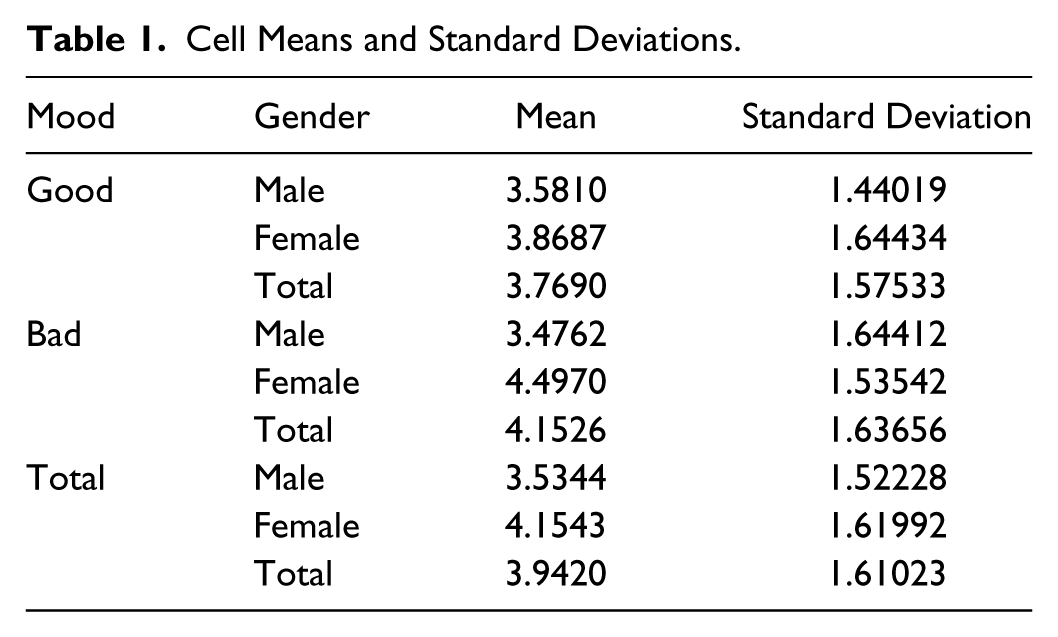
The results from an ANCOVA table indicate a significant main effect for gender (F = 6.29, p < 0.05). However, this main effect was qualified by a significant interaction between gender and prepurchase mood (F = 3.99, p < 0.05). As shown in Figure 1, in the bad mood condition, women exhibited higher levels of guilt than men, MFemale = 4.50, MMale = 3.48, t = −0.2.71, p < 0.05. However, in the good mood condition, there was no significant difference in the level of guilt between women and men, MFemale = 3.87, MMale = 3.58, ns. Taken together, these results are consistent with hypotheses 1 and 2.
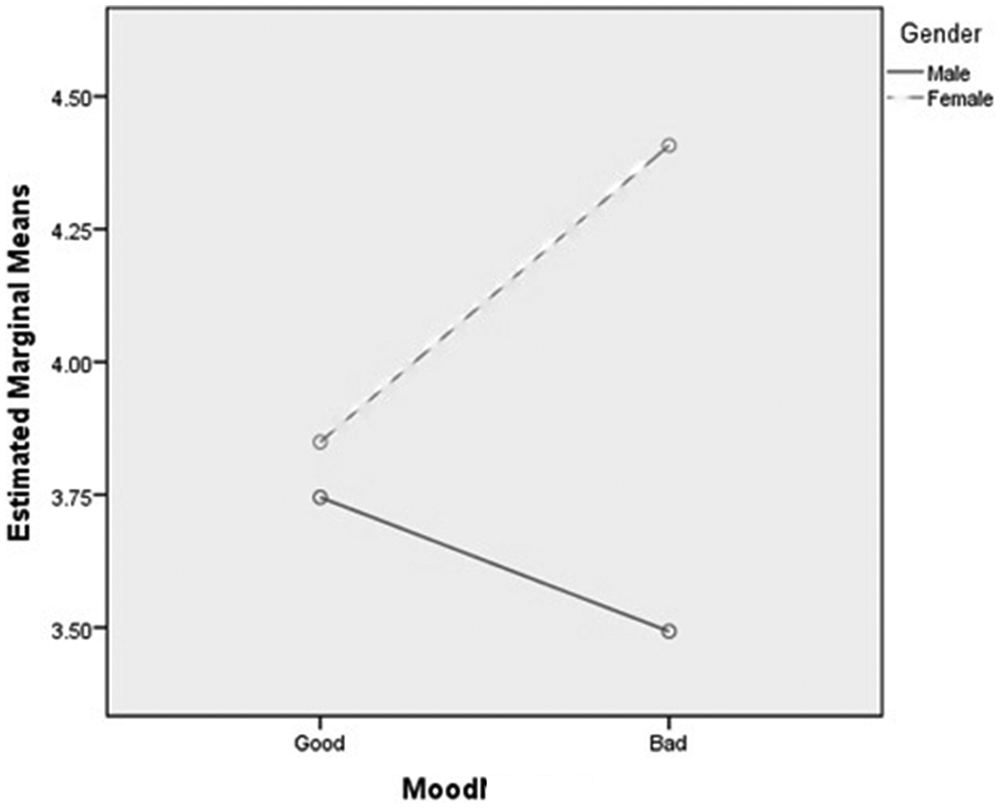
Estimated marginal means of guilt.
Cell Means and Standard Deviations.
Tests of Between-Subjects Effects.
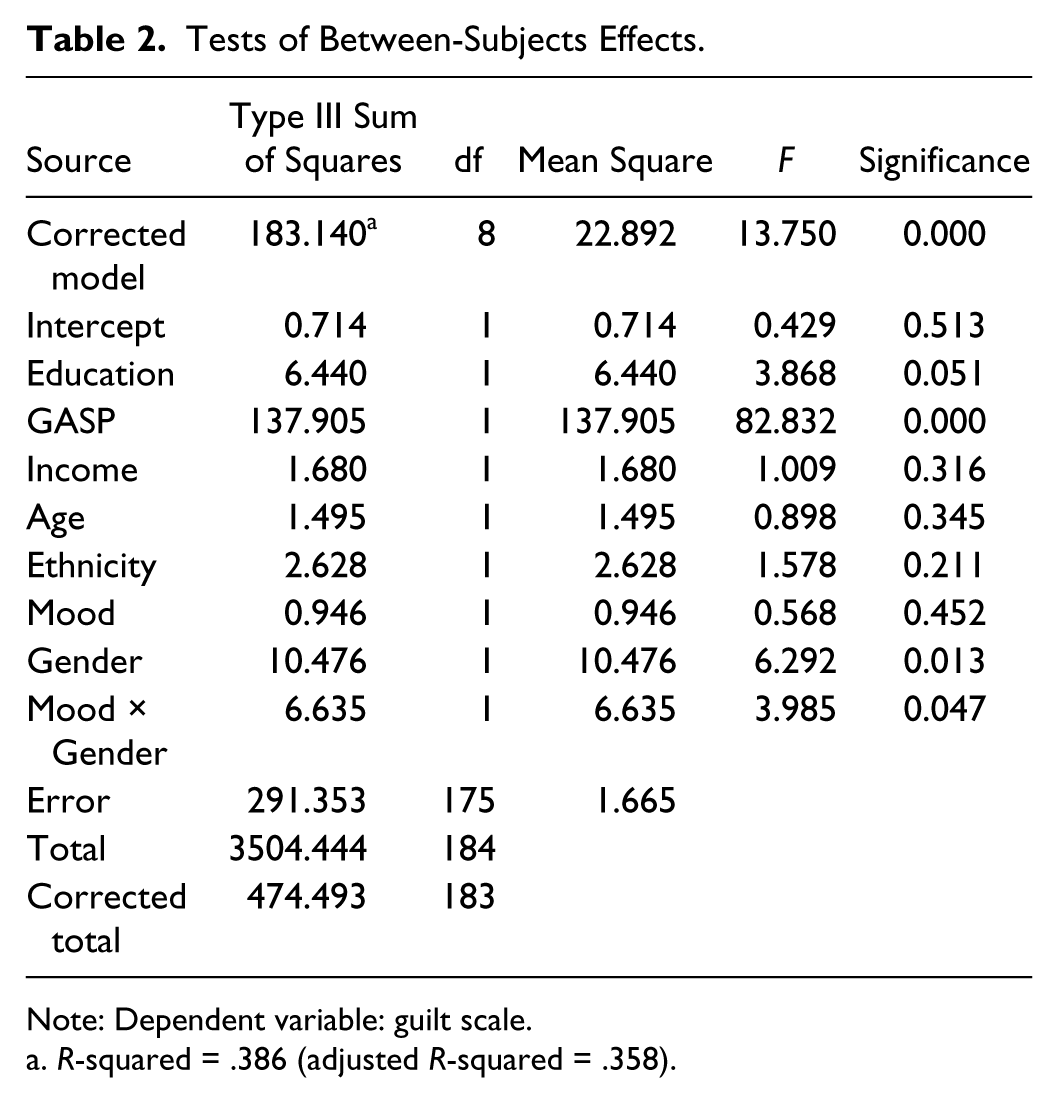
Note: Dependent variable: guilt scale.
R-squared = .386 (adjusted R-squared = .358).
Regression Analyses on Emotional Responses and Encounter Satisfaction
In the ANCOVA, consumer guilt was included as a dependent variable, with prepurchase mood and gender as independent variables. However, because it is feasible that consumer guilt has a direct influence on anticipated satisfaction with the purchase, it is of great interest to investigate the effect of consumer feelings of guilt on anticipated satisfaction. In hypothesis 3, we predicted that higher levels of consumer guilt would lead to lower levels of anticipated satisfaction with the purchase.
Regression Coefficients.
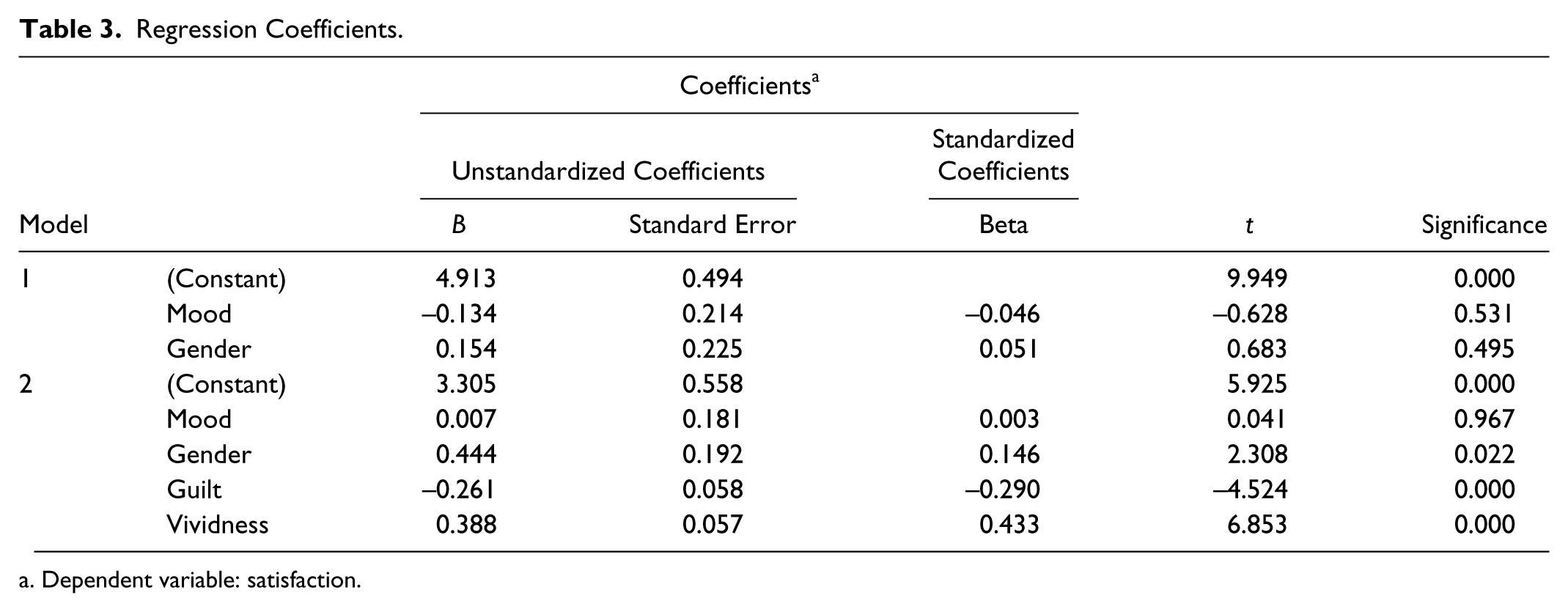
Dependent variable: satisfaction.
We used hierarchical regression analysis to test impact of guilt on anticipated satisfaction. Two variables (prepurchase mood and gender) were entered in the first step, followed by guilt and vividness. Vividness was measured with one item (How easy is it for you to imagine yourself or someone you know in the scenario?) and was included because prior research has demonstrated that vividness is closely related to anticipated satisfaction (Shiv and Huber 2000). The results from the multiple regression analysis are shown above.
An examination of the regression coefficients indicate that prepurchase mood (standardized B = 0.149, p = 0.001), guilt (standardized B = −0.216, p <0.001), and vividness (standardized B = 0.366, p < 0.001) are significantly linked to anticipated satisfaction. These results are consistent with hypothesis 3.
Discussion and Conclusions
This mixed-methods study was composed of a qualitative study consisting of two focus groups and a quantitative study employing a scenario and survey. This paper addressed three important research objectives: (1) to confirm the presence of consumer guilt and gain insight into how participants experience it, (2) to examine how prepurchase mood and gender interact to impact the experience of consumer guilt, and (3) to investigate the impact of consumer guilt on anticipated satisfaction with the purchase.
The results of our qualitative study suggest that consumers do indeed experience consumer guilt. Participants indicated that they felt guilt after making purchases for a variety of reasons. Buying things they did not need, paying too much for an item, spending money on themselves that could have been better spent on other members of the family, going over budget, and not getting a good deal were all discussed as potential sources of consumer guilt.
Although exploratory, our results also detected a difference in the ways in which men and women experienced consumer guilt. Women appeared to experience more consumer guilt, have a lower threshold for experiencing such guilt, and internalize the guilt more so than their male counterparts. These preliminary results suggested that an empirical investigation of consumer guilt was warranted, and to this end, we developed a quantitative study based on scenarios and a survey.
The results of our quantitative study shed further light on the experience of consumer guilt in a travel purchase context. Prior research has identified guilt as a key emotion in the consumer purchase context (Carter and Gilovich 2010; Brewer and Weber 1994), and in this study, we were particularly interested in the experience of guilt in the context of the purchase of experiential services. We examined specifically financial guilt, as a better understanding of financial guilt is particularly relevant to the hospitality and tourism industries, given that many purchases in this sector represent a major financial commitment. We chose an impulse travel purchase as our context, as feelings of guilt are likely to be particularly salient when making an impulse purchases (Wong 2004; Woods 1960; Zahn-Waxler and Kochanska 1990). In this study, we were interested in two factors that may influence a consumer’s experience of postpurchase guilt after an impulse purchase: prepurchase mood and gender.
We hypothesized that women would be more likely than men to experience consumer guilt following an impulse travel purchase, and that this effect would be moderated by prepurchase mood. These hypotheses were supported by our results. While we found no significant difference between the genders in level of guilt while in a good mood, women in a bad mood experienced significantly more guilt than men in a bad mood. Previous literature suggests that information processing is affected by gender (Mittal, Huppertz, and Khare 2008), particularly with regard to the level of cognitive elaboration during information processing (Meyers-Levy and Maheswaran 1991, 1998; Meyers-Levy and Sternthal 1993). This stream of research suggests that males tend to use heuristics to process information in order to limit cognitive effort. Women, conversely, tend to engage in more elaborate information processing, preferring a logical, sequential, detailed approach (Pogun 2001).
Given that the experience of guilt requires relatively effortful processing, we predicted that males will process the purchase consumption information heuristically, resulting in lower levels of guilt. As females tend to process information more deeply, and this type of processing lends itself to the experience of guilt, we would expect that women will experience higher levels of guilt than men. The results of our qualitative study seem to bear this out, and indeed, when in a bad mood, women felt a higher level of guilt over the vacation purchase than did men. However, these results were qualified by prepurchase mood. When women were in a good mood, the level of guilt after the purchase was significantly reduced. Previous studies have indicated that happy moods appear to result in more global, heuristic processing (Clore, Schwarz, and Conway 1994; Carlsmith and Gross 1969), rather than the more effortful, detailed processing that is necessary to experience guilt. It appears that when women were in a good mood prior to their purchase of the trip, they processed the purchase at a more shallow, heuristic level and did not experience high levels of guilt over the money spent.
Hierarchical regression analysis also indicated that consumer guilt affected levels of anticipated satisfaction with the purchase, over and above the effect attributed to prepurchase mood and gender. Our results demonstrated an inverse relationship between consumer guilt and anticipated satisfaction, indicating that as guilt increased, consumers anticipated being less satisfied with their purchase when they actually consumed it. While this outcome seems intuitive, future research could explore boundary conditions and moderating factors that may impact this relationship.
Implications
Using both qualitative and quantitative methods, this study sheds new light onto the topic of consumer guilt in the hospitality and tourism context. Prior research on consumer guilt has been limited (for exceptions, see Carter and Gilovich 2010; Brown, Homer, and Inman 1998; Webster and Kruglanski 1994), and our findings add to the body of literature on this topic.
One of the goals of this study was to confirm the presence of consumer guilt and explore how consumers experience it in a travel and tourism context. The descriptions of the experience of guilt about purchases, given in the participants’ own words, lend weight to the construct and suggest a number of boundary conditions to be further explored.
Our results also contribute to the emotions and satisfaction literature. The relationship between emotions and satisfaction has been widely studied (Brewer and Weber 1994; Dittmar 1992; Zakay, Nitzan, and Glicksohn 1983; Bigné, Mattila, and Andreu 2008), but research on the construct of consumer guilt is scant, particularly in the hospitality and tourism literature. The results of our regression analysis demonstrated that high levels of consumer guilt adversely affected the consumer’s level of anticipated satisfaction with the purchase of a cruise. To our knowledge, no other studies have examined the relationship of these two variables, making this study a unique contribution to the field of hospitality and tourism.
In addition to providing theoretical contributions, this study provides a number of important managerial implications for travel and tourism marketers and managers. Our results yielded some useful information for managers and marketers regarding the ways in which the genders experience consumer guilt differently. First, when in a bad mood, women reported feeling higher levels of consumer guilt over their impulse travel purchase than did men. As consumer guilt has the potential to adversely impact anticipated satisfaction with the purchase, an awareness of these results could be helpful during the marketing process. As managers and marketers cannot ascertain a potential customer’s mood, marketing campaigns aimed at female consumers could focus on combating any possible guilt feelings by highlighting the benefits and justifications for making a purchase, the experiential nature of the trip, and the value of the travel purchase.
In addition, our results suggest an effective strategy for marketing travel experiences to female consumers. We found that when in a good mood, women felt far less guilt about making purchases. Hospitality and tourism marketers and managers could use this information to craft ad campaigns that induce a positive mood prior to the purchase. One possible way to do this would be to construct ads or marketing materials that prime a good mood by having the consumer imagine, picture, or remember positive experiences, exotic travel destinations, and fun travel activities, much like our experimental prime was designed to do. In addition, they could design pleasant servicescapes and encourage friendly, happy consumer–employee interactions in order create a happy mood in their customers (Lin and Worthley 2012), thereby mitigating potential guilt feelings.
Limitations and Future Research
As with all research, our study has a number of limitations. First, our sample was not a representative one. Caution must be exercised when interpreting results gathered from such a narrow sample. This issue is particularly important given that the internal standards of right and wrong, which give rise to guilt, are developed in relation to salient reference groups, including parents, peers, or society at large. As reference groups change, or as one’s relationship to certain groups becomes more or less salient, it is possible that these standards may change (Baumeister, Stillwell, and Heatherton 1994; Priester and Petty 1995). Given this, it is important that future research replicate this study with samples taken from various ethnic and socio-economic populations in order to increase the generalizability of the results. In addition, the salience of various reference groups could be manipulated or measured as a factor in future studies.
Second, further research is warranted to explain our unexpected results regarding men in bad moods feeling little guilt over impulse purchases when in a bad mood. It would be interesting to explore the cognitive processes taking place after such a purchase. Future research could investigate the ways in which men justify their impulse purchases and how emotions impact those justifications.
Third, our study examines only one aspect of consumer guilt: financial guilt. Brown, Homer, and Inman (1998) suggested that individuals could also experience health guilt, moral guilt, and social responsibility guilt, all in a consumer context. Future research is needed to test these categorizations and determine if other types of consumer guilt do indeed exist, and if so, to test the boundary conditions for each.
Fourth, our study controlled for guilt proneness and purchase price, but future studies could control for other possibly related variables. Factors such as regret, involvement, refund options, compulsive consumption, overspending propensity, and brand loyalty were not explored in the current study, but would serve as interesting variables for future research.
Fifth, although our results demonstrate an inverse relationship between guilt and anticipated satisfaction, we propose that this relationship may not always be the case. It is possible to imagine scenarios where a person could feel extremely guilty yet still derive a great deal of satisfaction out of the experience. A recent study by Goldsmith, Cho, and Dhar (2012) suggested that in some cases, guilt may actually enhance pleasure with hedonic consumption. Future research could explore such situations.
Sixth, our study was conducted using scenarios, which leave our results open to common method bias. As the respondents were asked to imagine themselves in a hypothetical scenario and asked what they “would” do in such a situation, our results are limited by the accuracy of the participants’ self-reporting. Additionally, our study was cross-sectional, gathering all data with only one instrument and at one point in time. Future research could employ field studies in real-world situations to triangulate our findings.
Footnotes
Appendix A
Appendix B
Declaration of Conflicting Interests
The author(s) declared no potential conflicts of interest with respect to the research, authorship, and/or publication of this article.
Funding
The author(s) received no financial support for the research, authorship, and/or publication of this article.