







Abstract
Social media are revolutionizing the way that destinations are being portrayed and perceived, yet remain underresearched in tourism. Netnographic analysis of 7,187 international comments on a YouTube video depicting an antitourist incident in the Maldives revealed two opposing social representations of the social-mediatized gaze. The first is hegemonic and tolerant, and indicative of resolution-based dialectics. The second is polemical and intolerant, and indicative of conflict-based dialectics, replete with anti-Islamic rhetoric. Social media, because of the interplay of proximity to and distance from the relevant inflammatory visual stimuli, attracts and amplifies the latter social representation and suppresses the former. However, because of viewer attention ephemerality, associated projections of power in the comments may not have a lasting negative impact on the destination.
Introduction
Dependency on 3S tourism is epitomized by the Maldives. In 2012, US$1,873 million in tourism receipts from 958,000 international tourists sustained 63% of employment, 38% of government revenue, and 28% of the GDP (MTAC 2013). Nevertheless, direct social impacts are limited because leisure tourism is confined to enclave resorts off-limits to nonemployee residents. Resort employees, however, experience boredom and alienation during prolonged periods of isolation, making them prone to acts of resistance (Shakeela and Weaver 2012). This was demonstrated in 2010 when an employee uploaded a YouTube video of a “wedding” ceremony conducted at a local resort. The ‘celebrant’ was seen reading a ‘sermon’ in the local Dhivehi language, and carrying out rituals for the Western-looking couple. In reality the employee, using a sing-song voice commonly used by Maldivian clerics, was reading from an employment contract, interjecting it with sexual profanity and bigotry. Attending employees, expressionless, appear complicit. The expressions of the couple, in contrast, indicate their belief that the ceremony is authentic. The video was removed a day later at management request, but a replica with English translation was uploaded by a local media source, perhaps for political purposes, and subsequently picked up by local and international media. By January 1, 2013, the video (http://www.youtube.com/watch?v=i5H64OOkeXA) attracted 453,409 visits, 2,519 comments, 225 likes, and 536 dislikes.
Protracted media coverage of the video (henceforth the Incident) reflects an attitude of “if it bleeds it leads,” whereby sensationalized stories are perceived to be well received by viewers “that the media believe want to be deeply mortified” (Buttle and Rodgers 2012, p. 126). The seriousness of the Incident, given the country’s profound dependency on tourism, was reflected in the personal apology given to the couple by the country’s president (The President’s Office 2010). Strong and diverse reactions, elicited by thousands of local and international viewers in various social and conventional media soon after the posting, constitute an invaluable database for gaining insight into the influence of contemporary social media in shaping viewers’ attitudes and intentions toward the featured destination. These attitudes and intentions are dimensions of a distinctive and rapidly emerging “social-mediatized gaze” that extends, to ex situ settings, the more conventional conceptualization of the gaze as an act directed by in situ tourists toward the host community (Urry 2002a) or, more recently, of local residents toward those in situ tourists (Moufakkir and Reisinger 2013). The power of both conventional and virtual gaze for potential visitors and hosts is tied to, and enabled by, various technologies such as camcorders, film, TV, cameras, and digital images as well as the burgeoning social media outlets that allow their outputs to be instantaneously transmitted to millions of viewers (Urry and Larsen 2011). However, within the tourism literature, engagement with these new technologies and their effects on attitudes and behaviors is still incipient relative to their burgeoning impacts, and especially when inflammatory visual content is involved.
Indeed, photography is inseparable from the act of being a tourist (Garrod 2009), and tourism research has explored the role of media in creating destination image (Yacouel and Fleischer 2012). However, visual stimuli, whether “researcher-found” or “researcher-created,” are still rarely employed in tourism research compared with other social sciences (Rakić and Chambers 2010). Increasing numbers of potential or actual visitors to destinations are being influenced by visual exposure to those places through social media, yet the nature of this influence is not well understood. Strong reactions, with important negative implications for the marketing and development of destinations, are especially likely in situations such as the Incident where translation reveals covert (i.e., deceptive) antitourist behavior. No prior studies have examined this perspective or contextualized it as a distinctive social-mediatized gaze. The purpose of this exploratory study, accordingly, is to clarify the emerging contours of this gaze by using a “netnographic” approach to examine the attitudes, emotions, and intentions evoked among those non-Maldivians—and potential tourists—who have viewed and commented on the provocative Incident, and to consider the implications of these reactions on the affected destinations. The next section provides a literature review on the gaze, antitourism behavior and veiled resistance, and the relationship between social media, image, and emotions, including the distinctive attributes of the social-mediatized gaze. Subsequent sections describe the netnographic methodology, the results, and their practical and theoretical implications.
The Gaze
Building on Foucault’s (1975) theory of the “medical gaze,” the concept of the tourist gaze (Urry 2002b; Urry and Larsen 2011) has broadened our understanding of how tourists view their tourism experiences and react to different cultural representations. Gazing entails both visual spectacle and mental discernment that is socially and culturally organized (Chhabra 2010); it is subject to change based on socioeconomic, demographic, historical, political, and other factors (Moufakkir 2011; Urry and Larsen 2011) and reflects the place in which it occurs and the people who are gazed upon (Reisinger, Kozak, and Visser 2013). Gazing can also involve the gaze of the host on the tourist (Chhabra 2010; Maoz 2006; Moufakkir 2011; Moufakkir and Reisinger 2013; Zhu 2012) and may display reciprocity and amalgamation when tourists and hosts engage in cocreation, as when the former participate in cultural performances (Zhu 2012). In any case, the gaze is filtered through desires and expectations, conditioned by personal experiences and memories, influenced by social representations, and framed by circulating images and texts. As such, it is an embodied social practice that involves senses beyond sight and can be a corporeal experience (Urry and Larsen 2011). The traditional way of gazing is to look (often with curiosity) at a pleasingly exotic place, object, or person producing wonder, fascination, awe, admiration, sympathy, or disgust and inducing visceral reactions of satisfaction or dissatisfaction, leading to “flight” or “fight” responses (Turner and Stets 2006).
The experience of the tourist “is to gaze upon or view a set of different scenes, of landscapes or townscapes which are out of the ordinary” (Urry and Larsen 2011, p. 1), or exotic. As each tourist is unique, there is no universal tourist gaze, and the same landscape or object is gazed upon and interpreted differently by each tourist (Reisinger, Kozak, and Visser 2013). Power, which is an explicit or implicit constituent element in all host–tourist interactions (Savener 2013), is also subsequently exercised in different ways from individual to individual. For example, some tourists may choose not to react at all to an offensive scene, while others decide to “take revenge” by departing early from the destination in question once the merely exotic becomes threatening. While such decisions may be rational, tourism implicates human nature deeply in both production and delivery, and is “not devoid of [the] seemingly irrational elements such as emotion and impulse” that often characterize such reactions (Papageorgiou 2008, p. 227). Trauer and Ryan (2004) contend that tourism-related service encounters are usually suffused with emotional content, and the inherent nature of the employee–customer relationship exaggerates this dynamic in situations where this relationship is implicated. Customer loyalty and other positive destination emotions are directly related to service quality (Kim, Ritchie, and McCormick 2012), so service encounters that are suffused with deception, animosity, and emotional dissonance are likely to attract an equally strong emotional response even from those not directly affected, especially if they see their own ethnic/religious profile reflected in the victims. In many cases, these reactions derive from social representations, or collective preconceptions, images, symbols, and values that people use to make sense of and interpret the world around them (Fredline and Faulkner 2000; Moscovici 1984).
Social Media, Images, and Emotions
Before Web 2.0, tourist gazes were shared by post or word of mouth to a few friends and relatives, or more rarely through print or other media. Subsequent projections of power, accordingly, were spatially and temporally confined. Urry (2002b, p. 3) recognized the role of technology in formulating and disseminating the gaze:
Places are chosen to be gazed upon because there is anticipation, especially through daydreaming and fantasy, of intense pleasures, either on a different scale or involving different senses from those customarily encountered. Such anticipation is constructed and sustained through a variety of nontourist practices, such as film, TV, literature, magazines, records and videos, which construct and reinforce that gaze.
Urry, however, did not anticipate the revolutionary effects of social media. Today, individuals with common interests form online travel communities to disseminate social-mediatized gazes through electronic word of mouth (eWOM) to millions of potential viewers, providing images to latch onto (Connell 2012) and often disseminating and reinforcing dominant tourism social representations objectifying the “Other” for the enjoyment and criticism of Western viewers (Dunn 2005). Virtual communities have similarities to traditional communities, with the critical difference that participants’ feelings, identity, influence, and attachment to each other are displayed in cyberspace (Blanchard 2008). For many potential tourists, sense-making takes place in parallel physical and virtual worlds, and their worldviews are shaped and influenced by other virtual community members (Munar, Gyimoóthy, and Cai 2013). While there are concerns about the credibility of online postings (Ayeh, Au, and Law 2013), the latter are used extensively in the pretravel, during-travel, and posttravel stages of the tourist experience, and now play a central role in forming perceptions of and intentions toward destinations (Filieri and McLeay 2014). Travel commentary websites such as TripAdvisor substantially influence behavioral intentions (Fesenmaier et al. 2010; Sparks and Browning 2011) because “online communities are contexts in which consumers often partake in discussions whose goals include attempts to inform and influence fellow consumers about products and brands” (Kozinets 2002, p. 61). Consumer hotel reservation intentions, for example, are highly influenced by online reviews of the hotel (Sparks and Browning 2011). For businesses, the Internet is now the most viable means of reaching global markets and has changed how buyers and sellers interact (Yacouel and Fleischer 2012). User-generated content influences potential consumer purchase decisions (Ayeh, Au, and Law 2013; Sparks and Browning 2011) and provides a rich source of customer feedback (Pan, MacLaurin, and Crotts 2007), revealing determinants of customer delight (Magnini, Crotts, and Zehrer 2011), and enabling tourism businesses to identify their competitive position (Crotts, Mason, and Davis 2009).
Web 2.0 platforms thus enable tourists, businesses, and residents to participate in an ongoing virtual consumption and production of tourist spaces (Pan et al. 2011). The globalized media culture allows people to travel mentally and emotionally, but a key challenge is blurred boundaries between physical and imaginative mobility (Jansson 2007). Destination perceptions, therefore, can be more important than the reality. Following this discourse, Tasci (2009) and Pan (2011) found that favorable visual media induce positive gazes that influence destination image and visit intentions. For example, the films Braveheart and Lord of the Rings increased international visits to filming sites. Tasci (2009, p. 494) further asserts that “positive reflections in the visual media might help reduce the perceived cultural and social differences” between tourists and residents. Unambiguously negative exposure, conversely, creates widespread negative sentiments and undermines desired destination images of safety and attractiveness (Buttle and Rodgers 2012). As with traditional media, user-generated content in virtual communities affects the behavior and emotions of tourists (Wang, Park, and Fesenmaier 2012) and residents (Shakeela and Weaver 2012). Exposed by social media, the Incident, with its volatile ingredients of race, religion, deception, and veiled contempt, appears ideal for provoking negative and emotionally charged viewer gazes. Until such images fade from public memory, reduced visitation is likely (McElroy, Tarlow, and Carlisle 2008; Sönmez, Apostolopoulos, and Tarlow 1991).
Discussions that derive from positive or negative visual stimuli are unsolicited and probably occur because online community members feel strongly about the subject matter. Techniques to influence others in these usually candid commentaries include uppercase letters to signal anger or shouting, and emoticons (Campbell 2006). The social-mediatized gaze, however, is distinctive from the conventional in situ gaze in more general ways that implicate contrasting and reciprocally amplifying dimensions of experiential proximity and distance. Proximity is indicated by the often intimate nature of the stimuli, the revealed meaning conveyed by the accompanying translation or narration, and the viewer’s ability to repeatedly and selectively (as through frame freezes and slow motion) view and assimilate the material. Distance is present in the viewer’s spatial and temporal removal from the image, possibilities for manipulation by the poster to achieve desired reactions, lack of surrounding context, and viewer anonymity. With respect to viewer reaction, proximity is evident in tendencies to frankly express visceral emotions because of the lack of constraints, and to do so spontaneously; distance is apparent in the lack of repercussions that accompany these expressions, and in the ephemeral nature of the viewer’s attention. Technology-mediated evaluations of tourism products and services are now commonplace and influential (Pan et al. 2011), but as new images and web pages are uploaded every second and viewer attention spans are short, the social-mediatized gaze may only be fleeting even when it involves inflammatory content.
This interplay of experiential proximity and distance ensures that Web 2.0 forums are replete with orchestrated images meant to provoke strong, unconstrained, and recurring (but also fleeting) reactions, often associated with relevant social representations because of the proximity of comments from fellow viewers. Viewer responses, in turn, are unmediated by the subtleties of spatial and temporal context or the social protocols that normally mediate in situ encounters between the gazer and the gazed-upon. Reminiscences can change depending on individual capacity to recall or may be modified to fit circumstance and audience. Although the stored images and sounds are usually not subsequently altered, emotions linked to the gaze can fade or amplify over time, and intentions and behavior can adapt accordingly as old stimuli is reassessed or new stimuli encountered.
Empirical research on the relationship between social media and tourism has only appeared during the past five years, reflecting the former’s recent status as a mass phenomenon. A strong marketing theme is evident in studies that focus on the use of social media as a promotional tool for destination marketing organizations (Hays, Page, and Buhalis 2013), the role of tourists in influencing destination marketing by posting images on YouTube and other social media (Månsson 2011), the examination of consumers’ perceptions of the credibility of travel-related user-generated content such as TripAdvisor (Ayeh, Au, and Law 2013), and the analysis of factors that influence the adoption of information from online reviews about accommodation (Filieri and McLeay 2014; Sparks and Browning 2011). More peripheral are investigations of the status of the hospitality exchange network Couchsurfing.org as a “moral landscape” (Molz 2013) and TripAdvisor content analysis to identify the nature of visitors’ encounters with giant pandas in China (Cong et al. 2014). Studies directly or indirectly involving visual images on social media are more limited, in part because of ethical concerns arising from the revealed identities of depicted individuals (Rakić and Chambers 2010). Among the few examples are those on New York City–themed videos (Tussyadiah and Fesenmaier 2009), the relationship between souvenir purchasing and the posting of souvenir pictures on social media (Boley, Magnini, and Tuten 2013) and the reactions of Maldivian residents to an antitourist incident, wherein residents were overwhelmingly supportive of the victimized tourists because of the country’s economic dependency on that sector (Shakeela and Weaver 2012). As with the latter, the current study makes an innovative contribution by focusing on highly controversial imagery that has potential to seriously undermine the Maldivian tourism sector, this time from the perspective of non-Maldivian viewers who are potential tourists.
Methodology
Visual research methods have gained widespread acceptance in the social sciences but, as seen above, have been infrequently employed in tourism research, even though photography “can serve to reinforce colonial representations as tourists seek to capture the ‘authentic’ and exotic” (Pattison 2013, p. 97). The camera can also be used by the host to challenge hegemonic Western representations of the “Other” people and places (Pattison 2013), as demonstrated, if perversely, by the Incident. Our research helps to address this limitation by using a netnographic approach to analyze viewer reactions to the Incident, an example of relevant “researcher-found”—as opposed to “researcher-created”—visual data. Netnography, or ethnography adapted to study communications within virtual communities, offers a naturalistic, unobtrusive, and interpretive methodology to study emotions and other reactions (Kozinets 2002; Sandlin 2007), and one that is especially appropriate for sensitive research topics (Langer and Beckman 2005). Among other applications, netnography has been used to explore the “authenticity” of tourist experiences with food (Mkono 2011) and the influence of cross-cultural ambivalence on brides-to-be planning cross-cultural weddings (Nelson and Otnes 2005). A key distinction between netnography and traditional ethnography is the primacy of textual discourse, in this case as it relates to the defined researcher-found images.
The application of netnography to this study allowed unobstructed participant observation and enabled the researchers to study online interactions among virtual community members within their “natural environment” (Sandlin 2007). The primary researcher assumed the role of a “lurker” observing but not contributing to ongoing online communications. This assured that virtual community dynamics were not influenced by the researcher. Procedurally, all relevant commentaries (or postings) from all online media sources published locally and internationally between October 24 and November 10, 2010, were identified. Online postings eroded dramatically after the first 12 days, with the last 6 days yielding only 1% of all international commentaries. Hence, a mutual decision was made to terminate the data collection stage after 18 days. This exhaustive data collection from the 18-day extraction period yielded 1,317 and 11,305 commentaries from 43 local and 120 international sources, respectively. These sources consisted of 75 newspaper articles, 50 blogs, 21 discussion boards, and 17 videos.
Subsequently, 11,664 commentaries (92% of the total) assumed to have been posted by international commentators (a person or group identified by a unique online profile name) were isolated. This includes 268 commentaries in local media by non-Maldivians, identified mainly by their indicated location. Where no location was provided, statements such as “Went there for our honeymoon five years ago” (dee eff on Discussion 7) were coded as non-Maldivian. To facilitate effective data coding, the researchers agreed to discard comments by “flamers” (Kozinets 1998) (those who attack another online community member in harsh, personal terms, e.g., “I think you are a moron” [sccadu on CNN]), “trolls” (Kozinets 1998) (those who deliberately post derogatory or inflammatory comments to goad responses from other online community members, e.g., “hopefully the sea rises and wipes these pig […] off the face of the earth” [Sinist3r666 on Video13]) and “spammers” (Kozinets 1998) (those who post unrelated text, e.g., “OMG JUSTIN BIEBER!!” [rythemandthebeat on Video 9]), as these commentaries did not disclose any destination-related views. This eliminated 6,478 postings (56%). Also eliminated preparatory to coding were a further 189 commentaries (2%) in foreign languages other than English, and postings from local Maldivians.
By way of disclosure, both authors are tourism academics. The primary author is a Maldivian and was responsible for data collection. To achieve observer triangulation (Babbie 2012), both researchers independently coded the data using NVivo. Although NVivo can code automatically, manual coding was applied. Once the initial coding was completed, both researchers discussed the differences and similarities between their nodes. NVivo uses the term “node” for code, which is a collection of references about a specific theme, gathered from various sources to a central point. These nodes were then organized into a dendritic hierarchy known as a “tree node” (Bazeley and Richards 2000). Where mutually agreed, some tree nodes were collapsed or separated into new nodes depending on the code relationship, and renamed where warranted. NVivo facilitated this flexibility between the researchers, enabling comparison and modification of codes as required. Independent coding by the research team ensured rigor in establishing a logical and relevant hierarchy of themes.
Discourse analysis, which emphasizes socially interactive aspects of written and spoken language as the primary context for extracting meaning (Fairclough 2003), was used to identify attendant subthemes and super-themes. This initially involved the use of manifest coding to extract and organize comments (or discrete reactions, several of which may be embedded in a single commentary). Manifest codes are the elements that are physically present at the surface of communication and are easily counted (Gray and Densten 1998). Ultimately, 7,187 comments were extracted from 5,623 individual non-Maldivian commentaries. These were then divided into relevant manifest subthemes. Latent content analysis, which focuses on the tone or implied meaning in the communication (Krippendorff 2004), was subsequently used to derive implicit meanings and to facilitate the distribution of the subthemes into relevant super-themes. Manifest and latent coding both deal with interpretations, which can vary in depth and abstraction (Graneheim and Lundman 2004). In latent coding, emoticons (e.g. ☺, ♥), which illustrate associated emotions, were also taken into consideration.
Results
Eighty-one subthemes were revealed. To facilitate description, Figure 1 includes only those having at least 27 comments (a clearly identifiable frequency threshold in the data). The first column initially organizes the subthemes between the aspects of the video content and video context. The second column lists seven gaze foci, three of which pertain to the content (Incident, couple, perpetrator/witnesses) and four to the context (destination, host society, Islam, media). Finally, the third column lists the qualifying subthemes, dividing these for initial convenience into two latent super-themes respectively reflecting essential sympathy with the tourist-victims (“SympTour”) or the destination (“SympDest”); the remaining subthemes are neutral or at least not clearly aligned.
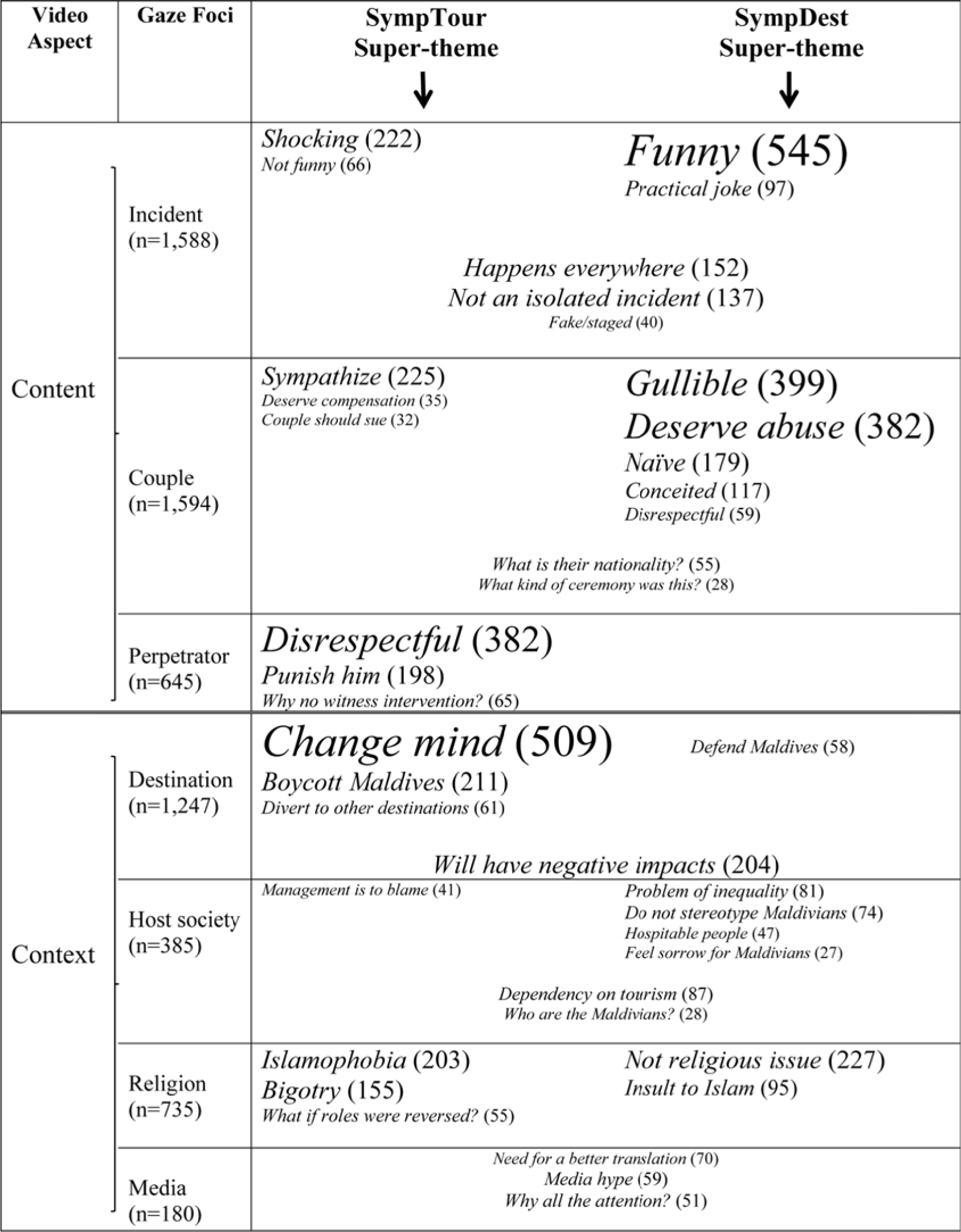
Foci, super-themes, and subthemes.
Video Content
Gaze on the incident (n = 1,588)
The SympTour super-theme for the Incident itself (288 comments) contains a substantial number of comments framing the Incident as (1) shocking and disgusting (n = 222) or (2) not funny (n = 66): 1. Shockingly tasteless and cruel does not even begin to describe this (Flokk on Huffington Post); 2. NOT FUNNY ! THERE ONW SPECIAL DAY AND THEY MESS IT UP (yttihp11 on Video 9).
The SympDest super-theme for the Incident is much larger (971 comments), and includes comments that (1) found it funny (n = 545) or (2) positioned it as a harmless practical joke (n = 97): 1. lol [laughing out loud] - this just made my day … russel peters, trevor noah and crowd, step aside !! there a new maldivian in the house !!! lmao [in my arrogant opinion] (HAHAH on IOL); 2. I know Maldivians very well and they are indeed very mischievous but THERE IS NO MALICE in their jokes, but when they see nothing but tourists all day, they find ways of entertaining themselves. I am sure there was nothing personal or malicious in their actions just entertainment for themselves which has backfired big time (jamitjimmy on Video 6).
Two subthemes were essentially neutral and contextual in contending that (1) antitourist behaviors happen everywhere (n = 152) or that (2) the Incident was not an isolated event (n = 137). Fewer comments (n = 40) positioned the event as fake or staged: 1. I have found similar situations in the Caribbean where resentful staff have been unable to contain their dislike for their guests (David Di Sera on Mail Online); 2. Of course it is NOT THE FIRST TIME this has happened. LOOK AT THE BLOODY VIDEO! (Salemaniac1 on Video 6); 3. Great publicity for the resort though. Makes you wonder if the whole thing could even have been set up for marketing’s sake. They do say bad publicity is good publicity (Sarah Spencer on Blog 16).
Gaze on the couple (n = 1,594)
The SympTour super-theme for the couple (292 comments) contained three main subthemes that (1) expressed sympathy (n = 225), (2) called for compensation (n = 35), or (3) wanted the resort owners sued (n = 32): 1. quite sad really seeing the happy couple wander off in the sunset all smiles thinking they are married! If only they new. (Steve, London on News); 2. The hotel should refund all their money paid for this vacation and give them a free vacation with a real wedding ceremony of the couple’s choice (eddhb on Video 7); 3. I hope that this unfortunate couple sue the backsides off the morons responsible for making a mockery of what should have been the most important day of their lives (Scotbell on Video 7).
The much larger SympDest super-theme for the couple (1,219 comments) includes subthemes that questioned why people would be so gullible as to use an uncomprehended foreign language for renewing their wedding vows (n = 399). This gaze largely questioned how meaningful such a ceremony could be. Often these commentaries were compared to those who do not speak a foreign language having Chinese or Kanji tattoos as body art. A related subtheme (2) situated the couple as deserving of the abuse for various reasons (n = 382), either because of the foreign language selection or because they selected an Islamic country for the ceremony. Other subthemes cited the couple’s (3) naïvety (n = 179), (4) conceit (n = 117), or (5) disrespect for local culture, tradition, and religion (n = 59): 1. Could someone explain WHY ??? WHY ??? WHY ???in the world would someone in the right state of mind would want to get blessing in some language that nor he nor she would understand?!?! (ed1ny, on Video 7); 2. They deserved this soooo much and this was truly fantastic……NOW THESE TWO STPID [*] SSWIPES SHOULD ASK FOR DIRECTONS TO THE NEAREST MOTEL ROOM AND SEE WHERE THEY END UP (1019drummer on Video 1); 3. isn’t just a tad naive to think that worldwide travel is as inconsequential as a local bus ride? If you go somewhere ‘exotic’, is it really that clever to assume things are just like they are at home, but with sunshine? (KJ44 on Discussion 3); 4. I definitely think people who read “Eat Pray Love” and find themselves drawn to Eastern “exoticism” are, as a rule, almost unbearably pretentious (babe169 on The Guardian); 5. I’m just disturbed by the notion that white westerners think they can go all over the developing world and exploit the “quaint native traditions” of these places for their own purposes (ericb on Blog 33).
Finally, two “neutral” subthemes captured “curiosity” comments seeking or providing clarification about (1) the nationality of the couple (n = 55) or (2) the nature of the ceremony (n = 28): 1. I believe the couple in the video, from the article I read, are not American but either French or Swiss. I see a bunch of French people posting so I’m leaning towards the French (Yargezim on Video 7); 2. There seems to be confusion among some of you posting. These people DID NOT Marry. This was a renewal of vows ceremony which many resorts in the Malldives (curt0903 on Video 9).
Gaze on the perpetrator/witnesses (n = 645)
The only super-theme that pertained directly to the perpetrators (all 645 comments) was SympTour, and this either (1) situated the culpable employee as despicable and disrespectful (n = 382), (2) called for him to be punished (n = 198), or (3) questioned why other attending employees did not intervene (n = 65): 1. It is extremely disrespectful. I don’t see how targetting foreigners makes it any better (Ibrahim in UK on Blog 4); 2. This man should be fired for using that kind of hate speech whether they could understand it or not (GrummoreGrummersum on Blog 17); 3. The celebrant’s behaviour is disgusting but so is the fact that the numerous members of staff standing around appear to hold the same opinions. Otherwise someone would have stopped it happening. Surely someone there felt it was wrong(!?) (celebritystains on video 6).
Video Context
Gaze on the destination (n = 1,247)
The SympTour super-theme dominated comments about the Maldives (781 comments), with the three dominant subthemes projecting (1) altered intentions about visiting (n = 509), (2) calls for a boycott (n = 211), and (3) diversion to other destinations such as Seychelles, Mauritius, and Bahamas (n = 61): 1. Having holidayed in the Maldives 3 times now, I shall be thinking long and hard whether we ever go back (MrCodface on Video 14); 2. Boycott the Maldives. They obviously don’t respect westerners or want their money (Feneter on Video 6); 3. I was actually in the process of booking a honeymoon in the Maldives, and I’ve now changed it to Egypt (Ron, on Blog 24).
The SympDest super-theme was much smaller and represented by comments (n = 58) promoting or defending the destination. These mostly indicate prior visits to the Maldives: My wife and I had our honeymoon in the Maldives after getting married in Malta, and it was wonderful. Everyone in the Maldives was nice to us, even after I told them I was Jewish (Scott, on Mail Online).
A prominent “neutral” subtheme (n = 204) speculated about the consequent negative impact of the Incident on the Maldivian tourism industry, without disclosing personal intentions: It wouldn’t surprise me if the Maldives tourist industry took a huge economic punishment over this incident (D, London on Mail Online).
Gaze on the host society (n = 385)
The SympTour super-theme was only modestly represented in the host society focus (41 comments), with the one main subtheme attributing culpability to the resort managers. In contrast, the SympDest super-theme was prominent (344 comments) and diverse, consisting of four subthemes. The largest of these (n = 81) (1) opined that hosts, and resort employees in particular, have just cause to resent tourists due to attendant wealth disparities. A second subtheme (n = 74) (2) called upon readers not to stereotype Maldivians or Muslims based on the actions of a few miscreants, while a smaller subtheme (n = 47) positioned the Maldivians unequivocally as hospitable people. The smallest subtheme expressed sorrow for residents (n = 27): 1. Local staff are bound to get upset, particularly if they’re pressured into living very austere and restricted lives in their own villages. Resentments are further inflamed by the resorts being totally self contained, so visitors spend little money locally and mostly wages are meagre as fat cats/politicians cream off the tourism’s wealth … (Simon on Mail Online); 2. And so you can’t judge 1 billion muslims because of the behavior of some idiots. Idiots are part of EVERY group, religions, country, race, skin color, and so on. If we judge a society by its idiot, we all would be idiots;) (Elekrohirsch on Video 9).
Finally, two subthemes were neutral, one (1) citing tourism dependency as a reality and danger for the Maldives (n = 87) and another (2) clarifying the ethnic status of Maldivians (n = 28): 1. I am sure they like the income they bring in to a country that is heavily dependant on their sort of tourism (Manterik on The Guardian); 2. the Maldives are not Arabs but are rather of South Indian ethnicity (kooolpanda on CNN).
Gaze on religion (n = 735)
The SympTour super-theme mostly implicated Islam in the Incident. One related subtheme (1) indicated Islamophobia (n = 203), while another subtheme (2) alleged Islamic bigotry against non-Muslims (n = 155). A smaller subtheme (n = 55) (3) queried how Muslims might respond to such an Incident if the roles were reversed: 1. Maldives is an island paradise populated by Islamic scum, in the Arabian Sea. They are a breeding ground for terrorists (James C. Bennett on Discussion 6); 2. Resentment, ignorance, and religious bigotry certainly account for this incident (John A. on MSN BC); 3. just imagine if the tables were turned there would be violent protests in the streets (eas29 on Fox News).
The SympDest super-theme for the religious focus largely centered on views that (1) the Incident was not of a religious or racial nature (n = 227) or that (2) it was an insult to Islam (n = 95): 1. Religion has NOTHING to do with this story. It was a bunch of idiots trying to be clever. None of us have to look very far to find these sort of people!!! (welshred on RWilliams); 2. the celebrants made fun of the couple and the Qur’an too which technically, I REPEAT technically makes him an infidel lol [laughing out loud] the irony! (Candlelights on Discussion 3).
Gaze on media (n = 180)
All comments relating to the media (Maldivian or international) were critical of such outlets. One subtheme (1) simply called for a better translation (n = 70), another (2) suggested reader over-reaction to media hype (n = 59), while another (3) questioned similarly why the Incident attracted global attention (n = 51): 1. What a waste of my time. I didn’t understand a friggen thing here…at least put in subtitles for crying out loud (LEFTIESAREDANGEROUS on Blog 35); 2. wow…the comments on here shows the wonders of a modern world…….you idiots have learnt nothing have you.….???…….a few people who are assholes no doubt are taking the piss……but you idiots are quite prepared to tarnish everyone with the brush.….you are being propagandised….….can you not tell??? (lumpfish99 on Video 12); 3. Media loves to bring everything to the religious debate. Especially if it involves Islam (moejoe83 on The Guardian).
Discussion
Competing Social Representations and Dialectics
The division of the comments into two super-themes indicating respective sympathy for the tourists and the destination is useful because it imposes preliminary structure on a large and complex database and stimulates further analysis. Such analysis, however, subsequently suggests this particular bifurcation to be incomplete. Further interpretation indicates the presence of two competing social representations of the social-mediatized gaze, each exhibiting different dialectical dynamics, and each affected differently by its display through social media. Dialectics variably entail constructive or confrontational interaction between opposites, and as such provide a useful alternative framework for analyzing this and other tourism-related phenomena (Weaver 2014). As an ideal dialectical type, the first representation can be described as rogue individual with intimations of moderate Islam (RI-MI). The analytical context here is both religious—wherein Islam is either seen as not implicated or a victim itself of an isolated act of bigotry—and societal, where calls are made not to stereotype Maldivians and where problems of inequality are invoked to explain the aberrant behavior of the perpetrator. This narrative strongly reflects the support for multiculturalism and pluralism that suffuses government and other institutions in many Western societies, and as such is an example of a hegemonic social representation (Moscovici 1988). The implicit dialectic here is a resolution-based “them” and “us” one that aspires to ideals of unity, diversity, cooperation, tolerance, and compromise (Carr 2000).
The second social representation is rogue culture/religion with fanatical Islam (RC-FI) as the referent. The attendant Islamophobic philosophy is clearly and often bluntly expressed in the often vitriolic contextual “religion” comments and in explicit descriptions of the Incident as a crime (n = 41) or an act of terrorism (n = 27). The dialectic here is conflict-based and predicated on “them” versus “us” thinking that evokes confrontation, absolutism, and intolerance. Because it challenges the official multiculturalism narrative, it is a polemical social representation (Moscovici 1988). Within this framework, deceitful offensive acts by Muslims are to be expected. Power and solidarity are subsequently expressed in calls for punishment and boycott, following from visceral and emotional expressions of shock and sympathy for the victims. At first appearance, comments about the couple emphasizing their gullibility and deserving of abuse support the tolerant RI-MI narrative. However, many of these particular comments also support the RC-FI representation by stating or implying that the victims should have been smart enough to realize that “Muslims cannot be trusted,” and deserved the abuse because they were not that smart. The RI-MI narrative may also be critical of the couple, but more because they are seen as arrogant, or naïve about the intentions and behavior of rogue individuals rather than any rogue religion. A major theme that is more difficult to contextualize is the framing of the Incident as “funny.” This lacks clear analytical precedents in the other comments but seems mostly affiliated with the RI-MI representation in its implication that the Incident should not be taken too seriously or the perpetrator(s) judged too harshly.
What we have thus far is an emergent dialectic between the hegemonic and polemic social representation of “Muslims,” with each displaying in turn in its own internal and contrasting dialectics of “them” and “us.” Dialectical interplay between the two representations is prevalent in contemporary Western societies and increasingly conflict-based, played out in arenas such as immigration and the “war on terrorism” and in “trigger” issues such as proposals to open new mosques (Dunn 2001) or restrict the display of religious symbols in public. In the daily face-to-face gaze, associated tensions are rarely projected. In the conventional media gaze, these latent tensions become salient but are constrained by content discretion, editorial intervention, and relatively modest circulation. None of these constraints apply similarly to the social-mediatized gaze. In a rapidly globalizing world, meanings become highly contested and emotionally charged, leading to sustained ideological battles, calls for solidarity, and more overt projections of the cultural biases that arise from deep-set ethnocentrism, prejudice, and racism (Reisinger, Kozak, and Visser 2013). Social media exacerbates these effects by generating a multiplicity of stimuli to respond to and forums in which to express and share opinions about these stimuli (Howarth 2006). Ominously, Moscovici (1984, p. 9) contends that social representations “impose themselves upon us with irresistible force. This force is a combination of a structure which is present before we have even begun to think, and of a tradition which decrees what we should think.”
Social media facilitates cathartic full frontal attacks of touchstone social representations because of the previously mentioned (dialectical) interplay of proximity and distance to the relevant stimuli. However, it is the polemical social representation that takes full flight in this unconstrained social media landscape. This is perhaps because of the inflammatory character of the Incident, which offers concrete “evidence” of the RC-FI narrative and places the RI-MI representation on the defensive. The reciprocal reinforcement of proximity and distance—that is, the leave to fulminate from a distance and without consequences against a profoundly intimate display of deceit and contempt – appears to have the same reciprocal effect on confirming and reinforcing the irreconcilable differences between “them” and “us.” Accordingly, in the social-mediatized gaze, Islamophobia is overt as an underlying ideology “explaining” support for the representation, but there is no comparable articulation of multiculturalism, a more nuanced competing ideology. Extending Savener’s (2013) ideas about the ubiquity of power in tourist–host relations, overwhelming “virtual power” is exercised in calls for punishing the perpetrator and, more tellingly, boycotting the Maldives, which is a way of “punishing those Muslims” more generally. But here as well, there is no comparable proactive exercise of power in comments that adhere to the hegemonic representation; a few reactive comments defend the Maldives, but very few suggest changing vacation plans to the Maldives as a gesture of solidarity, or go out of their way to recommend the Maldives. Both sides freely vilify the hapless perpetrator, but the narrative of perpetrator as representative of a rogue culture is more compelling, emotive, and conducive to calls for solidarity than that of perpetrator as lone wolf who poses no existential threat to the gazers.
Social Media as Conflict Amplifier?
We tentatively conclude, therefore, that social media is more conducive to amplifying social representations that evoke conflict-based dialectics than those that evoke resolution-based dialectics. And this is from results where numerous incendiary comments from flamers—further demonstration of this amplification effect—had already been removed. More disturbingly, social media is an ideal forum for those wishing to instigate or deepen conflict due to the ease with which inflammatory messages can be created and uploaded. It is difficult to know the motivations of the uploader, although this may have been a political act designed to undermine a rival who was also the owner of the resort where the Incident occurred. As for effects, the credibility of the boycott calls is called into question by the arrival of a record 930,000 international tourist arrivals in 2011 though with declining market share from traditional European markets such as the United Kingdom, Germany, Italy, France, and Switzerland (MTAC 2013). Continuing global economic volatility and tourism boycott campaigns in the United Kingdom carried out by a Maldivian political party (Makan 2012) may have also played a role.
Further evidence of ephemerality and limited consequences for destination image and viability derive from the fact the Incident initially generated a surge in commentary from non-Maldivian viewers but fell to almost nothing after 12 days. However, in the contemporary social-mediatized world, images and sound are retained and relived and are not easily eliminated from public memory; tech-savvy individuals wishing to damage the Maldives again can easily recrudesce the Incident. Indeed, the tourism sector, and especially the resort enclave-type epitomized by the Maldives offers an ideal breeding ground for the resentment and anger that spawn hostile social media content, even though those Maldivians who commented in social media about the Incident were themselves mostly sympathetic to the tourists, perhaps because they recognize their dependence on tourism and are insulated from direct negative effects (Shakeela and Weaver 2012). Resort employees are isolated from society, poorly paid, work long hours, and expected to be always friendly and compliant (Lacher and Oh 2012). To avoid retribution from employers, veiled acts of resistance are commonly performed to level the balance of power. Most hotel employees (85%) interviewed by Harris and Ogbonna (2002) admitted to performing production sabotage during the previous week, while all admitted to witnessing sabotage. Effective saboteurs gain hero status in their group, indicating that the least powerful are most likely to assert power when opportunities arise (Bugental and Lewis 1999). Social media provides an accessible and highly effective new vehicle for enabling host resistance, allowing them to project their own social-mediatized gaze and emancipated social representations that challenge the more dominant narratives and indicate, perhaps, incipient dialectical synthesis (Weaver 2014).
Conclusion
Research focused on visual stimuli is rare in tourism, and this is the first systematic netnographic investigation of online responses to an inflammatory tourism-related social media video by people who are not residents of the destination and hence are potential tourists. Two social representations were identified, one of them hegemonic and tolerant, and the other polemical and intolerant. It appears as if social media, in this case through YouTube, attracts and amplifies the latter representation, achieving this through the paradoxical reciprocal relationship between viewer proximity and distance to the visual imagery, wherein intimately offensive images attract unconstrained vitriol without consequences. This social-mediatized gaze therefore reflects and encourages the conflict-based dialectics of “them” versus “us.”
Future Research and Limitations
Further investigation is required to understand how social media influences the construction and reproduction of such social representations within the virtual community, and how this differs from the comparable dynamics in conventional social configurations. Also, why is the alternative representation, with its resolution-based dialectics of “them” and “us” so comparatively weak, and what are the implications for the affected destination? Do outraged calls for boycotts and changes in vacation plan mean anything in such a transient and unaccountable environment? Availability of email addresses allows researchers to contact commentators to see whether they actually changed their plans as stated or even had such plans in the first place; if not, then the comments are projections of “mock power” that are probably intended to shock, influence others, and vent against the “rogue culture.” An intriguing possibility, arising from common patterns of support for tourism and the tourist-victims among both non-Maldivian and Maldivian commentators, is the role of antitourism video incidents in fostering emotional solidarity between residents and nonresidents (Woosnam, Norman, and Ying 2009).
Given the proliferation of visual online content related to tourism, it would also be useful to identify other antitourism incidents in other destinations to see whether similar patterns pertain. For industry stakeholders, social media has to be accepted as a crucial and valuable marketing tool but also an uncontrollable and potent tool for sabotaging those same official marketing efforts. Do they therefore need to participate in these online discourses to disseminate effective counter-narratives, or are they best ignored? Such issues, which often implicate political motivations, suggest that social media effects need to be integrated into holistic crisis management strategies of destinations (Ritchie 2004). A limitation of any netnographic research is that commentator traits such as age, gender, education level, and location cannot be established and appended to quotations as per convention, thereby limiting attempts to outline the contours of virtual communities. Interpretation of viewers’ visual and auditory responses is also not possible. However, social media will continue to expand as a forum for expressing opinions and influencing others, and an understanding of the attendant dynamics is increasingly imperative for gaining a proper understanding of the contemporary destination and tourist.
Footnotes
Declaration of Conflicting Interests
The author(s) declared no potential conflicts of interest with respect to the research, authorship, and/or publication of this article.
Funding
The author(s) received no financial support for the research, authorship, and/or publication of this article.