







Abstract
General models of tourist decision making have been developed to theorize tourist decision processes. These models have been based on the premise that tourists are rational decision makers and utility maximizers. Further, these models have been operationalized through input–output models to measure preferences and behavioral intentions. The extent that they remain viable to explain and predict tourist behavior as tourism markets mature however is uncertain. This review article critiques these approaches and proposes a new general model based on dual system theory to account for different types of choice strategies, the constructive nature of preferences, and to recognize the individual and contextual factors that influence choice processes. The article argues that a general tourist choice model should integrate the psychological processes that determine choice strategies, or heuristics, and consider choice context. These include individual differences, task-related factors, and principles determining system engagement. Future research and practical implications are outlined.
The rule that human beings seem to follow is to engage the brain only when all else fails—and usually not even then.
Introduction
Tourist choice and decision making has become one of the cornerstones of research in the tourism literature spanning five decades of theoretical and empirical development (Smallman and Moore 2010). Theoretical progress has been rich, recognizing the inherent complexity involved in tourism decision making, and numerous general models have conceptualized the determinants, phases, and intervening variables involved (Sirakaya and Woodside 2005). Yet, fundamental questions remain unanswered about the extent that our conceptual models actually reflect tourist behavior. A particular issue is whether they are reflexive enough to account for developments in the culture and practice of tourism as it has evolved into a pervasive global activity and become established as a cultural norm in many societies.
While there has been great progress made in conceptualizing tourist consumer behavior, we argue that the tourism studies academy has been rather selective in its application of theory and concepts from psychology, economics, and consumer research, and has too often positioned tourist choice processes as rational, logical, and involving complex reasoning that is both abstract and affect-free. Theory development appears to have reached an impasse as a consequence. This in turn drives a question about the extent to which conventional models of decision making remain relevant over time. As tourism has become a global industry, employing sophisticated marketing and consumer research, and in which tourists are ever more experienced and empowered, it is reasonable to assume that tourist decision-making processes have also evolved. Cognition has a socially embedded dimension, and behavior is constantly adapting and adjusting (Moore et al. 2012). Tourism plays a profoundly different role globally now in both the psychological as well as the social and cultural environment than it did previously.
Additionally, a great wealth of empirical tourism consumer research has been produced over recent decades, applying a systematic focus on specific constructs (such as motivation, destination image, information search, attitudes, etc.). Yet, while incremental conceptual knowledge from the core disciplines (economics, psychology, consumer research) may have been integrated into these empirical studies, some has not been reintegrated into the general models. There is a need to reappraise the general models of tourist decision making to integrate recent theory building in tourist consumer behavior research, and to recognize the possibility of plurality in tourist reasoning and decision-making styles. Thus, we argue it is time for a radical reappraisal of tourism decision-making theory and research.
Specifically, this paper proposes that in today’s complex global tourism system, it is untenable to assume that all tourists’ decision making follows a uniform pattern or process as suggested by general models. Indeed, we argue that affect, intuition, and other subjective and situational factors often drive tourists toward decisions that do not provide optimal value or are rational. Since we know that tourist decision making involves different types of decisions at different stages, the general models need to reflect the fact that decisions can be made in different ways, including heuristics. This review paper integrates recent research in consumer psychology and proposes a revised model that incorporates dual-system theory into a holistic model of tourism decision making. The aim is to contribute to the literature in three main ways: to develop theory that is more flexible to account for different systems of decision making; to address the existence of fast, intuitive, affect-driven, and simplified decision-making processes that have been largely overlooked in tourism research; and to propose new directions and areas for knowledge development in future tourism consumer research that perhaps relate more readily to current consumer behavior trends and patterns.
This discussion is organized in the following way. First, we evaluate the contribution of the general models of tourist consumer behavior that has depicted tourist decision making as comprising singularly complex, analytic reasoning processes. We then review and critique the three main theoretical approaches for modeling tourism decision making: the normative approach, the cognitive approach, and the choice sets approach. Following this review, the paper outlines a new conceptual model that is based on the following assumptions: tourists employ different choice strategies some of which are complex, logical, utility driven and normative, but others are driven by emotions, and reflect informal and unstructured processes, associative and intuitive styles of reasoning. Tourist decision making is made up of stages in that multiple decisions are often made, each of which may require different types of choice strategies. The overall decision is determined by a range of factors within each choice context. It is this context that directs tourists toward the use of different types of decision strategy. From the outset and for clarity, in this article we refer to behaviors and decision-making processes in commercial leisure travel as opposed to business or other types of tourism behavior.
General Models of Tourist Consumer Behavior
It is beyond the scope and purpose of this article to present a detailed review of the models of tourist behavior, and numerous contributions have already provided excellent reviews of the relative merits of such models (cf Jeng and Fesenmaier 2002; Sirakaya and Woodside 2005; Smallman and Moore 2010). The following brief discussion highlights the major contributions and critical issues relevant to our discussion.
The main models of tourist decision making are closely based on and reflective of earlier models developed in consumer research (Howard and Sheth 1969; Engel, Kollat, and Blackwell 1967). These general models approach the inputs, variables, and outputs from a macro-perspective, the entire process, including the pretrip planning, anticipation and information search, the on-trip experience, and reflection and savoring in the post-trip experience (Clawson and Knetsch 1966). The main benefit of this approach is that it is useful in providing an overarching sense of the individual and social–psychological context alongside the inputs that influence tourists’ decision making. However, where these models benefit from integrative strength, they are weak in that they are complex and difficult to operationalize and thus lack empirical support (Moutinho 1987). For example, they cannot help us determine how alternative possibilities are evaluated by tourists. This lack of practical application to the empirical domain means that the models have less predictive power to explain actual outcomes (Sirakaya and Woodside 2005).
The general models of consumer behavior are grounded in the competing theoretical approaches of the disciplines of psychology and economics. Tourism, as a field of inquiry as opposed to a discipline, has adapted theories, in a rather ad hoc fashion, to suit the contextual parameters of the phenomena. Decrop (2014) for example identifies five major theoretical approaches that have been applied to theory building in tourism decision making: the microeconomic approach, the motivational perspective, the behaviorist paradigm, the cognitivist approach, and the postmodern perspective. It is through these theoretical approaches that the grand models are operationalized in empirical research. The microeconomic approach views decision makers as rational, since choices are determined primarily by expected utility and price/value considerations. Cognitive models focus on the mental processes that underlie the decision-making process. Structural and process models prevail among the cognitive models (Correia, Kozak, and Tão 2014). The structural models have tended to assess the linkages between inputs and outputs in consumer’s behavior (attitudes and intentions, for example). Thus, the general models have been translated into a number of operational research models.
Most of these models have a fundamental basis in cognitive psychology (Wahab, Crampon, and Rothfield 1976; Schmoll 1977; Mathieson and Wall 1982; Van Raaij and Francken 1984; Moutinho 1987; Woodside and Lysonski 1989). Where behavioral approaches have been proposed (e.g., Middleton, 1994) these are generally in the style of cognitive behaviorism, which recognizes that the same stimuli have profoundly divergent effects on individuals in the marketplace (alongside mainstream thinking in behavioral psychology at the time [Stewart 1994]). Both the cognitive and behavioral types of model are based on an assumption that tourists are rational utility maximizers, following linear and sequential decision processes (Sirakaya and Woodside 2005). An exception is the general systems framework of consumer choice decisions (Woodside and MacDonald 1994) and subsequent models (Decrop 1999, 2014) that have argued that tourists’ choice processes are not always rational but can also be driven by social and emotional aspects. However, the underlying cognitive mechanisms remain embedded in these revised models.
Since the advent of the critical turn across the social sciences, heralded by a rejection of positivist empiricism, and the turn to postmodernism, general models of consumer behavior have been widely criticized for failing to account for the emotional, social, and symbolic drivers and influencers in consumption (Holbrook and Hirschman 1982; Urry 1995; Decrop 2014). The postmodern perspective emphasizes the experiential dimensions of tourist behavior and consumption (Smallman and Moore 2010), opposes the essentializing and reductive approaches of positivism, and eschews the idea of grand narratives or meta-theories, which produced the general models of decision making. The postmodern or interpretive approach does not aim to generalize or ascribe causality to actions, arguing instead for recognition of plurality and phenomenological interpretations of tourist behaviors (Uriely 2005), the role of consumption emotions more generally (Goldie 2009), or within tourism experience contexts (Malone, McCabe, and Smith 2014). Within positivist psychology, emotions have only recently begun to be defined, explored, and measured in relation to decision making (Alba and Williams 2013), and there has been a recent surge in interest among tourism scholars (Pearce 2009; Hosany and Gilbert 2010; Ma et al. 2013). However, these advances have not been reincorporated into the general models of decision making.
This rather simplistic analysis can ultimately only provide a gloss over a highly complex set of theories and a huge range of empirical research, but it is possible to highlight a number of salient issues. Many researchers have criticized the general models of decision making (Decrop 2014). Some have recognized that tourists, faced with too much information, decompose decision making into manageable units or steps (Eymann and Ronning 1997) that include an initial decision to take a holiday followed by motivation type and then destination (Nicolau and Mas 2005, 2008). The general models do not seem to recognize that tourism decisions are often divided into different phases. Others have highlighted the need for greater modeling of the prevacation planning structures (Hyde 2008). Most are focused on individual decision making, which ignores the eminently social characteristics of tourism behavior and decision-making contexts (Decrop and Kozak 2009), including the influential role of children in family decision making (Thornton, Shaw, and Williams 1997), the more spontaneous nature of some decisions (i.e., last minute) rather than linear and sequential steps (Decrop and Snelders 2004), and their complexity and difficulty in operationalization, in addition to a lack of linkages between some constructs in the models (Decrop 2014).
Some major review papers have argued that there needs to be a greater emphasis in future research on the different types of decision styles, influencing constraints and heuristics in tourist choice research (such as Sirakaya, McLellan, and Uysal 1996; Sirakaya and Woodside 2005). However, there has been limited progress toward this goal. Instead, what has occurred is that researchers have applied theoretical constructs into operational tools or instruments with the aim of explaining and predicting behavior. There are three general types of operational models that have been extensively applied in tourism research: the normative approach, the prescriptive cognitive approach, and the structured process approach.
Utility Theory: The Normative Approach
The investigation of decision making from a normative approach is based on the premise that decision makers are economic agents, who always behave rationally and make decisions based on the evaluation of the benefits and cost of each alternative product. Here, the tourist identifies the independent variables (the relevant attributes of each destination) so that the value of the dependent variable (i.e., preference for any particular destination) can be calculated. In economics, the benefit gained by consumers from the product is the utility, and the cost is represented by the constraints. It is assumed that individuals always follow a utility-maximization principle, whereby the product chosen should be the one providing the highest utility to the individual, subject to the constraints. In fact, of course in many situations people are not rational, in which case the utility-maximization theory will not apply.
Lancaster (1966) provided a “characteristic” theory to understand and estimate utility values, which is derived from the characteristics or attributes of the product. This theory fits the tourism context well, since most of the time tourists do not derive utility by possessing or using travel destinations as a whole, but by consuming the components such as transport, accommodation, and attractions (Tussyadiah, Kono, and Morisugi 2006). Because of its explanatory value, Lancaster’s characteristic theory was first used by Rugg (1973) in a tourism context to identify the determinants of destination choice. It was subsequently adopted and developed by others (e.g., Apostolakis and Jaffry 2005; Morley 1994; Papatheodorou 2001; Seddighi and Theocharous 2002). More recently, Tussyadiah, Kono, and Morisugi (2006) extended Lancaster’s theory to explain destination choice.
Although the normative approach provides a useful framework to explain the decision-making process, individuals are often described as seeking satisficing rather than optimum choices (Steinbruner 1974; Simon 1997). Prospect Theory (Kahneman and Tversky 1979) is useful in that it reconciles classical economic theory with psychological factors, including perception and value expressions such as risk, alongside intuitive reasoning, and so argues that rationality is “bounded” (Correia, Kozak, and Tão 2014). Although some aspects of Prospect Theory such as risk (Williams and Baláž 2014) and intuitive reasoning (Nicolau 2011) have been investigated in isolated studies, these have been undertaken independently rather than integrated into models of tourism decision making. Additionally, tourist decisions based on intuitive reasoning are regarded as a special outcome of particular contexts rather than an equivalent alternative to the rational processing system.
The Theory of Planned Behavior: The Prescriptive Cognitive Approach
The classic psychological theory used to explain tourists’ decision making is the theory of planned behavior (TPB), which is grounded in the theory of reasoned action (Ajzen 1991; Fishbein and Ajzen 1975). TPB is based on the premise that if people believe that a certain behavior will lead to a beneficial outcome they will tend to carry out this behavior, suggesting a strong positive relationship between intentions and actual behavior. The judgment of the value of an outcome is shaped by three belief dimensions: behavior belief (attitude toward the behavior), normative belief (subjective norms), and control belief (perceived behavioral control). In the context of tourism decision making, scholars propose that intention to travel to a destination can predict actual travel behavior. Many tourism studies have sought to identify the factors influencing travel intentions.
TPB provides a useful framework to summarize the types of factors that determine tourists’ intentions. Since Lancaster’s characteristic theory is widely accepted in tourism studies, tourist’s attitudes toward a specific destination are usually measured as the sum of the attitudes toward experiencing the destination’s perceived attributes (Crompton 1992; Yoo and Chon 2008). Thus the attitude can be calculated as the likelihood of experiencing this attribute at a certain destination multiplied, for example, by the benefit value of this attribute as rated by tourists. Subjective norms reflect the tourist’s perception of his or her reference group’s belief as to whether he or she should travel to this destination. Subjective norms are determined both by the individual’s beliefs about ‘what others would think about it’ and how much the individual would like to comply with the considerations of the reference group (Ajzen and Fishbein 1980). Perceived behavioral control relates to the perceived ease or difficulty of traveling to a certain destination. The validity of the application of planned behavior theory in tourism decision making has been tested in several studies (Gnoth 1997; Yoon and Uysal 2005). In a study by Lam and Hsu (2006), past behavior (frequency of previous travel) was added to the framework to increase the predictability of travel intentions.
However, the models rely upon the assumption that the consumer undertakes comprehensive cognitive processing prior to purchase behavior, an assumption that is challenged by other philosophical approaches (Bagozzi, Gurhan-Canli, and Priester 2002; Smallman and Moore 2010). The reliance on cognition appears to neglect any influence that could result from emotion, spontaneity, habit, or as a result of cravings (Hale, Householder, and Greene 2002). In certain circumstances decision makers do not appraise attributes by a process of referral to additional information, but rely on previously formed global affective evaluations in a process called affect-referral (Wright 1975). It is widely acknowledged in the literature that choices are influenced by emotional factors such as love, or fear, and that “the incorporation of psychological factors into the choice process model leads to a more behaviorally realistic representation of the choice process and consequently has better explanatory power” (Fleischer, Tchetchik, and Toledo 2012, 654). Correia, Kozak, and Tão (2014) argue that individuals have limited memory and therefore perform decision making through a simplification process that in part relies on trust and intuitive perceptions, rather than logical reasoning. This raises the prospect of uncertainty in the decision outcome, which means that decisions are influenced by emotions and cognitions, alongside psychological and social factors. Therefore, TPB approaches are deficient in accounting for the psychological processes involved in tourist decisions.
The Choice-Set Model: The Structured Process Approach
The choice-set model was introduced from marketing and consumer research and is more business and practice oriented (Spiggle and Sewell 1987). The work of Woodside and Sherrell (1977) was the first attempt to conceptualize choice sets for leisure travel. This model describes a funnel-like process in which a tourist first develops an initial set of destinations, the awareness set, and then eliminates some of them to form a smaller late-consideration or evoked set (Bradlow and Rao 2000; Manrai and Andrews 1998), finally selecting a destination from this smaller set. The awareness and consideration sets as well as the final choice are the key elements widely acknowledged by most researchers (Crompton and Ankomah 1993).
Based on this simple two-stage choice-set model, other choice sets, such as inert set, inept set, and action set, were developed in later research (Crompton 1992; Decrop 2010) so that the position of each destination within the tourist’s mind can be modeled more accurately. Although the choice-set model provides theoretical insights into tourists’ decision making, it simplifies the process into structured outcome stages where alternative destinations can be positioned within a certain choice set so that destination marketers are able to apply more effective advertising campaigns and make improvements in the timing of messages accordingly. However, a number of criticisms have also been made regarding the usefulness of choice-set models in predicting behavior. They tend to oversimplify the reality of choice processes to a binary logic, whereas fuzzy logic would perhaps be more accurate (Decrop 2010). Perdue and Meng (2006) argue convincingly that the reasons for selection of destinations differs considerably from the reasons for rejection such that actual choices might be better based on the processes of elimination than on the extent that selected destinations reflect desired attributes.
To sum up, there are two fundamental problems that are revealed from the discussion above. First, that rationality is assumed or is implied in these approaches. This assumption negates the role of emotion and intuition in decision making (Correia, Kozak, and Tão 2014). Secondly, most models in tourism studies analyze the decision-making process as an input–output process. The normative approach investigates the relationship between attributes (input) and decision outcomes (output) while the models of the prescriptive cognitive approach studies the relationship between psychological factors (input) and intentions (output). Input–output analysis remains at the computational level providing indicators of which types of inputs cause particular kinds of outputs (Marr 1982). Although the choice-set approach explains decision making as a filtering process, it focuses on the outcome stages rather than the mental mechanism behind the process, thus essentially a “variance” ontological position (Smallman and Moore 2010). As a matter of fact, the mental processes behind tourism decision making has been largely ignored altogether, so there is little conceptual understanding or any empirical estimations that explore just how tourist decisions are made.
Given these criticisms, which have somewhat constrained advancement in theory development, a new approach to the conceptualization of tourist behavior is necessary. This will enable future researchers to explore relationships between psychological and contextual factors, account for multiple types of and stages in tourist’s decision strategies and develop better predictive models, which will be of practical use to tourism marketers. The dual system framework offers a useful approach in which to develop such a holistic conceptual model.
Reconfiguring Tourism Decision Making Based on Dual-System Theory
Leisure tourism includes many different types of activity such as long stay, main annual vacations, and short breaks and incorporates many motivations. Consumers undertake a variety of tourism trips during the year, during summer and winter, and so on. Therefore, tourists are confronted with a range of choices and may employ different types of strategies in each specific context. However, within each choice context, a number of factors may push tourists toward the use of simplifying strategies that limit the amount of cognitive effort required to make any decision.
Within psychology, researchers have postulated two distinct modes of cognitive processing behind decision making, often called dual system theory. Dual-system theory has been described as the experiential and rational system (Pacini and Epstein 1999), reflexive and reflective system (Evans 2006), impulsive and reflective system (Strack and Deutsch 2004), and heuristic and systematic/analytic system (Lieberman 2003; Chaiken and Ledgerwood 2012). However, there are some common aspects that can be summarized as follows: first, system 1 is an intuitive, rapid, automatic, and effortless process while system 2 is a rational, slower, deliberate, and effortful process; second, system 1 focuses on readily accepted and understood cues, such as the communicator’s credentials or the number of advantages presented, whereas system 2 involves thorough information search and careful evaluation and consideration of attributes (Chaiken and Ledgerwood 2012).
Dual system approaches indicate that preferences are constructed (rather than innate) within the context of each new decision problem. Preference construction could arise as a result of system 1 generating an intuitive response or system 2 activating deliberate processing or an interaction of both systems (Dhar and Gorlin 2013). Although the existence and use of the dual-system has been proved by empirical studies in behavioral research (Ferreira et al. 2006), psychology and consumer research as well as neuroscience (Goel and Dolan 2003), it has been largely overlooked in tourism decision making research.
Jun and Vogt offer three reasons that might explain the lack of attention given to dual process systems of tourism decision making (2013). First, dual-process models have been perceived as less applicable with intangible/experiential products when an individual’s information-processing motivation for those products is high. Yet, for repeat visitors, who revisit the same destination each year, the motivation for information search behavior may not be significant. Second, research in tourism has focused on the intrinsic characteristics of individuals and their social situations rather than on the processes involved in decisions. This relates to the focus on input–output approaches to tourist choice, which overlooks the mental processes tourists apply. Third, assessment of dual system approaches is more amenable with experimental research studies, common in behavioral science, but less frequently used in tourism.
Simonson (2008) noted a growing consensus among researchers that because of limits in working memory, preferences are constructive and largely determined by the choice context. In tourism decision making, there are some compelling macro socioeconomic and technological factors that influence choice contexts and that signify the appropriateness of the dual system approach. Choice and behavior patterns might be malleable over time and as tourism markets develop and become more sophisticated. Travelers in the advanced economies are becoming very experienced, and mobile Internet technology has made massive amounts of information easily accessible without temporal or spatial boundaries. The global financial crisis of 2008 onward has made consumers more “value-conscious,” and there is evidence that consumers search for and respond to stimuli relating to ‘deals’ or sales promotions, particularly those groups which are not constrained by peak time holidays (such as retired people). In these conditions, different types of decision making strategies are perhaps more relevant than others.
Experienced travelers might be readily expected to engage in a mixture of complex, elaborate decision processing and intuitive, simplifying strategies in particular choice contexts, (either relating to a specific vacation involving stepped decisions or to the overall process). Although there are some exceptions within the literature (Au and Law 2000; Law and Au 2000; Van Middelkoop, Borgers, and Timmermans 2003), which have examined the use of heuristics in choice of shopping and transportation, and a few studies emerging on the dual system approach (Jun and Holland 2012; Jun and Vogt 2013), they have focused on testing how the two processes occurred during the information search phase rather than attempting to integrate dual system processing into a conceptual model of decision making. We propose that in addition to the macro environment of the tourism market, a range of individual choice contexts influences the use of the different systems to generate preferences. These include repeated, routinized decision making (inertia); risk/loss aversion; information overload; and time poverty.
Inertia
Consider the concept of novelty-seeking behavior. It seems counterintuitive to assume that people who do not seek novelty from their tourist experience but instead follow repetitive, habitual patterns of behavior undergo complex rational decision-making processes. Once we have achieved a highly satisfactory experience, the drive to retain, recapture, or repeat it is extremely strong. This is what Solomon (2002) terms “inertia.” Despite a stream of literature on the subject of novelty-seeking behavior among tourists (Lee and Crompton 1992), there is a countervailing argument that much of what tourists actually do is very repetitious (Niininen, Szivas, and Riley 2004).
Risk/Loss Aversion
In general conceptualizations of tourism behavior, most tourism decision making has been assumed to involve risks because of the intangible and experiential nature of tourism (Williams and Baláž 2014). Risky decisions come to the surface primarily when novelty is sought, indicating an optimum value sought from the experience, and a normative choice process. We argue that many holiday decisions could be characterized as being essentially risk-free, however, because of a number of factors: repeat behavior among the mass-packaged holiday market; standardized offering among holiday providers; globalization processes that lead to homogenous brand experiences internationally and can render cultural differences between destination experiences minimal (Baloglu and McCleary [1999] found that visitors and nonvisitors held similar perceptions about the images of four Mediterranean countries in their sample of the U.S. market, for example); and also due to Internet technology, which enables consumers to have a pretrial and to undertake much information search prior to the trip. Recent increases in demand for all-inclusive holiday products or cruise holidays are examples that could be construed as containing minimal risks.
A related issue is the notion that decision makers do not evaluate outcomes based on an absolute utility level but rather on the extent that they meet a reference level, which is the fundamental basis for Kahneman and Tversky’s Prospect Theory (1979). This states that different heuristics are applied by decision makers depending on whether they perceive the outcomes as losses or gains relative to their reference point. The effect of loss aversion is important because it has such a profound impact on final decisions, which is important for marketers (Kahneman 2011). While there are studies that have examined the relationships between price and elasticities of demand, few have included psychological constructs to assess whether loss aversion might influence decisions. An exception is Nicolau, who was able to segment a response sample according to the degree that individuals tended toward loss aversion (2012).
Information Overload
It has long been recognized that in the information era, driven by technology, individuals are faced with complex information environments, containing many channels and providers. In the tourism sector, this is particularly complex due the number of firms and organizations involved and the fragmented and overlapping way that the industry now makes offers available to the market. Similarly, dual system theory argues that consumers are not capable of processing all available alternatives and so make short cuts to save time and effort (Kahneman 2011). Sometimes consumers ignore available information particularly if they do not perceive it as relevant to their decision-making goals (Jun and Holland 2012), and the information environment is so complex that new technology could increase uncertainties in choice and decrease the effectiveness of search processes (Bettman, Luce, and Payne 1998).
Time Poverty
It is generally claimed that in advanced economies, many individuals perceive that they are money-rich but time-poor. One consequence of this is a perceived need to downsize, a return to basic values and “slow lifestyles,” including “slow tourism” (Fullagar, Markwell, and Wilson 2012). But in dual process theory under time pressure, individuals are pushed toward decision making that requires less effort and is based on reducing the onus on cognitive processing. While time pressure might direct some people toward choices that provide relaxation and escape, the time available to process information and make choices might for some people be very constrained and can direct them toward fast, intuitive decisions.
New General Model of Tourism Decision Making
Therefore, we propose a new model that depicts tourism decision making as a dynamic process in which both systems may be involved. In fact, there are different tourism decisions, for example, the initial decision to take a vacation and the choice of destination, tour package, or mode of transport (Nicolau and Mas 2008). However, in order to clearly illustrate the model, destination choice is used here as an example. In Figure 1, at each stage either system 1 or 2 type decision processing may be engaged. Heuristics (system 1) are affect-driven, automatic, intuitive, rapid, and requiring less effort while rules of logic and statistics (system 2) have been linked to rational reasoning (Gigerenzer and Gaissmaier 2011). A tourist may apply the analytic or heuristic system at each stage of decision making depending on general choice-related factors (i.e., level of involvement and cognitive load), and these factors can be influenced by sociopsychological differences between individuals and the characteristics of the task.
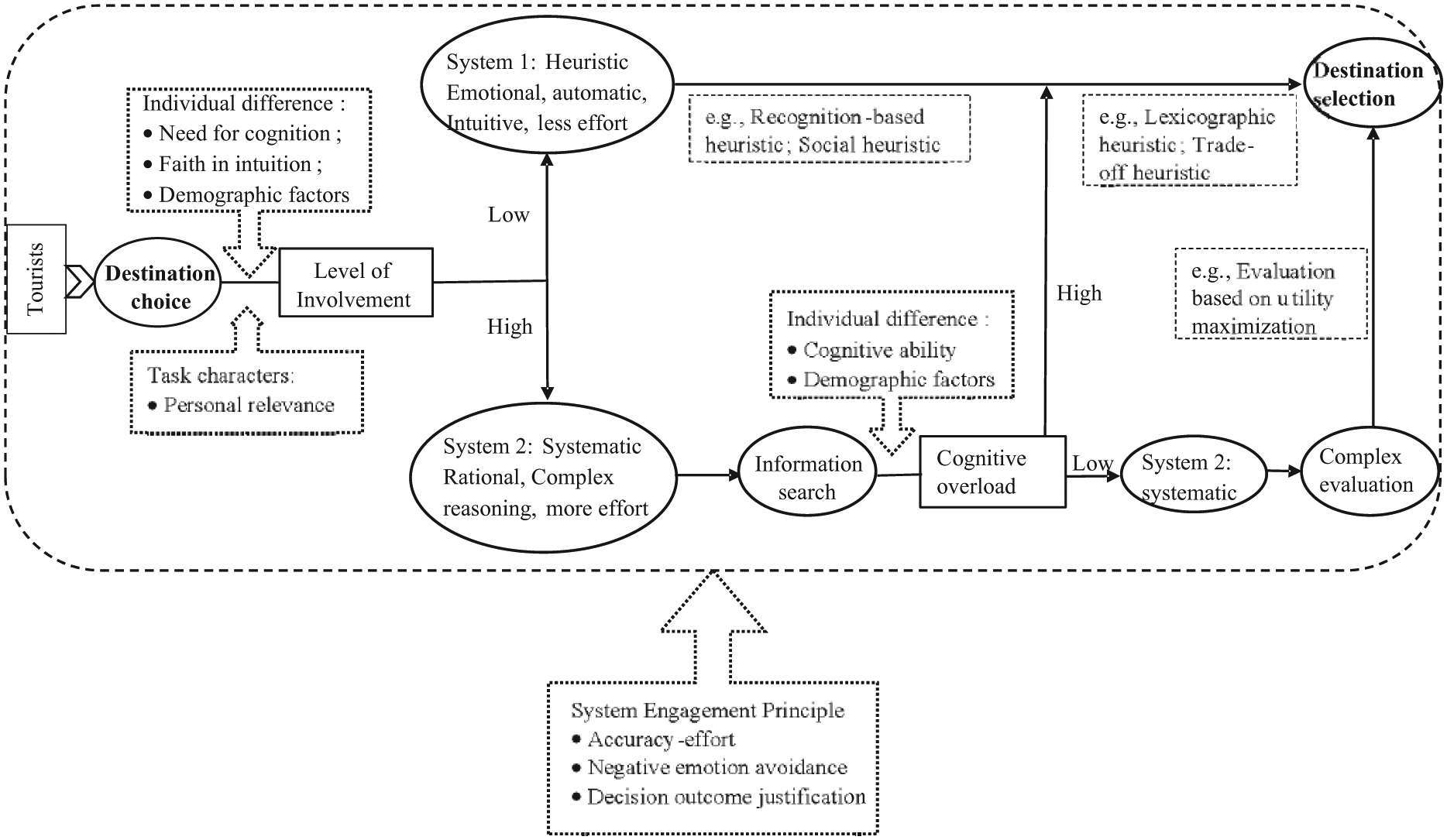
New general model of tourism decision making.
The level of involvement in the decision-making process is a key factor that triggers the use of the different systems at the stage where tourists recognize the need to choose a tourism destination. In a low-involved situation, tourists lack commitment to the task and have a greater possibility of applying the heuristic system, whereas in a high-involvement situation, individuals tend to put more effort into searching and processing travel-related information (Jun and Holland 2012). Level of involvement is highly determined by the personal relevance of the task (Jun and Vogt 2013) and can be influenced by different individual characteristics. These characteristics include the need for cognition (Cacioppo and Petty 1982), faith in intuition (Epstein et al. 1996), and demographic characters. For example, need for cognition (NFC) reflects an individual’s general propensity to engage in and enjoy effortful cognitive activity (Cacioppo and Petty 1982). Higher-NFC individuals are assumed to be more likely to be involved in the information search process. In contrast, low-NFC individuals do not prefer effortful cognitive evaluation and are more likely to rely on the heuristic system.
When the heuristic system is used by tourists in a low-involvement situation, there are different types of heuristics that could be selected. One type is based on recognition. If an available alternative is recognized, the decision maker may infer this alternative as having a higher value and therefore might be expected to select the recognized option. For example, a tourist may choose a destination just because he or she knows it or is more familiar with it than others. This type of heuristic may also be adopted by repeat tourists. Tourists recognize destinations they have previously visited faster than other alternatives, so they may select or reject known destinations easily. Social heuristics are purely based on social information and can also be applied in tourism decisions. These heuristics include imitating the majority heuristic, imitating the successful or averaging the judgments of others (Hertwig and Herzog 2009). Tourists may choose a destination because a celebrity is known to have visited, or because it is popular within the individual’s social circle. Social heuristics are helpful and may be adopted by decision makers when they know little information about the alternatives (Gigerenzer and Gaissmaier 2011). For instance, an inexperienced tourist might choose a particular long-haul destination because of its renowned image as a result of limited previous experience and a lack of knowledge about alternative destinations.
Heuristics based on recognition and social factors can be extremely fast and can even lead to a final choice being made without recourse to external information search and evaluation of alternatives. However, in a high-involvement situation, tourists are very likely to follow system 2 processing and search for additional information to assist their decision making. At the stage of information search, however, another factor, cognitive load, may divert some tourists into system 1 decision making. If the perceived cognitive load is acceptable, decision makers may keep processing the information using the analytic system and undertake complex evaluation (e.g., utility maximization) among alternatives until eventually a final choice is made. However, if the perceived cognitive load is high, decision makers may resort to simplifying strategies to reduce the information used to make the decision. The perceived cognitive load can be different among individuals. When people lack the cognitive resources (i.e., the personal abilities or motivation to process information is constrained), they tend to rely on the heuristic decision system rather than the analytic system (Petty and Wegener 1999; Ferreira et al. 2006). Additionally, people’s demographic differences also affect perceived cognitive load. For example, developmental psychologists found that in old age, people’s ability to apply abstract thinking and reasoning declines correspondingly, which leads to a higher dependency among this age group on the heuristic system rather than the analytic (Klauer, Musch, and Naumer 2000).
In tourism decision situations characterized by massive information availability such as destination choice, we might expect a high number of people who lack skills, time, or the motivation to use the analytic system. In these cases, heuristics such as the lexicographic heuristic or the trade-off heuristic might be used. The decision maker may focus on the most important cue/attribute (e.g., lowest price) under certain conditions such as time limits or information overload. If there are ties regarding the most important attribute, then the second most important attribute (e.g., sunshine) is considered and forms the basis of further comparison. This kind of choice process is known as the lexicographic heuristic, and there is some emerging work in this area in tourism (Li 2014). Compared with lexicographic heuristics, trade-off heuristics involve increased cognitive effort during the evaluation. Although this kind of heuristic allows trade-offs among attributes, unlike traditional utility maximization, it does not rely on a weighting of the importance of each attribute. The analysis is based on the number of attributes in each alternative and the choice process leading to the highest number of favorable attributes (Gigerenzer and Gaissmaier 2011). Either type of simplified heuristic will enable tourists to make a final destination choice.
There are additional factors that trigger or influence the use of different systems at different stages of decision making. Consumers, when encountering a choice problem such as a vacation destination choice, apply some basic principles that explain a tendency toward the use of the different systems. These are what Bettman et al. (1998) called the choice goal principle. These goals are the accuracy–effort principle, the minimization of negative emotions, and the maximization of ease of justification for the choice. Johnson and Payne (1985) developed the accuracy–effort framework for understanding how decision makers choose among different processing strategies. It suggests that people consciously select a processing system to balance their desires to make a more accurate decision and to minimize cognitive effort. The accuracy and effort required is highly contingent on the characteristics of the choice context. For example, in some contexts, where tourist decision makers are time-poor, for example, accuracy may be compromised so that effort can be spared.
In other contexts, where the possibility that negative emotions may result from a poor choice outcome, tourists may be more likely to use the analytic system. Emotion-laden choices occur when there are conflicts between choice goals that are important to the individual (Bettman et al. 1998). Conflicts emerge when trade-offs have to be made on attributes for which the consumer does not wish to incur losses. This will depend on whether the attributes are goals or resources (e.g., goals include pleasure or quality family time together whereas resources include cost or time). The extent that minimization of negative emotion influences the need for cognitive effort interrelates with the accuracy–effort principle but can also be affected by the justifications people use in making decisions.
Consumers often find it difficult to trade off one attribute to another or to determine which attribute is more important when faced with a decision. They tend to construct reasons in order to resolve tension or conflicts in trade-offs and to justify their choices to themselves and/or to others (Bettman, et al. 1998). Indeed, consumers may rely more on evaluations of the relationships between options in a choice set to provide justified reasons for the selection, rather than deriving overall values for each option and selecting the option with the best value. Researchers have noted that a dominance relationship between options is easier to justify as a reason for choice. This provides an interesting set of questions when an asymmetrical relationship between choice options exists within a choice context. The composition of the choice set does affect choice behavior, such that if a dominant option is considered, say for example a destination well known as a celebrity haunt, it may hold an asymmetric position among the alternatives in terms of the ease of justification.
There are some issues that need to be noted regarding the proposed framework. First, destination choice was used as an example in this paper to illustrate tourism decision making based on the dual-system theory. There are other types of tourism decisions (e.g., choice of transport mode; choice of tourism activities) and the model can be adapted to explain, understand, and investigate these tourism decisions. Second, there are different stages within the decision-making processes, and either system can be engaged in each stage. For example, a tourist may apply an analytic system at the stage of information search due to a high level of involvement in the situation but turn to use the heuristic system at the stage of information processing/alternative evaluation if the perceived cognitive load is too high. Third, there is no clear distinction between the heuristic and analytic systems. Dual-system theory proposes two ends of a continuum rather than discrete systems (Evans 2008). In addition, although both systems would lead to a final choice eventually, different processes of decision making can make a substantial difference to what is chosen, and a comprehensive outcome for tourists is not only the final choice of the vacation but also includes the choice process itself (Sen 1997). Finally, there are other types of heuristics, and there are different ways to distinguish and classify them. This paper has presented some common types. More efforts are required in the future to identify different types of heuristics and to explore the correct methods to classify them.
Conclusions: New Research Directions
As a result of this reconceptualization, a wide set of implications and a range of potential avenues for further research arise. As pointed out in the review, two major theoretical problems are associated with the conventional approaches to tourist decision making; rationality and the focus on input–output variables rather than cognitive processes. These two problems constrain knowledge development on tourism decision making. Therefore, different approaches are needed to help academics and practitioners develop new knowledge and progress ideas and methods about how tourists make decisions among all the multitude of possible strategies. By doing so, theory can progress, and marketers can develop new marketing strategies and campaigns to target potential consumers based on better predictive models of behavior.
Firstly, much further research is required to explore which types of decision strategies are used by different tourists in specific decision contexts. Tourism markets having unique cultural and socioeconomic conditions may exhibit a propensity toward a particular type. However, there is more likely a range of different types of decision making occurring in all markets. Therefore, there is need for applied research on the existence and engagement of different systems. In order to determine which types of decision strategies are being used in different decision contexts, a range of methods of data collection and models of estimation analysis will need to be developed and deployed. Thus, advances in methodologies and analytic methods could be a by-product of this new research. Behavioral science and experimental research design is one area of enormous potential for tourism research.
Since a range of factors could influence the engagement of different systems, research is needed to identify which factors are influential in determining a particular approach within different decision contexts. Although there are many studies in psychology that have identified salient factors generally, we have little knowledge of which ones are more influential in tourism decisions, and any relationships between the factors remains unknown. The investigation of the dual-system theory within tourism contexts may also contribute to theory development on issues such as how the two systems operate together; whether the analytic system is absolutely superior to the heuristic system, exploration of the role of affect in the dual system, and the differences in outcomes that arise out of the use of different systems.
Finally, tourism scholars can apply the dual-system framework to a wide range of research areas, for example, tourist’s attitudes toward destinations. The measurement of destination attitudes or image conventionally relies on a self-report method, which focuses explicitly on the cognitive process. In contrast, psychologists have instead suggested that people’s attitude can be formed based on explicit or implicit thoughts, indicating that individuals may have two different types of attitude toward an object at the same time—conscious, explicit attitudes and unconscious, implicit attitudes (Greenwald and Banaji 1995). Implicit attitudes operate primarily within the experiential system, whereas explicit attitudes operate mainly within the analytical system (Gawronski and Bodenhausen 2006). Applying these ideas to the measurement of destination attitude, Yang, He, and Gu (2012) introduce an implicit attitude measurement (Implicit Association Test [IAT]) into the domain of destination image measurement. They demonstrated that Chinese tourists’ explicit preference between Japan and Hong Kong is insignificant (measured by a traditional self-report questionnaire), but they expressed a significant implicit preference for the perceived image of Hong Kong to that of Japan. In some cases, the implicit measure of attitude has a better prediction on real behavior than self-report measures (Greenwald et al. 2009).
In terms of practical marketing implications, there is a lot of scope to investigate which types of marketing messages are more likely to be required by consumers in different contexts and to align with a range of possible decision strategies. The timing of campaigns, type of information provided, pricing strategy, and use of discounts and promotions to elicit specific types of decision strategies are just a number of different avenues for future research. Research on preference estimation and behavioral science methods that identify causal relationships will add value to the predictive capabilities of consumer research, which will assist tourism marketing practitioners in devising new marketing strategies and products. This article does not provide all the solutions, but it does offer a new set of possibilities for theory and empirical research to develop knowledge on tourist consumer processes, especially the mental mechanisms that drive tourist choice.
Footnotes
Declaration of Conflicting Interests
The author(s) declared no potential conflicts of interest with respect to the research, authorship, and/or publication of this article.
Funding
The author(s) received no financial support for the research, authorship, and/or publication of this article.