







Abstract
This article seeks to examine the impact of the customer experience (concept of THINK, FEEL, SENSE, ACT and RELATE developed by Schmitt in 1999) on relationship quality with travel agencies in a multichannel environment (in-store and online). A self-administered Web questionnaire was answered by 289 adult respondents from a panel of individuals residing in Canada, not working for a travel agency and having visited both the physical agency (in-store) and website (online) of the travel agency with which they generally conducted business. Results were analyzed using structural modeling techniques (EQS 6.2). For both the in-store and online contexts, results pointed to the THINK and FEEL dimensions as the key factors positively impacting relationship quality. The ACT (in-store) and SENSE (online) dimensions were also found to influence relationship quality positively.
Introduction
In today’s era, travelers are more informed, more demanding, more independent (Law, Law, and Wai 2002) and increasingly adopt multichannel behavior. The advent of the Internet has completely transformed how business is conducted and significantly altered how customers seek out information about tourism products (Grissemann and Stokburger-Sauer 2012). Many organizations use the Internet to provide customers with added value as part of a multichannel retail offering (Andrews et al. 2007).
Competition in the travel agency sector is fierce. Traditional brick-and-mortar travel agencies, important intermediaries in the tourism industry (Leblanc 1992; Hui and Wan 2005; Lai 2014), must nowadays compete with online travel agencies (OTAs) such as Expedia, Travelocity, and Orbitz that rely solely on a Web-based interface to serve customers (Kim and Lee 2004). Web technology indeed renders these agencies convenient and cost-effective (Park, Gretzel, and Sirakaya-Turk 2007). Traditional agencies must also compete with myriad online travel service suppliers such as hotels and airline companies that, in addition to traditional distribution channels, provide their own travel resources to potential customers via the Web (Law, Law, and Wai 2002; Kim and Lee 2004). The result, a plethora of challenges for conventional agencies (Grissemann and Stokburger-Sauer 2012)—hence the need to reappropriate their intermediary role by enhancing the quality of their relationships with consumers (Kracht and Wang 2010; Grissemann and Stokburger-Sauer 2012). As their use of websites has increased, they have had to find ways of making this channel work for them (Lee et al. 2004) while continuing to ensure in-store success. For the Internet as a channel cannot supplant the traditional face-to-face approach, generally key to the provision of superior-caliber service (Thao and Swierczek 2008).
Relationship marketing and experiential marketing are deemed of paramount importance in tourism (Li and Petrick 2008; Ritchie, Sun Tung, and Ritchie 2011; Manthiou et al. 2014; Knobloch, Robertson, and Aitken 2016). Building long-term relationships with consumers and providing them with positive before, during, and after experiences (Hwang and Seo 2016) across all touch points enables tourism businesses to distinguish themselves from the competition, generate revenue (Li and Petrick 2008; Kim, Ritchie, and McCormick 2012; Walls et al. 2011; Wolfe, Kang, and Hsu 2005), and drive loyalty (Hosany and Witham 2010; Lai 2014).
The shift to tourism products based more on consumer experiences relates to the notion of the “experience economy” (Pine and Gilmore 1998; Shaw, Bailey, and Williams 2011). The focus on quality and functional product attributes simply no longer suffices (Schmitt 2003; Gentile, Spiller, and Noci 2007). Modern-day consumers seek out experiences intended to stimulate their senses and curiosity, engage them personally, and touch their hearts (Schmitt 1999). Holbrook and Hirschman (1982) emphasize the importance of the three Fs, namely, fun, feelings, and fantasies, as does Williams (2006) for tourism. Although tourism researchers and practitioners have found that building on relationship marketing can be effective, success is not readily achievable (Li and Petrick 2008).
Relationship quality is deemed the essence of relationship marketing and serves as an indicator of the health and future wellbeing of long-term relationships (Crosby, Evans, and Cowles 1990; Nguyen and Nguyen 2014). Finding ways to build strong bonds with consumers remains more important than ever before for travel agencies (Lee et al. 2004; Lai 2014; Moliner et al. 2007). This being said, does customer experience contribute to enhanced relations with travel agencies?
Marketers face the challenge of how to allocate resources across different channels (Baxendale, Macdonald, and Wilson 2015; Mahrous and Hassan 2016). Indeed, customer experiences differ from one channel to the next and consideration must be made for each (Verhoef et al. 2009; Grewal, Levy, and Kumar 2009). With customers open to multiple channel experiences (Gentile, Spiller, and Noci 2007; Stein and Ramaseshan 2016), does the impact of customer experience on relationship quality vary based on the channels used (in-store vs. online)?
Only limited empirical studies have investigated the determinants of relationship quality in travel and tourism literature (Jones, Mak, and Sim 2007; Kim and Cha 2002; Moliner et al. 2007; Huang et al. 2009). To date, studies have touched on perceived value (Jones, Mak, and Sim 2007; Moliner et al. 2007), service quality (Huang et al. 2009; Kim and Cha 2002; Dolnicar, Coltman, and Sharma 2015), and image/facilities (Jones, Mak, and Sim 2007). To our knowledge, customer experience as a determinant has not been examined, a gap that this study aims to fill.
This paper indeed seeks to examine the impact of customer experience on relationship quality with travel agencies in a multichannel environment. This innovative study enriches travel and tourism marketing literature.
In the upcoming section, we provide an overview of literature on relationship quality, customer experience, and the links between the two concepts. Subsequently, we develop our research hypotheses and detail both the methodology employed and results obtained. In the discussion section, we substantiate the theoretical and practical implications. We then detail study limits and future research in the conclusion.
Literature Review and Hypothesis Development
Relationship Quality
In marketing, the study of relationship quality begins with Dwyer and Oh (1987), only to be expanded upon soon afterwards by Crosby, Evans, and Cowles (1990). Relationship quality has emerged in travel marketing literature over the past decade, and academic research relating to the concept appears relevant (Lai 2014). Hennig-Thurau and Klee (1997) define relationship quality between customers and firms as the “degree of appropriateness of a relationship to fulfill the needs of the customer associated with the relationship” (p. 751). Relationship quality plays a critical role in studies on the maintenance of long-term relationships (Finn 2005). A strong relationship is an intangible asset not easily duplicated by competitors (Wong, Hung, and Chow 2007; Rajaobelina and Bergeron 2009). Research suggests that strong relationships with customers tend to make them more loyal and profitable (Lai 2014). Indeed, they shop more frequently (De Wulf, Odekerken-Schröder, and Iacobucci 2001; Grégoire and Fisher 2006), spend more per visit (De Wulf, Odekerken-Schröder, and Iacobucci 2001; Grégoire and Fisher 2006), demonstrate a willingness to pay a premium for the products and services purchased (Grégoire and Fisher 2006), readily recommend a merchant to friends and family (Moliner et al. 2007), and cost less to serve (Grégoire and Fisher 2006).
No consensus has yet been achieved regarding the conceptualization and measurement of relationship quality (Lo and Im 2014). Relationship quality is most often qualified as a concept that includes trust, satisfaction, and sometimes commitment (Wu and Li 2011; Lo and Im 2014). Some studies nonetheless consider commitment as a consequence of the first two constructs (e.g., Ha and Jang 2009; Kim and Cha 2002; Lee et al. 2012). Therefore, in this study, we deem relationship quality to have two dimensions, namely, trust and satisfaction (Crosby, Evans, and Cowles 1990; Rajaobelina and Bergeron 2009), which is in keeping with a number of tourism studies (e.g., Kim, Lee, and Yoo 2006; MacIntosh 2007; Jin, Line, and Goh 2013). Trust is crucial for establishing long-term relationships with travel agencies (Coulter 2002; Hui and Wan 2005; Agag and El-Masry 2016) and refers to the level of customer confidence in a firm’s integrity and reliability (Moorman, Zaltman, and Deshpande 1992). Trust is a key performance indicator for travel organizations that influences perceived risk, attitude, and consumer intentions to purchase travel products (Agag and El-Masry 2016). Satisfaction, also important, has been investigated in numerous tourism studies (Cole and Scott 2004) and is defined as a consumer’s affective state resulting from an overall appraisal of his or her relationship with a retailer (Crosby, Evans, and Cowles 1990). Higher levels of satisfaction are perceived to spawn a greater tolerance for price increases (Baker and Crompton 2000; Maunier and Camelis 2013), while enhancing reputation or brand image (Fornell 1992; Anderson and Sullivan 1993; Kobylanski 2012). Additionally, satisfied consumers make recommendations to others, help secure future revenue (Anderson, Fornell, and Mazvacheryl 2004; Kobylanski 2012), and generate fewer relationship terminations (Ganesan 1994; Clark, Adjei, and Yancey 2009).
Like De Wulf, Odekerken-Schröder, and Iacobucci (2001) and De Cannière, De Pelsmacker, and Geuens (2009), this study considers relationship quality as a single latent construct with statements that measure trust and satisfaction given the high correlation between the two constructs (Brun, Rajaobelina, and Ricard 2014).
Customer Experience and Impact on Relationship Quality
Creating positive customer experiences is imperative in today’s travel and tourism industry (Mahrous and Hassan 2016) and, in fact, constitutes a leading priority for researchers (Fernandes and Cruz 2016). The notion has proven a key construct in travel and tourism research (Oh, Fiore, and Jeoung 2007; Fernandes and Cruz 2016; Hwang and Seo 2016), with work focusing on tourist experience tending to be more recent (Crouch, Huybers, and Oppenwal 2016). Studies by Pine and Gilmore (1998) and Schmitt (1999) brought the notion to the fore and revisited general conceptualization. Customer experience “originates from a set of interactions between a customer and a product, a company, or part of its organization, which provoke a reaction” (Gentile, Spiller, and Noci 2007, 397).
In recent years, a consensus has emerged pointing to consumer experience as a multidimensional construct (e.g., Schmitt 1999; Gentile, Spiller, and Noci 2007; Hosany and Witham 2010; Fernandes and Cruz 2016), while tourism studies have examined diverse dimensions of tourism experiences, such as emotion (Hosany and Gilbert 2010; Kim 2012) and education (Kim, Ritchie, and McCormick 2012; Tung and Ritchie 2011). In the bed and breakfast lodging sector, Oh, Fiore, and Jeoung (2007) develop an instrument for measuring customer experience that includes Pine and Gilmore’s (1999) four dimensions of aesthetics, education, entertainment, and escapism. Hosany and Whitam (2010) applied the same framework to cruise experiences and Manthiou et al. (2014) to music festivals.
However, several authors (e.g., Brakus, Schmitt, and Zarantonello 2009; Gentile, Spiller, and Noci 2007; Tsaur, Chiu, and Wang 2006; Yoon 2013) advocate use of the five dimensions proposed by Schmitt (1999), namely, THINK, FEEL, SENSE, ACT and RELATE, to qualify experience. We favor the latter approach in this study given its holistic vision and inclusion of the social (RELATE) and behavioral (ACT) dimensions of customer experience.
THINK refers to customer thinking and conscious mental processes (Gentile, Spiller, and Noci 2007; Schmitt 1999; Zinkhan and Braunsberger 2004; Carù and Cova 2003; Schmitt 1999; Pine and Gilmore 1998; Hirschman and Holbrook 1982). This dimension gives consumers the impression that they are learning something. By piquing both their curiosity and creativity, they are drawn to engage in reflection (Oh, Fiore, and Jeoung 2007; Brakus, Schmitt, and Zarantonello 2009).
FEEL refers to the internal feelings and emotions of individuals. Consumer emotions can be either positive or negative (Bagozzi, Gopinath, and Nyer 1999; Gentile, Spiller, and Noci 2007; Schmitt 1999; Richins 1997; Hirschman and Holbrook 1982; Prayag et al. 2017; Ding and Tseng 2015). Emotions are ubiquitous in tourism (Aho 2001) and play a central role in defining memorable experiences (Tung and Ritchie 2011; Hosany et al. 2015). An experience can surprise, entertain, or delight just as it can disappoint, anger, bore, or render impatient (Richins 1997). Kim, Ritchie, and McCormick (2012) suggest that future research should consider negative feelings such as anger and frustration. Indeed, in the hospitality industry, negative emotions tend to impact satisfaction to a greater extent than positive emotions (Han and Back 2007). FEEL (negative) is therefore included in this study (Richins 1997) given its importance and the strong correlation between FEEL (positive) and SENSE (Brakus, Schmitt, and Zarantonello 2009).
SENSE refers to stimulation of one or more of the senses: sight, hearing, smell, taste, and touch (Krishna 2012; Hultén 2011; Slatten et al. 2009; Gentile, Spiller and Noci 2007; Tsai 2005; Schmitt 1999; Hirschman and Holbrook 1982). Not all the senses are stimulated at the same time. Much depends on the channels used. For example, in a Web-based context, the sense of taste would necessarily be less relevant.
ACT encompasses all the behavioral aspects of consumption (Gentile, Spiller, and Noci 2007; Chang and Chieng 2006; Schmitt 1999; Pine and Gilmore 1998; Hirschman and Holbrook 1982). In the travel agency context, we can assess the capacity of businesses to engage customers in transactions, search for information, and organize travel plans (Childers et al. 2001; Baumgartner and Steenkamp 1996; Law and Leung 2000; Couture et al. 2013).
RELATE is defined by an individual’s social identity and link to a reference group (Schmitt 1999; Gentile, Spiller and Noci 2007; Chang and Chieng 2006). This dimension is consistent with social identity theory (Tajefl 1981) and suggests that “consumers prefer to surround themselves with others who have similar characteristics. Consumers will be more compatible with other customers with whom they can identify and are likely to evaluate those customers positively within a retail environment” (Brocato, Voorhees, and Baker 2012, 386).
In work to date, the link between customer experience and relationship quality as a global construct has been little covered in online and offline contexts (e.g., Jung and Soo 2012) and, to our knowledge, never investigated in a travel and tourism environment. In topical literature, the links between customer experience and the dimensions of relationship quality (trust and satisfaction) have been examined separately.
In a brand context, experience positively influences trust (Ha and Perks 2005) and satisfaction (Brakus, Schmitt, and Zarantonello 2009; Ha and Perks 2005; Hosany and Gilbert 2010). When customers enjoy a positive experience, they strengthen their relationship with and come to trust a brand (Jung and Soo 2012; Chen, Petrick, and Shahvali 2016). Also, customers who have a pleasant experience during in-store or Web-based visits generally agree that the service provider has exceeded their expectations, leading to the creation of a satisfying relationship. In an online retailing environment, some dimensions of experience (THINK and FEEL) impact satisfaction (Rose et al. 2012; Martin, Mortimer, and Andrews 2015). In restaurant, hospitality, and tourism contexts, positive experience induces satisfaction (Tsaur, Chiu, and Wang 2006; Yuan and Wu 2008; Ren et al. 2016). In an online hospitality environment (e.g., hotels), SENSE also impacts trust and satisfaction (Lee and Jeong 2014).
Having extrapolated results and applied them to the travel agency sector, we proffer the following hypotheses:
Hypothesis 1: THINK positively impacts relationship quality (in-store and online).
Hypothesis 2: FEEL (negative) negatively impacts relationship quality (in-store and online).
Hypothesis 3: ACT positively impacts relationship quality (in-store and online).
Hypothesis 4: SENSE positively impacts relationship quality (in-store and online).
Hypothesis 5: RELATE positively impacts relationship quality (in-store and online).
Figure 1 illustrates the model and corresponding hypotheses.
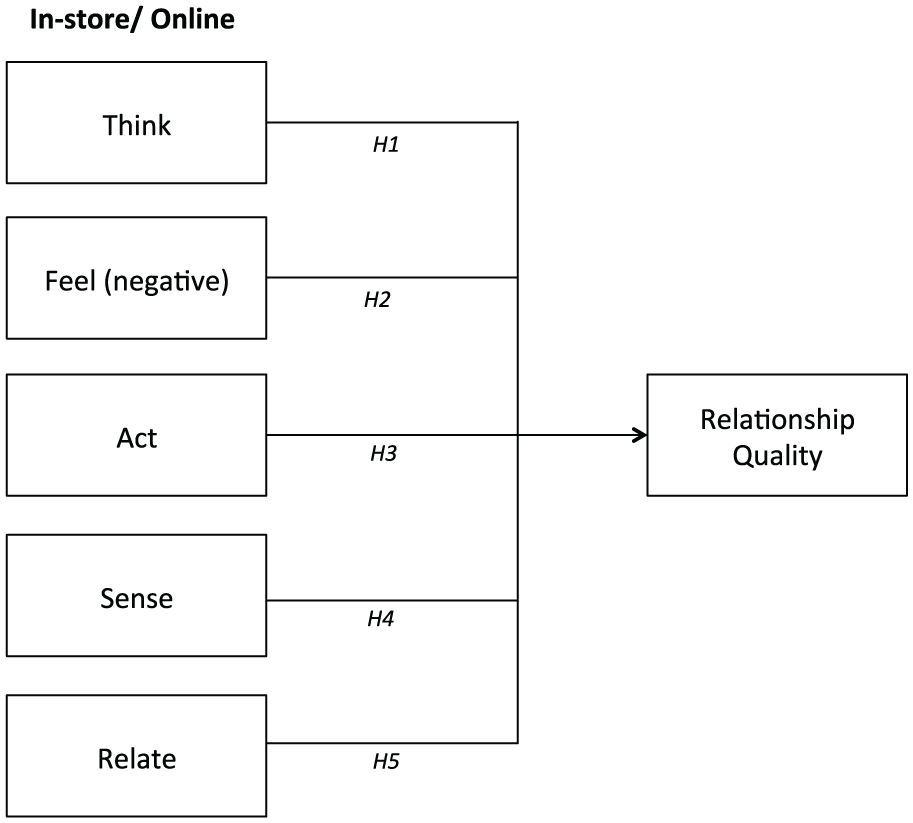
Conceptual model.
Methodology
Sample and Data Collection
We enjoyed access to 450,000 panelists of a Canadian research firm, which randomly forwarded invitations to people who met study criteria: respondents had to be 18 years of age or older, reside in Canada, not work for a travel agency, and have, during the last year, visited both the physical branch (in-store) and website (online) of the travel agency with which they generally conducted business. The research firm then selected individuals interested in taking part in the survey to achieve our desired quotas. Participants totaled 720 in number. As a consequence of the low incidence of people having visited both a physical travel agency and the latter’s website and our limited research budget, we retained 300 respondents for the purpose of the study at hand. Eleven respondents were removed owing to extreme values and contradictory or repetitive responses, resulting in a final sample of 289 respondents.
Data were gathered using a self-administered Web questionnaire. The questionnaire was pretested with 50 panelists from the research firm and revised by three experts in experiential and relationship marketing to ensure content validity. Women comprised 50.2% of the final sample, with median respondent age falling within the 35- to 54-year age bracket. A total of 53.3% had completed undergraduate studies, with median gross annual household income assessed at >C$80,000. Table 1 shows the sample profile.
Sample Profile.
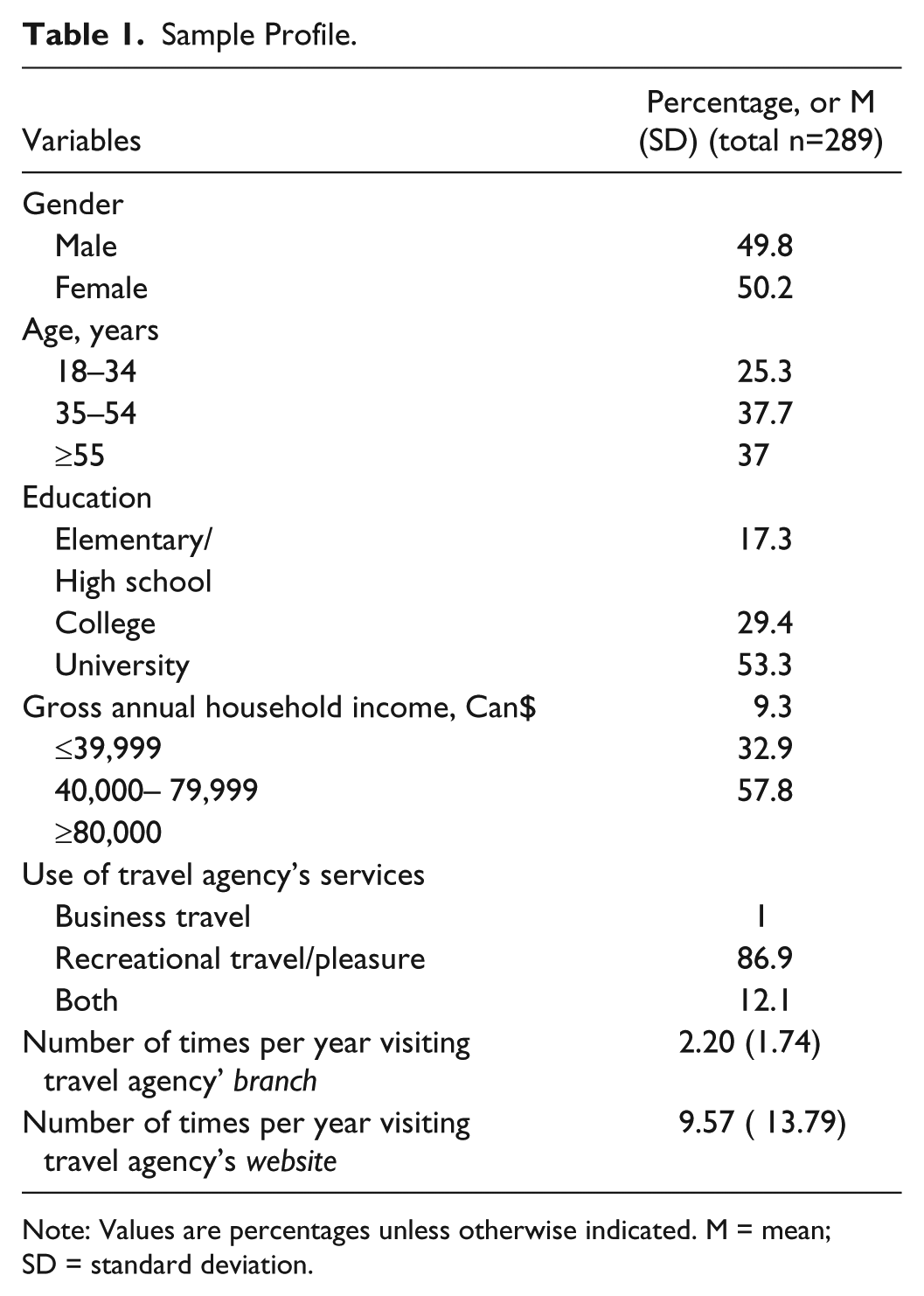
Note: Values are percentages unless otherwise indicated. M = mean; SD = standard deviation.
Measures and Data Analysis
Relationship quality was measured using six items adapted from topical literature (Crosby, Evans, and Cowles 1990; Jin, Line, and Goh 2013). This scale included items such as “This travel agency keeps my best interests in mind” (for trust) and “Globally, I am very satisfied with my relationship with this travel agency” (for satisfaction).
The dimensions of experience were adapted from the measures proposed by different studies validated in topical literature. THINK is reflected in four items that include “My curiosity is stimulated” whereas SENSE is measured in three items that comprise the likes of “My senses are involved.” These scales are based on the work of Brakus, Schmitt, and Zarantonello (2009). We chose Richins’s (1997) well-established scale from the literature to measure FEEL (negative). Samples from the four items selected include “I sometimes feel angry” and “I sometimes feel disappointed.” RELATE is measured by adapting a two-item scale developed by Brocato, Voorhees, and Baker (2012) (e.g., “I feel that I am a part of a community”). Lastly, ACT is measured by adapting a three-item scale developed by Childers et al. (2001). Prototypical items of this scale include statements such as “I tend to review my travel plans.”
All measures were plotted using a 7-point Likert-type scale, with each respondent required to evaluate his or her in-store and online experience (paired measures). The psychometric properties of the scales and testing of the five hypotheses with regard to the structural model were analyzed using EQS 6.2. Structural equation modeling (SEM) was selected over simple regression tools as the former enabled us to test a series of dependence associations simultaneously (Hair et al. 2010). In the proposed model, THINK, FEEL, SENSE, ACT, and RELATE represent the exogenous variables, whereas “relationship quality” qualifies as the endogenous variable.
Results
Reliability and Validity of Model
Results in Table 2 show that the Cronbach alphas vary between 0.76 and 0.95, and are situated above the recommended threshold level of 0.70 (Nunnally 1978). Composite reliability indices range from 0.79 to 0.96, therefore also exceeding the 0.70 threshold necessary for measurement reliability (Fornell and Larcker 1981). With regard to convergent validity, all items in the model have significant factor loadings greater than 0.50 (Hair et al. 2010). In addition, average variances extracted (AVEs) are between 0.56 and 0.78, and are greater than 0.50, which suggests adequate convergence (Fornell and Larcker 1981). Furthermore, discriminant validity is confirmed since no squared correlation (off-diagonal value) is greater than the AVEs (on-diagonal) (Fornell and Larcker 1981) (please see Table 3).
Results of Confirmatory Factory Analyses (In-store/Online).
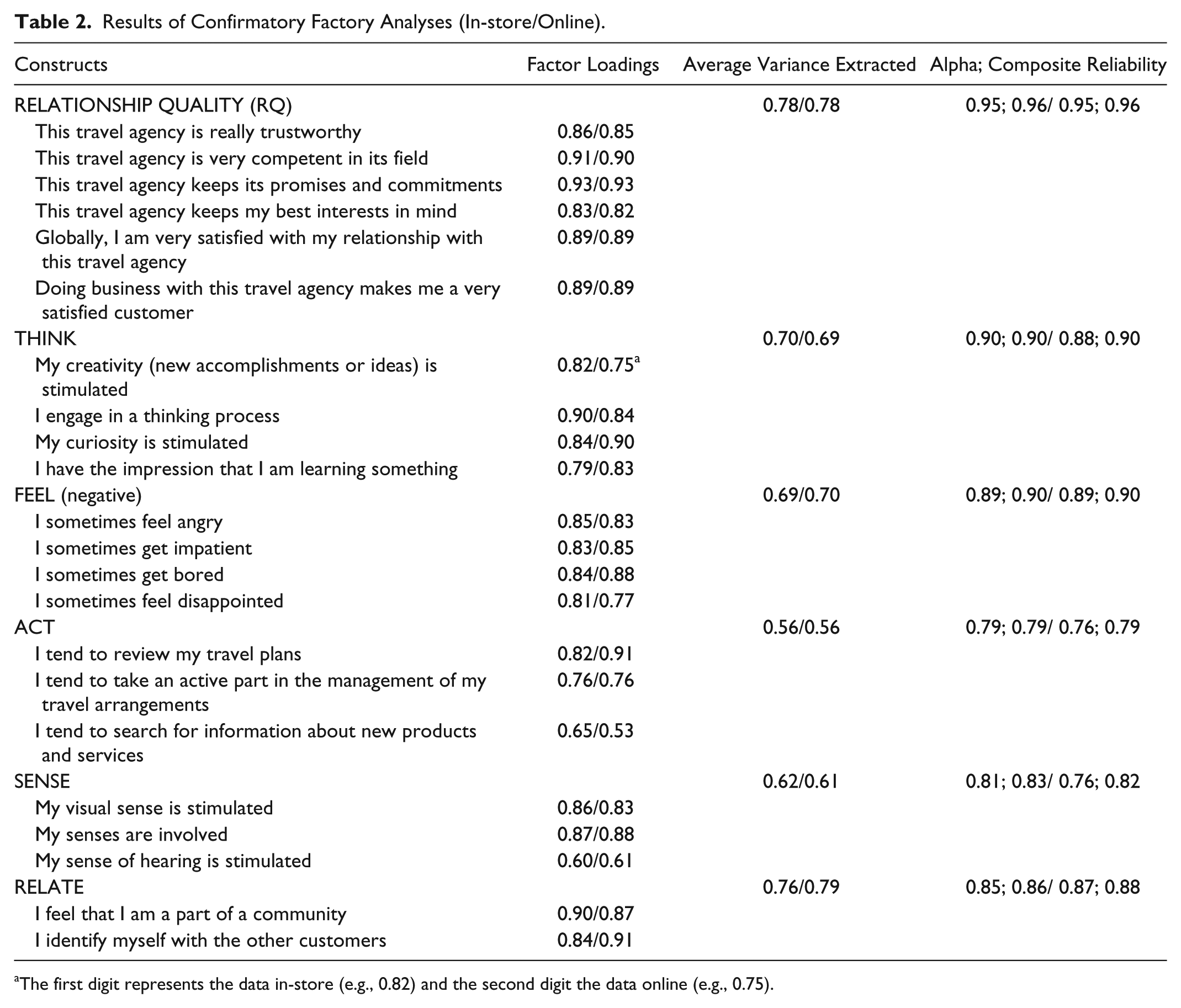
The first digit represents the data in-store (e.g., 0.82) and the second digit the data online (e.g., 0.75).
Discriminant Validity a (In-Store/Online).
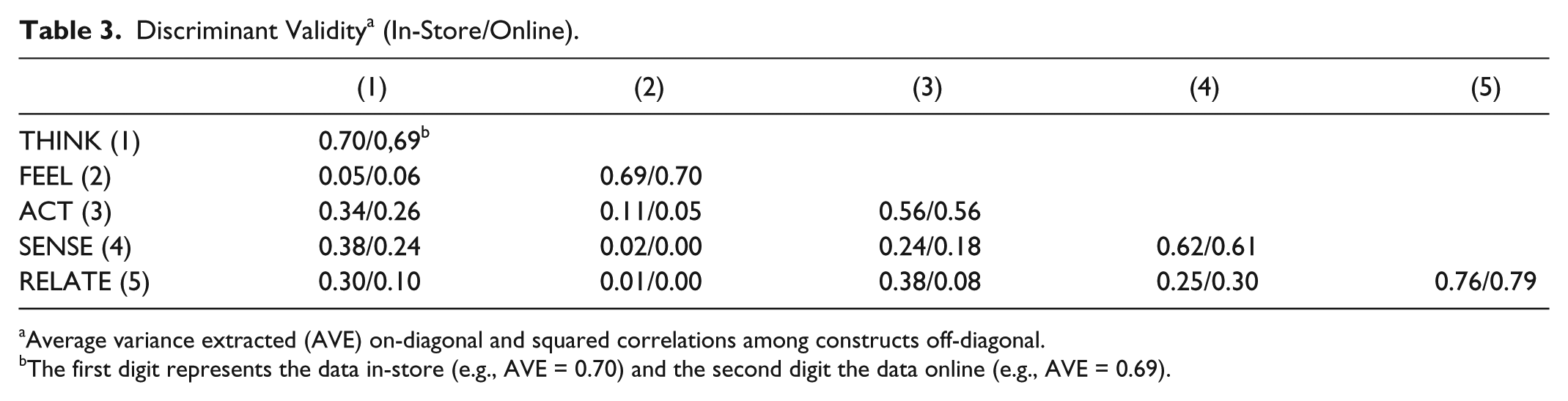
Average variance extracted (AVE) on-diagonal and squared correlations among constructs off-diagonal.
The first digit represents the data in-store (e.g., AVE = 0.70) and the second digit the data online (e.g., AVE = 0.69).
Measurement Model
We performed two confirmatory factor analyses (CFAs) to test the adequacy of the measurement models using EQS 6.2. Results indicate an excellent fit between the models (in-store and online) and the observed data. The overall fit indices of the measurement models are as follows: χ2 = 318.42 (df 194)/324.60 (df 194), p = 0.00/0.00, χ2/df = 1.64/1.67, nonnormed fit index = 0.95/0.94, comparative fit index = 0.96/0.95, root mean square error of approximation (RMSEA) = 0.05/0.06, with 90% confidence interval of RMSEA = 0.04-0.06/0.04-0.07.
Results of Structural Equation Modeling Analysis
The adequacy of the structural models was then estimated. According to the parameters recommended by Hu and Bentler (1999) for CFI (cut-off value of 0.95) and Browne and Cudeck (1993) for RMSEA (below 0.05) to supplement chi-square tests, the proposed models fit the data extremely well (see Figure 2). Further, the χ2/df ratios are lower than 3, suggesting an excellent fit according to Hair et al. (2010). Figure 2 also shows the results of standardized parameter estimates (for both channels) and of R2.
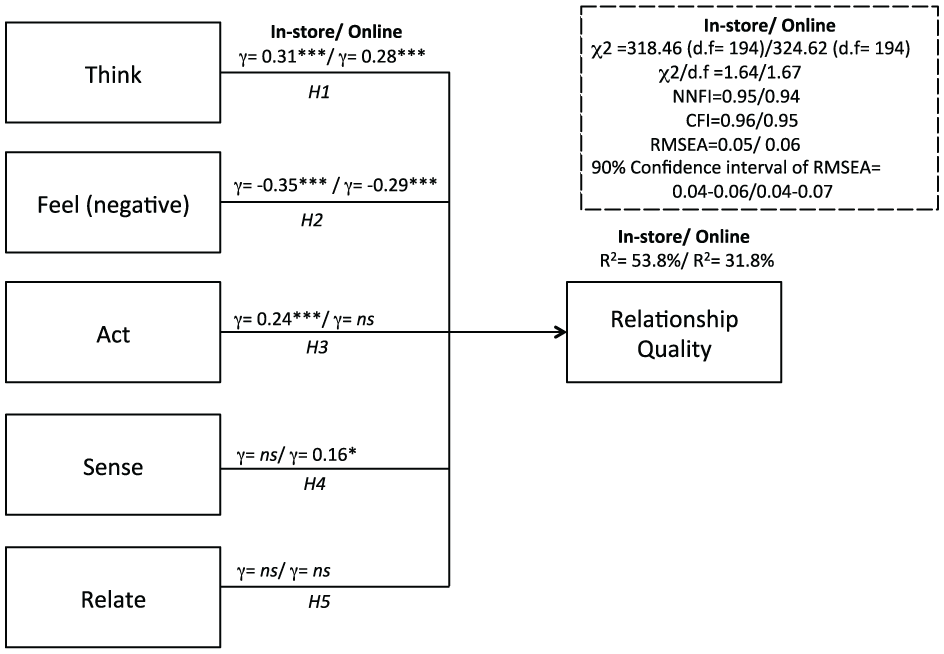
Structural results.
The model explains 53.8 % of the variance of relationship quality in-store and a lesser percentage online (31.8%). Hypotheses 1 and 2 are confirmed, hypotheses 3 and 4 partially confirmed, and hypothesis 5 rejected. While the impact of the THINK and FEEL dimensions is important and significant for both channels, the impact of ACT proves significant only for in-store (γ = 0.24***), and the impact of SENSE significant only for online (γ = 0.16*). RELATE has no impact on relationship quality in either channel. We provide a possible explanation for this latter finding in the Discussion section.
Post Hoc Analyses
To enhance the usefulness of results for travel agencies interested in fine-tuning their strategy for relevant segments, post hoc analyses were performed to reveal differences in the models based on gender. Given the subjective nature of tourist experience (Kim, Ritchie, and McCormick 2012), the importance of different dimensions of experience may vary based on gender (Yavas, Karatepe, and Babakus 2015).
In an in-store environment, female consumers are generally more influenced by FEEL and SENSE than their male counterparts (Wu and Tseng 2015). They demonstrate greater concern for social context and relationships (RELATE) (Hupfer 2002; Yavas, Karatepe, and Babakus 2015; Wu and Tseng 2015; Garg, Rahman, and Qureshi 2014). Males, on the other hand, are more task- and goal-oriented (ACT) (Hupfer 2002; Iacobucci and Ostrom 1993; Yavas, Karatepe, and Babakus 2015). Gender differences are rarely discussed in an online experiential context. In online banking, for example, females lend more importance to SENSE (online aesthetics) than males (Garg, Rahman, and Qureshi 2014). On the contrary, males are more confident and active in terms of Web search (ACT) (Zhou 2014).
Results of the post hoc analyses (see Table 4) show that in an in-store environment, the impact of THINK on relationship quality is higher for males. The impact of ACT on relationship quality is significant for males, whereas it would appear to be nonsignificant for females. Furthermore, the impact of FEEL on relationship quality is more important for females. Online, the impact of THINK on relationship quality is greater for males in contrast to the impact of FEEL for females. SENSE has a marginal impact on relationship quality for females, but would appear to be nonsignificant for males.
Results According to Gender.
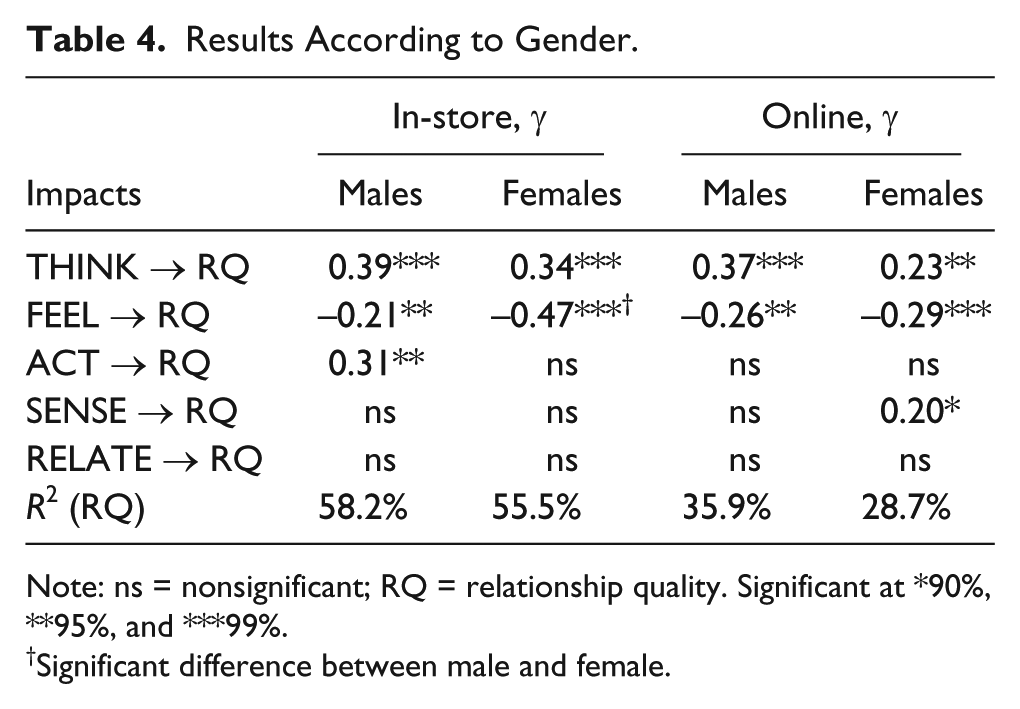
Note: ns = nonsignificant; RQ = relationship quality. Significant at *90%, **95%, and ***99%.
Significant difference between male and female.
Discussion
The objectives of the study were twofold. First, the study sought to examine the impact of customer experience on relationship quality with travel agencies. To date, research relating to customer experience considers the concept mainly from the standpoint of an overall evaluation based on accumulated experience (Stein and Ramaseshan 2016). This study is the first to consider the impact of customer experience on relationship quality in two distinct channels (in-store and online), thereby enriching travel and tourism marketing literature. Results indeed show that customer experience contributes to enhanced relations. In both channels (in-store and online), THINK and FEEL impact relationship quality. Second, the study substantiated the varying impact of customer experience on relationship quality by channel (in-store vs. online). It is interesting to note that some dimensions of customer experience impact relationship quality in only one of the two channels (ACT for in-store and SENSE for online). Furthermore, we found that customer experience appears to impact relationship quality more in an in-store context than online. Although the Internet has revolutionized the travel and tourism sector in recent years (Xiang et al. 2015), the in-store channel must not be overlooked as it represents a powerful channel for using customer experience to build relationships.
Study findings are valuable to academic researchers and marketing practitioners and include contributions to both customer experience and relationship quality literature in topical tourism literature. More specifically, this study underscores the importance of customer experience as a determinant of relationship quality, an aspect overlooked in previous studies. Also, results underline the importance of making allowance for the impact of FEEL (negative), a factor rarely incorporated albeit occasionally suggested by some authors (Brakus, Schmitt, and Zarantonello 2009; Kim, Ritchie, and McCormick 2012).
Lastly, this study enriches customer experience literature by taking into account differing gender-based impacts rarely included in topical literature (Jin, Line, and Goh 2013). Results indeed show that the impact of customer experience on relationship quality varies according to gender. In fact, the impact of THINK on relationship quality is higher for men who are reported to be more independent, confident, competitive and willing to take risks than women (Barber 2009). This suggests that men are probably more likely to appreciate opportunities to learn (THINK), which might explain the greater impact of THINK on relationship quality for them. The impact of ACT on relationship quality is also greater for men (in-store), substantiating the fact that men are more task- and goal-oriented (Yavas, Karatepe, and Babakus 2015). The impact of FEEL on relationship quality is more important for women in each of the two channels. Consistent with the findings of Jin, Line, and Goh (2013), women value the emotional aspects of consumption more than men, hence the impact on relationship quality. Online, the impact of SENSE on relationship quality is significant for women but not for men, an outcome echoing the work of Garg, Rahman, and Qureshi (2014), who found that the visual aspects of a website are more important for women. These results are consistent with some gender-linked findings which notably confirm that FEEL and SENSE are more important for women (Wu and Tseng 2015).
RELATE is found to have no impact on relationship quality in either channel for either segment. Social identification, undeniably less present owing to decreased human interaction and increased technology use (e.g., interactive terminals, the Internet), tends to render consumers more independent (Grissemann and Stokburger-Sauer 2012). Also, the sense of belonging is likely of lesser importance in this particular context. Today’s travelers seek out custom offerings with enhanced levels of personalization and favor distinctiveness over identification with others.
These results allow us to proffer practical recommendations for travel agency managers. It is important to build on the cognitive and affective dimensions of customer experience to strengthen in-store and online relations. Moreover, managers should strive to enhance the in-store experience as our results have indicated that relationship quality variance is better explained for this channel. Considering the gender-based differences shown, customization strategies should also be deployed. Following are several specific tactics that could prove useful in the circumstances.
For the THINK dimension, managers could seek to pique travelers’ curiosity. The digitization of points of sale could be a way for agencies to differentiate themselves from the competition. Virtual reality could be implemented on agency premises and agencies could provide and promote travel-based learning through workshops, conferences, and exhibitions. In France, Maisons du Voyage features a library and conference program. On their websites, travel agencies could showcase practical, relevant information (to promote learning) and quizzes (to arouse interest). On the Voyageurs du Monde website, each country or region has dedicated advisers (e.g., historians, geographers, teachers, or individuals with a passion for travel) poised to share valuable information. Since the impact of THINK on relationship quality is greater for men, it might be appropriate to provide males with more readily accessible information. Men prefer simple, straightforward information, whereas women are more receptive to more complex materials (Meyers-Levy and Maheswaran 1991; Putrevu 2004; Richard et al. 2010).
For the FEEL dimension, in-store, it would be important to provide a warm welcome, hone agent competence and benevolence, and offer customization options to reduce or keep negative emotions at bay. The ability of employees to cope with customer negative emotions would also appear important for enhancing overall relationship quality (Dube and Menon 2000; Han and Back 2007). Managing negative emotions should be more up front, especially for women. In fact, drawing on our findings, the impact of FEEL on relationship quality is greater for female travelers who play active roles in travel decisions. According to Bond (2015), 80% of all travel decisions are made by women. Scripts (as for Disney) could be employed (Dube and Menon 2000; Han and Back 2007) or greater employee empowerment (as for The Ritz-Carlton) could be implemented. On the Web side, ease of use (functionality, accessibility, consistency and effective navigation, search capability, ease of finding desired products and services) (Park, Gretzel, and Sirakaya-Turk 2007) and absence of software glitches help to reduce negative emotions.
For the ACT dimension, in-store, managers need to find ways to facilitate action (e.g., information search or travel plan management). For example, Connections Travel Concept Store features multimedia screens with a map of the world. Consumers enjoy real-time world temperatures, practical information, and promotions designed to spur action, especially in men.
For the SENSE dimension, more specifically in an online context, providing consumers with a good website design and 360-degree virtual guided tours help stimulate the senses, an aspect of greater importance to women.
Conclusion
This study was the first of its kind to examine the impact of customer experience on relation quality in the travel agency sector, and in a multichannel context. The investigation process extended to consideration of negative emotions as suggested by some authors (Brakus, Schmitt, and Zarantonello 2009; Kim, Ritchie, and McCormick 2012). We also took into account gender-based differences rarely incorporated into customer experience literature (Jin, Line, and Goh 2013). In-store and online, cognitive and affective dimensions stood out as the factors most positively affecting relation quality. The ACT (in-store) and SENSE (online) dimensions also positively influenced relationship quality. Furthermore, the impact of customer experience on relationship quality varied according to gender, confirming theories found in topical literature.
This study has some limitations that open the door to further studies of interest. Although 289 respondents constitute an acceptable sample, a greater number of respondents would perhaps render findings more relevant. We performed post hoc analyses (separate models) relating to gender to enrich our results, but more respondents would be appropriate and conducive to the conduct of multigroup analyses. Although we favored the conceptualization of relationship quality by Crosby, Evans, and Cowles (1990) which includes trust and satisfaction, it would be interesting to compare models with and without “commitment.” The measure of the RELATE dimension could be enhanced given its link to only two items. Although Schmitt (1999) makes mention of social identification, this dimension may include relationships among consumers or with agents. Given that we considered two channels (in-store and online), it would be interesting to expand and include other channels (e.g., mobile channel that has grown significantly). Smartphones are acknowledged as important in influencing travel behavior (Tussyadiah 2016). In addition, apart from gender as a moderator, other sociodemographic variables such as age or education could be incorporated into the model. There are demographic differences between travel agent users and Internet users (Wolfe, Kang, and Hsu 2005). Gitelson and Crompton (1983) report that older adults are more likely to seek assistance from travel agents than younger travelers. People using the Internet to search for travel-related information are likely to be educated and under 45 years of age (Bonn and Furr 1999; Wolfe, Kang, and Hsu 2005). Future research could finally investigate the moderating role of culture. Customers of some cultures (e.g., Southeast Asia) still prefer interpersonal interaction with travel agencies despite acceptance of the Internet as a valid channel (Thao and Swierczek 2008).
Footnotes
Acknowledgements
The author would like to thank Isabelle Brun, professor of marketing at Université de Moncton (New-Brunswick, Canada), for her contribution to the data collection instrument.
Declaration of Conflicting Interests
The authors declared no potential conflicts of interest with respect to the research, authorship, and/or publication of this article.
Funding
The authors received no financial support for the research, authorship, and/or publication of this article.