







Abstract
This article examines perceptions of how safe airline travel is and respondents’ level of concern over privacy and trust of authorities. These attitudes are then used to understand the choice to travel under passenger screening processes with differing levels of invasiveness. We find that travelers who are more trusting of authorities are more likely to choose to travel internationally, whereas those with low overall feelings of safety while onboard an aircraft are predisposed to not travel. Our analysis reveals what attitudes and potential screening measures are linked to this feeling of overall safety, chief among which is the presence of visible uniformed police. Our results are also novel as they study these attitudes in the context of a spate of recent air-related disasters; finding no desire to accept screening processes that invade privacy beyond what is currently practiced.
Background
Tourism and travel are important drivers of many economies; it has been shown that there is a significant correlation between real tourism output and gross domestic product (Office of Travel and Tourism Industries 2012) and as much as 3.4% of global GDP is supported by the air transport industry (Oxford Economics and Air Transport Action Group 2014). While the World Tourism Organisation (UNWTO 2013) predicts that the number of international travelers will grow exponentially, air-related disasters can have a significantly detrimental impact on the aviation industry and thus domestic economies. From the period 2000 to 2010 global long haul travel grew 40%, whereas overseas travel to the United States over the same time period grew by only 2%, meaning the United States lost 68.3 million visitors; which resulted in 441,000 job losses and approximately $800 billion in lost spending, trade, and tax revenue as a result of 9/11 (US Travel Association and Oxford Economics 2010).
On March 8 in 2014, Malaysian Airlines Flight MH370 went missing, and is yet to be found. On July 17, Malaysian Airlines Flight MH17 was shot down over Ukraine. Both events received significant media attention, and as a result of these incidents the share price of Malaysian Airlines fell 60% to a value of US$0.04 and the company has since been put into full public ownership. Neither of these incidents are the direct result of onboard terror activities; however, there is doubt over exactly what happened to MH370 (potentially malicious actions by the pilot) and it has been debated in the media that MH17 was at risk because of poor management decision making. Regardless, the impact of these two incidents and major airline disasters more generally may be to put doubt in the mind of the traveling public with respect to how well security screening procedures perform, particularly given the revelations that a number of travelers on MH370 were traveling on forged passports.
While it is intuitive that perceptions of how safe air travel is and the role of passenger screening in choosing to fly are related, there is no research that examines the role of this part of the travel experience on the choice to travel in the context of international aviation. This could be explained by the rarity of such events or that many assume that variations in the screening process need not take traveler preferences into account. Consequently, the objective of this article is to fill this identified gap in the literature: first, to examine traveler perceptions of how safe different aspects of flying are perceived to be and general levels of concern for privacy and trust of authorities; and second, to understand how these perceptions influence the choice to fly under different passenger security screening regimes, with different levels of invasiveness given that authorities may consider making passenger screening a more intensive process after a series of air travel–related incidents. The remainder of this article is structured as follows: the next section summarizes the relevant literature; this is followed by a description of the survey used in this study; the modeling methodology is then provided; the results are outlined next; we then offer a discussion of these results; and concluding remarks.
Literature Review
Travel Choices and Tourism in the Context of Extreme Events
Travel and tourism choices are broad and influenced by a range of factors from novel experiences (Assaker and Hallak 2013; Fuchs 2013), environmental awareness, pollution and climate change (Perkins and Grace 2009; Rossello-Nadal 2014; Li et al. 2015), social media and word of mouth (Tham, Croy, and Mair 2013), and loyalty and satisfaction (Romao et al. 2014) to the previous choices or experiences that an individual has had (Oppewal, Huybers, and Crouch 2015; Crouch, Huybers, and Oppewal 2016). Travel choices can also be influenced by a wide range of crisis events from something as small as bed bugs (Liu, Pennington-Gray, and Klemmer 2015) to large-scale health epidemics like swine flu and SARS (Page, Song, and Wu 2011; Garg 2015), or disasters like Hurricane Katrina (Miller 2008), the BP oil spill (Ritchie et al. 2014), and Haiti earthquakes (Van Hoving et al. 2010).
Related to this study, research has also examined the role of terrorism and other types of violent and disruptive events on tourism (Ryan 1993; Neumayer 2004; Sarman, Scagnolari, and Maggi 2016), the impact of which can be both positive and negative (Araña and León 2008; Saha and Yap 2014) and perhaps surprisingly can result in a feeling of greater security post terrorist event (Wolff and Larsen 2015). It has been established relatively early and confirmed recently with the example of tourism crises in Egypt (Eli 2016) that in cases of terrorism and similar traumatic events it is perceptions and mass media reporting that play a role shaping the potential impact on tourism (Weimann and Winn 1994). What most of these studies have in common is their reliance on historical data and the assumption that travel attitudes (which in addition to potential anxiety will also impact on the travel choice) and behavior do not change over time. For example, while some studies (Enders, Sandler, and Parise 1992) have shown that tourism effects have a negative impact on tourism revenues, others were able to index terrorism activity and its impact over time, which allows not only to study the severity and magnitude of the impact of each event (Krakover 2005) but also whether the frequency of such events matters (Pizam and Fleischer 2002). We argue that context matters more than accounted for in previous research.
In understanding tourism and perhaps more important to this article travel behavior, the evaluation of risk is an important determinant of choice. How travelers perceive risk significantly influences how risk-related communications are evaluated (Ritchie, Chien, and Watson 2014), and the level of self-confidence exhibited by a traveler impacts on the travel planning decisions when faced with considering risky travel (Valencia and Crouch 2008). Even in the absence of extreme/traumatic events, the pure fact of flying internationally creates anxiety in some travelers (Reisinger and Mavando 2005). In the context of terrorism, some studies have found that women are more likely to be influenced by terrorism and perceived risk (Azim 2009; Qi, Gibson, and Zhang 2009; Sarman, Scagnolari, and Maggi 2016), whereas others find no such differences (George 2010). While Araña and León (2008) produce some first findings on the impact of terrorism or reductions in security perception and how this affects preference structures in regard to the image profile of destinations, they have not investigated travel behavior. This is an important limitation as travelers may travel internationally for other reasons than tourism such as visiting friends or relatives and business, and they might actually also decide to choose a different mode than air travel such as high-speed rail. We see our study as an extension of this previous research (in line with Potoglou et al. 2010 and Patil et al. 2014), showing that a more in-depth analysis of micro determinants of travel behavior is important. Our study contributes to the tourism and travel research literature by looking at the role of air disasters on the perceptions of air safety and the subsequent choice to travel under different security screening procedures.
Air Security Measures
In the post-9/11 era, it is unsurprising that there is attention given to the financial aspects of security measures in the air travel process. Wu and Mergersen (2013) acknowledge that airport management is extremely complex as a result of the various stakeholders (and their objective functions) and the many processes and interactions involved, but they highlight the importance of security management particularly following 9/11. Fox (2014) focuses on the development of the respective aviation liability and compensation framework, analyzing the insurance requirements for air carriers operating in the European Union. Some have argued that in this context, there is a long list of policies developed in the EU, which are the subject of politicking and can be criticized for having a deleterious impact on passengers’ rights (Argomaniz and Lehr 2016). From an economic perspective, Gillen and Morrison (2015) argue that aviation security management is mainly about how to best allocate the scarce resources that are available for keeping the probability of a successful attack against air travel at an acceptable level.
With respect to airports themselves, Blalock, Kadivali, and Simon (2007) examine the impact of post-9/11 security measures, specifically baggage screening and the federalization of passenger screening, on the demand for air travel, finding that the process of baggage screening significantly reduced passenger volume. Key performance indicators measuring the relative performance of airport safety and security and the role of facility management in achieving that level of performance have also been developed, finding that safety and security are foremost in the mind of operators when seeking to maximize potential revenue from facilities (Enoma and Allen 2007). Stewart and Mueller (2013) evaluate the costs and benefits of three security measures designed to reduce the likelihood of a direct replication of the 9/11 terrorist attacks, showing how different policies are more successful than others given different threat levels. Cole (2014) examines the broad range of security measures that have been introduced to mitigate possible diverse attacks on the air transport system that have occurred during the last decades.
In assessing the robustness of airport infrastructure to security threats, Stewart and Mueller (2014) show that airports are currently too safe from a cost-efficiency perspective, a view that is confirmed by Kirschenbaum (2013) who found that airport security does not only increase cost but also significantly reduces airport passenger throughput. The overinvestment in security infrastructure is perhaps reasonable given that risk assessments are highly diffuse, reflecting considerable risk ambiguity in the context of security threats, and that people fear severe worst-case terrorism outcomes (Viscusi and Zeckhauser 2003).
In light of some increased security measures implemented over the last 15 years, there has been research into how acceptable these procedures are to the traveling public. Much attention has been paid to the role of whole of body scans and the monitoring and storage of the images that such a scanner creates (see Boyle [2015] for an example of press reporting on the inappropriate use of such technology). Despite this, it has been found that there is high public acceptance of the device, a high preference for them over pat-downs, and if information about the scanning process is presented to passengers there is a high probability that a passenger will voluntarily opt for a scan (Mitchener-Nissen, Bowers, and Chetty 2012). Likewise, the controversial use of racial profiling at airports has also received significant media attention. While public approval for the use of racial/ethnic profiling to prevent crime is low, in contrast the public is more supportive of the use of racial/ethnic profiling to prevent terrorism (Johnson et al. 2011); however, racial and ethnic minorities were less likely than whites to believe that profiling at airports was justified (Gabbidon et al. 2009). Nevertheless, general support for profiling increases if there is a substantial reduction in delays experienced by other passengers (Viscusi and Zeckhauser 2003).
Choosing to Fly
Looking at the large body of literature on the broad choice to fly, studies examine the general willingness to pay for air travel (e.g., Merkert and Beck 2017; Hess 2008), preferences in terms of particular airlines (e.g., Collins, Rose, and Hess 2012) or more specific items such as in-flight entertainment (Balcombe, Fraser, and Harris 2009) or aviation carbon offsets (Choi, Ritchie, and Fielding 2016; Araña et al. 2013). Gao and Koo (2014) investigate a range of factors affecting Australian travelers’ choice of Chinese carriers and though not explicitly addressed by these authors, safety issues are likely to play a role given that the reputation that Chinese carriers have for safety is not a good one (Cui and Li 2015). Addressing safety more directly, Fleischer, Tchetchik, and T. Toledo (2012, 2015) find that providing passengers with safety information about the airline when choosing a flight significantly influences their choice. Building on these studies and their earlier work, Koo, Caponecchia, and Williamson (2015) established a willingness to pay of up to AU$700 per international flight for a safer flight via a stated preference survey. While these studies do not consider security aspects of international aviation, Alards-Tomalin et al. (2014) have shown that airport security measures have the potential to influence passengers’ enplanement decisions. In addition, Chen and Noriega (2004) examine perceptions of safety and security in tourism among a convenience sample of staff and faculty, finding that faculty members were more likely to make changes relative to students.
Thus, while the willingness to pay for general travel safety risk reductions is established more broadly (e.g., Hensher et al. 2009) and there is evidence that there is a willingness to pay for general terrorism risk management programs (Mumpower et al. 2013), it is possible to use similar methods to assess the role of the security process and travel risk reduction in the choice of air travel—something that has been directly addressed by the literature. An important study for this article was conducted by RAND Europe (Patil et al. 2015), which made use of a stated preference approach to examine rail travel within the European Union. In this study, the authors examined the role of CCTV surveillance, the type of security personnel encountered, random physical security checks, and the additional costs of security measures and systems. They found that in the context of rail journeys, respondents prefer deployment of security personnel (particularly unarmed police) and have a strong preference for cameras with advanced features such as face recognition with image storage for 7 to 15 days. In the context of this study, it has been shown that latent concerns for privacy, liberty, and security and a distrust of business, government, and technology significantly explain the choice to opt out of traveling (Daly et al. 2012), though there is some evidence that travelers are willing to trade personal freedoms for improved security (Potoglou et al. 2010). For the case of surface transportation Wafa, Albert, and Shiftan (2013) have further shown that travelers’ behavior will be impacted by the pure threat of terror attacks and may consequently refrain from using buses (such as in London) or public transport more generally (as in Israel) and instead use the private car for traveling.
In the pursuit of increased security, it is possible that authorities may consider measures that may impinge on the civil liberties of passengers, particularly when considering such changes in the aftermath of significant aviation incidents. Our study addresses the gap in the literature with respect to how the security screening process may affect the choice to travel by air, by adapting and extending the RAND Europe study to the context of aviation. The timing of the survey is also interesting, in that data are collected in the immediate aftermath of two air disasters, enabling us to examine what preferences may look like while safety and security are at the forefront of one’s mind.
Research Design
This article aims to examine attitudes about how safe flying is, how concerned people are about privacy, and their level of distrust of authorities. We then examine the choice to fly as a function of differing passenger screening procedures, where given the recent context of air disasters the choice to fly may involve an increased invasion of personal freedoms relative to that which is currently experienced. We also use attitudes to differentiate between groups of respondents with differing preferences toward the screening process. We use traditional attitudinal questions and ratings scales to examine attitudes toward the safety of international travel by air. We then use a stated preference experiment to investigate how different policies within the passenger screening process may affect the choice to travel internationally.
Attitudinal Questions
To address the gap in the literature, we collected in a first stage data on general attitude. The statements were generated from discussions with airline and airport management, in-depth interviews from a convenience sample of travelers, and refined from a pilot study of 66 master’s students and are displayed in Table 1. Note that these pilot data are not used in the main analysis; they are only used to assess the performance of the survey instrument and to acquire priors for the experimental design.
Attitudinal Questions.
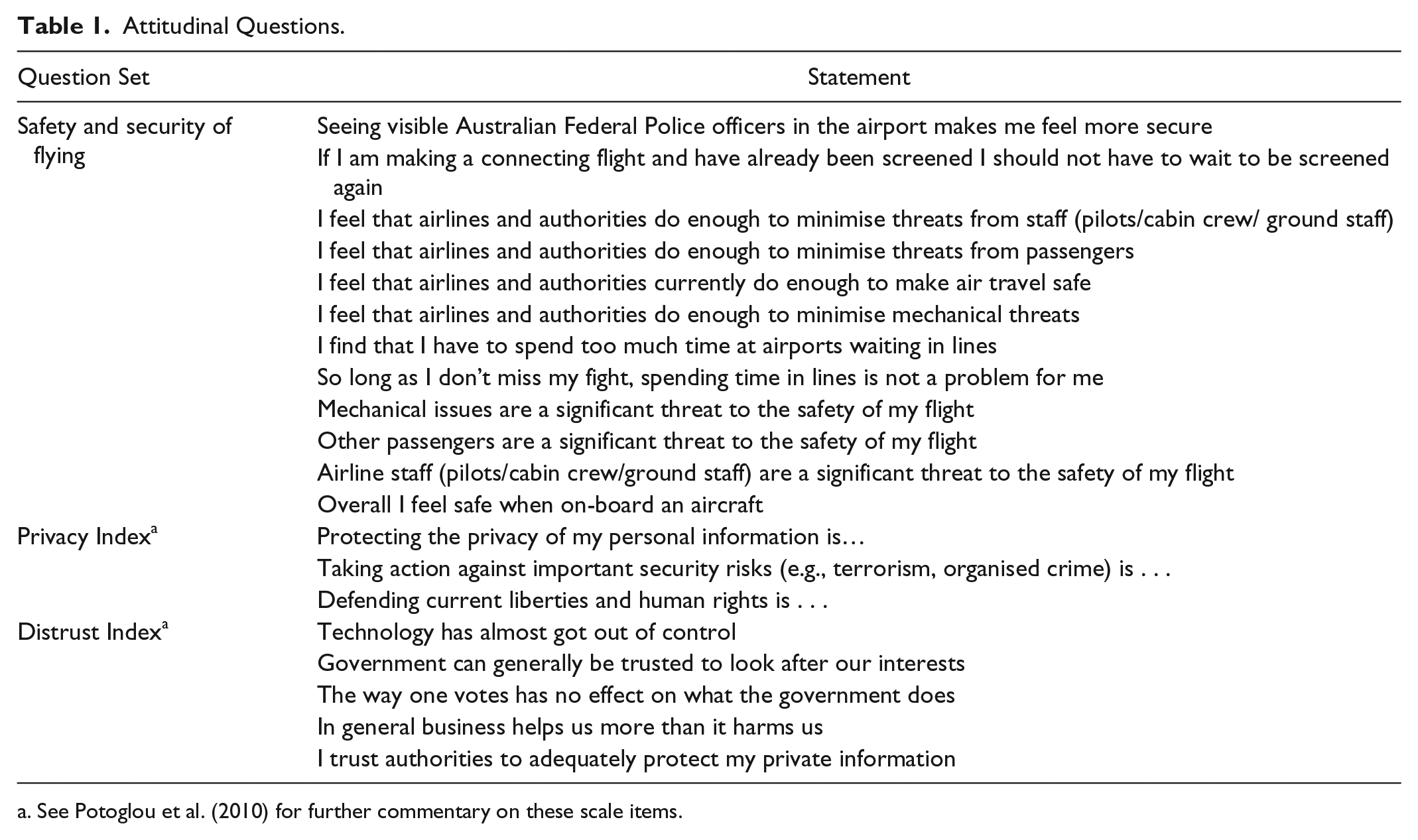
See Potoglou et al. (2010) for further commentary on these scale items.
In total, there are 12 questions where respondents were asked to rate their level of agreement with each statement on a one-to-seven scale (1 = strongly disagree; 7 = strongly agree). Additional to these questions, in line with Potoglou et al. (2010), we use both a Distrust Index and a Privacy Index to assess attitudes toward privacy (Kumaraguru and Cranor 2005; Louis Harris et al. 1994). To remain consistent Potoglou et al. (2010) the privacy questions are measured on a scale of one to four: 1 = not at all important, 2 = not very important, 3 = somewhat important, 4 = very important, and a don’t-know response was also included. Similarly, the distrust index response items are as follows: 1 = disagree strongly, 2 = disagree somewhat, 3 = agree somewhat, 4 = agree strongly, and don’t know. Note that as the don’t-know responses are fundamentally different from those that offer an opinion (and indeed cannot be assumed to be the same as those that indicate a neutral opinion) these responses are reported but dropped from further analysis.
A number of these attitudes were found to be important in the choice to travel via rail within a pan-European study with more than 16,000 respondents. Based on discussions with these authors, it was felt the scale items should be repeated in this study, particularly given it has been found that Australians are more concerned about privacy than ever before (OAIC 2013) and that many of the potential security processes in the choice experiment involved increased levels of invasiveness.
Stated Preference Experiment
Respondents were then presented with a stated preference experiment aimed at identifying different preferences for levels of security screening and privacy characteristics in the context of choosing to travel internationally by air. The stated preference experiment in our study involved asking respondents to imagine they were at an airport for an international flight and then choosing between two different security processes and a third alternative, which was to not fly under either of passenger screening scenarios displayed. The two alternative security processes were described using nine different attributes, covering a wide range of relevant levels to encourage respondents to compare and consider a trade-off between the attributes and alternatives. Attributes were selected via review of the extant literature, interviews with airport management of various airports of different sizes within Australia, and in-depth interviews based on a convenience sample of international travelers.
The attributes and levels are described in Table 2. It should be noted that where possible each attribute included a level that described the current practice for airport security (as identified by airport management). It should be noted that the time variable was described as specifically the time needed to pass through security screening and immigration (as opposed to the total time required at the airport to check in, pass through screening and immigration, and board). We also included a range of relatively large cost increases to air tickets in order to test for potentially large reductions in cost sensitivity given the temporal proximity of the Malaysian Air disasters.
Attributes and Levels for Stated Preference Task.
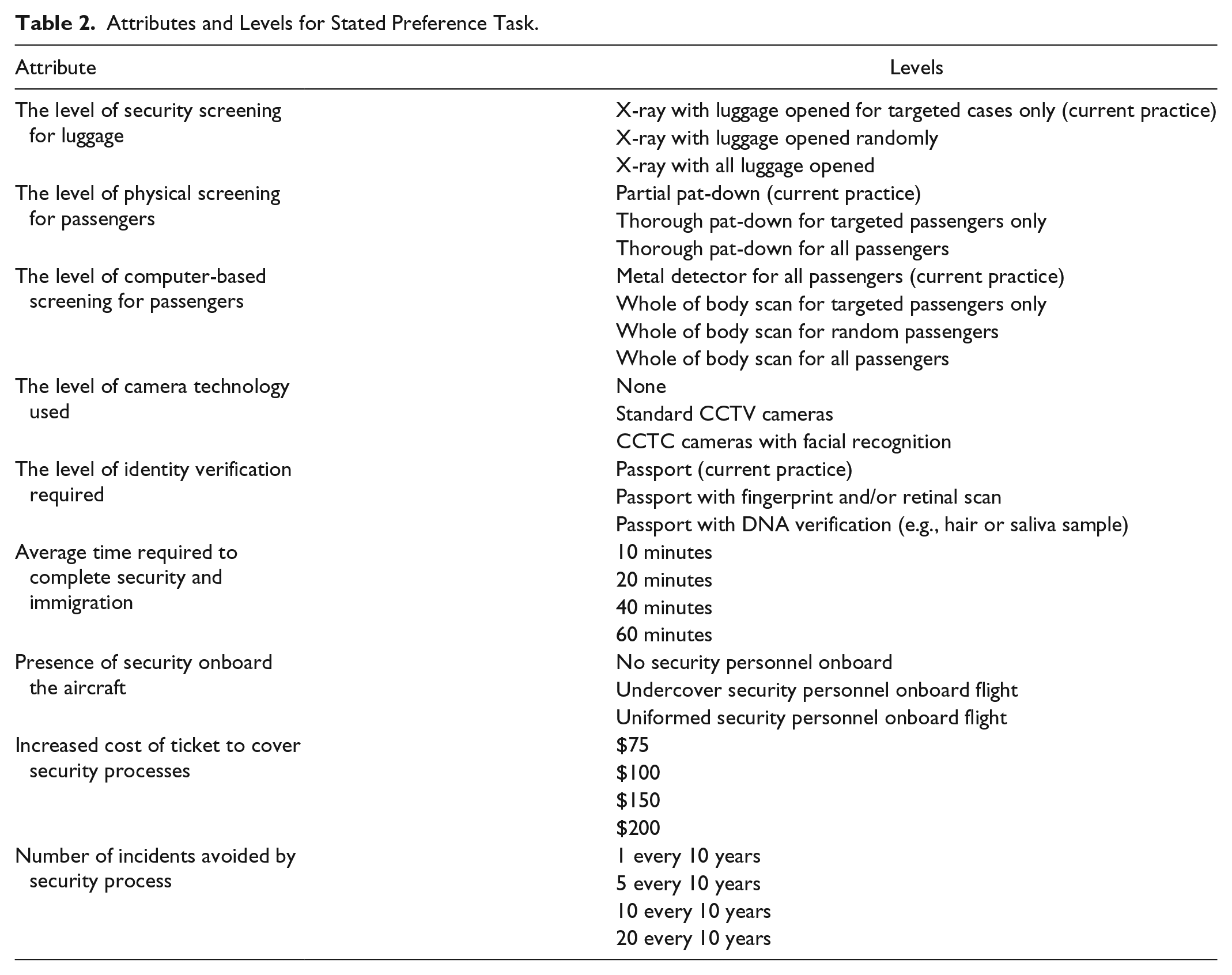
An orthogonal design was used initially to construct a pilot survey that was distributed to 61 master’s students at the University of Sydney. The results from the pilot were subsequently used as priors in the creation of a Bayesian D-efficient design. The final design was generated under the assumption of an MNL model and was based on uniformly distributed priors that accounted for the expected directions of the parameters, as determined by the pilot study. The design was generated assuming each attribute would be effects coded, and 500 Halton draws were used in simulating the Bayesian prior parameter distributions. The resulting design had 24 choice tasks that were grouped into four sets of six blocks each, meaning that respondents were presented with six stated preference tasks as part of the survey, an example of which is provided in Figure 1.
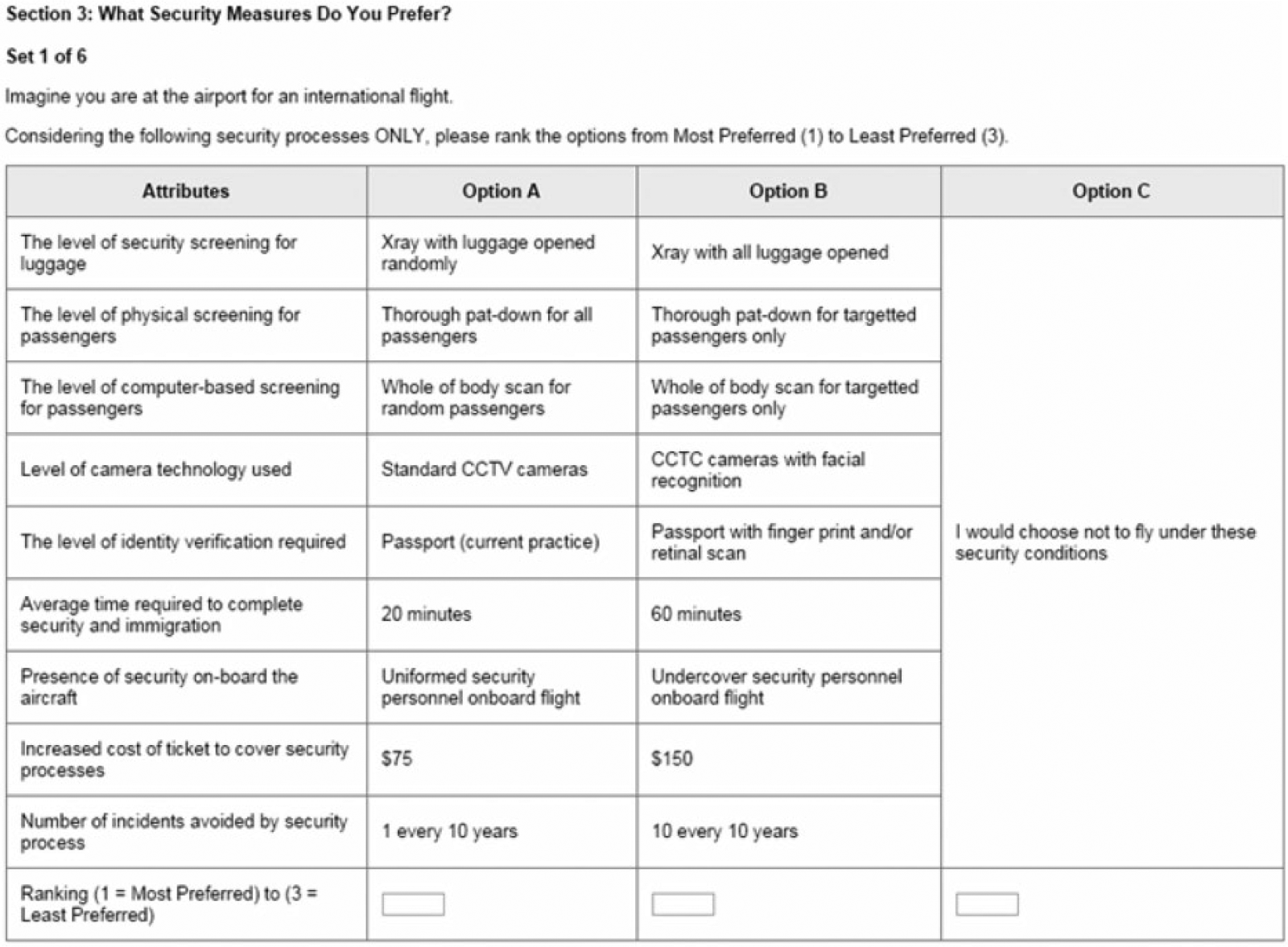
Example stated preference task.
Method
The chosen method for estimating models on the stated preference data is the latent class model which can be used to identify the presence, and number of, segments or classes within the sample (see Kamakura and Russell 1989 or Scarpa et al. 2003). There are several advantages of this modeling approach, in particular, the ability to link taste heterogeneity to sociodemographic and attitudinal indicators rather than simply knowing that a given sensitivity follows a certain (assumed) random distribution in the sample population as is the case with, for example, the mixed multinomial logit. Additionally, the latent class approach offers considerable gains in computational efficiency and is less affected by the varied number distributional assumptions inherent in a model such as the mixed logit (see Daly, Hess, and Train 2012).
To operationalize the model, the analyst assumes the existence of C classes, such that the probability that respondent n belongs to class c is given by
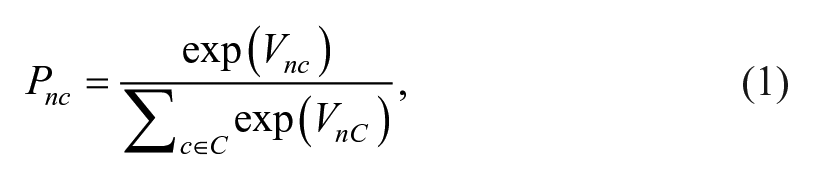
where
Conditional on belonging to class c, the probability that respondent n chooses alternative j in choice situation s given becomes
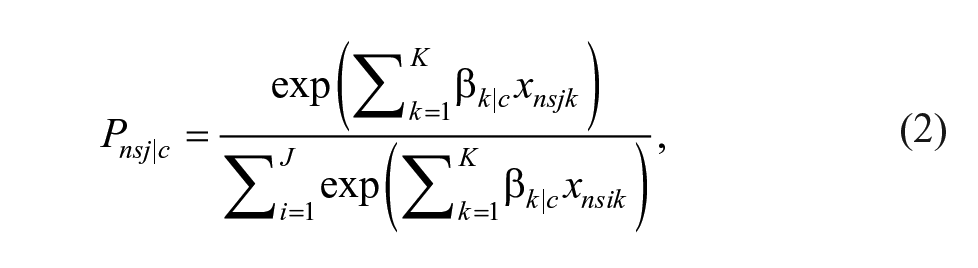
where
Given observed choices,
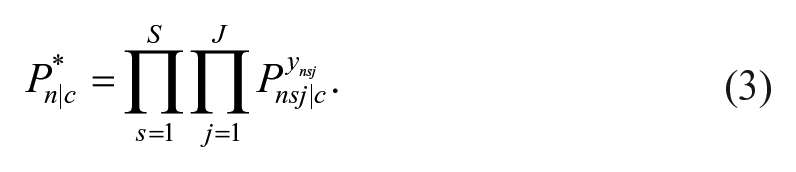
In the stated preference task, despite rankings data being collected, we use only the most highly ranked alternative to represent the choice indicator,
The log-likelihood function used to estimate the parameters
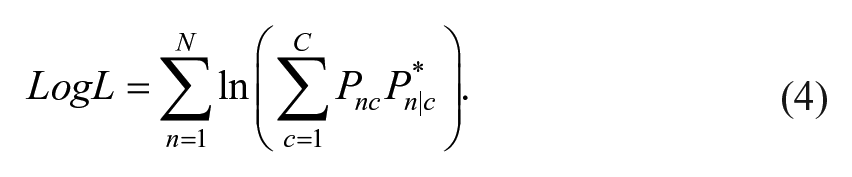
Results
Sample Description
The data were collected in Australia in early August 2014, following almost immediately after the MH17 incident in July and shortly after MH370 in March. A total of 304 responses were collected, resulting in 1,824 choice observations for the stated preference experiment. Respondents were recruited from an online consumer panel from the Greater Sydney region. Only respondents 18 years or older were sampled; thus the average age of 53.0 years (standard deviation of 15.4) is higher than expected, but compares favorably to the average age of 47.6 years for similar individuals in the Greater Sydney region, as does the sample median income of $45,500 versus $53,000 (ABS 2011). The sample has a higher number of male respondents than expected (61%). Ninety-one percent of respondents travel for leisure, with 9% traveling for business, which is consistent with other studies in this geographic region (see Merkert and Beck 2017).
Overall, 20% of the sample viewed themselves as frequent international travelers, 48% as infrequent international travelers, and 32% do not travel internationally. The majority of respondents (64%) indicated that they were excited by the idea of international travel, with 14% stating that such travel made them nervous. Ninety-one percent of respondents traveled for leisure, with 9% traveling for business. The majority of respondents traveled alone (44%) or with their partner (43%), 11% traveled with their partner and children, and 2% of respondents traveled with a work colleague(s). With respect to class of travel, the vast majority did so in economy (82%), 9% traveled in premium economy, 7% in business, and 1% in first class.
Attitudes toward Safety
As a first finding, respondents indicated a general level of agreement with an overall feeling of safety when traveling on an aircraft, as displayed in Figure 2. It is worth noting, however, only 11% of respondents strongly agree with this statement, indicating that there is perhaps some level of trepidation with respect to international air travel. 1 As one would expect, international travelers (both frequent and infrequent) report significantly higher average levels of overall safety than non-travelers (F = 7.138, significance = 0.001) and those who are excited about international travel, on average, report a significantly higher overall feeling of safety than those who are neither positive or negative, who in turn are significantly higher than those who are nervous about international travel (F = 22.123, significance = 0.000). There is no significant difference across gender or whether the trip was for business or leisure and while age (r = 0.121, significance = 0.035) and income (r = 0.137, significance = 0.026) were significantly related the correlations were weak.
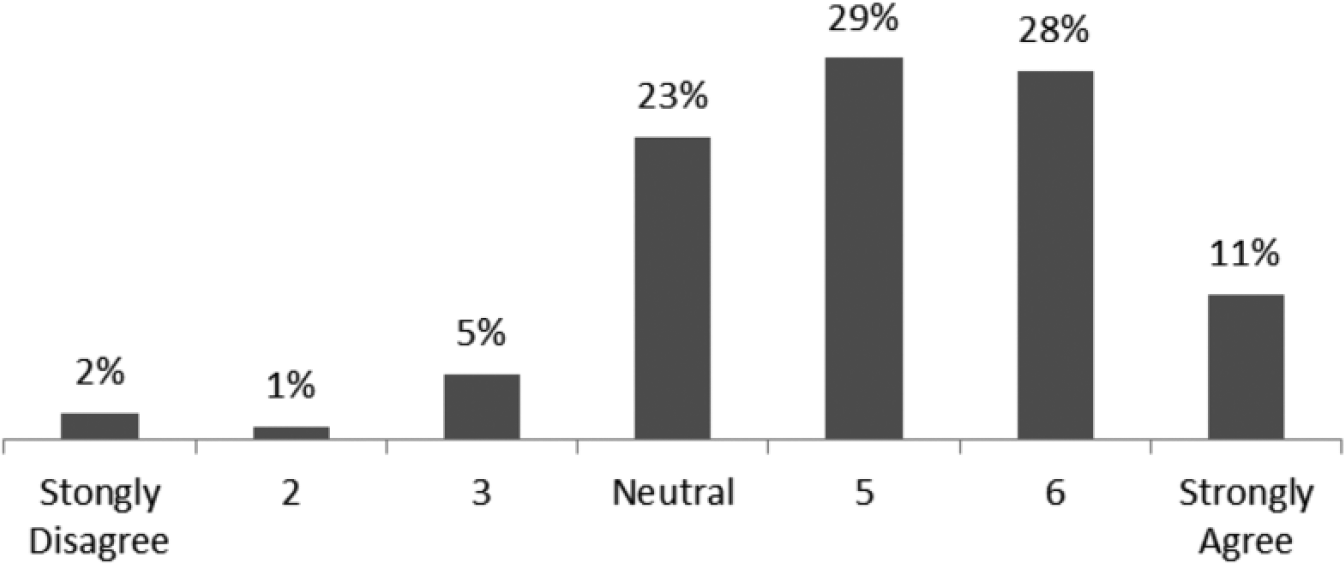
Overall, I feel safe when onboard an aircraft.
Table 3 provides results for the remaining 11 attitudinal questions. An interesting result in this table is the relatively high number of neutral attitudes (within each statement, approximately one quarter of the sample reported neutral attitudes). This is indicative of a lack of clarity surrounding security procedures with respect to air travel. The highest level of agreement was toward the presence of visible uniformed police creating a greater feeling of security. Seemingly, there is a limit to the number of screening processes that travelers feel are necessary, with the next highest level of agreement being that they should not have to wait to be re-screened between connecting flights. Interestingly there are only relatively moderate levels of agreement that spending time in lines is not a problem, but also only moderate agreement that travelers currently spend too much time in lines. This can be interpreted as travelers being happy with how long it currently takes, but on a threshold of not desiring any further time being spent in airports. Overall there is agreement that airlines and authorities do enough to minimize threats from staff and passengers and generally do enough overall to make air travel safe, but the number of travelers who strongly agree with these statements is small.
Attitudes toward Air Travel.
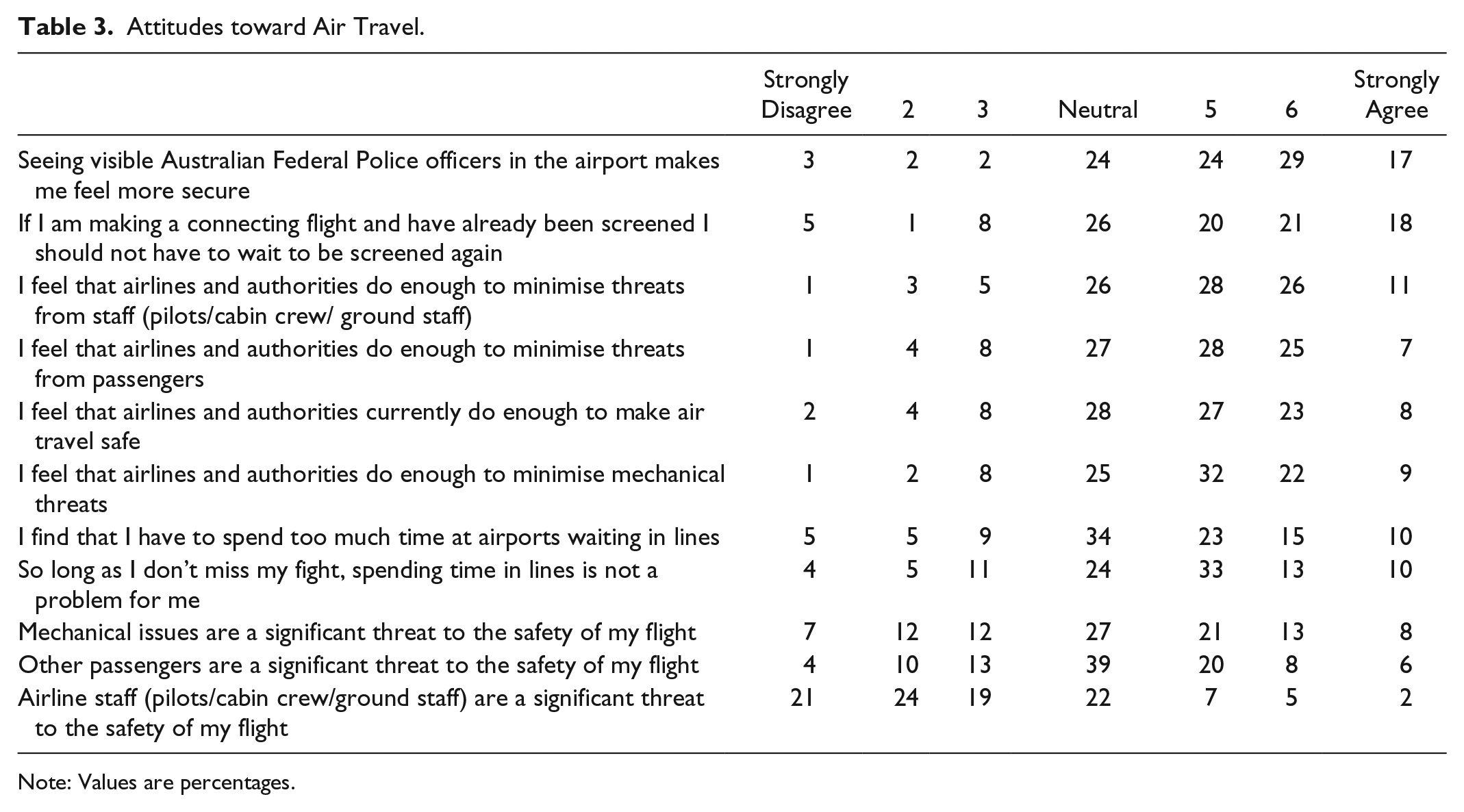
Note: Values are percentages.
Many attitudes differed significantly based on sociodemographic characteristics. Older respondents were significantly more likely to agree that airlines and authorities do enough to minimize threats from staff (r = 0.137, p value = 0.017) and less likely to agree that staff are indeed a significant threat (r = −0.239, significance = 0.000). In a similar vein, older respondents are less likely to agree that mechanical problems are a significant threat to safety (r = 0.123, p value = 0.033) and more likely to feel that airlines do enough to minimize such threats (r = −0.123, p value = 0.032). Those with higher incomes are more likely to agree that they spend too much time in airports waiting in lines (r = 0.133, p value = 0.031). Males have higher average levels of agreement that airlines and authorities do enough to minimize threats from passengers (t = 2.508) and mechanical problems (t = 2.410), whereas females are more inclined to agree that mechanical issues are a significant safety threat (t = 4.134) and while still largely in disagreement, are less likely to disagree that airline staff are a significant threat (t = 2.135).
There are a large number of significant differences in average attitudes based on the self-reported frequency of international travel and whether respondents are excited or nervous about such travel. These differences are presented in Table 4; all post hoc testing was performed using Tukey’s honestly significant difference. Generally, frequent (and to a lesser extent infrequent) travelers report higher average agreement that airlines and authorities are doing enough to minimize threats, but interestingly report higher agreement that airline staff are a significant threat to safety. Those who do not travel report significantly lower average agreement that too much time is spent in lines at airports and that rescreening should occur. A similar intuitive pattern of results emerges based on whether respondents are excited or nervous about international travel. Those excited by travel typically report higher average levels of agreement that airlines and authorities do enough to minimize threats to travel. Interestingly, ambivalent travelers report lower agreement that visible policing increases the sense of security.
Average Attitudes by Travel Characteristics.
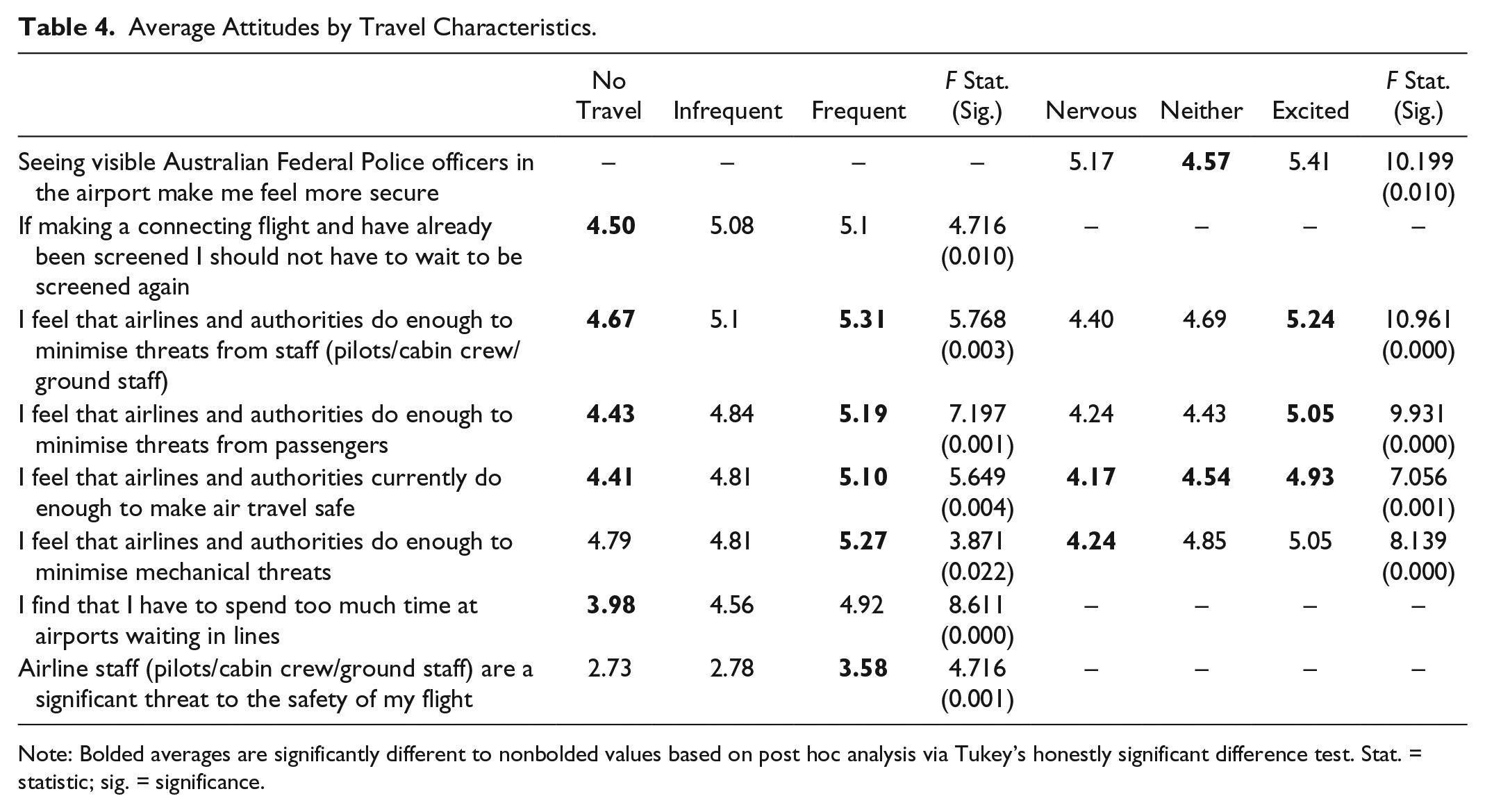
Note: Bolded averages are significantly different to nonbolded values based on post hoc analysis via Tukey’s honestly significant difference test. Stat. = statistic; sig. = significance.
With respect to differences between business and leisure travelers, business travelers report higher average levels of agreement that they spend too much time in lines (t = 3.614), that mechanical issues are a threat to safety (t = 2.107) but also that airlines and authorities do enough to minimize these threats (t = 2.344), that other passengers are a threat to safety (t = 2.145) but also that airlines and authorities do enough to minimize these passenger-based threats (t = 3.221), and that staff are a threat to safety (t = 3.178). Significant differences are also observed based on the recency of the previous international trip, whether it was within the last year or was made a year ago or longer. Those who have traveled internationally within the last year, on average, agree more that they spend too much time in lines at airports (t = 3.750), that staff are a significant threat to safety (t = 4.375), and that airlines and authorities do enough to minimize mechanical threats (t = 2.183) and threats from other passengers (t = 2.114).
Attitudes toward Distrust and Privacy
In line with Potoglou et al. (2010), we use both a Distrust Index and a Privacy Index to assess attitudes toward privacy (Kumaraguru and Cranor 2005; Louis Harris et al. 1994) and provide an interesting counterpoint to the results from this study. Table 5 presents the results from the Distrust Index and Table 6 those from the Privacy Index. For comparison, the results from the European study (as reported in Daly et al. 2012) are provided in italics and in brackets underneath our results. The majority of respondents in this survey disagree with the statement that technology has gotten out of control, with one in four respondents strongly disagreeing with this statement, a higher percentage than those from Europe. More respondents disagree with the statement that governments can be trusted to look after our best interests, but relative to the European results this study indicates that Australian respondents are slightly more trusting of their government. That said, the majority of the sample agree with the statement that voting has no effect on what the government does, with 25% agreeing with this statement strongly; this indicates a potentially large disenfranchisement with politics in the Australian context especially when compared to Europe. Finally, levels of trust and distrust of authorities to adequately protect privacy information are split evenly, however, with the strength of distrust being slightly stronger at the extreme.
Distrust Index.
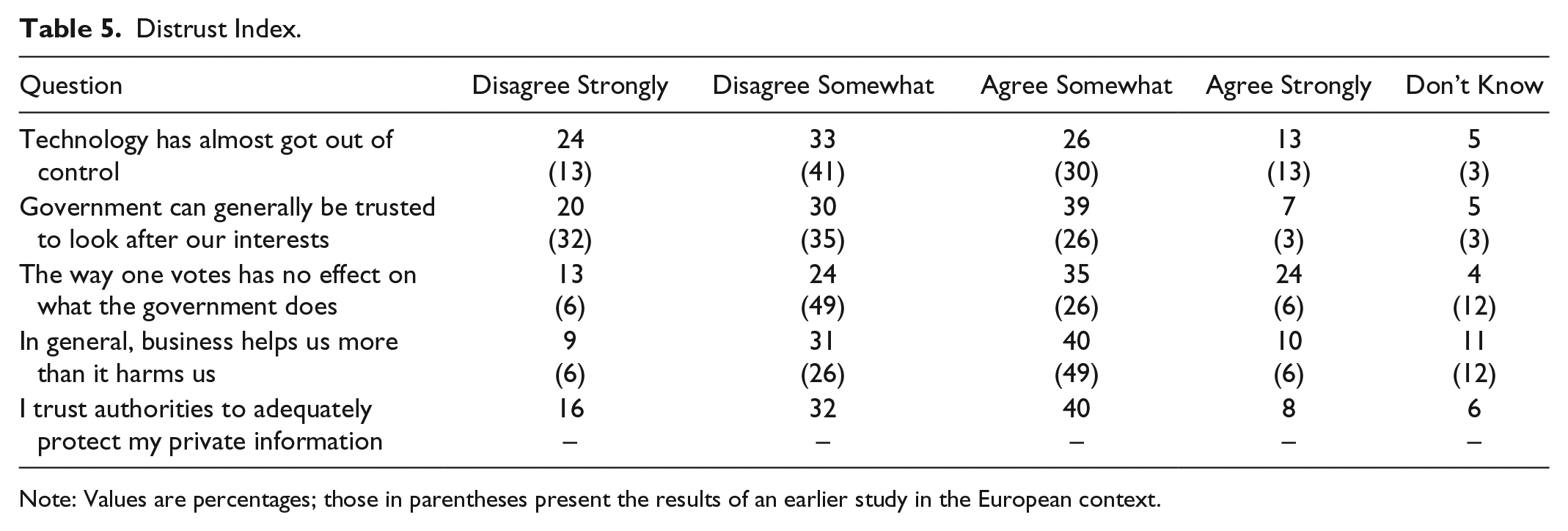
Note: Values are percentages; those in parentheses present the results of an earlier study in the European context.
Privacy Index.
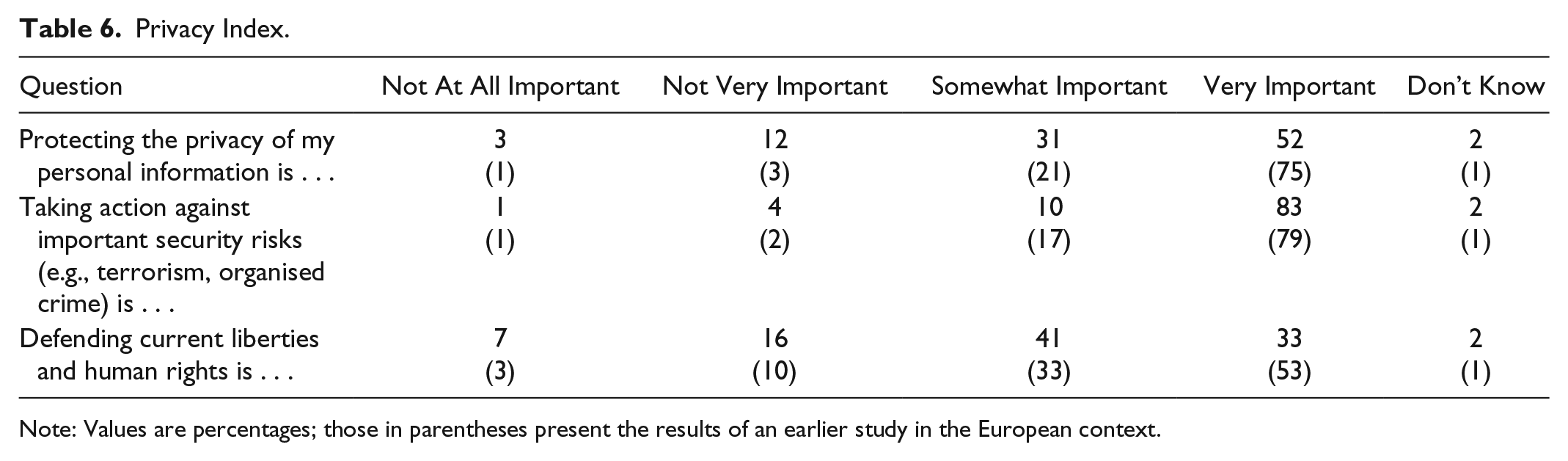
Note: Values are percentages; those in parentheses present the results of an earlier study in the European context.
Levels of distrust are largely invariant with respect to sociodemographics. Somewhat counterintuitively, older respondents are more likely to disagree that technology has gotten out of control (r = −0.113, p value = 0.048), however perhaps younger respondents are more aware of how much personal data can be collected via new technology such as smartphones. Females report, on average, significantly higher levels of agreement that technology is out of control (t = 3.098). Those who state they are frequent international travelers on average report higher agreement that technology has almost gotten out of control (F = 4.775, p value = 0.009) but that governments can be trusted to look after our interests (F = 4.568, p value = 0.011). Those excited by the prospect of international travel report higher average trust in government (F = 3.931, p value = 0.021) and the helpfulness of business (F = 3.102, p value = 0.046) and in the authorities to protect private information (F = 4.528, p value = 0.012). There are no significant differences based on whether respondents travel for business or leisure; however, those respondents whose most recent trip was within the last year have a higher average level of agreement that voting has no effect on government actions (t = 2.054).
With respect to privacy concerns, 83% of respondents feel that taking action against security risks is important or very important; compared to the European experience, however, far fewer respondents in this study feel that protecting personal information and defending current liberties and human rights is very important. In contrast to levels of distrust, privacy concerns were invariant to differences in frequency of international travel, whether such travel made respondents excited or nervous, whether the most recent international trip was within the last year or more than a year ago and whether or not they travel for business or leisure. Privacy attitudes, however, did vary significantly with respect to age and income, with older respondents more likely to report that taking action against security risks is important (r = 0.255, p value = 0.000) and that defending current liberties and human rights is not important (r = −0.147, p value = 0.010). Interestingly, respondents with higher levels of income are more likely to find that protecting privacy of personal information is not important (r = −0.149, p value = 0.016) and that defending current liberties and human rights is also not important (r = −0.147, p value = 0.038). On average, females find protecting privacy of personal information significantly more important (t = 3.109) than male respondents.
Drivers of Attitude to Overall Safety
Ordered logit was performed to gain greater insight into what influences the perception of respondents that they feel safe overall when onboard an aircraft (see Figure 2 for the distribution of these responses). 2 Table 7 presents the results of this analysis; the signs of the coefficients are as expected, and the model is an excellent fit for the data (Rho = 0.828). Notably the only significant drivers of overall safety are attitudes, with characteristics such as age, income, gender, business, or leisure travel and recency of international travel all being insignificant factors. 3
Ordered Logit: Perception of Overall Safety.
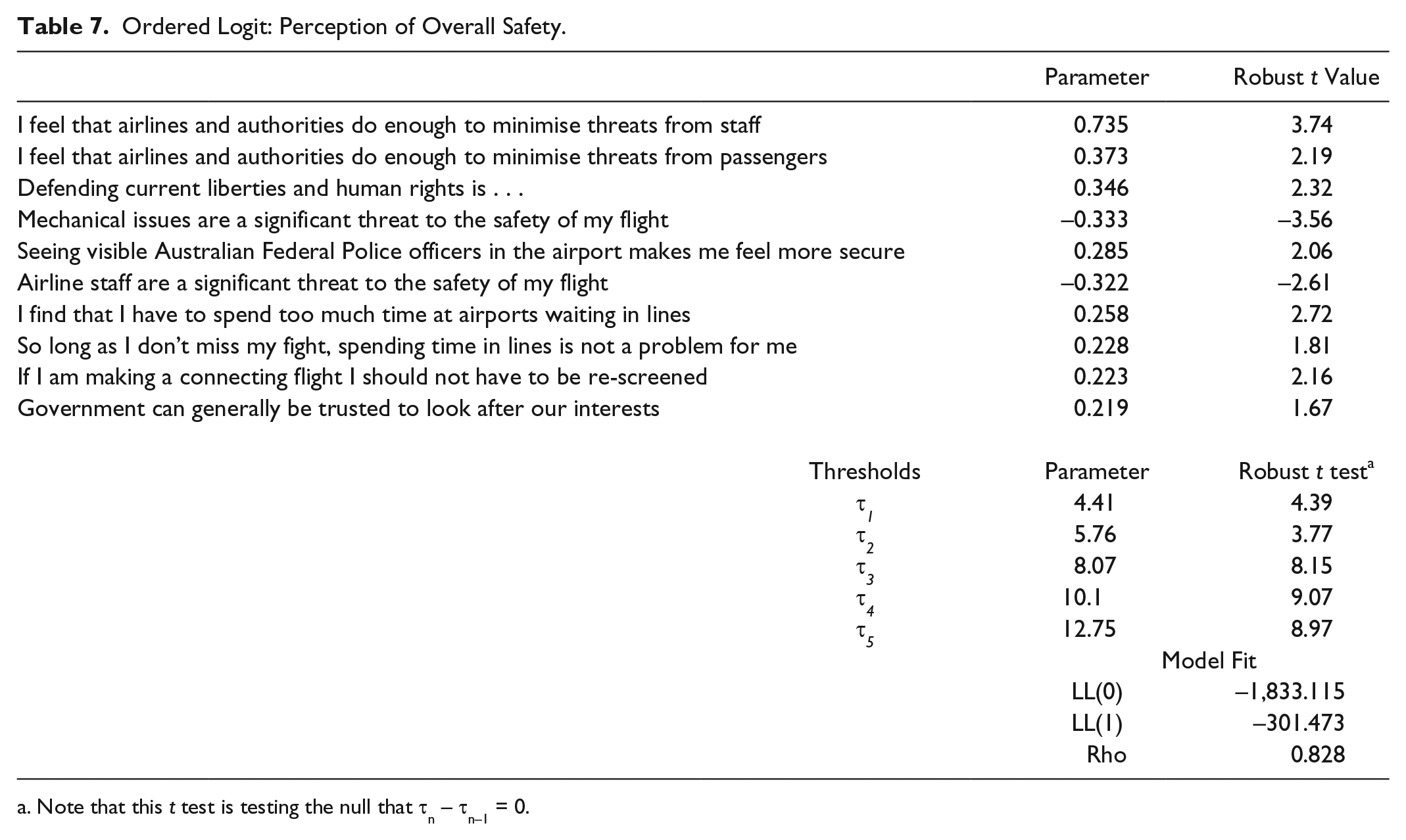
Note that this t test is testing the null that τn – τn–1 = 0.
Respondents who agree that airlines and authorities do enough to minimize threats from staff, passengers, and mechanical issues feel a higher level of overall safety. Higher levels of disagreement with the statement that mechanical issues and airline/airport staff are a threat to flying also results in a greater feeling of overall safety. Interestingly, respondents who agree that visible Australian Federal Police make them feel more secure also respond with higher levels of overall safety. If respondents agree more with the statement that they do not mind waiting in lines so long as they do not miss their flight, they also feel significantly safer onboard the aircraft, indicating that perhaps time is not so much an issue if the queuing is as a result of clearly effective security screening.
Interestingly, the other time-related variables have positive coefficients, indicating that as respondents agree more with the statements that they spend too much time waiting in lines and that if they have already been screened they should not have to wait to be screened again, the higher their overall perception of safety. It is possible however that causality may run in the other direction in that those respondents who feel safer overall are predisposed to view that lining up for long periods of time may be unneeded or inconvenient. That said, one interpretation of these results is that while lining up for passenger screening may result in higher levels of overall safety, travelers may feel they are at the limit of their time and that repetitive screening processes may be a disincentive in the long term.
Also of interest is that two attitudes from the distrust index are also significant drivers of how safe travelers feel overall. Respondents who trust the government to look after their interests feel safer overall onboard aircraft. This is perhaps indicative of the trust that passengers who feel safe have in the management of the screening processes employed by the relevant air travel authorities. Respondents who place greater importance on the defending of current liberties and human rights also feel significantly safer overall. There are two possible interpretations of this result. First, it could be true that respondents view safe international travel as an important civil liberty (particularly in Australia where almost all international travel involves long haul flights and where screening is substantially more rigorous for international flights compared to domestic flights), and thus the screening processes used in air travel ensure such liberty and overall safety. The second interpretation is that those who view the protection of civil liberties as being paramount are perhaps comfortable with traveling because they are prepared to accept greater risk to reduce security screening.
The Passenger Screening Process and Choosing to Travel
Table 8 provides the results from the latent class estimation of international air travel choices under different combinations of passenger security screening, including the option to not travel at all. In deciding on the final model form, both Akaike’s information criterion (AIC) and consistent Akaike’s information criterion (CAIC) were used as measures of fit for models with different classes (Louviere, Hensher, and Swait 2000), the results of which are displayed in Table 9 for models of two, three, and four classes. Consideration should also be given to the application of the model, making sure that the number of classes specified is meaningful and practicable, and that membership of each class is both sensible and can be interpreted (see Beck, Rose, and Hensher 2013). In this study, it was determined that a model with three classes fits the data best.
Air Travel Choices under Varying Airport Security Processes.
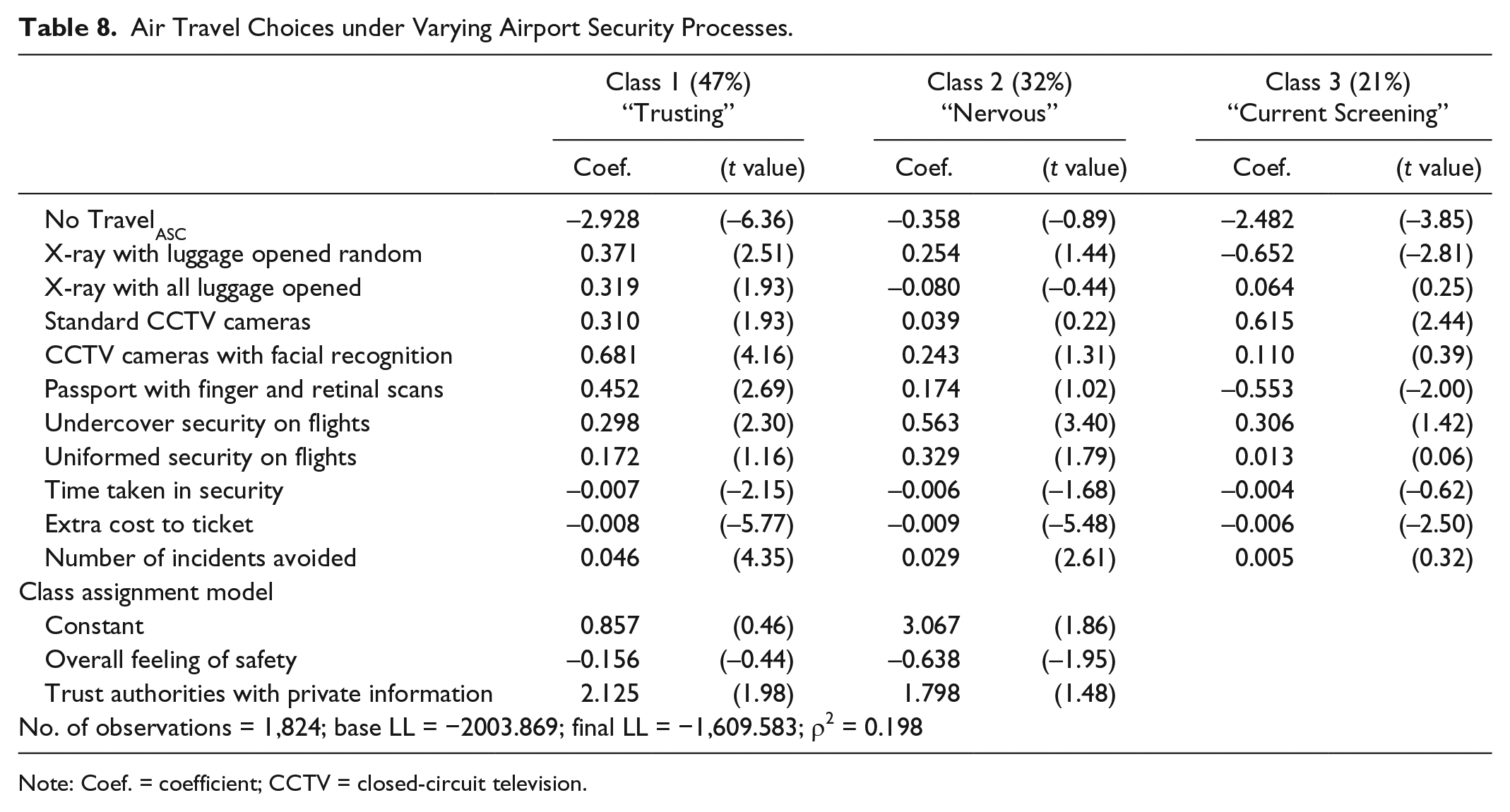
Note: Coef. = coefficient; CCTV = closed-circuit television.
Model Fit Statistics for Different Numbers of Classes.
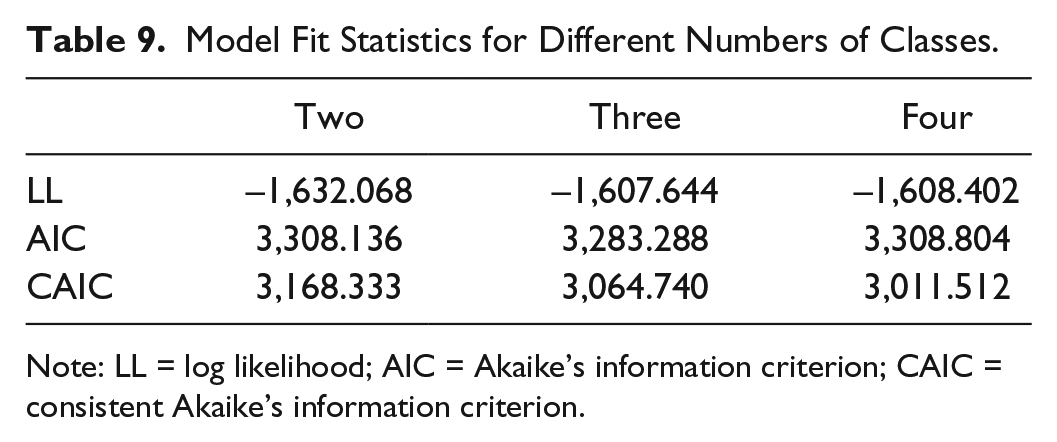
Note: LL = log likelihood; AIC = Akaike’s information criterion; CAIC = consistent Akaike’s information criterion.
In the model presented, class membership can be described by the attitudes of overall safety and whether or not respondents are trusting of authorities’ ability to protect private information (where responses of 4 or 5 on the 5-point scale are coded as agreement and other scores as disagreement). Different variables were used to predict class membership, including age, gender, income, class of travel, travel companion, and frequency of travel; however, none of these were significant.
Those respondents who are relatively more trusting of authorities are more likely to belong to the “Trusting” class, which have significant preferences for choosing to travel, but also find a range of differing security measures to be attractive. Respondents in this group prefer x-ray procedures that are more intensive than current practice, prefer standard CCTV cameras to none but also have a positive preference for CCTV with facial recognition, for undercover security on flights, and for passport checking with finger and retinal scans. Those in this group prefer faster screening times and are sensitive to increased costs, but prefer situations where the number of incidents avoided by security measures is higher. The second class of respondents are “Nervous” travelers, who report lower feelings of overall safety. As a reflection of this nervousness, this group is equally likely to choose the no travel option as they are one of the travel alternatives. They are cost sensitive, but only marginally dissuaded by longer time spent in security. They prefer higher numbers of incidents avoided and have overt preferences for security onboard flights, in particular, uniformed security. The last group of respondents have been labeled “Current Screening” travelers, in that they prefer standard CCTV, x-ray with luggage opened for targeted cases as per current practice, invariant between differing passport practices, amount of time taken in passenger screening, and the number of incidents avoided. They are also cost sensitive with respect to increased ticket costs to cover additional security.
Examining what drives people to select the no-choice alternative, we asked respondents who selected not to travel why they did so. The predominant responses were that security measures were either costly and/or too time consuming. Based only on these explanations from the respondents who chose not to travel, there is a general feeling that the security process is a public good and the passengers should not be the one to pay for them. A number of respondents elected not to travel when there were “no security cameras to capture incidents.” Again, there was the general sense that security cameras should be used and that camera technology should be improved. Some people did not like body scans because of radioactivity, pregnancy, or because of small children. In some instances the alternative screening processes were deemed “too much of a hassle” or there was “so much invasion of privacy.” Others mentioned thoughts along the line that “Australia doesn’t have terrorist threats except for manufactured ones” or that “people are treated on mass as untrustworthy, it is demeaning.”
Based on the results presented of the latent class model, we compute the amounts respondents are willing to pay for each of the attributes (known as marginal willingness to pay (mWTP) estimates). To calculate the willingness to pay statistics we use a method known as the Krinsky and Robb procedure (Krinsky and Robb 1986). This procedure uses the variance-covariance matrix relevant to the specific attributes used in the willingness to pay calculations in conjunction with the asymptotic properties of maximum likelihood parameter estimates to simulate the asymptotic distribution of the derived willingness to pay function.
Note that the choice experiment was framed such that respondents were asked to think only about the screening process and only about the costs of that process; we assume that this is sufficient to isolate sensitivities to differing security processes and costs and thus willingness to pay therein. These are presented in Table 10. The largest mWTP is associated with the presence at airports of CCTV cameras with facial recognition, followed by having undercover security agents onboard aircraft, and then standard CCTV cameras located at airports. Having a uniformed security agent onboard flights is valued approximately half that of having undercover security agents present. Respondents were found to also be willing to pay $7.83 to save an additional minute of time spent clearing passenger screening and immigration, and hence $78.30 to save 10 minutes. Interestingly, the lowest mWTP appears to be associated with avoiding additional incidences. This is surprising as it suggests that respondents prefer measures that give the appearance of increasing the level of security over measures that actually increase the level of security.
Willingness to Pay for Elements of the Airport Security Process.
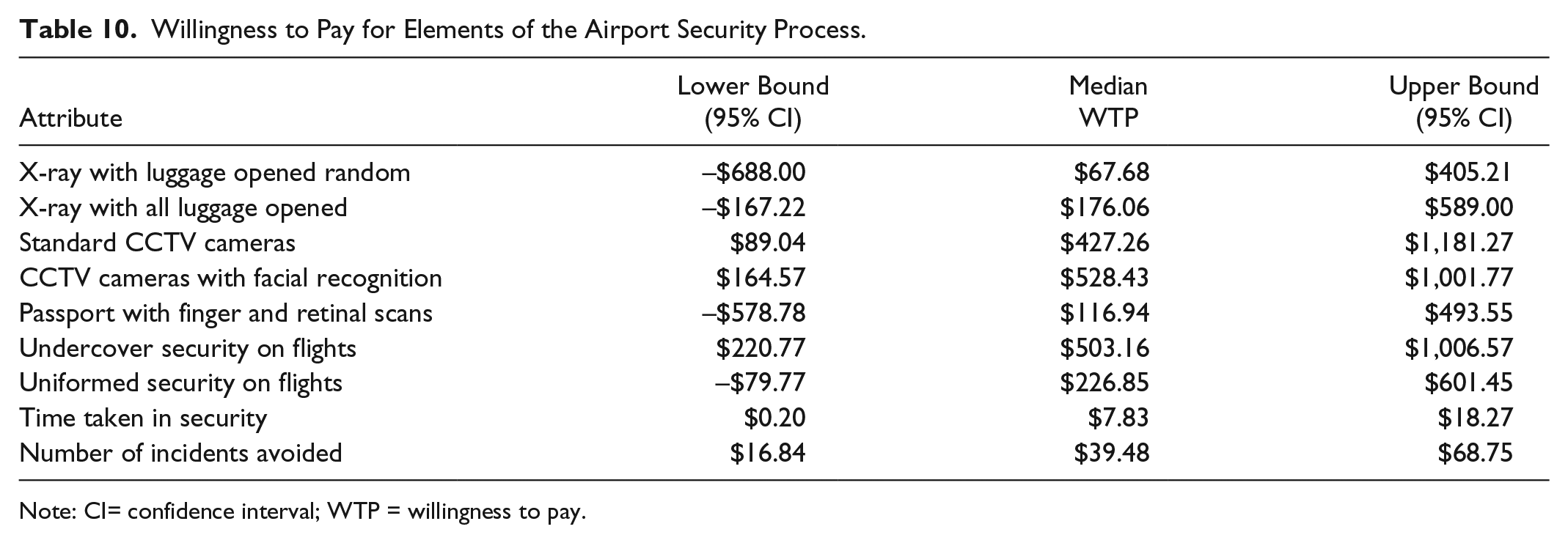
Note: CI= confidence interval; WTP = willingness to pay.
Discussion and Conclusion
Our survey was conducted very shortly after the second of the Malaysian Airline tragedies and it is interesting to note approximately 7 of every 10 respondents (68%) were nevertheless excited by the prospect of international travel. This suggests that the majority of travelers are either able to compartmentalize these events as isolated incidents, or view the reward of international travel to largely outweigh the risk. Alternatively, respondents may also be likely to ascribe negative incidents as specific to the airline in question rather than to the industry as a whole. This might be particularly true in Australia where Qantas, the national carrier, has an international reputation for being particularly safe (see, e.g., Daily Telegraph UK 2016 ).
In this final section, we will provide a broader overview of the results discussed above, and attempt to give insight into the potential ramifications of our research; first with respect to the attitudes of respondents and second with respect to their preferences toward the passenger screening process, which included security screening regimes with more invasive measures that policy makers might consider as a result of a spate of air-related incidents. It should be noted that data were collected prior to the Germanwings disaster on March 24, 2015.
Attitudes Overall
Examining overall attitudes to air travel, the highest level of agreement was that the presence of visible uniformed police creates a greater feeling of security. This is an important finding for the management of passenger screening processes within airports. Examining the same attitudinal data also points toward there being a limit to the number of screening processes that travelers are willing to endure. This indicates that travelers are happy with how long it currently takes, but on the threshold of not wanting any more time to be consumed in this process. Overall there is agreement that airlines and authorities do enough to minimize threats from staff and passengers and generally do enough overall to make air travel safe, but interestingly the number of travelers who strongly agree to these statements is small. Those managing air security operations, including airlines and airports, and those formulating regulations and aviation security policies are advised to keep this result in mind and potentially better communicate what they do and why it is necessary and effective in threat minimization.
When looking more globally at whether or not Australians are (dis)trustful or concerned about their privacy, generally Australians report similar levels of (dis)trust as Europeans in that there is slightly more distrust than trust. Our results suggest that particular Australians are more disillusioned with governments when compared to other nationalities. With respect to privacy, fewer respondents in this study feel that protecting personal information and defending current liberties and human rights is very important—a result that is at odds with the OAIC (2013) finding that Australians are particularly concerned about privacy. It should be noted that the OAIC study is more general attitudes of privacy, whereas this study deals specifically with international travel. This suggests that when answering questions of privacy and dignity, respondents are doing so in the context of such travel, whereby opting into such travel requires a person to relinquish some degree of personal freedom. It could also be possible that the twin disasters of MH370 and MH17 have made Australians more willing to accept intrusions to privacy than they were in 2013 or in Europe.
In identifying the drivers of overall feeling of safety onboard aircraft we found that sociodemographics such as age, gender, travel purpose, and income were insignificant. Attitudes toward various aspects of air travel were instead found to be significant determinants of the feelings of overall safety of air travel. This indicates the airline and airport management should seek to leverage attitudes that are largely consistent across the population as a whole. In other words, messaging or policy actions can be consistent across the population. In particular, we recommend that security staff in airports be visible (Australian Federal Police if possible), and that all initiatives be aimed at improving the opinion that authorities are attempting to minimize the threat from staff, other passengers, and mechanical issues.
The Choice to Travel
The stated preference experiment revealed three broad classes of differing sensitivities toward traveling under different passenger screening regimes. One class of respondents who are best termed nervous about flying are seemingly persuaded to travel by the presence of security personnel (either uniformed or not) onboard the aircraft. The largest class of potential travelers are those who are trusting of authorities and have relatively higher levels of overall safety while flying. This group of travelers are willing to experience a range of security measures, many of which are potentially more invasive than the current systems. The last class is somewhat akin to status quo travelers who seemingly wish to maintain the current levels of security, perhaps because they feel it is sufficient protection.
The implication for those in the travel and tourism sector is that policies and communication emphasizing the trustworthiness of security staff and protocols should be strongly considered. To reduce the number of nervous travelers, attention should be paid to increasing the feeling of overall safety onboard an aircraft; the discussion in the previous section outlines the drivers of this feeling, but emphasizing the role of uniformed police and communicating the effectiveness of the protocols which are used minimize the potential threats to flights from staff and passengers are the leading measures that should be considered.
From an Australian perspective, there is significant willingness to pay for increased measures during passport screening. It was revealed as part of the investigation into the disappearance of MH370 that two Iranians on board were traveling on stolen European passports that went unchecked against international databases or any potential biometric information. The resultant controversy surrounding the use of stolen passports is perhaps the reason for this high willingness to verify the identity of the passport holder. In Australia, a raft of new measures were announced in August 2014, with the Federal Government stating that finger printing technology at the departure and arrival gates will follow the early rollout of e-gates with facial recognition software. Additionally, 80 national security officers will be deployed at every major airport to deal with potential threats, though these security measures are yet to pass Parliament (Migration Amendment Bill 2015). Seemingly, there is support for these measures.
Perhaps most interesting is the relative magnitudes of the marginal willingness to pay statistics that are calculated from this study. The willingness to pay values for the extant and overt measures such as x-ray procedures, security personnel, CCTV, and more thorough passport protocols are much higher than the willingness to pay to stop one more additional incident over a 10-year period. These results reflect the strength of preference among respondents that these measures are needed and sufficient to encourage travel, and we hypothesize that given respondents view these measures as being effective, there is no need to pay more for stopping incidents (i.e., the current measures do successfully stop incidents such that respondents can see no real improvement to stopping threats). While the incidents avoided variable was based on the work of Potoglou et al. (2010), in the context of this study it might also be the case that the concept of stopping one or two additional incidents every 10 years may be vague to respondents or that in the context of air travel (particularly for Australians), security breaches and air-related incidents are viewed as highly improbable events that they are unlikely to experience it themselves (perhaps a belief that it will happen to someone else, not me) and thus are unwilling to pay a great deal for something they consider highly unlikely already.
Alternatively, the relative recency of the MH370 and MH17 events may have been perceived as the occurrence of two highly rare events within a short span of time; thus, respondents view that the chances of anything happening within the next 10 years is very small. Again, on this point it is worth noting that this survey was collected prior to the Germanwings Flight 9525 and the TransAsia Flight 235. Willingness to pay to avoid incidents may have changed given the density of such events over the last 12 months, although both Germanwings and TransAsia are seemingly the result of staff actions, rather than failures of passenger facing security measures (and to some extent perhaps there is the view that the Malaysian Air disasters are also the result of staff or policy rather than arising from actions of passengers).
Limitations and Future Research
In this article, we have examined the attitudes and behaviors of travelers with respect to passenger security procedures inherent in the process of international travel, contributing to a gap in the extant literature. With respect to the limitations of this study, future research will seek to explore in more detail how respondents perceive the threat of incidents. In particular, at what rate of incidents over a certain time horizon does risk of travel become a significant factor, or when asked to imagine air related incidents, how do people process that request? Additionally, future research will be conducted to explore how these preferences change over time, especially as the memory of incidents fade. Another aspect worth further investigation is to try to disentangle the concepts of safety and security, which is not trivial and a limitation of this study as the terms often overlap both in the perception and practice of traveling.
One potential ramification of our analysis for future research is the exploration of how respondents perceive threat detection in the context of passenger screening and international air travel. While significant in the choice experiment, the willingness to pay number of incidents avoided was, to us, surprisingly low. As previously stated, there may be a range of reasons why this might be so: people might not be able to deterministically value what are essentially small probability events; may not believe that you can increase the number of threats detected regardless of what screening measures you implement; might discount such events in instances where they have limited experience (air security incidents and terrorism are very isolated in Australia and have never targeted air travel); could place a lower priority on threat detection than other aspects of the screening process; or indeed might not think that such incidents are anything to worry about or do not care that they exist. We believe that clarifying perceptions in this space would be of great interest to policy makers and practitioners in the air travel industry.
Overall, while mirroring Potoglou et al. (2010) in finding some evidence that travelers are willing to trade personal freedoms for improved security, we largely conclude that with respect to international air travel the magnitude of trade-offs are limited. Either travelers are willing to accept risk or perceive them as isolated or perhaps limited to airlines with inferior safety records. In conclusion, travelers are willing to accept the passenger screening process as part of the travel process and are seemingly willing to spend a little more time in the process so long as it is effective in increasing safety. These results are particularly poignant given the short time frame after the MH370 and MH17 incidents in which the data were collected.
Footnotes
Acknowledgements
We would like to acknowledge the contributions from three anonymous reviewers, whose efforts have helped the creation of this article.
Declaration of Conflicting Interests
The author(s) declared no potential conflicts of interest with respect to the research, authorship, and/or publication of this article.
Funding
The author(s) received no financial support for the research, authorship, and/or publication of this article.