







Abstract
Travel providers advertise low prices to attract customers, which can decrease willingness to pay through anchoring effects. Customers often approach purchases with a budget goal, which can influence price interpretation due to framing effects. Accommodation prices are typically displayed per night, whereas consumers may have a total trip budget in mind, leading to metric incompatibility. This research uses experimental methods to test the effects of price anchors, framing, and metric compatibility on willingness to pay for a Spring Break vacation. A high anchor increases willingness to pay compared to a low anchor, and consumers will pay more when exposed to an average price versus a range. Anchoring effects are reduced when the budget goal is incompatible with a high anchor but not a low anchor. The findings can be attributed to dual processing systems and asymmetry effects. The results yield practical guidelines for effective pricing strategies.
Introduction
Hotels frequently advertise rates “starting from” a low value, with the goal of attracting customers. When customers proceed to the booking stage, the price is invariably higher. The anchoring heuristic operates when an initial value serves as an anchor, thereby biasing decisions in the direction of the anchor (Tversky and Kahneman 1974). Therefore, advertising a low price point may backfire and reduce the price people are willing to pay. Pricing strategies that include a high anchor could have a positive impact on willingness to pay and allow operators to charge a higher rate.
Consumers approach purchase decisions with a particular budget in mind (Ülkümen, Thomas, and Morwitz 2008). Budget-conscious travelers may want to spend as little as possible, whereas higher-income customers may allocate a certain amount for travel that they do not want to exceed. Mental budgeting and income influence consumer reactions to price increases (Homburg, Koschate, and Totzek 2010). The influence of budget goal on price evaluations can be explained by framing principles. Framing effects occur when the perspective influences evaluation of outcomes (Tversky and Kahneman 1981). Framing can influence consumers’ response to price anchors when purchasing products online (Wu and Cheng 2011). Therefore, high- or low-budget framing may influence the way in which hotel pricing strategies affect purchase decisions.
When shopping for a hotel stay, most online travel agency (OTA) sites display an average nightly rate for a list of hotels after the user inputs travel dates. The total trip cost is not shown until two steps later, after the consumer selects a particular hotel and room type. This pricing practice may conflict with peoples’ budgeting if they allocate funds for the entire trip. When making their pre-purchase evaluations, the pricing will be incompatible with the budgeting process. The compatibility principle suggests that the correspondence of inputs and outputs is enhanced when they are expressed in the same metric (Tversky, Sattath, and Slovic 1988). Research suggests that anchoring effects do not occur when the anchor is expressed on a different scale than the judgment (Chapman and Johnson 1994). Therefore, the effects of price anchoring for lodging may depend on whether a consumer’s travel budget is per night or per trip.
Although average nightly rates are commonly displayed when booking hotels, some major hotel companies and OTAs display their products along with the lowest price directly or indirectly to attract customers. For example, Marriott and Accor Hotel Group display their rooms using the word “From” and Agoda.com, a major OTA, displays its products with the phrase “as low as.” In addition, although hotels and OTAs do not typically display the highest price as an anchor of a product, this strategy is often used when presenting a price reduction. Discounts “up to” a certain percentage or dollar amount are a commonly observed practice in services and retailing contexts (Chen, Monroe, and Lou 1998; Della Bitta, Monroe, and McGinnis 1981). The high anchor could have the unintended effect of disappointing customers when the actual discount is less. The current research explores the possibility that a high anchor for the product itself could be beneficial and increase willingness to pay.
The effects of anchoring, framing, and metric compatibility in hotel pricing can be evaluated in terms of dual processing systems. System 1 (heuristic) involves automatic processing with limited cognitive effort. System 2 (systematic) involves thoughtful processing (Kahneman 2011). The online travel booking environment contains multiple cues that may lead consumers to use system 1 processing and apply judgmental heuristics to simplify the decision process (Tversky and Kahneman 1974). “Anchoring effects are strikingly pervasive and robust” (Mussweiler and Strack 2001, p. 234) and are likely be triggered by pricing cues. It is suggested that anchoring can result from thoughtful or automatic processing; therefore, it is critical to understand the moderators of anchored judgments (Wegener et al. 2010). The current research proposes budget framing (low-high) and metric compatibility (per night–per trip) are moderators that interact with price anchors as a function of dual processing systems.
The objective of the research is to evaluate the effects of anchors created through hotel pricing strategies and the way in which individuals’ budget goals moderate the influence of price anchors on decisions. Metric compatibility between the goal and the anchor is proposed as the mechanism that leads to system 1 or system 2 processing. The research evaluates the effect of these variables on price perceptions and willingness to pay for accommodations on OTA websites. The findings are important to operators by providing insight into the way in which pricing strategies influence hotel financial performance. The research is theoretically significant, as it applies dual processing systems to determine the factors that moderate anchoring effects from accommodation pricing. Although the variables have been investigated in the pricing literature, their interactions have not been tested in a single study with a unified theoretical framework. The findings have actionable implications for practitioners, while advancing knowledge about travel decision making in today’s purchasing environment.
Literature Review
Pricing Principles
A reference price can be conceptualized as the standard price against which individuals evaluate the current price (Monroe 1973). Consumers form price evaluations by comparing the current price of the target service or product to a reference price (Briesch et al. 1997; Choi, Joe, and Mattila 2018; Kalyanaram and Winer 1995). Therefore, an individual’s price perception of the target object is largely determined by his or her internal reference price (Winer 1986). When the current price is higher (lower) than one’s reference price, this price difference leads to unfavorable (favorable) perceptions of the current price (Xia, Monroe, and Cox 2004). The term reference price is commonly used to refer consumers’ internal price standard formed through previous price exposure (Kalyanaram and Winer 1995). However, researchers have described external reference price as recently encountered pricing for a specific purchase decision (Briesch et al. 1997; Choi, Joe, and Mattila 2018; Viglia, Mauri, and Carricano 2016). There is an asymmetry between the external price and the internal reference price, such that consumers react more strongly to price increases than to price decreases (Choi and Mattila 2018; Kalyanaram and Winer 1995).
Internal and external reference prices have been shown to influence hotel and travel product price evaluations and purchase decisions (Viglia, Mauri, and Carricano 2016). Research tends to pay attention to travelers’ relative use of two different reference prices in the context of travel and lodging where the revenue management practice is universal (Choi and Mattila 2018; Viglia, Mauri, and Carricano 2016). Research shows that travelers are more likely to use external reference prices compared to internal reference prices due to greater information accessibility and diagnosticity of external reference prices (Choi and Mattila 2018). It is suggested that the relative use of internal versus external reference prices is contingent on traveler characteristics, such as the degree of brand preference (Karande and Magnini 2011). The study shows that travelers loyal to a hotel brand are more likely to use internal reference prices, whereas non–brand loyal travelers are more likely to rely on external reference prices.
Heuristics
Selecting hotels from an online travel agency (OTA) website is a complex process (Pan, Zhang, and Law 2013). There are multiple properties per page and many cues competing for consumers’ attention. This makes online hotel purchasing a prime candidate for the use of judgmental heuristics (Tversky and Kahneman 1974). Heuristics are mental shortcuts that simplify the decision process, but may lead to systematic biases. Decision theorists propose two cognitive systems: system 1, which is automatic and leads to the use of heuristics, and system 2, which is systematic and involves thoughtful processing (Kahneman 2011). Hotel pricing strategies intended to attract customers may be detrimental to business outcomes if heuristic processing is used. In particular, the practice of advertising a low price can lead to the use of the anchoring heuristic if system 1 processing is activated. However, increased cognitive activity will reduce reliance on the anchoring heuristic through system 2 processing (Adaval and Wyer 2011).
Anchoring
Anchoring refers to the tendency to anchor a decision at an initial value and fail to adjust sufficiently to reach the true value (Tversky and Kahneman 1974). Two types of anchoring are proposed: priming and adjustment (Kahneman 2011). In priming, system 1 is activated and consumers process information selectively to confirm the anchor. In adjustment, system 2 is used to adjust values from the anchor deliberately, but people fail to make sufficient adjustments (Kahneman 2011). Research supports the dual-process approach by suggesting that there can be thoughtful and nonthoughtful anchoring effects (Wegener et al. 2010). In one study, participants made numerical estimates in the presence of a high or low anchor, and were provided with background knowledge that was in the same or opposite direction as the anchor (Blankenship et al. 2008). Cognitive load was manipulated by having half the participants engage in a secondary task while making the estimates. Under low cognitive load, anchoring effects were larger when background knowledge was consistent with the anchor. Under high cognitive load, background knowledge did not influence the degree of anchoring (Blankenship et al. 2008). The implication is that low cognitive load facilitated thoughtful processing, whereas high cognitive load led to heuristic processing.
Conscious attention to the anchor moderates anchoring effects, providing further evidence of dual-processing systems. Consumers are willing to pay more for a retail product with a high anchor than a low anchor (Adaval and Wyer 2011). However, when deliberate attention to the anchor is induced, anchoring effects are restricted to the specific product due to systematic processing. Without conscious cognitive activity, the anchoring effect carries over to unrelated products due to automatic processing. Consumers adjust downward from a high anchor more than they adjust upward from a low anchor (Adaval and Wyer 2011). For example, the degree of upward adjustment from an advertised sale price that is higher than an individual’s internal reference price (IRP) is less than the amount of downward adjustment if the advertised price is lower than the IRP (Chandrashekaran and Grewal 2006). This introduces an asymmetry effect in anchoring, whereby adjustment is biased toward a lower price point. From a hotel pricing perspective, this limits how much more hotels can charge if they advertise a low anchor.
Research demonstrates the role of anchoring in travel purchase decisions. In an eye-tracking experiment, Pan, Zhang, and Law (2013) found that peoples’ attention was drawn to low price and to hotels at the top of the web page fold, which could serve as an anchor for subsequent decisions. Participants exposed to two resorts, one with neutral reviews and one with positive reviews, were willing to pay more per night if the positive resort was priced extremely higher than the alternative, but not if it was moderately higher (Book, Tanford, and Chen 2016). In a dynamic pricing scenario, participants’ reference price was influenced most by the first price in the sequence, which created an anchor (Viglia, Mauri, and Carricano 2016). Providing high or low hotel prices influenced price evaluation and willingness to pay for hotels in a different city, demonstrating that anchoring effects carry over to unrelated judgments (Shen and Wyer 2008).
Although relevant, research on reference price does not address the price anchoring heuristic as it relates to hotel pricing practices. Reference price is typically considered internal, whereas price anchors are imposed externally through pricing practices. Moreover, evidence of the effects of anchoring on purchase decisions lies largely in the retail consumer setting. This research evaluates the extent to which anchoring operates under different pricing strategies when choosing a resort vacation. The literature on anchoring effects leads to the following hypothesis.
Hypothesis 1: Participants will be willing to pay more for accommodations with a high versus a low price anchor.
In addition to high- and low-anchor conditions, the research tests two alternative pricing displays: average and range. Range includes values corresponding to the low and high anchor, whereas average is the mean of the high and low values. The price-structure literature has examined the impact of changes in a distribution of prices on consumers’ price evaluations (Cunha and Shulman 2011). Previous research argues that price judgments within the distribution are influenced by variation in the range of prices or the mean of the price distribution (Cunha and Shulman 2011). One stream of research shows that when an individual encounters a range of prices, he or she tends to rely on the highest and lowest prices (i.e., the endpoints) in the range (Janiszewski and Lichtenstein 1999). Moreover, a broad range of values leads to greater adjustment than a narrow range (Janiszewski and Uy 2008). Alternatively, prior studies find that an individual’s price perceptions and evaluations within the distribution are contingent on a central tendency measure of prices, such as the mean of the price distribution (Monroe 1990). Applying the adjustment principle and asymmetry effects, participants are expected to adjust insufficiently from the low anchor. Therefore, responses will be lower with a range than they will be with an average price.
Hypothesis 2: Participants will be willing to pay more for accommodations with an average price versus a price range.
Framing
Framing effects occur when changing perspective influences evaluation of outcomes (Tversky and Kahneman 1981). For example, a 10% chance of failure is less attractive than a 90% chance of success. Framing operates in price promotions, such that a discount framed as a “percentage off” has greater perceived value than an “extra product” deal with equivalent monetary value (Sinha and Smith 2000). Goal framing occurs when the objective of the action is framed from different viewpoints (Levin, Schneider, and Gaeth 1998). In one study (Ahluwalia 2002), students evaluated a brand of athletic shoes with the goal of accuracy (impression involvement), promoting the product (position involvement), or influencing the athletic department’s purchase decision (outcome involvement). Outcome involvement increased the weight assigned to negative information, position involvement supported more positive information, and impression involvement did not differentiate between positive and negative information (Ahluwalia 2002). Applying the dual processing approach, Meyers-Levy and Maheswaran (2004) evaluated the conditions under which message framing produces heuristic versus systematic processing. Participants evaluated a cholesterol-reducing product with high (20%) or low (2%) risky implications, framed in terms of benefit or risk. Their findings suggest that systematic processing occurs when risk and relevance are high, whereas heuristic processing operates when both are low.
Framing has been linked to anchoring effects, suggesting the framing provides a hypothesis that is evaluated against the anchor (Mussweiler and Strack 1999). Approaching a purchase with the goal of ruling out alternatives versus selecting the best option can influence attention to the anchor (Chapman and Johnson 2002). The joint effects of anchoring and framing were investigated for Internet buying decisions (Wu and Cheng 2011). Framing was positive or negative, and the anchor was a banner ad showing the same product at a very low ($26) or very high ($1140) price. Banner ads such as this are often present on OTA sites, making the findings relevant for travel purchases. There was no effect of framing with a low anchor, whereas negative framing reduced purchase intention and WTP with the high anchor. The findings implicate dual processing systems, where a high anchor activates systematic processing and causes consumers to consider other relevant cues and a low anchor overrides other considerations through heuristic processing (Wu and Cheng 2011).
Research investigating framing in travel purchase decisions is limited. Positive framing of messages was more effective than negative framing in promoting sustainability among hotel customers (Kim and Kim 2014). In the context of online hotel reviews, framing was defined as whether positive or negative reviews appeared first (Sparks and Browning 2011). Positive framing combined with numerical ratings increased booking intentions, which the authors attribute to reliance on easy-to-process information. An investigation of hotel pricing found that framing a room rate as a premium or a discount did not influence price perceptions (Rohlfs and Kimes 2007). On the other hand, a promotion framed in dollars off produced higher willingness to book a hotel room than a promotion framed as percentage off, but only for individuals with low need for status (Choi and Mattila 2014).
Mental Budgeting
Based on theoretical development of mental accounting, Heath and Soll (1996) introduced the concept of mental budgeting. Mental budgeting demonstrates that individuals tend to classify their money into different expense categories (e.g., housing, food, entertainment, and so on) and then track those expenses against their budget (Ülkümen, Thomas, and Morwitz 2008). If the limit is reached within a given category, they stop spending. The topic of mental budgeting has been widely examined in the context of grocery and travel purchases (e.g., Brida and Tokarchuk 2015; Stilley, Inman, and Wakefield 2010).
Consumers engage in mental budgeting by allocating income to different expense categories and tracking those expenses. Mental budgeting and framing influence reactions to a price increase (Homburg, Koschate, and Totzek 2010). In one experiment, subjects were confronted with a price increase for an intended purchase that would exceed their budget in a specified category (clothing). Consumers were more likely to purchase the item if the increase was framed in dollars versus percentages, and mental budgeting proclivity mediated the effect of income on purchase likelihood. In the second experiment, mental budgeting reduced likelihood to purchase in the same category but not a different category. Temporal framing was manipulated by having participants estimate their food and entertainment budgets for one month or one year and keep a diary of expenses for one week (Ülkümen, Thomas, and Morwitz 2008). Compared to actual expenses, next-month budgets were underestimated under low cognitive load but not high cognitive load. This finding supports the adjustment principle of anchoring, since consumers failed to adjust their budgets to consider unplanned expenses.
Building upon the framing and budgeting literature, framing is defined as an individual’s budget goal for an upcoming trip, which is framed as low (spend as little as possible) or high (spend up to a certain amount). When framing is consistent with the anchor, it is expected to activate heuristic processing and the anchoring effect will be magnified. When framing is inconsistent with the anchor, thoughtful processing is required and the effect of the anchor will be attenuated, but only in the high-anchor condition. Because of asymmetry effects and insufficient adjustment from low price points (Adaval and Wyer 2011; Chandrashekaran and Grewal 2006), a low anchor is expected to override high goal framing.
Hypothesis 3a: Participants will be WTP more for accommodations with a high price anchor when their goal is to spend up to a certain amount versus as little as possible.
Hypothesis 3b: Goal framing will not influence WTP for accommodations with a low price anchor.
Hypothesis 4a: The effect of a high price anchor on price perceptions will be increased when the goal is to spend up to a certain amount versus as little as possible.
Hypothesis 4b: Goal framing will not influence price perceptions with a low price anchor.
Metric Compatibility
Hotels typically advertise room rates per night. However, when planning a trip, consumers may have a total budget in mind. The principle of compatibility indicates that “the weighting of inputs is enhanced by their compatibility with the output” (Tversky, Sattath, and Slovic 1988, 371). It is suggested that anchor-target compatibility is a necessary condition for anchoring (Chapman and Johnson 2002). Research investigated the effect of high and low anchors on evaluation of lotteries that varied in dollar amounts and probability of winning (Chapman and Johnson 1994). The anchor was either incompatible (an object description) or compatible (monetary value) with the judgment. Anchoring effects occurred when the judgment and the anchor were presented on the same scale, but not when the anchor was on a different scale. Further evidence for the influence of metrics on judgments was obtained by Pandelaere, Briers, and Lembregts (2011), who found that consumers were willing to pay more for an upgraded product when its quality was expressed on a 1000- versus a 10-point scale. Consumers’ budget estimates differ between annual and monthly, such that people tend to underestimate monthly budgets (Ülkümen et al. 2008). The authors suggest that this is due to insufficient adjustment from a starting value.
The asymmetry between high and low anchors extends to metric compatibility. For example, establishing an anchor that is different from the judgment (height vs. width) reduces anchoring for a high but not a low anchor (Strack and Mussweiler 1997). Framing and compatibility have been linked to consumer reference price, such that reference price is more influential if it is compatible with the outcome (Garbarino and Slonim 2003). In an analogous fashion, price anchors are expected to be more influential when they are compatible with individuals’ travel budgets. Given the asymmetry principle, this effect is expected to occur primarily with a high anchor.
Hypothesis 5a: Participants will be WTP more for accommodations with a high price anchor when their budget goal is per night versus per trip.
Hypothesis 5b: Metric compatibility will not influence WTP for accommodations with a low price anchor.
Hypothesis 6a: The effect of a high price anchor on price perceptions will be reduced when participants’ budget metric is per trip versus per night.
Hypothesis 6b: Metric compatibility will not influence the effect of a low price anchor on price perceptions.
Methodology
Two experiments investigated the effects of price anchoring, goal framing, and metric compatibility on price perceptions and willingness-to-pay (WTP) for a Spring Break vacation. A preliminary experiment was conducted to establish anchoring effects of different pricing strategies, and determine their impact on WTP at different price levels. The main experiment investigates the joint effects of anchoring, framing and metric compatibility on judgments. A hypothetical Spring Break travel scenario was utilized in both experiments. Subjects were recruited in hospitality classes at a major U.S university between March and April 2017, shortly before and after Spring Break. To ensure independent samples, data for the two experiments were collected in different classes, and students who had participated in another class were asked to return their materials. Utilizing student samples is often criticized as a limitation. By using a decision context that is meaningful to students, the research has ecological validity in terms of capturing the effects of interest. Previous studies on pricing (Tanford, Erdem, and Baloglu 2011), online reviews (Book et al. 2018; Tanford and Montgomery 2015) and online travel planning (Bai et al. 2004) employed students making Spring Break judgments as their sample. Therefore, using a student sample is appropriate for the current study.
Data were collected in classrooms using color printed questionnaires. Subjects were randomly assigned to experimental conditions by prearranging surveys in random order. Subjects were instructed to assume they were making purchase decisions for Spring Break travel to Cancun, which is one of the top Spring Break travel destinations (Meltzer 2017). Data were collected before safety concerns for Mexico tourism arose in summer 2017. The dependent variables were willingness to pay and price perceptions. Participants indicated how much they would be willing to pay per night at each of the resorts in an open-ended question format. Although there are other methods of measuring WTP, an open-ended measure was selected to avoid providing any reference values that would interfere with the anchor. Participants rated perceptions of price on a 7-point numerical scale from 1 (low) to 7 (high). The survey concluded with demographics.
Preliminary Experiment
Design
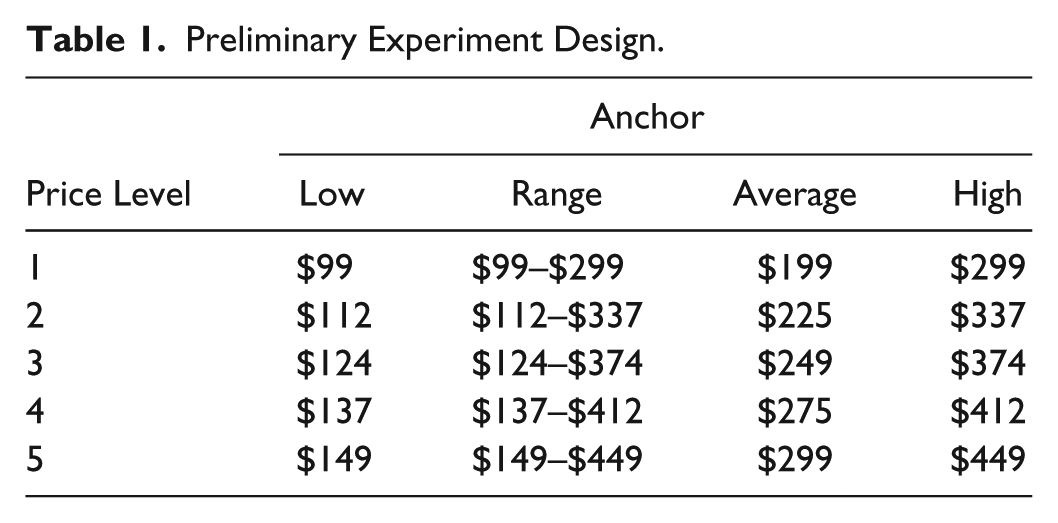
The preliminary experiment utilizes a 4 (anchor) × 5 (price level) mixed design, with anchor as a between-subject factor and price level as a within-subject factor. Anchor is defined as low, range, average, or high price presentation on a simulated online travel website. Each anchor condition displays five properties at different price levels, where 1 is lowest and 5 is highest. Table 1 provides the operational definitions of price level under each anchoring condition.
Preliminary Experiment Design.
Stimuli consisted of photos and descriptions of five different Cancun resorts adapted from Expedia along with price information worded according to the anchor. Pretesting was conducted to ensure that the resorts were moderately attractive. Groups of 31–35 students evaluated a subset of 12 descriptions and photographs of Cancun resorts and rated them on 7-point bipolar scales of bad–good choice for Spring Break and extremely unlikely–extremely likely to choose the resort. The five selected resorts had mean ratings from 4.4 to 5.4 across the two items. Price level was determined by analyzing typical room rates during Spring Break season in Cancun on Booking.com and Expedia. The lowest resort price was $99 and the highest price was $449. Anchor was manipulated using four different types of price presentations, which are “Starting from,” “Average,” “Ranging from,” and “Up to.” A sample of the stimulus is provided in Figure 1 for the low-anchor condition.
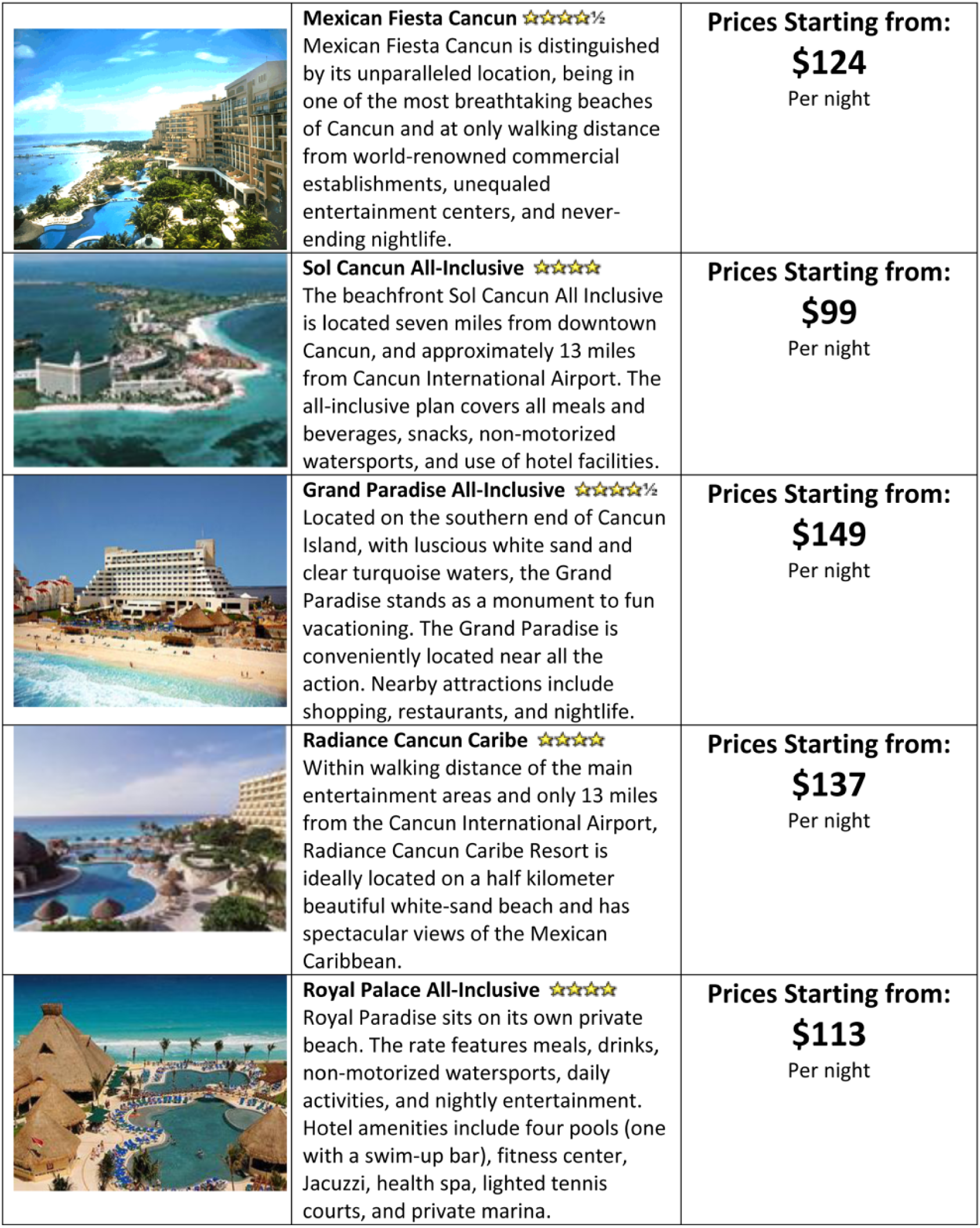
Stimulus Example (Preliminary Experiment).
Subjects
The sample contained 215 subjects, with 50–57 subjects in each of the four anchoring conditions. Subjects within each anchoring condition were exposed to all five price levels, so the sample size was 50–57 for price level within anchoring. This sample size is sufficient to detect medium-sized effects with greater than 0.95 statistical power. The sample was 60.2% female and 39.8% male. The majority of the sample was 18–21 years old (59.0%) followed by 22–29 (36.8%) and 30 or higher (4.2%). Most of the participants were juniors (49.1%), seniors (22.6%), and sophomores (22.2%) in college.
Results
The realism of the scenario descriptions was assessed using a single-item scale (“How realistic were the resort scenarios?”). The mean rating was 5.03 out of 7.00 (SD = 1.18), suggesting that the scenarios were perceived as believable. Perceptions of price increased significantly as a function of price level (F4,824 = 17.05, p <.001, eta2 = .076). Mean ratings were 4.12, 4.60, 4.84, 4.87, and 5.09 from low to high price levels; therefore, the manipulation was effective.
The effects of price and anchoring on WTP were analyzed in a 4 × 5 analysis of variance (ANOVA) with one between-subjects factor (anchor) and one within-subjects factor (price level). There is a significant effect of price (F4,824 = 58.67, p = .000, eta2 = .222), anchor (F3,206 = 71.66, p = .000, eta2 = .511), and a price × anchor interaction (F12,824 = 4.97, p = .000, eta2 = .068). Post hoc Bonferroni tests reveal that all four anchoring conditions are significantly different at p < .01. WTP is significantly higher with the high anchor (M = $284) than the low anchor (M = $123) supporting hypothesis 1. WTP with the range anchor (M = $161) is significantly lower than the average anchor (M = $202), supporting hypothesis 2. The interaction was investigated further by analyzing the simple effect of anchor for each price level, the results of which are displayed in Table 2. Bonferroni post hoc tests reveal that all four anchor conditions are significantly different at each price level. Consistent with hypothesis 1, participants report the lowest WTP with a low anchor and the highest WTP with a high anchor. In support of hypothesis 2, the average anchor produces significantly higher WTP than the range, demonstrating the expected asymmetry effects of price anchoring. The partial eta-squared values indicate that anchoring effects are large in magnitude.
Effects of Price and Anchor on Willingness to Pay.
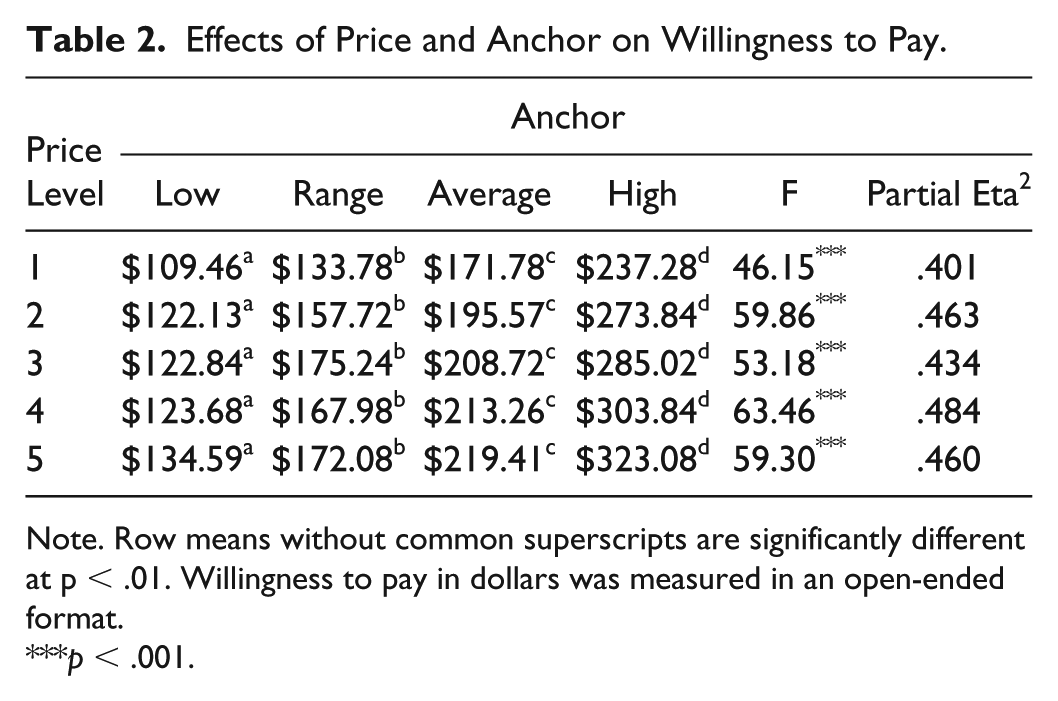
Note. Row means without common superscripts are significantly different at p < .01. Willingness to pay in dollars was measured in an open-ended format.
p < .001.
Main Experiment
Design
The main experiment uses a 2 (anchor: high vs. low) × 2 (framing: high vs. low) × 2 (metric compatibility: compatible vs. incompatible) between-subjects design. Anchor is defined using the low and high conditions from experiment 1. Goal framing is defined as a budget goal to spend as little as possible (low), or not to exceed a certain amount (high). Metric compatibility is defined by depicting the goal as compatible (per night) or incompatible (per trip) with the anchor. A photo and description of a single Cancun resort was selected from experiment 1 using the third price level, which represents a typical range. The mean price rating was 4.84 on the 7-point scale, which suggests that the price was not too high for the student sample. The selected resort had a mean attractiveness rating of 5.0 on the pretest scales.
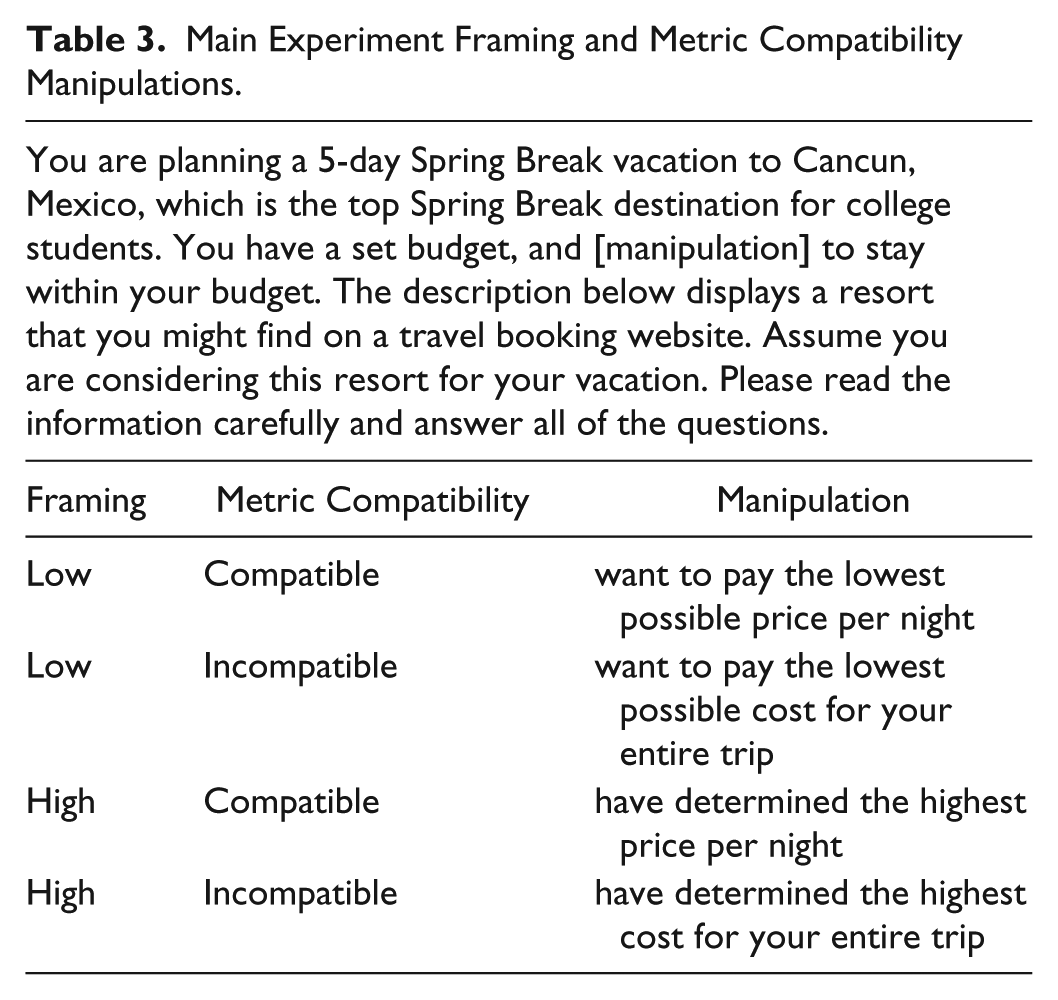
The low anchor was depicted as “starting from $124” and the high anchor was “up to $374.” Goal framing and metric compatibility were manipulated using a scenario in which participants were instructed to assume they are planning a Spring Break trip to Cancun and have established a set budget corresponding to the experimental condition. The budget was framed as low (lowest possible price) versus high (highest price), and the metric was compatible (per night) or incompatible (per trip) with the anchor. Table 3 displays the text of the scenarios for the four framing-compatibility combinations.
Main Experiment Framing and Metric Compatibility Manipulations.
Subjects
A total of 309 subjects participated, with 35–46 subjects randomly assigned to each of the eight experimental conditions. This sample size yields statistical power greater than .95 for detecting medium-sized effects. The sample was 63.8% female and 36.2% male, with ages of 18–21 (50.5%), 22–29 (45.3%), and 30 or older (4.2%). The sample contained mostly juniors (36.8%) and seniors (32.6%), followed by sophomores (24.8%).
Results
The realism of the scenario descriptions was assessed on a 7-point bipolar scale. The mean rating was 4.89 out of 7.00 (SD = 1.34), suggesting that the scenarios were perceived as believable. A 2 (anchor) × 2 (metric compatibility) × 2 (framing) ANOVA was performed on WTP for the resort. There is a significant main effect of anchor (F1, 301 = 53.66, p = .000), which is large in magnitude (eta2 = .151). WTP is significantly lower when the anchor is low (M = $145) versus high (M = $211), supporting hypothesis 1. There was not a main effect for framing, and framing did not interact with anchor as expected. Since framing did not influence WTP with a high or low anchor, hypothesis 3a is not supported but hypothesis 3b is supported.
A main effect of metric compatibility on WTP was not found; however, there was a significant interaction between anchor and metric compatibility on WTP (F1, 301 = 6.81, p = .010, eta2 = .022). The interaction was investigated further by analyzing the simple effect of metric compatibility at each anchor level. The effect of metric compatibility is significant at a high anchor (F1,142 = 8.00, p = .005, eta2 = .053) but not when the anchor is low (F1,163 = .19). The means for this interaction are displayed in Figure 2. When the anchor is high, participants report higher WTP when the metric is compatible (per night) versus when the metric is incompatible (per trip). When the anchor is low, WTP does not differ as a function of metric. These findings support hypotheses 5a and 5b.
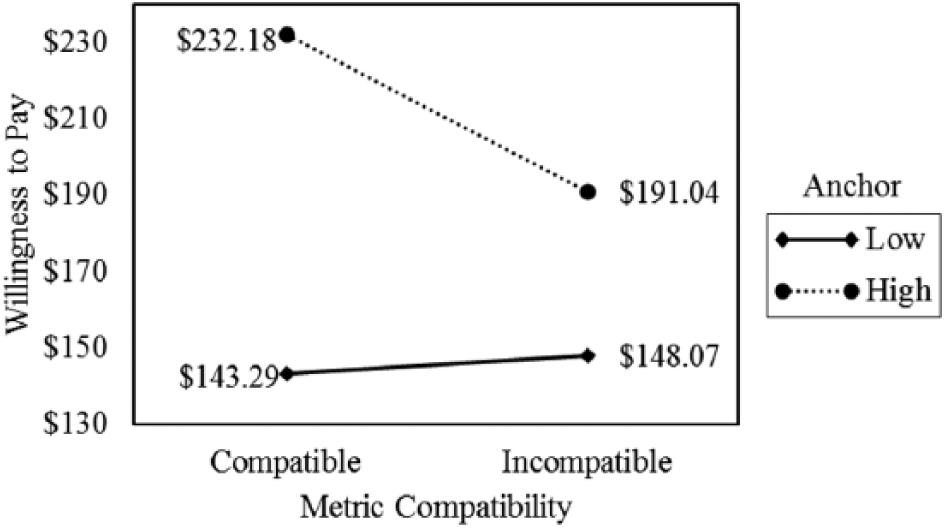
Effect of anchor and metric compatibility on willingness to pay.
There was a significant three-way interaction between anchor, framing, and metric compatibility on price perception (F1,299 = 6.05, p = .014, eta2 = .020). The interaction was investigated further by analyzing the simple interaction effect of metric compatibility × framing each anchor level, which revealed a significant two-way interaction for the high anchor (F1,140 = 5.06, p = .026, eta2 = .035) but not for the low anchor (F1,161 = 1.50). The interaction was investigated further by analyzing the effect of metric compatibility at each framing level for the high-anchor condition (Figure 3). The effect of metric compatibility approaches significance when framing is high (F1,70 = 3.81, p = .055, eta2 = 0.052), but not when framing is low (F1,70 = 1.77, p = .188). When the anchor is high and framing is high, price evaluations are higher when the metric is incompatible with the anchor. When framing is low, metric compatibility does not influence price evaluations. Another way to describe the result is that framing does not differentiate high- versus low-budget goals when the metric is compatible, which suggests that system 1 (heuristic) processing is occurring. The incompatible metric requires conscious thought, which activates system 2 and differentiates the two framing groups. The finding supports hypotheses 4a and 4b since framing influences price perceptions with a high but not a low anchor. The finding complements the result for WTP (hypothesis 5) and supports hypotheses 6a and 6b since metric compatibility influences price perceptions with a high but not a low anchor.
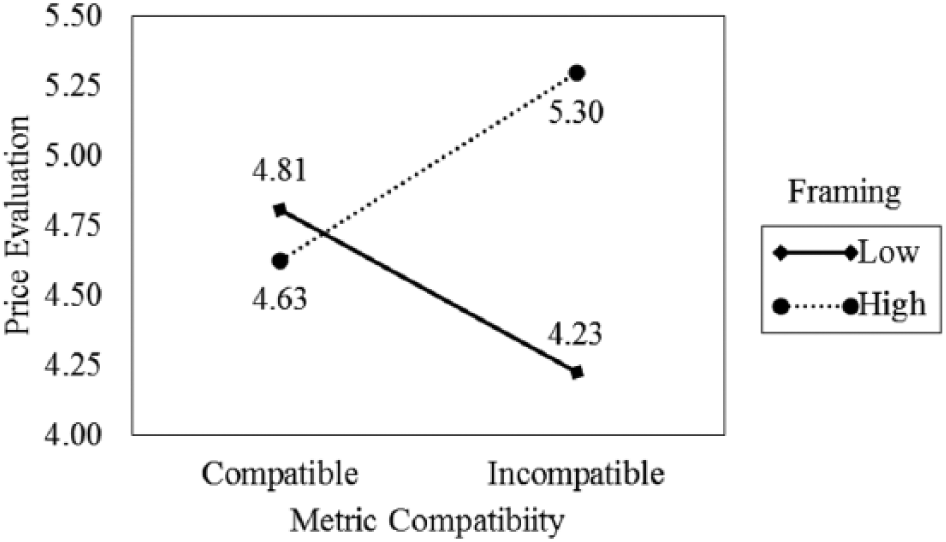
Effect of framing and metric compatibility on price perception (high anchor).
Discussion
Hotel pricing strategies may be detrimental to the bottom line, and the current findings help answer the question of when, why, and how. The findings demonstrate clear anchoring effects for advertised prices and the conditions under which these occur. A summary of hypothesis support is provided in Table 4. The results demonstrate that a high anchor advertising prices “up to” a certain amount increases potential consumers’ willingness to pay, compared to a low anchor advertising prices “starting from” a specified amount, supporting hypothesis 1. This effect persists across a range of price levels from $99 to $449. Offering a range of prices or an average produces less pronounced anchoring effects, but WTP is anchored toward the low end of the range as predicted by hypothesis 2. This finding is consistent with other studies that demonstrate an asymmetry in pricing, whereby consumers adjust downward from a high price more than they adjust upward from a low price (Adaval and Wyer 2011; Chandrashekaran and Grewal 2006).
Hypothesis Support.
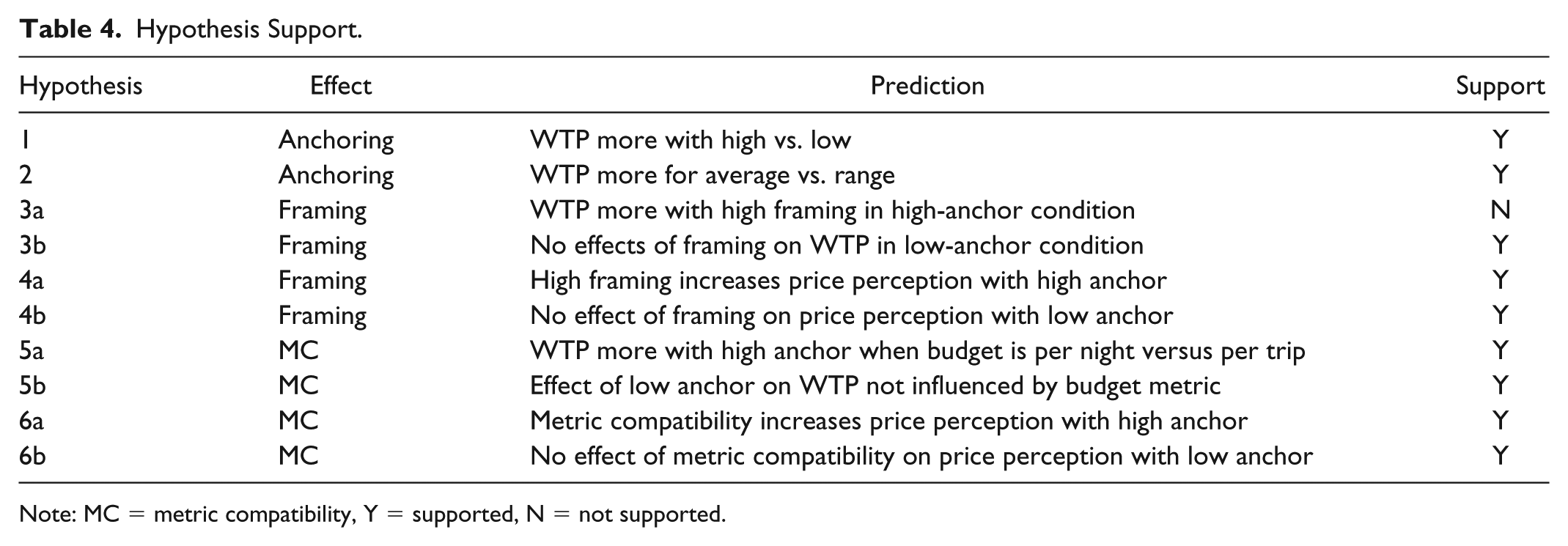
Note: MC = metric compatibility, Y = supported, N = not supported.
The findings suggest that the way in which people budget for travel influences their response to pricing strategies. Budget was manipulated in two ways: framing (high or low) and metric (per night or per trip). The predicted interaction between framing and anchoring did not occur for WTP (hypothesis 3) but did occur for price perception (hypothesis 4). An asymmetry effect was predicted, such that people would adjust downward from a high anchor, but would not adjust upward from a low anchor. In their study of retail pricing, Wu and Cheng (2011) obtained such a result on purchase intentions and WTP. However, their anchors consisted of banner ads at extremely low or high price points. A broad range of values leads to greater adjustment than a narrow range (Janiszewski and Uy 2008). Moreover, advertised sale prices have more influence if presented in percentages rather than a dollars-off format (Chandrashekaran and Grewal 2006). It is possible that the price perception rating scale was more sensitive to anchor-framing compatibility than the WTP measure in dollars. Alternatively, a more extreme high anchor may have increased downward adjustment on WTP with a low budget goal.
The predicted interaction between metric compatibility and anchor occurred for both WTP and price perception. When the budget metric (per trip) is incompatible with the anchor (per night) the effect of a high anchor on WTP is reduced (hypothesis 5a) but the effect of the low anchor is not (hypothesis 5b). Personal budget can be considered an internal reference price, which influences perceptions of the external price (Choi, Joe, and Mattila 2018). This finding provides another instance of the asymmetry between low and high pricing, and is consistent with research showing that consumers react more strongly to hotel price increases versus decreases relative to the IRP (Viglia, Mauri, and Carricano 2016). Budget framing (high or low) alone does not influence WTP or price perceptions, suggesting that the anchoring effect supersedes framing. However, framing leads to higher perceptions of price when the anchor and framing are high and the budget is per trip. This finding suggests that the anchor leads to system 1 (heuristic) processing when the metric is compatible, and individuals may not consult their internal budgets. However, when the metric is incompatible, it involves conscious thought (system 2) to compare the internal trip budget with the external advertised rate.
Theoretical Implications
The findings support a dual-process explanation of consumer response to hotel pricing strategies, and extend principles of judgmental heuristics in online travel purchases. There are two forms of anchoring: priming and adjustment (Kahneman 2011). Priming is automatic, and people process information selectively to confirm the anchor. The findings suggest that this occurs in the low-anchor condition, as participants are motivated to pay the low price and do not consider other variables. In adjustment, consumers deliberately adjust values but fail to make sufficient adjustments. This is the case in the range condition, where participants do not adjust equally between the two anchors; therefore, their WTP is significantly lower than the average of the two end points.
In the main experiment, it was necessary to enlist cognitive processing to reduce anchoring effects. Various factors can reduce anchoring, including uncertainty (Simonson and Drolet 2004), product relevance (Adaval and Wyer 2011), and cognitive load (Blankenship et al. 2008). These effects can be interpreted from the perspective of system 1 versus system 2 processing, whereby judgments that require cognitive effect cause people to attend to other cues besides the anchor. In the current research, metric incompatibility triggers cognitive effort since mental calculations are required to convert a trip budget to a nightly rate. However, this is only true in the high-anchor condition. As price becomes higher, people tend to be more attune to other cues so as to minimize the risks of a costly choice (Wu and Cheng 2011).
The findings support the asymmetry effect in pricing, and suggest the presence of a broader asymmetry effect in travel purchase decisions that can be explained in terms of judgmental heuristics. Social psychologists have long recognized asymmetric effects between positive and negative information, such that negative information is given more weight (Taylor 1991). Research on the effects of online travel reviews indicates that negative reviews outweigh other considerations including price (Book, Tanford, and Chen 2016; Book et al. 2018; Noone and McGuire 2014) and preexisting attitudes (Tanford and Montgomery 2015). It has been suggested that heuristics can be explained in terms of effort reduction, whereby consumers use heuristics to examine fewer alternatives, simplify the weighting process, and integrate less information (Shah and Oppenheimer 2008). In the case of a low price anchor or negative reviews, that cue alone provides sufficient information to make a decision, as people seek to pay a low price just as they want to avoid a negative experience. With high price or positive reviews, more effort is required to obtain the necessary information to make a decision. The findings suggest that asymmetry effects can be broadly explained in terms of a dual processing system, such that negative information processing is automatic and positive information processing is systematic.
This is the first study to investigate the interactions between anchoring, framing, and metric compatibility. Since anchoring can result from systematic or automatic processes, it is essential to understand the moderators of anchoring effects (Wegener et al. 2010). Given the complexity of the online purchasing environment, there are numerous cues competing for consumers’ attention, which cannot be considered in isolation. The current research suggests that these external cues are moderated by individuals’ mental budgeting processes. Pricing research often considers internal reference price, while framing studies tend to impose external frames and metrics. This research demonstrates that the influence of external price anchors can be moderated by individuals’ internal budget framing and metric compatibility between the budget and the anchor.
Practical Implications
The findings have implications for effective pricing and marketing strategies. Hotel companies use a variety of pricing strategies at different stages of the sales process. At the prepurchase stage, there are many places where the “starting from” strategy is used, including billboards, banner advertising, the hotel website, and television advertising. Advertising prices “starting from” a stated amount may pique interest, but will reduce the rate consumers are willing to pay at the point of sale. Likewise, a range is not effective, because decisions will be anchored toward the low end. A better strategy might be to advertise average prices, separated for weekdays and weekends. Even though participants adjusted downward with the average anchor, they were willing to pay over 50% more than those with the low anchor.
At the purchasing stage, OTA websites typically require the user to input dates, and display an average nightly rate, which is less susceptible to anchoring than other pricing strategies. However, some hotel websites, such as Marriott, show ratings “starting from” a certain dollar amount per night when travel dates are entered. Many hotel companies are implementing strategies to increase direct bookings and avoid commissions of 10% to 20% that are charged by OTAs (Ting 2017). A low anchor display may be detrimental to direct booking through the hotel website, especially since OTA pricing often uses the opposite approach.
OTAs do not typically display prices “up to” a certain amount. However, it is common practice by OTAs such as Expedia to show a standard rate crossed out with a lower sale price. This may have the same psychological effect by providing a high anchor against which the sale price is compared. On the same web page, options that show a single price will have a disadvantage. The magnitude of the difference is important, as a higher base price will increase willingness to pay for a reduced price. For example, one Expedia search yields Las Vegas properties priced at $229 ($255 crossed out), $275 ($393 crossed out), and $193 (no crossed out values). The most expensive option could be considered the most attractive based on the high anchor provided. Providing the absolute dollar difference will have more impact than banners displaying the percentage off (Chandrashekaran and Grewal 2006), which is done for some properties. The findings have implications for the practice of advertising discounts “up to” a certain amount in retail and service industries (Chen, Monroe, and Lou 1998; Della Bitta, Monroe, and McGinnis 1981). A better strategy might be to advertise a discount of at least a certain amount, which could lead consumers to consider a higher priced product that has a larger discount.
Operators should consider peoples’ budget processes when pricing their properties online. Typically, rates are shown per night after the customer selects dates. For example, on Expedia, the trip total is not displayed until the third screen. The first screen contains a list of properties with the average nightly rate, the second screen displays room types for the selected property with the average nightly rate, and the third screen shows the average nightly rate and the trip total. Hotel operators could gain a competitive advantage by including the trip total on the first screen, where the consumer could assess quickly whether that option fits within their budget. This strategy may be most effective for lower-priced properties, as consumers will rely on the pricing cues if the metric is compatible. For higher-priced properties, the incompatible metric may be desirable, since consumers are likely to engage in systematic processing and consider other features about the property besides price.
In summary, the findings suggest that the following strategy may be most effective for hoteliers. When advertising hotel prices, display average nightly rates to attract customers at the prepurchase stage without creating a low anchor. At the purchase stage, provide the sale price with a high anchor crossed out, and the savings displayed in dollars, along with the total trip cost and savings to facilitate mental budgeting. When listing on OTA sites, use anchoring to gain a competitive advantage by having a larger gap between the regular and sale price. Hoteliers should avoid using a “starting from” strategy to stimulate direct booking, as it may backfire and reduce willingness to pay. Conversely, they should not advertise discounts “up to” a certain amount, which will produce disappointment and decrease willingness to book when the discount is lower than expected.
Limitations and Future Research
The goal of this research is to evaluate the effects of anchoring, framing, and metric compatibility on accommodation purchase decisions. The relationships between the three theoretical constructs have not been investigated in a single study, making it critical to maximize internal validity through experimental control. As such, it was necessary to make tradeoffs with external validity. Participants made hypothetical decisions after reading scenarios, and their willingness to pay could be different when booking an actual trip. However, when testing theories experimentally, the key criterion is that the “constructs cannot be construed in terms of other constructs” (Calder, Phillips, and Tybout 1981, p. 197). Willingness to pay cannot be construed as something else. The budget goal was assigned to the participants, and could be different than the way they actually budget for expenses. Consumers’ internal budgeting processes can influence their responses to a price increase (Homburg, Koschate, and Totzek 2010).
The participants were college students making travel decisions for Spring Break travel, but it is unlikely that all students were interested in visiting Cancun. A student sample may be more price-sensitive than the general population, so the pricing effects might differ for more affluent travelers. However, the usual criticisms for using student samples do not apply here, since the materials simulated a student purchasing context. Homogeneous samples are preferred when testing theoretical constructs (Calder, Phillips, and Tybout 1981) and student samples tend to be more homogeneous (Peterson 2001). Moreover, students represent the Millennial generation, which is the fastest-growing segment of travelers (Fromm 2017). Therefore, despite the aforementioned limitations, the research accomplished its goal of testing the relationships between the key constructs using relevant stimuli, measures, and participants.
Nonetheless, given the practical significance of the findings, it is beneficial to establish their generalizability to actual pricing situations, different products, and other consumer groups. Partnering with an OTA or hotel operator, field experiments could be conducted in which the pricing format is manipulated on websites, advertisements, and billboards. The effect of these manipulations on booking activity, ADR, and other outcomes could be measured. Secondary data from an OTA could be analyzed to determine the relationship between pricing strategies and business outcomes. Framing and mental budgeting could be investigated further by evaluating consumers’ natural tendencies and measuring their reactions to price anchoring scenarios. Further research is needed to determine how consumers’ internal reference price interacts with price anchoring effects. The research questions could be extended to restaurant settings. A restaurant meal is less costly and important than a vacation, and research indicates that anchoring and framing effects differ for high- and low-cost items.
Conclusion
This research demonstrates that pricing strategies designed to attract customers may be detrimental to the bottom line. Principles of heuristics and dual processing theories help explain when and why this will occur. New relationships between anchoring, framing, and metric compatibility are revealed in simulated purchase decisions that reflect the way consumers book travel in today’s environment. We certainly do not expect operators to know about the anchoring heuristic, but they should be strategic about their price presentation and not simply follow the pack. Pricing is one factor that is under their control, and should be used to maximum advantage. The findings will help operators make informed pricing decisions while advancing knowledge about hospitality consumer behavior.
Footnotes
Declaration of Conflicting Interests
The author(s) declared no potential conflicts of interest with respect to the research, authorship, and/or publication of this article.
Funding
The author(s) received no financial support for the research, authorship, and/or publication of this article.
