







Abstract
Our study aims at understanding how coopeting tourism managers perceive their competitors. Competitor perceptions are consequential because they have implications for interfirm relationships. Collaboration with competitors offers benefits otherwise unattainable, such as improved destination marketing, more successful attracting of tourists, increased tourism product complexity, and better service, but is used to various degrees by tourism firms. We use a purposeful sampling procedure for maximum heterogeneity to select interviewees from Polish tourism DMO member firms. We inductively code and thematically group their perceptions to find that tourism managers develop a detailed understanding of collaboration with competitors and precisely identify their competitors, but interpret this so as to either facilitate collaboration or to remain in rivalrous mode, depending on their behavioral disposition. We propose a framework for developing perceptions with mindsets in a pivotal role.
Introduction
Perceptions are useful in understanding and predicting tourist behavior (Mazanec and Strasser 2007). Essentially, developing perceptions entails identifying relevant target attributes and evaluating their similarity to predefined categories in order to classify target representations (Peteraf and Bergen 2003). Perceptions may refer to the attributes that tourists identify in their choice of alternative, be it destinations (Pike and Ryan 2004), sites (Poria, Reichel, and Biran 2006), travel booking (Park and Tussyadiah 2017), etc. in order to first develop their respective perceptions and then to infer from these perceptions for their individual choices. The long-standing tradition of using image and evaluative factors to better explain tourists’ behavioral intentions (C. F. Chen and Tsai 2007; Pandža Bajs 2015) provides an increasingly fine-grained understanding of how relevant attributes such as authenticity (Revilla and Dodd 2003; Lu, Gursoy, and Lu 2015), familiness (Presas, Guia, and Munoz 2014), ethnicity (Thanopoulos and Walle 1988; Yang 2011), or risk perceptions (Karl 2018; Park and Tussyadiah 2017) can effectively be used to attract tourists, increase their satisfaction, and subsequently enhance tourism firms’ performance.
Similarly to tourist perceptions, managerial competitor perceptions are consequential because they have implications for actions such as attack, response, cooperation, or engagement in collective endeavors (M. J. Chen and Miller 2015). Competitor identification is a complex process based on an evaluation of the tensions between the focal firm and any given competitor (Tsai, Su, and Chen 2011). Managers evaluate competitors in terms of their market profile and resource endowments (M. J. Chen 1996) and compare their own organization pairwise with rivals (M. J. Chen, Su, and Tsai 2007). In doing so, managers follow a categorization process which starts with (1) developing a representation of the target firm; follows with (2) retrieving the attributes of the “competitor” category from their memory; then continues with (3) evaluating the similarity of the target firm representation with the “competitor” category representation; providing (4) a classification of the target as a competitor (or not); and (5) storing the result in memory (Clark and Montgomery 1999). This process results in classifying firms on the basis of relevant similarities (Peteraf and Bergen 2003) that are likely to drive action. The greater the similarity in terms of resource endowment and market profile, the more a given rival is perceived as a competitor, and the stronger the competitive tension toward such a competitor arises. Therefore, identifying perceptions is of paramount importance in any understanding of competitor interaction (Clark and Montgomery 1999).
The manager-oriented perspective on competitor identification addresses the complexity of relationships between any given pair of firms, and the heterogeneity of possible perceptions that managers may have in the exact same conditions (M. J. Chen, Su, and Tsai 2007). Competitor perceptions may be asymmetrical; that is, two rivals may evaluate each other in a different way (Tsai, Hu, and Chen 2011), or available information may be interpreted to understand competitor behavior (Ghoshal and Westney 1991) related to any given pair of rivals (M. J. Chen and Hambrick 1995). Differently from the industry-oriented perspective, which departs from the assumption that all industry players are by default competitors, and from the strategic groups–oriented perspective, which restricts the scope of competition in industries to smaller sets of firms according to their similarities and differences (Gur and Greckhamer 2018), the manager-oriented perspective adopts a fine-grained approach to understanding what a firm does when competing with specific rivals, or by extension how a firm manages competition–cooperation interdependence (M. J. Chen and Miller 2015).
Interestingly, while resident and visitor perceptions (Moyle, Weiler, and Croy 2013) are established themes in the literature, tourism competitor perceptions have so far not received similar attention. The few available studies suggest competitor perception to be obstructive in regional development, but that tourism firms are able to overcome it and successfully work together (Gordon 2007). Others find that competition may be perceived in different ways, including gaining more business by working with others (Wang and Krakover 2008), which suggests a consequential role played by competitor perceptions in destination marketing collaboration. Research in this area would be enriched if scholars went beyond the polarized “threatening vs. non-threatening” view of competitors (Clark and Montgomery 1999). For instance, a study of hoteliers in Sydney, Australia, found that performance may dramatically increase when competitors are perceived as friends (Ingram and Roberts 2000). Indeed, competitiveness in tourism is necessarily a function of how successfully various actors work together (Fyall, Garrod, and Wang 2012). Collaboration helps alleviate the resource constraints that individual firms often experience, opens up access to novel opportunities, increases the understanding of how to integrate resources, creates new offers, and helps improve service quality (Lusch and Vargo 2006). The long-standing interest in tourism collaboration (Jamal and Getz 1995) has recently been enriched with an increase in the attention devoted to collaboration with competitors, or coopetition (Chim-Miki and Batista-Canino 2017; Chim-Miki, Medina-Brito, and Batista-Canino 2019; Czernek and Czakon 2016; Damayanti, Scott, and Ruhanen 2019). By pooling the resources and capabilities dispersed across various firms, sharing accumulated knowledge, and jointly mobilizing actions toward the accomplishment of common objectives, coopetition helps achieve benefits otherwise unattainable (Fong, Wong, and Hong 2018).
Tourism actors have been found to intentionally set up coopetitive endeavors for more effective destination marketing (Gretzel et al. 2006; Wang and Xiang 2007), more successful attracting of tourists (Falk 2017), and to offer increasingly complex tourism product (Czakon, Klimas, and Mariani 2019). Also, tourism actors have been found to unintentionally engage in collaboration with competitors for better customer service (Kylänen and Rusko 2011) or to adopt coopetitive strategies to promote events and scale up destination attractiveness through the institutional involvement of public authorities (Mariani and Kylänen 2014). Even though empirical studies demonstrate a positive linkage between coopetition within destinations and their competitive advantage (Della Corte and Aria 2016), researchers underline that coopetition in tourism is used to various degrees (Wang and Krakover 2008; Czernek and Czakon 2016). Our study addresses the diversity of coopetition in tourism destinations from a behavioral perspective by examining how competitors are perceived by coopeting tourism managers.
Scholars recognize that simultaneous collaboration and competition with the same actors involves cognitive, emotional, and behavioral tensions (Tidström 2014) inherent to paradoxical contexts (Czakon, Fernandez, and Minà 2014), where contradictions between value creation and appropriation are particularly pronounced (Ritala and Tidström 2014). It is important to understand how individuals cope with the tensions associated with the contradictory demands of collaboration and competition (Khalilzadeh and Wang 2018), as coopetition poses a behavioral challenge to individuals in terms of finding a position when a competitor becomes a partner (Le Roy and Czakon 2016). Collaboration often presents challenges to participants, particularly when there is a real or perceived divergence between the individual interests of participants in a collaborative arrangement and the collective interests of the collaborative endeavor as a whole (Fyall, Garrod, and Wang 2012). Competitors typically display high degrees of market commonality and resource similarity, which may elicit competitive tensions and thus increase the risk of opportunism in collaboration ( W. L.Chang and Chiu 2016).
Our qualitative study seeks to arrive at an understanding of competitor perceptions from the perspective of those experiencing coopetition. We pursue three specific objectives that address our research question: How do coopeting tourism managers perceive their competitors? First, we aim to capture managers’ representations of why collaboration with competitors is relevant, and how perceptions are connected with tensions. Second, our objective is to examine how tourism firm managers identify competitors. Third, we focus on the interpretative preferences that our interviewees displayed in developing useful competitor perceptions. We give voice to our interviewees (Gioia, Corley, and Hamilton 2013) and inductively code and thematically group (Braun and Clarke 2006) their nuanced perceptions into a collaborative mindset construct useful in understanding the interpretation processes reported by our interviewees.
Theoretical Framework
The behavioral view of strategy postulates that the way strategists represent a given setting affects their strategic actions, which subsequently affects the results obtained (Gavetti 2012). Cognitive representations are conceptual structures in the minds of individuals that epitomize a simplified understanding of the reality the individuals face (Lakoff 1987). These representations provide frameworks for understanding a situation, filtering knowledge and taking direct action (Gaim 2018). Since its introduction into management literature, the concept of coopetition has been closely tied to thinking, perception, perspective, and understanding the environment of a firm, which results in the ability to purposefully shape strategies (Brandenburger and Nalebuff 1997). Managers can perceive competitors solely as threats that have to be responded to and eliminated, which implies that interactions with relevant actors will be a zero-sum hostile competitive game, or inversely as potential collaborators, which implies that a positive-sum collaborative game can be applied (Brandenburger and Nalebuff 1995). In this section, we discuss concepts important for understanding competitor perceptions in tourism coopetition. We first outline the relevance of perceptions in coopetition, and the role of mindsets in explaining the differences in individuals’ cognition when identifying coopetition benefits, engaging in coopetition and coping with associated tensions. Next, we review the literature on tensions felt by coopeting managers, and the association of such tensions with the perception of competitors.
Cognitive Underpinnings of Coopetition
The behavioral view of coopetition postulates that cognitive representations of the strategy problem are embedded in a value network, involve win–win situations, and are consequential for managerial action (Czakon, Klimas, and Mariani 2019). This extends the cognitive view of competition wherein “rivalry occurs when one firm orients itself toward another and considers the actions and characteristics of the other in business decisions, with the goal of achieving a commercial advantage over the other” (Porac et al. 1995, p. 204). From the behavioral perspective, markets are socially constructed networks of firms that define each other as competitors. Similarly, the cognitive view of collaboration suggests that “organizations seek legitimacy by adopting structures and behavioral patterns that have been previously approved and accepted as correct” (Fyall, Garrod, and Wang 2012, p. 15). Hence, collaborative relationships are socially contrived and shaped by the interpretations of the parties involved (Wang 2008). Relational mixes are important in understanding coopetition (Bouncken and Fredrich 2012), a complex relationship that involves simultaneous competition and collaboration between the same actors (Bengtsson and Kock 2000).
For instance, collaborative destination marketing involves a dynamic interplay between competition and collaboration, depending on the way the actors perceive the benefits sought after. The dominance of a particular business relationship has been found to depend on (1) norms and values, (2) community feelings, (3) relationships, (4) business model, and (5) strategic thinking (Wang and Krakover 2008). Among these five dimensions, the competitive and collaborative perceptions are opposites. Collaboration implies that a firm serves the interest of a destination, shares community feelings, recognizes interdependence with other actors, opts for a cooperative business model, and focuses strategic thinking on cooperation. Competition involves the opposite preferences. Hence, perceptions of others as competitors may be detrimental to collaboration within destinations.
Differently from cognitive representation, a mindset may be considered as a habitual mental outlook that determines how one interprets and responds to situations (Gaim and Wåhlin 2016). As such, a mindset intervenes between representations and the meaning that individuals assign to them. Differences in individual cognition can be attributed to different mindsets. For instance, a holistic mindset among directors of collaborative tourism organizations influences organizational commitment and helps recognize the benefits of joint action (Garnes and Mathisen 2014). Mindsets that are risk or benefit oriented lead travelers to assess the helpfulness of online travel reviews differently, as positive mindsets tend to focus attention on positive material, while negative mindsets tend to generate critical assessment (Shin et al. 2019). Similarly, responsiveness to market changes may be slowed down if managers’ mindsets are driven by established performance measures in setting priorities in destination management (Gretzel et al. 2006). Also, the conservation-oriented mindsets of policy makers have been found to slow down the activities of commercial tourism enterprises (Mariani and Guizzardi 2019).
The competitive mindset is equaled with an egocentric perspective (Brandenburger and Nalebuff 1997), typically reflected in an orientation toward own profit maximization and no involvement in collective actions (Wang and Krakover 2008). The cooperative mindset is equaled with an allocentric perspective (Brandenburger and Nalebuff 1997), typically reflected in common goals sought through collective action (Wang and Krakover 2008). While both competitive and cooperative mindsets have been found to exist at the same time in a tourism destination, individual businesses are unable to display both at the same time (Wang and Krakover 2008).
Prior literature offers conceptual insights into the coopetitive mindset construct. Luo (2007) suggests that accepting tensions between competition and cooperation, as well as embracing conflict, diversity and variety, is characteristic of the coopetitive mindset. Hence, the coopetitive mindset addresses tensions related to the complex nature of coopetition (M. J. Chen 2008), and can be seen as the capacity of an individual to moderate the level of tensions associated with coopetition (Bengtsson, Raza-Ullah, and Vanyushyn 2016). Another take on the coopetitive mindset underscores the importance of (1) recognizing the importance of coopetition; (2) identifying opportunities for value creation with rival firms; (3) helping other managers develop a coopetitive mindset, and thus effectively manage the dynamics of coopetition (Gnyawali and Park 2009). Thus, the coopetitive mindset helps filter knowledge and directs action (Gaim 2018) in view of practicing coopetition effectively (Luo 2007).
A mindset is rooted in experience, attributed for instance to the formative years of individuals, which results in the different mindsets and travel behaviors found in different generations (Gardiner, Grace, and King 2014). However, individuals may adopt, drop, and change their mindset to the extent that it is useful in coping with the challenges they face. The adoption of coopetition by tourism firm managers is connected with an enormous change in the mindsets that define the intended business focus (Gretzel et al. 2006). A change of mindsets and cognitive schema confirms the tenets of service dominant logic, which advocates the interlocking effects between actors, practices, and context formation through value co-creation processes (Altinay, Sigala, and Waligo 2016). Researchers recognize that modifying cognitive frameworks in order to develop a coopetitive mindset requires flexibility and willingness (Mariani 2007). A longitudinal study on the tourism industry in Macau reveals a change in incumbent firms’ mindsets from competitive to coopetitive in order to cope with drastic changes in market conditions and regulatory policies (Fong, Wong, and Hong 2018). Stakeholders are likely to display different mindsets, and their attitudes toward collaboration and their expectations regarding prospective outcomes become heterogeneous, which results in non-equal contributions (Khalilzadeh and Wang 2018).
All in all, engaging in coopetition has recognized cognitive underpinnings, reflected in distinctive representations, mindsets, and perceptions. However, the literature does not explain how tourism firm managers represent, identify, and perceive their competitors and how mindsets impact these perceptions. Our research question addresses this gap.
Coopetitive Tensions
Successful coopetition enhances the capacity of meeting goals synergistically, in particular, goals related to challenges faced by all actors involved. Prior studies identify several such common challenges: competitive disadvantage due to peripheral location (Kylänen and Rusko 2011), competition among destinations at a national (Wang and Krakover 2008) and international level (Della Corte and Aria 2016), effective promotion (Abrate et al. 2019), generating additional value for tourists in a ski destination in view of attracting them and prolonging their stays (Falk 2017), integrating online and offline channels to attract new customers to hotels (Y. W. Chang, Hsu, and Lan 2019), facing discontinuities in online platform operations (Tekin Bilbil 2019), or adapting travel agency practices to long-term evolution of the operating environment (Fong, Wong, and Hong 2018). By collaborating with those who face the same challenges, tourism firms are found to be more effective, and their individual performance can be significantly increased. However, competition among involved actors can make collaborative arrangements fragile (Khalilzadeh and Wang 2018).
Coopetition involves a logic of interaction different both from pure competition, which is associated with the hostile and self-interested pursuit of individual interests, and from pure collaboration, which is seen as a friendly and collective pursuit of common goals (Bengtsson and Kock 2000). The simultaneous occurrence of both collaboration and competition in the same relationship generates tensions related to contradictory logic, which may produce different outcomes depending on the way they are managed (Tidström 2014). Tensions are perceptual (Czakon, Fernandez, and Minà 2014), and natural in coopetitive relationships (Fernandez and Chiambaretto 2016). Tensions manifest themselves as stress, anxiety, discomfort, or tightness in making choices as well as responding to and moving forward in organizational situations (Putnam, Fairhurst, and Banghart 2016). Within coopetitive relationships, two distinct types of tensions have been identified: competitive (Wilhelm 2011) and paradoxical (Tidström 2014).
Competitive tensions refer to competitor perception, and the threat competitors may pose in the short and long term. Competitive tensions appear in coopetitive relationships because apart from providing benefits (Kraus et al. 2018), coopetition involves rivalry for scarce resources and generated value (Wilhelm 2011). Furthermore, coopetition may impede a firm’s operations by enabling its competitors to first obtain sight of it, and then to imitate the firm’s core competencies (Tidström, Ritala, and Lainema 2018). M. J. Chen (1996) indicates that the degree of similarity between a given pair of firms influences the perception of the target firm as a threat and increases the likelihood of rivalrous action. Hence, competitor perception plays a significant role in understanding competition (Figure 1) because of tensions, which reflect the strain between a pair of firms, and beyond a certain point that strain transforms their static relationship into a dynamic interplay observable in competitive actions (M. J. Chen, Su, and Tsai 2007).
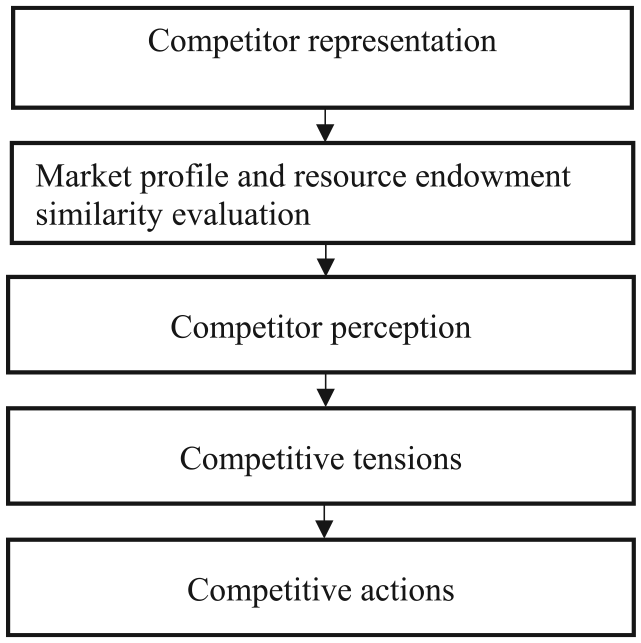
The role of competitor perception in managerial action.
The second type of tensions identified in coopetition refers to its paradoxical nature. Scholars indicate that the competition–collaboration paradox is the antecedent of tensions felt within coopetitive relationships (Raza-Ullah, Bengtsson, and Kock 2014). Tensions may be external, referring to inter-organizational dynamics, or internal—that is spread internally and felt by a firm’s employees (Bengtsson, Raza-Ullah, and Vanyushyn 2016). Our research question focuses on external tensions, which concern the difficulties managers face when making decisions on collaboration with competitors. Conflicting demands, opposing perspectives, or seemingly illogical findings referred to as paradoxes in the literature are cognitively or socially constructed (Lewis 2000). Actors oftentimes simplify the increasingly intricate, ambiguous, and changing world into polarized distinctions. Coopeting managers have been reported to experience “schizophrenic” situations with regard to simultaneously cooperative and competitive relationships (Ritala, Hurmelinna-Laukkanen, and Blomqvist 2009). Paradoxical tensions differ from conflict in that they are more abstract and relationship-specific, while conflicts are short-term and situation-specific (Tidström 2014). Paradoxical tensions involve incompatibilities of perception, such as perceiving the same target firm as a competitor and as a partner. Our research question addresses this incompatibility by looking at how coopeting tourism managers perceive their competitors.
The literature formalizes the tensions felt as an actual and experienced state of cognitive and emotional stress inside an organization (Gnyawali et al. 2016), involving both strain and conflict between contradictory demands. Research on paradoxical tensions relate them to the conflicting roles played by actors within a coopetitive relationship (Bengtsson and Kock 2000); knowledge sharing and protecting interests in view of coopetition goal achievement without losing control of proprietary knowledge (Fernandez and Chiambaretto 2016); power asymmetries that may be exploited by the stronger partner (Czakon 2009); and the possibility of various opportunistic behaviors (Tidström, Ritala, and Lainema 2018), in particular through nonequal contributions or free-riding (Khalilzadeh and Wang 2018). These tensions play a negative role in establishing coopetition in tourism as the perceived risks associated with coopetition might prevail over the benefits. Therefore, tourism coopetition requires careful governance to help mitigate the perceived opportunism risk in event organization (Mariani 2016), as well as trust-building efforts (Czernek and Czakon 2016) and institutional evolution (Fong, Hong, and Wong 2018).
While much of the literature pictures tensions as negative phenomena, tensions may also be perceived in a positive way as a pursuit of harmony, wherein both parties perceive that the cooperative and competitive processes are congruent and compatible with each other (Mattsson and Tidström 2015). The important role of positive interdependency, involving a give-and-take attitude and a constructive discourse around potential tensions, has exemplified the harmony within coopetitive settings (Chou and Ziolkiewski 2017). The positive effects of tensions involve enhanced creativity, stimulation of dialogue, and a critical contribution to an organization’s success (Karhu and Ritala 2018).
All in all, coopetitive tensions are associated either with the perception of others as competitive threats, or as sources of the risk of opportunism. The literature identifies competitor perceptions as behavioral drivers of interfirm competition (M. J. Chen 1996), and suggests that they can be usefully applied to all relationships between firms, including cooperative and nonmarket moves (M. J. Chen and Miller 2015). Recently, scholars mobilized this framework to examine coopetitive interactions in the airline industry ( W. L. Chang and Chiu 2016). However, challenges relative to DMO coopetition (i.e., among a DMO’s members) such as coopetition adoption or mindset change (Gretzel et al. 2006) are still unanswered. An understanding of how tensions are connected with the process of developing competitor representations, identifications, and perceptions is missing in the literature. Our study addresses this gap by looking at how coopeting tourism managers perceive their competitors.
Empirical Research Design
This study focuses on the individual perceptions of collaborating competitors in order to identify how coopeting tourism managers perceive their competitors. In line with the managerial-oriented perspective on competitor identification methodology, we rely on qualitative research and its methods in order to explore how managers’ cognitive maps are linked to competitor identification (Gur and Grekhamer 2018). Qualitative research is needed here for two main reasons. First, it aims to understand a phenomenon by giving answers to questions of “How?” by capturing qualities that describe or explain a phenomenon of theoretical interest (Gioia, Corley, and Hamilton 2013). Second, it allows for the identification and description of new concepts, categories, or relations, especially when there is no theory or the existing one is not sufficient to explain a particular issue (Graebner et al. 2012).
Ontologically, we follow the interpretative research paradigm based on the assumption that social reality is not objective, and that it is shaped by human experiences together with the social context in which they operate. This entails our epistemological position, according to which social reality can best be studied within its context by presenting the subjective opinions and interpretations of interviewees creating this reality. We view qualitative accounts both as representations of interorganizational reality and constituting organizational phenomena and actions (Jørgensen et al. 2012). Thus, by investigating a context-specific understanding of the involved actors, we aim to capture an actor’s perceptions of collaboration with competitors. Our unit of analysis is the firm, represented by individuals who decide about interfirm relationships (collaboration, competition, and coopetition).
Data Collection
In order to identify crucial and variable features of competitor perception as experienced by individuals in diverse tourism contexts, we have used a purposeful sampling procedure for maximum heterogeneity (Suri 2011). As ensuring diversity is important, we opted for interviewees from several regions, instead of one in-depth study. We therefore solicited interviewees from various destination marketing organizations (DMOs) from different parts of Poland. We acknowledge that administrative boundaries and the different specificity of the 16 Polish regions (called voivodships), including the diversity of resources, are important determinants of tourism collaboration (Czernek 2013), and so should be incorporated in the purposeful sampling criteria. Therefore, we selected owners or tourism managers responsible for collaboration with other tourist actors (Table 1) as follows:
those with membership in DMOs so as to increase the likelihood that they will be knowledgeable and experienced in cooperation (including cooperation with competitors), and will be able to comment on the subject of coopetition;
their importance and popularity as tourist attractions or services in each of the 16 Polish regions;
locations in both small and large cities to encompass the possible differences of competitor perceptions;
diverse types of activity—attractions, accommodation, tourist guides, gastronomy, size, time of existence, etc.—in order to ensure the diversity needed in qualitative research, and assuming this issue can also affect coopetition.
Interviewees Characteristics.
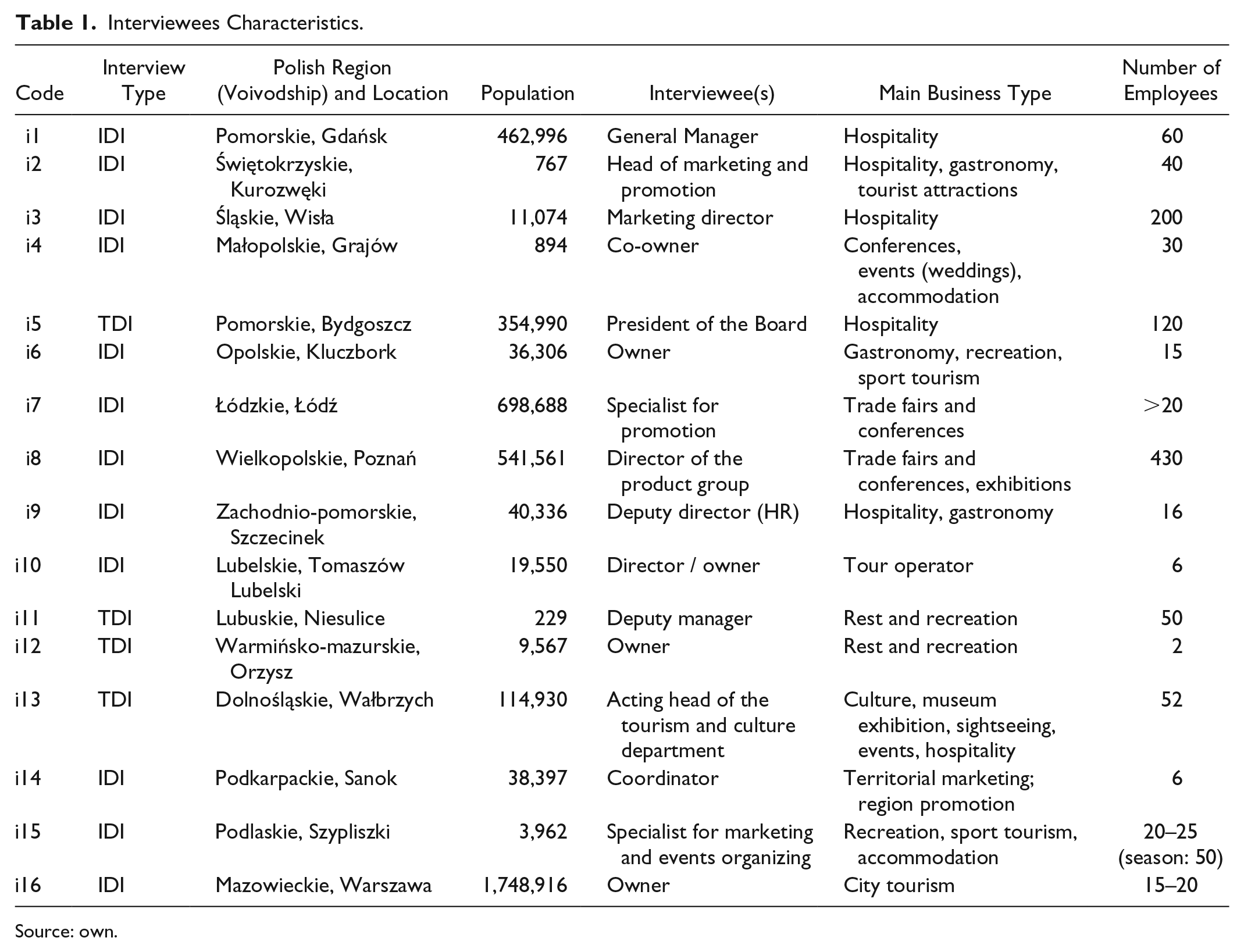
Source: own.
The choice of interviewees was made using secondary sources—Internet resources and telephone conversations—aimed at making sure that the potential interviewee is a valuable source of information (taking into account the research question), and agrees to participate in the study.
We used a semistructured interview containing open and closed questions. Before the actual data collection, two pilot interviews were conducted in order to avoid misunderstandings in the data collection process and to assess the validity of the semistructured interview. These two pilot interviews were not included in the main research sample of 16 interviewees, and responses collected at that stage are not used in this article. All main sample interviewees were asked to answer the following questions:
with whom they collaborate;
- is their partner a competitor or noncompetitor;
- [when a partner is perceived as a competitor]—what factors decide that;
- what is the aim of collaboration; and
- how they perceive collaboration with competitors (what is its importance for their business—is it beneficial, not beneficial—and whether there exist any problems in collaboration with a competitor, etc.).
Since a naturalistic inquiry into social phenomena should be conducted in a natural setting where contextual variables can be observed and considered in seeking explanations for a phenomenon, the research was conducted in a place chosen by the interviewees—in which they felt comfortable and treated it as their own familiar environment.
On average, the interviews lasted about one hour. The longest lasted 1 hour 45 minutes, and the shortest, 35 minutes. All interviews were recorded, and field notes were created immediately after each interview to better understand the issues studied, as well as the context itself that was characteristic for the interviewee and could influence his or her perception. Field notes were a valuable complement to the transcription of interviews. In total, the interview transcripts amounted to 212 pages.
Data Coding and Analysis
In the data analysis process, we followed an approach consisting of three concurrent flows of activity: data reduction, data display, and verification (Miles and Huberman 1994). Data reduction was based on preparing transcriptions of the whole material, recognizing that digressions can also be relevant, and creating case cards for each of the 16 interviewees. This allowed us to present the data. To make the research results conceptually and structurally categorized, we wanted to assign our inductive codes to three main categories: collaboration characteristics, competition characteristics, and mindset/tensions (Table 2). This ensures cohesive order, which is important in addressing the research question (Miles and Huberman 1994).
Final Codes List.
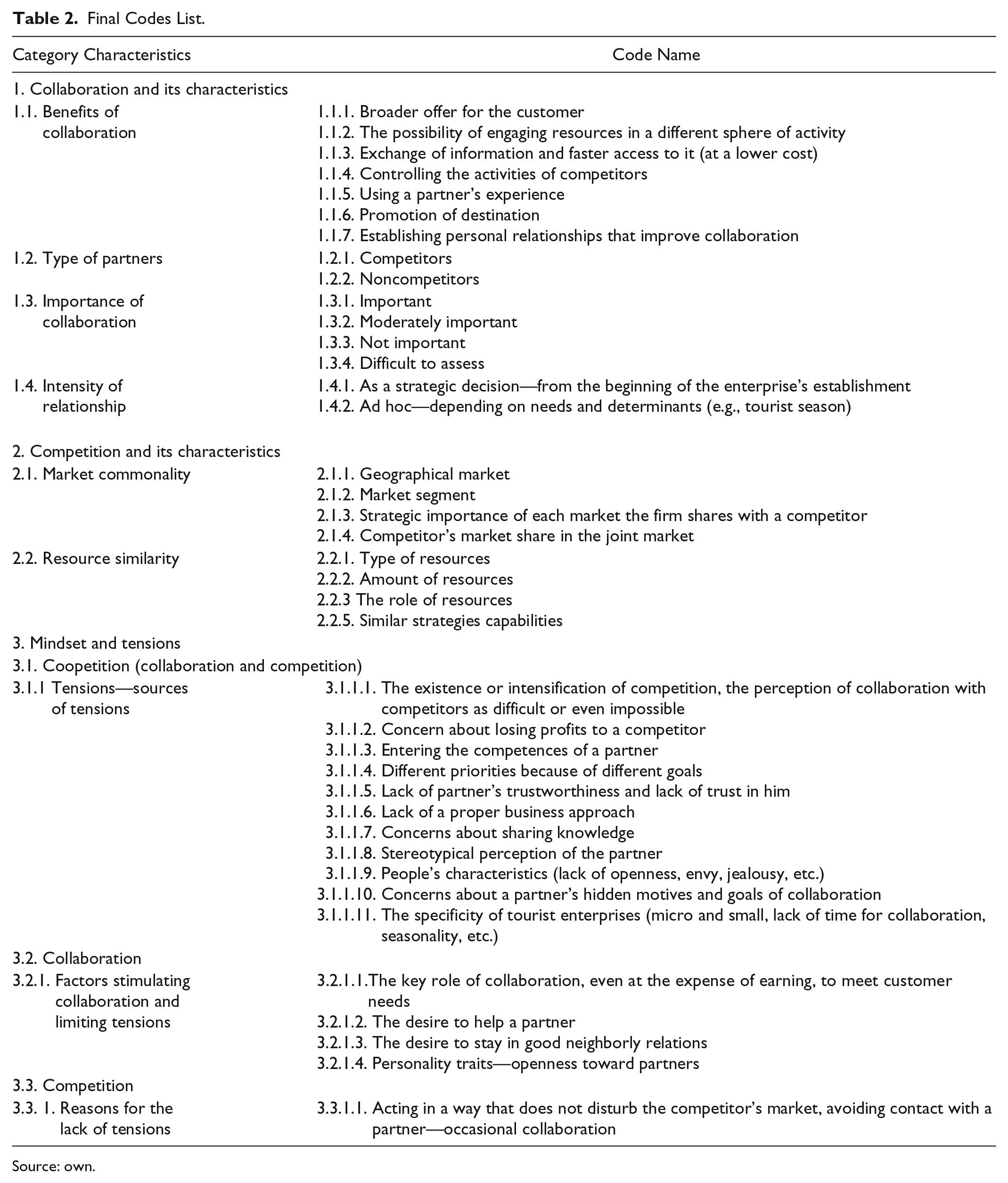
Source: own.
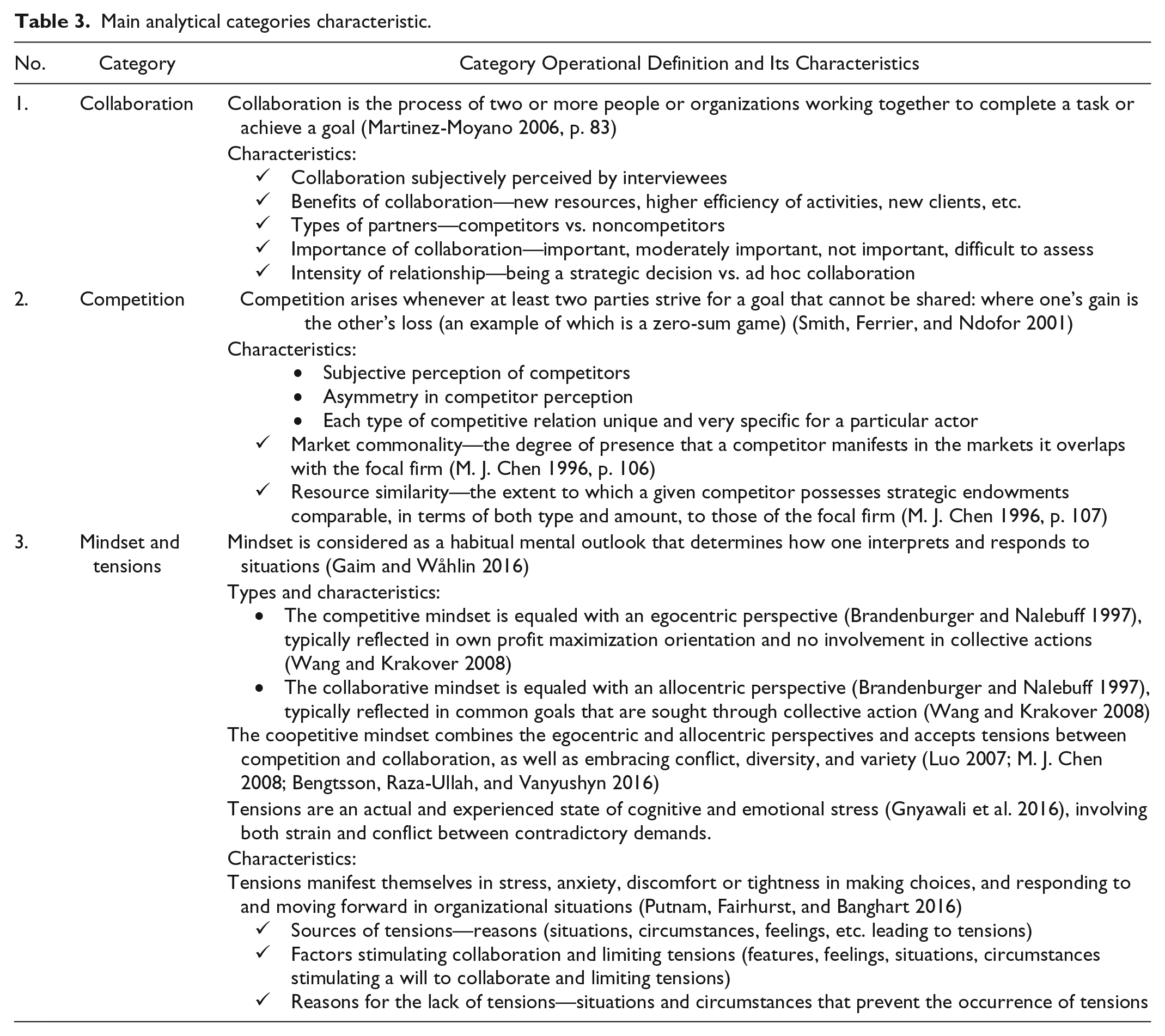
Collaboration was characterized by issues such as sense of cooperation, type of partner (competitor/noncompetitor), importance of cooperation, and its intensity. Competition was characterized using market commonality and resource similarity. Mindset and tensions were analyzed in relation to three broad categories: cooperation, competition, and coopetition—when interviewees perceived the target firm both as competitor and collaborator (Table 3).
Main analytical categories characteristic.
During reading and analysis of the text, inductive codes started to emerge for all three categories: collaboration, competition, and mindset and tensions, which referred to sources, stimulating or limiting factors, as well as reasons for lack of tensions (Table 2).
We coded our data, assuming that the unit assigned to a given code should be a piece of heuristic information, that is, leading to the discovery of new concepts or allowing us to better understand our research question (Miles and Huberman 2000). Such excerpts could be of different length—from one sentence to whole paragraphs. We assumed that this length would be set by defining the amount of information needed for it to constitute a valuable statement.
In the final analytical step, whenever we noticed that some of the inductive codes were very similar to each other and that they could be combined, we merged them and coded the whole data set again with the full list of codes. The coding process was conducted with the use of the Atlas.ti v. 7.0 software application.
After retrieving relevant quotations from our dataset, we proceeded to thematically group emerging topics into overarching themes (Braun and Clarke 2006) for perceived coopetition benefits, sources of tensions when collaborating with competitors, and collaborative mindset characteristics (Appendixes A, B, and C). We proceeded by iterations and discussion between the two researchers in order to identify consistent findings (Fereday and Muir-Cochrane 2006).
In order to verify the data and reinforce trustworthiness (Miles and Huberman 2000), we used available theories and concepts regarding collaboration, competition, and coopetition, together with the role of mindset and tensions in interpreting perceptions and interfirm actions (Table 3).
Findings and Discussion
This study aims to understand how coopeting tourism managers perceive their competitors. We have thematically analyzed coded data and grouped quotations by similarity in order to address our study objectives and provide meaningful, nally heterogeneo coherent categories that are internally homogeneous and exter us (Braun and Clarke 2006). This section is structured around the perceived benefits of coopetition in tourism, associated tensions in tourism coopetition, competitor identification, and the collaborative mindset in tourism competitor perceptions.
Perceived Benefits of Coopetition in Tourism
Our evidence indicates that managers are able to identify a number of benefits of collaborating with rivals: three types of benefits at the firm level (Kylänen and Rusko 2011), four distinct benefits at the destination level (Della Corte and Aria 2016), and two types of social benefits (Altinay, Sigala, and Waligo 2016). Thus, we offer a fine-grained view on the benefits perceived by tourism firms and link this ability to such firms perceiving the various benefits of engaging in coopetition (Appendix A).
The benefits that accrue for individual firms are related to improving tourist satisfaction, as our interviewees indicate: “Acting alone we are not able to create a complete offer that is always tailored to the needs of our client” [P6]. This refers to the observed phenomenon of tourist needs “getting higher and we have to meet them” [P3], and relates to the fact that “the tourism industry is quite specific and these companies have to support themselves” [P5]. Also, collaborating with competitors provides access to relevant operational information, such as “our own occupancy; what kind of occupancy we have, what occupancy rate the other hotel has; what the average price of room sales is; we exchange information about our guests, be it positive or negative” [P16]. The closest competitors hold the most precious information as they face the same challenges; therefore, exchanging this is seen as “definitely necessary, if only on the basis of so-called good practice” [P5]. Additionally, our interviewees find that “mutually recommending clients to arrange events” [P15] is beneficial, in particular when tourism firms “send our guests to them and they send their guests to us” [P16]. The practice of mutual recommendation is helpful in meeting tourist expectations and overcoming tourist firms’ own constraints: “If I know that I cannot take on an event because of my obligations, then I can recommend a facility which I work well with, where I know its quality. Well, it is my direct competition, and maybe this client’s next order won’t come to me, but I know that I have presented him with a good solution” [P4]. Hence, those interviewees who focus on individual benefits indicate that collaboration with competitors helps both in running better operations and in strategically shaping value for customers.
Benefits related to the destination in turn contribute to creating higher value for tourists, through (1) superior offers, (2) overcoming capacity constraints, (3) destination promotion, and (4) having the possibility to receive support in various situations. Our interviewees indicate that other firms’ customers “come to us to use our attractions” [P10] and outline a network of attractions for tourists “that would enrich the offer together—suppose one has horses, another has something else, a shooting range—then it’s cool, isn’t it?” [P3]. They appreciate the support of competitors when facing resource constraints: “We help each other in renting conference equipment such as tables, chairs, banquet and catering equipment, as well as creating an offer that exceeds the capacity of a single hotel” [P4]. Interestingly, the attractiveness of the destination is seen as increasing total business value, as firms can then compete for a share in the increased “business pie” (Brandenburger and Nalebuff 1997): “Our common goal is to bring as many tourists to our destination as possible, and it is also important for us as a private enterprise. This is due to the fact that the more these tourists come here, the greater the chances that a percentage of them will use our services” [P9]. Lastly, the awareness that mutual support and help will be needed has been clearly voiced: “It is important for us to have several such entities that you can always count on” [P16]. Hence, collaboration with competitors helps to increase the attractiveness of the destination, and the value offered to tourists once on-site.
In addition to business-related benefits, social relations in the immediate neighborhood as well as in the wider community were also reported. This social dimension was very important for the interviewees, and appeared with certain actors labeled as “friends” [P15]. When recognizing competitors, our interviewees add social relationships: “Well, actually, there is competition, because it is my direct . . . he is for me a competitor, but he is also my neighbor!” [P2]. At the community level, good social relationships are recognized as “most important, first of all, are good neighborly relations, so to speak” [P16].
Tensions in Tourism Coopetition
The benefits available through collaboration with competitors are associated with tensions (Luo 2007) in the cognitively complex situation inherent to coopetition (Lundgren-Eriksson and Kock 2016). The coopetitive tensions identified by our interviewees may be aggregated into five distinct themes related to the perceptions of (1) competition, (2) goal divergence, (3) partners, (4) general orientation, and (5) protection (Appendix B).
Managers reported tensions related to the intensity of perceived competition: “There was a period of boom in the building of wedding houses and various restaurants, and now there are more than needed. Well, not all of them manage, and quite fierce competition has begun in this segment” [P6]. Tourism firm managers are aware of competition and prefer to limit its scope by working “in a smaller group, so that there are fewer partners to share the pie” [P8].
Tensions also resulted from differences in competitors’ business goals, underlining that “it is difficult for us to really find a common policy” [P1]. They may refer to different priorities in operational activity and divergent strategic assumptions (i.e., difference in challenges) resulting, for example, from a different scale of business operations [P1]. These differences, according to our interviewees, either hampered the formation of collaboration with competitors, or required additional effort in exploiting it because the “different priorities of different individual entities must be reconciled” [P4].
Another type of tensions was connected with the perceptions of a given partner, associated with reputation concerns: “Nobody wants to collaborate with a partner who has problems” [P6]; feared power dominance in the prospective coopetitive relationship: “Some people have such an attitude that we are the dominant one, we suppress them, subordinate, etc.” [P6]; negative attitudes presented by a partner in an unfriendly atmosphere of collaboration or negative emotions: “Sometimes I feel people’s envy, somehow, I don’t know . . ., some negative feelings, you know?” [P2]; and hidden action plans or a lack of such plans: “When someone has these hidden goals, he doesn’t want to make them clear, or he just doesn’t know, so then it’s just harder” [P6]. Taken together, partner-specific concerns do hinder collaboration.
Tensions also resulted from perceived differences in orientations attributed to actors. Some interviewees complained that partners displayed insufficient business orientation: “They function in this economic sphere, but not always with the right approach” [P6], that is manifested in a perceived focus on goals other than business, such as the desire to get satisfaction from the business or to pursue their personal passions through their professional work. Orientation-related tensions also resulted from perceived reluctance to collaborate, were connected with an inability to identify the potential benefits of collaboration, or generally with certain personality traits manifested by target firms’ managers: “The worst situation is when someone is closed and cannot see that everyone can benefit from collaboration” [P15]. These types of tensions could also stem from a perceived lack of own resources, such as time or an appropriate number of employees, despite a general awareness of the importance of coopetition: “We often don’t have enough time to focus on collaboration, because it really requires a lot of energy, a lot of time” [P8]. This was visible in the case of managers of small and micro firms.
The last type of tensions is related to the protection of an interviewee’s business and knowledge. Our interviewees stressed that tensions resulted from an unwillingness to collaborate because it was perceived as too risky for their own interests: “I don’t see that there is such a large opportunity to learn from each other, also because of protecting some business interests” [P8], which in particular manifested itself in a reluctance to share knowledge: “This is an observation quite often made by people from outside—outside our city—that it is harder to work here, that it is more difficult to establish business relations” [P15] and caused tensions.
All in all, tensions are related to differences that are difficult, or impossible to be reconciled by interviewees. Our evidence complements and expands the range of coopetitive tensions, and arranges them in aggregate categories depending on their source. Prior literature focused on single sources related to power asymmetries (Czakon 2009), knowledge appropriation (Fernandez and Chiambaretto 2016), opportunism risks (Tidström, Ritala, and Lainema 2018), and free-riding (Khalilzadeh and Wang 2018). We find that tensions are multi-level, and appear at three levels of analysis: (1) within destinations relating to the intensity of perception competition; (2) at the dyad level relating to the partner-specific perception of goals, orientations, and traits; (3) at the firm level relating to value protection concerns. Contradictions between competition-collaboration, protection-sharing, and self- or community-orientation have been emphasized.
Competitor Identification in Tourism Coopetition
Our findings show that market commonality and resource similarity, the two dimensions of competitor analysis, appear to be useful for analyzing target firms in the tourism sector (Appendix C). These categories were spontaneously used by our interviewees, even if the questions asked were not explicitly phrased in this way.
Market commonality is an important trait for identifying competitors. When interviewees considered that they were focused on a different customer market than other firms, in their opinion they did not constitute any competition: “It’s hard for me to talk about competition, because that’s the question, how do we understand competition. . . . If we understand it here, locally, then there are two 4-star hotels in Wisla; mine and [hotel name X]. Each of us has different clients and we don’t get in each other’s way” [P7]. Interestingly, representatives of tourist attractions located nearby did not perceive themselves as competitors, even if objectively they were: “These are definitely not competitors, because the names of the Old Mine and the National Museum are not either. The status of these organizations excludes competition in relation to us” [P1]. Indeed, tourists have a limited time or budget to take advantage of all the attractions in a tourist destination, and ultimately will choose some at the expense of others. Surprisingly, the existence of such competition was often denied.
Importantly, when interviewees noticed a market overlap with the activities of another entity, they focused their attention on other areas of activity that complemented each other: “I emphasize all the time that we are lucky, that with these entities we simply complement each other in some way” [P1]. Also, direct competition avoidance was emphasized: “and they deal with . . . a very similar activity to us, they have a large hotel and they also deal with the organization of events. . . . Well, of course, although we are a competitor, we don’t block each other” [P15]. This allowed actors to recognize that others are not at all in competition, or are only to a limited extent: “It exists in some segments of our activity—in the sense in some of its parts. We feel such competition, for example, in such a segment as parties” [P6].
Competitors were also identified on the basis of the strategic importance of the shared market. The greater the difference between entities in this respect, the less they were perceived as competitors: “[There are] hotels in the city, and we also have an accommodation facility. But our main activity on which we earn, are skiing and winter ski lifts” [P10]. An important criterion for distinguishing competitors from noncompetitors was also the geographical location of entities: “I am still thinking about competition . . . with some other attraction—it doesn’t happen to us anymore, but probably also because everyone is far away from us” [P15]. The closer they were to each other geographically, the more they were considered competitive: “There are about ten such houses in Rostki—if we were the only house, then of course it is clear that we would have a lot more of these guests. So yes, this competitive pressure is undoubtedly very . . . noticeable” [P2]. Inversely, the more distant they were from each other, the less they perceived others as a threat, or even as no threat at all [P3].
The last trait for market commonality is a competitor’s strength in shared markets. Factors important for tourism sector businesses, such as the seasonality of operations, was revealed to be quite significant in how competitors were perceived: “When the winter is good, we don’t have (competition)” [P10], or “for us, we are practically fully reserved as early as February, for practically the entire summer season” [P3]. Some interviewees stressed that because of a convenient location or climatic conditions, they may operate longer during the year or under better conditions, and therefore other entities are not competitors at all, or only to a limited degree: “because here we don’t see such fighting for clients, especially at our lake, because we have a really loyal group [of clients]” [P3].
In terms of resource similarity, interviewees often emphasized that the type of resources possessed was important for the perception of the entity as a competitor or noncompetitor. The more similar the resources, the more it favored the perception of a given entity as competitive: “This competitive pressure is undoubtedly very . . . noticeable. So, for example, for this reason, to raise the attractiveness of services, we began the rental of tourist equipment” [P2]. Hence, if competitive pressure is felt, then resources are allocated to competitive actions in view of achieving an advantage over others. Consequently, some interviewees claimed that “if someone would like to collaborate and has similar infrastructure and a similar idea, then it makes no sense” [P3], others that they prefer “to do as much as we can, so that we don’t have to share the profit margin” [P8]. Interestingly, some interviewees indicated that it is the similarity of resources that stimulates them to collaborate with their competitors. They reported collaboration in view of overcoming size and capacity constraints [P16, P4, P3], get various types of support, and exchange information [P16]. In turn, the more unique the resources, the less our interviewees emphasized concerns about the existence of competitors: “Even if someone sets up a hotel, he will not put up a 14th-century palace, so he is not a competitor for us, right?” [P6]. Most often, representatives of unique tourist attractions did not perceive themselves as competitors, building their offer based on their resources that were unique in the municipality or region, or even in the country as a whole. It was pointed out that in order to differentiate themselves from competitors, the tourist offer was enriched by acquisition of a unique resource. The more diverse resources were, the more our interviewees perceived opportunities to establish collaboration in view of “enriching the offer together” [P3].
Another trait relevant for identifying competitors was the amount of resources owned. The more similar this amount was, the more they were perceived in terms of competition. In turn, perceived differences in this area predisposed the entities to establishing more frequent collaboration with others: “They have everything on a smaller scale, they have smaller possibilities in terms of quantity” [P15]. For example, the more similarity was perceived in the scale of the business, the more it was recognized as a competitor: “If someone would like to collaborate and has similar infrastructure and a similar idea, then it makes no sense, because it is simply competition, so we should cut ourselves off” [P3]. The last element indicated by our interviewees was the importance of evaluating strategic capability in identifying competitors. Firms seen as competitors were those perceived to have the strategic capabilities (i.e., larger funds, better business conditions, better contacts, etc.) to take over their markets [P3].
We provide empirical insights into the actual use of the competitor analysis framework by tourism managers. This framework (M. J. Chen and Miller 2015) is shown to be useful in searching for actors in the surroundings in view of possible collaboration. While our reading of competitor perception literature made us first focus on clear identification of rivals, empirical data during the coding process unveiled a more nuanced perception of actors reported by our interviewees. They indeed use clear representations of other tourism firms based on the relevant competitor analysis traits of market commonality and resource similarity in their process of competitor identification (Figure 1). We have found a detailed and deep knowledge of these traits. Furthermore, we find that evaluations of similarity are very precise, and only a complete match of a target firm’s representation with an actor’s own firm draws the conclusion that the target is a competitor. Whenever the match is not perfect in terms of the tourist market targeted, or the resources of quality and quantity, then competitive tension is not felt by our interviewees. They acknowledge that although a given entity could be perceived as a competitor, they either diminished the competitive tension: “only to a small extent” [P8]; or deliberately denied it: “The status of these organizations excludes competition in relation to us” [P1]. As a result, competitor perception does bring very limited competitive tensions, with the exception of a perfect resources and market match.
Collaborative Mindset in Tourism Competitor Perceptions
We find that the question whether the outcome of competitor analysis brings competitive tension and subsequent action, or inversely results in collaborative value creation for tourists, depends on the interpretation preferences our interviewees display. Interestingly, only limited examples of simplified, polarized, and paradoxical (Lewis 2000) perceptions of target firms were reported by our interviewees. On the contrary, we single out a recurrent use of expressions such as “although” [P3, P8, P13], “however” [P6, P8] and “but” [P6, P10, P14, P15] in the competitor analysis framework applied by our interviewees (Appendix C). This discursive trait unveils interpretations developed by our interviewees, wherein they opt to refrain from categorizing other actors as competitors, thus reducing and eliminating the perception of competition. This may allow them to alleviate cognitive tensions related to the perception of a partner as a competitor. Furthermore, social relationships are explicitly underlined when addressing competitors: “good relations with competing hotel directors” [P4]; “we make friends” [P15]; “so he is a competitor for me, but also my neighbor” [P2]. The representations of relevant actors appear here as complex in business terms but also incorporate a social dimension. Hence, instead of simplifying the perception of others as competitors or partners, our interviewees display the ability to develop complex representations, involving many business roles and social roles at the same time.
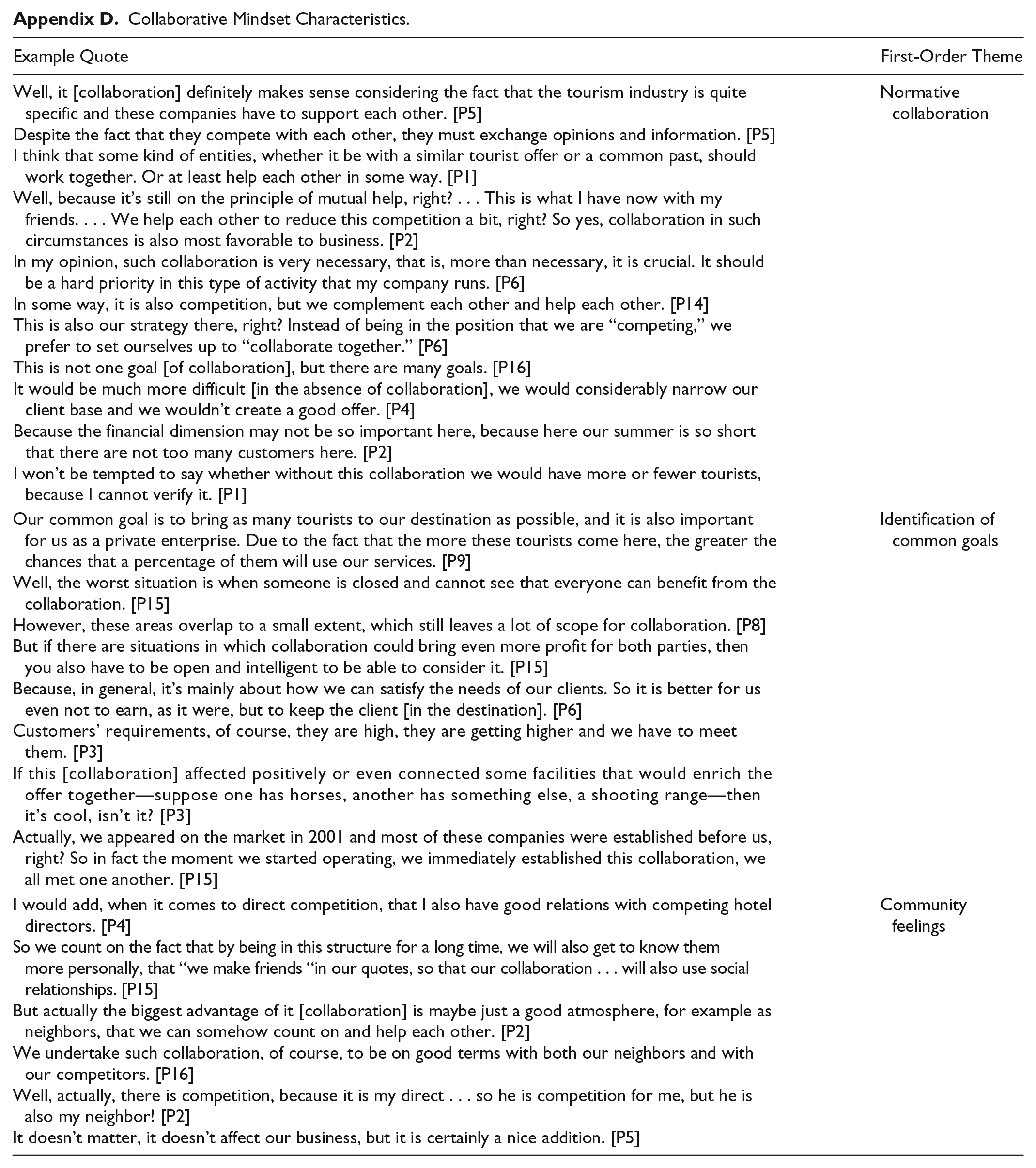
Our research shows that the interpretation of relationships with relevant actors regarding collaboration stems from several sources that can be aggregated thematically to three areas (Appendix D): (1) normative collaboration; (2) identification of common goals; and (3) community feelings. Taken together, these general categories reflect a collaborative mindset.
Regarding normative collaboration with competitors, our interviewees referred to the specificity of tourism, using unequivocal expressions to underscore their view that collaboration is necessary. They identified the need to provide tourists with a comprehensive and complementary offer created by several service entities, who “must exchange opinions and information” [P5] and collaborate. Without it, as our interviewees claimed, it would not be possible to create an offer that would satisfy diverse tourists’ needs. Firms “should work together” [P1], as a “principle” [P2], or a “crucial” priority [P6]. Even if interviewees acknowledged that it is sometimes difficult to clearly assess the benefits of such collaboration, firms were still sure that working with others is a priority for their business: “I won’t be tempted to say whether without this collaboration we would have more or fewer tourists, because I cannot verify it” [P1]. This suggests that a behavioral norm is distinctive in guiding managers to adopt collaboration with competitors.
Second, the collaborative mindset relates to identifying common goals. Interviewees claimed that at the destination level, collaboration is essential if tourists are to choose this particular destination rather than another one because “the more these tourists come here, the greater the chances that a percentage of them will use our services” [P9]. They were aware that this is possible only when the offer available to the tourist at the destination level is wide and attractive, and will satisfy the different and at the same time high requirements of tourists: “It’s mainly about how we can satisfy the needs of our clients. So it is better for us even not to earn, so to speak, but to keep the client [in the destination]” [P6]. They emphasized that in order to encourage tourists to stay in a destination or region, it is worth recommending a competitor, even if this meant giving up immediate benefits and risking that in the future the client would choose the competitor. This suggests that value creation–value appropriation tensions (Ritala and Tidström 2014), or even fears that others may benefit more without appropriately contributing to collective benefits (Khalilzadeh and Wang 2018), may be alleviated through a collaborative mindset.
Third, the collaborative mindset was also reflected in the attention interviewees allocated to building a cohesive community. Beyond the potential benefits of collaboration for their own individual businesses, interviewees stressed the need to collaborate in order to build and sustain good, friendly relationships with competitors operating or living in their neighborhood, or in the local community. Our interviewees appreciated such relationships and perceived them as very important because of the possibility of “counting on” others [P15], and developing a reciprocal and trusting “atmosphere” with them [P2]. This social context even resulted in them sometimes perceiving their competitors more as friends/neighbors/colleagues than market rivals, and directly expressing this during the interviews [P2, P15, P16]. Our findings thus extend prior research (Ingram and Roberts 2000) that underscored the importance of friendship for enhanced performance in competition. We find that social relationships are important for coopetition. Interestingly, the social rationale appears both at the dyadic level, where a competitor is also a friend or a neighbor, and at the collective level, where having many friendly relations helps create a favorable business environment. We posit that the social emphasis helps alleviate the tensions related to coopetition by adding a more lasting dimension to relationships than mere business interactions.
Hence, competitors’ perceptions as reported by our interviewees seem to be more nuanced and complex than simple coopetitive paradoxes or competitive tensions. Our findings suggest that a collaborative mindset allows actors to see avenues for collaboration, where others displaying a competitive mindset would see reasons for rivalry. Identical traits in a target firm make some managers perceive it as a competitor, while others would perceive it as a noncompetitor. For example, some saw benefits of collaboration in the case of resource similarity with a given actor, while others only in resource dissimilarity. Similarly, some saw benefits of collaboration when market overlap was limited, while others saw benefits even in the case of full market overlap. This leads to the finding that competitor identification produces different competitor perceptions, that is, either rivalrous or relational (M. J. Chen and Miller 2015), depending on the general mental outlook of interviewees, that is, their mindset. We can see that mindset appears to be an important cognitive mediator of coopetition as it breeds interpretations (Ghoshal and Westney 1991) or assessments (Shin et al. 2019), and effectively allows or disallows for collaboration with others in the very same circumstances. Therefore, we propose an extension and modification of the theoretical cognitive process depicted in Figure 1. A collaborative mindset helps establish coopetition, while a competitive one will lead to competitive tensions and actions (Figure 2).
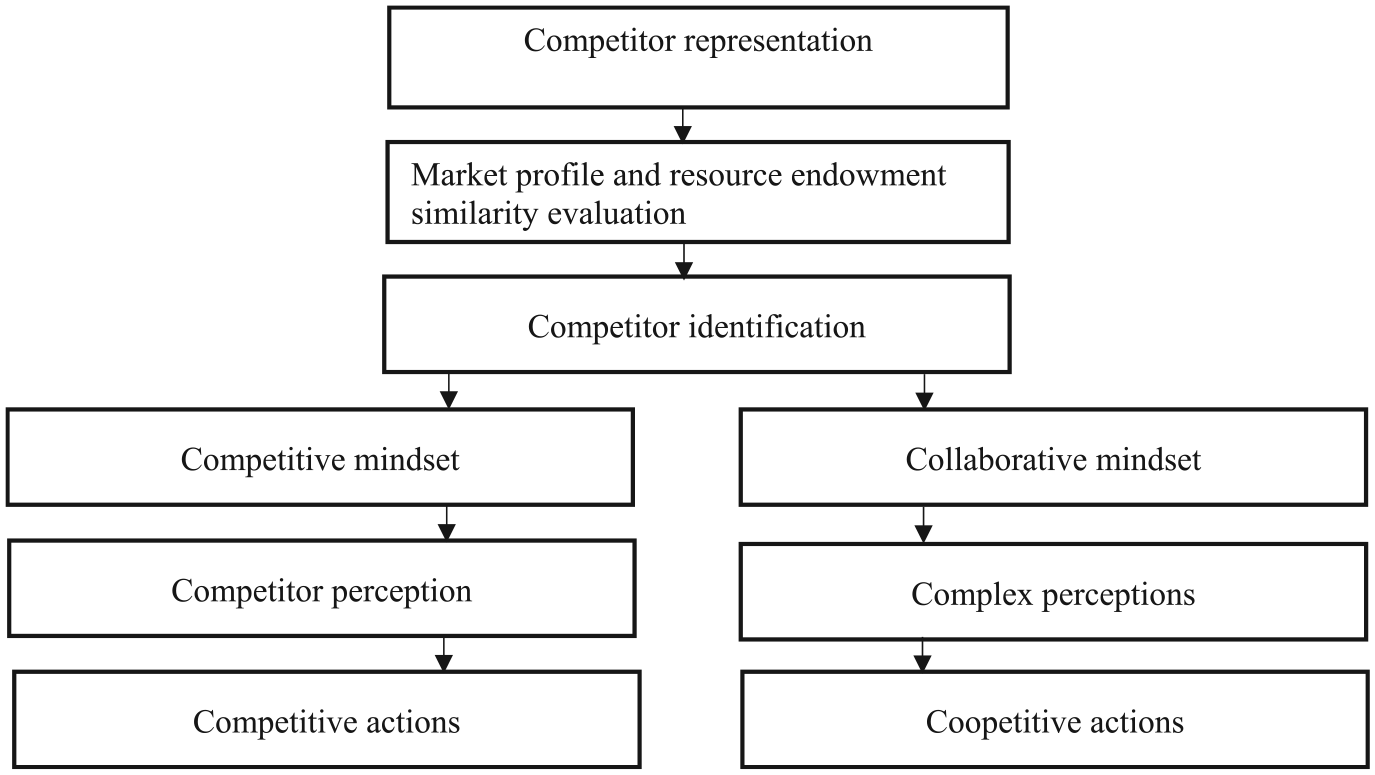
The role of mindset in developing competitor perceptions and subsequent actions.
Coopetitive tensions are claimed to be underpinned by cognitive and emotional tensions that stem from paradoxes (Raza-Ullah, Bengtsson, and Kock 2014). Our study reveals a filter of knowledge that alleviates these tensions by focusing on the avenues for collaboration, and thus directs action (M. J. Chen, Su, and Tsai 2007). We extend collaboration perception literature by adding relational components such as friendliness, neighborhood, and community feelings. Rather than coping with paradoxes, coopeting tourism managers seem to display harmony (Chou and Zolkiewski 2017) by developing complex perceptions of relevant actors.
Conclusions
This study aimed to identify tourism firm managers’ perceptions of their competitors within coopetitive relationships. We offer several noteworthy contributions to the literature.
First, to our knowledge, this study is the first one to examine competitor perceptions in tourism coopetition. We extend and complement the vast stream of research using behavioral constructs to understand and predict tourist behavior (Mazanec and Strasser 2007; Pandža Bajs 2015; Karl 2018) and the perceptions that managers develop toward their competitors. The process of developing perceptions of relevant actors in destinations draws from the competitor analysis framework to search for market commonality and resource similarity. This study identifies two distinct cognitive processes in competitor perception: identification and interpretation. Competitor identification involves representing the key traits of a target firm, and evaluating their match with the “competitor” category (Clark and Montgomery 1999). We find that a target firm is viewed by tourism managers as a competitor when there is a perfect match with the focal firm in terms of its key traits. A certain degree of similarity does not seem sufficient to identify a tourism firm as a competitor. However, we also find that identifying target firms does not involve competitive tensions in a direct and mechanical way. The process of developing competitor perceptions involves making sense (Ghoshal and Westney 1991) of actors’ roles and developing useful views of the environment. In doing so, managers use their mindsets either to come up with perceived competitive tensions if a given firm is considered a threat, or with collaborative ventures if the firm is not considered a rival.
Therefore, our second contribution advances competitor analysis literature by incorporating behavioral constructs into an otherwise rational process (Kilduff 2019). Extant literature (M. J. Chen, Su, and Tsai 2007) depicts managers as rational agents who carry out a systematic analysis of a limited set of factors before considering a given firm to be in direct competition with the focal firm, and taking rivalrous action. Recent extensions (M. J. Chen and Miller 2015) to this view involve more actors and more possible actions, such as varied collaboration and coopetition options, but remain essentially rational and calculative in exploring when firms are more likely to take a particular course of action. By contrast, our study sheds light on its behavioral underpinnings by identifying the phenomenon of opposing perceptions of a target firm as competitor or noncompetitor, and relating this difference to an interpretative preference that managers display through their mindsets. Tourism managers have a detailed and refined awareness of their competitors and interpret this so as to either facilitate collaboration or remain in rivalrous mode, depending on their behavioral disposition.
Third, we find that coopetition in tourism seems to be cognitively underpinned. Collaboration with competitors in tourism is possible when firms’ managers are capable of (1) identifying the benefits achievable through collaboration with competitors; (2) developing complex representations of actors and their respective roles; and (3) filtering competitor perceptions to focus on collaboration. This study advances prior conceptual views on mindsets, focused either on identifying opportunities for coopetition (Gnyawali and Park 2009), or on coping with tensions (Luo 2007). Our fine-grained analysis of the cognitive process underpinning competitor perceptions suggests that mindsets are important for interpreting perceptions as they either drive competitive actions or enable coopetition. The perception of a competitor may be deliberately focused on avenues for collaborative value creation for tourists. Even if the target firm is identified as having significant resource similarity and market overlap, its perception can still be focused on joint value creation. The collaborative mindset seems to filter both the individual objectives of involved actors, and the common ends important for the tourism destination. We suggest that a collaborative mindset mediates the relationship between competitor perception and coopetition.
Fourth, our evidence challenges the focus on paradoxical tensions that is widespread across coopetition literature. Instead of simplifying their position into contradictory logics, tourism firms display the ability to develop complex representations of competitors (Lundgren-Eriksson and Kock 2016), and to find harmony within them (Chou and Zolkiewski 2017). We find complex representations involving nuanced views of business and social relationships, rather than literature-informed but simplified categorizations as “either partner or competitor.” Socially embedded perceptions involve friendship (Granovetter 1985) and are used in prior literature to better understand competition (Ingram and Roberts 2000) and the community feelings found in collaborative destination marketing (Wang and Krakover 2008). Our findings suggest that socially embedded perceptions facilitate coopetition among tourism firms.
Managerial Implications
Our study focuses attention on perceptions and representations, which may prove helpful both to tourism firm managers and to tourism destination marketing organizations. Regarding individual firms, our evidence suggests that the same perceived environment may incite an actor to collaborate or not with competitors, depending on the mindset adopted. Regarding destination marketing organizations, our evidence suggests that developing a mindset is critical in fostering collaboration. Individual firms are typically well aware of their competitive environment and develop accurate perceptions of relevant actors. However, they differ in interpreting what can be achieved together. Therefore, we encourage destination management organizations and local authorities to focus their activities on developing and spreading shared collaborative mindsets. This can be achieved by initiating and organizing meetings, seminars, or workshops for tourism entrepreneurs, where successful cases of coopetition and the benefits of collaboration with competitors can be presented. Social ties between firms can be further strengthened during such events.
Given the importance of social embeddedness in tourism, it is advisable to undertake community-oriented actions. While neighborhood relationships or friendship between given actors are important, the cohesiveness of communities and their culture are also relevant. Efforts to incorporate community feelings, collective benefits, and values to the local community may be valuable. These can open up avenues for benefits otherwise unavailable both to individual firms and destinations.
Our findings suggest that a competitive mindset hampers coopetitive endeavors in tourism. Therefore, low awareness among tourism managers of the benefits of coopetition, how to deal with tensions, and how to overcome reluctance to collaborate with competitors appear to be behavioral barriers to increasing performance and destination competitiveness. Efforts are required to develop such awareness and to spread a collaborative mindset through meetings, training sessions, workshops and destination promotional campaigns by leading actors. Changing competitive ways of thinking about collaborative perceptions and interpretation is a major challenge.
Limitations and Further Research Agenda
Our study’s methodological choices are associated with some limitations, which open up paths for further scrutiny and a better understanding of coopetition in tourism. First, we adopted a qualitative approach, which provides insights into the underlying cognitive processes but cannot test patterns of association between cognitive underpinnings and tourism firms’ or destinations’ performance. We believe that our findings may promote development of a measurement tool related to perceptions and representations. Second, we used interview data focused on collaboration, and selected those that declared collaboration with competitors. Our database does not contain entries related to firms that do not collaborate at all with others, or which dropped collaborative strategies. This opens avenues for dynamic research on perceptions in order to understand how and when managers change their mindsets. Third, our research uses individual respondents, which focuses attention on individual cognition but leaves collective perceptions and collective mindsets beyond the scope of the paper. While consistent with our study objectives, this choice leaves room for further investigation of sense-making processes within an organization in order to develop an understanding of how collective perceptions emerge, how collective mindsets develop, and how these impact collective action.
Finally, we recognize that while coopetition offers benefits otherwise unattainable, it also poses challenges absent from less ambiguous and tense settings, which in turn may expose tourism firms to additional risks, costs, or competitive challenges. Tensions appear at multiple levels, and entail cognitive, emotional, and social stress. Our study focused on mindsets that are helpful in overcoming and alleviating those tensions. Further research into the emotional and social tensions associated with collaboration with competitors might develop our understanding, which so far is confined to an economic and rational perspective.
Footnotes
Appendix
Collaborative Mindset Characteristics.
| Example Quote | First-Order Theme |
|---|---|
| Well, it [collaboration] definitely makes sense considering the fact that the tourism industry is quite specific and these companies have to support each other. [P5] Despite the fact that they compete with each other, they must exchange opinions and information. [P5] I think that some kind of entities, whether it be with a similar tourist offer or a common past, should work together. Or at least help each other in some way. [P1] Well, because it’s still on the principle of mutual help, right? . . . This is what I have now with my friends. . . . We help each other to reduce this competition a bit, right? So yes, collaboration in such circumstances is also most favorable to business. [P2] In my opinion, such collaboration is very necessary, that is, more than necessary, it is crucial. It should be a hard priority in this type of activity that my company runs. [P6] In some way, it is also competition, but we complement each other and help each other. [P14] This is also our strategy there, right? Instead of being in the position that we are “competing,” we prefer to set ourselves up to “collaborate together.” [P6] This is not one goal [of collaboration], but there are many goals. [P16] It would be much more difficult [in the absence of collaboration], we would considerably narrow our client base and we wouldn’t create a good offer. [P4] Because the financial dimension may not be so important here, because here our summer is so short that there are not too many customers here. [P2] I won’t be tempted to say whether without this collaboration we would have more or fewer tourists, because I cannot verify it. [P1] |
Normative collaboration |
| Our common goal is to bring as many tourists to our destination as possible, and it is also important for us as a private enterprise. Due to the fact that the more these tourists come here, the greater the chances that a percentage of them will use our services. [P9] Well, the worst situation is when someone is closed and cannot see that everyone can benefit from the collaboration. [P15] However, these areas overlap to a small extent, which still leaves a lot of scope for collaboration. [P8] But if there are situations in which collaboration could bring even more profit for both parties, then you also have to be open and intelligent to be able to consider it. [P15] Because, in general, it’s mainly about how we can satisfy the needs of our clients. So it is better for us even not to earn, as it were, but to keep the client [in the destination]. [P6] Customers’ requirements, of course, they are high, they are getting higher and we have to meet them. [P3] If this [collaboration] affected positively or even connected some facilities that would enrich the offer together—suppose one has horses, another has something else, a shooting range—then it’s cool, isn’t it? [P3] Actually, we appeared on the market in 2001 and most of these companies were established before us, right? So in fact the moment we started operating, we immediately established this collaboration, we all met one another. [P15] |
Identification of common goals |
| I would add, when it comes to direct competition, that I also have good relations with competing hotel directors. [P4] So we count on the fact that by being in this structure for a long time, we will also get to know them more personally, that “we make friends “in our quotes, so that our collaboration . . . will also use social relationships. [P15] But actually the biggest advantage of it [collaboration] is maybe just a good atmosphere, for example as neighbors, that we can somehow count on and help each other. [P2] We undertake such collaboration, of course, to be on good terms with both our neighbors and with our competitors. [P16] Well, actually, there is competition, because it is my direct . . . so he is competition for me, but he is also my neighbor! [P2] It doesn’t matter, it doesn’t affect our business, but it is certainly a nice addition. [P5] |
Community feelings |
Acknowledgements
We would like to thank the anonymous reviewers for their insightful comments and guidance which has help us improve and clarify our manuscript.
Declaration of Conflicting Interests
The author(s) declared no potential conflicts of interest with respect to the research, authorship, and/or publication of this article.
Funding
The author(s) disclosed receipt of the following financial support for the research, authorship, and/or publication of this article: The project was financed from sources of National Science Centre in Poland according to decision UMO-2017/27/B/HS4/01150 (Wojciech Czakon), and UMO-2017/27/B/HS4/01051(Katarzyna Czernek-Marszałek).
