







Abstract
Given the significant practical value impulsive buying brings to destinations, it has increasingly become a popular topic in tourist behavior research. However, few studies have examined how practitioners can sway tourists to engage in impulsive buying. This paper explores a possible strategy for practitioners by testing the effect of endorsers’ emotions (excitement vs. calmness) on the tourists’ arousal levels and their subsequent impulsive buying. In three experimental studies (including an actual behavioral study), we show that exciting (vs. calm) endorsement causes tourists to feel more aroused, which results in higher impulsive buying, manifested by unplanned purchases in both restaurants (Study 1) and hotels (Study 3), and actual impulsive purchases of special local products (Study 2). Moreover, the effect disappears when the tourists have a limited (vs. expanded) time horizon. Based on these findings, tourism marketers could choose and train endorsers for their products and services promotion accordingly.
Introduction
The worldwide hospitality and tourism industry has faced severe hurdles as a result of the COVID-19 outbreak. While encouraging news has prompted expectations for a global revival in hospitality and tourism, the sector’s future remains uncertain. The epidemic of COVID-19 has had a significant influence on how tourists behave (e.g., H. Kim et al., 2021; J. Kim et al., 2022; Luo, Hu, et al., 2023; Miao et al., 2021). Investigating tourists’ post-COVID behaviors will add valuable insights into the recovery (X. S. Liu, Shi, et al., 2022; X. S. Liu, Yi, & Wan, 2022; X. S. Liu, Wan, & Yi, 2022). The growing use of e-commerce and digital solutions is one major development brought about by the epidemic. From 2020 to 2021, the pandemic increased e-commerce in the United States by $218.53 billion (Berthene, 2022). Furthermore, a recent study has revealed that one of the most prominent post-COVID tourist behaviors is an attempt to compensate for a shortage of travel options, which commonly results in impulsive actions (Gössling et al., 2021; Miao et al., 2021).
Although impulsive buying has been recognized as a crucial topic in the hospitality and tourism literature recently (e.g., Ahn et al., 2020; Luo, Wan, & Liu, 2023; Miao, 2011) and plays an essential role in increasing the profit of business firms and enhancing the overall consumption experience of tourists (X. S. Liu, Shi, et al., 2022), the investigation of tourists’ impulsive buying is still in its initial stage. Previous literature has extensively documented various factors that influence consumer impulsive buying, including time pressure (X. S. Liu, Shi, et al., 2022), culture-related factors (Kacen & Lee, 2002; Y. Zhang et al., 2010), emotions (Sneath et al., 2009), brand loyalty (Cobb & Hoyer, 1986), and shopping environment (Brida & Tokarchuk, 2017). However, no research to date has investigated the topic from the perspective of endorsers’ promotion strategies. The current epidemic has underlined the need for marketers to implement more effective and focused marketing methods, while also optimizing their expenditures. Concurrently, the epidemic has increased consumer internet spending. As a result, it’s critical to look at how both online and offline marketing efforts impact tourist impulsivity. In this study, we aim to examine the drivers of tourists’ impulsive buying by exploring the impact of endorsers’ emotions from both online and offline sources, including online influencers, service providers, and other tourists. This factor, despite its ubiquity, remains understudied in the context of tourists’ impulsivity.
Unlike previous research, which has primarily focused on the effect of consumers’ incidental feelings on decision-making, our study broadens this line of inquiry by investigating the methods by which these specific feelings are induced by examining the interaction between service providers and customers. This investigation holds significant practical implications as it offers service providers an effective means to influence consumers’ feelings. Moreover, while previous research has primarily focused on how incidental feelings facilitate the fluent processing of subsequent emotion-congruent messages, our study goes beyond this scope of processing fluency by focusing on the unique process of emotion contagion between the sender and receiver.
Tourism is often described as a collaborative experience involving both service providers and tourists (McCartney & Chen, 2020; Prebensen & Foss, 2011; Wan et al., 2021), including other tourists who have shared similar experiences (e.g., other tourists who write online reviews about the same tour) (Malone et al., 2018). The collaborative nature of tourism experiences suggests that the emotions displayed by endorsers (i.e., service providers and other tourists) with whom tourists interact will significantly influence the tourists’ evaluation of their consumption experiences (McCartney & Chen, 2020; Prahalad & Ramaswamy, 2004). Tourism and hospitality organizations emphasize displaying favorable emotions with different valences to create a high-quality service environment (Kang & Jang, 2022). For example, Disneyland cast members participate in programs such as “Happy Me, Happy Guests,” which train them to show excitement in the workplace and deliver memorable experiences to tourists (Disney Community Report, 2008). Flight attendants, on the other hand, are trained to stay calm to ensure the safety of passengers, even during chaotic incidents in the air. Studies have shown the effect of eliciting people’s incidental emotions on their subsequent behaviors (Bigné & Andreu, 2004; S. Li, Wang, Filieri, et al., 2022; Wan & Wyer, 2020; Wyer et al., 2019). Accordingly, the ideal emotion transmitted varies depending on the situation. More importantly, Volo (2021) highlighted that previous literature has largely ignored the emotions of stakeholders, managers, employees, and other actors involved in delivering the tourism experience, despite their influence on tourists. Since the tourism industry is primarily hedonic-oriented (X. S. Liu, Shi, et al., 2022), the lack of knowledge regarding endorsers’ emotions could prevent managers from taking a proactive approach to employee training and strategy design (Hosany et al., 2017; Volo, 2021).
Instead of assuming that emotions of the same valence have an equal impact on consumption behavior (e.g., X. S. Liu, Shi, et al., 2022; Moal-Ulvoas, 2017), we delve deeper into the role of distinct positive emotions and their implications. Research has shown that when consumers experience feelings of peacefulness (vs. excitement), they will evaluate vacation products with serene (vs. adventurous) appeals more favorably (H. Kim et al., 2010), which suggests that positive emotions with different valences may generate distinctive reactions. Drawing from the earlier examples, even though tourists may feel pleasant in both situations—interacting with excited Disneyland cast members or calm flight attendants—they may feel more stimulated in their interactions with the excited employees than with the calm employees. Positive emotions, characterized by a sense of pleasurable engagement with activities (Clark et al., 1989), will weaken individuals’ self-control in a consumption context (Fedorikhin & Patrick, 2010); therefore, we extend the downstream consequences of self-control to impulsive buying as a correlated outcome within the consumption context.
In contrast to earlier studies suggesting that a positive emotion results in increased impulsivity regardless of distinctions between positive affective states (Z. F. Li et al., 2015; X. S. Liu, Shi, et al., 2022; Sohn & Lee, 2017), we suggest that two specific positive emotions, excitement and calmness, would have differential impacts on tourists’ impulsive buying. Specifically, positive emotions with high arousal levels (i.e., excitement) transferred by an endorser are likely to enhance tourists’ impulsive buying. Based on the emotional contagion theory (Schoenewolf, 1990) and the mood maintenance theory (Di Muro & Murray, 2012), we propose and test the mediating role of tourists’ arousal levels. Furthermore, based on the emotional regulation theory, we suggest that the favorable effect of excited endorsers on tourists’ impulsive buying would only hold when tourists have expanded (vs. limited) time horizons.
We confirmed these possibilities through three experimental studies, including an actual behavioral study, and identified a boundary condition for their occurrence. This study contributes to the literature in several ways. First, most previous literature has focused on the impact of tourists’ spontaneous emotions on impulsive buying. Furthermore, we validate the influence of endorsers’ emotions, including those of service providers, YouTubers, and other tourists, on different forms of impulsive consumption (e.g., unplanned purchases and actual impulsive buying behavior) in tourism and hospitality contexts across various measurement approaches, including self-reported intentions, tourist choices, and actual behaviors. Second, we contribute to the ever-growing body of literature on positive emotions and consumption by differentiating between the effects of endorsers’ excitement and calmness (e.g., H. Kim et al., 2010) and by identifying the specific role of tourists’ arousal levels that underlie this difference. This addresses the need for more in-depth research on emotional discourse in the context of tourism (Volo, 2021). Third, we show that the time horizon serves as a boundary condition that moderates the positive effect of excitement on impulsive buying. Our findings offer important practical insights for hospitality managers and marketers seeking to design promotional strategies for their services and products, both during and after the pandemic.
Theoretical Background
From Endorsers to Tourists: The Application of the Emotional Contagion Theory
Emotion refers to the experience of feelings that are distributed along a broad spectrum of valences, that is, emotional responses or actions (from positive to negative) and arousal levels (from low to high; Larsen & Diener, 1992; Russell, 1991). Emotions are contagious, and the emotional contagion theory describes the phenomenon of emotions flowing from one person to another, with the receiver catching the emotions displayed by the sender (Schoenewolf, 1990, p. 51). This theory validates the use of emotion as a persuasive communication tool to enhance the evaluation of featured products or services. For example, the universal “service with a smile” mantra prevails across Western and Eastern cultural backgrounds (Woo & Chan, 2020), indicating the effectiveness of transmitting employees’ emotions to receivers. Recent research has also shown that the happiness of live-streaming broadcasters can influence their receivers, making them feel happier and encouraging further viewer activities, such as sending virtual gifts (e.g., tips) (Y. Lin et al., 2021).
Most of the implications of emotional contagion theory in tourism and hospitality literature are encompassed within the research on emotional labor, especially from the perspective of frontline service employees. A prominent topic of study is whether tourists are infected by the positive or negative emotions displayed by frontline service providers (e.g., Woo & Chan, 2020). The findings have provided insightful implications for practitioners. However, due to rapid technological advancements, products and services in the tourism and hospitality industries are no longer solely endorsed by the emotional labor of frontline employees. The emotions expressed by key opinion leaders on social media platforms and online reviewers also play a significant role in tourists’ decision-making processes. Therefore, we aim to expand beyond the scope of frontline employees and adopt a broader perspective that includes endorsers from various sources.
However, endorsers’ emotions have received scant scholarly attention in the hospitality and tourism industries (Volo, 2021). M. Pham (1998) suggests that emotions as an information input have a more significant effect than information alone on individuals’ judgments and decisions, especially when the evaluated target is experience-oriented, such as hospitality and tourism services. Therefore, tourists may be influenced by endorsers’ emotions in their subsequent decisions about the endorsed products. Although it is well known that the positive emotions transferred by product or service endorsers are always beneficial, we still lack knowledge about which positive emotions promote consumption behavior in the hospitality and tourism industries. Therefore, it is essential to differentiate the distinct effects of specific positive emotions on tourists’ consumption, especially those based on global happiness.
The Two Facets of Happiness: Calmness and Excitement
Emotion regulation studies (Gao et al., 2019) have shown that individuals are motivated to maintain their positive emotions (Andrade, 2005; H. Kim et al., 2010; Wegener et al., 1995) and alleviate their negative emotions (Andrade, 2005). Therefore, people tend to focus on experiences or products that sustain their positive emotions (H. Kim et al., 2010). Notably, studies have mainly examined the effect of valence on subsequent behavior, that is, behavior to maintain positive emotions or mitigate negative emotions (Andrade, 2005; Wegener et al., 1995), especially in the tourism and hospitality fields (e.g., S. Li, Wang, Filieri, et al., 2022; Moal-Ulvoas, 2017). However, some recent studies have acknowledged the vital role of specific emotions and shown that positive emotions of the same valence could lead to different consumption consequences (Griskevicius et al., 2010). For example, Griskevicius et al. (2010) found that two positive emotions—pride and contentment—lead to variations in customers’ product desirability.
Of greater relevance to the present research is the concept of happiness. Happiness is a multidimensional (vs. unidimensional) construct (Russell & Barrett, 1999) that includes calmness and excitement. H. Kim et al. (2010) observed that although calmness and excitement share the same valence, these two emotions induce contrasting impacts on tourists’ preferences, such that excited tourists prefer adventurous vacations while calm tourists prefer serene vacations. Moreover, Mogilner et al. (2012) discovered that when happiness is defined as an exciting feeling (as opposed to calmness), individuals are more likely to choose activities (e.g., running), products (e.g., coffee), or experiences (e.g., an adventure vacation) that emphasize excitement over options that promise calmness (such as yoga, herbal tea, or a beach vacation).
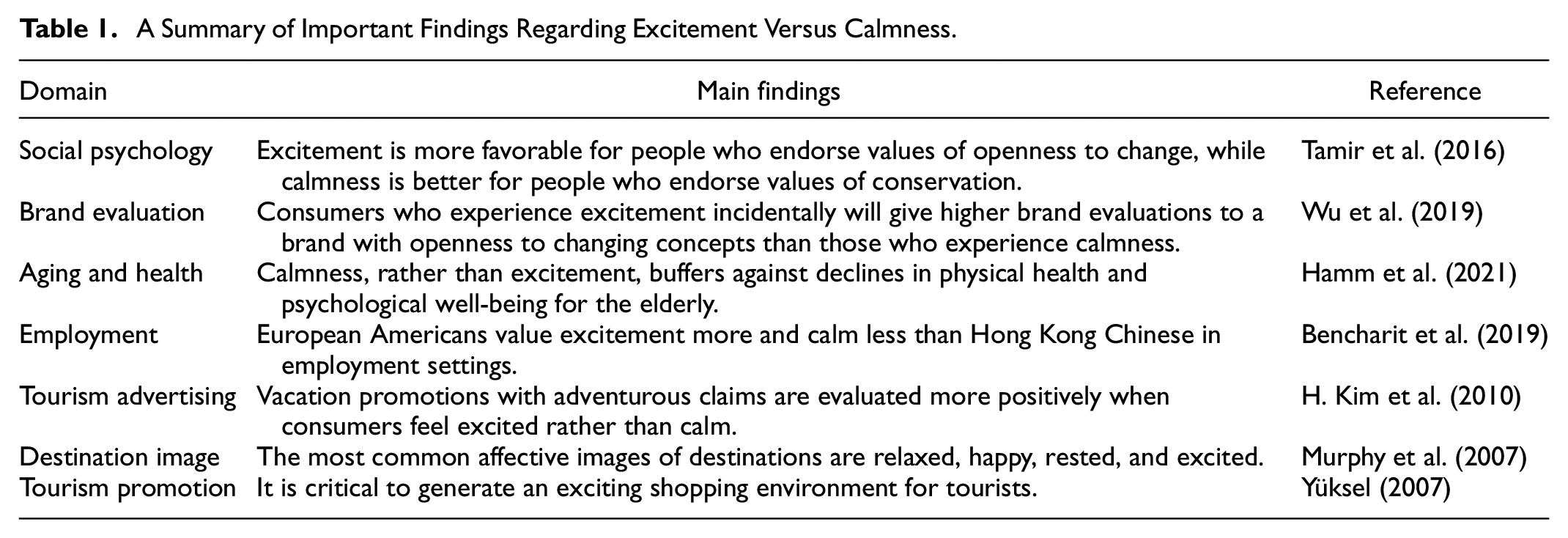
Here, our focus is on differentiating between two specific and prevalent types of positive emotions: excitement and calmness. Through this distinction, we aim to gain a more nuanced understanding of their implications for tourist consumption. In Table 1, we have summarized several relevant studies that compare excitement and calmness in various domains. Building upon the significant differences observed between these two positive emotions, we delve deeper into their respective influences on tourists’ impulsive consumption.
A Summary of Important Findings Regarding Excitement Versus Calmness.
Our investigation assumes that endorsers’ emotions in the hospitality and tourism industries are generally positive, as they rarely display negative emotions when interacting with tourists (H. Kim et al., 2010). Additionally, we recognize that as individuals’ arousal levels increase, their incidental positive emotions can weaken self-control in the consumption context. This is because heightened arousal interferes with the self-regulatory focus of positive emotions (Fedorikhin & Patrick, 2010). Based on this understanding, both excitement and calmness have the potential to influence tourists’ impulsive buying behavior.
A Consequence of Endorsers’ Emotions: Impulsive Buying
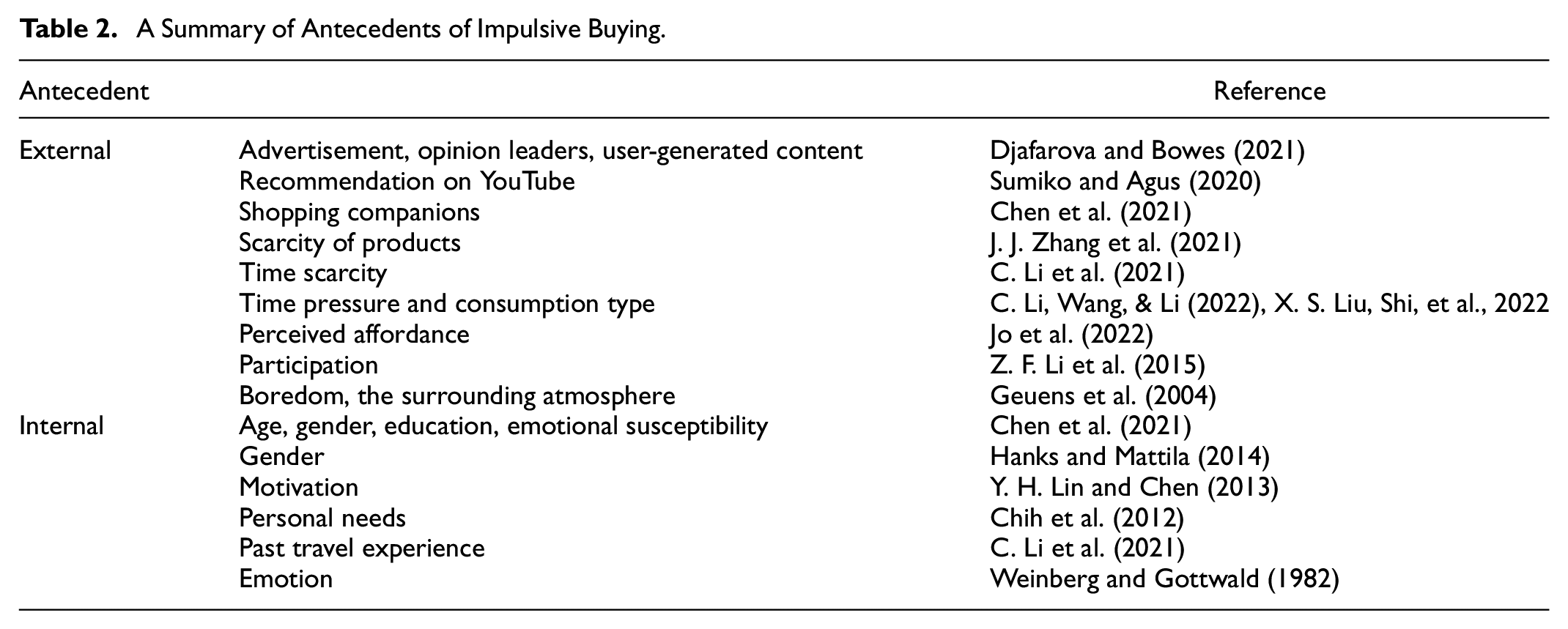
Interestingly, tourist consumption is a hybrid of planned, impulsive, and experiential behavior (Jin et al., 2017). Research has documented that approximately 60% of travelers make impulsive purchases, suggesting that impulsive buying is pervasive (Geuens et al., 2004), and there is a call for more studies on this ubiquitous tourist phenomenon (Ahn et al., 2020; C. Li et al., 2021). Impulsive buying, defined as “episodes in which a consumer experiences a sudden, often powerful, and persistent urge to buy something immediately” (Rook, 1987, p. 191), has been examined recently in the tourism and hospitality literature (for a review, see Ahn et al., 2020; Karl et al., 2021). Various factors influence individuals’ impulsive buying, which can be categorized as external and internal factors. Marketing scholars have identified a variety of external factors, such as products (Rook, 1987) and shopping companions (Chen et al., 2021), and internal factors, such as motivation (Y. H. Lin & Chen, 2013) and emotions (Weinberg & Gottwald, 1982) (see Table 2 for a review).
A Summary of Antecedents of Impulsive Buying.
Based on the mood maintenance theory, positive moods will motivate people to maintain their emotions and positively evaluate the consumption behaviors that are expected to make them feel better or aroused (Di Muro & Murray, 2012). Impulsive buying, which fulfills sensational desires, can stimulate feelings of arousal. Bashar et al. (2013) found that when consumers experience positive emotions in the consumption context, they usually regard their impulsive buying as a tool to prolong these feelings. Moreover, positive emotions will weaken individuals’ self-control in consumption (Fedorikhin & Patrick, 2010) and can facilitate impulsive buying (X. S. Liu, Shi, et al. 2022).
According to previous literature (Larsen & Diener, 1992), high-arousal positive affective states include excitement and enthusiasm, while low-arousal positive affective states include calm and relaxation (Bencharit et al., 2019). The feeling of excitement is a high-arousal emotion that can enhance individuals’ likelihood of choosing options with excitement over options that promise calmness (Mogilner et al., 2012). People tend to become highly aroused from the stimulation provided by their impulsive buying as they may misattribute their experience of arousal based on their consumption behaviors as representative of their feelings (M. Pham, 1998); therefore, when tourists experience a high-arousal positive affect (i.e., excitement) delivered by an endorser that arouses them, they may intend to maintain such arousal feelings, and they become more likely to buy impulsively. Conversely, when they engage in a low-arousal positive emotion (i.e., calmness) delivered by an endorser that makes them less aroused, they would find consumption behavior associated with low-arousal positive valence more favorable and less prone to impulsive buying.
Drawing on the emotional contagion and mood maintenance theories, we hypothesize that the excitement or calmness exhibited by endorsers has differential impacts on tourists’ impulsive buying behavior. Specifically, tourists are more likely to have higher intentions to engage in impulsive buying when an endorser displays excitement compared to when they exhibit calmness. Therefore, we propose the following two hypotheses:
Hypothesis 1: Exciting (vs. calm) endorsement generates a more favorable impact on tourists’ impulsive buying.
Hypothesis 2: The effect of endorsers’ emotions on tourists’ impulsive buying is mediated by tourists’ level of arousal, such that exciting (vs. calm) endorsements lead to a higher level of arousal among tourists, which results in a higher proclivity for impulsive buying.
Moderating Effect of the Time Horizon
In the previous section, we proposed that the effect of endorsers’ emotions on tourists’ impulsive buying would be mediated by tourists’ levels of arousal. However, whether such an effect occurs depends on whether the endorsers’ emotions match the tourists’ ideal emotions because ideal emotions have been shown to play a crucial role in guiding individuals’ decision-making behavior (Bencharit et al., 2019; Tsai, 2017). Ideal emotion refers to a desired affective state that helps people evaluate their own and others’ affective experiences. In general, individuals ideally prefer to feel more positive and less negative than they currently do (Tsai et al., 2006). Prior research shows that people will behave in a manner that is consistent with their ideal emotions. For example, when people ideally favor high-arousal positive emotions, they are more likely to choose products that will stimulate high arousal levels rather than soothing products (Chim et al., 2018; Tsai et al., 2015). In contrast, individuals who ideally value low-arousal positive emotions exhibit the opposite preference. In line with such findings, we argue that people’s ideal emotions would also guide their responses to endorsers’ emotions. When a tourist’s ideal emotion is a high-arousal positive emotion, an endorser’s transmitted excitement would match the tourist’s emotional expectation, resulting in a favorable effect on the tourist’s impulsive buying. On the other hand, when a tourist’s ideal emotion is a low-arousal positive emotion, the endorser’s transmitted excitement would mismatch the tourist’s emotional expectation and may not affect the tourist’s impulsive buying.
Based on the above arguments, we can infer that factors influencing tourists’ ideal emotions would moderate the effect of endorsers’ emotions on impulsive buying. Research has shown that individuals with different time horizons prefer different ideal emotions (Mogilner et al., 2011, 2012). The time horizon, whether expanded or limited, captures how much time individuals perceive they have ahead of them in their lives. Prior research has shown that excitement is ideal for those who have an expanded future time horizon but less so for those who have a limited time horizon (Mogilner et al., 2011, 2012). As a high-arousal positive emotion, excitement is associated with acquiring goals and fulfilling the future, whereas calmness, as a low-arousal positive affective state, guarantees feelings of safety and helps individuals to savor the present (Bencharit et al., 2019; Carstensen et al., 2003).
A variety of research regarding the time horizon and ideal product in the consumption context provides strong support for our propositions. For example, individuals with an expanded time horizon tend to prefer exciting products over calming ones. Conversely, those with a limited time horizon are more inclined to choose calming products (Etkin, 2016). Mogilner et al. (2012) have shown that when individuals perceive expanded (vs. limited) time available in their future, they will be more likely to choose an exciting flavor of tea, an exciting brand of bottled water, or an exciting song than their calmer counterparts. These findings suggest that the more expanded (vs. limited) time people perceive to have ahead in their lives, the more they will value excitement (vs. calmness).
Taken together, these findings suggest that the high arousal level induced by endorsers’ excitement may be maintained only when tourists’ ideal emotion aligns with high-arousal emotions, such as when tourists have an expanded time horizon. However, when tourists ideally favor low-arousal emotions, such as when they have a limited time horizon, they may experience an undesirable feeling when interacting with an excited endorser. In this regard, the excitement transmitted by endorsers may not stimulate tourists to engage in impulsive buying. We formally propose our third hypothesis:
Hypothesis 3: Tourists’ time horizon moderates the relationship between endorsers’ emotions and tourists’ impulsive buying, such that the favorable effect of an exciting (vs. calm) endorsement on impulsive buying only holds when tourists have an expanded time horizon, and the effect is mitigated when tourists have a limited time horizon (Figure 1).
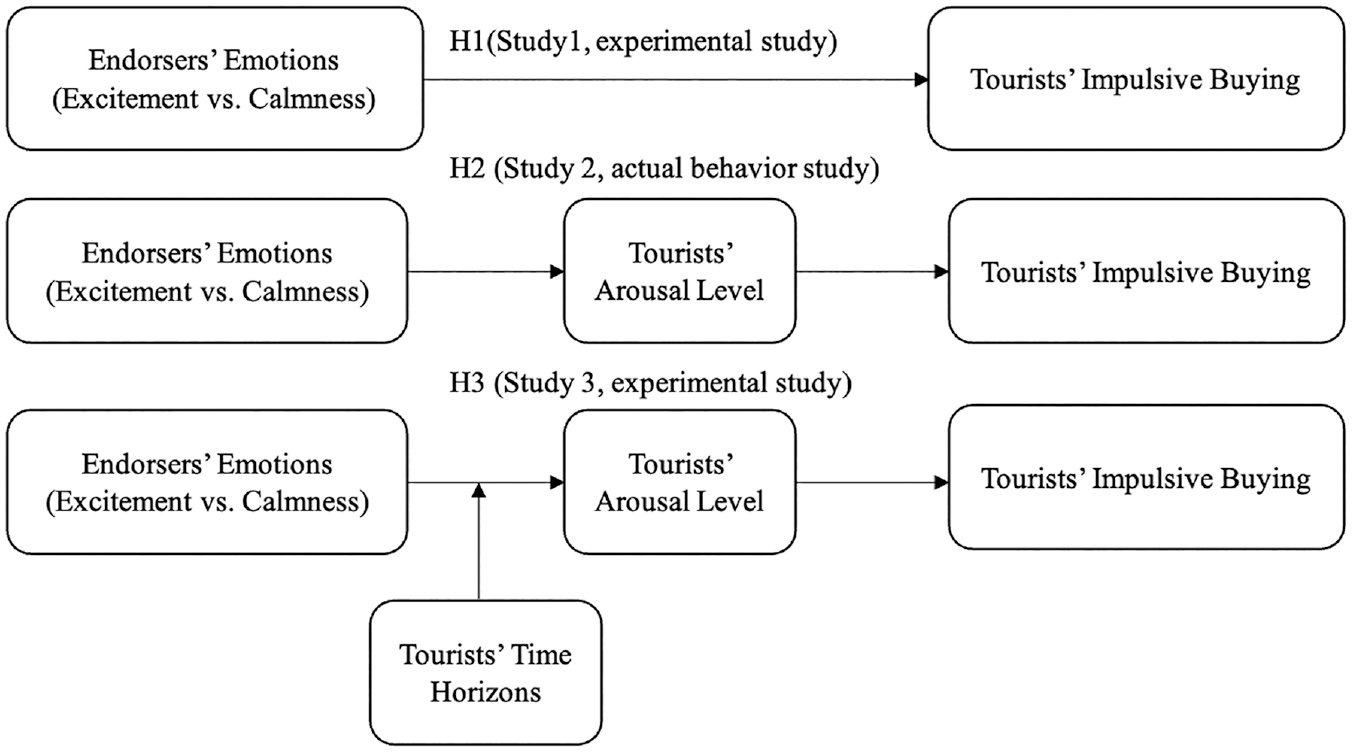
Theoretical framework.
Methodology
Overview of Studies
We test the hypotheses across three studies, including an actual behavior study and two scenario-based studies, as a response to a call from tourism researchers for more experimental studies to delve deeper into the decision-making process of tourists (McCabe et al., 2016). Experiments enable the causal relationship between variables to be drowned out (Dolnicar & Ring, 2014). By randomly assigning participants to either a control or treatment group, all other extraneous variables are supposed to be controlled. Thus, we can infer that the different outcomes between the treatment and control groups result from the manipulation of independent variables.
We follow the measurement-of-mediation approach (Baron & Kenny, 1986; Spencer et al., 2005) to guide our study design. Specifically, one or two studies will be conducted to show the main effect of the independent variable on the dependent variable. Next, another study will be designed to support the mediation effect of the mediator. Additional studies will follow to test the boundary conditions for the main effect to occur. In general, by using multiple operationalizations in experimental design, the generalizability of the findings can be enhanced. Generalizability is optimized when the independent variables are manipulated and the dependent variables are measured using varying settings (Frey, 2018).
Sample sizes for all three studies were predetermined using G*Power. In the subject recruitment process, we first fulfilled the required sample size calculated by G*Power and then recruited additional participants until our budget was exhausted. The objective of this approach is to increase the statistical power of our studies.
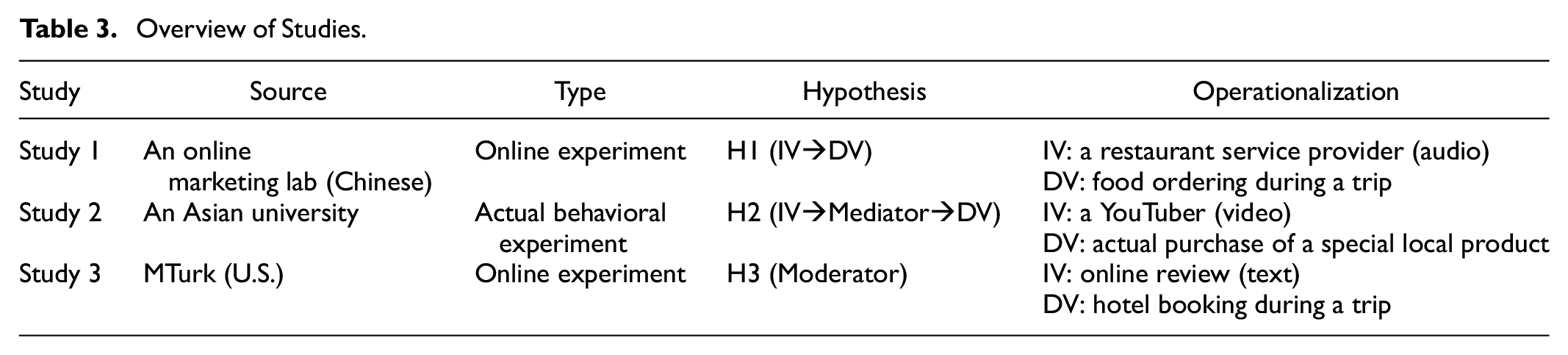
Study 1 examines the focal effect of endorsers’ emotions on tourists’ impulsive buying by manipulating the audio presentation of a service provider’s emotion (excitement vs. calmness) in a restaurant setting. Next, in Study 2, we further consolidate the focal effect observed in Study 1 by manipulating the video presentation of another type of endorser in an online promotion setting. By employing a noninvasive measurement of arousal level (i.e., heart rate) and assessing actual behavioral choice (i.e., selecting pineapple cakes as a special local product), we support the positive relationship between exciting endorsement and tourists’ impulsive buying and the mediating role of tourists’ arousal level. The findings from Study 1 and Study 2 suggest that the proposed effects hold consistent across different contexts and assessments (i.e., both hypothetical and actual choices). Moving on to Study 3, we investigate the moderating role of tourists’ time horizons by manipulating the textual representation of endorsers’ emotions in a green hotel setting. We show that the positive effect of excited endorsers on tourists’ impulsive buying only holds when the target tourists have an expanded (vs. limited) time horizon. The findings from these studies are theoretically and practically significant. All the studies were conducted after the outbreak of the COVID-19 pandemic, indicating timely findings in the new normal era (Table 3).
Overview of Studies.
Study 1—A Restaurant Experimental Study
Design, Participants, and Procedure
In Study 1, we compare the effects of excitement and calmness displayed by an endorser (e.g., a service provider in a restaurant) on tourists’ impulsive buying. We expect that an excited service provider will trigger a higher level of impulsivity in tourists. Inputting a medium effect size (i.e., 0.3) into G*Power determined a rough sample size of 111 at 80% power with three groups and a 5% false-positive rate. We fulfilled the required sample size and ceased subject recruitment upon reaching our budget limit.
Three hundred and thirty participants (Mage = 24.17; 43.3% female; see Appendix C for detailed descriptive statistics for all samples) were recruited from an online marketing lab in China with monetary incentives (CNY 2, approximately USD 0.3). The participants were randomly assigned to one of three conditions: control, excited service provider, or calm service provider condition. They were first instructed to read a cover story in which they imagined being on a trip and planning to have a healthy salad for lunch. Upon arriving at the restaurant, the service provider presented them with a menu (see Appendix A) and introduced the menu items. The participants perused the menu, which included four salad options, two cake options, and various beverages. Among the items was a mouth-watering tray of cake, their favorite dessert, and they felt a strong craving for it immediately.
We manipulated the service provider’s emotions using an artificial intelligence dubbing technique to create an excited or calm tone in the video audio while maintaining the same script. In the control condition, no video was displayed. The participants were then asked to imagine that they had a sweet tooth and choose one of the five alternatives (adapted from Miao, 2011; Rook & Fisher, 1995). The five alternatives (i.e., get the salad for lunch, not even think about the cake; get the salad for lunch, want the cake but not get it; decide not to get the salad but get the cake instead; get both the salad and cake; get both the salad and the cake plus other items to complete the meal) represented increasing levels of impulsiveness. The participants’ impulsivity was characterized by a disproportionate focus on hedonic and unhealthy food over a healthy salad based on the gratification of their desires. As for manipulation checks, the participants responded to three items indicating whether they felt that the service provider’s emotions were either tranquil/peaceful/serene or active/excited/enthusiastic using a 9-point scale (α = .68; H. Kim et al., 2010). They then responded to several items measuring their regulatory focus (α = .80; Higgins et al., 2001), level of loss aversion (Xu & Zeng, 2022), health consciousness (α = .93; Y. Zhang et al., 2021), and perception of the credibility of the endorser (α = .86; Choi et al., 2018) as confounding variables (see Appendix B for full scales). At the end of this study, the participants provided some demographic information and were thanked.
Results and Discussion
Manipulation Check
The three items in this manipulation check were averaged as an indicator of the extent to which participants perceived the service providers’ emotions to be. An independent sample t-test was performed on the indicator. As predicted, the participants in the excited condition reported that their service provider was significantly more excited than their counterparts in the calm condition (6.66 vs. 4.59, t(218) = 9.35, p < .001,
Impulsive Buying
We expected that an excited (vs. calm) service provider would lead the participants to have a higher tendency to buy impulsively. To test our prediction, we performed another one-way ANOVA using the endorsers’ emotions as the independent variable, the participants’ choices as the dependent variable, and their regulatory focus, level of loss aversion, as well as health consciousness as covariates. The analysis yielded a significant effect on endorsers’ emotions while controlling the effects of three covariates (F(2, 324) = 4.74, p = .009,
Although the study results supported the positive effect of an excited endorser on receivers’ impulsive buying (H1), the question remains whether this effect is robust in actual behavioral choices and the underlying mechanism. We addressed these questions in Study 2 by using an actual behavior study with a mediation test.
Study 2—An Actual Impulsive Buying (Pineapple Cake) Experimental Study
Design, Participants, and Procedure
We conducted Study 2 to accomplish three goals: (a) demonstrate that arousal level mediates the effect of endorsers’ emotions on tourists’ impulsive buying (H2); (b) strengthen the evidence by using an actual behavioral measurement rather than scenario-based settings and simulated choices; and (c) examine the focal effect in another commonly encountered context, namely, online promotion of a special local product by a key opinion leader.
The anti-pandemic measures have prevented the inclusion of a large number of subjects in our laboratory experiments because of health requirements. To ensure the power of this actual behavior study under anti-pandemic measures, we input a relatively large effect size (i.e., 0.4) into G*Power, and a sample size of 50 at 80% power with two groups and a 5% false-positive rate was determined. We fulfilled the required sample size and stopped recruiting subjects once we met our budget.
Sixty-four staff and students (Mage = 26.8; 65.6% female) at a university individually participated in the current study in exchange for monetary incentives (HKD 40, approximately USD 5). On arrival, the participants were told that they would respond to several unrelated tasks. The first task was to watch a video clip (see Appendix A for a screenshot of the video) featuring a YouTuber called Iris, who described her experience at a newly opened local café on vacation. Iris introduced the café and tried out its famous pineapple cake. We described the video as recorded by Iris and uploaded it to her YouTube channel. We manipulated Iris’s displayed emotions by recording two videos in which she excitedly or calmly performed an identical script. The participants were randomly assigned to watch one of the two video clips. Immediately after this task, the experimenter measured the participants’ heart rates as a noninvasive assessment of their arousal level, following Mehta et al. (2012).
After watching the video, the participants were informed that they could receive HKD 40 as an incentive and that they could use the incentive to buy the special local product (i.e., pineapple cake) promoted by Iris in the video clip. The price was HKD 1 for one slice (around 6 g per slice) of pineapple cake. The experimenter deducted the quantities the participants consumed from their monetary incentive. We adapted this approach from the literature (Vohs & Faber, 2007), in which impulsive buying was measured by unplanned purchases regardless of the product’s price.
At the end of this study, the participants responded to a 3-item scale (α = .94; H. Kim et al., 2010) to measure their feelings about Iris’s emotions, as the scale used in Study 1, and several demographic questions. Subsequently, the experimenter provided them with pineapple cake slices and monetary incentives.
Results and Discussion
Manipulation Check
As expected, an independent sample t-test showed that the endorser was rated as more excited by the excited group compared with the calm group (6.44 vs. 3.28, t(62) = 8.79, p < .001,
Arousal Level
The participants’ arousal level was measured using their heart rates. As hypothesized, we found a significant difference between the two conditions. An independent sample t-test showed that in the excited endorser condition, participants’ heart rates were significantly higher than in the calm endorser condition (73.84 vs. 66.73, t(62) = 2.30, p = .025,
Actual Impulsive Buying
We hypothesized that the greater impulsiveness stimulated by excited endorsers revealed in Study 1 would also hold for actual purchasing behavior. In the current study, we supported this hypothesis by comparing the amounts of pineapple cake that the participants bought between the two conditions. Another t-test showed that, as expected, the participants who experienced an exciting promotion from Iris spent more of their monetary compensation on the pineapple cake than did those in the calm condition (2.90 vs. 0.33, t(62) = 2.01, p = .048,
Mediation Analysis
To examine the indirect effect of endorsers’ emotions on impulsive buying through the receivers’ arousal level (H2), we conducted a bootstrap analysis (PROCESS Model 4; Hayes, 2017) using 5,000 samples and a 95% confidence interval (CI). The results confirmed the path of the endorsers’ emotions → receivers’ arousal level → impulsive buying (index = 0.58, 95% CI [0.0206, 1.3703]), supporting our hypotheses (H2).
Study 3-A Green Hotel Experimental Study
Design, Participants, and Procedure
In Study 3, we tested the moderating role of the time horizon. To reiterate, we expected that the favorable effect of excited endorsers on tourists’ impulsive buying would only hold when tourists have expanded (vs. limited) time horizons. To increase the generalizability of our findings and probe marketing-relevant outcomes, another tourism consumption—the green hotel—was adopted. Following previous literature documenting that impulsive buying implies exceeding a given or planned budget (C. Li, Wang, & Li, 2022; May & Irmak, 2018), we utilized impulsive buying as the dependent variable.
Inputting a medium effect size (i.e., 0.3) into G*Power determined a sample size of 90 at 80% power with four groups and a 5% false-positive rate. We fulfilled the required sample size and stopped recruiting subjects once we met our budget. Two hundred eighty-four participants (Mage = 40.49; 39.8% female) were recruited from Amazon Mechanical Turk (MTurk) in October 2021 for monetary exchange (USD 0.5). We recruited participants based on the number of HITs Approved (>5,000), HIT Approval Rate (>95%), and Location (US). These qualifications were based on MTurk worker registration and activity information, which ensured representativeness and data quality. They were randomly assigned into a 2 (emotion: calm vs. excited) × 2 (time horizon: limited vs. expanded) between-subjects experimental design.
The participants were informed that the survey included two unrelated studies. In the first study, they were told that the survey was to help us understand individuals better and probe how they enjoyed their lives. The participants in the expanded or limited time conditions were shown one of the following two statements manipulating how much time is ahead in a person’s life: “Life is long. Enjoy it forever, over a long period of time!” or “Life is short. Enjoy the moment, right now!” The participants were then instructed to spontaneously list five ways that they would like to enjoy life. They then completed the time horizon manipulation questions (e.g., “This statement made me think about the present”) using a 6-item, 9-point scale (α = .64; Williams & Drolet, 2005).
Immediately after the first task, in the second ostensibly unrelated study, we asked participants to imagine that they were planning a budget for a 5-day trip and had $100 left for the last day. The participants were told that they could go to a theme park and book a hotel room for the fifth day. While browsing online, they saw a green hotel with an exclusive offer of a single room for $149 per night at an original price of $250. The participants were shown a screenshot of one of the representative reviews from other customers. The review varied in its text and expressive style, using either calm or exciting emotions as indicated by emoticons, exclamation points, and uppercase text (see Appendix A for additional details). The participants were asked to select one of the five choices that they would make with varying levels of impulsiveness from low to high (i.e., buying the theme park ticket only; wanting to book the green hotel but not booking it; deciding not to buy the theme park ticket but booking the green hotel with a credit card; buying both the theme park ticket and booking the green hotel with a credit card; and buying both the theme park ticket and the green hotel in addition to booking a matching buffet with a credit card). A higher score indicated a higher level of impulsiveness. The participants then answered questions about their level of arousal (e.g., “Please indicate how do you feel at this moment?” where 1 = stimulated; 7 = relaxed) using a 4-item, 9-point scale (α = .70; Kacen & Lee, 2002). Next, the participants answered questions in a manipulation check of their emotions as in Study 1 (α = .96), in addition to providing their demographic information.
Results and Discussion
Manipulation Check
We conducted a two-way ANOVA on endorsers’ emotions. The results revealed that participants in the exciting condition perceived the review as more exciting than those in the calm condition (6.36 vs. 5.11; F(1, 280) = 24.24, p < .001,
Impulsive Buying
We conducted a two-way ANOVA on impulsive buying intentions. The results revealed only an interaction effect between emotions and time horizons (F(1, 280) = 4.30, p = .039,
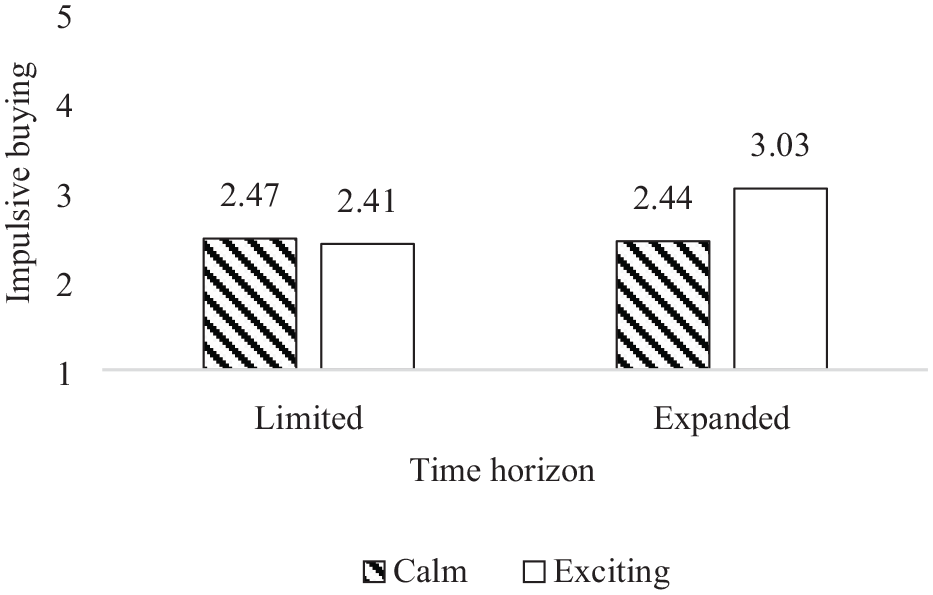
Interaction effect between the emotion and time horizon on impulsive buying.
Arousal Level
We conducted a two-way ANOVA on arousal level. The results revealed a main effect of emotions (F(1, 280) = 8.09, p = .005,
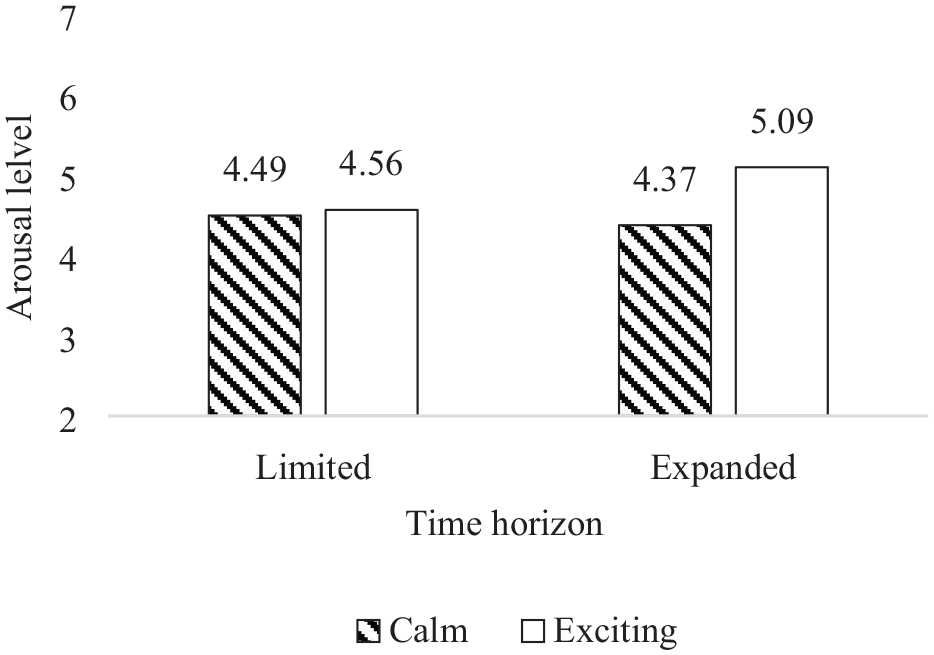
Interaction effect between the emotion and time horizon on arousal level.
Mediated Moderation Model
To examine the indirect effect of emotions and time horizons on impulsive buying through arousal levels, we conducted a bootstrap analysis (Model 8; Hayes, 2017) using 5,000 samples and a 95% CI. The results confirmed the path of emotion × time horizon → arousal level → impulsive buying (index = 0.14, 95% CI [0.0155, 0.3089]). In particular, the indirect effect of arousal level was significant only when the participants were primed with an expanded time horizon (with the effect size of 0.16, LLCI = 0.0458, ULCI = 0.3026), but was eliminated when primed with a limited time horizon (with the effect size of 0.02, LLCI = −0.0745, ULCI = 0.1203).
Conclusion and Discussion
This study examined the effect of endorsers’ emotions on tourists’ impulsive buying. The hypotheses describing the focal effect and its boundary condition were supported by the results of three experiments.
In Study 1, we provided initial evidence of the positive effect of excited endorsers on tourists’ impulsiveness using audio manipulation in a restaurant context. Study 2 further elucidated the focal effect and demonstrated the mediating role of tourists’ arousal levels through an actual behavioral experiment. To simulate the pervasive and growing consumption of online content in daily life, we manipulated the emotions expressed by a YouTuber in her videos. We measured the participants’ heart rates as a noninvasive indicator of arousal level and their unplanned spending on the featured product as an actual indicator of tourists’ impulsive buying. We found that our hypotheses were supported in both experimental and actual assessments. Study 3 demonstrated the boundary condition of our focal effect, such that the favorable effect of excited endorsers only holds when tourists have an expanded time horizon. In this study, we also showed that conveying excitement (vs. calmness) through text messages in an online review context can elicit the favorable effect of endorsers’ emotions on tourists’ impulsive buying in a green hotel context, thus enhancing the generalizability of our findings.
Theoretical Implications
This study makes several contributions to the literature. First, earlier studies have documented various influential factors in individuals’ impulsive buying, such as power distance belief (Y. Zhang et al., 2010), consumer emotions (Sneath et al., 2009), cultural backgrounds (Kacen & Lee, 2002), product features (Yeung & Yee, 2010), and shopping environments (Brida & Tokarchuk, 2017). Our findings add to this ever-growing stream of literature on impulsive buying by extending tourists’ emotions to the endorser side and examining how endorser emotion can transfer to the consumer and further impact their impulsive buying. In addition, abundant research has uncovered the effect of people’s incidental emotions on their subsequent behaviors (Bigné & Andreu, 2004; S. Li, Wang, & Filieri, et al., 2022; Wyer et al., 2019); however, few studies have examined how stakeholders’ (i.e., endorsers’) emotions might influence tourists’ behaviors (Volo, 2021). We shed new light on the interactions between endorsers and tourists and underline the vital role of endorsers’ emotions in tourists’ impulsive buying.
Second, emotion has increasingly become an important topic in tourism and hospitality research (Rahmani et al., 2019; Wang et al., 2021). Positive emotions are particularly prevalent in the tourism industry; thus, understanding the distinct effects of different positive emotions can be beneficial. Earlier studies on impulsive buying investigated the advantages of positive emotions (Gao et al., 2019; Z. F. Li et al., 2015; X. S. Liu, Shi, et al., 2022; Sohn & Lee, 2017). To our knowledge, most of the literature has focused on consumer or tourist emotions instead of endorser emotions. Besides, there has been limited research distinguishing the effects of specific positive emotions on impulsive buying. It is essential to reveal the distinction between specific positive emotions and their subsequent behavioral implications, given the relatively limited knowledge available on specific positive emotions rather than negative emotions (Agrawal et al., 2007; Cavanaugh et al., 2007). Building upon the categorization of positive emotions of the same valence (H. Kim et al., 2010), our research goes beyond the focus on global emotional valence by distinguishing the impact of excitement and calmness on tourists’ arousal levels, which in turn influences their impulsive buying.
Moreover, we have expanded the connotation of “impulsive buying.” Previous literature regarding impulsive buying has limited the discussion to vice product categories, such as alcohol (Y. Zhang et al., 2010) and cake (Miao, 2011). We extend impulsive buying into the virtue product category (i.e., green hotel) and discover a positive aspect of emotion in impulsive buying in the context of green hotel consumption. The findings suggest that even though impulsive buying frequently occurs for certain products, it may not be dependent on a specific product category, which can contribute to a deeper understanding of impulsive buying and also provide insight for future studies regarding impulsive buying.
Lastly, we also identify a boundary condition for these effects. By addressing the distinctions in time horizons, we show the importance of ideal emotion in the endorsers’ emotional influence on tourists’ impulsive buying. Earlier studies have shown that ideal emotion matches will magnify hiring practices (Bencharit et al., 2019), giving to strangers (Park et al., 2017), and emotional claims (H. Kim et al., 2010). Our study adds new insight that ideal emotion matches also will enhance consumption impulsiveness, manifested by unplanned purchases and over-budget consumption.
Managerial Implications
This research suggests that excited endorsers will generally affect tourists’ impulsive buying more positively than calm endorsers. We show convergent evidence across three studies that our findings are robust for different product categories (i.e., salad and cake, pineapple cake, green hotel), from the vice to virtue category. Accordingly, hospitality marketers can facilitate their goals by training endorsers or designing promotional materials with either an excited or calm style. When promoting products or services, the use of excited (vs. calm) emotions by endorsers can be influential in transferring those emotions to tourists, ultimately leading to higher levels of impulse buying. Marketers can deliberately choose, or train endorsers based on their preferred styles to align with their promotional objectives.
In addition, exploring the role of ideal emotions in individual interpretations of endorsers’ emotions may have important implications for hospitality marketing strategies. These findings further imply the possibility of manipulating time horizons when needed by using different promotional cues. For instance, priming an expanded time horizon (e.g., Life is long. Enjoy it forever, over a long period of time!) will be beneficial for exciting promotions. More importantly, a variety of factors can influence the way we perceive the time that we have available in the future. For example, when people feel that life is short, news about scientific breakthroughs empowers them to believe in the expansion of lives (Williams & Drolet, 2005), which can also be an effective way to prolong the perception of time as needed.
Moreover, our findings may have implications for several social issues. For example, since the mechanism of impulsive buying works for both vice and virtuous products/services, excited endorsers (e.g., key opinion leaders) will be more effective than calm endorsers in boosting green hotel bookings, which can, in turn, benefit society by relatively increasing green hotel bookings. Green tourism marketers can leverage the impulsiveness induced by excited endorsers to boost green consumption. On the contrary, when considering the societal issues arising from increasing rates of obesity, healthcare professionals should suggest calmness as the ideal emotion to prevent overeating behavior.
Limitation and Future Research
Despite its contributions, our research has several limitations that suggest avenues for future work. First, previous literature has documented that how emotion is measured (e.g., self-report and psychophysiological measures) may bias consumers’ perception and judgment of tourism advertisements due to social desirability concerns (S. Li et al., 2018). Future research may try more diversified methods to probe tourists’ inner emotions (Hosany et al., 2021). Moreover, although we adopted various methods to capture tourists’ impulsive buying, such as self-reported intentions, tourist choices, and actual behaviors, we also used different ways to manipulate the expression of emotions, such as texts, emoticons, voice accents, and videos. All studies were designed based on scenario-based experiments, and the majority were online samples, which may undermine the external validity of our findings. Future work may explore how endorsers’ choice of emotional expressions influences tourists’ behavior in the real world.
Besides, the scenarios in the current research mainly focused on a specific consumption context during travel, such as choosing dishes in a restaurant in Study 1, purchasing a special local product in Study 2, and deciding where to live while traveling in Study 3. Future studies could further validate the effect by considering the whole tourist journey and considering the pre-travel consumption experience. In addition, the COVID-19 pandemic prevented the inclusion of a large number of subjects in our laboratory experiments because of health requirements, which limited the sample size of our field experiment (i.e., Study 2). Although the results validated our proposition, the effect size was only approximately medium, which may influence the validity and stability of our findings. Thus, future research should conduct field studies with proper sample sizes.
In addition, marketers hardly control the emotional display of endorsers, which may limit the practical implications of the current research. Although marketers can use training skills to manipulate the emotional presentation of endorsers, the authenticity of the emotional display may be an issue, which suggests an interesting avenue for future research. Besides, previous literature has shown that both positive and negative emotions can impact impulsive buying behavior (Ahn & Kwon, 2022). In the current study, we only look at positive emotions, so future studies can see if the effect can be extended to negative emotions. Moreover, salesperson interactions have been shown to significantly affect impulsive buying only during the initial store visit (Katakam et al., 2021). Future studies may adopt a longitudinal design to verify whether the emotion-contagious effect holds over a longer period.
Lastly, Ahn et al. (2020) suggested that visiting purposes may affect tourists’ decision-making processes and impulsive buying. That is, leisure travelers are likely to buy more impulsively than business travelers. We did not delineate visiting purposes in our scenarios. Traveling is more likely to be associated with leisure, fun, and enjoyment; therefore, we suggest that our findings can be applied to leisure travelers. In a similar vein, product type may also serve as a moderator. Research has shown that impulsive buying is higher for the highly hedonic product (i.e., snake box) than for the less hedonic product (i.e., first aid kit) after caffeine consumption (Biswas et al., 2023). Also, time pressure may sway impulsive buying behavior such that impulsive buying for hedonic (vs. utilitarian) products will be higher under high (vs. low) time pressure (X. S. Liu, Shi, et al., 2022). Accordingly, future studies could extend our findings and detect whether visiting purposes and product type may moderate endorsers’ emotions and tourists’ impulsive buying.
Supplemental Material
sj-docx-1-jtr-10.1177_00472875231213210 – Supplemental material for Excited or Calm? Effects of Endorsers’ Emotions on Tourists’ Impulsive Buying
Supplemental material, sj-docx-1-jtr-10.1177_00472875231213210 for Excited or Calm? Effects of Endorsers’ Emotions on Tourists’ Impulsive Buying by Xiaoyan Luo, Xing (Stella) Liu and Lisa C. Wan in Journal of Travel Research
Footnotes
Declaration of Conflicting Interests
The author(s) declared no potential conflicts of interest with respect to the research, authorship, and/or publication of this article.
Funding
The author(s) disclosed receipt of the following financial support for the research, authorship, and/or publication of this article: The work was supported by a grant funded by the Project Impact Enhancement Fund (PIEF) 2020-21, The Chinese University of Hong Kong (Grant No. 3133277) awarded to the last author.

Supplemental Material
Supplemental material for this article is available online.
Author Biographies
References
Supplementary Material
Please find the following supplemental material available below.
For Open Access articles published under a Creative Commons License, all supplemental material carries the same license as the article it is associated with.
For non-Open Access articles published, all supplemental material carries a non-exclusive license, and permission requests for re-use of supplemental material or any part of supplemental material shall be sent directly to the copyright owner as specified in the copyright notice associated with the article.
