







Abstract
Scholarship on wellness tourism has experienced exponential growth. Despite this, limited studies have explicitly examined how the perceived destination restorative qualities of a wellness tourism destination facilitate psychological recovery. Findings from a survey with 942 Chinese wellness tourists revealed perceived destination restorative qualities positively influenced psychological recovery, increasing ontological security, with the effect diminishing as individual resilience increased. This research provides conceptual clarity on the intricate relationship between perceived destination restorative qualities and psychological recovery, highlighting the critical role of wellness tourism for alleviating stress, and threats experienced in everyday life. Future studies should conduct longitudinal studies focused on the psychological recovery of wellness tourists.
Keywords
Introduction
In contemporary society, with the quickening pace in individual lifestyles, increasing numbers of hours engaged in full-time work, and mounting pressure both in work and daily life alike, there is a common desire to find effective ways to gain restoration and maintain or improve one’s physical and mental health (Hu et al., 2022; X. Y. Lehto et al., 2023). According to a global survey by the World Health Organization, only 5% of humankind is considered truly healthy (i.e., disease-free), with a further 20% having diagnosed diseases, and the remaining 75% have sub-optimal health status (SHS) which is an intermediate state between health and disease (Tao et al., 2020). SHS is often medically undiagnosed (e.g., stress, mental fatigue, and declining vitality), leading the public to overlook this state, and thus increasing the risks of developing disease (Sun et al., 2022)—this will then be a direct cause of a wide range of adverse outcomes, for example, a decline in workplace productivity, increased medical costs and the aggravation of social burdens (J. Chen et al., 2023; He, Liu, & Li, 2022; Liu, Li, et al., 2022). Consequently, tourism scholars and practitioners alike are particularly concerned with how to achieve Sustainable Development Goal #3, that is, SDG#3: Ensure healthy lives and promote well-being for all at all ages (United Nations, 2015).
Against this backdrop, perceived destination restorative qualities have emerged as a key factor for elucidating the attributes and characteristics of a place/destination in facilitating buffering or therapeutic effects for mentally stressed individuals (Hu et al., 2022; X. Y. Lehto, 2013). Previous studies have conceptualized perceived destination restorative qualities as the restorative characteristics of a particular destination as perceived by tourists (X. Y. Lehto, 2013; Y. Yang & Chen, 2021). In this way, the role of perceived destination restorative qualities aligns with the purposes of wellness tourism around how travel can promote tourists’ physical, psychological, and spiritual wellbeing (Liu, Li, et al., 2022; Voigt et al., 2011). Wellness destination refers to a specific type of travel destination well-known for wellness-related offerings, providing a range of services, facilities, and experiences aimed at enhancing physical, mental, and emotional health (He, Liu, & Li, 2022). Experiencing wellness tourism in such destinations has been demonstrated as an active contributor to health and wellbeing and thus plays a key role in visitors upgrading from sub-health status to a more optimal state of health (He et al., 2023). In spite of the recent growth of research related to perceived destination restorative qualities and wellness tourism, conceptual understanding of perceived destination restorative qualities is relatively underdeveloped in travel and tourism settings. Existing studies are predominantly conceptual and originate from the environmental behavior domain, specifically focusing on the perceived environmental restorative quality (cf. G. Chen et al., 2017). Connected to this, there is a critical gap in research regarding whether and how the environmental restoration qualities of a wellness destination can effectively contribute to subsequent restoration outcomes.
In response, this study intends to address the research gap by leveraging the lens of conservation of resources theory. This theory posits that individuals are motivated to retain and protect existing resources, as well as to obtain and foster more resources in response to the threat of resource loss during negative events (Halbesleben et al., 2014; Hobfoll et al., 2018). In this case, chronic overwork and mounting pressure caused by modern life, especially following the outbreak of COVID-19 globally, can severely deprive an individual’s psychological resources, for example, disrupting one’s sense of ontological security. Ontological security represents the degree to which individuals feel their world, and role within it, is secure and predictable (Campbell et al., 2020; Giddens, 1984), and is affected by threats that may disrupt an individuals’ norms, beliefs, routines, and practices. Accordingly, an individual’s developed sense of ontological security is a psychological resource that is useful when the individual is exposed to stressful situations. Linking these ideas together, traveling to a wellness destination and engaging with restorative stimuli has the potential to replenish psychological resources and protect against the continued depletion of resources (i.e., ontological security), thereby increasing the resource stock utilized by individuals to manage their health and wellbeing.
This paper also further elucidates the dynamics of ontological security by considering the moderating effect of psychological resilience. According to conservation of resources theory, psychological resilience is considered a key internal resource foundation for facilitating a quick recovery despite stress and pressure (Mao et al., 2021). In particular, this study examines the condition (i.e., level of psychological resilience) in which the relationship between perceived destination restorative qualities and ontological security could be undermined. Following this rationale, a survey was conducted in Shizhu county, a well-known China local tourism destination renowned for its health-and-wellness tourism. Drawing on Shizhu county as a case study, this research unravels the intricate connections between perceived destination restorative qualities, ontological security, restoration, and psychological resilience. Accordingly, this research advances existing knowledge not only by focusing on how perceived destination restorative qualities in the wellness tourism context influence subsequent restoration outcomes, but also by examining boundary conditions underlying the restoration outcomes. This paper provides vital empirical insights into resource conservation strategies which tourists utilize to conserve their ontological security, providing implications for destination management. Drawing on conservation of resources theory this manuscript expands current knowledge on the intersection between wellness tourism and restorative qualities by advancing the conceptual understanding of how tourists react to challenges to their psychological resources which disturb their daily routines and lifestyles.
Literature Review and Hypothesis Development
Perceived Destination Restorative Qualities in Wellness Tourism
In the recent past, and in particular as amplified by the evolving COVID-19 pandemic, surging demand for maintaining and improving health and longevity has driven exponential growth of wellness tourism (K. H. Chen et al., 2022; L. Xie et al., 2021). Travel for wellness reasons is increasing in popularity, reflecting a growing societal emphasis on self-care, health, and holistic well-being (Kim et al., 2017; X. Y. Lehto et al., 2006). In seminal work on wellness tourism, Smith and Puczkó (2008) have propagated wellness tourism as an alternative therapy which turns travel into an opportunity to maintain and improve holistic health. This perspective is further reinforced by Li et al. (2023), who highlight the positive health-related outcomes associated with wellness tourism. These benefits include, but are not limited to, enhancements in self-perceived health (He, Liu, & Li, 2022), physiological and psychological relaxation (Backman et al., 2023; Ohe et al., 2017), enhanced well-being (Y. Chen et al., 2013; Dryglas, 2020), and an overall improvement in the quality of life (Luo et al., 2018). According to the Wellness Tourism Market Report (2021), the global market share for wellness travel was estimated to be worth 1.10 trillion USD in 2028. Relative to global tourism generally, the wellness tourism sector is expanding twice as fast (He et al., 2023; Hunt & Harbor, 2019).
Wellness tourism, as an encompassing concept that describes a vacation capable of inspiring a feeling of vitality and overall well-being, has forged itself into the forefront of travel experiences (X. Y. Lehto & Lehto, 2019). Wellness tourism embodies a comprehensive perspective in which travelers aim to improve their overall well-being by engaging in self-care activities and programs like yoga, Tai Chi, hot spring and spa treatments, massages, as well as physical fitness pursuits (X. Y. Lehto & Lehto, 2019). However, it is an academic challenge to universally define wellness tourism despite its exponential growth (Li et al., 2023). Cultural and linguistic differences (Dryglas, 2020) and diverse expectations and perceptions among tourists (Majeed & Gon Kim, 2023) contribute to the complexity of providing a comprehensive and accurate definition. Wellness tourism has been closely associated with prevention of disease and health, yet its efficacy is largely relative, subjective, and perceptual (Dillette et al., 2021). Despite this, wellness tourism brings the promise of transforming travel into an opportunity to maintain and improve holistic health (He, Liu, & Li, 2022). Recently, research has delved into specific niches within wellness tourism, including areas such as babymoons (Ghosh & Mandal, 2019), wellness travel catering to individuals coping with chronic illnesses like cancer (K. Wang et al., 2020), and programs tailored for those seeking to restore mental and emotional balance (He, Liu, & Li, 2022). In contrast with medical tourism, wellness tourism represents a personal lifestyle choice, enabling tourists to attain a comprehensive state of health (body and spirit) during their wellness-oriented vacations without the necessity of direct medical interventions (K. Wang et al., 2020).
A wellness destination is closely associated with offering therapeutic or restorative experiences (Voigt et al., 2011). As a result, the role of perceived destination restorative qualities of a wellness destination is instrumental in fostering the interaction between wellness tourists and restorative environments (X. Lehto et al., 2017), further boosting tourists’ essential psychological resources to counteract the growing stress and anxiety stemming from their hectic daily routines (Hu et al., 2022). The work of X. Y. Lehto (2013) has pioneered tourism studies in assessing perceived destination restorative qualities through the elucidation of six dimensions: compatibility, extent, mentally-away, physically-away, discord, and fascination. Extant studies using this scale show that compatibility describes the congruence/fit between a destination and the visitor; extent refers to the sufficiency and scope of a destination; mentally-away denotes the extent to which tourists feel removed from regular routines; physically-away is the physical difference a visitor perceives between destination environment and usual home/work environment; discord consists of reverse-worded items to connote the distractions, confusions, or dissonance a destination can create for travelers; and fascination is about having one’s attention effortlessly absorbed (G. Chen et al., 2017; Hu et al., 2022; X. Y. Lehto, 2013). This six-dimension scale offers a baseline measure for evaluating the restoration potential of a destination (Hu et al., 2022). Following X. Y. Lehto’s (2013) insights in a North American context, the perceived destination restorative quality scale was cross-culturally validated in China (G. Chen et al., 2017), Australia (Gill et al., 2019), and within the demographically diverse on-line survey platform Amazon MTurk (Kirillova & Lehto, 2015).
Despite the development of conceptual understanding on the dimensionality of the perceived destination restorative quality construct, to the authors’ best knowledge, there is a paucity of tourism research delving into how perceived destination restorative qualities assist tourists to gain restoration. This is partly because existing literature extensively focuses on the impact of the wellness tourism experiences (He, Liu, & Li, 2022, 2023; Majeed & Ramkissoon, 2020; Voigt et al., 2011), with little attention paid to its antecedents (Y. Yang & Chen, 2021). Of the notable exceptions, studies in the wellness tourism context have demonstrated that restorative outcomes can be facilitated by tourist motivations (Kim et al., 2017; Liu, Li, et al., 2022), co-creation (Hjalager & Konu, 2011; L. Xie et al., 2021), and certain characteristics of wellness tourism (Han et al., 2018). Nevertheless, sparse research focuses on the psychological mechanisms underpinning the effect of environmental restoration qualities of a wellness destination on restoration outcomes.
Conservation of Resources Theory
The study of human stress has driven the evolution of psychological theories, for example, conservation of resources theory (Hobfoll, 1989; Lazarus & Foikman, 1984). As a branch of stress theory, the focus on conservation of resources originated from Hobfoll’s (1989) observation and thinking on clinical stress disorder and aims to reveal patterns of individual psychology and behavior when responding to stressful circumstances (Hobfoll et al., 2018). The theory assumes that “what is threatening to people is the potential or actual loss of valued resources” (Hobfoll, 1989, p. 516). As a response, people strive to retain, protect, and build resources that have utility, including external resources (e.g., employment, home, and marriage) as well as internal sources (e.g., physical and cognitive energy, attention, and mental resilience) (C. C. Chen et al., 2016; ten Brummelhuis & Bakker, 2012). Conservation of resources theory explains the underlying mechanism of how individuals respond to stressful situations from the perspective of resource depletion and compensation, and posits that achieving a state of stable and balanced resources is a key factor in maintaining and promoting physical and mental health. The explanatory power of the theory is robust, making it one of the most widely cited theories in organizational psychology and organizational behavior (Hobfoll et al., 2018).
The human propensity to conserve resources provides a theoretical explanation for tourism phenomena. The utilization of this theory in existing tourism studies is primarily linked to human resource and organizational management (H. Lin et al., 2022; Mao et al., 2021), psychological resilience in stressful situations (Liu et al., 2023), and the perception of safety (Akamavi et al., 2023). It has been shown that after experiencing negative or stressful situations (e.g., occupational stigma and COVID-19 pandemic), individuals in the tourism context are more likely to report higher levels of emotional exhaustion and lower job performance (H. Lin et al., 2022). Research endeavors outside of the organizational psychology context remain scant, and the potential of conservation of resources theory to explain relationships and processes in the wellness tourism context is underexplored. In response, in this paper we assume the mounting pressure fueled in daily life is a stressor that can harm tourists’ internal stock of resources. In this case, the potential or actual loss of resources triggers tourists to go beyond the usual environment to seek restorative experiences which provide opportunities for relaxation thereby increasing their buffer of resources. These resources can, in turn, promote positive outcomes, and reduce negative states such as burnout (Mao et al., 2021). Thus, conservation of resources provides a theoretical basis to explain and predict the effect of perceived destination restorative qualities on restoration outcomes in the wellness tourism context.
Perceived Destination Restorative Qualities and Restoration Outcomes
The concept of perceived destination restorative qualities holds a central position in academic discourse concerning the relationship between environmental characteristics and restoration outcomes (X. Y. Lehto, 2013). However, limited attention has been paid to the effect of perceived destination restorative qualities on individuals’ social-psychological states. Aligned with the conceptual framework outlined in the Restoration Outcome Scale (Tyrväinen et al., 2014), the process of restoration encompasses three primary dimensions: relaxation and calmness, attention restoration, and clearing one’s thoughts. Due to therapeutic landscapes and diverse wellness tourism activities of wellness destinations, wellness tourism experiences are associated with improved physical and mental wellness (Li et al., 2023). Conceptually related studies in wellness tourism highlight the critical role of tourist-environment interaction in a wellness destination in generating positive psychological outcomes, including but not limited to the recovery experience (Backman et al., 2023; C. C. Chen et al., 2016; X. Lehto et al., 2017).
The relationship between perceived destination restorative qualities and restoration outcomes is related to perceived restorative effects on wellness tourists, which can lead to positive restoration outcomes such as recovery from mental fatigue and improved overall self-health (X. Y. Lehto, 2013; G. Wang et al., 2022). When individuals perceive a destination as possessing restorative qualities such as natural beauty, serenity, and a sense of escape from the pressures of everyday life, they are more likely to report higher levels of stress relief (C. C. Chen et al., 2016). Beyond mere correlation, academic studies have shown that manipulating or enhancing perceived destination restorative qualities in a destination can directly impact the restoration outcomes of visitors (Kirillova & Lehto, 2015). For example, deliberate efforts in destination design, such as the creation of aesthetically pleasing landscapes and provision of recreational amenities, can elevate the perceived restorative qualities of a destination (Gill et al., 2019). Consequently, this alteration in perceived destination restorative qualities can lead to improved restoration outcomes, illustrating the dynamic and actionable nature of this relationship (Qiu et al., 2022). According to core tenets embedded in conservation of resources theory, tourists who are at risk of burnout in daily life will actively engage with the restorative experience to obtain or maintain psychological resources (C. C. Chen & Petrick, 2013). As such, destinations that are perceived to have high perceived destination restorative qualities are likely to provide a more therapeutic experience for wellness tourists, emphasizing the psychological resources that can be derived from interactions with wellness landscape (Backman et al., 2023; X. Y. Lehto, 2013). Thus, the following hypothesis is proposed:
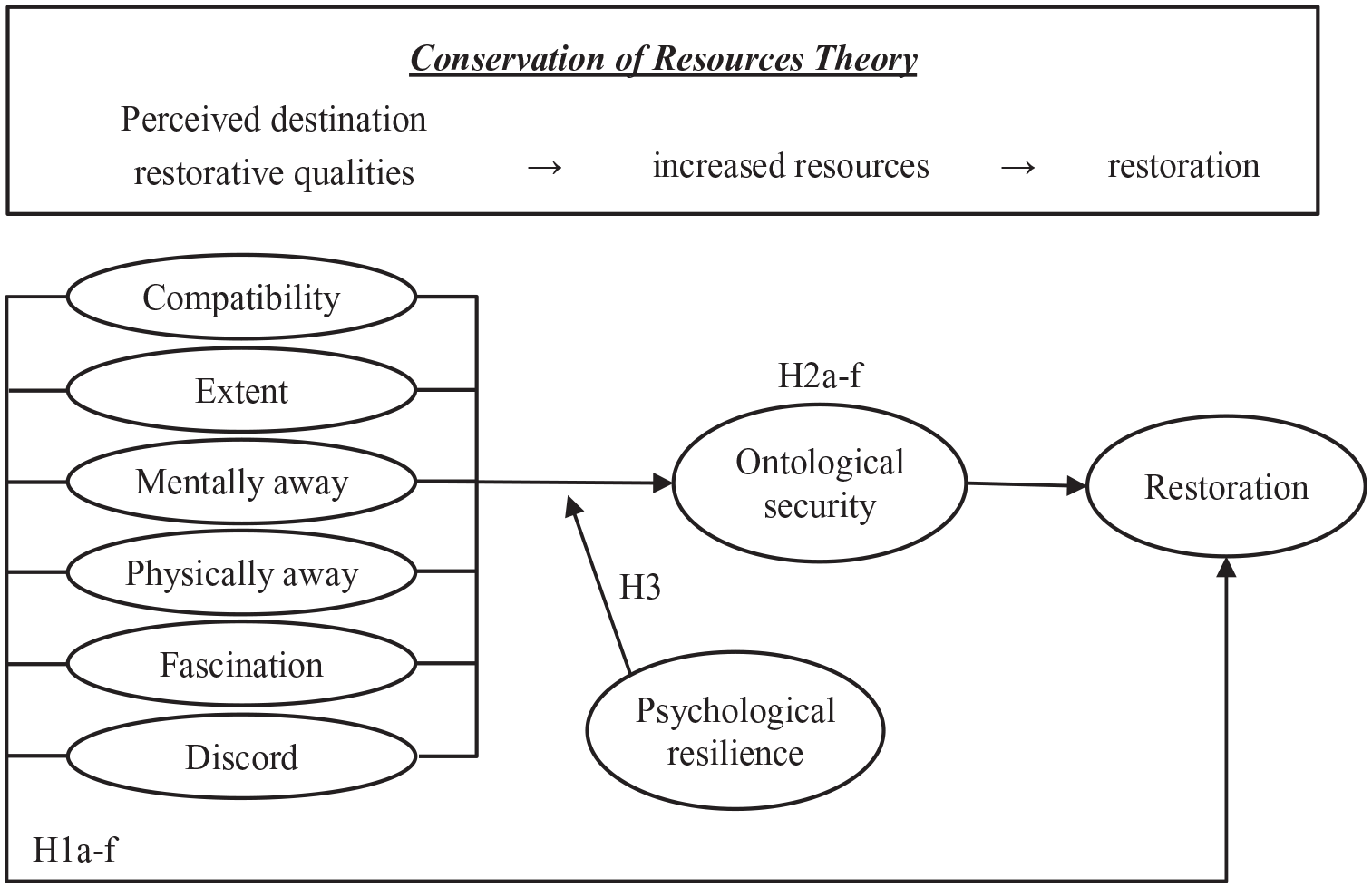
H1: Perceived destination restorative qualities are positively related to restoration outcome. Specifically, compatibility (H1a), extent (H1b), mentally-away (H1c), physically-away (H1d), fascination (H1e), and discord (reversed score) (H1f) are positively related to restoration outcome.
The Mediating Role of Ontological Security
In contemporary life, perceived threats to everyday health and security are mounting, which leads to the sustained depletion of psychological resources, and a growing sense of personal insecurity (Campbell et al., 2020; Giddens, 1984). Ontological security is a term coined by psychologist Laing (1960, p. 39) to describe the need for a person to “have a sense of his/her presence in the world as a real, alive, whole, and in a temporal sense, a continuous person.” More recently Phipps and Ozanne (2017, p. 362) succinctly explained ontological security as “an unconscious need to feel existentially secure.” Individuals are likely to experience ontological insecurity stemming from perceived lack of order, meaning, and continuity (Xu et al., 2020). Ontological security is a positive psychological resource which people are motivated to maintain and protect (Areni, 2019). Wickens (2002) postulated ontological security feeds into a variety of affective, cognitive and behavioral outcomes, and offers a sense of continuity. However, despite the increasing quest for ontological security in our daily lives, its important role as a fundamental psycho-social need remains largely neglected by tourism scholars.
This paper incorporates ontological security as a critical resource within the conservation of resources theory. Conservation of resources includes four main types of resources individuals value, specifically objects, conditions, personal characteristics, and energies (Hobfoll et al., 2018). An individual’s developed sense of ontological security is an important part of what is termed a “personal characteristics resource,” which is particularly valuable when the individual encounters stressful circumstances (Areni, 2019; Liu, Moyle, et al., 2022). Ontological security encompasses the fundamental human requirement for stability, consistency, and a defined sense of self within their social environment (Phipps & Ozanne, 2017). In the context of wellness tourism, the concept of ontological security emerges as an important and highly relevant perspective, as it provides a nuanced framework for scrutinizing the intricate dynamics involved in how tourists negotiate and cope with stressful situations, which inherently entails a process of resource loss (Xu et al., 2020). Through the lens of ontological security, this research delves into resource conservation strategies in which wellness tourists endeavor to achieve a state of stable and balanced resources, thus maintaining and promoting physical and mental health.
In the tourism context, the role of ontological security has been sporadically considered in pilgrimage tourism (Nilsson & Tesfahuney, 2018), coastal tourism (Wickens, 2002), and social media usage (Areni, 2019), where these studies generally argue a sense of being astray or disoriented drives people to look for solutions beyond the flow of daily routine and seek answers in restorative experiences (Nilsson & Tesfahuney, 2018). Recent literature delves into the idea of safety, akin to ontological security, illustrating that ensuring safety for tourists at the destinations they visit is crucial not only for their enjoyment and experiences but also as a decisive factor in the success of the destination (Akamavi et al., 2023; C. Xie et al., 2021). Threats to individuals’ ontological security can lead to feelings of uncertainty, anxiety and stress, and threat-induced disruptions can potentially be addressed by wellness tourism. The drive for ontological security, in part, urges tourists to reinforce psychological resources by experiencing the perceived destination restorative quality dimensions of compatibility, extent, mentally-away, physically-away, and fascination. Following this rationale, perceived destination restorative qualities can re-establish an individual’s sense of ontological security as a critical psychological resource, thus leading to a desirable restoration outcomes. Accordingly, the following hypothesis thus is proposed:
H2: Ontological security plays a mediating role in the relationship between perceived destination restorative qualities and restoration outcome. Specifically, ontological security plays a mediating role in the relationship between compatibility (H2a), extent (H2b), mentally-away (H2c), physically-away (H2d), fascination (H2e), and discord (H2f) and restoration outcomes.
The Moderating Role of Psychological Resilience
Theories of resilience originated in ecology where Holling (1973) defines it as a system’s ability to withstand disturbances and changes and maintain its basic functions. Its conceptualization has been extended to other scholarly inquiries such as psychology where the concept of “psychological resilience” denotes the ability of a person to bounce back following stressors or other adverse situations (Anasori et al., 2023). In terms of conservation of resources, psychological resilience is a significant internal resource foundation for facilitating a quick recovery despite stress and pressure (Mao et al., 2021). The recent remarkable growth of conceptually related research notwithstanding, there is a lack of in-depth investigation into how psychological resilience influences the effectiveness of perceived wellness destination restorative qualities in promoting restoration outcomes.
Resilience theories are rapidly emerging as a new focus of tourism research endeavors in an effort to understand tourists’ capabilities to cope with external or internal threat-induced disruptions (Guo et al., 2018). Prayag et al.’s (2020) study has demonstrated that psychological resilience can lessen the negative psycho-social outcomes of earthquakes (e.g., depression and anxiety) on individuals and concomitantly boost life satisfaction. In addition, a high level of psychological resilience can contribute to a tourist’s positive psychological resource conservation and reduce resource loss, thereby improving positive behavior and attitudes while reducing negative ones (Abbas et al., 2014; Chowdhury et al., 2019; Prayag et al., 2023). For these reasons, this research suggests that tourists with higher psychological resilience are better equipped to handle mental stress, potentially reducing the strength of the positive relationship between perceived destination restorative qualities and ontological security when compared to those with lower psychological resilience. As such, we hypothesize that the positive impact of perceived destination restorative qualities on ontological security would decrease as psychological resilience increases. The following hypothesis thus is proposed:
H3: Psychological resilience plays a moderating role in the relationship between perceived destination restorative qualities and ontological security. Specifically, the positive effect of perceived destination restorative qualities on ontological security diminishes as psychological resilience increased.
As shown in Figure 1, building on conservation of resources theory, this research aims to examine the influence of perceived destination restorative qualities on restoration outcomes. Furthermore, as suggested by the literature, the mediating role of ontological security and the moderating role of psychological resilience are incorporated into the proposed conceptual framework below.
Conceptual framework.
Methodology
Research Site
The study was conducted in the county of Shizhu which is located in the east of Chongqing province, southwestern China. Shizhu county has gained the reputation as one of the best alpine ecological leisure areas in China, with forests, grasslands, streams, lakes, Karst caves, canyons, and other natural landscapes being suitable for leisure, vacation, sports, fitness and health care (Liu, Li, et al., 2022). According to the local government’s annual report (2021), 75% of the area of Shizhu county is located between 800 and 1,900 m above sea level, leading to an average annual temperature of 16.5°C, which is optimal for human habitation. Shizhu county is acknowledged as one of the most renowned wellness tourism destinations in China (He, Liu, & Li, 2022). For example, Shizhu county is listed as “one of the top 60 counties with sustainable development capacity in China’s wellness industry” in 2020 and “one of the most representative health-longevity counties in China” (He et al., 2023). This wellness destination was also awarded the title of “home of healthy food in China.” Economically, wellness acts as a pillar industry in Shizhu county as demonstrated by local industry added value of the wellness economy reached 50.2% of GDP (Government Work Report of Shizhu County, 2021). Against the background of rural revitalization in China, the government of Shizhu county is committed to invigorating rural industries by promoting the wellness tourism industry.
According to the Government Work Report of Shizhu County in China (2021), there are six wellness aspects that have been advertised to attract wellness tourists (noting this list is not exhaustive): (1) Therapeutic landscape: this encompasses wellness attractions like wellness resorts, gardens, forests, lakes, and natural scenic spots; (2) Chinese traditional medicine: Shizhu county offers opportunities for experiencing Chinese traditional medicine, with options such as coptis chinensis and polygonatum; (3) Healthy cuisine: visitors can enjoy nutritious local dishes, such as 莼菜 (“watershield”), as part of their wellness journey; (4) Local culture: the county boasts its rich local culture, featuring local celebrities and historical events that add value to the wellness tourism experience; (5) Wellness-oriented accommodation: Shizhu county provides wellness retreat centers that offer dedicated spaces for activities like spa treatments, meditation, mindfulness practices, and massages; and (6) Sports and recreation: the region hosts a variety of sports and physical activities, including national sports brand events like Tai Chi, Chi Kung, yoga, bicycle riding, canoeing, and open water swimming. In recent years, the wellness reputation of Shizhu county has attracted over 56 million wellness tourists, generating tourism income of 35.2 billion RMB (Liu, Li, et al., 2022).
Measurement
This study adopted previously validated scales to ensure the validity and reliability of measurement. For the perceived destination restorative qualities scale, G. Chen et al.’s (2017) study suggested the exclusion of the “discord” dimension in light of potential recall bias when approaching participants, which had been identified as a limitation in earlier research. This research, however, mitigated this concern by engaging with participants during a trip. Consequently, to achieve a full and comprehensive understanding of perceived destination restorative qualities, we retained all six original dimensions in this paper (X. Y. Lehto, 2013; X. Lehto et al., 2017). To help reduce acquiescence bias, the reverse-worded items of discord were used for measurement. Subsequently, to keep consistency with the other five dimensions during the data analysis process, the score on this subscale of discord was reversed. Concomitantly, for other variables in the scope of this paper, seven items were used to measure ontological security (Xu et al., 2020), six items for measuring restoration outcome (Tyrväinen et al., 2014), and four items for measuring psychological resilience (Prayag et al., 2020). Seven-point Likert scales were used to measure key variables ranging from “strongly disagree = 1” to “strongly agree = 7.” The detailed scale items of each construct can be seen in Table 3. Finally, the questionnaire was also designed to collect the participants’ sociodemographic information.
Sampling and Data Collection
This research employed a questionnaire survey of wellness tourists in Shizhu county conducted in July 2021. More than 10 trained research assistants collected data in several popular wellness resorts located in Shizhu county. The participants were approached in rest areas in the wellness resorts so that they could respond the survey in comfort. We followed a four-step process to verify sample eligibility: (1) we selected Shizhu county as our research location, renowned as one of China’s premier wellness tourism destinations (this deliberate selection increases the probability of enlisting genuine wellness tourists as government statistics confirm that visitors primarily travel to this destination for the six wellness-related reasons detailed in section of “Research Site”); (2) potential participants had to satisfy the screening questions, such as “are you traveling in Shizhu county for wellness or health purposes?” to ensure their eligibility—consequently, only participants whose responses align with wellness and health-related interests (such as seeking wellness activities and relishing nutritious cuisine) were eligible to complete the questionnaire; (3) in the opening section of the questionnaire, a concise overview of wellness tourism was provided, ensuring that eligible participants could comprehend of the essence of wellness tourism; (4) additional information about wellness tourism was supplied by the research assistants when requested by the participants. As an incentive, the participants were given 10 RMB upon they completed the survey. A valid sample of 942 cases was achieved from the initially distributed set of 1,029 participants. Table 1 shows the sociodemographic profile of the collected sample.
Sociodemographic Profile of Participants (N = 942).
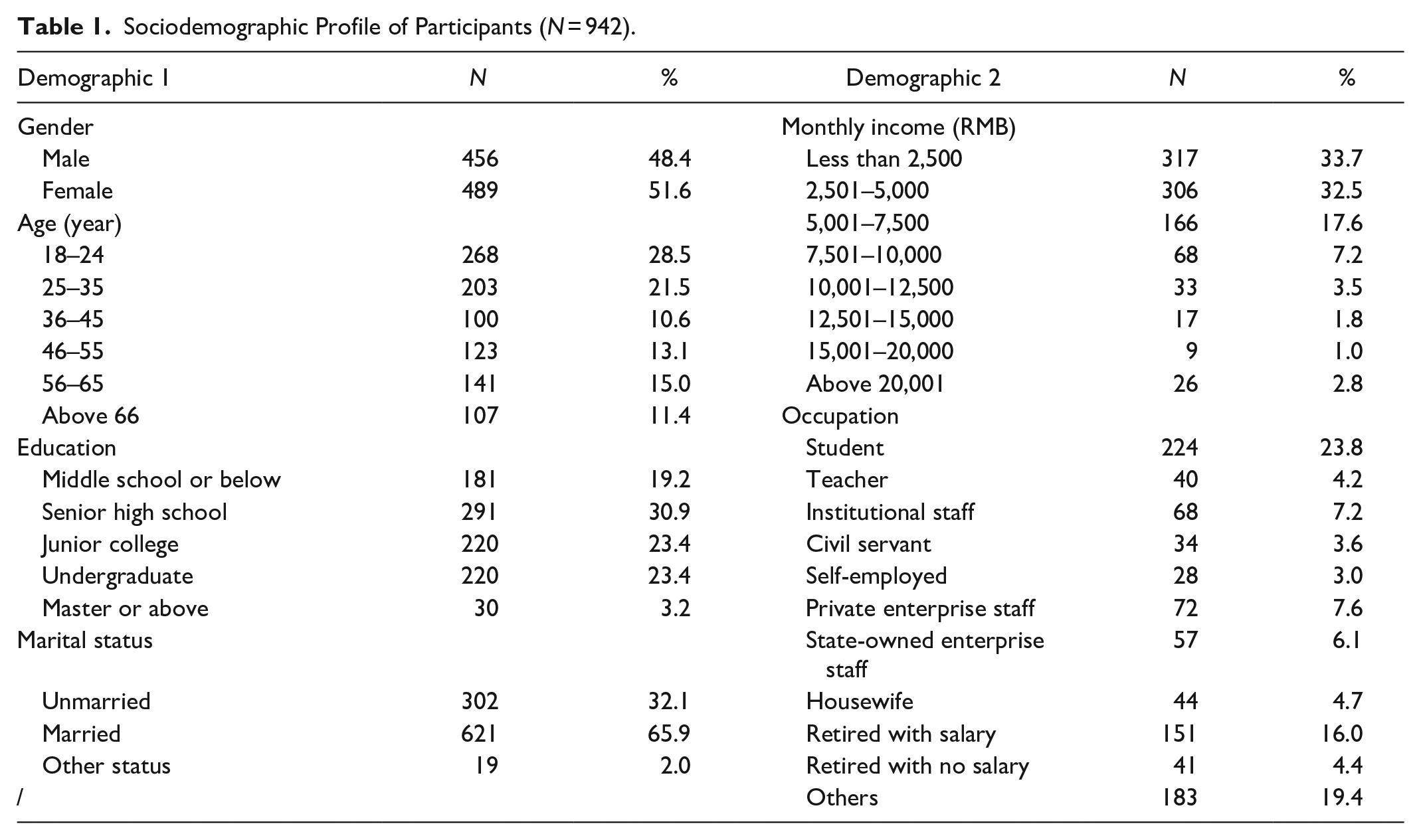
Among the sample of 942 Chinese wellness tourist, 51.6% were female and 48.4% were male. The participants’ average age was 31.6 years, with an age range spanning from 18 to 87 years. The majority of participants had completed at least a senior high school education (80.9%). Of the participants, 65.9% were married, and 83.8% had a monthly income of less than 7,500 RMB. Approximately a quarter of the sample consisted of students (23.8%), followed by retired individuals receiving a salary (16.0%). Travel motivations predominantly centered around the following categories: proximity to nature (69.3%), relaxation (53.7%), and engagement in wellness activities (50.5%). Participants were also requested to evaluate the salience of their health goals (with a mean score of 5.74), as measured using two items from He, Liu, and Li’s (2022) study, suggesting that the sample exhibited a strong emphasis on wellness-related factors. On average, the duration of wellness trips was 3.7 nights, and the sample had visited Shizhu approximately 2.3 times prior this survey.
Data Analysis
Data Screening
A set of procedures was adopted to ensure the eligibility of data before transitioning to the formal analysis. First, missing data was imputed using the corresponding sequence mean. Subsequently, the results of skew (range −1.31 and −0.27) and kurtosis (range −0.99 and 1.78) analysis were well within the acceptable range between −3 and 3 (Hair et al., 2010), confirming that the data met the requirement of normality. Finally, Harman’s one-factor test was utilized for disconfirming common method bias. The one-factor model showed a poor fit to the data (χ2/d.f. = 12.39, CFI = 0.70, TLI = 0.61, RMSEA = 0.13, SRMR = 0.10), indicating the issue of common method bias is not serious in the study measurement (Li et al., 2021).
Measurement Model
Internal consistency and composite reliability were examined using SPSS 24.0. The measurement’s internal consistency was confirmed using a Cronbach’s alpha cut-off of above .80 for each factor (Nunnally, 1978), and a composite reliability value of above .70 (Bagozzi & Yi, 1988). Confirmatory factor analysis was performed using Mplus 7.0 to examine the validity of the structure model. The measurement model showed an acceptable model fit: χ2/d.f. = 2.59, CFI = 0.92, TLI = 0.92, RMSEA = 0.06, SRMR = 0.07. All estimations of the standardized factor loading were higher than 0.70 (Fornell & Larcker, 1981). All values of average variance extraction (AVE) were higher than 0.60 indicating convergent validity (Fornell & Larcker, 1981). Meanwhile, by comparing the square root of AVE (i.e., values calculated on the diagonal in Table 2) with the highest correlation coefficient in the corresponding row and column, discriminant validity of each variable was ensured because the former is higher than the latter. The results of the measurement model are displayed in Table 3.
Results of Convergent and Discriminant Validity Analysis.
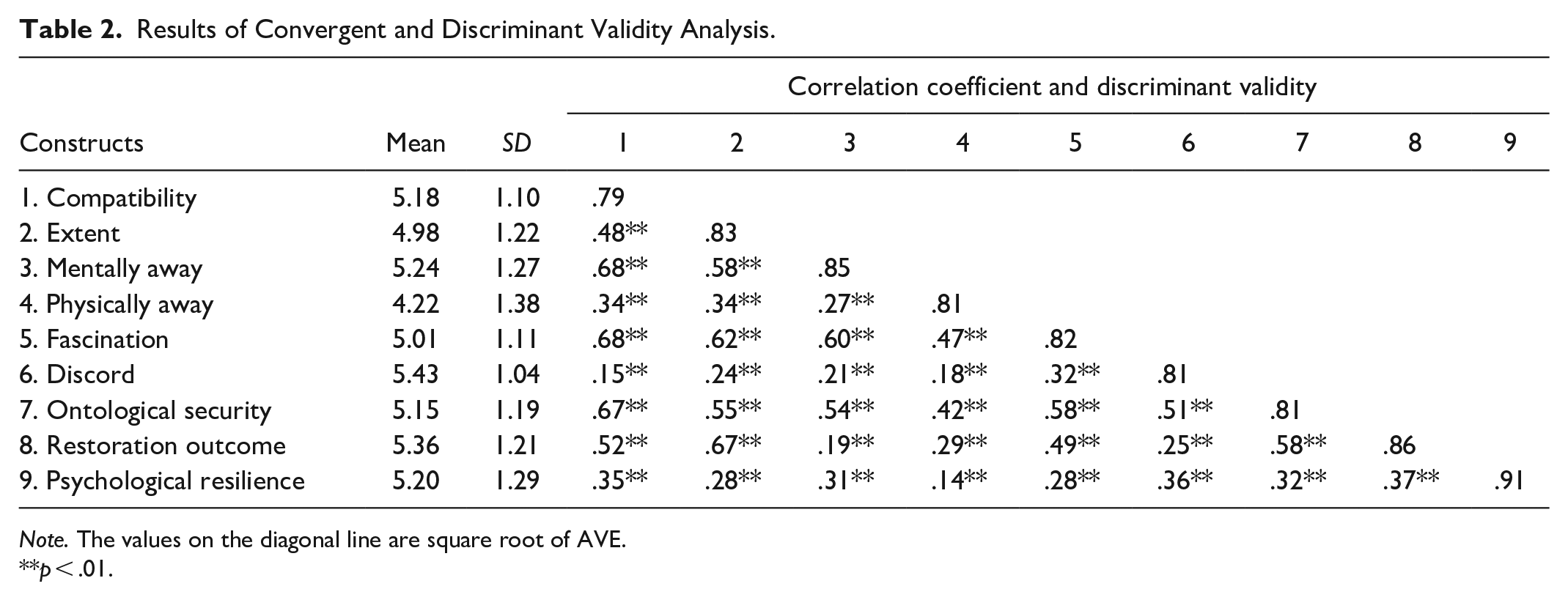
Note. The values on the diagonal line are square root of AVE.
p < .01.
Results of the Measurement Model.
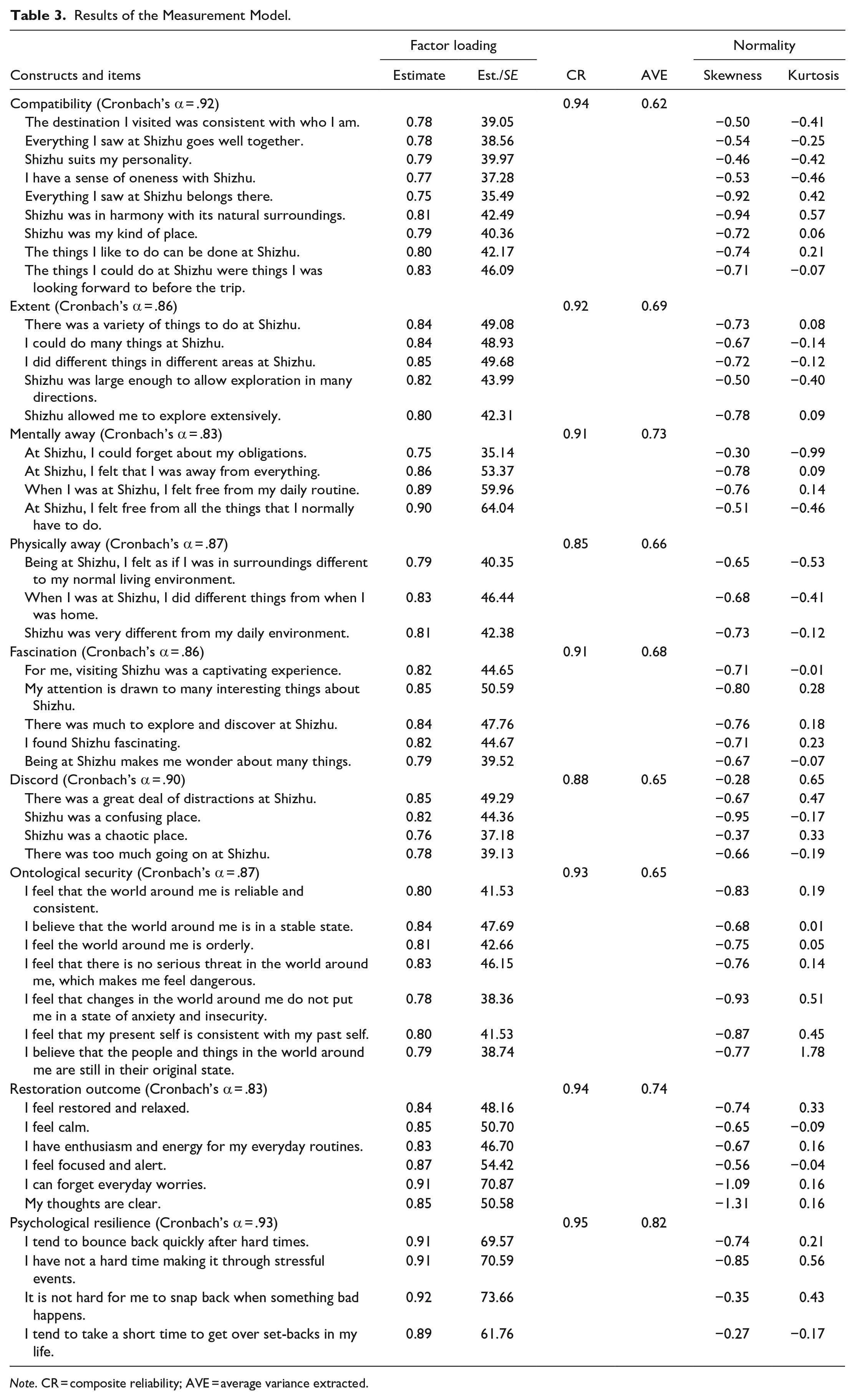
Note. CR = composite reliability; AVE = average variance extracted.
Structural Model
Structural equation modeling (SEM) was employed to test the hypotheses proposed in the conceptual model. The goodness-of-fit statistics indicated a good model fit to the data (χ2/d.f. = 2.19, CFI = 0.94, TLI = 0.93, RMSEA = 0.03, SRMR = 0.05). The analysis results supported the research hypotheses regarding the direct pathways. Specifically, compatibility (β = .64, p < .001), extent (β = .54, p < .001), mentally-away (β = .87, p < .001), physically-away (β = .38, p < .01), fascination (β = .44, p < .001), and discord (reversed score) (β = .61, p < .001) have a significant positive relationship with restoration outcome (H1a-f). In a same vein, the results also show compatibility (β = .35, p < .01), extent (β = .21, p < .01), mentally-away (β = .41, p < .001), physically-away (β = .16, p < .01), fascination (β = .22, p < .01), and discord (reversed score) (β = .28, p < .01) have a significant positive relationship with ontological security. Following this, ontological security was found to play a mediating role in the relationship between compatibility (β = .17, 95% CI: 0.06, 0.29), extent (β = .29, 95% CI: 0.16, 0.38), mentally-away (β = .26, 95% CI: 0.15, 0.27), physically-away (β = .16, 95% CI: 0.06, 0.21), fascination (β = .18, 95% CI: 0.02, 0.18), discord (β = .20, 95% CI: 0.12, 0.36), and restoration outcome (H2a-f) (see Table 4). Taken together, H1a-e and H2a-e were supported.
Results of Hypotheses Testing: H1a-f and H2a-f.
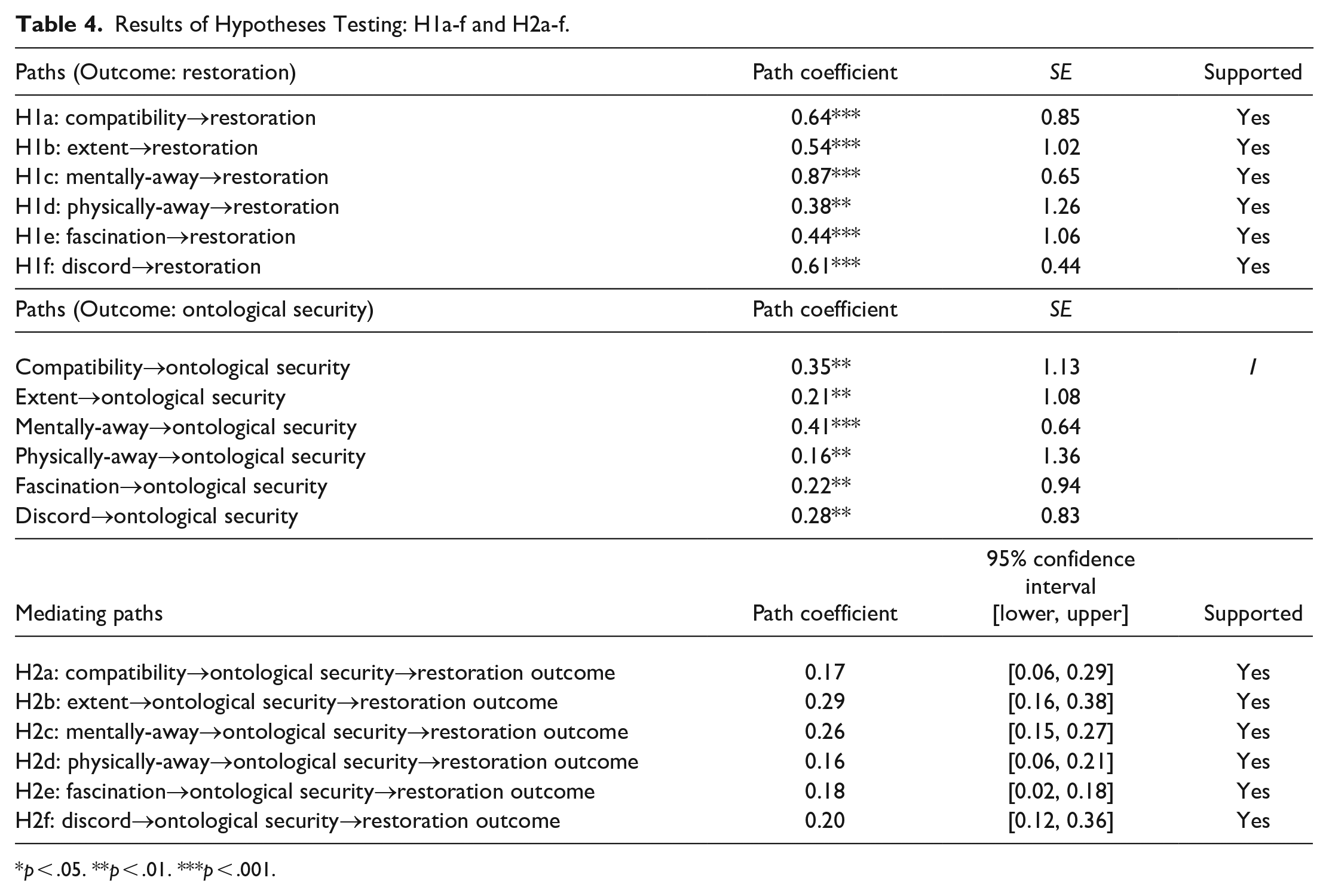
p < .05. **p < .01. ***p < .001.
Latent Moderated Structural Model
The Latent Moderated Structural (LMS) approach was used to test whether psychological resilience, as a continuous latent variable, moderated the effect of perceived destination restorative qualities on ontological security (H3). According to Cheung and Lau’s (2017) recommendation, LMS can be applied if the model fit without the interaction term is acceptable and the factor loadings are significant. Accordingly, we performed a bootstrapping analysis with a size of 1,000, with results revealing that the model without the interaction term had an adequate fit (χ2/d.f. = 2.58, CFI = 0.91, TLI = 0.93, RMSEA = 0.05, SRMR = 0.06). In addition, factor loadings for all measurement items were significant (p < .001). Accordingly, the results of the estimations of the interaction show that the latent interactions between perceived destination restorative qualities and psychological resilience have a significant effect on ontological security (β = −.35, p < .001). Furthermore, according to Dawson’s (2014) suggestion, a simple slope analysis was conducted where psychological resilience was divided into a low group and a high group by using the mean ± 1 SD (see Figure 2). Specifically, in the low psychological resilience group, perceived destination restorative qualities had a significant positive effect on ontological security (β = .52, p < .001); by contrast, in the high psychological resilience group, perceived destination restorative qualities still significantly affected ontological security, but the positive effect was weakened (β = .24, p < .05). Thereby, LMS analysis verified H3, which means all research hypotheses of this study were supported.
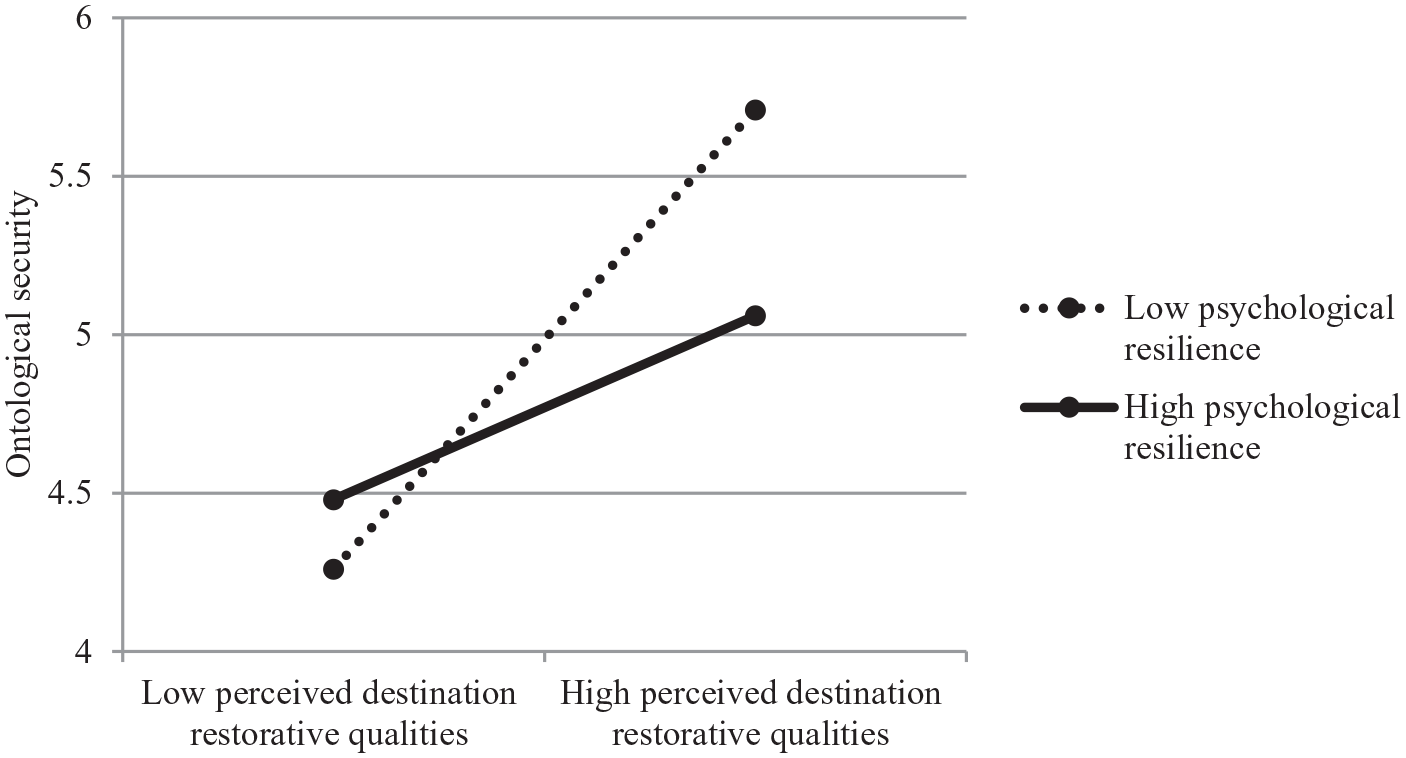
The moderating effect of psychological resilience.
Discussion
Drawing on conservation of resources theory, combined with existing knowledge in tourism and conceptually related areas, this manuscript conducted an empirical assessment of the relationships among perceived destination restorative qualities, ontological security, restoration, and psychological resilience in a wellness tourism context. All three hypotheses, which are summarized in Table 4 and Figure 2 (H1–H3) were supported. This research examined the influence of perceived destination restorative qualities on restoration outcomes, unearthing the underlying mechanism behind this effect, yielding findings with both theoretical contributions and practical implications.
Overall, this paper affirms the consistency of perceived destination restorative qualities when applied to the wellness tourism context. Furthermore, the findings of this paper indicate that the six dimensions representing perceived destination restorative qualities among Chinese wellness tourists align with the restorative dimensions previously proposed and empirically validated in Western contexts (X. Lehto et al., 2017). Specifically, the highest mean value was observed in the discord dimension (M = 5.43). This occurrence could potentially be attributed to the influence of Chinese cultural beliefs rooted in Confucianism, such as the emphasis on “achieving harmony between humans and nature” and “avoiding confrontation” (G. Chen et al., 2017; Hsu & Huang, 2016). The mentally-away dimension (M = 5.24) yielded the second-highest score, followed by compatibility (M = 5.18), demonstrating that tourists can easily escape from daily life, by acquiring a sense of matching with the restorative environment of a destination. Fascination (M = 5.01) and extent (M = 4.98) were roughly at the same level, which means the restorative environment has an ample amount of visible and experiential elements to support the restoration process, and evokes fascination. Physically-away (M = 4.22) had a relatively lower score, suggesting experiencing a wellness tourism destination with restorative properties has a moderate influence on the physical contrasts between a destination’s environment and a visitor’s home environment. The six domains of wellness destination properties account for how Chinese wellness travelers internalize the restorative aspects of wellness tourism experiences.
Our empirical findings, collected from a survey of 942 Chinese wellness tourists, suggest that the dimensions of compatibility (H1a), extent (H1b), mentally-away (H1c), physically-away (H1d), fascination (H1e), and (lack of) discord (H1f) are positively related to restoration outcome. In accordance with extant studies on the dimensionality of perceived destination restorative qualities (X. Y. Lehto, 2013; X. Lehto et al., 2017), this paper found tourists interacting with an environment that is rich in inherently therapeutic stimuli promotes their restoration and recovery. The supported hypotheses (H1a-f) verify the importance of perceived destination restorative qualities as part of an on-going process of sustaining a sense of recovery while at a restorative destination (Kirillova & Lehto, 2015; Qiu et al., 2022). Specifically, H1a shows that the compatibility between tourist and destination is critical to forge harmony or connectedness. According to H1b, the scope of a wellness destination necessitates a range of physical or mental exploration, which is a critical driver of restorative experiences. H1c indicates that the quality of a wellness destination helps wellness tourists psychologically escape from their life routines and obligations and facilitates psychological benefits. H1d reinforces the belief that wellness tourists increasingly need to recover their mind and body through physically-away leisure (Hu et al., 2022). H1e informs that inspiring awe in a wellness destination can effectively help wellness tourists recover from attention fatigue. H1f underscores the importance of creating a harmonious and stress-free environment in wellness tourism destinations.
Further, ontological security plays a mediating role in the relationship between compatibility (H2a), extent (H2b), mentally-away (H2c), physically-away (H2d), fascination (H2e), discord (H1f), and restoration outcome. This finding aligns with Wickens’s (2002) research, which proposed that religious tourism serves to provide ontological security, helping tourists experience a sense of stability and predictability, thereby reducing stress. The supported hypotheses (H2a-f) demonstrate perceived destination restorative qualities in wellness tourism offer a unique lens through which to explore the profound effects of wellness travel on an individual’s sense of stability, predictability, and meaning in their lives (Farkić et al., 2020).
Psychological resilience was included as a moderating factor, and the results of LMS analysis indicate psychological resilience indeed has a moderating effect on the relationship between perceived destination restorative qualities and ontological security. This indicates the positive effect of perceived destination restorative qualities on ontological security diminishes as psychological resilience increases. This finding indicates wellness tourists are renewing their pursuit of resiliency and seeking links with restoration and wellbeing, reinforcing the belief that resilience is a positive and ideal personal trait that helps an individual cope with multiple adversities (C. Xie et al., 2021).
Theoretical Contributions
Prior research on wellness tourism is predominantly focused on the outcomes of wellness tourism experiences (He, Liu, & Li, 2022, 2023; Majeed & Ramkissoon, 2020; Voigt et al., 2011), with little attention paid to its antecedents (Y. Yang & Chen, 2021). Through a critical examination of the role of perceived destination restorative qualities in a wellness destination in fostering a restorative experience, this study aligns with the conclusion of Li et al. (2023), who indicated that the restorative environment is a pivotal element of the wellness experience, shaping positive emotions, and behavioral intentions. Subsequently, by drawing on conservation of resources theory, this research was able to integrate key tenants from environmental psychology and health psychology to supplement existing knowledge which underpins the restorative qualities from wellness tourism experiences.
This manuscript assessed how perceived destination restorative qualities of a wellness destination can facilitate subsequent restoration outcomes. Despite the growing interest related to perceived destination restorative qualities, this multi-dimensional concept has been relatively understudied in wellness travel settings due to being predominantly located in the field of environmental behavior (i.e., perceived environmental restorative quality) (G. Chen et al., 2017). Engagement with perceived destination restorative qualities presents a unique and timely opportunity to contribute to the tourism literature by providing a framework for understanding how tourists perceive wellness destinations for their potential to improve the physical, mental, and emotional well-being of tourists (Hu et al., 2022). By examining how tourists perceive the restorative qualities of a destination, tourism researchers can reassess the motivations, emotions, and decision-making processes of wellness tourists, which are central topics in tourism psychology and behavior studies (Gill et al., 2019). The search for restorative experiences commonly coincides with a preference for natural and pristine environments (Zhai et al., 2023). Research on perceived destination restorative qualities highlights the importance of sustainable tourism practices and the preservation of natural and cultural resources, as degradation of these resources can diminish the restorative qualities of a destination (G. Wang et al., 2022). Consequently, perceived destination restorative qualities contribute to the theoretical foundations of tourism research by expanding the scope beyond economic and sociocultural factors, adding depth to our understanding of the experiential and psychological dimensions of tourism (Kirillova & Lehto, 2015). This research validated the dimensions of perceived destination restorative qualities in a Chinese context, thus ensured its measurement generalizability, echoing G. Chen et al.’s (2017) study who stated it is important to further understand and verify the dimensionality of perceived destination restorative qualities, and empirically examine the outcomes of these qualities by “cross-culturally validating the original perceived destination restorative qualities with Chinese vacationer samples” (p. 1116).
This research enriches conservation of resources theory by incorporating ontological security as the psychological resource, adding emerging knowledge by discussing in detail how perceived destination restorative qualities mitigate daily pressure in the context of wellness tourism. While a wealth of established knowledge exists concerning the resources highly valued by individuals, it is noteworthy that studies in related fields have rarely conducted explicit assessments of ontological security as a psychological resource. This research addresses this gap by empirically examining that perceived wellness destination restorative quality played an important part in assisting tourists to complement the depleted resources in the flow of daily routine, and thus increased ontological security. This finding is in line with Wickens’s (2002) study which posited that the need for ontological security in religious tourism relieving stress for tourists to feel stable and predictable. Also, this study pioneers an empirical analysis on the mediating role of ontological security, unveiling the underlying mechanism explaining how perceived destination restorative qualities boost restorative experiences. Building on Campbell et al.’s (2020) seminal work in consumer behavior, the conceptual framework of this paper is designed to inform the broader landscape of how tourists respond to threat-induced disruption in “times of trouble.”
This research empirically demonstrates that psychological resilience moderates the relationship between perceived destination restorative qualities and restoration outcomes, which indicates response to the dynamic nature change of psychological resources depends on psychological resilience. As a crucial concept of positive psychology, psychological resilience involves a collection of assets and resources in one’s personal psychology and surrounding environment that enhance a tourist’s capacity to adapt and bounce back from stress and threat (Prayag et al., 2020). This paper clarifies the role of psychological resilience in tackling strain and distressing circumstances from the perspective of positive psychology. Additionally, in accordance with conceptually related studies which incorporated psychological resilience in the face of negative events and situation into studies (Anasori et al., 2023; L. P. L. Lin & Hsieh, 2022), the findings indicate wellness tourists are renewing their pursuit of resiliency and seeking links with restoration and wellbeing. This research offers a timely contribution to an analysis of how the positive effect of perceived destination restorative qualities on psychological resources can be amplified, and how the adaptive process can be facilitated, which is valuable in shedding light on the underlying psychological process of individuals coping with hard times and achieving mental restoration.
Managerial Implications
This research provides practical implications for various wellness industry stakeholders. This research not only demonstrates the advantage of enhancing the wellness tourism restorative experiencescape and its subsequent restoration outcomes, but its findings also point to an expedited recovery of the wellness tourism industry post-pandemic. Based on the parameters outlined in this paper regarding the wellness tourism experience, wellness tourism destination marketing organizations can match advertising strategies to meet tourist psychographics, specify the content and characteristics of wellness services and attributes on offer, and define the traits sought in potential employees.
This paper contends the six dimensions of perceived destination restorative qualities are positively related to restoration outcomes, indicating destination marketing organizations in a wellness destination should be aware of the importance of perceived destination restorative qualities-related cues in facilitating the success of wellness tourism programs. For example, advertising information at a wellness destination can be tailor-made to focus on what is congruent with tourist motivations and preferences (i.e., compatibility). In addition, information highlighting the availability of comprehensive wellness tourism service and activities will extend the sufficiency and scope of a destination choice (i.e., extent). Industry practitioners can also actively promote “get-away” activities to encourage tourists to take a break from the pressure of regular routines such as office-work and work-related smartphones (i.e., mentally- and physically-away). Other marketing strategies can emphasize attractive landscapes that have the potential to evoke or enhance tourist aesthetics and relaxation experiences (i.e., fascination). In accordance with He, Liu, and Li (2022) who also highlighted the role of recovery experience of wellness tourism in contributing to increase positive outcomes, the practical suggestions provided in this study could benefit industry practitioners by advancing current understanding of optimizing experience-based management in wellness destinations.
Developing wellness tourism based on perceived destination restorative qualities involves leveraging the inherent features and attributes of various types of tourism destinations to create environments that promote psychological restoration and well-being. In the context of natural and scenic destinations, it could be advantageous to underscore the therapeutic aspects of verdant landscapes, pristine forests, and unspoiled natural vistas. This can be achieved by crafting wellness programs that actively encourage engagement in activities such as immersive forest bathing, invigorating hikes, and serene nature meditation sessions. For adventure and sports destinations, industry stakeholders are well-advised to seamlessly integrate exhilarating adventure experiences with wellness-oriented recuperation strategies. This may involve offering post-adventure relaxation sessions, rejuvenating sports massages, and al fresco yoga sessions designed to aid travelers in recuperating from the physical demands of their adventures. In the realm of cultural and heritage destinations, it may be helpful to highlight the tranquility and reflective atmosphere of historic sites. To this end, wellness experiences like enlightening heritage tours can be curated, allowing visitors to deeply immerse themselves in the rich cultural history and architectural heritage of the destination. In each distinctive category of a destination, it is essential to communicate the perceived destination restorative qualities effectively through marketing materials and experiences. Collaborating with wellness experts, local communities, and wellness providers can help create compelling wellness tourism offerings that align with the perceived destination restorative qualities of each location.
The results suggest that ontological security serves a crucial function in linking perceived destination restorative qualities to restoration outcomes, and thus, the wellness tourism service and products should be strategically designed to enhance the sense of ontological security when tourists frequent a wellness destination. This could be achieved by providing tourists with a sense of safety, stability, and predictability. The mounting pressure in the regular life, especially in the COVID-19 pandemic have dramatically disrupted tourists’ sense of ontological security. As a result, the wellness industry, for example, should prioritize to provide a safe and secure environment for tourists, co-creating a sense of community and belonging and incorporating therapeutic or restorative characteristics (Nilsson & Tesfahuney, 2018) to unconsciously trigger ontological security. In addition, individuals have to invest significant emotional resources in re-establishing the balance of psychological resource stock when ontological security is disturbed (Campbell et al., 2020). Destination marketing organizations can offer opportunities for personal growth and transformation, which can help tourists develop a stronger sense of self and improve their ontological security. Through boosting self-development and enhancing self-identity coherence, stressed tourists are able to “bank” positive psychological resources in the face of negative situations (Faraji-Rad & Lee, 2022).
Despite the positive role of perceived destination restorative qualities and ontological security, destination management organizations should develop tailor-made marketing strategies and recovery plans in terms of wellness tourists’ personal traits. Accordingly, wellness destination managers can be inspired to understand benefit-based wellness tourist segmentation based on psychological resilience or other psychological factors. Specifically, the positive effect of perceived destination restorative qualities on ontological security can be reinforced when it comes to a wellness tourist experiencing a low level of psychological resilience. In this case, wellness destination management organizations should prepare tailored plans related to psychological resilience as it benefits bringing wellness tourists to the destinations and augments the health-enhancement results. By contrast, resilient tourists already have higher perceived safety, so other alternative marketing tools should be used (C. Xie et al., 2023). For instance, destination management organizations can boost the visit intention of high-resilience tourists by altering the marketing mix, such as, free tickets and product discounts, or offering novel and exciting tourism products/experiences, such as, virtual reality (VR) and augmented reality (AR).
Conclusion
This research presents four key theoretical contributions which will advance discourse on perceived destination restorative qualities in wellness tourism. First, this research enriches wellness tourism literature by focusing on the antecedents (i.e., perceived destination restorative qualities) of wellness tourism experiences, explicitly examining how perceived destination restorative qualities of a wellness tourism destination facilitates psychological recovery. Second, this research enhances the generalizability perceived destination restorative qualities’ measurement by validating the dimensionality in a Chinese context. Third, the contribution of this study is to embed ontological security as a psychological resource into the conservation of resources theory, which advances literature on the role of perceived destination restorative qualities in alleviating daily stress in the context of wellness tourism. Fourth, this research unveiled a significant moderating effect of psychological resilience on the relationship between perceived destination restorative qualities and restoration outcomes, examining the boundary conditions underlying the restoration outcomes.
Practically, this research informs that both government bodies and industry stakeholders should take proactive steps to promote and develop wellness tourism, given the increasing prevalence of SHS in our modern society. The demonstrated strong connection between six dimensions of perceived destination restorative qualities and the outcome of restoration underscores the significance for destination marketing organizations in wellness destinations to recognize the role of cues related to perceived destination restorative qualities in promoting the effectiveness of wellness tourism initiatives. In tandem, the success of wellness tourism destinations hinges on more than just the physical services and products offered. It extends to the creation of an environment that nurtures a profound sense of ontological security among wellness tourists. As a result, wellness destinations and the services they offer must be meticulously planned to create an environment where tourists feel safe, emotionally grounded, and spiritually nourished. Lastly, by incorporating wellness tourists’ personal traits (e.g., psychological resilience) into the segmentation strategies, wellness destination managers can gain valuable insights into the diverse needs, preferences, and motivations of wellness travelers, ultimately elevating the quality of the wellness experiences they offer.
It is acknowledged that the representativeness of this research is limited due to sample diversity. Accordingly, the robustness of the findings of this study can be further tested in other countries. Importantly, given that this research was conducted within a COVID-19 pandemic period, it is meaningful to further understand how the impact of the pandemic may have led to significant differences in health-oriented aspects of wellness tourists between during and post pandemic (He et al., 2021; He, Liu, Song, & Li, 2022). Additionally, COVID-19 has fueled fear of contagion and discrimination against tourists from the center of the pandemic (F. X. Yang & Wong, 2020), leading to a broader discourse of how self-esteem and social identity influence the resource conservation strategies which tourists utilize to conserve their ontological security. Thus, it is highly recommended to monitor the effects of the pandemic based on the conceptual model. Methodology-wise, restoration outcomes were assessed by self-report method, which could lead to subjective bias in the measurement. Future research should complement existing self-report approaches by incorporating physiological metrics (e.g., systolic and diastolic blood pressure, and pulse rate) for evaluating the relaxation effects of perceived destination restorative qualities, adding further reliability to the self-report measures (Ohe et al., 2017). Future conceptually related studies are suggested to involve other variables such as personal characteristics and support services, to consider deeper engagement on the constructive scholarly debate of SDG#3: Ensure healthy lives and promote well-being for all at all ages (United Nations, 2015).
Footnotes
Declaration of Conflicting Interests
The author(s) declared no potential conflicts of interest with respect to the research, authorship, and/or publication of this article.
Funding
The author(s) disclosed receipt of the following financial support for the research, authorship, and/or publication of this article: This project is funded by the National Natural Science Foundation of China (No. 42371242).
