







Abstract
The principle of “entropy increase” is a universal law describing a natural progression from order to disorder. This paper is innovatively the first to take the principle as a theoretical basis for assessing how tourism influences human health from a sociomateriality perspective. Despite a growing emphasis on the intersection of tourism and health, there remains a need for further theoretical development in this evolving field—particularly tourism’s positive and negative impacts on physical, mental, and social health based on physiological measures. From an entropy point of view, positive travel experiences could help maintain a low-entropy state (i.e., bodily health) by influencing four key systems. Conversely, negative travel experiences could increase entropy and lead to health issues. An innovative conceptual framework is proposed to illustrate the nexus between tourism and health. This interdisciplinary investigation illustrates a transition in the research paradigm from “health tourism” to “health and tourism.”
Introduction
Limited research has addressed how tourism may influence personal health based on physiological indicators (e.g., heart rate, blood pressure, blood sugar, salivary amylase, pain level, disease symptoms). Individuals’ subjective perceptions tend to be prioritized, but self-report measures are not always optimal. Fully answering the question “How does tourism affect people’s physical and psychological health?” necessitates an interdisciplinary approach merging the social and health sciences. Relevant theoretical underpinnings are essential in order to guide research and yield actionable insights.
Tourism scholarship is evolving, with a growing emphasis on theoretical foundations to elucidate complex phenomena (McCabe, 2024). Challenges nonetheless persist in integrating diverse theories and transcending disciplinary boundaries (Williams & Baláž, 2015). McCabe (2024) pointed out the absence of theoretical bases, particularly for emerging topics. Tourism and human health constitute one such lacuna (Wen, Kozak, Jiang, 2022). Despite the application of theories related to positive psychology, such as bottom-up theory, top-down theory, the PERMA model, and flow theory (Chen & Petrick, 2013; Wen, Zheng, Hou, et al., 2022), most of these frameworks reside within social science and concern tourism’s benefits for emotional and mental well-being. Associated aspects have been tracked in tourism contexts using subjective indicators (Uysal et al., 2016). Yet tourism does not always improve health, and the field lacks theories that elucidate tourism’s positive and negative health-related impacts (Hu, Wen, Zheng, et al., 2023). Discourse on the potential effects of tourism on people’s physical, mental, and social health using objective (e.g., physiological) indicators also remains limited. The general concept of health encompasses disciplines across the natural and social sciences. It is accordingly vital to draw from broader knowledge bases (e.g., in health science) to determine how tourism may affect health.
The concept of entropy refers to a measurable physical property linked to chaos, disorder, randomness, or uncertainty within a system. According to the second law of thermodynamics, in an isolated system, things tend to spontaneously and irreversibly move toward an increase in entropy (i.e., disorder). Once entropy peaks, the system experiences severe disturbance, resulting in its demise (Wang, 2022). This phenomenon is so prevalent that it touches all fields. It captures the ultimate law of cosmic evolution wherein everything in the universe—including life—is moving toward a state of increasing disorder in a holistic sense (Wand & Sharp, 2018). This universal law has been adopted in domains such as physics, chemistry, health science, ecology, economics, and sociology (Silva & Annamalai, 2008). In health science, the idea of “entropy increase” has been used to interpret the deterioration of human health as well as the aging process. Health signifies a state where the body is in a high-ordered, low-entropy state in terms of structure and function; disease implies that an organism’s structure and function are in a disordered or high-entropy state. People can improve their self-organizing, self-defense, self-healing, and anti–wear-and-tear abilities through medical interventions or healthy lifestyles. Doing so helps combat entropy increase, thereby enhancing health (Wang, 2022).
Although it is currently infeasible to halt the entropy increase in humans, this process can be slowed (Wang, 2022). Might tourism contribute to its deceleration? Tourism may hold value for public health beyond conventional leisure and recreation (Wen, Kozak, Jiang, 2022). As an integral environmental component, travel can elevate people’s physical and mental health through positive experiences (e.g., physical activities, novel stimulation, and social interaction). The idea of travel therapy has been proposed to describe such health benefits (Hu, Wen, Zheng, et al., 2023). Travel therapy applies to populations in various states, from optimal to suboptimal health (i.e., an intermediate state between health and disease) and even specific conditions (Wen, Zheng, Hu, 2022). Despite its promise, the notion of travel therapy is in its infancy. It is unclear how travel specifically affects human health—especially in the absence of a solid theoretical backing. An individual’s progression from a state of health to suboptimal health and then to disease aligns with entropy increase (i.e., moving from order to disorder; Wang, 2022). Indeed, tourism’s role in improving people’s health is akin to combating entropy increase. Conversely, tourism can involve negative experiences that potentially lead to health problems, paralleling the process of promoting entropy increase. The intersection of tourism and health blends the social and health sciences to signal a paradigm shift in tourism research from single disciplines to a cross-disciplinary approach. It thus transcends the boundaries of social science, highlighting a move from “health tourism” to “health and tourism” on the basis of entropy. We propose taking the principle of entropy increase as a foundation for understanding how tourism may affect health. Our interdisciplinary effort addresses a pertinent question: how might positive travel experiences help maintain the human body’s low entropy (i.e., a state of health)?
The Principle of Entropy Increase
Entropy is a fundamental concept in thermodynamics, proposed by the German physicist Rudolf Clausius in 1865. Entropy originally referred to the total amount of energy that could not be used to perform work (Wang, 2022). This function captures a system’s thermodynamic state (i.e., the macroscopic physical meaning of entropy; Wand & Sharp, 2018). Boltzmann interpreted entropy in a microphysical manner: he defined it in statistical mechanics as a measure of the disorder or chaos within a system. When a system moves toward a more organized state, entropy is lower; it rises as the system tends toward greater disorder. The second law of thermodynamics states that the total entropy of any spontaneous process in an isolated system does not decrease. Rather, it either remains constant or increases. The system thus always tends toward a higher-entropy state (i.e., more disorder and chaos) as indicated by the principle of entropy increase (Buonsante et al., 2016; Wang, 2022). Entropy has since been integrated in a variety of fields (Silva & Annamalai, 2008). Notable contributions have involved Gibbs entropy (i.e., entropy + probability theory) and Shannon entropy (i.e., entropy + information theory; Buonsante et al., 2016). Shannon put forth the idea of Shannon entropy, also termed information entropy, in 1948 to measure the uncertainty or the amount of information affiliated with a random variable. The greater an event’s ambiguity, the higher its entropy, demonstrating that a larger amount of information is needed for clarification. Shannon entropy suggests that two seemingly disparate disciplines, thermophysics and information theory, can be linked through the lens of entropy. The universality of entropy increase makes it a powerful theoretical backdrop to explain systems’ evolutionary trends. Everything—whether in nature, society, or the universe—is evolving toward a more disorderly and complex state on microscopic and macroscopic levels (Wand & Sharp, 2018; Wang, 2022).
Entropy increase has been adopted in the life sciences to rationalize living organisms’ structure, functioning, and energy use (Buonsante et al., 2016). This framework expands the understanding of how living systems sustain ordered states. Applying entropy increase to these systems carries far-reaching implications: it suggests that systems tend to be more disordered and that the process is generally irreversible, with only the rate of entropy increase varying (Berretta & Moscato, 2010). Different from non-living systems, living systems can slow entropy increase or even decrease entropy throughout certain periods (e.g., early stages of development and growth) or under specific circumstances (e.g., with adequate nutrition and efficient metabolism; Wang, 2022). Living systems are open and have highly organized, dissipative structures that enable them to obtain negentropy (i.e., entropy decrease or order) by exchanging materials and energies with the external environment (Wand & Sharp, 2018). This characteristic permits living systems to mitigate the entropy increase and maintain a low-entropy state or homeostasis. In the book What is Life?, Nobel-laureate physicist Erwin Schrödinger pointed out that living organisms feed on negative entropy. This statement may be somewhat exaggerated but partly explains how living organisms preserve an ordered state (Butler, 1946).
In health science, entropy increase can explain human disease and aging (Buonsante et al., 2016). A low-entropy state indicates a highly organized structure and well-coordinated bodily functions. In this condition, the body can cope with external pressure and maintain normal physiological functions and overall health (Silva & Annamalai, 2008). Entropy increase is believed to be responsible for deteriorating human health and accelerated aging. This process reflects a progressive decline in an organism’s order at several levels (e.g., molecular, cellular, tissue, organismic, or systemic). Factors such as cellular damage, reduced function, and inflammation due to chronic illness and aging lead to chaos and disorder within the body (Berretta & Moscato, 2010; Wang, 2022). Entropy increase coincides with problems such as cancer, metabolic diseases, and viral and bacterial infections (Silva & Annamalai, 2008; Wand & Sharp, 2018). Scholars continue to seek ways to counteract this increase. To date, no one-size-fits-all solution has been identified. A typical approach involves reducing entropy increase as much as possible (Berretta & Moscato, 2010; Wang, 2022). This principle has permeated the social sciences as well, namely in economics, sociology, and management. Entropy increase has been used to trace the dynamics of markets and economic systems, organizational transformation, and the growing complexity of social systems (Jakimowicz, 2020). Researchers have further proposed social entropy theory to evaluate social behavior (Bailey, 1990). The theory has yet to appear in tourism and hospitality apart from the use of information entropy weights to monitor destination metrics (e.g., competitiveness, socio-ecological status, and tourism and performance; Tang, 2015).
Tourism and Human Health
Tourism, a popular recreational activity, is closely tied to human health. Tourists may face challenges such as infectious diseases, accidents, injuries, violence, water and food safety issues, and concerns related to inappropriate tourism engagement (Hu, Wen, Zheng, et al., 2023; Page, 2009). Negative travel experiences could thus lead to health problems. A prominent example is the public health crisis of COVID-19. While the pandemic reinforced the link between tourism and human health, this prospect merits a closer look. Early explorations of tourism and AIDS inspired tourism and hospitality scholars to discuss travel-related health concerns, including infectious disease risks and wildlife encounters (Hu, Wen, Zheng, et al., 2023). The interdisciplinary field of travel medicine has also been brought into tourism and hospitality to prevent and manage health problems (Page, 2009). However, research in this area remains inadequate and lacks theoretical support.
Tourism’s possible advantages for human health are also worth noting: positive travel experiences could enhance individuals’ physical and mental wellness through exposure to novel environments, engagement in physical activities and social interaction, and the fostering of positive emotions (Hu, Wen, Phau, et al., 2023). These potential benefits have been acknowledged through topics such as wellness tourism, health tourism, and yoga tourism (Chen & Petrick, 2013). Tourists’ behavior and industry development are common foci, yet there is little evidence regarding tourism’s affirmative impacts on health (Godovykh & Ridderstaat, 2020). This gap has only received dedicated attention recently, particularly after the pandemic. Some authors have scrutinized tourism’s therapeutic effects on participants’ health. Mental health is one such matter: several studies have pondered tourism’s role in mitigating depression (Christou & Simillidou, 2020; Levi et al., 2018). Buckley and colleagues addressed the value of tourism by articulating the foundations, frameworks, and future of tourism and mental health (Buckley et al., 2021, 2022). Wen and his team proposed the interdisciplinary concept of travel therapy as a possible dementia intervention (Wen, Zheng, Hou, et al., 2022). Travel therapy could contribute to the physical and mental health of diverse populations, including people in good, suboptimal, and poor health (Hu, Wen, Lim, et al., 2023; Wen, Zheng, Hu, 2022). It could improve healthy people’s well-being and prevent related issues, promote recovery and halt deterioration for individuals in suboptimal health, and serve as a non-pharmacological approach to relieve symptoms and enhance quality of life for those with medical conditions (Hu, Wen, Phau, et al., 2023). However, an unanswered question remains: how does tourism affect the health of these diverse populations, and what mechanisms underlie this phenomenon? Tourism and health represent a complicated and immature research area. Solid theoretical underpinnings and more empirical evidence are hence necessary.
Unveiling Tourism’s Impact on Human Health: The Entropy Perspective
To better understand how the entropy perspective helps elucidate tourism’s impacts on human health, we define entropy in this context as the degree of disorder or chaos within bodily systems. Lower entropy signifies a more ordered and healthy state, whereas higher entropy indicates disorder and potential health deterioration. Tourism could induce entropy changes: positive experiences may combat entropy increase, thereby enhancing health; negative experiences could promote entropy increase, leading to health impairment. Health is a state of complete physical, mental, and social well-being and not merely the absence of disease or infirmity (WHO, 1946). The biopsychosocial model asserts that health is not solely influenced by a single dimension but rather results from the interaction of biological, psychological, and social factors (Bolton & Gillett, 2019). In this case, entropy changes encompass a spectrum of alterations in tourists’ physical, mental, and social states. The concept of entropy thus presents a unique perspective on how tourism influences human health. The specific mechanisms through which tourism affects health, particularly in maintaining a low-entropy state (i.e., health), are important to determine.
Four components constitute potential mechanisms for maintaining the body’s low-entropy state: the self-organizing system, the self-defense system, the self-healing system, and the anti–wear-and-tear system (Wang, 2022). The self-organizing system can spontaneously develop an orderly structure through internal interactions and maintain physiological homeostasis without central control or external guidance. For example, cells can autonomously assemble themselves to form tissues and organs. The system’s degree of self-organization depends on its capacity to exchange material, energy, and information with its surroundings (i.e., metabolism; Kornev, 2018). Major systems such as the respiratory, digestive, cardiovascular, and excretory systems dominate this process. A higher ability to self-organize correlates with better maintenance of a low-entropy state and, by extension, good health (Wang, 2022). The self-defense system involves the immune system, which is primarily tasked with recognizing and resisting foreign pathogens to maintain the body’s immune homeostasis (Randow et al., 2013). The human body is an open system; it obtains negentropy from its surroundings to counter entropy increase and maintain a low-entropy state. However, the external environment also carries health risks. Cellular self-defense cooperates with the systemic protection of conventional immunity, fortifying the body against pathogens (Wang, 2022). The self-healing system refers to the body’s inherent mechanisms for rehabilitation: it entails processes such as cell repair, tissue regeneration, and wound healing (Urciuolo et al., 2013). This system helps restore the functionality of damaged body parts to preserve physiological integrity and a low-entropy state (Wang, 2022). The anti–wear-and-tear system is the body’s built-in protective mechanism meant to slow the aging of organs and tissues, including the musculature and joints (Shrier, 2004). This system helps uphold the body’s structure and function. Protecting physiological equilibrium and organ health thus mitigates entropy increase. The proper functioning of these systems can counteract entropy increase, which further enhances their performance, creating a virtuous cycle. Healthy lifestyle habits such as a nutritious diet, exercise, adequate sleep, and stress management positively influence these capabilities and combat entropy increase (Wang, 2022). Taking the sociomateriality of cells as a mediator, we presume that positive travel experiences may benefit these core systems to promote a low-entropy state in the human body (see Figure 1).
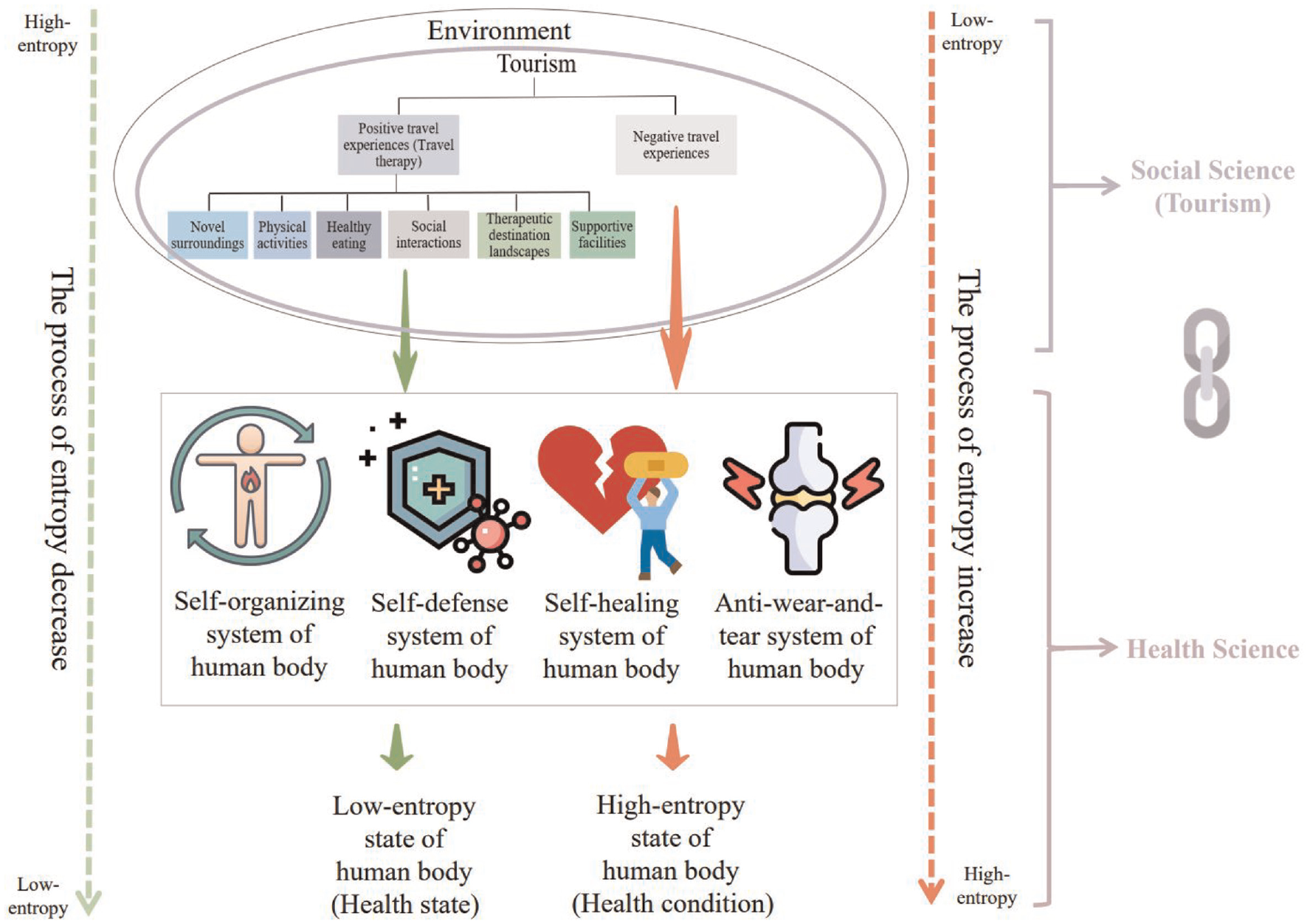
Principle of entropy increase: a novel view of tourism’s effects on human health.
Sociomateriality is an interdisciplinary theory that underscores the joint effects of social and material factors. These facets work in concert to shape social phenomena. “Social” refers to the practices, cultures, organizations, relationships, and structures in human society, including behavior, values, and social norms. “Material” reflects the entities and material elements that interact with “social,” including objects, tools, techniques, equipment, and resources (Moura & Bispo, 2020). This concept has appeared in sociology, anthropology, organizational studies, information systems, and other domains. Within biology, sociomateriality has been employed to ascertain how the environment affects cell functions, cell behaviors, and pathologies (Wang, 2023). A dense interplay of physiological and environmental factors regulates cellular activities. Cells must be able to sense and adapt to their surroundings to maintain normal functioning (Kornev, 2018). Medical scientists have used sociomateriality to explore how interactions among social (e.g., cultural beliefs, social networks, healthcare systems) and material aspects (e.g., medical technologies, medications, healthcare infrastructure) beyond one’s genetics and physiology influence entropy increase in the body and thus affect health outcomes and medical practices (Moura & Bispo, 2020; Wang, 2023). These experts emphasize integrating social and material dimensions in studies of health-related issues and health-enhancing interventions.
Travel therapy is an emerging concept bridging tourism and health science. It could serve as a novel health promotion tool for a range of populations (Wen, Zheng, Hu, 2022). From a sociomaterial point of view, tourism activities (as social practices) involve social and material attributes. On the social side, elements such as tourists’ behavior, sociocultural settings, social relations, and tourism-related events come into play. In material terms, relevant factors include facilities, attractions, transportation, accommodation, food and beverage, and tourism-related equipment in destinations. These two dimensions are entangled, making tourism an important part of the environment. The environment is a rather broad concept in itself: it refers to the conditions within which an organism lives, including natural, social, and cultural dimensions. Based on cells’ sociomateriality, the environment assumes an imperative role in modulating cell responses (Cosselman et al., 2015). The environment therefore affects essential cell activities such as self-organization, repair, and regeneration. Environmental characteristics are substantial risk factors for health conditions (i.e., suboptimal health and disease; Cosselman et al., 2015; Wang, 2023). Tourism is rooted in the environment while shaping it; it presents people with novel surroundings through environmental changes (Hu, Wen, Phau, et al., 2023). Tourism, as a sociomaterial practice, accordingly introduces factors that can either increase or decrease entropy in the human body by informing basic cellular processes. These entropy changes mirror tourism’s impacts on human health. Positive travel experiences may feature novel cognitive and sensory stimuli, physical activities, social interaction, therapeutic landscapes, pleasant emotions, and vulnerability-friendly facilities and services (Hu, Wen, Zheng, et al., 2023).
Travel therapy could serve as a groundbreaking health intervention when viewed through an entropy lens. As a primary aspect of the environment, positive travel experiences may help the body sustain a low-entropy state by modulating its four major systems. Tourism typically exposes people to new surroundings and relaxing activities. Novel settings can stimulate stress responses and elevate metabolic rates, positively influencing metabolic activities and the body’s self-organizing capabilities. These contexts may also trigger an adaptive immune system response. This reaction improves the body’s ability to perceive and defend itself against external threats; put simply, the self-defense system becomes more resilient. Hormones conducive to tissue repair and regeneration may be released and promote the self-healing system’s functioning (Wen, Zheng, Hou, et al., 2022). Leisurely travel activities might help alleviate chronic stress, dampen overactivation of the immune system, and encourage normal functioning of the self-defense system. Engaging in recreation potentially releases tension and fatigue in the muscles and joints. This relief helps maintain the body’s metabolic balance and increases the anti–wear-and-tear system’s effectiveness. Organs and tissues can then remain in a low-entropy state (Jennings & Guerin, 2014). Travel encompasses physical activities such as hiking, climbing, walking, and cycling. Physical exertion can boost metabolism, energy expenditure, and material transformation, all of which help coordinate self-organizing systems (Wang, 2022). Participating in these activities could enhance the body’s immune function and self-defense capabilities, bolstering its hardiness to external risks. Physical exercise may also improve blood circulation, expedite nutrient transport, and aid waste elimination to collectively maintain an active self-healing system. Moderate exercise is beneficial to the bones, muscles, and joints in addition to supporting the body’s anti–wear-and-tear system (Piercy et al., 2018).
Destinations’ diverse culinary specialties and farm-to-table produce afford tourists a variety of wholesome meal options rich in vitamins, antioxidants, and fiber (Hu, Wen, Phau, et al., 2023). A nutritionally balanced diet is vital for the orderly growth and development of body tissues. Healthy eating helps to balance metabolism, strengthen the immune system, support anti-inflammatory and repair processes in the self-healing system, and sustain the anti–wear-and-tear system (Wang, 2022). Positive social and emotional encounters during trips may enhance core functions including energy metabolism and self-defense. These experiences can also invigorate the body by reducing stress and chronic inflammation while mediating neuroendocrine responses’ effects on self-healing and repair (Holt-Lunstad, 2018; Wen, Zheng, Hou, et al., 2022). Therapeutic destination landscapes, such as those with green and blue elements, are good for physical and mental health. Natural landscapes can lower stress hormones and promote a balanced metabolism. Adequate sunlight exposure stimulates vitamin D production to support immune health. These settings also diminish stress and mental fatigue, invigorate the self-repair system, and lessen physical wear and tear (Finlay et al., 2015). Well-designed destination support facilities and therapeutic landscapes can create a convenient, comfortable environment for tourists to help maintain normal functioning of the body’s core systems. Sanitary conditions prevent pathogen spread, easing the burden on the immune system. Amenities like spas and massages offer physical and psychological pleasure to ensure an active self-healing system. Rest and relaxation amenities such as plush seating ease wear and tear on the body and provide a health-promoting environment (Hu, Wen, Lim, et al., 2023; Wen, Zheng, Hou, et al., 2022). Tourism is one example of a healthy, active lifestyle; it could be incorporated into health science research and practice to develop therapies and expand healthcare resources. Travel interventions can be tailored to personal health by embracing the tenets of preventive, predictive, and personalized medicine (Wang, 2023). However, travel does not always benefit health: negative travel experiences may expose tourists to health risks, disrupt the body’s functioning, and increase entropy (Hu, Wen, Zheng, et al., 2023). By introducing the principle of entropy, we provide a unique framework with which to understand tourism’s positive and negative health impacts. This approach addresses the limitations of traditional models, such as the biopsychosocial model and those from positive psychology. The biopsychosocial model may be useful for exploring how tourism affects health given the tenet that biological, psychological, and social factors jointly influence health; however, the fluid nature of health changes remains unaccounted for (Bolton & Gillett, 2019). The principle of entropy increase provides a dynamic perspective to understand tourism’s impacts on health. This law underscores the trend of systems toward disorder or higher entropy, reflecting the progression from health to illness and eventually death in humans (Silva & Annamalai, 2008). While this process is irreversible, it can be mitigated through measures such as positive travel experiences. Positive psychology theories tend to emphasize tourism’s benefits for mental and emotional well-being by heavily relying on subjective measures and self-reported health outcomes. In examining how tourism influences the body’s core systems, the entropy perspective enables a more holistic understanding of tourism’s effects on overall health (i.e., physical, mental, and social aspects). Our framework also integrates subjective and objective health metrics.
Rethinking the Research Paradigm: From “Health Tourism” to “Health and Tourism” Through an Entropy Lens
Tourism and health science (e.g., medicine) have traditionally represented separate domains. The intersection of tourism and health is unique in that it combines knowledge from the health and social sciences, embodying a paradigm shift in tourism research that extends beyond the confines of social science to embrace a more interdisciplinary perspective (Page, 2009). This integration marks a step forward in understanding how tourism influences human health (Hu, Wen, Phau, et al., 2023; Wen, Kozak, Jiang, 2022). We use the concept of entropy to show how travel can affect health. The proposed theoretical framework will guide interdisciplinary work in this vein; it signifies a transition from a narrow focus on “health tourism” to a broader perspective of “health and tourism.” Current health tourism research covers diverse topics but revolves around industry development and tourist behavior. Study populations are often homogeneous and mainly composed of healthy tourists. The intersection of tourism and health has rarely been appraised on the bases of public health values and therapeutic effects. This conventional paradigm thus fails to give full play to the nexus between tourism and human health (Hu, Wen, Zheng, et al., 2023). We advocate for reconsidering this field in light of entropy. Leveraging expertise from health science and tourism will capture associated intricacies. This innovative perspective will better explain dynamic changes in personal health and well-being during trips, possibly informing the construction of health-promoting and personalized travel programs. It will also generate opportunities for tourism and healthcare service providers to collaborate in advancing industry development.
Several research directions exist. First, research methods and outcome measures should accommodate this paradigm shift. Incorporating approaches from the health sciences into tourism research will offer more compelling evidence of tourism’s effects on health (Zheng et al., 2023). These methods include experimental (e.g., randomized and non-randomized controlled trials) and observational studies (e.g., case–control, cohort, and cross-sectional studies). Randomized controlled trials are believed to have the greatest precision in evidence-based medicine, often referred to as the “gold standard” of clinical trials. This method can provide particularly robust evidence on tourism’s health benefits and safety for specific populations (Benson & Hartz, 2000). Technological developments, including big data analysis, artificial intelligence, and mobile health apps, have yielded refined tools for processing data (Hu, Wen, Zheng, et al., 2023). Using these technologies enables detailed, real-time information collection to assess the dynamics of tourism and health.
As mentioned, tourism-induced entropy changes involve alterations in physical, mental, and social well-being. Therefore, to comprehensively measure entropy changes, specific indicators reflecting shifts in these three aspects are essential. These alterations may include physiological markers like heart rate variability, blood glucose concentrations, and cortisol levels for physical health; assessments of stress levels and mood fluctuations for mental health; and evaluations of social connectedness and interaction patterns for social well-being (Hu, Wen, Phau, et al., 2023; Zheng et al., 2023). The indicators chosen could vary with health conditions and populations. For instance, measures such as blood pressure and lipid profiles may be applicable to people with cardiovascular diseases, while assessments of cognitive functioning and emotion regulation might be more pertinent for individuals with mental disorders (Silva & Annamalai, 2008; Wang, 2022). Thus, tailoring indicator selection to specific health states and demographic characteristics is crucial for obtaining accurate insights into tourism’s impacts on health. Some scholars have contemplated measuring entropy increase directly within organisms to observe changes in life processes and health statuses (Wang, 2022). Entropy could thus symbolize how tourism influences health.
Second, per the biopsychosocial model, the intersection of tourism and health encompasses complex social and health phenomena influenced by numerous factors (Bolton & Gillett, 2019). The entropy perspective provides a powerful tool to establish an initial understanding of the dynamics at play. Future research can build on this framework to further explore the finer mechanisms within this domain. Third, greater emphasis should be placed on sustainable tourism and social responsibility. Investigating the health consequences of tourism is key for promoting public health and social equity. This topic aligns with the United Nations’ Sustainable Development Goals and resonates with the emerging research agenda on sustainable tourism for equity and inclusion (Hu, Wen, Lim, et al., 2023).
Implications
This paper holds implications for stakeholders such as academics, tourism practitioners, healthcare professionals, and policymakers. For academics, from the macroscopic to the microscopic features of tourism, the scholarly gaze remains fixed on theoretical evolution (Williams & Baláž, 2015). Not every study mandates a theoretical foundation; however, the roles of theoretical frameworks in elucidating phenomena cannot be overstated, particularly for forward-looking academic work (McCabe, 2024). This study provides a fresh perspective by introducing the concept of entropy as a way to contextualize tourism’s positive and negative impacts on physical, mental, and social health. The corresponding paradigm shift could inspire deeper exploration of the intersection between tourism and health. For instance, interdisciplinary research that combines medical measures and objective metrics may offer rich evidence of tourism’s health-related effects.
The entropy perspective suggests that tourism could trigger entropy changes: positive experiences might mitigate entropy increase and enhance health, whereas negative experiences may contribute to entropy increase and compromise health. Therefore, tourism practitioners should aim to foster positive travel experiences while reducing negative ones. It is important to prioritize tourists’ satisfaction and well-being, including via personalized services, accessible facilities, supportive environments, healthy dining options, wellness programs, and therapeutic landscapes (Hu, Wen, Lim, et al., 2023). Practitioners should also address common pain points tourists face by using efficient communication channels, improving safety measures, and offering flexible cancellation policies and comprehensive travel insurance. Promoting responsible tourism practices, such as by supporting local communities and minimizing environmental consequences, can help decrease the likelihood of negative experiences and contribute to a more sustainable tourism industry (Page, 2009).
Healthcare professionals are similarly advised to consider tourism’s potential effects on health. They can offer tourists empirically based health guidance. Collaborating with tourism practitioners could collectively improve health management in the tourism industry as well. For instance, healthcare professionals could recommend destinations, transportation options, and activities based on one’s health status. These measures enable tourism to serve as a health intervention while broadening healthcare resources.
Policymakers are suggested to devise evidence-based policies and initiatives for the tourism sector: crafting health standards, promoting product innovation, integrating medical resources, enhancing health education, and fortifying safety protocols. Governmental entities are encouraged to work closely with academics, tourism practitioners, and healthcare professionals on these matters. Such cooperation should involve information exchange and training program development to bridge tourism and health.
Conclusion
As the intersection between tourism and health garners academic attention, holistic theoretical underpinnings for this field remain lacking. In response to McCabe’s (2024) call for theoretical contemplation of tourism’s internal characteristics, we suggest applying the principle of entropy increase to explain how tourism might affect human health—particularly by maintaining a low-entropy state. Improving health through tourism essentially involves counteracting entropy increase. Positive tourism experiences cannot do so in full but may slow the process. Nevertheless, negative tourism experiences may increase entropy in the human body, exposing individuals to health crises. Thoughtfully prepared and customized travel arrangements could minimize these risks. This theoretical lens links the social (e.g., tourism) and health sciences (e.g., medicine) through travel therapy, exemplifying a paradigm shift from “health tourism” to “health and tourism.” In closing, it is believed that this letter provides conceptual grounding and potential avenues for future research aiming to undertake subsequent empirical investigations to elucidate the nuanced effects of tourism experiences on human health. Such interdisciplinary effort will likely uncover novel interventions and perspectives on managing contemporary health challenges within the context of global tourism dynamics.
Footnotes
Authors’ Statement
Author confirm that no subsequent addition of authors’ names will be permitted by the journal.
Author Contribution
Fangli Hu: conception and design; draft the manuscript; critically revise the manuscript; and give final submission approval.
Jun Wen: conception and design; draft the manuscript; critically revise the manuscript; and give final submission approval.
Danni Zheng: conception and design; draft the manuscript; critically revise the manuscript; and give final submission approval.
Tianyu Ying: conception and design; critically revise the manuscript; and final submission approval.
Haifeng Hou: conception and design; critically revise the manuscript; and final submission approval.
Wei Wang: conception and design; critically revise the manuscript; and final submission approval; supervision.
Declaration of Conflicting Interests
The author(s) declared no potential conflicts of interest with respect to the research, authorship, and/or publication of this article.
Funding
The author(s) disclosed receipt of the following financial support for the research, authorship, and/or publication of this article: This work was supported by the National Natural Science Foundation of China [72102045], Shanghai Pujiang Program [22PJC020], the European Commission Horizon 2020 [779238-PRODEMOS], CSC (China Scholarship Council) – ECU (Edith Cowan University) Joint PhD Scholarship (No. 202109327004).
Ethical Approval Statement
Not applicable.
Declaration of Generative AI in Scientific Writing
This study did not use generative AI in scientific writing.
Submission Declaration and Verification
The authors of this research confirm that the work described has not been published previously, that is not under consideration for publication elsewhere, that its submission and publication is approved by all authors and tacitly or explicitly by the responsible authorities where the work was carried out, and that, it will not be published elsewhere in the same form, in English or in any other language, including electronically without the written consent of the copyright-holder.
