







Abstract
“Abroad-at-home” (ABH) framing, positioning domestic destinations as local alternatives to foreign locales, has gained practical attention but limited academic focus. This research finds that ABH framing reduces visit intentions, but this negative effect is contingent on familiarity with the foreign counterpart and the perceived heritage related to the destination’s foreignness. Specifically, when familiarity or perceived heritage is high, this negative effect is mitigated or reversed. We propose a dual-process model where ABH framing triggers both impaired mental simulation (negative pathway) and enhanced perceived novelty (positive pathway). Theoretically, this work clarifies when, why, and how ABH framing influences tourist responses, revealing that its effect depends on the dual-process competition between mental simulation and perceived novelty, moderated by familiarity and perceived heritage. Practically, ABH destinations should target well-known foreign counterparts, boost tourists’ familiarity through informational or visual cues, or highlight foreign-related heritage signals in their marketing materials.
Introduction
Imagine you are exploring a potential vacation destination and encounter two advertisements. One says, “Visit the lavender estate and enjoy the unique landscape,” while the other says, “Enjoy the Provence Lavender Tour right next to home—no need to travel abroad.” Which one appeals to you more?
In an increasingly competitive domestic tourism landscape, destination managers are continuously seeking innovative strategies for differentiation. One emerging approach is to frame domestic locales as offering experiences akin to traveling abroad—a novel travel style termed “Abroad-at-Home” (ABH). As illustrated by the preceding example, a local lavender estate might be marketed as “Provence next to home,” evoking the famous French region known for lavender to enhance its appeal. Such domestic destinations promote themselves as staycations that resemble outbound destinations, allowing tourists to experience foreign scenery, explore foreign culture, taste foreign foods, or enjoy other abroad-like offerings without leaving their home country (Davison & Ryley, 2016; Vu et al., 2023).
ABH presents valuable opportunities for the domestic tourism industry. From a managerial perspective, packaging a destination as a foreign locale during promotion provides a strategic way to differentiate it from competitors, creating a unique selling proposition among homogenized tourism products. ABH also contributes to economic recovery by enhancing domestic tourism, especially when international travel is restricted due to global crises such as disease outbreaks or geopolitical conflict (Chua et al., 2021). From the tourists’ perspective, ABH destinations provide a convenient, accessible, and cost-effective way to enjoy foreign-like experiences (Aziz & Long, 2022; Xiong et al., 2021). Reflecting these benefits, ABH has become a notable trend across global tourism. For instance, National Geographic has listed numerous North American destinations that mimic international locales from Japanese New Year celebrations to French cafés (National Geographic, 2015). Notable examples also include destinations framed as Swiss-inspired towns, such as Little Switzerland in the North Carolina Mountains and Arxan National Forest Park referred to as “Little Switzerland of the East.”
However, the effectiveness of ABH framing is not guaranteed. For example, when destinations prioritize superficial mimicry of foreign attractions to draw tourists’ attention, such “instant” approaches to ABH tourism may risk appearing inauthentic or contrived to potential visitors (Lyu et al., 2024). This creates a central concern that ABH framing is not always a beneficial strategy. While it is expected to help attract tourists with its novel and unique positioning, it can also backfire under certain conditions. This raises critical questions for both researchers and practitioners: Are destinations explicitly marketed as local alternatives to foreign ones more appealing to tourists compared to those offering similar attractions without highlighting the ABH label, and why? When does this strategy succeed, and when does it fail?
To date, ABH remains underexplored in the academic literature. The concept of ABH as a new type of travel experience was first established by Vu et al. (2023). Yet, no study has empirically examined its marketing effectiveness. This study aims to enhance knowledge about ABH by proposing a framework to understand its outcomes and the underlying mechanisms. We first propose that when a domestic destination is framed as an ABH destination, as an overall effect, it can challenge tourists’ visit intentions.
Secondly, and more importantly, we argue that this negative effect is not uniform. Instead, its strength and direction are highly contingent on key boundary conditions related to both tourists and the ABH-framed destinations. Specifically, we identify two crucial factors. First, it depends on a tourist-side factor: their familiarity with the foreign destination being emulated. Second, it also depends on a destination-side factor: the perceived heritage associated with the destination’s foreign frame. Moreover, to explain why familiarity and perceived heritage moderate the ABH effect, we propose and test a countervailing dual-process model. We posit that ABH framing simultaneously triggers two competing psychological pathways: a negative path via impaired mental simulation, and a positive path via enhanced perceived novelty. The final outcome depends on which of these two pathways dominates, and this balance is conditional on familiarity and perceived heritage.
Through four experimental studies, we test this moderated mediation model. Our findings enhance knowledge about ABH by not only providing the first empirical evidence of its effectiveness, but also moving beyond a simple main effect to reveal a dual-process mechanism. Moreover, we identify tourist familiarity and perceived heritage as two critical contingencies that determine the net outcome of this strategy. These findings elucidate the complex, double-edged nature of ABH framing and offer actionable guidance for managers on developing more segmented and effective ABH framing marketing strategies.
Literature Review
Abroad-at-Home
Abroad-at-home (ABH), as an emerging phenomenon in domestic tourism in recent years, is formally conceptualized by Vu et al. (2023) as “a special type of domestic tourism that offers overseas-like travel experiences.” ABH destinations mimic overseas environments, enabling tourists to interact with foreign scenery, immerse themselves in different cultures, and savor international cuisines while staying in familiar surroundings (Davison & Ryley, 2016). Through these experiences, tourists may perceive themselves as exploring foreign destinations, thus creating a unique travel style that substitutes for actual international travel (Vu et al., 2023). ABH has gained popularity among domestic tourists, particularly as it provides accessible and cost-effective local alternatives to global destinations that fulfill tourists’ desires for “abroad-like” experiences (Yanek, 2015). However, while ABH tourism is gaining popularity in practice and its potential of contributing to domestic tourism (Hull et al., 2021; Prendergast, 2021), this concept has gained little scholarly attention and was not formally introduced into the literature until Vu et al. (2023).
Theoretically, ABH framing can be understood as a specific practice of metaphorical marketing applied to destination branding. Metaphorical marketing uses a familiar, accessible concept (the source domain) to help consumers understand and evaluate a less familiar one (the target domain) (Brown & Wijland, 2018; Morgan, 1980). In ABH metaphors, a domestic destination attempts to transfer the positive associations and anticipated experiences linked to a renowned foreign destination, thereby shaping its destination image and attracting visitors (Chang et al., 2018). However, ABH framing differs from typical product metaphors in two ways: it compares within the same category across regions (e.g., branding a local water town as the “Venice of China”) rather than disparate categories (e.g., “makes hair soft as silk”) (Hirschman, 2007), and it evokes a holistic travel experience (e.g., the “Venice of China” evokes canals, boats, and architecture) rather than a single attribute (e.g., “faster than a speeding bullet”) (Brown & Wijland, 2018). However, the effects of ABH framing remain uncertain and largely unexplored in the literature. While destination marketers intend for this metaphor to distinguish themselves from domestic tourism competition, the strategy may backfire due to the psychological friction inherent in its structure. Specifically, ABH framing explicitly links a domestic destination to a foreign counterpart (Vu et al., 2023), creating a juxtaposition that induces cognitive dissonance (Khan et al., 2019). Unlike conventional metaphors that highlight shared attributes, ABH framing forces the coexistence of two mutually exclusive identities: the domestic reality and the foreign frame. According to cognitive dissonance theory, inconsistencies between cognitions motivate individuals to resolve the discomfort caused by such contradictions (Festinger, 1957). Tourists hold well-established schemas for what constitutes a “local” versus “foreign” destination (Todorović et al., 2024), which involve distinct natural, cultural and social representations. When marketers attempt to merge these elements into a single destination image, it can lead to a perceived schema incongruity (Meyers-Levy & Tybout, 1989) that violates the destination’s established prototype, thereby inducing psychological discomfort (Fischer & Zeugner-Roth, 2017). It creates processing tension and increases cognitive load as tourists struggle to reconcile the familiar domestic context with the incongruent foreign cues. Meanwhile, rather than transferring positive associations from the foreign counterpart, such incongruity triggers evaluative skepticism and reduces the perceived reliability of the ABH marketing message. As a result, the inherent tension between the known domestic origin and the imposed foreign identity diminishes tourists’ intention to visit (Lee & Shen, 2009). Therefore, we propose that:
Contingency on Familiarity with the Foreign Destination and Destination Heritage
While we propose an overall negative main effect (H1), we suggest that the outcomes of ABH framing are highly contingent upon specific boundary conditions related to both the tourist and the destination itself. One key moderator from the tourist side is their familiarity with the foreign destination being emulated. Another key moderator relates to the ABH-framed destination itself, specifically the perceived historical depth or heritage associated with its spotlighted foreignness, which we term destination heritage for brevity.
The Moderating Role of Familiarity with the Foreign Destination
Familiarity, defined as the amount of related experience or information an individual has accumulated regarding an entity (Alba & Hutchinson, 1987; Baloglu, 2001), is one of the most influential factors in tourists’ decision-making (Kim et al., 2019). In our context, we argue that tourists’ familiarity with the referenced foreign place is a key boundary condition for the effectiveness of ABH framing.
Specifically, ABH destinations typically mimic foreign culture, architecture, or environment that may be unfamiliar to target domestic tourists (Davison & Ryley, 2016). When tourists possess low familiarity with the foreign destination invoked by the ABH framing, they lack clear, accessible knowledge regarding the foreignness (Kim et al., 2019). This unfamiliarity may further restrict their ability to form a coherent and positive impression of the destination and increase uncertainty (Zhang et al., 2025). Consequently, tourists are confronted with a double layer of uncertainty. They have to process information about the introduced unfamiliar domestic destination while simultaneously trying to understand its connection to another unfamiliar foreign counterpart (Wong et al., 2023). This dual uncertainty leads to cognitive difficulty. According to cognitive load theory (Sweller, 1988), when cognitive resources are stretched too thin due to excessive information processing demands, mental simulation—the process of mentally constructing a scenario or situation based on available cues—becomes less effective. In this case, low familiarity disrupts the ability to mentally simulate how the domestic destination can align with the foreign counterpart, thus impairing the cognitive processing of the ABH framing and leading to lower visit intentions (Pham et al., 2023).
Conversely, high familiarity with the foreign destination enables tourists to easily draw upon pre-existing knowledge structures and cognitive schemas related to the foreign place (Kim et al., 2019; Li et al., 2024). This increased familiarity reduces cognitive load, facilitating a more seamless connection between the domestic and foreign elements of the ABH destination. Therefore, high familiarity can shift the cognitive focus toward novelty appreciation. Tourists are more likely to focus on the novel aspects of the foreign destination’s characteristics, which they find intriguing and appealing, rather than struggling to mentally integrate the two destinations (Harmon-Kizer, 2017). At this point, the ABH frame is no longer perceived as confusing but as an understandable yet surprising concept (Agarwal, 2019). As a result, this increased novelty appreciation is likely to make the ABH framing more engaging and desirable, thus increasing the likelihood that tourists will have a more favorable response and a higher intention to visit. In sum, tourist familiarity with the foreign destination shapes the direction and strength of the ABH framing effect. Formally, we hypothesize:
The Moderating Role of Perceived Heritage
Beyond individual-level factors like familiarity, the effectiveness of ABH framing is also contingent upon the characteristics of the destination itself. One particular factor is the ABH-framed destination’s heritage associated with the foreignness it features. Generally, heritage refers to aspects of an entity’s identity that connect its past, present, and potentially its future, often through narratives, symbols, and a sense of continuity over time (Martin et al., 2024; Pecot et al., 2019). We propose that the destination’s heritage associated with the ABH destination’s foreign elements serves as a crucial moderator of the impact of ABH framing, and conceptualize this perceived heritage specifically as tourists’ perception of the historical depth and authenticity associated with the foreignness spotlighted by the ABH destination.
Specifically, when an ABH destination is presented with low heritage (e.g., a recently developed site with limited historical continuity), tourists are likely to encounter a sharp disconnect between the emphasized foreign experience and the destination’s actual domestic foundation. This discrepancy disrupts the destination narrative, leading tourists to view the ABH destination as superficial, inauthentic or staged (Martin et al., 2024; Newman & Dhar, 2014). From a cognitive perspective, such an incoherent historical narrative results in reduced mental simulation, as tourists struggle to integrate the foreign elements with the domestic reality, thereby diminishing the destination’s appeal and leading to lower visit intentions.
Conversely, when an ABH destination is presented with high heritage (e.g., a destination with long-standing foreign cultural roots), the foreign aspects of the ABH frame are more easily integrated into a coherent destination narrative (Can et al., 2021). The heritage of foreign elements acts as a cognitive cue that allows tourists to construct a believable story and authentic connection between the destination’s past development and its present foreign character (Martin et al., 2024). Under this condition, tourists are more likely to view the ABH frame as an innovative and refreshing destination offering and appreciate the novelty of the ABH destination without incurring additional cognitive burden. Such perceived novelty enhances the destination’s appeal. Formally, we hypothesize:
Countervailing Dual Process of ABH Framing: Mental Simulation and Perceived Novelty
Thus far, we have argued that the results of ABH framing are complex: while it has an overall negative main effect on visit intentions (H1), this effect is highly contingent on tourist familiarity (H2) and destination heritage (H3). To understand this complexity, we now delve deeper to explain the underlying psychological mechanisms and propose a countervailing dual-process model. Specifically, we posit that ABH framing simultaneously triggers two distinct psychological pathways: a positive pathway by enhancing perceived novelty and a negative pathway by impairing mental simulation. The net effect on visit intentions, and the moderating effects of familiarity and heritage, depend on the relative strength of these two competing pathways.
The Negative Pathway: (Impaired) Mental Simulation
Given the intangible, experiential nature of tourism products, travelers rely heavily on mental processes to evaluate their options before making travel decisions (Yoo & Kim, 2014). A key aspect of this pre-purchase evaluation is mental simulation, which refers to the cognitive construction of hypothetical scenarios, where individuals imagine possible future events (Li & Wan, 2025). In tourism, mental simulation allows potential visitors to vividly envision themselves at a destination, creating detailed representations of the destination and anticipating the experience (Xie et al., 2023; Zhao et al., 2011). This process aids in learning about a destination, forming attitudes, reducing uncertainty, and ultimately fostering stronger behavioral intentions, such as the intention to visit (Elder & Krishna, 2012; Jiang et al., 2014; Skard et al., 2021).
However, ABH destinations could have trouble igniting effective mental simulation (Vu et al., 2023). By explicitly linking a domestic destination to a foreign counterpart, the ABH frame introduces a potential information conflict or ambiguity that requires greater cognitive effort (Gao et al., 2022). Mental simulation is an effortful cognitive task that requires coherent and easily accessible information to construct a vivid scenario (Xie et al., 2023; Zhao et al., 2011). Therefore, when the core concept of the destination feels difficult or effortful to process due to the presence of conflicting cues, tourists may struggle to generate a smooth, detailed, and engaging mental pre-experience (Le et al., 2021). Consequently, if tourists struggle to mentally simulate the promised “abroad-like” experience fluently and positively, the perceived appeal and value of the ABH-framed destination are likely to diminish, potentially leading to lower visit intentions. Therefore, we hypothesize:
More importantly, this negative pathway is not uniform. Its strength is contingent on individual and situational factors, such as familiarity and destination heritage. First, when tourists are unfamiliar with the foreign culture or environment referenced by the ABH destination, they face higher cognitive load than those who are familiar (Lee & Shen, 2009), and thus find it more difficult to mentally simulate their travels at the destination (Gao et al., 2022). Such impaired mental simulation leads to lower intention to visit (Li & Wan, 2025). Conversely, when tourists’ familiarity is high, they have an accessible schema and a rich set of cues regarding the foreign counterpart (Li et al., 2024). This availability of information helps resolve the cognitive load (Le et al., 2021), and thus mitigates the impairment of mental simulation. Therefore, we hypothesize:
Second, destination heritage also moderates this pathway. Specifically, immersive mental simulation relies on a coherent and credible script (Martin et al., 2024). Low perceived destination heritage suggests a superficial or inauthentic link between the ABH destination and its foreign referent, which can create a fragmented, contrived narrative that makes it difficult for tourists to engage in the mental pre-experiencing process (Karl et al., 2021; Yoon, 2013). Therefore, low heritage hinders tourists’ mental simulation and reduces visit intentions. High heritage, however, provides a credible and context-rich narrative (Martin et al., 2024) that provides necessary cues for imagination (Yoo & Kim, 2014), thus reducing the cognitive difficulty of mental simulation caused by ABH framing.
Therefore, we hypothesize:
The Positive Pathway: (Enhanced) Perceived Novelty
Beyond influencing the experiential processing of destination content via mental simulation, ABH framing may also trigger another pathway related to the evaluative processing of the branding concept itself (Qu et al., 2011), primarily through perceived novelty. Perceived novelty refers to the extent to which a stimulus, such as a product or destination concept, arouses curiosity, provides newness, or satisfies a desire for knowledge (Sheth et al., 1991; Wang et al., 2024). As a key driver of consumption motivations, novelty plays a significant role in tourism by attracting attention, sparking interest, encouraging exploration, and increasing purchase intention (Adapa et al., 2020; Blomstervik & Olsen, 2022; Wang et al., 2024).
The ABH framework possesses the potential to enhance perceived novelty. According to schema incongruity theory (Mandler, 1981; Meyers-Levy & Tybout, 1989), information that presents a moderate level of incongruity with existing expectations—that is surprising yet still understandable—is often perceived as more interesting, engaging, and novel than information that is either completely congruent or extremely incongruent (Halkias & Kokkinaki, 2014; Lee & Kim, 2022). In the ABH context, this moderate incongruity arises because the domestic context with which tourists are familiar provides an accessible reference point that prevents the ABH message from becoming unanchored (Lee & Shen, 2009). While the foreign referent introduces an element of surprise that deviates from the universal domestic prototype, this incongruity remains resolvable, as tourists align the foreign elements with the presented domestic destination’s attributes or identify underlying historical and cultural connections between the two locales. Through this active cognitive matching process, tourists can identify the metaphorical link. This process creates a blended mental schema that is distinct from traditional destination marketing yet coherent enough for tourists to process comfortably. This conceptual blend can break through the homogeneity of typical destination marketing messages, distinguishing the destination itself as unique, different, and creatively positioned, which constitutes a psychological perception of novelty (Hung & Chen, 2012). As tourists devote more attention to novel stimuli and evaluate them more favorably (Cui et al., 2025), we predict that such perceived novelty leads to a positive response to ABH framing and enhances onsite visit intentions. Therefore, we hypothesize:
The positive pathway of ABH framing is also contingent on familiarity. Familiarity facilitates the crucial process of incongruity resolution described above. When tourists are familiar with the foreignness referenced in the ABH framing, the initial cognitive load is resolved, allowing them to process the ABH concept more efficiently (Kent & Allen, 1994). At this point, their focus shifts from struggling with resolving the ambiguity to appreciating the creativity and distinctiveness of the ABH cues (Kim et al., 2019). The ABH frame is thus perceived as an innovative yet understandable metaphor linking a foreign destination to a domestic context, creating a moderate level of schema incongruity (Lee & Kim, 2022). According to schema incongruity theory, such moderate incongruity, which is surprising yet still understandable, is often perceived as interesting, engaging, and curious (Campbell & Goodstein, 2001), which is highly relevant to perceived novelty (Wang, 2024). This perceived novelty then leads to higher visit intentions (Song et al., 2025). In contrast, when familiarity is low, the overwhelming cognitive load prevents this positive novelty perception. Instead, the negative pathway through mental simulation dominates (as proposed in H4a). Therefore, we hypothesize:
Moreover, perceived destination heritage also moderates the effect of ABH framing via perceived novelty. While low heritage suggests a shallow, superficial, or inauthentic connection between the ABH destination and the foreign referent (as argued in H4b), high heritage signals authenticity, historical continuity, and credibility (Pecot et al., 2019). High heritage acts as a heuristic cue that validates the comparison, making the incongruity easier to resolve and accept. By providing a coherent narrative foundation, high heritage ensures that the ABH frame is not perceived as a contrived label, but as a justified and novel representation of the destination (Lee & Kim, 2022; Pecot et al., 2019). Therefore, under high heritage conditions, the ABH frame is no longer perceived as a confusing or contrived label, but as a justified and novel yet coherent representation of a destination (Reggev et al., 2016). This moderate level of schema incongruity, which is surprising while understandable (Yoon, 2013), can arouse tourists’ perceived novelty and evoke their intention to visit (Li et al., 2024). Therefore, we hypothesize:
Based on the literature review, we propose the conceptual model (see Figure 1):
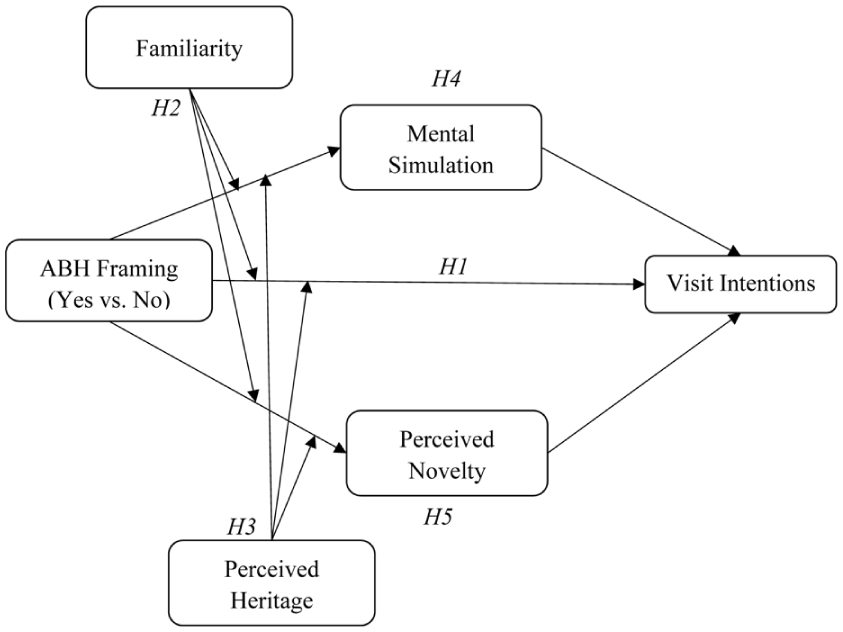
The conceptual model.
Methodology
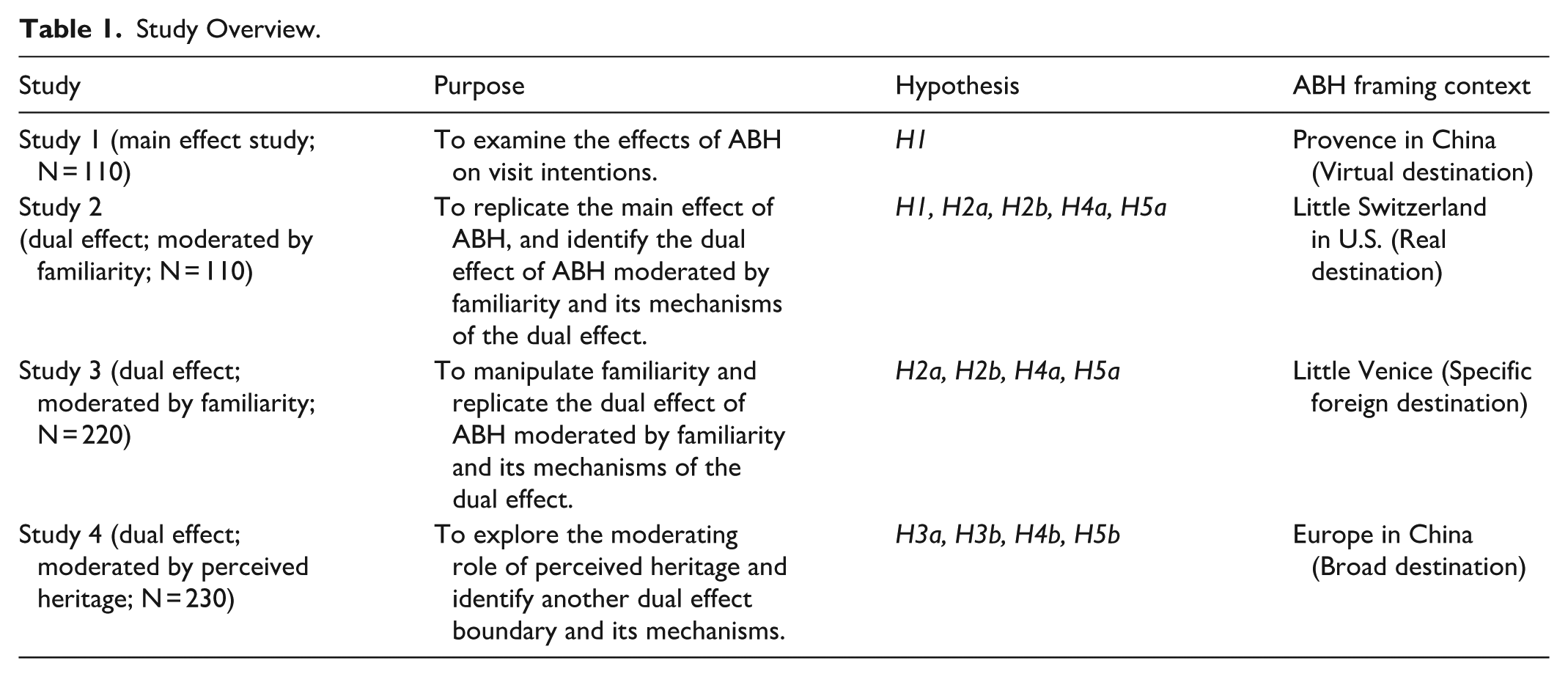
To examine our stated research hypotheses, we conducted four studies (see Table 1). Study 1 examined the effect of ABH framing on tourists’ visit intentions (H1). Study 2 aimed to replicate the main effect of ABH on visit intention, as observed in Study 1 (H1), while also exploring the moderating role of destination familiarity (H2). Specifically, we found that ABH framing had a dual effect on visit intention depending on tourists’ familiarity with the foreign destination (H2). Furthermore, Study 2 explored the mediation mechanisms underlying this dual effect: when familiarity was low, the negative effect of ABH was mediated by impaired mental simulation (H2a, H4a); when familiarity was high, the positive effect of ABH was mediated by perceived novelty (H2b, H5a). Study 3 further tested the moderating role of familiarity on the relationships between ABH and visit intentions (H2) by manipulating familiarity and validated the mechanisms (H4a, H5a). Study 4 tested the moderating role of perceived heritage (H3) and its underlying mechanisms (H4b, H5b). Study 4 manipulated perceived heritage and demonstrated that the negative effect of ABH framing appeared when perceived heritage was low (H3a) and diminished when perceived heritage was emphasized, with the negative effect mediated by mental simulation (H4b) and the positive effect of ABH mediated by perceived novelty (H5b).
Study Overview.
Data and Effect Sizes
Data were collected through two professional survey platforms: Credamo and Amazon’s Mechanical Turk (MTurk). 670 responses were collected through 4 studies. Credamo is a Chinese survey company with a panel of over 3 million participants and serves numerous academic institutions, including New York University and Peking University (Credamo, 2025). Credamo was utilized to ensure comprehensive data collection from the Chinese market (Au et al., 2025). MTurk was selected for its wide use in academic research and access to a demographically diverse U.S. sample (Fang et al., 2025). These platforms provided a diverse dataset from both U.S. and Chinese populations.
The sample size for this study was determined through power analysis (Cohen, 1992) using the G*Power program. A minimum sample size of 52 was required to achieve a statistical power of 80% at a significance level of 5%, with an effect size of 0.40.
Study 1
In this study, we aimed to examine the main effect of ABH framing on tourists’ visit intentions (H1). We predicted that ABH framing (vs. Non ABH framing) would decrease visit intentions.
Design and Participants
110 Chinese adults (Mage = 31.10, SDage = 9.96; 75 females, 35 males) recruited from Credamo participated in this study for monetary compensation. Study 1 employed a single-factor between-subjects (ABH framing: yes vs. no) design.
Procedures and Measures
Participants were shown an advertisement for Lavender Manor, designed to elicit either an ABH or a non-ABH perception. In the ABH framing condition, the advertisement described the manor as “Provence in China,” emphasizing its scenic beauty and the unique experience of an abroad-like atmosphere at home, with a focus on the lavender fields and nearby attractions. In contrast, participants in the Non ABH condition read a similar advertisement but excluded the “Provence in China” reference and any mention of international elements (see details in Web Appendix A).
Following the reading, participants completed measures of their visit intentions using three items (Khan & Kalra, 2022; α = .81). They were asked to indicate how likely/inclined/willing they would be to visit this destination (1 = not at all, 7 = very much). Subsequently, they rated their mental simulation using three items (Li & Wan, 2025; 1 = not at all, 7 = very much; α = .82). Specifically, they were asked to what extent they could imagine traveling to, experiencing, or visualizing the destination.
Finally, participants completed a manipulation check for ABH framing by indicating to what extent the scenic spot in the advertisement resembles the lavender estates of Provence, Europe (1 = not at all, 7 = very much). At the end of this study, participants answered demographic questions.
Results
Manipulation Check
An independent sample t-test revealed that the ABH framing condition reported a higher level of resemblance (M = 5.22, SD = 1.23) compared to the Non ABH framing condition (M = 4.40, SD = 1.72; t(108) = 2.88, p = .005, d = .55). These results confirmed the effectiveness of our manipulation of ABH framing.
Main Effects
We conducted an independent sample t-test to examine our predictions that ABH framing had a negative effect on visit intentions (H1). The results supported H1, as participants in the ABH framing condition had lower visit intentions (M = 5.75, SD = .73) than those in the Non ABH framing condition (M = 6.05, SD = .56, t(108) = 2.44, p = .016, d = .47).
Discussion
This study provided preliminary evidence for the negative effect of ABH framing on visit intentions, supporting H1. While ABH framing is widely used in tourism marketing, the observed negative effect raises questions about its universal efficacy. This finding underscores the importance of exploring the conditions under which ABH framing might instead have a positive effect on visit intentions. Specifically, Study 1 highlighted the need to examine the situational or contextual factors that could reverse the negative effect, as well as the underlying mechanisms contributing to this shift.
Study 2
Study 2 aimed to address three primary objectives: (a) to determine whether the effects observed in Study 1 would replicate in a real-world context (H1), (b) to verify the cross-cultural robustness of the effects of ABH framing and (c) to explore the dual effect of ABH framing on participants’ visit intentions and its underlying mechanisms (H2a, H2b, H4a, H5a).
Design and Participants
We enrolled 110 participants from MTurk (Mage = 41.67, SD = 11.26; 56 females, 54 males) to take part in a single-factor between-subjects experiment. The experiment included two different ABH framing conditions (yes vs. no). In Study 2, we employed a real-world destination, specifically Milepost 334 in the Blue Ridge Mountains, to assess the influence of participants’ familiarity with the destination on the effect and test the external validity of the findings from Study 1.
Procedures and Measures
Participants were presented with an advertisement for Milepost 334, a resort town in the Blue Ridge Mountains, designed to evoke either a high or low perception of an ABH destination. In the ABH condition, participants were informed that Milepost 334 was often referred to as “Little Switzerland in the U.S.,” with an emphasis on the destination’s resemblance to the Swiss Alps. This framing highlighted panoramic views of deep valleys and distant mountain ranges, along with architectural elements inspired by Swiss styles, reinforcing the idea of experiencing an “abroad-like” atmosphere at home. In contrast, the Non ABH condition did not reference any foreign elements. Instead, it focused on the local context, emphasizing features such as scenic mountain views and unique artisan shops offering local crafts (see Web Appendix B for further details).
Following exposure to the advertisement, participants completed measures of their visit intentions using three items (Khan & Kalra, 2022; α = .96). They were asked how likely, inclined, and willing they would be to visit the destination (1 = not at all, 7 = very much). Subsequently, they rated their mental simulation using three items (Li & Wan, 2025; 1 = not at all, 7 = very much; α = .94). Specifically, they were asked to what extent they could imagine traveling to, experiencing, or visualizing the destination. Perceived novelty was measured using four items, including the extent to which the destination felt adventurous, satisfied curiosity, provided authentic experiences, and was educational (Wang et al., 2024; 1 = not at all, 7 = very much; α = .94).
To further rule out alternative explanations for the observed effects, we assessed several potential mediators, including uniqueness (Chaudhuri, 2002; α = .83) and perceived authenticity (Liang et al., 2018; α = .95). These measures were chosen based on their potential to influence participants’ responses to the ABH framing. Details of the measurement items and the analysis can be found in Web Appendix B.
Additionally, participants’ familiarity with Switzerland was measured using two items adapted from Guan et al. (2022). Specifically, participants were asked how familiar they were with Switzerland and how well they knew the country (1 = not at all, 7 = very much; r = .81).
Finally, participants completed a manipulation check for ABH framing by indicating to what extent they thought Milepost 334 resembled Switzerland (1 = not at all, 7 = very much). At the end of this study, participants answered demographic questions.
Results
Manipulation Check of ABH
An independent sample t-test revealed that participants in the ABH framing condition reported a higher level of resemblance (M = 5.15, SD = 1.17) compared to those in the Non ABH framing condition (M = 4.51, SD = 1.82; t(108) = 2.18, p = .031, d = .42). These results confirmed the effectiveness of our manipulation of ABH framing.
Main Effects
We conducted an independent sample t-test to examine the effect of ABH framing on visit intentions. Consistent with Study 1, the results showed that participants in the ABH framing condition had lower visit intentions (M = 4.78, SD = 1.79) than those in the Non ABH framing condition (M = 5.43, SD = 1.34, t(108) = 2.44, p = .033, d = .41).
Interaction of ABH Framing and Familiarity
First, we checked the main effect of ABH framing on familiarity. Results showed that there was no significant effect of ABH framing on familiarity (MABH = 4.04, SD = 1.96, MNon ABH = 3.93, SD = 2.05; t(108) = .28, p = .779, d = .05). Next, we analyzed the moderating role of familiarity. Figure 2 shows the interaction effects. The interaction between the ABH framing and familiarity had a significant effect on visit intentions (b = .71, t = 5.97, p < .001). When the participants were unfamiliar with the referred foreign destination, participants in the ABH condition showed lower visit intentions compared with those in the Non ABH condition (MABH = 3.29; MNon ABH = 5.39; b = 2.10, t = 6.29, p < .001). When the participants were familiar with the destination, participants in the ABH condition showed higher visit intentions compared with those in the Non ABH condition (MABH = 6.19; MNon ABH = 5.47; b = .72, t = 2.17, p = .032). As such, H2a and H2b were confirmed.
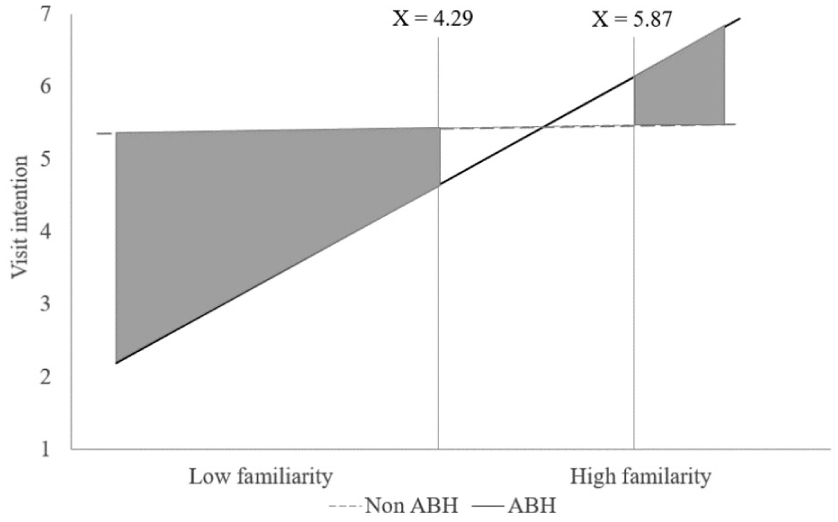
Moderation effect of familiarity.
A Johnson-Neyman technique (i.e., floodlight analysis; Spiller et al., 2013) revealed conditional outcomes of ABH framing. Specifically, when participants were unfamiliar with the foreign destination (lower than 4.29), their visit intentions toward the ABH (vs. Non ABH) destination was significantly lower. This effect became non-significant when participants’ familiarity with the foreign destination was in a moderate level (greater than 4.29 and lower than 5.87). Notably, the effect of ABH reversed and became significantly positive when participants’ familiarity was high (greater than 5.87; see Figure 2). These results provide precise support for our moderation hypotheses (H2a, H2b), confirming that familiarity with the foreign destination systematically determines both the significance and the direction of the ABH framing effect.
Moderated Mediation Effect
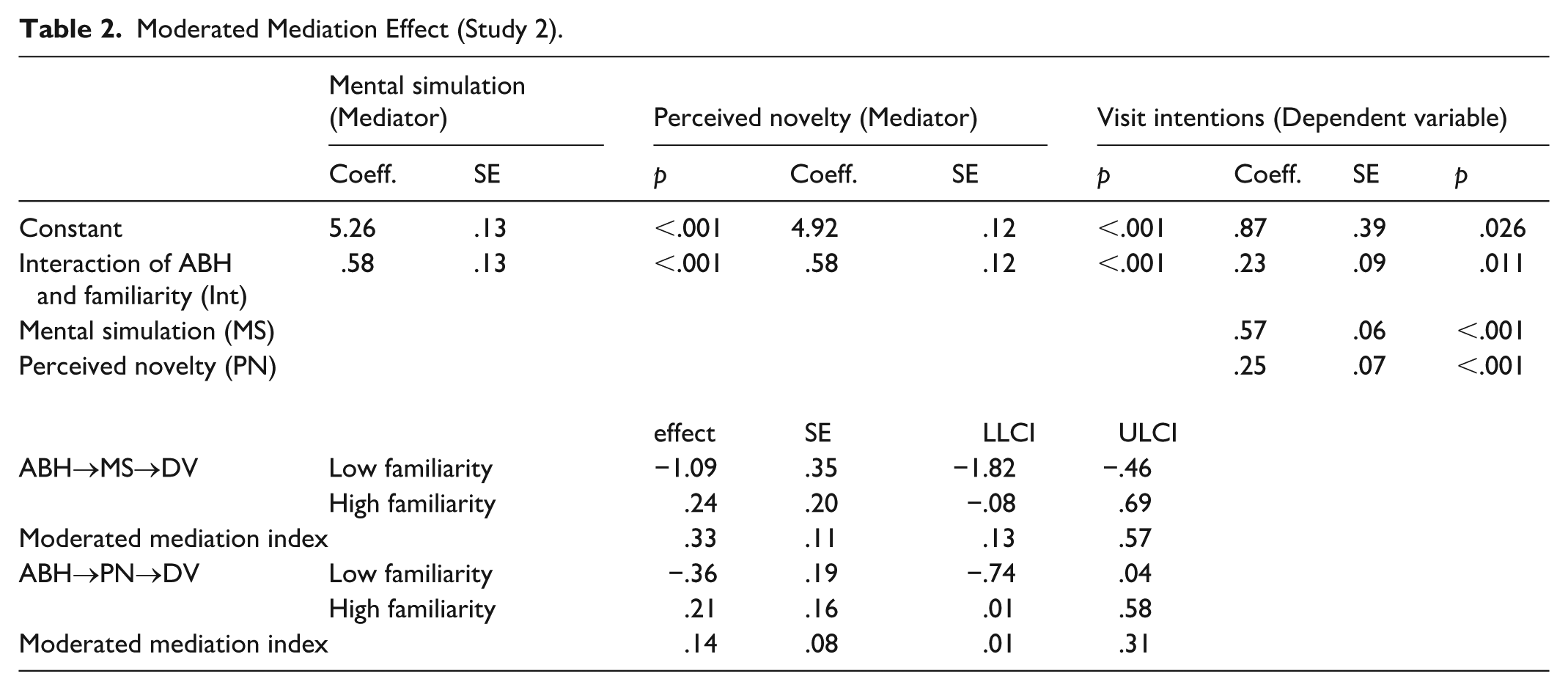
To test the hypothesized moderated mediation (H4a, H5a), we employed PROCESS macro Model 8 (Hayes, 2017) with 5,000 bootstrap samples and 95% confidence intervals. ABH framing was the independent variable, visit intentions was the dependent variable, with mental simulation and perceived novelty entered as parallel mediators and familiarity serving as the moderator. Results for the Model 8 were shown in Table 2. The results showed that when familiarity was low, ABH significantly impacted the visit intentions through mental simulation (b = −1.09, SE = .34, 95% CI [−1.82, −.46]). The moderated mediation effect was significant (b = .33, SE = .11, 95% CI [.13, .57]). When the familiarity was high, ABH significantly impacted the visit intentions through perceived novelty (b = .21, SE = .16, 95% CI [.01, .58]). The moderated mediation effect was significant (b = .14, SE = .08, 95% CI [.01, .31]). Therefore, the hypothesized moderated mediation effect was also supported (H4a, H5a). These findings confirm that tourists’ familiarity with the foreign destination moderates which psychological pathway becomes dominant, switching the indirect effect of ABH framing from negative (via impaired mental simulation) to positive (via enhanced perceived novelty).
Moderated Mediation Effect (Study 2).
Discussion
Study 2 moves beyond the baseline effect explored in Study 1 and systematically tests the hypothesized boundary conditions of ABH framing. While the results replicated the overall negative impact of ABH framing on visit intentions found in Study 1, the primary contribution of this study lies in demonstrating why this effect occurs and when this effect is amplified or reversed. The findings provided support for our dual-pathway theoretical framework. Firstly, we found that the effect of ABH framing was significantly moderated by participants’ familiarity with the foreign destination (H2a, H2b), indicating that the net impact of ABH is contingent rather than uniform. Furthermore, we identified the mediating mechanisms underlying this interactive effect. When participants were unfamiliar with the foreign destination, ABH framing reduced mental simulation, which subsequently led to a decrease in visit intentions (H2a, H4a). Conversely, when participants were familiar with the foreign destination, ABH framing had a positive effect on visit intentions, mediated by enhanced perceived novelty (H2b, H5a). In addition, Study 2 excluded alternative explanations, including perceived uniqueness and perceived authenticity (see details in Web Appendix B). In sum, Study 2 provided the first empirical evidence that ABH framing triggers countervailing psychological processes.
Study 3
Study 3 aimed to replicate the dual effect of ABH on visit intentions, with familiarity as a moderator (H2a, H2b). To avoid potential biases due to participants’ prior knowledge of a real domestic destination, we used a virtual destination that participants had no pre-existing familiarity. In Study 3, we experimentally manipulated familiarity and investigated the mediation mechanisms underlying the dual effects of ABH framing on visit intentions (H4a, H5a).
Design and Participants
We enrolled 220 participants from Credamo (Mage = 32.64, SD = 9.60; 152 females, 68 males) to participate in a 2 (ABH: yes vs. no) × 2 (Familiarity: high vs. low) factorial between-subjects design experiment.
Procedures and Measures
Participants were randomly assigned to one of four conditions. The first phase involved a reading task to manipulate participants’ familiarity with the destination (Malodia et al., 2025). In the low familiarity condition, participants read an introduction to Paris, France, while in the high familiarity condition, they read an introduction to Venice, Italy. This manipulation aimed to vary participants’ prior familiarity with Venice, the referent destination.
In the second phase, participants finished the ABH manipulation. In the ABH condition, participants were informed that the town, a waterfront tourist destination, was known as “China’s Little Venice.” The advertisement highlighted features such as crisscrossing waterways, European classical architecture, and vibrant Venetian art, suggesting that visitors could experience these elements without leaving China. In contrast, participants in the Non ABH condition read the same advertisement, but without any reference to Venice. Subsequently, all the participants completed the questionnaire assessing visit intentions (α = .83), mental simulation (α = .87), and perceived novelty (α = .82) using the same items as Study 2.
To verify the effectiveness of the familiarity manipulation, participants rated their familiarity with and knowledge of Venice (Guan et al., 2022; 1 = not at all, 7 = very much; r = .83). As a manipulation check of ABH, they answered to what extent they perceived the destination resembled Venice (1 = not at all, 7 = very much). Finally, participants provided demographic information at the end of the study.
Results
Manipulation Check of Familiarity
A 2 × 2 ANOVA showed that the familiarity manipulation had a significant main effect on perceived familiarity with Venice (F(1, 216) = 4.45, p = .036, η2 = .02). The interaction between ABH framing and familiarity (F(1, 216) = .30, p = .586, η2 = .001) and the main effect of ABH on perceived familiarity with Venice (F(1, 216) = .01, p = .906, η2 = .001) were not significant. As intended, participants in the high familiarity condition (M = 4.50, SD = 1.42) had a higher perceived familiarity with Venice compared to those in the low familiarity condition (M = 4.10, SD = 1.41). Thus, the manipulation of familiarity was successful.
Manipulation Check of ABH Framing
A 2 × 2 ANOVA showed that ABH framing had a significant main effect on perceived resemblance (F(1, 216) = 45.00, p < .001, η2 = .17). The interaction between ABH framing and familiarity (F(1, 216) = 1.87, p = .173, η2 = .01) and the main effect of familiarity on perceived resemblance (F(1, 216) = 1.87, p = .173, η2 = .01) was not significant. Specifically, participants in the ABH condition (M = 6.09, SD = .76) perceived higher resemblance compared to those in the Non ABH condition (M = 5.15, SD = 1.26). These results revealed that the manipulation of ABH destination was successful.
Interaction of ABH Framing and Familiarity
To examine the moderating role of familiarity in the effect of ABH framing on visit intentions, a 2 × 2 ANOVA was performed. The analysis showed a significant interaction between ABH framing and familiarity (F(1, 216) = 14.06, p < .001, η2 = .06), but no significant main effect of ABH framing (F(1, 216) = .78, p = .377, η2 = .004) and familiarity (F(1, 216) = 2.17, p = .142, η2 = .01) on visit intentions (see Figure 3 for details).
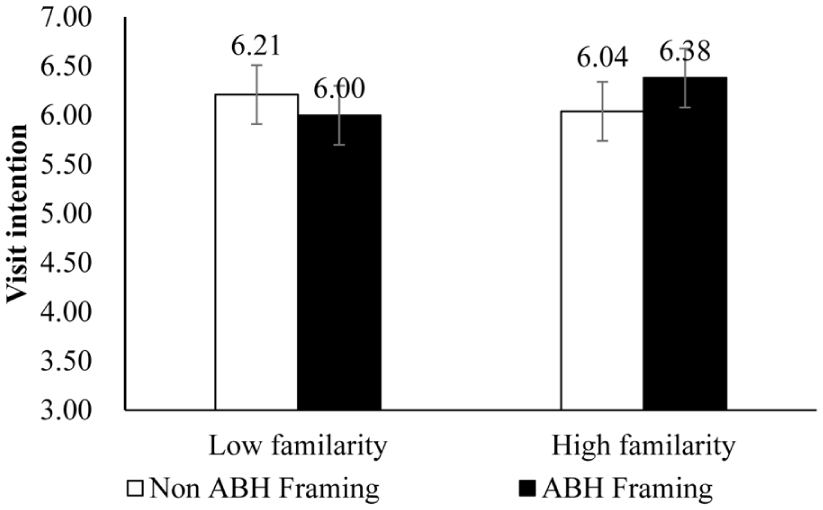
The interaction between ABH framing and familiarity on visit intentions.
Planned contrast analysis showed that the negative effect of ABH was significant in the low familiarity condition. Specifically, in the low familiarity condition, participants showed lower visit intentions for ABH framing (M = 6.00, SD = .49) compared to Non ABH framing (M = 6.21, SD = .55; F(1, 216) = 4.10, p = .044). Although this difference was statistically significant, it represents a small practical effect of 0.21 on a 7-point scale, suggesting a modest magnitude in real-world impact. Nonetheless, this finding supports H2a, indicating that ABH framing can have a negative impact on visit intentions under conditions of low familiarity. Conversely, in the high familiarity condition, ABH framing (M = 6.38, SD = .54) led to higher visit intentions than the Non ABH framing condition (M = 6.04, SD = .54; F(1, 216) = 10.74, p = .001), supporting H2b. This study demonstrated the key role of familiarity in the effect of ABH framing on visit intentions.
Moderated Mediation
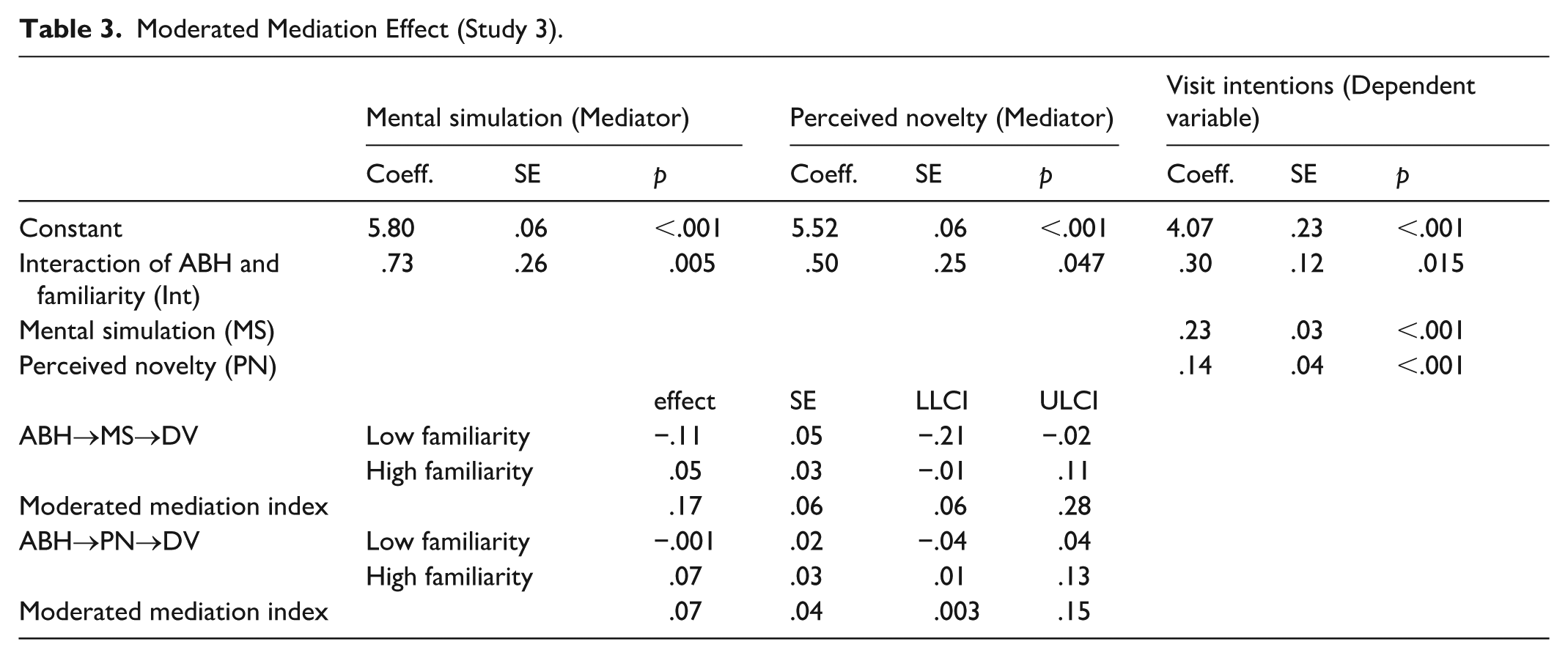
To explore the underlying mechanisms of the dual effect of ABH on visit intentions moderated by familiarity, we employed PROCESS macro Model 8 (Hayes, 2017) with 5,000 bootstrap samples. In the PROCESS Model 8, familiarity served as the moderator, and mental simulation and perceived novelty served as two mediators. As shown in Table 3, when familiarity was low, ABH significantly impacted the visit intentions through mental simulation (b = −.11, SE = .05, 95% CI [−.21, −.02]), supporting H4a. The moderated mediation effect was significant (b = .17, SE = .06, 95% CI [.06, .28]). When familiarity was high, ABH significantly impacted the visit intentions through perceived novelty (b = .07, SE = .03, 95% CI [.01, .13]), supporting H5a. The moderated mediation effect was significant (b = .07, SE = .04, 95% CI [.003, .15]). Therefore, the moderated mediation effects were also supported (see details in Table 3).
Moderated Mediation Effect (Study 3).
Discussion
Study 3 provided causal evidence for our hypotheses. By manipulating familiarity, this study confirmed the dual effect of ABH framing on visit intentions moderated by familiarity (H2a, H2b) and its underlying mechanisms (H4a, H5a). Specifically, our results demonstrated that familiarity acts as a contingent factor determining whether the negative path (for the low familiarity condition, via impaired mental simulation) or the positive path (for the high familiarity condition, via enhanced perceived novelty) predominates the effect of ABH.
Notably, the main effect of ABH framing was non-significant, which was inconsistent with the negative main effects observed in Study 1 and Study 2. We argued that this pattern strongly supported our hypothesis of familiarity as a moderator. The negative main effect in Studies 1 and 2 reflected the natural distribution of a general sample, where most tourists possess low-to-moderate familiarity with a specific foreign destination (see IX. Distribution of participant familiarity in Study 2 in Web Appendix B), making the negative pathway of ABH framing more salient. However, Study 3 employed a balanced experimental design (50% low vs. 50% high familiarity) and created conditions where the opposing conditional effects could offset one another. As our planned contrasts revealed, the ABH framing induced a significant negative effect under low familiarity (H2a) and a significant positive effect under high familiarity (H2b). These opposing effects canceled each other out in the overall analysis, demonstrating that the net impact of ABH is not uniform but contingent on tourists’ level of familiarity.
Study 4
Study 4 aimed to test the moderating role of destination heritage on the effect of ABH framing and its underlying mechanisms (H3a, H3b, H4b, H5b). We predicted that the negative effect of ABH framing (vs. Non ABH framing) would reverse when its heritage was stressed, driven by enhanced perceived novelty. Unlike Studies 1–3, which used specific foreign destinations as the focal ABH referents, Study 4 broadened the scope by using Europe as the object of the ABH framing. This broader foreign destination was chosen to increase the generalizability of the ABH framing effect.
Design and Participants
230 participants recruited from Credamo (Mage = 30.79, SD = 8.27; 154 females, 76 males) took part in a 2 (ABH: yes vs. no) × 2 (Heritage: high vs. low) between-subjects design experiment.
Procedures and Measures
Participants were randomly assigned to one of four conditions. In the ABH × low heritage condition, participants were informed that town A, referred to as “Europe in China,” had European-style elements such as architecture and cultural festivals, which were newly developed, with a history of only three years. In the ABH × high heritage condition, participants read the same introduction about town A as “Europe in China,” but with the European style presented as having a well-established heritage dating back over 30 years. In the Non ABH × low heritage condition, participants were told that town A was a tourism destination known for its unique style, such as architecture and cultural festivals, which was newly developed with a history of only three years. No emphasis was placed on foreign-related features. In the Non ABH × high heritage condition, participants received the same information about town A as in the Non ABH × low heritage condition, but the history was described as 30 years. Again, no foreign-related features were highlighted (see details in Web Appendix D).
After the manipulations, all participants completed a questionnaire assessing visit intentions (α = .78), mental simulation (α = .78), and perceived novelty (α = .80) using the same items as in Studies 2 and 3.
To verify the effectiveness of the heritage manipulation, participants rated the extent to which they believed A town was closely connected to its past and history (Pecot et al., 2019; 1 = not at all, 7 = very much; r = .71). To assess the effectiveness of the ABH manipulation, participants indicated to what extent they felt that A town resembled European attractions (1 = not at all, 7 = very much). Finally, participants provided demographic information.
Results
Manipulation Check of Heritage
A 2 × 2 ANOVA showed that the heritage manipulation had a significant main effect on perceived heritage (F(1, 226) = 13.43, p < .001, η2 = .06). The interaction between ABH framing and heritage (F(1, 226) = 1.21, p = .272, η2 = .01) and the main effect of ABH on perceived heritage (F(1, 226) = 2.55, p = .112, η2 = .01) were not significant. As intended, participants in the high heritage condition (M = 5.76, SD = 1.91) had a higher perceived heritage compared to those in the low heritage condition (M = 5.24, SD = 1.25). Thus, the manipulation of heritage was successful.
Manipulation Check of ABH Framing
A 2 × 2 ANOVA showed that ABH framing had a significant main effect on perceived resemblance (F(1, 226) = 65.14, p < .001, η2 = .22). The interaction between ABH framing and heritage (F(1, 226) = .19, p = .661, η2 = .001) and the main effect of heritage on perceived resemblance (F(1, 226) = .63, p = .427, η2 = .003) were not significant. Specifically, participants in the ABH condition (M = 6.05, SD = .90) perceived higher resemblance compared to those in the Non ABH condition (M = 4.49, SD = 1.87). These results revealed that the manipulation of ABH framing was successful.
Interaction of ABH Framing and Perceived Heritage
To examine the moderating role of perceived heritage in the effect of ABH framing on visit intentions, a 2 × 2 ANOVA was performed. The analysis showed a significant interaction between ABH framing and perceived heritage (F(1, 226) = 6.56, p = .011, η2 = .03), a significant main effect of ABH framing (F(1, 226) = 7.18, p = .008, η2 = .03) and a significant main effect of perceived heritage (F(1, 226) = 11.60, p < .001, η2 = .05) on visit intentions.
Planned contrast analysis showed that the negative effect of ABH framing was significant in the low heritage condition. Specifically, in the low heritage condition, participants showed lower visit intentions for ABH framing (M = 5.51, SD = .75) compared to Non ABH framing (M = 6.00, SD = .92; F(1, 226) = 13.86, p < .001), supporting H3a. Conversely, in the high heritage condition, there was no significant difference between ABH framing (M = 6.07, SD = .58) and Non ABH framing condition (M = 6.08, SD = .49; F(1, 226) = .007, p = .934), H3b was not supported. This study demonstrated the key moderating role of perceived heritage in the effect of ABH framing on visit intentions (see Figure 4 for details).
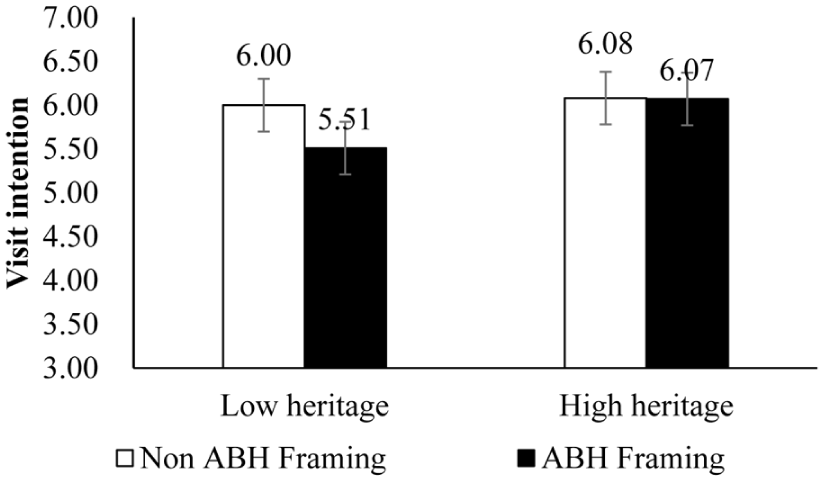
The interaction between ABH framing and perceived heritage on visit intentions.
Moderated Mediation
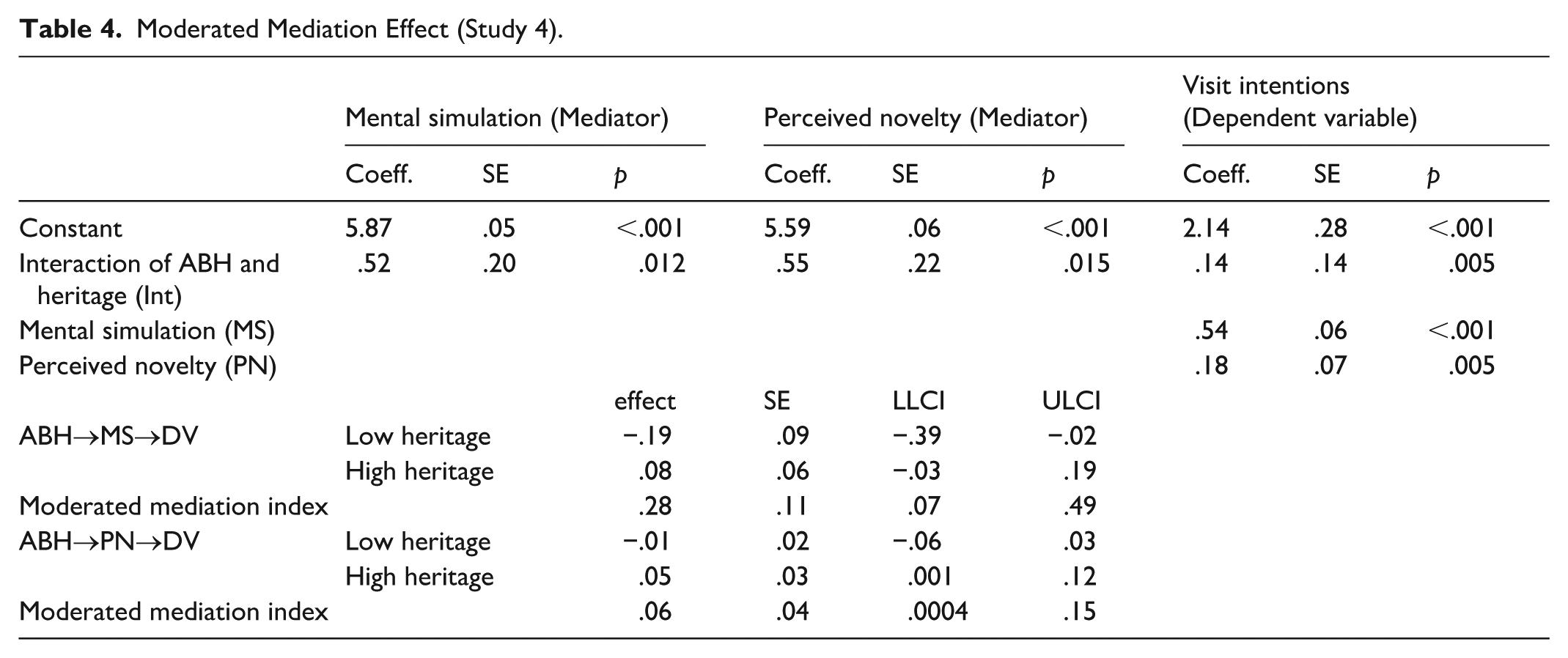
To explore the underlying mechanisms of the effect of ABH on visit intentions moderated by perceived heritage, we employed PROCESS macro Model 8 (Hayes, 2017) with 5,000 bootstrap samples. In the PROCESS Model 8, heritage served as the moderator, and mental simulation and perceived novelty served as the two mediators. As shown in Table 4, when perceived heritage was low, ABH significantly and negatively impacted the visit intentions through impaired mental simulation (b = −.19, SE = .09, 95% CI [−.39, −.02]), supporting H4b. The moderated mediation effect was significant (b = .28, SE = .11, 95% CI [.07, .49]). When perceived heritage was high, ABH significantly and positively impacted the visit intentions through perceived novelty (b = .05, SE = .03, 95% CI [.001, .12]), supporting H5b. The moderated mediation effect was significant (b = .06, SE = .04, 95% CI [.0004, .15]). Therefore, the moderated mediation effects of perceived heritage were also supported (see details in Table 4).
Moderated Mediation Effect (Study 4).
Discussion
This study demonstrated the moderating role of perceived heritage in the effect of ABH framing on visit intentions, as well as the dual-path mechanisms of mental simulation and perceived novelty (H3a, H4b, H5b). Specifically, when perceived heritage was low, ABH framing reduced visit intentions by impairing mental simulation. This suggests that, in contexts where perceived heritage was less salient, ABH framing may fail to engage potential visitors’ imaginations, leading to lower intentions to visit. In contrast, when perceived heritage was high, a positive indirect pathway via enhanced perceived novelty was observed, which neutralized the negative pathway, resulting in an overall non-significant main effect of ABH framing. This dual-path mechanism underscores the nuanced role of perceived heritage, suggesting that the heritage context fundamentally shapes which psychological pathway (impaired mental simulation or enhanced perceived novelty) dominates the overall effects of ABH framing on visit intentions. By identifying heritage salience as a boundary condition, this study offers a deeper understanding of ABH tourism and highlights the need for tailored tourism marketing strategies that align ABH messages with the heritage context of a destination.
General Discussion
Conclusion
The concept of ABH framing, where domestic locations are designed or framed to resemble foreign destinations, has become increasingly prevalent in tourism. However, it remains largely underexplored in the academic literature (Davison & Ryley, 2016; Vu et al., 2023). The present study proposed and tested a dual-process conceptual model to investigate how ABH framing influences visit intentions. Specifically, Study 1 indicated that ABH negatively influenced visit intentions. Studies 2 and 3 explored the dual effect of ABH moderated by familiarity and its mediating mechanisms of mental simulation (for the negative effect) and novelty (for the positive effect). Study 4 extended the effect of ABH by identifying heritage as another practical moderator. Through the moderated mediation analyses throughout Studies 2–4, we provide a detailed picture of the complexity of ABH and uncover the conditional mechanisms: When tourists are unfamiliar with the foreign destination, or the destination possesses a low foreign-related heritage, ABH framing impairs tourists’ mental simulation and lowers visit intentions. However, when tourists are familiar with the foreign counterpart or when the ABH-framed destination holds a high level of heritage of its foreignness, the negative effects of ABH framing on visit intentions reverse or disappear, via enhanced perceived novelty.
Theoretical Implications
This study makes several notable contributions to the tourism literature. First, it adds to the knowledge about ABH tourism as a novel segment of domestic tourism. ABH destinations allow domestic tourists to experience foreign-style scenery and activities without leaving their home country (Vu et al., 2023). This hybrid model of tourism presents new challenges and opportunities for tourism managers. While ABH is becoming more prevalent in industry practices (e.g., Hull et al., 2021; Jawal, 2021; Prendergast, 2021), its impact on tourist decision-making remains largely unexplored. Existing destination management research, typically focused on either purely domestic or international contexts, cannot fully account for tourists’ responses to this hybrid model (Davison & Ryley, 2016; Sharma et al., 2022; Yuan & Peluso, 2024). In this study, we provide crucial empirical evidence demonstrating that ABH framing, counterintuitively, can negatively impact visit intentions (Study 1). This finding challenges the assumptions about the inherent appeal of foreignness and points out the complexities involved in destination impression construction under this context.
Building on the findings from Study 1 and considering the widespread application of ABH in real life (e.g., Jawal, 2021; Prendergast, 2021; Vu et al., 2023), we hypothesized that ABH can have a positive effect in certain contexts. We explored these contexts and found that ABH has a positive impact when tourists are familiar with the foreign counterparts (Studies 2 and 3). Furthermore, the negative effect of ABH framing diminishes when the heritage associated with the foreign elements in the ABH destination is long-established (Study 4). This extends our understanding of ABH, demonstrating that ABH is not a one-size-fits-all solution, but rather a destination marketing strategy that requires careful design and refinement. By introducing a novel perspective on destination packaging, we contribute to the understanding of ABH tourism and expand the literature on destination marketing (e.g., bilingual signage destination marketing; Chen et al., 2024; Zhang & Xu, 2024), illustrating how specific framings of destination attributes influence tourists’ decision-making processes.
Thirdly, this study contributes to the understanding of mental simulation in tourism marketing by focusing on conditions that inhibit this process. Although existing literature has explored mental simulation as an important psychological mechanism in enhancing market responses, such as destination brand experience (Bogicevic et al., 2019), destination attractiveness (Li & Wan, 2025), and tourists’ emotional responses (Xie et al., 2023), little attention has been paid to the specific conditions under which mental simulation may be diminished and its consequences. Our findings highlight how cognitive load provides a fundamental explanation for why ABH framing can cause initial cognitive difficulty and psychological tension for tourists. Subsequently, mental simulation theory, by detailing a critical cognitive process in tourist perception and decision-making, explains how this dissonance impairs tourists’ ability to mentally pre-experience the destination—a process crucial for forming visit intentions. Thus, we argue that cognitive load theory and mental simulation theory offer complementary explanations for how ABH framing shapes tourist responses, therefore establishing a theoretical bridge between the two.
Finally, this research identifies perceived novelty as the underlying mechanism of the positive consequences of ABH. Previous studies have established that novelty-seeking tendencies are a key factor in shaping tourists’ revisit intentions (Abubakar et al., 2017). Specifically, when tourists perceive a destination as novel, it enhances their hedonic experiences (Pratminingsih et al., 2025). In addition, prior research has established the positive effect of familiarity on novelty (Delhaye et al., 2017). Specifically, familiarity enables more fluent processing of repeated stimuli, which may help in recognizing novel experiences (Reggev et al., 2016). Building on these findings, this study extends the understanding of ABH and novelty by revealing that the positive effect of ABH is mediated by perceived novelty. Importantly, this effect is contingent upon tourists’ familiarity with the destination, as familiarity enables them to recognize and anticipate novelty. This finding not only strengthens the theoretical framework but also provides a deeper understanding of how novelty influences tourists’ emotional and behavioral responses.
Managerial Implications
Our findings offer several practical insights for tourism businesses, particularly those promoting domestic destinations through ABH framing. Given the growing popularity of ABH destinations, it is crucial for tourism companies to understand the potential negative impact of this framing strategy on visit intentions. As ABH framing may elicit less mental simulation, managers should strategically emphasize sensory engagement and mental simulation to counteract this effect. For instance, enhancing the descriptions of sensory experiences associated with ABH destinations, such as sights, sounds, and smells, can help tourists form more vivid mental simulations of their visit, which, as demonstrated in our study, leads to stronger visit intentions. By providing concrete sensory details, including high-quality visuals, immersive soundscapes, and videos, destinations can make the emulated foreign experience feel more tangible and accessible to tourists. Meanwhile, destinations should take advantage of advanced techniques, such as virtual reality (VR) and augmented reality (AR), to enhance the marketing effect of ABH framing. With these digital tools, destinations can develop immersive online previews of ABH experiences, allowing tourists to “walk through” and interact with the destination from afar, which enhances the overall perception and dynamic previews of the destination. By utilizing advanced digital techniques such as VR and AR, destinations can create a comprehensive pre-visit experience that facilitates mental simulation and therefore enhances visit intentions (Zheng et al., 2022).
Furthermore, we found that when participants were familiar with the foreign destination, ABH framing had a positive effect on visit intentions. This suggests that tourism managers should carefully consider the level of familiarity tourists have with the foreign destination when implementing ABH strategies. Specifically, it is recommended that tourism marketers either choose well-known foreign destinations or increase tourists’ familiarity with the destination before applying ABH framing. One way to achieve this is by providing knowledge or visual cues, such as pictures of the foreign destination, to ensure that foreign elements are meaningfully integrated into the local context without causing confusion or dissonance. Additionally, destinations can enhance their promotional materials by incorporating interpretative storytelling. By explaining how the local society has been influenced by or integrated with foreign cultures, these narratives can enrich the heritage and appeal of the ABH destination, making the connection between the local and the foreign more coherent and engaging.
In addition, our findings highlight the critical role of heritage management in the effective implementation of ABH strategies. The negative impact of ABH framing is not uniform. Rather, it is moderated by the level of heritage associated with the destination. Specifically, when the heritage is perceived as significant or prominent, the negative effect of ABH framing becomes non-significant. This suggests that tourism managers should carefully assess the heritage attributes of a destination and strategically leverage them when applying ABH framing. By highlighting the foreign-related heritage cues, such as its historical origins, longstanding foreign craftsmanship, or cultural lineage, ABH could positively influence visit intentions.
Limitations and Directions for Future Research
This study, while providing important insights, has several limitations that offer opportunities for future research. First, this study focused on the relationship between ABH and visit intentions in a controlled experimental setting, which may affect the external validity of our study. Field experiments in collaboration with real tourism attractions would enhance the external validity of our study. Second, this study investigated the consequences of ABH framing through the perspective of mental simulation and novelty. However, it is noteworthy that in Study 4, while high heritage successfully unlocked a positive indirect effect of ABH framing via enhanced perceived novelty, the overall effect of ABH framing remained non-significant compared to Non ABH framing. This indicates that increased heritage can only mitigate the negative effect of ABH but not significantly improve it. Future focus should be devoted to uncovering other potential mechanisms to provide a more comprehensive understanding of the complex, double-edged nature of ABH. Third, this study focused on familiarity and heritage as boundary conditions, demonstrating how these factors moderate the impact of ABH framing on visit intentions. However, it is important to note that in Study 4, heritage was operationalized through a single dimension: temporal longevity (3 years vs. 30 years). While this manipulation effectively captures one aspect of heritage, namely, historical depth, it does not fully encompass the multifaceted nature of the heritage construct, which also includes dimensions such as the authenticity of cultural transmission and the richness of the destination’s narrative continuity. This focused operationalization should therefore be considered a limitation, and future research could explore these additional dimensions of heritage to provide a more comprehensive understanding of its moderating role in ABH framing. Moreover, these boundary conditions are not exhaustive, and other relevant moderating variables may further explain the nuanced effects of ABH on visit intentions. For instance, future studies could explore additional individual-level factors, such as personality traits, prior travel experiences, or cultural orientation, which may affect how ABH framing is perceived and processed.
Supplemental Material
sj-docx-1-jtr-10.1177_00472875261454658 – Supplemental material for Domestic Yet Foreign? Tourists’ Responses to Abroad-at-Home Framing
Supplemental material, sj-docx-1-jtr-10.1177_00472875261454658 for Domestic Yet Foreign? Tourists’ Responses to Abroad-at-Home Framing by Xuan Zhang and Yi Huang in Journal of Travel Research
Footnotes
Authors’ Note
The two authors contributed equally to this research and share first authorship.

Author Contributions
Funding
The authors disclosed receipt of the following financial support for the research, authorship, and/or publication of this article: This research was funded by Science Research Project of Hebei Education Department (QN2025003) and the Fundamental Research Funds from Hebei University of Technology awarded to Xuan Zhang.
Declaration of Conflicting Interests
The authors declared no potential conflicts of interest with respect to the research, authorship, and/or publication of this article.
Supplemental Material
Supplemental material for this article is available online.
Author Biographies
References
Supplementary Material
Please find the following supplemental material available below.
For Open Access articles published under a Creative Commons License, all supplemental material carries the same license as the article it is associated with.
For non-Open Access articles published, all supplemental material carries a non-exclusive license, and permission requests for re-use of supplemental material or any part of supplemental material shall be sent directly to the copyright owner as specified in the copyright notice associated with the article.
