







Abstract
This research investigates how businesses can design effective and ethical Fear of Missing Out (FOMO) appeals in tourism marketing. We introduce a four-dimensional framework that identifies content (trip desirability and social presence), source (from social connections vs. businesses), style (explicit/direct or implicit/indirect in expressing FOMO), and orientation (focusing on missing personal growth opportunities or social comparison) as critical design elements. Four experiments show that FOMO messages that are rather explicit/direct or that compare people socially can backfire, making tourists feel uncomfortable and less positive about the business. Conversely, messages highlighting the potentially missed personal growth opportunities are more likely to create positive reactions. Integrating insights from past FOMO and tourism marketing research with ethical design principles and consideration of emotional well-being, our work theoretically adds to the underexamined domain of business-generated FOMO appeals and provides actionable guidance for developing FOMO-based strategies that foster engagement without compromising tourists’ autonomy or well-being.
Keywords
Introduction
In today’s social media–driven and experience-oriented economy, understanding the Fear of Missing Out (FOMO) is essential for tourism businesses aiming to engage prospective travelers effectively. FOMO is a persistent anxiety arising from the fear of missing out on rewarding experiences, driven by a strong desire to stay connected to socially or personally valuable events (Tandon et al., 2021; Wut et al., 2024). Within tourism contexts, FOMO often emerges when individuals feel anxious upon learning that friends or other acquaintances are participating in appealing travel experiences (Lim et al., 2023). For example, exposure to social media posts showcasing others’ tourism activities can trigger FOMO among prospective tourists, motivating them to pursue similar experiences (Park & Lee, 2024; Uslu & Tosun, 2024; Ye et al., 2025), particularly among those predisposed to travel-related FOMO (Djafarova & Kim, 2025). In some cases, individuals may even choose destinations they believe will generate FOMO—both for themselves and for their peers (Boley & Woosnam, 2021).
Research suggests that FOMO can heighten tourists’ decision-making urgency, enhance perceived experiential value, and increase purchase intentions (Hodkinson, 2019; Phan & Hoai, 2025). Behavioral manifestations of FOMO include greater engagement, impulsive purchasing, and intensified social media activity (Bui et al., 2021). These effects are especially relevant in tourism, where travel decisions are inherently social and emotionally charged. Tourists often seek self-enhancement and social belonging through their experiences, making them particularly susceptible to FOMO-based appeals (Rifkin et al., 2025; Wut et al., 2024). Recognizing this, tourism marketers—such as travel agencies and destination marketing organizations—have increasingly incorporated FOMO-based appeals into promotional strategies (Djafarova & Kim, 2025).
Although FOMO appeals are increasingly applied in tourism marketing, empirical research on their effectiveness remains limited. Specifically, few studies have examined how tourists respond to business-generated FOMO appeals (see Good & Hyman, 2020; Hodkinson, 2019, for exceptions). Within tourism scholarship, most research has focused on FOMO as an individual trait rather than as a strategic marketing tool (e.g., Lim et al., 2023; Uslu & Tosun, 2024), necessitating our engagement with related fields such as marketing and psychology, while also underscoring a promising avenue for future tourism scholarship. Consequently, the efficacy of FOMO-based appeals in tourism contexts remains underexplored.
Another important research gap concerns how to ethically design FOMO appeals to safeguard tourist well-being. Ethical marketing design refers to creating tourism marketing materials with transparency, honesty, and accountability in portraying destinations and services, so that it is not only effective but also morally responsible (Shahidul Islam, 2026). The World Tourism Organization outlines key principles in their Global Code of Ethics for Tourism, including individual and collective fulfillment (e.g., respecting human rights and refraining from human exploitation), and stakeholder responsibility (e.g., providing honest and objective information; World Tourism Organization, 1999). Particularly, Article 6.6 articulates, “The press, and particularly the specialized travel press and the other media, including modern means of electronic communication, should issue honest and balanced information on events and situations that could influence the flow of tourists; they should also provide accurate and reliable information to the consumers of tourism services; the new communication and electronic commerce technologies should also be developed and used for this purpose; as is the case for the media, they should not in any way promote sex tourism.” Thus, using pressure tactics such as traditional FOMO appeals to motivate a choice that tourists feel compelled to make does not align with the notion of providing honest and balanced information, nor accurate and reliable information. Furthermore, the American Marketing Association’s Statement of Ethics argues that marketing communications should do no harm, foster and maintain integrity, and embrace the ethical values of honesty, responsibility, equity, transparency, and citizenship. Taken together, these perspectives highlight the need for FOMO appeals that do not elicit negative affect and instead empower tourists to choose travel services that fit their goals and desires. Furthermore, scholars have increasingly emphasized the need for research addressing the ethical implications of employing FOMO-based marketing strategies, particularly in view of the psychological and behavioral consequences for consumers (Chan et al., 2022; Morsi et al., 2025).
In addition, despite growing scholarly interest, most prior empirical investigations on FOMO in tourism settings have relied heavily on cross-sectional survey methods, indicating a methodological gap that calls for experimental designs to establish causal inferences (Tandon et al., 2021). Current studies also lack a systematic examination of the design elements that constitute effective FOMO appeals, particularly in ways that enable tourism organizations to evoke FOMO without adverse consequences. Accordingly, the present study examines the critical components of an effective FOMO appeal that do not compromise, and may even enhance, tourist well-being.
The aims of our studies are threefold. First, because existing research on FOMO appeals is fragmented and lacks a systematic approach to appeal design, we seek to develop a comprehensive multidimensional framework. Second, we aim to identify the conditions under which appeals elicit FOMO among tourists and to examine the downstream consequences of this emotional response. Building on this foundation, our third objective is to determine how FOMO appeals can be designed not only to induce FOMO, but to do so in ways that yield positive outcomes for tourists. Collectively, these efforts culminate in a four-dimensional framework for effective FOMO appeal design.
We therefore address the aforementioned critical gaps in tourism and marketing literature by developing a systematic framework and novel approach to crafting FOMO messages that benefit both tourists and tourism businesses. Grounded in Reactance Theory (Brehm & Brehm, 2013), Self-Determination Theory (Deci & Ryan, 2012), and FOMO’s dual-conceptualization (Wut et al., 2024; Z. Zhang et al., 2020), we identify effective and ethical configurations of FOMO messages through four studies conducted via diverse online platforms, which examine appeal content (Study 1), source (Study 2), presentation style (Study 2 and 3), and orientation (Study 4). Theoretically, our findings provide novel insights into what drives FOMO appeal effectiveness. Practically, this research contributes by establishing a structured approach for developing FOMO appeals that are not only compelling and actionable for tourism organizations but also ethically designed to promote tourist well-being. In the following sections, we establish a theoretical foundation and present a series of hypotheses.
Literature Review
FOMO & Ethical Tourism Marketing
Unlike traditional forms of fear, FOMO centers on perceived exclusion from socially or personally valuable events. FOMO activation is defined as the process by which people feel a fear of missing out, often triggered by social comparison (Dinh & Lee, 2021) or the frustration of unmet psychological needs (Przybylski et al., 2013). In tourism, prior research has linked FOMO to stress and compulsive travel behaviors (Djafarova & Kim, 2025). However, recent studies broaden this perspective by highlighting FOMO’s potential to drive constructive behaviors. For instance, social media-induced FOMO can prompt spontaneous travel decisions (Kumar & Kumar, 2024), and tourism research suggests that FOMO may mediate well-being through novel, enriching experiences (Yudhistira et al., 2025). Among lifelong learners, FOMO can heighten motivation to visit educational venues, such as museums, as a means of acquiring knowledge and mitigating exclusion (Uslu & Tosun, 2024). Recent research demonstrates that tourists are motivated to visit and recommend destinations when they entail traveler-endorsed content with FOMO appeals, driven by anticipated elation, anticipated envy, and social influence (Lee et al., 2025). Nevertheless, to our knowledge, no other empirical studies tackle the ethical design of FOMO appeals in tourism settings. Thus, while FOMO can be emotionally taxing, it also holds the potential to stimulate positive, goal-directed behaviors when effectively managed.
This dual nature of FOMO underscores the importance of ethical considerations in tourism marketing. Growing attention to ethical design in tourism contexts (Dastane et al., 2026) calls for virtual strategies—including FOMO-based appeals—that promote consumer well-being rather than undermine it (Wallace et al., 2018). Ethical marketing design entails creating marketing materials that consider both effectiveness and moral responsibility (Dastane et al., 2026). Scholars emphasize that social media–driven persuasion must balance effectiveness with respect for consumer autonomy and broader ethical standards (Vrontis et al., 2021). Responding to these concerns, our work foregrounds the largely overlooked ethical dimensions of FOMO appeal design and advances marketing ethics by outlining principles for crafting FOMO strategies that enhance tourist engagement while safeguarding psychological well-being. Our approach builds on these principles and aligns with Stakeholder Theory, which advocates integrating organizational goals with consumer welfare to create mutual benefit (Hult et al., 2011; Laczniak & Murphy, 2012). By demonstrating how FOMO appeals can be deployed responsibly—encouraging positive tourist attitudes without manipulation or harm—we advance sustainable marketing practice and offer a framework for ethically grounded digital persuasion (Gordon et al., 2011).
Although tourism ethics research has grown, it has largely centered on ethical tourist behavior (Tolkach, 2024), with comparatively limited attention to ethical issues in tourism marketing (Shahidul Islam, 2026) or the incorporation of ethics into tourism practices more broadly (Jamal & Lee, 2020). Moreover, despite calls for responsible marketing, empirical assessments of ethical marketing effectiveness remain scarce. Our study addresses this gap by evaluating how ethically designed FOMO appeals influence tourists’ feelings about the business being promoted, their interest in the business, and their likelihood of trying the business’ services. In the next section, we outline FOMO appeals in tourist communications to develop evidence-based guidance for tourism organizations seeking to adopt FOMO strategies that are both effective and ethically sound.
FOMO Appeals in Tourist Communications
FOMO appeals can originate from both commercial sources (e.g., businesses) and noncommercial ones (e.g., peers; Good & Hyman, 2020; Hodkinson, 2019). Although emerging conceptual models have begun to map consumer decision-making in response to FOMO triggers (Hodkinson, 2019; Morsi et al., 2025), most research has focused on peer-generated FOMO appeals (Park & Lee, 2024; Ye et al., 2025). In contrast, business-generated FOMO appeals have received comparatively limited scholarly attention—even as their use in tourism promotion continues to grow (Hodkinson, 2019).
The existing research, which has primarily examined consumer-generated- and trait-FOMO, offers mixed conclusions. Studies indicate that FOMO can enhance consumers’ purchase intentions (Dinh & Lee, 2021; Flecha Ortiz et al., 2023; Good & Hyman, 2020). For example, individuals high in dispositional FOMO are more likely to purchase products endorsed by influencers (Dinh & Lee, 2021), and anticipated FOMO—created by emphasizing an upcoming desirable experience—can increase purchase likelihood (Good & Hyman, 2020). However, FOMO’s effects are not uniformly positive. Studies indicate that it can intensify conspicuous consumption (Argan et al., 2022; Dursun et al., 2023) and undermine well-being by inducing anxiety, stress, and emotional discomfort (Bui et al., 2021; Chan et al., 2022; Morsi et al., 2025; Rifkin et al., 2025; Roberts & David, 2019). Momentary FOMO, triggered by awareness of a missed enjoyable experience, can even reduce satisfaction with current experiences and lower intentions to repeat them (Hayran et al., 2020).
Given the complex emotional profile of FOMO—marked by anxiety, apprehension, and emotional unease (Rifkin et al., 2025; Tandon et al., 2021)—its emotional effects warrant particular attention. Emotional distress often precedes cognitive distortions such as regret, indecision, or excessive valuation of missed options (Flecha Ortiz et al., 2023; Morsi et al., 2024). Mitigating the emotional toll of FOMO, therefore, may be key to improving tourist well-being and reducing harmful decision-making. Accordingly, we focus on designing effective business-generated FOMO appeals that alleviate these negative emotional effects as a critical pathway to safeguarding tourists’ psychological health.
FOMO Appeal Design
Building on prior research in FOMO appeals and ethical tourism marketing, we introduce a four-dimensional framework for designing ethical and effective FOMO-based messages. We identify content (the nature of the travel experience), source (the presence or absence of social connections), style (the use of explicit vs. implicit messaging), and orientation (whether the message focuses on the personal growth or on social comparison) as key design elements that shape responses to FOMO appeals. In the sections that follow, we draw on the dual conceptualization of FOMO—personal FOMO (P-FOMO) and social FOMO (S-FOMO; Wut et al., 2024; Z. Zhang et al., 2020)—together with Self-Determination Theory (Deci & Ryan, 2012) and Reactance Theory (Brehm & Brehm, 2013) to articulate our hypotheses and substantiate the proposed framework.
Foundational FOMO Appeal Content and Source
We begin with the content that may enable business-driven appeals to evoke the FOMO state. Drawing on self-determination theory (Deci & Ryan, 2012), prior research suggests that individuals experiencing unmet basic psychological needs—particularly autonomy, competence, and relatedness—are more susceptible to experiencing a heightened FOMO state (Gupta & Sharma, 2021; Przybylski et al., 2013). Highly desirable travel experiences signal opportunities to fulfill these unmet needs by offering self-endorsed choice (autonomy) and opportunities for personal enrichment or accomplishment (competence), thereby increasing sensitivity to the possibility of missing out on such benefits. Consistent with this reasoning, prior studies show that appealing and rewarding consumption opportunities can intensify situational FOMO responses (Tandon et al., 2021; Wut et al., 2024). Accordingly, perceived trip desirability is expected to function as a key antecedent of the FOMO state in business-driven appeals (H1a). In turn, heightened FOMO strengthens favorable tourist attitudes toward the trip (H1b) because concern about missing a meaningful opportunity increases motivational engagement with the option (Dinh & Lee, 2021; Flecha Ortiz et al., 2023; Good & Hyman, 2020). Thus, the FOMO state is likely to serve as a psychological mechanism through which perceived trip desirability translates into more positive evaluations of the travel option, mediating the relationship between trip desirability and tourist attitude (H1c).
Beyond desirability, the need for relatedness represents another important driver of the FOMO state. When close others are involved in a travel experience, individuals may perceive a potential threat to their sense of social connection if they are excluded from that shared activity (Gupta & Sharma, 2021; Przybylski et al., 2013). Prior research shows that FOMO intensifies when friends or family participate in appealing experiences without one’s involvement (Lim et al., 2023). For example, Rifkin et al. (2025) demonstrate that the presence of close social ties heightens FOMO because exclusion from valued group experiences can undermine perceived belonging. Extending this logic to tourism contexts, the inclusion of close others in trip-related content should activate concerns about missing opportunities for shared experiences and relational bonding, thereby strengthening the FOMO state (H2a). In turn, this heightened FOMO is likely to translate into more favorable tourist attitudes toward the trip (H2b), as individuals become more motivated to restore threatened relatedness through potential participation (Dinh & Lee, 2021; Flecha Ortiz et al., 2023; Good & Hyman, 2020). Thus, the FOMO state should serve as a psychological mechanism through which the presence of close others indirectly enhances tourist attitudes toward the travel option (H2c). Together, H1 and H2 validate and extend core FOMO antecedents identified in prior research.
Finally, although existing work emphasizes consumer-generated content as a persuasive driver of FOMO state, it remains unclear whether businesses can evoke the same response. Source credibility is central here, as peer-to-peer communication is typically more influential than firm-generated messaging (De Vries et al., 2017; Stephen & Galak, 2012; Villanueva et al., 2008). FOMO-based messages also tend to feel more authentic and emotionally resonant when they originate from peers rather than commercial entities (Hodkinson, 2019). Therefore, tourist-to-tourist (noncommercial) appeals should elicit a stronger FOMO state than business-to-tourist (commercial) appeals (H3a). In turn, heightened FOMO increases motivational engagement with the highlighted opportunity and strengthens evaluative responses toward the trip (Dinh & Lee, 2021; Flecha Ortiz et al., 2023; Good & Hyman, 2020), leading to more favorable tourist attitudes (H3b). Thus, the FOMO state is also expected to function as the psychological mechanism through which appeal source influences tourist attitudes, mediating the relationship between message source and attitudinal responses to the travel option (H3c).
FOMO Presentation Style
Given that tourists may not always respond favorably to business-generated FOMO appeals, an important question is how businesses might present such appeals more effectively. One underexplored dimension is presentation style. Tourism marketing materials vary widely in how they evoke FOMO: some rely on explicit language referencing “missing out,” while others use implicit cues such as scarcity, exclusivity, or access to VIP experiences (see Supplemental Appendix A for examples).
We define explicit FOMO appeals as messages that directly activate fear of missing out by clearly warning individuals about the risk of missing an opportunity. These appeals use unambiguous, directive linguistic cues that mention missing out, urgency, or limited availability in literal terms (e.g., “don’t miss out,” “last chance,” “only a few left”), which may heighten pressure and elicit psychological reactance (Good & Hyman, 2020; Phan & Hoai, 2025). In contrast, implicit FOMO appeals evoke the feeling indirectly by implying—rather than stating—that desirable experiences are happening without the target individual. These messages avoid literal references to missing out and instead leverage implied comparison, social cues, or imagery highlighting others’ enjoyment (Hodkinson, 2019; Rifkin et al., 2025). Because implicit appeals invite self-generated inference rather than prescribing action, they are less likely to be interpreted as externally imposed persuasion attempts.
Importantly, the consequences of these presentation styles are particularly pronounced in business-generated FOMO appeals, where persuasive intent is more salient. While peer-generated FOMO cues are typically interpreted as authentic signals of lived experience, similar cues from businesses are more likely to be viewed as strategically motivated and potentially intrusive (Q. Zhang & Sapp, 2013). Under such conditions, drawing on Reactance Theory (Brehm & Brehm, 2013), explicit business-generated FOMO appeals that directly emphasize urgency or exclusion can heighten perceptions of external pressure and trigger resistance to the message. This resistance is likely to influence both tourists’ evaluative judgments and their affective reactions. Specifically, when tourists perceive a message as controlling, they are less likely to form favorable attitudes toward the promoted trip because the recommendation appears externally driven rather than self-endorsed. At the same time, perceived pressure may generate discomfort, irritation, or skepticism that dampens positive emotional responses to the travel opportunity. In contrast, implicit appeals allow tourists to infer the value of the opportunity more autonomously, which supports both more favorable evaluations and more positive emotional engagement with the trip. Accordingly, among business-to-tourist FOMO appeals, implicit presentation styles are expected to enhance tourist attitudes (H4a) and positive emotional responses (H4b), whereas explicit appeals are more likely to undermine them.
Consistent with Reactance Theory (Brehm & Brehm, 2013), these effects are expected to operate through perceived threat to personal autonomy. Explicit business-generated FOMO appeals directly highlight urgency and missed opportunities, increasing the likelihood that tourists perceive their freedom of choice as being constrained. Such perceived autonomy threat can activate psychological reactance and weakens favorable evaluations of the trip and simultaneously reduces positive emotional engagement with the travel opportunity. By contrast, implicit appeals attenuate perceived freedom threat by preserving a sense of volitional choice. Thus, perceived threat to autonomy is expected to mediate the negative effects of explicit business-generated FOMO appeals on tourist attitudes (H5a) and emotions (H5b).
FOMO Appeal Orientation
An implicit presentation style may reduce the adverse effects of business-generated FOMO appeals; however, we extend this line of inquiry by examining how such appeals can both effectively activate FOMO and protect tourist well-being. Because FOMO is associated with negative psychological outcomes (Morsi et al., 2024; Rifkin et al., 2025; Roberts & David, 2019), it is important to design appeals that elicit the FOMO state without compromising well-being. We propose that FOMO is not inherently harmful: it may be constructive when aligned with goals for self-growth rather than driven by external validation or social comparison. This distinction aligns with the dual conceptualization of personal FOMO (P-FOMO) and social FOMO (S-FOMO; Wut et al., 2024; Z. Zhang et al., 2020). P-FOMO reflects concern about missing personally meaningful opportunities, whereas S-FOMO captures anxiety about falling behind peers.
Individuals with higher self-esteem and stronger self-regulation capacity are less susceptible to comparison-driven FOMO and associated compulsive behaviors (Kumar & Kumar, 2024). Such individuals typically possess an internally guided sense of identity and are motivated more by personal growth than by social approval. Accordingly, priming customers with FOMO appeals framed around self-development opportunities may activate a motivational concern about missing personally meaningful experiences rather than a defensive concern about social exclusion. This suggests that the orientation of a FOMO appeal—whether self-focused (personal development) or other-focused (social comparison)—should produce systematically different psychological and evaluative responses among tourists.
The first important question is whether self-focused FOMO appeals can effectively activate the FOMO state, as compared to other-focused appeals. Although prior work has emphasized the role of social comparison in eliciting FOMO (Kumar & Kumar, 2024), emerging research suggests that concern about missing personally valuable opportunities can similarly produce anticipatory regret and motivational urgency (Wut et al., 2024; Z. Zhang et al., 2020). Dogan (2019) also calls for research comparing the effects of other-centered versus self-centered interests in FOMO formation. Because self-focused appeals highlight the loss of intrinsically meaningful experiences rather than relative disadvantage, they can activate the perception that a valuable opportunity for personal enrichment may be forgone. Thus, self-focused FOMO appeals should effectively elicit the FOMO state (H6).
Beyond activating FOMO, appeal orientation is also expected to shape tourists’ attitudinal and emotional responses to the promoted trip. Compared with other-focused appeals, self-focused FOMO appeals emphasize autonomy, self-direction, and personal meaning, which increases the likelihood that tourists perceive the travel opportunity as aligned with their intrinsic goals. This alignment should strengthen favorable attitudes toward the trip (H7a) because the recommendation appears self-relevant rather than socially imposed. At the same time, by avoiding comparison-based pressure, self-focused appeals are less likely to evoke anxiety, discomfort, or defensiveness that often accompany socially driven FOMO cues. Instead, they are more likely to generate positive anticipatory emotions associated with growth-oriented experiences (H7b).
Consistent with Self-determination Theory (Deci & Ryan, 2012), these effects are also expected to reflect differences in perceived threat to autonomy. Appeals emphasizing external comparison implicitly signal normative expectations about what one should experience, which can increase perceived pressure and threaten decision freedom. In contrast, self-focused appeals frame participation as a personally meaningful opportunity rather than a socially required behavior, thereby preserving perceived volitional choice. As a result, self-focused FOMO appeals should elicit lower perceived threat to autonomy than other-focused appeals (H7c).
Finally, we propose that the effects of appeal orientation on tourist responses operate through two distinct yet complementary psychological mechanisms: the activation of the FOMO state and the perception of threat to personal autonomy. Specifically, the FOMO state represents an opportunity-based motivational pathway through which perceived risk of missing a meaningful experience increases engagement with the travel option, thereby strengthening favorable tourist attitudes (H8a) and positive emotional responses (H8b; Dinh & Lee, 2021; Flecha Ortiz et al., 2023; Good & Hyman, 2020). In contrast, perceived threat to autonomy represents a resistance-based pathway through which externally imposed comparison cues reduce perceived decision freedom and weaken evaluative (H8a) and affective (H8b) receptivity to the promoted experience (Brehm & Brehm, 2013). Appeal orientation determines the relative strength of these two mechanisms: self-focused appeals emphasize personally meaningful opportunity loss and therefore primarily activate motivational FOMO, whereas other-focused appeals highlight social comparison and are more likely to increase perceived autonomy threat. The present study is therefore the first examination of how appeal orientation shapes both attitudinal and emotional responses through a dual mediation process. Importantly, as self-focused FOMO appeals emphasize personally meaningful opportunities rather than comparison-based pressure, they are more likely to foster positive anticipatory emotions and support tourists’ psychological well-being (Ryff & Singer, 2006). From an ethical communication perspective, such appeals emphasizing autonomy, self-direction, and meaningful personal goals offer a more beneficial approach to promoting customer well-being while strengthening long-term trust.
Based on this foundation, we propose a framework for the design of FOMO appeals that considers four core dimensions: appeal content, appeal source, presentation style, and appeal orientation (see Figure 1 below).
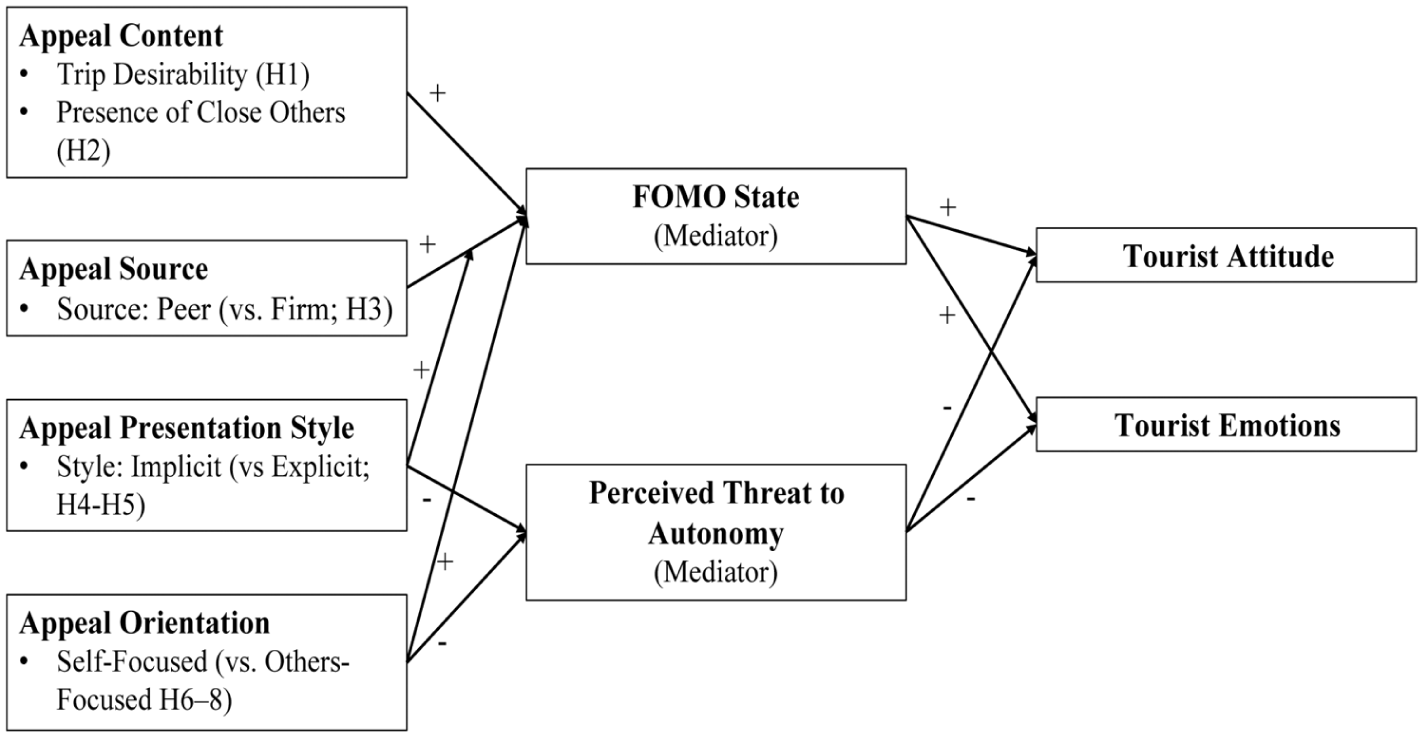
Conceptual model of FOMO appeal design in tourism communications.
Grounded Reactance Theory (Brehm & Brehm, 2013), Self-Determination Theory (Deci & Ryan, 2012), and FOMO’s dual-conceptualization (Wut et al., 2024; Z. Zhang et al., 2020), we identify effective and ethical configurations of FOMO messages through examining appeal content, source, presentation style, and orientation. Study 1 highlights trip desirability and the presence of close others as key appeal content elements driving FOMO and favorable tourist responses. Study 2 shows that appeal effectiveness depends on both the source (business vs. close others) and presentation style (explicit vs. implicit), with businesses less able to evoke FOMO than close others. Study 3 explores how presentation style influences responses to business-generated FOMO, revealing risks of backfire. Study 4 identifies a self-focused appeal orientation as an effective and emotionally responsible strategy, regardless of presentation style.
We collected data using online platforms that provide geographically- and demographically diverse samples (with participants screened to ensure all had 95%+ approval ratings), with new samples of different participants collected for each study. We also collected data in different years (with Study 1 & 2 collected in 2020–2021, and Study 3 & 4 in 2025, including both pre- and post-pandemic), showing consistent results over time. Manipulation checks for all studies can be found in Supplemental Appendix E. All studies were conducted in accordance with Institutional Review Board approval and complied with the ethical standards through the processes (IRB #: 2411372) with no deception and minimal anticipated risks beyond opportunity costs.
Study 1
Method
We recruited 257 participants from MTurk (Mage = 44; 64.2% Male, 35.8% Female) for a 2(Desirability: High vs. Low) × 2(Presence of close others: Present vs. Absent) between-subjects design. This sample size exceeds the required minimum sample size of 128, via G*Power estimation given a medium effect size (f = 0.25), α = .05, and desired power level of 0.8.
All participants first ranked 11 leisure activities according to their preferences in an ostensibly unrelated task. The choice of leisure activities is to ensure that this initial survey would not be connected with the later experiment where they saw a trip related to these activities. Then, participants were asked to imagine an experience that will take place in the near future (see Supplemental Appendix B for sample stimuli). The experience that participants saw corresponded with either their third (high desirability) or eighth (low desirability) ranking. These more moderate levels allowed us to realistically assess the effect of FOMO on a trip that is either relatively desirable or undesirable. We also randomized whether the experiences were to be attended by close friends (present) or no one that the participant knew (absent). After reading the scenario, participants responded to five items measuring their situational fear of missing out on 5-point scales, with minor contextual adaptations from prior research; we chose these measures given their established validation (α = .89; Good & Hyman, 2020). Then, two highly correlated attitudinal questions were adopted with scores averaged to create a composite of tourist attitude: How do you feel about the experience? How interested are you in going to the experience? (r = .73; p < .001). Finally, participants responded to a realism check and manipulation checks assessing their comprehension of the presence of close others in the scenario experience and the limited-time nature of the event (According to the study, were your friends going to the special event?; According to the study, would the special event happen only once or more than once?). Participants who failed the manipulation check were removed, leaving a sample of 205 participants. The realism check confirmed the realistic nature of the experimental paradigm (See Supplemental Appendix E).
Results
FOMO State
A 2(Desirability: High vs. Low) × 2(Presence of close others: Present vs. Absent) ANOVA revealed a main effect of desirability on FOMO (F(1, 201) = 9.78, p = .001, ηp2 = 0.046). Participants felt significantly more FOMO when the experience was desirable (M = 2.97) than when it was undesirable (M = 2.46), supporting H1a. Results also revealed a marginal effect of close others (F(1, 201) = 3.32, p = .07, ηp2 = 0.016), such that participants felt more FOMO when close others were present (M = 2.83) than when they were absent (M = 2.51), tentatively supporting H2a. The variables did not interact (p > .9).
Tourist Attitude
A 2(Desirability: High vs. Low) × 2(Presence of close others: Present vs. Absent) ANOVA revealed main effects of both independent variables. Participants felt significantly more positive about the experience when it was desirable (M = 5.75) than when it was undesirable (M = 4.22; F(1, 201) = 51.31, p < .001, ηp2 = 0.203), and when close others were attending (M = 5.21) than when they were not (M = 4.55; F(1, 201) = 7.43, p = .007, ηp2 = 0.036). The variables did not interact (p > .7).
Mediation Analysis
To assess mediation, we used PROCESS Model 4 from Preacher and Hayes (2004) for each of our independent variables since the variables did not interact. When examining the impact of close others on participants’ perceptions of the experience, results from the bootstrapping procedure using 5,000 resamples indicate evidence of mediation through FOMO (b = 0.286, SE = 0.143; 95% CI [0.002, 0.567]). When FOMO is included in the model, the effect of desirability on participants’ perceptions of the experience remains significant (b = 0.382, SE = 0.184, p = .04; 95% CI [0.020, 0.745]), suggesting partial mediation (supporting H2c). When examining the impact of experience desirability on participants’ perceptions of the experience, results from the bootstrapping procedure using 5,000 resamples again indicate evidence of mediation through FOMO (b = 0.404, SE = 0.127; [CI] [0.158, 0.661]), and the direct effect is significant when FOMO is included in the model, suggesting partial mediation (b = 1.13, SE = 0.170, p < .001; [CI] [0.790, 1.46]; supporting H1c).
Manipulation Check
We found no significant differences across conditions concerning the popularity of the experience (ps > .1).
Discussion
Study 1 highlights two key elements for effectively triggering FOMO: destination desirability and the presence of close others. While the impact of close others was marginal, this may be due to the hypothetical nature of the scenario. To address this, the following studies use a realistic travel business context. Still, participants rated experiences as more appealing and showed greater interest when the destination was desirable or involved close others. FOMO feelings mediated the effects of both factors on attitudes toward the experience. Importantly, the presence of close others did not diminish the role of trip desirability, underscoring its unique influence on tourist evaluations. With these foundational insights, we next examine whether business-initiated FOMO appeals can backfire and how presentation style (explicit vs. implicit) moderates this effect.
Study 2
Study 1 demonstrated that customers experience FOMO when close others are present and when tourism experiences are desirable. While most travel destinations are designed to be desirable, the presence of close others is not guaranteed. Therefore, Study 2 tests the primary proposition that customer-generated FOMO appeals are effective (given the presence of close others), but that business-generated FOMO appeals backfire (given the absence of close others) while holding the desirability of the experience constant. We also assess how businesses can more effectively employ FOMO appeals by examining the effects of explicit and implicit FOMO presentation styles—another critical dimension for effective FOMO appeal design. In some tourist communications, businesses explicitly warn tourists not to miss out; however, some campaigns use a more implicit approach without directly mentioning FOMO (see Supplemental Appendix A). Furthermore, this study investigates whether FOMO appeals influence the tourist attitude toward the business as a whole, beyond shaping attitudes toward a specific tourism product, by using tourists’ overall attitude toward the business as the dependent variable. Realism and manipulation checks indicated an effective experimental paradigm and successful manipulations (See Supplemental Appendix E).
Method
We recruited 242 workers (i.e., >the minimum sample size of 128) from Amazon Mechanical Turk (Mage = 35; 62.1% Male, 37.1% Female) to participate in a 2(Source type: tourist-to-tourist vs. business-to-tourist) × 2(Presentation: Explicit vs. Implicit) between-subjects design. All participants were told that they were evaluating a new travel business that may be available to them in the near future. The travel service, Nomadic Traveler, offers customizable “bucket-list” experiences at steep discounts.
With manipulations following the examples of existing tourism campaigns, half of the participants saw an Instagram post from the company displaying a picture from a tropical destination. The other half of the participants saw the same picture, but purportedly posted by a friend. We also manipulated the directness of the appeal. For half of the participants, the post read “You’re missing out! #nomdictraveler #travel #FOMO” (explicit); for the other half, the post read, “Living life to the fullest with Nomadic Traveler! #travel” (implicit). All other content in the posts was identical across conditions (See Supplemental Appendix B for stimuli). After seeing the posts, participants rated their attitude toward the business on three highly correlated questions averaged to create a composite score of tourist attitude (α = .896): how do you feel about the company, interest in the company’s services, and likelihood to try the service. We chose these measures to align with Study 1, while expanding them considering the focal target. Specifically, now that participants were evaluating a tourist business (vs. a destination), we also assessed intentions to try the service. As tourist attitude toward a trip and attitude toward the business offering the trip represent the different aspects of the same DV of focus-Tourist Attitude, validating the FOMO mechanisms on both attitudinal aspects offers a more robust check of the FOMO appeal effectiveness in tourist attitude shaping. Participants also indicated the degree to which they felt as though they were missing out after seeing the post. We chose this item to expand how FOMO is assessed across studies, and this measure has also been validated by prior research (Hayran & Anik, 2021; Hayran et al., 2020). All measures were assessed on 1- to 7-point scales.
Results
Feelings of Missing Out
Our first analysis explored the extent to which participants felt like they were missing out after seeing the post. A 2(Source Type) × 2(Presentation Style) ANOVA revealed only a significant main effect of source (F(1, 238) = 6.90, p = .009, ηp2 = 0.028), such that participants felt as though they were missing out when the post came from a friend (M = 4.40) but not when the post came from the business (M = 3.73), which supports H3a. There was no effect of presentation style (F(1, 238) = 0.158, p = .692, ηp2 = 0.001) and the variables did not interact (F(1, 238) = 2.19, p = .141, ηp2 = 0.009).
Tourist Attitude
A 2(Source Type) × 2(Presentation Style) ANOVA revealed significant main effects of source (F(1, 238) = 7.48, p = .007, ηp2 = 0.031) and presentation style (F(1, 238) = 9.06, p = .003, ηp2 = 0.037). Participants indicated a more positive attitude toward the business when the post came from a friend (M = 5.06) than when it came from the business (M = 4.56) (supporting H3b), and when the FOMO appeal was implicit (M = 5.09) versus explicit (M = 4.54). We also found a significant interaction (F(1, 238) = 6.58, p = .011, ηp2 = 0.027; see Figure 2). Planned contrasts revealed that when the post came from a friend, participants indicated similarly positive attitude toward the business regardless of whether the FOMO appeal was explicit (M = 5.02) or implicit (M = 5.10; F(1, 238) = 0.1; p = .75, ηp2 = 0.00). However, when the post came from the business, participants indicated a more positive attitude when the FOMO appeal was implicit (M = 5.07) than when it was explicit (M = 4.04; F(1, 238) = 15.42; p < .001, ηp2 = 0.061), supporting H4.
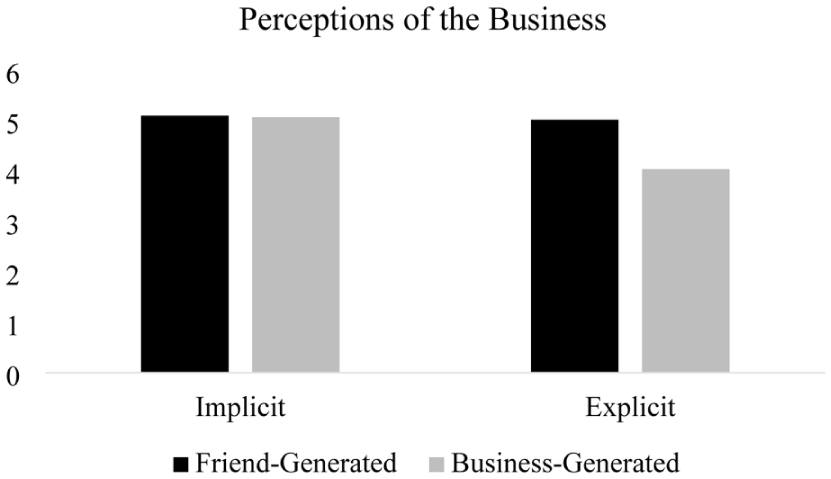
Interaction chart for appeal source and presentation style.
Mediation
Given the main effect of source on FOMO, we used PROCESS Model 4 from Preacher and Hayes (2004) to assess whether the effect of source on tourist attitude toward business was mediated by the activated FOMO state. Results from the bootstrapping procedure using 5,000 resamples indicate evidence of mediation through FOMO (b = 0.336, SE = 0.130; 95% CI [0.080, 0.588]). When FOMO is included in the model, the effect of source on participants’ attitude toward the business is not significant (b = 0.169, SE = 0.142, p > .2; 95% CI [−0.111, 0.449]), suggesting full mediation, supporting H3c.
Discussion
The results indicate that tourists respond differently based on the source and presentation style of FOMO appeals. Participants showed more favorable attitudes toward businesses using implicit FOMO messaging, while explicit appeals reduced positive perceptions—suggesting that overt FOMO tactics can backfire. Additionally, only personal sources (e.g., close others) effectively triggered a FOMO response. Combined with findings from Study 1, this highlights the critical role of including close others in FOMO appeals—regardless of content or source—to successfully evoke FOMO.
Study 3
To better understand the potential downsides of business-driven FOMO appeals and improve their effectiveness, Study 3 further examines how presentation style influences tourist responses. We first assess tourists’ emotional reactions, recognizing emotions as key indicators of well-being. We then explore the mechanism behind the differing impacts of implicit versus explicit FOMO messaging, noting that explicit appeals may threaten consumers’ sense of autonomy. To test the robustness of our findings, we use different operationalizations, including a new sample from Prolific Academic, which is a different platform with well-documented competent performance (Albert & Smilek, 2023), and a revised version of the FOMO messages. The implicit appeal invites tourists to imagine a memorable experience, while the explicit version more directly highlights what they’ll miss if they don’t participate. Study 3 offers insights into how tourism businesses can craft FOMO appeals that are both effective and supportive of tourist well-being. Realism and manipulation checks indicated an effective experimental paradigm and successful manipulations (See Supplemental Appendix E).
Method
We recruited 201 workers (i.e., >the minimum sample size of 128) from Prolific Academic (Mage = 39; 51% Male, 47.5% Female) to participate in a 2-level (Business Explicit FOMO Appeal vs. Business Implicit FOMO Appeal) between-subjects design. All participants were told that they were evaluating a new travel company that may be available to them in the near future. The travel service, Nomadic Traveler, offers customizable “bucket-list” experiences at steep discounts.
Adapting from existing campaigns, half of the participants saw an Instagram post from the company displaying a picture from a tropical destination with an explicit FOMO appeal. The other half of the participants saw the same picture, with an implicit FOMO appeal. All other content in the posts was identical across conditions (See Supplemental Appendix B for stimuli). After seeing the posts, participants rated their attitude toward the company on the same three measures as Study 2 (α = .927). They indicated the extent to which they felt as though they were missing out on the same five items used in Study 1 (α = .951). Next, we measured the process by examining the extent to which participants felt that the post threatened their freedom/autonomy using eight items with minor contextual adaptations from prior research (α = .835; Hu & Wise, 2021; Shen & Dillard, 2005; Q. Zhang & Sapp, 2013) on a 5-point scale. Finally, we assessed emotional states using 4 positive (i.e., happy, excited, inspired, and enthusiastic) and 4 negative items (i.e., irritated, angry, annoyed, and aggravated) on 1 to 5 scales. The negative affect measures followed prior research exploring anger that emerges under autonomy threat (Q. Zhang & Sapp, 2013). The positive affect measures were adapted from established scales (Watson & Clark, 1994; Watson et al., 1988).
Results
FOMO State
As expected and replicating the pattern of effects from Study 2, there were no significant differences in FOMO across the appeal types (F(1, 198) = 0.62, p = .432, ηp2 = 0.003). In the absence of close others, businesses are unable to evoke legitimate feelings of FOMO regardless of whether the appeal is implicit (M = 2.05) or explicit (M = 2.15).
Emotional Reactions
Our first analysis explored the extent to which the FOMO appeals impacted participants’ emotions. We combined the four negative emotional states into a composite of negative affect (α = .901) and the four positive emotional states into a composite of positive affect (α = .964). A one-way ANOVA revealed that the explicit FOMO appeal resulted in significantly greater negative affect (M = 1.42) than the implicit FOMO appeal (M = 1.17; F(1, 198) = 7.89, p = .005, ηp2 = 0.038). The explicit appeal also resulted in significantly less positive affect (M = 2.25) than did the implicit appeal (M = 2.64; F(1, 198) = 4.96, p = .027, ηp2 = 0.024), supporting H4b.
Tourist Attitude
A one-way ANOVA revealed a significant main effect of appeal type (F(1, 198) = 6.06, p = .015, ηp2 = 0.030) such that participants felt significantly more positively about the business when the appeal was implicit (M = 4.73) than when it was explicit (M = 4.21), supporting H4a again.
Perceived Threat to Autonomy
We then assessed the extent to which participants felt that the business’s post represented a threat to their autonomy. As expected, the perceived threat was significantly higher for the explicit appeal (M = 2.55) than for the implicit appeal (M = 1.97; F(1, 198) = 32.86, p < .001, ηp2 = 0.142).
We used PROCESS Model 4 from Preacher and Hayes (2004) to assess the extent to which feelings of perceived threat mediated the effect of appeal type on business perceptions. Results from the bootstrapping procedure using 5,000 resamples indicate evidence of mediation through perceived threat (b = −0.519, SE = 0.130; 95% CI [−0.786, −0.284]). When the perceived threat is included in the model, the effect of FOMO appeal on participants’ feelings toward the business is not significant (b = −0.001, SE = 0.207, p = .995; 95% CI [−0.409, 0.406]), which supports H5a. We ran the same mediation analysis for both negative and positive emotions as well. Supporting H5b, results from the bootstrapping procedure using 5,000 resamples indicate evidence of mediation through perceived threat for negative affect (b = 0.313, SE = 0.080; 95% CI [0.171, 0.486]) and positive affect (b = −0.441, SE = 0.105; 95% CI [−0.655, −0.246]). When the perceived threat is included in the model, the effect of FOMO appeal on participants’ negative emotions is not significant (b = −0.066, SE = 0.075, p = .380; 95% CI [−0.213, 0.082]), nor is it significant for positive emotions (b = 0.046, SE = 0.173, p = 0.793; 95% CI [−0.296, 0.387]).
Discussion
Study 3 replicates the findings from Study 2 for business-generated FOMO appeals. In the absence of close others, FOMO appeals are ineffective. Further, appeals that explicitly mention missing out backfire by eliciting a perceived threat to autonomy that negatively impacts tourists’ attitudes toward the business. The explicit appeals also evoke greater negative affect and less positive affect when compared to the implicit appeals. In our next study, we will examine the efficacy of business-generated FOMO appeals when close others are present, along with a promising appeal orientation that aims to effectively activate FOMO without producing negative outcomes for businesses or tourists.
Study 4
In our final study, we examine how businesses can effectively employ FOMO appeals that positively impact both business and tourist outcomes. Our findings from Studies 2 and 3 the adverse effects of business-generated FOMO appeals when close others are not present. Additionally, Study 1 highlighted the critical roles of experience desirability and the presence of close others in shaping FOMO responses. Building on these insights, Study 4 holds both experience desirability and the presence of close others constant at high levels, while manipulating the appeal orientation (self-focused vs. other-focused) to identify more effective FOMO strategies for tourism marketing. Furthermore, we re-examine the moderating role of message presentation style (implicit vs. explicit) to validate the robustness of the presentational style effect in the context of close others. Given that Study 2 showed that the presence of close others diminishes the influence of presentation style, we thereby assume that with the inclusion of close others in business-generated appeals in Study 4, the impact of appeal orientation will be less sensitive to variations in message presentation. Realism and manipulation checks indicated an effective experimental paradigm and successful manipulations (See Supplemental Appendix E).
Method
We recruited 400 workers (i.e., >the minimum sample size of 128) from Prolific Academic (Mage = 40; 40% Male, 59% Female) to participate in a 2(FOMO Focus: Self-Growth vs. Social Comparison) × 2(Presentation Style: Implicit vs. Explicit) between-subjects design. All participants were told that they were evaluating a new travel company. The travel service, Nomadic Traveler, offers customizable “bucket-list” experiences at steep discounts. A pretest with 50 workers from Prolific Academic determined that our vacation destination in the advertising appeal was highly desirable (M = 4.28/5; t(49) = 12.91, p < .001, d = 1.83, 95% CI [1.37, 2.28]) and appealing (M = 4.44/5; t(49) = 17.64, p < .001, d = 2.50, 95% CI [1.93, 3.96]). Further, all participants were told to imagine that many of their close friends and social media connections were already using this travel service. We excluded participants (51) who failed our attention check (According to the directions in the study, were you asked to imagine that many of your social media connections- including your close friends- are already using Nomadic Traveler?).
Half of the participants saw an Instagram post from the company displaying a picture from an exotic destination with a FOMO appeal that emphasized self-growth. The other half of the participants saw the same picture, with a FOMO appeal that emphasized social comparison. For half of the participants, the message directly mentioned missing out (explicit); the other half of the participants saw an appeal that indirectly suggested missing out (implicit). All other content in the posts was identical across conditions (See stimuli in Supplemental Appendix B). The manipulation is derived from the established intervention by Che et al. (2025) with adaptations to the tourism context. After seeing the posts, participants rated their attitude toward the company on the same three measures as prior studies (α = .913). They also indicated the extent to which they felt as though they were missing out on the same five items used in Study 1 and Study 3 (α = .944). Next, we measured the extent to which participants felt that the post threatened their autonomy using the eight items from Study 3 (α = .808), as well as their positive and negative emotional states using the same measures from Study 3.
Results
Tourist Attitude
A 2(FOMO Orientation: Self- vs. Other-focus) × 2(Presentation Style: Implicit vs. Explicit) ANOVA revealed a marginal main effect of FOMO orientation (F(1, 345) = 2.84, p = .093, ηp2 = 0.008) such that participants felt more positively about the business when the appeal focused on self-growth (M = 5.14) than when it focuses on social comparison (M = 4.89). More importantly, we found a significant interaction (F(1, 345) = 4.59, p = .033, ηp2 = 0.013). When the appeal focused on self-growth, it positively impacted business perceptions regardless of whether the message was implicit (M = 5.2) or explicit (M = 5.09; F(1, 345) = 0.104, p = .74, ηp2 = 0.00). However, when the business focused on others, the explicit appeal was significantly more effective (M = 5.17) than the implicit appeal (M = 4.64; F(1, 345) = 7.30, p = .007, ηp2 = 0.021). Such results conditionally support H7a.
Tourist Emotions
Our analysis also explored the extent to which the FOMO appeals impacted participants’ emotional well-being. We combined the four negative emotional states into a composite of negative affect (α = .905) and the four positive emotional states into a composite of positive affect (α = .960). There were no significant differences in positive affect across the four conditions; however, the appeals significantly impacted negative emotions. A 2(FOMO Orientation: Self-Growth vs. Social Comparison) × 2(Presentation Style: Implicit vs. Explicit) ANOVA revealed only a main effect of FOMO orientation (F(1, 345) = 9.17, p = .003, ηp2 = 0.026). Participants felt significantly more negative emotions when the FOMO appeal focused on others (M = 1.35) than when it highlighted self-growth (M = 1.16), supporting H7b.
FOMO
To assess H6, we first conducted a one sample t-test examining the effect of the self-focused FOMO manipulation on the FOMO state. Results revealed that the self-focused appeal effectively elicited FOMO (M = 2.13; t = 29.32, df = 172, p (two-sided) < .001, 95% CI [1.99, 2.27]). Next, a 2(FOMO Orientation: Self- vs. Other-focused) × 2(Presentation Style: Implicit vs. Explicit) ANOVA revealed a main effect of presentation style (F(1, 345) = 5.61, p = .018, ηp2 = 0.016), such that explicit appeals elicit significantly more FOMO (M = 2.24) than do implicit appeals (M = 1.98). We also found a significant interaction (F(1, 345) = 10.47, p = .001, ηp2 = 0.029). When the business focused on self-growth, the message elicited similar levels of FOMO across implicit (M = 2.18) and explicit appeals (M = 2.09; F(1, 345) =0 .373, p = .54, ηp2 = 0.001), demonstrating that self-focused FOMO appeals effectively elicit FOMO. However, when the business focused on others, the explicit appeal elicited significantly more FOMO (M = 2.41) than did the implicit appeal (M = 1.81; F(1, 345) = 15.84, p < .001, ηp2 = 0.044). Taken together, these results support H6.
Given the interaction, we used PROCESS Model 7 from Preacher and Hayes (2004) to assess the extent to which FOMO mediated the effect of FOMO orientation on attitude toward the business, along with the moderating effect of presentation style. Results from the bootstrapping procedure using 5,000 resamples indicate evidence of moderated mediation through FOMO (b = 0.567, SE = 0.183; 95% CI [0.199, 0.937]). Feelings of FOMO mediate the effect of FOMO orientation on attitude toward business when the appeal is explicit (b = 0.304, SE = 0.115; 95% CI [0.078, 0.531]), but not when it is implicit (b = −0.263, SE = 0.138; 95% CI [−0.538, 0.014]). When FOMO is included in the model, the effect of FOMO orientation on participants’ feelings toward the business is not significant (b = 0.228, SE = 0.119, p = .06; 95% CI [−0.005, 0.462]). This finding conditionally accepts H8a. We did not find evidence of mediation when assessing FOMO orientation on negative affect, along with the moderating effect of presentation style (b = −0.001, SE =0 .028; 95% CI [−0.058, 0.054]), failing to support H8b.
Perceived Threat to Autonomy
We then assessed the extent to which participants felt that the business’s post represented a threat to their autonomy. A 2(FOMO Orientation: Self-Growth vs. Social Comparison) × 2(Presentation style: Implicit vs. Explicit) ANOVA revealed only a main effect of FOMO orientation (F(1, 345) = 15.61, p < .001, ηp2 = 0.043). Participants perceived significantly greater threat from the other-focused FOMO appeal (M = 2.35) than from the self-focused FOMO appeal (M = 2.06), supporting H7c.
Given the main effect of FOMO orientation, we used PROCESS Model 4 from Preacher and Hayes (2004) to assess the extent to which feelings of perceived threat mediated the effect of FOMO orientation on tourist attitude toward the business. Results from the bootstrapping procedure using 5,000 resamples indicate evidence of mediation through perceived threat (b = 0.313, SE = 0.089; 95% CI [0.152, 0.499]). When perceived threat is included in the model, the effect of FOMO orientation on participants’ feelings toward the business is not significant (b = −0.054, SE = 0.129, p = .674; 95% CI [−0.308, 0.199]). We ran a similar mediation analysis on negative affect. Using PROCESS Model 4 from Preacher and Hayes (2004), we assessed the extent to which feelings of perceived threat mediated the effect of FOMO orientation on negative affect. Results from the bootstrapping procedure using 5,000 resamples indicate evidence of mediation through perceived threat (b = −0.134, SE = 0.043; 95% CI [−0.227, −0.061]). When perceived threat is included in the model, the effect of FOMO orientation on participants’ negative affect is not significant (b = −0.060, SE = 0.055, p = .281; 95% CI [−0.169, 0.049]). These mediation results support H8a and H8b.
Discussion
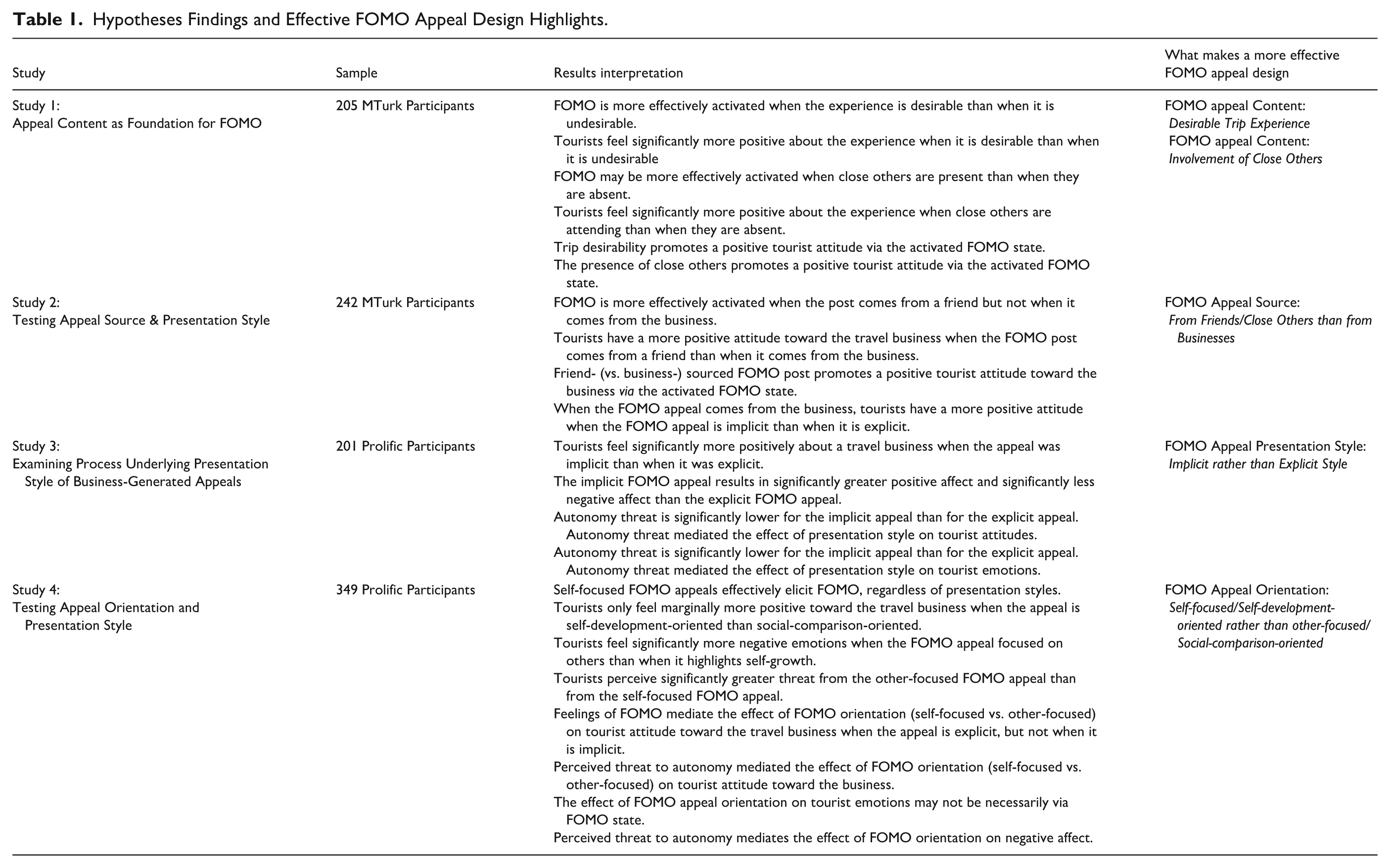
Study 4 explored how tourism businesses can use FOMO appeals effectively while holding trip desirability and the presence of close others constant. We found that self-growth-focused FOMO appeals improve tourist attitudes and reduce negative emotions and perceived threats to autonomy, regardless of whether the message is explicit or implicit. Furthermore, the difference in effectiveness between explicit and implicit styles is smaller for self-focused appeals than for other-focused ones. This likely stems from greater consumer trust in brands that emphasize personal development. Unlike other-focused appeals, which may seem manipulative, self-focused messages signal a growth mindset, fostering trust. Prior research supports this, showing that brands promoting personal improvement build stronger trust (Murphy & Dweck, 2015). This trust may help buffer against the psychological resistance often triggered by explicit messaging. In contrast, other-focused appeals lack these trust cues and are more likely to provoke negative emotional responses. Thus, self-focused FOMO appeals offer a more effective and ethical strategy for engaging tourists. Table 1 provides a summary of our four studies and their findings, as well as how the findings inform what comprises a more effective FOMO appeal design.
Hypotheses Findings and Effective FOMO Appeal Design Highlights.
Conclusion
FOMO appeals are increasingly utilized in business communications toward tourists, yet their implications for both businesses and tourists remain underexplored. To advance the ethical and effective design of such appeals, we conducted four experiments using diverse participant samples and experimental manipulations. Our findings identify optimal combinations of appeal content (e.g., trip desirability and inclusion of close others), source (the presence or absence of social connections), presentation style (implicit vs. explicit), and appeal orientation (self-focused vs. other-focused) that collectively contribute to effective and responsible FOMO marketing strategies in tourism.
Theoretical Implications
Grounded in Reactance Theory (Brehm & Brehm, 2013), Self-Determination Theory (Deci & Ryan, 2012), and FOMO’s dual conceptualization (Wut et al., 2024; Z. Zhang et al., 2020), this research develops a systematic framework for FOMO appeal design. It offer a novel approach to effectively and ethically crafting FOMO messages. This framework addresses the relative lack of empirical attention to FOMO appeal design and broadens the application of these foundational theories to a new and practically relevant domain. Also, our demonstrated interactive effects among appeal elements provide nuanced insights into the mechanics underlying FOMO appeal effectiveness. Additionally, these insights offer depth to the theoretical understanding of FOMO messaging and advance FOMO research methodologically through the use of experimental designs that allow for stronger causal inference (Tandon et al., 2021).
Specifically, our findings (H1a-b and H2a-b) reinforce the independent importance of trip desirability and close others’ involvement in triggering FOMO—two factors previously examined in other domains (Phan & Hoai, 2025; Rifkin et al., 2025) but empirically validated here for the first time within tourism. Specifically, it suggests that the effectiveness of FOMO appeal content may depend on the satisfaction of basic psychological needs—autonomy, competence—through desirable experiences, and relatedness through the inclusion of close others. This inspires future research to further examine whether the satisfaction of these psychological needs mediates the relationship between the appeal content and FOMO activation. The significant mediation effects of FOMO identified in H1c and H2c further demonstrate and stress the importance of appeal content design in translating the activated FOMO state into more favorable tourist attitudes toward travel offerings. To the best of our knowledge, this study represents one of the earliest efforts to empirically connect FOMO appeal design to practically meaningful outcomes, such as tourist attitudes.
Also, our H3 results showed consistent findings with prior literature (Hodkinson, 2019; Rifkin et al., 2025) that FOMO appeals originating from close others are more persuasive and less harmful than those from businesses. More importantly, results reveal FOMO activation as an underlying mechanism that helps explain the observed superiority of consumer-to-consumer communication over business-initiated messaging in shaping consumer attitudes. In addition, this enables the extended application of Self-Determination Theory by demonstrating that relatedness satisfaction can be operationalized through both appeal content (H2) and appeal source (H3), offering a more nuanced understanding of how FOMO appeals may be designed.
Results for H4 provide the first empirical evidence that FOMO presentation style influences both business-related and tourist-related outcomes. By demonstrating this effect, the study draws attention to presentation style as a previously underexplored yet consequential dimension of FOMO appeal design, particularly in business-driven contexts. Similarly, findings for H5 extend the limited research on FOMO appeals by identifying perceived threat to autonomy as a key explanatory mechanism for the observed backfire of explicit, business-generated FOMO appeals—a phenomenon not previously theorized or empirically tested. It also lends empirical support to Reactance Theory as an explanatory framework for understanding how distinct presentation styles generate different tourist responses. Our investigation into presentation style also reveals the inclusion of close others as an important boundary condition for explicit messaging to improve tourist attitudes than damaging their trust and emotional well-being. It suggests that the inclusion of socially relevant others can buffer the psychological reactance typically triggered by overt messaging, possibly due to heightened trust in the message source (Ladhari & Michaud, 2015)—a potential mechanism for future explorations.
Building on the conceptual differentiation between personal FOMO (P-FOMO) and social FOMO (S-FOMO) (Wut et al., 2024; Z. Zhang et al., 2020), H6-8 findings are the first to empirically demonstrate the effectiveness of self-focused (vs. other-focused) FOMO appeals as a powerful design dimension in simultaneously eliciting the FOMO state, contributing to positive tourist attitudes about a business and its travel offerings, and preserving individuals’ emotional well-being. Also, the advantage of self-focused appeals appears to stem primarily from their capacity to reduce negative emotions rather than to amplify positive ones (H7b). This pattern echoes with prior literature that FOMO is more closely associated with negative affective responses than positive emotional experiences (Bui et al., 2021; Chan et al., 2022; Morsi et al., 2024; Rifkin et al., 2025; Roberts & David, 2019). Moreover, results for H7c, H8a, and H8b for the first time identify perceived threat to autonomy as a key mechanism explaining the differential effectiveness of self-focused versus other-focused FOMO appeals.
Beyond these immediate findings, our findings open several novel avenues for future tourism marketing research. While our study establishes the immediate attitudinal impact of these triggers, it informs the future investigation into the longitudinal consequences of FOMO-driven tourist decision-making, specifically whether high-urgency appeals create an “expectancy-disconfirmation” gap that affects post-trip satisfaction. Additionally, our framework provides a baseline for exploring ethical boundary conditions and the point of “reactance”—the threshold at which a persuasive FOMO appeal is perceived as manipulative, leading to tourism product avoidance rather than engagement. Moreover, we encourage the application of our multi-dimensional design model to sustainable tourism marketing, examining if the psychological mechanisms of FOMO can be repurposed as a “nudge” to encourage patronization of eco-conscious tourism businesses or destinations, thereby aligning social urgency with responsible consumption. Lastly, we advance ethical marketing and tourism ethics scholarship by empirically demonstrating how FOMO-based persuasion can be designed to enhance tourist engagement without compromising autonomy or psychological well-being. We reposition FOMO from a potentially manipulative tactic to a responsible marketing strategy that aligns business performance with consumer welfare, thereby contributing to sustainable and ethically grounded tourism marketing frameworks. More investigations should be conducted leveraging FOMO appeals for improved tourist well-being.
Practical Implications
Given that travel decisions are highly susceptible to social comparison and emotional triggers, tourism marketers must design FOMO appeals thoughtfully—balancing urgency and desirability without undermining consumer trust or psychological health. Thus, mastering FOMO appeal design is not only a competitive advantage but also a strategic necessity for sustainable tourism marketing in the digital age.
Our findings carry significant implications for tourism marketing practitioners across different organizational contexts, aiming to use FOMO appeals strategically and ethically. For travel agencies and tour operators, H1-2 results underscore the importance of framing FOMO appeals around co-travel plus aspirational, rewarding, and emotionally appealing experiences. At the same time, agencies should prioritize the integration of authentic user-generated content (H3), such as referral programs, client photos and story posts, and other social sharing prompts, which more effectively stimulate FOMO without damaging brand sentiment. Unlike heavily scripted appeals centered on urgency or scarcity, tourist-generated narratives preserve credibility and emotional resonance. Subtle references to what “others have enjoyed” or to the transformative potential of a journey can outperform direct exhortations to “book now” or “secure limited spots” (H4). Such restraint reduces perceptions of autonomy threat and protects long-term trust in the agency brand (H5). Highlighting vivid personal benefits (e.g., once-in-a-lifetime moments, meaningful milestones) can further enhance FOMO activation and tourists’ responses (H6–8).
Destination marketing organizations (DMOs) can also benefit from adopting more implicit and self-growth-oriented FOMO appeal strategies (H4–8). Rather than relying on conventional scarcity rhetoric, DMOs may enhance destination appeal by showcasing immersive, communal experiences in which visitors engage deeply with local culture, traditions, or natural landscapes. Campaigns that foreground personal development or transformation—whether through wellness, creativity, or meaningful self-reflection—encourage a constructive form of FOMO that strengthens both destination evaluations and tourist intentions while avoiding negative affective responses. This approach also aligns with a broader shift in destination branding toward authenticity and experiential value. Encouraging tourists to share their own experiences through social media or destination-hosted platforms further amplifies appeal by blending personal storytelling with collective aspiration. Importantly, even when campaigns highlight groups of tourists or families, the emphasis should remain on choice and enrichment rather than on implied pressure, thereby reinforcing autonomy while stimulating desire to sustain ethical and effective persuasion.
For hotels, resorts, and attractions, the evidence points to the effectiveness of integrating self-focused (H6–8) and guest-generated narratives (H3) into marketing communications. Visuals and testimonials that capture authentic shared moments—family dinners, group adventures, or quiet personal escapes—can induce FOMO in ways that feel organic and trustworthy. Framing experiences around personal renewal or growth, rather than competitive social comparison, further protects against negative emotional outcomes and fosters more favorable brand attitudes. This orientation is particularly valuable because it remains stable across different presentation styles, affording marketers greater flexibility in campaign design. By contrast, explicit scarcity messaging—such as heavy emphasis on limited availability—risks being perceived as manipulative and may undermine customer sentiment. A more effective and ethical approach is to hint at exclusivity through subtle cues or to highlight unique aspects of the experience that tourists will value on a personal level.
It is also worth noting that, while other-focused FOMO appeals may still activate FOMO under certain conditions—particularly when messages are explicit—such appeals risk emotional backlash and reduced psychological comfort (H8). Tourism marketers should limit their use or combine them with autonomy-supportive framing to mitigate harm and achieve responsible marketing. Furthermore, across all sectors of tourism marketing, the results suggest a need to move beyond reliance on urgency and scarcity as the primary mechanisms for generating FOMO (H4). While such tactics can, under certain conditions, increase engagement, they are prone to backfiring when tourists perceive a threat to autonomy. Instead, appeals that emphasize self-fulfillment and enrichment offer a more sustainable path, stimulating FOMO in ways that motivate tourists’ interest in a business’ services and tourist well-being (H6–8). In doing so, they can balance competitiveness with responsibility, ensuring that FOMO appeals strengthen rather than erode trust in the tourism industry.
For tourism marketing practitioners, our findings translate into a specific blueprint for crafting high-conversion social media content. Based on the identified optimal mix, effective business-generated FOMO appeals should move away from aggressive, “other-focused” pressure (e.g., “Don’t be the only one left behind”) and toward implicit, “self-focused” narratives that emphasize personal reward and social belonging (e.g., “Imagine waking up to this view with your favorite people. Your perfect escape is waiting.”). Specifically, marketers should prioritize themes of trip desirability and social inclusion involving a traveler’s “close others” to lower psychological barriers (e.g., “The best stories are the ones you tell together. Create your next chapter at [Destination] before the season ends.”). Another examples embody all the dimensions would be- “A rare chance to reconnect in paradise. Make sure your inner circle is part of the moment.” By utilizing these implicit cues, practitioners can trigger the psychological necessity of the experience without inducing the reactance often associated with explicit “hard-sell” tactics. This approach allows brands to provide inspirational value while subtly minimizing the transaction costs associated with decision-making. Furthermore, by framing these messages around the tourist’s own potential for joy or growth rather than a comparative fear of others’ status, marketers can maintain ethical boundaries that prioritize tourist autonomy and emotional well-being.
Beyond organizational strategies, our findings offer critical insights for public policy and the development of ethical tourism marketing standards. As digital platforms increasingly utilize psychological triggers like “social urgency” and “scarcity,” there is a heightened risk that these tactics may infringe upon tourist autonomy and well-being by inducing anxiety or impulsive consumption (Shahidul Islam, 2026; Zeng et al., 2024). Consequently, we recommend that tourism policymakers and regulatory bodies consider formalizing “Ethical FOMO Guidelines” to protect vulnerable tourists from manipulative messaging. Specifically, regulations should mandate transparency in the disclosure of FOMO appeal patterns with strong tendency of inducing anxiety or pressure (e.g., influencer-led urgency), ensuring that promotional appeals do not bypass the consumer’s rational decision-making through manufactured pressure (Seo et al., 2025; Sigala et al., 2024). By prioritizing “process transparency” and consumer digital literacy, policy-makers can help shift the industry toward a virtue-ethics framework where the pursuit of conversion does not come at the expense of traveler mental health or trust (Shahidul Islam, 2026). Such a regulatory shift would not only safeguard individual tourists but also enhance the long-term credibility and sustainability of tourism business brands in an increasingly saturated digital marketplace.
Limitations & Future Research Directions
While this research offers valuable insights into designing effective and ethical FOMO appeals in tourism marketing, several limitations merit acknowledgment. All four studies were conducted in controlled online settings, which support internal validity but may lack real-world applicability. We also collected data both pre- and post-COVID, showing consistent results across sampling periods. Nevertheless, post-pandemic motivations to travel may exacerbate the negative effects of FOMO appeals, making tourists feel particularly anxious about missing out. Future research could explore field experiments or longitudinal studies to assess FOMO’s impact on actual travel decisions over time. Additionally, reliance on self-reported data may introduce bias. Incorporating alternative measures of FOMO, or behavioral or physiological measures of downstream outcomes—such as click-through rates, booking data, or eye-tracking—could yield a more robust understanding of tourist responses.
Another limitation concerns the cultural and demographic composition of the samples. While participant diversity was achieved across studies, the sample was still Western-centric and cultural values (e.g., individualism vs. collectivism) may shape how FOMO appeals are perceived, particularly regarding autonomy threat and social comparison. Our sample reflected an individualistic cultural orientation. Future studies could adopt cross-cultural comparisons to examine how cultural orientation moderates FOMO appeal effectiveness. Recruiting from online platforms (Mturk and Prolific) also generates a sample that is tech-savvy, which may limit generalizability.
Moreover, while the present research identifies key elements of source, appeal content, presentation style, and orientation, future investigations might explore alternative dimensions (e.g., social media channel, visual or textual expression) or sub-dimensions of these dimensions and their respective emotional and behavioral impacts. Specifically, we identified implicit, friend-generated, and self-growth-oriented FOMO messages as beneficial; however, future research should continue exploring the elements of FOMO appeals that promote positive tourist outcomes. Finally, with AI and personalization increasingly shaping tourism marketing, future work could also examine how adaptive FOMO messaging, tailored to individual traits or digital behavior, can boost effectiveness while maintaining ethical standards.
Supplemental Material
sj-docx-1-jtr-10.1177_00472875261459185 – Supplemental material for Designing Effective and Ethical Fear-of-Missing-Out Appeals in Tourism
Supplemental material, sj-docx-1-jtr-10.1177_00472875261459185 for Designing Effective and Ethical Fear-of-Missing-Out Appeals in Tourism by Gia Nardini and Ye Zhang in Journal of Travel Research
Supplemental Material
sj-docx-2-jtr-10.1177_00472875261459185 – Supplemental material for Designing Effective and Ethical Fear-of-Missing-Out Appeals in Tourism
Supplemental material, sj-docx-2-jtr-10.1177_00472875261459185 for Designing Effective and Ethical Fear-of-Missing-Out Appeals in Tourism by Gia Nardini and Ye Zhang in Journal of Travel Research
Supplemental Material
sj-docx-3-jtr-10.1177_00472875261459185 – Supplemental material for Designing Effective and Ethical Fear-of-Missing-Out Appeals in Tourism
Supplemental material, sj-docx-3-jtr-10.1177_00472875261459185 for Designing Effective and Ethical Fear-of-Missing-Out Appeals in Tourism by Gia Nardini and Ye Zhang in Journal of Travel Research
Supplemental Material
sj-docx-4-jtr-10.1177_00472875261459185 – Supplemental material for Designing Effective and Ethical Fear-of-Missing-Out Appeals in Tourism
Supplemental material, sj-docx-4-jtr-10.1177_00472875261459185 for Designing Effective and Ethical Fear-of-Missing-Out Appeals in Tourism by Gia Nardini and Ye Zhang in Journal of Travel Research
Footnotes
Acknowledgements
During the preparation of this work the author(s) used ChatGPT to improve the readability and language of the manuscript. After using this tool/service, author(s) reviewed and edited the content as needed and take(s) full responsibility for the content of the published article.

Ethical Considerations
All four studies have gone through the IRB approval of FAU and complied with the ethical standards through the processes (IRB #: 2411372).
Consent to Participate
Informed consent to participate was written at the beginning of the online survey and received from all participants.
Author Contributions
Funding
The authors received no financial support for the research, authorship, and/or publication of this article.
Declaration of Conflicting Interests
The authors declared no potential conflicts of interest with respect to the research, authorship, and/or publication of this article.
Supplemental Material
Supplemental material for this article is available online.
Author Biographies
References
Supplementary Material
Please find the following supplemental material available below.
For Open Access articles published under a Creative Commons License, all supplemental material carries the same license as the article it is associated with.
For non-Open Access articles published, all supplemental material carries a non-exclusive license, and permission requests for re-use of supplemental material or any part of supplemental material shall be sent directly to the copyright owner as specified in the copyright notice associated with the article.
