






Abstract

Introduction
Climate change is no longer a distant prospect for tourism; it is an unfolding crisis that is already reconfiguring destinations, demand patterns, and governance systems (Scott, 2024). Evidence shows that human-induced global warming has accelerated in recent years (Foster & Rahmstorf, 2026), reinforcing the urgency of the climate crisis and the need for transformation. This acceleration is manifested not only through intensifying extreme weather events, but also through slower-onset processes such as shifting climatic zones, rising sea levels, and widespread ecosystem change. Tourism sits at the centre of this crisis. Heavily implicated in terms of both cause and effect, tourism epitomises a profound paradox, simultaneously depending on and eroding stable climatic and ecological conditions through emission-intensive aviation, cruise tourism, accommodation and activities (Becken & Loehr, 2022; Gössling & Higham, 2020; Higgins-Desbiolles et al., 2026; Higham et al., 2021). This paradox positions tourism not merely as a casualty of climate change but as a central arena in which competing claims over climate futures are negotiated. The tourism sector is a microcosm of broader societal tensions between growth, justice, and planetary boundaries.
Foundational research anticipated these dynamics (e.g., McBoyle & Wall, 2005; Scott et al., 2003). Early studies projected that climate change would restructure global tourism flows and seasonality, privileging higher-latitude regions while reducing the climatic suitability of traditional sun-and-sea destinations (Belle & Bramwell, 2005; Hamilton et al., 2005). Subsequent empirical evidence has confirmed the growing sensitivity of tourism economies to even modest climatic shifts, with weather variability affecting visitation, expenditure, and workforce conditions (H. Li et al., 2017; Wilkins et al., 2017; Zhou et al., 2024). Yet, the impacts of climate change are not evenly distributed. Although climate change impacts are increasingly evident across the world, tourism vulnerability is most pronounced in Africa, the Middle East, South Asia, and Small Island Developing States (SIDS), regions where the sector contributes significantly to national Gross Domestic Product (GDP) and where tourism growth is projected to accelerate in the coming decades (Scott et al., 2019; Scott et al., 2023). These cases, among many others, demonstrate that the entanglement of tourism with climate change can be existential in cases, exposing deep contradictions between economic dependence on continued growth and the biophysical conditions that ultimately sustain tourism.
Despite these realities, policy and scholarly responses have often retreated into the language of adaptation, resilience, and technological innovation. Managerial framings address how destinations might extend seasons, how businesses might adapt to new weather patterns, or how technologies might decarbonise aviation. While offering practical insights these framings have the effect to depoliticise the issue by reducing climate change to a matter of risk management. They obscure important ethical and distributive dimensions and sustain the illusion that tourism’s growth trajectory can remain intact through well-planned adjustment. Global policy gaps are evident. In Africa, extreme heat, drought, and flooding increasingly disrupt tourism economies and workforce well-being; yet Nationally Determined Contributions (NDCs) have rarely outlined tourism-specific emission targets or adaptation mechanisms (Dube et al., 2024). In SIDS, tourism-dependent economies face existential threats from sea-level rise and extreme weather events. Although nearly all SIDS have submitted NDCs and inclusion of tourism is becoming more evident (Becken & Rastegar, 2025), implementation of tourism-related climate action remains fragmented, constrained by limited capacity, high debt (Wolf et al., 2022) and disadvantages in accessing climate finance (Treichel et al., 2024).
The inequities embedded in global tourism are profound and enduring, reflecting deep asymmetries in mobility, labour, and environmental responsibility. Recent scholarship has begun to confront these structural questions more directly, advancing justice-oriented frameworks that embed principles of equity, participation, and recognition into tourism’s climate policy and planning (e.g., Bigby et al., 2024; Becken & Rastegar, 2025; Higgins-Desbiolles et al., 2026; Rastegar & Becken, 2025). Yet, the sector remains defined by stark contradictions. Carbon-intensive mobility continues to privilege affluent travellers (Gössling & Higham, 2020), whose consumption practices are glamorised through aspirational media cultures such as the “Rich Kids of Instagram” (Cohen et al., 2021). These consumption practices are materially sustained by the invisible and precarious labour of workers and the degradation of ecosystems elsewhere. Indigenous and local communities whose cultural landscapes underpin tourism economies, along with workers in low-wage and climate-exposed sectors, bear disproportionate burdens of climate disruption despite their own negligible contributions to emissions (McNamara et al., 2022; Rudge, 2025).
It is now increasingly recognised and accepted that these dynamics extend beyond distributive imbalances and reveal entrenched structural injustices rooted in colonial, capitalist, and extractive histories. Tourism, in this sense, functions both as a driver and amplifier of broader socio-economic inequalities and as a force that exacerbates climate injustice, where the pleasures and profits of carbon-intensive mobility accrue to the few, while the environmental, social, and cultural costs cascade to the many. Climate justice in tourism, therefore, must critically embed ethical, political, and social dimensions within the scientific and policy discourses that shape climate responses. This letter responds to this complex and challenging context.
Climate justice in tourism requires bridging the analytical divides between climate science, climate policy, and justice scholarship. Each offers a distinctive yet partial lens on how climate change is understood and governed. Climate science is a broad field that encompasses physical climate science, impact and risk modelling, and socio-economic analyses, providing insights into the complex two-way interactions between anthropogenic activities and the climate system (IPCC, 2023). It addresses physical risks, exposures, and thresholds of change, and reveals how human activities alter climatic and ecological systems by contributing to greenhouse gas emissions. While conceptualising risk and vulnerability in technical and model-based terms, it can overlook their social, historical, and political foundations. Climate policy translates knowledge into governance structures, targets, and adaptation mechanisms, but implementation frequently falters amid technocratic approaches that marginalise diverse knowledges and lived experiences. Justice scholarship, by contrast, interrogates the ethical and political dimensions of climate change, how benefits and burdens are distributed, whose knowledge counts, and whose voices shape decision-making, yet its theoretical focus can leave a gap between critique and practical application.
This letter begins by offering a concise synopsis of each of the three domains of climate science, climate policy and climate justice. Rather than seeking to reconcile tensions between these domains, we advance an integrated discussion that brings them into dialogue through the illustrative case of global aviation emissions in tourism. In doing so, we foreground tensions between these domains, recognising that transformative change emerges not from attempts to achieve a degree of consensus, but from engaging with the contested terrains of responsibility, knowledge, and power that shape tourism’s climate futures. We advance these contested terrains to create a dialogic space that bridges disciplinary divides, and to inform an interdisciplinary research agenda that invites more inclusive ways of imagining and advancing just climate futures.
Climate Science: How is Climate Change Transforming Tourism?
Climate science provides the foundation for understanding how anthropogenic influences on the climate system reshapes tourism, destinations, demand, and development. The world has entered a new climate state, with observed changes in the climate system that “are unprecedented over many centuries to many thousands of years” (IPCC, 2021, p. 7). The multi-decade warming trend continues; 2016 to 2025 was the warmest in the instrumental record, with record emissions and atmospheric concentrations of greenhouse gases (GHG) also recorded in 2025 (World Meteorological Organization, 2026). The frequency, intensity, and duration of extreme heat, precipitation, drought, and storm events have increased in most regions of the world (IPCC, 2021). In 2024, global-average temperatures for the first time exceeded the +1.5°C (above pre-industrial levels) warming threshold (World Meteorological Organization, 2026). Overshooting this threshold puts the world at greater risk of multiple catastrophic climate tipping points (Lenton et al., 2025).
UNEP’s (2024) global emissions report concluded that there is currently no credible pathway to achieve the Paris +1.5°C target and that current national policy settings will cause warming of approximately +3°C by 2,100. A survey of leading global climate scientists likewise found the majority believed warming this century would exceed +3°C (Tollefson, 2021). A +3°C world would risk ecosystem collapse, intensify food and water insecurity, displace hundreds of millions of people, erode GDP in many countries, and diminish the development prospects of billions (IPCC, 2023; World Bank, 2024). It is already the case that the burden of contemporary climate change is unequal (IPCC, 2023; Zahnow et al., 2025). Diffenbaugh and Burke (2019) report that the gap between the economic output of the world’s richest and poorest countries is 25% larger today than it would have been without global warming over the past 50 years.
Regardless of whether or not government signatories collectively achieve their national determined Paris Agreement commitments, which aim to collectively stablize global warming to “well below +2°C,” climate change is already and will continue to transform global tourism with major distributive consequences (Scott, 2024). The media (e.g., Ma & Kirilenko, 2019) and literature (see reviews by Arabadzhyan et al., 2020; Scott & Gössling, 2022; Zhou et al., 2024) increasingly reveal the far-reaching impacts associated with accelerating changes in climate. Analyses of contemporary extreme events and slow-onset impacts on tourism sector performance remain more limited (Scott, 2024), but recent studies illustrate the significant financial costs. Wildfires in Australia in 2019 to 2020 cost Australian tourism AU$2.8 billion and over 7,300 jobs (Reiner et al., 2024). Changing winter conditions cost the U.S. ski industry US$5 billion between 2000 and 2020 (Scott & Steiger, 2024). While similar insights in the Global South remain a persistent gap (Scott et al., 2023), a meta-analysis by Zhou et al. (2024) found climate change will disproportionately harm tourism demand in SIDS and lower-income countries in Africa, the Middle East, South Asia and the Caribbean, Indian and Pacific Oceans.
Per-capita tourism GHG emissions differ by a factor of over 100 between the richest and poorest populations. These disparities reveal deeply embedded inequalities in mobility, shaping who gets to travel, how often, and with what levels of comfort and luxury (Gössling & Humpe, 2020). The uneven geography of the causes and consequences of climate change reveals a stark mismatch between those who have driven tourism-related carbon emissions and the destinations and sectors now carrying the heaviest climate burdens. Figure 1 compares the relative climate change vulnerability of national tourism economies (Scott et al., 2019) with the share of tourism sector emissions they generate (Y.-Y. Sun et al., 2024).
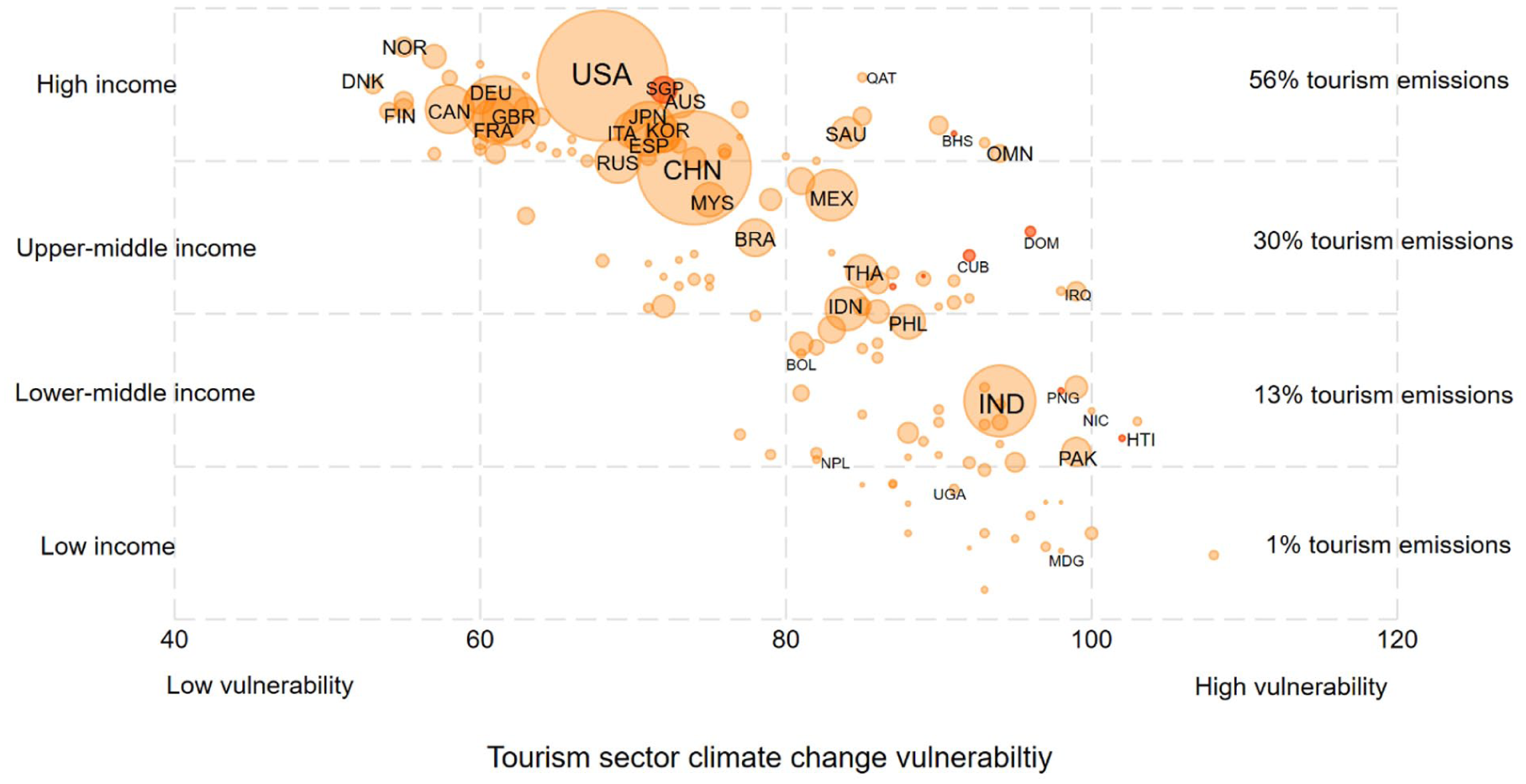
Comparative tourism vulnerability to climate change and GHG emissions.
It is evident in Figure 1 that low-income and lower-middle-income and small-island countries contribute the least tourism-related emissions (14%) and are the most vulnerable to the impacts of climate change. Importantly, the highest climate change vulnerability occurs in countries with the highest dependence on the tourism economy (based on tourism contribution to GDP and employment; Scott et al., 2019). High climate change vulnerability is also aligned strongly with regions where tourism growth is anticipated to be the strongest in the coming decades, posing a barrier to future development. In contrast, Organisation for Economic Co-operation and Development (OECD) countries located in the Global North mid-latitudes exhibit the lowest vulnerability yet contribute the most to tourism-related emissions (over 50%). Indeed, these countries are expected to benefit from ongoing climate change, as more favorable weather conditions will attract additional tourists, resulting in higher tourism receipts and, consequently, greater emissions (Zhou et al., 2024). The magnitude of these inequities is projected to grow over time.
Climate Policy: Who Shapes Tourism’s Climate Agenda?
The international community has developed a comprehensive global climate change policy framework anchored around the Kyoto Protocol (1997) and the Paris Agreement (2015). Individual countries respond with national climate policy and legislation, connected to those global frameworks through various reporting mechanisms. Sectors are recognised within these, but typically not tourism. One reason for this might be that ‘tourism’ itself sits within a fragmented global governance system that is distributed across international, national, and local institutions. UN Tourism is the principal global agency responsible for tourism governance, although not formally mandated with climate action. Initiatives, such as the Glasgow Declaration on Climate Action (One Planet Network, 2021) and supporting policy guidance (UN Tourism, 2024) encourage decarbonisation and adaptation efforts amongst tourism actors. In 2024, the agenda for the UN Climate Change Conference of the Parties (COP29) included a special session on tourism for the first time. UN Tourism (2024, np) claimed that this marked “. . .a turning point, when ambition meets action, and vision transforms into commitment [. . .] to positive transformation for a better future for our planet.”
Despite explicit acknowledgement of the extent of tourism’s carbon footprint (Y.-Y. Sun et al., 2024), no explicit mention was made of tourism and climate justice at COP29. Addressing questions of justice (or injustice) is difficult for a global organisation that must represent the interests of all member states equally. This neutral position is rapidly becoming untenable, particularly given that the UN’s Development Programme recently reported on a ‘decade lost’ due to lack of progress on peace, justice and inclusion (UNDP, 2025). The same inertia characterises the global aviation regime (Higham et al., 2018), where greenhouse gas emissions are governed by the International Civil Aviation Organization (ICAO, 2022). ICAO’s interpretation of justice elevates universal access to flying above the urgent imperative to curb emissions. Like UN Tourism, it is an organisation bounded by consensus-driven mandates that privilege the sovereignty of member states and therefore sovereign economic growth interests. Both operate within institutional logics that resist redistributive policies or acknowledgment of embedded injustices.
Non-government and network organisations have attempted to fill the vacuum of global institutional leadership on climate justice in tourism. Polycentric governance, where a diverse network of actors interact to inform decision-making and resource allocation processes, is becoming more prominent (Becken & Loehr, 2022). Climate Action Network (CAN) (2025), which represents more than 1,900 civil society organisations in over 130 countries, has consistently raised justice concerns at COP meetings, drawing attention to travel and tourism. The Climate Justice Alliance foregrounds community-led just transitions, although its engagement with tourism remains limited. The Tourism Panel on Climate Change (TPCC, 2023), an independent network of researchers, has outlined links between scientific assessments and justice-oriented debates. Together, these network actors indicate a shifting governance landscape where knowledge generation and moral authority are increasingly dispersed. Despite these recent shifts, the established governance architecture of tourism and its (limited) climate response continues to reflect deep structural inequalities. Without explicit mechanisms for inclusion, accountability, and redistribution, global tourism governance continue to perpetuate the very injustices that climate justice seeks to redress.
Climate Justice: Why Do Vulnerabilities and Injustices Persist?
Climate justice is a contested political and ethical domain. Its roots lie in the environmental justice movements of the 1980s and 1990s, which exposed how environmental harms from extractive industries disproportionately affected marginalised communities. As carbon emissions have emerged as the defining environmental challenge of the 21st century, activists and scholars have (re)framed climate change as a justice issue: those least responsible for emissions such as low-income groups, Indigenous peoples, and nations of the Global South are the most exposed to its impacts (Schlosberg, 2007). The broader scholarship on environmental and climate justice has long explored how climate change interacts with social inequality (Coolsaet et al., 2024). Current research seeks to translate these insights into actionable frameworks for policy, governance, and just actions. This framing insists that climate change must be understood as embedded in historical trajectories of colonialism (Sultana, 2025), capitalism (Bianchi & Milano, 2024), historical responsibilities (Coolsaet et al., 2024), and structural inequality (Y.-Y. Sun et al., 2024). Within tourism academic debates, this domain has evolved into a multidimensional framework linking recognition, procedural, distributive, and restorative notions of justice (e.g., Becken & Rastegar, 2025; Juhola et al., 2022; Walker, 2012).
The scientific evolution of climate change justice can be traced across four key phases; post-Kyoto Protocol (1997–2010), climate justice awakening (2011–2015), post-Paris consensus (2016–2019), and the climate–biodiversity–justice nexus (2020–2023) (Karimi & Karamidehkordi, 2025). Through this sequence, scholarship has progressed from normative debates on responsibility and emissions to more complex and interconnected explorations of governance, equity, participation, and resilience. Yet, the dominance of Global North perspectives and political framings persist. Limited representation from the Global South, insufficient attention to local knowledge (Rubiano Rivadeneira & Carton, 2022), intersectional inequalities (McNamara et al., 2022), and the failure of transformative governance (Becken & Loehr, 2022) remain the case.
More recently, climate justice has been conceptualised as a (in)justice multiplier, a dynamic that amplifies existing inequalities across gender, class, race, and geography (Rastegar, 2026). This dynamic illuminates how both climate change impacts and responses can either reinforce or challenge systemic inequities. Across diverse contexts—from Pacific Island nations confronting sea-level rise to Mediterranean destinations grappling with heat stress—climate risk in tourism is revealed not as a meteorological issue but as a deeply social and political one (Belle & Bramwell, 2005; Hamilton et al., 2005; H. Li et al., 2017). Meanwhile, dominant market-based solutions (e.g., carbon offsetting and aviation subsidies) enable responsibilities to be externalised, while masking unequal power relations under the banner of green growth (Gössling & Higham, 2020).
The concept of vulnerability is a key entry point for climate justice debates. The Intergovernmental Panel on Climate Change (IPCC) defines vulnerability as “the propensity or predisposition to be adversely affected,” encompassing “sensitivity or susceptibility to harm and lack of capacity to cope and adapt” (IPCC, 2022, p. 5). As Adger (2006, p. 268) reminds us, vulnerability is not merely a state of exposure but “a state of susceptibility to harm” shaped by unequal power relations, resource access, and adaptive capacity. Climate justice scholarship therefore moves beyond descriptive categories of “the vulnerable” (e.g., women, the elderly, people with disabilities, informal workers, and marginalised groups), to interrogate how vulnerability is socially constructed through intersecting systems of inequality. Through a recognition justice lens, this means identifying who is vulnerable, why, and in what ways. Geographically, these inequities are amplified across the North–South divide: while the Global North retains greater adaptive capacity, communities in the Global South remain disproportionately exposed to hazards (Rastegar, 2026; Scott et al., 2019). Beyond human populations, entire ecosystems are rendered vulnerable by extractive and carbon-intensive development, none more so than coral reefs (see Sunkur et al., 2023; Weststrate et al., 2024; Wolf et al., 2022).
Such patterns of climate vulnerability, risk, and responsibility underscore that vulnerability is not evenly distributed; rather, it is produced and entrenched through social, economic, and spatial hierarchies. Tourism workers, low-income residents including tourism workforces in peripheral destinations with livelihood instability and little capacity to adapt bear the brunt of climate risks and impacts (Rastegar & Becken, 2025). Understanding these asymmetries is central to situating climate justice as an analytical framework for advancing more plural, justice-centred approaches that operationalise fairness and inclusion within climate policy, planning, and practice.
Global Aviation Emissions in Tourism: Intersecting Tensions of Science, Policy, and Justice
A Climate Science Perspective
International tourism is dependent on aviation which has become a deeply problematic carbon-intensive sector of the global economy due to resistance to emissions abatement (Lyle, 2025). Global aviation is riddled with tensions that cut across the science, policy and justice domains in ways that play out at different global, national and local scales of analysis. Research has revealed that when full life-cycle accounting methods are applied, including international travel, supply chains, and destination-based consumption, tourism contributes a substantial share of total global GHG emissions (Y.-Y. Sun et al., 2024). Among all elements of the tourism system, air travel is the dominant driver of tourism emissions due to high per-passenger emissions intensity and sustained growth in international air travel (Y.-Y. Sun et al., 2024). The aviation climate science is unequivocal. Aviation faces substantial decarbonization challenges as ICAO’s (2025) Net-Zero 2050 goal requires a combination of ambitious reductions in air transport demand and technological breakthroughs that do not as yet exist (Bergero et al., 2023).
The decarbonisation of aviation is complicated by the highly uneven distribution of aviation-related emissions across and within countries (Gössling & Humpe, 2020). The benefits of tourism air travel accrue disproportionately to relatively affluent populations, as a small cohort of frequent flyers (1%) generates approximately half of total aviation emissions while much of the global population rarely or never flies. For effective emissions mitigation, this implies that demand reduction should target frequent flyers (Büchs & Mattioli, 2024). Yet this raises a parallel macro-level question: which countries and destinations can continue to rely on air travel demand, and which cannot. The dilemma is particularly acute for tourism-dependent SIDS. In countries such as the Maldives, Mauritius, Cyprus, and Seychelles, international tourism is a key economic pillar but also accounts for 30 to 80% of tourism emissions (Lenzen et al, 2018). Although SIDS are exempt from mandatory offsetting obligations under CORSIA, broader reductions in aviation may still reduce inbound tourism demand and harm their economies. Progress in mitigating aviation emissions therefore depends on resolving two salient and interconnected tensions—which countries should retain capacity for aviation growth, and who should fly less, to where, and by how much.
The aviation climate science has revealed the structurally problematic nature of aviation (Peeters et al., 2016), highlighting a persistent tension between technological optimism and the biophysical and socio-ecological limits of decarbonisation (Higham et al., 2018). This tension is particularly evident in the growing reliance on sustainable aviation fuels (SAFs) as a pathway to net zero without constraining travel demand. While SAFs are often presented as a viable solution, their large-scale deployment raises significant concerns regarding biodiversity loss, land-use competition with food production, and the allocation of limited renewable energy resources (Becken et al., 2023). Synthetic fuels, for example, require substantial quantities of renewable electricity that could otherwise support decarbonisation in other sectors, highlighting important opportunity costs.
These technological pathways are not neutral mitigation options but are embedded within broader political–economic structures. Instruments such as carbon pricing, offsetting, and SAF investments are frequently framed as mechanisms capable of decoupling aviation growth from emissions, yet they typically obscure the redistribution of environmental burdens and resource claims. Biofuel production, for instance, can intensify land pressures, while large-scale nature-based offsetting projects have been associated with the displacement of local livelihoods and erosion of community land rights (Rastegar & Becken, 2025). Rather than resolving the climate challenge, these approaches risk externalising environmental and social costs to already vulnerable regions, reinforcing existing global inequalities.
A Climate Policy Perspective
The science of aviation emissions is reflected in tensions in global climate policy discourses between top-down governance frameworks and meaningful local participation. International aviation emissions are primarily governed through multilateral processes under ICAO, involving complex consensus-based negotiations among national governments (Lyle, 2025). While necessary given the transboundary nature of aviation, these negotiations are shaped by geopolitics and industry influence, resulting in policy outcomes that reflect the priorities of powerful states and aviation stakeholders. Local governments, regional destinations, and affected communities remain largely excluded from ICAO processes and other global forums such as the United Nations Conference of the Parties (COP). These global governance structures produce a democratic deficit in aviation climate policymaking, where decisions are made globally while environmental and economic consequences are experienced locally.
These governance limitations are compounded by the dominance of soft, voluntary, and market-based instruments within aviation and tourism climate policy. Institutional frameworks continue to prioritise awareness-raising and technological efficiency over directive, regulatory, and redistributive measures aligned with climate justice (Loehr & Becken, 2024; Lyle, 2025). This reflects a deeper structural tension in which justice-oriented interventions are marginalised in favour of politically feasible and industry-aligned solutions, reinforcing existing power asymmetries and privileging economic growth over transformative climate action.
The influence of economic and industry interests further entrenches the tension between technological optimism and the need for demand management. Industry promises of radical technological advances, including low- or zero-carbon aviation and alternative fuels, have consistently failed to keep pace with rapid growth in global air travel, resulting in continued increases in gross emissions (Peeters et al., 2016). ICAO’s Carbon Offsetting and Reduction Scheme for International Aviation (CORSIA) (ICAO, 2018) exemplifies this misalignment, relying on offsetting and technological mitigation rather than absolute emissions reductions, while negotiated exemptions significantly limit its coverage (Higham et al., 2018).
At the national level, aviation emissions policymaking is shaped by the persistence of ‘aviation exceptionalism’ (Maclaurin et al., 2026), whereby governments afford the sector preferential treatment relative to other (lower carbon) transport industries. Despite growing recognition of aviation’s emissions, policies continue to prioritise expansion through tourism growth, trade, and connectivity over transitions to low-carbon mobility systems. This is reflected in the continued exemption of jet fuel from taxation under the Chicago Convention (Lyle, 2025), a legacy that remains largely unchallenged despite increasing climate urgency. Such preferential treatment contrasts with stronger regulatory approaches in other sectors (Y.-Y. Sun et al., 2024), creating a growing tension between pro-growth aviation policies and societal expectations for meaningful climate action.
Enduring policy tensions also surround the allocation of responsibility for aviation emissions and the design of equitable transition instruments. Responsibility is frequently shifted onto individual travellers through narratives such as the ‘flyers’ dilemma’, while systemic drivers of demand receive less scrutiny (Higham et al., 2021; Young et al., 2014). This obscures the disproportionate contribution of frequent flyers (Gössling & Humpe, 2020) and reflects a broader failure to internalise emissions responsibility. Policy instruments such as uniform ticket taxes risk disproportionately burdening occasional travellers, while more progressive measures such as frequent-flyer levies face strong industry resistance. At the same time, voluntary carbon offsetting introduces an ethical paradox, enabling continued high-emission behaviour while often failing to deliver real emissions reductions and delaying structural transformation (Becken & Mackey, 2017; Maclaurin et al., 2025).
A Climate Justice Perspective
Climate justice debates surrounding aviation emissions are closely integrated with tensions between the need for emissions reductions, development priorities, and local environmental and community impacts (Rastegar & Becken, 2025). Aviation generates a range of local environmental burdens, including aircraft noise and air pollution, that disproportionately affect communities living near airports, many of whom rarely benefit from air travel themselves (Cohen & Gössling, 2015). Local impacts intersect with broader questions of tourism development and climate vulnerability (Loehr & Becken, 2024). Regional and island regions are typically dependent on air connectivity to enable engagement in the global economy and to sustain tourism-based livelihoods. Those destinations also face heightened exposure to climate risks such as sea-level rise, extreme heat, and ecosystem degradation. Policies aimed at reducing aviation emissions create difficult trade-offs. While emissions reductions are necessary to mitigate long-term climate impacts, measures that increase air travel costs, limit route capacity or constrain growth threaten the accessibility and economic viability of tourism-dependent and geographically remote communities.
A second set of tensions emerges from competing perspectives on aviation and justice. Air transport industry interests frame aviation as a form of mobility that should be universally accessible, emphasising the social and economic benefits of air travel (Lyle, 2025). By contrast, climate justice perspectives reveal the profound inequalities in global aviation demand. Climate justice research shows that a small proportion of the global population accounts for the vast majority of aviation emissions (Gössling & Humpe, 2020). The reverse arises in the case of the climate impacts associated with aviation which are felt most acutely in vulnerable regions (Young et al., 2014). This raises normative questions about the legitimacy of aviation emissions associated with discretionary leisure travel when compared with forms of mobility that are essential for disaster response, medical care, humanitarian needs, or basic connectivity in remote or developing regions. The contrast between luxury emissions including the unregulated use of private jets (Gössling, et al., 2024) and essential mobility sits at the centre of contentious debates about responsibility, equity and justice in aviation climate governance.
A third dimension of climate justice concerns the spatio-social and temporal distribution of economic benefits and environmental costs associated with aviation growth. National and regional development strategies typically promote airport expansion and increased air connectivity as mechanisms for economic growth, tourism development and employment generation, the benefits of which are unevenly distributed. Debates surrounding airport expansion have become a focal point for conflicts between economic development and local community interests (e.g., Becken, 2026; Sulub & Subtil Fialho, 2026). The transition toward lower-carbon aviation raises questions about justice for workers within the sector, given that decarbonisation policies will reshape employment patterns in the airline and airports (and related) industries.
Aviation emissions also raise concerns of intergenerational justice. A persistent tension in global aviation governance relates to historical emissions. A small number of high-income countries have produced the majority of aviation emissions and benefited from long-standing access to aeromobility (Y.-Y. Sun et al., 2024). This raises distributive justice concerns in negotiations involving emerging economies such as India, Brazil, Indonesia, and Vietnam (Higham et al., 2018), as well as tourism-dependent small island states that contribute minimally to global emissions yet rely heavily on long-haul aviation for economic survival (Y.-Y. Sun et al., 2024). Continued expansion of air travel today also contributes to cumulative greenhouse gas emissions that will (re)shape future travel opportunities if, in the words of Urry (2003), the conditions for leisure travel are used up in the “hypermobile present.” The long-term climate outcomes and environmental consequences of unrestrained contemporary aviation growth will be borne disproportionately by future generations, highlighting the inescapable, but as yet unresolved, temporal dimensions of justice embedded in aviation climate policy.
These tensions point to fundamental incompatibilities across climate science, policy, and justice domains. Industry discourses and policy frameworks remain rigidly oriented toward sustaining growth through techno-optimistic pathways and market-based instruments (Gössling et al., 2025). From a justice perspective, these approaches obscure deeply unequal distributions of power, responsibility and impact while deferring and delaying meaningful accountability (Rastegar, 2026). These contradictions suggest that prevailing assumptions underpinning aviation and tourism, particularly the compatibility of continued growth, technological substitution, and equitable climate outcomes, can no longer be sustained and must be challenged. They also suggest the urgent need for a new interdisciplinary research agenda if climate justice in tourism is to be meaningfully advanced.
Advancing Climate Justice in Tourism: An Interdisciplinary Research Agenda
This letter seeks to integrate perspectives to create a dialogic space that bridges disciplinary divides and invites more inclusive ways of imagining and advancing just climate futures. Climate science, in its core orientation, is largely positivist, seeking to understand and model planetary processes under different greenhouse gas scenarios, often remaining agnostic to policy positions. However, the translation of scientific knowledge into modelling frameworks and response pathways is shaped by particular paradigms, frequently influenced by techno-optimist and economically driven assumptions about mitigation and adaptation. Climate policy, in turn, mobilises political will and institutional action, but is typically embedded within existing neoliberal governance systems, where incrementalism, economic growth imperatives, and political feasibility often constrain more transformative responses. Justice scholarship, by contrast, draws on critical and emancipatory traditions, foregrounding questions of power, responsibility, and inclusion, and advocating for more equitable and inclusive approaches to climate action.
Fostering dialogue across science, policy, and justice is therefore not simply a matter of integration, but of engaging with the misalignments and exclusions that structure each domain. While science and policy have often prioritised efficiency, growth, and technocratic solutions, justice scholarship, despite its strength in diagnosing structural inequalities, has at times remained conceptually rich but institutionally distant, with more limited engagement in the design of implementable policy instruments, governance mechanisms, and regulatory pathways. Meaningful dialogue thus requires the bridging of epistemic divides, given the challenges of political resistance and institutional inertia, by interrogating how knowledge is produced and translated, whose interests are prioritised, and how normative commitments to justice can be operationalised within real-world decision-making contexts. In response, this section identifies four interrelated research priorities that emerge directly from the tensions discussed above.
Embedding Justice within Tourism Climate Modelling and Risk Assessment
A first research priority emerging from the tensions identified in Section 5 concerns the need to more meaningfully embed justice within tourism climate modelling and risk assessment frameworks. Existing tourism climate modelling approaches often prioritise aggregate emissions and sector-wide risk assessments, but remain insufficient for understanding how climate burdens, responsibilities, and adaptive capacities are unevenly distributed across populations and places.
Advancing this agenda requires change in science and modelling. At present, much tourism carbon modelling and climate risk assessment work operates at highly aggregated scales, providing broad insights into the sector’s overall contribution to climate change. Whilst informative for some policy making, this level of abstraction obscures the profound and granular inequalities in both emissions’ responsibility and climate exposure. A growing body of research offers more detailed, place-specific analyses that reveal the uneven and context-dependent nature of these dynamics (e.g., Higgins-Desbiolles et al., 2026; Scott et al., 2019; Y.-Y. Sun et al., 2024). Embedding justice-oriented considerations will require a shift toward disaggregated, placed-based approaches that identify unequal emissions patterns and differentiated climate vulnerabilities across travellers, operators, workers, and communities. Rather than assuming equal responsibility and vulnerability, modelling approaches need to more explicitly account for distributional effects across different populations. While some mitigation frameworks, such as carbon pricing, already differentiate responsibility based on emissions intensity, these mechanisms often remain partial and may not fully capture broader questions of equity. Greater attention is therefore needed to how decarbonisation pathways distribute costs and responsibilities across actors. Similarly, adaptation assessments should more systematically consider uneven exposure and differentiated adaptive capacities, particularly among those whose livelihoods remain precariously tied to climate-sensitive destinations.
An intersectional perspective further deepens this critique by demonstrating that climate vulnerability is not evenly distributed but produced through intersecting systems of inequality, including class, gender, race, and labour precarity (Crenshaw, 2015; Rastegar, 2026). In tourism contexts, these dynamics are particularly evident among precarious and informal workers who face compounded exposure to climate risks such as extreme heat, while lacking access to social protection or decision-making processes (Kotsila & Anguelovski, 2023; Bigby et al., 2024). However, many existing modelling approaches rely on aggregated indicators of exposure and vulnerability, often treating populations as relatively homogeneous units. In doing so, they risk overlooking how intersecting socio-economic variables interact to shape differentiated risk profiles across groups. Incorporating more disaggregated variables, alongside longer temporal horizons that account for historically produced inequalities, would enable models to better capture the layered and path-dependent nature of climate vulnerability, and thus more meaningfully engage with the concerns of climate justice.
These methodological and justice-related gaps are magnified at the global level. The majority of tourism carbon footprint models and climate risk assessments originate from high-income economies with robust data infrastructures (TPCC, 2023). Meanwhile, many countries in the Global South face persistent barriers in accessing baseline tourism data, modelling tools, and technical capacity. This asymmetry not only limits domestic planning for adaptation investments and institutional strengthening but also impedes vulnerable countries’ ability to access climate finance, including through mechanisms such as the Global Environment Facility (GEF), the Green Climate Fund (GCF), and more recently, the Fund for Responding to Loss and Damage (FRLD). Addressing these structural inequities requires coordinated action across both scientific and policy domains: expanding inclusive and context-sensitive knowledge production, while simultaneously investing in data systems, institutional capacity, and knowledge infrastructures that enable at-risk destinations to develop and utilise their own national and regional climate assessment frameworks.
Advancing climate justice therefore requires moving beyond assumptions of homogeneous vulnerability and universally applicable transition pathways (Rastegar, 2026). Y.-Y. Sun et al. (2024) provides an informative example of research that differentiates global tourism carbon emissions by country of analysis, revealing the extent of inequity between countries based on responsibility for producing tourism emissions. This signals the urgent need for more differentiated, historically grounded, and place-sensitive approaches to climate, emission and justice research in tourism.
Moving Beyond Technocratic and Top-Down Climate Governance
A second research priority concerns the limitations of existing tourism climate governance frameworks, which frequently prioritise technocratic coordination and political feasibility over democratic participation. Procedural justice is central to addressing these dynamics. Climate adaptation and tourism planning are often governed by top-down, technocratic processes that marginalise those most affected. The notion of “just transitions” seeks to democratise decision-making by involving workers, residents, and Indigenous communities in shaping low-carbon futures. Yet, as Potawatomi scholar Whyte (2017) warns, climate governance can reproduce “intensified colonialism,” as emergency management regimes frequently silence Indigenous voices. Such practices transform justice discourse into bureaucratic ritual rather than meaningful participation, perpetuating procedural inequalities under the guise of inclusion. Distributive and restorative justice extends this critique by exposing moral geographies of responsibility. Those least responsible for emissions such as Pacific Island nations bear the gravest impacts while lacking resources for mitigation and adaptation. The International Court of Justice (ICJ) Advisory Opinion that fossil fuel production and consumption “may constitute an internationally wrongful act” (McVey & Savaresi, 2025, p.1) underscores this injustice, opening new pathways for legal accountability and reparations through the Loss and Damage Fund. Yet, entrenched resistance to redistribution and historical accountability in the Global North continues to obstruct meaningful progress (Sultana, 2021), reflecting the persistent colonial logics underpinning global climate governance.
Critical diagnosis is required of the political and institutional barriers that currently constrain global bodies such as UN Tourism and ICAO from meaningfully engaging with questions of justice. These constraints are not merely situational but reflect entrenched economic interests and longstanding governance arrangements that systematically marginalise distributive and procedural concerns. Understanding these barriers is a necessary precursor to assessing whether such institutions are fit for purpose, or whether alternative institutional arrangements are needed. Requiring UN Tourism to collaborate with justice-oriented agencies such as UNDP may be needed, given UNDP’s commitments to equity, inclusion, and the recognition of Indigenous knowledge systems (UNDP, 2024, 2025). The longstanding and unresolved critique of ICAO’s repeated failures to regulate aviation emissions in ways consistent with justice or climate science (Higham et al., 2018; Lyle, 2025) highlight the limits of incumbent institutions and the need to imagine new global governance architectures capable of redefining tourism’s climate leadership.
These institutional limitations are mirrored in global climate finance mechanisms, which remain insufficiently attuned to the specific vulnerabilities of tourism-dependent economies. While instruments such as the Green Climate Fund and the Fund for Responding to Loss and Damage have been established to support climate-vulnerable countries (United Nations Environment Programme, 2023), their focus on infrastructure and post-disaster recovery often overlooks indirect and slow-onset impacts on tourism systems, including declining destination competitiveness and long-term demand shifts (Dogru et al., 2019; Phill & Hammersley, 2024). This reinforces structural inequalities by limiting the ability of tourism-dependent regions in the Global South to access resources necessary for measurement, mitigation, adaptation and resilience-building.
Reconsidering Growth-Oriented Tourism Futures
A third research priority concerns the need to critically interrogate the continued dominance of growth-oriented tourism futures within climate policy and industry discourse. The tensions identified above reveal persistent contradictions between aviation growth, technological optimism, climate mitigation goals, and justice-based transition pathways (Gössling et al., 2025; Peeters et al., 2016). Despite growing awareness of tourism’s contribution to climate change, policy and industry responses remain firmly anchored in their orientation toward sustaining continued growth through technological innovation, market-based instruments, and efficiency improvements (Higham et al., 2018; Lyle, 2025) rather than confronting the structural implications of demand reduction or mobility limits.
Recent interventions from activist scholarship further underscore that these tensions are not easily reconciled. For instance, the Stay Grounded network argues that dominant aviation decarbonisation pathways rely on “false solutions” that sustain growth while displacing environmental and social burdens (Sulub & Subtil Fialho, 2026), highlighting the limits of current science–policy alignments in addressing climate justice. Similar critiques have emerged in relation to carbon offsetting schemes (e.g., Higham et al., 2018), sustainable aviation fuels (e.g., Becken et al., 2023), and voluntary carbon markets, all of which are frequently positioned as mechanisms capable of decoupling tourism growth from emissions while avoiding more politically difficult questions surrounding demand management, redistribution, and mobility justice.
Current aviation decarbonisation strategies and policy narratives largely maintain the assumption that technological innovation, efficiency gains, and market-based instruments can reconcile continued tourism expansion with climate mitigation goals (Higgins-Desbiolles et al., 2026; Rastegar & Becken, 2025). This highlights the need for more critical research that interrogates the growth assumptions embedded within dominant tourism and aviation transition pathways. However, growing evidence regarding the biophysical, social, and political limitations of these approaches raises important questions about whether continued expansion can remain the central organising principle of desirable tourism futures (Peeters et al., 2018). Future research therefore needs to engage more directly with post-growth and differentiated transition pathways, including questions surrounding demand management, differentiated mobility rights and responsibilities, limits to long-haul mobility, and the political feasibility of alternative low-carbon tourism models.
This also requires greater critical engagement with the assumptions embedded within dominant tourism futures (Gössling et al., 2025). Prevailing transition narratives frequently treat continued aeromobility, expanding global mobility, and increasing tourism consumption as socially desirable and economically necessary outcomes. Yet the tensions identified throughout this letter suggest that the compatibility of continued tourism growth, technological substitution, and equitable climate outcomes can no longer remain analytically uncontested. Advancing climate justice in tourism may therefore require not simply improving existing growth trajectories, but reconsidering the kinds of tourism futures that are socially just, politically viable, and ecologically sustainable under conditions of accelerating climate change.
Advancing Transformative and Decolonial Approaches to Climate Justice
A fourth research priority concerns the need to advance more transformative, restorative, and decolonial approaches to climate justice in tourism. Existing tourism climate research frequently emphasises mitigation efficiency and adaptation management while giving comparatively limited attention to repair, redistribution, sovereignty, and systemic transformation. A structural justice perspective reveals the deeper foundations of vulnerability in patriarchy, extractivism, colonialism, imperialism, neoliberalism, and capitalism (Mikulewicz et al., 2023; Rastegar, 2026). These “interlocking systems of oppression and exploitation” (Sultana, 2021, p. 120) not only produce inequality but also normalise it through global tourism’s reliance on cheap labour, land appropriation, and ecological commodification. Recognising this allows a move from framing the vulnerable as passive victims to acknowledging their capacities, agency, and situated knowledge. As Arora-Jonsson (2011, p. 121) suggests, this enables a shift “away from victim narratives or fetishising resilience” toward co-construction and partnership in adaptation. Yet, restorative and transformative dimensions of justice are rarely considered in climate change debates, where responses often stop at recognition or redistribution without addressing the need for repair, healing, and systemic change.
The pursuit of climate justice in tourism cannot be advanced solely on technocratic modelling or elite-driven policy arenas. Justice must be nurtured through bottom-up processes grounded in lived realities, local knowledge systems, and political agency. Around the world, communities are advancing transformative initiatives, often in the margins of dominant policy processes such as the Conferences of the Parties (COP) global framework. Green Zone spaces, Indigenous climate leadership, and community-led adaptation projects illustrate vibrant forms of climate action that are more inclusive, relational, and ethically grounded than many formal negotiations. Indigenous movements, in particular, foreground the need to reject climate colonialism and centre resurgence, sovereignty, and ecological stewardship. Rooted in decolonial and relational worldviews, these approaches remind us that climate solutions cannot be imposed from above (e.g., Everett, 2026); they must emerge from reciprocal relationships, local knowledges, and collective mutuality (Higgins-Desbiolles et al., 2022). Greater research engagement with and empowerment of indigenous epistemologies, traditional knowledge, and non-western research paradigms would be a step in this direction. Such a step would be fostered by a conscious and collective commitment to open publications pathways for non-traditional research that fundamentally challenges rather than reproduces the status quo.
Conclusion
In this letter our attention falls upon the scholarly divide between the domains of climate science, climate policy, and climate justice. While the research communities serving each of these domains continue to build edifices of knowledge, the domains themselves remain beset by critical blind spots arising from lack of integration. Climate science offers abundant evidence of risk and exposure while generally failing to move beyond addressing vulnerability as a technical rather than social and historical condition. The scale, urgency, and uneven distribution of climate change impacts is well established. Policy frameworks have sought to translate this knowledge into action but remain constrained by technocratic paradigms that overlook diverse knowledges and lived experiences. Both continue to fall short in addressing whose futures are prioritised and whose lives are rendered expendable. Climate justice remains underdeveloped in tourism research and governance. Justice scholarship exposes inequality, coloniality, and responsibility but often lacks the empirical and policy grounding needed for systemic change. These interdisciplinary divides are most evident in the case of global aviation emissions, which illustrates the intersecting tensions of science, policy and justice in tourism.
We argue that advancing climate justice in tourism depends on fostering meaningful dialogue across the domains of climate science, climate policy and climate justice. Adopting a justice perspective reframes tourism not as a passive victim of climate change, but as an active force in shaping, perpetuating, or potentially transforming the power relations at the heart of the climate crisis. Justice exposes the misalignment between scientific imperatives, policy responses, and lived realities and should therefore not be positioned as an ethical supplement to existing tourism–climate debates. Prioritising justice calls into question the compatibility of aviation-led growth with climate science, the reliance on technological substitution within policy frameworks, and the neutrality of aggregated carbon accounting that obscures unequal responsibility and vulnerability. It challenges the assumption that tourism development is inherently beneficial, revealing its entanglement with historical and ongoing forms of economic, social and environmental inequality.
A justice-oriented perspective seeks to move from diagnosis to transformation of existing systems. It demands a shift from incremental adaptation to structural change, from efficiency to equity, and from growth-oriented paradigms to regenerative and redistributive futures. In this sense, climate justice is not a solution but a critical intervention, one that confronts the limits of current science–policy alignments and redefines what constitutes legitimate, feasible, and desirable futures for tourism in a climate-constrained world. The interdisciplinary research agenda that we offer in this letter attempts to give expression to an urgent challenge facing the research community.
