







Abstract
This study develops a substantive theory explaining how brief encounters with unfamiliar fellow tourists can trigger meaningful psychological change. Drawing on constructivist grounded theory and interviews with 25 Vietnamese tourists, the study identifies a four-stage process termed the stranger effect. The process begins with safe unfamiliarity, where anonymity and the suspension of everyday roles create a liminal relational space that lowers social defensiveness. Within this context, emotional resonance emerges through rapid affective attunement, enabling strangers to recognize and respond to each other’s emotional states. This alignment facilitates inner co-creation, a reflexive dialogue through which individuals collaboratively reinterpret personal concerns and life narratives. These insights are integrated into eudaimonic transformation, expressed through cognitive reframing, self-understanding, and behavioral change. By theorizing how transformation can arise from brief travel encounters, the study reconceptualizes stranger interactions as catalysts of intersubjective meaning-making and introduces inner co-creation as a novel form of value co-creation in tourism.
Keywords
Introduction
Contemporary tourism research increasingly recognizes a shift in tourists’ motivations and expectations toward experiences that provide meaning, reflection, and personal development (Jieyao & Kumar, 2025; Stankov & Filimonau, 2021). Instead of seeking experiential consumption or sensory stimulation, many people are aiming to regenerate their spirit, regain a healthy rhythm of life, and open up the depth of their being after a long period of work pressure and social uncertainty (Ha My & Le Thanh, 2023; Stankov et al., 2020; Stankov & Filimonau, 2021). Recent studies show that tourism is increasingly seen as a space of inner transformation (X. Huang et al., 2023; J. M. Pung et al., 2020; Tran, 2026), where people reflect on life values, re-identify themselves and seek existential authenticity. This approach is reflected in many works on transformative tourism, in which the process of moving, de-territorializing and temporarily leaving social roles is seen as the starting point of cognitive change (Kirillova et al., 2017b; Matteucci, 2021; J. M. Pung et al., 2020).
Notably, a significant portion of these transformations arise not only from specific spaces such as pilgrimages, retreats, or nature therapies (Inversini et al., 2022; Tsaur & Lin, 2023), but also from very ordinary moments when tourists encounter strangers (S. Bai & Chang, 2021; Chen et al., 2020; Yang, 2020). Across studies, tourists often report feeling unusually open, seen or heard when interacting with unfamiliar fellow tourists, as anonymity and distance from familiar social roles reduce self-presentational pressure and create a space where vulnerability can be expressed without fear of judgement (Han et al., 2021; Jiang et al., 2023; Yu & Lee, 2013). These encounters occur in solo travel (Yang, 2020; Zhang et al., 2024), group tours (Jiang et al., 2023; Zhou et al., 2023), shared accommodations (Inversini et al., 2022) and frequently produce lingering emotional or reflective after-effects (Zhou et al., 2023). A related body of work on serendipity highlights that spontaneous, unplanned interactions and acts of kindness from strangers can generate comfort, companionship and moments of insight that deepen the travel experience.
However, the academic gap here is clear. Transformative tourism research has identified many important elements such as existential uncertainty, authenticity, liminal states, and self-expansion (Kirillova et al., 2017a, , 2017b; Neuhofer, 2024), but most focus on intentional contexts such as therapy, meditation, self-pilgrimage, or other forms of holistic escape. The micro-moments that create emotional transformation through encounters with strangers in ordinary journeys are less understood as a processual mechanism. Recent meaningful tourism research has shown the potential for self-reflection and reconfiguration of values (Matteucci, 2021; Soulard & Russell, 2025; Tran, 2026), but a model that explains the social-emotional dynamics of brief interactions is lacking.
Meanwhile, the research stream on value co-creation has developed in the direction of emphasizing the interaction between tourists and suppliers, aiming at functional value, surface emotions, or service participation (Blasco-Arcas et al., 2014; Finsterwalder & Kuppelwieser, 2011; Payne et al., 2007). Works focusing on customer-customer interactions also note that relationships between consumers can create social value but mainly describe it at the behavioral level and do not approach the ontological depth (John & Supramaniam, 2024; Pandey et al., 2024). This leads to a limitation: co-creation is understood as functional participation, without including the process of creating meaning between strangers.
In parallel, scholarship on stranger encounters in tourism remains fragmented. Existing studies document how meeting unfamiliar fellow tourists can offer comfort and companionship in challenging environments (White & White, 2008), reduce perceived social distance (S. Bai & Chang, 2021), enable exchange of information and emotional support (Chen et al., 2020; StokowskI, 1992), or generate memorable experiences through kindness, coincidence, or ad hoc communities (Glover & Filep, 2016; Thiel et al., 2015). Other research highlights how intense shared environments can produce circulating affective energies between individuals (Martini & Sharma, 2022), how structured experiential settings may stimulate transformative outcomes and place attachment (Amaro et al., 2026), and how processes of reflection can mediate the transition from restorative travel experiences to deeper personal transformation (M. Bai et al., 2025). Yet despite these contributions, the literature remains largely descriptive: it identifies the existence of encounters but does not explain how anonymity, liminality, emotional synchrony, or serendipity interact to produce deeper psychological outcomes. Crucially, stranger encounters have not been theorized as processual mechanisms capable of generating emotional resonance, intersubjective meaning-making, or eudaimonic transformation. This conceptual gap limits current understanding of the micro-social foundations of transformative experiences in tourism.
The intersection of these three gaps suggests the urgent need to develop a grounded theory that explains how temporary interactions between strangers (unfamiliar fellow tourists) can trigger inner reflection and transform tourists’ meaning. This method is appropriate because it allows theory to be generated from field data, emphasizes the co-construction of meaning between participants and researchers, and allows for interpretation of the socio-emotional process rather than imposing a pre-existing model (Hardy, 2005; Matteucci & Gnoth, 2017; Mills et al., 2006). This is the goal of this study: to develop a grounded theory of the stranger effect in tourism, understood as the process by which chance encounters between strangers create safe unfamiliarity, emotional resonance, co-construction of meaning, and the formation of eudaimonic imprints for tourists.
The study makes three key contributions. First, it advances transformative tourism theory by reconceptualizing stranger encounters and serendipitous meetings not as incidental social episodes but as multi-stage mechanisms capable of generating emotional resonance, intersubjective meaning-making, and eudaimonic transformation. Second, it demonstrates the methodological value of constructivist grounded theory for uncovering deeply affective and ontological processes that existing models have not captured. This approach allows the analysis to trace how anonymity, liminality, attunement, and serendipity interact to produce psychological change. Third, the findings offer practical implications for designing human-centered tourism environments, such as group tours, solo travel contexts, and serendipity-enabling spaces, that intentionally cultivate emotional safety, meaningful micro-encounters, and opportunities for reflective inner dialogue.
Literature Review
Transformative Tourism and Existential Change
The research on transformative tourism begins with the recognition that travel experiences can disrupt familiar rhythms of life and open up space for existential reflection (Zhang, 2025; Zhao & Agyeiwaah, 2023). In foundational research, Kirillova et al. (2017a) and Sheldon (2020) point out that tourists often face existential impulses when temporarily leaving their daily responsibilities and encountering new landscapes (Kirillova et al., 2017a; Sheldon, 2020). It is this disruption that creates the premise for self-reflection and re-evaluation of life’s meaning. In another study, Kirillova et al. (2017a) analyze how existential authenticity helps tourists access vulnerable states, thereby expanding their self-awareness and promoting inner acceptance (Kirillova et al., 2017a). This research strand is extended when Matteucci (2021) emphasizes the role of moments of separation from familiar surroundings as a favorable space for reorganizing emotions and restructuring the concept of personal well-being (Matteucci, 2021). In a similar vein, J. Pung and Chiappa (2020) show that tourism can trigger a reshaping of values through exposure to new socio-cultural contexts (J. Pung & Chiappa, 2020).
Recent research further supports the view that transformational experiences often occur in explicitly catalytic contexts, where the environment and operational structures are designed to facilitate change. Jiang et al. (2023) found that in a religious tourism space in Yunnan, tourist interactions increased interpersonal authenticity and emotional solidarity, which in turn promoted altruistic behavior (Jiang et al., 2023). This study confirms the role of sacred space as a powerful catalyst for socio-emotional change.
Similarly, Zheng et al. (2025), based on in-depth interviews with 29 tourists after a cultural tourism experience, identified four transformational value components: personal growth, self-expansion, cultural identification, and cultural knowledge acquisition (Zheng et al., 2025). Again, the specific cultural context played a central role in facilitating change. Coghlan and Weiler (2015) also found that volunteer tourism can create inner transformation, although the external behavioral manifestations are not always evident (Coghlan & Weiler, 2015). This supports the argument that transformative experiences are often associated with purposeful participation in humanitarian or community service activities.
Meanwhile, Inversini et al.’s (2022) study of Malaysian homestays proposes an initial framework for transformative tourism based on immersive interactions and co-creation of experiences between tourists and communities, thereby activating transformative learning processes (Inversini et al., 2022). In another direction, Zhuo et al. (2024) demonstrated that even dark tourism experiences can be transformative when they evoke strong negative emotions such as anger, grief, or pity (Zhuo et al., 2024). Recent research further highlights the role of circulating affect in shared environments (Martini & Sharma, 2022), structured experiential programs that facilitate transformative outcomes (Amaro et al., 2026), and reflective processes that mediate the transition from restorative travel experiences to deeper transformation (M. Bai et al., 2025).
These emotions often lead to self-reflection, identity re-evaluation, and enhanced well-being. A common pattern emerging from much of the transformative tourism literature is that transformation is frequently examined in contexts characterized by strong catalytic conditions, such as religious journeys, immersive cultural experiences, volunteer tourism, homestays, or dark tourism. In these contexts, the environment itself is often intentionally or implicitly designed to stimulate reflection, learning, or emotional intensity.
At the same time, other strands of research recognize that transformation may also emerge through relational encounters and spontaneous interactions during travel, including moments of existential reflection or meaningful exchanges with others (Dieteren & Neuhofer, 2025; Jiang et al., 2023; Neuhofer et al., 2021). However, these studies tend to emphasize the experiential outcome or emotional significance of such encounters rather than explaining the micro-social processes through which they unfold.
Consequently, while spontaneous encounters are acknowledged as meaningful elements of tourism experiences, the literature has rarely conceptualized how brief interactions between strangers evolve into deeper psychological processes. Specifically, little attention has been given to the sequential mechanisms, such as anonymity, liminal openness, emotional resonance, and intersubjective meaning-making, through which such encounters may generate transformative outcomes.
This is where the gap appears. Although Lean (2012) has emphasized that tourism is inherently transformative (Lean, 2012), most research has focused on intentional or ritual contexts. Micro, spontaneous, unstructured interactions, especially encounters between strangers, have been largely overlooked as a source of independent transformative power. Current research fails to explain how a fleeting conversation on a bus, a few minutes of sharing on a group tour, or a moment of empathy between two complete strangers can produce cognitive or behavioral changes that last long after the trip. This lack of observation of micro-human interactions creates a theoretical gap for intervention research on the stranger effect, which aims to show that eudaimonic transformations do not arise solely from designed contexts but can be triggered by ordinary yet profound moments between strangers.
Co-creation, Customer-to-Customer Interaction, and Meaning-Making
Research on co-creation in tourism has developed primarily on the basis of service logic, in which value is created through the active participation of tourists in the process of contact with the supplier (Borges-Tiago & Avelar, 2025; Campos et al., 2015; John & Supramaniam, 2024). Works such as Payne et al. (2007) and Blasco-Arcas et al. (2014) describe co-creation as intentional interactions aimed at enhancing functional and emotional value, focusing on tourists’ participation in the experience, feedback on the service, and coordinated actions with the business (Blasco-Arcas et al., 2014; Payne et al., 2007). In the same approach, Finsterwalder and Kuppelwieser (2011) analyze how the service ecosystem shapes the role of tourists as co-agents contributing to economic-emotional value, emphasizing the effectiveness of active participation in the supply process (Finsterwalder & Kuppelwieser, 2011).
While this theoretical framework has broadened our understanding of behavior and engagement (Assiouras & Bayer, 2024; Borges-Tiago & Avelar, 2025), it has remained limited to tourist-provider interactions, where all value is viewed as a result of service structures. When extended to customer-customer interactions, studies such as Soltani et al. (2024) have primarily described social support, cooperative behavior, or satisfaction arising from incidental relationships (Soltani et al., 2024). These studies acknowledge the positive role of mutual presence between tourists, but the analysis is still biased toward describing surface behaviors and emotions rather than the depth of meaning. This limits co-creation to collaborative action, failing to capture how people construct meaning in their lives through short-term social interactions.
A common thread among the co-creation literature is that it views value as something shaped by intentional participation and embedded in predictable service structures (Campos et al., 2015; John & Supramaniam, 2024). This leaves open the possibility that ontological values can emerge from unstructured interactions between strangers. In many cases, as noted in studies related to social emotions and interactional values (Finsterwalder & Kuppelwieser, 2011; Payne et al., 2007; Wang et al., 2025), tourists do not seek to participate in co-creation but nevertheless experience emotional resonance and a sense of being understood through the presence of others.
Therefore, a major gap in the field of co-creation lies in the failure to explain how temporary, non-service-oriented, non-business-driven relationships can create intrapersonal value and foster new understanding. The absence of existential and self-transcendental dimensions in current models suggests the need to explore co-creation as a process of meaning-making between strangers, beyond the functional framework that current theories assume.
Stranger Encounters, Serendipity, and Emergent Sociality in Tourism
Research on stranger encounters in tourism highlights their role in shaping sociality, meaning-making, and comfort in unfamiliar environments. Early relational analyses positioned tourist-stranger interactions as part of the social consumption of destinations (StokowskI, 1992), while later work demonstrated that the presence of unknown others can significantly shape destination experience, both positively and negatively (Guthrie & Anderson, 2007). Studies in remote and challenging environments show that tourists actively seek companionship among strangers as a way of coping with perceived hostility or isolation, valuing interactions “without obligation” and free from long-term attachment (White & White, 2008). Similarly, meeting new people remains a core motivation and a major source of satisfaction for solo tourists (Bianchi, 2015; Yang, 2020), and guest-guest interactions offer emotional benefits, curiosity gratification, and social support (Chen et al., 2020).
Other research elaborates on the relational depth possible between strangers. CouchSurfing studies show that technologies of hospitality can engineer planned encounters where strangers cultivate intimacy, trust, or mutual learning, though sometimes with tension arising from power asymmetries (Bialski, 2012). Solo female travel studies similarly reveal forms of companionship, acts of kindness, emergent friendships, and even affective ties formed with male strangers, demonstrating that strangers can become memorable or emotionally significant (Su & Wu, 2021). Studies of intercultural contact further reveal both supportive interactions and role conflicts connected to stranger status (Yu & Lee, 2013). Work on tourist-to-tourist encounters (S. Bai & Chang, 2021) suggests that increased interaction can reduce perceived social distance but also generate interpersonal conflict, highlighting the ambivalence embedded in stranger dynamics.
In parallel, research on serendipity has examined how spontaneous, unplanned encounters and acts of kindness enrich tourist experiences. Serendipitous stranger contact appears in studies of trail magic, where hikers unexpectedly receive gifts or emotional support from unknown others (Glover & Filep, 2016), and in road-trip contexts where ad hoc communities emerge through mobile technologies facilitating spontaneous connection (Thiel et al., 2015). Independent travel studies conceptualize serendipity as a style rooted in delight from random encounters and spontaneous moments of belonging that contribute to self-discovery (W.-J. Huang et al., 2014). More recent analyses show that platform technologies increasingly blur the distinction between chance and choice, generating “stranger intimacy” mediated by algorithmic pairing rather than accidental meeting (Koch & Miles, 2020).
Relating to transformative tourism, Kirillova et al. (2017b) describe liminal states as a condition in which tourists temporarily escape from familiar roles (Kirillova et al., 2017b). This state sets the stage for openness, which often occurs when tourists interact with strangers in low-constraint environments. Similarly, Kirillova et al. (2017a) show that existential authenticity can emerge in contexts where people allow themselves to be vulnerable (Kirillova et al., 2017a). These conditions naturally converge in encounters between strangers, where there are no rigid social expectations or maintenance of self-image.
In contrast, research in the areas of co-creation and customer-customer interaction tends to describe the presence of strangers as enhancing the service experience. For example, Soltani et al. (2024) note customer-customer interaction as a source of social support (Soltani et al., 2024), while Blasco-Arcas et al. (2014) and Payne et al. (2007) emphasize the role of interaction in enhancing engagement (Blasco-Arcas et al., 2014; Payne et al., 2007). These findings are useful but remain limited to surface behaviors and emotions, and do not explain how a brief conversation or a shared moment can create emotional resonance and foster new understanding.
One intersection of these lines of research is the recognition of the role of social context in shaping the tourist experience. However, the most significant omission is the potential for these casual interactions to trigger self-reflection. Matteucci (2021) points out that tourists tend to seek out spaces for personal reflection, but does not explain how the presence of others, especially strangers, can serve as objects of internal reflection (Matteucci, 2021). Similarly, J. Pung and Chiappa (2020) emphasize that exposure to new social contexts alters value systems, but do not consider the role of brief encounters in shaping that perception (J. Pung & Chiappa, 2020).
Collectively, these bodies of work show that stranger encounters provide companionship, comfort, information, social support, and occasional emotional significance. However, the literature treats these encounters as episodic social interactions rather than multi-layered relational processes capable of generating deeper psychological effects. Three gaps stand out. First, existing studies do not theorize how anonymity, liminality, and evaluative neutrality interact to create safe unfamiliarity within stranger contexts. Second, while emotions appear in prior research, the literature has not articulated a mechanism of affective attunement or emotional resonance between strangers. Third, no existing study maps the processual sequence through which stranger encounters may evolve into meaning-making or eudaimonic change.
By synthesizing these fragmented strands, the present study advances the field by proposing that stranger encounters constitute an emergent, multi-stage relational process with cognitive, emotional, and existential consequences, moving beyond existing views of strangers as sources of support, novelty, or sociability. The stranger effect framework developed in this paper addresses precisely this conceptual and theoretical gap.
Constructivist Grounded Theory in Tourism Research
Grounded theory is increasingly used in tourism research due to its ability to trace processes, interpret behavior, and describe the emergence of new phenomena based on field data (Matteucci & Gnoth, 2017; Qian et al., 2025). Among the approaches, classical grounded theory is often considered a method for building grounded theory from a structured coding system (Mills et al., 2006; Zhang et al., 2024). This approach helps tourism research identify previously unmodeled elements of experience, especially when the phenomenon under study has a latent structure that has not been fully identified.
In the tourism field, grounded theory is also used to explore situational or intrapersonal experiences, where pure description is not enough to explain the mechanisms at work (Matteucci & Gnoth, 2017). Hardy (2005) shows that grounded theory has the potential to analyze the complex decision-making processes and interactions between tourists and their environments, thereby explaining behaviors that are difficult to measure with quantitative methods (Hardy, 2005). This application is particularly useful for multi-layered phenomena where emotions, contexts, and social interactions are intertwined, requiring a flexible yet insightful approach. Similarly, Matteucci and Gnoth (2017) note that grounded theory can shed light on the meaning structures in tourist experiences, especially in processes of self-formation and personal development (Matteucci & Gnoth, 2017).
In addition, grounded theory has been used to examine emotional experiences in tourism. Gedecho and Kim (2024) apply this approach to describe how tourists construct emotions in unstructured spaces, thereby explaining the interweaving of social interactions and deep emotional states (Gedecho & Kim, 2024). However, although grounded theory has been applied to many tourism topics, no research has used this method to trace the micro-transformation mechanism based on interactions between strangers. The articles on grounded theory in tourism mainly focus on individual behavior, emotions, or structural processes, without considering how chance encounters create co-construction of meaning. This creates a clear methodological gap: the lack of a grounded theory that describes how stranger interactions become a driving force of emotional resonance, self-reflection, and inner transformation. This gap is the basis for the current study to use constructivist grounded theory to develop the stranger effect as a new grounded theory for tourism.
Method
Research Philosophy and Orientation
The study uses constructivist grounded theory to explore the process of meaning-making in short-term interactions between tourists and strangers. This approach is appropriate for the purpose of the study because the stranger effect is a phenomenon that has not been conceptualized in the literature, requiring a method that can trace the nature of the change process through field data rather than imposing a pre-existing theoretical framework (Matteucci & Gnoth, 2017; Mills et al., 2006). The constructivist grounded theory views reality as a result of co-construction between participants and researchers and emphasizes intersubjective, emotional, and contextual elements that play a central role in tourists’ experiences when encountering strangers (Mills et al., 2006).
In this study, two key concepts are defined to clarify the scope of the analysis.
First, “stranger” refers to an unfamiliar fellow tourist encountered during the same journey, rather than local residents or host community members. These individuals are typically co-present tourists who share temporary spaces of mobility, such as group tours, transportation, or shared accommodation, but have no prior relationship, social obligation, or continuing connection beyond the encounter.
Second, “brief encounters with unfamiliar fellow tourists” describe short-term interactions that occur spontaneously during travel, usually lasting from a few minutes to several hours within shared tourism settings. These encounters are characterized by temporary proximity, situational anonymity, and low social commitment, allowing participants to engage in conversations or emotional exchanges without the expectations typically associated with established relationships.
Conceptually, the study approaches these encounters through an existential lens that extends beyond the dominant emphasis on individual reflection in transformative tourism research. Previous existential approaches have highlighted transformation through reflection on existential authenticity and anxiety (Jiang et al., 2023; Kirillova et al., 2017a, 2017b, 2017c; Matteucci, 2021) often conceptualizing transformation as an intrapersonal process initiated by disruptive travel experiences. Building on this perspective, the present study adopts an intersubjective existential orientation, proposing that transformation may also arise through relational meaning-making between individuals who momentarily step outside their habitual identities. Rather than focusing solely on solitary reflection, this perspective examines how shared vulnerability, dialogue, and interpretive exchange between strangers can catalyze shifts in self-understanding and life interpretation.
Sampling Strategy and Participants
The study applied a purposive sampling strategy, focusing on domestic tourists who had experienced memorable interactions with strangers on their most recent trip.
Participants were initially identified through a screening question embedded in two related tourism studies on co-creation experiences. At the end of those surveys, respondents were asked an open question: “During your most recent trip, did you have a meaningful or memorable conversation with someone you had never met before?” Individuals who answered positively and expressed willingness to share their experiences in more depth were invited to participate in follow-up interviews. In total, more than 110 potential participants were approached through this process, but only those who met the inclusion criteria and were able to recall the encounter in detail were selected for the qualitative phase. The inclusion criteria included:
Vietnamese tourists who had participated in a solo or group tour in the last 12 months,
Had shared experiences, meaningful conversations, or emotionally significant exchanges with a stranger during the trip. In this study, a stranger refers to an unfamiliar fellow tourist encountered during the journey (e.g., someone met on a tour, during transportation, or in shared travel spaces) rather than a previously known acquaintance.
Had the ability to share and relive these experiences.
A total of 25 participants met the inclusion criteria. The sample size was determined at the point of theoretical saturation (21st case) when no new categories emerged and the relationships between categories were stable. Additional interviews were conducted until the 25th participant to ensure the stability and density of emerging categories.
Data Collection
Data were collected using semi-structured in-depth interviews. Interviews were conducted in person in Ho Chi Minh City or online from January 2025 to August 2025, each lasting 30 to 60 min. The interview guide focused on the stages of the experience: initial context, feelings when meeting strangers, content of exchange, moments of resonance, changes in feelings and what remained after the trip (see Appendix B). To support the ability to recall, participants were encouraged to use photos, personal notes, conversations or travel diaries. This approach helped mitigate retrospective bias by anchoring participants’ narratives in concrete episodes and contextual details.
All interviews were recorded, transcribed verbatim and checked with participants to ensure accuracy. In addition, the researcher’s reflective diary was maintained continuously to record impressions, feelings and changes in understanding of the data through each round of analysis.
The study followed the ethical guidelines for social science research of the host university. Participation was voluntary and participants were informed about the purpose of the study and their right to withdraw at any time. As the research did not involve sensitive or personal topics, informed consent was obtained verbally prior to the interviews. To protect confidentiality, participants were anonymized using coded identifiers and all data were used solely for research purposes.
Coding Process
The analysis process fully followed the steps of grounded theory in a constructivist manner (Corbin & Strauss, 2014; Mills et al., 2006).
Initial coding. Each interview transcript was coded line by line using in vivo codes to preserve the way participants articulated their experiences. This coding phase prioritized openness, avoiding reference to any theoretical framework.
Focused coding. In this phase, codes with high frequency or strong explanatory power were grouped, forming clusters of meaning that reflected recurring actions, emotions, or social relationships. This was the phase where patterns of the phenomenon began to be identified.
Axial coding. The study traced the relationships between clusters of codes to identify the progression of the experience, including conditions, agents, outcomes, and contexts. Through this process, three central constructs gradually emerged: unfamiliar but safe spaces, moments of emotional resonance, and internal interpretations.
Theoretical coding. The axial categories were then integrated to form the underlying theory of the stranger effect, describing the process of introspective co-creation and eudaimonic transformation of tourists.
Throughout the process, analysis memos were maintained to visualize the evolution of each category, track changes in data understanding, and connections between abstract constructs.
Research Quality Assurance
To enhance trustworthiness and analytic rigor, the study employed several quality assurance strategies. First, member checking was conducted by confirming key interpretations with participants after the interviews to ensure that their experiences were accurately represented. Second, coding comparisons were performed between two independent researchers. The second coder was a research colleague experienced in qualitative tourism research who independently reviewed a subset of interview transcripts and the preliminary coding structure. Any discrepancies were discussed collaboratively until conceptual consensus was achieved.
Transparency in the research process was ensured through detailed documentation of the research context, data collection procedures, and analytic steps throughout the coding process. Analytic decisions and emerging relationships between categories were recorded through analytic memos during the development of the grounded theory.
Triangulation was conducted by comparing information from interviews, the researcher’s personal documents, and field observations to identify converging or contrasting patterns in the data. In this study, personal documents refer to the researcher’s own quick notes and descriptive records written during and immediately after interviews, capturing contextual elements such as participants’ tone, emotional expressions, situational cues, and emerging analytic impressions. Field observations consisted of contextual notes about the circumstances of the reported encounters (e.g., travel environments, interaction settings, or mobility contexts) that helped situate participants’ narratives within concrete tourism situations. These additional records supported deeper interpretation of how stranger encounters unfolded and how participants later interpreted those experiences.
Researcher Role
In constructivist grounded theory, the researcher does not stand outside the research process as a detached observer but participates in the co-construction of meaning with participants (Hardy, 2005; Mills et al., 2006). Consequently, reflexivity plays an important role in maintaining interpretive rigor.
Reflective notes were recorded after each interview to capture the researcher’s immediate impressions, emotional reactions, and preliminary interpretations of participants’ narratives. These reflections were revisited during the coding process to identify possible assumptions or interpretive biases that might influence the analysis. By comparing reflective notes with interview transcripts and analytic memos, the researcher actively bracketed personal preconceptions and ensured that emerging categories remained grounded in participants’ accounts rather than in prior expectations.
Results and Discussion
Sample Profile
The study involved 25 Vietnamese tourists who had experienced a memorable or meaningful interaction with a stranger during a recent trip (see Appendix A, Table A1). The sample included 13 female and 12 male participants, with ages ranging from 21 to 50 years old, representing a variety of adult life stages and travel experiences. Participants came from diverse occupational backgrounds, including students, teachers, healthcare workers, office staff, engineers, designers, business professionals, and public-sector employees. This diversity helped capture a broad range of perspectives on encounters with strangers during travel.
The interactions described by participants occurred in ordinary tourism settings across Vietnam rather than in specially designed programs. These included conversations during long-distance transportation (night trains, sleeper buses, shared vans, and boat transfers), accommodation settings (hostels and homestays), group tours, trekking trips, cafés, scenic viewpoints, beaches, and temple visits. In most cases, the strangers involved were fellow tourists encountered during the same journey, often in situations where individuals shared temporary spaces of mobility or leisure.
Rather than seeking statistical representativeness, the sample was designed to provide theoretical variation across demographic backgrounds and travel contexts, enabling the identification of recurring experiential patterns in how interactions with strangers unfold during tourism experiences. This diversity of participants and encounter contexts contributed to the development of the four-stage process that later formed the substantive theory of the stranger effect.
Safe Unfamiliarity
Safe unfamiliarity emerged as the foundational relational condition enabling strangers to become emotionally available to one another (see Appendix C, Table C1). Across accounts, participants consistently described unfamiliarity not as distancing but as liberating, revealing how anonymity, role suspension, and the loosening of evaluative norms create a low-surveillance environment that structurally reduces self-defensiveness. Such conditions resonate with previous tourism studies showing that temporary detachment from everyday identity structures can open space for existential reflection and relational openness during travel (Jiang et al., 2023; Kirillova et al., 2017a; Matteucci, 2021).
For instance, one participant recalled a conversation with another tourist during a long intercity bus journey:
“I find it easier to talk to strangers . . . maybe because they don’t carry any expectations about who I should be. With people I already know, I feel like they already have an idea of me, so it’s harder to say things that don’t fit that image. But with someone I just met on the bus, it feels simpler to be honest.” (P3, female, 31, accountant)
This account reflects the focused code anonymity that reduces social pressure, where the absence of prior knowledge removes reputational monitoring embedded in familiar relationships. In this situation, anonymity allows participants to express thoughts more directly without anticipating how those disclosures might affect future interactions.
Similarly, another participant described an encounter with a fellow tourist during a trekking trip:
“No one knows who I am, so I feel free . . . I don’t have to manage how others see me. At home I’m usually careful about what I say, but during the trip it felt like I could just talk normally without thinking too much about it.” (P7, male, 38, software engineer)
Here anonymity dismantles habitual self-presentation scripts, enabling individuals to temporarily inhabit a more flexible version of the self. This echoes tourism research suggesting that travel environments can temporarily relax everyday identity constraints and encourage more authentic self-expression (Fernandes & Matos, 2023; Kirillova et al., 2017a, 2017b).
A second cluster of statements highlights the mechanism of stepping out of social roles. One participant explained:
“With familiar people, I have to maintain my image . . . there’s always a role I’m expected to play. For example at work or with relatives, I feel like people already expect a certain behavior from me.” (P9, female, 34, teacher)
This observation illustrates how everyday relationships often carry implicit expectations tied to professional or familial identities. Encounters with strangers temporarily suspend these expectations, creating space for expression that feels less constrained.
This suspension is reinforced by comments such as:
“No one here judges me . . . it feels neutral, like a blank page. We were just two people talking during the trip, so there was no pressure about what I should or shouldn’t say.” (P12, male, 29, graphic designer)
This corresponds to the focused code absence of evaluation, where participants emphasized the perceptual neutrality of tourism settings. Similar relational neutrality has been observed in tourism contexts where individuals temporarily disengage from normative social expectations (Matteucci, 2021).
Liminal distancing further contributes to this relational ecology. A participant describing a trip in Hue City noted:
“It feels like being removed from real life . . . I’m not tied to my usual identity here. During the trip I didn’t feel like I had to act the same way I normally do in everyday situations.” (P14, male, 37, civil servant)
This statement reflects how physical dislocation during travel induces psychological displacement, weakening the grip of everyday identity commitments. Such experiences align with research showing how tourism spaces can function as liminal environments that facilitate reflective detachment from routine life (M. Bai et al., 2025; Kirillova et al., 2017a; Rana et al., 2025).
Within this buffer, emotional decompression becomes possible. As one participant explained:
“I don’t need to act strong . . . I can let parts of myself soften. Usually I try to stay composed when talking to people I know, but with that person during the trip I felt more relaxed.” (P6, female, 29, marketing specialist)
Participants often associated the absence of social surveillance with a reduced need to maintain emotional control, allowing conversations to move into more personal topics.
Likewise, another participant reflected on a spontaneous conversation with a fellow tourist while waiting for a delayed train:
“We are unrelated, so I can share more . . . it actually feels safer than telling someone close. If I say something awkward, it doesn’t follow me later, so somehow it feels easier to speak honestly.” (P11, female, 33, pharmacist)
These narratives illustrate the paradoxical function of social distance as a disclosure affordance, where relational distance reduces perceived social risk and encourages openness.
Synthesizing these mechanisms, the axial category safe unfamiliarity captures a temporary relational ecology where anonymity, suspended roles, and evaluative neutrality jointly reduce defensive boundaries. Analytical memos suggest that this condition does not merely create comfort but produces a relational affordance that transforms strangeness into a condition for micro-relational openness. By loosening identity constraints and increasing affective openness, safe unfamiliarity prepares the ground for emotional resonance, functioning as the structural gateway through which deeper interpersonal attunement becomes possible.
Emotional Resonance
Emotional resonance describes the moment when the lowered defenses created through safe unfamiliarity transition into affective synchrony. Participants consistently reported experiencing a striking immediacy of emotional understanding, an alignment that did not depend on shared history but on the permeability of the self once situational constraints had loosened (see Appendix C, Table C2). Such moments echo prior tourism research suggesting that meaningful encounters during travel can generate heightened emotional attunement between individuals who share a transient experiential space (Jiang et al., 2023; Yu & Lee, 2013; Zhou et al., 2023).
One participant recalled a conversation with another tourist during a night train journey:
“They understood me immediately . . . as if they already sensed what I was holding inside. I didn’t have to explain much; they just seemed to get the feeling I was trying to describe.” (P5, female, 38, HR specialist)
This statement reflects the focused code instant sense of being understood, where emotional cues are rapidly interpreted by the other person. In these encounters, strangers appear to absorb affective signals more freely because the interaction is not constrained by existing relational expectations.
A second cluster of accounts illustrates what we refer to as inner synchronicity, a subtle convergence of internal states in which two individuals unexpectedly align in thought or emotion during a brief interaction. One participant described a moment during a group tour break:
“They said exactly what I was thinking . . . I didn’t even finish my sentence; they just completed it. It surprised me because we had only met that day, but somehow we were already on the same wavelength.” (P8, male, 27, photographer)
In this context, inner synchronicity does not imply supernatural coincidence but rather an intuitive alignment that emerges when participants become emotionally attentive to each other. The suspension of social roles appears to increase this receptivity, allowing participants to notice and mirror subtle emotional cues.
Silence also emerged as a powerful pathway to resonance. A participant reflecting on a hiking trip in northern Vietnam explained:
“We stayed silent but felt close . . . the silence felt warmer than words. We were just sitting there looking at the mountains, but somehow it felt like we understood each other.” (P10, female, 35, nurse)
Here silence does not signal disengagement but instead functions as a shared emotional space. Participants described these moments as comfortable pauses where emotional understanding occurred without the need for verbal explanation.
Another participant recounted a similar experience after meeting a fellow tourist at a bus stop:
“One moment felt closer than years with friends . . . I didn’t expect a stranger to reach me that fast. We had only been talking for a short time, but the conversation somehow went straight to things that mattered.” (P13, male, 33, architect)
These narratives illustrate the focused code instant closeness, where emotional alignment emerges rapidly once defensive boundaries have softened.
Participants also frequently described deep empathy. One participant recalled an exchange during a hostel conversation:
“Their story hurt me like it was my own . . . our emotions blended for a moment. I could feel the weight of what they were saying even though we had just met.” (P15, female, 28, designer)
This corresponds to the mechanism of self–other merging, where emotional experiences temporarily overlap. In a similar account, another participant described the mutual escalation of emotion:
“I cried, and they teared up too . . . our feelings moved back and forth. It felt like we were both carrying the same emotion for a moment.” (P17, female, 41, teacher)
Here emotional contagion functions as a form of co-regulation in which affective intensity is shared between two individuals. Rather than imitation, this process reflects a gradual calibration of emotional states during the interaction.
Resonance also produced moments of interpretive clarity. One participant described how a simple remark from a stranger during a boat trip shifted their perspective:
“One thing they said made everything clear to me . . . suddenly the situation looked different. It wasn’t even long advice, just one sentence that made me rethink the problem.” (P19, female, 36, officer)
Participants often emphasized the timing of such insights. As one tourist reflected after meeting someone during a temple visit:
“It felt like the right person at the right time . . . the moment felt strangely precise. If the conversation had happened earlier or later, it might not have had the same effect.” (P21, male, 45, businessman)
Finally, authenticity appeared to reinforce the resonance process. A participant describing a casual café conversation noted:
“Their sincerity made me soften . . . I dropped my guard. It didn’t feel like they were trying to impress me, just speaking honestly.” (P6, female, 29, marketing specialist)
Synthesizing these mechanisms, emotional resonance forms the axial category capturing affective attunement as a transitional process. It functions as the energetic bridge through which openness crystallizes into shared emotional rhythm. Analytical memos indicate that resonance represents a micro-temporal relational alignment, a brief yet powerful moment in which emotional boundaries soften and interpersonal understanding intensifies. This alignment creates the relational conditions through which deeper interpretive processes, conceptualized in this study as inner co-creation, can subsequently emerge.
Inner Co-Creation
Inner co-creation marks the shift from affective alignment to interpretive collaboration, a moment when strangers not only feel each other but begin to think with each other. Participants described this phase as one in which meaning becomes a shared, co-authored project rather than an internal monologue (see Appendix C, Table C3). Such collaborative meaning-making resonates with tourism research suggesting that encounters during travel can stimulate reflection and reinterpretation of personal experiences through dialogue with others (M. Bai et al., 2025; Inversini et al., 2022; Jiang et al., 2023; Kirillova et al., 2017b).
One participant described a late-night conversation with another tourist during a homestay stay:
“They helped me understand my own issue . . . they pointed to things I hadn’t linked together . . . it felt like they joined me inside my own thoughts. I had been thinking about that problem for months, but somehow the way they asked questions made me see connections I hadn’t noticed before.” (P4, male, 33, engineer)
This excerpt illustrates the focused code co-interpreting life problems, where strangers function as temporary interpretive partners. In this situation, the stranger does not simply listen but helps organize scattered thoughts into a clearer structure.
A related mechanism appears in the focused code seeing oneself through another’s lens. One participant reflected after speaking with another tourist during a group tour break:
“They helped me see things differently . . . their angle was so unexpected . . . it made my problem look new to me. I had been looking at it the same way for a long time, so hearing another perspective made me reconsider what was actually important.” (P16, female, 35, teacher)
Because the interlocutor has no relational history with the participant, their perspective is less influenced by prior expectations. This distance appears to make the feedback feel more neutral and easier to accept.
Participants also described moments of existential alignment. During a conversation with another tourist at a café near a tourist site, one participant noted:
“Our stories felt strangely similar . . . their experiences echoed parts of mine . . . it felt like we were walking parallel paths. Even though our lives were different, there were certain situations that sounded almost the same.” (P11, female, 33, pharmacist)
This account reflects the focused code existential similarity, where individuals recognize overlapping life experiences in unexpected relational contexts. The recognition often strengthened the sense that their personal struggles were not isolated.
Such exchanges sometimes led to narrative restructuring. One participant described a discussion during a bus ride between destinations:
“They summarized my whole story for me . . . they captured it in a way I never could . . . hearing it back made everything clearer. When they repeated it in their own words, it sounded simpler than how I had been thinking about it.” (P13, male, 33, architect)
Here strangers help reorganize emotional experiences into a more coherent storyline. The reinterpretation often occurs spontaneously as the conversation unfolds.
Inner co-creation also involves exposing blind spots. One participant reflecting on a conversation with another tourist during a trekking break explained:
“They showed me what I’d been avoiding . . . it was uncomfortable but true . . . I didn’t realize how long I’d been dodging it. At first I felt a little defensive, but later I realized they were pointing to something I had ignored for a long time.” (P16, female, 35, teacher)
The nonjudgmental nature of the interaction appears to make such observations easier to acknowledge. Because the relationship is temporary, the critique does not carry the same social consequences as feedback from familiar contacts.
Reciprocal openness also appeared in moments of collaborative reflection. One participant described an exchange during a hostel conversation:
“We analyzed each other’s stories together . . . it didn’t feel like advice . . . more like building meaning side by side. We were both trying to understand our situations, so the conversation felt balanced.” (P18, male, 39, officer)
This interaction reflects the focused code mutual meaning-making, where participants engage in joint reflection rather than unilateral guidance.
Self-other mirroring further deepens the process. A participant recalling a conversation during a coastal trip noted:
“It felt like talking to another version of myself . . . they said things I might have said . . . it was like meeting my mind in someone else. Sometimes they expressed thoughts that sounded very close to what I had been thinking.” (P20, female, 28, designer)
Such mirroring appears to strengthen the interpretive clarity of the conversation, as participants hear their own thoughts articulated from another perspective.
This process sometimes culminated in shared insights. As one participant explained after meeting another tourist during a temple visit:
“We came to the same conclusion together . . . neither of us forced it . . . the understanding just formed between us. By the end of the conversation it felt like we had both reached the same realization.” (P21, male, 45, businessman)
These moments illustrate the focused code joint insight formation, where understanding emerges collaboratively rather than being delivered as advice.
Synthesizing these mechanisms, inner co-creation constitutes the axial category in which strangers collaboratively reorganize meaning through reflexive reciprocity. Analytical memos conceptualize this process as a temporary cognitive partnership, where two individuals jointly explore interpretations of personal experiences. Through this intersubjective exchange, participants often reach insights that might have been difficult to access through solitary reflection alone, thereby preparing the ground for the longer-term processes of eudaimonic transformation.
Eudaimonic Transformation
Eudaimonic transformation represents the phase in which insights generated through inner co-creation are described by participants as becoming internalized, extended, and woven into their sense of self. Unlike emotional resonance, which operates in the immediacy of the encounter, eudaimonic transformation unfolds temporally, after the encounter, after the trip, after meaning has been allowed to settle. Participants often described a period of continued reflection following the journey (see Appendix C, Table C4). One participant recalled revisiting a conversation with another tourist after returning home:
“I couldn’t stop thinking about what they said . . . their words stayed with me for weeks . . . I kept returning to the same sentence in my mind. Even after the trip ended, I found myself replaying that conversation while commuting to work.” (P2, female, 32, bank officer)
This account corresponds to the focused code post-trip reflection, where the encounter continues to resonate beyond the immediate travel context. Such reflection appears to function as a mechanism of meaning consolidation, allowing insights from the conversation to gradually reorganize the participant’s interpretation of personal experiences.
A similar pattern appeared in another participant’s recollection of a late-night conversation with a fellow tourist in a hostel common area in Da Lat:
“We were just sitting in the hostel lounge talking about random things . . . but something they said stayed with me. After the trip, I kept thinking about that moment while going back to my normal routine. It wasn’t a big conversation, but it somehow lingered in my mind.” (P1, male, 21, university student)
In this case, the conversation did not appear extraordinary in the moment, yet its meaning unfolded gradually afterward. The participant described how the memory resurfaced repeatedly during everyday activities, suggesting that even brief exchanges with strangers may continue to shape interpretation once the travel context has ended.
This reframing appears explicitly in another participant’s narrative describing a conversation during a solo trip:
“That trip changed how I see life . . . it shifted the angle of everything . . . I didn’t know a short encounter could alter my worldview. I had always thought of that issue in one way, but after that conversation it suddenly looked different.” (P8, male, 27, photographer)
This example illustrates cognitive reframing, where the encounter interrupts habitual interpretive patterns and introduces an alternative perspective for evaluating life situations. Participants often described these moments not as dramatic turning points but as subtle shifts in how they understood their circumstances.
Such reinterpretation sometimes led to recalibrated self-relations. One participant explained after recalling a conversation with another tourist during a hiking trip:
“I learned to be kinder to myself . . . their empathy softened something inside me . . . I realized I’d been too harsh on myself. Hearing someone else say it out loud made me reconsider how I had been treating myself.” (P10, female, 35, nurse)
Here the stranger’s empathetic response becomes a reference point for self-compassion, where participants begin to reinterpret their own struggles with greater understanding.
Participants sometimes described meaning integration as extending into concrete relational actions. One participant reflected on the impact of a conversation during a group tour:
“I apologized to my mother afterward . . . the conversation made me see how stubborn I’d been . . . I knew I needed to make things right. After the trip, I kept thinking about that discussion and eventually decided to call her.” (P12, male, 29, graphic designer)
This example reflects reparative action, where the reflective insight gained during the encounter translates into interpersonal repair.
Similarly, the influence of the encounter sometimes extended to life decisions. One participant explained:
“Their story gave me the courage to change my job . . . hearing how they faced their fears pushed me . . . it made my own situation feel possible to change. Before that trip I had been hesitating for a long time.” (P16, female, 35, teacher)
In this case, the narrative resonance between two strangers appears to stimulate existential courage, encouraging participants to reconsider previously avoided decisions.
Participants also reported adopting new reflective habits following the encounter. One participant noted:
“I started journaling after that trip . . . writing helped me keep the clarity alive . . . it became a habit I still continue. Sometimes I write down thoughts that come back from that conversation.” (P18, male, 39, officer)
This statement illustrates the emergence of self-care routines, where participants attempt to maintain the clarity generated during the interaction.
Greater self-awareness also appeared in several narratives. As one participant explained:
“I understand myself better now . . . I can name my emotions more clearly . . . I see patterns I couldn’t see before. Looking back, that conversation helped me notice things I had ignored.” (P20, female, 28, designer)
This account corresponds to eudaimonic clarity, where reflection on the encounter helps participants articulate emotional and cognitive patterns previously left unexamined.
Participants also described experiences of emotional closure and appreciation. One participant reflected:
“It helped me close an old chapter . . . I finally let go of something lingering . . . it felt like turning a page. I didn’t expect a conversation during a trip to have that effect.” (P21, male, 45, businessman)
Another participant described a shift in perspective toward everyday life:
“I appreciate my life more . . . the encounter reminded me of what I already have . . . it brought gratitude back into focus. After returning home, I started paying more attention to small things.” (P6, female, 29, marketing specialist)
Synthesizing these mechanisms, eudaimonic transformation emerges as the axial category through which participants narrated the integration of intersubjectively generated insights into their cognitive, emotional, and behavioral self-understandings. Analytical memos conceptualize this process as a slow-burning identity reconstruction, where a fleeting encounter is retrospectively interpreted as a catalyst for ongoing personal development rather than a single decisive turning point.
Toward a Conceptual Framework of the Stranger Effect in Tourism
The stranger effect integrates the four axial categories into a coherent theoretical process that explains how brief encounters with unfamiliar fellow tourists can culminate in profound psychological transformation. Rather than treating each category as discrete, the coding structure reveals a sequential and mutually reinforcing progression: safe unfamiliarity functions as the enabling condition; emotional resonance emerges as the affective bridge; inner co-creation provides the interpretive engine; and eudaimonic transformation marks the long-term assimilation of shared insight (see Appendix C, Table C5). The core category crystallizes the patterned pathway through which strangers become catalysts of inner change.
This process begins with the mechanisms embedded in safe unfamiliarity, where anonymity, role suspension, and evaluative neutrality jointly lower defensive boundaries. These mechanisms remove the performative weight of familiar relationships and generate a liminal identity space in which openness becomes structurally possible. As analytic memos indicated, this is not merely a psychological state but a relational affordance, an interactional configuration that transforms social distance into a safe platform for vulnerability.
Within this permissive field, emotional resonance emerges through affective attunement, mirroring, synchronicity, and shared vulnerability. These mechanisms convert the openness established earlier into a momentary emotional alignment between strangers. Resonance thus performs the transitional work of reorganizing emotional boundaries, creating a shared affective corridor that invites deeper interpretive engagement. It is the energetic hinge of the stranger effect, turning availability into attunement.
Building on this alignment, inner co-creation marks the cognitive and existential phase of the process. Here, strangers engage in reflexive reciprocity: revealing blind spots, restructuring narratives, articulating shared insights, and participating in mutual meaning-making. Analytical memos conceptualize this as a temporary cognitive partnership, in which the self becomes co-authored through intersubjective exchange. The mechanisms underlying inner co-creation explain why insights achieved with strangers feel unusually clear, sharp, and “unfiltered”, the encounter lacks relational baggage, allowing meaning to be reconstructed with precision.
Finally, eudaimonic transformation represents the slow-burn phase where insights are stabilized into cognitive, emotional, and behavioral structures: reframing life priorities, practicing self-compassion, repairing relationships, adopting reflective routines, and gaining existential clarity. These mechanisms demonstrate that the transformation initiated in the encounter is not ephemeral; instead, it migrates into long-term self-formation.
Figure 1 synthesizes these relationships into a conceptual framework of the stranger effect in tourism. The framework illustrates how temporary relational conditions created by unfamiliar encounters during travel can initiate a process of emotional attunement, interpretive collaboration, and post-encounter meaning integration.
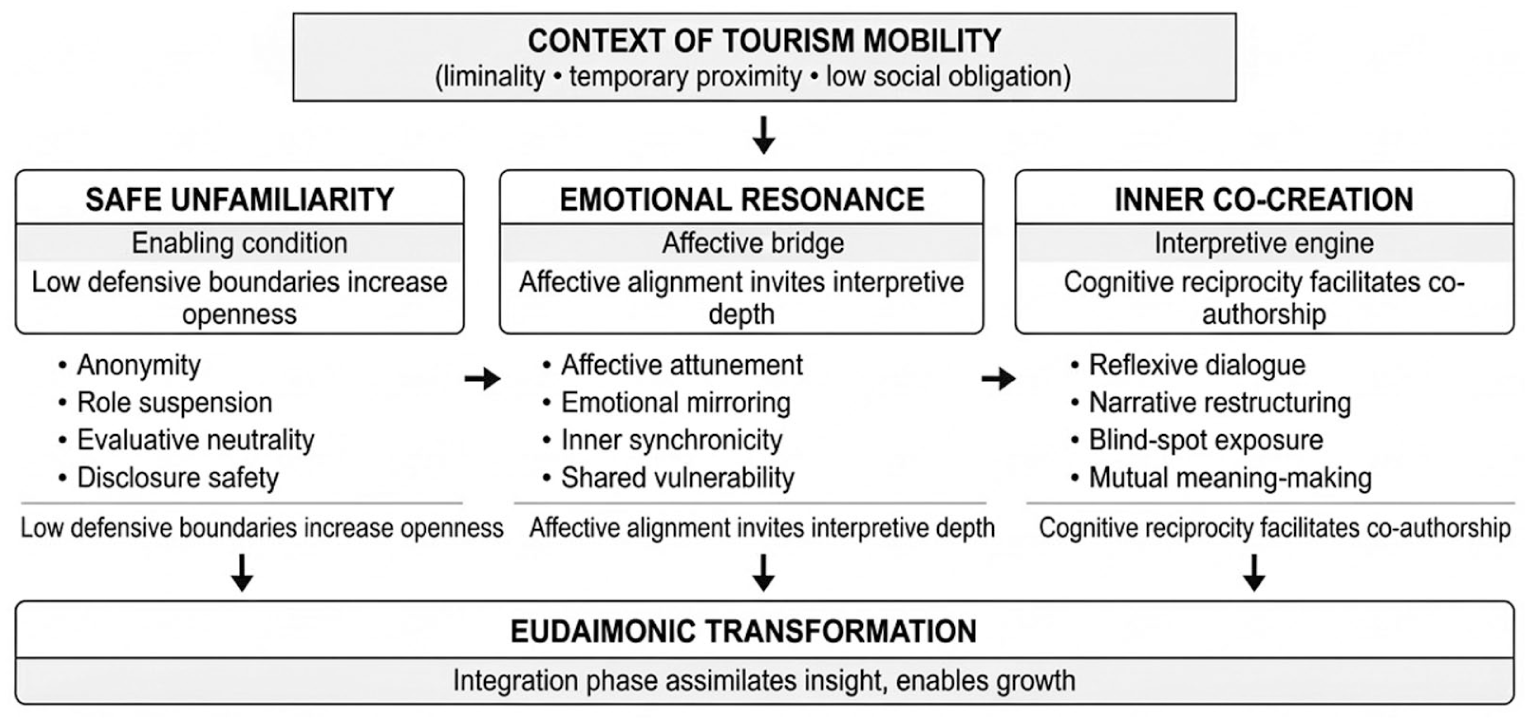
Conceptual framework of the stranger effect in tourism.
Synthesizing these layers, the stranger effect constitutes the substantive theory explaining transformation induced by stranger encounters in tourism. Its core contribution lies in demonstrating that meaningful psychological development does not require deep relational history or intentionally designed experiences. Instead, transformation arises from a structured interplay of liminal safety, affective synchrony, interpretive reciprocity, and post-encounter integration. The stranger effect thus reconceptualizes strangerhood as a developmental resource embedded in the social ecology of travel.
An important contextual consideration concerns the cultural background of the participants. The empirical material for this study was generated entirely from Vietnamese tourists, whose social interactions are shaped by a predominantly collectivist and high-context cultural environment. In such settings, everyday communication often involves implicit norms, role expectations, and hierarchical sensitivities that regulate how individuals express emotions or disclose personal concerns. Within this context, the mechanism of safe unfamiliarity observed in the data may become particularly salient because encounters with strangers temporarily suspend these familiar social hierarchies and relational obligations. When tourists interact with unfamiliar fellow tourists outside their routine networks, the absence of predefined roles, such as family member, subordinate, or colleague, may reduce the need for face management and enable more candid expression of personal thoughts and emotions. From this perspective, the stranger effect may be partly amplified by the release from culturally embedded relational expectations.
At the same time, the purpose of this grounded theory is not to claim universal generalizability but to propose a conceptual explanation of how transformation may emerge through transient stranger encounters in tourism contexts. The model therefore should be understood as a theoretically grounded framework that may be transferable to other travel settings where anonymity, temporary mobility, and low-obligation interactions occur. Future research across different cultural environments, particularly in lower-context or more individualistic societies, can further examine how cultural communication norms shape the intensity, progression, or expression of the stranger effect.
Discussion
Dialogue With Transformative Tourism Research
Research on transformative tourism has widely recognized that travel can trigger deep changes in tourists’ self-understanding and life orientation. Within this literature, transformation is often conceptualized through either educational or existential perspectives, both of which emphasize reflective meaning-making following disruptive experiences (J. M. Pung et al., 2020). In the existential tradition, transformation has been associated with shifts in existential authenticity and heightened awareness of existential concerns, often triggered by emotionally intense travel episodes (Kirillova et al., 2017a, 2017b). These studies show that transformative experiences emerge when tourists encounter moments that challenge their existing self-understandings and subsequently reinterpret their lives through reflection. Similarly, other work has emphasized the narrative reconstruction of the self, where tourists symbolically represent and integrate their transformation through stories and meaning-making practices (Soulard et al., 2021).
Recent scholarship has also sought to model the broader experiential process of transformation. For example, Neuhofer and Dulbecco (2024) conceptualize transformative tourism as a multi-phasic process unfolding across extraordinary experiential settings, such as outer space, natural environments, and psychedelic journeys, where individuals move through stages of self-reconfiguration before integrating the experience into their lives (Neuhofer & Dulbecco, 2024). In parallel, Zhang (2025) critiques the tendency of tourism research to overemphasize singular transformative moments, arguing instead that transformation may develop gradually through the accumulation of experiences and the evolving narrative identity of the tourist (Zhang, 2025).
The findings of the present study align with these perspectives in recognizing transformation as a process of meaning-making and identity reconfiguration. However, they extend this literature in two ways. First, while many existing studies situate transformative change within extraordinary environments, symbolic narratives, or individual reflection, the present findings highlight the micro-relational conditions through which transformation may emerge in ordinary travel encounters. Specifically, the stranger effect model shows how brief interactions between unfamiliar individuals can evolve through a sequence of safe unfamiliarity, emotional resonance, inner co-creation, and eudaimonic transformation. This process illustrates how temporary anonymity, role suspension, and evaluative neutrality create a relational form of liminality that allows strangers to become catalysts for reflection and reinterpretation.
Second, the study shifts attention from transformation as a primarily intrapersonal process toward transformation as intersubjective meaning-making. While prior research acknowledges relational dimensions of transformation, these interactions are often embedded within communities, organized programs, or symbolic rituals. In contrast, the findings demonstrate how fleeting encounters between strangers, without shared history or institutional structure, can produce moments of emotional attunement and collaborative interpretation that reshape tourists’ understanding of their lives. In this sense, the contribution of the study lies not in suggesting that relational interactions matter for transformation, which is already recognized in the literature, but in identifying the processual mechanism through which such interactions unfold within the everyday social ecology of travel.
Dialogue With Co-creation and Guest-Guest Interaction
In the study of co-creation, works such as Payne, Blasco-Arcas or Finsterwalder and Kuppelwieser have emphasized the role of the active participation of tourists in the service ecosystem (Blasco-Arcas et al., 2014; Finsterwalder & Kuppelwieser, 2011; Payne et al., 2007). Guest-guest interaction is also considered a source of social value, but the analysis mainly focuses on the functional or superficial emotional benefits such as information support, comfort in companionship or a temporary sense of belonging (Payne et al., 2007; Reichenberger, 2017; Wang et al., 2025).
The stranger effect challenges this understanding by showing that interactions between strangers not only create social value but also trigger the process of life meaning-making and ontological transformation. Inner co-creation shows that strangers can become agents to help tourists look back at themselves, identify their inner blind spots and restructure their life stories. This form of co-creation differs from service-based co-creation because it is grounded not in consumption, but in existential dialogue.
The analysis also shows that current co-creation models do not take into account the role of anonymity, an important factor in creating psychologically safe spaces to open up. Safe unfamiliarity shows that strangeness does not eliminate the possibility of co-creation; rather, it can activate co-creation at a deeper level than familiar relationships. This suggests that value in tourism is not only co-created with the supplier or the local community but also with the people who happen to be present on the journey.
Dialogue With Studies on Stranger Encounters
Research on stranger interactions in tourism has documented a wide range of relational outcomes, comfort and companionship in remote or challenging settings (White & White, 2008), helpful information or emotional support between unfamiliar tourists (Chen et al., 2020; StokowskI, 1992), quick formation of travel friendships or affective ties (Su & Wu, 2021), reduced social distance (S. Bai & Chang, 2021), or the emergence of ad hoc communities through digital mediation (Thiel et al., 2015). However, despite their richness, these studies remain largely descriptive and do not articulate the mechanisms through which stranger encounters become psychologically consequential. Much of the existing literature acknowledges positive feelings, instant rapport, temporary attachment, and emotional warmth but stops short of explaining how anonymity, liminality, evaluative neutrality, and spontaneous timing interact to produce deeper change.
The findings of this study add conceptual depth by proposing a processual model that clarifies these mechanisms. Emotional resonance identifies the precise moment when strangers enter affective synchrony, generating instant understanding through alignment of inner states rather than relational history. This form of attunement, rooted in low surveillance, heightened presence, and reduced identity performance, has not been systematically theorized in previous research.
Similarly, inner co-creation reframes dialogue between strangers as a site of intersubjective meaning-making, where unbiased reflection, narrative mirroring, and exposure of blind spots co-produce clarity and cognitive reframing. This mechanism goes beyond prior work that framed stranger encounters primarily as sources of information, companionship, or emotional support.
Implications
Theoretical Implications
First, a central theoretical implication of this study lies in reframing stranger encounters and serendipitous meetings as structurally transformative rather than incidental. Existing research has long acknowledged that interactions among unfamiliar fellow tourists can shape comfort, companionship, and satisfaction in tourism, yet these encounters have rarely been theorized as psychological engines of change. The present study advances this conversation by demonstrating that anonymity, liminality, and evaluative neutrality jointly produce a relational affordance, safe unfamiliarity, that lowers defensiveness and enables affective permeability.
Second, this study extends serendipity research by showing that its generative power does not lie in randomness alone, but in how unexpected encounters activate interpretive openness, cognitive reframing, and eudaimonic growth. Rather than treating serendipitous meetings as delightful anomalies, the findings conceptualize them as micro-contexts in which psychological restructuring can occur. In doing so, the study links two previously disconnected streams, transformative tourism and stranger sociality, and offers a processual framework showing how emergent encounters can trigger durable shifts in self-understanding.
Third, the study extends transformative tourism research by showing that transformative change may arise not only from intentionally designed contexts such as retreats or ritualized settings, but also from brief encounters between strangers in ordinary travel situations. While prior work has examined relational and micro-social dynamics in transformative experiences, these studies typically situate transformation within extraordinary environments or narrative meaning-making following the experience. In contrast, the present study conceptualizes transformation as an emergent micro-relational process unfolding within everyday tourist mobility. By identifying the sequential pathway of safe unfamiliarity, emotional resonance, inner co-creation, and eudaimonic transformation, the findings show how anonymity, role suspension, and evaluative neutrality can generate a relational liminal field that enables reflection and meaning-making. This perspective refines existing understandings of liminality by suggesting that transformation does not necessarily depend on highly curated transformative settings but can emerge from transient social configurations between strangers during ordinary travel.
Fourth, the study introduces inner co-creation as a new form of co-creation. Existing co-creation research has largely centered on functional, experiential, or emotional value within service environments. In contrast, inner co-creation conceptualizes how strangers co-structure meaning through reflexive, intersubjective dialogue. This extends co-creation to the ontological level by showing that value is not limited to consumption or experience design but can emerge organically between unacquainted individuals without guidance from a service ecosystem. It positions strangers as temporary meaning-making partners capable of reshaping one another’s interpretive frameworks.
Next, the findings advance the literature on emotional contagion and social bonding by theorizing emotional resonance in contexts characterized simultaneously by safety and unfamiliarity. The results demonstrate that under certain socio-emotional conditions, lowered defenses, absence of surveillance, and heightened presence, strangers can achieve levels of affective attunement equal to or deeper than those formed within familiar relationships. This challenges assumptions that emotional congruence is rooted in relational history and suggests instead that socio-situational affordances in tourism can rapidly reconfigure emotional boundaries.
Finally, the proposed stranger effect adds a new mechanism to the study of eudaimonia in tourism. While eudaimonic transformation has traditionally been framed as an individualized or introspective process, the findings reveal that it can be catalyzed by short-term intersubjective encounters. This position sees stranger-mediated insight, narrative reframing, and emotional release as legitimate pathways to eudaimonic growth. It also offers a socially grounded model of well-being, one in which psychological development is co-produced through transient but meaningful relational moments.
Practical Implications
The findings indicate that the practical value of the stranger effect does not lie in deliberately orchestrating emotional encounters, but in designing tourism environments where safe unfamiliarity can emerge naturally. Across the participants’ narratives, meaningful exchanges with strangers occurred not because they were actively facilitated, but because the travel context temporarily reduced social pressure, suspended everyday roles, and allowed individuals to interact without expectation. For tourism providers, the key implication is therefore not to force interaction but to create conditions in which interaction remains possible, voluntary, and psychologically safe.
First, tourism experiences can be designed to support safe unfamiliarity through spatial configuration and group structure. Small-group formats, shared walking segments, communal seating areas, or informal rest stops can allow tourists to encounter one another without pressure to perform or participate. In contrast to highly scripted tours where attention is constantly directed toward the guide or attractions, environments that allow moments of quiet co-presence enable strangers to observe each other gradually and decide whether to engage. Such settings mirror the conditions identified in the findings, where anonymity, temporary co-presence, and the absence of evaluative expectations lowered defensive boundaries and opened space for conversation.
Second, temporal design plays an important role. The stranger effect unfolded gradually in the data: tourists first experienced a sense of comfort in unfamiliar surroundings before emotional resonance and deeper conversation became possible. Tourism programs that include reflective pauses, flexible pacing, or loosely structured interaction periods may therefore be more conducive to meaningful encounters than tightly scheduled itineraries. Moments such as shared meals, slow travel segments, or quiet transitions between activities provide opportunities for spontaneous interaction without imposing it.
Third, tourism staff should adopt a light-touch facilitative role rather than direct emotional intervention. The findings suggest that emotional resonance between strangers emerges from authenticity and mutual openness, conditions that cannot be manufactured through instruction. Instead of encouraging forced ice-breaking or structured emotional sharing, guides can focus on maintaining a respectful and relaxed atmosphere in which tourists feel comfortable speaking, or remaining silent. In many cases, preserving voluntary boundaries and avoiding intrusive facilitation may be more supportive than attempting to stimulate interaction.
Finally, destinations may incorporate the insight of the stranger effect into experience design and destination storytelling. Participants frequently described brief yet meaningful encounters with unfamiliar fellow tourists as some of the most memorable aspects of their journeys. Recognizing this, destinations can highlight the social openness of travel environments, spaces where people may unexpectedly meet, exchange perspectives, and momentarily accompany each other’s life reflections. In this sense, designing for the stranger effect does not mean engineering intimacy but creating environments where meaningful human encounters remain possible.
Methodological Implications
First, the study demonstrates that grounded theory is a constructivist approach that is particularly relevant to tourism phenomena with deep emotional and ontological depth. The reconstruction of the process from openness to transformation shows that grounded theory not only helps to discover categories but also allows for an explanation of their workings over time.
Second, the use of in vivo coding in the early stages demonstrates the power of participants’ own language in the formation of new categories. This emphasizes the importance of methodological humility and avoiding imposing pre-existing theoretical frameworks on complex and unpredictable experiences such as the stranger effect.
Third, researcher reflection is imperative in grounded theory, especially when the research subject involves inner experiences and deep emotional structures. The study shows that keeping a reflective journal not only reduces bias but also allows researchers to identify how they co-construct meaning with participants.
Fourth, the four-layer coding process (initial, focused, axial, theoretical) demonstrates the value of grounded theory in moving from raw data to grounded theory. This is evidence that grounded theory can be applied more broadly in research on inner tourism, healing tourism, and deeply humanistic topics.
Conclusion, Limitations and Further Research Directions
This study develops a grounded theoretical framework for the stranger effect, derived from field data on spontaneous interactions between tourists and unfamiliar fellow tourists during travel. Through iterative coding and constant comparative analysis, four interrelated categories, safe unfamiliarity, emotional resonance, inner co-creation, and eudaimonic transformation, emerged as successive layers of a structured socio-emotional process. By conceptualizing these encounters as a patterned process rather than isolated anecdotes, the study offers a new explanatory lens for understanding the psychological depth that may arise from seemingly ordinary interactions in tourism settings.
The findings extend several strands of tourism scholarship. First, they broaden the scope of transformative tourism research by demonstrating that meaningful change does not occur only within intentionally designed contexts such as retreats, pilgrimages, or immersive programs, but may also emerge from micro-social encounters embedded in everyday travel situations. Second, the study contributes to value co-creation theory by introducing the notion of inner co-creation, highlighting how meaning can be collaboratively constructed through reflexive dialogue between strangers rather than through service-provider interactions alone. Third, by placing intersubjectivity at the center of the analysis, the stranger effect reframes strangers as reflective agents who momentarily mirror, challenge, and clarify each other’s life narratives.
More broadly, the study adds a humanistic dimension to tourism research by suggesting that ontological growth can arise not only from solitude or structured experiences but also from timely interpersonal encounters. Within the transient social ecology of travel, where anonymity, mobility, and liminality loosen everyday roles, brief conversations may open spaces for vulnerability, recognition, and reflection. In this sense, the stranger effect reveals how tourism can facilitate subtle yet meaningful forms of self-understanding, emerging from the simple but powerful moment when two unfamiliar lives intersect.
However, the study does have some limitations. First, the sample focused on Vietnamese solo tourists or group tours, which may make the results culturally specific and require caution when generalizing to other contexts. Second, the data reflect retrospective experiences, so may be subject to selective memory or post-experience idealization. Third, the study did not follow the long-term progress to see how eudaimonic transformations are sustained over time. Determining the sustainability of transformations requires longitudinal research or the recording of real-life diaries of tourists. In addition, as with many grounded theory studies, the goal of this research is not statistical generalization but theoretical development. Grounded theory has occasionally been critiqued for its limited capacity to produce universally generalizable findings. However, the purpose of the present study is to develop a substantive theoretical explanation of the stranger effect grounded in participants’ experiences. The resulting model should therefore be understood as a conceptual framework that may be transferable to similar tourism contexts where temporary anonymity, liminal mobility, and spontaneous encounters occur, rather than as a universally applicable predictive model.
Based on these limitations, several directions for future research are suggested. First, the stranger effect should be examined in cross-cultural contexts to explore how cultural norms, communication styles, and social hierarchies shape the emergence of safe unfamiliarity, emotional resonance, and inner co-creation. Second, longitudinal research would help trace how eudaimonic transformations evolve over time, clarifying whether the reflective insights generated through stranger encounters persist, intensify, or fade months or years after the travel experience. Third, combining grounded theory with complementary methods such as digital diaries, participant observation, or episodic interviews may offer deeper insight into how moments of emotional resonance and co-created meaning are integrated into tourists’ everyday lives after travel. Finally, future research may explore whether digital environments, such as tourist chat groups, online travel communities, or immersive virtual worlds where individuals interact through avatars, can create forms of safe unfamiliarity that facilitate emotional openness, reflective dialogue, and meaning-making similar to those observed in physical travel encounters.
The study concludes with the observation that encounters with strangers, however fleeting, can be one of the most healing moments in travel life, where people quietly co-create meaning for each other, and in silence or brief conversations, a part of themselves is opened and matured.
Supplemental Material
sj-docx-1-jtr-10.1177_00472875261459253 – Supplemental material for The Stranger Effect in Tourism: A Constructivist Grounded Theory of Inner Co-Creation and Eudaimonic Transformation
Supplemental material, sj-docx-1-jtr-10.1177_00472875261459253 for The Stranger Effect in Tourism: A Constructivist Grounded Theory of Inner Co-Creation and Eudaimonic Transformation by Tuyen Tran in Journal of Travel Research
Footnotes

Author Contributions
Funding
The author received no financial support for the research, authorship, and/or publication of this article.
Declaration of Conflicting Interests
The author declared no potential conflicts of interest with respect to the research, authorship, and/or publication of this article.
Supplemental Material
Supplemental material for this article is available online.
Author Biography
References
Supplementary Material
Please find the following supplemental material available below.
For Open Access articles published under a Creative Commons License, all supplemental material carries the same license as the article it is associated with.
For non-Open Access articles published, all supplemental material carries a non-exclusive license, and permission requests for re-use of supplemental material or any part of supplemental material shall be sent directly to the copyright owner as specified in the copyright notice associated with the article.
