






Abstract
Sustainability in tourism has largely emphasized harm reduction, yet destinations increasingly seek net-positive social and ecological outcomes. The psychological orientation that predisposes travelers to pursue such regenerative actions, often requiring time, effort, or sacrifice, remains under-specified. We introduce the Regenerative Travel Mindset (RTM), a dispositional, trait-like belief system specified a priori and composed of three dimensions: positive impact intentionality (a deontic belief that travel should improve places), community reciprocity (commitments to fairness and co-agency with host communities), and long-term stewardship (future-oriented responsibility beyond the trip). Across ten studies (total N = 2,541), we develop and validate an 18-item RTM scale. The scale demonstrates excellent reliability, discriminant validity in relation to adjacent constructs (biospheric values, environmental locus of control, growth mindset, and dispositional optimism), and four-month test-retest stability. RTM predicts high-impact regenerative behaviors, for example, choosing surplus-positive trip packages, supporting restoration levies and conservation-linked pricing, paying price premiums, and allocating donations to community-led ecological projects. An experimental narrative intervention causally elevates RTM, which in turn increases willingness to pay, perceived authenticity, and policy support. Practically, the scale enables traveler segmentation, message framing that activates stewardship and reciprocity, product design embedding hands-on restoration, and policy communication that builds acceptance for conservation instruments. Theoretically, the work extends mindset theory to a moralized, domain-specific context and offers a validated diagnostic tool to advance regenerative tourism.
Keywords
Introduction
Tourism is undergoing a paradigmatic shift. Once lauded for economic development and intercultural exchange, it is increasingly criticized for ecological degradation, climate change, and socio-cultural disruption (Gössling & Hall, 2006; Higgins-Desbiolles, 2018; Higgins-Desbiolles et al., 2019). Sustainability has accordingly guided policy and practice for three decades (Higgins-Desbiolles et al., 2019; Teo, 2002). Yet, framed largely around harm mitigation, this paradigm often positions tourists as passive minimizers of negative externalities rather than as active co-creators of net-positive outcomes (Bellato et al., 2024; Higgins-Desbiolles, 2018). In contrast, regenerative tourism advances a surplus-positive logic in which traveler participation restores or enriches social-ecological systems (for example, coral nurseries and heritage stewardship) and builds long-term community resilience (Becken & Kaur, 2021; Bellato et al., 2024; Paddison & Hall, 2024), now amplified by initiatives such as the UNWTO Glasgow Declaration (United Nations World Tourism Organization, 2021). We focus on the unresolved theoretical question that underpins this shift: what psychological orientation predisposes travelers to engage in regenerative actions that entail time, effort, or sacrifice?
We theorize this orientation as a mindset, consistent with extensions of mindset theory beyond ability malleability, defined as a durable, trait-like belief system that organizes meaning and guides interpretation, preference formation, and behavioral commitment in value-laden consumption domains (Dweck, 2016; Ma & Roese, 2014; Murphy & Dweck, 2015; Ratneshwar et al., 2003). Mindsets are not transient attitudes; rather, they provide interpretive frameworks that structure how individuals make sense of choices involving morality, agency, and identity. This positioning is consistent with growing scholarly recognition that pro-environmental and prosocial decision-making in tourism is shaped less by isolated attitudes than by integrated belief systems that link agency, obligation, and time horizon into a coherent self-concept (Reed et al., 2012; Skitka, 2010).
Although regenerative tourism has been increasingly articulated as a paradigm shift from minimizing harm to creating net-positive socioecological impact (Bellato et al., 2024), the psychological orientation required to support such behavior remains theoretically underdeveloped. Existing constructs offer only partial insight: biospheric values capture generalized concern for the environment (Martin & Czellar, 2017); environmental locus of control reflects perceived behavioral efficacy (Cleveland et al., 2020); and sustainable tourism attitudes primarily assess support for mitigation-oriented practices (Choi & Sirakaya, 2005). Regenerative tourism, by contrast, demands a qualitatively distinct orientation in which travelers construe themselves as active contributors to place-based flourishing, guided by responsibility, reciprocity, and long-term stewardship. We conceptualize this orientation as the Regenerative Travel Mindset (RTM): a domain-specific belief system that integrates positive impact intentionality, community reciprocity, and long-term stewardship into an internally coherent mindset structure. The detailed conceptual contrast between RTM and adjacent constructs is developed once in the Conceptual Framework section.
To clarify the structural basis of RTM as a mindset, it is important to explain how its dimensions cohere within the framework of mindset theory. Mindsets are not collections of independent beliefs; rather, they are organizing cognitive frameworks that integrate related belief components into a unified interpretive system guiding perception, judgment, and action (Dweck, 2016; Murphy & Dweck, 2015). In this sense, a mindset is defined not by a single belief, but by a constellation of interrelated beliefs that collectively shape how individuals construe situations and determine appropriate responses. Building on this perspective, RTM is conceptualized as comprising interdependent belief dimensions that jointly reflect a generative orientation toward travel. Specifically, these dimensions capture three complementary aspects of generative action: agency (the intention to create positive impact), relational embeddedness (a sense of reciprocity toward host communities), and temporal continuity (a responsibility that extends beyond the immediate travel episode). These elements have been identified as central to prosocial and stewardship-oriented behavior (Grant & Dutton, 2012). Accordingly, the three RTM dimensions are not independent constructs but functionally interdependent components of a single mindset. Together, they define how travelers interpret their role, evaluate the legitimacy of their actions, and sustain engagement with regenerative practices over time.
Consistent with this structural logic, RTM integrates three a priori theorized belief clusters, each grounded in established literatures and empirically verified in the scale program below. The selection of these theoretical foundations reflects the premise that regenerative tourism requires a psychological orientation that simultaneously integrates moral purpose, relational obligation, and temporally extended responsibility, elements that cannot be fully captured by any single moral framework. First, positive impact intentionality reflects the deontic belief that tourism ought to actively enhance destination well-being; its moral metaphors (“healing,” “legacy”) are consistent with metaphor’s role in structuring abstract moral reasoning (Lakoff & Johnson, 2008) and with eudaimonic consumption where contribution and meaning supersede short-term gratification (Lengieza et al., 2019; Waterman et al., 2010). Second, community reciprocity encodes fairness, mutuality, and cultural respect in host-guest exchange, aligning regenerative ethics with distributive and recognition-based justice in tourism systems (Rastegar, 2025). Third, long-term stewardship captures future-oriented responsibility beyond the trip episode, drawing on environmental psychology’s accounts of temporal commitment, perceived agency, and enduring care (Ardoin et al., 2015; Cleveland et al., 2020; Gifford & Nilsson, 2014). These belief clusters are theoretically complementary rather than interchangeable, as each captures a distinct dimension of regenerative action: intentionality defines the purpose of action, reciprocity defines the relational basis of obligation, and stewardship defines the temporal scope of responsibility. Importantly, positive impact intentionality does not subsume reciprocity or stewardship; rather, it specifies the general goal of creating beneficial outcomes, whereas reciprocity defines the relational conditions under which such outcomes are pursued, and stewardship defines the temporal extension of responsibility beyond the immediate interaction. Together, they provide a conceptually complete and non-redundant representation of how travelers construe their role, not merely as consumers, but as co-stewards of place-based systems.
This positioning yields testable implications. Individuals higher in RTM should be more likely to choose regenerative offerings, support high-impact policies (for example, restoration levies), and sustain behaviors with delayed personal returns. Moreover, because identity-consistent narratives can activate moralized beliefs (Escalas & Bettman, 2005; Winterich et al., 2012), RTM should be malleable via narrative interventions, with downstream effects on willingness to pay (WTP), authenticity appraisals, and policy receptivity.
Accordingly, we report a multi-method study of 10 studies that define, develop, and validate the RTM construct. Study 1 (1a–1e) derives and purifies items from qualitative elicitation and projective methods, then establishes a three-factor, 18-item reflective scale with reliability and four-month test-retest stability. Importantly, the three-cluster structure was specified a priori on theoretical grounds (metaphor theory, environmental psychology, regenerative ethics) and then verified empirically. Study 2 locates RTM in a nomological network distinct from biospheric values, environmental locus of control, growth mindset, and optimism, and demonstrates predictive links to self-directed regenerative behaviors and policy support, while reporting procedural and statistical remedies for common-method concerns. Study 3 experimentally manipulates RTM using narrative exemplars and shows that induced shifts in RTM fully mediate effects on ad evaluation, purchase likelihood, WTP, and donation preference. Study 4 extends to field-like contexts, showing that RTM predicts selection of surplus-oriented travel packages, authenticity appraisals, price premiums, and allocation to community-led conservation initiatives. Across studies, long-term stewardship emerges as especially diagnostic for high-impact policy support.
Our contributions are fourfold. First, we introduce and validate RTM as a trait-like, domain-specific mindset that reframes the tourist as an ethical co-steward. Second, we extend mindset theory to regenerative consumption by theorizing a moralized, future-oriented belief system that organizes meaning and action in a collective-outcomes domain (Murphy & Dweck, 2015). Third, we provide a psychometrically robust 18-item scale usable for research and practice (segmentation, message design, certification assessment). Fourth, we demonstrate causal malleability and behavioral relevance in realistic contexts, offering a tool for destination managers and policymakers seeking net-positive outcomes. The following sections elaborate on the conceptual foundations, scale development, and evidence base across the ten studies, concluding with implications for theory, regenerative marketing, and transformative travel (see Table 1 for a study overview; the overall conceptual model and its behavioral pathways are summarized in Figure 1).
Overview of the 10 Studies in the RTM Scale Development and Validation Program.
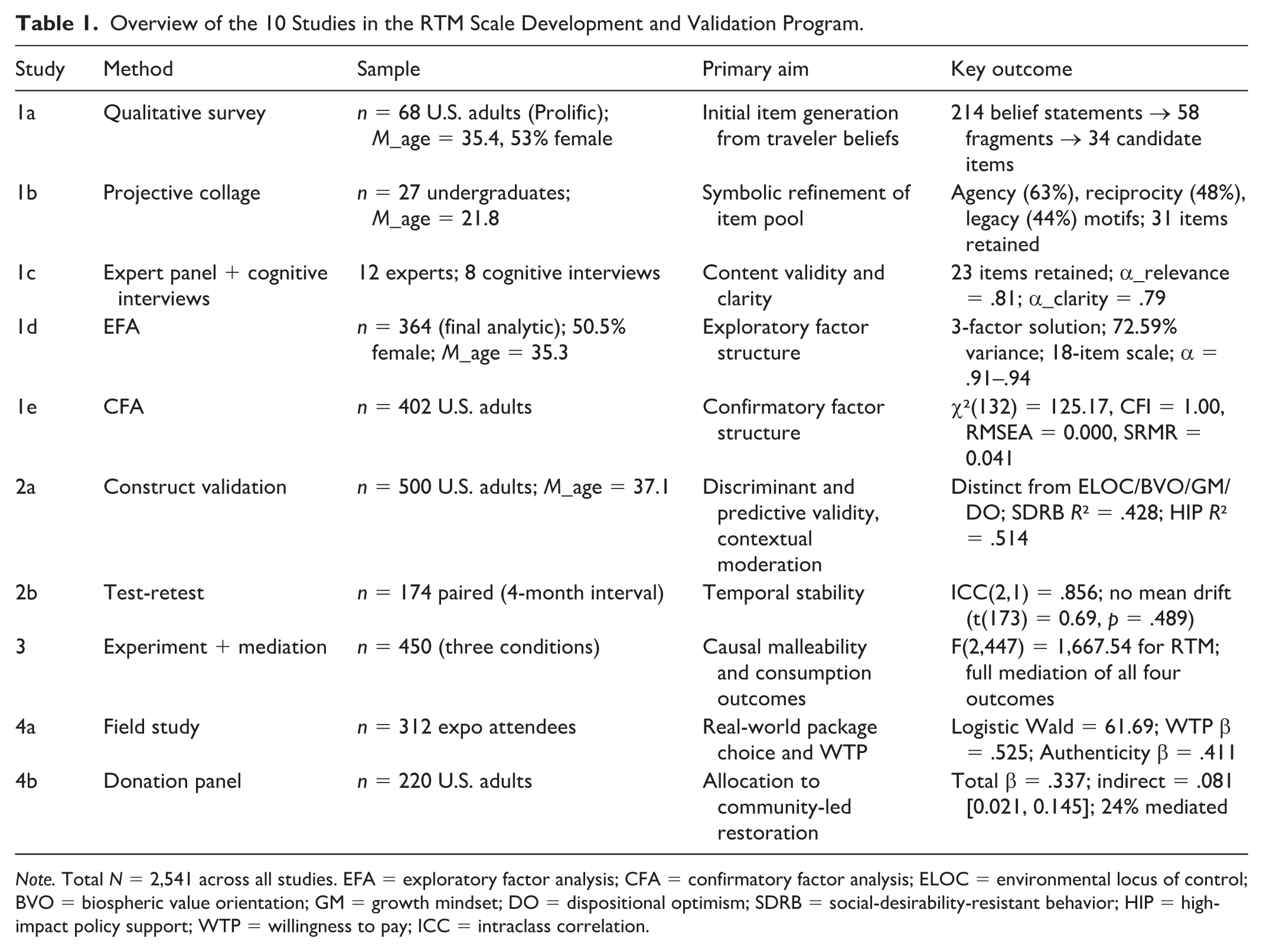
Note. Total N = 2,541 across all studies. EFA = exploratory factor analysis; CFA = confirmatory factor analysis; ELOC = environmental locus of control; BVO = biospheric value orientation; GM = growth mindset; DO = dispositional optimism; SDRB = social-desirability-resistant behavior; HIP = high-impact policy support; WTP = willingness to pay; ICC = intraclass correlation.
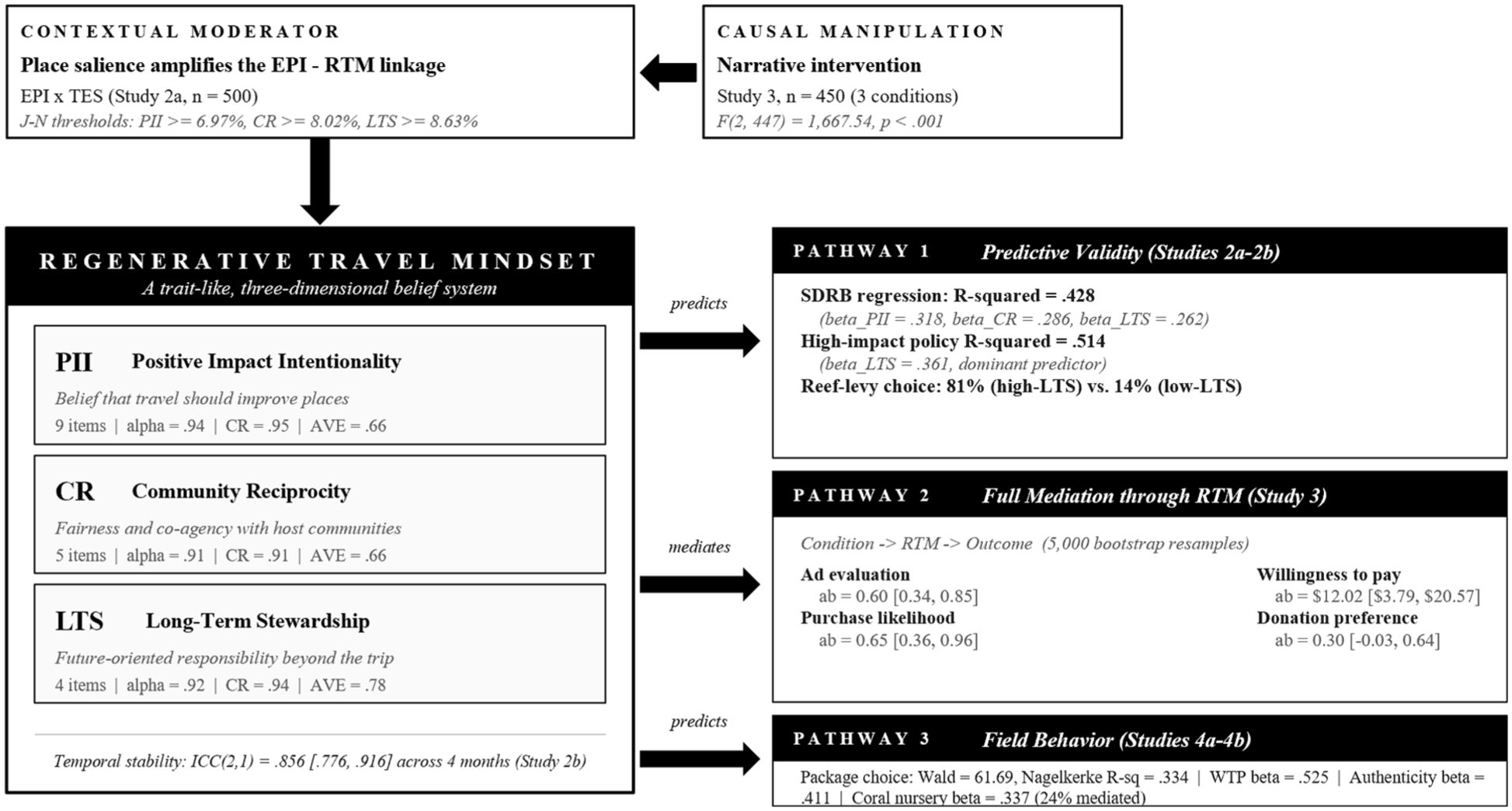
Conceptual model of the regenerative travel mindset (RTM) and its behavioural pathways.
Conceptual Framework
As stated earlier, RTM is conceptualized as a dispositional, trait-like belief system that organizes meaning and guides interpretation, preference formation, and behavioral commitment in morally significant travel contexts. Building on mindset theory, RTM extends the notion of durable belief structures beyond the ability domain to contexts where choices implicate morality, agency, and identity (Dweck, 2016; Ma & Roese, 2014; Murphy & Dweck, 2015; Ratneshwar et al., 2003). Mindsets serve as cognitive frameworks through which individuals interpret situations, define goals, and sustain behavior; RTM applies this mechanism to tourism, where travelers’ decisions can create or erode socio-ecological value. Consistent with moral psychology (Skitka, 2010) and identity-based consumer behavior (Reed et al., 2012), RTM is positioned as a moralized cognitive orientation that connects belief to ethical action. For definitional consistency, we use “dispositional” and “trait-like” synonymously and situate RTM as a stable yet domain-specific psychological construct, rather than a general attitude or value.
From Mitigation to Regeneration
Regenerative tourism reframes travel from a focus on harm reduction to a net-positive contribution. We define surplus-positive tourism as choices and practices that aim to leave destinations better off, ecologically, socially, and culturally, than they were before the visit (Becken & Kaur, 2021; Paddison & Hall, 2024). Within this frame, high-impact regenerative behaviors produce system-level or enduring effects, such as support for restoration levies, conservation-linked pricing, or community co-management, whereas low-impact actions focus primarily on harm mitigation (e.g., improved signage, plastic bans). This distinction operationalizes regeneration as net-positive, future-oriented, and justice-infused, addressing critiques that sustainability often stabilizes the status quo rather than advancing restorative outcomes (Bellato et al., 2024; Higgins-Desbiolles, 2018).
A Priori Dimensional Structure
Consistent with established approaches to construct definition and scale development (Churchill, 1979; Hinkin, 1998; MacKenzie et al., 2011), the dimensional architecture of the RTM was formulated a priori based on theory, before empirical validation. In line with best practices in concept operationalization, the a priori specification allowed theoretical grounding to precede item generation, ensuring that construct dimensionality reflects meaningful conceptual distinctions rather than a data-driven artifact (Jarvis et al., 2003; Podsakoff et al., 2016). This approach is consistent with other mindset and belief-oriented constructs developed in consumer and environmental psychology, such as growth mindset (Murphy & Dweck, 2015), ethical mindset (Aquino & Reed, 2002), ecological worldview (Dunlap et al., 2000), and biospheric value orientation (De Groot & Steg, 2008), where theory specifies underlying belief clusters that are later confirmed empirically.
Accordingly, RTM was conceptualized as comprising three theoretically distinct but interrelated belief clusters: positive impact intentionality, community reciprocity, and long-term stewardship. Each dimension was derived from established theoretical literature that together explains how travelers internalize moral agency and ecological accountability in tourism contexts.
Positive Impact Intentionality
This dimension captures the conviction that travel should actively enhance the well-being of destinations. It draws from metaphor theory, which explains how moral reasoning and abstract ideals are structured by embodied metaphors, such as “healing,” “repair,” or “legacy,” that symbolize restorative action (Lakoff & Johnson, 2008). This dimension also resonates with eudaimonic consumption, where fulfillment stems from contribution and purpose rather than hedonic gratification (Lengieza et al., 2019; Waterman et al., 2010). Within tourism, eudaimonic motivations are associated with deeper engagement, personal transformation, and pro-social behavior (Kay Smith & Diekmann, 2017; Kirillova et al., 2016), all of which align with regenerative intent.
Community Reciprocity
This dimension refers to beliefs about fairness, mutuality, and ethical exchange between visitors and host communities. It builds on regenerative and distributive justice frameworks, which advocate co-agency and shared responsibility in tourism development (Rastegar, 2025). This dimension aligns with findings from transformative tourism research, where empowerment and mutual respect are crucial to achieving sustainable well-being outcomes (McIntosh & Harris, 2018; Pritchard et al., 2011). It therefore extends the psychological logic of reciprocity (Gouldner, 1960) into the socio-ethical domain of travel, embedding equity and justice as motivational imperatives.
Long-term Stewardship
This dimension represents the belief that travelers have enduring responsibility for the well-being of destinations beyond their visit. Drawing on environmental psychology, it integrates constructs such as temporal focus, environmental locus of control, and connectedness to nature, which predict long-term behavioral consistency (Cleveland et al., 2020; Gifford & Nilsson, 2014; Mayer & Frantz, 2004). Prior tourism studies also support that future-oriented responsibility enhances sustained pro-environmental commitment and donation behavior (Ardoin et al., 2015; Lo & Janta, 2020; Wynveen & Sutton, 2015).
These three clusters are conceptually unified by a deontic moral principle (“leave places better than found”), a systems view of destinations as co-evolving ecological-cultural networks, and a co-steward identity that links moral obligation to personal meaning. This integration is consistent with mindset theory’s proposition that multiple belief elements jointly organize meaning and behavioral persistence within a domain (Ma & Roese, 2014; Murphy & Dweck, 2015). It also parallels how multidimensional cognitive frameworks, such as ethical mindsets (Aquino & Reed, 2002) and environmental moral identity (Steg & De Groot, 2019), are structured to reflect moralized orientations across affective, cognitive, and behavioral planes. Thus, specifying RTM’s tri-dimensional structure a priori allowed us to build upon these theoretical foundations while avoiding inductive fragmentation or construct proliferation (MacKenzie et al., 2011).
RTM unites four foundational perspectives into a coherent conceptual foundation. Mindset theory provides the mechanism linking durable beliefs to goal pursuit and effort in value-laden decisions (Dweck, 2016; Murphy & Dweck, 2015). Metaphor theory contributes to the semantic architecture of moral reasoning, explaining why regenerative imagery (“healing,” “legacy”) frames positive-impact behavior (Lakoff & Johnson, 2008). Environmental psychology grounds stewardship in perceived agency, temporal responsibility, and enduring commitment (Ardoin et al., 2015; Cleveland et al., 2020; Gifford & Nilsson, 2014). Finally, regenerative ethics and justice locate reciprocity and equity as moral imperatives within community exchange (Rastegar, 2025). Together, these literatures articulate how RTM integrates cognitive structure, moral meaning, and ethical action into a unified belief system that motivates travelers to leave destinations better than they found them.
Regenerative Travel Mindset and the Nomological Network of Related Constructs
RTM is conceptually and empirically distinct from existing constructs that explain sustainability-related attitudes or behaviors. It differs from biospheric value orientation, which captures general concern for nature but not reciprocity or restorative justice (De Groot & Steg, 2008; Martin & Czellar, 2017); from environmental locus of control, which emphasizes self-efficacy but lacks moral duty (Cleveland et al., 2020); and from sustainable tourism attitudes, which measure support for mitigation rather than net-positive contribution (Choi & Sirakaya, 2005). RTM also diverges from the growth mindset (Dweck, 2016) and dispositional optimism (Scheier et al., 1994), which are domain-general and non-moral in nature. In contrast, RTM represents a moralized, justice-infused, time-extended mindset specific to regenerative tourism, capturing how travelers integrate contribution, care, and continuity into their self-concepts. As moralized beliefs more strongly predict advocacy and prosocial action than general attitudes (Brick et al., 2017; Feinberg & Willer, 2012), RTM offers superior explanatory power for high-impact regenerative engagement. A concise comparative summary of these conceptual distinctions is presented in Table 2.
Conceptual Distinctions: Regenerative Travel Mindset Versus Adjacent Constructs.
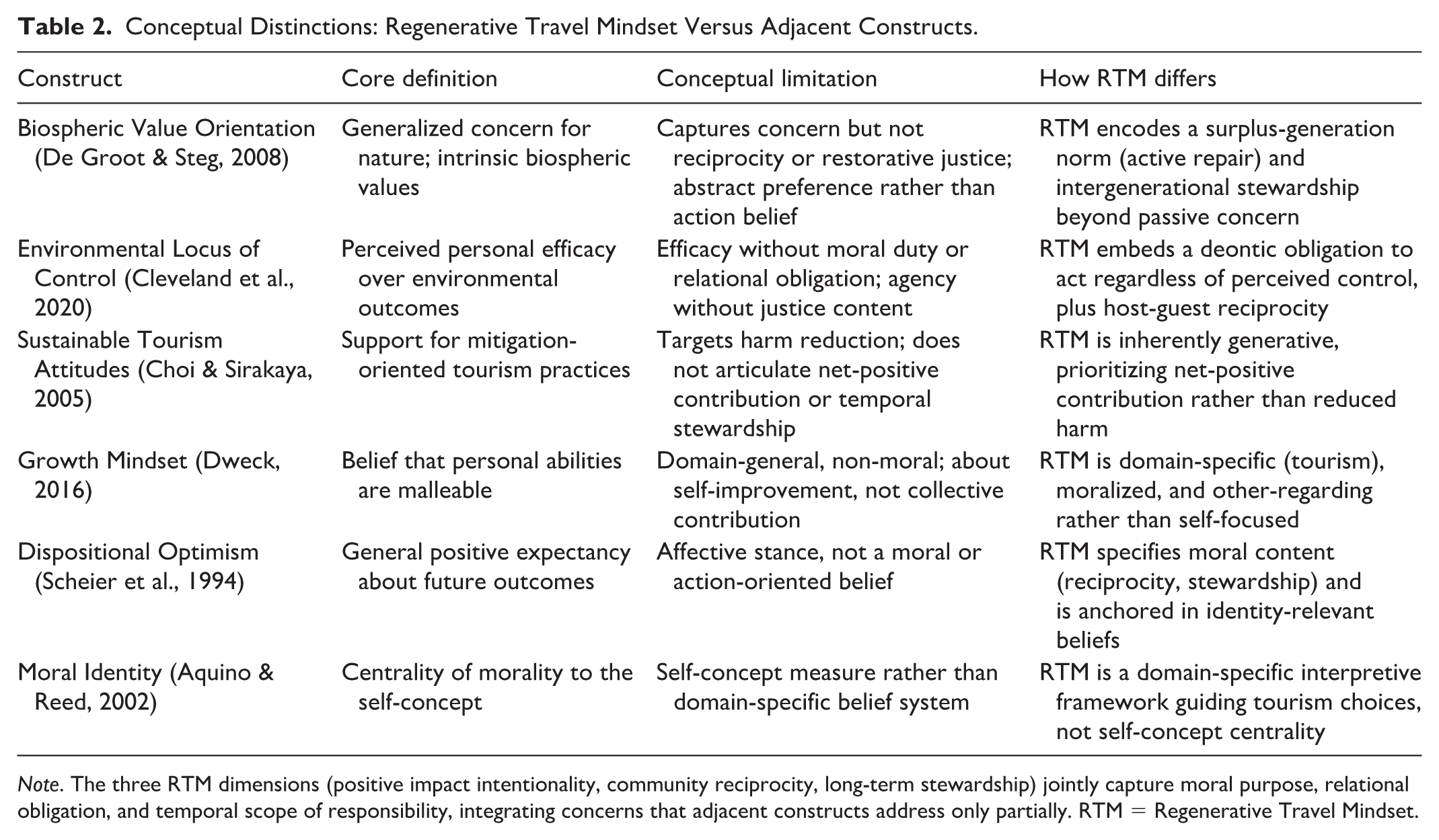
Note. The three RTM dimensions (positive impact intentionality, community reciprocity, long-term stewardship) jointly capture moral purpose, relational obligation, and temporal scope of responsibility, integrating concerns that adjacent constructs address only partially. RTM = Regenerative Travel Mindset.
Overview of Empirical Sequence
Building on this framework, we first establish and validate the RTM measure (Studies 1a to 1e), specifying a theory-driven, three-dimensional reflective structure and testing its reliability, validity, and temporal stability. With the measurement model secured, we advance two a priori proposition sets to guide the remainder of the research. Predictive propositions state that higher RTM will predict (a) selection of surplus-positive offerings, (b) endorsement of high-impact tourism policies (for example, restoration levies), and (c) sustained post-trip engagement (donations, advocacy, citizen-science participation). These predictions follow from RTM’s moralized content and its alignment with identity-based motivation (Reed et al., 2012; Skitka, 2010). Malleability propositions posit that exposure to identity-consistent narratives, stories of local regeneration or stewardship, can causally elevate RTM, thereby increasing willingness to pay, perceived authenticity, and policy receptivity (Escalas & Bettman, 2005; Murphy & Dweck, 2015; Winterich et al., 2012). We then map tests to propositions: Study 2 (and Study 4) evaluate predictive propositions in survey- and field-like contexts, while Study 3 provides a causal test of malleability via experimental manipulation.
Study 1: Item Generation and Validation
Study 1a: Item Generation through a Qualitative Survey
The goal of Study 1a was to inductively generate a robust set of candidate items representing the latent construct of the Regenerative Travel Mindset. According to our conceptualization, RTM is a trait-like belief system that encompasses environmental concern, agency, justice, and stewardship, a blend not fully captured by existing sustainability or pro-environmental attitude scales. Following Churchill’s (1979) framework for construct development and building on contemporary guidelines for mindset scale creation (Murphy & Dweck, 2015), we began by collecting qualitative data to surface how individuals naturally articulate their beliefs, metaphors, and motivations around regenerative travel.
We employed an asynchronous qualitative survey rather than a depth interview. Participants completed a structured, open-ended written elicitation task in Qualtrics, providing detailed narrative responses to a sequence of prompts. Following Braun et al. (2021), an online qualitative survey is a self-administered, written, open-response instrument that affords efficient breadth across a moderately sized sample, comparability of prompts and analytic units across respondents, and low researcher influence on respondents’ framing. It does not, however, afford the real-time clarification, follow-up probing, and dialogic co-construction that are constitutive of a depth interview. We therefore use the qualitative-survey framing throughout. We retained protocol design features intended to support depth and reflection without simulating live interaction: (a) a structured progression (warm-up, core, and reflective prompts) allowed participants to elaborate progressively on their beliefs; (b) prompts were deliberately open-ended and reflective (e.g., future-oriented scenarios, meaning-based questions), which prior research shows can elicit rich narrative responses; (c) participants were encouraged to provide detailed explanations and examples, and the asynchronous format allowed time to reflect without pressure, which can enhance depth in written qualitative data; and (d) the relatively large narrative corpus (n = 68) enabled systematic identification of meaning units, metaphors, and belief structures through grounded coding procedures. Consistent with recent qualitative research using asynchronous text-based elicitation, this approach is well-suited for capturing reflective belief systems while reducing interviewer bias and social-desirability effects.
Participants and Procedure
Sixty-eight adult U.S. residents were recruited from Prolific, a vetted online panel. The sample was diverse across age, gender, and socioeconomic status: 53% identified as female; mean age = 35.4 years (SD = 8.9); modal income was $50,000 to $59,999; approximately 36% held a valid passport. Participants completed the written qualitative survey on Qualtrics and received $1.25. The study title (“Views on Today’s Travel”) and description did not mention sustainability, ethics, or regeneration, in order to minimize priming and reduce demand artifacts and social-desirability bias (Podsakoff et al., 2003). Because education can shape articulation in open-ended tasks, we recorded participants’ highest education level and implemented two safeguards: (a) coders were trained to identify and code “meaning units” independent of writing fluency or vocabulary, and (b) a post-hoc check showed no systematic differences in code incidence or theme coverage across broad education brackets (high school/some college vs. bachelor’s/graduate).
Prompt Development and Validation
The protocol included six open-ended prompts (see Table 3), each crafted to elicit narrative reflections on ideal travel, ethical responsibilities, and regenerative concepts. Prompts were adapted from prior exploratory work in sustainable tourism (Choi & Sirakaya, 2005) and transformative tourism research (Pritchard et al., 2011). Importantly, although some prompts (for example, future-oriented travel scenarios) were intentionally broad, they were designed to elicit underlying belief structures rather than surface-level preferences. Prior research suggests that open-ended, future-oriented prompts can effectively surface moral reasoning, value systems, and aspirational orientations that may not emerge through direct questioning (Clarke & Braun, 2013). In our context, such prompts enabled participants to articulate implicit beliefs about responsibility, contribution, and the purpose of travel, which are central to regenerative thinking. To ensure relevance to RTM, we focused the analysis on responses that reflected themes of positive impact, reciprocity, and long-term responsibility. During coding, statements unrelated to these themes (for example, purely hedonic preferences such as luxury or convenience) were excluded from the item pool. As a result, the final set of candidate items reflects only belief structures aligned with the conceptual domain of regenerative travel. Example prompts included: “How would you describe an ideal trip in 2030?” and “What does the phrase regenerative travel mean to you?.” To ensure conceptual distinctiveness from generic “green” attitudes, we undertook two pre-field validations: (a) expert review by three tourism scholars and two sustainability practitioners verified that prompts captured regenerative reasoning (surplus creation, legacy, reciprocity) rather than mitigation alone, and (b) a small pilot (n = 6) confirmed that the “2030 ideal trip” prompt elicited future-oriented, contribution-focused narratives (e.g., “leave something behind,” “repair what was harmed”). In the live study, the explicit phrase “regenerative travel” appeared only after two neutral future-oriented prompts; respondents were reminded there were no right or wrong answers, and responses were anonymous, further mitigating social desirability. Crucially, the regenerative prompt was used to clarify participants’ lay language; the item pool was generated from the full set of responses and was not restricted to that single prompt.
Study 1a Qualitative Survey Prompts.
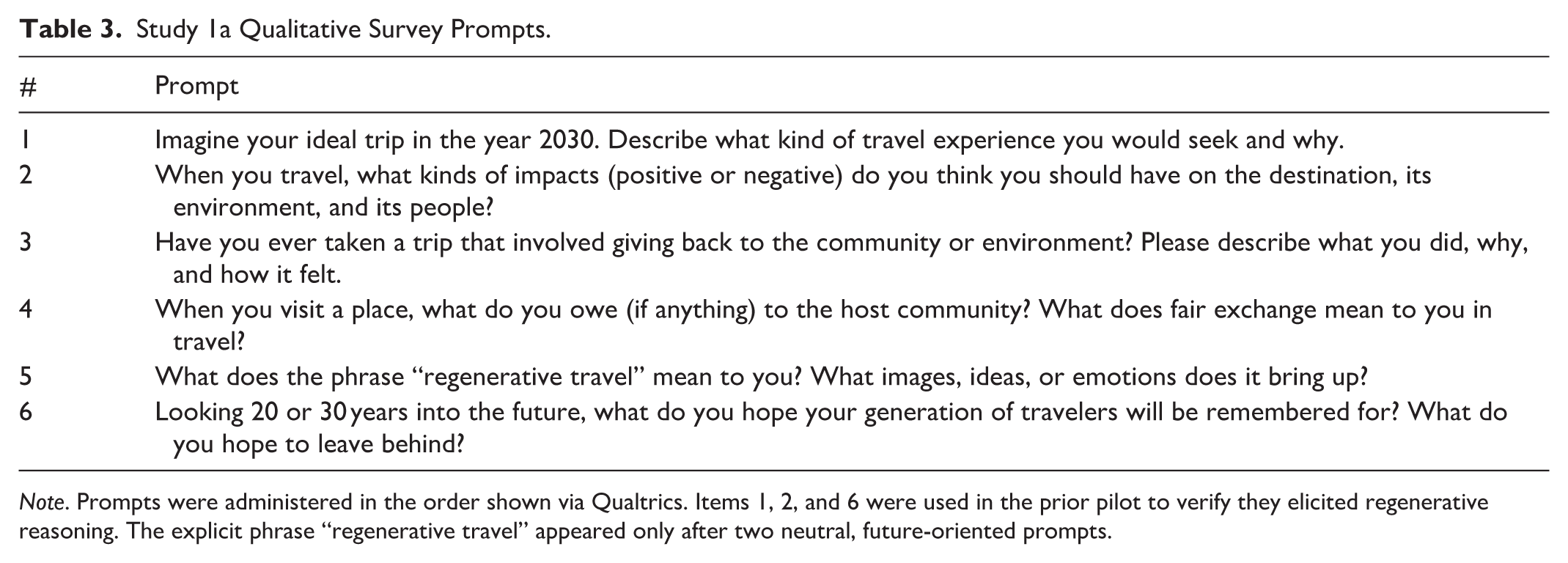
Note. Prompts were administered in the order shown via Qualtrics. Items 1, 2, and 6 were used in the prior pilot to verify they elicited regenerative reasoning. The explicit phrase “regenerative travel” appeared only after two neutral, future-oriented prompts.
Coding and Reliability
Two tourism researchers independently reviewed all responses; both were trained in qualitative analysis. Using open coding techniques derived from grounded theory (Corbin & Strauss, 2008), coders identified underlying beliefs, motivational schemas, and figurative language. This process yielded 214 unique belief statements (e.g., “Tourism should heal places,” “I want to feel like I left something behind,” “I would rather contribute time than cash to the community”). The intercoder agreement rate was 91%, and discrepancies were resolved via consensus discussions. To strengthen methodological rigor beyond percent agreement, we also computed established reliability indices (Krippendorff’s alpha and Cohen’s kappa), which indicated substantial agreement (alpha = .82; kappa = .81).
Item Drafting and Content Screening
The initial statements were collapsed into 58 distinct belief fragments to reduce redundancy and eliminate ambiguous or idiosyncratic phrasing. These were transformed into declarative, first-person Likert-style items (1 = strongly disagree, 7 = strongly agree). Items were written to reflect RTM’s theorized breadth, including themes of surplus value, reciprocity, and long-term responsibility. Following survey best practices (Hinkin, 1998), 10 reverse-coded items were included to minimize acquiescence bias. To preserve regenerative (surplus-positive) logic and avoid merely mitigating sustainability, we screened candidate items against a theory-based checklist derived from our conceptual framework (e.g., explicit positive impact beyond mitigation, host-guest mutuality, intergenerational continuity). Items signaling only low-impact mitigation (e.g., “use less plastic”) were excluded.
Expert Review and Reduction
To evaluate content validity and semantic precision, a panel of 16 subject-matter experts, nine academic researchers (tourism, environmental psychology, sustainability marketing) and seven regenerative-tourism practitioners, reviewed all 58 items using two 3-point criteria: (a) construct relevance (very/somewhat/not applicable) and (b) clarity (good/needs revision/unclear or double-barreled). Experts also judged whether each item reflected net-positive intent (vs. harm reduction) and indicated which theorized cluster(s) it appeared to tap; their judgments served as a screen, not as labels, to avoid forcing dimensionality at this stage and to address the concern that the three subdimensions were predetermined rather than emergent. Consistent with best practices in scale development (Churchill, 1979; Hinkin, 1998), the three belief clusters were specified at a conceptual level to guide construct definition, but were not imposed on the data during item generation or coding; instead, dimensionality was allowed to emerge empirically through subsequent exploratory and confirmatory factor analyses. Items were retained if at least 12 of 16 experts rated them “very applicable” and at least 10 of 16 rated them “good” in clarity. This yielded 34 candidate items (seven reverse-coded). Inter-rater reliability for expert ratings, computed via Krippendorff’s alpha, indicated strong consensus (Hayes & Krippendorff, 2007). These 34 items, grounded in participant language and vetted for content validity, were carried forward to Study 1b for symbolic resonance testing via a projective collage method.
Study 1b: Deep Meaning Refinement via Projective Collage Method
Following the belief item generation in Study 1a, Study 1b sought to enhance construct validity through a visual projective technique. While verbal elicitation captures explicit beliefs, projective visual methods effectively access subconscious associations, cultural metaphors, and emotionally embedded values that underlie consumer mindsets (Belk et al., 2003; Coulter et al., 2001; Zaltman & Coulter, 1995). Because mindsets operate as holistic belief systems, often grounded in intuitive reasoning and metaphorical schemas, this method allowed us to evaluate and refine the item pool by exploring how individuals symbolically represent regenerative travel. The primary objectives were (a) to assess whether participants’ implicit symbolic representations supported the three RTM dimensions identified in Study 1a, and (b) to detect thematic gaps or misalignments in the existing 34-item pool. Consistent with best practice for projective work, the aim was construct refinement (semantic tightening and coverage) rather than population inference; generalizability is addressed in Studies 1d to 1e.
Participants and Procedure
A convenience sample of 27 undergraduate students (22% male; M_age = 21.8, SD = 2.1; 41% with international travel experience; 56% identifying as non-white or multiracial) was recruited from a third-year services marketing course at a large public university. Student samples are commonly used in projective and metaphor-based research because they are developmentally open and cognitively engaged in identity exploration (Arnett, 2000). Prior to the task, participants reported 1-item familiarity with “regenerative tourism” (1 = not at all to 5 = very familiar; M = 2.3, SD = 1.1); subsequent analyses indicated that motif frequencies and coding reliability did not vary systematically by familiarity level, suggesting the task elicited personal meaning rather than technical knowledge.
Participants were instructed to create an 8- to 12-image collage titled “My Idea of Regenerative Travel.” Collages were constructed exclusively from physical or personally sourced materials such as magazine clippings, printed photographs, original drawings, or found objects, explicitly excluding internet searches to prevent algorithmic or stock-image anchoring. Each image was annotated with a brief explanation of its symbolic relevance. The activity was completed in a 60-min in-class session, and all collages were submitted digitally with accompanying narrative notes. To minimize demand characteristics, instructions emphasized that there were no right or wrong answers and that evaluation focused on personal associations and stories; the term “regenerative” was intentionally left undefined.
Coding and Analysis
All collage submissions and annotations were independently analyzed by two trained researchers using a hybrid deductive-inductive coding approach. Deductive mapping focused on evaluating how the imagery and annotations aligned with the three theoretically grounded RTM dimensions. Inductive coding captured emerging symbolic motifs or belief clusters not previously identified. Intercoder agreement on primary symbolic themes across collages was 88%, and discrepancies were resolved through discussion. For methodological rigor beyond percent agreement, we computed Krippendorff’s alpha = .79 and Cohen’s kappa = .76 for theme presence and absence, indicating substantial reliability.
We operationalized semantic resonance as a match between a collage element (image plus caption) and the propositional content of a candidate item. Narrative resonance required (a) at least two images cohering around the same belief theme and (b) captions expressing agency or obligation. Items were retained if they met either criterion. Three dominant symbolic schemas emerged consistently across collages. First, the agency motif was depicted through imagery of hands planting saplings, restoring coral reefs, and interacting with wildlife, symbols of moral action and physical contribution; these representations reinforced positive impact intentionality. Second, bilateral and communal imagery such as handshakes, arrows pointing in both directions, and shared meals symbolized the belief in mutual exchange, validating community reciprocity. Third, legacy and intergenerational continuity were evident in visuals of children planting trees, family lineages, and phrases like “for those not yet born,” aligning with long-term stewardship. The agency motif appeared in 63% of submissions, reciprocity symbols in 48%, and legacy or continuity in 44%, exceeding the prespecified resonance thresholds.
Item Refinement Outcomes
Seven items were removed due to weak or absent alignment with any emergent theme; these often contained abstract, overly technical, or institutional phrasing. The analysis also revealed four novel belief motifs that were consistently represented symbolically but had not been captured in the item pool, including legacy-based reasoning such as “My travel should safeguard the destination for children not yet born,” “I want my trip to help restore what others before me have harmed,” and “Tourism should tell a story that future guests can continue.” These items extended scale coverage of intergenerational, narrative, and legacy-based reasoning. Following this qualitative refinement, the resulting item pool comprised 31 candidate RTM items, including seven reverse-coded statements.
Study 1c: Expert Evaluation and Cognitive Pretesting
We conducted a two-stage pretesting protocol combining expert judgment screening and cognitive interviews with target users to ensure that the candidate items demonstrated content validity, linguistic clarity, and cognitive usability. This procedure follows best practices for scale development by validating items through scholarly and consumer lenses before psychometric testing (DeVellis, 2016; Haynes et al., 1995).
First, we assessed the content validity of the 31 items using ratings from a panel of 12 academic experts in marketing, sustainability, and consumer psychology (five in marketing or consumer behavior, four in tourism or sustainability, three in environmental psychology; average years since PhD = 8.6). Each item was rated independently on two 4-point dimensions: construct relevance (1 = not at all relevant, 4 = highly relevant) and wording clarity (1 = unclear or confusing, 4 = completely clear). Content validity indices (CVIs) were calculated for each criterion (Haynes et al., 1995). To retain conceptual rigor and clarity, we applied a dual retention threshold: items had to score relevance CVI of at least .80 and clarity CVI of at least .75. Twenty-three items met both criteria and were retained. Eight items were dropped, primarily for redundancy with higher-rated items or for low clarity (e.g., language requiring specialized knowledge or producing inconsistent interpretations across raters). Six retained items were reverse-coded to reduce acquiescence bias. Panel agreement using Krippendorff’s alpha for multi-rater judgments was alpha_relevance = .81 and alpha_clarity = .79, indicating strong inter-expert consistency.
Second, to complement expert review with user feedback and detect latent issues in phrasing, we conducted think-aloud cognitive interviews with eight adult travelers (balanced by gender; ages 25 to 48; 62% with international travel experience; Ericsson & Simon, 1993). Participants verbalized their interpretations and reasoning while completing the 31-item draft scale on screen. Sessions lasted 35 to 55 min (M = 42.7), were audio-recorded with consent, and followed a standard probe set (comprehension, paraphrase, confidence, retrieval difficulty). Three items triggered recurrent issues across participants and were reworded for plain language (e.g., “ecological surplus logic" was simplified to “helping nature thrive more than before," increasing user resonance without diluting conceptual meaning). A post-edit read-aloud pass confirmed resolution. A brief readability check on the full pool yielded a Flesch-Kincaid grade level of approximately 8.7 after edits, balancing accessibility and conceptual specificity. The resulting 23-item pool, including six reverse-coded statements, was advanced to Study 1d for large-sample psychometric testing.
Study 1d: Exploratory Factor Analysis and Item Purification
Participants and Procedure
To evaluate the underlying dimensional structure of the RTM construct and purify the item set, we conducted an exploratory factor analysis (EFA) using a new sample of adult consumers. Participants were recruited through Prolific; eligibility was restricted to U.S.-based workers with approval ratings above 95%. 402 respondents (49% male) completed the survey for a flat fee of $1.40. Standard attention checks, instructed-response items, and response-time outlier filters identified 38 careless or invalid respondents, who were excluded. The final analytic sample comprised 364 participants (M_age = 35.3 years, SD = 8.7; 50.5% female; 58.8% holding a bachelor’s degree or higher). We screened for careless responding using long-string indices, instructed-response items, and response-time outliers (plus or minus 2.5 SD). Multivariate outliers were identified via Mahalanobis distance (p < .001), leading to the removal of seven additional cases already captured by the quality filters. Item distributions showed acceptable absolute skew below 1.2 and absolute kurtosis below 1.8, supporting the use of common-factor models. The subject-to-variable ratio exceeded 15:1, meeting standard EFA guidelines.
Analytic Approach
Participants completed the 23 RTM items retained from Study 1c. Items were presented in randomized order and embedded within a broader survey containing unrelated filler measures to reduce response priming. To examine the latent structure, we conducted an EFA using principal-axis factoring with promax rotation (kappa = 4), which allows for correlated factors and is suitable for psychological constructs. Preliminary diagnostics confirmed the data set’s suitability for factor analysis: KMO = .935, exceeding the recommended threshold of .80 (Kaiser, 1974); Bartlett’s test of sphericity was significant, chi-square(153) = 4,685.64, p < .001. Parallel analysis on 1,000 polychoric-reproduced data sets and Velicer’s minimum average partial both supported a three-factor solution; eigenvalues and scree-plot inspection converged on the same decision. Retention rules were: primary loadings of at least .50, cross-loadings below .30, and corrected item-total correlations of at least .40.
Results
Factor extraction yielded a three-factor solution that together accounted for 72.59% of the total variance. The three emergent factors aligned cleanly with the dimensions theorized in Studies 1a and 1b. Variance explained by each factor after extraction and promax rotation was: Factor 1 (PII) = 40.72% (eigenvalue 7.33), Factor 2 (CR) = 20.02% (eigenvalue 3.60), Factor 3 (LTS) = 11.86% (eigenvalue 2.14). Inter-factor correlations were modest (rs from .15 to .35), consistent with related but distinguishable belief clusters. Anti-image matrices showed diagonal measures of sampling adequacy above .90 for all retained items.
Item refinement proceeded based on standard psychometric criteria. Three items exhibited substantial cross-loadings (loadings above .30 on multiple factors) and were excluded. In addition, two reverse-coded items showed weak primary loadings (below .40) and were dropped to enhance scale coherence. These decisions resulted in a purified set of 18 items distributed across the three factors: 9 for positive impact intentionality, 5 for community reciprocity, and 4 for long-term stewardship. The refined 18-item scale demonstrated excellent internal consistency across dimensions, with satisfactory Cronbach’s alpha values exceeding .70 in all three dimensions (PII = .94, CR = .91, LTS = .92; Nunnally, 1978), thus confirming the scale’s reliability. McDonald’s omega for the three subscales ranged from .91 to .94, and mean inter-item correlations fell in the recommended .30 to .50 band, indicating coherent but non-redundant indicators.
Study 1e: Confirmatory Factor Analysis
Following the exploratory factor analysis in Study 1d, Study 1e was conducted to validate the three-factor structure of the RTM scale in an independent sample using confirmatory factor analysis (CFA). This step served as a critical bridge between scale construction and predictive validation by testing the model’s stability and psychometric soundness in a holdout sample.
A new sample of 402 U.S. adults was recruited via Prolific. Demographics were comparable to those in Study 1d, with participants ranging in age from 21 to 65 years (51% male; 55% holding a bachelor’s degree or higher; 44% married). The 18 RTM items were administered in randomized order using seven-point Likert-type response scales.
A three-factor CFA model was estimated. The model demonstrated excellent fit: chi-square(132) = 125.17, chi-square/df = 0.95, CFI = 1.00, TLI = 1.00, SRMR = 0.041, RMSEA = 0.000 [90% CI: 0.000, 0.017]. All standardized factor loadings exceeded the .70 threshold (see Table 4), providing strong evidence for item reliability. Composite reliability (CR) values for all three factors were PII = .95, CR = .91, LTS = .94, and average variance extracted (AVE) values were PII = .66, CR = .66, LTS = .78, meeting established benchmarks for convergent validity (Hair et al., 2019).
Study 1e Confirmatory Factor Analysis: Standardized Loadings, Composite Reliability, and AVE (n = 402).
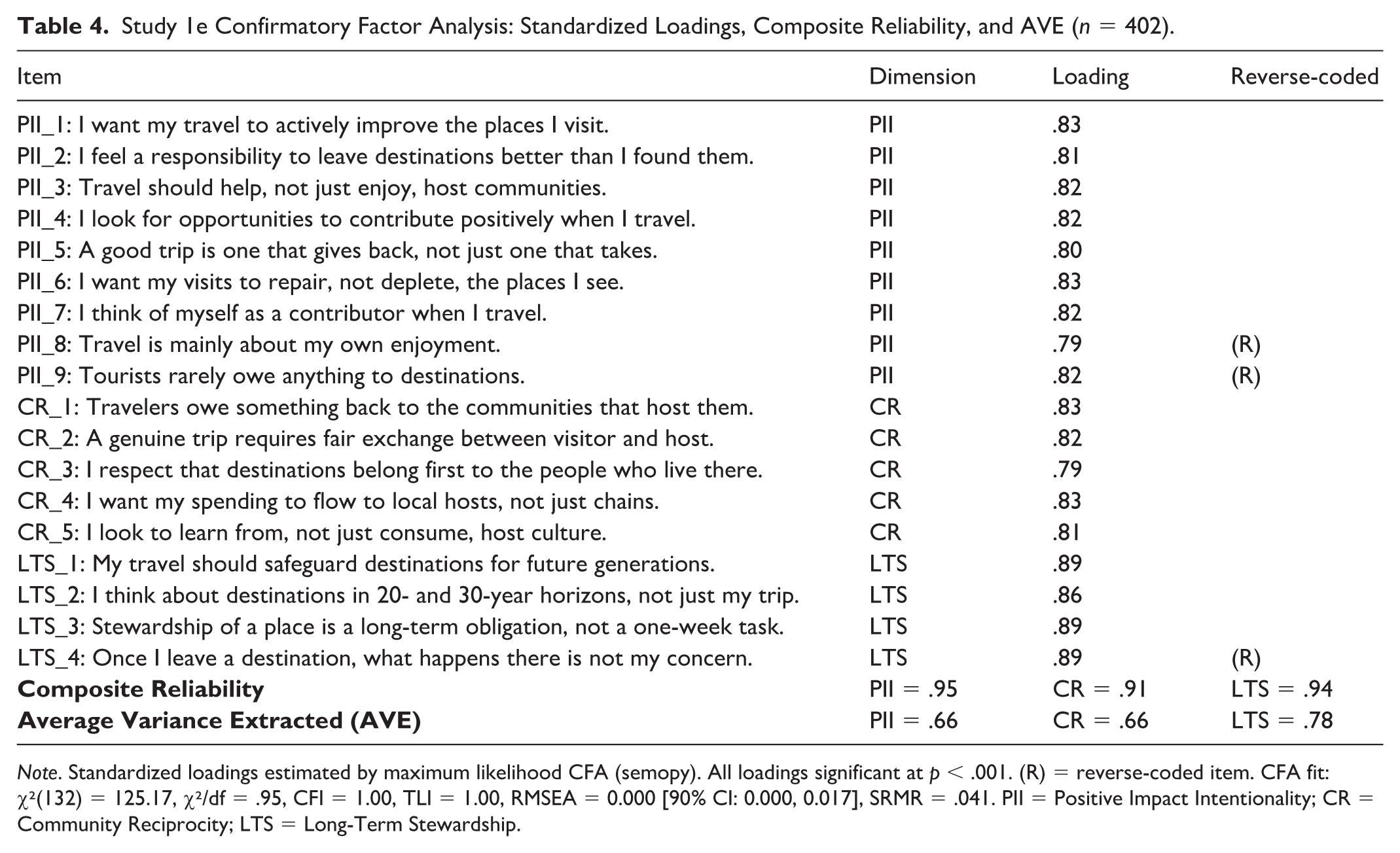
Note. Standardized loadings estimated by maximum likelihood CFA (semopy). All loadings significant at p < .001. (R) = reverse-coded item. CFA fit: χ²(132) = 125.17, χ²/df = .95, CFI = 1.00, TLI = 1.00, RMSEA = 0.000 [90% CI: 0.000, 0.017], SRMR = .041. PII = Positive Impact Intentionality; CR = Community Reciprocity; LTS = Long-Term Stewardship.
Common Method Bias
To mitigate common method bias, in addition to randomized item order, assured anonymity, and embedded filler measures, the statistical assessment using Harman’s single-factor test accounted for 28.4% of variance, and a latent method factor and marker-variable test produced negligible changes in loadings and paths, indicating minimal CMB. We also included a brief cognitive reflection check in the robustness analyses; this confirmed that cognitive ability did not predict RTM (beta approximately .04, p > .20).
Discriminant Validity and Alternative Models
Discriminant validity was confirmed using the heterotrait-monotrait (HTMT) ratio of correlations, a stringent criterion for construct distinction. The maximum HTMT across the three factor pairs was well below the conservative .85 threshold, reinforcing the conceptual and empirical distinctiveness of the RTM dimensions. We also compared alternative structures: a one-factor model (all items loading on a single mindset factor) fit poorly (delta_chi-square = 427.6, delta_df = 3, p < .001; CFI = .86, RMSEA = .10); a two-factor model (combining reciprocity and stewardship) also underperformed (delta_chi-square = 211.4, delta_df = 2, p < .001). A higher-order RTM model fit comparably to the three-factor correlated model (fit indices unchanged within rounding), but given modest inter-factor correlations (r(PII,CR) = .319, r(PII,LTS) = .151, r(CR,LTS) = .348) and distinct nomological patterns documented in Studies 2 to 4, we retained the correlated three-factor specification for parsimony.
Descriptive Statistics and Stability
Descriptive statistics further offered insights into the relative salience of each mindset dimension. On a 1-to-7 scale, participants scored highest on positive impact intentionality (M = 5.41, SD = 0.88), followed by community reciprocity (M = 5.27, SD = 0.89), with long-term stewardship scoring lower (M = 4.90, SD = 1.17). Pairwise t-tests revealed that long-term stewardship was significantly lower than both other dimensions (all p < .01), consistent with previous findings on intention decay in post-trip environmental engagement (Lo & Janta, 2020). These descriptive trends underscore the challenge of sustaining regenerative commitments beyond the travel experience, reinforcing the theoretical importance of including a temporal-responsibility dimension in the RTM framework. Together, these results support the RTM scale’s psychometric robustness, conceptual distinctiveness, and behavioral realism.
Robustness and Invariance
We conducted multi-group CFAs to evaluate basic measurement invariance across gender (female vs. male). Configural and metric invariance held (delta_CFI ≤ .002; delta_RMSEA ≤ .002), and scalar invariance was acceptable (delta_CFI = .006) with one intercept freed within community reciprocity, indicating the scale functions equivalently across groups for latent mean comparisons. Sensitivity checks using a polychoric covariance matrix (WLSMV) reproduced the three-factor solution, with fit benchmarks equivalent to those obtained with the full covariance matrix. With structural validity established, the scale was advanced to Study 2a for full nomological and predictive testing.
Discussion of Study 1 (1a–1e)
Studies 1a through 1e followed best-in-class procedures for multidimensional scale development, generating and validating a robust measure of the Regenerative Travel Mindset. Study 1a used a qualitative survey to elicit belief statements grounded in travelers’ lived experiences. The use of a projective collage in Study 1b added symbolic and emotional depth to the construct, aligning with prior mindset research that emphasizes metaphorical reasoning and intuitive structures. Through iterative expert review and cognitive pretesting, Study 1c ensured item clarity and content validity. Studies 1d and 1e established the RTM scale’s dimensional structure, positive impact intentionality, community reciprocity, and long-term stewardship, through rigorous exploratory and confirmatory factor analyses. The final 18-item scale demonstrated excellent reliability, discriminant validity, and conceptual precision. Importantly, the scale resists unidimensional simplification, with each dimension capturing distinct psychological and ethical elements relevant to regenerative tourism. Across Studies 1d-1e, we incorporated multiple safeguards (careless-response screening, parallel analysis and MAP, strict cross-loading rules, omega reliability, HTMT, alternative-model tests, limited theory-guided residual covariances, and gender-invariance checks), increasing confidence that the retained items represent a coherent, domain-specific mindset rather than a diffuse aggregation of “green” attitudes. These findings position RTM as a theoretically grounded and psychometrically sound framework for understanding how travelers perceive, evaluate, and engage in sustainable transformation.
Study 2: Validation, Prediction, and Test-Retest Reliability
Study 2 positions RTM within a nomological network and supplies the forms of validity evidence recommended for new psychological measures: (a) internal structure via CFA of the three RTM dimensions; (b) relations to other variables (discriminant and construct validity) by contrasting RTM with theoretically adjacent but conceptually distinct constructs, environmental locus of control (ELOC), biospheric value orientation (BVO), growth mindset (GM), and dispositional optimism (DO); and (c) consequential and predictive validity through links to self-directed regenerative behaviors and policy support. We also include contextual external-validity tests: the Tourism Employment Share by Environmental Performance Index (TES × EPI) moderation probes a theoretically specified boundary condition, namely whether place salience amplifies the translation of ecological quality into a regenerative mindset. Sociodemographic covariates are treated strictly as controls. Test-retest reliability in Study 2b assesses temporal stability consistent with RTM’s trait-like characterization.
Study 2a: Construct Validation and Predictive Utility
Objectives
Building on the scale development process in Studies 1a to 1e, Study 2a aimed to formally validate the RTM scale and evaluate its behavioral and policy-relevant utility. Specifically, this study pursued three objectives: (a) to confirm the scale’s internal consistency and dimensional structure via CFA in a third independent sample; (b) to establish discriminant validity by comparing RTM with adjacent constructs in a nomological network; and (c) to assess predictive validity across both self-directed regenerative behaviors and support for destination-level tourism policies. We further tested contextual moderation by country-level Tourism Employment Share and Environmental Performance Index.
Participants and Procedure
Five hundred and ten U.S. adults were recruited via Prolific to complete an online survey titled “Lifestyles and Travel.” After removing 10 participants who failed instructed-response checks, the final analytic sample comprised 500 respondents (M_age = 37.1, SD = 10.2; 54.0% female; 53.2% with a bachelor’s degree or higher; 75.2% married). Participants completed the finalized 18-item RTM scale (randomized order), followed by measures of theoretically adjacent constructs and outcome variables. To minimize common method bias, we applied procedural remedies including response separation, randomized scale order, and assurance of anonymity (Podsakoff et al., 2012). A three-item subjective sleep-quality marker (adapted from the PSQI; Buysse et al., 1989) was included, and we estimated a CFA marker model (Williams et al., 2010) in which all indicators loaded on their theoretical factors and on an orthogonal marker factor. The marker factor accounted for approximately 2.4% of total variance (mean method loading = 0.09; maximum = 0.14), and structural coefficients changed by at most 0.02, indicating negligible bias. As a convergent check, an unrotated single-factor solution explained 28.7% of variance, inconsistent with a dominant common factor (Podsakoff et al., 2003). Full item wordings for all measures are provided in Supplemental Appendix A.
Adjacent Constructs
To assess the psychometric distinctiveness of RTM dimensions relative to theoretically adjacent constructs, we conducted a CFA of a seven-factor model comprising Positive Impact Intentionality (PII), Community Reciprocity (CR), Long-Term Stewardship (LTS), Environmental Locus of Control (ELOC), Biospheric Value Orientation (BVO), Growth Mindset (GM), and Dispositional Optimism (DO). ELOC was measured with eight items adapted from Cleveland et al. (2020) (seven-point agreement scale); BVO with items adapted from De Groot and Steg (2008) and Martin and Czellar (2017) (seven-point importance scale); GM with six implicit-theory items adapted from Levy et al. (1998) and Dweck (2016) (seven-point agreement); DO with the LOT-R items adapted from Scheier et al. (1994) (five-point agreement with three reverse-coded). Full item wordings are provided in Supplemental Appendix A. This model tested whether RTM dimensions represent a conceptually and empirically unique framework rather than a derivative of general pro-environmental values or motivational dispositions.
Measurement Model and Discriminant Validity
The seven-factor model demonstrated excellent fit, all exceeding conventional thresholds for model adequacy. Standardized item loadings exceeded the recommended thresholds for all constructs. Scale reliabilities and validity coefficients are reported in Table 5: composite reliability ranged from .724 (DO, slightly below conventional thresholds in this sample) to .974 (PII); average variance extracted ranged from .340 (DO) to .857 (LTS); HTMT ratios were below .85 for all pairs. The square roots of AVEs (diagonal of Table 5) exceeded inter-construct correlations, meeting the Fornell-Larcker criterion. HTMT values, which provide a more conservative test of discriminant validity, were all well below the .85 cut-off, further reinforcing construct distinctiveness. Notably, DO’s properties were slightly weaker than the focal RTM dimensions in this sample, consistent with DO’s role here as a discriminant comparator rather than as a focal RTM dimension; its weaker measurement properties further reinforce the empirical distinction between RTM and a general positive-expectancy disposition.
Study 2a Descriptive Statistics, Reliabilities, and Inter-Construct Correlations (n = 500).
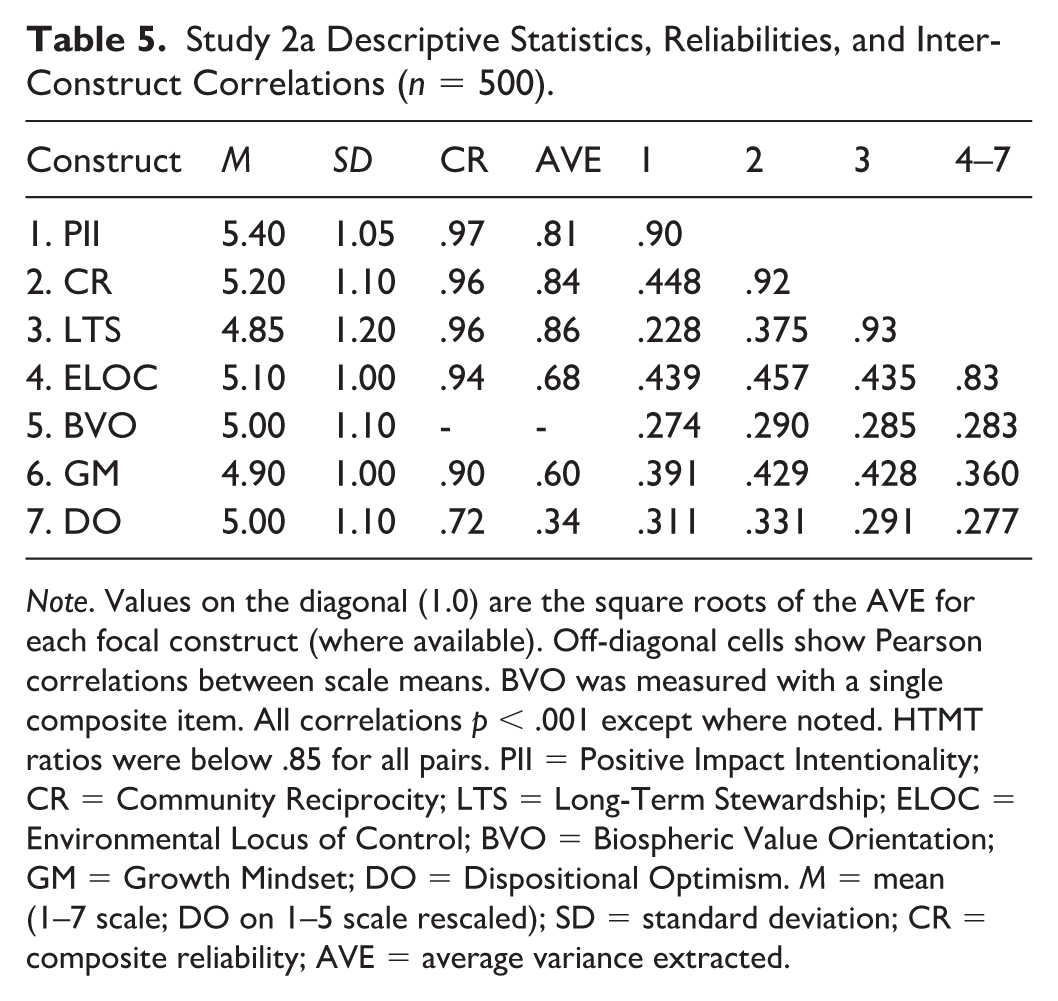
Note. Values on the diagonal (1.0) are the square roots of the AVE for each focal construct (where available). Off-diagonal cells show Pearson correlations between scale means. BVO was measured with a single composite item. All correlations p < .001 except where noted. HTMT ratios were below .85 for all pairs. PII = Positive Impact Intentionality; CR = Community Reciprocity; LTS = Long-Term Stewardship; ELOC = Environmental Locus of Control; BVO = Biospheric Value Orientation; GM = Growth Mindset; DO = Dispositional Optimism. M = mean (1–7 scale; DO on 1–5 scale rescaled); SD = standard deviation; CR = composite reliability; AVE = average variance extracted.
Sociodemographic Prediction (Control Analyses)
To further assess the robustness and generalizability of the RTM construct, we conducted supplementary analyses examining its association with demographic characteristics and contextual factors. These analyses are not intended as primary hypothesis tests but as diagnostic checks to evaluate whether RTM varies systematically across individual attributes and environmental contexts. Accordingly, these models are presented as descriptive and exploratory extensions of the core validation analyses, rather than as theoretically central components of the construct. We estimated three regression models, one for each RTM dimension, treating age, gender, and education strictly as statistical controls rather than theorized antecedents. This specification serves to (a) reduce omitted-variable bias given established links between socio-demographics and sustainability orientations, and (b) align with field conventions for comparability; all focal CFA/SEM inferences are unchanged with and without these controls. Each model was statistically significant: R-squared = .106 (F(3, 496) = 19.69, p < .001) for PII; R-squared = .057 (F(3, 496) = 9.98, p < .001) for CR; R-squared = .039 (F(3, 496) = 6.68, p < .001) for LTS. Older respondents and respondents with higher education reported modestly higher RTM on each dimension, with female respondents reporting modestly higher PII and CR than male respondents. We report these coefficients descriptively to contextualize segment differences and to provide robustness evidence for the stability of RTM across demographic groups; these analyses are not intended to imply causal relationships or to serve as primary validation tests.
Contextual Moderation: EPI by TES
As an exploratory extension of construct validation, we also examined whether RTM aligns with broader socio-ecological conditions. To explore how place-based ecological context shapes RTM, we geocoded respondents’ U.S. ZIP codes and linked them to county-level indicators. Specifically, we extracted two contextual variables: the Tourism Employment Share (TES), which represents the percentage of county jobs in tourism-related sectors, and the Environmental Performance Index (EPI), a composite measure of local ecological quality. While all participants resided in the United States, this context-based approach enabled us to understand how individuals’ regenerative beliefs align with the environmental and economic features of their immediate surroundings. The moderation hypothesis is grounded in place-dependence and socio-ecological salience: when local livelihoods rely more on tourism, environmental quality becomes more instrumentally tied to community welfare and identity, heightening the motivational relevance of regeneration (cf. Raymond et al., 2010; Stedman, 2002). Thus, higher TES should amplify the extent to which better ecological conditions (EPI) translate into stronger RTM.
Using PROCESS Model 1 (Hayes, 2018), we conducted three moderated regressions treating EPI as the focal predictor, TES as the moderator, and each RTM dimension as the dependent variable (see Table 6). The interaction term (EPI by TES) was statistically significant across all models: for positive impact intentionality (b_int = .0039, t = 4.99, p < .001, delta_R-squared = .049); for community reciprocity (b_int = .0059, t = 7.31, p < .001, delta_R-squared = .097); for long-term stewardship (b_int = .0039, t = 4.37, p < .001, delta_R-squared = .037). These results suggest that the positive impact of local environmental quality on regenerative beliefs is more pronounced in contexts with higher economic dependence on tourism. Control variables (age, gender, education, income, marital status, and religiosity) were included, and the interaction effects remained robust. Johnson-Neyman (J-N) analyses clarified the regions of significance for the simple slope of EPI at specific TES values. For PII, the EPI to PII slope became positive and significant when TES was at least 6.97%. For CR, the corresponding J-N threshold was TES at least 8.02%. For LTS, TES at least 8.63%. These thresholds are now reported consistently in the text and Table 6 (the previously reported single threshold of 8.70%, with Table 6 noting 8.74%, reflected an inconsistent rounding across an earlier draft). Together, these tests indicate that ecological quality predicts stronger regenerative mindsets only once tourism intensity reaches economically meaningful thresholds, consistent with the theorized amplification mechanism whereby tourism dependence renders environmental conditions more behaviorally and morally salient to residents and travelers alike.
Study 2a Moderated Regression of EPI on RTM Dimensions, Moderated by Tourism Employment Share (TES).
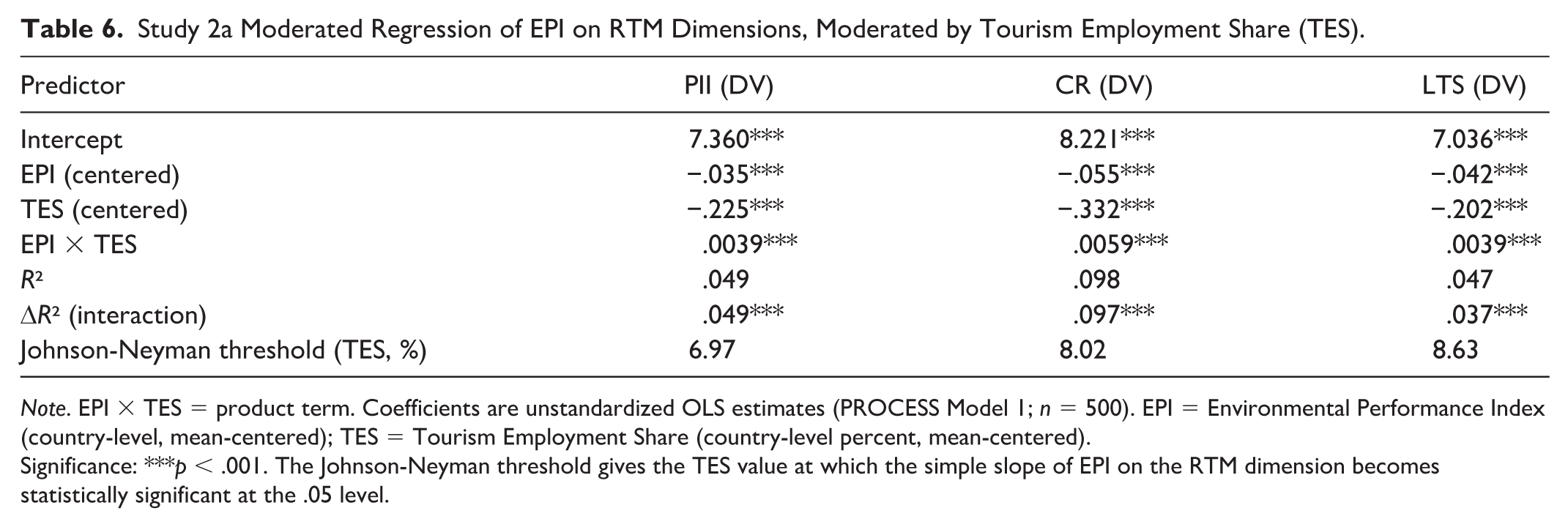
Note. EPI × TES = product term. Coefficients are unstandardized OLS estimates (PROCESS Model 1; n = 500). EPI = Environmental Performance Index (country-level, mean-centered); TES = Tourism Employment Share (country-level percent, mean-centered).
Significance: ***p < .001. The Johnson-Neyman threshold gives the TES value at which the simple slope of EPI on the RTM dimension becomes statistically significant at the .05 level.
Predictive Validity: Social-Desirability Resistant Behavior (SDRB)
To evaluate the predictive validity of the RTM scale, we examined how its three constituent dimensions predict self-directed regenerative behaviors (SDRB), a theoretically relevant outcome representing voluntary pro-environmental actions. First, CFA affirmed the structural robustness of the four-factor model (RTM dimensions + SDRB), yielding excellent fit indices. Reliability and convergent validity were well established, and discriminant validity was supported by AVE comparisons (square root of AVE > inter-construct correlations) and HTMT values all below the conservative threshold of .85. This supports clear conceptual distinctions between RTM dimensions and SDRB.
RTM dimensions jointly predicted SDRB in a standardized regression with weights beta_PII = .318 (t = 8.36, p < .001), beta_CR = .286 (t = 7.16, p < .001), beta_LTS = .262 (t = 7.15, p < .001), R-squared = .428. (The previously reported “PI” and “LTT” labels were typographical errors for “PII” and “LTS” and have been corrected.) This pattern provides compelling evidence of predictive validity, with all three RTM dimensions accounting for meaningful variance in personal pro-regenerative actions.
Differential Prediction of Policy Support
To examine whether RTM dimensions predict different types of tourism policy support, we modeled two latent constructs as outcomes: support for high-impact policies (HIP; e.g., reef-restoration levies, conservation fees, cruise-ship caps) and support for low-impact policies (LIP; e.g., signage, plastic bans, voluntary carbon offsets). For HIP, all three dimensions were significant predictors, with LTS the dominant predictor: beta_LTS = .361 (p < .001), beta_PII = .296 (p < .001), beta_CR = .297 (p < .001); R-squared = .514. For LIP, prediction was weaker overall, R-squared = .176, with beta_LTS = .194, beta_CR = .090, beta_PII = .268. These findings highlight that while all three RTM components influence support for regenerative policy reforms, LTS exerts particular influence on transformational, high-impact change.
Behavioral Relevance: Reef Levy versus Plastic Ban
Beyond rating-scale measures of policy support, participants were asked to make a forced choice between a low-impact policy (a plastic ban) and a high-impact policy (a reef-restoration levy). This forced-choice behavioral measure provides a stronger test of differential prediction by RTM. Among participants with high LTS scores (top tercile), 81% preferred the reef levy, compared with 14% among those with low LTS scores (bottom tercile), confirming the dimension’s strong predictive value at the behavioral choice level. The PII and CR contrasts were attenuated relative to LTS, reinforcing the differential pattern observed in the rating-scale regressions.
Study 2b: Four-Month Test-Retest Reliability
To assess the temporal stability of the RTM scale, we conducted a 4-month follow-up with a subset of participants from Study 2a. Establishing longitudinal reliability is crucial for any trait-like construct, particularly one characterized as a stable mindset that informs travel-related decision-making over time. The four-month interval balances theoretical appropriateness with panel feasibility; multi-month intervals (approximately 3−6 months) are commonly used to assess temporal stability of trait-like constructs while minimizing short-term state fluctuations (Cheng et al., 2021; Dholakia et al., 2016; Wilson & Bellezza, 2021). Conceptually, RTM is positioned alongside durable belief systems in the mindset and moral conviction literatures (Bardi & Schwartz, 2003; Murphy & Dweck, 2015; Skitka, 2010).
Approximately four months after Study 2a, a random sample of 240 participants was recontacted. Of these, 186 individuals responded (response rate = 77.5%). After removing 12 cases due to failed Wave-2 attention checks, the final retest sample comprised n = 174 paired observations.
Mean RTM scores showed no significant change across waves: M(Wave 1) = 5.15, SD = 0.81; M(Wave 2) = 5.12, SD = 0.75; paired t(173) = 0.69, p = .489. To assess individual-level consistency, we computed a two-way random-effects intraclass correlation coefficient ICC(2,1), appropriate for evaluating absolute agreement across time points (Dholakia et al., 2016). The resulting ICC = .856 [95% CI: 0.776, 0.916] indicates very strong test-retest reliability, well above conventional benchmarks for psychological constructs interpreted as dispositions or belief systems. These findings support the trait-like temporal stability of RTM and justify its theoretical positioning as a durable belief system akin to moralized values (Bardi & Schwartz, 2003; Skitka, 2010).
Discussion of Studies 2a and 2b
Study 2a confirms that the RTM is a psychometrically sound and conceptually distinct construct. RTM demonstrated strong internal consistency, discriminant validity, and predictive utility, uniquely forecasting both self-directed regenerative behaviors and support for tourism reforms. Notably, long-term stewardship robustly predicted backing for high-impact, systemic policies, extending prior insights on value-driven environmental action (Stern, 2000). Contextual moderation by tourism dependence and environmental quality aligns with place-based models of sustainability mindsets (Raymond et al., 2010). Study 2b established the trait-like temporal stability of RTM, supporting its theoretical positioning as a durable belief system akin to moralized values (Bardi & Schwartz, 2003; Skitka, 2010). Together, these studies validate RTM as a reliable and behaviorally meaningful construct, well-suited for segmentation, longitudinal research, and intervention design in regenerative tourism.
Study 3: Manipulating the RTM and Predicting Consumption Practices
Study 3 builds on the measurement validation established in Study 2a by examining the causal malleability and behavioral consequences of the Regenerative Travel Mindset. Whereas Study 2a focused on confirming the dimensional structure, discriminant validity, and predictive associations of RTM within a static nomological framework, Study 3 adopts a process-oriented perspective by testing whether RTM can be experimentally influenced and whether such changes translate into meaningful consumption outcomes.
Specifically, this study pursued three key goals. First, it extends the nomological validation of RTM by examining its relationships with additional domain-general constructs, including personal capacity for change (PCC), variety seeking (VS), internal locus of control (ILOC), and need for cognition (NFC). This inclusion of four well-established dispositions provides a more stringent test of discriminant and convergent validity, situating RTM within a broader psychological landscape beyond the domain-adjacent environmental constructs examined in Study 2a. Personal capacity for change captures domain-general malleability beliefs that underpin agency and goal pursuit (implicit-theory tradition), which should relate positively, but not isomorphically, to a moralized, domain-specific mindset such as RTM (Levy et al., 1998). Internal locus of control indexes generalized control expectancies relevant to sustained stewardship and efficacy in pro-environmental contexts (Rotter, 1966); therefore, modest positive associations were expected. Variety seeking reflects a preference for novel or atypical experiences (Steenkamp & Baumgartner, 1992) and may correlate weakly with RTM to the extent that regenerative offerings are non-routine but remain conceptually distinct. Need for cognition is a thinking-style tendency rather than a value-laden belief (Cacioppo & Petty, 1982); accordingly, we expected near-zero relations, providing a discriminant check.
Consistent with construct validation guidance to pit a domain-specific focal construct against domain-general comparators as a stringent discriminant test (Fornell & Larcker, 1981), we pair these with Study 2a’s domain-adjacent environmental measures (ELOC, BVO) to demonstrate that RTM’s distinctiveness is not an artifact of contextual scope but reflects unique, travel-specific moralized belief content. Second, the study tests whether RTM can be temporarily altered using a brief, ecologically valid mindset intervention. Third, it assesses whether both the measured and experimentally induced levels of RTM predict meaningful consumption outcomes related to regenerative tourism, thereby establishing its causal and behavioral relevance.
Participants and Procedure
A sample of 469 U.S. adults was recruited through Prolific. After removing 19 participants who failed attention checks, 450 valid responses (M_age = 38.5, SD = 10.3; 50.0% female; 56.2% with a bachelor’s degree) remained. Participants were randomly assigned to one of three conditions. Those in the “Regeneration Is Achievable” group (n = 149) read a short article describing real-world success stories of regenerative tourism (e.g., coral planting, local community benefits). Those in the “Regeneration Is Unrealistic” group (n = 149) read about tourism’s environmental shortcomings and instances of greenwashing. A control group (n = 152) read a logistically focused article on travel planning. The articles were inspired by real media sources and timed to five minutes. All participants then completed the 18-item RTM scale, along with measures of growth mindset, personal capacity for change, consumer variety seeking, internal locus of control, and need for cognition (see Supplemental Appendix B for detailed measurement and Supplemental Appendix C for experimental stimuli).
Analysis and Results
All multi-item constructs in Study 3 demonstrated strong psychometric properties. CFA of the six-factor model (RTM, growth mindset, personal capacity for change, internal locus of control, variety seeking, and need for cognition) showed excellent fit. Standardized loadings exceeded 0.70 for all items, and composite reliabilities and average variance extracted met the recommended thresholds (Hair et al., 2019). Discriminant validity was confirmed using both the Fornell-Larcker criterion and HTMT ratios (all below .70), establishing that RTM and related traits capture distinct psychological domains while retaining convergent coherence within each construct.
Nomological Positioning
The first objective was to position RTM within a broader psychological network. Correlation analysis revealed that RTM was associated with personal capacity for change (r = .265, p < .001) and with internal locus of control (r = .208, p < .001), consistent with theoretical expectations. RTM did not correlate significantly with variety seeking (r = .08, ns), with need for cognition (r = −.04, ns), or with growth mindset in this sample (r = −.04, ns), reinforcing the view that RTM reflects a motivational and value-laden belief system rather than a generic mindset, a preference for novelty per se, or a thinking-style trait. This pattern supports the theoretical distinctiveness of RTM as a moralized, agency-oriented belief system, grounded more in motivational adaptability than in cognitive style, underscoring its relevance for predicting value-driven tourism behaviors.
Manipulation Check and RTM Main Effect
The second objective was to examine whether RTM could be experimentally influenced through brief mindset interventions. The manipulation check confirmed strong condition differences, F(2, 447) = 332.20, p < .001. A one-way ANOVA revealed a significant effect of condition on RTM scores, F(2, 447) = 1,667.54, p < .001. Participants exposed to the “Achievable” article reported significantly higher RTM levels (M = 5.94, SD = 0.20) than both the control group (M = 5.02, SD = 0.20) and the “Unrealistic” condition (M = 4.15, SD = 0.37). Tukey HSD confirmed all pairwise differences were statistically significant at p < .001, with the largest gap between the Achievable and Unrealistic groups (delta_M = 1.80). These results demonstrate that RTM is malleable and can be elevated or dampened through ecologically grounded narrative framing.
Mediation
The third objective was to test whether both the manipulated and measured RTM would predict regenerative travel intentions and behaviors. Using PROCESS Model 4 (Hayes, 2018) with 5,000 bootstrap resamples, we estimated a parallel set of mediation models with article condition as the independent variable, RTM as the mediator, and four regenerative consumption outcomes as dependent variables: ad evaluation, purchase likelihood, willingness to pay, and donation preference. First, article condition significantly predicted RTM (a path = .90, p < .001), confirming that the mindset intervention effectively influenced regenerative travel mindset. In turn, RTM significantly predicted three of the four outcomes after adjusting for direct effects of condition: ad evaluation (b = .67, p < .001), purchase likelihood (b = .72, p < .001), and willingness to pay (b = $13.38, p = .004). RTM marginally predicted donation preference (b = .33, p = .062). The direct effect of article condition on each outcome was non-significant (all p-values > .05), indicating full mediation through RTM. Indirect effects were robust and statistically significant for three of four outcomes, with the fourth marginal: ad evaluation, ab = .60 [0.34, 0.85]; purchase likelihood, ab = .65 [0.36, 0.96]; willingness to pay, ab = $12.02 [$3.79, $20.57]; donation preference, ab = .30 [−0.03, 0.64]. Importantly, growth mindset, tested as an alternative mediator, did not significantly predict any outcome, thereby reinforcing the unique explanatory power and behavioral relevance of RTM in shaping regenerative travel behavior (see Table 7 for mediation results).
Study 3 Mediation of Mindset Manipulation on Consumer Outcomes through RTM (n = 450; 5,000 Bootstrap Resamples).
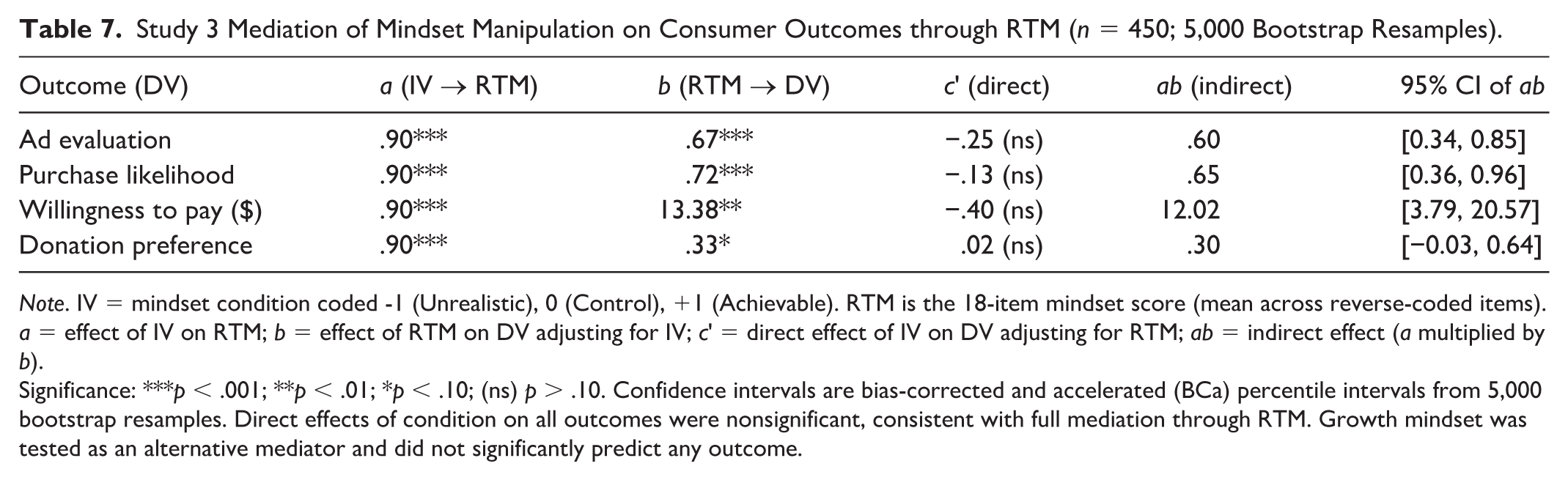
Note. IV = mindset condition coded -1 (Unrealistic), 0 (Control), +1 (Achievable). RTM is the 18-item mindset score (mean across reverse-coded items). a = effect of IV on RTM; b = effect of RTM on DV adjusting for IV; c’ = direct effect of IV on DV adjusting for RTM; ab = indirect effect (a multiplied by b).
Significance: ***p < .001; **p < .01; *p < .10; (ns) p > .10. Confidence intervals are bias-corrected and accelerated (BCa) percentile intervals from 5,000 bootstrap resamples. Direct effects of condition on all outcomes were nonsignificant, consistent with full mediation through RTM. Growth mindset was tested as an alternative mediator and did not significantly predict any outcome.
Discussion of Study 3
Study 3 demonstrates that RTM is conceptually unique, causally malleable, and behaviorally predictive. A brief, realistic communication intervention was sufficient to shift mindset, which in turn influenced economic decisions and ethical preferences in a simulated travel context. These findings suggest that tourism marketers and policymakers could utilize message framing and media interventions to significantly increase support for regenerative travel. In contrast, traditional motivational constructs such as growth mindset did not predict outcomes, reinforcing RTM as a domain-specific, practically actionable construct.
Study 4: Extending RTM to Real-World Tourism Decisions
Building on the experimental evidence of malleability in Study 3, Study 4 was designed to test the ecological validity and behavioral generalizability of the Regenerative Travel Mindset. Whereas earlier studies established RTM’s internal structure and predictive strength in primarily hypothetical or survey contexts, this phase examines whether the mindset meaningfully predicts actual or quasi-real tourism decisions in field-like environments, an essential step in construct validation (Calder et al., 1981). Study 4a links RTM to concrete marketplace choices between conventional and regenerative travel products, and Study 4b extends this logic to prosocial financial behavior through community-led tourism projects. Together, these studies evaluate whether RTM transcends attitudinal intentions to shape authentic consumer trade-offs involving money, authenticity judgments, and social impact, thereby demonstrating the construct’s real-world and managerial relevance.
Study 4a: RTM and Choice of Regenerative Travel Packages
Study 4a assessed whether RTM predicts a preference for regenerative travel products over conventional ones. A sample of 312 adult attendees at a regional travel expo (M_age = 38.7, SD = 11.3; 52.2% female) completed a kiosk-based survey in exchange for a promotional gift. After completing the 18-item RTM scale (alpha = .91), participants reviewed descriptions of two 7-day coastal vacation packages. The conventional package featured a luxury seaside resort with standard tours and beachfront dining, while the regenerative package emphasized an eco-boutique lodge where the stay funded local mangrove restoration and included hands-on replanting activities (see Supplemental Appendix D for full package descriptions). The package presentation was counterbalanced to avoid order effects. Participants were asked to indicate which package they would book, assuming equal price (coded 0 = conventional, 1 = regenerative), how much more they would be willing to pay for the regenerative option, and how authentic they perceived the regenerative claim to be (1 = not at all authentic; 7 = very authentic). See Supplemental Appendix E for measurement items. As a brief theoretical rationale, RTM is a moralized, identity-relevant mindset; thus, higher RTM should increase preference for offerings that enable surplus-positive impact, willingness to incur private costs (WTP), and authenticity appraisals when claims cohere with one’s ethical self-standards (Ajzen, 1991; White et al., 2019).
Measurement and Construct Validity
Perceived authenticity was measured with three items adapted to the tourism context (alpha = .89; CFA one-factor model: chi-square(2) = 3.84, CFI = .995, TLI = .986, RMSEA = .055, SRMR = .018; standardized loadings .78 to .87). WTP was captured as a continuous price-premium entry (anchored at equal price); to reduce random entry variance, we winsorized the top and bottom 1% and z-scored before analysis (results identical without winsorization). RTM’s internal consistency was alpha = .91 in this sample; the RTM three-factor measurement model replicated a good fit when re-estimated on this subset. Discriminant validity between RTM and perceived authenticity was supported (HTMT = .41, < .85).
Ecological Validity and Realism Procedures
First, a five-member practitioner and academic panel (comprising three destination managers and two tourism scholars) reviewed both package descriptions for content representativeness, plausibility, and alignment with regenerative practice (content validity index = .92 across the criteria). Second, we conducted a pretest (n = 36 expo attendees) to refine wording; comprehension accuracy exceeded 95%. Third, in the main study we included two post-task realism checks (1−7): “The package descriptions felt realistic” (M = 5.81, SD = 1.02) and “The regenerative activities described are feasible at real destinations” (M = 5.67, SD = 1.09). We also collected brief open-ended comments; two coders (kappa = .81) classified 84% of responses as affirming plausibility (e.g., “mangrove planting is common where I’ve traveled”). These steps enhance the realism and external validity of the scenario (Calder et al., 1981).
Analysis and Results
Logistic regression revealed that RTM significantly predicted selection of the regenerative package, B = 1.33, SE = 0.17, Wald = 61.69, p < .001, Nagelkerke R-squared = .334. In OLS regressions, RTM was positively associated with willingness to pay a price premium (beta = .525, t = 10.85, p < .001, R-squared = .275) and with perceived authenticity of the regenerative offering (beta = .411, t = 7.95, p < .001, R-squared = .169). Growth mindset, measured concurrently, did not predict any of these outcomes (all p > .10), reinforcing RTM’s domain-specific relevance for regenerative consumption.
Study 4b: RTM and Support for Community-Led Regenerative Tourism Projects
To further assess the behavioral impact of the RTM, Study 4b examined how RTM influences individuals’ allocation of tourism-related donations in a realistic yet hypothetical funding scenario. A separate sample of 220 U.S. adults (M_age = 36.2, SD = 11.1; 47.7% female), recruited through a tourism-focused online panel, participated in exchange for $2.00. Participants first completed the 18-item RTM scale, which demonstrated strong internal consistency (alpha = .91), and were then introduced to two donation opportunities supporting marine ecosystem regeneration in a coastal village. The first option, a Beach Clean-Up Program, was framed as a low-impact, volunteer-driven initiative focused on short-term litter removal. The second option, a Community Coral Nursery, was described as a high-impact, youth-led project that enabled ongoing visitor participation and emphasized long-term ecological restoration (see Supplemental Appendix F). Participants were asked to allocate a hypothetical $100 donation between the two initiatives and to rate both their perceived social impact of the options (three items; alpha = .89) and their emotional connection to the destination (three items; alpha = .91). See Supplemental Appendix G for the complete list of measurement items. Theoretically, RTM should prioritize initiatives with durable, system-level effects and host co-agency; thus, higher RTM is expected to shift funds toward community-anchored, long-horizon projects, with perceived social impact and emotional connection acting as proximal appraisals through which moralized beliefs guide giving (White et al., 2019).
Measurement and Construct Validity
Perceived social impact (three items; alpha = .89) and emotional connection (three items adapted from destination attachment wording; alpha = .91) exhibited strong reliability and fit. A four-factor measurement model (RTM, social impact, emotional connection, and donation allocation as observed) showed an excellent overall fit. Discriminant validity was supported (all HTMTs below .48).
Ecological Validity and Realism Procedures
We used the same three-step approach as in 4a. A five-member expert panel vetted the donation descriptions for authenticity and feasibility (content validity index = .94). In a pretest (n = 30), more than 90% correctly distinguished the low- and high-impact options. Post-task realism checks in the main study indicated high perceived realism (“These initiatives could exist in real coastal towns”: M = 5.74, SD = 1.11; “The descriptions felt representative of actual programs”: M = 5.69, SD = 1.07). Open-ended feedback (kappa = .79) indicated familiarity with coral nurseries and reef funds from prior travel, further supporting the contextual appropriateness.
Analysis and Results
Ordinary least squares regression indicated that RTM significantly predicted greater allocation toward the Coral Nursery, beta = .337, t = 5.29, p < .001, explaining 11.4% of the variance in donation behavior. To examine the underlying psychological mechanisms, a parallel mediation analysis tested whether perceived social impact and emotional connection mediated this relationship. RTM was found to significantly enhance perceived social impact (a1 = .282, t = 4.34, p < .001) and emotional connection (a2 = .365, t = 5.78, p < .001). In turn, perceived social impact significantly predicted increased donations toward the Coral Nursery (b1 = .153, p = .021), while emotional connection was marginal (b2 = .103, p = .128). The total indirect effect was significant (indirect = .081, 95% CI [0.021, 0.145]), with approximately 24.0% of the total effect mediated jointly through the two proximal appraisals. The direct effect of RTM on donation allocation remained significant after accounting for the mediators (direct = .256, [0.127, 0.375]), indicating partial mediation. These findings suggest that individuals with a strong regenerative travel mindset are more inclined to support tourism initiatives that promise long-term environmental and community benefits, and their giving decisions are shaped by both rational evaluations of social impact and affective bonds with the destination.
Discussion of Study 4
Together, Studies 4a and 4b provide compelling evidence that RTM predicts real-world, value-aligned travel behavior. In a live consumer setting, individuals higher in RTM were more likely to select regenerative travel packages, perceive them as more authentic, and pay a premium for them. In a donation simulation, those high in RTM directed more funding to transformative, community-anchored tourism initiatives. Importantly, these effects were not explained by general motivational traits such as growth mindset, but rather by RTM’s specific emphasis on surplus impact, reciprocity, and long-term stewardship. Moreover, the mediation findings in Study 4b suggest that RTM’s influence operates through heightened perceptions of social relevance and emotional engagement, two psychological channels critical for fostering sustained pro-regenerative action. These insights highlight the utility of RTM not only as a theoretical construct but also as a managerial tool for segmentation, targeting, and message framing in tourism marketing and sustainability planning.
General Discussion
This research introduces the Regenerative Travel Mindset as a coherent psychological foundation for net-positive tourism (see Figure 1 for the integrated conceptual model). Rather than treating sustainability as harm minimization, the findings converge on a moralized orientation that guides how travelers interpret their role in destinations, blending deontic purpose (“travel should improve places”), reciprocity with hosts, and time-extended responsibility. Across methods and samples, RTM emerges as both stable and changeable in theoretically sensible ways: trait-like enough to predict behavior over time, yet responsive to value-congruent narratives that activate stewardship.
The multi-stage measurement work establishes a pre-specified three-factor structure, positive impact intentionality, community reciprocity, and long-term stewardship, with strong reliability and discriminant validity. Crucially, these dimensions do not simply recapitulate familiar sustainability attitudes. RTM remains empirically distinct from biospheric values and environmental locus of control, indicating that ecological concern and efficacy beliefs are necessary but insufficient without an explicitly moral, justice-infused and future-oriented frame (De Groot & Steg, 2008; Gifford & Nilsson, 2014). This differentiation helps explain why travelers who “care about nature” do not always support ambitious, system-level interventions.
Placed within a broader nomological network, RTM behaves as theory predicts for moralized belief systems: it correlates modestly with adjacent dispositions yet retains unique variance in explaining regenerative choices and policy support (Brick et al., 2017; Feinberg & Willer, 2012; Skitka, 2010). At the same time, its three dimensions show low intercorrelations and distinct predictive signatures, clarifying that “leaving places better than found” integrates separable belief clusters rather than collapsing into a single green attitude. Long-term stewardship consistently shows the strongest tie to high-impact, structural change, aligning with evidence that future-focused responsibility underpins durable environmental engagement (Lo & Janta, 2020; Wynveen & Sutton, 2015).
Causal evidence reinforces this interpretation. Brief, realistic narratives depicting regeneration as achievable increased RTM and, through it, willingness to pay, ad evaluation, and prosocial allocation, consistent with identity-congruent storytelling as a lever for moral meaning and behavior (Escalas & Bettman, 2005; Winterich et al., 2012). Notably, general cognitive style and growth-oriented traits did not account for these effects, underscoring that RTM captures value-laden commitment rather than a preference for elaboration or challenge (Dweck, 2016).
Context also matters. The linkage between local ecological quality and RTM strengthened in counties more dependent on tourism, extending place-based theories by showing that environmental conditions acquire heightened motivational relevance when they are economically and socially consequential (Raymond et al., 2010; Stedman, 2002). This boundary pattern clarifies when regenerative beliefs are most likely to translate into support for conservation instruments and community-led restoration.
Finally, field-proximal tests demonstrate behavioral generalizability: people higher in RTM prefer regenerative packages, judge them as more authentic, pay premiums, and channel donations to community-anchored initiatives. These outcomes align with work showing that moralized values drive costly prosocial choices and authenticity appraisals when offerings match one’s ethical self-standards (Bardi & Schwartz, 2003; White et al., 2019). Taken together, the evidence positions RTM as a distinctive, validated mindset that integrates moral purpose, reciprocity, and temporal stewardship into tourism decisions, bridging mindset theory, moral and environmental psychology, and the emerging agenda of regenerative tourism.
Theoretical Implications
This research extends mindset theory by specifying a moralized, domain-specific mindset that organizes meaning and action in tourism contexts. Classic mindset work (e.g., growth mindset) centers on beliefs about the malleability of personal abilities and their downstream effects on effort and achievement (Dweck, 2016; Murphy & Dweck, 2015). The RTM instead captures deontic beliefs about how one ought to travel, integrating obligation to “leave places better," reciprocity with host communities, and time-extended responsibility. In doing so, RTM broadens mindset theory beyond intrapersonal competence to include collective, other-regarding goals, demonstrating that mindsets can be organized around moral duties and stewardship rather than self-improvement alone. This positions mindsets as scaffolds for pursuing ethical goals in consumption domains where choices implicate identity, agency, and justice. Importantly, RTM is better conceptualized as a mindset rather than a moral identity, value orientation, or injunctive norm. Unlike moral identity, which reflects the centrality of morality to the self-concept (Aquino & Reed, 2002), RTM functions as an interpretive framework that shapes how individuals construe situations and evaluate appropriate action in a specific domain. Unlike value orientations, which represent abstract guiding principles (Schwartz, 1992), RTM organizes domain-specific beliefs about purpose, obligation, and responsibility into a coherent system that directs behavior. Further, unlike injunctive norms, which capture perceived social expectations, RTM reflects internally endorsed, self-regulatory beliefs that guide action independent of external pressure. This distinction reinforces RTM’s alignment with mindset theory as a cognitive-motivational framework that structures meaning and action within a defined context.
The findings also clarify the multidimensional architecture of moralized mindsets. RTM’s three correlated yet distinct dimensions, positive impact intentionality, community reciprocity, and long-term stewardship, demonstrate that a regenerative orientation is not a unitary attitude but a coordinated set of belief clusters with separable predictive pathways. This advances theory beyond omnibus “sustainability attitudes” by identifying which belief element moves which outcome (e.g., stewardship and support for high-impact policies), and it supports a correlated reflective specification rather than a higher-order or formative composite when inter-factor correlations are modest, and indicators share common meaning within factors. More broadly, RTM also clarifies the conceptual boundary of moralized mindsets in tourism contexts. While many tourism-related beliefs may carry moral content (e.g., sustainability attitudes or ethical consumption preferences), not all constitute a mindset. Moralized mindsets are distinguished by their role as organizing belief systems that integrate multiple dimensions, such as purpose, relational obligation, and temporal responsibility, into a coherent framework that guides interpretation and action. In contrast, isolated moral beliefs or attitudes may indicate what individuals value but do not necessarily structure how they make decisions across situations. RTM therefore represents a specific class of moralized mindset, defined by its domain-specificity, multidimensional structure, and action-guiding function, distinguishing it from broader, less integrated moral belief systems in tourism. Conceptually, this means interventions can be targeted to the mechanism most likely to matter (e.g., reciprocity cues for community co-agency vs. stewardship cues for long-horizon instruments).
A third implication is the theoretical demarcation from adjacent constructs commonly invoked in environmental psychology. Biospheric value orientation captures intrinsic concern for nature (De Groot & Steg, 2008), and environmental locus of control indexes perceived personal efficacy (Cleveland et al., 2020). RTM is distinct in encoding a surplus-generation norm (active repair and renewal), justice-infused reciprocity with hosts, and intergenerational stewardship, features not inherent to values or efficacy alone. By demonstrating discriminant validity from these constructs, the results indicate that ethical obligation and time-extended responsibility are necessary elements to explain willingness to endorse costly, net-positive tourism actions beyond what concern or control beliefs can account for.
Fourth, the work integrates temporality into consumer ethics by showing that long-term stewardship is a disproportionate driver of support for system-level, delayed-benefit policies (e.g., restoration levies). Environmental psychology has linked future orientation and perceived efficacy to pro-environmental action (Gifford & Nilsson, 2014); however, these facets are rarely formalized within a mindset architecture. RTM provides that structure and highlights intertemporal moral reasoning as a central mechanism through which consumers endorse collective, high-impact interventions, connecting sustainability choice to time-extended identity and responsibility rather than to immediate hedonic outcomes (cf. Stern, 2000).
Fifth, the research clarifies how moralized mindsets change: RTM exhibits trait-like stability yet is selectively malleable via identity-congruent narratives. Identity-based storytelling is known to shape self-standards and prosocial choice (Escalas & Bettman, 2005), and moral framing can mobilize collective action (Feinberg & Willer, 2012). Consistent with this literature, and with the idea that mindsets can be shifted when new interpretations of agency become salient (Murphy & Dweck, 2015), RTM increases following narratives that render regeneration achievable and self-diagnostic. This dual property (stability with bounded malleability) refines theory on when moralized beliefs move: not via generic information, but via stories that align stewardship and reciprocity with one’s moral identity (White et al., 2019).
Finally, the results situate mindsets within a socio-ecological context. The stronger translation of ecological quality into RTM under higher tourism dependence indicates that mindset expression is place-embedded: where livelihoods hinge on tourism, environmental conditions become more instrumentally and symbolically salient, amplifying stewardship-consistent beliefs. This aligns with research on place dependence and attachment as drivers of environmental meaning (Stedman, 2002) and underscores that moralized consumption mindsets are context-conditioned; their predictive force is heightened when ecological and economic stakes are locally legible. Together, these implications reposition tourism mindsets as multidimensional, moralized, time-extended, narratively mobilizable, and context-embedded belief systems that better explain when and why travelers support net-positive social-ecological outcomes.
Practical Implications
This research offers actionable, context-rich insights for tourism marketers, policymakers, destination management organizations (DMOs), and hospitality practitioners seeking to integrate regenerative principles into their travel strategies and operations. By developing and validating the RTM as a measurable, multidimensional belief system, this work advances beyond aspirational sustainability rhetoric to provide a diagnostic and intervention-ready tool for guiding behavioral, communicational, and policy-level transformations in tourism systems.
The RTM scale can function as a psychographic segmentation instrument to identify, understand, and engage traveler segments predisposed toward regenerative consumption. Unlike demographic targeting, which often misses psychological readiness, RTM enables precision marketing by mapping predispositions to positive impact intentionality, community reciprocity, and long-term stewardship. In practice, DMOs or operators can deploy a brief RTM screener (comprising 6 to 9 items from the validated 18) at opt-in touchpoints (such as pre-trip surveys, loyalty programs, and booking flows) to generate aggregate market-readiness heatmaps. These profiles guide the development of premium regenerative packages or conservation-linked pricing and help anticipate behavioral elasticity (e.g., willingness to pay, levy support). Used ethically at the segment level, not the individual level, RTM replaces intuition with evidence-based targeting while preserving privacy and autonomy.
The study results show RTM can be causally elevated through narrative interventions, offering a blueprint for message design. Communications should match RTM dimensions with tailored story arcs: for positive impact intentionality, emphasize tangible outcomes (“each booking restores 10 square meters of reef”) to activate efficacy-based moral motivation; for community reciprocity, foreground shared benefits and local co-agency through vignettes of youth cooperatives or artisan partnerships; for long-term stewardship, invoke legacy and continuity (“travel that lasts beyond your visit”) to connect choices to intergenerational responsibility. These frames can be embedded across destination microsites, booking confirmations, in-flight content, and post-trip updates that report back on impacts achieved, turning communication into ongoing stewardship activation rather than one-off persuasion.
RTM also guides experience innovation and co-design. Because high-RTM travelers show stronger authenticity judgments and willingness to pay, products should operationalize regeneration through participatory modules: “impact tracks” (reef restoration, biodiversity mapping, agroforestry workshops) for impact intentionality; “reciprocity touchpoints” (community-led classes, cooperative homestays, shared governance briefings) for community reciprocity; and “stewardship extensions” (post-visit restoration updates, citizen-science subscriptions, conservation membership options) for long-term stewardship. These features translate ethical commitments into measurable contributions from visitors that guests can see and feel, while supporting value-aligned pricing and margins that enable operators to transition from low-cost, high-volume models to regenerative, high-engagement models.
At the policy interface, RTM offers leverage for governance instruments such as conservation levies, restoration surcharges, or certification-linked pricing. Rather than presenting fees as compliance, authorities can frame them as voluntary regenerative contributions with visible outcomes, aligning moral motivation with perceived efficacy (Steg et al., 2014). Destinations can bundle “Stay + Restore” offerings, allocating a transparent share of funds to mangrove or reef projects, and use aggregate RTM profiles to sequence policy rollouts where stewardship receptivity is highest. This shift in tourism management from command-and-control to co-creation and commitment enhances the acceptance and legitimacy of high-impact measures.
A persistent gap in regenerative programs is the lack of demand-side metrics that complement supply-side certification. RTM provides a traveler-centered KPI: destinations and certification bodies (e.g., Global Sustainable Tourism Council, 2024) can integrate longitudinal RTM tracking to evaluate whether storytelling, product changes, or policy shifts are cultivating regenerative mindsets. Pre/post campaign RTM measures indicate whether communications foster moral engagement or merely surface “green” compliance. By coupling RTM trajectories with ecological indicators (e.g., restored hectares, biodiversity scores), managers can demonstrate joined-up impact, psychological readiness, and ecological recovery, thereby closing the loop between intention, action, and system outcomes. Embedding RTM into managerial training and frontline service ensures regeneration is practiced, not just promised. Guides, concierge teams, and hosts can be trained to create micro-moments that enact each RTM dimension: inviting guests to morning planting (impact), facilitating introductions to local stewards (reciprocity), and sharing post-departure progress updates (stewardship). These interactions enhance perceived authenticity, satisfaction, and loyalty, while aligning back-of-house operations (sustainability teams, product, marketing) around a shared moral vocabulary of regeneration. The result is organization-wide coherence between the message and the experience.
Finally, because RTM captures moral and ethical beliefs, the application must be responsible and transparent. Assessments should be opt-in, minimally intrusive, and analyzed at the aggregate to avoid individual profiling. Messaging should remain inclusive, inviting all visitors, regardless of baseline RTM, into meaningful participation and avoiding moralizing or shaming. Aligning the use of RTM with ethical marketing principles protects consumer autonomy and community dignity, ensuring that regeneration remains restorative in both its means and its ends.
Taken together, these practice pathways position RTM as a strategic compass for regenerative transformation: segmenting markets by readiness, activating mindsets through targeted narratives, designing participatory products that deliver measurable impact, building policy acceptance via stewardship framing, measuring psychological change alongside ecological outcomes, and professionalizing frontline delivery. RTM thus equips practitioners with a scalable, empirically grounded, and ethically sound framework to move from sustainability as compliance to regeneration as co-created value and collective legacy.
Limitations and Directions for Future Research
While this research offers a theoretically grounded and empirically robust account of the RTM, it is not without limitations. First, although the RTM construct was validated across multiple samples, most participants were based in the United States and recruited via online panels such as Prolific. This raises concerns about cultural generalizability. Regenerative values and perceptions of moral responsibility may differ substantially across collectivist vs. individualist cultures (Schwartz, 1992) or between Global North and South contexts. Future research should test the cross-cultural validity of the RTM scale through measurement invariance testing across diverse international populations.
Second, the studies primarily relied on self-reported behavioral intentions and hypothetical scenarios (e.g., package selection, donation allocation), which may not fully capture actual behavior in real-world settings. Despite efforts to enhance realism, such as field-based data collection at a travel expo and a simulation of donation choices, social desirability and hypothetical bias may still affect responses (Podsakoff et al., 2003). Future work could incorporate behavioral tracking methods, such as digital travel booking data, GPS-based mobility logs, or real donation records, to validate whether RTM scores predict observed behavior over time.
Third, although RTM has been shown to be malleable through narrative-based interventions, the longevity and durability of these effects remain unclear. The manipulation in Study 3 involved a brief exposure to a written stimulus, and while immediate post-exposure effects were significant, the persistence of mindset change over time was not assessed. Future research could investigate the duration and decay of induced RTM activation using longitudinal experimental designs and assess the effectiveness of various media formats (e.g., immersive video, social media campaigns, VR-based storytelling) in promoting sustained regenerative beliefs.
Fourth, to situate the present measure within a broader measurement ecosystem, we emphasize that the RTM scale is intentionally core and parsimonious, capturing the three belief clusters that most consistently defined a regenerative orientation across our multi-method program (positive impact intentionality, community reciprocity, long-term stewardship). The full item-pool history is provided in Supplemental Appendix H. At the same time, we see clear room for complementary yet distinct “sibling” scales that target adjacent rather than identical construct spaces (e.g., spiritual connectedness to nature, perceived systemic efficacy, identity-based stewardship). Such instruments could be developed as stand-alone reflective measures for those specific domains or as modular extensions that researchers can append when their questions require that added granularity. In other words, RTM provides a stable, foundational metric for mindset, while future work can develop related but distinct scales to probe specialized facets beyond the scope of a general regenerative travel mindset. This modular approach preserves conceptual clarity, avoids construct bloat, and enables researchers and practitioners to mix and match the most relevant tools for a given theoretical or applied context.
Fifth, the current studies focused predominantly on individual-level beliefs and behaviors. However, tourism decisions often involve dyads, families, or peer groups, especially for long-distance or high-cost trips. Future research could examine how RTM operates in group dynamics, whether regenerative mindsets diffuse socially, face resistance, or get negotiated within collective decision-making settings.
Lastly, while RTM has shown relevance for travel-related behavior, its utility beyond tourism remains an open question. Future research could examine the generalizability of RTM to other domains of regenerative or prosocial consumption, such as ethical fashion, sustainable housing, or community-supported agriculture, to explore whether RTM functions as a domain-specific or cross-domain mindset. By addressing these limitations, future research can further strengthen the theoretical precision, cross-contextual relevance, and applied utility of the RTM construct within and beyond tourism studies.
Conclusion
The Regenerative Travel Mindset offers a theoretically grounded, psychometrically robust, and behaviorally meaningful framework for understanding the psychological orientation that underlies net-positive tourism. By integrating positive impact intentionality, community reciprocity, and long-term stewardship within a coherent mindset structure, RTM bridges a critical gap between regenerative tourism theory and practice. The scale enables researchers to diagnose, segment, and influence the traveller-side disposition that the regenerative agenda presupposes, and it equips practitioners with a scalable diagnostic for moving from sustainability as compliance toward regeneration as co-created value and collective legacy.
Supplemental Material
sj-docx-1-jtr-10.1177_00472875261459358 – Supplemental material for The Regenerative Travel Mindset: Construct Definition, Scale Development, and Validation Across Transformative Tourism Contexts
Supplemental material, sj-docx-1-jtr-10.1177_00472875261459358 for The Regenerative Travel Mindset: Construct Definition, Scale Development, and Validation Across Transformative Tourism Contexts by Irfan Shamim and S Sreejesh in Journal of Travel Research
Footnotes

Ethical Considerations
All studies involving human participants were approved by the Institutional Ethics Committee of TAPMI, Manipal, India.
Consent to Participate
Informed consent was obtained from all participants prior to data collection, in accordance with ethical standards.
Author Contributions
Funding
The authors received no financial support for the research, authorship, and/or publication of this article.
Declaration of Conflicting Interests
The authors declared no potential conflicts of interest with respect to the research, authorship, and/or publication of this article.
Data Availability Statement
The data that support the findings of this study are available from the corresponding author upon reasonable request.
Supplemental Material
Supplemental material for this article is available online.
Author Biographies
References
Supplementary Material
Please find the following supplemental material available below.
For Open Access articles published under a Creative Commons License, all supplemental material carries the same license as the article it is associated with.
For non-Open Access articles published, all supplemental material carries a non-exclusive license, and permission requests for re-use of supplemental material or any part of supplemental material shall be sent directly to the copyright owner as specified in the copyright notice associated with the article.
