






Abstract
Last-chance tourism (LCT) involves visiting destinations threatened by environmental change or human activity before they disappear or transform. Although vulnerability-focused media messages can raise awareness of threatened places, they may also increase visitor pressure. Using a pre-test/post-test experiment, this study examined how LCT appeals influence visit intentions for two cultural heritage sites with different awareness levels: Venice (higher awareness) and Hasankeyf (lower awareness). The results show that LCT appeals moved the last-chance motive from the lowest-ranked to the second-ranked priority in both groups, indicating motivational activation. However, this activation translated into higher general visit intention only for the lesser-known destination, while foreseeable visit intention remained unchanged for both destinations. Theoretically, the findings show that destination awareness conditions whether motivational activation converts into behavioral intention. Practically, the results suggest that vulnerability messaging should be used cautiously and, where appropriate, framed as conservation-oriented communication rather than as a simple invitation to visit.
Keywords
Introduction
Several destinations around the world are disappearing or undergoing irreversible transformation due to climate change and human activity. News articles, travel magazines, and online media have repeatedly drawn attention to these vulnerable places by emphasizing that travelers may have only a limited opportunity to see them (Buhasz, 2007; Smith, 2008). Such media presentations of environmental or cultural vulnerability are referred to here as “LCT appeals.” These appeals have become sufficiently common in public discourse to popularize the term last-chance tourism (LCT), which describes travel to disappearing landscapes, natural wonders, and cultural heritage sites before they are permanently altered or lost (Dawson et al., 2011; Lemelin et al., 2010).
Paradoxically, increased media attention to a destination’s fragility may accelerate its degradation. This concern is not merely theoretical but is evidenced by previous research on the impact of LCT travel. LCT destinations typically require long-haul journeys to remote locations, resulting in substantial carbon footprints. Eijgelaar et al. (2010) demonstrated that a single Antarctic cruise generates substantially higher greenhouse gas emissions than average international trips, meaning that visiting LCT destinations may actively contribute to the very environmental degradation threatening their existence (D’Souza et al., 2021).
Despite longstanding concern that media coverage of LCT destinations may increase visitation and intensify site vulnerability (Dawson et al., 2011; Denley et al., 2020; D’Souza et al., 2021; Lemelin et al., 2010; Miller et al., 2020), little is known about the specific mechanisms through which such coverage influences potential visitors. Existing research has focused primarily on famous destinations and on-site visitors who have already decided to travel (Piggott-McKellar & McNamara, 2016; Vila et al., 2016), creating a critical gap in understanding how potential visitors respond to LCT appeals across destinations with different awareness levels.
Previous research consistently identifies the “LCT motive,” the desire to witness vulnerable places before they vanish or transform, as one of the strongest drivers of LCT engagement (Groulx et al., 2016; Lemelin et al., 2010; Salim et al., 2022). However, this motive does not always occupy the highest position in visitors’ motivational hierarchies (Kucukergin & Gürlek, 2020; Salim et al., 2022). This raises an important question: what role does media framing play in activating the LCT motive during the pre-visit consideration stage, before the motivational hierarchy stabilizes into actual travel planning?
While the LCT motive remains central, recent research has identified destination fame as another significant motivational factor. Salim and Ravanel (2020) found that nearly half of their participants at France’s Mer de Glace glacier visited primarily because of its reputation as a must-see attraction, rather than solely because of its environmental vulnerability. This suggests that LCT motivation is shaped by destination awareness. Recognizing a destination is the essential first step in the tourist decision-making process (Chen & Myagmarsuren, 2010; Gartner & Ruzzier, 2010). Awareness may therefore determine whether LCT appeals translate motivational activation into visit intention.
Consequently, this study examines whether LCT appeals influence travel intentions among potential visitors to vulnerable destinations and how destination awareness moderates that influence. The core theoretical contribution is threefold. First, the study conceptualizes motivational activation as the process through which LCT appeals elevate the LCT motive within potential visitors’ motivational hierarchies at the pre-visit consideration stage. Second, it identifies destination awareness as a boundary condition that determines whether this motivational activation translates into behavioral intention. Third, it differentiates general and foreseeable visit intentions, allowing a more precise assessment of where LCT appeals operate within the intention-formation process. By comparing experimental responses to a high-awareness destination (Venice) and a lower-awareness destination (Hasankeyf), this study advances understanding of how media framing, scarcity-based vulnerability appeals, and destination awareness jointly shape pre-visit responses to last-chance tourism. The following sections build the theoretical foundation by reviewing LCT and its motivational dynamics, destination awareness in tourism decision-making, and framing and scarcity appeal perspectives.
Literature Review
Last Chance Tourism
Last-chance tourism (LCT) can be defined as “a niche tourism market where tourists explicitly seek vanishing landscapes or seascapes, and/or disappearing natural and/or social heritage” (Lemelin et al., 2010, p. 478). The scope of LCT extends beyond nature-based destinations to encompass ancient cultural locations and regions inhabited by vulnerable indigenous populations (Dawson et al., 2011). Researchers have further expanded this definition to include destinations affected by anthropogenic causes (Çakar & Seyitoğlu, 2023).
The LCT literature has examined a diverse range of vulnerable destinations. Pioneering studies focused on Arctic regions, particularly Churchill, Canada, where polar bears threatened by climate change can be observed (Groulx et al., 2016; Miller et al., 2020). Research subsequently expanded to other prominent vulnerable locations, including Antarctica, the Great Barrier Reef in Australia, and the Maldives (Eijgelaar et al., 2010; Piggott-McKellar & McNamara, 2016; Vila et al., 2016; H.-C. Wu et al., 2020). Recent studies have investigated glacier tourism destinations, such as the Mer de Glace, Argentiere, and Bossons glaciers in France, which qualify as LCT destinations due to rapid glacier retreats (Salim et al., 2022). Additionally, researchers have begun extending LCT research to heritage sites, further diversifying the types of destinations studied (Hindley & Font, 2015).
Researchers have extensively investigated what motivates tourists to visit these vulnerable destinations. The LCT motive, the desire to witness destinations before they disappear or significantly change, has consistently emerged as a strong motivation among actual visitors across LCT destinations (Eijgelaar et al., 2010; Piggott-McKellar & McNamara, 2016; Salim et al., 2022). However, it is not always visitors’ primary motivation. Natural appreciation, storytelling, or fascination often rank higher than the LCT motive (Groulx et al., 2016; Kucukergin & Gürlek, 2020; Salim & Ravanel, 2020). Recent research on LCT visitor narratives similarly shows that even committed LCT visitors often frame their experiences through experiential lenses rather than foregrounding the disappearance narrative (Abrahams et al., 2021). Although the top-ranked motive varies across destinations and visitor profiles, the LCT motive often occupies a secondary position. The process by which LCT appeals shift this motive upward is referred to in this study as motivational activation.
Beyond motivations, researchers have explored the psychological and attitudinal factors that predispose individuals toward LCT participation. Environmental values and consciousness have been identified as significant antecedents of LCT participation. Groulx et al. (2016) demonstrated that climate change concerns predict LCT engagement, with place identity and nature-relatedness playing partial roles in LCT motivation. Building on this, Kucukergin and Gürlek (2020) proposed environmental consciousness as an antecedent of LCT engagement. More comprehensively, Denley et al. (2020) found that constructs from the Value-Belief-Norm model of environmental psychology can predict engagement in LCT among prospective visitors. Woosnam et al. (2021) further expanded this theoretical framework by incorporating the Theory of Planned Behavior.
Researchers have also raised concerns, particularly regarding the media’s role in promoting vulnerable destinations. Lemelin et al. (2010) first recognized the paradoxical tendency among LCT visitors, noting that promoting LCT could accelerate the destruction of the very destinations being visited. Dawson et al. (2011) similarly questioned the ethics of exploiting vulnerable features of LCT destinations for tourism purposes. Denley et al. (2020) emphasized the importance of responsible LCT marketing. Despite these well-articulated concerns, the specific mechanisms by which LCT appeals influence potential visitors’ travel intentions, and whether motivational activation is the key process driving this effect, remain largely unexplored.
Destination Awareness in LCT Contexts
Recent research by Salim and Ravanel (2020) at the Mer de Glace glacier in France revealed that approximately half of the visitors were primarily attracted by the site’s status as a renowned attraction rather than solely its environmental vulnerability. This finding indicates that destination awareness significantly shapes LCT motivation patterns, with media coverage potentially playing a substantial role in establishing travel intentions. However, previous LCT studies have predominantly focused on well-known travel destinations with high awareness levels, representing a significant gap in the literature.
Destination awareness can be described as “having heard of or recognizing the name of a destination” (Milman & Pizam, 1995, p. 23) or as “the destination that first comes to mind when considering potential destinations” (Pike, 2002, p. 9). Tourism researchers have established that destination awareness is a critical precursor to destination decision-making (Chen & Myagmarsuren, 2010; Gartner & Ruzzier, 2010), as tourists cannot select destinations they are unaware of (Milman & Pizam, 1995). This awareness influences travel behavior through multiple pathways. It positively affects travel intentions by shaping visitors’ perceptions of destinations (Horng et al., 2012), and contributes to destination brand loyalty (H.-K. Kim & Lee, 2018). The relationship between awareness and decision-making is further explained by halo effects from social psychology (Nicolau et al., 2020; Nisbett & Wilson, 1977), where high awareness leads tourists to evaluate destination quality more favorably (Dedeoğlu et al., 2019).
Despite its established importance in tourist decision-making, destination awareness has received limited attention in LCT research. This gap is significant because media coverage both informs potential visitors about vulnerability and interacts with existing awareness levels. Famous destinations may leverage established awareness to amplify vulnerability messaging, potentially accelerating visitation to already threatened sites. Conversely, lesser-known destinations face a dilemma. They might benefit from highlighting LCT features as a distinctive positioning strategy or struggle to generate sufficient interest despite similar environmental threats.
Understanding why destination awareness moderates the effect of LCT appeals requires examining how these messages operate as persuasive communication. Framing effects and scarcity appeal research together explain the cognitive and motivational pathways through which LCT appeals activate the LCT motive, and why destination awareness conditions whether this activation produces intention change.
Framing Effects and Scarcity Appeals in LCT Contexts
Framing represents a fundamental concept in communication research that offers insights into how messages are constructed and interpreted. Frames serve as essential tools for both presenting and understanding information, operating at two distinct levels: media frames and individual frames (Scheufele, 1999). Media frames organize and present information to shape public understanding, while individual frames function as cognitive schemas that help people interpret information they encounter.
The framing process unfolds through interconnected phases that are particularly relevant to tourism communication (Scheufele, 1999; Scheufele & Iyengar, 2014). Frame building refers to the stage at which tourism marketers, destination management organizations, and media outlets construct frames about destinations. This is followed by frame setting, in which media frames influence potential visitors’ perceptions by emphasizing specific destination attributes or considerations. Importantly, media frames set by senders can become individual frames among prospective travelers, shaping how they perceive destinations and evaluate travel options. The individual-level effects of framing represent the third phase, exploring how these adopted frames influence tourists’ attitudes, travel intentions, and decision-making processes.
Originally rooted in sociology through Goffman’s (1974) work, the concept of framing has evolved across multiple disciplines. Research examining how media framing shapes travel motivations and visit intentions is growing, though still limited in scope. For instance, Xie et al. (2022) conducted an experimental study showing that risk message framing directly affected travel intention via perceived safety and travel fear. S. Li et al. (2021) showed that message framing significantly affects tourists’ willingness to pay for pro-poor tourism products. These studies demonstrate framing’s power to shape how tourists perceive destinations and make travel decisions, though most evidence concentrates on crisis-related or sustainability-related framing.
While framing theory explains how LCT appeals may reorganize cognitive priorities, scarcity appeal research explains why these frames carry motivational force. Scarcity appeals are persuasive messages that emphasize limited availability, either in quantity or time (Gupta & Gentry, 2019). In marketing contexts, such appeals can increase perceived value and create urgency to act (Eisend, 2008; Gupta & Gentry, 2019; S. Kim et al., 2020). However, their effectiveness varies across individual and contextual conditions (Gupta & Gentry, 2019; H. Huang et al., 2020; Mukherjee & Lee, 2016). A scarcity message is therefore not persuasive simply because it signals loss; its effect depends on how the recipient interprets the object’s value, feasibility, and relevance.
Applied to LCT contexts, framing effects explain how vulnerability-focused media messages become individual-level interpretive frames that reorder potential visitors’ motivational priorities. In this study, this reordering is conceptualized as motivational activation: the upward movement of the LCT motive within the visitor’s motivational hierarchy. Scarcity appeal research complements this account by explaining why messages emphasizing limited time, disappearance, or irreversible loss can create urgency and increase perceived value. The behavioral consequences of this activation, however, are unlikely to be uniform across destinations. Destination awareness shapes prior knowledge, perceived value, novelty, and baseline intention, thereby conditioning whether motivational activation translates into intention change. Together, framing theory and scarcity appeal research provide the basis for expecting LCT appeals to activate the LCT motive, while destination awareness determines the extent and direction of their effect on visit intentions.
Operationalization and Hypotheses
This study examines how LCT appeals affect travel intentions differently between famous and lesser-known destinations. Intention to visit, frequently used in tourism research as an indicator of visitation likelihood (M. J. Khan et al., 2018), serves as our primary outcome. Following established definitions, intention to visit represents the likelihood of individuals visiting a certain destination (Ajzen, 1991; Fishbein & Ajzen, 1975).
Intention-focused research offers several practical advantages in this context. Examining intentions among potential visitors before travel commitment offers one practical avenue for studying pre-trip persuasion effects in controlled settings (G. Wu & Ding, 2023). Additionally, intention measures are widely used as proxies for behavior in tourism contexts (Woosnam et al., 2021). Measuring actual visitation behavior would also have presented significant practical difficulties, given our international destination focus and the closure of one case destination. We acknowledge, however, that stated intentions do not guarantee actual travel behavior (N. Khan et al., 2024; McKercher & Tse, 2012; Viglia et al., 2024), a limitation we address more fully in the limitations section.
To refine the predictive meaning of our intention measures, we distinguish between two dimensions of visitation intention. General intention to visit refers to a person’s broad interest or desire to visit a destination without a specific timeframe, capturing aspirational travel interest and overall motivation. Foreseeable intention to visit incorporates temporal parameters (e.g., “in the near future”) and represents a more concrete, time-bound intention, capturing actual travel planning rather than aspirational interest. By measuring both dimensions, we aim to contribute to the refinement of the intention construct rather than to resolve the intention-behavior gap per se, a distinction we address more fully in the theoretical implications.
Although this study focuses on visit intention as its primary outcome, it is important to distinguish this construct from travel craving. Travel intention is a forward-looking cognitive-volitional state that implies at least some perceived capacity to act (Ajzen, 1991). Travel craving, by contrast, refers to a cognitive-emotional desire to travel under conditions in which travel is constrained or impossible (Mitev & Irimiás, 2021). COVID-era tourism research shows that travel desire or craving can persist even when actual travel is not feasible and that it can diverge from intention when structural constraints block action (Fedeli et al., 2022). This distinction is relevant because Hasankeyf has been inaccessible since 2019. We therefore clarify in Section “Selection of Destinations” why participants’ responses are interpreted as experimentally elicited visit intentions under the information conditions provided, while acknowledging in Section“Limitations and Future Research” that independent awareness of the closure could have produced responses closer to travel craving.
LCT appeals can be defined as media presentations that emphasize a destination’s imminent disappearance or significant alteration due to climate change or human activities. From a framing theory perspective (Scheufele, 1999), LCT appeals function as media frames that direct attention toward a destination’s vulnerability, reorganizing how potential visitors prioritize their travel motives. From a scarcity appeal perspective, LCT appeals signal that a destination may soon become unavailable, a form of time-based scarcity that can elevate perceived value and generate urgency to visit (Eisend, 2008; Gupta & Gentry, 2019; S. Kim et al., 2020). Among actual LCT visitors, the desire to witness a threatened destination before it changes has consistently emerged as a significant travel motive across diverse destination contexts (Eijgelaar et al., 2010; Piggott-McKellar & McNamara, 2016; Salim et al., 2022). Taken together, we propose that LCT appeals can activate the LCT motive among potential visitors at the pre-visit consideration stage, increasing their intention to visit. Therefore, the following hypotheses are developed:
Motivational activation, the upward shift of the LCT motive in visitors’ priority rankings, serves as the proposed mechanism through which LCT appeals may produce intention effects. However, the conversion of motivational activation into intention change is likely to vary by destination awareness level. Destination awareness is operationalized as “having heard of or recognizing the name of a destination” (Milman & Pizam, 1995, p. 23).
Destination awareness can strengthen this conversion when prior recognition supplies richer associations and perceived value for the scarcity frame to build on. From a halo-effect perspective, greater awareness can lead tourists to evaluate destination quality more favorably overall (Dedeoğlu et al., 2019; Nicolau et al., 2020), potentially amplifying responses to vulnerability messaging.
However, destination awareness can also dampen change. Highly familiar destinations may already have stable baseline intentions, leaving limited room for LCT appeals to increase general interest. Lower-awareness destinations, by contrast, may receive a larger informational and motivational gain because the appeal simultaneously introduces the destination and frames it as vulnerable. Because these logics point in different directions, and because little empirical research has tested this interaction in LCT contexts, we specify a non-directional moderation hypothesis:
Beyond its interaction with LCT appeals, destination awareness is expected to exert an independent main effect on visit intention. Awareness is a necessary precursor to destination choice, as tourists cannot intend to visit places they have not heard of (Milman & Pizam, 1995). High awareness activates favorable destination associations through the halo effect: an established positive reputation leads potential visitors to evaluate destination quality more favorably even without direct experience (Dedeoğlu et al., 2019; Nicolau et al., 2020; Nisbett & Wilson, 1977). This elevated evaluation subsequently increases willingness to visit (Horng et al., 2012; H.-K. Kim & Lee, 2018). Thus:
Additionally, environmental consciousness has been consistently identified as a significant predictor of LCT engagement across multiple studies. To examine the specific effects of LCT appeals and destination awareness, environmental consciousness is controlled in our experimental design using the New Ecological Paradigm scale (Dunlap et al., 2000). Demographic variables, including gender, education, age, and income, are also controlled to account for confounding effects.
Another potential confounding factor relates to country effects. Country image refers to the overall emotional evaluation and feelings an individual holds toward a country as a whole (Reitsamer et al., 2016). Country familiarity is operationalized as the extent to which an individual perceives themselves as knowledgeable about or experienced with a country as a whole, regardless of depth or accuracy (Baloglu, 2001; Liu et al., 2018). By including these variables as covariates, we aim to examine the effects of destination awareness and LCT appeals independently of broader country-level influences.
Methods
Selection of Destinations
Because this study examines the effect of LCT appeals on travel intentions, the experimental destinations needed to be vulnerable to disappearance or irreversible transformation. Venice, Italy, was selected as a high-awareness case because it has been repeatedly described as threatened by rising sea levels and the fragility of its lagoon foundation (Hindley & Font, 2015). Hasankeyf, Turkey, was selected as a lower-awareness case because the ancient settlement was submerged as part of the Ilisu Dam project despite its 12,000-year historical significance (Çakar & Seyitoğlu, 2023).
This study also examined the effect of LCT appeals at two different levels of destination awareness, requiring one destination with high awareness and another with comparatively low awareness. According to Euromonitor International (2019), Venice was ranked 46th among the top 100 cities by international visitors, while Hasankeyf was not ranked within the top 100 cities. In addition, Venice has thousands of reviews on TripAdvisor, while Hasankeyf has only 87 reviews. These objective indicators strongly suggest that Venice enjoys substantially higher global awareness than Hasankeyf.
Additionally, Venice and Hasankeyf are situated approximately 2,500 km apart, spanning different regions of the Mediterranean basin. This substantial separation prevents potential spillover effects in travel planning and ensures cultural and contextual separation, strengthening our ability to examine the effects of destination awareness and LCT appeals.
Finally, both destinations also share significant cultural heritage value. Venice has been listed as a UNESCO World Heritage Site since 1987 (UNESCO World Heritage Convention, n.d.), while Hasankeyf meets 9 of 10 selection criteria for a UNESCO World Heritage Site (Bouscaren, 2020). Both destinations feature distinctive architectural heritage, historical significance, and water-related landscapes as central to their identity.
Hasankeyf stopped accepting visitors on October 8, 2019, due to the dam project. This circumstance raises an important conceptual issue: participants may have expressed visit intention toward the destination presented in the experiment, or, if they independently knew of its closure, something closer to travel craving. We interpret the responses primarily as experimentally elicited visit intentions for three reasons. First, participants were not informed of Hasankeyf’s closure. Because the site-specific constraint was not made salient, the task did not ask participants to evaluate a destination they knew they could not visit. Second, the sample was restricted to participants who planned to travel internationally within the next 12 months, reducing the likelihood that responses reflected general travel deprivation rather than prospective travel evaluation. Third, Hasankeyf was the only destination that satisfied the comparative criteria required for the design: cultural heritage attributes comparable to Venice, substantially lower awareness, and similar geographic distance from the U.S. sample. These considerations support the use of Hasankeyf as a valid experimental case while also motivating the limitation discussed in Section “Limitations and Future Research.”
Pilot Tests
Prior to the main experiment, we developed carefully matched stimuli for Venice and Hasankeyf. We created factual descriptions highlighting each city’s characteristics as a travel destination, constructed with similar length, structure, and information density. We also developed an explanatory text defining LCT and destination-specific LCT appeals, describing each city’s vulnerable and disappearing features in comparable detail.
We conducted pilot tests to ensure the appropriate development of stimuli and the relevance of the selected destinations for our research objectives. Participants were recruited through Amazon Mechanical Turk (MTurk). Recognizing that non-U.S. individuals could access the survey via VPNs, we asked participants to report their nationality, explicitly stating that this would not affect payment or qualification.
The first pilot test evaluated message clarity and legibility. Results showed high comprehension across all materials: LCT concept (ease: M = 5.90, SD = 1.30; clarity: M = 6.10, SD = 1.18), Venice description (ease: M = 6.20, SD = 0.89; clarity: M = 6.10, SD = 1.11), Hasankeyf description (ease: M = 6.00, SD = 1.28; clarity: M = 6.00, SD = 1.42), Venice LCT appeal (ease: M = 5.90, SD = 1.18; clarity: M = 5.90, SD = 1.04), and Hasankeyf LCT appeal (ease: M = 5.90, SD = 1.35; clarity: M = 6.10, SD = 1.11). All means ≥5.90 on 7-point scales confirmed that participants easily comprehended all materials.
The second pilot test identified the most suitable photographs for each destination. Participants read each description for at least 7 s, then selected one image from four city description options and five LCT appeal options that best matched each description. The two most frequently chosen images for each destination were used in the main survey.
The final pilot tests verified destination suitability. Participants rated awareness levels for Venice (M = 6.26, SD = 0.78) and Hasankeyf (M = 4.59, SD = 1.28), confirming a significant awareness differential (t = 11.40, p < .001). After viewing descriptions and the LCT explanation, participants assessed their LCT understanding and whether both destinations qualified as LCT destinations. Chi-square tests showed no significant difference in LCT classification between destinations (χ² = 0.21, p = .65), indicating that both were equally recognized as LCT destinations. Participants also evaluated destination attribute comparability. Results confirmed similar attribute profiles despite awareness differences (t = 1.33, p = .19), validating their experimental suitability. Detailed pilot test results and final stimuli are provided in Supplemental Appendices A and B.
Samples
The U.S. population was selected as the focus of this research for several reasons. First, the United States is geographically distant from both Venice and Hasankeyf, with similar long-haul travel distances required to reach either destination, ensuring that travel effort and accessibility would not confound participants’ responses. Second, U.S. travelers represent significant international arrival markets for both Italy and Turkey (Istituto Nazionale di Statistica, 2019; Republic of Turkey Ministry of Culture and Tourism, 2019). For these reasons, U.S. residents were recruited via the online research panel platform Pollfish, which provides access to a diverse national sample.
We employed several quality control measures. A stratified national panel was utilized to ensure demographic representativeness, and all previous pilot test participants were explicitly excluded to prevent contamination effects (Paolacci & Boegershausen, 2015). The sample was restricted to adults over 18 years of age, as individuals under this threshold are generally not considered to have sufficient discretionary income for international travel decisions (Woosnam et al., 2021). Multiple attention check questions were embedded throughout the survey, and respondents who failed these measures were excluded from the final dataset.
We implemented screening questions to ensure participant eligibility aligned with our research objectives. Individuals who had previously visited either Venice or Hasankeyf were excluded, as their firsthand experience would introduce confounding variables. We also excluded participants who showed no interest in visiting these destinations for holiday vacations, retaining only those who expressed at least moderate interest, because individuals with zero interest would be unlikely to engage with media coverage of these destinations in real-world settings. After data collection, we applied additional post-hoc exclusion criteria, removing respondents who demonstrated inadequate comprehension of the LCT concept or who failed to recognize the selected destinations as legitimate LCT destinations. This comprehensive screening approach ensured our final sample consisted of qualified potential visitors.
Study Procedure
To examine the specific mechanism through which LCT appeals influence visit intentions, this study used a vignette-based online experiment with a mixed factorial design. Given our use of real-world destinations, we could not strictly control pre-existing awareness levels. Consequently, we adopted a within-subjects pre-test/post-test design, which is well suited for measuring within-person attitudinal shifts immediately following exposure to informational vignettes (Kazdin, 2017).
This approach was selected deliberately over naturalistic methods such as content analysis of real media posts. Content analysis of user-generated posts or visitor comments would necessarily capture individuals who have already decided to visit or have experienced LCT destinations firsthand. This introduces a selection bias that is misaligned with our study objective: understanding how LCT appeals shape travel intentions among potential visitors who have not yet committed to travel. The pre-visit consideration stage is precisely where LCT appeals operate, and studying post-visit or post-commitment responses would address a different phenomenon.
Our review of LCT media coverage suggests that such coverage can be broadly categorized into two types: articles that present destination information alongside LCT appeals, and articles that additionally incorporate ethical or environmental considerations of visiting a threatened destination. Although naturalistic analysis of these coverage types would capture authentic communicative environments and real-world framing variation, it would not isolate the specific effect of LCT appeals because media exposure in natural settings is confounded with self-selection, prior destination knowledge, and ambient media consumption. Our experimental stimuli followed the first coverage type, presenting destination information and LCT framing without ethical commentary, allowing us to examine the persuasive effect of LCT appeals in their most direct form.
After screening for eligibility based on our predetermined criteria, 200 qualified participants were randomly assigned to one of two experimental groups (Venice or Hasankeyf). The experimental procedure consisted of five sequential phases. First, participants were presented with factual information about their assigned destination, carefully constructed to provide equivalent content about each destination’s tourism characteristics, history, and cultural significance. Immediately after reviewing this information, participants rated their initial general intention to visit (without temporal constraints) and foreseeable intention to visit (with specific temporal parameters). General intention to visit was measured using a three-item scale (Cruz-Milán, 2022), while foreseeable intention to visit was evaluated using a three-item scale adapted from Woosnam et al. (2021). Both scales used 7-point Likert responses (1 = strongly disagree, 7 = strongly agree).
Participants also ranked four destination visit motives according to their personal priority before exposure to LCT appeals (1 = highest priority, 4 = lowest priority). The four motives, cultural exploration, LCT, escape, and storytelling, were selected based on motivations frequently identified in previous LCT and destination choice literature (Kucukergin & Gürlek, 2020; Lemieux et al., 2017; Salim & Ravanel, 2020). This motive ranking captured the baseline motivational hierarchy prior to LCT appeals.
Participants then completed scales assessing potential confounding variables. Country image was assessed using a five-item scale adapted from Boo et al. (2009) and Chi et al. (2020). Country familiarity was measured using a six-item scale adapted from Chi et al. (2020) and Gursoy and McCleary (2004). The environmental worldview was evaluated using a seven-item scale derived from the New Ecological Paradigm (Dunlap et al., 2000). Participants’ pre-existing destination awareness level of the assigned city was assessed using a five-item scale (Chi et al., 2020; Gursoy & McCleary, 2004; Horng et al., 2012) to verify our manipulation. All measures used 7-point Likert scales.
Subsequently, participants were introduced to the concept of LCT through an explanatory text defining the phenomenon and completed a comprehension check. Following this, participants were shown the LCT appeals, which specifically highlighted the vulnerable and disappearing features of the assigned destination. Finally, participants again rated their general and foreseeable intentions to visit the destination using identical measures to those administered before exposure to the LCT appeals and re-ranked the four visit motives according to their post-LCT appeal priorities. The detailed description of the survey flow and experimental procedure, including all scale items, is provided in Supplemental Appendix B.
One concern with this design is that pre-existing attitudes, rather than the experimental stimulus, could explain post-test differences. We addressed this concern by controlling for pre-existing country image, country familiarity, and environmental worldview as covariates, reducing the risk that baseline differences drove the observed patterns. The experiment concluded with demographic questions. Data collection for the main study was conducted in July 2025.
Results
Profiles of Participants
Table 1 presents the demographic profiles of participants across both groups. Overall, the two groups were broadly comparable in gender, education, income, ethnicity, and age, suggesting that experimental outcomes were unlikely to be influenced by demographic variations.
Demographic Characteristics of Participants.
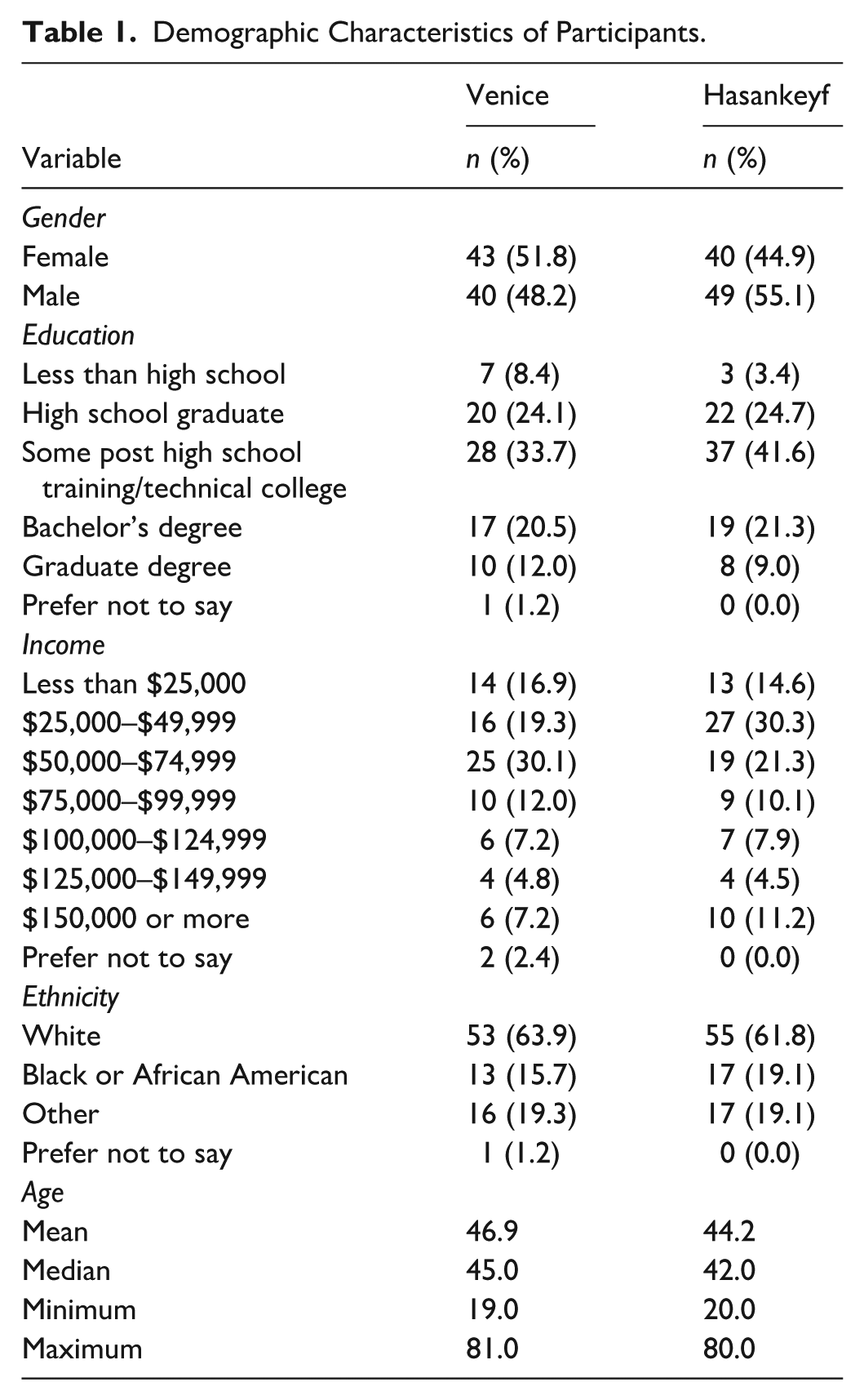
To assess whether the two sub-samples differed significantly, chi-square analyses were conducted on categorical demographic characteristics. Results indicated no significant differences between groups in gender (χ² = 0.81, p = .37), education level (χ² = 2.99, p = .56), income (χ² = 4.43, p = .62), and ethnicity (χ² = 1.22, p = .55). Given that age was measured as a continuous variable, an independent t-test confirmed no significant difference in age between groups (t = 1.15, p = .25), confirming the equivalence of sub-samples and successful random assignment.
Manipulation Check
The manipulation of destination awareness was confirmed using an independent t-test. As expected, participants in the Venice group reported higher destination awareness (M = 5.13, SD = 1.02) than those in the Hasankeyf group (M = 4.10, SD = 1.60). Welch’s t-test showed that this difference was statistically significant (t = 5.10, p < .001), confirming that Venice represented a high-awareness destination and Hasankeyf a relatively lower-awareness destination.
To ensure the validity of our experimental design, we also assessed participants’ understanding of the LCT concept and their recognition of the destinations as LCT destinations. Participants who did not clearly understand the concept of LCT were excluded from further analysis (16 for Venice and 8 for Hasankeyf). Similarly, those who did not consider Venice as an LCT destination (4 participants) or Hasankeyf as an LCT destination (5 participants) were also excluded. After applying these exclusion criteria, our final sample consisted of 83 participants in the Venice group and 89 participants in the Hasankeyf group.
Motivational Ranking Analysis
Before proceeding to the main hypothesis tests, we examined how LCT appeals influenced participants’ motivational priorities. Participants ranked four visit motives before and after exposure to LCT appeals. For each motive, an index was computed by averaging individual rankings across participants within each group, providing a summary measure of motivational priority at each time point. Although averaging ordinal rankings is an approximation, it offers a straightforward way to track relative shifts over time. Wilcoxon signed-rank tests were conducted separately for each group to assess whether motive rankings shifted significantly after exposure to LCT appeals. Table 2 presents the before-and-after means and statistical results for all four motives. Lower means indicate higher motivational priority (1 = highest priority, 4 = lowest priority).
Motivational Priority Rankings Before and After Exposure to LCT Appeals.
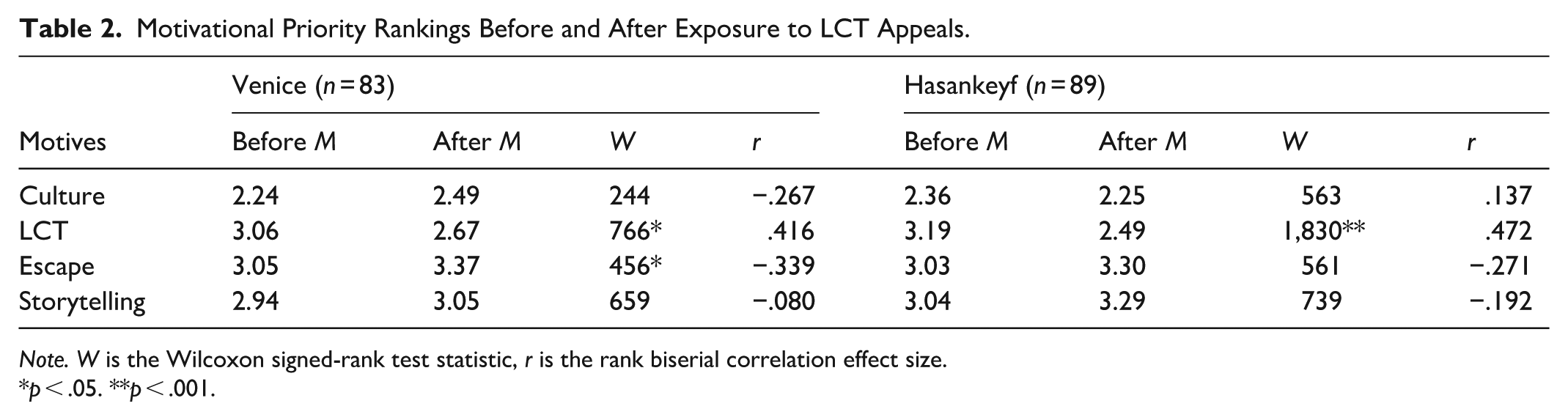
Note. W is the Wilcoxon signed-rank test statistic, r is the rank biserial correlation effect size.
p < .05. **p < .001.
Prior to exposure to LCT appeals, cultural exploration ranked highest in both groups (Venice: M = 2.24; Hasankeyf: M = 2.36), while the LCT motive ranked fourth (Venice: M = 3.06; Hasankeyf: M = 3.19). Following exposure to LCT appeals, the LCT motive shifted significantly upward in both the Venice group (W = 766, p = .012, r = .416) and the Hasankeyf group (W = 1,830, p < .001, r = .472), moving from fourth to second place in each. Cultural exploration retained the top position in both groups and showed no significant shift. In the Venice group, escape motivation decreased significantly in priority (W = 456, p = .030, r = −.339), while storytelling showed no significant change. In the Hasankeyf group, neither escape nor storytelling shifted significantly. This pattern indicates motivational activation across both groups. However, it translated into significantly higher general visit intention only for Hasankeyf participants, an effect outlined in the hypothesis tests below.
Measurement Model Assessment
A confirmatory factor analysis (CFA) was conducted to establish construct validity of the survey instrument. Two separate CFAs were conducted for repeated measures, as general intention to visit and foreseeable intention to visit were measured twice (before and after exposure to LCT appeals). The normality of the data was examined prior to CFA. The data demonstrated acceptable normality with skewness values ranging between −1.26 and 0.10 and kurtosis values between 1.93 and 6.07, within acceptable ranges (Hair et al., 2010).
Items with factor loadings below 0.60 were removed to improve model fit and construct validity. This resulted in the elimination of two items for country image, one item for country familiarity, and four items measuring environmental worldview. Reliability analysis of the refined scales showed excellent internal consistency, with Cronbach’s alpha values ranging from .79 to .94 across all constructs, exceeding the recommended threshold of .70. After removing these items, both CFA models demonstrated acceptable fit. The pre-exposure model showed RMSEA = 0.077, SRMR = 0.065, CFI = 0.949, TLI = 0.937, and χ²/df = 1.716, while the post-exposure model showed RMSEA = 0.065, SRMR = 0.052, CFI = 0.965, TLI = 0.956, and χ²/df = 2.018. Detailed CFA results are provided in Table 3.
Confirmatory Factor Analysis (CFA) Results.
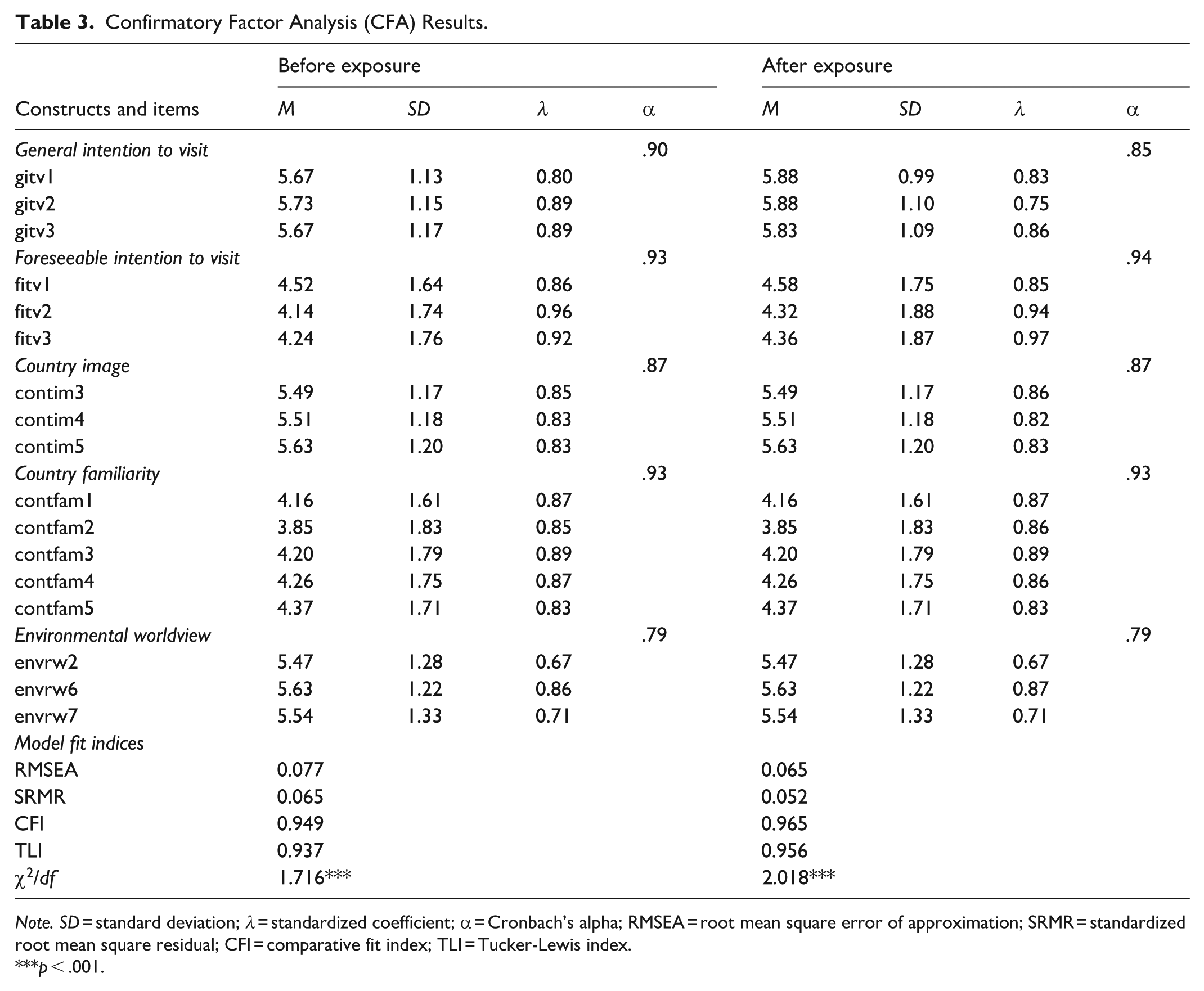
Note. SD = standard deviation; λ = standardized coefficient; α = Cronbach’s alpha; RMSEA = root mean square error of approximation; SRMR = standardized root mean square residual; CFI = comparative fit index; TLI = Tucker-Lewis index.
p < .001.
Discriminant validity was assessed using the Fornell-Larcker criterion (Fornell & Larcker, 1981). The average variance extracted (AVE) value of each construct exceeded the squared correlations with other latent variables (Table 4), confirming adequate discriminant validity. Overall, the measurement models demonstrated satisfactory convergent and discriminant validity, providing a solid foundation for subsequent hypothesis testing.
Fornell-Larcker Discriminant Validity.
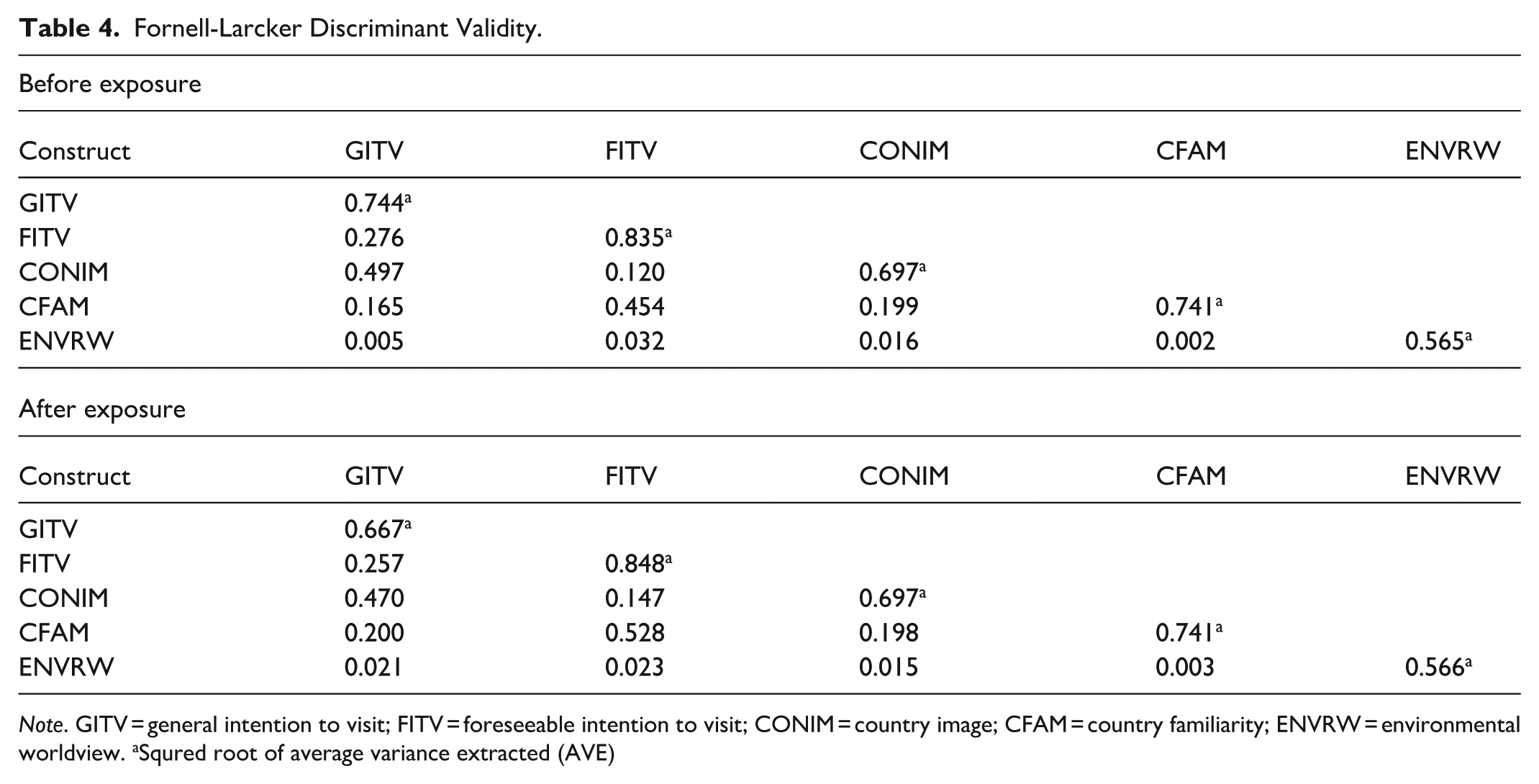
Note. GITV = general intention to visit; FITV = foreseeable intention to visit; CONIM = country image; CFAM = country familiarity; ENVRW = environmental worldview. aSqured root of average variance extracted (AVE)
Hypothesis Testing
To address the established research hypotheses, we employed repeated-measures analysis of covariance (ANCOVA), which is appropriate for our mixed between-within factorial design. This analytical approach allowed us to test three key effects simultaneously: (1) the within-subjects effect of time (before and after exposure to LCT appeals), (2) the between-subjects effect of destination awareness (Venice vs. Hasankeyf), and (3) their interaction (time × destination type), while controlling for potential confounding variables.
We developed a hierarchical testing strategy with two sequential models. Model 1 examined the effects of time, destination, and their interaction while controlling only for demographic variables. Model 2 extended this analysis by additionally controlling for theoretically relevant covariates: country image, country familiarity, and environmental worldview. This hierarchical approach allowed us to assess whether the inclusion of these tourism-specific covariates significantly improved model fit and altered the pattern of results. Both models were applied separately to the general intention to visit and the foreseeable intention to visit.
Effect of LCT Appeals on General Intention to Visit
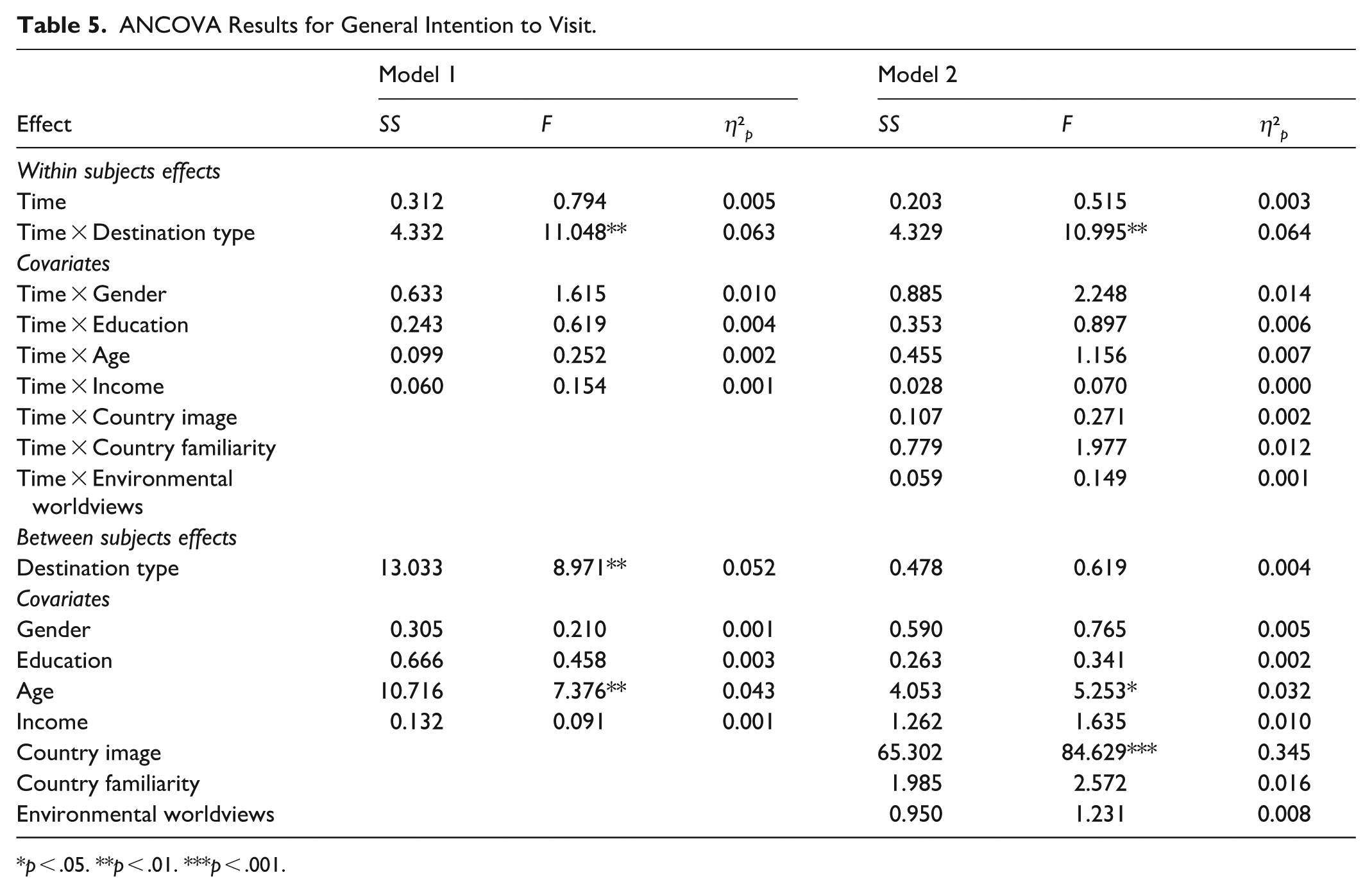
For general intention to visit, the main effect of time (before vs. after exposure to LCT appeals) was not significant in either Model 1 or Model 2. Thus, LCT appeals did not produce a uniform increase in general visit intention across both destinations, and H1a was not supported at the overall level. However, the time × destination type interaction was significant in both Model 1 (F = 11.048, p < .01) and Model 2 (F = 10.995, p < .01). The time × destination type interaction remained significant after controlling for tourism-specific covariates, providing evidence for the non-directional moderation pattern anticipated in H2a: the effect of LCT appeals on general visit intention varied between the high-awareness destination (Venice) and the lower-awareness destination (Hasankeyf) (Table 5).
ANCOVA Results for General Intention to Visit.
p < .05. **p < .01. ***p < .001.
Figure 1 illustrates the interaction. In Model 1, Venice (high-awareness destination) remained relatively stable in general intention from pre-exposure (M = 6.01, SE = 0.11) to post-exposure (M = 5.94, SE = 0.10). In contrast, Hasankeyf (lower-awareness destination) exhibited a substantial increase from pre-exposure (M = 5.39, SE = 0.11) to post-exposure (M = 5.78, SE = 0.10). This pattern indicates that LCT appeals positively influenced general visit intention for the lesser-known destination, while having minimal impact on the well-known destination. The pattern remained consistent in Model 2 after additional covariates were included.
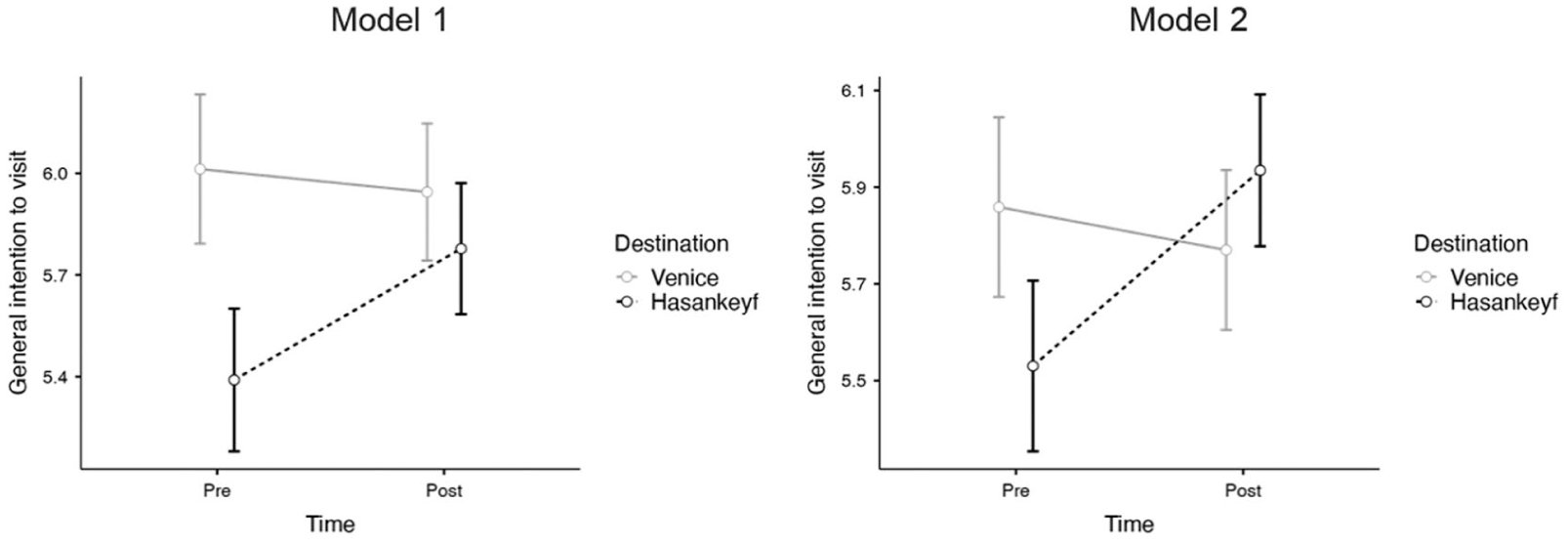
Interaction effect plots.
In Model 1, a significant main effect of destination type was observed (F = 8.971, p < .01), indicating that general visit intention differed between Venice and Hasankeyf when only demographic variables were controlled. However, this main effect became non-significant in Model 2 after country-level variables and environmental worldview were added. Country image emerged as a strong predictor in Model 2 (F = 84.629, p < .001), suggesting that the apparent destination effect was largely attributable to broader country-related evaluations rather than destination awareness alone. H3a, therefore, received only partial support.
Effect of LCT Appeals on Foreseeable Intention to Visit
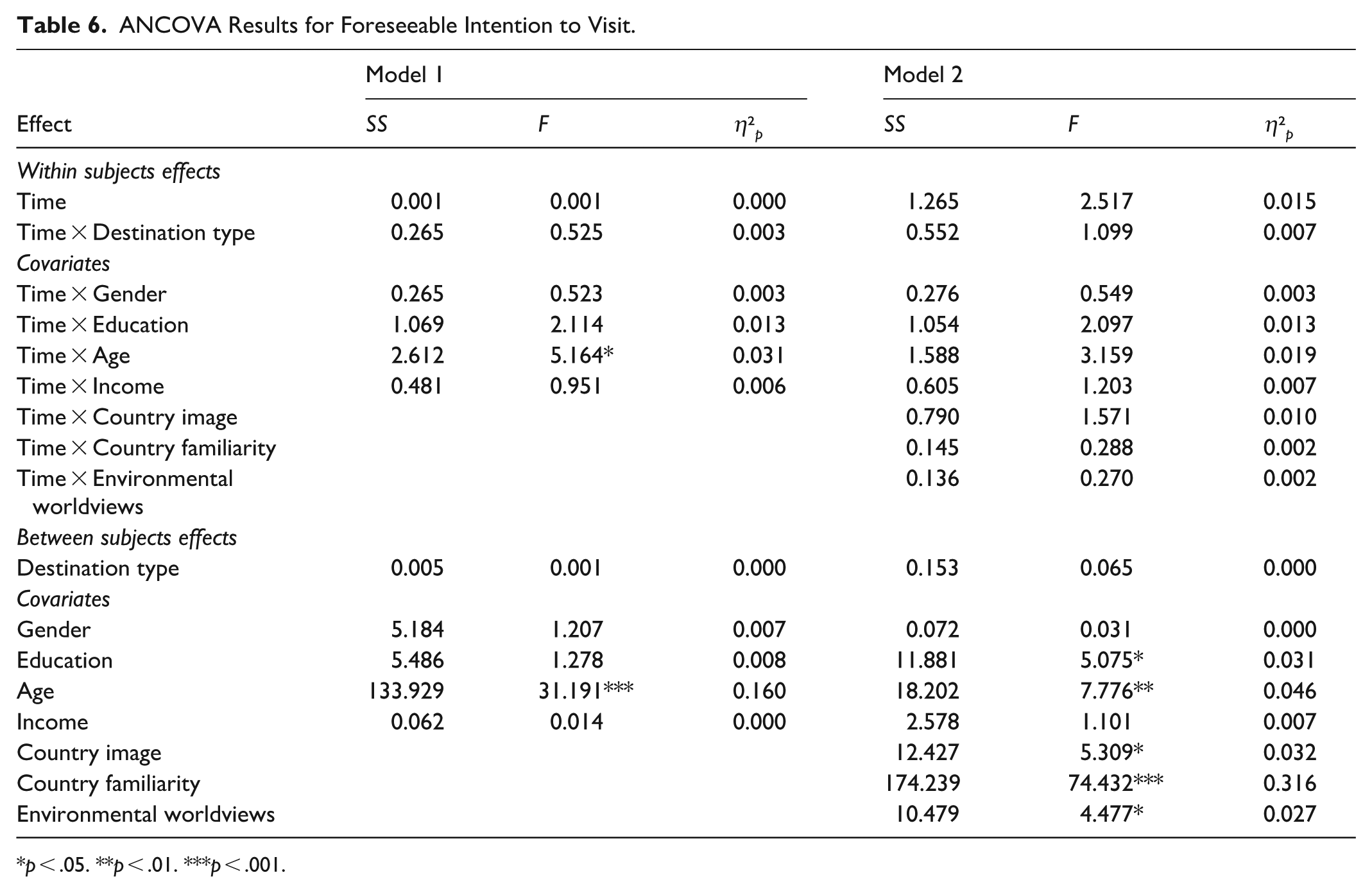
For foreseeable intention to visit, the main effect of time was not significant in either Model 1 or Model 2. This indicates that LCT appeals did not produce a uniform change in temporally specific visit intentions, and H1b was not supported. The time × destination type interaction was also nonsignificant in both models, indicating that the effect of LCT appeals on foreseeable intention did not differ meaningfully between destinations; thus, H2b was not supported. Finally, no significant main effect of destination was observed in either model, resulting in no support for H3b (Table 6).
ANCOVA Results for Foreseeable Intention to Visit.
p < .05. **p < .01. ***p < .001.
Among the covariates, age demonstrated a strongly significant effect in Model 1 (F = 31.191, p < .001) and remained significant in Model 2 (F = 7.776, p < .01). In Model 2, education (F = 5.075, p < .05), country image (F = 5.309, p < .05), country familiarity (F = 74.432, p < .001), and environmental worldview (F = 4.477, p < .05) emerged as significant predictors. Most substantially, country familiarity demonstrated a large effect size, indicating that participants’ familiarity with the destination country strongly influenced foreseeable intention to visit, regardless of specific destination or LCT appeals.
Discussion
This study examined how LCT appeals affect travel intentions toward LCT destinations with different awareness levels among prospective visitors. Three findings are central. First, LCT appeals significantly elevated the LCT motive in both destination groups, shifting it from the lowest-ranked to the second-ranked priority. Second, despite this equivalent motivational activation, only participants assigned to Hasankeyf showed a significant increase in general visit intention, whereas Venice participants remained largely stable. Third, foreseeable visit intention did not change significantly in response to LCT appeals for either destination. Together, these findings suggest that LCT appeals can activate the LCT motive, but destination awareness conditions whether this activation extends into behavioral intention.
The motivational ranking results are central to understanding these divergent intention outcomes. Before exposure to LCT appeals, cultural exploration ranked first in both groups, while the LCT motive ranked fourth. The persistent dominance of the cultural exploration motive suggests that potential visitors are fundamentally driven by the desire to experience the objective authenticity of these heritage sites before they are irreversibly altered (Lee et al., 2024). After exposure, the LCT motive shifted significantly upward to second place in both groups. Although both groups shared this motivational shift, they produced asymmetric intention effects. For Hasankeyf, the elevated LCT motive appears to have had greater room to shape intentions upward, given comparatively fewer pre-existing associations. For Venice, the LCT motive rose similarly in priority, but general intention remained unchanged. This is likely because well-established associations with the destination, including high baseline intentions and awareness of overtourism concerns, absorbed the LCT appeals without shifting intentions in either direction.
In both groups, the upward shift in the LCT motive did not extend to foreseeable visit intention. Country familiarity, rather than LCT appeals, influenced foreseeable visit intention, suggesting that forming a concrete intention to visit within a specific timeframe requires more than motivational activation alone.
Theoretical Implications
This study makes three theoretical contributions to the LCT literature and to the intersection of tourism behavior and communication research. The first and most substantive contribution concerns the mechanism connecting media framing to travel-intention change. Prior LCT research has documented the presence of the LCT motive among actual on-site visitors (Dawson et al., 2011; Denley et al., 2020; Lemelin et al., 2010; Miller et al., 2020), but has rarely examined whether media-based LCT appeals can activate this motive among potential visitors at the pre-visit consideration stage. Our findings show that exposure to LCT appeals reliably reordered participants’ motivational hierarchies in both destination groups, moving the LCT motive from lowest to second priority. This positions LCT appeals not merely as information about destination vulnerability, but as a motivational intervention that reshapes how prospective visitors prioritize their reasons for travel. The finding extends framing theory’s account of individual-level framing effects (Scheufele, 1999; Scheufele & Iyengar, 2014) by identifying motivational hierarchy reconfiguration as one consequence of media frames, complementing prior tourism framing studies focused on attitude change or willingness to pay (S. Li et al., 2021; Xie et al., 2022).
Second, our results indicate that motivational activation does not automatically produce intention change. Although motivational rankings shifted in the same direction across both destination groups, increased general visit intention occurred only for Hasankeyf. This decoupling identifies destination awareness as a critical boundary condition in framing effectiveness that has remained largely overlooked in LCT research. Building on Salim and Ravanel (2020), who showed that destination fame shapes LCT motivation, our results suggest that destination awareness also conditions whether activated motivation converts into behavioral intention. This finding refines the scarcity appeal literature by showing that vulnerability-based scarcity does not operate uniformly across destinations of different awareness levels. This asymmetric response aligns with recent destination branding research, which demonstrates that external interventions (such as hosting mega-events) generate substantially greater equity gains for emerging or lesser-known city brands than for already famous national brands (Kim & Choe, 2026). Similarly, in the LCT context, for lower-awareness destinations, LCT appeals may create both informational salience and urgency; for high-awareness destinations, established baseline associations may absorb the message without producing additional intention change. The result challenges the implicit assumption that LCT appeals universally amplify visitation interest (Dawson et al., 2011; Lemelin et al., 2010).
Given that motivational activation produced differential effects across two intention dimensions, a further theoretical contribution concerns the operationalization of visit intention itself. Rather than treating intention as a unidimensional construct, this study distinguished between general and foreseeable visit intentions that differ in temporal specificity. We propose this not as a resolution to the intention-behavior gap, which remains a structural challenge beyond the scope of any intention-based study (N. Khan et al., 2024; McKercher & Tse, 2012; Nieto-García et al., 2024; Viglia et al., 2024), but as a more theoretically refined approach to measuring behavioral intention. A single, temporally undifferentiated intention item can conflate broad interest with temporally committed intent. As our results show, these are distinct states that respond differently to the same persuasive stimulus. By separating them, researchers can more precisely identify the level of intention formation at which a given intervention operates. Our results show that LCT appeals engage general interest but leave temporally specific intent largely unmoved, a distinction that would be invisible with a unidimensional measure. This refinement offers tourism researchers a more differentiated lens for studying pre-visit decision processes and invites future research to examine what additional conditions are required for general interest to progress into near-term commitment.
Finally, the study also offers a methodological contribution. Barton and Goh’s (2025) systematic review notes that the LCT field has relied heavily on surveys, qualitative interviews, and case studies, and calls for more controlled experimental approaches. This study responds directly by employing a pre-test/post-test experimental design with motivational ranking measures and individual-level covariates, offering a more rigorous approach to examining how LCT appeals influence potential visitors during the pre-visit consideration stage.
Practical Implications
The practical implications of this study require careful consideration. Our findings demonstrate that LCT appeals can activate the LCT motive and increase general visit intention for lesser-known destinations. This does not, however, constitute a straightforward endorsement of vulnerability-based marketing. Where a destination is already environmentally or culturally threatened, the responsible priority for destination management organizations is protecting and rehabilitating the site, not amplifying visitor demand. The implications below should be read as guidance for organizations already managing some level of visitation and grappling with how to communicate responsibly about a site’s condition, not as a prescription for leveraging vulnerability as a promotional tool.
One substantive implication is that LCT appeals do not automatically translate into foreseeable visit intentions, as country familiarity played a far stronger role in shaping near-term travel plans than vulnerability messaging did. This means that communicating about a site’s threatened condition does not necessarily trigger a surge in visitor demand, leaving room for a form of engagement that goes beyond tourism promotion. LCT messaging can be framed as a call to care, rather than a call to visit, building conservation interest (Do et al., 2014) and engaging heritage advocacy communities (Lever et al., 2022). These approaches do not require increasing physical visitor numbers. That said, any communication strategy should be accompanied by robust visitor flow management and capacity planning, ensuring that whatever interest is generated can be absorbed responsibly without adding further pressure to an already vulnerable site.
Our results also suggest that vulnerability-focused communication carries risks, particularly for lesser-known destinations. If a destination becomes primarily associated with disappearance, it may struggle to project a positive and attractive identity over time. For sites that remain active cultural or natural environments, communication that highlights what makes the place worth caring about, its people, history, traditions, and natural features, is likely to resonate more sustainably than messaging centered on loss. Emphasizing these enduring cultural elements fosters constructive authenticity, which is crucial for creating memorable and deeply satisfying visitor experiences beyond the mere novelty of disappearance (Lee et al., 2024). Therefore, where vulnerability framing is used, it should sit alongside a broader story of the destination’s value rather than serve as the main message (Ben Youssef et al., 2018).
For well-known destinations like Venice, our findings indicate that LCT appeals have minimal additional effect on the visit intentions of already-aware potential visitors. The more pressing challenge for high-awareness destinations is not generating new interest but managing the interest and visitor pressure that already exist. Programs that engage visitors as active participants in conservation, through voluntary contribution schemes, tightly managed access, or participatory stewardship activities, redirect the energy that LCT awareness generates toward outcomes that benefit the site rather than strain it (Hehir et al., 2022; Miller et al., 2020). These approaches also reframe the visitor’s role from passive consumer to responsible stakeholder, a shift that aligns with the ethical imperatives scholars have consistently raised about LCT (Dawson et al., 2011; Denley et al., 2020).
The significant effect of country familiarity on foreseeable intentions across both groups carries additional communication implications. For destinations situated in countries with low global recognition, investments in country-level awareness, through cultural diplomacy (Hurn, 2016), national tourism campaigns (S.-C. L. Huang & Lin, 2017), or media partnerships (Dedeoğlu et al., 2019), may be a prerequisite for converting destination-level motivational interest into foreseeable intentions. Destination-specific messaging alone, even when emotionally resonant, may be insufficient if potential visitors lack basic familiarity with the country in which the destination is located. Beyond country-level awareness, reducing practical barriers to travel planning may also help bridge the gap between general interest and foreseeable intention. Previous research suggests that providing potential visitors with ready-made or customized itineraries can nudge motivated individuals toward action (Gollwitzer & Sheeran, 2006; X. Li & Petrick, 2008). For lesser-known destinations where visitors lack destination knowledge, structured travel information that lowers planning friction may be particularly valuable.
Limitations and Future Research
This study employs behavioral intentions as its primary outcome measure, and intention-based measures carry inherent limitations (N. Khan et al., 2024; McKercher & Tse, 2012; Nieto-García et al., 2024; Viglia et al., 2024). Distinguishing between two temporal horizons of intention offers a clearer picture of where LCT appeals operate, but both measures remain stated likelihoods rather than confirmed behavioral commitments. Measuring actual visitation behavior was also not feasible, given the international nature of both destinations and the closure of Hasankeyf (Arceneaux, 2010; Spector, 2019). Longitudinal research tracking participants from initial LCT exposure through actual travel decisions would provide valuable insight into both the durability of framing effects and the conditions under which general interest converts into concrete travel behavior.
We also acknowledge that some participants may have been independently aware of Hasankeyf’s closure. For those participants, responses may have reflected travel craving, or desire toward an inaccessible destination, rather than realistic visit intention. Because the study did not measure perceived accessibility or prior knowledge of the closure, we cannot determine the extent of this possibility. Future research should directly manipulate or measure perceived accessibility to distinguish more clearly between intention toward an apparently visitable threatened destination and craving for a destination known to be inaccessible.
The study’s use of U.S. participants limits cultural generalizability. Scarcity-based appeals, which underlie LCT communication, have been shown to operate differently across cultures with varying orientations toward time, urgency, and individual versus collective decision-making (Roux et al., 2023). Future research should replicate this study with participants from diverse cultural backgrounds, particularly from collectivistic societies where responses to LCT appeals may differ substantially from the individualistic orientation of U.S. visitors.
Additionally, our selection of cultural heritage sites (Venice and Hasankeyf) as experimental stimuli represents a departure from the predominant focus on natural destinations in LCT research. While this choice allowed us to examine LCT appeals in an underexplored context, it also raised questions about the generalizability of our findings to natural LCT destinations (Barton & Goh, 2025). The psychological mechanisms underlying visitor responses to disappearing natural phenomena (e.g., glaciers, coral reefs) may differ from those associated with vulnerable cultural heritage sites. Future studies should test whether the interaction between LCT appeals and destination awareness observed in our research applies similarly to natural LCT destinations, which often involve different emotional connections and conservation narratives.
Finally, the consistent and significant effect of age on both general and foreseeable visit intentions across conditions warrants dedicated investigation. Younger generations may respond more strongly to vulnerability messaging, given their heightened environmental consciousness. However, their limited financial resources may prevent general interest from progressing into foreseeable intentions. Older generations, by contrast, may have greater financial capacity for international travel but different time horizons and motivational priorities that shape how they engage with LCT appeals. Understanding these generational differences in how vulnerability messaging is processed and acted upon could meaningfully extend both the theoretical and practical scope of LCT research.
Supplemental Material
sj-docx-1-jtr-10.1177_00472875261462941 – Supplemental material for Does “See It Before It’s Gone” Increase Visit Intentions? Destination Awareness in Last-Chance Tourism Appeals
Supplemental material, sj-docx-1-jtr-10.1177_00472875261462941 for Does “See It Before It’s Gone” Increase Visit Intentions? Destination Awareness in Last-Chance Tourism Appeals by Mina Kim, Lori Pennington-Gray and Hany Kim in Journal of Travel Research
Supplemental Material
sj-docx-2-jtr-10.1177_00472875261462941 – Supplemental material for Does “See It Before It’s Gone” Increase Visit Intentions? Destination Awareness in Last-Chance Tourism Appeals
Supplemental material, sj-docx-2-jtr-10.1177_00472875261462941 for Does “See It Before It’s Gone” Increase Visit Intentions? Destination Awareness in Last-Chance Tourism Appeals by Mina Kim, Lori Pennington-Gray and Hany Kim in Journal of Travel Research
Footnotes

Ethical Considerations
This study was reviewed and approved by the Institutional Review Board of the University of South Carolina (Pro00144865).
Consent to Participate
All participants provided informed consent prior to participation in the study, in accordance with the guidelines of the University of South Carolina’s Institutional Review Board.
Author Contributions
Funding
The authors received no financial support for the research, authorship, and/or publication of this article.
Declaration of Conflicting Interests
The authors declared no potential conflicts of interest with respect to the research, authorship, and/or publication of this article.
Data Availability Statement
The data that support the findings of this study are available upon reasonable request from the corresponding author.*
Supplemental Material
Supplemental material for this article is available online.
Author Biographies
References
Supplementary Material
Please find the following supplemental material available below.
For Open Access articles published under a Creative Commons License, all supplemental material carries the same license as the article it is associated with.
For non-Open Access articles published, all supplemental material carries a non-exclusive license, and permission requests for re-use of supplemental material or any part of supplemental material shall be sent directly to the copyright owner as specified in the copyright notice associated with the article.
