







Abstract
A constitutive version of methodological individualism (MI) derives from the approaches of Menger, Simmel, and Weber. It encompasses two key ideas: causal individualism and interpretive causation rooted in socially constructed meanings, which imply epistemological anti-reductionism. Early proponents such as Mises, Hayek, Popper, and Watkins advanced these principles, though Watkins departed from the constitutive version. Their contributions ignited a decades-long controversy over MI. This analysis explores the MI controversy by examining its foundational premises, proposing a thesis on the factors driving it—mainly involving divergent epistemologies—and testing this thesis through MI definitions in key texts from the 1950s–2010s.
1. Part 1: An Insider’s View of Methodological Individualism
1.1. Introduction
Methodological individualism was conceived as a major methodological approach in the social sciences in opposition to historicism that dominated the nineteenth century and tended to interpret historical movements holistically. In this context, MI’s founders, Carl Menger, Georg Simmel, and Max Weber, as well as its early proponents, developed its basic principles as an alternative to approaches that attribute direct influence to collective concepts on individual actions. By contrast, MI proponents asserted the irreducible role of the individual in explaining social phenomena. In this regard, they defended the need to adopt an interpretive approach that incorporates an understanding of individuals’ subjective reasons for acting, thereby assigning a central role to the principle of rationality, broadly understood. MI established itself as a major approach in the social sciences in the mid-twentieth century, with notable contributions from Ludwig von Mises, Friedrich Hayek, Karl Popper, and John Watkins. However, these contributions sparked a controversy, largely focused on the meaning of MI, that has continued to haunt the philosophy of the social sciences for seven decades. The present analysis aims to understand this enduring controversy.
The first part highlights the converging premises of MI’s founders and early proponents, which methodologically combine causal individualism with epistemological anti-reductionism. The second part presents a hypothesis to explain the persistence of the MI controversy, involving divergent epistemological and conceptual meaning structures brought into play to interpret MI. The third part tests this hypothesis by examining definitions of MI proposed in key texts by both its critics and defenders, from the early 1950s to the late 2010s.
1.2. The Emergence of MI in the Social Science Landscape
It is through the work of the founders of MI that one can attempt to understand its authentic foundations, with a view to uncovering the internal coherence of their original conceptions. This coherence of scientific thought encompasses not only their explicit assertions but also the structures of meaning implicitly endorsed by scholars. However, the identification of MI’s foundational writings can be questioned, since the name itself emerged only after the major innovative epistemological and methodological works that are assumed to underpin its basic principles. The term appears to have been used in its literal form for the first time in 1904
1
by an uninformed author (Halévy 1904), and later, notably in reference to the work of the marginalist school in economics, by Joseph Schumpeter (1908 [2010]). The selection of the founding conceptions of methodological individualism (MI) is further complicated by the existence of an earlier approach, closely linked to MI through the works of Simmel and Weber: “understanding” or “interpretive” sociology. Ernest Nagel (1961 [1979]) notes the direct nature of this connection: Let us finally examine the claim that [...] the distinctive aim of the social sciences is to “understand” social phenomena by explaining them in terms of the “motivational meaningful” (or “subjective”) categories of human experience. This view has for many years been referred to as “interpretative social science” (or as “verstehende Sociologie,” to mention a widely used German label) and more recently it has been frequently advocated under the name of “methodological individualism” and is contrasted with “methodological collectivism” or “holism.” (Nagel 1961 [1979], 540)
In any case, two researchers are generally regarded as the founders of MI: Menger on the side of economics, and Weber on the side of sociology. Weber, in his methodological introduction to Economy and Society, refers readers to Simmel’s Problems of the Philosophy of History for the concept of “understanding [Verstehen].” Like Simmel, Weber developed an understanding approach in sociology based on a “strictly ‘individualistic’ method” (Weber 1920 [2012], 410) reminiscent of Menger’s compositive method. One circumstance corroborates the close intellectual ties of these scholars in the conception of MI: their shared antagonism toward what was then identified as historicism. 2 Menger, the founding economist of the Austrian school and a pioneer of marginalism, theorized his methodological approach during the 19th-century battle of methods (“Methodenstreit”), which pitted him against Gustav von Schmoller, the figurehead of the German historical school. This opposition to historicism was later taken up and renewed by Weber (1903-06 [2012]) in his critical reflections on Wilhelm Roscher and Karl Knies’ Historicist Approaches to Political Economy, and by Simmel’s (1905 [1977]) Problems in the early twentieth century.
Nevertheless, it was with the re-emergence of the critique of historicism in the mid-twentieth century by Mises, Hayek, and Popper that the term MI was popularized. In particular, the critiques by Hayek and Popper attracted considerable attention, notably through their articles published in the journal Economica, which were later reprinted in 1952 by Hayek (The Counter-Revolution of Science: Studies on the Abuse of Reason) and in 1957 by Popper (The Poverty of Historicism). The relationships among MI’s founders and early proponents, as well as the connections between these early proponents, are also relatively close. The intellectual lineage connecting members of the Austrian school is well known. Moreover, although Hayek makes little reference to Weber, he was familiar with his major works and influenced by thinkers, such as Mises who had integrated Weber’s methodological ideas. 3 Hayek and Popper shared a close personal and professional relationship from their first meeting in the early 1930s. Popper, who is acquainted with Weber’s work, takes a partly critical view of it. He is more inclined to align the method he advocates with the “compositive method” of Menger and Hayek (see Popper 1957, 130). For instance, Popper (1974, 93) explains that the situational analysis he developed was “an attempt to generalize the method of economic theory (marginal utility theory) so as to become applicable to the other theoretical social sciences.” The fourth figure central to the re-emergence of the critique of historicism is John Watkins, a collaborator and defender of Popper’s ideas. Although Watkins is not a founder of MI and belongs to a third generation, he remains a prime target of MI critics to this day.
Contrary to widely held belief, MI, as conceived by its founders and early proponents, is grounded in relatively sophisticated and well-defined epistemological and methodological work. 4 Based on their shared fundamental principles, it can be demonstrated that MI constitutes a cohesive body of doctrine. Furthermore, the writings of these founders and early proponents suffice to delineate its meaning—a central issue in the controversy—as it is primarily to them that its protagonists refer.
1.3. The Methodological Premises of MI According to Its Founders and Early Proponents
In this section, I aim to identify the constitutive foundations of MI as conceived by its founders and early proponents: Menger, Simmel, Weber, Mises, Hayek, Popper, and Watkins. The purpose here is not to delve into the details of these authors’ conceptions, but rather to demonstrate their fundamental convergence on two key dimensions broadly conceived: methodological and epistemological. Methodologically, each of them advocates for explanatory or causal individualism as opposed to strict empiricism. It is a principle for analyzing phenomena specific to a given science using basic units endowed with causal properties. These units are seen as the primary bearers of the causal relationships needed to explain observed phenomena. Epistemologically, all of these authors defend a form of anti-reductionism due to the interdependent nature of the causal properties of the basic units involved—although Watkins’s approach stands out in this regard, as we shall see later. Regardless of how these basic units are defined—whether as individuals and their meaningful actions, social actors, or otherwise—their causal properties are interdependent because they refer to interpretive properties that lie at the heart of the principle of rationality, which each of these founders and early proponents mobilizes in their own way. This leads to an important corollary: These two perspectives, causal individualism and anti-reductionism, are coherently articulated in the constitutive version of MI. Focusing on the basic principles of MI, I leave aside here the question of the composition of individual actions, and their potentially unintended effects, which is of particular interest to these authors. Indeed, such effects reveal the deeper processes underlying phenomena that give the illusion of being driven by a supra-individual logic.
Let us start with the methodological dimension, namely causal individualism, which involves analysis in basic units that are as elementary as possible, but irreducible according to the scientific approach under consideration. This condition of irreducibility is specific to the study of functional wholes, where the causal properties of the defined units are constitutive of these wholes and therefore interdependent. This interdependence is the reason why Menger (1883 [1985], 130) writes that the whole and the part cannot be considered as independent, or autonomous entities; why Simmel (1905 [1977], 114), points out that simplicity and complexity make part and whole relative concepts, explaining that “they do not correspond to the distinction between reality itself and the derivative conceptual constructs of reality”; or why Mises (1949 [1966], 43) further emphasizes that there is no precedence of the individual over the collective, and so forth.
This methodological foundation, shared with the natural sciences, presupposes that, instead of focusing primarily on the search for empirical laws, we construct theoretical systems that involve basic units carrying the causal relationships which, depending on the context, allow for the explanation of observed phenomena. In this respect, Menger (1883 [1985], 56-57) contrasts the notion of “exact” science with the “empiricist-realist” approach, which seeks to develop explanations based on an apprehension of phenomena in their observable integrity. Strictly empirical knowledge cannot reveal what persists through change and lead to strict causal relationships, since the latter always transcend experience. 5
Explanatory models in the theoretical sciences must rely on the simplest, most essential “strictly typically conceived” factors, which “cowork” to underpin the complex phenomena under study. In the social sciences, these are “human individuals and their aspirations” (Menger 1883 [1985], 93-94, 113, 130). For Simmel (1905 [1977], 112, 116), the sufficient cause of a complex phenomenon is the system of elementary actions of “basic constituents” for which “the laws of real forces are valid,” the basic constituent for historical analysis being the “individual mind or personal self.” Similarly, for Weber (1922a [2024], 80; 1920 [2012], 410), the basic unit in the social sciences is social action, which is endowed with subjective meaning and oriented toward others. Mises (1949 [1966], 42), further emphasizes that it is not action as such that forms the basis of explanation, but its subjective, socially oriented meaning: “It is the meaning that marks one action as the action of an individual and another action as the action of the state or of the municipality.” For Hayek (1952, 38), the social scientist “systematically starts from the concepts which guide individuals in their actions,” so that MI “is closely connected with the subjectivism of the social sciences.” Popper (1957, 145-146), asserts that MI’s explanation of collective phenomena involves models of actions and interactions between individuals that bring into play the “aims, hopes, and thoughts of individual men.” Finally, Watkins (1952a, 39-42, 105-106) emphasizes that the explanatory social sciences, like the sciences of matter, adopt an approach in terms of mechanisms referring to ultimate constituents which, in the social sciences, are “individual people who act more or less appropriately in the light of their dispositions and understanding of their situation.”
The causal individualism of the constitutive version of MI does not refer to the purely descriptive notion that social phenomena are mediated by individual behaviors—a point readily acknowledged by social scientists. Rather, it stands in binary opposition to causal holism, as this opposition refers to the unit of explanation of these behaviors, namely individual or collective. For individualists, an individual unit of explanation does not exclude the influence of collective factors, just as holists do not deny the micro-foundations of social phenomena. In causal holism, however, the unit of explanation is the collective, based on various possible hypotheses implying that individuals are shaped by supra-individual logics. In all cases, causal forces are attributed to collective concepts that are assumed to directly influence individual behavior through causes (explicit or implicit) derived from the natural sciences. In contrast, causal individualism takes the individual as the unit of explanation assuming that action is the result of a process whose logic is defined at the individual level of complexity. Simmel (1905 [1977], 54) asks whether the movements of a group can “be derived as a composite of individual processes,” or whether they are “a consequence of a superindividual total spirit”; Weber (1920 [2012], 410) contrasts the sociological use of collective concepts with the consideration of individual action, the meaning of which is seen as causal; Popper (1957, 145-146) explains that all collective phenomena are the products of individual actions endowed with thought, and Watkins (1955, 62) that one cannot be both a methodological holist and a methodological individualist, attributing both collective and individual logics of explanation to individual behaviors. Individual units are constructed as constitutive parts of the whole under study, so that in MI, the collective does not intervene in their action as a superimposed cause but, where relevant, through their interrelationships and their interdependent causal properties.
While acknowledging the commonality of method with the natural sciences, methodological individualists emphasize that the social scientists have a significant advantage in some respects: They have internal knowledge of the causal units they study. Weber (1903-06 [2012], 24) observes that “in the domain of the sciences of society, we are in the fortunate position of [being able to] observe the internal structure of the ‘smallest elements’ of which society is composed and which must permeate the whole web of its relations. Menger was the first, followed by many others, to make this point” (see Menger 1883 [1985], 157-158; Simmel 1905 [1977], 116; Hayek 1952, 28-29, 38). This internal knowledge allows us to postulate that the unit of explanation is individual by virtue of the interpretive unity represented by human consciousness, which justifies the individual character of motivation (Simmel 1905 [1977], 115-116). This also explains why the social scientist must often introduce interpretive hypotheses to complement the observed facts, thereby clarifying the subjective unity of meaning that underlies social action (Simmel 1905 [1977], 46ff.). This unity imbues the sequence of thoughts with a rationality that can be grasped neither by natural laws nor by formal logic, but only through our internal knowledge of mental processes (Simmel 1905 [1977], 74). In this regard, Simmel (1905 [1977], 44) considers the causal link represented by the motivation-action bipole to be fundamental, while Weber (1903-06 [2012], 87) emphasizes the direct causal relationship it represents in comparison to forms of causality based on nomological generalizations. 6 For his part, Mises (1949 [1966], 39), who distinguishes mechanical causality and teleological causality as two fundamental principles of human knowledge, explains that the reason underlying teleological causality is specific in that it is of the same nature as its effect, action. 7
The interpretive unity of individual thought leading to action is reflected in the principle of rationality in MI which is closely related to the subjective meaning of action. This principle translates the control individuals exercise over their actions through this subjective meaning reconstructed in an abstract, ideal-typical way, so that this meaning, or their “reasons,” represent its primary cause.
8
In this perspective, Menger’s contribution with the marginalist utility model highlights the subjective rationality of action, where individuals’ choices are guided by their personal and contextual assessment of their needs. Weber (1922a [2024], 93) closely associates the interpretive approach of action ideally-typically conceived as meaning-oriented with the principle of rationality, and sees this meaning related to action as its cause: “Sociology [...] is a science that aims to understand social action interpretively and thus to explain its course and effects causally” (Weber 1922a [2024], 19). Similarly, Popper’s situational analysis,
9
which brings into play the principle of rationality (first outlined in the 1945 and 1957 works), can be associated with understanding analysis. Popper even defines it by the very concept of understanding: We can try, conjecturally, to give an idealized reconstruction of the problem situation in which the agent found himself, and to that extent make the action “understandable” (or “rationally understandable”), that is to say, adequate to his situation as he saw it. This method of situational analysis may be described as an application of the rationality principle. (Popper 1968 [1979], 179)
The two forms of objectivity that underlie Popper’s situational analysis, namely the objectification of subjective structures of meaning (through the reconstruction of the problem situation), and the principle of (objectively) appropriate action to the problem situation as (subjectively) perceived, represented by the principle of rationality, constitute the objectivist translation of understanding analysis, according to which the subjective meaning of action is its causal principle. The notion of subjectivity, which drives the identification of the problem situation, opens up the space of possible situational factors that can be evaluated through the principle of rationality to explain action. However, we must consider why individuals, if necessary, may not have fully reasoned to develop the most accurate perception of the situation, or why they may not have been attuned to contradictions that further reasoning might have revealed. The introduction of auxiliary or more fundamental goals, specific experiences, as Popper suggests, or consideration of the information, beliefs, and knowledge that individuals possess—or lack—is essential to support the explanation. Ultimately, these different situational models do not so much illustrate a growing distance from objectivity as they do demonstrate that it is the subject who serves as the measure of action. 10
Two points need to be emphasized here. First, the principle of rationality does not imply that social actors are fully aware of their reasons for acting. Simmel (1905 [1977], 51ff.) highlights that the reference to consciousness does not require this assumption, since meaningful processes, initially conscious, are subsequently internalized, so that such reference is rather a methodological choice: If the analyst assumes that motivation is individual, a more decisive role is ascribed to consciousness. This does not mean that all motivations for action are present in the social actor’s consciousness, but that action can ideally be justified by reasons. Similarly, Weber (1922a [2024], 93) explains that, in most cases, actual action occurs in a state of semi-consciousness or partial unconsciousness of its “intended meaning,” with fully conscious action representing a borderline case. 11 On the other hand, the principle of rationality does not exclude irrational action, insofar as it is relevant to the social sciences. But, as Popper (1967 [1994], 177) explained, it is generally more fruitful to revise our understanding of individual situations than to question the principle of rationality. 12
The principle of rationality, which is related to the attribution of a subjective meaning to action, is thus a pivotal element. It brings into play individual interpretive properties that are constitutive of the social and, in this respect, represent interdependent causal properties. Mises (1949 [1966], 43) explains that “as a thinking and acting being man emerges from his prehuman existence already as a social being,” while Popper (1945, 2: 89) notes that “we certainly must assume that man or rather his ancestor was social prior to being human (considering, for example, that language presupposes society).” Interpretive processes involve socially developed structures of meaning: There can be no intentionality or “reasons” in the social sense without relationships with others, without points of view, tools of thought, positions, and dispositions whose nature is irreducibly social. Positions refer to external relational structures, while dispositions refer to the internalized structures of meaning that underlie interpretive capacities of individuals. In particular, Simmel (1896-97) explains that it is through their mental nature that social forms are maintained. Unlike the material processes of the natural sciences, these forms are transmitted as largely implicit interpretive premises in social interactions (Simmel 1905 [1977], 54), and persist across spatial and temporal boundaries through the essentially progressive renewal of the group. Weber (1922a [2024], 87-88) observes that collective concepts “represent ideas about something that partly exists in reality and partly has normative authority in the minds of real people [...] who orient their actions according to these ideas.” Hayek (1952, 28-29, 38, 55-56) argues that the meaning structures underlying communication are fundamentally social in nature, and that “popular concepts” are not acquired individually or intuitively, as they mostly refer to conceptual constructs rather than empirical similarities. Similarly, Watkins’s explanation of action (1952a, 39-42; 1957, 105-106) involves individuals’ interpretation of their situation, which brings into play “situational beliefs,” that presuppose socially developed meaning structures.
Two important consequences follow from the inherently social nature of the interpretive properties of individuals in MI. First, this reference to interpretive or rational properties of individuals in the social sciences precludes psychologism, which reduces the social to psychological processes that are not inherently interpretive or that are independent of social contexts. In this regard, Simmel (1905 [1977], 206) emphasizes the need for an “abstract psychology” in which mental contents are constructs relative to the perspective of the social science involved. Weber (1922a [2024], 87) argues that a psychology that does not involve interpretive processes is of no greater interest to the social sciences than any other natural science. Popper (1957, 145-146), for his part, criticizes the misconception that MI in the social sciences would imply psychologism, and so on. Second, social wholes influence social action through processes involving individual interpretive properties. Mises (1949 [1966], 42-43) explains that it is through interpretive processes that collectives acquire a reality and a causal role: “A collective always operates through the intermediary of one or several individuals whose actions are related to the collective as the secondary source.” Similarly, Popper’s World 3 (1978, 164), which encompass all the productions of the human mind as thought content distinct from thought processes, has an influence on social action which is always indirect, mediated by the interpretive activity of individuals. 13
Before concluding this section, it is worth pointing out a difference in perspective that becomes noticeable with Watkins and which may be due to less mature thinking on the subject. Indeed, Watkins was only 28 years old in 1952 when he published his first article on MI. Notably, he is the author most often cited by critics of MI, while being rarely referenced by its proponents. This difference in perspective concerns whether approaches are more “subjectivist” or “objectivist.” In this respect Watkins is naturally closer to Popper than Weber. This manifests itself in Watkins’s thinking in two ways. First, Watkins tends to base the causal individualism of MI merely on individual agency (which deals only with the microfoundations of social phenomena), rather than on the principle of rationality. For him, human beings are the only “moving agents” of history (Watkins 1957, 105). Second, Watkins tends to interpret the modes of action of these social agents through psychology as a discipline, rather than through the subjective or interpretive dimension of human life. This is evident in his assertion that individuals “act more or less appropriately in the light of their dispositions and understanding of their situation.” Watkins thus explicitly separates “dispositions” from “situations” subjectively interpreted by individuals, while understanding such dispositions as conative tendencies: “The dispositions which comprise a unique personality are, so to speak, ‘laws’ which apply to only one man over a limited period of time” (Watkins 1952a, 36)—as an example, Watkins cites Brutus’s disposition to place his loyalty to the state above his loyalty to his friends. Watkins’s distancing from the subjectivist principle is made explicit in his criticism of Hayek’s argument that the relationship of familiarity between observer and object in the social sciences does not apply to the kind of dispositions he distinguishes (Watkins 1952a, 39). 14
These aspects of Watkins’s approach—namely the justification of MI by the microfoundations of social phenomena and the reliance on a “psychology” of individual dispositions (socially induced or otherwise, see Watkins 1955, 394), raise the same issue. Watkins’s approach does not assign a regulatory role to the principle of rationality in individual action. This is made clear in his argument that “the assumption of the quasi-permanence of personalities corresponds roughly—very roughly—to the natural scientist’s belief in the permanence of the natural order” (Watkins 1952a, 37). For proponents of the constitutive version of MI, it is the general rational or interpretive properties of individuals that ensure the observer’s expectations of coherence and continuity in social life (and, in Simmel’s insight, the maintenance of social forms). In this respect, Watkins differs from Popper, who describes the principle of rationality as equivalent to Newton’s universal laws that drive the solar system model (Popper 1967 [1994], 168-169). This is why Watkins’s approach is ultimately vulnerable to a form of reductionism, as individuals’ motivational tendencies lie outside the rational regulation of action.
2. Part 2: Thesis
2.1. Individualism vs Holism and Reductionism vs Anti-Reductionism
Distinction of Theoretical Approaches According to Epistemological and Methodological Principles Method.
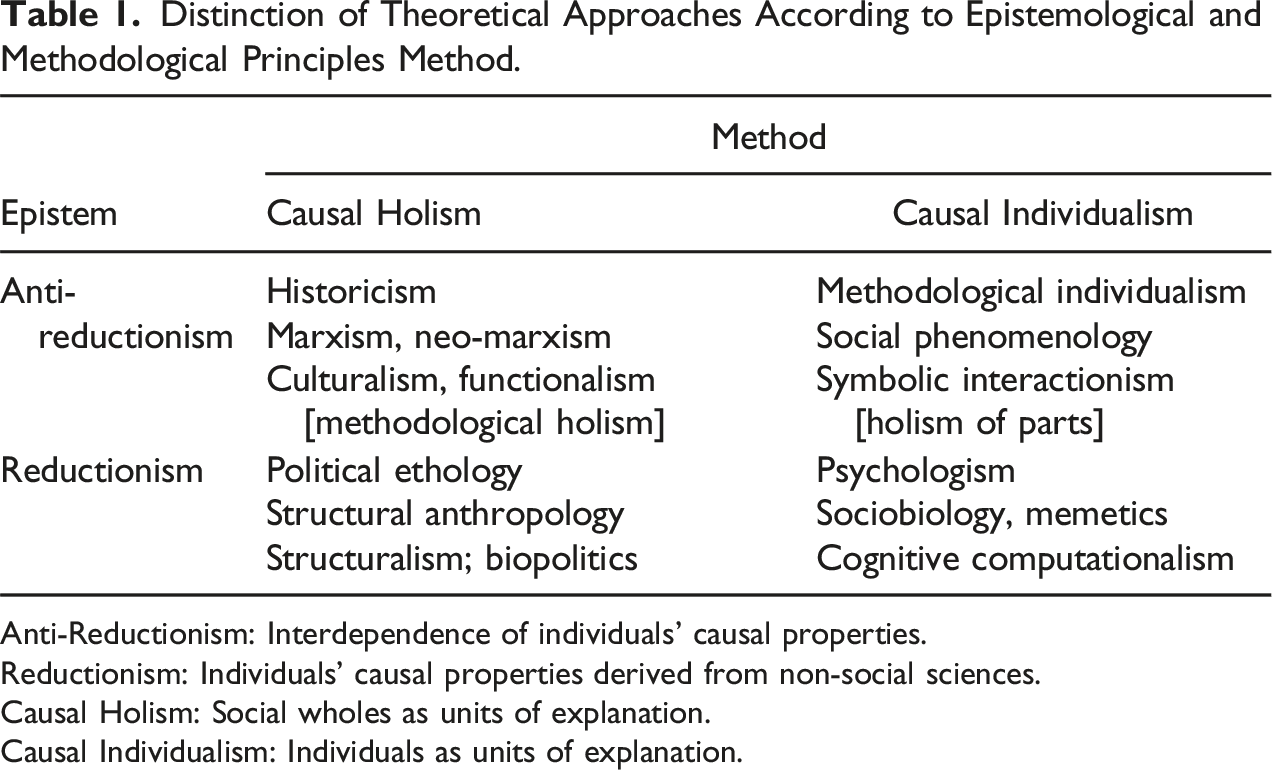
Anti-Reductionism: Interdependence of individuals’ causal properties.
Reductionism: Individuals’ causal properties derived from non-social sciences.
Causal Holism: Social wholes as units of explanation.
Causal Individualism: Individuals as units of explanation.
The methodological dimension here contrasts (vertically) holism and causal individualism in terms of the unit of explanation, whether collective or individual. The definition of such a unit depends on the problems posed within the special sciences concerned, and should not be confused with the epistemological issue of reduction (distinguished horizontally). The issue of epistemological reduction concerns not the unit of explanation per se, but the type of knowledge that defines it, and underpins an approach of replacement. In the case of inter-theoretical reduction, this means moving from one theoretical framework to another, possibly involving a micro-reduction. Micro-reduction presupposes decomposing the objects of the reduced theory, viewed as “wholes,” into their proper parts which belong to the universe of discourse of the reducing theory (Oppenheim and Putnam 1958, 6). Therefore, to explain phenomena concerning these wholes, micro-reduction involves recourse to elementary units with causal properties that are independent of the wholes themselves. 15 Regardless of its formulation, micro-reduction tends to evoke a stratified ontology of reality, characterized by successive levels of composition.
The methodological and epistemological dimensions distinguished here are independent, and allow us to identify approaches that vary in their positioning along these two dimensions (see Table 1). It is not necessary to delve into the details of the approaches presented as examples, as their primary purpose is to illustrate the distinction between the methodological and epistemological dimensions under discussion.
In the upper part of the table, which refers to anti-reductionist epistemologies, the approaches illustrate the interdependence of the causal properties of individuals. In the upper left corner, the approaches which are commonly referred to as “methodological holism” imply that individual properties refer to a collective explanatory unit. From this perspective, individual agencies mediate collective logics under the influence of historical and social contexts. This is reflected in the “spirit of the people” found in certain historicist approaches, the class consciousness central to Marxism, or the class habitus invoked in Pierre Bourdieu’s sociology. The causal power of collectives is also found in culturalism, where the internalization of cultural models, conceived as closed totalities, shapes individual personalities. Similarly, functionalist approaches attribute this power to the internalization of social roles that serve to maintain social functional equilibria.
At the top right of the table, the interdependent causal properties of individuals imply an individual unit of explanation. In particular, these interdependent properties refer to shared tools of thought and meanings that are socially transmitted. Alfred Schutz’s social phenomenology, for instance, emphasizes the subjective and intersubjective construction of the social world, while symbolic interactionism focuses on how meanings are negotiated in social interactions. Methodological individualism, on the other hand, examines the collective, often unintended effects of individual actions, which by definition are socially meaningful. Although, formally, symbolic interactionism and social phenomenology can be integrated into the field of MI, historical developments have led to a relative differentiation in their identification, particularly in terms of level of analysis, with MI usually being associated with macrosociology. A common MI approach in mainstream economics, known as rational choice theory (RCT), tends to minimize the interdependence of individuals’ causal properties in the context of mathematical modeling—by postulating that individuals are motivated by self-interest and make optimized decisions—but more recent versions of RCT include a broader interpretation of rationality (see Opp 2023). In contrast to methodological holism, these approaches all suggest a “holism of the parts,” a term introduced by Jan Smuts (1926), who coined the term “holism.” In his book Holism and Evolution, Smuts argues, consistent with MI, that the whole does not act as a separate cause but operates through the causal operation of its parts (see Bulle 2023a). 16
In the lower part of the table, reductionist approaches involve causal properties of explanatory units that are independent of the social or confined to a particular subdomain. In the lower left corner, reduction operates through a collective explanatory unit. For instance, political ethology explains social and political behavior in terms of biological inheritance, such as dominance or territoriality, observed in other species. Claude Lévi-Strauss’s structural anthropology interprets behavior through unconscious collective structures that shape cultural practices. Similarly, French structuralists such as Roland Barthes and Michel Foucault analyze societies and cultures through the lens of discursive structures. Biopolitics, also associated with Foucault, examines power dynamics in terms of the regulation of biological life within populations, borrowing concepts from the life sciences.
At the bottom right of the table, the reduction of the social to other theoretical fields (or subfields) is based on an individual unit of explanation. One example is the historicist psychologism of John Stuart Mill (see Thilly 1923), which uses associationist psychology and the interactions of individuals with their environment to justify the existence of broad sociological laws. 17 Another example is the psychologism of George Homans, who grounds his sociology in behaviorist psychology. 18 Sociobiology, for its part, analyzes social behaviors such as altruism and aggression through mechanisms of natural selection and evolutionary success. The memetic approach, associated with Richard Dawkins, seeks to explain cultural transmission and the evolution of beliefs and behaviors by positing “memes” as cultural units propagated through imitation. Finally, computationalism models cognitive processes in terms of mechanisms based on the syntactic and computational properties of information-processing systems, whether biological (e.g., neuronal states) or artificial (e.g., computer algorithms).
From a terminological perspective, a few clarifications are necessary. Outside the social sciences, methodological individualism may refer to what I have defined more broadly as causal individualism.
19
In the social sciences, however, methodological individualism combines causal individualism with anti-reductionism, for the reasons outlined above. This distinction helps to explain why Popper (1945), in his discussion of Mill’s psychologism, initially acknowledges the value of psychologism in implying methodological individualism—apparently in the broader sense of causal individualism—only to reject psychologistic reductionism in the social sciences: The mistake of psychologism is its prejudice that this methodological individualism in the field of social science implies the programme of reducing all social phenomena and all social regularities to psychological phenomena and psychological laws. The danger of this prejudice is it leads to historicism, as we have seen. (Popper 1945, 2: 91-92)
Therefore, it seems reasonable to consider that, in Popper’s view, Mill’s work represents a psychologistic individualism (see Yoshida 2023, 462).
On the other hand, the idea of reductionism is often associated with the notion of atomism and considered its intellectual successor. In the nineteenth century, the term “atomism” was used imprecisely and ambiguously, particularly by proponents of the German historicist school, who contrasted it with their more descriptive, empirical, and causally holistic approach to historical development. Menger’s work was misinterpreted by these scholars as an endorsement of “atomism” in the British tradition—a complete misunderstanding, as Menger, on the contrary, challenges the classical objectivist paradigm. The economist, who reintroduces the term—arguably in a provocative manner—uses it in opposition to causal holism, 20 to denote what is here identified as causal individualism: a general methodological criterion rather than an epistemological reduction. These various uses of “atomism” effectively illustrate how epistemological frameworks shape the distinction between epistemological and methodological “reduction.”
2.2. Thesis: Epistemological and Conceptual Dispositions
The thesis I propose to defend aims to explain the main misunderstandings that fuel the controversy over MI. Its reductionist interpretation is so persistent and widespread in the philosophy of the social sciences—particularly outside practitioner circles—that it constitutes a remarkably puzzling social phenomenon. If we accept that the interpretation of a scientific approach is a theory of that approach, then generations of researchers have endorsed and disseminated what amounts to a false theory. However, they had the works of MI’s founders, advocates and practitioners, at their disposal, and many of these critics cited them in support of their arguments.
Possible explanations, such as general intellectual or institutional conflicts, academic dynamics of belonging, dominance, and publication, or the endogenous dissemination of received ideas, seem insufficient in light of the magnitude of the phenomenon which calls for a more fundamental explanation. Given the academic seriousness of the protagonists involved in this controversy, any explanation must remain compatible with the commitment to truth that drives the scientific community as a whole. A reasonable assumption is that misconceptions do not persist for decades within such a community, unless the protagonists have good reason for holding them as true. My thesis is that the misconceptions surrounding MI primarily arise from the epistemological and conceptual premises of the researchers involved—in other words, from the structures of meaning they mobilize to apprehend MI. To illustrate the role these premises play, I propose a general diagram (Figure 1)
21
that shows the relationships between the theoretical, empirical, and ontological dimensions in various epistemological approaches to the social sciences. General relationships between the theoretical, empirical, and ontological in social sciences explanations.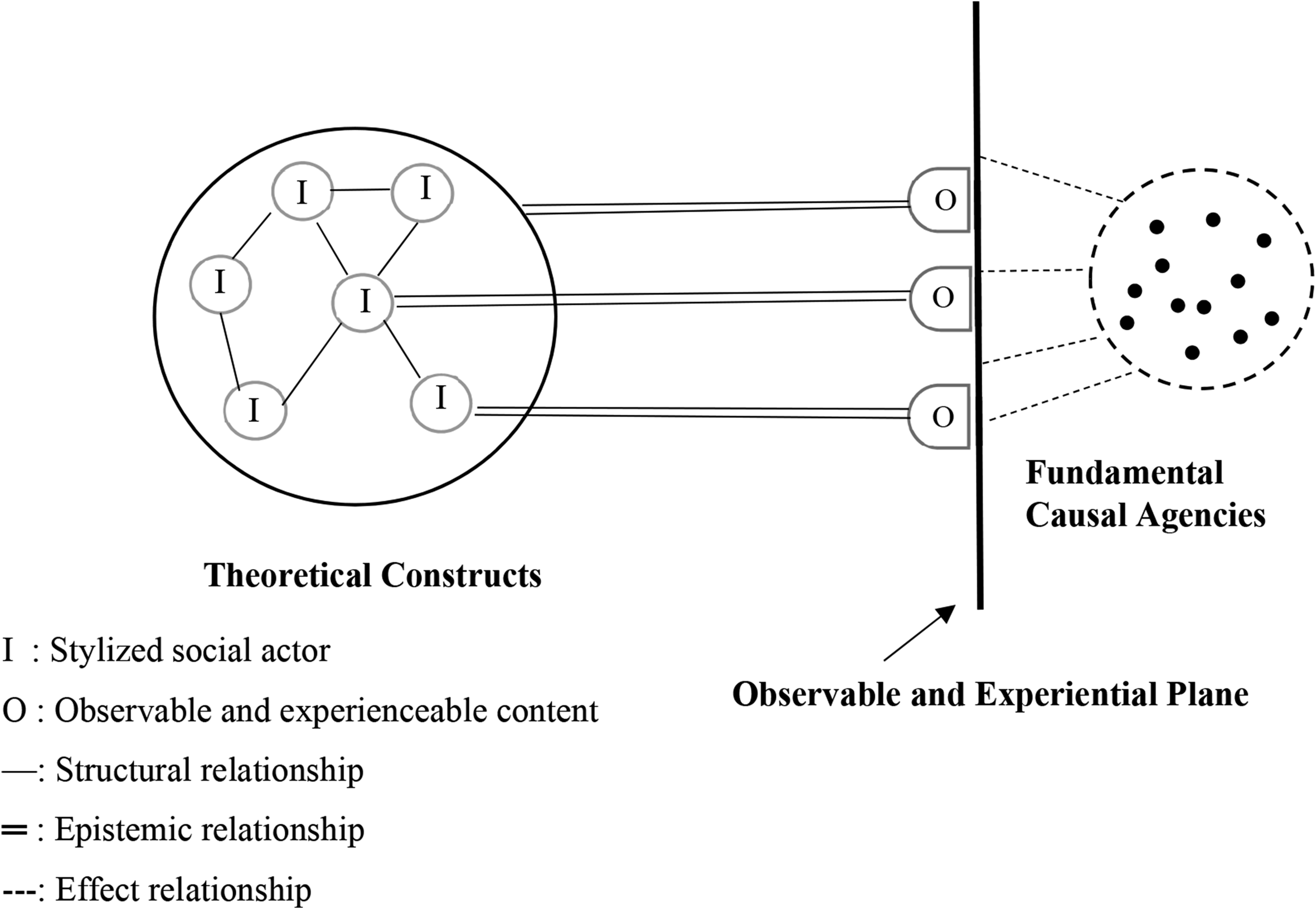
Since Hume, empiricists have maintained that human knowledge cannot extend beyond the data of experience. Accordingly, the associationist psychology developed by classical empiricists ultimately grounds all knowledge in links between sensory impressions. This perspective translates in positivist epistemologies into an emphasis on empirical relationships, where theoretical structures represent external connections between observational data. Through the work of the Vienna Circle in the 1920s, the positivist perspective enriched by the formal logic of Frege and Russell, as well as Wittgenstein’s Tractatus, led to the development of logical positivism, or logical empiricism. In contrast to classical empiricism, logical empiricists acknowledge a pragmatic a priori as the formal framework of theories, but reject the Kantian notion of synthetic a priori, which asserts the existence of universal and substantive forms of knowledge prior to experience. On this basis, logical empiricists distinguish two kinds of meaningful propositions: those with an analytical or logical role (necessary truths, as in pure mathematics), and verifiable empirical statements (“matters of fact,” see Ayer 1936 [1971]). As Hempel (1950, 41) explains, “The fundamental tenet of modern empiricism is the view that all non-analytic knowledge is based on experience.” Propositions falling outside these categories are dismissed as meaningless, emphasizing that all theoretical terms must, at least in principle, be related to observables. Consequently, the meaning of theoretical entities and properties depends on their connection to the empirical, and causal relations are understood as regularities describing relationships between observables. By restricting the scope of theoretical relations to the logical or analytic domain, logical empiricism sought to limit scientific ontology and eliminate metaphysical entities.
However, since not all theoretical concepts can be systematically linked to observational concepts, as logical empiricists were quick to acknowledge, the theoretical necessarily involves an irreducible interpretive dimension. This dimension may be controlled in scientific development simply by maintaining a close relationship with the observable, as in Popper’s approach, which does not specifically focus on the meaning of theoretical constructs. This interpretive dimension can also be understood as a purely heuristic strategy, based on the “as if” principle, to provide an intelligible interpretation of the observable. It is worth noting in passing that this might be a way of understanding causal holism in the social sciences—a perspective that MI proponents consider deceptive when it claims to uncover essential causal relationships. Other epistemological perspectives, however, argue that scientific explanation progresses by approaching more authentic or fundamental causal processes. These processes involve entities and properties that tend to persist across changing situational contexts, even though their expression depends on those contexts. The idea of a tendency for the scientific progress to approximate real causal structures inspires, albeit in diverse ways, contemporary active epistemologies. These approaches emphasize trans-situational causal capacities or powers, as opposed to “passive” approaches based on laws or counterfactuals tied to the observable (see for example Cartwright 1999; Harré and Madden 1973; Machamer et al. 2000; Mumford 2009). The search for deep causal structures translates into the exploration of “generative mechanisms.” As noted earlier, this conception of explanation tends to be shared, with epistemological variations, by proponents of the constitutive version of MI, once they rely on the social scientist’s specific knowledge of the genuine causal properties of units of action in the social sciences.
Differences in how epistemological approaches conceptualize the relationship between theoretical constructs and the observable 22 imply divergences in how relationships between theories are conceived. When the scientific ideal is to align all the theoretical constructs with empirical data, these data tend to ground the meaning of scientific concepts. Such correspondence ensures compatibility with a shared logical framework, thereby enabling the formal translation of concepts and principles from one theory to another. This perspective motivated the logical empiricists’ ambition to unify the sciences, especially by formalizing logical relationships between theories, and fostered the idea of translating all sciences, in principle, into the language of physics, regarded as the fundamental science. From this standpoint, the micro-reduction discussed above means expressing the concepts of macro-theory in the terms of micro-theory (thereafter semantic reductionism) 23 and expressing the laws of macro-theory through those of micro-theory (thereafter nomological reductionism). When individual units thus refer directly to observable entities, the feasibility of such reduction is ultimately an empirical issue.
On the other hand, for postpositivist epistemologists who argue that theories are only indirectly informed or constrained by observational data, the possibility of replacing an explanation or theory with a more fundamental one at a lower level of complexity is not merely an empirical question. Such substitution is possible only if the causal properties attributed to elementary entities by the more fundamental theory or explanation are maintained when these entities interact with others at higher levels of complexity. In other words, a system can be explained or reduced by a theory of its components only if the causal properties of these components remain independent of the system as a whole. Within this epistemological framework, “reducing” the sociological requires that the causal properties of the basic units involved be independent of the social.
Epistemological differences lead to variations in the very assessment of the reduction enterprise. Within empiricist epistemologies, certain approaches—such as those originally developed by neoclassical economics—may appear tendentiously reductionist, relying on models of individual choice based on limited consideration of structural variables. For methodological individualists, however, the introduction of structural variables such as the relationships between individuals and the supra-individual systems that organize their activities refers to the boundary conditions of the models. Epistemologically, this implies differences of degree rather than of kind between approaches, provided that the individuals involved act on the basis of interpretive capacities that socially embed their causal properties. On the other hand, for these very reasons, the introduction of structural variables does not guarantee protection against reductionism. The critical question is whether the causal properties of individuals are interdependent. In other words, the question is whether these properties do not exist independently of the social, or even further, whether the individuals themselves—assuming that these properties are inherent in their nature—cannot be conceived of outside the social.
Nagel’s (1961 [1979]) discussion of the critique of reductionism in emergentist conceptions tends to reveal these underlying conditions within the empiricist framework itself: The contrast [between reduction and its opposite] seems to hinge on the claim that the parts of a functional whole do not act independently of one another, so that any law which may hold for such parts when they are not members of a functional whole cannot be assumed to hold for them when they actually are members. (Nagel 1961 [1979], 394-395)
Nagel employs emergentist terminology that identifies reduction with an “additive” or “mechanical” analysis, referring, as the quoted passage indicates, to laws that apply only to parts in an independent state. He notes that even so-called “summative” wholes—such as mechanical systems (e.g., the solar system, or a carbon atom), introduce assumptions about the organization of the parts and the causal relationships that connect them. More complex cases, such as the electromagnetic field, can also be considered mechanistically, as it merely serves as an “intermediary device for formulating the effects of electrically charged particles upon other such particles.” The key point is that referring to relationships between entities in a system does not preclude reduction, which hinges on the independence of the mode of action of these parts, so that a theory can be developed based on them alone. On this basis, Nagel argues that identifying a “functional whole” remains a conceptual challenge, because it runs the risk of being merely epistemic. In this regard, proponents of MI, who rely on their specific knowledge of individual modes of action, acknowledge from the outset the intrinsic connection of these modes of action to social life.
In addition, and closely related to their epistemological dispositions, the researchers’ conceptual dispositions also hinder their understanding of MI. 24 As we have seen, for its founders and early proponents, the interpretive nature of human reason presupposes socially transmitted structures of meaning. However, this approach to the human mind is not intuitive. It is not consistent with either of the two dominant legacies of early twentiethth-century psychology—English empirical and associationist psychology, and continental metaphysical psychology. It will be especially developed in Lev Vygotsky’s cultural-historical psychology (Vygotsky 1934 [1986]). 25 These two traditions imply, on the one hand, a materialist and objective approach, and on the other, an idealist and subjective approach, both of which lead to forms of psychologistic reduction. The former is reductionist because it relies on infra-conscious processes whose nature is independent of the social. The latter is reductionist because it assumes the universality of the rational foundations of human reason, transcending historical and social particularities. While MI’s reference to the interpretive properties of individuals is inspired by the subjective approach of the second tradition, it explicitly integrates the role of intersubjective structures of meaning that link the rational or interpretive properties of individuals.
If scholars’ epistemological and conceptual predispositions lead them to conflate the search for laws between mere observables with the search for genuine causal structures, then the methodological and epistemological distinctions outlined above collapse: The methodological opposition between causal holism and causal individualism, based on the explanation units at stake, tends to be conflated with the epistemological opposition between anti-reductionism and reductionism, then interpreted in terms of reference to discrete descriptive units. As we shall see, this conceptual collapse is a major factor in the controversy over MI. The intrinsic interdependence of the causal properties of individuals in MI, as implied by the principle of rationality, or the centrality of this principle to MI itself, has been obscured in the intellectual context shaped by logical empiricism. In particular, the emphasis in this context on the empirical externalization of causal properties and relations made reference to the mental states of individuals largely irrelevant. Even before the MI controversy emerged in the 1950s, neopositivists had opposed the “Verstehen” method interpreted as empathic understanding, on the grounds that it was not a valid method for testing hypotheses, without even distinguishing Weberian Verstehen as rational understanding. 26 Instead, they argued that the behaviorist psychology’s translation of all mental phenomena into bodily behavior was more aligned with the scientific conception of the world. However, as Mises observes (1949 [1966], 2): “We may call the offering of a commodity for sale a ‘stimulus.’ But what is essential in such an offer and distinguishes it from other offers cannot be described without entering into the meaning which the acting parties attribute to the situation.” 27
3. Part 3: Understanding the MI Controversy
3.1. The Intellectual Premises
Since the writings of the founders of MI and their immediate successors have been the primary target of MI critics, the controversy is well circumscribed by their conceptions. We have seen that these scholars developed relatively convergent methodological premises. On the one hand, the subjective meaning of action is seen as its cause, so that the interpretive or rational capacities of individuals are the causal properties underlying social action. On the other hand, these bring into play meaning structures of an irreducibly social nature, so that MI is epistemologically anti-reductionist. In other words, and despite certain differences or ambiguities in Watkins’s work, these methodological premises consistently hold the interpretive or rational capacity of individuals—or other decision-making bodies that may constitute interpretive units—to be the key causal property in MI, articulating a causal individualism and an epistemological anti-reductionism.
Furthermore, as outlined above, the goal of epistemological reduction discussed by logical empiricists in the first half of the twentieth century, which aimed to build bridges between scientific theories, was fostered by the idea that the empirical “drives” the theoretical. In contrast, MI advocates emphasize the irreducibly interpretive nature of the theoretical dimension of the scientific enterprise. For them, it is the theoretical perspectives applied to reality that differentiate the sciences, rather than the domains of the observable (see, e.g., Menger 1883 [1985]; Simmel 1905 [1977], chap. 2; Weber 1922a [2024], 1922b [1947], 1904 [2012], 111; Mises 1949 [1966], 51, 42-43; Popper 1934 [1959], 1945; Hayek 1952, 46; Watkins 1958). Consequently, the problem of reducing one science or approach by another was in no way an objective for the proponents of MI.
When the defense of MI developed in the mid-twentieth century, it was closely tied to a critique of the forms of methodological holism in the social sciences, then associated with historicist approaches. This critique was amplified by the perceived influence of these approaches in legitimizing totalitarian ideologies. At the time, logical empiricism dominated the epistemological landscape, and focused on issues of inter-theoretical reduction. This intellectual context led to a misinterpretation of the premises of MI through the lens of these issues. The controversy that has unfolded over the last three-quarters of a century is, to a large extend, the story of this misunderstanding. This is the issue we will now examine.
3.2. The Development of the Controversy
The controversy surrounding MI has focused primarily on the question of its meaning. This observation made by Lars Udehn (2001, 2002) is not contradicted by the present research. It suggests that debates have rarely focused on methodological issues based on a clear understanding of the principles of MI, but have been driven by divergent interpretations of these very principles. However, as demonstrated in Part 1, a constitutive version of MI, relatively well-defined in the texts of its founders and early proponents, does indeed exist. This lends the controversy a particularly enigmatic nature. To shed light on it, Part 3 will test the thesis developed in Part 2 regarding the epistemological and conceptual dispositions of scholars. This analysis will focus on the definitions of MI they have formulated and on the basis of which they have criticized or defended it.
To identify the main texts fueling this controversy, I have selected the most influential articles and books published between 1950 and 2020. The selection is limited to texts specifically focused on MI (excluding those addressing related issues, such as its application to Marxist theory), but includes significant works on inter-theoretical reduction referring to MI. The measure of influence, with potential impact beyond strictly academic circles, is based on citation counts provided by Google Scholar. 28 Because the topic of MI is less controversial in economics, and for the sake of brevity, I have included only a few notable articles by economists. While the final list is not exhaustive, it aims to reflect as accurately as possible the terms and development of the overall controversy.
The trigger, if there is one, is Friedrich Hayek’s (1952) critique of scientism, which he defines as the misapplication of the natural sciences methods to the social sciences. Hayek rejects the attempts of certain thinkers and intellectual movements, notably positivism, to impose a strictly empirical and quantitative methodology on the social sciences, disregarding the specificity of their object of study. In 1954, the philosopher of science May Brodbeck, influenced by the tradition of logical positivism and in defense of the methodological unity of the sciences, inaugurated the riposte. She interpreted the social science method supported by Hayek in the spirit of neopositivism, highlighting what she saw as an apparent contradiction in his approach which she characterized as “reductionist in one sense, anti-reductionist in another” (Brodbeck 1954, 141). According to Brodbeck, in Hayek’s view, “the behavior of groups” must be explained in terms of “the behavior of individuals,” in keeping with the perspective of intertheoretical reduction. She notes, however, that “the psychology of individuals,” based on “systematic subjectivism,” cannot not be further reduced. The misunderstanding is profound: The anti-reductionism of the individual, taken as a constitutive unit of the social and grounded in the subjectivism advocated by Hayek, implies socially developed structures of meaning that inherently sustain the anti-reductionism of the social. Brodbeck’s misinterpretation is compounded by a misunderstanding of the scope of MI as presented in Hayek. She reduces MI to what she perceives as the supposedly reductionist part of this dual movement, overlooking Hayek’s (1952, 38) explicit framing of MI as based on structures of meaning (concepts) “which guide individuals in their actions.” 29 Brodbeck’s epistemological presuppositions provide a straightforward explanation for these misinterpretations. On the one hand, they have led her to inappropriately reinterpret Hayek’s approach through the lens of “reduction” in the epistemological sense: Causal individualism is conflated with an empiricist reduction of social phenomena to strictly individual phenomena, thereby disregarding the central role of subjectivism in MI. It is noteworthy that in an article on MI published 4 years later, Brodbeck defines MI exclusively in terms of neopositivist reductionism and explicitly aligns her interpretation with it. She distinguishes between the intertheoretical reduction of concepts—“the view that there are no undefinable group concepts [in terms of the behavior of the individuals and/or their relations]”—from that of laws, “the view that the laws of the group sciences are in principle reducible to those about individuals” (Brodbeck 1958, 20).
Prior to the publication of this second article, which has been widely cited in the literature, three other authors played a notable role in the debate: Maurice Mandelbaum in 1955 and 1957, Ernest Gellner in 1956 and 1959, and Leon Goldstein in 1956 and 1958. Although Mandelbaum was not a philosopher in the neopositivist tradition (and opposed reductionism), he probably relied on Brodbeck’s interpretation (which he cited in Mandelbaum 1957, along with Gellner and Goldstein) to attribute two reductionist theses to MI defined in neopositivist terms. The first, in his 1955 article, outlines a semantic reductionism: “societal facts,” must be “reduced” to concepts referring solely to “psychological facts”—the thoughts and actions of specific individuals. The second, in his 1957 article, defines nomological reductionism: There should be no irreducible societal laws.
Gellner’s role in these debates is highlighted by Ian Jarvie (2022). His scientific anti-reductionism (see Reichert 2025) underlies his particularly critical approach to MI, which he undoubtedly misinterprets through the previous articles (he cites Mandelbaum), and through his reading of Watkins (1952a). Gellner interprets MI on the very basis that distinguishes Watkins’s approach, characterizing it as a reduction of explanations to “individual dispositions,” which he defines as “low-level generalizations about the conduct of individuals.” 30 For this reason, Gellner (1959), in a reply to Watkins (1957), argues that Watkins’s MI is vulnerable to the same infinite regress as the psychologism criticized by Popper. 31 However, Gellner expresses his confusion in a debate where hypotheses, the relations between wholes and parts, and causality, are insufficiently clarified by either side.
Goldstein, influenced by logical empiricism in his early work, explored the application of Hempelian principles of nomological generalization to the social sciences (see O’Sullivan 2006). In 1956, this led him to interpret MI as an attempt to “exhaustively” analyze all the concepts used in social science theory in terms of psychological facts such as “the interests, activities, volitions, and so forth of individual human beings.” Two years later, he reinterpreted these psychological facts as “individual dispositions,” like Gellner (1956). Interestingly, Goldstein (1956, 806) notes that John O. Wisdom privately suggested to him that he was using the term “methodological individualism” in a manner quite different from Popper or Watkins. Goldstein does not seem to fully grasp the extent of this error, attributing it instead to his neglect of Watkins’s reference to ideal-typical individuals (“allowing anonymous individual concepts”) rather than specific individuals. He maintained his criticism of MI, concluding that, since “Miss Brodbeck” seems to make the same interpretive error, “to warn possible readers against what I deem to be a methodological inadequacy seems perfectly justified.”
In this period of the 1950s, apart from the 1952 article (reprinted in 1953 in the collective Readings in the Philosophy of Science edited by Herbert Feigl and May Brodbeck) and a 1952 note (Watkins 1952b), the young Watkins published another article on MI in 1957 (reprinted in 1968 in the collective Readings in the Philosophy of Social Science edited by May Brodbeck and in 1959 in Theories of History edited by Patrick Gardiner), and responded to critiques: Watkins (1955) to Brodbeck (1954), Watkins (1957) to Mandelbaum (1955), Gellner (1956) and Goldstein (1956), and Watkins (1959) to Goldstein (1958). In response to the criticism that rejecting methodological holism (MH) does not necessarily equate to defending MI (interpreted in a reductionist way)—a criticism that opens the door to various methodological possibilities, including MI in its constitutive sense, Watkins emphasizes the mutual exclusivity of these two methodological perspectives in an explanatory framework. He thus implicitly alludes to the causal structure of explanations, with the observation that the reference to individual behavior may remain implicit: Speaking loosely, one can say that climate, famine, the location of minerals, and other physical factors help to determine history, just as one can say that alcohol causes road accidents. But speaking strictly, one should say that alcohol induces changes in people who drink it, and that it is the behavior of some of these affected people, rather than alcohol itself, which results in road accidents. (Watkins 1955, 58)
Against the reductionist interpretation, Watkins argues that the “dispositions” he refers to involve individual properties developed in social life: I agree that methodological individualism allows the formation, or “cultural conditioning,” of a widespread disposition to be explained only in terms of other human factors and not in terms of something inhuman, such as an alleged historicist law which forces people’s dispositions into some pre-determined mould. But this is just the anti-historicist point of methodological individualism to which Mr. Goldstein does not object. (Watkins 1957, 394)
The question remains, however, of whether Watkins’s focus on conative dispositions, with only secondary reference to the principle of rationality, introduces an epistemological reductionism as defined above (Part 2). Addressing it would require specifying the type of theory underlying the formation of dispositions in Watkins’s approach—namely, whether this formation is based on processes ultimately indifferent to the social nature of the environment. Nevertheless, Watkins’s conception of individual actions also involves the individuals’ understanding of their situations, which is rooted in explicitly social processes. His objectivist tendencies, combined with terminological ambiguities, have undoubtedly added to the confusion. For instance, as we have seen, he favors the “psychological” concept over the “subjective.” Commenting on the revolution in economics brought about by the marginalist school, Watkins writes that the reference to the utility of a marginal unit of a good (subjective utility) “is the recognition of a psychological contour-line which had not been clearly mapped before” (Watkins 1952a, 35). 32 For Watkins, however, the psychological does not refer specifically to individual properties independent of the social, as he writes, “A lump of matter may exist which no one has perceived, but not a price which no one has charged, or a disciplinary code to which no one refers, or a tool which no one would dream of using” (Watkins 1952a, 28). But Nagel, who has adapted the neopositivist tradition by broadening its principles, focuses instead on the sentence immediately following this passage: “From this truism I infer the methodological principle which [...] searching for explanations of a social phenomenon until he has reduced it to psychological terms” (Watkins 1952a, 28-29; quoted in Nagel 1961 [1979], 541), and uses this quotation to justify his evaluation of MI through the lens of intertheoretical reduction criteria, which he himself has refined.
Despite his legitimate but potentially confusing methodological use of the term “reduction,” Watkins does not provide much clarity on the debate surrounding this issue. My hypothesis is that he focuses on the foundational aspects of MI, without engaging in a broader epistemological debate. Independently of the MI controversy, however, Watkins (1958) criticized the metaphysical aporias of neopositivism.
For their part, Oppenheim and Putnam (1958), like earlier interpretations of MI, very generally confuse causal individualism with epistemological reduction. They (1958, 17) observe that the “technical term ‘micro-reduction’ is not, of course, employed by writers in [social theory],” but that the major approaches in this field are “micro-reductionist” in nature: [M]any writers have discussed “the Principle of Methodological Individualism”; and this is nothing more than the special form our working hypothesis [regarding the theoretical unity of all sciences] takes in application to human social groups. (Oppenheim and Putnam 1958, 17)
However, an article by Joseph Agassi, a former student of Popper, published in 1960, and revised in 1975, clearly interprets the opposition between methodological individualism and methodological holism on the basis of the unit of explanation. Agassi defines individualism as the theory that attributes causal action only to agents with decision-making power, so that the whole does not have causal action in addition to that of its parts: There is no mysterious additional entity which turns a collection of individuals into a society; a collection of individuals is a society if there is strong interaction between them; this interaction is due to the fact that when any one individual acts (rationally) on the basis of his own aims and interests, he takes into account the existence of other individuals with aims and interests. (Agassi 1960, 244; 1975, 146)
Agassi thus rejects the unilaterally reductionist interpretation of MI. Nevertheless, undoubtedly influenced by Gellner (1956, 1959) to whom he refers—some of his analyses were, in fact, presented at a seminar led by Gellner at the London School of Economics in 1958—he considers psychologism as a possible variant of MI, and proposes the term “institutional individualism” for the non-psychological version (for further developments see Yoshida 2023).
Steven Lukes (1968) who, despite having read Agassi (1960), refers to the early critics mentioned above and proposes a definition of MI—widely referenced in the literature—that focuses on the reduction of “facts” from one domain to another (this is consistent with the evolution of analytic philosophy’s approaches to reduction, influenced by developments in the philosophy of mind) 33 : “Facts about society and social phenomena are to be explained solely in terms of facts about individuals” (Lukes 1968, 120).
Notwithstanding the confusion caused by reading Watkins, familiarity with the foundational texts on MI does not seem to prevent interpretations framed in terms of epistemological reduction. Both Murray Webster (1973), who describes MI advocacy as an “article of faith,” and Robert Nozick (1977), who speaks of a “chicken-and-egg situation,” draw on these texts in their discussions of reductionism in MI.
In the late 1970s, however, Richard W. Miller (1978) published an article arguing strongly against reductionist interpretations of MI. It is worth noting that Miller (1987) later developed an anti-positivist epistemology, emphasizing the interpretive role of theories and adopting a causal realist approach in Fact and Method: Explanation, Confirmation, and Reality in the Natural and Social Sciences. In his 1978 article, the philosopher refers to earlier critiques of MI, arguing that they “have concentrated their fire on extremely implausible versions of methodological individualism” with no practical implications for the social sciences. He revisits Watkins’s work to argue that MI does not imply an implausible semantic reductionism: It does not require that the claims of social scientists be expressible in a language, no individual term of which refers to a phenomenon entailing the existence of a society. Very likely, no individualistic definition of “marriage,” for example, can be given. But if a marriage custom can be explained as due to participants’ beliefs about marriage, the individualistic constraint on explanation is still satisfied. (Miller 1978, 388-389)
Miller argues that MI imposes an explanatory constraint in terms of subjective reasons which is far from trivial, even though he considers this constraint inadequate in light of the role of objective class interests in Marxist theory. Notably, in defending this interpretation of MI, Miller examines Watkins’s notion of “dispositions” and suggests that they are equivalent to Weber’s explanations in terms of “‘subjective meanings’ that agents attach to their actions,” that is, “agent’s reasons,” despite Watkins’s distinction between “the cognitive from the conative aspect of reasons” (Miller 1978, 392, 396). Miller then concludes that if his argument is correct, “the two decades of attack on methodological individualism have largely been a misfortune for the social sciences” (Miller 1978, 388). As noted in Part 2, Watkins’s concept of individual conative dispositions is problematic because it aims to explain the behavior of individuals at the margins of their interpretive activities. But the misfortune for the social sciences is no less important, knowing that they have often discussed MI only in terms of the ambiguous and specific ideas of one of its proponents.
It is also worth mentioning Elliott Sober (1980), a philosopher of biology, whose emerging field introduces concepts and methods largely incompatible with principles of reduction. Sober draws a parallel with the contrast between group selection and individual selection hypotheses to shed light on the issues at stake in the debate between individualists and holists. Like Miller, he criticizes the implausibility of the reductionist interpretation of MI: Do individualists seriously propose to ignore relations? Are individualists really such benighted atomists? Not at all, say the individualists, who insist they not be confused with the straw man just discussed. (Sober 1980, 94)
Sober explains that the reduction proposed by MI is methodological in nature and concerns the causal structure of theories: This reformulation makes the dispute harder than it was before; the road away from truisms and toward contentful hypotheses about causal mechanisms is never an easy one. But this presumably is a price that an explanatory science willingly pays. (Sober 1980, 116)
The 1980s saw the emergence of significant figures in MI. Raymond Boudon, who presents himself as Weberian and also frequently refers to Simmel, 34 first uses the term to describe the method he supports in sociology in The Logic of Social Action (Boudon 1979 [1981]); Jon Elster reassesses Marxist theory by adapting it to a methodological individualist approach in Making Sense of Marx (Elster 1985), a central and widely debated work in analytical Marxism. James Coleman, in The Foundations of Social Theory (1990), argues that explaining a social system does not necessarily require accounting for individual actions, but contends that “a more fundamental explanation based on the actions and orientations is more generally satisfactory” (Coleman 1990, 4). The foundations of MI, as developed by Boudon (1979 [1981], 1984 [1986], 1987), Elster (1982, 1985), and Coleman (1990) combine causal individualism (relying on reasons or motives) 35 and epistemological anti-reductionism (relying on socially defined situational structures, including structures of meaning). Specifically, Boudon (1984 [1986]) explains that MI principles recommend seeking the meaning of actions from the perspective of the subjects within their own situations, thereby involving irreducible social variables. Coleman (1990, 18) also emphasizes the individuals’ interpretive capacities by associating MI with the notion that “the theoretical aim of social science must be to conceive of that action in a way that makes it rational from the point of view of the actor.” However, Elster, who defines MI on the basis that “all social phenomena—their structure and their change—are in principle explicable in ways that only involve individuals—their properties, their goals, their beliefs, and their actions” (Elster 1985, 5), makes no specific reference to the principle of rationality (see Elster 2023). He thus endorses a version of MI that can be identified as minimalist, a premise observed in Watkins, who distinguishes the explanatory role of individual dispositions from that of individuals’ interpretations of their situation.
Let us note that, as a result, we have identified the development of three versions of MI. The first, the constitutive version—associated with its founders and early proponents, at least up to Popper—articulates causal individualism and anti-reductionism through the principle of rationality in the broadest sense. The second, minimalist version, which takes shape with Watkins and continues with Elster, opposes causal holism—the idea that collective entities exert a separate causal action—by emphasizing a principled reference to the micro-foundations of social action. In this second, more objectivist version, the principle of rationality no longer plays a central explanatory role. Theoretical individual entities are not specifically defined as interpretive units, but rather by their concrete capacity for action. This expands the scope of explanation to include individual behaviors resulting from processes that are not only unconscious (which, as we have seen, the constitutive version does not reject), but also meaningfully uninterpretable, whose methodological status remains uncertain. Finally, a third, reductionist version that has emerged since the 1950s, originally based on neopositivist reductionist criteria aimed at unifying the sciences, relies on theories of individual behavior that are independent of the social. This version, as we have seen, is incompatible with the methodological principles of MI and thus represents a purely philosophical construct.
So far, explaining the misinterpretations of MI through scholars’ epistemological and conceptual dispositions proves enlightening. Logical empiricism, which dominated epistemology in the early twentieth century, lost its influence between the 1950s and the 1970s—a period in which Weber’s recognition as a major founder of sociology became firmly established. The first chapter of Economy and Society offers the most comprehensive account of the individualist method in the social sciences. The reference to Weber, almost systematic among MI proponents, has also developed among its critics. However, this reference does not safeguard against reductionist interpretations, suggesting that epistemological and conceptual dispositions play a profound and often unnoticed interpretive role in the understanding of MI. 36
The MI controversy continued for the next three decades, with the parallel development of its three versions: constitutive, minimalist, and reductionist. The reductionist version was discussed almost exclusively within the framework of analytic philosophy, which inherited logical empiricism’s commitment to physicalism. Questions of reduction thus remained central, particularly in the philosophy of mind, where debates focused on the possibility of reducing mental states to cerebral states. Analytic philosophers reformulated the MI controversy by incorporating notions developed to address the mind-body problem, such as the concepts of supervenience and multiple realization. Supervenience refers to a dependence relationship between two sets of properties, where the properties at a higher explanatory level (e.g., the mental or social) rely on those at a more fundamental level (e.g., the physical or individual). Applied to the social-individual relationship, this means that no change in social properties can occur without corresponding changes in individual properties. In the philosophy of mind, this is often interpreted as supporting the causal primacy of physical properties, however, supervenience merely underscores the dependency of higher-level properties. Multiple realization, on the other hand, challenges the feasibility of reduction by showing that the same social (or mental) state can arise from diverse individual (or physical) configurations. While higher-level properties depend on foundational ones, they retain characteristics irreducible to them due to the plurality of possible realizations. The argument of multiple realization thus supports the epistemic autonomy of supervenient levels of explanation such as the social or mental.
The controversy redefined on the basis of these concepts, which extend the problem of reduction to non-strictly empiricist epistemological approaches, nevertheless reiterates its central misunderstanding by interpreting MI as an enterprise of epistemological reduction involving theories referring solely to “individuals” (Kincaid 1986), “lower-level regularities” (Little 1991), “the study of individuals” (Bunge 2000), “individuals and their properties” (Zahle 2003), “individuals and their relationships” (Sawyer 2004), or “facts about individuals” (Epstein 2009), or else, “facts about individuals and their interactions” (List and Spiekermann 2013)—For critical discussions, see Bouvier (2023), Di Iorio (2023), Mitrović (2017), and also Sugden (2016). Some reductionist interpretations, influenced by the history of the controversy, come from economists such as Geoffrey Hodgson (1986, 211), who defines MI as “a doctrine within which all explanations of social phenomena have to be couched in terms of statements about individuals.” In a later article, Hodgson (2007) acknowledges versions of MI that also include interactions. Similarly, Kenneth Arrow (1994, 3) states that in MI “whatever happens can ultimately be described exhaustively in terms of the individuals involved.” Kaushik Basu (1996), for his part, in his discussion of Rajeev Bhargava’s (1992) work on MI—a work also informed by secondary literature—expresses perplexity at the implausibility of MI’s reductionist project and the triviality of its critics’ defense of irreducible social concepts.
Given the various contemporary interpretations of MI’s proponents, the minimalist version, methodologically understood as opposition to the misuse of collective concepts, is presented by Alban Bouvier (2011) as a form of MI common ground. This version developed alongside the emergence of analytical sociology (Hedstrom and Swedberg 1996), which initially represented a direct extension of MI. The focus of analytical sociology on the study of “social mechanisms” or “generative mechanisms,” often through simulations using multi-agent models, 37 reflects this continuity. However, the centrality of modeling techniques brings with it a more descriptive and technical orientation (see Boudon 2012, 31). The under-theorization of the relationships between models and the phenomena they target has even led to the adoption of the pragmatic criterion of “generative sufficiency” as a test of model validity (Epstein and Axtell 1996; Hedström 2005, 143-144). Moreover, separated from the principle of rationality, the minimalist version of MI favored by analytical sociologists tends to justify the reference to individual agencies solely on the grounds that their activities mediate or “microfound” social phenomena (see, for example, Epstein and Axtell 1996; Demeulenaere 2011, Introduction; Manzo 2014, 4).
The requirement for microfoundations—while not equivalent to the methodological rejection of causal holism, as Bouvier (2023) points out—is now framed by analytic philosophers as an alternative version of MI distinct from epistemological reductionism (Little 1991; Zahle and Collin 2014; Zahle and Kincaid 2019) but without clear methodological consequences. As Daniel Little (1991) observes, there is no requirement that the explanation of any phenomenon must necessarily involve its constituents. Moreover, within a pragmatist, empiricist approach to explanation, there is no compelling reason to retain the reference to microfoundations at all. This explains the subsequent distancing of analytical sociology from MI (Jepperson and Meyer 2011; Marchionni and Ylikoski 2013; see also Kincaid and Zahle 2022 and Di Iorio’s [2024] reply).
Also related to the minimalist interpretation is Lars Udehn’s (2001, 2002) analysis of MI, which explores the various approaches in the literature that focus on individuals—i.e., linked to versions of what is identified here as causal individualism in the social sciences. These approaches include, among others, classical and neoclassical economics, 38 Mill’s psychologism, and social contract theories. Udehn’s integrative, analytical, and critical perspective leads him to refocus the distinction between individualism and holism on the exogenous explanatory factors. From these broad and epistemologically diverse foundations, Udehn observes a historical evolution toward a growing consideration of social structures in explanation. His de facto objectivist and descriptivist empirical perspective underpins his preference for the notion of structural individualism, a position shared with analytical sociologists and intended as an intermediary between individualistic reductionism and causal holism (Hedström and Bearman 2009, 7-8).
Definitions of MI based on its constitutive version have also progressed in this latter period. Significantly, contributions involving this version focus on MI’s causal individualism and anti-reductionism.
Clive Lawson, who shares Tony Lawson’s advocacy for critical realism in economics, defines Menger’s basic unit as “the agent with needs and the intention and means to satisfy such needs” (Lawson 1996, 452). He acknowledges Menger’s “particular essentialist-realist position” asserting that theoretical knowledge must target what is persistent throughout change (Lawson 1996). 39 Joseph Heath (2005 [2024]) defines MI through its constitutive link to interpretive sociology, 40 emphasizing that, since actions are motivated by individual intentional states, methodologically privileging action inherently implies methodologically privileging individuals.
Daniel Steel (2006) as well as Bulle and Phan (2017) discuss a version of the multiple realization argument based on the methodological opposition of individualism to holism. Steel (2006, 440) presents MI in terms of the proposition that “social phenomena are best explained in terms of the motivations and interactions of individual persons.” Drawing on Woodward’s theory of causal explanation, he argues that, for any given social system, explanatory mechanisms at the individual level are invariant across a wider range of interventions than at the collective level, thus reflecting a deepening of explanation. For their part, Bulle and Phan (2017) define MI by referring to the actors’ rational capacity (broadly defined as interpretive capacity), as the driving principle of individual action, so that, from an explanatory perspective, analytical sociology cannot abandon the principles of MI (see also Opp 2024 on this issue).
Furthermore, Francesco Di Iorio (2015), with reference to Hayek, defines MI in terms of the (causal) autonomy represented by individual meaning-making. Bulle (2019) argues that MI analyses are characterized by their distinction between two types of causes: individual causal powers (trans-situational rational capacities) and the situational properties on which individuals’ rational capacities are exercised. It is on these grounds that MI’s anti-reductionism is defended in various texts involving the role of socially developed structures of meaning.
Gary Madison (1990, 45) asserts that individual action in Hayek is “thoroughly social and intersubjective in nature”; Richard Shweder (1995), who defines MI based on notions of intentionality and individual agency, discusses the concept of social mediation in thought processes; Di Iorio (2016, 354) explains that in MI “[social] constraints must be analyzed with account taken of the individual subjective standpoints” and defends the coherence of Popper’s MI with his World 3 against critics in the literature.
The scholars in question have developed epistemological and conceptual dispositions that favored their adoption of the constitutive version of MI. Richard Shweder worked with Clifford Geertz, a figure of interpretive anthropology; Joseph Heath worked with Charles Taylor, and Gary Madison with Paul Ricoeur, both of whom developed a hermeneutic approach to the mind. Daniel Steel collaborated with Nancy Cartwright, a figure of active epistemologies; Nathalie Bulle worked with Raymond Boudon; Francesco Di Iorio with Jean Petitot, who explored the connections between phenomenology and cognitive science, and with Dario Antiseri, whose research focused in particular on Popper and hermeneutics.
3.3. Conclusion
According to the foregoing analyses, a constitutive version of MI has its roots in the methodological approaches of its founders, Menger, Simmel, and Weber, who defended two main ideas. The first concerns the unity of the explanatory method of the natural and social sciences—causal individualism—the principle of analyzing phenomena specific to a given science using basic units endowed with causal properties. The second involves the reliance of the social sciences on different types of causation compared to the natural sciences. This second idea is grounded in the specific access that social scientists have to the causal properties of their basic units, which are interpretive in nature. Such interpretive, or rational, properties imply an epistemological anti-reductionism because they depend on socially constructed structures of meaning. These two basic premises were relayed by the early proponents of MI in the mid-twentieth century, principally Mises, Hayek, Popper, and Watkins, although Watkins tends to diverge from the constitutive version of MI by emphasizing conative dispositions rather than the interpretive, or rational, properties of individuals as the regulators of social action. Since the MI controversy, driven largely by debates over its meaning, has developed with reference to the conceptions of these founders and early proponents, their conceptions delineate the object of this enduring debate.
A study of the successive characterizations of MI in the articles shaping this controversy reveals their close dependence on the epistemological and conceptual frameworks favored by the various scholars involved, whether critics or proponents of MI. The constitutive version of MI is rooted in postpositivist epistemologies that emphasize the role of theory in developing hypothetical causal relationships and extend to contemporary active epistemologies, where theory seeks to capture fundamental causal relations. In contrast, the neopositivist epistemology that dominated during the emergence of MI in the twentieth century limited theory to describing and structuring of relationships between observables. This conflation of the real with the observable supported an ideal of scientific unity and inspired the idea that all sciences could, in principle, be reduced level by level to the most fundamental science, represented by physics. The issue of reduction was later revisited within the framework of physicalism in the philosophy of mind, particularly with regard to the reduction of mental states to cerebral states. These epistemological frameworks have contributed to significant misconceptions about MI, as neopositivists and their successors in the analytic tradition have conflated the methodological principles of MI with an ideal of intertheoretical reduction. However, MI involves theoretical constructs as irreducible causal units, adopting an epistemologically anti-reductionist approach since the causal action of individuals is based on interpretive or rational properties that are intrinsically interdependent and thus inherently social.
The definitions of MI proposed in the literature since the mid-twentieth century underscore the significant influence of scholars’ epistemological premises in shaping their understanding. These premises account for the constitutive version upheld by the main proponents and advocates of MI, the creation of a reductionist version within the critical literature, the emergence of a minimalist version, and, ultimately, the enduring nature of the debates. The spread of the reductionist version was facilitated by the incompatibility between the central role of the broadly defined principle of rationality and the empiricism underpinning the dominant epistemology. This same incompatibility also explains why some proponents of the minimalist version replaced the concept of methodological individualism with that of structural individualism. However, the minimalist version is weakened by its lack of a methodological justification consistent with the empiricist orientation of its epistemology, as evidenced by the course of the debates.
The present analysis, which focuses on the epistemological dispositions of scholars, is obviously not complete, since these dispositions are combined, in various ways, with other conceptual premises that contribute to the formation of coherent interpretive frameworks. The resulting structures of meaning seem deep enough to explain the difficulty of correcting the misconceptions about MI in the literature—at least until these structures are explicitly addressed. As Simmel (1905 [1977]) notes, the more general these structures of meaning are and the more they apply across different content, the more they become self-evident and obscure their role in shaping knowledge.
The aim of this analysis was to identify some of the key factors that have sustained the MI controversy over several decades, and this objective appears to have been achieved. This does not mean that all potential issues raised by this major social science approach have been resolved, but it does suggest that future debates, freed from false problems, could gain in relevance and contribute to advancing methodological reflection. However, we might be tempted to go a step further. The MI controversy may not merely be fueled by debates about its meaning. Rather, these debates seem to be driven by deeper, latent disagreements about the most appropriate epistemology for the social sciences.
Footnotes
Declaration of Conflicting Interests
The author(s) declared no potential conflicts of interest with respect to the research, authorship, and/or publication of this article.
Funding
The author(s) received no financial support for the research, authorship, and/or publication of this article.
Notes
Author Biography
 .
.