






Abstract
Since its foundational manifestos, analytical sociologists have stressed the importance of building a catalogue of social mechanisms, understood as a toolbox to provide mechanistic explanations of social phenomena. Despite its centrality, the catalogue has remained largely underdeveloped. We assess and operationalize the idea of such a catalogue of mechanisms by specifying what its construction would entail given analytical sociologists’ other theoretical commitments. We then contrast this operationalization to analytical sociologists’ current practice. We argue that the catalogue project exposes a mismatch between analytical sociology’s empirical successes and how its proponents conceptualize knowledge accumulation and generalization.
Introduction
Analytical sociology is a meta-theoretical and methodological framework that emphasizes the central role of mechanisms in the social sciences. It emerged at the end of the 20th century, as a movement that constituted a third, middle way between two opposed approaches to social sciences. In this way, analytical sociology constituted a middling ground between more interpretative or critical approaches to social sciences and the atheoretical empiricism of quantitative social science that was gradually taking prominence at the time. This approach, strongly influenced by Merton’s idea of middle-range theories, also distanced itself from grand theories such as Parsons’s structural functionalism or Luhmann’s systems theory (Hedström and Udehn 2009). Analytical sociologists prized themselves for combining rigorous theoretical modeling (often rooted, especially in early times, in rational choice theory) with an emphasis on the empirical testability and validation of those theoretical insights. At the heart and center of this approach was the notion of mechanism, meant to provide a comprehensive understanding of the “nuts and bolts” (in the words of Jon Elster [1989]) of social phenomena (Hedström 2005; Hedström and Swedberg 1998a). Mechanisms were thus the vehicles for theoretical, general insights to figuring out social facts and also the locus of empirical tractability of the social scientific explanations proposed by analytical sociologists.
Since its emergence, proponents of analytical sociology have consistently called for the development of a systematic catalogue of such mechanisms, arguing that a mature social science should provide an organized repertoire of semi-general mechanisms applicable across a variety of social contexts (Hedström and Swedberg 1998b; Hedström and Ylikoski 2010). 1 For example, once the mechanism of self-fulfilling prophecy was identified, it could be used to explain a bank run, but also the self-reinforcing nature of some gender stereotyping practices. Equally, the mechanism of a Lewisian convention could explain both the coordination over socially appropriate color linked to mourning, but also the shift from left side driving to right side driving in 1967 Sweden. A catalogue of social mechanisms could in this way allow for the accumulation of social scientific knowledge and was considered crucial to developing successful mechanism-based explanations in sociology.
Nonetheless, despite its relevance within the analytical framework, the idea of the catalogue of mechanisms seems to have fallen into a strange limbo: while it still is referenced (often vaguely) by practitioners, it has not been the subject of an explicit development by analytical sociologists. In this sense, 25 years after the emergence of analytical sociology, now a thriving research program, the project of a catalogue of mechanisms has still not received the attention it deserves in methodological or philosophical circles. Relevant questions remain open regarding the exact form of its components, its use, and the current degree of development of the catalogue. It is still unclear what the catalogue would consist of, how it would be used, or what stage it is at. Moreover, it is uncertain which theoretical and disciplinary commitments the catalogue implies for analytical sociologists. This paper aims to explore, clarify, and assess the idea and the project of the catalogue of mechanisms.
The structure of the paper is as follows. The second section introduces analytical sociology and summarizes its main theoretical and methodological principles. The third section, based on an analysis of analytical sociology’s precepts, sets the ground for understanding what characterizes the project of the catalogue of mechanisms. To illustrate what a catalogue would entail, we consider in detail the well-known mechanism of self-fulfilling prophecy. In the fourth section, we flesh out in full the idea of catalogue of mechanisms and its workings, in an attempt to operationalize it. To this avail, we identify and discuss the ways in which a catalogue could be used by analytical sociologists in explanations of new phenomena, by either choosing existing mechanistic schemata from the catalogue or by adding new schemata to the common toolbox. The following sections contrast this operationalization with analytical sociologists’ practices. The fifth and sixth sections focus, respectively, on the recently coined Trojan-horse mechanism and on the classic Schelling’s model of spatial segregation. Both of these cases illustrate the difficulties embedded in the project of the catalogue of mechanisms and illuminate some of the unresolved tensions regarding the nature of the generalization of mechanistic explanations. The seventh section concludes.
Analytical Sociology
The launching of analytical sociology can be traced back to the publication of Social Mechanisms: An Analytical Approach to Social Theory (Hedström and Swedberg 1998a). This book, edited by Peter Hedström and Richard Swedberg, introduces and illustrates the core principles of analytical sociology. In the introductory chapter of this volume, Hedström and Swedberg defend that “the advancement of social theory calls for an analytical approach that systematically seeks to explicate the social mechanisms that generate and explain observed associations between events” (1998b, 1). The core ideas of analytical sociology have been developed in subsequent “manifestos” such as Dissecting the Social: On the Principles of Analytical Sociology (2005) by Hedström and “What Is Analytical Sociology All about? An Introductory Essay” (2009) by Hedström and Bearman. 2
The most defining feature of analytical sociology is its endorsement of the mechanistic account of scientific explanation, where social phenomena are explained by identifying the mechanisms that give rise to them (Hedström 2005; Hedström and Bearman 2009; Hedström and Swedberg 1998b). As Manzo has put it, “[m]echanism-based explanations are at the heart of analytical sociology” (Manzo 2021, 1). In contrast to what analytical sociologists consider unsatisfactory explanations, such as covering-law accounts, mechanistic explanations open the black box between explanans and explanandum by detailing the social cogs and wheels of the causal process. Moreover, and beyond their centrality in explanation, social mechanisms are also considered relevant to establishing causal relations, guiding research, and organizing scientific knowledge.
Regarding the definition of social mechanism, in the last two decades, several characterizations have been developed and endorsed by analytical sociologists (Hedström and Ylikoski 2010; Mahoney 2001). Although there is no unique characterization of social mechanism accepted by all analytical sociologists, there is agreement regarding some general traits (Hedström and Ylikoski 2010). We can list at least four traits of mechanisms that are widely accepted among analytical sociologists. First, mechanisms are identified and delimited by the phenomena they produce: a mechanism is always a mechanism for a phenomenon, so the phenomenon in question is then the main reference for identifying the components of the mechanism and establishing its boundaries. Second, a mechanism is an irreducible causal notion. It involves entities (e.g., buyers, parents, politicians) and their causal actions and interactions (e.g., purchasing, educating, governing). Third, a mechanism has a structure: component entities and activities are organized. Fourth, mechanisms form a hierarchy. In each field or research program, the existence of the entities and activities that constitute a mechanism is taken for granted (e.g., political parties can be considered a relevant actor for some political sociology questions). Nonetheless, these same entities and activities are in turn the product of lower-level mechanisms that give rise to them (e.g., agents interact giving rise to the formation of political parties).
Analytical sociologists also share some commitments about which entities and activities should constitute social mechanisms in mechanism-based explanations of social phenomena (Pérez-González 2020). They widely agree that, in mechanism-based explanations, social mechanisms should refer to individuals, their properties, actions, and relations. 3 In this sense, Hedström and Bearman claim: “Analytical sociology explains by detailing mechanisms through which social facts are brought about, and these mechanisms invariably refer to individuals’ actions and the relations that link actors to one another” (2009, 4). These commitments regarding the components of social mechanisms are related with analytical sociology’s view of social explanation and its embracement of structural individualism (Hedström 2005; Hedström and Bearman 2009; Hedström and Ylikoski 2010; Manzo 2014). According to structural individualism, “all social facts, their structure and change, are in principle explicable in terms of individuals, their properties, actions, and relations to one another” (Hedström and Ylikoski 2010, 60). Structural individualism, unlike other forms of methodological individualism, emphasizes the importance of relations and relational structures. Individuals are the main entities and their actions are the main activities that give rise to social phenomena, however, relations and relational structures may also be explanatively relevant.
Although analytical sociology is not closely tied to any specific research area, certain topics, such as racial and spatial segregation, social stratification, and social norms, have arguably received particular attention (Little 2025), probably due to the interesting intricacies of the relation between individual and collective levels in those areas. Methodologically, analytical sociologists have been an important force in the promotion of novel methods across the social sciences: agent-based modeling, process tracing, fields experiments have all been employed to study social mechanisms. Among these, in recent years, agent-based models have had a growing role and are now considered a crucial tool for exploring the dynamics of complex systems and testing mechanistic hypothesis (Hedström and Bearman 2009; Macy and Flache 2009; Manzo 2014).
The Catalogue of Mechanisms
The centrality of the mechanistic view in analytical sociology is perhaps best embodied in the foundational project involving the development of a catalogue of social mechanisms that lists and characterizes the diverse types of mechanisms responsible for social phenomena (Hedström and Bearman 2009; Hedström and Swedberg 1998b; Hedström and Ylikoski 2010). References to the catalogue are already present in the 1998 introductory chapter by Hedström and Swedberg: there are general types of mechanisms, found in a range of different social settings, that operate according to the same logical principles. Our vision of an explanatory sociology contains an ensemble of such fundamental mechanisms that can be used for explanatory purposes in a wide range of social situations. (1998b, 2)
In this foundational volume, references to the idea of the catalogue of mechanisms are also present in the contributions of Schelling (1998) and Gambetta (1998). Gambetta claims that “[t]he family of individual mechanisms identified by social scientists as relevant to their models is large and growing” and that “[a] catalogue of mechanisms […] would indeed be of great value” (Gambetta 1998, 103).
The idea of a catalogue of mechanisms remains central to the project of analytical sociology, as evidenced by the regular references to it. Even today, we usually find explicit and implicit mentions of the catalogue of mechanisms (see, for instance, Hedström and Bearman 2009; Hedström 2005; Hedström and Ylikoski 2010). The catalogue continues being associated with key functions and objectives within the discipline, many of which are interconnected and, in some cases, partially overlap. We summarize them here in five groups of functions: (1) By listing diverse types of social mechanisms that can be employed and adapted to particular situations and explanatory tasks, the catalogue facilitates the identification and characterization of the mechanism responsible for certain phenomenon of interest. The catalogue is conceived as providing a toolbox for the development of mechanism-based explanations (Hedström and Bearman 2009; Hedström and Ylikoski 2010; Hedström and Ylikoski 2011). (2) Typically, mechanistic models and explanations are evaluated within the context of competing proposals. When considering the explanation of a phenomenon, we tend to compare a range of how-possible explanations, which refer to different ways in which the phenomenon in question could emerge. Ruling out alternative how-possible explanations is, in this way, crucial for supporting a proposed explanation. By offering a menu of different mechanistic structures, the catalogue would assist researchers in the development of alternative mechanistic explanations (Ylikoski and Aydinonat 2014). (3) As it has been noted, mechanisms are nested and form a hierarchy (see the second section). Each component of a mechanism is usually itself a mechanism, whose properties and behavior depend on lower-level components. Therefore, mechanisms of lower levels of organization can explain the entities and activities that higher-level mechanisms take for granted. The catalogue would therefore serve an integrative role, by establishing connections between mechanism-based explanations from diverse fields (Hedström and Ylikoski 2010). (4) According to analytical sociology, in order to be explanatory, mechanism-based explanations must involve a certain level of generality. Hedström and Swedberg (1998b, 2) claim that “[a]ll proper explanations explain the particular by the general, and […] there are general types of mechanisms, found in a range of different social settings.” Mechanism-based explanation should not simply describe the chain of events that produces the phenomenon. They should associate the phenomenon with some semi-general mechanism that can operate across different social settings. The catalogue, which compiles available semi-general mechanisms, would facilitate and systematize this association and increase the explanatory power of mechanistic explanations (Hedström 2005; Hedström and Swedberg 1998b; Hedström and Ylikoski 2010). (5) According to analytical sociologists, scientific knowledge increases when new types of social mechanisms are identified, or the knowledge about a (already known) type of mechanisms gets more detailed (Hedström and Ylikoski 2010, 2011). For example, Hedström and Ylikoski claim that “[u]nderstanding accumulates as the knowledge of mechanisms gets more detailed and the number of known mechanisms increase” (Hedström and Ylikoski 2010, 61). Consequently, the development of the catalogue of mechanisms is usually identified with the cumulative growth of social scientific knowledge. This development may involve identifying new types of mechanisms or improving the characterizations of known types of mechanisms.
Despite the importance of the functions and roles attributed to the catalogue of mechanisms within analytical sociology, its internal structure and practical operation remain surprisingly underdeveloped. While the idea of such a catalogue is frequently invoked, little has been said about how it should actually be structured or used. Once we begin to consider seriously what such a catalogue would entail, a number of important questions arise.
A Catalogue of Models
Regarding the structure and nature of the catalogue of mechanisms, there is a first set of questions concerning the content of the catalogue itself: is it a collection of mechanistic explanations, as in, a list of empirical exemplars, or is it instead a taxonomy of abstract types of mechanisms? Each of these possibilities carries different epistemological and methodological implications. Moreover, mechanism itself is an ambiguous notion, because we use it to refer both to the mechanisms understood as real thing in the world, and to the mechanistic models of those.
Given these ambiguities, what do analytical sociologists mean by a “catalogue of mechanisms”? Analytical sociologists have not been explicit in this regard, yet we can reconstruct (or rather, build) some of the characteristics of the catalogue by inferring them from their other theoretical commitments. We argue in this section that, given these commitments, the notion of a catalogue of mechanisms only makes sense if it is interpreted as a catalogue of semi-general mechanistic models.
Over the years, analytical sociology has progressively adopted many of the core premises of the new mechanical philosophy, which in turn allows us to flesh out certain features of the catalogue of mechanisms that its defenders have not made fully explicit. First, and regarding the individual components of the catalogue, we argue that a catalogue of mechanisms must be a catalogue of mechanistic models, rather than a catalogue of mechanisms themselves. This is because, over time, analytical sociologists have come to embrace an ontic approach to mechanisms and a realist view of explanation: mechanisms exists in the world and are independent of our representations of them (see, e.g., Hedström 2005). It is important to note that this has not always been the case, particularly when, at the outset, analytical sociologists were mostly engaged with rational choice theory and assumptions behind mechanistic explanations were not a pressing preoccupation. As analytical sociology became gradually more self-aware regarding these matters, many principles of the new mechanical philosophy were taken on board, and realist assumptions started to take a prominent place. Consequently, we should infer that the catalogue of mechanisms should not be conceived as a collection or list of social mechanisms, but instead as a collection of models of those same mechanisms. Again, following the new mechanical philosophy, a mechanistic model includes both a phenomenal description and a mechanism description (Glennan 2005, 2017). The phenomenal description represents the phenomenon that the mechanism brings about, while the mechanism description represents the mechanism responsible for that phenomenon.
Manzo spells out the realist commitment of analytical sociology and the related distinction between mechanisms and models of mechanisms in the following passage: The distinction between the concept of mechanism and that of “generative model” helps clarify that mechanisms are “parts” of the social world, not mere theoretical constructs. What is instead theoretical is the set of hypotheses built to mimic the mechanism, that is, the “generative model.” Analytical sociology is all about the construction of “generative models” and their empirical testing. (Manzo 2014, 17)
Given the roles that analytical sociologists have attributed to the catalogue (see above), we can also infer that, if components of the catalogue are models of mechanisms, these models should be general enough to represent types of social mechanisms, rather than particular social mechanisms. Although analytical sociologists have not been explicit in this regard, they have often referred to the idea of semi-general (models of) mechanisms: these are “(semi) general in the sense that most of them are not limited to any particular application” (Hedström and Ylikoski 2010, 61). It should be noted that, for analytical sociologists, a genuine scientific explanation must reach beyond a single case and apply across multiple contexts. In their inaugural volume, Hedström and Swedberg (1998b) stressed that while case studies are valuable, they fall short of the hallmark of social science: theoretical grounding in the form of “middle-range theories” that extend across cases. Descriptive approaches—such as detailed, case-based narratives—may provide rich and illuminating accounts, but, in the founders’ view, they remain closer to “journalism” than to social science precisely because they lack this generalizability.
Consequently, we could consider that individual components, i.e., the models in the catalogue, would take the form of semi-general mechanistic models or mechanism schemata. A mechanism schema has been described as “a truncated abstract description of a mechanism that can be filled with descriptions of known component parts and activities” (Machamer et al. 2000, 15), and this concept has been subsequently often used by some analytical sociologists (see Hedström 2005; Hedström and Bearman 2009; Hedström and Ylikoski 2011, 2014). Mechanistic schemata are built by taking an exemplary case as reference and removing details. 4 Mechanism schemata can encompass, under a general truncated description, diverse particular mechanisms. Inversely, a mechanism schema can result in a more detailed representation of a specific mechanism once we fill in the gaps or enrich it with concrete detail.
Summing up, by taking as a basis some of the commitments of analytical sociologists, we can reconstruct and give more concreteness to the idea of a catalogue of mechanisms, understanding it as an ensemble of mechanistic models. These models are schemata that belong in the catalogue in virtue of their general character. As noted, analytical sociologists maintain that for an explanation to qualify as scientific, it must exhibit a certain degree of generality, so the catalogue of mechanisms can be thought of as useful insofar it contains an ensemble of semi-general models that apply to more than one case. Next, we will see in depth what is probably the most commonly cited example for a semi-general mechanism model.
The Mechanism of Self-Fulfilling Prophecy
The well-known mechanism of self-fulfilling prophecy can be thought of as a representative example of a mechanism schema. In fact, analytical sociologists usually cite the mechanism of self-fulfilling prophecy when they need to illustrate the idea of the toolbox of mechanisms (Hedström and Bearman 2009; Hedström and Swedberg 1998b; Hedström and Ylikoski 2010, 2011). In this sense, Hedström and Ylikoski claim: The mechanism [of self-fulfilling prophecy] sketched by Merton is an important part of the theoretical toolbox of sociology, and it is an ideal example of what the analytically oriented mechanism approach is all about. […] The development of this mechanism scheme also provides a good example of growth of mechanism-based knowledge. (Hedström and Ylikoski 2010, 62)
Merton (1948) introduced the mechanism of self-fulfilling prophecy to refer to the process through which an initially false belief induces behavior that eventually makes the false belief come true. In a self-fulfilling prophecy, individual actors usually fail to understand how their false belief has contributed to shape social reality and, given the final realization of the process, they might still consider that their belief was true and accurate all along (Biggs 2009). The mechanism of self-fulfilling prophecy is often invoked to explain how individual self-reinforcing processes may result in unintended collective outcomes, as in Merton’s classical (1948) bank run, where an initial false believe (the bank is insolvent) provokes a behavior (savings’ withdrawals) that eventually makes the initial belief true. 5
The schema of the self-fulfilling prophecy illustrates well the principle of generality in explanation embraced by analytical sociologists—an idea, we argue, is central to the notion of a catalogue of mechanisms (see the previous subsection A Catalogue of Models). The notion is specific enough to identify a distinct process, yet at the same time it can account for the mechanisms responsible for diverse kinds of phenomena, pertaining to diverse domains. This is because the self-fulfilling prophecy schema includes no constrains regarding types of actors, types of actions, content of beliefs, etc.: actors can be not only depositors, but also investors, police officers, teachers, et al. In fact, self-fulfilling prophecies have been used to explain different phenomena such as investment bubbles, racial prejudices, placebo responses, and interpersonal expectancy in education (Biggs 2009).
In sum, we have so far shown how one of the foundational aims of analytical sociology has been to develop a catalogue of mechanisms. While there would perhaps be broad agreement on the inclusion of (at least a few) certain paradigmatic components, such as the self-fulfilling prophecy, there are several aspects of the catalogue project that have remained underdeveloped and somewhat ambiguous. Key questions—such as which mechanism schemata should be included and how much progress has been made so far—are still undefined. By clarifying that its core units are mechanism schemata representing semi-general mechanisms, here we have laid the groundwork for a more complete articulation of the catalogue. In the following section, we address how analytical sociologists can use this catalogue in practice, how it can grow with the addition of new schemata, and how it can guide the explanation of novel social phenomena.
Browsing the Catalogue
In the project of analytical sociology, the catalogue of mechanisms is considered a key tool to the explanation of social phenomena: phenomena can be explained when fitted into mechanism schemata from the catalogue. Nonetheless, even after we understand the role of the catalogue in explanation in this way, some questions remain: how does this organized collection come about? How do analytical sociologists individually contribute to its building? And how exactly do researchers employ the catalogue in explaining particular phenomena? Despite the centrality of the idea of the catalogue, little has been said regarding these matters, as neither the founding members of analytical sociology, nor current scholars of the movement, have developed these points fully. Features of the catalogue instead remain undefined, up to the imagination of individual analytical sociologists. In this section, we try to fill the gap between the centrality of the catalogue and the sparseness with which it has been described, by offering an operationalization of its use in explanations.
Given the components and the uses associated with the catalogue in analytical sociology (see the third section), we can make some inferences regarding how it could be used in explanation. For this purpose, let us first think of an example in a rather loose, informal way. Suppose a new form of phenomenon, say, an investment bubble, is identified. Researchers, when faced with this new phenomenon that they seek to explain, would first browse the catalogue in search of an existing mechanism schema that resembles the case in point. They would, for example, consider how the case fits the schema of self-fulfilling prophecy, or other semi-general schemata listed in the catalogue. The explanation of this particular case (of investment bubble) would thus occur by fitting this phenomenon into a previously identified mechanism schema. We can also imagine cases where researchers would be confronted with an entirely new specimen that does not resemble any previously identified schema in the catalogue. In these cases, researchers would need to come up with a new mechanism schema, thus enlarging the catalogue of mechanisms. Under this interpretation of the project, the process of using the catalogue would involve one of two things: either choosing from the existing catalogue or expanding the catalogue by adding to it new mechanism schemata.
Choosing from and adding to the catalogue
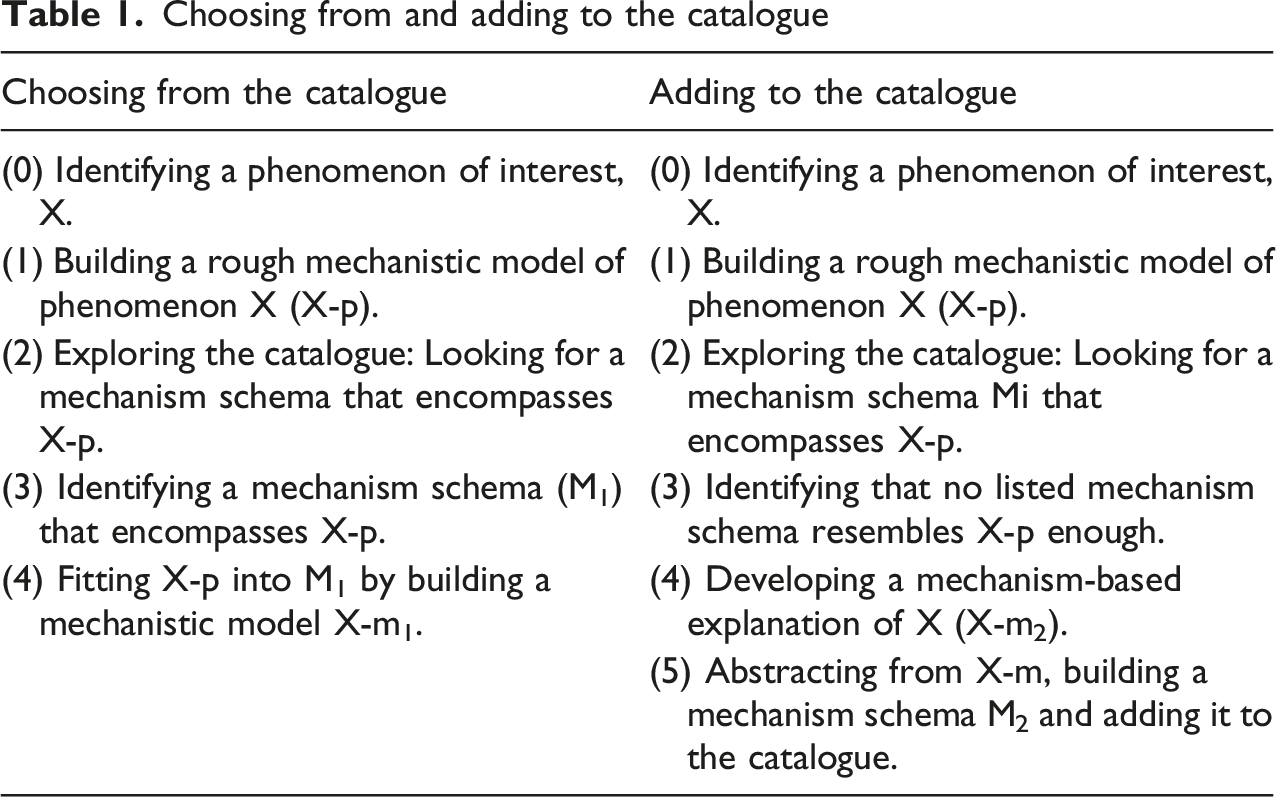
Let us now, in turn, go through the instance in which a new mechanism schema would be added to the catalogue (see Table 1, right column). As before, suppose that a sociologist identifies a social phenomenon of interest X. After they have tentatively represented it through a rough preliminary model X-p, they would inquire into whether it is similar enough to any of the schemata Mi present in the catalogue. If no element in the catalogue is similar enough to X-p, then a new detailed mechanism-based explanation of X is developed, as an explanatory mechanistic model of X (X-m2). As a final step, and taking X-m2 as reference, the sociologist would abstract a mechanism schema M2 and add it to the catalogue, which is now expanded.
This operationalization allows us to illustrate and understand better the roles attributed to the catalogue of mechanisms in the agenda analytical sociology (see the third section). In particular, let us focus on the last two roles attributed to the catalogue (generality and knowledge accumulation).
Once spelled out in detail, we can make sense of the idea that the catalogue allows analytical sociologists to provide general explanations (recall that for analytical sociologists mechanisms not only provide explanations, but that these explanations are general): the same semi-general mechanism may be present in more than one case, and the same schema can be used and reused across cases. This is particularly relevant because generality is often considered the Achilles’s heel of mechanistic accounts of explanation in general (Halina 2017), and it is also a central worry for analytical sociologists, who are keen to distance themselves from the work of historians who instead tend to focus on one-off cases. As we saw, the founders of analytical sociology find that a historical mechanistic narrative which is not aimed at generalization is somewhat lacking as a scientific explanation. Although social scientific explanations cannot rely on laws, they must be general enough to rest on middle range theories.
Our operationalization also illuminates how analytical sociologists think of knowledge accumulation, and how the catalogue of mechanisms would contribute to it. By adding (new) mechanism schemata to the catalogue, new types of semi-general social mechanisms are identified and characterized. Knowledge accumulation thus happens either when new semi general mechanism schemata are added to the catalogue or when pre-existing schemata are chosen from the catalogue for the explanation of new phenomena.
So far, we have operationalized the idea of the catalogue in order to understand and clarify the ways in which it is central to the project of analytical sociology. Through this operationalization, we have seen how the catalogue would assist in developing mechanism-based explanations of social phenomena, and also how it contributes to increasing the significance of these explanations. However, the question that now arises regards the extent to which this operationalization reflects the actual practice of analytical sociology.
The Actual Practice of Analytical Sociology: The Trojan-Horse Mechanism
In the previous section we have operationalized the idea of the catalogue of mechanisms and, in so doing, we have illuminated its pivotal role in the project of analytical sociology. This, however, prompts key questions concerning analytical sociologists’ practices vis-à-vis this project: do they actually assume or act as if there is something like a catalogue that they can consult before attempting to provide new social scientific explanations? And if so, how do they go about using this catalogue? When adding a new mechanism to the toolbox, is there a general expectation that this mechanism will be used again, for other phenomena, so that the explanations linked to a particular mechanistic schema can be considered general?
In order to address analytical sociologists’ practice, let us first focus on a recent example that, as we argue below, might be particularly relevant to the idea of a catalogue of mechanisms. In the article “The Trojan-Horse Mechanism: How Networks Reduce Gender Segregation,” Arvidsson et al. (2021) explore labor market mobility patterns in the Stockholm region during the years 2000–2017. The study introduces and characterizes a new semi-general mechanistic schema: the Trojan-horse mechanism. The authors also provide empirical evidence of its role in reducing gender segregation in the labor market for the relevant region and period.
The Trojan-horse mechanism involves a sequence of interconnected events where the mobility of a minority group member triggers subsequent moves along the same network path by majority group members. To illustrate its workings, consider two organizations: Organization A, which employs a large proportion of male employees, and Organization B, which employs a large proportion of female employees. When Organization B recruits a female from Organization A, it initially contributes to labor market segregation. However, this move also initiates other mobility events that counteract this segregating effect. Employees from Organization A now gain access to job opportunities at Organization B via their former colleague, who recently joined Organization B. This increases the likelihood of employees from Organization A moving to Organization B. Nevertheless, because Organization A primarily employs males, these new recruits to Organization B are more likely to be male. This mechanism is analogous to the Trojan horse from Greek mythology. Just as the entry of soldiers inside the Trojan horse opened the gates for more soldiers, the entry in B of a female employee from A can pave the way for the entry of other A male employees, unexpectedly altering the gender composition of the organization.
Although the study focuses on gender segregation on the labor market, Arvidsson et al. (2021) explicitly highlight the potential generality of the Trojan-horse mechanism. In this sense, they claim that “in any setting where we encounter groups (e.g., firms, schools, and neighborhoods) that are composed of individuals with different characteristics (e.g., ethnicity, gender, and social class) and where the individuals move between the groups, the Trojan-horse mechanism is of potential relevance for explaining how individual characteristics become distributed across groups” (Arvidsson et al. 2021, 5). We take this to mean that the authors consider the contribution of the article in line with the idea of adding to the catalogue developed previously in our operationalization: abstracting from a particular mechanism-based explanation, a new mechanism schema is developed and added to the catalogue for further use to other phenomena.
We can consider, in fact, this study to be canonical to (or at the very least representative of) the project of analytical sociology. In 2023, the article received the Robert K. Merton Best Article Award from the International Network for Analytical Sociology, awarded yearly to the best contribution in the area. The Merton Award statement explicitly underlines that the article increases the repertoire of available mechanisms for analytical sociology: “The article challenges the longstanding view of networks as amplifiers of segregation and adds an important mechanism to the toolbox of analytical sociology” (Buseva 2022; emphasis added). The assessment of the Merton Award Committee fits quite nicely with the idea of adding a new mechanism to the catalogue, as per our operationalization above.
This reading of the Trojan-horse contribution would in principle suggest that the practice—or at least the best practice—of analytical sociology aligns well with the notion of a catalogue of mechanisms. Analytical sociologists are rewarded when they identify semi-general mechanisms and, in doing so, contribute to the expansion of the catalogue. However, some questions immediately arise: in order to be general, do these schemata have to be applied across different cases? How often are these newly added models subsequently selected by other researchers to explain different phenomena? In virtue of what are these schemata general and not just abstract? These questions are relevant because they address a central aspect of the analytical sociology view of explanation and its relation to generality—namely, the idea that generality is grounded in middle-range theorization through semi-general mechanisms.
It should be noted that explaining a phenomenon via a semi-general mechanism and adding this mechanism schema to the common repertoire makes this explanation general only in some (arguably) limited sense. Once added to the catalogue, the explanation becomes potentially generalizable to other cases, waiting to be applied to these other instances. Some could thus argue that the generalizability of a given explanation could remain merely potential unless it is actualized; that is, that an explanation based on a mechanism schema becomes only truly general when other scholars adopt the said schema in their own explanatory work. Arguably, a semi-general mechanism model can be seen as merely abstract, rather than general, unless used across different cases.
Analytical sociologists have not been explicit in this regard and so it is possible to conceive that at least some of them understand the notion of generality as limited to a merely potential attribute of explanation, and without requiring that this generality be actualized. In this sense, a mechanism schema could meet the criterion of generality simply by being prima facie generalizable, even if it were never subsequently reused. This interpretation would however be at odds with some of the core features of the catalogue as understood by analytical sociologists—especially its roles as a toolbox and as an integrative framework (see the third section). After all, if schemata were merely reusable but never de facto reused, the catalogue would not be considered a useful toolbox, and there would be no place for its role in the integration or unification of different explanations under the same mechanistic schema. It therefore makes more sense to think that analytical sociologists understand generality as an ideal that is reached when different phenomena are explained by the same semi-general mechanisms, i.e., when the mechanisms in the catalogue are not only potentially applicable across cases but de facto applied to several phenomena.
Returning, then, to the practice of analytical sociologists: Do mechanisms added to the catalogue—such as the Trojan-horse mechanism—subsequently get picked up by other sociologists? Are they actually chosen from the catalogue and then used in subsequent explanations?
The Trojan-horse mechanism, despite being a relatively new contribution, has been widely cited so far. Since its publication in April 2021, Arvidsson et al.’s article has received several citations, some of which involve high-impact journals such as Nature Human Behaviour, Sociological Methodology, and Journal of Computational Social Science. In this sense, it can be said that the Trojan-horse mechanism has already made a significant contribution to subsequent research. But does it mean that the Trojan-horse mechanism has been “chosen from the catalogue” by other scholars to explain other social phenomena? According to our operationalization, using the catalogue of mechanisms implies not merely citing a particular mechanism, but using it as a constitutive part of an explanation for a social phenomenon.
Although Arvidsson et al.’s paper has so far received a good amount of attention in the form of citations, the majority of the articles citing it do not even explicitly discuss or consider the specific mechanism that it describes. Among the citing articles, only Vedres and Vásárhelyi (2023), in their research on creativity in the video game industry, explicitly refer to the Trojan-horse mechanism, though they do not use it as part of an explanation. In this particular instance, the Trojan-horse mechanism is referenced as an example of a process that can potentially foster inclusion and that, together with gender diversity, could potentially increase collective creativity in the video game industry. Other papers citing the study tend mostly to refer to the paper’s methodology or to the phenomenon of gender segregation. 7 In these other instances, the study is quoted as a representative example of, among others, computational social science and labor-market gender segregation analysis, but the Trojan-horse mechanism itself is not the focus of interest.
We can thus see how a paper identifying a novel semi-general mechanism (and so praised on the merits of this identification) does get cited widely, yet, the mechanism schema introduced by the paper does not seem to be directly employed in new explanations, despite having been identified as an addition to the analytical sociologist toolbox. The case of the Trojan-horse mechanism illustrates that the influence of a mechanism schema within analytical sociology can diverge significantly from the ideal envisaged in the catalogue of mechanisms—where new mechanisms added to the toolbox are later reused to explain different phenomena. Instead, the Trojan-horse case shows that a mechanistic model’s impact, as reflected in citations, can extend well beyond its direct use as an explanatory tool. One may wonder if the Trojan-horse contribution is perhaps too recent for us to observe direct applications of the model, yet, as we will see next, a similar pattern emerges in the way analytical sociologists reference other well-known mechanistic models.
In a recent chapter, Manzo (2021) examined all journal articles having received the Merton award (or an honorable mention for it) between the years 2013–20. He takes the set as an interesting sample in which to test whether analytical sociologists follow, in their practice, the theoretical principles they herald in their manifestos, and in particular their commitment to a mechanistic theoretical stance. To this avail, Manzo reconstructs the explanatory framework of each Merton awarded article and assesses how well they conform to analytical sociology’s requirement of achieving explanation by formulating well-specified models of mechanisms. Manzo’s verdict regarding the coherence between the goals and outputs is overall positive, given that “all the eleven Merton awarded articles, in practice, followed analytical sociology’s theoretical principles concerning how to define the research question, what constitutes a relevant explanandum, how to explain it, and what the structure of the explanation should basically contain” (Manzo 2021, 39–40). However, Manzo also criticizes the fact that these articles do not explicitly try to place their particular mechanistic explanations within the repertoire of mechanisms proposed by analytical sociology’s previous works. Although he is not referring explicitly to the idea of the catalogue, or at least not in these same terms, Manzo’s conclusions indicate that the awardees do not make use of the catalogue of mechanisms. In particular, Manzo finds that this omission to insert newly posited mechanistic explanations in relation to existing ones constitutes a threat to the possibility of knowledge accumulation.
Although Manzo’s preoccupations are different from those of the present article, his analysis of the mechanistic commitments of previous Merton awardees sheds some light regarding the practices of analytical sociologists. Manzo’s analysis shows that, in accordance with their principles, analytical sociologists (or at least Merton awardees) do in fact refer to mechanistic considerations in their analyses, that the explanations they provide are properly micro-founded, and that they do cite some paradigmatic foundational papers in the discipline. But this falls short of the idea that there is a sense in which these scholars explain new phenomena by choosing from a catalogue of mechanistic semi-general models. One could wonder, nevertheless, if Manzo’s analysis is perhaps tainted by the fact that he is only analyzing award-winning articles. After all, these are exceptional contributions that may emphasize novelty and may be distinctly prone to posit new mechanisms rather than reuse well-known ones in their explanations. To address this concern and to further shed light on the practice of analytical sociologists in regard to the catalogue project, in the following section we will focus on how classic contributions may in some sense also fail to be used in the way the idea of the catalogue suggests.
How Are Some Classic Examples Used in the Literature? Schelling’s Model of Spatial Segregation
Our analysis of analytical sociologists’ practice so far suggests that references to a catalogue of mechanisms do not translate in actual research practices. So, even if one were to treat a current set of well-known semi-general mechanisms as a de facto catalogue, the prevailing approach would not really align with the ideal of explaining new phenomena by fitting them into pre-existing mechanism schemata. Instead, as Manzo’s analysis points to, analytical sociologists often simply tend to explain newly found phenomena—or reinterpret known ones—by identifying their micro-foundations, without necessarily referring to previously known specific mechanism schemata and without necessarily putting forward explanations that can easily be coached in terms of a kind of semi-general mechanism schema. As we see next, analytical sociologists may frequently cite classic papers in the field, yet without necessarily adopting the mechanistic models in those works as schemata for their own explanations. In some cases, as we saw regarding Arvidsson et al.’s Trojan-horse article, authors may claim that a new mechanism has been added to the toolbox, but that does not entail that it will be used later on as the basis for new explanations. Instead, references to previous well-known mechanistic explanations in the field tend to focus on specific aspects of these papers, such as their empirical or methodological contributions, or they are perhaps cited simply to underline partial or even faint similarities between new phenomena and previously identified ones. All of this, without reproducing or using as a template the mechanism depicted in the classic contributions. To exemplify this, let us now turn our attention to the citation practices behind one of the most cited and paradigmatic works in analytical sociology: Schelling’s (1971) models on spatial segregation. Though this paper technically predates the analytical sociology movement, Schelling is considered one of the parents of this research program and this paper is one of the most cited works in analytical sociology. Indeed, it already incorporated many of the explanatory and substantive assumptions of the analytical sociology framework (Little 2025). Nonetheless, if we examine the way in which analytical sociologists use and refer to this model (or series of models), we see how this use also diverges considerably from the principles expressed in the idea of the catalogue.
The contribution of Schelling’s paper is twofold: methodological and substantive. Methodologically, Schelling’s segregation model is considered one of the precursors of agent-based modeling. Agent-based modeling constituted then a new, generative methodological approach to test mechanistic hypotheses. By means of a model founded on the preferences and actions of individual agents, the paper tests whether a certain initial distribution of individuals can generate a given aggregate phenomenon. In terms of its substantive contribution, Schelling’s model provides a (potential) mechanism-based explanation of spatial segregation.
Schelling’s methodological contribution has had a huge influence among analytical sociologists. To attest to this, suffice to mention that in his elaboration of analytical sociology’s principles, Manzo (2014) considers agent-based models a core methodological postulate. As Arvidsson et al.’s (2021) paper also illustrates, agent-based modeling is now routinely used by analytical sociologists to test mechanistic hypotheses, allowing them to assess whether a proposed mechanism can generate the social phenomenon of interest. This general methodological contribution, however, does not fit the idea of employing a given mechanism schema in the explanation of a phenomenon in the way suggested by the catalogue of mechanisms.
Let us now consider Schelling’s substantive contribution. The checkerboard model provides a (potential) mechanism-based explanation of spatial segregation. From this explanation, a more general schema can be abstracted. This schema would refer to how individual-level preferences regarding spatial allocation give rise to a specific aggregated distribution. In his own words, Schelling’ paper “is about the mechanisms that translate unorganized individual behavior into collective results” (Schelling 1971, 145). In particular, it could explain how moderate individual preferences can give rise to extreme aggregate configurations. Although in the original paper “the ultimate concern is segregation by ‘color’ in the US” (Schelling 1971, 144), Schelling considers that the underlying semi-general mechanism can work with any “twofold, exhaustive and recognizable distinction” (Schelling 1971, 144), so that it could also apply to phenomena such as how “boys and girls” decide where to sit, or how “students and faculty” or “officers and enlisted” decide to distribute themselves spatially. Schelling’s contribution can in this respect be conceived as providing a semi-general model (a mechanism schema) to which detail can be added in order to accommodate diverse phenomena.
Nonetheless, the practices around this model, much as in the case of the Trojan-horse mechanism, do not really fit the idea of a mechanistic model that is part of a broader catalogue or toolbox of models and that gets sometimes used for the explanation of other social phenomena. Although sociologists in general and analytical sociologists in particular often cite Schelling’s substantive contribution, the focus is very often limited to a particular trait of Schelling’s explanation: the fact that in this model individual-level preferences give rise to unexpected macro-level properties.
The checkerboard model’s contribution can hardly be exaggerated, for it is one of the main exemplars that helps remind social scientists about the intricacies of aggregate action and it is often used to illustrate the possibility of systemic emergent properties. However, referencing a model to illustrate a type of phenomenon and reminding or teaching social scientists about it does not amount to using the underlying schema for building the explanations of other social phenomena. In other words, for the checkerboard model to be used in the way our operationalization suggests, the mechanism schema underlying in the checkerboard model should be a constitutive part of the explanation of other, newly identified phenomena. Yet the majority of citations of Schelling’s work cannot be described as cases in which the checkerboard mechanism schema is being used for explanatory purposes.
Surely, a small but non negligible number of papers seem to attempt precisely this. For example, Ruoff and Schneider (2006) apply Schelling’s analytical framework to the building and interpretation of a field experiment on the seating decisions within a classroom (and thus a low-cost decision-making situation, in contrast to residential choices). Yet this type of exercise represents a very minimal proportion of the bulk of citations of Schelling’s contributions. But more importantly, when this type of contribution appears is not meant as an explanation of a phenomenon (the phenomenon itself might not be of substantive sociological interest), but rather, this type of exercise is often conceived as a means of testing whether the generative sufficiency of Schelling’s model actually can take place in real-world settings (Ubarevičienė et al. 2024).
That the checkerboard schema is not primarily used in explanations of other phenomena does not mean, however, that Schelling’s model is not influential, only not in the way that the idea of a catalogue of mechanistic models suggests. As we already underlined, the checkerboard model is influential both methodologically, in that it introduced a novel method to the modeler’s repertoire, and substantively, in that it helps illustrate cases in which surprising aggregate outcomes can emerge from particular configurations of individual preferences. Yet neither of these important ways of influence translate straightforwardly into the type of functions that the idea of the catalogue of mechanisms suggested.
In sum, the checkerboard model (often presented as a clear, canonical illustration of what a toolbox or catalogue of mechanisms should offer) is not actually used in the way that this toolbox metaphor suggests and this further illustrates how the actual practices of analytical sociologists do not support the idea that such a catalogue exists and/or functions as its founders envisioned. Moreover, the fact that the checkerboard mechanism continues to face scrutiny regarding its plausibility and robustness across varying conditions underscores this: it shows not only that well-known mechanisms are not systematically reemployed in other explanations, but also that their status (in terms of generality or reliability) is often far less secure than the idea of a catalogue of mechanisms presupposes. Together, these observations cast doubt on both the existence and the practical usefulness of the catalogue that analytical sociology theoretically claims to rely on.
The divergence between the practices of analytical sociologists and the project of the catalogue is, however, hardly accidental or anecdotic. Once we operationalize the idea of the catalogue and consider real cases of semi-general mechanism schemata that could be part of it, relevant theoretical and conceptual problems of the project become apparent.
First, there are problems related with the individuation of the different mechanism schemata. According to our operationalization above, a semi-general mechanism schema needs to be abstracted and stripped of detail in order to be reused in further explanations. Nonetheless, discerning what aspects of a given mechanistic model are to be chosen as part of the semi-general schema (and which should not) may often not be obvious. The individuation of a semi-general schema out of a given mechanistic explanation seems to be best conceived as interest-specific, i.e., it is likely that different researchers will decide to take on in their own research different aspects of the model, depending on their interests. And this is in fact what we observe when looking into the relevant literature in the case of Schelling’s checkerboard model: different authors will pick different aspects of the model relative to their interests. Put in terms of our own operationalization of the workings of the catalogue above: when confronted with a phenomenon of interest X, not only there are many possible avenues regarding what aspects of it we want to represent but also, importantly, there will be many possible avenues in which different researchers can interpret Schelling’s model (or any other model) provides a semi-general schema. There is more than one way to interpret what in the original model is essential and should remain in the schema, and what is case-specific detail.
The individuation of semi-general models from mechanistic explanations seems trickier and a more subjective and researcher-specific task than the idea of the catalogue of mechanisms in principle suggested. If this is so, then, the catalogue is perhaps not one of semi-general mechanisms (for different authors will pick different aspects of the same model), but a more mundane list of (successful) explanations, or, in the classic parlance of philosophers of science, a mere list of exemplars.
Second, there are ambiguities related with the way in which researchers should interact with the repertoire of models in the catalogue. It is unclear how sociologists, when engaging in the explanation of a newly found phenomena, should choose between an existing mechanism schema (say using Schelling’s checkerboard schema, however interpreted) or instead adding a new type of mechanism to the catalogue. When does a mechanism schema based on a previous template become a different specimen in the catalogue, or when is it a mere version of an existing mechanism? There is no precise criterion for assessing the level of similarity and determining whether the preliminary model sufficiently resembles certain schema from the catalogue or whether instead it merits its own type, a new schema.
Again, the individuation of a semi-general mechanism schema and its relevance to the mechanistic explanation of a given phenomenon seems also riddled with subjective and interest-related considerations that are difficult to systematize and thus put a shadow over the idea of a well-working catalogue that a community of researchers use in an agreed upon way. These difficulties in themselves could explain why there seems to be little in the practice of analytical sociologists that coheres with the idea of a catalogue. To be sure, analytical sociologists, much like practitioners in other research programs and disciplines, do refer and recurrently cite famous models, papers, or explanations of phenomena that work as exemplars. This, however, does fall short of the idea of a catalogue of mechanisms playing a crucial role in the explanatory practices of analytical sociologists.
Conclusion
The methodological movement of analytical sociology, which has achieved an important standing within contemporary sociology, involves a series of theoretical stances and commitments. Central among these is the idea of a catalogue of mechanisms. The catalogue would, according to analytical sociologists, provide a toolbox for generating new explanations, increase their explanatory power, and account for knowledge accumulation. Nevertheless, despite its centrality, the idea of the catalogue has remained underdeveloped, and there is little clarity regarding what it would entail or whether it can be said to already be functioning.
In this paper, following the theoretical commitments of analytical sociology, we have operationalized and assessed the proposal of the catalogue of mechanisms. According to our operationalization, the idea of the catalogue can be made sense of if understood as a collection of semi-general models of mechanisms, i.e., mechanism schemata. This collection could then be used by analytical sociologists in two different ways. When choosing from the catalogue, a previously identified mechanism schema is adapted to account for a specific social phenomenon. Conversely, when adding to the catalogue, a new mechanism schema is developed and included in the toolbox. Based on our operationalization, we assess the degree of correspondence between the idea of the catalogue and analytical sociologists’ current practice. For this purpose, we consider two particularly relevant case studies: the Trojan-horse mechanism and the Schelling’s model of spatial segregation. 8 We find many substantial differences between the way in which analytical sociologists interact with previous mechanistic explanations and the description suggested by the notion of a catalogue of mechanisms.
Although analytical sociologists may sometimes think of their scientific contribution in terms of new mechanism schemata to be developed and added to the catalogue, those schemata are afterwards only seldom chosen to form new explanations. Given the importance of generality in the explanation ideal of analytical sociologists, the fact that mechanism schemata are rarely reused should give pause to theoreticians of the movement. The ideal of generality embodied in the catalogue of mechanisms seems to be compromised: if the mechanism schema instantiated in an explanation is not present in other explanations, the promise of generality remains unfulfilled.
In this sense, analytical sociology then grapples with the problem of the generalization of mechanistic explanations as much as any other mechanistic account, and what seemed like a way out of it (the catalogue of mechanisms) remains a vague desideratum that is for the most part negated or ignored in their practices. As it is well-known, the mechanistic approach to scientific explanation faces several limitations when it tries to account for generality. Mechanistic explanations often remain too detailed or context-dependent to support wide-ranging claims across different cases, and social scientific explanations of the sort envisioned by analytical sociologists are no different. As a result, mechanistic accounts in analytical sociology are so far still closer to patchworks of local models. A few central exemplars recur in the training and socialization of analytical sociologists, and these do function as a kind of “toolbox” within this empirically successful research program. However, this feature is not unique to analytical sociology; more importantly, this limited set of exemplars falls short of constituting the extensive and widely applicable catalogue of mechanisms originally envisioned by its founders.
Footnotes
Acknowledgments
We thank the editor and the anonymous reviewers for their constructive reading of the paper and their helpful comments. We also benefited from feedback from audiences at the Contemporary Philosophy Meets Philosophy of Science (Athens, 2024), the XI Congress of the Spanish Society for Logic, Methodology and Philosophy of Science (Oviedo, 2024), the TINT Seminar (Helsinki, 2024), the METIS seminar at UNED (2023), and the Evidence and Mechanisms in the Social Sciences Workshop (Valencia, 2023).

Funding
The authors disclosed receipt of the following financial support for the research, authorship, and/or publication of this article: Grants PID2021-125936NB-I00 and PID2024-155508NA-I00 funded by MICIU/AEI/10.13039/501100011033 and by ERDF/EU, and Grant PROMETEO-CIPROM/2023/55 funded by Valencian Department of Education, Culture, Universities, and Employment.
Declaration of Conflicting Interests
The authors declared no potential conflicts of interest with respect to the research, authorship, and/or publication of this article.