






Abstract
Inclusive urban planning requires comprehensive and sufficiently detailed information about urban areas. In the absence of such information, many informal settlements are left out in the city-wide planning process. In the metros as well as in many big cities in particular, large proportion of the urban population lives in slums in India. The urban projects undertaken in these cities tend to ignore significant slum improvement interventions. The development plans have really not addressed the issue of the marginalisation of the poor in the cities, often leading to their spatial exclusion. They are pushed out of the city, where services are poor and investments are low.
Slum Environmental Sanitation Initiative (SESI) of UN-HABITAT in the cities of Bhopal, Indore, Gwalior and Jabalpur in the State of Madhya Pradesh has resulted in significant improvements in the lives of slum communities through creating open defecation free slums, improving access to safe water, sanitation and hygiene practices and mobilising men and women for community action.
Poverty Pocket Situation Analysis (PPSA) has been used as an instrument to prioritise the slums for investments based on poverty and environmental infrastructure deficiency matrix. The process involved spatial mapping of infrastructural deficiencies in the slums. The outcome helped in the selection of the most vulnerable slums for water and sanitation intervention under SESI.
One of the main obstacles to inclusive urban planning is the lack of up-to-date, comprehensive and sufficiently detailed information about urban areas. As a result of this gap in information, many informal settlements are left out in the city-wide planning process. In the metros as well as in many big cities in particular, large proportion of the urban population lives in slums in India. The urban projects undertaken in these cities tend to ignore significant slum improvement interventions. The development plans have really not addressed the issue of the marginalisation of the poor in the cities, often leading to their spatial exclusion. They are pushed out of the city, where services are poor and investments are low.
This article is based on UN-Habitat’s work in the State of Madhya Pradesh from 2005 to 2012 while supporting the implementation of an ADB-assisted project on water and sanitation in four cities. One of the key challenges for each of the four cities of Madhya Pradesh, namely, Bhopal, Indore, Gwalior and Jabalpur was to reach the last mile while implementing city-wide project on water and sanitation at a total cost of about US$ 400 million. A situation analysis of the poverty revealed that the poor do not live only in slums and squatter settlements. There may be poverty pockets (PPs) elsewhere as well.
A detailed survey titled Poverty Pocket Situation Analysis (PPSA) was carried out in the four project cities. PPSA aims at ranking PPs in terms of availability and access to water and sanitation facilities. This was not a household survey. The data under this study have primarily been derived from key informant interviews and group discussions and reflects the multiple and overlapping perspectives of different stakeholders in all the PPs of the four selected cities. This process involves spatial mapping of infrastructural deficiencies in the slums and a base line survey of the individual household for monitoring the MDG parameters for sustainable access to improved sanitation and safe drinking water. The final outcome of this mapping exercise is the selection of the most vulnerable slums for water and sanitation interventions under Slum Environment Sanitation Initiative (SESI).
This article is thus divided in two parts. The first explains the poverty mapping framework for infrastructure interventions as developed by UN-Habitat in supporting the implementation of the project and the second part details out the specific pilot project titled Slum Environment Sanitation Initiative as a mechanism to reach the urban poor.
Poverty Mapping Framework for Infrastructure Interventions
Background
The State of Madhya Pradesh has very poor coverage of urban population through tapped water sources and sanitation facilities, in addition to its gaining momentum in the process of urbanisation. Most affected by this lack of basic services are the city’s poor who constitute a sizeable population and live in the slums. Official data on the slum population including basic service delivery status, status of BPL families, etc. are either very old or inadequate. The rate of increase in urban poverty and PPs in the large cities of Madhya Pradesh further makes the Census data and the existing municipal data irrelevant. In this context, a study was taken up to find out the status of water and sanitation in the PPs of the project cities in the state.
Objectives and Strategies
To select PPs in consultation with the municipal corporations of the four project cities covering 5,000 households for project intervention, having concentration of the poor with higher deficiency in water and sanitation; and
Collate data on all the PPs on the availability of environmental deficiency parameters for starting the Municipal Action Plan for Poverty Reduction (MAPP), a process initiated by the municipal corporations under the ADB project supported by UN-Habitat under the Water for Asian Cities Programme.
Mobilisation of Resources
This initiative was a collaborative effort between UN-HABITAT, Water Aid and the local municipal corporations. The mapping of the poor in the city was done in order to monitor the impact of the intervention on targets 10 and 11 of goal seven of the MDG on water and sanitation at the local level. The slums were selected on the basis of this mapping exercise in consultation with the city corporations and the partner NGOs, namely, Advocacy for Alternative Resources, Action, Mobilisation and Brotherhood (AARAMBH) in Bhopal, SAMBHAV Social Service Organisation in Gwalior, Bhartiya Gramin Mahila Sangh (BGMS) in Indore, KSHITIJ and Association for Community Transformation (ACT) in Jabalpur. Approximately, 500 officials of the municipal corporations and 600 NGO staff were involved in this survey. Several rounds of consultations were conducted with the municipal corporation staff and local counterpart NGOs. Each questionnaire had a provision for dual signature of both the entities.
Process
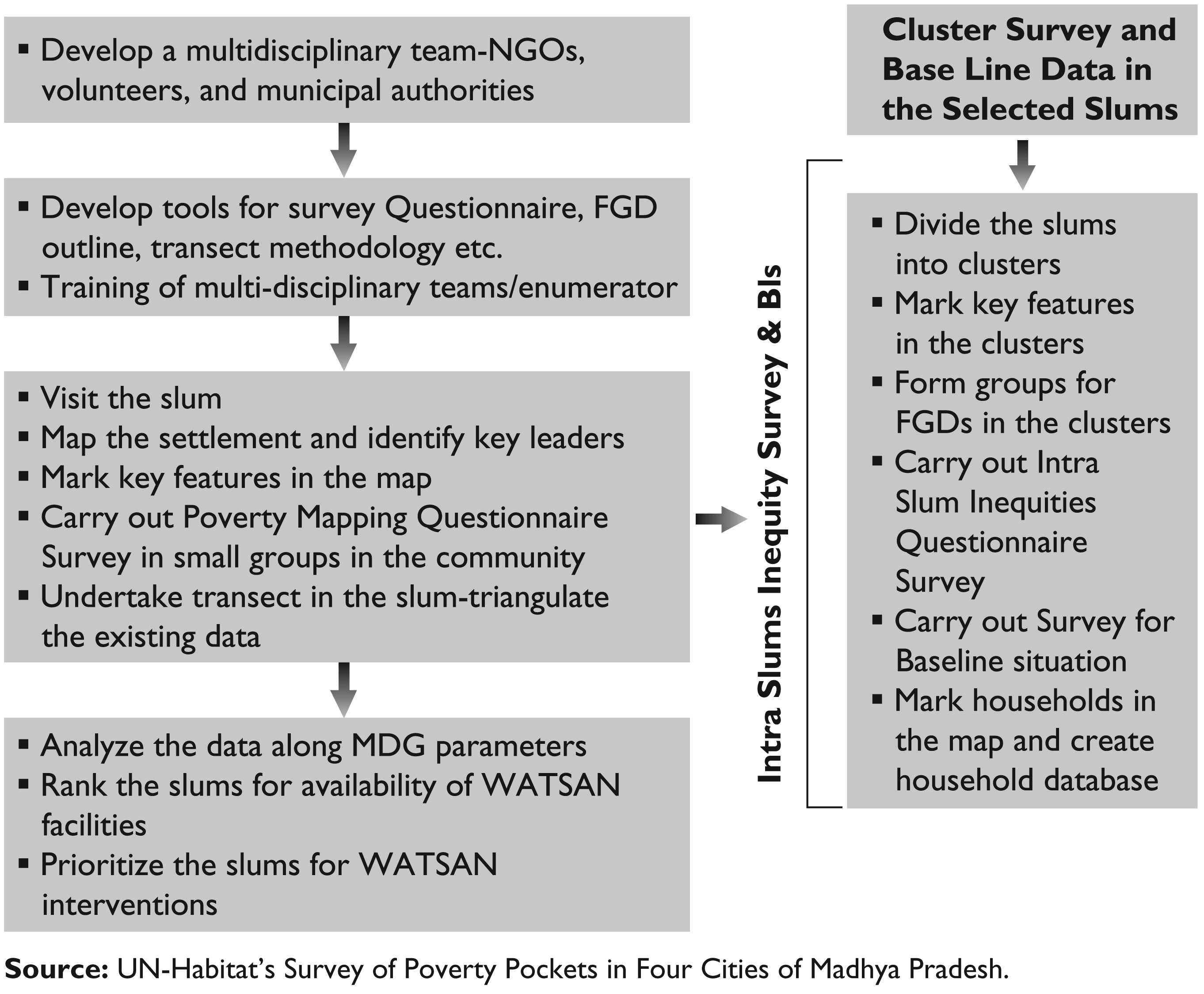
This initiative started with the collection of baseline data by a physical survey which illustrates the location and condition of the poor in various localities and establishes baseline values for the MDG indicators in each of the areas, establishing programme management indicators.
The questions in the survey form were regarding population (number of households, number of families below poverty line (BPL), total population, etc.), presence of infrastructure (roads, street lights, schools, anganwadi, balwadi, health centres, etc.) access to water supply (hours of water supply, number of individual and community water connections, quality of water, etc.) and access to sanitation (individual and community toilets, open defecation practice, solid waste management, etc). The data analysis provided information on PPs with least access to water and sanitation and where the number of people living BPL was high apart from access to infrastructure. Based on the individual PP’s information on these counts, PPs were categorised and ranked. In order to triangulate the quantitative data as well as to collect information on quality and status of available infrastructure and basic services impacting quality of life in PPs, qualitative surveys were also undertaken in few slums separately using participatory exercises for community’s direct feedback from six PPs in each of the cities for final analysis.
In the selected PPs for project intervention, a base-line survey at the household level was later carried out to assess the status of water and sanitation services besides the knowledge, attitude and practices (KAP) of the slum residents in their hygiene behaviour. This information was subsequently used for the development of operational plans for project interventions. Further, the baseline data were also used to define GIS layers and mapping of the status of these pockets through visual maps in GIS.
Given below is the flow chart that explains various stages involved in the process of data collection during PPSA exercise:
Results Achieved
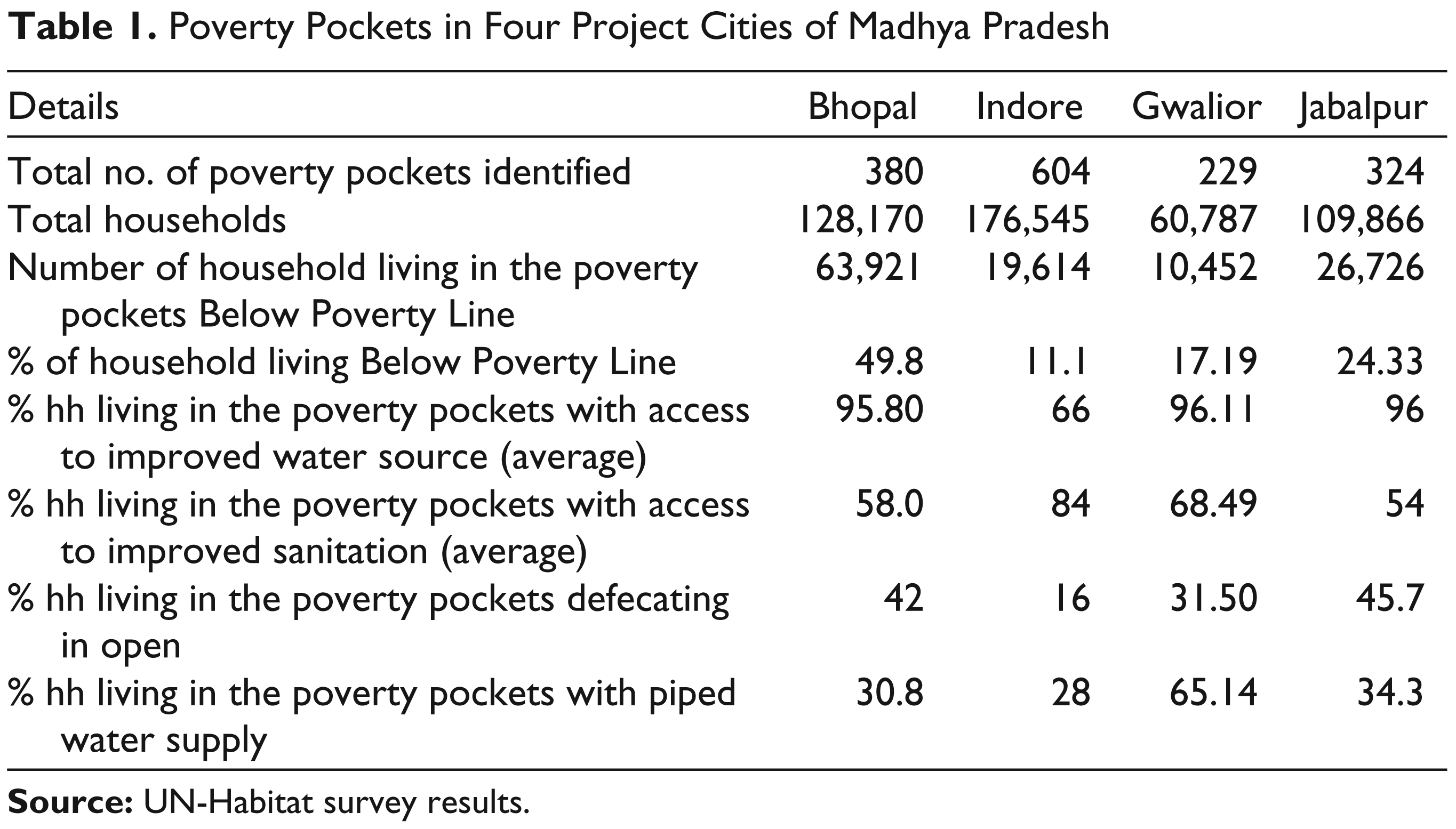
This study finds that the number of PPs (Table 1) and their population in these cities have been severely under-reported in the official records. There are 55 to 65 per cent gaps in the estimation of number of PPs between official data and current survey. While the Census 2001 reported 8.3 per cent (125,720) Bhopal’s population in 209 slums (Census 2000), the present survey recorded 128,170 households in the 380 PPs/slums. Even considering a conservative estimate of five members per households, it multiplies the household’s number to a much higher figure of 640,850 persons, which is more than 45 per cent of the city’s population recorded in 2001, that is, 1.43 million. The presence and identification of a large number of non-notified slums underscores the importance of formalising these and also the urgent need to take facilities and entitlements to the large concentrations of households (HHs) in such PPs. The study revealed a high percentage of HHs having access to improved water sources, which was indicative of the presence of infrastructure but did not necessarily ensure the required availability of water to the HHs.
Survey data using participatory methodologies provide contrasting answers to the queries relating to access to water, sanitation and basic infrastructure. These are indicative of the complexity of the issues at hand. In the absence of piped water supply to households and low water tables in many areas, in summer a household may have to spend as much as 4–5 otherwise productive hours in fetching water. This takes away their time from other livelihood activities and puts a tremendous burden on women in particular. Households pay private water providers where quality of water is anyone’s guess. Water scarcity has also been found to be one of the important reasons for the discontinuance of education of adolescent girls, who are generally given the responsibility of fetching water for the households. Each water source has a number of people dependent on it resulting in a tremendous amount of pressure on each source. Opportunity costs of accessing water are high, as households lose out on income contributions by one or the other productive member due to the need for someone to take responsibility to fetch water and, on the other hand, pay high amounts of money to private providers to get this basic service.
Poverty Pockets in Four Project Cities of Madhya Pradesh
Qualitative findings reveal the seasonality of water availability, predictably the summer season being the worst for the inhabitants in the PPs. Water supply through municipal taps gets reduced considerably as well as through hand pumps, bore wells and tube wells. Water is supplied through municipal tankers, but this also fails to fulfil the requirements. The qualitative survey also found that even where sources of water were present, the dependence of the community was gradually increasing on the same source over time due to increase in population. Therefore, lack of access is not just a function of complete absence of infrastructure but also of an increasing population dependent on available sources and interventions which need to be planned in this light.
Lower access to quality sanitation facilities and services is mainly hindered by the current status of low availability and poorly maintained sanitation and sanitary conditions. Qualitative survey noted that even the households, which have got personal toilet, prefer to go for open defecation. One important reason for this has been lack of water for cleaning and flushing the toilets. The other reason has been the lack of a proper drainage system, which result in choking of these toilets very frequently. This information of about 1,540 slums was collected, analysed and uploaded onto the GIS and later made available to the municipal corporations.
Sustainability
The data generated through the survey would help in implementing other pro-poor initiatives in the project cities. This data have been used by the government of Madhya Pradesh for implementing basic services for the urban poor in the project cities and act as a tool for monitoring the status of the slums for convergence of the resources and at the same time, would help in assessing the infrastructural deficiencies and plan interventions. The factors leading to sustainability include:
Financial: The use and leveraging of resources, including cost recovery, indicating how loans are being paid back and their terms and conditions; Social and Economic: Gender equity, equality and social inclusion, economic and social mobility; Cultural: Respect for and consideration of attitudes, behaviour patterns and heritage; Environmental: Reducing dependence on non-renewable resources (air, water, land, energy, etc.) and changing production, consumption patterns and technologies.
Lessons Learnt and Transferability
The Poverty Mapping Framework revealed that the number of slums in the project cities has increased considerably as compared to the Census survey conducted in 2001 by government of India. The process was designed to provide the framework for participatory planning between corporation and communities at the neighbourhood level and need for undertaking such surveys at frequent intervals to monitor the achievement of MDGs.
This programme provided the framework for participatory planning between corporation and communities at neighbourhood level, aimed at networking slum improvements to citywide infrastructure. The poverty mapping data and reports have been handed over to the state government and municipal corporations for preparing the Municipal Action Plans for Poverty Reduction under the DFID-funded Madhya Pradesh Urban Services Project Programme. Under the MAPP process, the majority of the Project investments were dedicated to improving major environmental infrastructure throughout the urban areas of the project cities. The Poverty Mapping Framework adopted in the four project cities is a pathfinder for pro-poor water and sanitation governance and becomes an essential and integral part of any city/town economic and social development.
Slum Environmental Sanitation Initiative (SESI)
SESI was a part of UN-HABITAT’s Water for Asian Cities Programme, which focused on developing approaches for making interventions at city and local levels, to extend coverage to un-served households with higher levels of sustainability. The cities selected for SESI were the same cities—Bhopal, Gwalior, Indore and Jabalpur, which were investing in upgrading the city-wide water and sanitation infrastructure with ADB assistance. The overall purpose of this initiative was to demonstrate and develop approaches for slum improvement (with focus on water, sanitation and hygiene) with select local Non-governmental Organisation (NGO) partners, which could influence the larger investments in the cities and access to services by the marginalised. This pilot project has demonstrated ways to promote pro-poor water and sanitation governance so that the poor have affordable access to safe drinking water and sanitation facilities which may improve their health, productivity and alleviate poverty through better income generation and livelihood opportunities. This project also influenced the adoption of community approaches including community financing and low cost technology options to influence the larger urban sanitation welfare schemes.
The project covered about 65 slums in the four cities. Significant improvements have been made in the lives of slum communities through creating open defecation-free slums, improving access to safe sanitation and water, improving hygiene practices and mobilising men and women for community action.
Background
In Madhya Pradesh, the process of urbanisation gained momentum when the state registered an urban growth rate of 52.92 per cent between 1971 and 1981. The rate of growth seems to be tapering off since then, yet the growth of urban population in the state (31.19 per cent) was higher than the national average (31.13 per cent) during 1991–2001. The urban population constitutes 26.6 per cent of the total population of the state which is comparable to the national average of 27.7 per cent, making it the sixth most urbanised state in India.
A study by Water Aid, on Water and Sanitation Status in Urban Areas of Madhya Pradesh (2005) found very poor coverage of urban population through tapped water source apart from inadequacies in proximity of sources. While availability of infrastructure is accounted for accessibility to water in the government records, the study noted that 93 per cent of towns in Madhya Pradesh have less than 70 litres per capita per day (lpcd) of water as against the minimum supply norm of 135 lpcd. The study also revealed that only 63 per cent of the urban centres receive water daily, while 28 per cent of towns receive water supply once in two days and 9 per cent towns once in two or more days. Sanitation coverage is also reported to be very low and no city is covered by a sewage network. Base-line studies in the selected slums of the four cities have revealed that almost 40 per cent of the population is dependent on water that is available for less than one hour per day.
Objectives and Strategies
The primary purpose of the SESI project was to demonstrate and develop approaches for pro-poor investments to improve water and sanitation conditions in slums. This pilot project tested a new partnership model involving different stakeholders including NGOs, Communities, Government and elected representatives, where each of them had a specific role to play. The project aimed to improve the water, sanitation and hygiene status amongst 20,000 families in 65 slums in the four cities, leading to open defecation-free PPs, while demonstrating an approach for pro-poor urban governance. The objectives of the project were:
To demonstrate a community-led approach for changing urban governance in favour of the poor and improving the conditions of slums; To test as a pilot, the partnership between UN-HABITAT, Water Aid India and the municipal corporations; Improving access to safe water and sanitation in selected slums to end the practice of open defecation; and Developing sustainable community-owned, managed and operated water and sanitation facilities.
Mobilisation of Resources
The project was jointly implemented by UN-HABITAT, Water Aid India and the City Municipal Corporations, with the support of implementing partners, namely, AARAMBH in Bhopal, SAMBHAV Social Service Organisation in Gwalior, BGMS in Indore, KSHITIJ and ACT in Jabalpur. UN-HABITAT, Water Aid and the Municipal Corporations financially supported this project. All the three partners have played a unique and significant role to enhance the outputs and learnings.
Process
SESI aimed to develop best practice models for implementing integrated water, sanitation and hygiene projects, to maximise the health benefits, which are also cost-effective and sustainable. The project emphasised on enhancing people’s capacities for adopting safe hygiene behaviours and generate demands for sanitary facilities through use of relevant information, education and communication (IEC) materials.
The key activities under this project include:
Mapping the poor in the four cities—a citywide mapping for all PPs, used for selection of slums for further intervention. The slums were selected on the basis of inaccessibility to basic services and prevalence of BPL families; Base line situational analysis for benchmarking of data on access to safe water, sanitation, hygiene practices, willingness to pay, institutional situation; Community mobilisation and awareness on sanitation and hygiene; Training and capacity building of Self-help Groups (SHGs), NGOs and slum-level groups; Value-based Water, Sanitation and Hygiene Education component—focus on hygiene behavioural change through school and community hygiene programmes; Infrastructure development—individual and community toilets, solid waste management, drinking water points and roof rainwater harvesting, among others; School sanitation activities; and Documentation and learning.
Awareness building, meetings with communities to disseminate hygiene messages, motivating and mobilising communities to construct toilets, sensitising them about the ill effects of open defecation, rallies and camps, formed the hallmark of community facilitation exercise done by the partners. Simultaneous efforts were made in the project to constantly dialogue and negotiate with the municipal officials to take up water related works, provide waste bins in the slums, provide water points in slums and also lay drainage works. Provisions were also made in the project for pro-poor funding, in the form of revolving loan/fund, to enable the poor to gain access to credit, to construct individual household toilets. Simultaneous efforts were made to orient the staff of municipal corporations and elected representatives through stakeholder consultations and workshops, on propoor approaches, highlighting the need for integration of hygiene with water and sanitation, sustainability and importance of community consultation, role of Corporators and official staff, etc. Exposure visit of Municipal Corporation Officials and Corporators (elected public representatives) were organised to Bangalore and Tiruchirapally (Trichy) where community-managed sanitation initiatives are running successfully.
Results Achieved
A few notable outputs at the end of the project were:
60 open defecation free slums—the first initiative in Madhya Pradesh; 20,000 families had access to safe sanitation—Household (HH) toilets; 20 School Sanitation Blocks constructed with rainwater harvesting structures; 15 new community toilets constructed and managed by communities; 1,000 metres of underground drainage restored/created—by municipal corporations; 50 water sources restored; 100 women’s groups spreading the message of safe hygiene; 63 Community Water and Sanitation Committees working; Waste bins and rickshaw vans provided in the slums—for door to door garbage collection; 11,000 families started using compost pits, soak pits; Corporators and elected representatives trained and exposed to issues of water and sanitation; and A large data and information base/GIS maps created for all the slums.
Discernible impacts can be seen in the following areas:
Increased levels of awareness regarding safe hygiene and sanitation practices amongst communities, especially women leaders and children. The emphasis on school hygiene education and the spread of hygiene messages through self-help groups (SHGs) has contributed to enhanced awareness and knowledge amongst women and children, who are now acting as hygiene ambassadors. Inclusion of the poor and the marginalised members of the slum communities in planning process—providing them with a platform to participate in the form of SHGs and Community-based Water and Sanitation Committees (CWASCs). Participation of women in the SHGs has considerably increased and provided them with opportunities to make decisions regarding locations for latrines, on investments for hardware structures and on interventions for slum improvement. Trained masons are a major human resource in the slums, who are actively engaged in the promotion of low-cost individual Household latrines. An overall sense of community ownership and sense of responsibility for taking up slum improvement activities is remarkably evident amongst the people. Few slum communities are in the process of declaring themselves open defecation free, totally changing the face of the slums. Construction of toilet facilities in the slums have not only provided increased convenience but also dignity to women and adolescent girls, who were under constant threat of physical abuse while going out in the open for defecation.
Impact at the strategic/sector level
Availability of sanitation fund has improved access to credit for the urban poor to construct toilets. Process is on to get the guidelines for sanitation fund adopted by the local government as this will enable rapid up-scaling of sanitation coverage. Open defecation free slums is a new ‘strategy’ in the selected slums of the project cities. Entire communities, so far unaware of the concept of HH toilets or Community Toilets, are now actively engaged in constructing pits for latrines, forming SHGs for management of the sanitation fund. The poverty mapping reports have, in terms of the issues, highlighted the interrelatedness of infrastructure issues, and as qualitative data have so forcefully brought out the need to take a holistic approach rather than providing one or the other kind of infrastructure and expecting long-term sustainable impact. The poverty mapping exercise has also been significant because it:
Takes into account all PPs—notified and non-notified. Has been able to identify a large number of non-notified slums in all cities. Inter PPs—WATSAN deficiency in the most deficient. The qualitative study focused on understanding the extent of lack of access and implications of infrastructure deficiency on education, especially girls, health and livelihoods. Engaged Corporators and local residents in an exposure visit to best practices in urban WATSAN sector in South India, as an outcome of which, councillors have constructed Child-friendly toilets and have facilitated Management of community toilets by SHGs, on the models set up in Trichy. Stakeholder consultations organised in each city, which were attended by respective city Mayors, City Municipal Commissioners, city engineers, Corporators and a large number of other stakeholders have been very effective forums to share the findings of PPSA and get these endorsed, but also to seek their commitment to the project.
Sustainability
The project emphasised on working through local partners and with communities, to ensure that there was full ownership of the project in planning, implementation and monitoring. Water Aid ensured that there exists a capacity within the community so that the benefits were sustained and communities were also empowered to demand and receive benefits from the municipalities. Some of the concrete steps taken were:
The CWASCs formed at the slum level for planning, coordination, monitoring of the project, have been oriented on various aspects of urban water and sanitation, their role as members of this group, and have been trained on organisational development aspects. Members of CWASCs have successfully interacted with local corporators to demand their attention and time for the project and seek their greater involvement. The local partner organisation has assumed greater responsibilities in interfacing with the municipalities and government officials, corporators, and local leaders and they have been successful in mobilising funds for activities to be done by the municipal corporations. Involvement of SHGs in all the project activities has given greater confidence that activities will be sustained over a long time. SHGs are closely involved in decision related to constructing latrines, slum sanitation activities etc. Involvement of SHGs has resulted in improved usage of assets. Involving women and children in hygiene promotion programmes have resulted in discernible changes in water handling practices and hand washing practices, at the HH levels.
Lessons Learnt and Transferability
This project has yielded good learning opportunities, both from working in the field and from strategic relationships built over the duration of the project. Some of the important lessons learnt were:
Providing alternate financing options, in the form of sanitation loan to communities can greatly enhance the pace of adoption of toilets in the urban context. The need for toilets is well articulated by the community in many cases but lack of adequate community-based financing options was a deterrent in taking up toilets. Majority of the communities that had chosen to work with belonged to the most deprived sections like rag pickers, those with very limited source of income and other deprived groups. It was also felt that targeting subsidies to these genuinely marginalised sections motivates them to adopt latrines. It is important to integrate provision of safe drinking water and improved sanitation with hygiene education in order to achieve improved health outcomes. It is essential that hygiene education is integrated right from the beginning in order to ensure greater adoption and usage of sanitation facilities. A significant outcome of the poverty mapping exercise has also been the identification of a large number of non-notified slums in all the four cities, underlying the need for taking services and entitlements to these areas.