







Abstract
The study delves into the occupational precariousness among adivasis and scrutinises the issues of adivasi migrant labour which have been reflected in the Disha Foundation’s report on Tribal Livelihood Migration in India (2021). The study disseminates that while land alienation has engendered livelihood insecurity among adivasis, the politics of identity and dominant pedagogical paradigm have intensified their occupational vulnerability which eventually turned a large section of them into precarious labour. These three factors together explain the increasing migrant labour among them in different states. Unless these three major issues are addressed, the problem of the employment crisis among them may not be mitigated as these are the factors that not only affect their economic life but also the socio-cultural life which plays a major role in their preference for occupation.
Introduction
Adivasis 1 are considered a self-sufficient and self-contained community. Their livelihood is mainly sourced from both agriculture and forestry. Their agricultural lands are mostly dry and classified as unfertile land since these are located in hilly terrains. Therefore, agricultural lands hardly meet the food demands of the households for the entire year. Moreover, their economic activities and labour power remain idle in the dry season (November to June). This recoupment is primarily mitigated by the forest economy. Throughout the year, the forest supplements a substantial part of their economy as well as food for consumption. Thus, both agricultural land and forest coherently sustain the self-reliance and self-contained life of adivasis. Any disruption in agricultural activities and forestry may beget a severe risk of occupational vulnerability and subsequently occupational dependency on the urban labour market among them.
Such disruption and shifting from self-contained to dependent community is not a recent phenomenon. It did occur in both pre-colonial and colonial periods. However, such transformation was vividly noticed in the colonial period and it is being intensified in the post-colonial regime. In the colonial period, it was reflected in the form of adivasi migration as indentured labour to the sprawling tea gardens of Assam and West Bengal. Between May 1863 and May 1866, about 84,915 adivasis from the Chota Nagpur Plateau were recruited in the tea gardens of Assam and Cachar. Such migration never uplifted their life and even today their descendants continue to live and are employed as precarious labour in the tea garden. Soon after migration, about 31,876 died within these three years due to the unhygienic environment (Bose, 1954; Griffiths, 1969). Such precarious labour migration continues to occur in the form of circular or seasonal migration in the post-colonial period as the growing industrialisation and urbanisation intensified the depletion of the traditional natural resource base. A report by the Disha Foundation, Ministry of Tribal Affairs (2021) on Tribal Livelihood Migration in India ascertains that migration has become the coping mechanism for adivasis in India in response to lack of earning sources in their traditional settlements. A significant portion of adivasi population from adivasi-dominated states such as Chhattisgarh, Madhya Pradesh, Jharkhand and Odisha migrate to other states in search of employment. All these states are also well known for the proliferation of mining and industrial activities. At this juncture, it is very relevant to raise the question, Why adivasis are migrating to other states in search of employment while employment machines are planted at their doorsteps?
Their migration to faraway places is conventionally driven by hopes of higher wages and undeniably, it has more or less contributed towards the affluence of their household as well as the village economy (Rajan & Sivakumar, 2018). However, a holistic analysis of migration manifests that their new livelihood strategy is invariably subject to risk, uncertainty, exploitation and lack of opportunities to move up the occupational ladder since they are generally concentrated in the informal and unorganised labour market (Mansoor & Abraham, 2021; Rajan et al., 2020). Furthermore, the unforeseeable economic shock like the COVID lockdown has far-reaching consequences of impoverishment and indigence on them as their unsustainable livelihood is prorogued (Rajan et al., 2020). In this context, their transformation from producer class to precarious migrant labour also holds importance as an aspect of inquiry in this study.
To address these research questions, the current study uses two rounds, that is, the 50th (1993–1994) round and the 68th (2011–2012) round of the Employment and Unemployment Survey (EUS) and the 2018–2019 Periodic Labour Survey (PLFS) by the National Sample Survey Office (NSSO), India. The study also draws data from various secondary sources to enrich the analysis. To explore the data and derive inferences, the study uses simple descriptive statistics. Since this study particularly aims to discuss the transformation of adivasis from cultivators to the labouring class, myriad issues of migrant labourers are not covered. Further, this study mostly confines the discussion to different factors determining this transformation.
Changing Occupational Status of Adivasis
Adivasis are recognised as an agricultural community. Historically, they owned forest lands and lands nearer to their settlement as they cleared the forest and turned it into agricultural land. Therefore, it is not unusual to enounce that adivasis own comparatively a substantial amount of land than other social groups in the country. It is also reflected in their involvement in cultivation which has remained persistently much higher than the other social groups ( Figure 1 ). However, over the past centuries, they lost a sizable amount of land to non-adivasis who migrated to their land in search of pristine land and as traders (Arnold, 1982; Bandyopadhyay, 1999; Bhukya, 2012; Kujur et al., 2020). Consequently, a large section of them turned into agricultural labourers. Over time, their dependency on agriculture labour for sustenance, however, is shifting particularly to non-farm unskilled labour and skilled and semi-skilled labour. While the proportion of adivasis engaged in agricultural labour has declined from 39 per cent in 1993–1994 to 18 per cent in 2018–2019, adivasis involved in non-farm unskilled labour and skilled and semi-skilled labour has increased from six per cent to 13 per cent and eight per cent to 16 per cent, respectively for the same period ( Figure 1 ). This decline in agriculture labour is mainly attributed to the contraction of bonded labour and increment of personalised forms of labour relations over the past century supplemented by the growing mechanisation of the agriculture sector (Breman, 2007; Lerche, 2011). Switching to the non-farm sector, on the other hand, would not relieve them from bondage as they were often subject to ‘neo-bondage’ wherein they were tied to a particular employer for a short period in lieu of advances (Breman et al., 2009; Pattenden, 2016). Importantly, their proportion in cultivation has increased over time. This increment is largely attributed to the increase in the proportion of female cultivators from 45 per cent in 1993–1994 to 52 per cent in 2018–2019 ( Figure 2 ). This is because the migration of male members of the family as circular migrant labour has delivered a greater responsibility and autonomy to female members in the household’s agricultural and other economic activities (Dasgupta, 1973; Garikipati, 2008, 2009; Rajan & Neetha, 2018; Rajan et al., 2020). Despite such a positive development in agricultural activities, the proportion of adivasis in the higher paid (salariat and business) and relatively better paid (skilled and semi-skilled) occupations has persistently remained much lower than that of the overall population, while higher in the precarious occupations, that is, agriculture labour and non-farm unskilled labour. Illustratively, the proportion of adivasis in the higher paid jobs (salariat and business) was four per cent in 1993–1994 which has increased to seven per cent in 2018–2019, while for the overall population the figures are 10 per cent and 16 per cent respectively for the same period. On the other hand, the proportion of agricultural labour among adivasis was 39 per cent in 1993–1994 which declined to 18 per cent in 2018–2019, while for the overall population the figures are 28 per cent and 13 per cent, respectively for the same period ( Figure 1 ).
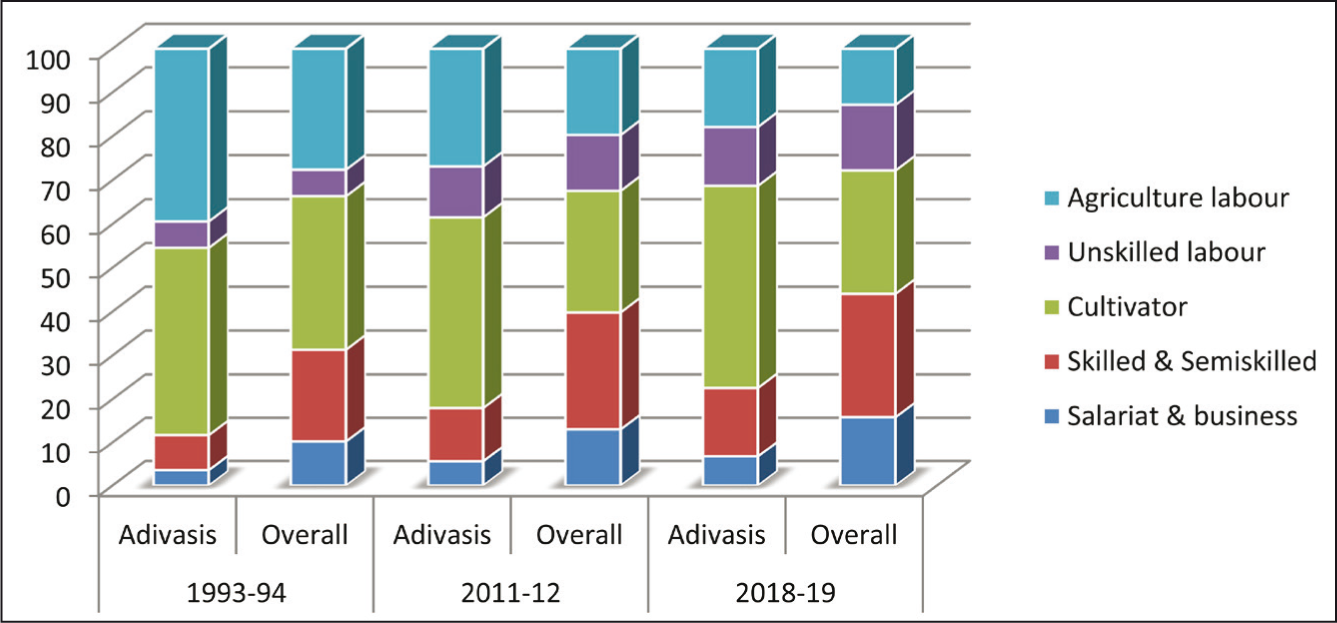
Source: Author’s calculation from EUS (1993–1994 and 2011–2012 rounds) and PLFS (2018–2019).
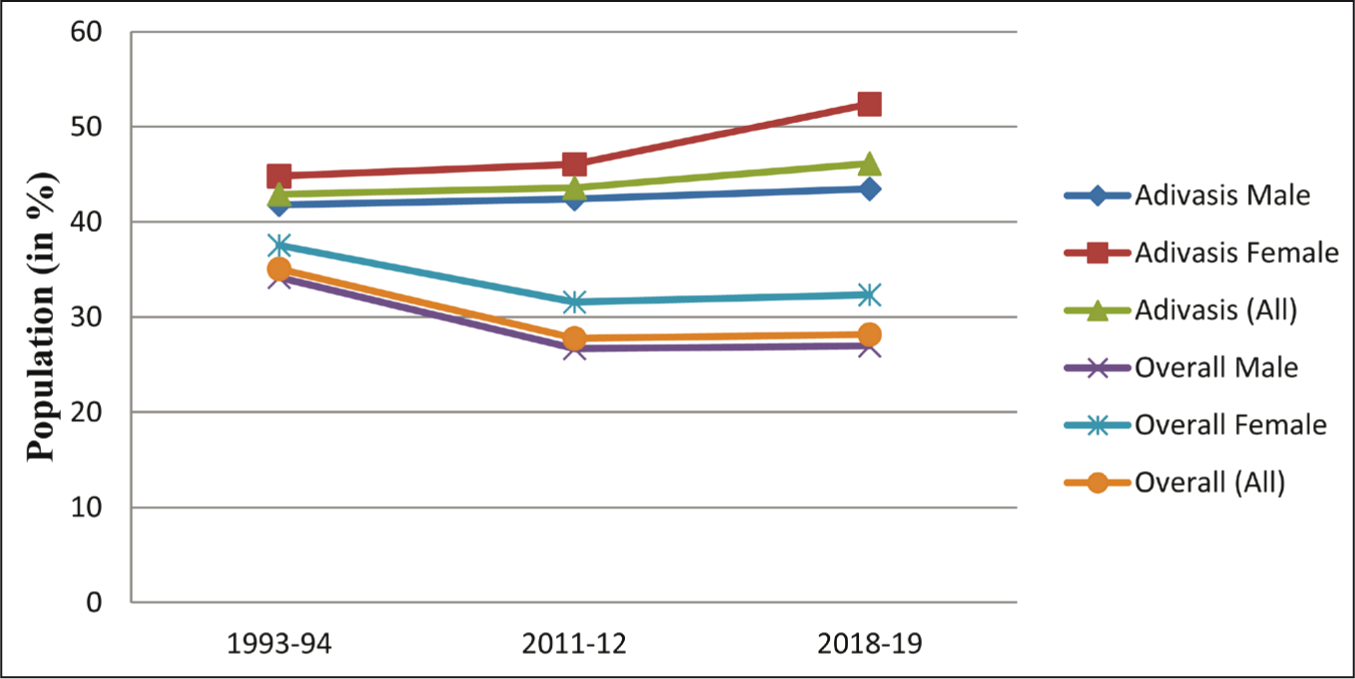
Source: Author’s calculation from EUS (1993–1994 and 2011–2012 rounds) and PLFS (2018–2019).
Factors Leading to Precarious Condition in the Labour Market
Declining Landholding and Traditional Livelihood Source
The foremost reason for their precarious condition in the labour market is land alienation and seclusion from the traditional natural resource base. Over time, all the social groups in India more or less have lost their landholding due to the structural transformation of the economy. Nevertheless, adivasis appeared to be the worst affected community in this regard (Kujur et al., 2020). According to the Ministry of Rural Development (1999), as of January 1999, about 4.65 lakh cases of land alienation among adivasis were reported in various states, out of which not even half have been disposed of. The states with a higher number of land alienation cases are Odisha (1.02 lakh), Bihar (undivided) (86,000), Andhra Pradesh (66,000) and Madhya Pradesh (undivided) (54,000) ( Table 1 ).
State-wise Land Alienation and Restoration (as of January 1999).
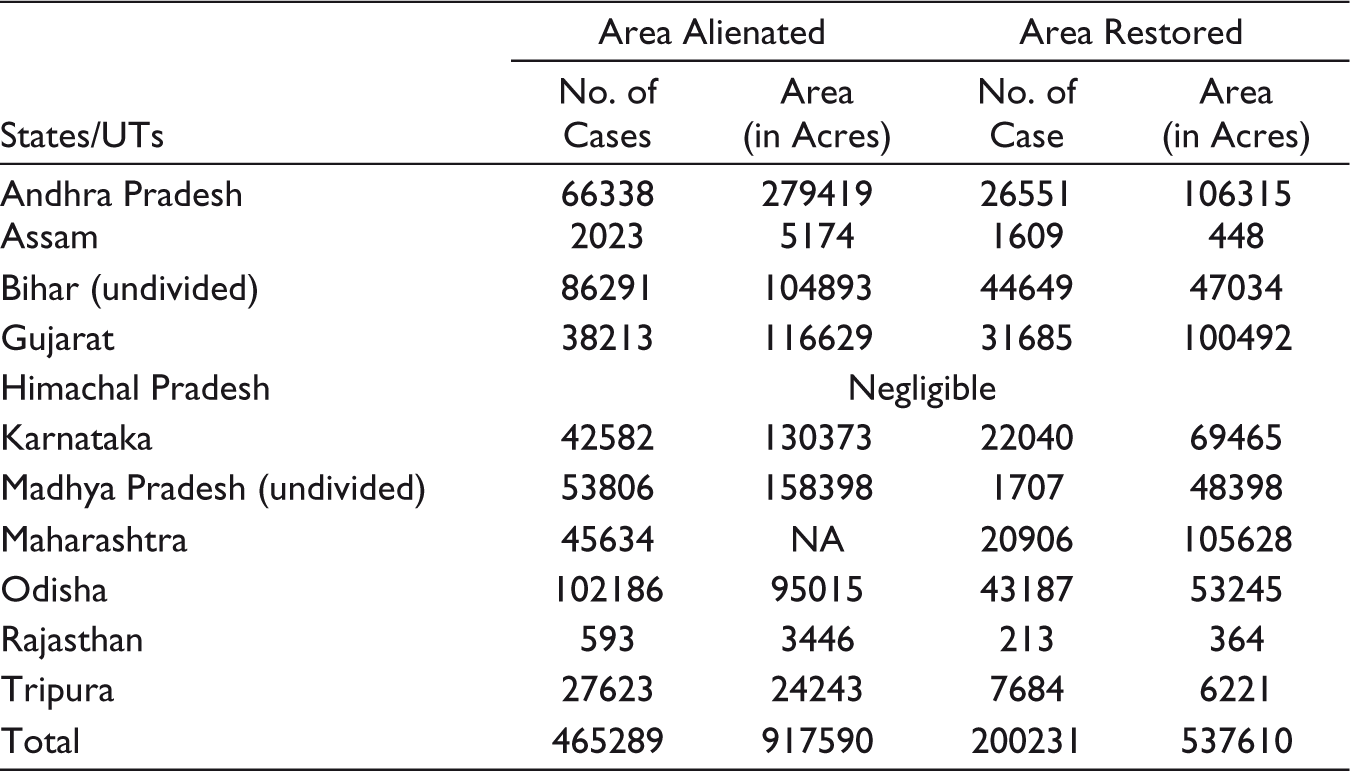
Source: Ministry of Rural Development (1999) (as cited in Government of India, 2001, pp. 128).
Note: NA: Not available.
Furthermore, as of 31.08.2020, about 42,53,089 claims of both individual and community land titles were filed under the Forest Rights Act, 2006, out of which 87.97 per cent of claims were disposed of and only 46.69 per cent of titles were distributed over the number of claims received (Ministry of Tribal Affairs, 2021, p. 265). On the other hand, a social stratification based on class such as rich peasants and agricultural labourers also emerged within the indigenous society when private land ownerships were assigned in the hinterlands (Pathy, 1982, 1984). The avarice to accumulate more private lands gave rise to a rich stratum of adivasis who were also recognised as land buyers. This stratification is partly owed to the anti-land alienation laws that restricted the transfer of adivasi land to non-adivasis. Further, the legal and affirmative policies particularly for them enhanced the social stratification as it uplifted certain sections within the community (Xaxa, 2008). This emerging economic stratification in the indigenous society also partly contributed towards the de-peasantisation of indigenous population.
The development-induced displacement, and forest and wildlife-related laws have largely affected their livelihood. As per the estimation of Fernandes (2008), adivasis constitute 8.6 per cent of the Indian population, but their share of the total displaced population is about 40 per cent to 50 per cent. He further enunciates that adivasis in India have not benefitted enough from development projects, rather ended up paying the cost of it all along. On the other hand, the continuation of colonial forest policy for more than five decades after Independence contracted their livelihood. The Indian Forest Policy, 1952, Forest Conservation Act, 1980, and Wildlife Protection Act, 1972, to a great extent, secluded them from their traditional source of livelihood. This gradually led even to starvation deaths among them (Radhakrishna, 2009). In India, 51 of 58 districts, each having more than 67 per cent of the forest coverage, are adivasi-dominated districts (Ministry of Tribal Affairs, 2006). Prior to the enactment of the Forest Right Act, 2006, adivasis were treated as encroachers on these forest lands as much of the forest coverage of these districts were classified as Reserved and Protected Forests, Wildlife Sanctuaries and National Parks (Ministry of Tribal Affairs, 2014). This alienation from the land and natural resources eventually compelled them to search for alternative livelihoods elsewhere.
Industrialisation and Employment Prospects for Adivasis
Although industrialisation has flourished in the adivasi-dominated regions, it has only brought agony to them by transferring their resources to non-adivasi migrants. The three states with substantial adivasi populations such as Jharkhand, Odisha and Chhattisgarh possess about 70 per cent of coal reserves, 80 per cent of high-grade iron ore, 60 per cent of bauxite reserves and almost 100 per cent of chromite reserves in the country. About half of the top mineral-producing districts of these states are adivasi-dominated districts which signify a large-scale loss of livelihood and displacement of adivasis (Bhushan et al., 2008; Ministry of Tribal Affairs, 2014). No doubt, mining and industrialisation generated ample employment opportunities, however, they became ghettoised in the employment process due to lack of social capital and politics of identity (Haldar & Abraham, 2015; Kujur, 2017; Strümpell, 2014). For instance, in the collieries and Bharat Coking Coal Ltd (BCCL) in the district of Dhanbad, Jharkhand, and Rourkela Steel Plant in the state of Odisha, the contractors and managers who were overwhelmingly non-adivasi migrants persistently skewed the recruitment in favour of their own countrymen, that is, persons sharing the same culture and connected by their kinship or caste (Heuzé, 1996; Kela, 2012; Parry & Strümpell, 2008). Such politics of identity in recruitment either pushed them into the lowest rung of the employment structure in the industries or compelled them to look for employment elsewhere away from their abode.
Dominant Socio-economic Structure and Indigenous Society
Over time, the infrastructural development and modern administrative system were extended to the areas belonging to the adivasis. This has resulted in mostly the migration of non-adivasis to the hinterlands and subsequently a penetration of the dominant socio-economic system into adivasi society. The assimilation and acculturation into the dominant society have redefined the indigenous way of sustainable living as backward and primitive. This paternalism of outsiders has not only caused repercussion to the social life of adivasis but also developed a sense of demoralisation among their youths towards traditional occupations. Therefore, currently, the exodus of adivasi youths to urban areas in search of non-agricultural activities is largely witnessed across the country. This occupational acculturation among adivasi youths is partly attributed to the dominant pedagogical paradigm which demonises and kills the traditional skills of earning livelihoods. Although the importance of pedagogical ingredients such as indigenous language and cultural resources (folklore, songs and history) in the adivasis’ education was recognised by the Dhebar Commission (1960–1961), it never materialised (Kujur, 2020; Shah & Bara, 2020).
Further, the pedagogical drive in adivasi lands seems to be just aiming at producing cheap labour force for the capitalist economy as the current education system has hardly been successful in uplifting their educational qualification beyond secondary education. According to the All India Survey on Higher Education Report (2018–2019) (Ministry of Human Resource Development, 2019), the Gross Enrolment Ratio of adivasis between the age group of 18–23 years in higher education is only 17.2 per cent which is much lower than that of the other social groups. The lack of appropriate educational qualifications or skills coupled with the economic backwardness in the post-land alienation period and the denial of employment opportunities in their homeland by non-adivasi contractors and managers have been push factors, while the higher wages and urban attraction have appeared as pull factors for their migration to urban clusters, far away from their abode. The loss of indigenous skills and the growing emulation of the dominant culture have also to a large extent shaped their preference for new areas of work based in urban sites.
Apart from this, as stated in the report of the Disha Foundation, the government schemes for the employment of adivasis failed to absorb their youth labour force as most of the schemes focus on the traditional and old work sectors such as forestry, agriculture, poultry, animal husbandry and so on (Disha Foundation, 2021). Moreover, skill development schemes such as the Pradhan Mantri Kaushal Vikas Yojana (PMKVY), Deen Dayal Upadhyaya Grameen Vikas Yojana (DDU-GVY) and Affirmative Action by the National Skill Development Corporation have either failed to include them or have largely remained underachieved. Many state-level schemes were also designed to make adivasis self-employed; however, these were often undertaken on a minuscule scale (Rajan et al., 2020). Resultantly, the current adivasi youth generation has adopted circular or seasonal migration to urban clusters as their new survival strategy.
Discussion and Conclusion
The precarious condition of adivasis in the labour market should not be seen as a recent phenomenon. Their transformation from agriculturalists to cheap labour was seen both in the pre-colonial and colonial regimes, and in the post-colonial regime, it has intensified further. Retrospectively, land alienation and seclusion from other natural resource bases have been major factors for their occupational vulnerability, while the politics of identity in recruitment and the assimilation and acculturation of dominant socio-economic life have supplemented the cause further.
The indigenous way of living a sustainable life has been acclaimed by many academicians and environmentalists. However, concurrently, the need for better education, healthcare facilities and roads and communications in consonance with their lifestyle was also felt by many researchers and government institutions for their integration into the overall socio-economic structure. This very motto to develop them ended up with assimilating them into the dominant society by desolating their socio-economic structure and transferring their traditionally owned resources to non-adivasis, particularly the dominant sections in the plains and metropolitan cities. The promises of education, healthcare facilities, infrastructure and so on have been proved to be false promises which not only deceived them into accepting the idea of ‘national development’ or ‘national interest’ but also completely broke their backbone of sustainable socio-economic life and eventually turned them into a perpetually dependent community. At this juncture of the unfair development process, policymakers and government institutions need to look back to the five fundamental principles 2 for indigenous people’s development propounded by Jawaharlal Nehru. Furthermore, the state must maintain the ethos of reciprocity with adivasis instead of just appropriating their resources whenever required.
Footnotes
Declaration of Conflicting Interests
The author declared no potential conflicts of interest with respect to the research, authorship and/or publication of this article.
Funding
The author received no financial support for the research, authorship and/or publication of this article.