







Abstract
Urbanisation is a ‘constant’ process and cities will account for all future world population growth. What does it mean for people who find these spatio-temporal existences entrapping and limiting? This article reflects upon the urban condition of India from the imaginative geographic perspectives (to use Edward Said’s concept) of working people, labour, informal proletariat, the slum-dweller. In order to do so, this article explores the ‘urban’ or the ‘city’ as a concept and therefore, its connection with its ‘other’. Since the quintessence of life is the flowing hermaphroditic existence of the slum-dweller and the displaced flowing through space, social change would mean comprehensive re-haul of geographic imaginations that understand how city and country are connected and how they are impacted by neoliberal policy shift. This article concludes that oppression of the urban poor is universal in most urban conditions, hence reversing this universality constitutes the quintessence of social change.
Introduction
If time is the flow in which humans live out their life, space is where they enact it—space and time, therefore, encapsulate the entirety of existence. For most humans in the global south, this lived experience is enacted in the city or country or somewhere in the city–country dialectic, that is, in transitional life spaces that are semi-urban or semi-rural. Said (1979, p. 49) in his influential work, Orientalism, coined the concept ‘imaginative geographies’ to talk about the concretions of time and space. In describing the ‘colonial present’, by which he means Israeli occupation of Palestinian life-spaces, he said that ‘imaginative geographies’ are not just accumulations of time (history), they are also performance of space (geography). Herein is the possibility for emancipation, revolution and social change, that is, if we can change the way we enact our lives in space, we can change time (usher good times, happy times, liberatory times), and, therefore, socially change our lives. Most people are living out urban lives in the world today. Urban centres tend to be the primary spatial sites through which the nation is imagined and developmental-nationalist imaginaries are enacted. Therefore, the urban structure that has solidified over time will constitute, the crucible of existence both in terms of material and imaginative geographies. What does it mean for people who find these spatio-temporal existences entrapping, limiting, violence-inducing and exploiting of life? Do they have the option to move to other geographies, other cities that are liberating? After all, if urban centres are the nerve centre of the nation, nations should offer a whole array of urban life opportunities and with globalisation and globalising urban conditions, where cities of the global south are increasingly tied to cities of the global north through trade, capital investments, retail chains, tourism, flow of goods, call-centres, migrant workers and expatriate dollars/dinars, humanity should be able to flow through space in less time (Harvey’s (2001) brilliant iteration of this as ‘time-space compression’ comes to mind) and liberate their social existence.
The following is a narrative based on some of my personal self-reflections synthesising over 15 years of research and fieldwork done in India. This article reflects on the urban condition of India from the imaginative geographic perspectives of working people, labour, informal proletariat (Davis, 2004a; Gilbert et al., 2004), the slum-dweller and the precarious worker (Munck et al., 2020), as well as on what social change would mean for them, and the different imaginations and geographies such a change entails. The aim is to imagine a counter-nationalist urbanism, one that is envisioned by ordinary people. In order to do so, this article also explores the ‘urban’ or the ‘city’ as a concept and therefore, its connection with its ‘other’, or the city–country dialectic, which is fundamental in the global south and everywhere else. The plan is to follow the flow of imaginative geographies of labouring life worlds as they are transmuted through relational spatial existences (country and the city, city and the nation, city and the globe) to understand disabling and enabling moments in each. Because people negotiate life spaces relationally, it is imperative that academic research emancipates itself from analytical spatial containers and understand labouring life spaces in their true manifestation so that social change is imagined as universally flowing and not contained within a city here or an urban subdivision there. Labouring life is inscribed as ebb and flow through space and time where an individual’s life in one city is really the concretion of time and performance of space of a whole host of labouring men and women preceding the ‘individual’ and connecting various cities and geographies in relationally complex ways. Therefore, although our research begins in one neighbourhood, one district, one city, we must be intellectually humble and admit that our starting point is a mere dot in the totality of imaginative geographies that charts out the present. It is in this theoretical space of contra-analysis that I situate this article as an entry point to understanding the universal labouring condition from the perspective of the urban poor in India. In the imaginative geography of people-centric and not policy-centric or ‘nation-building’ centric urbanism that I etch out below, the urban, the rural, the national and the global ebb and flow into each other in a non-Cartesian dialectical unity (Chatterjee & Ahmed, 2019). The inscriptions of labouring life in time and space that I present here is not data driven, or a case study, or an empirical perch for broader generalisation towards a positivist urban theory of the future. They merely illuminate the quintessence of relationality of life as universal geographical imagination from the perspective of urban labour in the global south. Universal here is not akin to positivist generalisation—generalisation is born out of adding pieces of data or fragments of facts, which, when deemed substantive by academic peers, is said to constitute a new theory based on scientific objectivity. This article argues that oppression of the urban poor through mechanisms of displacement and entrapment that are universal in most urban conditions etches out the core of national urban lives. Hence, reversing this universality constitutes the quintessence of social change that can be universally emancipating for the poor.
The City (Masculine) and the Country (Feminine)
Much feminist literature has explained how capitalism is the political economic zenith of patriarchy (Eisenstein, 2005; Foucault, 2016; Fraser, 2009; Gibson-Graham, 1997). Unlike other modes of production (hunting gathering, kin-ordered/tribal, agricultural) (Hobsbawm, 1964; Mandel, 1976), industrial capitalism starkly and profoundly separates geographies of home and work, where the home becomes the inward-looking, emotional, feminine sphere of care-giving and reproductive duties that are then solely assigned to women. The work space, the factory or the mill, then becomes inaccessible to her as it is spatially set apart from home (unlike the foraging spaces of the forest in the hunting gathering mode or the agricultural field as in the agricultural mode). Along with geography, the temporal rhythms of the modern industrial workday that demands entrapment of the factory worker in the factory floor also sets her apart from accessing formally paid labouring spaces. Thus, the geography of capitalism entrenches ‘work’ as the masculine sphere of rationality and paid work and ‘home’ as the emotional sphere of unpaid care-giving work. While feminist geography (Chatterjee, 2012; Freeman, 2001) deepens our understanding of how capitalist life sediments patriarchy by spatially separating home and work, much fewer academic musings have been devoted to explicating the same when it comes to the city–country dialectic.
I argue that the establishment of the city versus country binary (Hugo, 2017; Stewart, 1958) is the extension of the same patriarchal vision of nationalist urban planning, managing and doing ‘development’, where the urban has been geographically imagined as separate and apart from the rural, where the former becomes the realisation of success, profit and economic productivity and the latter an irrational baggage that needs to ‘man-up’ and urbanise/industrialise/capitalise. Much of the global south, and certainly India’s urban–rural dialectic is wrapped up in that post-Enlightenment, imperialistic science of life where the urban/modern/independent is tied to the rural/traditional/dependent. Hence, post-Independence planning policy too was dichotomised between rural planning and urban development, with the intermediate town seen as a crucial spatial link that must be invested upon and developed to reverse the uneven regional development inscribed by colonial spatial logistics (Baviskar, 2003; Das & Pathak, 2012; Varshney, 1998). A variety of spatial-Keynesianism called ‘regional planning’ and development thus became a necessary instrument of social change towards spatially balanced regional growth (Davoudi, 2009). Post-independence development vision immediately realised the sleight of the colonial hand—imperialistic rationality was not interested in social change in colonised spaces, which were merely convenient sites for extraction of surplus value that would flow to metropolitan London. A rural–urban dichotomy suited that logic. But a postcolonial imagined geography must uplift the nation. Unfortunately, the nation was saddled with colonial legacies of hunger and poverty in, but not limited, to the country. The cities that had become spaces of affluence during the colonial era as collection point for goods, investment and infrastructure stood in contrast to the rural but not disconnected to it. Although caught in the Nehru (modernity) versus Gandhi (self-sufficient village communities) (Roy, 1999) imaginative geography, the city/urban was and is never delinked from the country. However, nationalist urban visions in social science research tend to analytically separate researchable topics that separate life spaces into urban planning versus rural planning, investigation of the farm versus the firm (Wood, 1958). My point here is to disrupt these analytical containers and explicate emphatically that the city or urban permeates the rural or extra-urban and that it is in understanding the relationality of these life spaces that we can conceive the nation and social change as a holistic process.
It is the life-scape of labour that helps disrupt false containers, and it is in tracing labouring as a process that we are able to see the entire tapestry of human existence. My research and life experiences inform my understanding of labouring people and how they stitch spaces together through hard work, sweat and blood to create the history and geography of their existence and mine. Life experiences are experiences lived, participated, observed and should count as research data as much as door-to-door surveys. The former counts more than the latter, because it is rigorously lived participant observation done over long periods of time. I therefore use my vantage point of having lived in a small town and having lived and researched in urban and rural worlds in multiple spaces as the basis for my reflections. What I hope to push here is a bit different. We have always known that this urban–rural duality exists in reality and in the geographic imaginations of nationalist planning policy, but policy makers and academics have usually embarked upon this reality as separate and discrete from the point of view of research, theory-building and policy. Yet, most of us have lived lives that have flowed through and connected these not-so-separate geographies in a non-Cartesian ‘whole’ called ‘life’. Labour and labouring processes, I argue, best demonstrate the non-Cartesian whole called life. In presenting the whole, we transcend not only the spatial dichotomy but also the epistemological dichotomy of the city and the country.
In my Ahmedabad city research (Chatterjee, 2009, 2014, 2020) on urban renewal and resettlement as a result of the Sabarmati Riverfront Development Project (SRFD), I had talked to many slum dwellers in slums facing removal from the heart of the city and ultimately removed. These were labouring men and women who were bravely contesting the development machinery of a geographic imagination that tied city-beautification to slum eviction and reclamation of spaces and their conversion to gardens, jogging parks and retail centres. Most were rural–urban migrants from Gujarat or other neighbouring states.
India’s national imaginative geography has forever been stitched by rural–urban migration and much of postcolonial planning policy has been a battle to reverse or slow the flow of labour from the country to the city with geographical imaginations that would hopefully usher a more balanced spatial growth and therefore, a less hardship-oriented, entrapped life for agrarian labour. This trend has not been reverted; as Davis (2004a, 2004b) argues, it has been magnified by the post-1980s structural adjustment programmes imposed all over the global south. David Harvey’s (2003) ‘accumulation by dispossession’ echoes Davis’ claim that a global shift to neoliberal free market policy regime in the 1980s has led to ‘new imperialism’. In other words, harsh structural adjustment policies imposed by the Bretton Woods institutions (World Bank, International Monetary Fund, World Trade Organization) at the behest of Western capitalist nations signify a global socioeconomic change that has put labour in rural and urban spaces in increased competition with labour in advanced nations as Third World governments’ import substitution regimes, subsidies for farmers, tariffs and quotas have been systematically dismantled (Ahmed & Chatterjee, 2016). Harvey and Davis argue that what has been touted as a new free market era where farmers, industrialists and capitalists would be freed from the shackles of government involvement (through subsidies, tariffs, quotas) and allowed to participate with their counterparts in the global economy work at a disadvantage for labour (farm and urban) in the global south because without the protection of the so-called nanny state, vulnerable labour in poorer countries are rendered more vulnerable to global corporations and predatory capital flowing from more affluent nations.
The result is often crop failure as farmers in India and other global south countries switch to corporate genetically modified seeds or change land use practices from edible food crops to cotton or soy (non-edible cash crops) according to trends in the global free market—indebtedness and farmers’ suicide in India are the most unfortunate manifestation of this (Gruère & Sengupta, 2011). The result is a semi-slavery-like situation where the rural agrarian sector is slowly impoverished, forcing agriculturalists who have either lost their lands to moneylenders or had to sell land to move to the city (Lenka, 2005). Similar is the situation of indigenous and forest people as more forests are logged for timber, fur and minerals (Münster & Münster, 2012). Global corporate capital flowing from affluent nations accumulate profit as they dispossess Third World labour in a repeat of old-style imperialism now called globalisation. Harvey (2003) calls this ‘accumulation by dispossession’ and Davis (2004a, 2004b) notes that the internal migration of labour forcefully displaced by predatory capital from rural spaces to cities gives an urban complexion to this new imperialism. As the country is wiped out and cannibalised, the city experiences a surge of super-desperate labour who now need urban employment. ‘Urban development’ therefore becomes the quintessence of recovering a nation emasculated by global capital. Davis (2004a) notes that this country–city dialectic is creating a burgeoning informal proletariat populating marginal spaces in cities as squatters and the homeless, and that as years pass by, the homeless ‘settle’ in ‘illegal’ slums, only to be evicted and displaced again by new rounds of global capital coming in to claim slum spaces for malls and I-Max theatres.
My own work in Ahmedabad documents this struggle of labour, its failure to legitimise its right to the city. Slum dwellers in Ahmedabad negotiated communal violence and caste discriminations even as their labour as auto-rickshaw drivers, construction workers, nannies, and so on, subsidised capital accumulation in the city. Most of the slum dwellers I interviewed were migrants/non-natives/displaced, and had faced multiple rounds of displacement from their respective villages to the city, and then multiple times within the city as urban development moved them to more and more marginal spaces.
In my previous experience in research—undertaken as ‘field work’ in early 2000 as a master’s student at Jawaharlal Nehru University—in Libaspur, a small satellite town of New Delhi, where our MA class was asked to do door-to-door survey of all households, all surveyed households comprised of migrants, mostly from other states. Delhi has a large catchment area and is a magnet for labour from rural spaces across the country. There were whole micro-geographies of intra-class discrimination among the inhabitants of Libaspur, with migrants from Uttar Pradesh and Madhya Pradesh disparaging and stigmatising the labour from Bihar.
The above is reiterated in my more recent research on Green City New Town, Kolkata (Chatterjee, 2021) where, in an effort to win the World Bank-encouraged green city/eco city/smart city status, the state of West Bengal adopted the ‘sustainable city’ agenda and focussed on New Town adjacent to Kolkata as an experimental space for environment-friendly green buildings, urban gardens and eco parks, digital technology. But this new urban geographical imagination was inextricably tied to agrarian labour and agrarian spaces because New Town was sedimented by reclaiming fresh water ponds, lakes and salt marshes, which have been the unique natural habitat for various species of fish and birds. These were also spaces where small-scale farmers worked closely in nature to produce nutrient-rich leafy greens and vegetables and supply these to local farmers’ markets throughout Kolkata. This was a creative, unalienated, soulful link between the industrial city and its green semi-urban rural geography. But the introduction of the Green City agenda and the desire to win that label required a different urban nationalist imaginary and a different green imagination that involved a murky process of forceful eviction of farmers by state governments of all political leanings and farmers’ resistance to this altered city–country relation. Here too, labour processes connected both urban and rural life spaces. In this case, it was not rural–urban labour migration but supply chains of local produce from rural to urban.
In my formative years as a child living in the small industrial town of Liluah, a sort of link-location in the railway route that connected the city of Kolkata to its rural hinterland, I had noticed the same urban–rural relations that I think was supremely important in forming my personhood. In my daily commutes via the local train to my school in the nearby district headquarter, Howrah, I saw farm women carrying heavy baskets with seasonal produce brought from the rural stations on the rail route. The further the train travelled from Howrah, the deeper the country and rural farm labour, especially women, took daily commutes bringing produce from their backyards to more urban stations like Liluah, Howrah and others closer to Kolkata. I marvelled at their stamina as they loaded and unloaded baskets in two minutes, the amount of time the train stopped at each station. Often the gourds would roll out of the baskets or the jute strings tying a bundle of greens would come undone and scatter the produce. These hardworking women would put down their baskets with composure, calmly retrieve the recalcitrant produce, and still make it in or out of the train coaches in time. As I tried to perform my own daily labour of making it into the crowded trains so that I could reach school in time, I was more holistically educated by the geographical imaginations that tied my urban life space with the labouring geographies of the rural spaces these women carried in their baskets. It was materially and imaginatively made very clear to me by life that the rural and the urban are not dualities but permeate each other deeply.
The point is that the city was never detached from the country and is now even more linked. It is only in the analytical containers of textbooks, thesis chapters and disciplinary specialties in university departments that walls are built for convenience so that we can label ourselves as ‘experts’ of this field or that space. Agricultural scientists, urban planners, neoclassical economists and environmental experts form the surface layer, which, when peeled, reveals a core of humanity where the geographical historical life is one that is lived in holistic complexity. The ‘social’ of existence and social change for a more emancipated existence must be a geographical imagination that understands, for example, urban spaces as rural incarnate and vice versa. I indicated in the beginning of this section how the urban imaginary, perhaps in all civilisations, has been envisioned as the desirable, the modern, the developed, as the ‘next-stage’ in evolution, a more civilised variant of its backward cousin, the rural. In terms of feminist critical positioning, the urban therefore, becomes the site of work, equivalent and opposite of its ‘other’, the home, where workspace is rational, the masculine and productive, and the home space is emotional, feminine, nurturing. I have in this section attempted to disrupt this duality through a non-Cartesian dialectical geographic imagination. By disrupting the urban/masculine–rural/feminine duality, I hope to carve a contra-nationalist imaginative geography that is fluid, relational and imagines the nation from the perspective of the poor. In the next sections, I provide examples of labour processes, with the objective to highlight the struggle of labour and the life-scapes they manage to carve instead of reading them as urban processes per se. The need for this reorienting of geographical imaginations away from Cartesian rigidities is imminent (particularly in the global south, which is on the receiving end of ‘new imperialism’) because social change cannot be envisioned in piecemeal ways where urban emancipation entails a different checklist from that of rural emancipation.
The whole of human emancipation is tied up with struggles that labour must undertake to overcome entrapments and these cannot be compartmentalised as rural and urban. This is where I differ from Harvey and Davis, both brilliant academics, but both strategically situating their research agenda on the critique of capitalism (neoliberalism/new imperialism) and social change within the urban context. For example, Harvey (2008) and Davis (2004a) explicitly state that all revolutions in the contemporary context will come from the urban informal proletariat, from the slums of the global cities and no longer from the countryside which was the seat of yesterday’s revolutions. Harvey (2008) in his discussion on the ‘right to the city’ attempts to characterise contemporary revolution as the right to control the urban process. Davis (2004a) talks about a shift in revolutionary praxis—whereas previous anti-colonial resistance all over the world always drew its base of radical proletariat from the rural, he thinks resistance will now be solidified from the urban slums where the informal proletariat have been utterly marginalised from the accumulation process while the rural has been decimated. Davis (2004a, p. 15) is hopeful that the urban informal proletariat have the ‘gods of chaos’ on their side. Harvey (2008) does not focus on the urban–rural dialectic at all. Instead, he hones in on the urban as the site for surplus extraction and distribution, and hence, the geographical basis of capitalism. It is interesting that Marx, in his characterisation of modes of production (Hobsbawm, 1964; Mandel, 1976), has a dynamic imaginary where the seeds of one mode of production is always embedded in a previous one—meaning, industrial capitalism is a synthesis of agrarian mode, and agrarian mode is a synthesis of kin-ordered or tribal mode, and so on and so forth. In other words, the emergence to industrial capitalism is not a discrete stage in history or geography. In keeping with that spirit of Marx’s mode of production (Hobsbawm, 1964; Mandel, 1976), but also inspired by Davis’ and Harvey’s analysis of resistance, I hope to arrive at a template of social change that conceives of a mode of emancipation honouring the contra-nationalist urban rural dialectic imagination.
Imaginative Geographies of Labouring
The Slum Dweller
There can be no generalised definition of ‘slums’—also known as kampungs, favelas, juggis and bustees—as their sociocultural and economic specificities are diverse across the global south. Most, however, describe slums as informal settlements situated illegally in public land that makes up marginal spaces of cities and as characterised by over-crowding, poor infrastructure like roads, sidewalks and scanty amenities like clean drinking water and electricity (UN-Habitat, 2003). The slum dweller is variously seen as the informal proletariat, the urban underclass, the urban poor and the precarious worker. Davis describes the slum dweller as the ‘marginalized in the shantytowns of neocolonial modernity’ (Davis, 2004b, p. 34). Brathen et al (2003) talk about the flow or migratory dynamics that I discussed in the above section to explicate the personhood of the slum dweller. They say that most slum dwellers, or their parents, have migrated to cities in search of better income opportunities and livelihoods. However, many of the urban poor find that their rights as urban citizens are not recognised and realise that they cannot rely on formal democratic channels or governance structures for their needs to be met. Ali (1995) talks about ‘slums within slums’ as new flows of squatters occupy the small, interstitial open spaces within older slums.
My personal research and observations of slums are limited to cities of India only. I have found slums extremely humanising, humbling and educating, and they have informed my geographic imaginations in a profound manner. I grew up in Calcutta (now Kolkata), India. I remember pointing out, when I was about five or six, a makeshift shelter made of jute rags beneath an overpass (locally called flyovers) in the middle of the city, and saying to my mother, ‘I would like to live there’. My mother was aghast; she told me about the hardships and struggles of such a life, the horrors of heat and cold, and the lack of bathrooms. I had not thought of that; it just looked like a toy house to me. I saw babies crawling behind the jute walls, I saw a pot of food on fire made from a pile of paper and cardboard—it would be fun, I had thought. I now know better. In my JNU days in New Delhi, I frequented the slums around campus—among the boulders, rubble and acacia shrubs of the Aravalli hills that was the landscape within which the university campus was ensconced. The ‘slum dwellers’ served as nannies, domestic helps, doormen, janitors to the urban middle class of the university campus and the surrounding housing complexes.
Made out of nothing, stitched out of burlap and built from loose bricks, slums were/are a fascinating labyrinth of minimalist survival. Through holes in the brick walls, I would catch the warm glow of the light bulbs fuelled by illegally tapped electricity. Incredible is the resilience and organising potential of the slum inhabitant. The inside walls would often be neatly painted, with layer upon layer of racks since every inch of space had to be carefully metabolised to manifest life. It caught my attention that the racks often contained a small TV or a boom box and the images on the TV or the music wafting from the boom box would be an image of exuberant affluence or a lyric of bourgeois romanticism—such a stark contrast to the rudimentary walls from which they emanated. How did the inhabitant so patiently and tolerantly accepted the violent contrast of his life to the entertainment that he was consuming? Why did the images and lyrics not anger him to set afire the towering five-star hotel in whose shadows he lived and worked?
I sometimes had the honour of being invited to these immaculately meticulous ‘castles’ of struggle. The smiling ‘home owner’ would narrate the story of his life, of how he moved from a village in Uttar Pradesh, Haryana, or Bihar (neighbour states). The stories were often similar. Movement upon movement, migration upon migration layered on top of another; stories of movement from a village to New Delhi, and various spaces in New Delhi as bulldozers came and evicted him. The finding of a new slum was a creative act of both job-hunting and living ingeniously stitched together. The new act of squatting would have to be in a new place somewhere close to an affluent geography so that the two worlds—the world of affluence and their world of struggle—could co-exist. Co-existence is the key concept here. Unlike the American projects or French banlieues (Murray 2006), the slums in the global south have a different geography of ghettoisation. In the former, the poor spaces, zip codes, suburbs are sealed off and rendered invisible to the rich through a tight spatial segregation thoroughly surveilled by the police, neighbourhood watches, and electronic surveillance assemblages. In the latter, there is a clear class entrapment, but a geographical coexistence The accumulation process in the city, to use Harvey’s (2008) analytical lens, needs the poor to generate surplus value through their pernicious but precarious labouring. The CEO cannot go to work and amass profit unless his chauffer or cook or nanny shows up. The urban rich needs the urban poor, the gated communities and five-star hotels need the slums, the city needs its urban poor, the urban needs the rural outcast in order to manifest the metropolis, and nationalist urbanisms need contra-nationalist people’s urbanism (see Figure 1). It is an eye-opening educational experience to ask the slum dweller to characterise the ‘squatter’, which is, after all, a label that the elite urban geographic imagination imposes on the hardworking populace with a remarkable resilience in eking out a survival and thus crafting the very edifice of rural as well as urban life.
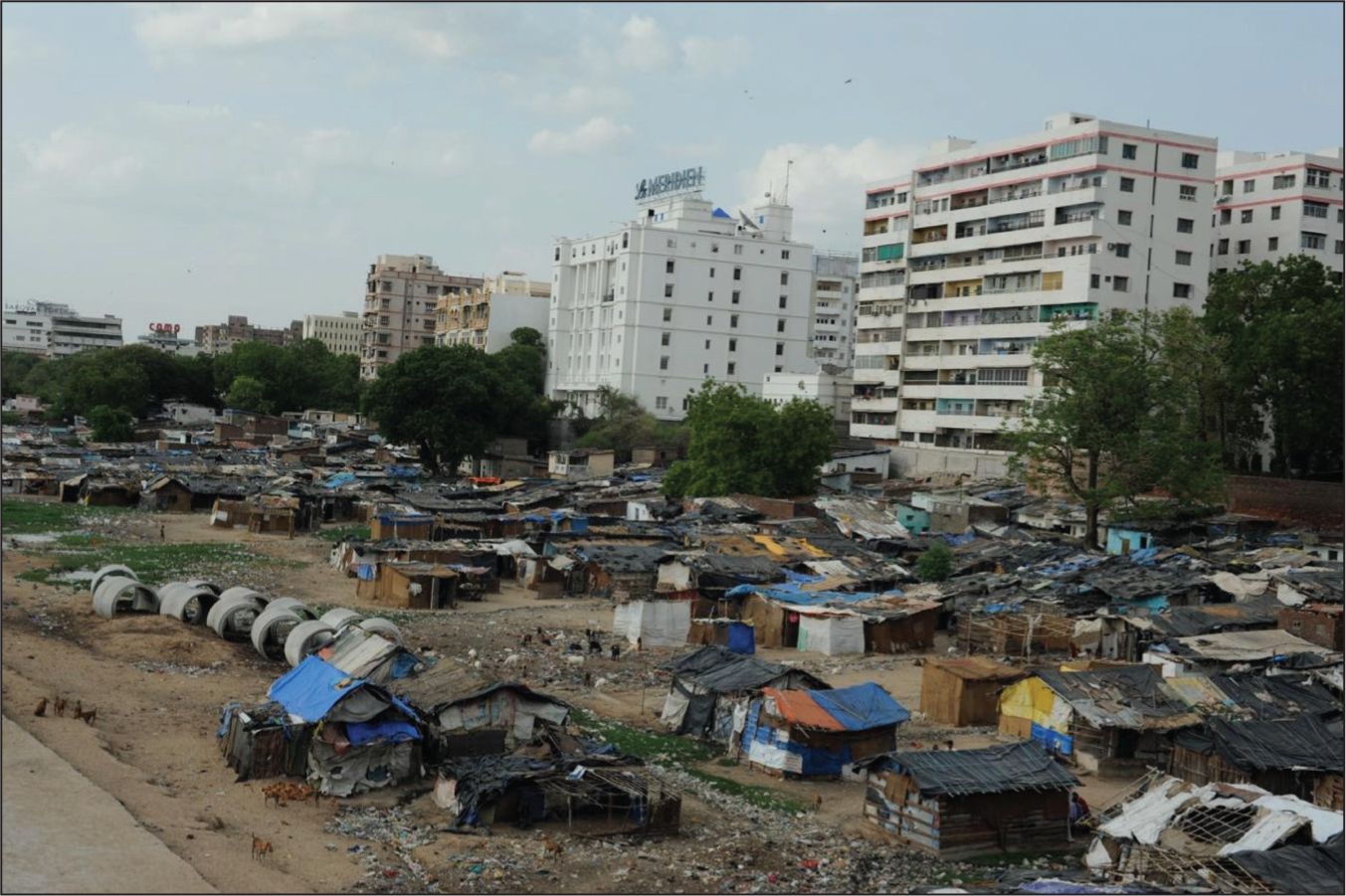
Source: Picture taken by Waquar Ahmed.
As I made my way through the gullies (narrow lanes) between the rudimentary huts of some 80,000 families along the banks of the Sabarmati in 2006 and again in 2010, the ingenuity of the poor, their ability to create something out of nothing amazed me. Those slums were displaced soon after 2010 under the SRDF (Chatterjee, 2020). Kite making, toy making, jewellery and trinket making, pickling, wafer, candy making, informal washing and drying were some of the myriad productive endeavours that flourished in the slums. Slum dwellers hawked these wares in order to have a precarious self-employed existence. Being post-2002, that is after the Hindu–Muslim riots that rocked Ahmedabad that year, my research keenly focussed on the ethno-religious ghettoisation of Muslims in the post-riot conditions. The nine bridges that crossed the river served as larger dividers parcelling one colony from another. Inter-ethnic suspicion and geography of fear sedimented and still sediments ‘slum life’ in these colonies (Chatterjee, 2009) as they serve as vortices of volatility for riot mobilising, marginalising the Muslim minority. These slum colonies are also spaces of feminisation of precarity as women undertake much of the cooking, prepping, crafting of the wares that are used by men for hawking, vote bank politics. Along with post-riot inter-ethnic divide, precarity, these slum pockets also simultaneously become sites for politics of eviction and resistance around development-induced displacement (Chatterjee, 2012).
Much of the nationalist urban development imaginary and urban planning strategies have borrowed the colonial cartography of ordering chaos, which meant slums have been characterised as the ‘other’ of development, ‘other’ of modernisation, as dirty, eyesores, and disease ridden. Development, prosperity and beauty means slum eviction, erasure of the slum dweller’s life story and their geographical imagination to be replaced by water parks, malls, restaurants and jogging parks.
The slum dweller is the ultimate nomad, carries little, lives lightly and flows through space effortlessly connecting the country with the city. She is agile, always pushed out, but never gives up the struggle, from struggling with tilling the land and battling the vagaries of weather in the countryside. She carries in her belly the seed of gumption and audacity to re-germinate. As she is displaced from her rural life-scape, she accepts this as fate and tackles it with forbearance, arriving with her satchel, sometimes goats and chickens and kids, to the city. There, she begins again, etching new kinds of geographies of struggle—queuing up behind hundreds of buckets of water, no longer having the village creek at her disposal, and at the mercy of a tiny thread of water that trickles from a public faucet catering to thousands. The essence of the urban condition is manifested in the spaces on which the contradictions of the slum dweller’s urban life gets etched—the contradictions of huts versus hotels, of children chasing goats versus joggers running in parks, between those flushing their toilets and those who do not have flushes. The story of their struggles is everywhere. The slum dweller is everywhere and simultaneously nowhere in the urban condition of the global south. She is simultaneously the agent of production (through informalisation) and the disrupter of urban capitalist development (resisting the bulldozer). She is co-opted (by politics, politicians, religious fundamentalism), but also radically antagonistic to the class-rich. The slum dweller is the quintessence of urban change in the global south and her urban world transitions between entrapment/struggle and emancipation/hope. She is simultaneously country-cousin and urban-wise-guy. Therefore, unlike the mythical ‘rational economic man’ of neoclassical economics, having flown through time and space, she is the real and therefore represents the whole of the history and geography of existence, both the masculine and feminine and the transitions. She is also a rational human, not one whose rationality is predicated in minimising cost and maximising profit, but one whose rationality is existing and actualising life through struggle. She is the microcosm of the cosmos of nationalist urban India and therefore the most catalytic element of social change. In other words, she is the mercury, the most volatile element in an alchemist’s Petri dish attempting a hermeneutic transformation from base metal to gold. If social change is the gold, the philosopher’s stone, the slum dweller is the essential active ingredient whose life must transform in order for development to manifest. The policy discourse of nationalist urbanism must develop the spiritual third eye to see this.
The Displaced
In the global south, development-induced displacement has been the normal order of doing business. And any resistance to this has been framed as a struggle between modernity and an irrational selfish impulse to hold on to non-existent idyllic village communities. The ontological warfare between holding on and allowing development to proceed is often waged on the streets and in the media. The difficult dialogues often swiftly degenerate into, ‘Do you not want progress?’, ‘Do you not want development?’, and ‘Ask not what the nation can do for you, ask what you can do for the nation’. Roy (1999), in the context of the World Bank-funded Sardar Sarovar Dam project in India and people’s resistance to it in the form of the Narmada Bachao Andolan, explains how the entire talk surrounding displacement is obscured within an overarching framework of development versus anti-development. The physical uprooting of the class poor, religious/ethnic minorities and marginal groups from their homes and hearths and their forced resettlement is understood as displacement. There is a general academic consensus that displacement is undesirable and constitutes injustice. Some critique state-sponsored or capital-sponsored displacement, demanding a more socio-spatially just society; others point out the imperialistic moorings behind land acquisition acts; and yet others provide policy suggestions for resettlement packages. However, a quick search in Google Scholar for the combination of the terms ‘displacement’ and ‘Global South’ reveals that an overwhelming proportion of the literature focusses on large-scale displacement ushered by mega infrastructural projects often involving resettlement across the affected state and sometimes even inter-state movements (Roy, 1999; Nayak, 2013). A smaller contingent of recent work explores intra-urban displacement due to urban revitalisation, state-sponsored projects and public–private partnerships (Bunnel et al., 2002; Chatterjee, 2014).
In my work on displacement related to the SRFD (Chatterjee, 2014, 2020) and displacement related to usurpation of farmlands to create New Town, Kolkata in its new avatar as Green City/Eco city (Chatterjee, 2021), I have argued, after Marx (1964) and Marx and Engels (2002), that development-induced displacement—whether to create a ‘global’ landscape of shopping and entertainment as in the Ahmedabad case or to create urban greens through trees and technology in order to meet the qualifications of a green city—represents an estrangement of labour from nature/space. Displacement involves estrangement of labour from land and the tearing away of lives and livelihoods from place, and hence is the very opposite of emplacement. Labouring, which is inherent in humans and defines their species being happens through space/nature (in this case urban). Existing is, therefore, labouring in space and is inherent in humans. Estrangement from space is estranged existence; it means that the very space humans produced through the act of labouring is reclaimed by others who had no part in labouring and the production of space. Estranged space is displacement.
An important flagship project of the Ahmedabad Municipal Corporation (AMC) that showcased its entrepreneurial turn was the SRFD project. The need to excavate river Sabarmati from its stagnant natural state into an unnatural spectacle of ‘space, light, exhilaration’ is fuelled by a desperate entrepreneurial urge to become ‘world class’ like Sydney, London, or New York—cities that are anchored by an urban imaginary of water. The AMC launched its ambitious SRFD project at an estimated cost of US$262 million, and constructions began in 2004. The project extended over 20.4 km along river Sabarmati, 9 km on one bank and 11.4 km on the other. The aim was to reclaim 162 ha of riverbed, fill it, and raise it to ground level. The land was then sold to private developers for building hotels, gardens, boulevards, promenades, water sports, heritage parks, skyscrapers, malls and a straight road to the airport for high-speed travel (Chatterjee, 2009). However, the project was soon mired in controversy, because it entailed the removal of thousands of low-income families (both Hindus and Muslims) who inhabited the banks of the river. The AMC had employed Nilima Rawat, a consultant, to supervise the relief and resettlement efforts. She claimed that about 8,000 families were displaced, but also clarified that nongovernmental organisations (NGOs) put the figure at 30,000. Mohammad Pathan Khan, leader of the Sabarmati Nagrik Adhikar Manch (SNAM), the largest social movement spearheading resistance to the project, counterclaimed that there were 38,000 families along the bank of the river, and that at least 20,000 families were moved against their will to resettlement colonies outside the city in the middle of nowhere where finding public transport or livelihood was a challenge. Muslims, who were the victims of Islamophobic rioting in 2002, claimed that the resettlement process was biased against them (Chatterjee, 2014, 2020).
When the West Bengal government decided to launch its own ‘Green City’ project in Kolkata’s New Town, the West Bengal Housing Infrastructure Development Corporation Ltd. (WBHIDCO), a wholly government-owned company was entrusted with the work of planning New Town. The ‘Land Use and Development Control Plan’ prepared by the WBHIDCO declares the New Town planning area as ‘environment friendly and aesthetically attractive new urban settlement functionally integrated with the future metropolitan structure’ (WBHIDCO, 2012, p. 11). The ‘environment’ and ‘aesthetic’ assemblage that WBHIDCO proposes encompasses a vision of ‘open space system’, albeit appropriately ‘enclosed’ from the ‘encroachment by squatters’ (WBHIDCO, 2012, p. 17). The highest percentage of the land use would be residential (29 per cent) with the next highest percentage being, open spaces and water bodies (10 per cent). Therefore, it can be inferred that the ‘environment’ (consisting of open spaces and water bodies) would be nurtured to boost real estate sales. Posh homes surrounded by greenery would be the primary draw for class elites (IT professionals, non-resident Indians) looking to find an ‘outside’, a country-club ambience, beyond the congestion and grime of the adjoining metropolis, Kolkata. Gizmo-based waste management, new transportation, street lighting and digitalisation schemes, tree planting and a 480 acres eco park are some of the green schemes that were adopted.
Underlying the Green City, however, lurks difficult stories of land-grab, displacement of local farmers, and theft of livelihood from farmers and sharecroppers. Local farmers claimed that land was forcibly acquired by the government under the Colonial Land Acquisition Act, 1894 for the construction of the New Town Green City. While the government claimed that land acquisition was peaceful, farmers complained that water supplies to their mature crop-fields were suspended and garbage was dumped on full-grown crops until they were forced to sell their land. The Rajarhat Jami Bachao Committee (Save Rajarhat’s land) and Save Rajarhat Farmers Committee were formed by local farmers resisting the land grab (Sengupta, 2008). Sanhati, a promotional organisation representing the farmers’ committee, claims that political parties of all stripes participated in the land-grab. Not only was the ruling Communist Party of India (Marxist)’s goons involved in the land grab at gunpoint; the then opposition party’s (Trinamool Congress) foot soldiers were also equally complicit. Farmers were given lower-than-market rates for prime agricultural land, which was sold by WBHIDCO to realtors at very high rates.
The New Town and the Sabarmati Riverfront displacement stories appropriately synthesise the heart of urban contradiction in India. That is, how does an urban society with a burgeoning informal proletariat fit with a nationalist green urban vision and a global environmental agenda? The informal workers living along the banks of the Sabarmati were made structurally and biologically redundant to the process of globalisation-led beautification and displacement served as the main mechanism. In New Town too, small farmers were made structurally and biologically redundant through forced land acquisition to make way for produced nature that answered the call for the green city agenda. In other words, society remains in uneasy dialectical contradiction with the production of a green nationalist vision. Social change therefore requires a fundamental reorganisation of labour, life and existence where geographies of displacement are replaced by democratic co-existence and full realisation of all human life in relation to land and nature. Displacement is the solvent that dissolves the rural migrant of the past into the slum dweller of the present. Nationalist development based on urban renewal is therefore the masculine, the desirable, the rational, the progress, while the associated displacement is the feminine that must cooperate, adjust, make way and complement its masculine in order to give birth to the ‘global city.’ In this context, the displaced is the slum dweller, the displaced encapsulates the fleetingness of the slum dwellers’ sedentarisation. The displaced is the twilight zone between development and displacement. Like its avatar, the slum dweller, the displaced represents the volatility of life of the urban poor, the mercury, the most volatile element in the alchemist’s Petri dish, the quintessence of transformation of national/global social life.
Social Change
If, as argued above, urbanisation is the constant aspect of national evolution, is/will be concentrated in the global south, and entails the cramming of humanity in the marginal spaces of cities, social change must involve change in the lives of these marginal citizens. Those who are variously referred to as informal proletariat, urban underclass, and precarious workers are therefore the quintessence of life, the fundamental genetic composition that constitutes histories and geographies and therefore geohistorical imaginations (nationalist and contra-nationalist). Changing life towards meaningful transformation means changing the entrapping and oppressive life-scapes of the urban poor in India (and elsewhere) and thus producing alternative geographic imaginations that include these people. In this article, I have argued that urban is never just urban and the urban poor is not just poor emplaced in the geographies of cities. I have argued that our academic/disciplinary/analytical/cartographic limitations must be transcended to understand how urban encapsulates its ‘other’, the rural. The rural is dialectically conjoined with the urban and the two templates of urban life that I present here, the slum dweller and the displaced, are the quintessence of this dialectical existence called life. These two templates synthesise the quintessence of people-centred, contra-nationalist urbanism. Contra, because the displaced and the slum dweller are often the contradiction that mainstream nationalist urban policy is trying to resolve or eradicate. I argue that these two templates are appropriate conceptual entry points to understanding the universal labouring condition from the perspective of the urban labour where the urban permeates the rural in a non-Cartesian imaginative dialectical geography. The rurally distressed becomes displaced from her rural lifeworld to be ‘emplaced’ as the urban slum dweller, only to be displaced again through urban development. The farmers in the peri-urban fringe also become displaced (of land and life) to accommodate urban development. Both templates are examples of a non-Cartesian ebb and flow where labouring processes under oppressive transformation disrupt false dichotomies and instead stitch the urban and the rural into a conjoined whole. The slum dweller flows through rural–urban spaces, stitching the analytically and academically segregated spaces into a whole called ‘social’. The slum dweller therefore is a being that in flowing becomes displaced. The struggles of flow from the rural to the urban and within the urban carve a geographic imagination of struggle that must be absorbed and imbibed to understand what a geographic imagination of the emancipated may look like. The farmer that lived by harvesting and providing fresh produce to adjoining urban centres also stitched the country with the city with his labouring process. Therefore, ‘green washing’ under the green city initiative represents oppressive transformation, the thieving of green from the farmer and transforming him into a displaced person.
The slum dweller, the displaced slum dweller and the displaced farmer are therefore the very quintessence of life, where their fleeting and volatile existence determines what our cities, villages and nations would look like. It is through slum dwellers’ and farmers’ dispossession and through exploitative wage relations in the city that the class of CEOs, global businesses, corporate power and urban commodity markets are propped up. The displaced and the slum dweller are the dual avatars of life in transition, the dissolving fluid, the mercury, the hermaphrodite that synthesises the thesis of urban–masculine against the antithesis of rural–feminine, the development–masculine against the displacement–feminine. The slum dweller/displaced is the twilight zone, the traveller between worlds, the interpreter-God named Hermes, who hermeneutically manifests life as a whole. The practical implications of fluidity are profound, and call for a contra-nationalist urban geographic imagination that demands social change to be envisioned holistically—not just rural development here and urban renewal there, and slum eviction here and green development there. Since the quintessence of life is the flowing hermaphroditic existence of the slum dweller and the displaced, social change would mean a comprehensive re-haul of geographic imaginations that understand how city and country are connected and how urban spaces are connected to other urban spaces and to the process of structural adjustment, neoliberal policy shifts and globalisation in general. Social oppression is not piecemeal. Although they have multiple local versions, in spite of local articulations, they are still overarching like the New Economic Policy or Structural Adjustment that impact all labouring lives.
Social change therefore must free itself from the spatially limited and imaginatively limited national-, regional-, and city-level agenda and comprehensively communicate and comprehend the flows and struggles of ordinary people as people, not just citizens of a city, state, or nation. The imaginaries of social change irrespective of whether labour has transmuted from being rural peasant to the new urban proletariat to the slum dweller, to the development- induced displaced must conceptualise change dialectically as the ruthless transformation of the whole of life, urban, rural and everything in between. The rational new human must be a radical new human possessing a critical consciousness that is non-dualistic, having an emotional rationality that is nurturing, intuitive and inclusive, thus encapsulating a geographic imagination that is profoundly non-Cartesian, a being that becomes neither masculine or feminine, but a perfect synthesis of a revolutionary human that transforms the whole of social existence and not just the city or the country in which she is emplaced. This means that nationalist urban visions based on traditional analytical containers thought up by policy planners must be disrupted to create contra-nationalist urban imaginaries that are people-centric and representative of poor people’s life as a whole.
Footnotes
Declaration of Conflicting Interests
The author declared no potential conflicts of interest with respect to the research, authorship and/or publication of this article.
Funding
The author received no financial support for the research, authorship and/or publication of this article.