







Abstract
Appendicectomy is the most common abdominal operation performed on an emergency basis in most parts of the world. The laparoscopic technique has many advantages over conventional open surgery especially in women and obese patients. A further improved version introduced recently is using a single-incision (SILS). Inducing a pneumoperitoneum, as a necessary precondition of laparoscopic procedures, represents a restriction of the surgeon’s freedom of movement and can lead to typical though rare complications. Gasless laparoscopic surgery has most of the advantages of laparoscopic surgery without many of the disadvantages. It is also less expensive, and can be combined with regional anaesthesia. Furthermore, fewer disposable materials are necessary. We describe a series of single umbilical incision gasless laparoscopic appendicectomies performed in rural areas of India.
Introduction
Appendicectomy is a very common emergency abdominal intervention. 1 The laparoscopic technique has many advantages over conventional open surgery especially in women and obese patients.2–4 The single-incision technique has a number of advantages. It reduces the visibility of the resultant scar and thus the improved cosmetic result may lead to improved patient satisfaction. 5
Pneumoperitoneum, used in laparoscopic procedures, has the rare but serious complication of gas embolism, as well as being expensive because of the need for air-tight laparoscopic ports, specialised instruments and the provision of cylinders of compressed gas. 6 Gasless laparoscopic surgery has most of the advantages of laparoscopic surgery without many of its disadvantages; it is also less expensive as fewer disposable materials are necessary, and can be combined with regional anaesthesia. 7
We describe a series of single umbilical incision gasless laparoscopic appendicectomies performed in rural areas of India.
Method
All patients are placed supine with the head end of the operating table lowered and the body inclined to the left following induction of spinal anaesthesia. Two towel clips are used to hold the lower end of the umbilicus up and an incision of approximately 3 cm in diameter is made large enough to introduce a finger. The Abdo-Lift, designed by Daniel Kruschinski as described in the Atlas for Lift-Laparoscopy, 8 was used to lift the anterior abdominal wall under vision.
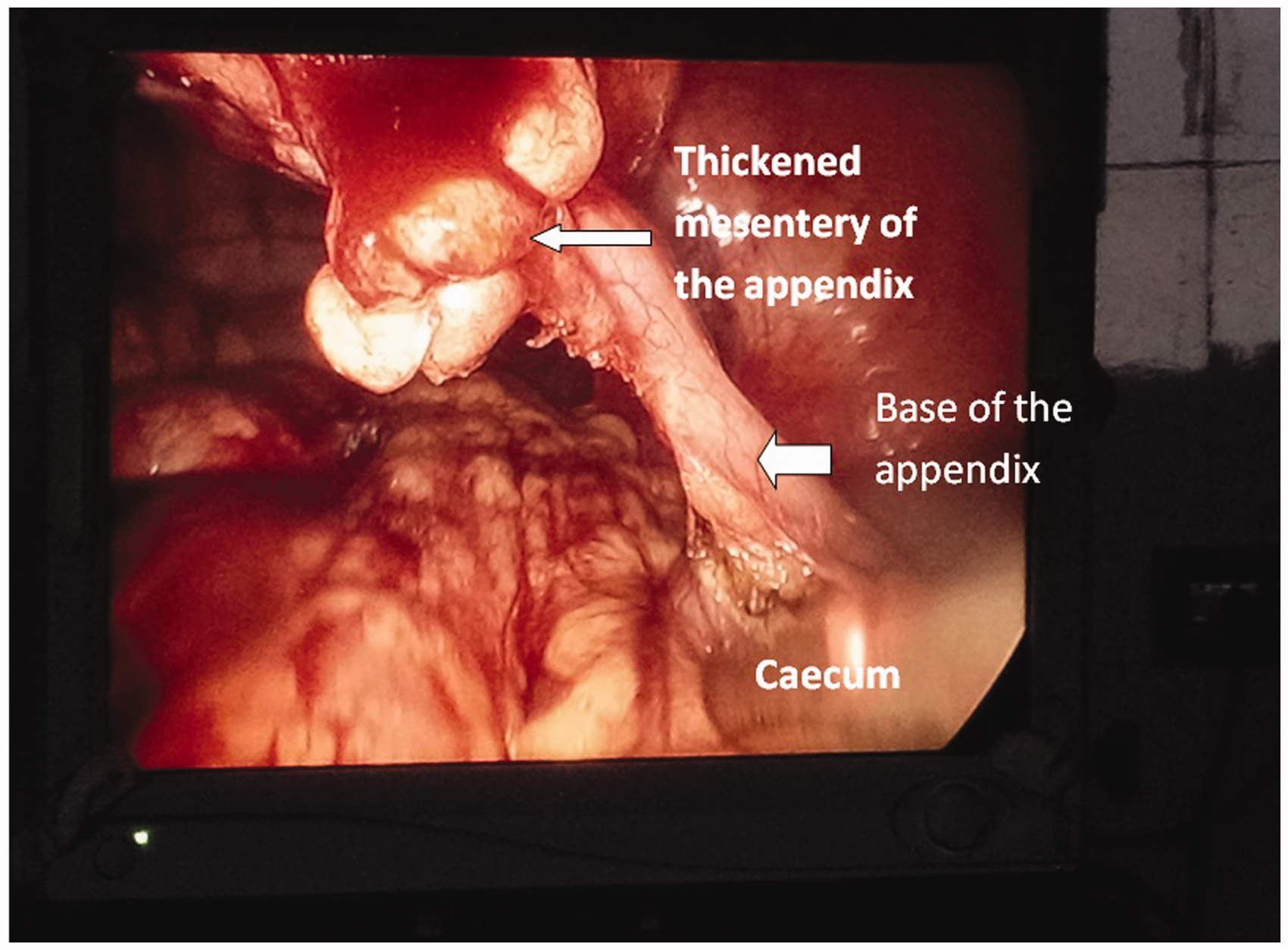
The Lift apparatus is designed such that it lifts the abdominal wall by raising the umbilicus approximately 10 cm and so lifts the recti muscles atraumatically. There is sufficient space to operate and most who follow live cinematic demonstrations do not realise no gas is used, such is the extent of visibility. Combinations of open and laparoscopic instruments are used for the surgical procedure. Since no gas is introduced, larger instruments may be utilised (Figures 1 and 2).
Surgery in progress during a workshop with combination of open and laparoscopic instruments. The view from the monitor.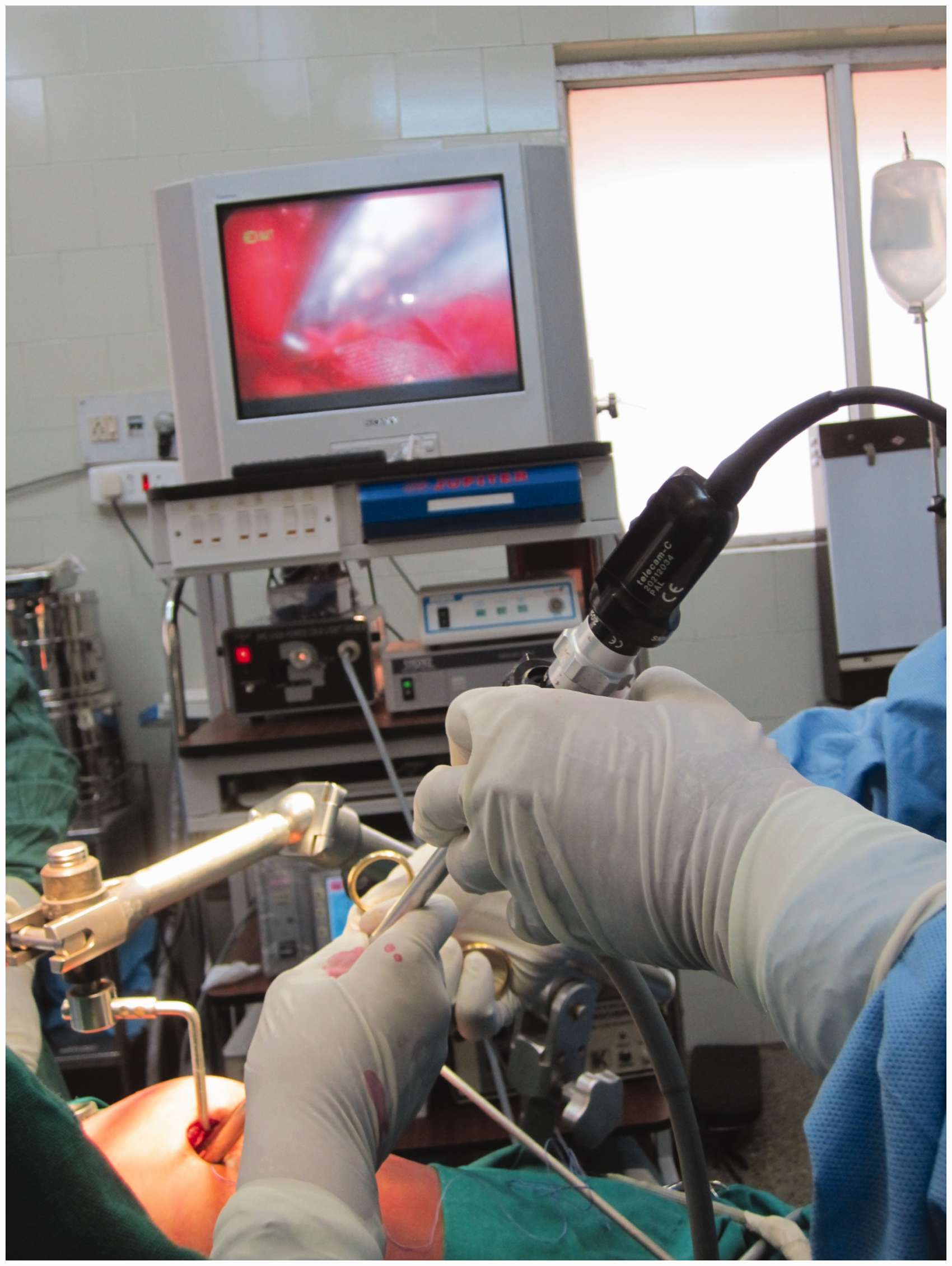
Results
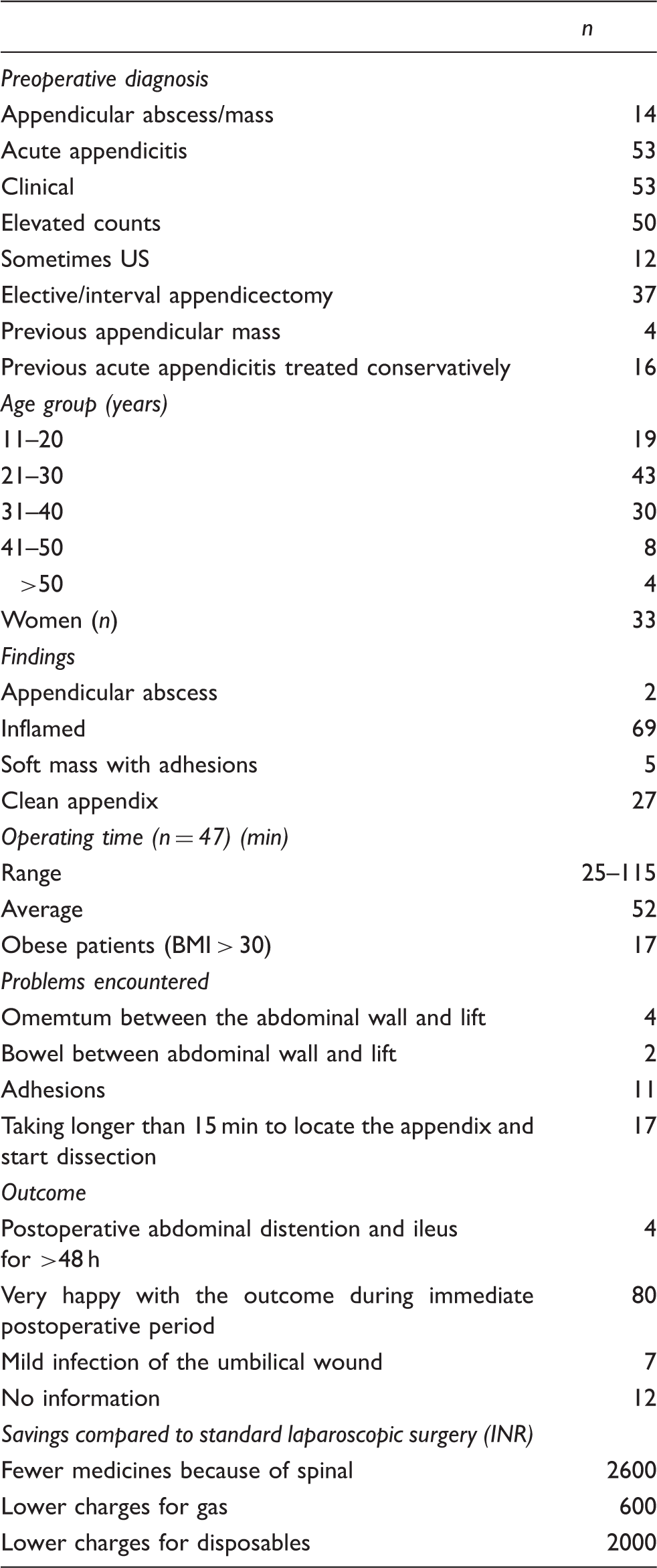
Details of surgeries from April 2012 to May 2014 in eight rural hospitals (n = 104).
Discussion
Single-incision minimally invasive appendicectomy has been in vogue for a long time and has been carried out even using a cystoscope. 9 Gasless single-incision laparoscopic appendicectomy with an incision over McBurney’s point using a lifting device have also been described. 10 However, these methods are not as cosmetically attractive as an umbilical incision and do not offer scope for diagnostic confirmation of other pathologies.
Compared to the expensive gas SILS laparoscopy with special ports, the above method is much less expensive. Postoperative shoulder pain has never been observed. A smaller 2–3 cm incision is used in combination with commonly used open surgical instruments. Some of these have been adapted with minor modifications, such as increase in length and sometimes double joints.
In most patients operation were carried out under spinal anaesthesia (83/104), whose cost is approximately INR 5,200 less than general anaesthesia and thus very suitable in rural areas. The lift-laparoscopy equipment and the instruments needed are very sturdy and consist of a once-in-a-lifetime investment for rural surgeons.
Complications recorded included infection in one patient and prolonged ileus in four patients. The latter was attributed to pre-existing peritonitis rather than the surgical intervention. The main difficulties encountered concerned lifting the ometum or bowel with the anterior abdominal in obese patients. To avoid damage to these structures, the abdominal wall was only lifted to its full extent once it was clear no omentum, bowel or other structure was caught between the lift and the abdominal wall. Most patients did not need injectable pain killers after surgery as long-acting local anaesthetic agent was introduced along the edges of the skin incision.
Summary
Gasless SILS appendicectomy is a safe, easy and less expensive procedure that is relevant for rural areas.
Footnotes
Declaration of conflicting interests
None declared.
Funding
This research received no specific grant from any funding agency in the public, commercial or not-for-profit sectors.