







Abstract
Hookworm infection is a neglected parasitic disease. Direct wet mount is the usual method for the diagnosis of hookworm in Ethiopia, but its sensitivity is unsatisfactory. A cross-sectional study was therefore conducted from January to February 2018 among 192 study participants in Debre Elias district. Stool samples were processed by three methods: the prevalence of hookworm was 77.6%, 68.2% and 49.0% by Kato–Katz, formol ether sedimentation technique and direct wet mount, respectively. Direct wet mount had relatively low sensitivity (61.4%) compared to formol ether sedimentation technique (85.6%) and Kato–Katz (97.4%). The latter two compared well with the gold standard method with kappa values of κ = 0.94, κ = 0.71 and κ = 0.39, respectively, and are therefore recommended over against the direct wet mount technique in detecting hookworm.
Background
Hookworm infection in human is a parasitic disease caused by nematode parasites and is transmitted via contact with contaminated soil. It is one of the most common chronic infections with an estimated 1.3 billion cases globally and directly responsible for 65,000 deaths annually.1,2 It remains a major public health concern throughout many countries of the world where access to anthelmintic is limited.3,4 Infection with hookworm has impact on nutrition, growth, physical fitness, cognitive function by producing anaemia in infants, school-age children and adults. 5 Infected people predominantly live in the least developed countries, where there is neither adequate waste disposal system nor clean water supply. 6 Hookworm is common in tropical and sub-tropical areas of developing countries, 7 where soils are infested with infective larvae. 8
The two major species of hookworm that infect human are Ancylostoma duodenale and Necator americanus. These two species differ in pathogenicity and mode of transmission which influence morbidity. 9 N. americanus is the most common hookworm worldwide and accounts for 90% of hookworm infection in tropical and subtropical regions. A. duodenale is geographically more restricted in distribution and more pathogenic causing four to five times greater blood loss and releasing twice the number of eggs per female.9,10 A. duodenale is found in highlands and in more extreme climates, whereas N. americanus is found at lower elevations and in more tropical areas, but both species may be endemic in the same geographical area. Moreover, it has been suggested that A. duodenale may be transmitted from mother to infant. 11
Hookworms have a prevalence range of 20–80% in low-income countries. 9 Infections reduce working capacity and increase maternal and foetal morbidity and mortality. 2 Globally, hookworm’s disease burden remains high, and around 500 million people are infected. 12 In 2010, an estimated 438.9 million people are infected with hookworm which is a cause of 4.98 million years lived with disability. 13
In Ethiopia, the prevalence of hookworm is estimated to be 16% and contributes to malnutrition and iron deficiency anaemia. 14 The number of adult hookworms and the faecal egg count are strongly associated with poor iron status and iron-deficiency anaemia and so have adverse effect on childhood growth, pregnancy and worker productivity.15–17 The morbidity caused by hookworm is directly related to the number of worms and duration of infection. Intestinal parasitosis, particularly hookworm, has been one of the 10 top infectious diseases in Debre Elias since the majority in this area walk barefooted and are actively working in fertile red soils. 18
Although there are several factors making an estimate of the number and burden of intestinal parasitic infections difficult, lack of accurate diagnostic tools is the major cause.19–21 Several diagnostic methods such as Kato–Katz and formol ether concentration (FEC) techniques are available, though direct wet mount is the commonly used diagnostic method in Ethiopia.22–25 However, poor sensitivity of this method is reported. 26 Our study aimed to evaluate the sensitivity, negative predictive value (NPV) and test efficiency (TE) of direct wet mount, formol ether sedimentation and single Kato–Katz techniques in detecting hookworm infection in Debre Elias district.
Methods and materials
A cross-sectional study was conducted from January to February 2018 in Debre Elias, Amhara region, which is located 42 km from Debre Markos town and 340 km far from Addis Ababa, the state capital. It rests at 2300 m above sea level and has an average temperature of 27℃. It is divided into two major agro-ecological zones, woynadega comprising 91% of the area at high altitude (2100–2300 m above sea level) and kola comprises 9% at only 1500–2100 m. The area is predominantly rural, and most residents live in villages as agriculturalists.
A total of 192 participants selected from three kebeles (Debre Elias district) were included. Participants willing to provide a stool specimen were included but those having history of anti-parasitic medication two weeks prior to screening and those with serious chronic infection were excluded.
Fresh stool (5–7 g) was collected from each participant into dry, clean and leak-proof container after appropriate instruction and checked visually for quantity, colour, consistency and appearance. Approximately 41.7 and 2 mg of the stool specimen were used to prepare a single Kato–Katz thick smear and wet mount preparation, respectively.
The formol ether sedimentation technique required 1 g. All samples were processed in Debre Elias Health Centre Laboratory by applying appropriate quality control measures.
Data were entered and analysed using SPSS-20 version. Since a gold standard test is not available for detection of hookworm, sensitivity, NPV and TE were calculated using the combined results of the three methods as a ‘gold standard’.27,28 Agreement of two methods in detecting hookworm was determined by the κ test ranging from 0 (absence of agreement) to 1 (perfect agreement). 29
Results
Of the 192 study participants aged 18–80 years, 100 (52.1%) were male. Half were aged between 35 and 54 years.
The prevalence of hookworm using direct wet mount, formol ether sedimentation and single Kato–Katz techniques were 49.0, 68.2 and 77.6%, respectively. The prevalence of hookworm when direct wet mount and formol ether sedimentation techniques used together was 72.9%. The prevalence of hookworm when all three methods used together was 79.7%.
Sensitivity, NPV and TE of direct wet mount, formol ether sedimentation and Kato–Katz technique compared to gold standard in detecting hookworm infection in Debre Elias District, Northwest Ethiopia, 2018 (n = 192).
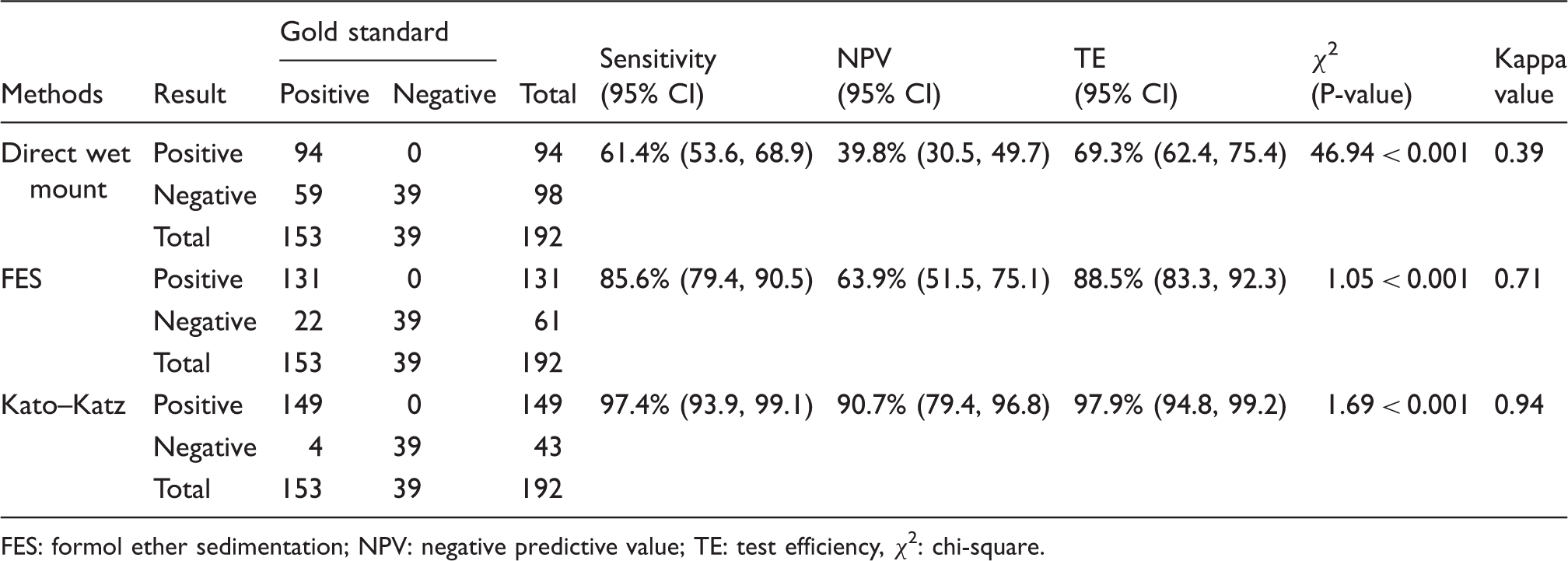
FES: formol ether sedimentation; NPV: negative predictive value; TE: test efficiency, χ 2 : chi-square.
Discussion
In Ethiopia, direct wet mount is used because it is simple to perform, inexpensive and not time-consuming. However, it underestimates the prevalence of the hookworm. This finding is supported by other studies conducted in Ethiopia30–32 and India. 33 Hence, use of another method with a higher detection rate is mandatory to reduce the burden caused in the community. The TE of Kato–Katz was best and is strongly recommended.
Footnotes
Acknowledgements
We would like to thank Debre Elias Health Centre laboratory staff and participants involved in this study.
Authors’ contributions
YA and AA conceived the study, and AA and MA participated in data collection, laboratory analysis and interpretation. YA analysed the data and wrote the first draft of the manuscript. All authors critically reviewed and approved the final version of the manuscript.
Availability of data and materials
The datasets used and/or analysed during the current study are available from the corresponding author upon reasonable request.
Declaration of conflicting interests
The author(s) declared no potential conflicts of interest with respect to the research, authorship, and/or publication of this article.
Ethics approval and consent to participate
The study was carried out after ethical approval is obtained from Research and Ethics Committee of the School of Biomedical and Laboratory Sciences, University of Gondar. Informed written consent was obtained after explaining the objective of the study. Stool examination was carried out free of charge, and positives for hookworm were linked to Debre Elias Health Center to have timely treatment and further interventions.
Funding
The author(s) disclosed receipt of the following financial support for the research, authorship, and/or publication of this article: The research was funded by University of Gondar.
